Leila in Saffron by Rukhsanna Guidroz illustrated by Dinara Mirtalipova

Standard
Leila in Saffron by Rukhsanna Guidroz illustrated by Dinara Mirtalipova

leila

I had really wanted to love this book about a young Pakistani girl living outside of Pakistan learning to love all her different parts.  Unfortunately, the book was so scattered that no point was made, no message conveyed, and sadly, no excitement at being represented in literature really felt, .

IMG_6403

This 32 page book isn’t bad, it just really isn’t memorable.  It starts out with Leila arriving at her Naani’s house for dinner as her parents and her do every Friday.  Her maternal grandmother comments that she likes Leila’s saffron buttons.  Leila beams at this because she doesn’t know that she always likes being herself.

IMG_6404

Tonight, they are joined by lots of extended family and Leila is on the lookout for parts of herself that she likes.  She feels safe with her family, and likes being told she looks like her aunt when she smiles.

IMG_6405

The book then kind of abandons the theme of finding parts of oneself to like, and moves on to cultural trinkets to enjoy.  She identifies camels on shelves and Arabic books too, and can’t wait to go on her first trip to Pakistan someday to get her own “Arabic books” and “special ornaments.”  I’m not sure why they books aren’t in Urdu, but none-the-less without any written connection to Islam, they are in Arabic, thus giving, erroneously, the reader the impression that is the language of Pakistan.

IMG_6406

Leila then helps her Naani cook which almost seems like an additional theme of the book: the passing on of traditions.  The book doesn’t really stay here though either, and has Leila running outside to get cilantro from the neighbor Miguel.  Possibly another theme in addressing multicultural neighbors or just how to be a good neighbor, is now being brought up, but nope, the book bounces back to dinner with the family.

IMG_6407

When it is time to leave, Naani invites Leila upstairs while her parents wait to leave.  Here she goes through fabric and scarves rich in color and textures and likens them to ethnic foods.  She then tries on her favorite one, but acts like she has never tried it on before or seen it before, I’m really not sure, the language is a bit awkward to me.  Anyway she opens her eyes in a surprise and likes what she sees, she likes her self, all her parts.

IMG_6408

I wish this book for preschool and kindergarteners, would have streamlined the message it wanted to convey most.  I like finding pieces of yourself and liking the completed you, but I don’t know what the pieces really are in the book.  Yes I could assume and figure it out, but I’m not 5 years old.  The book should have articulated it clearly.  Or if the book wanted to celebrate culture and family traditions, it should have stuck to that.  It really seems all over the place no matter how many times I read it.

IMG_6409

The illustrations are rich and vibrant.  They definitely give a lot to look at and the expressions on the characters faces will probably make the little ones giggle.  There are a few Urdu and Arabic words used in the story that are defined on the back cover.

IMG_6410

The characters aren’t identified as Muslim, none of them wear hijab, but they say Salam and have Arabic books, so one can assume. I picked up the book at the library and don’t regret it, but I probably wouldn’t buy it or unfortunately, check it out again.

The Sign of the Scorpion by Farah Zaman

Standard
The Sign of the Scorpion by Farah Zaman

scorpion

This is the second book in the Moon of Masarrah series, but can be read as a stand alone book if you are looking for a linear story with fast paced action, intense twists, decently developed characters and quality writing that brings the sleuthing of Muslim characters to life.  At 229 pages including the glossary, the book reads to me as a middle grades book, but the last 50 pages place a lot of emphasis on accusations of a character molesting servants in the castle and another character having an affair, which might be more appropriate for older readers.  Perhaps middle school readers would be a better target audience, but I’m waiting to hear back from the author regarding who she had in mind when she wrote it.  The author said she wrote it for Young Adult, ages 12 and up in mind.

SYNOPSIS:

Brother and sister, Adam and Layla are reunited with their friends, siblings, Zaid and Zahra after last summers intense adventure involving a diamond.  This summer as a result, they are the honored guests of Shaykh Sulaiman at his dessert home, Dukhan Castle. They arrive to find out that the Shaykh is bedridden from a stroke after learning his son has died.  With a house full of relatives with reasons to want their claim to the Shaykh’s fortune, the four teenagers start putting odd occurrences of a ghoul in white, a hooded horseman, a gypsy woman’s tale, and the idea that there has been foul play, together to try and arrive at the truth of what is going on.  As they piece more and more together about the tutor, the cousin, the fiance, the grandson, and a mysterious mole-man following them, they themselves get tangled in the sinister plot of revenge and must keep an eye out to figure out who the scorpion, Al-Aqrab, is before one of them ends up dead.

WHY I LIKE IT:

Set in a fictious land, the detail is the perfect balance between setting a stage and over describing it.  The book did not drag for me at any place, nor did I find myself confused about what was going on and why.  Granted I probably could not tell Adam apart from Zaid and Layla from Zahra, but the book is about their adventure and figuring out whats going on, not about their relationships or back story.  And with the focus on all the possible perpetrators and their motives taking center stage, having four people gathering clues makes the information come easier and smoother.

All the characters are Muslim.  Some of the women cover and some do not, some stop to pray and make regular references to Islamic hadith or Quranic Ayats, and some are suspects.  For example when they are exploring the dungeons beneath the castle, they liken the caves to the Sleepers in the Cave mentioned in Surah Kahf.  The book never gets anywhere near preachy, nor do the few references ever get annoying, they just flesh out that the characters are Muslim, and thus they see the world through that lens.

FLAGS:

The book has murder, lying, deception, all the ingredients for a good who done it.  And while the details are all clean regarding how the four teens interact with the opposite genders, the climax of the book is the coming to light of allegations of molestation and a failed marriage is attributed to a presumed affair.  No definition of the words is given, and I reread many of the passages and I don’t know that there is even enough context clues to decipher what the word molest means in the text.  Most kids however, could easily ask Siri or Hey Google or whatnot and may have more questions about what it means to sexually assault a person, specifically a woman or child, and why someone would do it.  I leave that for parents to decide at what age those in their charge can grasp such a word and concept.

TOOLS FOR LEADING THE DISCUSSION:

I’m torn on teaching the book as the linear telling might not appeal to older kids, but the motive and revenge isn’t appropriate for younger kids.  I think if used to discuss broader issues the book could be really powerful, and not just a fun read.  I could see discussing with 9th graders or so the seriousness of false accusations, drawing on the Me Too movement and how sexual crimes and transgressions should be handled and treated.  I think the book could be a springboard for those discussions and seeing the effects of believing or not believing, and perhaps suspending judgement until research can be done.  In the case of the book, it would not have been difficult to pursue the allegations, while protecting any potential victims.


NOTE:

The first book in the series, The Moon of Masarrah, was originally published under the title, The Treasure at Bayan Bluffs, some changes have been made in the new printing, so while I don’t normally review second books in a series, I felt this book might bring attention to the new title of the first book and drum up interest for the upcoming third book in the series.  No, I don’t benefit in any way and I purchase my copies just like you, the stories are just really well done and I want readers to give them a try.  Happy Reading!

If Allah Allah Wills by Dr. Oz illustrated by Mariya Khan

Standard
If Allah Allah Wills by Dr. Oz illustrated by Mariya Khan

if allah wills

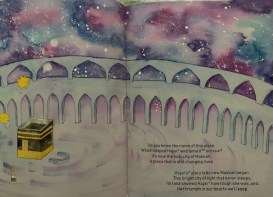
Not all books need to teach something, but when the book would lend it self so easily to dropping a fact or two, it seems like it would take it.  In 40 pages, preschoolers are taken on a highly imaginative journey to the Ka’ba, yet no information about the history of the Ka’ba, or any mention of Umrah or Hajj is shared, not even in passing.

IMG_6336

Faris wants to go to the Ka’ba but it is nearly his bedtime, so he has to act fast.  He asks his mom what he needs to wear, obviously knowing special clothes are required, but his mom prefaces the answer of white sheets as being “odd” and then adds that you need sandals.  For a book that wants to normalize Islam for children, I don’t understand why the mom would say that ihram is odd, why the word ihram isn’t used, why it doesn’t even specify the number of white pieces of unstitched cloths and why sandals would be included.

IMG_6337

Faris then finds two white sheets, but the illustration shows him getting towels out of the bathroom (possibly showing his imagination, but kids will just think it is an error, mine did), packing some food and jumping on his rocking horse to head off for the Ka’ba.

Faris finds himself among the stars without a map and starts to worry that he won’t find his way.  He then sees a flock of birds and wonders how they know where to go.  The book however, doesn’t answer how birds know, and just has him land and find someone to ask.

IMG_6338

Luckily Faris finds a camel to ask, and luckily he is a nice camel and he shows Faris to the Ka’ba.  Faris is surprised at how big it is and then supposes that Allah’s house has to be.  But he asks it as a question, which makes it a little off grammatically.  The camel points out that Allah swt is above and that the Ka’ba is for people to visit.  Faris asks what is supposed to be done at the Ka’ba and the camel answers, “We circle the Ka’ba, pray to Allah, and thank Him.”  This seems like a great place to sneak in some facts about who built the Ka’ba and why or mention Hajj or Umrah, it seems so misguided to just say we circle it.

IMG_6339

Faris makes some prayers that he can return for real one day with his parents before he finds a place to eat his snack and share his food with his camel.  It is nice that he shares with his new friend, but odd that when they part Faris asks him his name and he says he doesn’t have one.  Maybe give him a name, and detail its meaning or don’t include the exchange at all.  I seriously don’t understand the purpose of the exchange.

IMG_6340

Faris makes is home with a crash and his mom tidies him up and they say InshaAllah that Faris’ prayer inshaAllah will come to fruition.

The book has a great premise of imagination and tying in the Ka’ba, but truly there is no information about Islam or the Ka’ba or even Allah swt, it gives a mood of worship, but that is about it.  I get that it is for little kids and the book is supposed to be whimsical and light, but sneak in some facts, kids can handle it.

As for the illustrations, they are just ok.  They would have benefitted from being a little smoother and not looking home-done, but there is nothing terribly wrong with them aside from the towel and sheet imagery.    The glossary cover and large font inside is age appropriate, some pages are a bit text heavy, but overall sufficient.

IMG_6341

Piece by Afshan Malik

Standard
Piece by Afshan Malik

Pieces.jpg

This 168 page young adult book from Daybreak Press focuses on a small Muslim family in Texas, that has their own stresses and interpersonal relationships, but are thrown in to a whirlwind when the father of the family returns home from a medical mission to Syria and finds himself in the psych ward broken and troubled.  The effects each of the character’s struggles have on them as well as those they care about, makes for a haunting yet relatable read for fourteen year olds and up.

SYNOPSIS:

The Jamal family is made up of Hannah and her older high school aged sister Noreen and their physician parents Dahlia and Adam.  Hannah runs track and is more introverted in handling friends and her father’s life altering condition.  Noreen on the other hand is ultra organized and rational in her approach to life, much more like her OB mother.  To cope with the stress of her father’s return she commits herself to more clubs at school and staring at her phone.

Hannah doesn’t seem to have a lot of friends, and when the track team understands that Hannah’s dad is dead and Hannah doesn’t correct them until later, her comfortable acquaintances turn on her and she will have to learn to stand up for herself and use her voice in the course of the book.  Noreen’s character arc is a bit more dramatic as her involvement in yearbook club brings new people in to her life, mainly a boy, who might not be as a genuine in his goals as she is, and thus their climax results in a trip to the police station.  Dahlia has a close friend, and Adam has a few as well, but the story really stays pretty streamline in exploring the relationships of the family and how little things and big things affect them all.

WHY I LIKE IT:

I love that the book takes on a serious issue like PTSD and is framed in such reality.  The scene where the dad blurs his past memories with the current real happenings, is done very well.  It conveys how fractured his brain is while showing the stress his situation lends to the mood of the home is powerful. There is also a very real situation of attempted physical and sexual assault that occurs when Noreen finds herself in a position with a male classmate who attempts to take advantage of her.  The book holds back in details, and she is able to defend herself, keeping the book clean, while still implying what his intent was, and how fortunate she is to get away.

More superficially, but also more relatable is the girls bickering and fighting and pushing each other’s buttons, and the mom trying to help, but is alas is frequently at a loss at what to do with them.  The situations the girls face at school are probable and relatable that I think a lot of middle school and high school readers will see themselves trying to balance extra curricular activities, friends, finding a quite place to pray and keeping their hijabs coordinating.  The family is Muslim and they dress the part, talk the talk, and pray together regularly.  Islam is very present, but not preachy, it is just what the characters believe and what they use to shape their view of many of the tests they are facing.

There are a few hiccups that are worth noting, but don’t overly deter for my appreciation of the story.  I struggled with the writing style in the first few chapters.  It took a bit to feel a connection to the characters and get what was going on sorted out.  It is written in 3rd person omniscient (I believe, it’s been a while) with each chapter more or less focusing on one of the four main characters.  As a result a handful of times the narrative gets awkward in explaining what one of the characters is doing or thinking, because the focus is on someone else, or the timeline overlaps a bit.  It doesn’t happen an awful lot, but the book is under 200 pages, so it is annoying that it happens at all, let alone more than once.

Story wise the characters seem oddly isolated.  The book tells us how small the town is, and shows us how everyone knows the parents regularly, the girls seem to be pretty lonely.  There isn’t any warmth from the schools or neighbors in helping them deal with their dad coming home so wounded.  In a town they have lived in for so long, this seems off to me.  Also if the town is so small, and the family so religious, there is an imam who visits once, you’d think there would be more of an Islamic community presence for the mom and girls to find support from.

FLAGS:

There is violence in the remembering of what happened in Syria.  There is some Islamaphobic talk as Hannah endures some verbal bullying and the attempted physical and sexual assault on Noreen.

TOOLS FOR LEADING THE DISCUSSION:

I would consider this as a possible middle school book club choice.   It tackless some big things, and uses Islamic boundaries to talk about mental illness and sexual violence which is a huge plus when addressing our youth.  Noreen isn’t in a relationship or even overtly infatuated with the guy who puts her in a compromising situation.  But even if she was doing something “wrong” what he did is not ok, and the fact that the authorities believe her, and she plans to discuss it with her mom, and she is not further victimized by speaking out, is something our kids need to see and understand.

There are discussion questions at the end and I think males and females will benefit from reading and discussing this book.  Unfortunately, and possibly the only other disappointment in the book is the price.  Nearly twenty bucks for a short YA paperback book makes it hard to buy classroom sets for such activities, and I’m sure will even keep the avid reader debating whether they should purchase it or not.


Malala’s Magic Pencil by Malala Yousafzai illustrated by Kerascoet

Standard
Malala’s Magic Pencil by Malala Yousafzai illustrated by Kerascoet

malala

I’m going to try my best to review a nonfiction autobiographical book and focus on the story, not on the author because yikes, Pakistanis have strong opinions about Malala, and I have no desire to get pulled in to an argument.  I’m half Pakistani, I know the position of both sides.

IMG_6245

I have read both the Young Readers Edition and original I Am Malala books, so I didn’t jump to review this book in 2017 when this AR 3.6 40 page re-re-telling of her story came out.  After reading numerous other children’s books about girls in the subcontinent striving to go to school and be educated, I thought maybe the controversy had calmed down and I could read this large hardbound book a bit more objectively, and thus focus on the story a bit more.

IMG_6246

The book is listed as a biography, not an autobiography, so I’m not sure Malala even wrote the book, but none the less it is a synopsis of her story for younger elementary children.

IMG_6247

Starting off a bit like Harold and the Purple Crayon, Malala asks if the reader believes in magic, and then tells what she would do if she had a magic pencil to draw things that would make other’s happy like a proper soccer ball for her brothers and a way to stop time so she could sleep in a little longer in the morning.

IMG_6249

Every night she hopes for a magic pencil, and every morning she is sad one hasn’t appeared.  As she starts to notice the world around her she realizes that the kids looking for food and metal scraps in the junk yard, have it much much worse.  She asks her father about it and learns that if the children were in school their family’s might go hungry.

IMG_6250

As she notices “real” problems around her, her ideas for what her magic pencil could fix, evolves and develops into a burgeoning social conscience.  But quickly her naive outlook is changed when dangerous men start to appear on the streets and girls in her class stop coming to school.

IMG_6251

Her magic pencil finds real world power when she uses her words and her voice to make a stand and people start to pay attention.  The rest of the book highlights how she made progress despite the attempt to stop her and how she now uses her “magic pencil” to work to make a more peaceful world.

IMG_6252

The surface story is incredibly hopeful and would motivate young children to notice the world around them and do what they can to improve it. Inquiring children might be alarmed at children going through trash, or want a lot more information about who the scary men are and why they don’t want girls going to school and why she gets to travel around and tell her story. Information that is given at the end of the book in an afterwards of sorts.

IMG_6253

Most pages have sparse text and the ones that have a lot are kept on level and avoid being preachy.  Even the attempt on her life is present, but not detailed, sufficing to say that they tried to silence her, but failed.

The illustrations are beautiful and tell the story as much as the words do.  The book does not mention religion, but in the pictures where she is out of the house her hair is covered, but not when she is at home in bed and whatnot.  Obviously it is how she carries her self in real life.

Overall, I think the book is incredibly well done and inspiring to young readers.  Anytime a modern day figure can show children that they too have a voice and can use it, I think it is a good thing.  The fact that the voice comes from a minority, a female, a person with a name and culture different than the ones in most western children’s text books is also a plus.  I hope if nothing else it opens a window to children that there are a lot of amazingly strong and courageous people in all cultures and to seek out their stories.

IMG_6254

Jasmine Falling by Shereen Malherbe

Standard
Jasmine Falling by Shereen Malherbe

jasmine

This 184 page book about a girl figuring out her past, to accept her present, and plot her future. is not marketed, or perhaps even written as a YA novel, but I’m reviewing it because while the protagonist is in her 20s the book could be enjoyable to ages 15 or so and up, if they are willing to stop trying to understand a lot about the book and are content to just go along for the heartfelt ride.

SYNOPSIS:

Jasmine is half Palestinian and half British and when her wealthy mother passes but stipulates to claim her inheritance Jasmine must find her father, the book leaves England and heads to Palestine.  To further complicate things she has only 10 days to find a father who has been missing for years, in a land she has only visited once before many years ago.

Once in Palestine, the story takes her from one city to the next and one village to another with pit stops at various historical sites along the way.   With lots of fragmented memories, the shadow world of Jinns, and a race against time and around the obstacles of the occupation, Jasmine rediscovers Islam, her family history, and the fears that haunt her.  She also meets Josh, a character of questionable allegiances, motives, and background himself, that constantly finds himself able to help Jasmine and possibly himself.

From Jericho and Jerusalem and Batien, Jasmine hears stories about her father from people that know her family,  as she pieces it all together and reunites with her family members, she understands her past and works to determine what path her future should take.

WHY I LIKE IT:

I love the backdrop of Palestine and the history and the richness of culture that is brought to light in a surprisingly non political way.  The interaction of the different faiths among the villagers and the love of the land is truly palpable.

The part I struggled with was the holes in the story telling, for each page that brought Jasmine closer to answering her one question of where her father is, the reader was given 27 new ones that would never be answered.  Where did the wealth come from, how did Jasmine’s parents meet, what were the circumstances that made Jasmine’s dad leave, who is Richard, who was Ali, how old is Jasmine, why are there so many Jinns every where, why is there secret passages in the mountain, how come she trusted Josh, how could Josh get from one city to another in record time, why did the soldiers at the check points know of her family and specifically her father, and most importantly why every time she meets someone that knows her family, why does she run away.   It is incredibly frustrating that every time the story hints at what makes her father so famous, or sought after or memorable, or hint at why he disappeared, something interrupts them and the reader is left in the dark, only to have the book end and no really understanding conveyed.

I get why the story is told in pieces, but really the story is confusing in how it is told, and it doesn’t need to be.  The author can write and the last 50 pages are really great.  For as confused as I was so often, I kept reading because the story is good.  There is just a tad too much with diving in to the past to understand the present, the supernatural of the jinn, the reemergence of faded memories and dreams, the political climate, the letters from World War II, that the character dynamics are lost until the end.  I care about Jasmine and am curious about Josh, but a little more detail to the relationships the two main characters have with all the other minor characters that they encounter would really make the story soar, and clarify so much.

One thing I didn’t love was the presentation of Jinns, I know it is to add cultural richness and a bit of muddled confusion, but really the story I think is strong enough without the supernatural and character building could have benefited in its place. I also really, really, really wished there was a map and an afterward telling what parts about Palestine and history and the Holy Cities is fact, for those of us that have never been.

FLAGS:

Jasmine attempts suicide, jumping out a window.  Jasmine also gets drunk a few times in the book before deciding to stop drinking as she doesn’t like who she is when she does.  There is some violence and killing talked about but not overtly detailed.

TOOLS FOR LEADING THE DISCUSSION:

I don’t think I would do this as a book club book, but I definitely would encourage those with connections to Palestine to read the book.  And I am really hoping that someone, anyone, that has read the book will chat about it with me.  For all the questions I have, I’m optimistic that I just missed the answers and that they were in fact there.


The Adventures of Nuh’s Ark by Khadijah Khaki illustrated by Tashna Salim

Standard
The Adventures of Nuh’s Ark by Khadijah Khaki illustrated by Tashna Salim

nuh

If you are looking for a comprehensive or somewhat detailed story about Prophet Nuh (AS), this book isn’t for you or your child.  If you want a silly story with hilarious animals to introduce your little one’s to the concept of the animals boarding Nuh’s Ark as a commandment from God, then order this book already!

IMG_6160.jpg

This 24 page rhyming hardback 8×10 book written for preschoolers through early readers takes the idea of animals boarding Nuh’s ark and tells what it is like in a fictional account narrated by the animals themselves.  And focuses on a pair of confused koalas as to what is going on.

IMG_6161.jpg

The poor koalas, are not prepared for rain and don’t do well in small spaces.  They pack too much and can’t keep up, but luckily the other animals are nice and they all work together until it stops raining and they can disembark on to land.

IMG_6162.jpg

The pictures are cute and comical and bring the text to life.  With the conversation bubbles adding to the story, even the pages that are a bit text heavy keep the younger listeners engaged, as they know something funny is about to be said.

IMG_6164.jpg

Also, the book is one in a series or three, so far, and the characters are the same ones found in the Adam and God’s Creation book as well (might be in the Ibrahim one too, but I haven’t read that one), making the nameless animal characters actually memorable as they say silly things, and are pictured being rather unique too.

IMG_6163.jpg

The books do not use the word Allah, but do mention God, and the Arabic of Nuh, rather than Noah, and there is mention of why there is a flood and how long it will last, but nothing quoted directly from the Quran.

My older elementary and middle school kids found the books silly as well, and giggled their way through.  It is a a fun read that even adults won’t mind repeating.  If you want a more Prophet story retelling, Migo and Ali Love for the Prophets is a good non fiction book, and it, along with the three book Lunar Learners serious can all be found at my favorite supplier Crescent Moon Store.


Owl & Cat Go To Hajj by Emma Apple

Standard
Owl & Cat Go To Hajj by Emma Apple

hajj.png

I thought I knew what this latest Owl & Cat book would entail.  I figured like the Islam is… and Ramadan is… books, this book would, in its simplicity, poignancy, and repetitive sentence structure convey the emotions and importance of Hajj.  So imagine my complete surprise when the 78 page book with two familiar characters actually detailed day-by-day the steps of Hajj for young preschool aged readers and listeners and up.

IMG_6029

Owl and Cat show what a pilgrim does on each of the 5 days of Hajj.  Each section is separated by days with color tabs on top to keep the steps clear.  The illustrations are a little crisper than in previous books which resembled little doodles a bit more to me.  And while the simplicity of sentence structure, length, and diction remains, the book is a lot more factual and didactic than sentimental, especially compared to the other books in the series.

The book starts off with a a list of contents and an informative page about Hajj.  Owl and Cat then pack their bags, and travel by plane to Mecca. Day one has them putting on ihram, performing tawaf, sa’iy, and heading to Mina.  Some details about what each step means are given, but nothing overwhelming or too wordy.  The illustrations show what the text means and offer a lot to the understanding, if the concepts are foreign.

IMG_6026

Day two is going to Arafat, and standing in prayer at Jabal ar-Rahma.  They then head to Muzdalifah to rest and collect stones.  It also mentions that “many Muslims who are not on Hajj will fast.”

IMG_6025

Day three takes them back to Mina to throw their pebbles, make sacrifice, cut their hair, and change out of their ihram before they do their second tawaf, sa’iy, and travel back to Mina for Eid.

IMG_6027

Day four is in Mina stoning the jamarat as is day five before they travel back to Mecca to do the final tawaf and drink Zamzam water before their Hajj is complete.

IMG_6028

The book would probably work for non Muslims in that it isn’t preachy, but some base knowledge would be needed as there isn’t a glossary.  The book is pretty thorough for a children’s book, but I think the information is needed.  Many children do stimulations of Hajj or read simplified versions and don’t realize there is some back and forth and many of the actions are done more than once, and that it is a lot of actions, steps, and traveling in a short amount of time.


Two Pigeons on a Pilgrimage: A Hajj Story by Rabia Bashir illustrated by Aisha Dean

Standard
Two Pigeons on a Pilgrimage: A Hajj Story by Rabia Bashir illustrated by Aisha Dean

pigeons

An adorable 40 page paper back book about Hajj aimed at ages 3 and up and told from the perspective of two Pigeons performing Hajj with humans.

IMG_5976

A boy and girl pigeon say Bismillah and spread their wings as they head off to Hajj.  They see pilgrims at the airport wearing ihram before they start circling the Ka’ba like the humans below.  After seven rounds they go to Ibrahim’s Station before they are off to Safa and Marwa while pausing to sip on Zamzam.

IMG_5977

With Umrah complete they are off to Mina, then Arafat where duas are made.  They then go to sleep under the stars in Muzdalifah, before they slaughter an animal, cut their hair, shower, and throw stones at Shaitan.

IMG_5978

The concepts are simplified, but told in sequential order of how hajj is performed with very little commentary or embellishment.  The lines rhyme, so there is some creativity thrown in to keep the pattern and facts in line.  The font size, spacing and overall presentation of the book is good for reading at bed time or in small groups.

IMG_5979

The best part of the book, are the pictures.  They are sweet, colorful, and engaging and to find out at the end that they are done by a 12 year old girl is an extra added bonus.

IMG_5980

The book is factual in the steps for hajj, but because it doesn’t have a glossary, or give much information about why Muslim’s perform Hajj or details about the different acts of worship, it probably is better suited for Muslim kids that will hopefully know some of the answers, or have access to an adult who can answer and fill in the blanks.

IMG_5981

Overall, a good addition to books about Hajj to share with your little ones.  I just wish it would have come out a little bit earlier, as the Hajj starts in a few days and the book just came out.  If you can’t find it this year, inshaAllah get a head start for next year as I think the book has staying power and will be read more than once as both a learning tool, and fun book requested by kids.

IMG_5982


What Happened to Zeeko by Emily Nasrallah illustrated by Maha Nasrallah Kays

Standard
What Happened to Zeeko by Emily Nasrallah illustrated by Maha Nasrallah Kays

zeeko

Told from a cat’s perspective about living through parts of the 1982 war in Beirut, this translated from Arabic young adult book is 121 pages.  It reads to me more like a middle grades book, and while the story is fairly monotone and anticlimactic, I find myself oddly thinking about it and wondering about everyday events from different perspectives.

SYNOPSIS:

Zeeka as a young kitten is taken from his cat family and placed with a new human owner, Muna, a young girl who loves and cares, and seemingly understands her new furry friend.  The relationship between Muna and Zeeko is really the crux of the book as they get to know one another, trust one another, vacation in the mountains together and then seek refuge in the basement shelter of their building when the shelling starts and the bombs destroy the neighborhood.  

Through the relationship details, the reader learns a lot about what kind of person Muna is and why Zeeka is willing to perform a heroic act to try and help her escape the danger, while sacrificing his own comfort.  

WHY I LIKE IT:

I don’t know that I loved the book, but it was a quick read that I don’t regret spending time with.  It is translated from Arabic, so there are some hiccups, but nothing that impairs the story continuity or comprehension.  It almost starts out like an early chapter book with each chapter being two pages long.  But then all of a sudden a neighborhood cat is murdered by a group of naughty boys, and you realize that it is not for younger children. 

How the book handles war however, is very removed and not really detailed at all.  Much like The Cat at the Wall for about the same age group, the use of an animal to simplify the absurdity and details of war is used to show a different perspective, however, in this book there is no information given about the war.  The reader is never told who is fighting, why they are fighting, what sparked the fighting, nothing.  All we know is that there is fighting.  

There is no mention of religion in the book, and I have no idea of the author’s faith, there really isn’t much culture in the book either. I didn’t learn much about Lebanon or the food or traditions.  I got the book from www. crescentmoonstore.com/ so I thought to review it as it seems available on Islamic websites.  Every dozen pages or so there are illustrations and sometimes there is a blank page before each new chapter and sometimes not.  There is a table of contents at the end of the book.

IMG_5938.jpg

FLAGS:

Murder of a cat, violence in general in terms of bombing and micro level of bullying and threatening.  

TOOLS FOR LEADING THE DISCUSSION:

I wouldn’t do this as a book club book, but I think if you are looking to learn more about Lebanon or point of view this book would have a lot of potential with guidance.  From a literary creative writing perspective the book would be a great tool to present complex events in simplified ways, it also would be a great read to get students to just look at things from different points of view.  If you have students that love cats and can handle the war aspects, this book would be fun for them.  In a social studies class if you are discussing affects of war or learning about Beirut in the 80’s the students will be able to fill in the gaps historically and politically.

IMG_5937.jpg