Tag Archives: Sweet

Growing Giddo’s Hair by Sumayyah Hussein illustrated by Milton Bazerque

Standard
Growing Giddo’s Hair by Sumayyah Hussein illustrated by Milton Bazerque

The latest batch of Ruqaya’s Bookshelf books have arrived at my house, and this was the first book my youngest picked to have read to him.  The book is silly, over the top and an easy read. The little boy shows initiative and creativity in trying to surprise his grandfather by sneakily applying hair regrowing serum on his Gido’s bald head.  It, as expected, causes a bit of mayhem, but I think 4-8 year olds will recognize the comedic intent of it all, as the love Nuh has for his Gido comes through the silliness.  I was a little surprised that it centered a birthday, it isn’t just the setting, it is the  main foundation of the book, and I was also a little surprised that the Muslim authored, Muslim published book, contained no Islam in the text.  The only featured Islam was the mom in hijab in the illustrations.

The book starts with Nuh trying to figure out what to get for his grandfather who is turning 70 in a week.  He contemplates a 70 layer cake with candles, 70 pairs of shoes, even a 70 flower bouquet, but nothing seems right until he stumbles on a picture of his grandfather years ago, when he had hair!  Later that night he sees a TV commercial for hair growth gel, and Nuh knows just what to get and can’t wait for the surprise.  Once it arrives, the biggest obstacle is getting it on Gido’s head without him noticing.  But Gido doesn’t stay still and the hair product has unintended results as it doesn’t just grow on one’s head.

The book in all its silliness, does offer a few “teachable moments” if desired: false advertising, lying, sneaking your parent’s credit card, etc..  My kindergartner thought it was silly, and enjoyed the illustrations.  For the most part so did I, although, the page of the razor shaving the hair on the tongue definitely makes me squirm and my tongue itch…yeah, my son found that pretty funny as well.

Momo & Bronty’s first book about Prophet Muhammad (saw) by Zanib Mian illustrated by Laila Ramadhani

Standard
Momo & Bronty’s first book about Prophet Muhammad (saw) by Zanib Mian illustrated by Laila Ramadhani

I’ve mentioned it numerous times over the years how few children’s books there are about Prophet Muhammad (saw), and I love that this new book by Zanib Mian is a wonderfully illustrated 14 page board book for toddlers introducing them to some of the basics about our beloved Rasulallah. Momo and his toy dinosaur Bronty are featured in the illustrations, but do not dominate the text, which keeps the focus on Prophet Muhammad (saw) being the last of Allah’s messengers sent to tell us Allah is One, that the salutation is said after his name, and that he is always smiling, truthful, and making duas for us all, his ummah. I read the book a few times to myself and stumbled over some of the short sentences, but oddly enough when I read it aloud to my kindergartner it flowed fine. I always read picture books aloud before writing my reviews, as I was taught to read my essays aloud in school before submitting them, to effectively find errors. So, I’m not sure why for this book, I stumbled when reading to myself, but not aloud, a first for everything I suppose. The last spread though I did benefit from reading beforehand, as the order of what text comes next is not clear on first look. The pictures contain a lot of accessible details and discussion points and even early elementary aged children will find themselves drawn to the book, the reminders, the messaging and the simple text.

The board book is not just a list of facts, but doesn’t have a plot either, it is somewhere in between as it stays on level and flows between ideas, keeping the readers engaged. It starts by explaining that Allah swt sent Prophet Muhammad to us, the Qur’an through him, the message he carried, and why we love him. It shows that he exemplifies what a Muslim is and gives some examples, it then highlights that “His face was more beautiful than the full shining moon” and that “he played with little ones and made them laugh.” It concludes with connecting us, his ummah, as being important to him as he knew “the message he brought from Allah,” would spread.

Aisha’s Colors by Nabila Adani

Standard
Aisha’s Colors by Nabila Adani

img_6445-1

On first glance it seems this 32 page picture book is going to focus on colors from the perspective of a little Muslim girl in Indonesia, but it isn’t a basic color book, in fact only three colors are even explored.  The book is also not religious, aside from the hijab wearing mother and grandmother in the illustrations. And the writing isn’t really noteworthy, but yet, the book is endearing, and I can’t wait for my physical copy to arrive so I can share it with my kids and some classes for story time. The book has a plot, a little girl wishing she was spending her summer vacation seeing and going fun place like her friends.  Instead she is going to her Grandma’s house, the same place they always go.  She throws a bit of a tantrum, and then cools off and gains some perspective.  It is sweet, it is realistic, it shows growth and life lessons of appreciating the beauty around you, and not worrying about other people, all without preaching or talking down to the reader in the simple text.  It is joyful and highlights bits of Indonesian culture with beautiful images by the author-illustrator, a solid addition on bookshelves for ages 3 and up.

The book starts with Aisha bemoaning that her friends are going to fun far away places over the holidays, and she is going where they always go, from their home in Jakarta, to their Grandma’s village.  She tells her parents about her friend Jennie going to see snow this year, and imagines the cold white crispness that she doesn’t know.  Her parents respond by taking her to get es campur.  

She then laments about Dimas floating in turquoise water looking up at a blue sky, to which her father encourages her to look out the window.  When their car breaks down, and Aisha is encouraged to go cool down after her tantrum, her mom works on fixing the car, and a sky of kites shakes Aisha’s melancholy mood.  By the time they arrive at Grandma’s Aisha is seeing her own vacation in a different way, surrounded by colors, love, and family.

The book warms your heart, Aisha is grumpy, but not annoying, and the yellow warmth of Grandma is palpable.  I wish a few more colors were included and more culture shown that way, and I stumbled repeatedly over a few awkward sentences, not that they were wrong, but they just didn’t seem to flow when read aloud.  Overall, a good book. Preorder today, it releases September 3, 2024. 

A Letter to the Beloved: Dear Prophet Muhammad (saw) by Jenny Molendyk Divleli illustrated by Rumeysa Abis

Standard
A Letter to the Beloved: Dear Prophet Muhammad (saw) by Jenny Molendyk Divleli illustrated by Rumeysa Abis

img_5332-1

I was a little skeptical about a 32 page rhyming letter to our beloved Rasullah, illustrated in book format, but it is cute and it won me over.  The rhythm keeps the rhyme from feeling too forced and allows for some forgiveness when it misses the mark, it also makes the book appeal to a wider audience. Even my preschooler could sit through it pretty well.  The book being the letter without any stilted framing, has a lovely authentic voice of a young boy, also named Muhammad, asking the Prophet (saw) questions and chatting in a very stream of conscience sort of way. It blends facts that the young boy knows with his stresses and asking the Prophet for advice.  The font is meant to look like a child wrote it, but it is a little cumbersome for children to read, and even adults (me) during read alouds.  I do wish the book was sourced, nothing really seemed wrong, but having it sourced or approved by a scholar is just a reassurance to the reader, and in my view a responsibility of the author.  The only line I didn’t like was near the end, when the boy hopes “that you will remember me, from this letter I am writing you.”  I feel like it will confuse kids, is the letter being sent? How would he know you when you’ve never met? What will be done with the letter once written? The illustrations are hit or miss, some are absolutely lovely, others a bit off, for example a music book on top of a picture of Masjid an Nabawi and the Kaaba, some also easier for small groups to see than others.  For kids there really aren’t a lot of books about Prophet Muhammad saw that are not textbook like in their portrayal, so I like the approach this takes, I just wish a few things were tweaked.

The book dives right in, with Muhamad introducing himself to our Prophet, he writes that he was named after him, and all about his family.  He then starts to tell what he knows about Prophet Muhammad, and questions he would like to ask.  Its a one sided discussion about siblings, smiles, appearances, kindness, and generosity.

The little boy then wants to know about Buraq, splitting the moon, talking to angels, standing out numbered at Badr.  It then turns to food and the little boy wondering about if RasulAllah would like mustard and relish, and burgers.  

img_5336-1

He imagines the Prophet visiting and leading his family in prayer and the scent that would then linger.  The boy hopes to meet him in Jannah, and promises to do his best to follow Allah’s decree. He signs off and sends salawat upon the Prophet. There is then a place for readers to write their own letters to the Prophet.  

Sami’s Special Gift: An Eid al-Adha Story by M.O. Yuksel illustrated by Huseyin Sonmezay

Standard
Sami’s Special Gift: An Eid al-Adha Story by M.O. Yuksel illustrated by Huseyin Sonmezay

img_5215-1

This sweet 32 page story, blends themes of loss, grief, giving, homelessness, Islam, Eid al Adha, and joy with simple early reader level text and beautiful illustrations. The book never gets preachy and doesn’t other, making it a great addition to all shelves, everywhere. There is information about Eid al Adha and what a homeless shelter is in the backmatter along with a glossary that explains, Islamic and Turkish terms.

Sami loves Eid and celebrating at the carnival with Dede, his grandfather, but this year, Dede is not there, and Sami is sad. When a package from Nene arrives from Turkiye with Dede’s favorite sheep decorated Eid tie for Sami, things start to look up. Sami never wants to take it off, and even wears it over his new Eid clothes as they head to the mosque for prayers. After salat and before the carnival, the family visits a local butcher and picks up meat to take to the homeless shelter.

Sami has never been to a homeless shelter and has only heard of his parents going and helping there. He asks his parents about it on their way and once they arrive heads off to play ball with a boy, as his sister shares her doll with a little girl. When it is time to leave for the carnival, Sami imagines what the his life would be like if he lost his home and belongings, and makes a decision, knowing exactly what his Dede would do.

img_5218-1

I love how the book weaves in information about Islam by having the family praying, listening to the imam, wearing new clothes, and giving in charity, without pulling out of the story. Same for the Turkish cultural inclusions of food and words. I also like that in the illustrations the mom wears hijab when out of the house, but not inside. It all comes together smoothly and is unapologetic, even while handling the sadness of his grandfather no longer being with him, the empathy at the homeless shelter, and joy at the carnival.

My only concern is when it says both in the text and in the backmatter that meat is given: one third to friends, one third to family and one third to the poor. I don’t know that it is wrong, but to clarify you keep one third for yourself (and family), and distribute one third to friends, and one third to the poor. Additionally, I also know a lot of people might not love the illustration style, but the picture of them in the mosque, won me over.

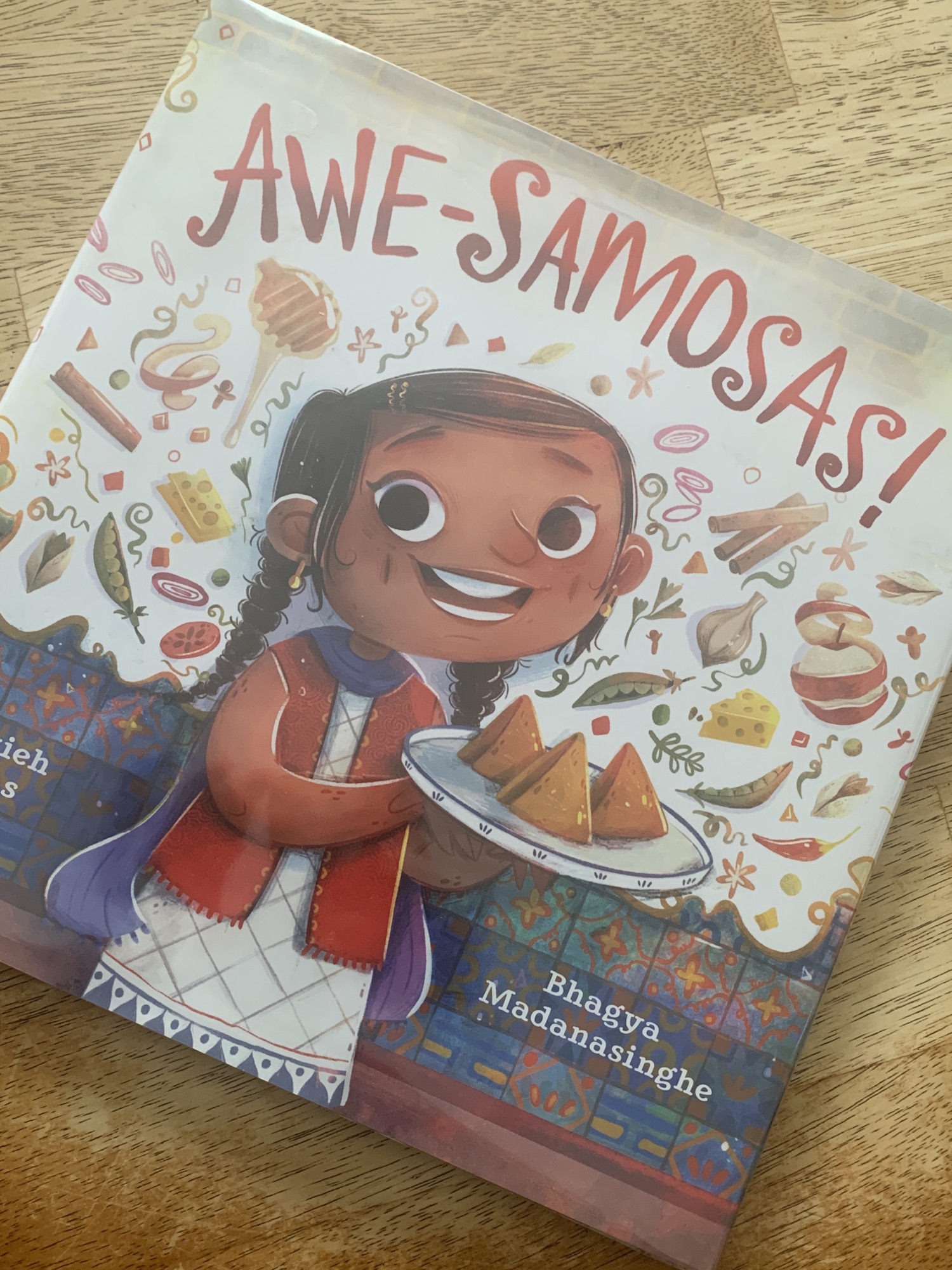
Awe-Samosas! by Marzieh Abbas illustrated by Bhagya Madanasighe

Standard
Awe-Samosas! by Marzieh Abbas illustrated by Bhagya Madanasighe

img_4196-1

I was really enjoying this book about a determined young girl and her dad making samosas for friends, missing Dadijan, adapting and problem solving, an encouraging Urdu speaking parrot, a reference to Ramadan, and incredible illustrations… and then I froze.  On page 32 of the 40 page book it says the word “pepperoni” clearly affirming that the Muslim girl who’s dupatta wearing Dadijan wakes up at fajr to call her, has made pepperoni pizza samosas for her friends.  Perhaps I’m over reacting, it is one word, but I truly cannot get past it.  The first time I recall asserting myself as Muslim was in preschool making pizzas and me telling my teacher at three and half years old that I cannot eat pepperoni.  Sure as a middle aged adult, I know you can get beef or turkey or faux pepperoni, but the standard is pork, and this book does not clarify that it is not pork.  The word is intentional, the story would be exactly the same if it were just a cheesy pizza samosa, yet it articulates it as a peperoni pizza samosa. And I truly cannot fathom why.  Classrooms and libraries will shelve this book, teachers and librarians will read this book, little Muslim kids that look like Noor, are going to shrink when they get to that line: either they will question if we can have pepperoni (why else was it in Noor’s home), or have to now convince adults and classmates that the book is wrong in addition to explaining that Muslims do not eat pork, a big task for the intended audience of preschool to third grade.  If you omit that one word, the book is wonderful, layered, joyful, and a lot of fun.

Noor’s friends are coming over, two girls and a boy, for the first time and Noor wants to make samosas to eat with them.  It is too early to call Dadijaan in Pakistan, and Noor thinks she remembers how to make them.  Abbu offers to order pizza, but Noor is determined, even when she discovers they don’t have the necessary ingredients.  She puts on Dadijaan’s kitchen dupatta, and with her parrot, Mithoo, encouraging her every time she gets stuck with “Sab theek hai. Sab theek Hoga! Everything’s great, everything’s going to be okay!” Noor heads to plan B, Awe-Samosas, samosas with unique fillings.

img_4197-1

Noor gets Abbu onboard and helping and when her friends arrive, the turmeric colored pastries are ready for eating.  Some are apple-cinnamon filled, and remind Kaitlin of her grandma’s Fourth of July apple-pie, some are stuffed with honey and pistachio like baklava according to Layla, and Jonathan finds the cheesy peperoni samosa genius.  When Dadijaan sees the pictures Abbu has sent at fajr, she calls and praises Noor with the friends hoping to have another samosa party when she is visiting next.

The book concludes with Dadijaan’s Special Samosa Recipe, and a Glossary.  The book is widely available, including here on Amazon.

img_4200-1

Idrees and the New Old Shoes by Hoda Elmasry illustrated by Tiemoko Sylla

Standard
Idrees and the New Old Shoes by Hoda Elmasry illustrated by Tiemoko Sylla

img_4191-1

This sweet 28 page book keeps the text to a minimum while showing a boy with a lot of heart doing what he knows is right, even when he knows he will be laughed at.  I really love how the story draws readers in and conveys a lot, without over explaining.  Ages preschool and up will understand that Idrees wants new shoes, but second hand shoes are what are available.  That he wants to prove how fast he is at school, but that being a good neighbor is the right thing to do.  Based on the illustrations, the family is Muslim, mom wears hijab when out, but not at home, but there is nothing in the text that articulates the family’s faith.  The author is Muslim and the book is published by Ruqaya’s Bookshelf.

Idrees can’t wait for his new shoes so that he can beat Harris and be the fastest runner at Barton Elementary.  When mama comes home, she has shoes, but they are not new, they are hand-me-downs from the neighbor Mrs. Freeman.  Things are not the same as last year for Idrees and his mom, but with help from the neighbors they get by.  They also look out for Mrs. Freeman who is always forgetting something or another it seems.

Idrees doesn’t think he can beat Harris with these old shoes, and dreads being teased, but with some prodding from mama he tries on the shoes and heads out the door.  He gets to school in record time and things are looking up.  Harris has jokes when he sees the outdated sneakers, but Idrees is confident he can win the race.  When Mrs. Freeman shows up lost though, somehow the race just seem that important.

The book is available here at Crescent Moon Store where my initials ISL will save you 10% at checkout.

Idrees and the New Old Shoes

Sister Friend by Jamilah Thompkins-Bigelow illustrated by Shahrzad Maydani

Standard
Sister Friend by Jamilah Thompkins-Bigelow illustrated by Shahrzad Maydani

img_3521-1

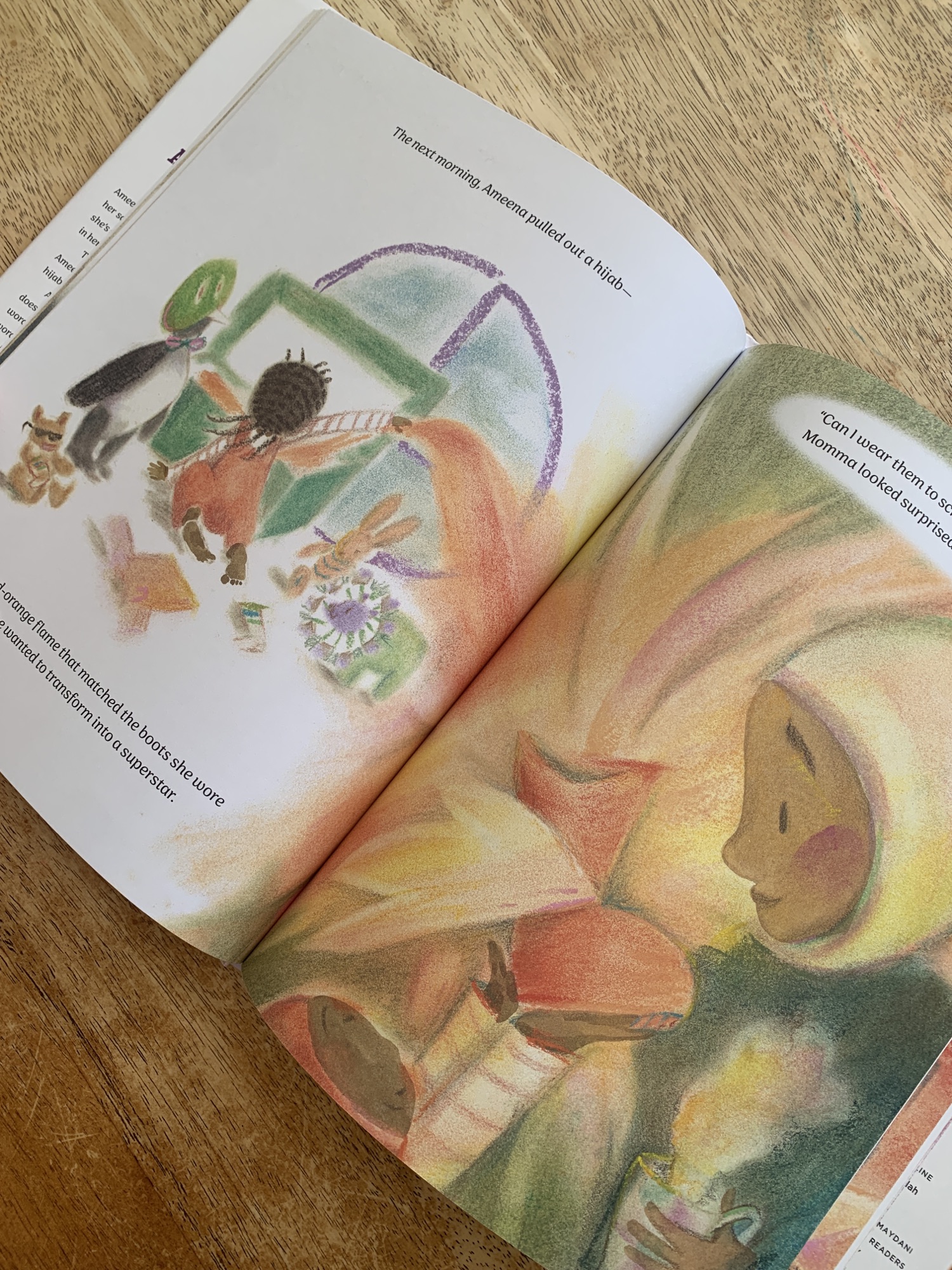
After years of teaching, librarian-ing, and mothering, my reviewers are for adults, but with kids in mind. I read in different environments and try and balance what children will think with my more critical literary impressions. But honestly, my first reaction when I see Jamilah Thompkins-Bigelow has a new book out, is not about the children, or their parents, it is incredibly selfish, and I want to read the picture book for me.  It has been about a year since I first read my all time favorite, Salat in Secret, and I still feel all the feels, every time I read the book. I even enjoy handing the book to people and watching them read it for the first time.  So, I was both excited, and nervous to read this new book, not knowing if it would measure up to my expectations or rather hopes, so to speak.  I needn’t have worried, subhanAllah, this book in it’s own right is moving, heartfelt, layered, powerful, hopeful, relatable, tender, and while staying on a kindergarten to second grade level is also unapologetic with its centering of Islam, race, and feeling invisible, being new, and making a friend.  The illustrations and words blend beautifully, and by the second page of the 40 page book, I was already emotionally attached to the little protagonist Ameena.  Good writing is good writing, and as a result this beautiful book works for all ages and will be appreciated on multiple layers even after dozens of readings, alhumdulillah.

img_3522-1

The book begins with Ameena playing a game by herself.  She always plays by herself at school, where she tends to be invisible.  Maybe it is her hair in twists or her brownness, she doesn’t know.  One day a new girl comes, her name is Sundus, she wears hijab like Ameena wears to the masjid.

All day Ameena tries to talk to Sundus, but something always seems to keep them apart.  When they finally meet,  Ameena’s excited words get all tangled, and a misunderstanding occurs.  Ameena decides the next day to transform into a rockstar: red-orange hijab and matching boots. The other kids say she is copying the new girl.  Sundus doesn’t say anything.

img_3523-1

Ameena disappears again at school, but family night at the masjid is her happy place.  Where she doesn’t play alone, and there are lots of browns, and she is seen.  When Mama meets a new sister, and greets her with Assalamu Alaikum, Ameena sees how a greeting and a hug can be the start of sisterhood and friendship. And the next time Sundus and Ameena meet, they know just what to say.

img_3525-1

The joy at the end forces you to smile, just as Ameena playing alone at the beginning tugs at your heart.  It is a great book to see yourself and see others in a beautiful, authentic way.  The universal themes of not being seen, making a friend, and being the new kid, are woven in just as hijab, masjid and Assalamu Alaikum are, making the book powerful for Muslim and non Muslims alike.

img_3524-1

I particularly love that their is no glossary, and that the text uses the word masjid not mosque, hijab not scarf and Assalamu Alaikum not salam.  That the masjid is her safe place to laugh and play, and that this book is mainstream published and will find its way to public spaces and be widely accessible.

You can preorder your copy here on Amazon.

Baby Touch: Happy Eid! by Lemon Ribbon Studio

Standard
Baby Touch: Happy Eid! by Lemon Ribbon Studio

img_3516-1

This 12 word, 10 page, touch and feel board book is nothing special, yet for some reason it does make me smile.  It could be better, and absolutely, “star” has nothing to do with Eid, but that it is in our public library, that it is full of joy for our littlest humans, and that it has mosque and prayer rug, and charity, and community, and family, and feast, is really quite sweet. It would work for either Eid and the bright uniform pictures are clear and simple to engage babies and toddlers alike.

img_3517-1

Each page spread has a singular image and a word below it.  The pictures on the right have some sort of touch and feel element, from a bumpy minaret, to raised smooth coins in the charity jar.  I wish the rice on the feast plate would have been raised and that a plush prayer rug would have been offered, but until publishers seek out beta readers, this is probably as good as it is going to get.

img_3518-1

Some of the words might be too advanced, but I think the singularity allows for discussion if the child wants, if not, it is still nice to see elements of Eid illustrated for a baby to connect to in a joyous presentation.  The 7x 7 book is not overly padded, but the corners are rounded and easy for little hands to carry.

I found mine at my library, but it is also available here on Amazon.

Until You Find the Sun by Maryam Hassan illustrated by Anna Wilson

Standard
Until You Find the Sun by Maryam Hassan illustrated by Anna Wilson

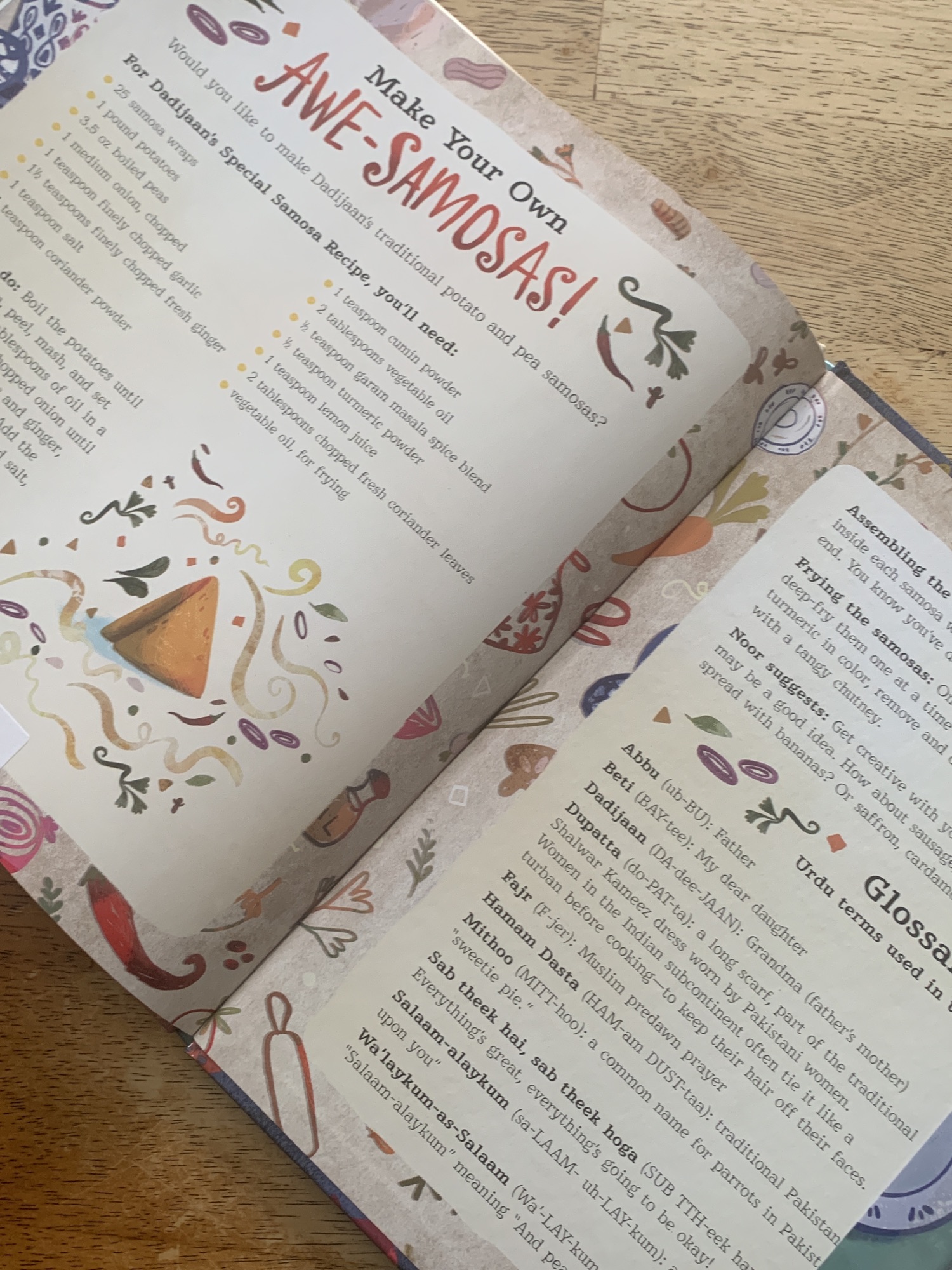
I don’t know that this book is particularly unique or mind blowing, but I read a digital copy a few weeks ago and was surprised when some tears fell, I read it when I got the physical copy to my kids and my throat caught again, and here I am writing this review and feeling all vulnerable.  It is as if I too am a little girl in a new place missing her grandfather on the other side of the world, which clearly I’m not.  The book is sweet, and moving, and I find myself emotionally invested every time I read through the 32 pages and get lost in the large sweeping illustrations.  The book is not Islamic, there are a few hijabis in the background and text that articulates friends saying salaam before the girl moves.  Additionally, the main character’s name is Aminah, and the author is of Pakistani decent, and has a Muslim sounding name.  The story though, at its core is universal, heartfelt, reassuring, hopeful, and lovely to share in all spaces. It begs to be read aloud and holds the attention of toddlers to early elementary aged children.

The book starts with a happy little Aminah in a bright sparkly environment of sunshine, mangoes, and salaams.  Every night she listens to Da’s stories of adventure as she snuggles next to her grandfather.  One day she finds out they are moving, going on an adventure.  Only Da won’t be joining them and Aminah is devastated.

The new home is gray, and cold, and no adventure at all.  She wants to go back, but Da reassures her during their nightly conversations that things will get better.  And sure enough, with a bit of bright yellow inspiration, she starts to discover the adventures awaiting in her new home.
Kids will find the end hopeful and resolved, but I somehow found it a little bittersweet.  Da loves his grand daughter and wants her happy, but the adult me, realizes their relationship will never be the same, and Da will miss her in many ways, alone, as she embarks on her own life.  I know I’m projecting, but the ability to see both perspectives adds a nice layer to the book.

The book is available here from Amazon and will be in local libraries in June 2024.