Tag Archives: Palestine

Folktales for a Better World: Stories of Peace and Kindness by Elizabeth Laird illustrated by Mehrdokht Amini

Standard
Folktales for a Better World: Stories of Peace and Kindness by Elizabeth Laird illustrated by Mehrdokht Amini

img_5848-1

The presentation, the tone, the vibe, the seven countries and stories selected, the illustrations and large size really make this book enjoyable.  With folktales from Ethopia, Sudan, Palestine, Yemen, Afghanistan, Syria, and Uighur, some contain Islam and Muslims, and some do not, but the messaging and lessons are for all.  Folktales are often used in classroom settings, and I appreciate that this book can be used in bits or all together.  Most of the selections are 6-8 pages, but contain large illustrations to help the readers engage with the lessons being conveyed. Having read a few books by the author, I think it is clear that the people represented in this collection is very intentional, and these old stories from the occupied, the oppressed, and the war torn in contemporary times, really show the universal humanity of stories, kindness and peace.

The introduction from the author sets the tone before the stories begin. The Dog Fight from Ethopia is a tale of conflict and perspective and pride.  Allah Karim from Sudan is trusting that Allah swt will provide, compassion for the homeless, and charity.  From Palestine, the folktale True Kindness shows the value of hospitality.  The Next Sultan from Yemen focuses on fairness and justice as does The Emir and the Angel from Afghanistan. From Syria the tale of The Woodcutter and the Lion focuses on friendship and being selfish, and finally The Nine Princesses of Kashgar, a Uighur story, shares a story of defending your land against occupiers.

Early elementary kids will enjoy the tales and relate to the lessons, they will get lost in the pictures, and recall the messages long after the book concludes.  This book reminded me of how few folktales I’ve read outside of teaching, and I look forward to sharing this at bedtime, story times, and gift it to teachers and librarians to do the same.  You can purchase the book here from Crescent Moon Store and save 10%.

A Map for Falasteen by Maysa Odeh illustrated by Aliaa Betawi

Standard
A Map for Falasteen by Maysa Odeh illustrated by Aliaa Betawi

img_5521-1

This 40 page OWN voice written and illustrated picture book for kindergarten to elementary, addresses the question and provides some answers that Palestinian diaspora children have faced for years, about the attempted erasure of Palestine by way of not labeling the country on maps.  The book does not name the occupiers, so hopefully it will avoid bans and censorship, as it does not shy away from articulating the taking of land, theft of homes, and renaming of villages.  The refrain is that “Palestine lives in you and me,” and that can never be taken away.  That the book stays on level and is traditional published is quite impressive for the contents contained. I love that their are resources as the beginning for adults to learn more, that Isha prayer is mentioned, The Proudest Blue is in an illustration, that rohi, omri and habibti are woven in, and the Author’s Note is detailed. 

img_5522-1

The book starts with little Falasteen at school, the class has a new map of the world and everyone is taking turns telling about where their families are from.  Let me pause here and say, this was my biggest, only real problem with the book, the illustration hints that the map is the rug, and the rug is just shapes of the continents, it is not a political maps that shows country boundaries, but I also read an e-arc so maybe something will change in the illustrations, but none-the-less, I note it here because it is the first page.  Moving on, when it is Falasteen’s turn she doesn’t see Palestine and when she asks her teacher, her teacher tells her, “I think there is no such place.” I wish I could say this is extreme, but I’ve been hearing similar conversations from friends for over 30 years, at least in the book the teacher isn’t mean about it, just ignorant, real life sadly, is often much more aggressive.  This is the catalyst though that prompts Falasteen to start asking her question.

When she gets home, she asks her Jido, who is tending the grape vines, why Palestine is not on the map, and he draws her a map to take to school the next day to share with her friends and teacher.  He tells her, her “teacher needs teaching.” Let me pause again her, I was initially a little surprised at this tone, and SPOILER that at the end it doesn’t circle back to her teaching her teacher and class, but on the second reading, I was glad for it.  No one should have to prove their existence, that is my bias of wanting to be accepted or palatable to an outside gaze.  Teachers all the time get asked something they don’t know and if it on topic will go and find an answer, to dismiss little Falasteen intentionally or out of ignorance regarding her home country, is not something that needs outside approval, or that needs to be proven.  Outside acceptance is not required in this example of reality. 

She then asks her Teta who is cooking in the kitchen, why Palestine is not on the map.  Teta tells her about when soldiers came with their tanks and guns, and burned their fields, and she had to leave with Falasteen’s mom in her arms to keep her safe.  She shows her the key that she keeps from her home that was taken, and how she longs to return.

img_5524-1

After Isha prayer, Falasteen asks her mother the same question.  Her Mama tells her that some places don’t need a map to be found, and that “Palestine lives in you and me.”  That even though Falasteen has never seen Palestine it is within her.  When she tells her mother that her teacher told her it doesn’t exist, her mom explains that those that say it doesn’t exist, that make the maps, cannot erase them, their memories, their culture. 

The remainder of the book is more hopeful and prideful of the places where Palestine is found and the hope that someday they can visit. I enjoyed the read, it is important, it is needed, and I hope you will preorder/order it to show your support.

Birthday Kunafa by Rifk Ebeid illustrated by Noor Alshalabi

Standard
Birthday Kunafa by Rifk Ebeid illustrated by Noor Alshalabi

img_4902-1

This 50 page wordless picture book allows readers to make up their own words to describe the progression of what is shown in the illustrations. With no right or wrong, the backmatter helps give context and points out key images that allow the story to resonate on multiple levels.  On the surface it is a birthday girl who is upset she cannot have kunafa, but when you truly look at the pictures, and see what is preventing her from moving from Jerusalem to Nablus, the reader is shown, she is not just a child wanting something she can’t have, but that she is being denied basic rights by an occupying force.  I love that the little girl represents so much more than just herself, and that her determination to cross checkpoints, is not just about acquiring dessert.  The book starts with a little girl on her birthday that could represent a little girl with her friends and family anywhere, but as the pages are turned you witness how beautiful Palestinian joy is, how much we take for granted the freedom to move, and how desperately we need to stand up for a free Palestine.  With no words, Islamic representation is limited to two hijabis in the illustrations.  The author and illustrator are Muslim. The book centers a birthday, there is dancing dabkah and an oud shown leaning up against a wall.

So often when thinking about Palestine, not just since October, we all find ourselves speechless.  There are no words, only tears when watching the news, reading headlines, or scrolling, and I find it incredibly timely for a wordless picture book about Palestine to be published.  There are a few labels so to speak throughout the book that I didn’t particularly find necessary, but they do not distract from the story, so they didn’t bother me.  I like that the book showed restraint in terms of the oppression that could have been shown.  It allows for the story of the little girl and her family to maintain the narrative.

The story that I understood the images to be telling is that it is a little girl’s birthday, the family is having a party, they have a birthday cake, but she wants kunafa, she tries to get some and along the way sees joy everywhere, until the checkpoints turn the images gray, and prevent her from moving forward.  So mama and her problem solve, they try and make their own, but it is not the same, so they devise a plan, and they try again.  They do not give up. There is no giving up.

The backmatter provides a recipe for kunafa, a two page spread about “Why Wordless Picture Books,” another spread about “Context Matters” giving information about Zionism and Palestinian resistance.  It is then followed by four pages entitled “Did You See?” where symbols are shown that appear in the pages and described.  Warning there are numerous sweet and savory foods shown, and it will make you very hungry.

The book is available here from Crescent Moon or here from Amazon.

Eliyas Explains + Bite-Size Journal: Why Does Allah Let Bad Things Happen? by Zanib Mian illustrated by Daniel Hills

Standard
Eliyas Explains + Bite-Size Journal: Why Does Allah Let Bad Things Happen? by Zanib Mian illustrated by Daniel Hills

img_3601-1

The book stems from the genocide occurring in Gaza, but expands to cover the more general concepts of qadr (destiny), tests, and sabr.  The book assumes that what is happening in Palestine is known and does not discuss specific details, allowing the book to be both timely, yet universal.  As with all the books in the series, the conversational humorous approach appeals to children as foundational Islamic concepts are broken down and explained.  The book is 73 pages with the journal portion starting on page 33. In some of the other books, the journal feels more of a hands on to already shared information, or an accompanying workbook of sorts.  In this book however, I feel like the second half continues to explain the topic at hand, and convey key components in understanding why Allah swt, lets “hard” things happen, how we should view the tests, approach difficulties, and inshaAllah triumph. The book has been checked by a Shaykh, and I highly recommend this important book for elementary, middle grade, and even middle school children. The concept of qadr is difficult, I struggle to truly grasp what we can and cannot change, but this book helps readers focus on what we can change and how to view terrible things that happen to us and to others.

The book starts with Eliyas introducing himself and his family, and then wondering why “Israel is being able to do what they’re doing in Gaza.  Why isn’t Allah stopping it?” As with all Eliyas books, mom and dad are sought out, food is somehow worked in, and time and space are given to Eliyas and his siblings to be given an answer. His parents start by being glad that Eliyas’s heart is soft for the Palestinians and that he is bothered by what is happening to them, before explaining that a lot of understanding is trusting and truly believing that Allah swt knows best.

img_3625-1

The book uses hadith, ayats from the Quran, it even shouts out other Zanib Mian books, The Mindful Book of Wellbeing, for seeing the bigger picture and Eliyas Explains Why Should I Pray my Salat on how to make yourself strong to get through the struggles of this duniya.

The book talks about why Allah swt didn’t make everyone good, and it is clear in saying that being mad and sad are ok too, as long as we are not questioning Allah swt. There are prompts and questions (with answers) and the book is not heavy, despite the subject matter, the tone and approach stay on level and allow readers to connect, alhumdulillah.

You can get your copy here at Crescent Moon Store.

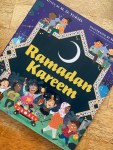
Ramadan Kareem by M.O. Yuksel illustrated by Hatem Aly

Standard
Ramadan Kareem by M.O. Yuksel illustrated by Hatem Aly

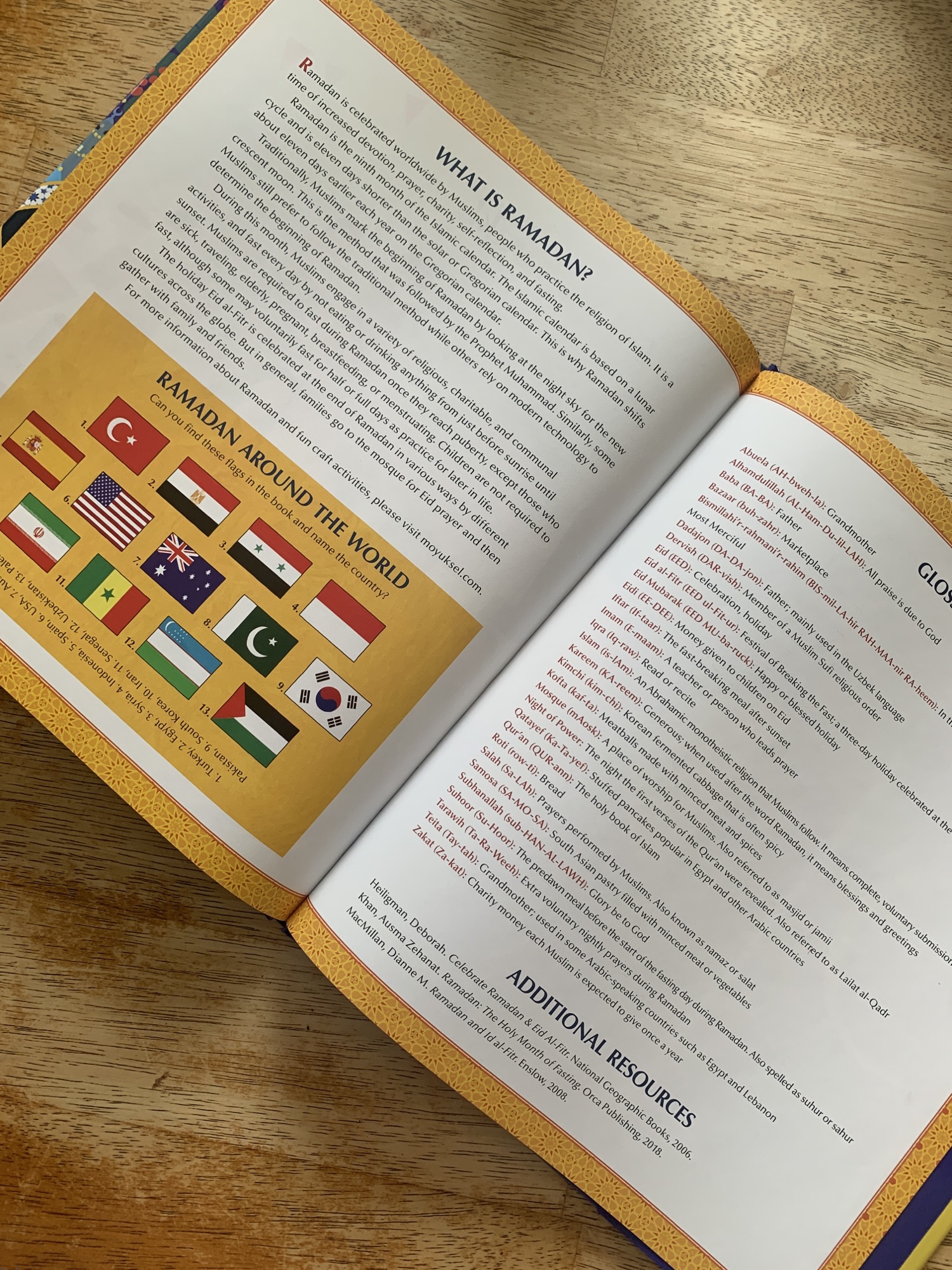
The lyrical text that shows joy, Muslim joy, all over the world during the most wonderful time of the year is felt, truly truly felt in this rich, beautiful book. The illustrations, the text, the sentiment, it all comes together so splendidly, that when you turn the last page you want to start over again. Hundreds of people are wondering what book to read to their children’s public schools this year, what book to start off masjid story times this Ramadan, what book to read every night leading up to the blessed month to get their children excited, what book to hand to your children to look through so they can have a few more minutes of sleep and alhumdulillah to all the above, I whole heartedly suggest, this one. Even with the errors.  The book states “the Night of Power is better than a thousand nights,” and should read, better than a thousand months.  The backmatter says “by not eating or drinking anything from just before sunrise until sunset.”  The story itself though has it correct and says “suhoor is a predawn meal” and notes the “sun is still sleeping.”

A universal story of celebrating Ramadan, with waking up for suhoor, greeting neighbors, having self control, praying, volunteering, iftar, community.  It is a singular story, but each two page spread showing a child in a new country continuing the narrative.  The worship uniting us all as Muslims even while our unique traditions add diversity and layers to the acts that we share.

It starts with gazing at the new moon in Turkey and mom saying that the narrator can fast. The drummer than beats her drum and it it time to wake up in Egypt. The call to prayer and remembering you are fasting reaches Syria, and donations are given in Indonesia. In Spain Qur’an is read in abuela’s lap and neighbors are visited in the United States.  Donations are packed in Australia,  friends and family are visited in Pakistan, and kimchi after dates for iftar in South Korea.  It is then off to Iran for prayers, Laylatul Qadr in Senegal, and getting ready for Eid in Uzbekistan.  Palestine is the final stop as Eid joy erupts for Muslims everywhere.

The book is widely available, you can order yours here at Crescent Moon or here on Amazon

Gates and Tales by Sally Zaki illustrated by Arwa Ali

Standard
Gates and Tales by Sally Zaki illustrated by Arwa Ali

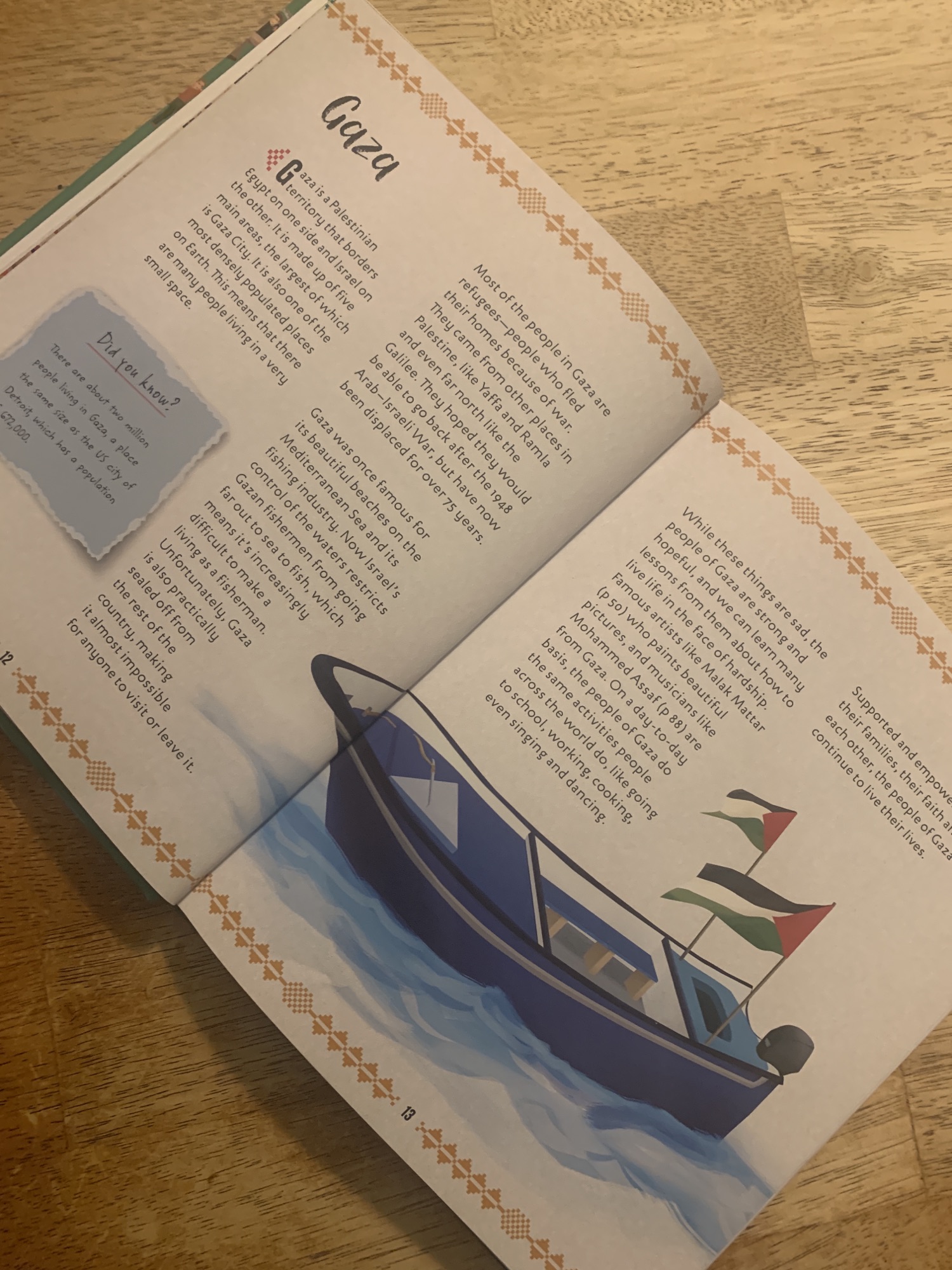
This 34 page picture book is adorably illustrated as it focuses on the gates leading to Masjid Al-Aqsa and sprinkles in culture, sights, and history about Palestine along the way.  I love the concept, it is unique, and I love that there are maps throughout of the masjid compound.  I truly learned a lot even though it is for early readers, naturally I wish there was a scannable QR code to learn more, but as an adult, with my kids, or in a classroom it would not be hard to search up Bab Al-Amud, Qubbat Al-Sakhra, Bab Al-Sahira, Salah Al-Din, Masjid Al-Qibli, Bab Al-Khalil, Al-Quds Citadel, Qaitbay’s Fountain, Bab Al-Asbat, or Qubbat Al-Silsilah.  Islam is also woven in, not just in the architecture or history, but also in mentioning the sunnah of fasting on Thursdays, quoting an ayat from the Quran in the text, and the kids meeting up to pray.  The writing isn’t super great,  it breaks down the fourth wall regularly, calling the readers “friends” and asking them to find things in the illustrations, their missing friends, and about foods and the flags of their country.  I’m not sure why the book hopes the readers are “from countries surrounding Palestine,” I found that a little off putting, and I’m not sure why we are supposed to memories the “gates by heart,” or how at the end we are now “victorious heroes.”  Even the defined words at the end, are a bit haphazard: za’atar, falafel and sido, being the only words highlighted, in a book with many Arabic words present. Presumably the reader found all the friends so they did reunite, it seemed to kind of falter, I thought they would show something they all love, or share some snacks, but the book, just kind of ended.  I like that the book is joyful and upbeat, I do appreciate that the last lines do mention that “Palestine is occupied today.  One day, insha’Allah, it’ll be free,” inshaAllah, inshaAllah, inshaAllah.

The book starts with Nidal introducing himself to the reader and letting you know he is going to take you on a special journey through four different gates.  He then asks the reader if they know where we are, before showing us Palestine on the globe.  He is going to “meet his pals at Masjid Al-Aqsa nestled east of the Old City of Al-Quds and includes the entire area inside the wall surrounding the Masjid.”  I love that it explains the area within the walls and the map on the opposite page is helpful.  

His mom has prepared him some snacks to share with his pals, and he puts on his Palestinian flag backpack before heading off.  He goes through Victory Gate.  Then his friend Aisha takes over and tells what gate she is entering through, shares details about the flower carved at Bab Al-Shira, and that her Sido would tell her about Salah Al-Din when they walked down Salah Al-Din street together to get to Masjid Al-Qibli, with its gray dome. Khaled and Jihad follow the same format and the book ends with the kids sitting in front of the Dome of the Rock asking what gate the reader will come through.  

I purchased my copy from Crescent Moon Bookstore here and if you use code ISL at checkout you will save 10%.

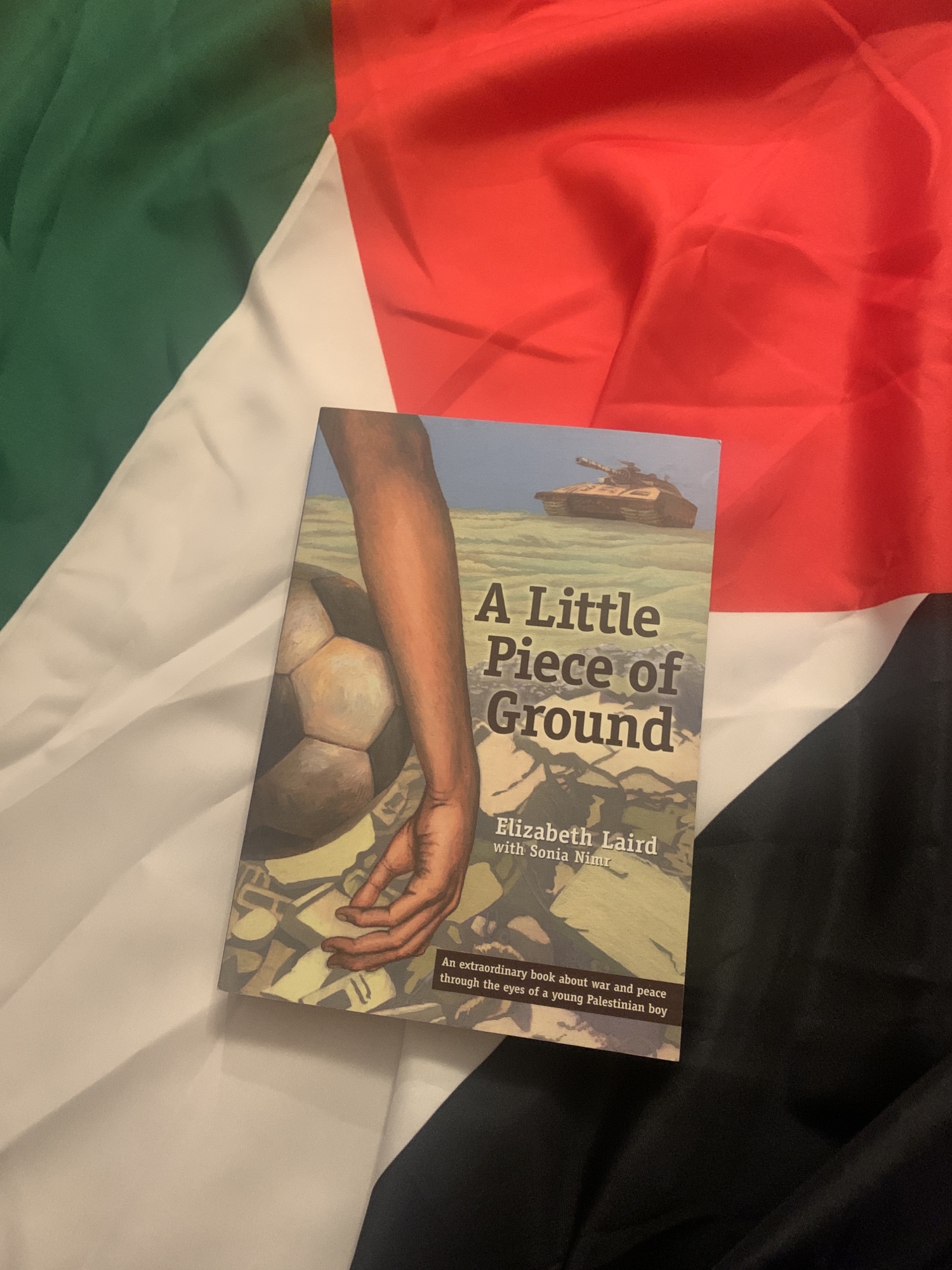
A Little Piece of Ground By Elizabeth Laird with Sonia Nimr

Standard
A Little Piece of Ground By Elizabeth Laird with Sonia Nimr

img_2165-1There are so few Palestinian middle grade books, so on that premise alone this 216 page book has a lot of value.  Because I am not Palestinian, I do not live, nor have I ever lived under occupation, I can argue some of the concerns from a point of privilege, and I acknowledge that is not my right.  I have been asked numerous times about this book and how it frames the suicide bombing mentioned in the text and blurbed about on the back of the book. It honestly is not a large part of the story, that being said, in my outside privileged view, I do not know that a 10 year old in the west will have context to understand the act of this level of desperation from the oppression and humiliation mentioned in the book. This is why I have held off my review.  The truth does not need to be defended or explained, and I fear my reservations will be taken as such, which is not my intention.  Would I let me 8 year old read this, yes, but we will read it together and discuss.  My children are aware of what is going on in Palestine, but Karim, the 12-year-old protagonist supports the bomber, and that notion is not clearly pushed back on. With discussion, absolutely, I think readers, will truly get Karim’s perspective that something has to be done to change the status quo.  The fear when Karim is alone and the target of soldiers, the settlers forcibly seizing the family land, the humiliation of strip searching men at checkpoints, the curfews, and constant fear of attack and imprisonment are all presented through the main character’s eyes, and would also do better with some discussion, so that empathy and duas and action can result.  But, the commentary as to the suicide bombing are minimal, there is even a prank package bombing that is presented as rebellion by a side character, and I would worry how a young child, without guidance, would internalize it.   Additionally, this is yet another difficult book for me to review, primarily because it was first published in 2003, and because I don’t know how much comes from a western gaze and how much the Palestinian voice played into it. Islam is clear on the prohibition of suicide.  In the early 2000 the news out of Israel was often about such attacks, but as an outsider, I honestly do not know if it was simply Israeli propaganda and stereotypes amplifying the idea as part of their public relations strategy or reality, seeing as now that Palestinians have direct outlets to share their daily life under an oppressive occupation, there is rarely talk of suicide bombing attacks. The author states on her website:

“I first visited Israel in 1968, and enjoyed a warm welcome from many Israeli friends. Later, I lived in Beirut with my husband and son during the civil war there, and became aware for the first time of the tragedy of the Palestinian refugees. I visited both Gaza and Ramallah, in the occupied territories, in 2002, while leading workshops for Palestinian writers. I was appalled by the circumstances in which people were living, and became aware that we in the West know very little of what life is like for Palestinians living under military occupation.

I have written A Little Piece of Ground in collaboration with Sonia Nimr, a Palestinian archaeologist, storyteller, writer and translator, who lives in Ramallah. We have tried to make our story as true to life as we can.”

The book is a hard read at times, but the joy is there.  Just as we as adults scroll through the devastation, the humanity persists.  The world may try and forget that they are attempting to erase a rich culture, but even in this book, their is laughter, and crushes, and sibling squabbles, and soccer games and friendship, and food, and joy.  There is a little Islam, not much, the main character is Muslim, a best friend is Christian.  It isn’t present in their everyday thoughts and actions, more just in identifying their faith.

SYNOPSIS:

Karim and his friends are not so much different than 12-year-olds everywhere, he loves video games, playing sports, isn’t so sure what he wants to be in the future, wonders what he will look like as he grows up, and is often annoyed with his family who he loves dearly.  Karim’s life in Ramallah is also unique, he lives under curfew, he doesn’t have freedom of movement, opportunity, or equal rights, and a simple family outing can be life altering.

The book follows Karim and his group of friend as they discover a patch of land they decide to turn into a soccer field, to claim as their own.  They work on it on days they can sneak away after school, in windows of time between curfews, and before long start to take pride in what the land can be. Adopting cats, learning about new friends from the refugee camp next store, teasing siblings about their crushes is all in contrast to Karim watching his father be stripped searched at a check point, being chased off their family land when they are harvesting olives by settlers shooting at them, and pranking soldiers in desperation of fighting back against oppression.

When soldiers roll in and occupy the land the boys have claimed, symbolic of their whole country, Karim gets stuck barricaded in an old abandoned car for days, with soldiers aiming their sights on him, and wondering if he will survive.

FLAGS:

Suicide, systemic abuse, oppression, humiliation, dehumanization, killing, beating, apartheid, genocide, violence, stripping, lying, crushes, occupation, shootings, injuries.

TOOLS FOR LEADING THE DISCUSSION:

This book does not need tools to be discussed.  It itself is a tool, to help middle grade kids be aware that this cruelty has been occurring for 75 years, this book took place 20 years ago, and today we just have social media sharing these stories more widely.  InshaAllah soon, Palestine will be free.

You can purchase this book here at Crescent Moon Store where code ISL at checkout saves you 10%

Palestine: The Special Edition by Joe Sacco

Standard

img_2164-1

Written between 1993 and 1995, and compiled as a complete set in 2001, this 285 page adult non-fiction graphic novel is not really something I can review, even if I knew how.  As we have passed 100 days of the escalation in Gaza, on top of the ongoing horrors of Israeli occupation, I am hoping to broaden my literary awareness to include not just children’s fiction and non-fiction about Palestine, but also adult works by those living it, those moved by it, and those reporting on it.

This particular “special edition” has a forward by Edward Said, and an introduction by the author and illustrator.  Once I started the actual story, I’ll be honest it took a few attempts to hook me, with the starting being in Cairo and being a little aggressive with alcohol and talk of women, but once I decided to just keep going, the book finds a bit of a rhythm.  It shows the author himself shaping his own opinion as he interviews, and sees, and reports on the events around him.  It is non-fiction, it is written by a journalist, at some points he acknowledges his bias, but the overall picture presented, is heart wrenching.  That the humiliation and torment and occupation of a people has been so well known and documented and ignored, in light of current events, and even in isolation, is devastating.  The exhaustion the writer feels just witnessing it, is palpable, and the complete ignorance of Israeli, former IDF soldiers none-the-less is stark.

The book is both a reflection of the time with internal political factions playing roles differently than they do in todays conflict.  There are also views about Iraq and Saddam Hussein, which might surprise readers today.  But the power of this book is what hasn’t changed, the torture, the imprisonment of children, checkpoints, illegal settlements, humiliation, restrictions from working, from moving, from being treated as equal.

I’m glad I read it, and spent time among the the ink filled pages. I am certain that many of the stories, particularly the ones from inside the prisons will stay with me and haunt me as I read headlines and scroll endlessly through the statistics occurring in real time.  How can we be so blind, for so long, how can a people endure so much and keep fighting, how does any of this make sense?

We are Palestinian: A Celebration of Culture and Tradition by Reem Kassis illustrated by Noha Eilouti

Standard

img_1887-1

The book is non fiction, the author not Muslim, but here I am reviewing this book because, we are all Palestinian and my heart enjoyed reading this 112 page book that covers Geography, Cultural Symbols, Creative Minds, Agriculture, Cuisine, Performing Arts, and History and Religion for middle graders and up.  The book is a celebration rooted in information and expressed with beautiful illustrations, fun facts and text blurbs to break up the text.  I do wish it was sourced, and I desperately wanted a map, particularly in the section on geography- it seems odd in fact that it doesn’t have one.  The book contains information about the nakba, but doesn’t let it control the narrative or overshadow the culture that thrives in Palestine and in all Palestinians. Undoubtedly, this is an important book to spend time with and share, especially as the global media is currently working overtime in attempts to erase the richness, joy, and even basic humanity of an entire population.

img_1888-1

The section on Geography covers Jerusalem, Gaza, Jericho, Akka, Haifa, Yaffa, Nazareth, Hebron, Nablus, Bethlehem, and Ramallah.  Some cities are combined and are featured on a full two-page spread after an introductory page for the section.

img_1889-1

Cultural Symbols covers the national anthem and flag, Handala, tatreez, thobes and gold hat, hatta and egal.  I enjoyed learning more about cultural items that have become increasingly familiar, but whose origins, importance, and displays were new.

img_1891-1

The Creative Minds section focuses on people both currently still living and deceased.  I always struggle with books that highlight important people because how they are chosen is always such a mystery, and this book at least acknowledges that this is just a tip of the iceberg cross-section of people influential, talented, and noteworthy.

The Agriculture and Cuisine sections are a celebration of food and resources that most of us who have been privileged to have Palestinian friends sharing their lunch and dinner with will find particularly enjoyable.

img_1892-1

Performing Arts was informative and new to me, and I think further shows the depth and richness of the culture.  It highlights specific people, dances, cinema, and instruments in this section.

The final section of History and Religion starts with ancient history, followed by the Nakba, al Naksa, and then a two page spread on Islam and a two page spread on Christianity.

img_1893-1

Notably not mentioned in the entire book is Israel, and in the religion section there are no other faiths shared except Christianity and Islam.  The author seems to be making a point, by what is included, and what is focused on, and keeping the light shined on Palestine. There is an index, but no sources.

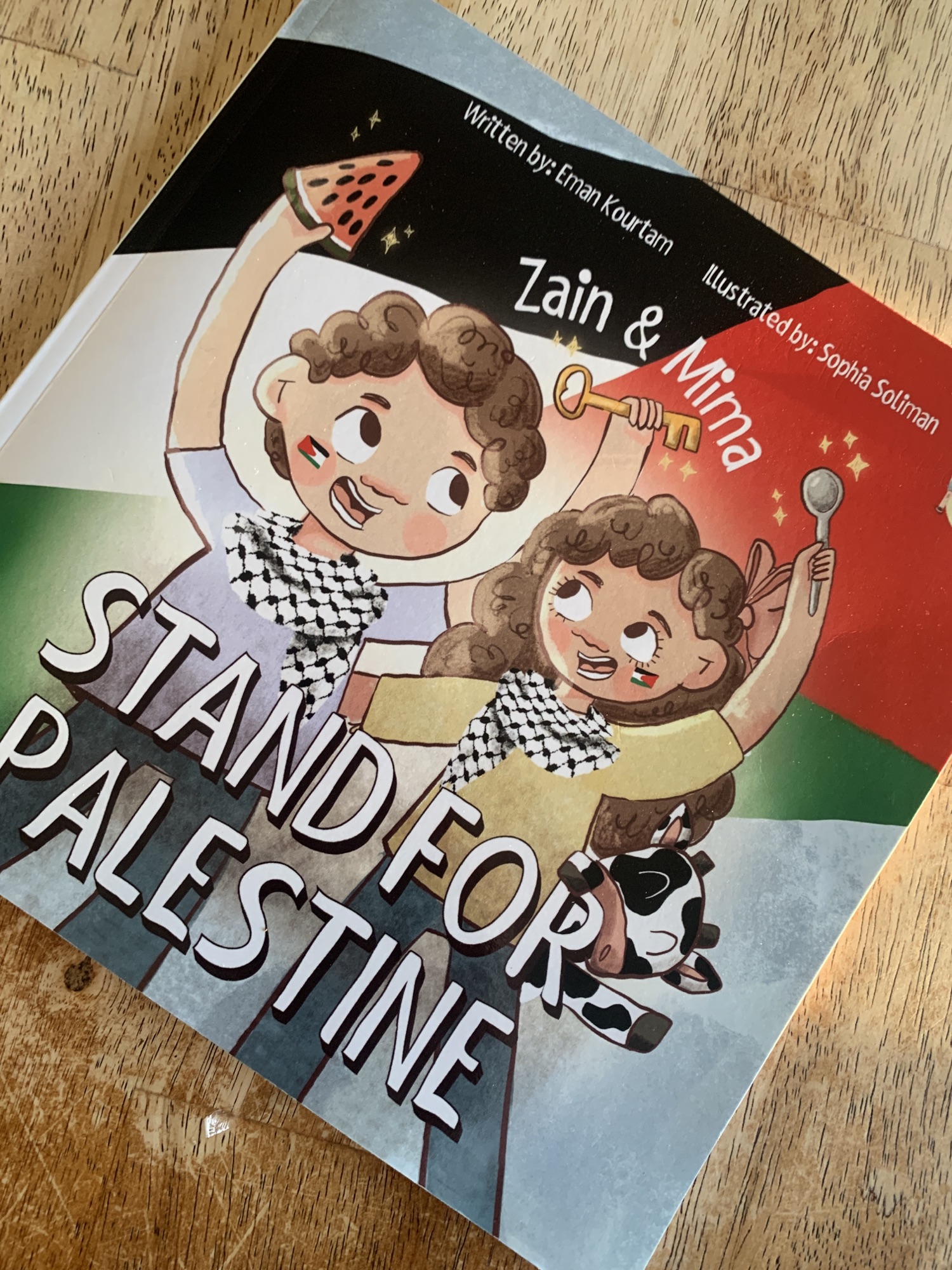
Zain and Mima Stand for Palestine by Eman Kourtam illustrated by Sophia Soliman

Standard

img_1853-1

I love this 57 page rhyming book from the perspective of a non Palestinian family pulling out their Palestine gear and taking to the streets to protest the occupation of Palestine.  Along the way the sibling duo, and thus the reader, learns about the history of Zionism, birth righters kicking people out of their homes, allyship with those on the side of Palestine, the crimes of Hitler, it shows maps of the occupation, details how movement is restricted, and even how to use BDS as a form of resistance from afar. All on an early elementary level.  There is a game at the end with an activity about resistance symbols, as well.

The book starts with Zain and Mima coming home from school tired and hungry.  They notice Mama is upset and glued to her phone, they then here noise outside and are encouraged by their mother to join the march as she hands them keffiyehs and explains that people are losing their homes in Palestine.

img_1855-1

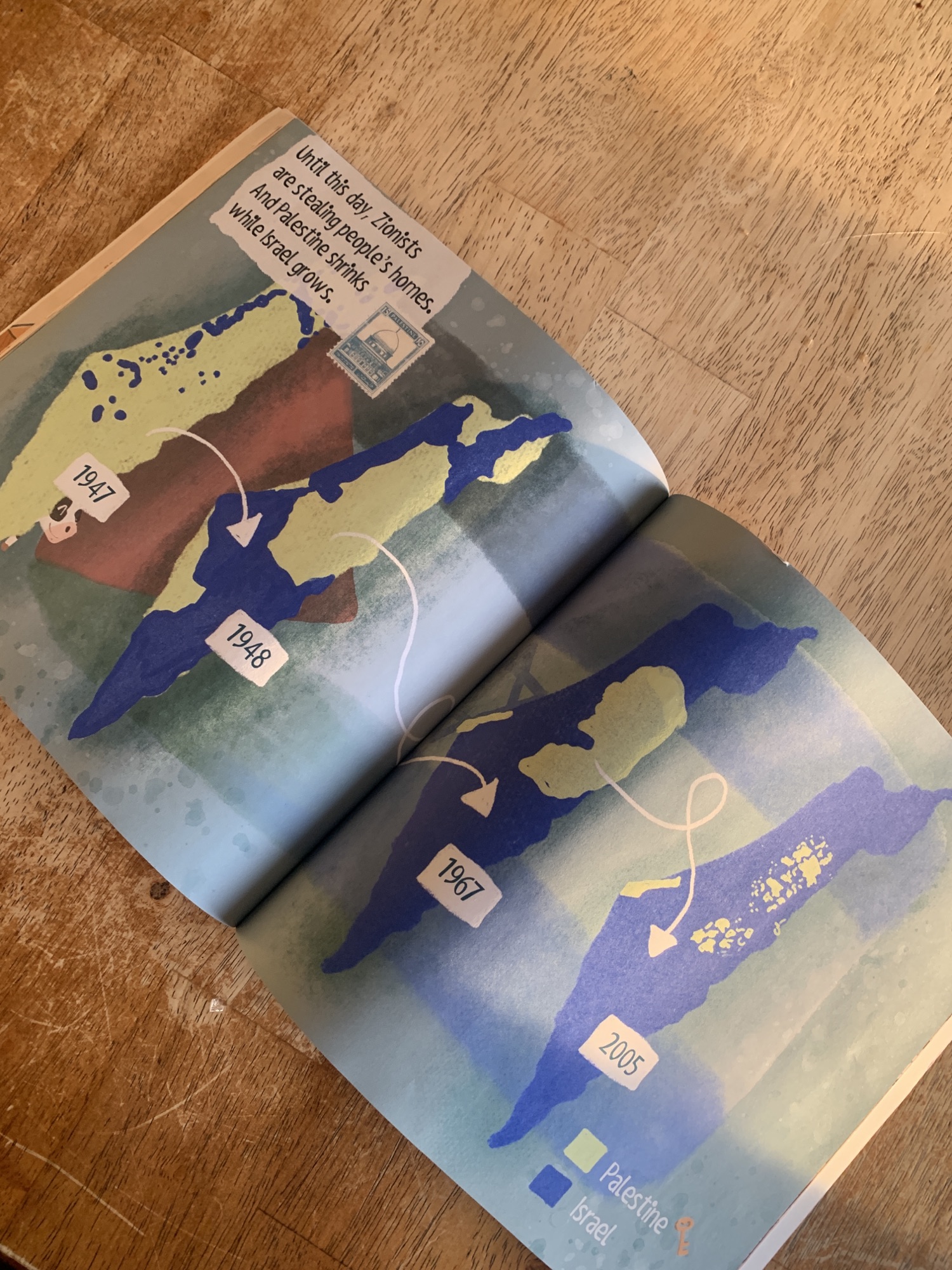
The kids are not sure of what is going on, but notice the chanting and signs and diversity of people coming together to demand freedom for Palestine.  After the protest they head home and Mama explains the history of Palestine and answers their questions.  She explains who Theodore Herzl was and his idea of Zionism.  Why it is dangerous and evil.  She then explains how Hitler’s actions in WWII gave rise to Zionism in the aftermath. A two page spread of maps show 1947 Palestine/Israel, 1948, 1967 and 2005 in easy to understand visuals. Mama then explains, without identifying any specific country, that Israel has the best weapons and Palestinians use rocks and slingshots to defend their homes and families.  It shows walls and checkpoints controlling people’s movements, and the oppression that has resulted.  When Mima asks what we can do in addition to marching and chanting, Mama explains using our money wisely with the BDS movement.  The next day, the children empowered by knowledge, make signs and are ready to stand bravely for Palestine.

img_1858-1

This book was originally written in 2022, and sadly is still so on-point.  It is available again on Amazon after being temporarily blocked, but I hope you will purchase it from a small business such as Crescent Moon Store where my initials ISL will save you 10%.

img_1857-1