Tag Archives: Muslim Characters

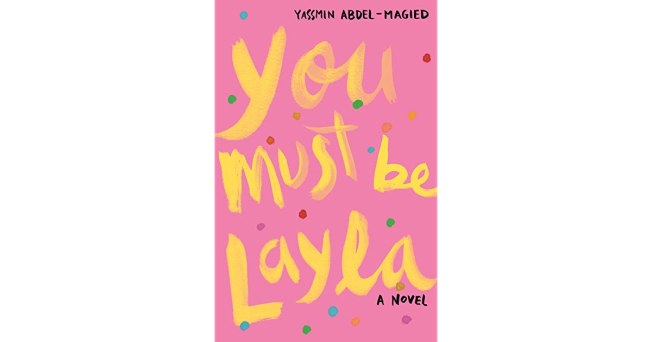
You Must Be Layla by Yassmin Abdel-Magied

Standard
You Must Be Layla by Yassmin Abdel-Magied

layla

This OWN story, upper middle grades book, is heavy on the pop culture, relatable on the Islamic family presentation and honest in its portrayal of Islamaphobia, yet somehow the tidiness in which everything wrapped up seemed too forced and a bit flat.  At 293 pages, including a three page glossary, the book is a quick read meant mainly for girls.  It involves robotics, academic achievement, and invention, while also discussing crushes, a character coming out to his family and friends, and mention of girls not praying at certain times of the month.

SYNOPSIS:

Layla lives in Australia and goes to the Islamic School of Brisbane. Her Sudanese family: older brother, younger twin brothers, and parents, her Doctor mom and medical machine tech dad, are active Muslims and proud of their culture.  They assimilate to Australian norms in varying degrees, but with all the kids at ISB, Layla doesn’t feel all that different in her school and social life.  Unfortunately she wants more, she wants to be an adventurer, and when she meets Adam over the break and learns about the various opportunities he has it his school, Layla decides she wants to prove herself on a larger stage.  Going in to “shut down” mode Layla has tunnel vision to ace the scholarship and entrance exam and go to a new school.

She gets in to Mary Maxmillion Grammar School and when she goes to meet the board they let her know that the decision to accept a girl like her was not unanimous.  Layla is an immigrant, she is black, she wears hijab, she is loud and proud, and apparently very smart, but as one trustee asks, is she brave?  On the first day of school she arrives late to first period, insults the teacher repeatedly and also makes friends with a group of slightly diverse boys.  At the end of the day however, Peter, a boy who had insulted her earlier, reinforces his disapproval of her being allowed at their school and pushes her.  Standing her ground, she verbal attacks and then head butts the boy in front of a large portion of the school at dismissal.  No one offers any help, nor speaks up when she is suspended for a week, her scholarship and admission put on probation, no one even asks for her side of the story, Peter, is let off completely free, as he is also the son of the Board Chairman.

Layla decides to prove she belongs at the school she is going to win a prestigious robotics competition and since everyone already is on a team, she decides to go for it solo.  The only problem, is she doesn’t know what to invent.  When she returns to school, her friend that she is crushing hard on is acting weird, and she gets caught up in a lie of sorts that serves as both the idea and silliness turned cleverness of the book.  While choking on gummy worms, she says she is working on an edible actuator for her robot, and somehow has to make that come to fruition.

The rest of the book is Layla making a lot of silly errors of judgement: missing classes being in SD mode in the workshop, forgetting to file the paperwork and registration to actually compete in the competition, and leads up to the resolution between her and Peter, learning her crush is gay, and deciding to be herself and proud of it.

WHY I LIKE IT:

I actually like the majority of the book, I really like how Islam is presented and lived.  They pray and say salam and cover, and recite tasbeeha to reflect, and quote hadith very naturally, even how others attack them, and the anger that Layla’s brother Ozzie feels at his inability to get a part time job reads and feels very authentic.  I also like how one of the teacher’s own experience as being a descendant of the forgotten generation and being a first nations ethnicity is woven in.  I felt the side character being gay was added and forced in as an after thought and I don’t know why, as it didn’t show Layla to be a particularly good friend.  She handled his coming out well, but when he was miserable she was wrapped up in her own stuff and didn’t reach out very well, even though he ended up being the spark for her invention.  Her friend at ISB is also an under developed character, that while I get is used to show another side of Layla, in many ways also showed her to be a rather poor friend.

I found the pop culture references annoying, not in and of themselves, but in knowing that they will date and make the book irrelevant in a few short years.  There is a lot of repetition of phrases and ideas that a few times when I put the book down I struggled to re-find my place (I know bookmarks, right?) but certain refrains and paragraphs seem so very similar.  I

There is a lot of good information about Sudan and their food and culture and traditions.  There is also a decent amount about Muslims in Australia.  I like that even within her family there are different views on how much to assimilate, and how much to fight back against perceptions, the fact that there is a lot of gray makes non Muslims and non immigrants reading the book hopefully realize how diverse all people are and to not assume anyone is only one way.  I would have liked more about Layla’s mom and being recruited to come to Australia, and how she was perceived at work, by patients and colleagues.  I also would have liked some sort of resolution about Ozzie and his job search.  Really though my biggest complaint is Layla, herself.  What does it even mean to want to be an adventurer? I like that she is fallible and human and in some ways she does grow, but I felt like her being smart and a go-getter is the foundation of the story, but that she didn’t seem to have much common sense seems a bit off.  Yes she is loud and funny and puts in hard work, but the way she talks to teachers, and misses classes and deadlines, and behaves seems like a disconnect from the pages constantly telling me how smart she is.  To me, part of being smart is knowing when to lash out and when to listen, I don’t feel like her growth arc was all that great, in a nut shell, she changed schools and confronted a bully, that is the story, while not a bad story, it could have been so much more.

FLAGS:

There is crushing, violence, a gay character, mention of alcohol at a party Layla didn’t attend, talk of hooking up in passing and some language.  There is lying but it is acknowledged guiltily, and not familiar with Australian slang, regular use of the phrase, Janey Mack, which according to google is a replacement for Jesus Christ.

TOOLS FOR LEADING THE DISCUSSION:

I don’t know why I wouldn’t use this book as a book club selection.  It just didn’t strike me as something they would benefit from.  I wouldn’t be opposed to someone picking it up and reading it in my house, but I doubt I’ll recommend it to my daughter and she is the ideal reader: she wears hijab, is in 8th grade at an Islamic school, and loves to read.  The book is really not memorable as good or bad, it just fell flat and I doubt I’ll read it again, luckily it only took two sittings to read, so I don’t feel like it was a waste of time, but seeing as I had to pay cover price and international shipping, I kind of regret rushing to buy it.

Teacher guide: https://www.penguin.com.au/content/resources/TR_YouMustBeLayla.pdf

Neither This Nor That by Aliya Husain

Standard
Neither This Nor That by Aliya Husain

neither this nor that

This 251 page novel reads like a biography that has no climax or real conflict in its linear retelling of the protagonist from 3rd grade to a junior in college.  If you are part or all Desi, raised in America in the ’80s and ’90s and have fond memories of NBC’s Must See TV, rolling your pants up, your family packing Corning Ware sets to take to the homeland, and the joys of TJ Maxx, you might enjoy the nostalgic similarities you too experienced, but even at that, with no plot or character arcs, the book is easily forgettable and you might forget to finish it.  For all my critiques of Muslim stories that don’t read authentic, this one definitely does, she doesn’t rebel, she doesn’t ever go against Islam, but because she is similarly not ever tempted to, I think most readers won’t relate to this fictional girl, who’s biggest worry is smelling like her mother’s cooking.  The book seems to just want to tell her life story, and getting through it is the point of the book, not making emotional connections, giving the reader something to think about or even inspiring others, which is ultimately a missed opportunity that this book could and should have capitalized on.

SYNOPSIS:

It is the first day of school for Fatima Husein the eldest of many daughters in her Indian American suburban home.  With a mother who doesn’t speak much English and parents that don’t seem to understand Fatima’s desire to fit in, the stage is set that will carry through the entire book of Fatima loving to study and separating herself as the girl at school pretending to be more American than she really is, and the girl at home pretending to be more Indian than she feels.  As the book follows the character through college, along the way Fatima and her family have extended maternal family move to America from India and then move back, they take a trip to India which is not enjoyed at all, her dad’s family then moves from India and settles near them, they move to be closer to the masjid, and they go for Hajj.  Characters bounce in and out: school friends, community friends, cousins, etc.. The only real constant is Fatima’s love of school and her paternal grandmother grumbling about her getting married. There are the ups and downs of life that are shared, most very specific to a ABCD (American Born Confused Desi) living in the ’90s.  Fatima is religious and Islam is important to her and she never waivers in her black and white view of things.  It does take her a little while to wear hijab, but there is no real self reflection and catharsis, it is just states she wants to fit in and isn’t ready.  The conclusion is she finally accepts a proposal from the son of an old family friend who lives in Chicago.  Not so much because she likes him, but more because she has no reason not to say yes and her parents are in favor it.

WHY I LIKE IT:

If this were a biography and it was someone famous, the minutia of day to day living might be compelling, but as it is fiction and you have no idea where the story is going, it just seems to tell a story about a typical girl doing typical things.  It has value in that it shows how normal and boring even, a normal Muslim family is, but it gets really preachy at times and really dry.  None of the side characters are memorable.  I have no idea how many sisters Fatima has, when her grandfather passed away I felt nothing, when two who families died in a car accident Eid morning on their way to prayers, I had to flip back to see if the characters had ever been mentioned before.  It seems like the whole point is to get to the end, and more heart and less tedium would have made this book an amazing example of American Muslims in America.  The first page mentions friends and there is no follow up to where they are or what happened to them, and this happens all through out the book, there are no emotional connections, nor attachments among the characters to include the reader into their plight as well.  The protagonist one must assume gains her voice from the author’s experiences herself, but it just lacks internal dialogue and conviction.

Fatima lives through the Gulf War and makes big changes and has to find her place, yet the book just tells us all this, it doesn’t show us how she internalizes and processes and emerges from the experiences shared, it just gives an example and then comments on it.  The font and layout visually looks like a text book, and at times, the internal structure reads like an essay, sharing an anecdote, backing it up, and moving on to the next event on the time line.

I feel like I know the character, it definitely comes from a place of shared experience and credibility, but you have no idea where it is going, and just like I doubt anyone would want to read my life story, the book needs a little direction and editing.  In the author interview posted below in the “Tools to Lead the Discussion” she mentions that mainstream publishers wanted more rebelling and she wouldn’t compromise.  I agree with her, we need books that don’t follow that assumed track, I think that the presentation of the story, however, as it is, is lacking.  The integrity is there, but the character is really flat, and there are plenty of literary tools that could enhance the story without compromising Fatima’s character to drugs and alcohol and boys.  The book was self published in 2010 and I really hope at some point the author will re-edit it, to make it relevant to preteens and teens today and more personable.  Ultimately making it so that the successes Fatima has are cheered on by the reader, who are also inspired by her accomplishments while staying true to her beliefs.

FLAGS:

Considering how many pages are dedicated to how she and her sister are to behave in India as to not seem naughty or as arrogant Americans, the curse words flow pretty regularly in the book, and the way she speaks to her elders and in front of her elders is not always kind.  There are side comments about hooking up, STDs, and drinking, nothing any of the characters engage in, but judgments regarding these topics for those that do is present. She also talks about her mom’s failure to discuss menstruation before hand, to exemplify how things are only discussed once they need to be dealt with.

TOOLS FOR LEADING THE DISCUSSION:

I don’t know that as a book club selection today’s youth would voluntarily pick up and read this book.  There might be some ability for a teacher to assign it and then turn around and make the students write something similar about their experiences in a fictionalized form.  I think students would struggle to relate to Fatima with the outdated references and the lack of conflicts and climaxes in the narrative.


You Can Control Your Voice: Loud or Quiet? You Choose the Ending by Connie Colwell Miller illustrated by Victoria Assanelli

Standard
You Can Control Your Voice: Loud or Quiet? You Choose the Ending by Connie Colwell Miller illustrated by Victoria Assanelli


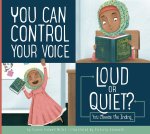
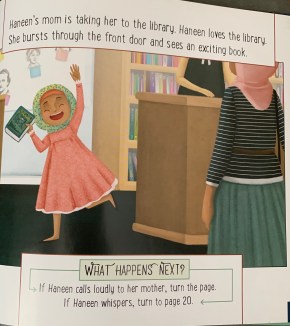
you can controlA choose your own adventure picture book, that doesn’t have anything Islamic specific, doesn’t seem to be written by a Muslim or illustrated by a Muslim, and that was found at the public library, starring a Muslim mom and daughter.  Oh hurrah for beautiful illustrations, teachable moments, volume control in a library and the fun to read the story and have control over what happens next.
91F3712F-C173-46C0-BD30-6B6814B951BA

This 24 page book meant for kids in kindergarten to second or third grade is part of a series featuring diverse characters learning universal manners and making good choices. To see Muslims represent a universal lesson in a relatable environment is a great way to normalize seeing women in hijab in real life.

685B4BFC-16EB-437A-842F-ED10B2580851

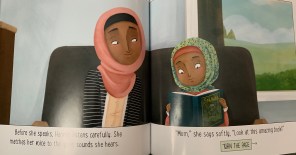
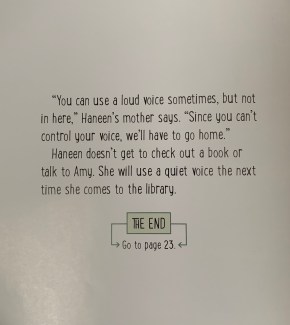
Haneen and her mom are at the library, and Haneen finds a book about fairies and cannot contain her excitement.  Immediately the reader has to choose what Haneen does next.  If she stays loud, the story ends rather quickly, but if she tries to keep her voice down, she might get to stay at the library a little longer.

9E7FC801-D531-42AA-9542-81C4BAF75364

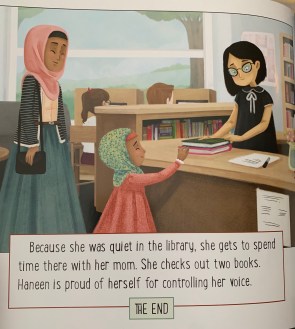
There is a big test when she sees a friend, and disturbs a gentlemen working on the computer, but if you make good choices Haneen gets to check out two books.  If your choices aren’t ideal you might have to just get the fairy book and get out, and if you really struggle to know how loud or quiet to be, you’ll have to come back another day and try again.

C00E287A-E463-427B-9AC4-C748681CC0F5

At the end of the book are some things to think about, to drive the point home.  I love the line, “We are all free to make choices, but choices have consequences.”  A great lesson for little ones, and a great reminder for older readers too.

3EF9066A-60F4-4A31-9E1C-19F228A0D7F4

The book is 9×8 and the expressions on the characters faces make the book a great option for circle time, story time, bedtime, and just to have on hands for kids to thumb through and enjoy.  Well done!

90F0B566-EE2F-490B-8D8C-3AD148BC0CE5

Internment by Samira Ahmed

Standard
Internment by Samira Ahmed

internment.jpg

The premise of this book is amazing, the writing and execution of it, unfortunately, falls flat.  The failure to set the stage, develop characters the reader cares about, and create a world in the near future that is both riveting and horrifying doesn’t come through in the book’s 387 pages written on an AR 4.7, but meant for high school aged readers grade nine and up.

SYNOPSIS:

Indian-American Layla Amin is 17 and since the census that her family honestly filled out and identified themselves as Muslim, their life under the new president has been shattered to say the least.  Her poet father lost his job as a professor, her chiropractic mother has lost numerous patients, Layla has left high school and they all live in fear.  With curfews and people they’ve known their whole lives turning on them openly, the book opens with Layla chooses to sneak off to see her Yemeni Jewish boyfriend, David after curfew.  The next day suits arrive to take the family to an internment camp in the desert, near the old Manzanar detention camp used to house Japanese Americans during WWII.

The new camp, Mobius, is the first one to house Muslims and the first of many slated to be built.  The detainees are divided by ethnic background, Layla’s FEMA trailer is in a block of other Desi families, Arabs a few blocks away, LatinX, converts, etc., all given minders to control them from within their own community.  As Layla whines about her cell phone being taken away and how much she misses David, a guard, Jake, takes pity on her and regularly risks his own position and Layla’s, as he sneaks her access to phones, gets her burner cell phones and even sneaks David in so the two can make out.  Somewhere along the way it seems Jake and Layla develop feelings for each other, but it really isn’t explored.  Layla makes friends and somehow becomes a revolution leader with her writing notes about life on the inside and having Jake and David get them to the media.

Those that speak out against their situation or complain, disappear and never return.  The Director of Mobius, ensures it.  In their refusal to eat dinner one night, and their protest at the front gate in front of protestors and the media, eventually Layla gets taken, but with her friendly guards, she finds she isn’t completely alone and that she just needs to be brave a little longer, stand up at the right time and get incredibly lucky to be successful in the revolt.

WHY I LIKE IT:

The President in the book is undoubtedly Trump, and I love the passages that reflect how the fictitious America didn’t become racist overnight, but that the leadership allowing it, ignited the ugliness that already existed.  It mentions making America great again and really sets the foundation of a simple “what if” that really could happen very easily.

The parts that struggle are the story elements, I really didn’t find myself cheering or even liking Layla, I didn’t find her charismatic or interesting, she was really whiney and flat to me.  I didn’t care one bit about her and David’s relationship, it seemed forced and completely not necessary.  A friend or concerned neighbor might have been more hope inspiring than a high school boyfriend she is brooding over to save her.  Her sneaking out and sneaking him in, all seemed selfish and juvenile for a character who in other arenas seemed pretty mature and level headed.  The disconnect is pretty prominent and I really cringed at all of the passages involving the two of them.

There are flash backs to life before the new President, but it isn’t engaging and doesn’t really highlight how horrific life is now, because the lack of character development and world building, everything seems like it has to be said, not shown.  Random characters at the camp would show up and then disappear, and we knew nothing about them, so there was no emotional connection or attachment to what happens to them, it really had so much potential to have heart and fear and insanity and it just doesn’t.

Layla identifies as Muslim, and lovingly recalls ayats and duas of her grandmother, but the family firmly believes that “there is no compulsion in religion” and thus doesn’t hide who they are, but don’t visibly display it in their clothing, or actions much either.  They don’t have a problem with their daughter having a boyfriend and they support it.  Layla and her mom don’t cover, but Layla does show massive respect for the Muslims that do.  Layla’s parents seem to pray, Layla doesn’t, but she doesn’t seem against it.

FLAGS:

Lots of kissing between Layla and David, a gay couple that disappears in the camp, flirting between various other characters, violence, oppression, language, death, beatings.

TOOLS FOR LEADING THE DISCUSSION:

I actually feel like this could work as a book club book because the discussion would be so great.  Yes, there are flags, but the relationship stuff is so annoying and awkward, I don’t think any kids will find it titilating or compelling at all. The writing is subpar, but the issues brought forth are important, and the students would have infinitely better plot lines for the characters that I think could make the books premise reach closer to its potential.

A letter from the Author: https://www.hachettebookgroup.com/articles/a-letter-from-samira-ahmed-author-of-internment/

Book Club Guide:https://www.hachettebookgroup.com/wp-content/uploads/2018/07/InternmentNovlBookClubGuide.pdf

Review podcast: https://teachnouvelle.com/internment-by-samira-ahmed/

There is a ton online, just google it and Happy Reading


I Say Bismillah by Noon H. Dee Iput translated by Shera Diva Sihbudi

Standard
I Say Bismillah by Noon H. Dee Iput translated by Shera Diva Sihbudi

i-say.jpg

Another adorable board book teaching the concept of saying Bismillah to the littlest Muslims. The illustrations are really sweet, and the text large and playful on their 5.5 square pages.  The story is simple, but because there is a story, and the word repeated, it does just what it intends to do and shows Bismillah being said before you start something.  It is worth noting though, that it never articulates why you say it.

IMG_8870

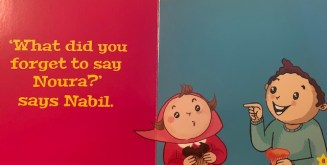
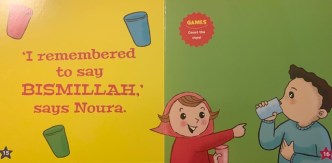
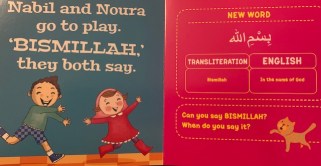
In this 20 page story brother and sister, Nabil and Noura are about to eat some yummy cupcakes.  Noura forgets to say Bismillah and her brother Nabil reminds her.  They both say Bismillah and then Noura says it before she drinks her milk.  Proud of herself for remembering, Nabil praises her as well, and they both head off to play after saying Bismillah again.

IMG_8871

I like that the siblings encourage each other and no one gets in “trouble” for not saying it, but rather they are gentle in their approach and it comes not from a parent or authority figure but from one another.

IMG_8872

There are a few “games” sprinkled in on two of the pages: say the colors of the cupcakes, count the cups.  There is also the word Bismillah written in Arabic at the end along with the English transliteration, English meaning and two questions: can you say Bismillah, and when do you say it, to verify comprehension.

IMG_8873

Thanks once again to Crescent Moon Store (www.crescentmoonstore.com) for their fast and friendly service and great prices.  There are four books in the series and they carry them all.

Satoko and Nada 1 by Yupechika

Standard
Satoko and Nada 1 by Yupechika

satoko.jpg

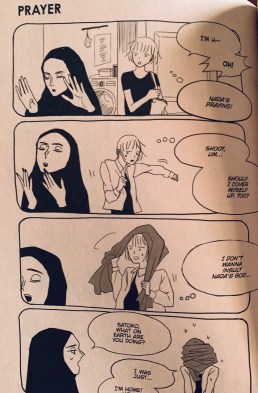
A manga series about two college roommates who have come to America to study, Nada from Saudi Arabia and Satoko from Japan.  Written by a Japanese author and translated into English, there is a lot about Muslims, particularly Muslims from Saudi, as the two characters get to know each other and become friends.  Their interactions work to dispel a lot of stereotypes and promote how rewarding getting to know people different from your self can be.  Volume one (there are three) is 127 pages, read right to left in four panel pages, and is fairly clean for all ages (they do buy underwear and bras at one point), but would most likely appeal to female readers in 4th or 5th grade and up.
8CE09DE5-2BEB-48C0-9157-96B13CC78CD9

SYNOPSIS:

The book is about two girls getting to know each other, learning about each other’s culture, and navigating life in America.  There isn’t really a plot or a story line outside of this basic framework, and with a heading every page or two it reads like a quick scene about the topic expressed in the heading.  So, for example there are headings of Veils, Ramadan, Birthday, MashAllah Choice, etc, and then a few panels showing the girls having an interaction about it, resulting in understanding, humor, or a lesson.

In a bit of a stereotype twist, Nada is more street savvy then Satoko when approached by a stranger for a ride, and thus Nada hasto educate her a bit.  The book brings in a Christian American character and a third generation Japanese character learning Japanese, to further show how assumptions plague as all and how simple conversation and an open mind, can lead to some amazing friendships.

WHY I LIKE IT:

The book is really choppy, but you get used to it and soon you forget that it isn’t a typical story.  I admittedly haven’t read a lot of manga so, I have no idea if this is the norm, or something unique.  I love that its upfront about stereotypes, if it was an American writing it, or a even a Muslim it would probably come across as preachy or arrogant, but somehow it doesn’t seem like the two characters have much baggage, nor feel a need to defend their culture by putting another’s down.  They deal with issues such as women driving in Saudi, differences between hijab, burka, abaya, niqab, being around alcohol,  the joy of a fatwa allowing soy sauce and its alcohol content to be permissible, etc.  Some things are cited for clarity and something are very Saudi, but it really contains a lot of information, about Islam that I am pretty impressed by.  There isn’t a ton about Japanese culture since I would assume it was written for Japanese readers, so it would be redundant, but I did learn, according to Satoko, how religion is viewed by Japanese, how putting age and gender and race on forms seems incredibly personal, and some information about food.

FLAGS:

There is a possible failed abduction, not sure what the guys intention was, but the girls treated it as such.  The girls do go buy undergarments, so they are visually depicted.  There is mention of alcohol.

2DF66805-A246-4150-89BA-E7E1EAF90E90
TOOLS FOR LEADING THE DISCUSSION:

I wouldn’t do this as a traditional book club, but I think I am going to get a copy of the series to pass around my daughters middle school group of friends, to

one- give them a taste of manga

two- see what they think of the Islamic rep from a Japanese paradigm and

three- give us all something to chat about

The book is fun, I got it at the public library and think it might open up a new book type for kids to try and a new point of view for many of us to consider.

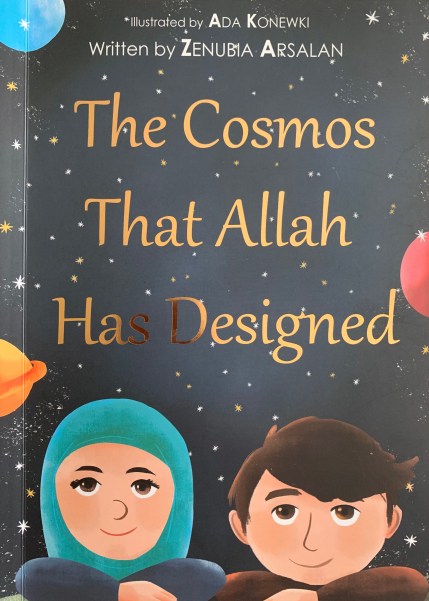
The Cosmos That Allah Has Designed by Zenubia Arsalan illustrated by Ada Konewki

Standard
The Cosmos That Allah Has Designed by Zenubia Arsalan illustrated by Ada Konewki

2E77412C-8D86-40DC-AC49-0409390CAD93

This 22 page beautifully illustrated picture book clarifies that it is not a science book, but rather an invitation to think deeply.  For ages 4 and up the rhyming pages will appeal to children’s sense of wonder and Allah’s perfection and precision.  Older kids will appreciate the journey through the cosmos and how limitless Allah swt is in all things.

1CE0C4F4-1AE9-4738-9D3E-BFAACA4A8186

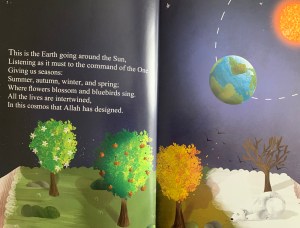
The book starts with Earth and how the spinning of our planet on its axis allows for the alternation of night and day, it then moves to how going around the sun at Allah’s command gives us our seasons.  But because it rhymes and is not a science book, the text is more imagery and tangible in nature, rather than a list of facts.

68DD1DA3-102B-417D-B24D-435B8DFC3FF0

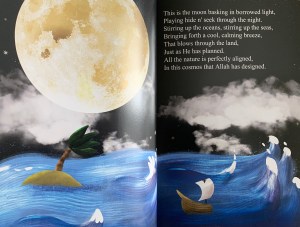
It touches on the moon reflecting borrowed light and the power and strength of the sun before moving on to the planets and gravity.

53909F77-D035-4FB9-BB77-3429E64A948E

It then extends out to the Milky Way and has a page on black holes before coming back to Earth for us to recognize how we only are a small part of something so much bigger.

31117DCF-73A0-4ABE-BD01-80AC92AA3843

There are two pages at the end with talking points, an ayat from the Quran, and emphasis that science and Islam are not at odds as Allah is the creator and governor of all things.

EFCD5023-940B-4D63-88FA-338A7F76C2D3

The book is 6×9 and with the beautiful illustrations I truly wish the book was larger.  Not only to dive in to the glossy pages easier, but also so that the book could be used at story time to small groups.  The tone is contemplative and marveling as it challenges the readers to find mistakes or flaws in the perfection of outer space. I love that science-y Islamic kid books are now available that appeal to children’s sense of wonder and understanding.  Really the only other suggestion I would have liked to see, would have been a page defining the word “cosmos” as it is used on every page, and while I think kids will figure it out as the continue through the book, I think it is a bit of a block for the younger readers.

The Broken Kingdom by H.G. Hussein

Standard
The Broken Kingdom by H.G. Hussein

broken kingdom.jpg

An engaging chapter book that blends adventure, friendship, battles, mystery, and faith over 292 pages of easy reading and rich storytelling.  The book appeals to readers 10 and up with it being completely clean and age appropriate for anyone younger who can handle the storyline.  The characters are not just active and practicing Muslims, but the story too, is Islamic in nature.   The story is unabashedly pro-Islam and slightly dogmatic, but not overly preachy and faith is woven in seamlessly throughout the story.

SYNOPSIS:

The Sultan of the Islamic Empire is having a recurring dream that involves a floating city falling when a flying object hits it, when he asks his guiding Imam what it means he learns that the city will be destroyed unless the Sultan assists.  Not knowing where the city is, what the object is, and trusting the Sheikh explicitly, a retired soldier is brought back in to service to find the city and save it.  Adam, before he leaves the capital is joined by two others to help him on his journey, Ali and Umar.  Ali is a quiet man whose voice when reciting is absolutely beautiful and whose eyesight and archery skills are unparalleled.  Umar is the Muezzin and the Grand Mosque and a seemingly close figure to the Sultan with familial ties to the area.  The trio sets off to Benghazi to talk with some Bedouins who were ambushed by some man-beasts and are too afraid to speak of the encounter.  It is believed that their experience and the dream are linked.

To reach Benghazi they must travel first by boat for about a week, while at sea they come across an abandoned vessel that has but one survivor and a lion aboard.  After the lion is killed and the injured man brought with them, they are able to continue to try and get information from the Bedouins.  Finally, the Bedouins and the trio are off to the place of the attack and the journey moves on.  When a rockslide and attack from these same mysterious beasts separates the group, Adam, Ali, and Umar are on their own to make there way through the mountains and figure out the threat on their own without the Bedouins.  They journey through a river within a mountain for days on end before meeting soldiers that take them back to their unnamed city.  The city is the one from the dream.  And as they must search to understand what plagues the inhabitants, how to defeat it, and how to survive, they suffer loses, confusion and only a few answers.   They do save the city from the immediate threat, but not from a larger looming one.

WHY I LIKE IT:

The book reads really smooth, a lot of self published chapter books are all over the place, and this one, sticks to the story pretty well.  There are a few tangents, such as the lion on the ship, that really have very little baring on the story, except to show maybe how good of an archer Ali is, however, most are mildly amusing and thus not terribly frustrating.  There are a few smaller incidents that make the book a little less cohesive, for example a passage about a man named Tarek, who brings the Sultan a message and is rewarded with gold, or such detail about Umar not being allowed to go on the assignment and then the Sultan allowing him to go, perhaps it is to show the Sultan’s generosity and willingness to take other people’s opinions in to consideration, but they aren’t particularly smooth anecdotes to the book and read a bit unpolished.  Often these little dives into side issues with fair amounts of detail made me think they would play a role later in the book, but by-and-large, they don’t. One that particularly stood out was Adam meeting the Chief’s daughter in the forbidden woods. I still really want to know why she and her children were there.  I also wanted more information about the man-beast figures and the man and woman that were so quickly killed, and the markings on the trees and in the caves (trying not to spoil too much), in the climax.

I love that the book is Islamic fiction from top to bottom, there are lots of morals exposed and teachings mentioned in real tangible situations.  The character’s pray and carry themselves at all times as Muslims and it is refreshing to read.  Characters in the book take shahada based on the manners of the Muslim characters and the readers see and understand repeatedly the power actions and values have in defining a person.  One of my favorite exchanges in the book is when Adam tells Ali, “The main reason for failure is manners.  To be specific, lack of manners.”  The details continue, and hopefully reinforce and articulate what parents everywhere are trying to teach their children.

The font and binding and all are adequate, I don’t love the cover though.  It seems this is the second cover, and I wish it was more eye catching, it is really bland, and unfortunately won’t compel readers to pick it up.  I also really wish their was a map.

FLAGS:

There is violence, nothing sensationalized or celebrated and it even mentions how heavy hearted characters should be about going in to battle and taking a life.

TOOLS FOR LEADING THE DISCUSSION:

I would love to do this as a middle school book club book. I’d love to hear how the students take the Sultan being referred to as Allah’s representative on Earth.  I get Leader of the Believers, and even Caliph, but I felt this description to be a bit grandiose.  I actually thought it was perhaps a Shia perspective, nothing wrong with that, it just wasn’t something I’d ever heard before and yes I assumed, but the author said, “Of course not.“  He then said, “The Caliph must ensure that the laws of Allah, Most High, are present on Earth.  Every Caliph represented the Creator ensuring Shariah was present, the same as every Prophet and Messenger.” Still not completely clear, I asked a trusted source (not Google) who said it comes from the Ummayads under Muawiyah. So, I’m not sure if anyone else would be hung-up on this, but it is something that stood out to me, although definitely not making the book something to avoid.

I think kids will have strong opinions on the mystery at hand being the book ends on a cliff hanger.  With a lot of questions still up in the air and no real right or wrong answer, I think discussing the book would be a lot of fun.

The book’s website: https://www.thebrokenkingdom.com/


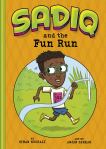
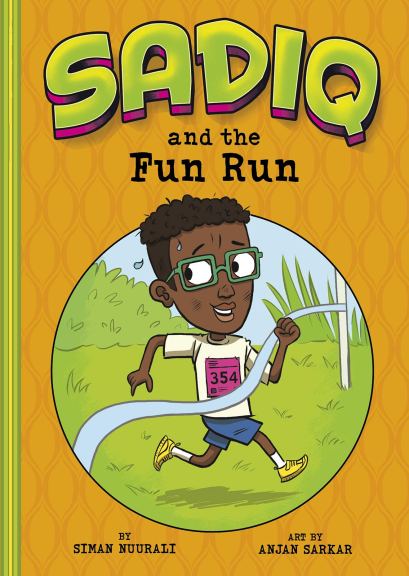
Sadiq and the Fun Run by Siman Nuurali illustrated by Anjan Sarkar

Standard
Sadiq and the Fun Run by Siman Nuurali illustrated by Anjan Sarkar

sadiq

This new series featuring Sadiq, a Somali American living in Minnesota, is great for early chapter book readers looking for representation and diversity.  There are four books about Sadiq, his family, and his friends and classmates in third grade, and all are either an AR 3.6 or AR 3.5.  At 57 pages long, divided into five chapters and filled with bright and colorful illustrations students in grades 1st through fourth, depending on reading level and interest, will enjoy these simple plotted, yet relatable stories.

F905B46F-CCAE-4094-A2C1-C7A66CD4B66F

SYNOPSIS:

Sadiq’s friends are all getting ready to try out for football, but his parent’s say that he is too young for such a rough sport and has to wait until he is 12 like his older brother, Nuurali, did.  Sadiq’s parents and family encourage him to try another sport, and with a new running club starting in a few days coached by a member of the national team, that’s what he opts to do.  Begrudgingly he joins the team, but is hurt when his friends talk about how much fun football is and how much more tough and difficult it is compared to running.  While this is going on, he is getting support from his brother to keep running, and from his teammates, but it is hard and he doesn’t enjoy it.  Slowly, he starts to improve, however, and with the Fun Run the climax of the book he sails across the finish line in first place when he sees his friends have come to cheer him on!

307C04CE-AE9B-4121-9DA0-04BE7302D795

WHY I LIKE IT:

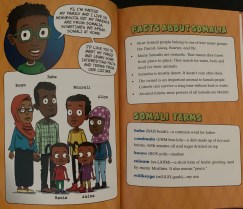
I love that the book/series proudly features a Somali-American-Muslim family.  There is information about Somali at the beginning as well as some Somali terms and a portrait with names for the members of Sadiq’s family.  The mom and older sister wear hijab, “Salaam” is one of the defined words and the characters use it when they meet.  I also love the diversity of skin tones in the illustrations and one of the girls on the track team wears a scarf as well.  There are Muslim named kids and non Muslim named kids in the story, and while Islam isn’t mentioned outright, it is definitely represented through the characters words, names, and appearances.

4F1421B3-B166-4B44-BB86-0DA161F5939F

The story is straightforward and perfect for the age group, the books in the series do not need to be read in any order, and you will get to see the different supporting casts featured more prominently in different books, thus getting to know Sadiq and his world.  I like that he doesn’t get his way, and doesn’t get to do what all his friends are doing, but he makes it work.  He is grumpy and upset, but he doesn’t get obnoxious or overly whiney.  I think this subtly gives readers some tools and insights to model in their own disappointments.  I also like that while he has to put in the work and fix his attitude, he doesn’t have to do it all alone.  His family and coach are supportive, and eventually his friends apologize and support him too.  For the simplicity of the book, you actually do get invested in his little trial and want to see the outcome.

3AC10F17-7A77-40AD-BC46-A57D4359D94F

FLAGS:

None, it is clean.

TOOLS FOR LEADING THE DISCUSSION:

This book is like a boy protagonist version of the Meet Yasmin books, they show a kid of culture in everyday experiences.  The target audience wouldn’t make it work for a school wide book club, but I think early elementary teachers would benefit from having the series in their classrooms and letting kids in small groups discuss if they want. These books would be great for first graders that are way above reading level and parents are struggling to find appropriate books.

The end of the book has some resources as well: a glossary, discussion questions to talk about and some to write down, as well as a home workout guide and information about the author and illustrator.

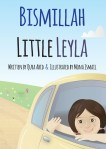
Bismillah Little Leyla by Qura Abid illustrated by Mona Ismail

Standard
Bismillah Little Leyla by Qura Abid illustrated by Mona Ismail

leyla

I thought this book might be leveled- reader type based on the binding and page numbers (26), but it reads more like a picture book with its repetitive refrain, and honestly the awkward small size (5×8) makes it feel like a pamphlet.  So, I’m not sure who it is trying to appeal to, and unfortunately is a great example of how the outward presentation killed an otherwise decent book.  I also don’t know who is to blame for the final physical product, the author, the publisher, the printer? But at a $10 price point, I’m not sure anyone who purchases this book is going to be happy with the size and binding, and the book will simply get lost on a book shelf, and be forgotten.

D2F8834B-35BD-4EDA-AD61-7DBBE81379C0

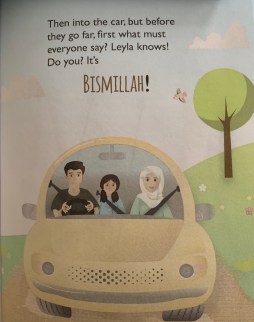
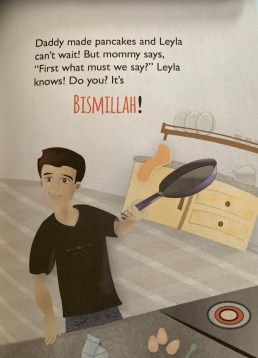
The premise of the book is good.  Rather than just tell kids to say Bismillah before they do anything, Little Leyla actually does it in the course of a morning.  I like that it shows that we say Bismillah before we do all types of things, not just before we eat or get in a car, but even when we swing and play a game or put on a jacket.

66AC3E97-BC82-4A6E-8E25-8E22F728E46E

The climax of the book is Leyla saying bismillah, shooting a goal and scoring against her dad.  The lesson being that Allah is always there to help us.

017585B3-7AD4-4769-AD6A-C218ECAE4A33

I’ve read the book a dozen times, to myself and aloud, and I think the book has a natural cadence based on the diction and sentence length, and I think it wants to rhyme.  Additionally, after each example and on nearly every page, the refrain at the end of the paragraph is (nearly) the same:  “What must she say? Leyla knows! Do you? It’s Bismillah!”  The repetition makes it memorable, but with the sing song beat and on and off, often forced, rhyme, I find myself tripping over the words a lot, and I cant quite put my finger on why.  If the book were larger, and I were using it for a preschool story time, I would just have to practice it a few times, but there is no way, sadly,  you could read this book to a group if you want them to see the pictures.

857FA476-B9FF-46D0-BBBA-035CBFADD7B1

The illustrations might be ok, it might also be a presentation thing that makes them look washed out OR maybe that is how they are, I’m not sure. The detail and expressions are there, they just kinda seem faded.   Concept wise I like that they show the dad cooking and Mom playing soccer. The mom wears hijab she the family seems warm and happy.

DD72FDED-2FB4-4E08-8275-22E7E7202728

Thanks again to crescentmoonbooks.com for the excellent customer service and selection.