Tag Archives: Family

A Map for Falasteen by Maysa Odeh illustrated by Aliaa Betawi

Standard
A Map for Falasteen by Maysa Odeh illustrated by Aliaa Betawi

img_5521-1

This 40 page OWN voice written and illustrated picture book for kindergarten to elementary, addresses the question and provides some answers that Palestinian diaspora children have faced for years, about the attempted erasure of Palestine by way of not labeling the country on maps.  The book does not name the occupiers, so hopefully it will avoid bans and censorship, as it does not shy away from articulating the taking of land, theft of homes, and renaming of villages.  The refrain is that “Palestine lives in you and me,” and that can never be taken away.  That the book stays on level and is traditional published is quite impressive for the contents contained. I love that their are resources as the beginning for adults to learn more, that Isha prayer is mentioned, The Proudest Blue is in an illustration, that rohi, omri and habibti are woven in, and the Author’s Note is detailed. 

img_5522-1

The book starts with little Falasteen at school, the class has a new map of the world and everyone is taking turns telling about where their families are from.  Let me pause here and say, this was my biggest, only real problem with the book, the illustration hints that the map is the rug, and the rug is just shapes of the continents, it is not a political maps that shows country boundaries, but I also read an e-arc so maybe something will change in the illustrations, but none-the-less, I note it here because it is the first page.  Moving on, when it is Falasteen’s turn she doesn’t see Palestine and when she asks her teacher, her teacher tells her, “I think there is no such place.” I wish I could say this is extreme, but I’ve been hearing similar conversations from friends for over 30 years, at least in the book the teacher isn’t mean about it, just ignorant, real life sadly, is often much more aggressive.  This is the catalyst though that prompts Falasteen to start asking her question.

When she gets home, she asks her Jido, who is tending the grape vines, why Palestine is not on the map, and he draws her a map to take to school the next day to share with her friends and teacher.  He tells her, her “teacher needs teaching.” Let me pause again her, I was initially a little surprised at this tone, and SPOILER that at the end it doesn’t circle back to her teaching her teacher and class, but on the second reading, I was glad for it.  No one should have to prove their existence, that is my bias of wanting to be accepted or palatable to an outside gaze.  Teachers all the time get asked something they don’t know and if it on topic will go and find an answer, to dismiss little Falasteen intentionally or out of ignorance regarding her home country, is not something that needs outside approval, or that needs to be proven.  Outside acceptance is not required in this example of reality. 

She then asks her Teta who is cooking in the kitchen, why Palestine is not on the map.  Teta tells her about when soldiers came with their tanks and guns, and burned their fields, and she had to leave with Falasteen’s mom in her arms to keep her safe.  She shows her the key that she keeps from her home that was taken, and how she longs to return.

img_5524-1

After Isha prayer, Falasteen asks her mother the same question.  Her Mama tells her that some places don’t need a map to be found, and that “Palestine lives in you and me.”  That even though Falasteen has never seen Palestine it is within her.  When she tells her mother that her teacher told her it doesn’t exist, her mom explains that those that say it doesn’t exist, that make the maps, cannot erase them, their memories, their culture. 

The remainder of the book is more hopeful and prideful of the places where Palestine is found and the hope that someday they can visit. I enjoyed the read, it is important, it is needed, and I hope you will preorder/order it to show your support.

Leena Mo, CEO by Deena Shakir illustrated by Nez Riaz

Standard
Leena Mo, CEO by Deena Shakir illustrated by Nez Riaz

img_5445-1

For ages four to eight this 40 page picture book really introduces great concepts of leadership, business, support systems, and dreaming big.  Before Leena Mo, leads a company though, she thinks up ideas to solve a problem, she turns her ideas into a plan, tests her hypothesis with her prototype, and takes her invention to the next step when demand grows.  Investors, employees, storage, sales, Leena Mo has not only created a product and a company, but she is leading a business, and inspiring others, even back in her Mama’s home in Iraq. With a Mama wearing hijab, a singular mashallah in the text, and the Arabic word for “my dream” Helmy being what she names her snow clearing robot, children everywhere will be inspired and encouraged to think a little bigger than they may have done before.

I love that this business concept is brought down to an early elementary age (and even younger), in a way that they not only will understand, but also be inspired by.  Younger kids might not get the steps, but the fun engaging illustrations, and simple text builds to show that the idea is also growing, and even four and five year olds will grasp that this is exciting.  There are books about science, inventions, even increasingly more about financial literacy, so this is in many ways a next step, that touches on those concepts, but really focuses on the investors, growth and leadership.  The story and concepts weave together, and that culture finds a place as well, is a testament to the quality of this solid, joyful OWN voice read.

The book starts with Leena playing outside in the snow with her friends, when her Mama asks her to shovel before it gets dark.  Leena hates shoveling.  She finds it worse than raking leaves, doing the dishes, and even taking out the garbage.  Instead of complaining though, she starts to dream up an idea of something that would make clearing the snow easier.  She decides on a robot, and gets to work designing and building and testing.

Once it works, a neighbor, Miss Irma, asks to borrow Helmy, and when she returns it, the rest of the neighborhood wants to know where they can purchase one of their own.  When Miss Irma invests in Leena and her team, the next phase begins and as parts turn into products, and equations determine cost, the team of Leena, Olivia, and Lily starts rolling out Helmies.

The sweet ending of inspiring others, will also hopefully inspire readers to think bigger, dream bigger, and recognize the role support,  teamwork, and leadership all play in bringing ideas to life.

The book can be preordered and soon ordered anywhere and everywhere books are sold.

Xavier’s Voice by Ashley Franklin illustrated by Tatiana Gardel 

Standard
Xavier’s Voice by Ashley Franklin illustrated by Tatiana Gardel 

img_5385-1

At 48 pages this picture book provides a tender window into a little boy with anxiety, a small voice, and a huge imagination.  I absolutely love that Xavier is the star, the other kids are not mean or overly nice, they are important, but at the story’s core is him finding his confidence, and accepting himself, through his love of superheroes, sketching, and imagining what-ifs.  Xavier is Muslim, there is an “Assalamu Alaika” on one of the pages from another character to him, a superhero by the name of Super Saleem, and Islamic decor in the illustrations in his home.  Religion is not centered or explored in this Muslim authored book, but Muslim readers will see the subtle hints and feel seen immediately.  I love that Xavier discusses coping techniques his therapist has taught him to help with his anxiety and that the tone is empowering and positive.  A good story for kindergarten through second grade, and a great way for kids with anxiety to see themselves represented, and a window for others to grow their empathy and compassion.

The book starts with Xavier at school, which is loud, and wishing that he could make his small voice big.  He notices the big voice kids, have lots of friends, and he can’t seem to find the words when people talk to him.  He gets nervous, and as a result, he is lonely.  One day he discovers Super Saleem and that inspires him to create his own superheroes that are unstoppable.  When raindrops start to fall, a new kid, comes to help, and BJ likes Xavier’s drawings.  Xavier wonders if he has finally made a friend.  The book shows that even when things are going well, there can be a lot of worries, stresses, over thinking, and missteps. But being brave to keep trying, can have super results.

img_5388-1

Sam(ira)’s (Worst) Best Summer by Nina Hamza

Standard
Sam(ira)’s (Worst) Best Summer by Nina Hamza

img_5254-1

The first 15% of this 336 page book were rough, the internalized Islamophobia/othering, the excessive discussion of Halloween and being toilet papered, but then I don’t know, something suddenly changed, and I was hooked.  There really is no plot, the reader just spends the summer with Samira, the highs the lows, you see it all through her tween eyes, which worked great for me because I truly loved her voice.  Her dry witty humor, the short choppy chapters, once the forced Islamic rep faded (I know, the irony is not lost on me), the book was hard to put down.  It has Muslamic flags: music is a HUGE part of the book, there is lying, mention of beer, parties with boys, Halloween, dancing, bullying, racism, ageism, Islamophobia, stereotypes, but it also has a lot of heart, finding yourself and voice, amazing sibling support, community, a super grandma, a little brother who is on the spectrum and absolutely a star who holds his own. It is very idyllic even for middle grade, but I think if you are ok with the aforementioned flags and have a middle grader trying to find their place or has had some friend trouble, this book will resonate and be well loved.

SYNOPSIS:
Sam/Sammy/Samira is wrapping up a school year that did not go as planned even though she found she loved being a photographer for the yearbook. She had a huge falling out with her best friend Keira, and she cannot wait for a summer of never leaving her room.  Her parents and older sister are heading to India, leaving her with her little brother Imran, and Umma, their Grandma who came from India to watch them. The end of school culminates with the yearbooks being delayed, her house being toilet papered, the talent show performance that she quit- being completely changed and incredibly racist, Keira spreading lies, and a new girl moving in to the neighborhood.  It is a lot for Samira, and summer is just getting started.  Umma knows the whole neighborhood before the week is out, and starts building a community that rallies around the three of them.  Samira becomes a roadie for a band, Imran gets an old artist to teach him to paint, parties are planned, voices are found, friendships are established, and videos are made celebrating the success and obstacles of it all.  Every time they call the rest of the family in India, even the reader realizes just how much they all have grown.

WHY I LIKE IT:

I just love Samira, she is relatable, funny, and you just cheer for her. I wish her lens though was Islamic.  She doesn’t wear a swimsuit because she misread the dress code, but had no Islamic perspective hesitation of going to a swimming party with boys.  She gets blamed for sneaking beer to a gathering and it says she doesn’t drink, but doesn’t stress, that it would be a huge, huge deal Islamically, not just because she is underage.  Music and dancing aren’t even blips on the radar. Umma prays, Sammy finds it annoying that her prayers seem to take longer when Sammy is waiting for her.  Once it mentions that Sammy was told to pray, but it never shows her praying.  Islam seems very forced, just enough for the character to mention Islamophobia in other instances where the label creates stress for the family.

The character development of Imran and Umma, even though they don’t change at all, has depth and grounds the story. I read a digital copy that doesn’t have any backmatter, but I do hope that the autistic rep is accurate.  Imran’s perspective and heart are so engaging and his and Samira’s relationship is very tender.  There is no pity, or looking down, he legit is fully fleshed out and awesome.  Umma is incredible too, her magic network of getting things done really is a super power.  She connects with people, has a huge heart, and picks her battles.  I wish I could take an internship from Umma.

I can’t figure out if the resolution to the “climax” is intentionally understated because Samira has moved on and grown, and having a big explosion doesn’t fit her character, or if it was just not written strong enough.  That is why I put climax in quotations, because there really isn’t a lead up, or rising action, it is a progression, but it is like the rest of the smaller ups and downs, it is just a stress of the day-to-day living of the protagonist.  The other thread of the “climax” being Alice’s grandma coming home from the hospital, really just seemed weak.  She should have come to the party in her wheelchair, I really didn’t get why it centered the party for being for her, but then let her leave.

I like that Keira wasn’t given redeeming qualities, and her treatment of Samira was never justified.  Often the bullies are shown to have hard lives, which is fine, but sometimes they are just mean.  Samira really takes the high road in handling Keira and what she wants their interactions to look like in the future, which is much better messaging than most books about bullies contain, and I really appreciate that.  

FLAGS:

Bullying, racism, stereotypes, lying, Islamophobia, agism, mocking, teasing, music, dancing, vandalism, mention of Halloween and beer.

TOOLS FOR LEADING THE DISCUSSION: It wouldn’t be possible to do this as a book club selection in an Islamic school because of the music element, but depending on the school, it might still be ok to shelve in classrooms and the library.

I’ll See You in Ijebu by Bunmi Emananjo illustrated by Dian Ejaita

Standard
I’ll See You in Ijebu by Bunmi Emananjo illustrated by Dian Ejaita

img_5253-2-1

As a window into Nigerian life, this 32 page book is beautiful, celebratory, and an incredible resource to learn from and emerge yourself in, as the beautiful pages, and delightful language sweeps you away to Ijebu and Olu’s grandparent’s house for Eid al Adha.  As a Muslim, this book’s framing might require some conversation with little ones that may or may not be right for your family.  The protagonist in the book, Olu, is Catholic, her siblings and parents are as well, her mother’s family however, is Muslim.  The multi-faith family celebrate each others’ holidays, for example Olu goes to the mosque to pray after taking communion at church, and the cousins haven’t seen each other since they came to Lagos to celebrate Christmas.  Eid al Adha is celebrated with a big meal, prayers, and being together, but nothing specific about belief or doctrine is included in the text. The tender heart of the story is the subtle bond between Olu and her grandfather, Baba, even though language differences prevent them from talking. The writing style is as beautiful as the full page illustrations, with part of each page dedicated to more traditional story telling, and another complimentary part expressed in a more lyrical fashion that reads often like a song.  The backmatter is robust with information about Nigeria (including a map), Food, Fun, Faith and Family, Oriki, Fashion, an Author’s Note, a recipe for Puff Puff, an Illustrator’s Note, and a list of people who helped create the book. The book is OWN voice written and illustrated, but I do not think either are Muslim, and while the publisher lists the book as being for ages 4-10, it is a bit text heavy, so take that into consideration. 

The book starts with Mummy calling Olu and her brothers for breakfast.  Daddy is in America at their old home visiting his brother, and today they are going to Ijebu to visit Baba and Iya Akin for Eid.  This year Olu is eight and will finally get to help make the Sallah feast. The traffic is bad in the hot weather, with smells of vendors cooking filling the air.  The family listens to Afrobeats and 90s pop music until they are finally there.  When they arrive Baba is waiting and sings Olu’s oriki as they embrace.  Food is a big part of visits to Ijebu, as they pick ripe cashews, sugar cane, guavas, and mangoes on Baba’s farm.

When it is finally Eid the family walks to the nearby mosque for prayers in matching outfits.  Then it is time to cook the two rams for the Eid feast.  Olu is going to braid the ram intestines.  It is a lot to cook and a lot to eat. When the week is over, and it is time to leave, once again it is Olu and Baba’s hug that make the love tangible and the book emotional as they say their wordless goodbye.

Sami’s Special Gift: An Eid al-Adha Story by M.O. Yuksel illustrated by Huseyin Sonmezay

Standard
Sami’s Special Gift: An Eid al-Adha Story by M.O. Yuksel illustrated by Huseyin Sonmezay

img_5215-1

This sweet 32 page story, blends themes of loss, grief, giving, homelessness, Islam, Eid al Adha, and joy with simple early reader level text and beautiful illustrations. The book never gets preachy and doesn’t other, making it a great addition to all shelves, everywhere. There is information about Eid al Adha and what a homeless shelter is in the backmatter along with a glossary that explains, Islamic and Turkish terms.

Sami loves Eid and celebrating at the carnival with Dede, his grandfather, but this year, Dede is not there, and Sami is sad. When a package from Nene arrives from Turkiye with Dede’s favorite sheep decorated Eid tie for Sami, things start to look up. Sami never wants to take it off, and even wears it over his new Eid clothes as they head to the mosque for prayers. After salat and before the carnival, the family visits a local butcher and picks up meat to take to the homeless shelter.

Sami has never been to a homeless shelter and has only heard of his parents going and helping there. He asks his parents about it on their way and once they arrive heads off to play ball with a boy, as his sister shares her doll with a little girl. When it is time to leave for the carnival, Sami imagines what the his life would be like if he lost his home and belongings, and makes a decision, knowing exactly what his Dede would do.

img_5218-1

I love how the book weaves in information about Islam by having the family praying, listening to the imam, wearing new clothes, and giving in charity, without pulling out of the story. Same for the Turkish cultural inclusions of food and words. I also like that in the illustrations the mom wears hijab when out of the house, but not inside. It all comes together smoothly and is unapologetic, even while handling the sadness of his grandfather no longer being with him, the empathy at the homeless shelter, and joy at the carnival.

My only concern is when it says both in the text and in the backmatter that meat is given: one third to friends, one third to family and one third to the poor. I don’t know that it is wrong, but to clarify you keep one third for yourself (and family), and distribute one third to friends, and one third to the poor. Additionally, I also know a lot of people might not love the illustration style, but the picture of them in the mosque, won me over.

Sheba: The Good Muslim Cat by Carima Elfarrah illustrated by Aaron Yusuf

Standard
Sheba: The Good Muslim Cat by Carima Elfarrah illustrated by Aaron Yusuf

img_4999-1

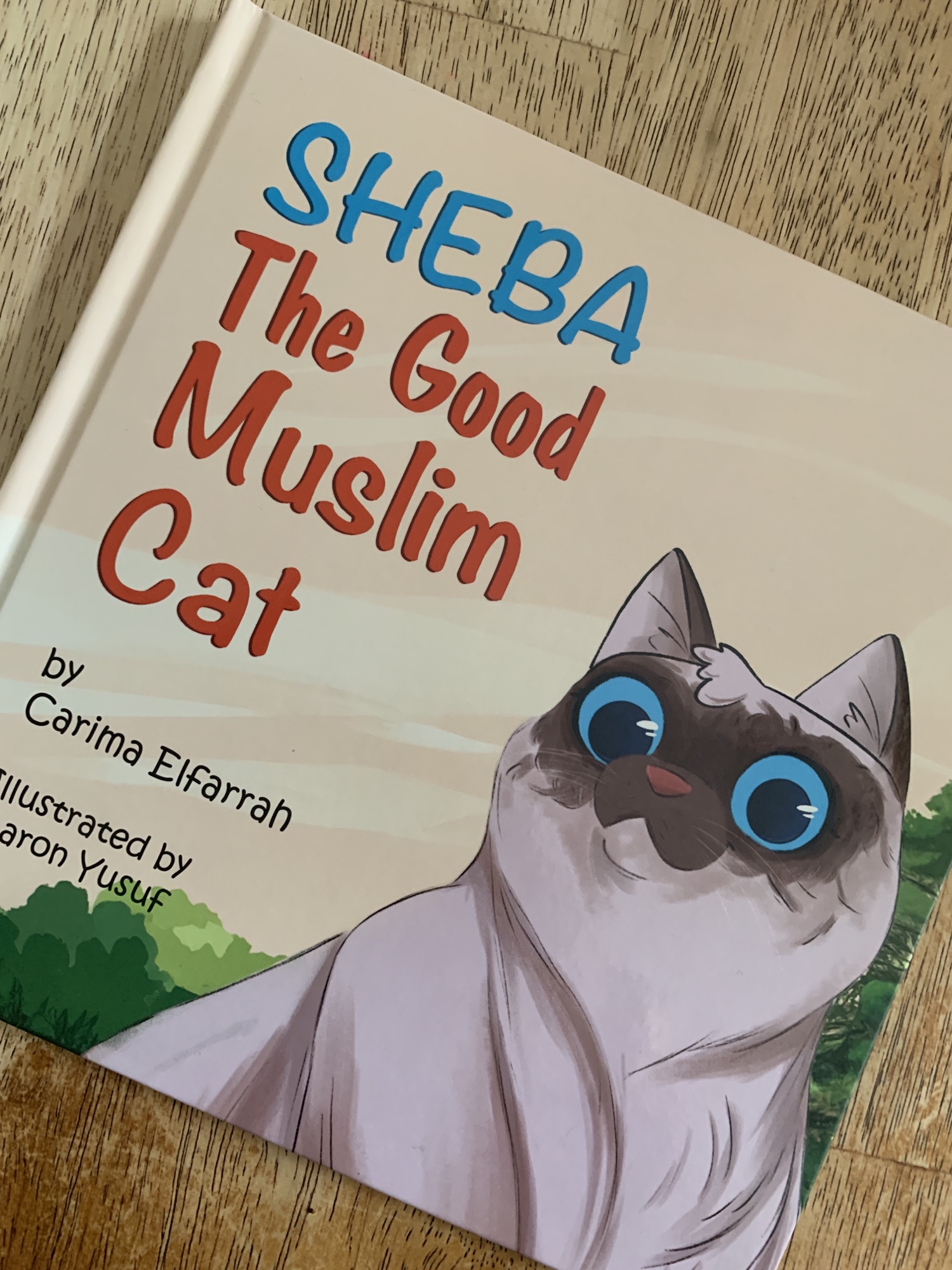
I was really looking forward to this book about Muslims and cats.  Every masjid seems to have cats all over the world, and while feline friends often sneak into Islamic fiction books about other things, I liked the idea of giving a cat the spotlight.  Alas, the rhyming text, the examples given, the inspiration shared in the backmatter, the angel imagery, and the ambitious glossary made this small 8×8 inch 32 page picture book rather off putting and ultimately forgettable unfortunately. The cat remains at the family home, and basically just hangs out with the family when they read Quran, pray, get up for fajr, and the cat is patient when waiting for food or water.  Sure it makes it a nice cat, but with a title implying this cat is a “Good Muslim,” I really expected more.  I appreciate the hadith at the end, but it is not sourced, and the cat with a halo and wings signals Christian imagery, that doesn’t align with the tone of the book.  Additionally, the idea of the book comes from a story of a Syrian scholar who had a conversation with a cat. I’m not saying it did or did not happen, but it seems a little bit of a stretch for my cynical brain.  The book reads for toddler and preschool Muslims, but the glossary reads copy and pasted from Wikipedia for non Muslim adults.  The small size makes the book impossible for group story times, and it can be hard to read at times because the text often runs over the pictures making it hard to see.  Ultimately though, while my toddler enjoyed it well enough the first time, he has not asked for the book again despite it sitting on my side table for weeks, which is probably more insightful than my review.

The book starts with a young boy introducing his family cat, Sheba, who has sapphire eyes. The family is Muslim and the boy is confident his cat is too because she hangs around his dad when he reads Quran, she comes running when salah time comes, she plays with the imam (the dad) after the last salaam, and she waits patiently for food and water when her bowls are empty.  She cries at fajr to wake the boy up and he hopes that on the day of judgement she will attest to the good the family did for her.

The backmatter includes the story of Shiekh Shukari, a scholar in Damascus that spoke to a cat, then a two page spread glossary, and author and illustrator bios. The illustrations aren’t particularly spectacular, the boy at the beginning seems much older on some of the pages compared to others, although his clothes stay the same.  I didn’t like the angel imagery, perhaps I’m erroneous, but none-the-less it felt off to me.

Birthday Kunafa by Rifk Ebeid illustrated by Noor Alshalabi

Standard
Birthday Kunafa by Rifk Ebeid illustrated by Noor Alshalabi

img_4902-1

This 50 page wordless picture book allows readers to make up their own words to describe the progression of what is shown in the illustrations. With no right or wrong, the backmatter helps give context and points out key images that allow the story to resonate on multiple levels.  On the surface it is a birthday girl who is upset she cannot have kunafa, but when you truly look at the pictures, and see what is preventing her from moving from Jerusalem to Nablus, the reader is shown, she is not just a child wanting something she can’t have, but that she is being denied basic rights by an occupying force.  I love that the little girl represents so much more than just herself, and that her determination to cross checkpoints, is not just about acquiring dessert.  The book starts with a little girl on her birthday that could represent a little girl with her friends and family anywhere, but as the pages are turned you witness how beautiful Palestinian joy is, how much we take for granted the freedom to move, and how desperately we need to stand up for a free Palestine.  With no words, Islamic representation is limited to two hijabis in the illustrations.  The author and illustrator are Muslim. The book centers a birthday, there is dancing dabkah and an oud shown leaning up against a wall.

So often when thinking about Palestine, not just since October, we all find ourselves speechless.  There are no words, only tears when watching the news, reading headlines, or scrolling, and I find it incredibly timely for a wordless picture book about Palestine to be published.  There are a few labels so to speak throughout the book that I didn’t particularly find necessary, but they do not distract from the story, so they didn’t bother me.  I like that the book showed restraint in terms of the oppression that could have been shown.  It allows for the story of the little girl and her family to maintain the narrative.

The story that I understood the images to be telling is that it is a little girl’s birthday, the family is having a party, they have a birthday cake, but she wants kunafa, she tries to get some and along the way sees joy everywhere, until the checkpoints turn the images gray, and prevent her from moving forward.  So mama and her problem solve, they try and make their own, but it is not the same, so they devise a plan, and they try again.  They do not give up. There is no giving up.

The backmatter provides a recipe for kunafa, a two page spread about “Why Wordless Picture Books,” another spread about “Context Matters” giving information about Zionism and Palestinian resistance.  It is then followed by four pages entitled “Did You See?” where symbols are shown that appear in the pages and described.  Warning there are numerous sweet and savory foods shown, and it will make you very hungry.

The book is available here from Crescent Moon or here from Amazon.

This Book Won’t Burn by Samira Ahmed

Standard
This Book Won’t Burn by Samira Ahmed

burn

It is clear that this 384 page contemporary YA book is about the hot topic of burn banning in America, and I would imagine most are aware that the overwhelming number of books that have been recently banned or pulled because of objection, are by BIPOC and queer authors featuring BIPOC and queer themes and representation.  So I read it not so much to see the author’s perspective, but more to see how the Muslim author had the Muslim identifying characters in the book approach the topic.  The book is very black and white: book banning is wrong, Republican right wing MAGA members are fascist, and liberal freedom of speech supporters are LGBTQ+ identifying and allies and upholder of first amendment rights.  Islam and the character’s Indian heritage is ingrained in the characters’ being, and a label they are comfortable with, unfortunately, it has no impact on how they act, think, or the lens in which they view their world. Every 50 pages or so some vague mention of Ramadan, or a tasbeeh, or mosque appears, only to disappear just as abruptly. The Muslim protagonist, Noor, likes two different boys, is often alone with one or the other, nearly kisses both, and with the support of her family attends prom. Her younger sister, Amal, is unsure if she wants a boyfriend or a girlfriend, it is not a major part of the story and is just mentioned in passing.  A major side character is lesbian, and starts a bit of a relationship with another girl, they hold hands, and there are a few kisses on cheeks, nothing overly detailed.  There is profanity in the book, arson, threats, racism, and stereotypes.

SYNOPSIS:
Noor and her family move to a small town from Chicago when her dad abruptly abandons the family.  It is the end of Noor’s senior year, and with the grief, stress, and emotional upheaval of her family, Noor just wants to get to graduation.  Quick friendships with Faiz and Juniper, and realizing that she is the daughter of her activist parents though, thrusts her into making enemies her first week in the conservative town by questioning the school’s book banning policies. Add in her strained relationship with her mom, her conflicting feelings for Andrew and Faiz, and her sisterly concern for Amal, and Noor has a lot on her plate as she shakes up a small town.

WHY I LIKE IT:
The first chapter is incredibly written, no doubt.  I hated the dad, actually more than that, I was so disappointed in him, and so concerned for Noor, Amal and their mom.  To feel such strong emotions for characters just introduced is a testament the author’s abilities.  Sadly, insight into why their dad left never came, and  perhaps no answers is something the characters had to grapple with, but as the reader, I felt it wasn’t really explored, or articulated, it just was unresolved, and I really wanted some closure.  In terms of literary quality, the book went down hill pretty quick for me.  The middle was slow and repetitive with the heavy handed views on book banning.  Some shades of gray, or some discourse would have prodded the readers to maybe think about the implications of banning books, but the narrative never allowed for that.  It is right vs wrong, us vs them from the start.  There really is no growth of the protagonist, she doesn’t have much of a character arc, and the supporting cast is not fleshed out.  I wanted to see more of Noor and her Mom, not just be told repetitively how absent she is, I wanted to see Faiz as a full person, not just the only other brown Muslim at the school and who likes to cook. Where are his parents, do they support his activism, that he is going to prom? Truly, there is no Islam in practice it is just a label that gets dropped when it furthers the notion of raging against an established bias system.  I’m not saying they need to be praying and reading Quran on every page, but I don’t know that the story would be much different if the family was not Muslim Indian American. Really the catalyst is that they are a new family, and a visible minority.

FLAGS:

Straight and LGBTQ+ relationships, arson, threats, stereotypes, racism, bullying, cursing.

Our World: Pakistan by Rumaisa Bilal illustrated by Nez Riaz

Standard
Our World: Pakistan by Rumaisa Bilal illustrated by Nez Riaz

img_4412-1

This 20 page board book doesn’t come out for a few months, but it really is adorable, and I love that it centers Islam, so I’m putting it on your radar hoping you might preorder to show your support.  This ever growing series highlights different countries by OWN voice authors, focuses on simple text, cultural insight, linguistic samples, and bright illustrations.  The book follows a little girl from morning to bedtime and then highlights parts of the unique cultural aspects shared in the back-ish matter.

img_4413-1

The book starts with Subah Bakhair, good morning, written in Urdu and English, before AllahuAkbar and prayers are made. Then it is time to get dressed and deciding what to wear.  Little brother is in a swinging cradle, and paratha and lassi are shared with family.  The little protagonist then heads on the driverless orange trains with her Dada, grandfather, to do some shopping, concluding with bedtime du’aas.

img_4415-1

Board books are a little tricky for me as if they are more than just a few words on a very basic topic, they seem to be really jumpy or really wordy.  If they manage to not have long blocks of text, and stay on the intended audience’s level, they seem to be random in what is included.  This book is no exception. I am not sure how the words were chosen to include in Urdu script, why some words are given for specific things like shalwar kameez, but not for the joolah.  Not sure why the bathroom, getting ready for bed scene is included, and why lota is highlighted in the end, either.  I’m sure to someone else it seems logical, there is nothing “wrong” with it, it just seemed a little disjointed from the rest of the inclusions.

img_4416-1

I love the illustrations, they are engaging and joyful.  Desis have a decent amount of rep in children’s books, but a board book dedicated just to Pakistan widely available here in the west, that is OWN voice, features Islam, and well done, really is delightful to see, alhumdulillah.

img_4418-1

You can preorder your copy here

img_4417-1