Tag Archives: Family

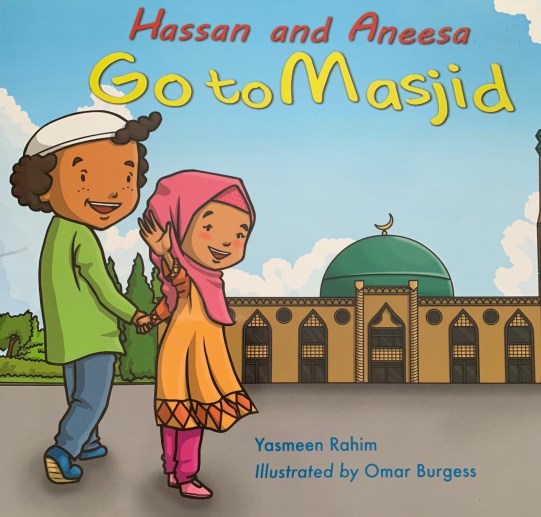
Hassan and Aneesa Go to Masjid by Yasmeen Rahim illustrated by Omar Burgess

Standard
Hassan and Aneesa Go to Masjid by Yasmeen Rahim illustrated by Omar Burgess

IMG_1911

I don’t often do two books in the same series, let alone three, but for as much as I enjoyed Hassan and Aneesa Love Ramadan and Hassan and Aneesa Celebrate Eid, I was a little disappointed in this story.  For starters, the title seems like it should read, Go to “the” Masjid, no? 

IMG_1912

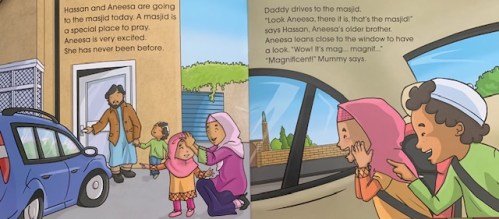
The story starts off with the notion that this is Aneesa’a first time to the masjid, which seems bit off.  Presumably mom and Hassan have been before, but mom’s excitement, and Hassan’s questions through the book, and knowledge about masjid etiquette make you wonder if it is their first time too.  A little odd, if you’ve read their other books, but ok, I’ll accept it and move on.

The family starts by marveling at the exterior architecture.  They enter and separate, Hassan going with his dad and Aneesa going with her mom, as it points out that men and women pray in separate areas.  It is a good tidbit of information, but again, it just seems a bit off in the way it is phrased that Aneesa wouldn’t know this.  

IMG_1913

The tone of the book is almost negative, again, a striking contrast to the other stories.  Aneesa splashes and wastes water when making wudu, doesn’t she make wudu at home? And the mom gets her clothes ruined in the process making her upset.  The illustration shows her to look really mad!

I would think a little context about not wasting water or even sharing the hadith about not wasting even if making wudu in a river, would have been a great lesson to convey, but instead the pictures show a lot of water by others also being wasted, and only mom looking really frustrated.

IMG_1914

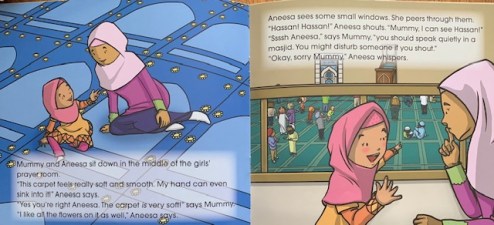
The two of them, put their shoes up and marvel at the dome and the soft carpet.  Aneesa then sees that the ladies prayer area over looks the mens and she begins screaming for Hassan.  Her mom corrects her and points out that “you should speak quietly in a masjid.  You might disturb someone if you shout.”

IMG_1915

Hassan turns and waves, and then rushes off to see a school friend.  But, first he is reproached for nearly walking in front of someone praying.  Again a good tidbit, but the phrasing of how the information is shared is rather negative, and these repetitive reprimands don’t make the book joyful.

IMG_1916

Hassan then learns about he mihrab and the mimbar before the athan is called and they all pray.  After salat they put some sadaqa in a box and the family heads home.

The illustrations are as sweet as ever, and the price very reasonable, but this book, compared to others in the series, is really wordy and there is a lot of text on EVERY one of the 20 pages.

IMG_1917

The framing of the book is awkward, thus making some of the behavior issues come off as negative, it is a minor thing that keeps the book from being great.  If the premise would have been maybe the kids talking about their favorite things about the masjid and reminding themselves to talk quiet and not waste water, the tone overall would have been lighter while still being really informative.

IMG_1918

If this is your first Hassan and Aneesa book, you might not be bothered, but if you find it a little off putting, try the other two.  The books says for ages 2 and up, but I think it would be better for 4 and up.  The younger kids you could tell them the story while showing them the pictures: what to expect at the mosque and how to behave, but there are too many words, and they will probably have a hard time staying focused.  Older four and five year olds, will enjoy seeing things they recognize and maybe learning some of the vocabulary for the architecture and being reminded on proper behavior at the masjid.


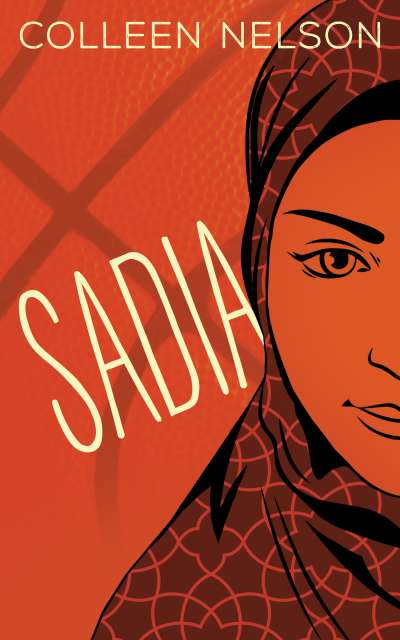
Sadia by Colleen Nelson

Standard
Sadia by Colleen Nelson

sadia.jpg

A middle school sports book with a female lead who wears hijab written by a non muslim.  The book could really go a lot of ways, I held my breath for all 239 pages waiting for something to go totally awry, and thankfully it never did.  In fact I read the book nearly straight through and while meant for ages 12 to 15, I quite enjoyed it.

SYNOPSIS:

Ninth Grader Sadia Ahmadi is an immigrant from Syria, her family left before things got “bad,” and while she has adjusted to life in Canada, High School is testing her in other ways.  Her best friend Mariam, an immigrant from Egypt, has started dejabbing, taking off her hijab to fit in it seems any chance she gets.  This is taken as a betrayal by Sadia and their friendship waxes and wanes throughout the book as each girl has to figure out who she is in relationship to hijab, and how to judge and/or accept each other and their choices.  Throw in a new refugee girl Amira from Syria who doesn’t speak English, a co-ed basketball tournament that doesn’t allow any headgear to be worn during games, a cute boy on the team and an awesome teacher with interesting assignments and you have the book in a nutshell.

WHY I LIKE IT:

I like Sadia, she is believable and strong.  She is well liked, athletic, she has a good relationship with her parents, brother and teachers, she prays and fasts and owns who she is, but she isn’t perfect.  She is hypocritical at times, and acknowledges it, she is tempted by parties, and boys and taking off her own hijab to play ball, and has to confront it about herself.  She doesn’t do things like pray on time, like she knows she should, but there she is and I am so impressed that the author picked up on so many nuances of Muslim life in her research or in her own observations as a teacher.  Yes, Amira has an awkward observation about Miriam being Muslim and not wearing hijab that seems really one dimensional considering large numbers of Muslims in Egypt and Syria don’t cover, but I don’t know if that was the author’s attempt to draw the issue to the light or if it was just a misstep.  

I like that there is a cute boy that accepts Sadia and who she likes as well, but they don’t do anything.  So often, these books become overrun by the romance story line and this one doesn’t, thankfully.  It seems to find a realistic balance, that she has feelings, but isn’t going to act on them, and based on her mom figuring out when she is lying that she won’t try and sneak behind her mom’s back.

Issues of halal food are mentioned in passing and it fleshes out that the girl is Muslim, not just going through the motions.  At times it is hard to know if her choices are based on belief and faith or expectation, but for an early YA/Middle School book, I think it suffices.  She mentions modesty as a reason for hijab, but also a lot of parental and cultural expectation.  One central theme the reader just has to go with, is that Sadia and the rest of the characters in the book, and there are a fair amount of Muslims, don’t know about any other ways to wear hijab for sports.  I get that Mariam and her sewing ability is a huge arc in the story, but they have smart phones, and its a contemporary piece, they have to know about Ibtihaj Muhammad in the Olympics, Bilqis Abdul-Qaadir, and Nike making athletic hijabs.  So, to make the story work you do have to turn a blind eye to the fact Muslima’s have taken to sports in the mainstream and that there is no way they can all be that clueless about her fabric, style, and covering options.

I love that the issue of refugees is addressed in the periphery, and the issues are given a human face.   I love that Sadia’s parents are religious, but not left as simple stereotypes, they deal with Islamaphobia, but aren’t looking for sympathy.

There is always the case, that the hijab becomes a stereotyped item as the story involves characters torn to wear it or not, but I loved how judgements were called in to questions and there wasn’t an easy answer.  The side friends in the story are all way too good to be true, but I think the whole book has a bit of a pollyanna feel to it, and in this case it was ok to error on the side of kindness than become overtly sensationalized and whiney.

The biggest hurdle this book faces is, is it the author’s story to tell. And I don’t know, I review a lot of books, and many are by Muslims and they get stuff wrong in my opinion, or they go so extreme to be accepted.  So, I don’t know, I think the book had heart, I didn’t know if the tournament would let Sadia play, I didn’t know if she would sneak off to the party, I didn’t know if she would cross the line with Josh, and I was curious, and invested and sucked in to it all.  Is it a book to teach others about Muslims or a book for Muslims to see themselves? I think all of the above.  Muslim’s should control their own narrative, but I think when author’s get so much right, we have to take some reassurance in the idea that we are being accepted by the larger society, and our stories are being told with love by other’s too.

FLAGS:

There is romance and lying, but no kissing, just hints at emotions or an errant arm flung over a shoulder during a huddle or photo.  There is mention of drinking at the parties, but Sadia doesn’t end up attending.

TOOLS FOR LEADING THE DISCUSSION:

I don’t know that I would do this as a book club selection, but if I met the right group of kids, I would definitely reconsider.  There is a lot of basketball, which I quite enjoyed, but I could see other’s maybe getting bored by the play-by-play.  I’ll make my daughter read it in a few years, and I look forward to discussing hijab and how she feels about it after.  It does raise the subject, and ask you to check your judgements on yourself and on others.

Author’s Website: http://www.colleennelsonauthor.com/


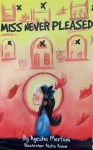
Miss Never Pleased by Ayesha Marfani illustrated by Aisha Aamir

Standard
Miss Never Pleased by Ayesha Marfani illustrated by Aisha Aamir

IMG_1860 (1)

I’ve been accused of being brutal in my reviews.  And while I don’t enjoy being mean, I do take some pride in the attribute, as I am paying for these books myself (unless I get them at the library) and it takes time out of my day to write these reviews.  I don’t get paid, I do it because I love books, I like supporting Muslim authors and those including Muslim characters in their stories.  I take recommending books to others serious, and can’t remember things if I don’t write them down, so here I am.  With this review I don’t want to be rude, or overly critical nor do I want to sound pompous and arrogant and privileged, but at the same time, I ordered the book off of Amazon for $7.99 so a fair review shouldn’t hold punches to spare what the author is trying to do and appreciating that she is writing for a cultural audience. 

Please believe me it isn’t personal, I am reviewing it based on my same criteria I review all the books through, my own personal bias.  That being said, if the reader is living in Pakistan, or has recently lived in Pakistan and English is a second or fifth language the 70 page story with games and activities at the end is decent.  Meant for ages 7-12 in that situation, that are intrigued by the moral lesson presented, I think the plot holes can be forgiven.  For those without ties to Pakistan, or with loose ties like me (I’m half Pakistani and grew up spending my summers visiting family) the book will be choppy, culturally specific, confusing and lacking.

SYNOPSIS:

The book opens with Habiba being distraught over her world crashing down on her and the pain she has caused her relatives consuming her.  She then opens her diary that she has kept for six years, starting back when she was seven recounting how she as Miss Perfect justified her self in incident after incident.  Thirty-one incidents to be exact, detailing how she would rat out her cousins, or critique elders food, or her tell her friends how to dress and what to study because it was the honest thing to do.   How she would decide who should be friends with who, if her family should go on picnics and how she didn’t want gifts but didn’t want to not get gifts either.  All-in-all Habiba is a self righteous awful, awful girl, I don’t think it is her trying to be perfect, I think she is just awful.  At the beginning she attributes it to praise she received as a child from her mom and grandma, but for this behavior to have gone on for so many years, I don’t think it was their praise, it was their lack of discipline that leads up to her catastrophic moment.  She fails her exams and then learns what her family really thinks about her in a poem, with a way too forced rhyme scheme, left lying around.  The story then returns to her undoing and a faqeer coming to cure her and her parents taking the blame for her poor upbringing.  She crosses out the title on her journal from Miss Perfect to Miss Never Pleased, to presumably denote how nothing could satisfy her.  The story then skips forward to her returning after University as the best international psychologist.  

WHY I LIKE IT:

I love the concept of the book, that a girl thinking she was so perfect could realize in fact she is not.  The idea is great.  I think it is a bit sad that her parents and involved extended family took so little interest in correcting her behavior, but at the same time I didn’t think it believable that she was absolved of all responsibility either. 

I feel like this book was a great first draft.  It needs some fleshing out, and some continuity corrections.  Incident #3 makes no sense, it starts with a party, then her ruining the mood of everyone at the party, and then her crushing her cousin’s dream of being in a play for her own twisted reasons.  But the jump from one idea to another seems like something got edited out and the rest of the four-and-a-half-page story didn’t get altered to reflect the missing details.  I have no idea what the party was for, what a wish gift is, and why anyone in their right mind would take a child’s opinion regarding someone else’s life so strongly. 

There are also contradictions, for example on page 14 she makes a big huff about her cousin wanting to study to be a teacher saying she wouldn’t be good at it, then on page 49 saying she would be marvelous, and this is before her climactic change of heart.  There are some awkward passages as well, that I had to read a few times, which could have been do to a different style of English, but sometimes I think it was confusing on its own.  Page 24 was all over the place with her not wanting to thank people for giving her a gift because she deserved the gift, but then telling them she appreciated it, along with her saying the gift, a dress, appealed to her, but that they should not have gotten it because it was an inferior quality.  Inferior to what we don’t know. So she didn’t say thank you, but said she appreciated it, isn’t that the same thing?  She didn’t like the dress, but it had appealed to her? Very confusing and just one example.

I say it is for Pakistani’s because I don’t know that anyone outside the subcontinent would know what a faqeer is, yes there is a glossary at the back, but it seems assumed in the story as a religious practice, which I find some issue with.  When Habiba was trying to dress everyone she says that a fishtail would look nice on her cousins and she gets a blue one.  I have no idea what a fishtail is.  It is not really explained, an illustration would have been helpful, but is not provided. She also once refers to her cousin as “dark” in a negative connotation, and that seemed very out of place and inappropriate to me.  And ultimately, if you don’t know the Pakistani school system I’m not sure you would understand how important the exam she failed is, nor why the scores are in the newspaper,  or that they have to pick their fields of study so early.  That being said, how did she get to University and do so well? If at 13 they had to choose their college and she didn’t pass wouldn’t she not be allowed to continue? I am so confused. And then she comes back after University, but is already being written about in the papers as if she has had a long and successful career.

The book doesn’t tell how she makes things right with all those she wronged either, after so many incidents, I think a little self reflection and humbling should have occurred to those that felt her wrath for so many years.  There isn’t really even a solution, her dad comes and talks to her, she reads what people think about her and then boom, happily ever after.

The illustrations are sporadic, but not consistent in the book.  The style seems to be different in each sketch.


FLAGS:

The girl lies and is incredibly mean but there isn’t anything inappropriate in terms of language or violence.  Islam is mentioned at the end when she thanks Allah swt for His help.

TOOLS FOR LEADING THE DISCUSSION:

I wouldn’t do this as a book club because it is so short, and I don’t know that kids would be compelled to read past the first few pages if it was in a classroom library.  

Book Video https://www.youtube.com/watch?v=QWoCiEnvg5U

If this book would have been written 20 years ago or so, I think readers everywhere would have given it a try as there was so little to choose from in Islamic Fiction, but there are options now, and much better ones.  I feel awful that I didn’t love the book, but I can’t suggest it either.  I plan to read one more book of the author’s to see if this one just didn’t work for me, and I’ll let you know what I think.

Burcu: No One Wants to Play with Me! by Nursen Sirin illustrated by Nese Inan

Standard
Burcu: No One Wants to Play with Me! by Nursen Sirin illustrated by Nese Inan

IMG_2348

This 32 page, 9×12 story book, for ages five and up, focuses on character education and is meant to be a relatable story with clear lessons about how to behave and deal with situations in life.  The opening page bullets all the lessons readers should learn from the story and the end of the book offers directions to make a balloon craft.  

IMG_2354

I don’t mind books with lessons and morals so clearly delineated, and I like that the morals come from such an adorable character with a whole cast of supporters, and a number of books to her series.  

IMG_2353

My problem is more the story itself, for a lesson on how to make new friends, and dealing with the universal struggle of moving and feeling like ‘no one wants to play with me.”  The book spends nearly seven pages on Burcu making a surprise breakfast for her family before hearing the news that she is moving because the landlord says they should.

IMG_2352

They pack and move seemingly the same day, and then the point of the book gets going.  Burcu has to say goodbye to her friends and doesn’t feel like even going out at the new house to make new ones.

IMG_2351

Her brother, Alper, has no problem making new friends, and finally Burcu gives it a try.  Only a little girl attempts to get to know her and Burcu dismisses her because she is so young.  She tries to be included with the other children, but they don’t know her and aren’t willing to let her play.

IMG_2350

Burcu finally confides in her dad, that she can’t get anyone except the little girl to play with her.  Her dad encourages her to give the little girl a chance.  Burcu does and finds out they are the same age, she just looks really young, and then all the kids are friends and happy.

IMG_2349

The real hero to me is the little girl, Katherine, who didn’t give up on an ageist Burcu that didn’t want to play with her.  Seems odd that Burcu wanted a friend, and then was arrogant to complain about the one she got.  Plus, I would imagine kids who have moved and don’t have friends, would turn to a book like this for tips and hints, and ways to feel less alone.  The book offers none of that.  It doesn’t tell how finally Burcu makes friends, or gets included, other than it took time.  Which is great, but not exactly helpful if you are five and crying everyday because no one will play with you.

The writing is very dry.  I think it has been translated from Turkish, many of the sentences are passive voice, and the sentences choppy.  The book doesn’t have any glaring errors, it just seems like it would work as a story time, or as part of a lesson, and  maybe once as a bedtime story, but not a book that kids will clamor to hear over and over again.

IMG_2355

There is nothing Islamic in the story, but most of the major online Islamic bookshops carry the Burcu series, so I would imagine the authors, and publishers are Muslim.

Overall, the book sets off to teach a great lesson, but falls a bit short.  The illustrations are adorable and the large size and playful font are very well done, the diction, not so much.  The books are reasonably priced and if you see a title that works for a lesson, or theme you are discussing, I think you can make the books work.  If you are looking for a book to read over and over to your kids, you might, however, be disappointed.


Whichwood by Tahereh Mafi

Standard
Whichwood by Tahereh Mafi

whichwood.jpg

I am admittedly late to the Tahereh Mafi fan club, and to rectify that I checked out all her books from the library (There’s quite a few).  Yeah, I have four kids and not a ton of time, so I decided to start reading Whichwood thinking then I could review it here due to it’s jacket claiming “Persian Fantasy,” plus noticing characters having names tinged with Islamic culture: Benyamin, Roksana, and Laylee Layla Fenjoon.  So, while I guessed the 368 AR 7.5 wouldn’t have anything Islamic, I figured it would at least give Muslim kids a taste of themselves in some of the words and representation by the hijab wearing author. And I think I was right. 

SYNOPSIS:

Laylee is a mordeshoor, which means she is responsible for caring for the dead and moving them to the next world. Its hard physical work, and since her Maman has passed away and her Baba has gone a bit crazy, the grueling job is left to her.  She is desperately tired and overworked and behind, and the people of the town, Whichwood, abuse and ridicule her relentlessly.  Laylee’s world is a frozen wonderland filled with odd characters and occurrences and magic of all random and gruesome sorts.  Two children, Oliver and Alice, from a different magical land show up unexpectedly to help Laylee with her burden, but Laylee is not well and is on the verge of death, and their help is not initially wanted.  As Laylee starts to die, it will take her living friends, with their variety of magical gifts to bring her back to life, and the dead ghosts that she can speak with, to help her live a life worth enjoying.

WHY I LIKE IT:

I love that Rumi is mentioned and quoted.  I love that words such as hamam and halva are tossed in, it gives flavor to a book that doesn’t need it, but is enhanced by it none-the-less.  The world created is so bizarre, that I was pleasantly surprised how the author kept the descriptions from becoming confusing albeit at times circular and tedious, the book starts out slow, but speeds up as you progress.  The narrator is telling the tale, and speaks often directly to the reader, which is a literary device that one doesn’t see that often in YA books, and I really enjoyed it.  It kept the book inline and avoided plot holes, as the narrator could just tell you how she knew and keep the timeline of the story intact.  

The characters are amazing.  Laylee is 13 and on her own, washing and scrubbing and pulling nails out of corpses before burying them in the frozen earth.  All while being harassed by the ghosts around her.  She has dropped out of school, the community doesn’t even pay her financially or with respect for the work she does, and yet she plugs along.  The reader wants to feel sorry for her, but there isn’t time, there is a lot going on.  Alice’s magic is she can color the world, and Oliver has the gift of persuasion.  Benyamin, Laylee’s closest neighbor on the peninsula, has insects and spiders that live in him and that he can communicate with.  His ailing mother can speak with whales, and rides inside them as a form of transport.  Yeah, it’s a bit nuts.  And because it is so fantastic, at times the story isn’t predictable or even really seeming to move to a clear climax, there is just so much to take in.  

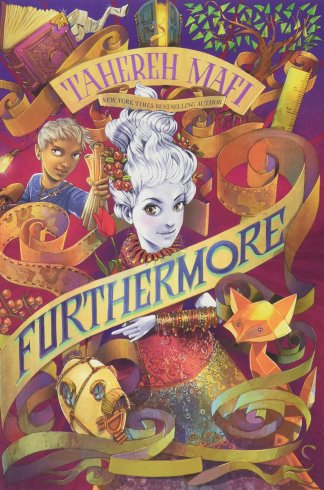
I don’t really even know what to critique in terms of what I wish I would have seen or felt was lacking because there was no expectation.  The book is a companion book to Furthermore, which I think I will do as later as an audio book with my kids.  Perhaps once I read that one I’ll know more about Oliver and Alice’s gifts as the book is about them, as I do have some lingering questions about their whimsical abilities and backstories.  I would have also like a bit more on the mordeshoors, how they are trained, when they marry what enchantments that entails etc.  Seems like the concept in its most basic form could have benefitted from a little more detail.

The book is dark, and there is some darkness in Laylee, and I think that is what makes me like her as a character.  There are some emotions that she really has to work through, and I like that it is fuzzy and messy, I think the target audience of the book will really identify with some of Laylee’s internal struggles. The heart of the book is solid and is very grounded in reality even with all the fantasy on the surface.  I love that Laylee isn’t affected by what other’s expect her to be, there is amazing strength in this being brought to the forefront.  Also, the crystallization of giving someone what they need, not what you think they need is a lesson that will hopefully linger in the readers. 

FLAGS:

The book could be seen as grotesque, but I didn’t find it overly icky, I think middle school and up will  be perfectly ok with all the death.  Oliver is completely star struck and in love with Laylee and her beauty.  But, the book hints only at a future romance.  Similarily, Benyamin and Alice might have a future, but it isn’t mentioned more than a crush and isn’t dwelled on or annoying to the action of dead bodies coming out of their graves or anything like that.

TOOLS FOR LEADING THE DISCUSSION:

Author’s Website: http://www.taherehbooks.com/

A youtube review: https://www.youtube.com/watch?v=bgwtFqiFIi0

Escape from Syria by Samya Kullab, Jackie Roche, and Mike Freiheit

Standard
Escape from Syria by Samya Kullab, Jackie Roche, and Mike Freiheit

9781770859821.jpg

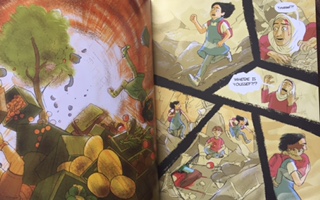
I have read a fair amount of fictionalized accounts of the war in Syria, the journey of refugees, and their resettling in various countries, but this was the first graphic novel on the subject that I have seen, and I was excited to wait my turn behind my kids to read it.  My 7th and 4th graders read it in about 20 minutes and said they really liked it, knowing that it was a quick read, I wanted to take it in slowly and examine each picture to grasp the full message that the author, a Lebanese journalist, was conveying.  Definitely meant, for ages 5th grade and up because of the content, I appreciated the book more than I loved it.  It seemed rather choppy and the fictionalized parts come across just as a front to convey facts.  The book definitely is a great introduction to the conflict, and the format will appeal to a broad range of individuals.  

SYNOPSIS:

Told from the voice of Amina, a bright young girl who rushes home to show off her latest A grade paper to her family, is met instead by a bomb striking the beautiful peaceful neighborhood.  The images on the first page are destroyed as her younger brother Youssef must be located in the rubble and debris.  Now in Canada, Amina tells the story of their journey from Aleppo.  The bouncing around of time, provides some context to how life became under the rule of Bashar al-Assad, how checkpoints and emergency rule changed everything about Amina’s life.  As war creeps in it isn’t just inconveniences and fear, but also death, as further shown through Amina’s uncle who has joined the rebel army.  The family decides they need to flee to Lebanon and truly believe it will be just for a little while. 
IMG_2082

They rent an apartment for a year, but when they cannot afford rent they relocate to a refugee camp, where they stay for two years.  Amina’s father is determined that Amina stays in school but as work remains scarce and Youssef’s health continues to deteriorate.  Amina is forced to take a break from school to try and find work.  Eventually her father arranges to go by raft to Europe to try and start a new life and bring his family there once he is settled.  The terms of the loan to pay the smugglers is steep and when the raft doesn’t make it too far before tossing its passengers, Amina’s father Walid is forced to return to Lebanon unsuccessful. 

It isn’t until Amina’s family considers, like many other families in the camp, to get her married to keep her safe.  That Amina upon picking up some aid at a UN reception center, spills everything to a worker there, and a week later the UNHCR contacts the family to help move them to Canada.  The readers at this point I would assume are relieved the family will be safe, and are surprised when the family isn’t sure if they want to leave.  Syria is there home, and before the mom will agree to anything, she wants to go back to Syria to see her newborn niece.  Once in Syria, she sees that her home is no more as she remembered it, and agrees to be resettled anywhere.  Through the same flashbacks and flash-forwards in time, we also see that life in Canada is not easy.  The family is welcomed and helped and grateful, but it isn’t yet home, and the ghosts of Syria are still present.

WHY I LIKE IT:

I kind of like how choppy it is upon further reflection.  At first it annoyed me, but as I thought about it more and more, I have decided I like that it isn’t easy and smooth and fleshed out, the tone of the unknown comes through by not over narrating the emotions and circumstances.  I also like that everything that happens to Amina and her family is anchored in reality and the footnotes, references, and facts are all in the Endnotes.  Having said that, I wish their was a little more character development, it reads like a bunch of facts strung together and connected by this fictional family.  There isn’t anything wrong with it, but a little more warmth for the characters would have added a beautiful level and would not have been hard to come by at all.  There are so many stories from this conflict out there, and the reason they resonate with so many isn’t from all the facts and numbers, but often from the individuals that make the numbers real and haunting.  I felt like this book fell short on the human element unfortunately.  The only character I really felt had some heart, was the dad, he was awesome, and his love for his family and determination for his daughter’s education was definitely felt.

The book does drop some acronyms and political alliances to add context but not overwhelm the reader.  It definitely hints that there are a lot of groups vying for power, and control: Assad, Russia, ISIS, US, rebels.

IMG_2084

I love that the flashbacks to pre-war Syria are so relatable.  Kids need to really understand that we are all so much more alike than different.  Not just in our hopes and dreams, but even in our daily lives.  The characters in the book are the same as us, their lives look great,  maybe even better.  They have friends, and families and jobs, and cell phones, they also unfortunately, have war.

There were a few surprises for me, for example that buses between Lebanon and ISIS held Syria took/take people back and forth.  Similarly,  I was surprised to see that the punishment of smuggling cigarettes was being beheaded, but maybe more surprised that the book included it.

IMG_2083

It is reassuring for readers to know that the family survives, but the harrowing journey of seeing body bags, cutting costs to survive, risking it all to trust smugglers with fake life jackets, paint pictures of a journey that will stay with the reader.  The book doesn’t talk down to anyone, if something seems too simplistic, it almost encourages the reader to go research more about it.  

There isn’t any mention of Islam or religion, the females wear hijab, that is the only indication along with their names that they are a Muslim family.

FLAGS:

The violence, is pretty haunting and while the images and text aren’t graphic, the splatter of blood and guns and death are very present.  There is also mention of cigarettes.  While not explicit and possibly over the heads of some readers, the book does show that the loan sharks would be willing to take Amina, “Something nice and sweet…like you,” to help pay off the family’s debts.  A former classmate of Amina also invites the family to her wedding.  At 13 Amina’s family is also considering getting her married as a way to help keep her safe.  

IMG_2085

TOOLS FOR LEADING THE DISCUSSION:

This book would be better in Social Studies class more than in a Language Arts one. It would be a great supplement to share even, when discussing current events.  Its a quick read, a factual account and a powerful one at that.  

Book Trailer: https://www.youtube.com/watch?v=AsZZwxM7YyQ

Publisher’s Synopsis: https://www.fireflybooks.com/index.php/catalogue/product/11566-escape-from-syria

Little Brother for Sale by Rahma Rodaah illustrated by Fuuji Takashi

Standard
Little Brother for Sale by Rahma Rodaah illustrated by Fuuji Takashi

IMG_1867.jpg

Oh how I love to read sweet books and repeatedly thumb through warm engaging illustrations.  This book is beautiful, fun, and (possibly) very relatable.

IMG_1860

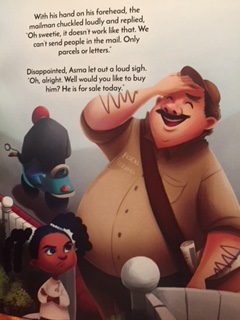
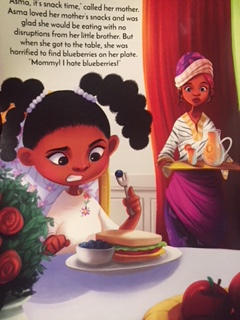
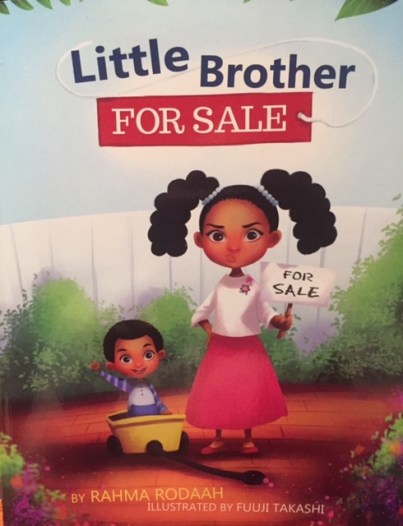
A big sister, Asma, is ready to get rid of her little brother, Hamza, so that she can enjoy all her parent’s attention.  But when the mailman won’t let her ship him to grandma, and neither the lady walking down the street nor the neighbor next door want to buy him, she is determined to find someone to take him off her hands.  Alas though, it is Hamza’s nap time and while mom makes salat Asma finally gets some time to herself.

IMG_1862

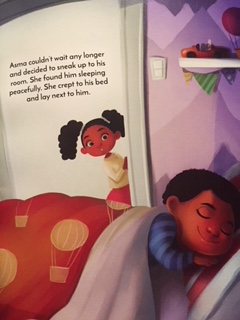
Except she misses having someone sharpen her crayons, or eat the blueberries she doesn’t like, and there is no one to dance with her around the living room.  She decides that maybe she does like her little brother, and lays down next to him with promises of loving and protecting him forever.  Ahhh…..

IMG_1866

Yeah, the book is pretty predictable, but the details make it charming.  I love the diverse characters and the love and warmth they all exude.  I love that when she drags her brother out in the wagon and holds up the for sale sign, mom is peeking out from the kitchen.  I reassured myself that she was there, so it was ok for Asma to be talking to the mail man, a potential stranger, and the lady walking down the street, muslimah or not. 

IMG_1861 

The only slight hiccup to me was what one-year-old, he was seemingly taking his first steps in the first picture, can sharpen crayons? Maybe I just failed to prepare my children, but other than that, the book is smooth, and well done.

IMG_1864

The binding quality, the font, the amount of text on the 26 pages, is definitely preschool to first or second grade, and the illustrations will mesmerize even toddlers who won’t understand why the book is so silly. 

IMG_1863

The book has been floating around my house and I’ve seen my 11 year old pick it up and read it on her own, and then read it to the three year old mutltiple times.  She possibly was getting ideas, but maybe it also reminds us that siblings really can be both annoying and lovely as well.

IMG_1865

Mustafa by Marie-Louise Gay

Standard
Mustafa by Marie-Louise Gay

mustafa book.jpg

This 40 page book caught my attention because I have a son named Mustafa, and the illustrations looked endearing and fun.  The author/illustrator was inspired to write the story when she visited Croatia and saw the resilience of the children.  She also remarks on her website, that children in new places can all relate to the nuanced uneasiness and gradual fitting in process that takes place universally (http://marielouisegay.com/blog/).
IMG_1816

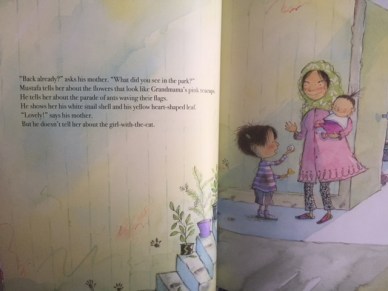
The text is prose-like as young Mustafa ventures from his apartment each day to the park nearby.  He notices things he has never seen before and compares them to the destruction he recalls of his homeland.  He also finds things that remind him of home and things that look familiar. From little ladybugs and a heart-shaped leaf, to the changing leaf colors and kids dressed up in costumes, there is so much to take in and understand.
IMG_1818

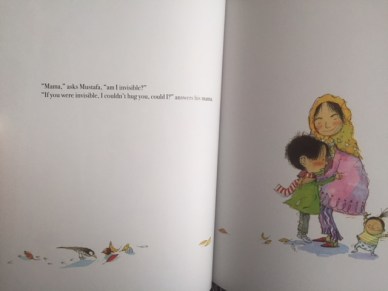
As the days go on, he begins to wonder if he is invisible.  Finally, a little girl with a cat makes a small beckoning gesture to him that doesn’t need language to be understood, and just like that, the world gets a little more welcoming.  This gentle story shows what being new can feel like, and reminds us that sometimes all it takes is a simple act of kindness to change so much.

IMG_1820

The book mentions that Mustafa came on a long journey, but does not specify where he has come from.  He draws his house being bombed in the dirt with a stick and mentions loud noises and fire.  The mother wears hijab, and obviously his name would identify them as Muslims, but other than that there is no reference or mention of religion.

IMG_1817

Overall, the book would be great for ages 4-8.  The passages are a little long, but with the illustrations and relatable concepts, I think children will reflect on what the author is trying to convey, and be able to process what Mustafa has been through, and how hard even the littlest things can be in a new place.

She Wore Red Trainers by Nai’ma B. Robert

Standard
She Wore Red Trainers by Nai’ma B. Robert

red.gif

After having fairly good luck with the Muslim YA Romance Novel Genre in An Acquaintance and Saints and Misfits, I was willing to give She Wore Red Trainers a try.  Na’ima B. Robert has written a lot of books and this 261 page book was an easy and entertaining read.  There are no plot twists, deep thoughts, or intense drama, its a light read that infuses religion and environment into a story that will be great for 14-16 year olds that have slim pickings of relevant, Islamic, “halal” fiction options.

SYNOPSIS:

The story is told from two 18-year-olds’ perspectives, Ali and Amirah. It goes back and forth and while the perspective is obvious, the bottom of the page identifies the character so there is no chance for confusion.

Ali has begrudgingly moved to London with his brothers and father.  Not very religious before his mother’s death, he and his father and younger brother have made a new start and commitment to Islam since losing her to cancer.  The middle brother, resists this, but isn’t too critical in the story, other than to add a voice to the concept that people have to come to Islam on their own, that the relationship between a person and Allah is not cookie cutter or often simple. 

Amira too has a past and a lot on her plate as she strives to balance her chaotic family life and moving past decisions of her rebellious self.  The two meet and in the brief second before gazes are lowered, they fall in love.  Ok, so it isn’t that cliche’ but it is close.

The two, as the dedication of the book states, “are striving to keep it halal.”  They have a few encounters and the sparks are there, but they both have their own stories and supporting cast of friends as well. It isn’t until the very end, SPOILER, they get married.

Yup. impromptu wedding of 18 year olds.  It isn’t out of left field though, there are passages that contemplate the Islamic merits of a young marriage, and perhaps that is the depth of the book, as far as giving the reader something to think about. That and choosing Islam and actively living it.

WHY I LIKE IT:

The stuff that makes the book interesting, isn’t really even the two love birds, it is the context.  The struggle of Amirah’s complex family situation with a mom that has had multiple husbands, and is suffering from depression.  Amirah also has a creepy stepdad (makes her uncomfortable and seems to make sexual advances toward her) and a sketchy past that isn’t really articulated but is hinted at enough to know that she did rebel briefly by running away and experimented with drugs and alcohol before realizing it wasn’t the life she wanted.  She takes tremendous care of her younger siblings, one who is deaf, and respects her older brother tremendously.  Her friends are not overly developed but provide enough diversity that the reader will see themselves in someone even if just fleetingly.

Similarly Ali is fleshed out by the company he keeps.  He has very religiously devout friends, a few rebellious ones and countless opportunities to define who he is.  His home life is a little chaotic, but they’ve gone through the destruction and are in the rebuilding phase. 

I like that the characters are fallible and represent a wide spectrum of religiosity.  The book isn’t political, nor does it discuss culture really, but it is meant for Muslim readers.  The characters throw in Arabic terms and while there is a glossary at the back, the religious rules, the contemplation of hadith and ayats, understanding Islamic divorce and the stress to be well established before marriage make it a book for those that can relate.  I love that part of keeping it halal is that they don’t talk and text.  I know that makes it a bit unbelievable, but I like that the line is drawn and established.

I wish that the past of many of the characters was clearer.  Not overly sensationalized, but a tiny bit more.  I wanted more information on what Ali’s dad’s new job was, and how far away they would be moving.  I wanted to know how Amira’s family would manage without her and the creepy stepdad, would the mom be able to step up and care for her kids.  I wanted more details about Amira’s family in general and why her older brother had to leave his studies permanently in Saudi Arabia, and wasn’t able to just delay graduation.  

I can’t criticize the writing too much because I did read the book in one sitting and it kept my interest.  I didn’t expect it to be deep or thought provoking, so for a light summer read, it was good enough.  I felt like the ending was a bit rushed, and yes there are some far fetched ideas, but I think it’s a romance novel, halal or not, so yeah, there are going to be some places that forgiveness is needed.

FLAGS:

There is mention of hooking up, drug and alcohol use, virginity, and a creepy sexual predator in the stepdad. It isn’t appropriate for middle school, but not so vulgar that one would need to be 18 to read.  I think high schoolers won’t find it too cheesy, and not be shocked by the content either.  Granted it depends on the reader. but I think it is better to be safe than sorry.

TOOLS FOR LEADING THE DISCUSSION:

I would consider the book for a high school book club. Might have to get parental permission, but I think it works well to consider how to have it all so to speak.  How to live within Islam and be smart about your choices.  The book doesn’t offer a lot to think about and mull over, but if you were a teenager, I would imagine that the book presents a lot of what you are feeling.  There is a lot to relate to in the friends, the deen, the emotions, and the temptations.  It also shows that just because families are Muslim, doesn’t mean that they are not complicated and troubled, a scenario that many would find reassuring at least superficially in the book.

Interview with the Author: http://www.kubepublishing.com/an-interview-with-naima-b-robert-about-her-forthcoming-book-she-wore-red-trainers/

You’re Not Proper by Tariq Mehmood

Standard

your not proper

This highly praised British young adult novel is intense.  If I was trying to sell you the book I would say that it is relevant, gritty, raw, and real, but as a reviewer, it is definitely more rough, all over the place, and random.  There is so much going on in the book that it should be well over 400 pages to resolve it all, but almost as if the publisher required that the book be less than 200 to fit the demographic, it all gets tied up way too simplistically and leaves dozens of tangents unresolved, unexplored, and hanging.  The main characters are 14 years old, but I think it is a bit too harsh for that age group and should probably not be read by them.

SYONPSIS:

Karen’s mom doesn’t believe in God but takes her to church.  Karen’s dad is a Pakistani Muslim who loves bacon and beer.  The book opens with Karen’s gang marking her forehead with a cross against her will, and her soon after deciding that she doesn’t fit in with her friends and will now be Muslim.  Part of this transformation involves her wanting her name pronounced properly, as Kiran and her wearing a hijab.  Her parents are pretty ok with the decision, but the author foreshadows that this will be the undoing of her family.  

The book gets crazy, like all over the place crazy, but because of the little hints that all this craziness is leading up to something, I kept reading thinking that the author had it under control.  But no, I don’t think he does or did. 

The most craziness comes from Kiran’s rival Shamshad who leads another gang and pretends to be really religious, but is a bit of a rebel and bully herself.  The author is told from both Kiran and Shamshad’s perspectives, and while at times the reader sympathizes with Shamshad, as her influential father is abusive, many of her actions are so jarring and awkward, that no, she isn’t really like-able at all.  She wants a computer, her parents are that strict, yet she goes out with a guy, gets drunk, hangs all over him, goes to a Halloween party/dance without seeming to have to sneak about doing it.  She is regularly beating people up, threatening to kill and maim people with scissors, not a nice 14-year-old, nor a believable one either.  

As Kiran tries to learn about Islam and figure out what is tearing her family apart, and Shamshad is trying to find her place, the two storylines come closer together before the big climax of learning what tied the two girls’ families together in Pakistan and then here in the same English neighborhood.  The climax/ point of the story is actually a good one, but the resolution of it, is so simplistic that it cheats the reader of any potential investment they may have skimmed from the crazy build up.  It seems like the author had an idea and just worked backward for his big reveal, which is probably how most books are written, but in good books, you connect with the character and join them in their journey, here there is no character connection.

WHY I LIKE IT:

I like the idea of the book.  That there are good and bad Muslims and Christians, that things are diverse and complicated and that we all have our own baggage either at home, or in our heritage, or in our environment. But the book is not cohesive, the characters are really, really harsh.  And it doesn’t seem the author gets their voices right.  Plenty of males write beautiful complex female characters and vice versa, and plenty of adults get teens right, but I don’t think this author got either.  The girls are not believable and the minor characters are just as bizarre.

I think if you you live in a highly diverse area and you are acquainted with lots of minorities you can handle the way Islam is portrayed, but if you aren’t I think both Muslim and non Muslim readers alike will be shocked and offended by the portrayal of such crude characters.  This isn’t a book of accepting differences and finding a way to get along, it is more of a book showing how awful everyone is in varying degrees.  If it was an adult book perhaps you could argue it is realistic, but as a teen book, I think the lifestyle choices of all the characters will be eye-opening and not necessarily in a good way.  I do like that the book isn’t offering a moral statement or opinion on Islam, but the way Islam is presented isn’t inspiring either.

I’ll admit I’m a sucker for books that are meticulous, not boring, but deliberate.  Authors like John Irving who seem to map their stories with crime solving precision.  Where every sentence serves a purpose and every idea has a reason for being shared.  Most books leave something hanging, but this book, left everything hanging.

For two girls in gangs, the gang members by and large fade away before we even get to know them.  There is a rally being planned but resolved half heartedly.  Kiran has to fight with her parents to learn about herself in a really unrealistic way.  Kiran harasses her dad to learn about Islam, but then all of a sudden her paternal grandpa lives nearby and brings over a marriage proposal, why couldn’t she ask him about Islam, and why would a 14 year old be considering marriage?  The whole scene of Kiran getting a hijab is weird and pointless, why stress underwear and having another customer make a random comment for no reason.  What was the obsession with swimming for Shamshad and her mother, like there is a lot of space dedicated to this topic, and I don’t really get it.  Shamshad’s dad is also creepy, he seems to have a decent relationship with her, but is physically abusive to her mom, and he does a weird inappropriate thing with a pointer stick to Kiran at the masjid, that should be discussed more in my opinion.

Once the big reveal happens really there are more questions than answers.  Like I still don’t get why the families hate each other, if they had to make promises of secrecy in Pakistan, couldn’t they just ignore and be ambivalent to one another in England? Why so much hate and hostility? And what is up Jake? He seems like a good friend that makes some mistakes and Kiran is awful toward him, then all of a sudden she claims him as a brother.  And whats up with him going on and on about his brother in the military, I need closure! And last but not least why when Kiran’s mom is in the hospital after a failed suicide attempt, why does the Curry Club, that no one in the book ever liked, suddenly in the hospital room with them, when it should be a tender mother-daughter moment? Seriously, I was beyond annoyed.  There should have been a message, or a cathartic release, not annoying super side characters coming back for no reason.

FLAGS:

Lots of violence, alcohol, language. There are also romantic relationships and the celebration of Halloween.

TOOLS FOR LEADING THE DISCUSSION:

I don’t know that I would recommend this book to anyone.  I am willing to concede that some of it was lost in translation for me, but there is so much going on in the book that there is no way that it can excuse it all.  I would love to discuss some of my concerns with someone who has already read it though. So feel free to reach out, I’m all ears.