Tag Archives: Family

Playing Atari with Saddam Hussein: Based on a True Story by Jennifer Roy with Ali Fadhil

Standard
Playing Atari with Saddam Hussein: Based on a True Story by Jennifer Roy with Ali Fadhil

atari

This 165 page AR 3.9 book about the 42 days in 1991 that Iraq was at war with the United States is told from an 11 year old half Kurdish Christian boy’s perspective, but he mentions that he has friends that are Muslim and culturally and historically the book is relevant, important, and engaging as well.  I had my 9, 11, and 13 year old read it to gain perspective of the Gulf War, the difference between politics and people, and to see diverse religions co-existing despite stereotypes, especially in the middle east.

SYNOPSIS:

Ali gets the highest score on his Atari console the day that the bombs start falling.  Ali and his brothers Shirzad and Ahmed, and sister Shireen along with their parents retreat to the safest room in the upper middle class home to hopefully stay safe.  With experience of surviving the Iran-Iraq war which ended just three years earlier, the kids camp out at night in the room farthest from the nearby school and spend their days playing soccer in the abandoned streets.  The safe room was determined by knowing that Saddam uses his own people as human shields and places military installments in public service locations so that he can use propaganda to try and convince people that the enemy is bombing schools and hospitals intentionally to harm the innocent.

When the electricity goes out and the water cuts off, the family is forced to accept government rations.  Their dad is a dentist, but as he is essentially property of the state, he is forced to work as a medic and is often absent from home.  The family lives in Basra, which is in southern Iraq and near to the invaded Kuwait, thus all the troops pass through the city and the children spend their days keeping up their house, playing soccer with their friend Mustafa and trying to avoid the bullies Omar and Umar who’s father is in Saddam’s Ba’ath Party.

Ali speaks English because of his love of American TV and feels that if he can meet some US soldiers he will convince them that he should be in America not in Saddam’s Iraq.  He loves Superman, video games, soccer, his family, and his country, but the people, not the leader, he loathes Saddam, even though he knows he can’t ever speak ill of him.

A trip to get rations results in Ali seeing public executions and a colleague of his math professor mother’s getting hauled away.  A visit from their cousin gives them news that their father is missing. Life is not easy for the family, and yet they know they have it better than a lot of other people.  After the war, once again the family will have to put back together their lives and carry on.

The book concludes with a 14 year jump and Ali translating at the trial of Saddam Hussein where the leader who has been hiding is found guilty and sentenced to be killed by hanging.

WHY I LIKE IT:

I love that Ali is so relatable, he could really be a kid anywhere which makes what he sees and hears and experiences all the more intense.  The way that the book shows how the soldiers are forced to be soldiers, the citizenry at the mercy of the government, and the inability to speak freely so very real and frightening, is strong, but not traumatizing to the reading audience.  Even Ali being forced to observe the killing of  people in the street is handled with the target audience in mind.  They are Kurdish and had to deal with that within Iraqi society, which is a nice added layer to understanding that Iraqis are not a single monolith.  I love how the family had to go to the governor’s house and how nice his son was, even though, they are all Ba’ath Party members and part of the larger oppressive system.  It shows that things aren’t always black and white, and to convey all this to eight and nine year olds so clearly is quite remarkable.

I also like that the book holds up over time.  My kids had no idea what Atari is or was, but they could understand that it is a video game, and that it was an escape during the night for Ali to imagine he was playing a game trying to catch the falling bombs as a way to be brave and endure.

FLAGS:

Execution, death.

TOOLS FOR LEADING THE DISCUSSION:

I would consider this for a middle school book club, it is a bit short and definitely more middle grades, but it would allow kids to identify and imagine and discuss war through the fictional characters and voice their understandings of an authoritarian government structure, which would be interesting.

Author’s Reading Guide: http://www.jenniferroy.com/wp-content/uploads/2017/05/Playing-Atari-Teacher-Guide.pdf


The Bee Tree by Stephen Buchmann and Diana Cohn illustrated by Paul Mirocha

Standard
The Bee Tree by Stephen Buchmann and Diana Cohn illustrated by Paul Mirocha

bee treeThis is one of those books that it is hard to know who the target audience is and who would most enjoy the text heavy 40 pages about a boy coming of age in Malaysia by harvesting honey in a traditional manner.  The two page spread illustrations are rich and inviting, and with an AR 5.7 level, the book would work well for children that enjoy other cultures, honey, insects, or children that you hope will be inspired to start seeing the world a little differently than they are used to doing.

5BD37914-E9B7-4D0B-BB0A-1286A8BC4C72

The story starts with a boy talking about his grandfather and how every year he goes to collect the honey from the tualang trees.  The bees travel hundreds of miles and arrive just as the rainforest starts to bloom.  The trees that they build their nests in are higher than the eye can see and grandfather, known as Pak Teh, is the leader of the honey hunting clan.

7CA311E6-B1B6-40E7-B735-FAACAD76597F

He tells everyone what their jobs will be: some will carry ropes, others pails, others torches.  One day, he tells them, someone will have to take his place as the one who climbs all the way up to the top to gather the honey.  He believes Nizam, the narrator, is the one.

To prove himself, Nizam has to practice climbing 120 feet into the sky.  Nizam and grandfather spend a lot of time together praying five times a day and walking through the dense rain forest.  He reminds Nizam that the forest doesn’t belong to them, but to the unseen protector. They enter the forest as if they are visiting a neighbors home.

837003A0-ED16-4CA9-9CD8-3CEBA7846D0A

At night all the hunters sit together and Grandfather tells the traditional story of the bees.  A story that involves a beautiful servant girl named Hitam Manis who worked in the Sultan’s palace and how the Sultan’s son and her were in love.  When the Sultan found out he ordered the girl run out from the kingdom.  As she and her loyal friends fled she was hit by a metal spear.  She did not die, but her and her friends were magically transformed into a swarm of bees.  Because it was metal that harmed her, she ruled that metal was never allowed to touch the honey.  Hence, when the bee hunters harvest they use a bone knife, leather pouches, and a wooden ladder.

2637F18A-FB0A-424D-AACF-58285BE31EC5

When it is time to enter the forest, it is pitch dark with no moonlight.  The hunters tap their glowing torches against the trees sending light sparks to the ground to tempt the bees and leaving their nests free for Nizam to collect the honey from.  For seven nights they climb the trees, and then they return home.  With greetings of salam, peace be upon you, Grandfather informs the family that when he can no longer climb the tree, Nizam will carry on the tradition.

908CAC37-2CCE-477A-93BC-B3EEF723C2BF

The book ends with factual information about Malaysia, the rainforest, giant honey bees, honey hunters, and the future.

Betty Before X by Ilyasah Shabazz with Renee Watson

Standard
Betty Before X by Ilyasah Shabazz with Renee Watson

betty

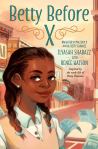
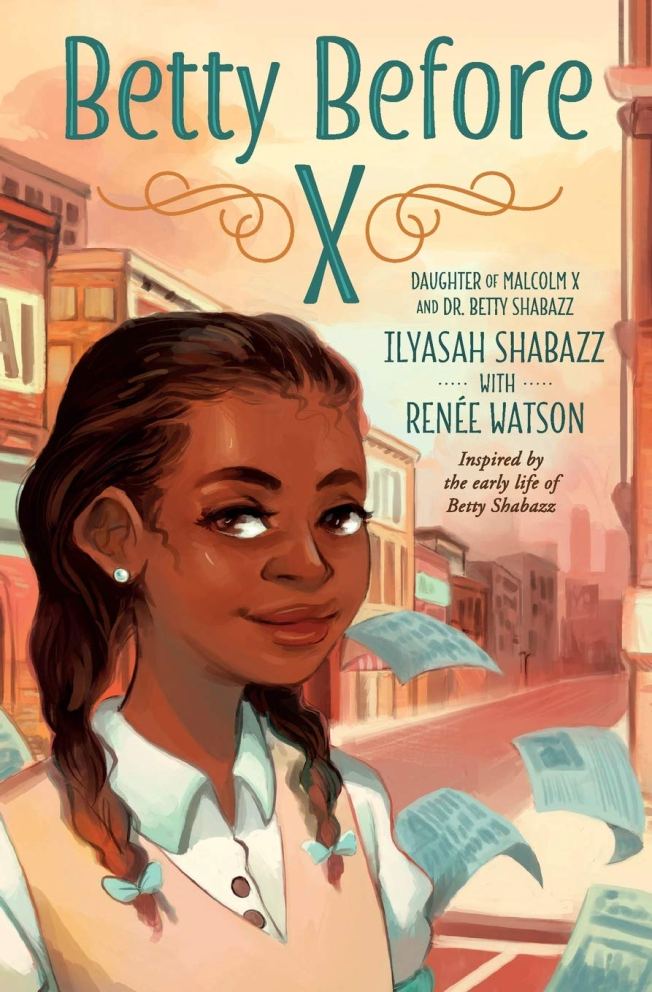
This 248 middle grades (AR 4.9) fictionalized biography of Betty Sanders, later to be Betty X and then Betty Shabazz, is the early years of her life in Detroit during the 1940s and how she understood her place in her family, and in the community.  Written by her daughter, the book hops around to major events in her life and doesn’t detail a lot of the whys, but rather keeps an 11 year-old-perspective, allowing readers to identify with her family stresses and anger at the racial discrimination and violence that is rampant.  Showing disagreements within the black community allows young readers to broaden their horizons and not see the civil rights as a monolithic point on a timeline, but something that is still ongoing and part of culture still today.  There is nothing Islamic in the book, as this is a glimpse of her childhood long before Nation of Islam, her conversion to Sunni Islam or her Hajj, in fact the majority of the book focuses on her involvement in the Bethel African Methodist Episcopal Church.

SYNOPSIS:

Betty was born in Georgia, as the story goes, but before she was even a year old, Betty’s grandma took her away from her mother and gave her to her aunt, Fannie Mae, to raise.  Having seen a bruise on the baby girl’s neck Grandma Matilda didn’t feel that the young mother was capable to care for Betty.  Fannie Mae showered Betty with love and consistency and treated her like her own daughter.  Betty saw her first lynching while in Fannie Mae’s care and the image stayed with her her whole life.  When Betty was seven her aunt died and Betty went to live with her biological mother, Ollie Mae, in Detroit.

In Detroit, Ollie Mae has married and has three daughters with her husband, Arthur, who also has two sons.  A full house that is religious and disciplined, but for Betty not full of love.  She prays that her mother will look at her the way she looks at her sisters, but that never seems to happen. The family attends Bethel AME church and at age 11 that is when the story gets going.  Betty and her friends sneak out of church to get candy and the cost will probably be a whipping.  Luckily a few of the church ladies like Betty and realize how hard Ollie Mae is on her.  They work to get Betty permission to hang out with girls her own age and try and convince her mother to let her join the Jr. Housewives’ League.  Ollie Mae doesn’t agree with the work of the Housewives, a strong group of women that work to convince others to only support businesses that hire Negroes.  This organization is a major division within the community and the church.  Mrs. Malloy and Mrs. Peck are leaders in the organization, and one of Betty’s friends is for it, while another is against it. This rift affects Betty in many ways.

At age 11 Betty leaves home to go and live with the Malloy family.  A husband and wife who have no children and own a shoe repair shop.  One night turns into two and then she is living there full time and only seeing her siblings and mom at church on Sunday.  She even gets to calling Mrs. Malloy, Mother.  As she comes of age with a new family, and splintering friendships she seeks to make her own family with those that love her, and seeing violence targeted against blacks when a young boy is shot by police in the back, and working with civil rights activists- the icon and leader we know Betty Shabazz to be, is shaped and inspired.

WHY I LIKE IT:

I love that she gets her own story and own voice, not just to be left as someone’s wife.   She is a force before she meets Malcolm and after he is murdered.  Her story is shaped by so many outside influences, but ultimately it is her own and even in her early years the reader feels that.  She seeks out those that love her the way she should be loved, but she doesn’t give up on those that try and leave her either.  She fights for her mother’s praise and doesn’t abandon friends that believe differently than her, which is powerful to see from an 11 year old.  She sees the world around her and takes a stand against that which is wrong, she feels and hurts and doubts, but she gets back up.

I like that she questions if what she is fighting for will make a difference, while simultaneously doesn’t want to take racism quietly.  The day-to-day nuances flesh out the struggle of the civil rights and give a unique perspective that biographies that cover adult lives or larger portions of one’s life don’t necessarily spend time on.  Seeing activism affect a young girl’s friendships will stay with readers,  as well as how desperate she is for her mother’s love, just as seeing how she is treated on a shopping trip will create a sense of universal struggle that make equality in society resonate as being the responsibility of us all, not just those that are being oppressed.

FLAGS:

Racism, violence, murder, lynching, abuse, Betty being born out of wedlock.

TOOLS FOR LEADING THE DISCUSSION:

The book would work for a book club, and would definitely be a great historical fiction touchpoint to bridge with the Black Lives Matter movement.  A classroom discussing Civil Rights and Malcolm X would perhaps get more value from it than a half hour lunch chat, but either way the book should be read, the ideas discussed, and people made aware of Betty Shabazz’s life.


The Girl and the Ghost by Hanna Alkaf

Standard
The Girl and the Ghost by Hanna Alkaf

ghost

A book meant for middle grades, 8-12 year olds, that has depth and layers and culture and strength is not something you find very often.  Over 275 pages, the book is at times dark and haunting, but what is truly remarkable is that it doesn’t talk down to young readers and with its pop cultural references and relate-ability,  the book is not dreary.  In fact, the true “haunting” occurs after the book is finished and the concepts of friendship, being alive, and forgiveness stick around and require thought and consideration.  The book is based on a Malyasian folktale, how much is a fleshing out, or simply a starting point, I do not know, but I do know that the characters are memorable, the concept thought provoking, the writing flawless, and the intertwining of Malay culture, Muslim characters and the supernatural, a combination that makes for an enjoyable read.

SYNOPSIS:

When an old witch dies, her pelesit, her ghostly demon, is passed on to her granddaughter Suraya.  Suraya lives with her mother, a teacher, and is lonely and emotionally neglected.  An adventurous girl, the pelesit, keeps the small girl safe, but waits to reveal himself to her in the form of a grasshopper when she is older.  When he does reveal himself to her, she asks him his name, and he doesn’t know it, so she names him Pink.

Suraya and Pink become best friends, and he provides company for her as she receives very little from her mother and has no friends.  Suraya had no knowledge of her grandmother and Pink modifies the stories to leave out how evil, cruel and vindictive she was through him.  As an evil being with no heart these acts never bothered him, although he stopped enjoying them long before she died.  With Suraya however, he feels things.  He is sad that she is unloved by her mother, teased by the other children, and that she doesn’t have the things other kids have.  Suraya is kind, and forgiving, and tries so hard not to let things bother her.  Pink however, with a twitch of his antenna can make things happen.  Bad things.  Things that might at first seem like a part of life, but when Suraya catches on, she scolds Pink.  She makes him promise never to use his magic to hurt people, ever.  He reluctantly agrees, she is his master after all.  Unfortunately he doesn’t keep his promise.

On Pink’s prodding, Suraya makes friends with a new girl at school, Jing, and their friendship makes Pink jealous.  He harms Jing and Suraya decides she no longer wants to be his master.  As a result Pink is determined to make Suraya’s life miserable.  As desperation mounts, Suraya tells her mom about Pink and a pawang is called in to separate the spirit from Suraya.  Something seems off about the pawang, and when Suraya investigates, she realizes that she must save Pink from him.  Together with Jing, Pink and Suraya are off on an adventure against the pawang and might just learn more than Pink’s backstory in their efforts along the way.

WHY I LIKE IT:

I love that Suraya and her family are Muslim and that Jing is not and they are best friends.  Suraya and her family pray, celebrate Eid, give salams when at the graveyard, but obviously also believe in magic and ghosts, and somehow in the story it doesn’t seem to be contradictory or odd.  I love Suraya’s strength.  None of the relationships in her life are good.  Yet, she is good, and she forgives and fights to make those close to her better.  Pink is manipulative and controlling and abusive, but she still fights for him to be treated better and that says more about her, than whatever he is.  Suraya’s mom is distant and neglectful, but yet, there is still realistic hope that their future can be and will be better.  I love that all these layers are there and yet are subtle too.  Kids are smart and they will bring their own experiences, understanding, and expectations to decipher these relationships, and that is amazing.  I love that the characters in the story may be so different than the typical western reader, but they will still see themselves in this poor Malay girl from a small village, in her best friend Jing who lives and breathes Star Wars, or even in the religions pawang who is a power hungry charlatan; toxic friendships and family secrets make the book universal.

FLAGS:

Pink makes it look like blood is on a girls back side, implying a girls fear of leaking, but it isn’t explicit or named.  There is death and dying and supernatural and lying.

TOOLS FOR LEADING THE DISCUSSION:

I am thinking strongly about using this as a book club book, as the discussion would be delicious and varied among the participants.

Interview with the author: https://thequietpond.com/2020/08/20/our-friend-is-here-an-interview-with-hanna-alkaf-author-of-the-girl-and-the-ghost-on-writing-friendship-malaysian-childhoods-being-true-to-your-stories/


The Battle by Karuna Riazi

Standard
The Battle by Karuna Riazi

the battle

This claims to be a companion book to The Gauntlet, but it does rely heavily on details from the first to make sense of who some of the characters are as this book does little to explain them and advance their story.  In reality the book is very similar to the first book, but sadly not as fun.  I was disappointed in the 295 page AR 5.2 book, but my fourth and fifth grade boys enjoyed it as they had few expectations and the fast pace kept the book fun.

SYNOPSIS:

It has been four years since Bengali American Ahmad Mirza has left the game world, Paheli, with his sister Farah and her friends.  The old board game has been destroyed and the reboot focuses on a new video game setup.  This time around Ahmad is the main character and with his ADHD he finds himself getting in trouble a lot in school and desperate for a friend.  When a mysterious package holding a video game shows up and Winnie sticks up for him, things are possibly looking up. When all of New York freezes at the insertion of the game, however it clearly is not.  Winnie and Ahmed are off to battle the Architect and MasterMind to unfreeze their beloved city and escape Paheli.

Different battles and characters inch the duo closer to winning, but facing their fears and  being sidetracked by remnants of the last game trying to return make everything complicated.  Ahmed’s uncle returns to the game, giant mice try and help, crazy monkeys distract, and flying rickshaws populate the eastern inspired world filled with Bengali, and Arab references.

WHY I LIKE IT:

I love that it is a Muslim kid with some struggles at the helm, but there is really so very little character building that it ultimately doesn’t count for much in the long run.  Just like the first book, the characters are taken from the “real” world and transported to a game world and they must win the game to return home.  The book is fast paced and fantastical, but I constantly felt confused.  The challenges were disjointed, there wasn’t a clear objective, Ahmed didn’t recall being there before or that Vijay bhai had somehow come back with them, the mice help and then they are absent, and there wasn’t really a big reveal or explanation resolving any of it.  It felt all over the place and with little world building I didn’t feel like I could even picture what Paheli looked like, so forget feeling what the characters felt or imaging the intensity that that the game was running on.  It seemed like an updated version of the first book, but not done as well at all.

FLAGS:

Pretty clean, some intensity, some fighting/battling, death, nothing detailed nor grotesque.

TOOLS FOR LEADING THE DISCUSSION:

I think the book is great to have in a classroom or on a home book shelf especially if the Gauntlet was enjoyed, but I wouldn’t use it as a book club book because it doesn’t offer much to talk about.  There isn’t a cathartic release or even an under current of family and friendship and loyalty, it really is just surface level story telling.

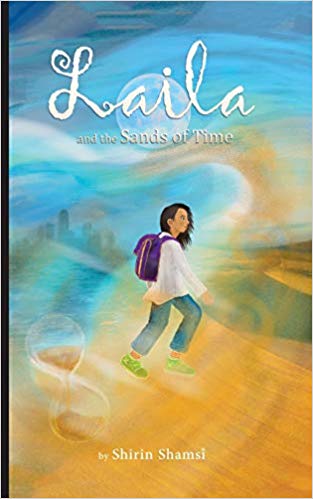
Leila and the Sands of Time by Shirin Shamsi

Standard
Leila and the Sands of Time by Shirin Shamsi

shirin shamsi

This 127 page book has a lot of potential, but ultimately didn’t win me over.  It is one of those that needs a good editor to encourage the author to flesh out the characters, take advantage of a potentially cathartic resolution, and fill the gaping holes in the story.  Meant for ages 8-12 the tiny font, and tight spacing, make the book really dense and intimidating to look at and read.  The book, as written, should be well over 200 pages, if spaced appropriately for the target audience.  Once you accept the presentation and get in to the story, it isn’t an awful read, it just could have and should have been so much more.  I hope the author revisits it and polishes it up- the time travel, the science DNA component, and the death of the protagonist’s parents, offer a lot for Muslim and non Muslim readers to sink their teeth in and be swept away by, but ultimately, I don’t know that most readers will be motivated to finish the book, and those that do, won’t remember anything about it.

SYNOPSIS:

Laila’s dad has recently died, and with her mother having died years earlier, Laila is now 13 and an orphan living with her stepmom and baby sister.  Feeling resentful that her dad remarried and had a child that took time away from her in his final span of life, doesn’t make Laila a very kind person at home.  Her best friend Beth, even points out how cold she is to her family.  With school vacations approaching, Laila is headed for Umrah with her dad’s brother, her uncle, and his wife.  While making tawaf, Laila loses her aunt and uncle in the crowd and finds herself transported to 7th century Arabia.  She hears a baby crying and learns that the baby’s life is in danger.  To save her, she must get the baby, the baby’s mom and baby’s sister from Makkah to Yathrib.  The only way to do that is to join a caravan, and they can only join a caravan if they have a male escort.  So Laila chops off her hair, acts like a boy, and gets them in the caravan.  They meet bandits along the way, but nothing too scary, they arrive in Medina and right before they meet RasulAllah, Laila finds herself back in the present.  She is in a hospital, but the doctors do not know what is wrong with her so they release her.  She returns to the US, relays the story to Beth, and decides that at an upcoming field trip to study DNA, she is going to submit the baby’s hair that she still has for dating.  The results show it is from 1400 years ago and a family heirloom of her step moms reveals that the baby is a great great great great… grandmother of her’s.  Resolved to open her heart to her family, Laila is a changed person, alhumdulillah.

WHY I LIKE IT:

I love the premise, it is like Sophia’s Journal and When Wings Expand  thrown together and scrambled.  Laila is struggling with her faith and is trying to find it, while also finding a way to move forward after losing her father.  There are just a lot of things that aren’t answered, are contradictory, or don’t make sense.  It says she learned Arabic because her mother spoke it, her dad is desi, but really no hiccups speaking in 7th century Arabia other than forgetting the word for scissors?  She at one point said she was a cousin from the north, but while on the caravan mentioned that she had never travelled through the desert.  There really should have been more action with the thieves and the regrouping when the men came back.  Similarly, her gender reveal should have been a bigger deal than it was.  I was hoping there would be a mention of if her hair was long or short when she awoke in the hospital, I don’t think I missed it, but maybe, or maybe it wasn’t there.  Once back home, there really needed to be a reunion scene with Laila and her stepmom and half sister, I mean the whole point of the time travel was to save a baby. Really? Nothing? I was disappointed that it was glossed over and mentioned as a retelling to Beth and pushed aside.  The second climax is when the DNA testing is being questioned, but I didn’t get the need for the babysitter and everything to be rearranged for a two second conversation with the principal accusing Laila of theft, a phone call should have sufficed, plus when Laila and Beth mention it to the scientist, it seems everyone was questioned, but Beth wasn’t, something wasn’t consistent there either.  Overall, the book needed more action for a book that involves time travel and more emotional attachment and character connection for a book that involves a newly orphaned young teen girl.

I like the conveying of Islamic facts and information and history in a fairly smooth way.  At the beginning, Umrah being explained was a little text bookish, but it smoothed out as the book progressed.  I love the little flashbacks at the beginning of each chapter, I wish there would have been some information about the remarriage of her father and her emotions on the matter at that time.  It is one thing to be grieving, but really she is a brat to her step mom, and if the uncle and aunt live right there, not sure where they live, someone should really be working on getting them all some family therapy, not a quality situation for anyone.

FLAGS:

none

TOOLS FOR LEADING THE DISCUSSION:

I wouldn’t use the book as a book club selection, nor would I think it would get read if on a classroom shelf.  I might use the premise of going back in time to meet Prophet Muhammad, as a writing prompt though.  Would be a good assignment with factual and Islamic references to get kids stretching their imagination to make it all come together and work.


Katie Woo’s Neighborhood: Open Wide, Katie! by Fran Manushkin illustrated by Laura Zarrin

Standard
Katie Woo’s Neighborhood: Open Wide, Katie! by Fran Manushkin illustrated by Laura Zarrin

katie

Oh how I love when a popular series includes diverse characters, and more specifically Muslims, I’m biased that way.  In this Katie Woo early reader for KG-2nd grade, a trip to the zoo and wondering how animals clean their teeth ties in to Katie’s trip to have her teeth cleaned by Ms. Malek, a hijab wearing dental hygienist, and having her teeth checked by dentist, Dr. Ali.  Spread over three chapters, the 5×9, 32 page book familiarizes kids with what happens in a dental check-up and shares some silly facts about animals too.

katie 1

SYNOPSIS:

On a trip to the zoo, Katie’s dad jokes that the alligator must need a big toothbrush.  This reminds Katie’s mom that Katie has an appointment with the hygienist the following day to have her teeth cleaned.  The next day on the way to see Ms. Malek, Katie sees her friend Haley, who along with her brothers also goes to the same dentist.  Everyone seems to love Ms. Malek.  In the waiting room theres lots of toys and when she gets called back, she gets to sit in the big blue chair that tips back.  Ms. Malek uses a little mirror to  check every tooth, before she brushes them.  She then tells Katie that hippos let fish clean their teeth.  This visit Katie doesn’t need X-rays taken but next time Dr. Ali says she will.  After picking a new toothbrush and toy, she is all set to go home.

On the way home, Katie sees some more friends and tells them about hippos using fish to clean their teeth. Pedro tells Katie that the dentist at the Zoo has to clean the tiger’s teeth.  Thinking that he must be really brave, Pedro explains that the dentist first puts the tiger to sleep.  Later that night, Katie brushes and flosses her teeth and then tells her dad that maybe when she grows up she can work at the zoo and clean the elephant’s tusks.

WHY I LIKE IT:

I love the diversity of Katie and her friends, and the people in her neighborhood.  Normalizing diversity in literature is a great way to open kid’s eyes to the world around them.  I also like that there is a glossary of words in the back, many dental in nature.  There is a page of Katie’s questions to get readers thinking.  And there is even an interview between Katie and Ms. Malek the dental hygienist.

FLAGS:

None.  There is nothing religious in the book, other than the names of the dentist and hygienist and the scarf on Ms. Malek.

TOOLS FOR LEADING THE DISCUSSION:

I think this book would be great at story time, and in classrooms.  It isn’t meant for a book club, but I think even in a group setting, kids will be reassured about a trip to the dentist and find the animal information funny and informative.   Kids might even have some more fun animal teeth facts to add to the discussion.

Salma the Syrian Chef by Danny Ramadan illustrated by Anna Bron

Standard
Salma the Syrian Chef by Danny Ramadan illustrated by Anna Bron

salma

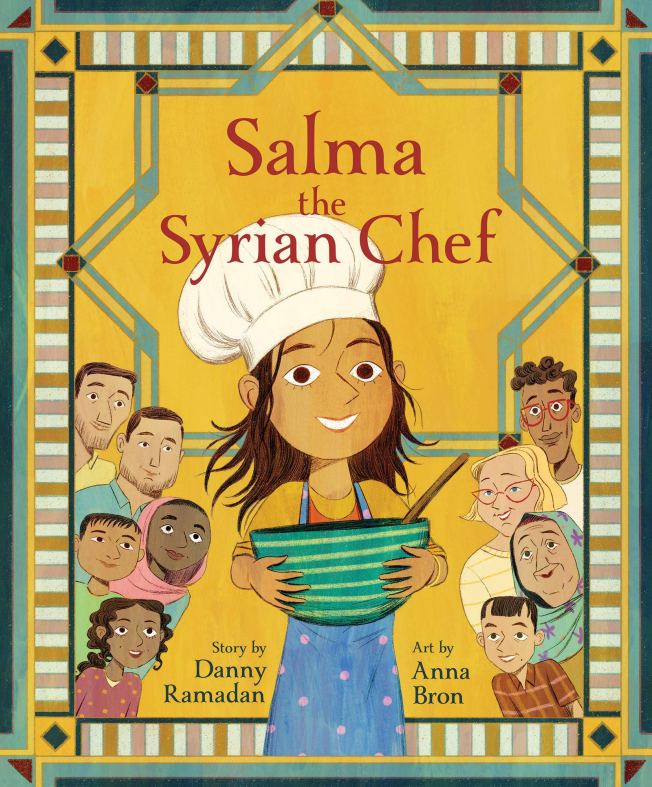
This 40 page picture book meant for 4-7 year old children is full of diversity, community and love.  The only thing missing, is a recipe for the dish, foul shami, that Salma recruits everyone at the refugee Welcome Center to help her make to cheer up her mom. Possible flag is there is a gay couple featured in the text and illustrations.

syrian1

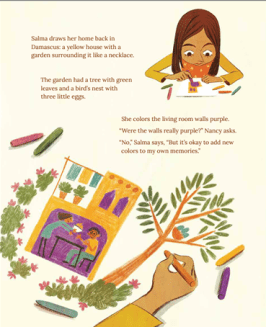
Salma and her mom are refugees from Syria living in Vancouver, and desperately missing Salma’s dad who still has not been able to join them.  When Salma shares her sadness with Nancy at the Welcome Center, she is encouraged to draw her good memories.  And then Salma has the idea to cook a dish from home for her mom. The other kids at the center mention foods they miss, Ayman from Egypt, Riya from India, Evan from Venezuela.   Then the translator, Jad, from Jordan helps her find a recipe online.

syria

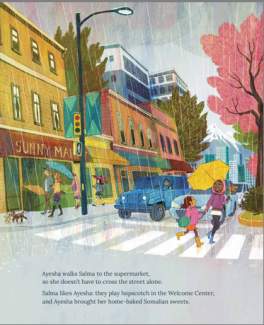
Convincing herself that she can do this, Salma  draws a picture for each of the ingredients since she doesn’t know the names in English.  She then heads to the market with Ayesha from Somalia, an older girl that helps her cross the street, and get the needed groceries.

syria2

Back at the Welcome Center to cook. Malek and Amir, a gay couple from Lebanon help her chop the vegetables and kiss away each others onion tears.  The spices make Salma sneeze, but she can’t find the sumac.

syria 5

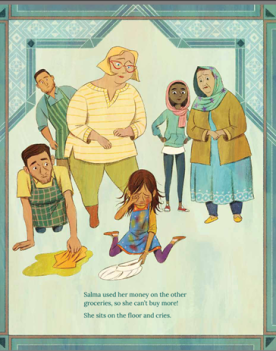
Granny Donya from Iran has the missing spice and reassures Salma that she can do this.  That is until the olive oil bottle slips and falls and shatters.  With no more money and feeling discouraged, it takes Nancy and everyone else to convince Salma not to give up as the dish is made with love and Mama will love it.

syriasad

Everything is set up to surprise Mama with the dish, but once mama comes home and the door bell rings, it is Salma who is surprised with all her friends coming over to bring her olive oil.

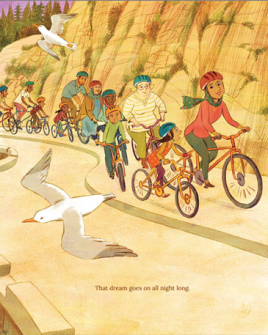
Mama laughs and tells Salma her smile is home, and Salma dreams of riding her bike around the Vancouver seawall laughing with her friends and Mama.

syriabike

I love the sense of community that it takes to make the dish and that she finds love and support from so many.  I also like her determination to make her mother smile along with her willingness to accept help when she needs it.

I’m assuming the family is Muslim, the mom appears to remove a scarf when she returns home, Ayesha and Granny Donya also wear hijab.


Diana and the Island of No Return by Aisha Saeed

Standard
Diana and the Island of No Return by Aisha Saeed

dianaThis Wonder Woman story of Princess Diana as a young girl is not noteworthy because of its groundbreaking storytelling, but more for the fact that the series and story is by a Pakistani-American Muslim author.  I am not sure how authors are assigned or chosen to  write these reimagined character series, but I think it is a great compliment to her writing and a great mainstream representation of diversity that we should celebrate.  Even more exciting is the subtle addition of Diana’s best friend, Princess Sakina, daughter of Queen Khadijah to the story, and that while they are citizens of fictitious world of Greek gods, they seem to spout Islamic wisdom on occasion, and be equally strong and important to the adventure at hand.  The book is meant for middle grades and at 288 pages is a fun light read for girls and boys of all ages.
SYNOPSIS:

Young Diana is anxiously waiting for the start of the yearly Chara Festival, when strong women from all over the world come to her island home of Themyscira to celebrate their different cultures and strengths.  Most of all Diana is waiting to spend the week with her best friend Sakina.  Frustrated that her mother is not allowing her to train with the other Amazonian women, Sakina listens to her and they hope to persuade Queen Hippolyta that this is the year.

As the women are arriving and gathering in the palace, Diana discovers a boy near the ships, Augustus.  Boys are not allowed on Themyscira.  There is no exception, but when all the women in the palace are drugged to sleep, her and Sakina are forced to trust him to try and save their loved ones.

Augustus confesses that a demon has hypnotized everyone on his island home, and that he was told to break the spell he needed to bring Princess Diana to the demon.  With no options and determined to prove her self, Diana and Sakina and her trusty bird fly off on a chariot to another world.

With tests around every corner, literally, the trio has to work together, to stay alive, gather the ingredients to make a potion to save the people on both islands, and push themselves to be brave.

WHY I LIKE IT:

So the story is ok, it is fun, I’m sure most kids that like superheroes and even many that don’t will enjoy the quick paced plot of the story.  There are definitely little nuggets of inspiration and motivation that make the book a positive influence on the reader.  The trio discuss bravery and how being scared doesn’t make you less brave, they encourage one another to push themselves and they forgive each other when they make mistakes.

Sakina and her people are scholars and on occasion says deep thoughts.  She says at one point, “My mother always says we are supposed to enjoin the right and forbid the wrong.” Which is a general principal, but the word choice sounds a lot like Surah 3 verse 110 “enjoining what is right, forbidding what is wrong,”

FLAGS:

There is talk of Zeus and the other gods.  There is lying.

TOOLS FOR LEADING THE DISCUSSION:

I probably wouldn’t do this as a book club book, but I would definitely encourage kids to read it.  I think muslim kids will get a kick out of seeing the names Sakina and Khadijah in the book and feel like its a bit of a shoutout, which I think is awesome.  It seems like it is book one in a three part series, so I hope to have my kids read them all and make sure the 3rd-5th grade teachers at their school have them as well.


When Stars are Scattered by Victoria Jamieson and Omar Mohamed

Standard
When Stars are Scattered by Victoria Jamieson and Omar Mohamed

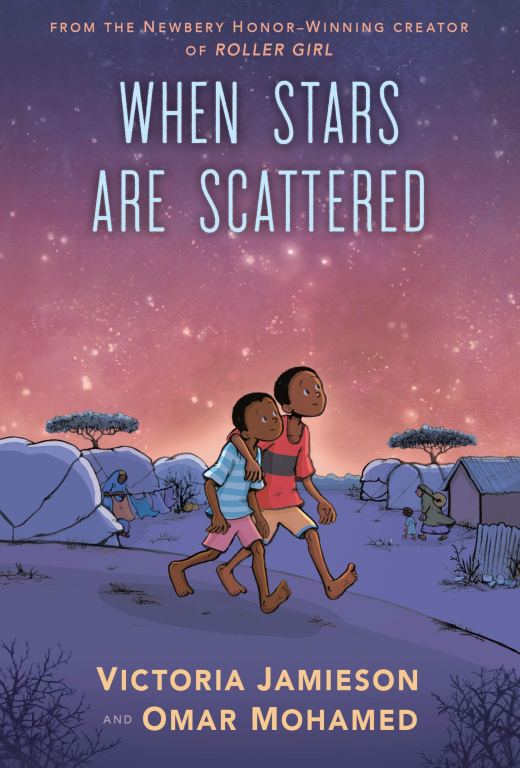
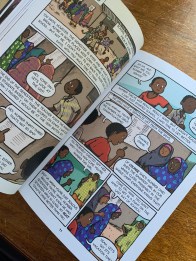
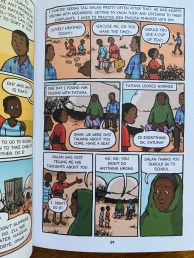
starsThis graphic novel swept me off my feet and left me in tears, not because of the hard life and sadness that life in a refugee camp entails, I had braced myself for that, but because of the hope and humanity and beauty that is so powerfully expressed and conveyed in this 264 page book.  Meant for 3rd graders and up, I think kids through middle school should be encouraged to read it.  The illustrations and colors are incredibly well done and the story is based on a true story that needs to be told and shared.  It is definitely in the top 10 books I’ve read this year and I keep catching my 11 year old re-reading this book repeatedly (like 5 or 6 times).
52BE6C8B-4246-4A92-BA66-004378A21862

SYNOPSIS:

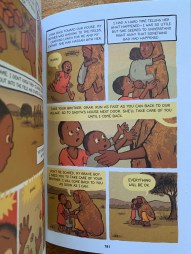
Omar Mohamed lives in Dadaab refugee camp in Kenya.  His father was killed in the Somali war and his mother has not been seen after she sent Omar and his younger brother Hassan to run with the neighbors to escape the violence.  Hasan suffers from seizures and doesn’t speak, save one word, Hooyo, mother in Somali.  The two boys have an adopted mom Fatuma, who looks after the boys in the camp as if they were her own.  Unable to go to school, Omar spends his days looking after his brother, playing soccer with plastic bags, and waiting in lines for water, food, and news of a better opportunity.

When Omar gets the chance to go to school (5th grade) he has to make the difficult decision of pursuing his own opportunities, with the hope of helping Hassan later, or living day to day and taking care of his younger brother.  He is finally convinced that education will help them both, and that if the girls can find a way to do their chores and attend class, he can too.

Each transition from primary, to middle to secondary school requires testing, and only the top get to continue.  Determined to stay in school, Omar studies while dealing with life’s many challenges and the daily additional challenges of living with little food and resources.

When Omar and Hassan’s names finally appear on a UN interview lists for resettlement, hope seeps in, but the wait and the uncertainty prove to be yet another test.  Along the way there are side characters from the United Nations that show compassion, other families that show how generous and loving humans can be, female classmates show him how to take advantage of his privilege and friendships that move friends to family.

D74285FB-CBDC-4C4A-BD7B-070439BB08EF

WHY I LIKE IT:

The book is gripping and has heart.  I don’t know what I expected, but I truly could not put it down.  The character’s stresses are felt and emotions are conveyed so powerfully, that I don’t know that you can read the book and forget it.  The most emotional part for me was his honesty in dealing with his brother, the strength of his friends, particularly female, and the bond to Fatuma.  Truly their living arrangements and loss of family is gut wrenching, but it was the little things that touched me the most.  The honesty of Omar having to decide if he was tempted to not go to school because he was scared. Was he using his brother as an excuse to stay with something he knew.  The emotional tipping point of no return for me was when he realized Fatuma would not be able to go to the second interview with the UN and would not be a part of what came after.  Of course I knew that, but by that point I was so connected to the character, that when Omar realized it, I broke for him.  To feel that connection in a graphic novel was new for me, perhaps a first, and alhumdulillah I am better for it.

The characters are Muslim and behave traditionally with praying and Ramadan and Eid.

F9E64F9D-1722-4CBD-B905-BE754BCE6C77

FLAGS:

There is talk of khat, something the men chew on the side of the road to forget things.  There is some violence, bullying, a young girl getting married before 6th grade and having a baby.

CDD12698-52CE-4FFD-9444-29A666980797

TOOLS FOR LEADING THE DISCUSSION:

Yes! I am hoping if and when we resume school I am starting with this book inshaAllah, for my middle school book club.  There is so much to talk about and understand and empathize with.