Tag Archives: boxing

Muhammad Ali and Malcolm X: The Fatal Friendship by Randy Roberts and Johnny Smith adapted by Margeaux Weston (A Young Readers Adaptation of Blood Brothers)

Standard
Muhammad Ali and Malcolm X: The Fatal Friendship by Randy Roberts and Johnny Smith adapted by Margeaux Weston (A Young Readers Adaptation of Blood Brothers)

bloodbrothers

A lot of us Muslims name drop Muhammad Ali and Malcolm X in discussions about civil rights quite often, and at least, speaking for myself, I thought I had the general idea about the relationship between these two iconic figures. I have read a fair amount of books in my quest to identify books that show how Islam shaped the men as opposed to those that tend to gloss over their eventual conversion to Sunni Islam, but I read this book as if it were fiction and I didn’t know what was going to happen next.  I have not read the original Blood Brothers, but this young readers adaptation is well done in conveying the politics, environment, struggles, and humanity of these two men.  Their flaws and growth, their tests, their friendship, it really is a compelling read. The focus on their friendship puts Nation of Islam as the focus, but the book does a good job of identifying it as being different than Islam.  As their friendship falters, Malcolm X goes for Hajj and is seen to change, and choices made by Cassius Clay show the men quite distant at the time of el-Hajj Malik el-Shabazz’s assassination, even though eventually their paths proved quite similar. The 240 page book is MG, but I think middle school readers (in classrooms, book clubs, and on their own) will better appreciate the intersection of these two giants, the events of their time, and the legacy they have left for us all.

SYNOPSIS:

The book is a snapshot in time, sometimes focusing on Malcolm X, sometimes on Cassius Clay, sometimes of their time together.  It starts with background insight and then shares the rise of both of them in their respective worlds, Nation of Islam and boxing.  Threaded through it all is the influence that Elijah Muhammad had on them, and key events they experienced that shaped their thoughts and opinions on race relations, politics, religion, and life.  It shows Malcolm X as the teacher, and leader taking in Clay and believing in him against the Nation’s wishes and thus when Muhammad Ali pushes him away the reader sees the Champ in a different light.  It shows deception and manipulation, as deep and riveting as the best fiction out there, but is very vulnerable in showing regret and both individuals’ ability to keep learning and growing.  The conclusion highlighting Muhammad Ali reaching out to Malcolm X’s daughter Attallah, and the forgiveness that took place in restoring the love between the two men and their families, really was a cathartic release that reminds readers that for as idolized as these two figures are in pop culture and history, they were very real people.  The book has a Biography at the end that breaks down sources by Government Documents, Archival Collections, Newspapers, Magazine Articles, Books, and Websites.  It is a “Selected Biography” that is seven pages long.

FLAGS:

Racism, manipulation, assassination, hate crimes, stereotypes, propaganda, oppressions, abuse, police brutality, assault, bombing, arson, attempted murder, fear, threats, killing.

TOOLS FOR LEADING THE DISCUSSION:

I have preordered a book for my own children to read and one for the school, I really think this book needs to be easily accessible for middle school students in libraries, classrooms, and homes.  I would love to do this as a middle school book club, I think the authentic perspective will give our youth who have heard of Malcolm X and think they know Muhammad Ali some insight into really spending time with what they did, what they faced, and how remarkable their friendship was.

Messenger: The Legend of Muhammad Ali by Marc Bernardin illustrated by Ron Salas

Standard
Messenger: The Legend of Muhammad Ali by Marc Bernardin illustrated by Ron Salas

img_9626

I’m always curious how books about Muhammad Ali will present his “Islam” and this 240 page graphic novel was no exception.  I was a little hesitant with the title, and with the foreword establishing that this book is akin to the heroic poems of Odysseus and Gilgamesh, and that “inspired by truth, and truth itself, aren’t the same thing.”  I did appreciate that it says if you are going to take a test on Muhammad Ali and this is your only source, you will fail.  It seems to recognize that Ali means a lot of very different things, to different people and this book at times is true and at times just feels true.  Broken into 12 chapters, 12 rounds, the author offers sources in the back, but leaves wiggle room for creative liberty.  I think if you are familiar with Ali’s life the book doesn’t provide anything shocking and you will enjoy seeing it play out in graphic novel form. If you aren’t familiar with him, the book is a little too choppy to paint a comprehensive biography and you will be confused and need outside clarification at times. I looked into the book before diving in, and many reviews say that the story makes his life accessible to middle grade and middle schoolers, the publisher says 10th-12th grade, and I think with the panel of a prostitute trying to talk to him, alcohol being offered to him, the recreation of him being positioned as a saint being martyred for a magazine cover shoot, comments about being with a lot of women, and some of the politics, the book is best suited for high schoolers.  

SYNOPSIS:

Framed around the lighting of the Olympic torch in 1996 the book then goes back and fills in the gaps on some of the big events of Muhammad Ali’s life:

Round One: Schwinn. 1954. Having his bike stolen and being introduced to boxing.

Round Two: Olympian. 1960. Winning Olympic gold.

Round Three: Church. 1961. Meeting Malcolm X.

Round Four: Sonny Liston. 1964. The fight.

Round Five: Media. 1967. Interview with Howard Cosell.

Round Six: Martyr. 1968. Esquire cover shoot.

Round Seven: Defendant. 1971. Draft evasion charges and fight with Joe Frazier.

Round Eight: Candle. 1974. Meeting a child with leukemia.

Round Nine: Rumble. 1974. Rumble in the Jungle.

Round Ten: Patient. 1980. Early signs.

Round Eleven: Shepherd. 1990. Iraq hostage negotiations with Saddam Hussein.

Round Twelve: Survivor. 1996. Lighting the Olympic torch.

WHY I LIKE IT:

It does articulate that he parted ways with Nation of Islam in chapter 11, Elijah Muhammad and Nation of Islam is pretty prominent in the book up until then, and then in Iraq it does show him praying salat, mentioning the blessings of Allah swt in freeing the hostages, and noting he is going as the most recognizable Muslim American.  I always enjoy reading about Ali and Cosell’s relationship, so I particularly enjoyed those scenes and like the premise of the book established, who knows if they are true, but they feel true and in many ways make Ali seem almost fictious with his equal parts arrogance, humility, humor, and insight.  I had to do a bit of outside reading about the Esquire cover shoot, and the Iraq hostage situation, the book did not seem to make it clear, and got me to thinking perhaps some of the other chapters only seemed clear because I had read about those incidents before.  

Normally I like books to be sourced and a book that is biographical to be accurate, but I almost wanted this book to just be extravagant.  To have fun with the persona of Ali and make him into something of legend that the foreword seemed to hint at.  What I thought was going to make him even more so “the greatest” seemed to just provide a safety net of protection to imagine what was going on in Ali’s head during the 12 rounds highlighted.

FLAGS:

There are some offers of alcohol which he refuses, some pointed political positions, a prostitute in a hallway invites him for free, he refuses. He recreates a martyr scene even once he established he was Muslim and wasn’t ok with it, but a phone call to Elijah Muhammad’s son, made it ok because it was for money, there is a lot to unpack there for kids.  He makes a comment about being with a lot of women at one point, not in your face, but in a graphic novel, to dedicate a panel to it, makes it stand out.  Racism, hate, bigotry, prejudice.

TOOLS FOR LEADING THE DISCUSSION:

I am a bit on the fence with this book.  I think it would work for a high school book club, but with a lot of context.  If you are discussing Ali, this would be a suitable supplement in a high school classroom.  If you are an English teacher talking about Homer and heroic poetry, I think this would be a great contemporary example. I don’t know that I would stop mature middle schoolers from reading it, but I don’t know that I would be suggesting it either.

If the book seems like a good fit for you, you can order it here.

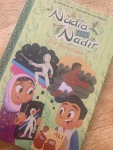
Nadia and Nadir Eid Surprise by Marzieh A. Ali illustrated by Lala Stellune

Standard
Nadia and Nadir Eid Surprise by Marzieh A. Ali illustrated by Lala Stellune

img_7058

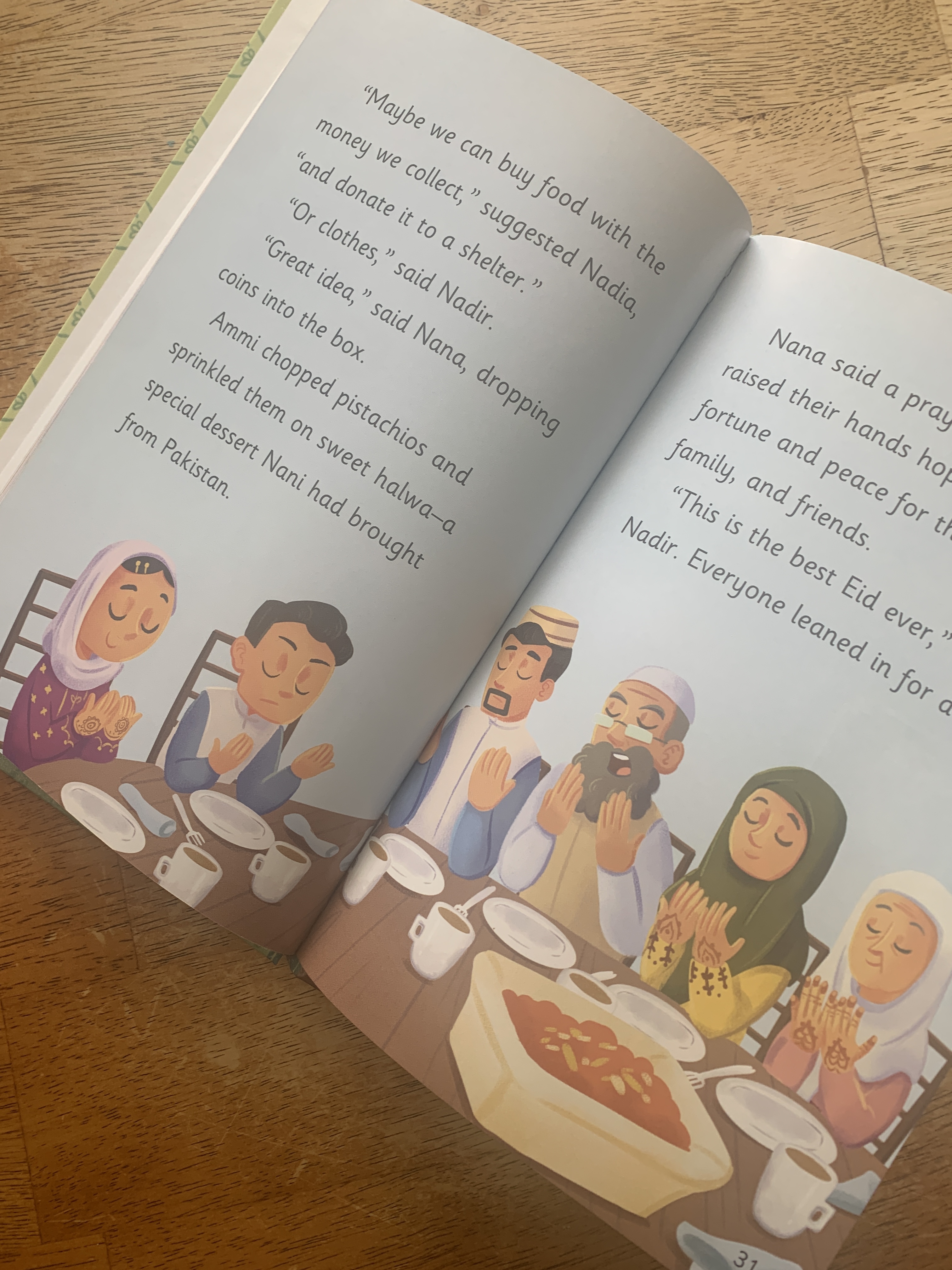
This is another holiday book in the Nadia and Nadir series for early readers, this one focusing on Eid al Fitr, but also celebrating Muslim American athletes Ibtijaj Muhammad and Muhammad Ali, sadqa, and the love of grandparents.  The 32 page book with four chapters shows Desi American siblings enjoying both their Pakistani and American cultures while consistently embodying their Islamic faith.  They pray salat, wear hijab, discuss sadqa, and say Salam and Eid Mubarak.  I am not sure why they pray Eid prayers at home, and not in a community congregation, no it is not a Covid set book, they then go to the mall, but the pride in their faith, culture, and family is enjoyable.  Early readers will enjoy the colorful pages, large illustrations, and relatable story situations.

img_7062

The book starts with the siblings hearing laughing downstairs, then seeing suitcases, and being surprised by their Nani and Nana coming from Pakistan to surprise them on Eid.  The family eats paratha and chai together before praying and making duas.

img_7061

After presents are passed out, the kids receive eidee and are off to the mall to pick out a toy.  Nadia sees an Ibtihaj doll, and Nadir points out that she is wearing a hijab just like his sister.  Nadia recognizes her and shares some facts since she has read her books.  Nadir wonders if Ibtihaj knows it is Eid and the family reassures him that Muslims everywhere in the world are celebrating.

img_7060

When it is Nadir’s turn to choose what to buy, he picks some boxing equipment with marketing images by Muhammad Ali.  Nana fills him in on the activism and accomplishments of Ali and how impressive his fearlessness really was.  When the change is given after paying, the kids and their grandparents discuss sadqa, charity, and this gives Nadia an idea.

The book concludes with a glossary of new words and information about the illustrator and author.  You can purchase your copy at all major retails such as here at Amazon, or you can support small business owners like Crescent Moon store and purchase your here.

The Next New Syrian Girl by Ream Shukairy

Standard
The Next New Syrian Girl by Ream Shukairy

next new syrian

This culture rich, American set, upcoming 416 page YA book proudly shows the characters’ Islam as it shares a story of pain, privilege, guilt, adversity, hope, and family dynamics.  The book is an easy read that is hard to put down, and is remarkably clean for the threads of romance, war, and mental health that permeate the pages (note that here are triggers of loss, separation, death, suicide, drowning, trauma, hate, and bullying).  There, however, are also some plot holes, contradictions, and weak threads that I feel obligated to note, but ultimately don’t make the book a bad read.  I think 16 year old readers, both Syrian and not, as well as Muslim and non Muslims will benefit from the characters sharing their lives and peeling back surface layers to show an intimate account of expectation and obligation for Syrian American girls in today’s world with the backdrop of war in Syria.  The book’s first few pages are powerful in their Islamic centering and unapologetic normalizing of salat and hijab and identity. The Islam in the forefront fades as the story progresses and I don’t think I can sign off on the relationship between two characters as being “halal,” but starting the story with fears of praying on the side of the road as a mom’s concern is next level.  Most book parents are trying to get their kids to pray, in this family- prayers are happening five times a day and on time, so the worry is knowing where you are when Maghrib time hits, because it obviously won’t be missed or delayed, alhumdulillah.

SYNOPSIS:

Khadija’s mom is queen bee in the tight knit Syrian community in Detroit and Khadija does not fit the mold of what the queen’s daughter should be.  It isn’t that Khadija is a rebel, she loves her mother, her faith, her roots, and well, boxing.  Khadija is wealthy, and privileged and so much of what is expected is for appearance sake only.  Khadija knows this, and takes boxing lessons for free in exchange for helping keep the gym clean as to establish this as her own thing, no strings attached.  When Khadija’s mom takes in a Syrian refugee and her daughter, Leene, Khadija has to figure out if she is threatened, jealous, or impressed by the new arrivals and what that means about her own family.

Leene shares the narrative with Khadija and shares her transition to life in America and in the Shaami home along with her past.  The loses she has faced, the obstacles overcome, and the secrets she keeps in order to face each new day show glimpses into the destruction of the Syrian war on a way of life and the beauty lost. 

The two girls are at odds with each other for much of the book, but as their stories start to intertwine, they find themselves with similarities and strengths that show they are a benefit to each other, despite their stubbornness and fiercely independent personalities.  In a race to reclaim what was once lost, the girls start to trust each other, and when family is further threatened the two girls allow themselves to be vulnerable and work together to save what matters.

Clearly I am trying not to spoil the book, nor takeaway from the climax, but I think most that start the book, will find themselves glued to the pages and will understand why I am choosing not to disclose too much.

WHY I LIKE IT:

The first chapter completely blew me away, I loved the idea of such a strong hijabi girl boxing and being so unapologetic about her Islam and culture.  I must admit I cried at the end as well.  It was tied up very neatly, arguably too perfectly, but there were tears none-the-less and no matter what I critique about the book, I was moved by it. The writing is engaging, and entertaining, no doubt, but alas, I have some questions, lots of questions in fact: How did the mom’s meet? One is super posh and high class, the other refugee with very little, how did their paths cross? How did Leene convince her mom to let her travel even if the ‘why’ was kept hidden? After everything they have been through wouldn’t being left to travel to the Middle East be a huge obstacle that needed to be overcome, it reads inconsistent and unbelievable. How hard was it for the “girls” to leave the “boys,” I would imagine it was devastating, yet it didn’t even get a mention.  

What changed so much about the family dynamic when they stopped going to Syria, the author shows the joy of Syria and being together for the family, but I think if you are not Syrian and do not know Syrians well, some of this thread, is going to fall short.  I talked to @muslimmommyblog and could see the reflection of the characters for her, but if I didn’t have her shared experience to flesh out the characters, I don’t know that I would have understood the weight of the guilt, the helplessness, and the frustration.  Similarly, only through talking to Shifa did I understand the pressures of being an American Syrian girl, if I’m being honest, Khadija the majority of the time, just reads whiney. Other family dynamic questions involve the dad and brother.  Was the dad always so absent? It must not have happened overnight, right? And exactly how old is Zain? He reads like he is 12, but he is in high school? Additionally, high school graduation is very important for both girls for very different reasons, but their is no talk of college or career plans, which was noticeably missing from the book.

Then there is the angsty storyline of Younes.  The perfectly selfless guy who doesn’t center his Islam as much, but does want to have a prolonged engagement.  What does that even mean, and how will that be ok Islamically, with them already laying on the 90s Bollywood style glances and loving confession?  Also why does Khadija frame morality through an Islamic lens for most things, but for the relationship resorts to worrying about what her mother will be ok with?  And was the family ok with Younes? How is he at the BBQ? Speaking of places he shouldn’t be, how was he at the party Nassima isn’t Arab enough for, when she at least speaks Arabic and he does not?

I think it best to just enjoy the story for what it is, not look too deep, not ask questions, and just enjoy the rep, the story, the characters, and the emotions released with the climax and conclusion.

FLAGS:

Romance, crushes, road rage, bullying, Islaophobia, mental health, death, killing, war, destruction, suicide, drowning, abandonment, separation, loss, grief, rebellion, angst, lying.

TOOLS FOR LEADING THE DISCUSSION:

This would not work for a middle school book club, and I really should say that this wouldn’t work for a high school book club either, but I know many older high school girls that would absolutely love this book and I think it might be possible to convince them that the relationship is more than the text shared, and was approved by the families and made halal.  Considering so many holes exist, it might be possible to control the narrative in a book club setting on the permissibility of the relationship.  It would definitely depend on the girls reading the book and I would strongly suggest that whether you read this book in a group or hand it to a teen, that you make it clear what a halal relationship looks like and that this is a work of fiction.

The book releases in March 2023 and as always to show support for OWN voice Muslim character filled stories please consider pre-ordering the book: you can do so here on Amazon.  And once the book releases please purchase, checkout from your library, and encourage your schools to shelve titles to encourage similar books to be published and made available, thank you.

Ordinary People Change the World: I am Muhammad Ali by Brad Meltzer illustrated by Christopher Eliopoulos

Standard
Ordinary People Change the World: I am Muhammad Ali by Brad Meltzer illustrated by Christopher Eliopoulos

muhammad ali

I think this 2022 published biography of Muhammad Ali just might be my favorite.  At 40 pages long and meant for first graders and up, it actually mentions that he is Muslim in multiple places.  So often these biographies about him or Malcolm X fail to incorporate their religion and just relegate their name changes to a footnote or after thought.  The book is engaging, informative, it is sourced, and the illustrations adorable.  My kids and I have read the book multiple times and are still enjoying the detailed illustrations (they even include #muslimsintheillustrations) and text.  Sports fans and even those that are not will appreciate what Muhammad Ali achieved, overcame, and accomplished.

The biography starts at Muhammad Ali’s birth and ends with his fight in Zaire- detailing his personality, growing up, how he got into boxing, becoming Muslim, refusing to go to war, and his biggest fights.  It weaves in how he worked against racism, standing up for his religion, and living life on his terms, at every step.  As the chronological story fades, it shows him lighting the Olympic flame in Atlanta, and the text starts to focus on the lessons that Ali fought to highlight, by encouraging us to continue his legacy.

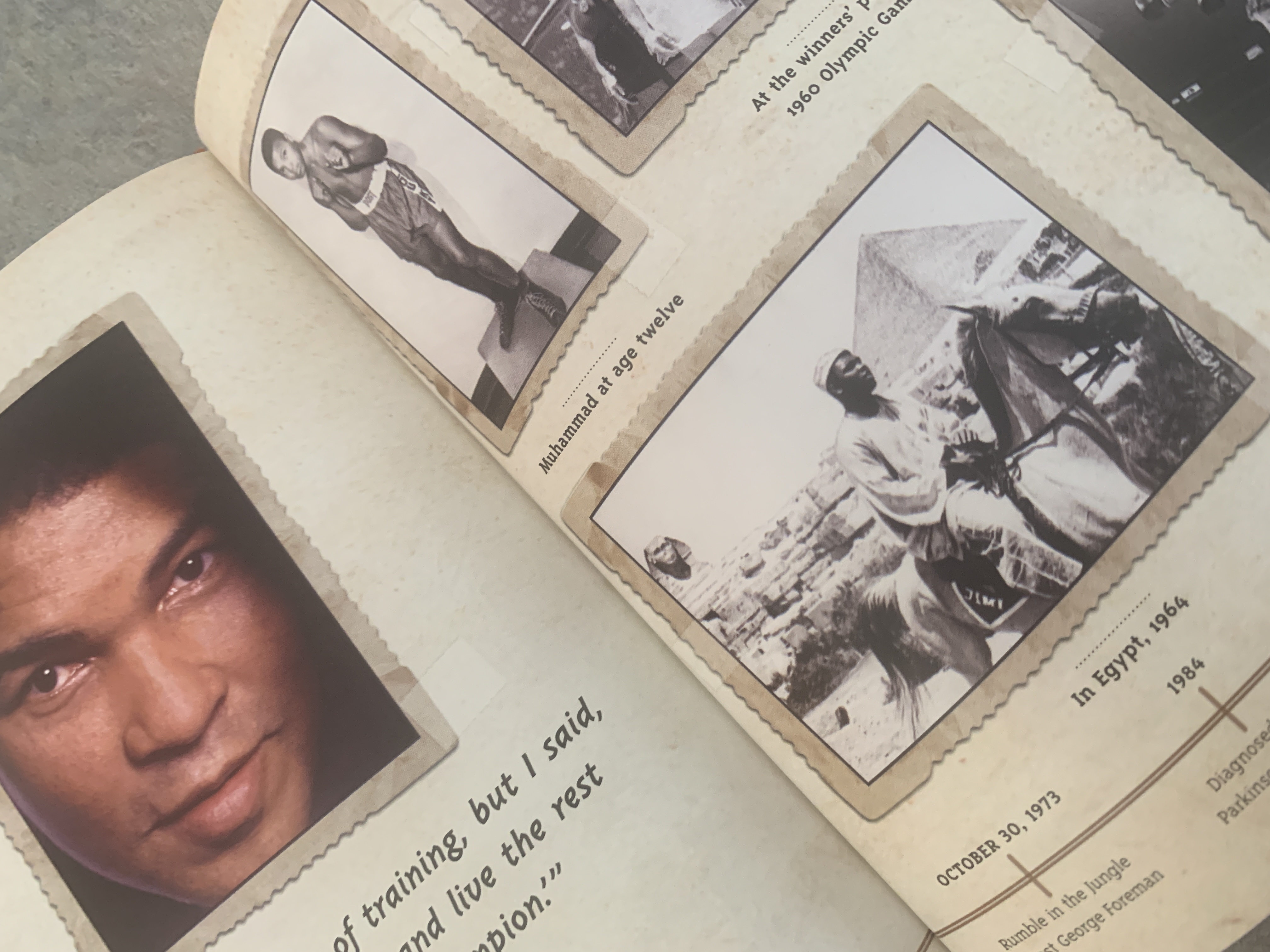
The illustrations show how his message is still powerful and inspiring to athletes, kids, ordinary people-everyone, the world over.  Ali stays depicted as a small child throughout, and the author captures his charisma, charm, and entertaining persona.  The final spread before the sources and further reading suggestions show a timeline of Muhammad Ali’s life and a few photographs of his life.

I need to read the other books in the series to see if they are just as engaging.  Undoubtedly Muhammad Ali’s story is entertaining and inspiring even when poorly written, but I have a feeling this particular biography really shines because the author and the subject matter came together.  I highly recommend this book for families, schools, and classrooms alike.

You can order it at Amazon and if you use this link, I get a few pennies! Thanks!

img_1293

Becoming Muhammad Ali by James Patterson and Kwame Alexander illustrated by Dawud Anyabwile

Standard

img_8575

This 310 page, AR 5.4 biography reads like a dream being remembered and flowing with newly awakened images presented in a lyrical way. The changes in point of view and writing style keep the book bouncing like a boxing match, and flesh out the early life of Muhammad Ali for middle grade readers.  Only at the very end does it mention that he changed his name when he converted to The Nation of Islam, it doesn’t detail much about it, and it doesn’t mention his eventual conversion to Islam, even though it does mention him being diagnosed with Parkinson’s and his death.  I understand that the book focuses on his preteen and teen years, but it seems like The Awakening of Malcolm X also intentionally cut that footnote out of the book, and having read that book a few weeks ago, it seems a deliberate exclusion in both cases and that bothers me.  It could be coincidence, as both 2020 published middle grade coming of age books have familial support in the writing and research, admittedly it just might be my timing of reading them makes it seem that something larger is at play.  Ultimately, this book gives insight into who Cassius Clay was, and what his life and friend circle looked like as a boy in Kentucky. The verse and flow of the text make the book an easy and enjoyable read.

SYNOPSIS:

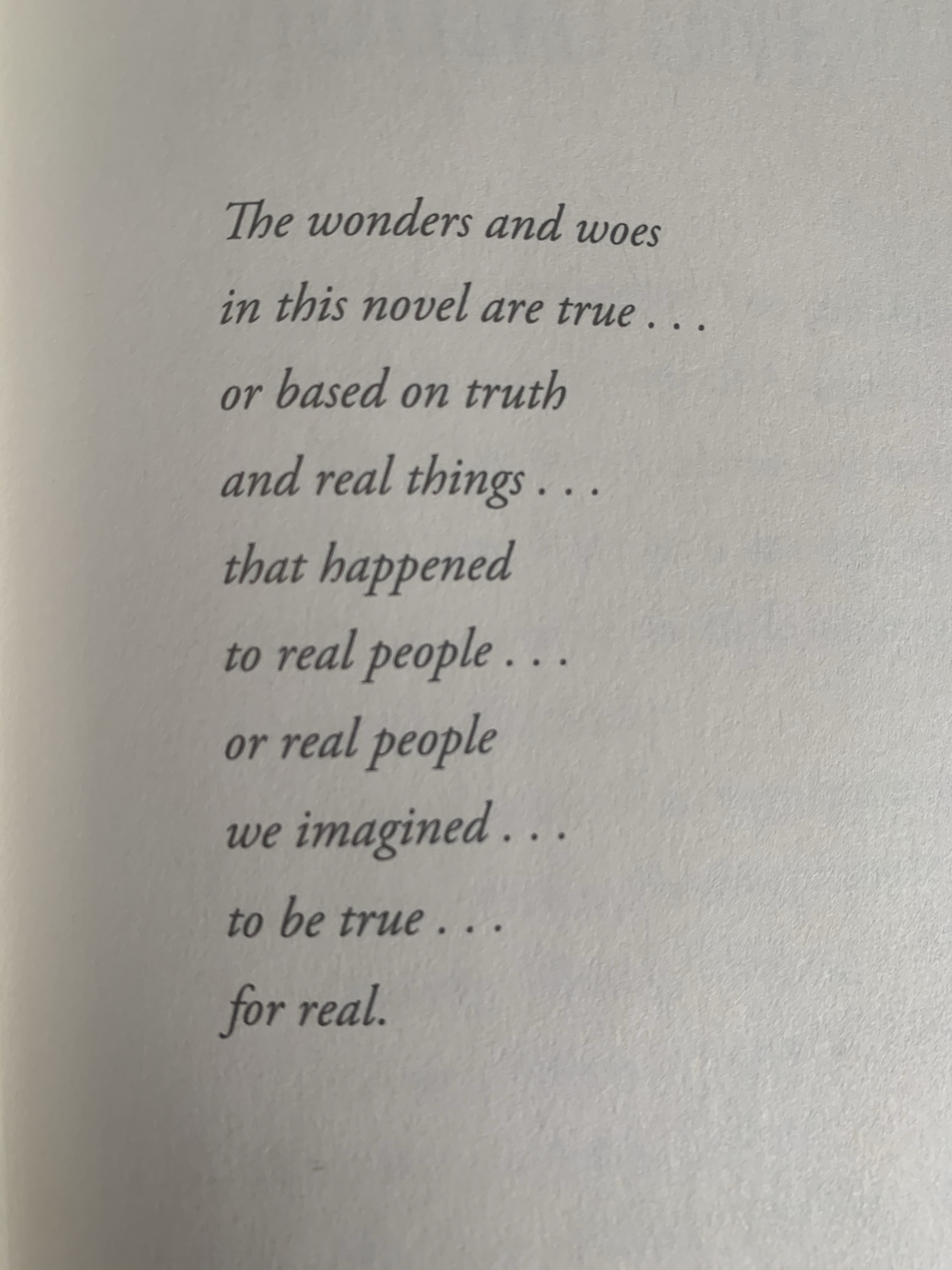
Lucky is Muhammad Ali’s friend growing up and is the narrating voice that sets up each chapter and overall framing of the book.  The bookish friend is a writer and eventually a journalist that moves the story forward.  The verses that follow each intro are the imagined voice of Muhammad Ali.  There is a bibliography at the back, but the story starts with this warning, or disclaimer, or wink of sorts:

img_8621

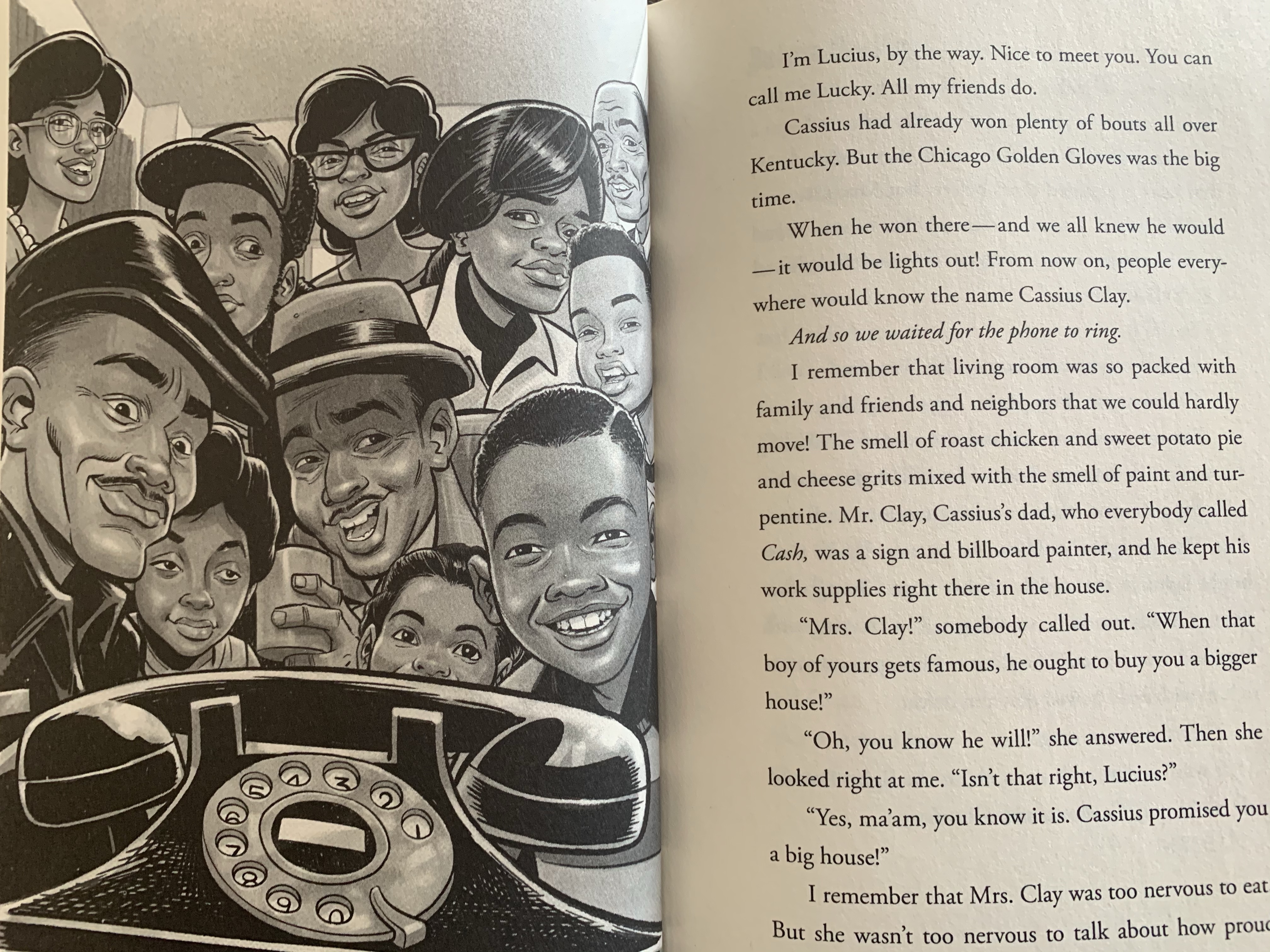
The book opens with Lucky and the Clay family waiting for the phone to ring in 1958 to find out if Cassius has won in Chicago.  He is there fighting for the National Golden Gloves.  He eventually loses the tournament, but he doesn’t stay down.  The book then rewinds and starts back before Cassius ever enters the ring.  The reader gets to know about Granddaddy Herman and the bond that the two share.  He is Cassius’s church and source of pride.  We also learn about how Cassius sees the world and the racism that exists in it. His humbleness and frustration with seeing how hard his mom has to work for so little reward.  We see how his friends shape him, but more importantly how he shapes them, and we see how although he struggles in school how he is articulate and respectful and beloved by so many.  His younger brother is a constant in the story, as is the narrator Lucky.  The book gets inside the character Cassius and if you didn’t know it was a biography, you would think it was a fictional coming of age book.  The ups and downs, the setbacks, the frustrations, the dreams, it all flows and makes you feel for this determined kid, who despite all his bravado, is really a down to earth human being.

img_8577

WHY I LIKE IT:

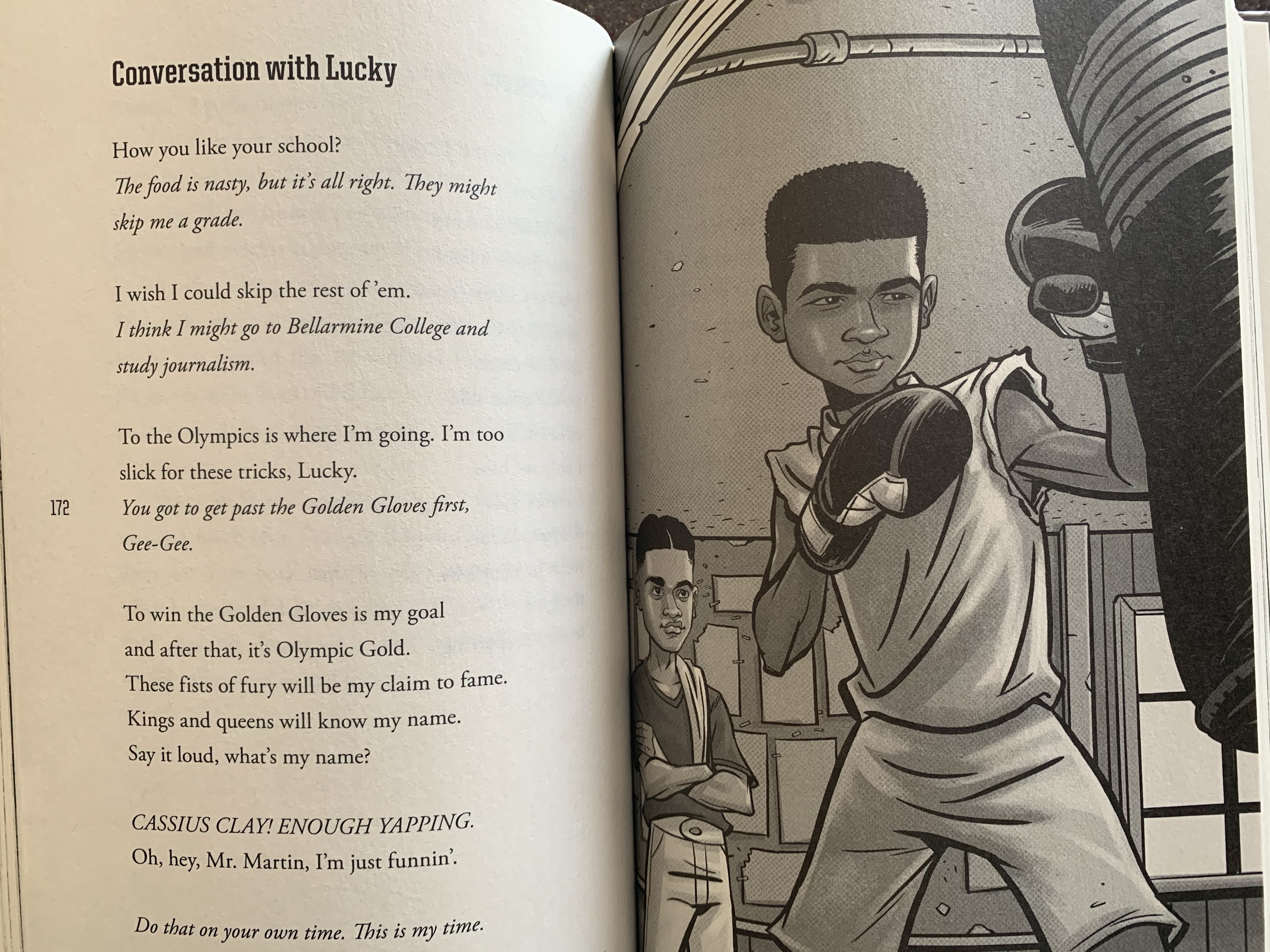
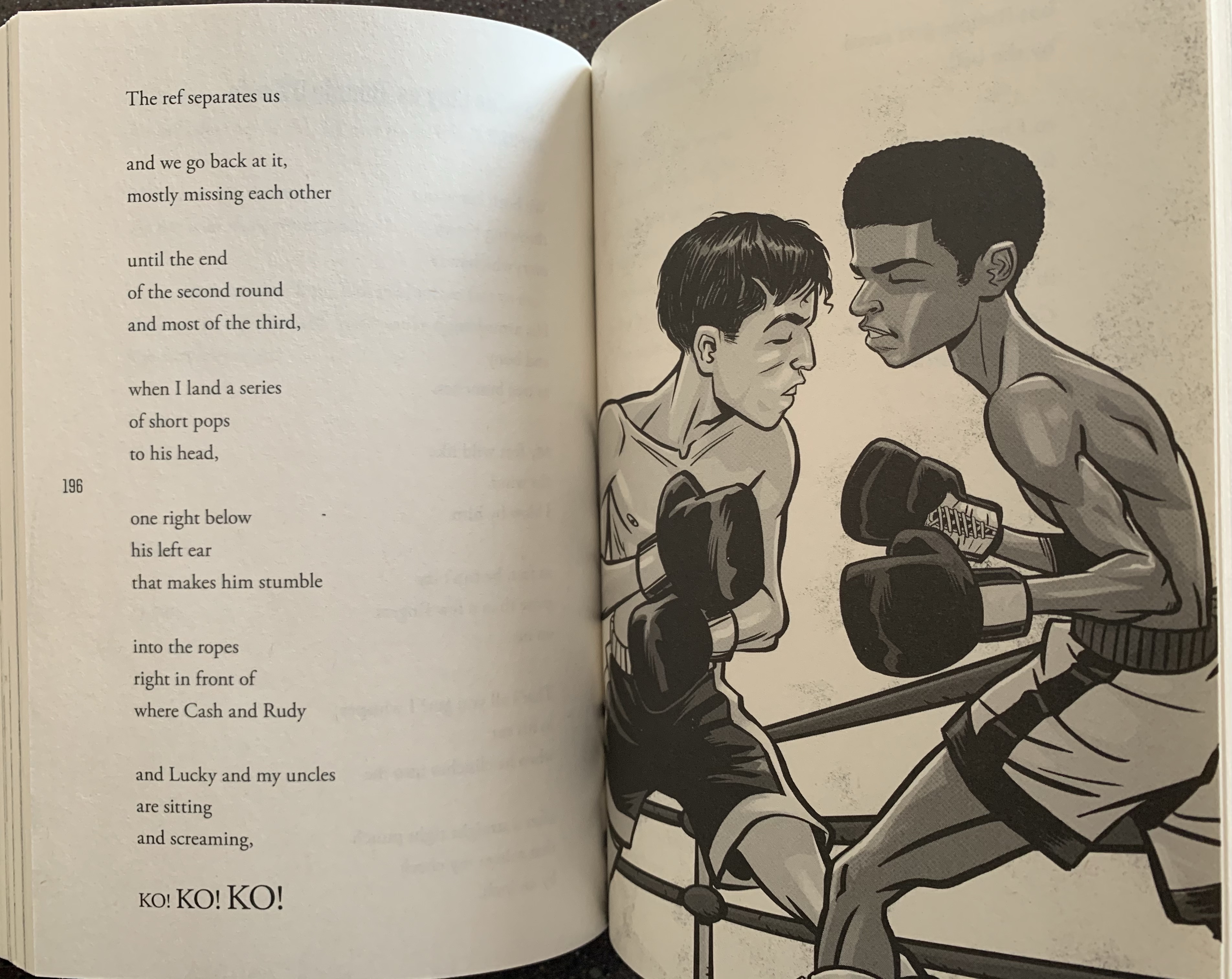
I don’t think I learned anything ground breakingly new reading this book, but I felt like I got to know the material in a more fleshed-out way.  It isn’t a list of facts or hight lights, it is the nuanced day-to-day that lift him off the page and out of the headlines.  I like the change of voice and style of writing, it made sense to me, and allowed the book to resonate differently than a traditional biography would.   I think it will also appeal to a wider audience because of the verse and easy flow.  I similarly enjoyed the illustrations that pepper the book.  I appreciate that the story is told from a friend looking in on someone that he knows well, but I almost would have preferred his brother being the voice and bringing the reader even closer to the boxer. Ultimately I want to know more about his parents and his brother and how they felt about his success.  The book didn’t answer a lot of question, but hopefully it will spark the curiosity of readers to go and learn more.

img_8578

FLAGS:

He slightly mentions crushes and dating, that his dad is out galavanting Friday nights until Saturday.  There is mention of a side character having part of his face damaged in an explosion, there is reference to the N word.

img_8576

TOOLS FOR LEADING THE DISCUSSION:

I would consider the book as a book club selection if it served a larger purpose or the group had a preexisting interest.  I think if I were to meet with a group of kids more than just once a month for an hour or so for a book club discussion, this book would have a lot of potential for introducing the athlete, writing styles, historical implications and so on.  I just don’t know that we could get to all that in such a limited time. If they had already learned about his boxing accomplishment,  his protesting of the war, his conversion for example, this book would be a great discussion extender to supplement basic knowledge of him.

Float Like A Butterfly by Ntozake Shange illustrated by Edel Rodriguez

Standard

img_8250

This 40 page biography beautifully presents major events of the famous boxer’s life without going in to much explanation. While it is an AR 4.7, it is still a picture book, and might work better for younger kids with some conversation and context, than for middle grade readers looking for anything in-depth about the beloved hero. While following his life, the reader sees him as a child growing up before he becomes famous, and sees that even after he retires, he is so much more than just a boxer, he is a compassionate leader, icon, and humanitarian.

img_8251

Born in Louisville, Kentucky in the Pre-Civil Rights South as Cassius Clay, he struggled to understand why there was only a white superman, and questioned if heaven was divided up by color and income like Smoketown.

img_8252

Cassius loved the power of words and would help his father make rhymes as a sign painter. When his bike gets stolen he is motivated to learn to fight so that nothing else is ever taken from him and his. He may not be the colored superman, but he is determined to be lightening fast and have fists that fly.

img_8253

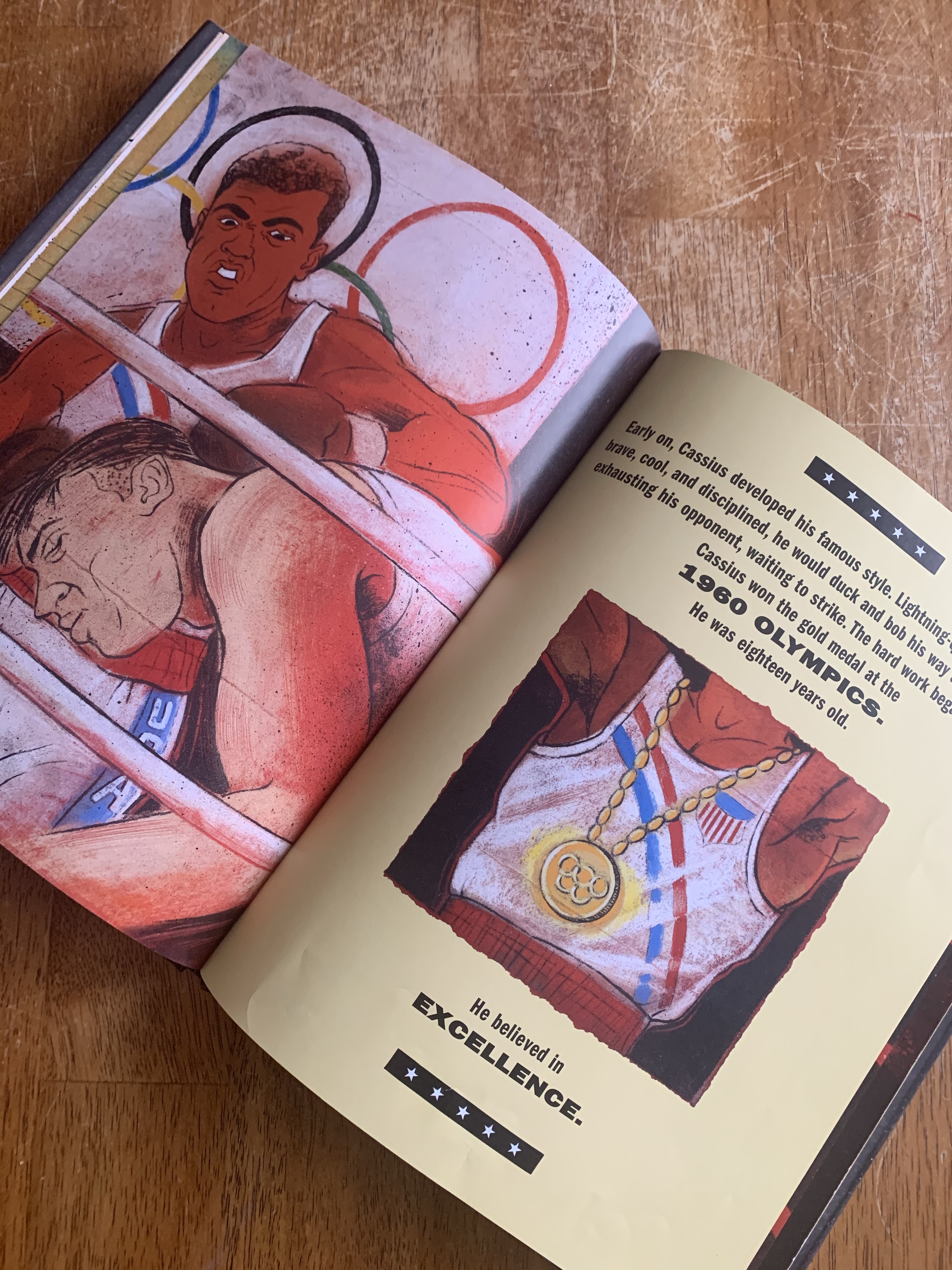
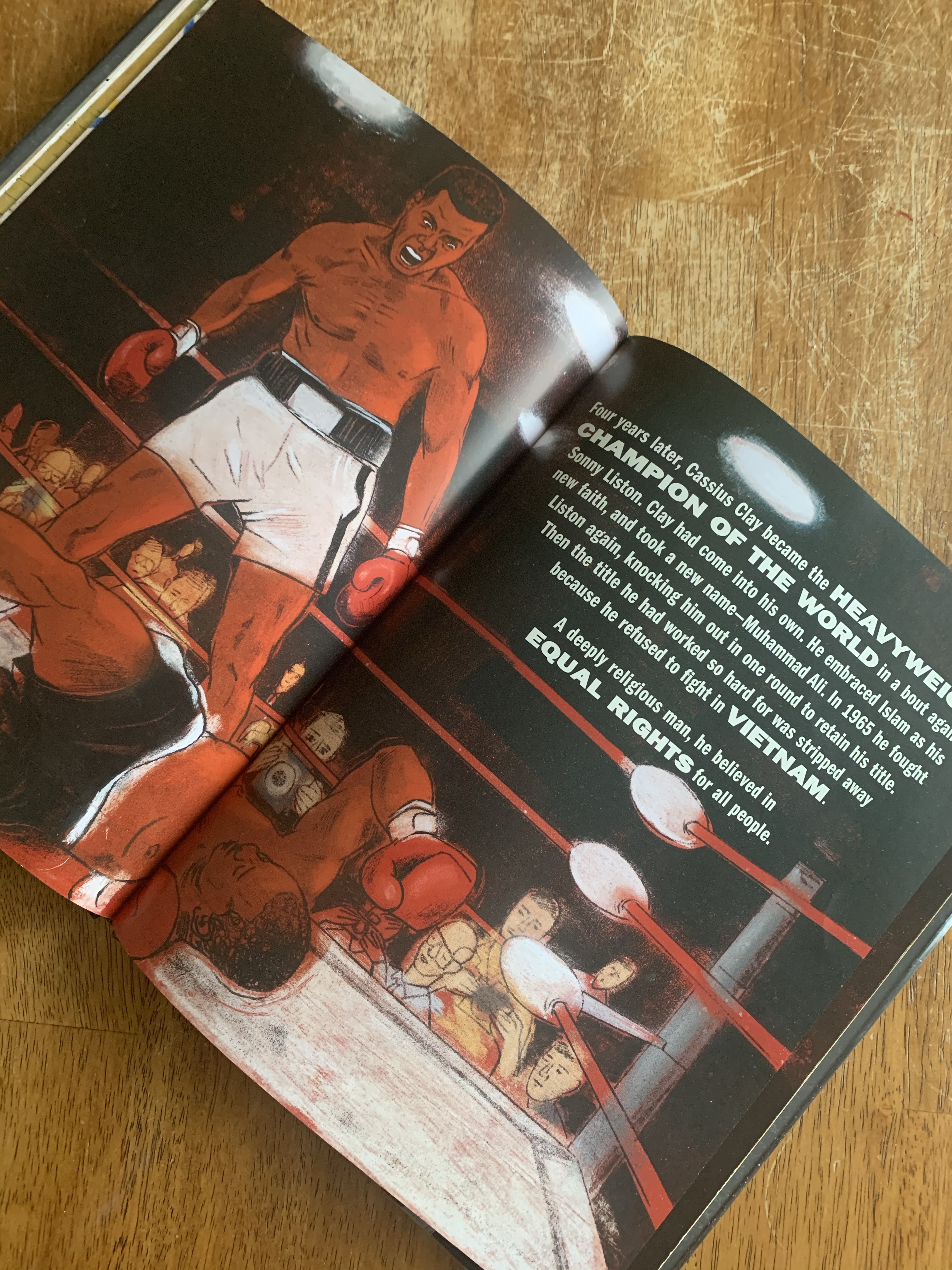
In 1960 at age 18 he won Olympic Gold. In 1964 he converted/reverted to Islam and changed his name to Muhammad Ali days after becoming the Heavyweight Champion of the World. His titles were stripped from him, however, when he refused to fight in Vietnam.

img_8254

Years later in 1971, the Supreme Court reversed his convictions for not fighting and in 1974 he reclaimed his title by beating George Foreman in “The Rumble in the Jungle.” In 1981 after winning, keeping and losing the title, Muhammad Ali retired from boxing for good.

img_8255

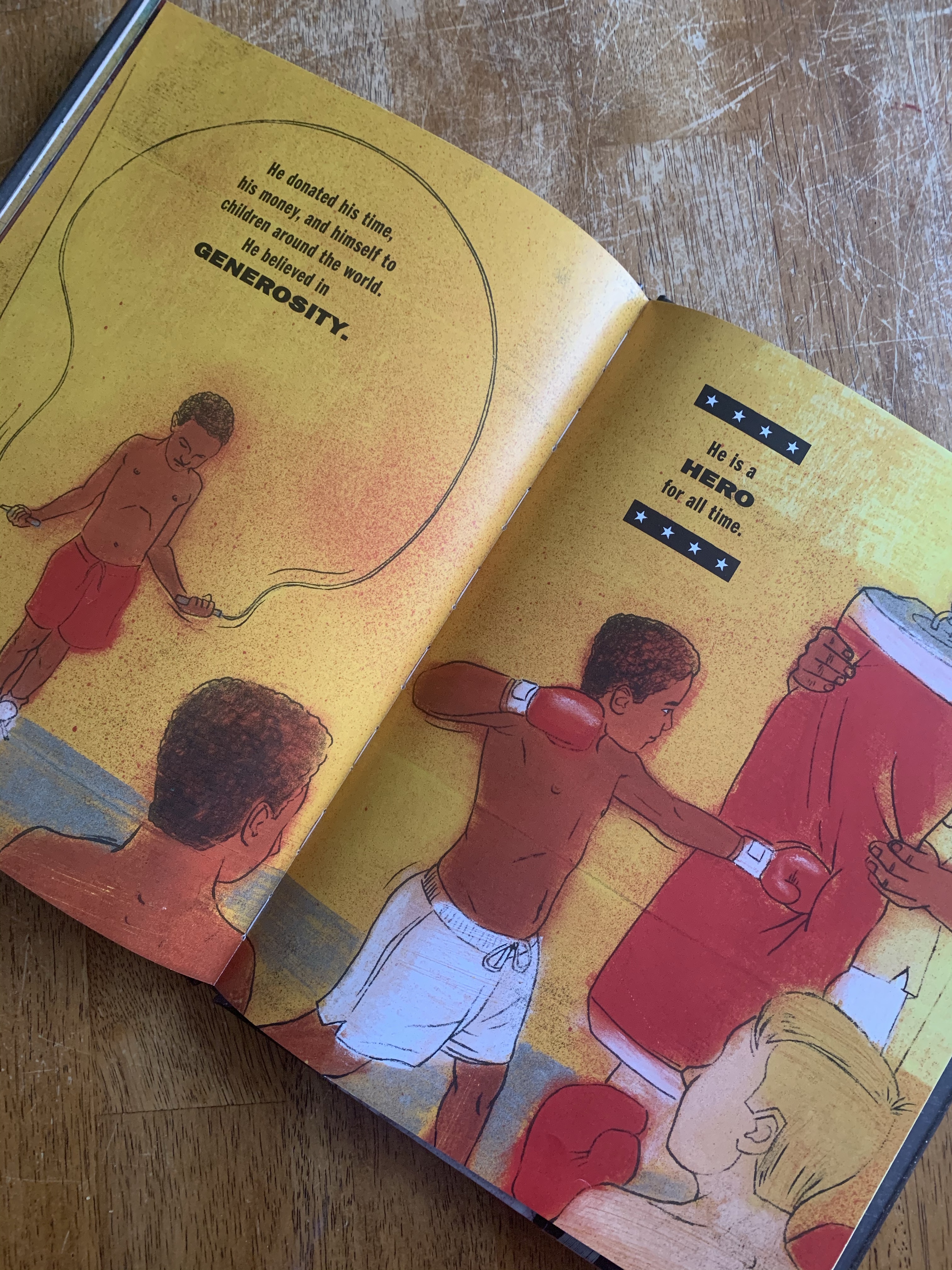
Muhammad Ali suffered from Parkinson’s disease but still donated his time, his money and himself. He believed in perseverance, and equality, and fought for what he believed in. He passed away in 2016 at the age of 74.

img_8256

This is an updated edition from the 2002 originally published book, it now includes his death. I wish it was more than a fleshed out timeline and showed him as a person, or what it was like to lose everything when standing up for something you believe in, or explained what some of his catch phrases meant, or really just as a more high energy celebration of his life.

img_8257