Tag Archives: adventure

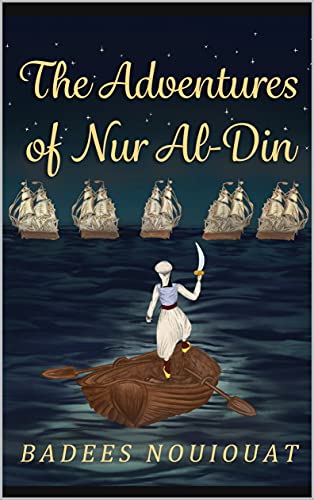
The Adventures of Nur Al-Din by Badees Nouiouat

Standard
The Adventures of Nur Al-Din by Badees Nouiouat

nur al din

I really enjoyed this book.  It is self published, and the expectation was zero and I honestly read all 214 pages in two sittings. I probably could have read it faster, but ahh kids and dinner, and my middle school son somehow got to it to read when I put it down.  We both enjoyed the quick pace, the strong Islamic presence, and the historical fiction based plot.  The book has a bit of language, hell and damn a few times, mentions prostitution and a brothel in two instances, and alcohol is present, but it is always crystal clear on Islamic and Muslim behavior.  The book is linear and straight forward and  probably YA readers will appreciate it, but I think it really is a middle school aged read, I think technically that makes it Young YA or Lower YA.  My only small grievance is the modern slang.  I appreciate that it isn’t written like Treasure Island and that you understand what the pirate crew is saying in plain modern English, but the few mentions of “idiot,” “chill out,” and “awesome” stick out very obviously and could easily be “fixed.”  Overall, so very impressed by the consistent pacing, historical references, writing quality, and internal reflection on our ummah’s strengths and weaknesses.

SYNOPSIS:

Farid is a young boy in Tunisia, and as the Spaniards start to flex their influence, his life begins to change.  The son of a fisherman, the family can barely enter the waters under the watchful eyes of the Spanish fleets.  When approached after a fight to join an Islamic pirate crew by Captain Aruj of the Barbarossa and his brother Khidr, he decides to leave his family and stretch his wings.   Having always dreamed of being in a leadership role, his optimism, and eagerness is quickly put to the test as the crews’ first mission in Northern Africa fails and sends the pirates scrambling on land.  They journey to the Mosque of Uqba (Great Mosque of Kairouan), and get help from the Emir in Tunis to replenish their losses.  It is then onto Tripoli where friendships and internal issues of race, and nationality threaten the cohesion of the Muslim pirates.  But it is in Spain where things really come to a head and Farid finds himself separated from his crew, in-prisoned for years, and tested both physical and emotionally that the story finds its climax before ending, and leaving the reader ready for more.

WHY I LIKE IT:

I have a soft spot for historical fiction, the original American Girl books for me were treasures to behold.  So the setting of this book really won me over: the mention of rulers, historical landmarks, the pain of the Inquisition on Spanish Muslims, the fact that there was a not just one map in the book, but two, all great things.  Like I mentioned above the pacing of the book is quick, from start to finish, and it is a pirate story so there is death, violence, battles, killing, and treason, but seeing as often in books about these type of things, I find myself glossing over the long detailed battle scenes, I was grateful that they are short and quick and possibly overly simplified.  It discusses weaponry, but it is not detailed, no glossary is needed, although there is one of the Islamic words at the beginning.  As for the Islam presence, it is very much a part of the story.  They raid a ship, the alcohol goes in the sea, they call athan differently, the characters discuss different madhhabs, just rulers are just even if they aren’t Muslim, and terrible rulers can also be Muslim, it doesn’t shy away from internal reflection and I appreciate that.  The only thing that caught my attention of being unaccounted for Islamically was when Farid puts on red and gold pants to head in to battle.  One- that seems the opposite of camouflage, and two- many Muslim don’t find it permissible for men to wear red and gold, obviously different people feel differently, but it seemed odd that the colors were specifically mentioned in such a quick moving book to no end.

Character-wise, I wanted a little more insight into Sameer and his racism, I also would have liked a little more about Farid’s first day in the sun after imprisonment.  I liked that the Jewish struggles under King Ferdinand in Spain weren’t just mentioned, but were brought in to the story.  And while I appreciate the reasoning for showing that Muslims were hiding behind a brothel to participate in learning and worship and thikr, that and the mention of a woman trying to seduce Farid in the street, both make the target audience a little more mature than the rest of the book might warrant otherwise.

FLAGS:

There is killing, fighting, raiding, stealing and there is plenty of physical violence.   The book mentions prostitution, seduction, and there is a fleeting glance at a woman that the main character pauses for, knowing he should lower his gaze, but then she is rescued and never seen or heard from again.  There is mention of alcohol as it is captured, as non Muslims stagger around drunk, etc.. There are a few curse words used a few times each: damn and hell and God.

TOOLS FOR LEADING THE DISCUSSION:

I think I would absolutely do this for a middle school book club amongst a mature group of girls and boys.  It is an easy read, but the discussions would be phenomenal as history and context would all come in to play.

For the sake of buzz and growth and attention, I hope the author will shop the book around, if he hasn’t already, see if it can be published on a larger platform and gain some traction.  We need books like this, solid Islamic fiction books, that aren’t shy to show our strengths and weaknesses and inspire our youth.

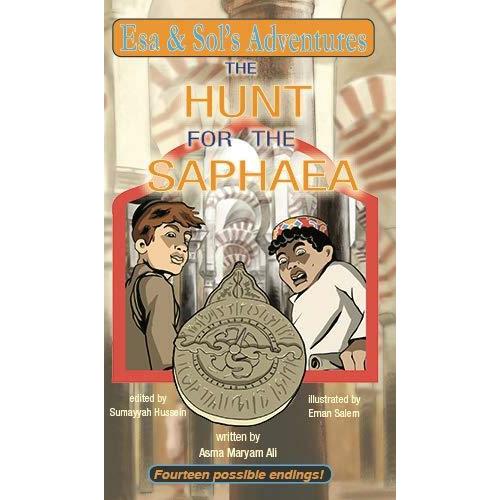
Esa & Sol’s Adventures: The Hunt for the Saphaea by Asma Maryam Ali, illustrated by Eman Salem

Standard
Esa & Sol’s Adventures: The Hunt for the Saphaea by Asma Maryam Ali, illustrated by Eman Salem

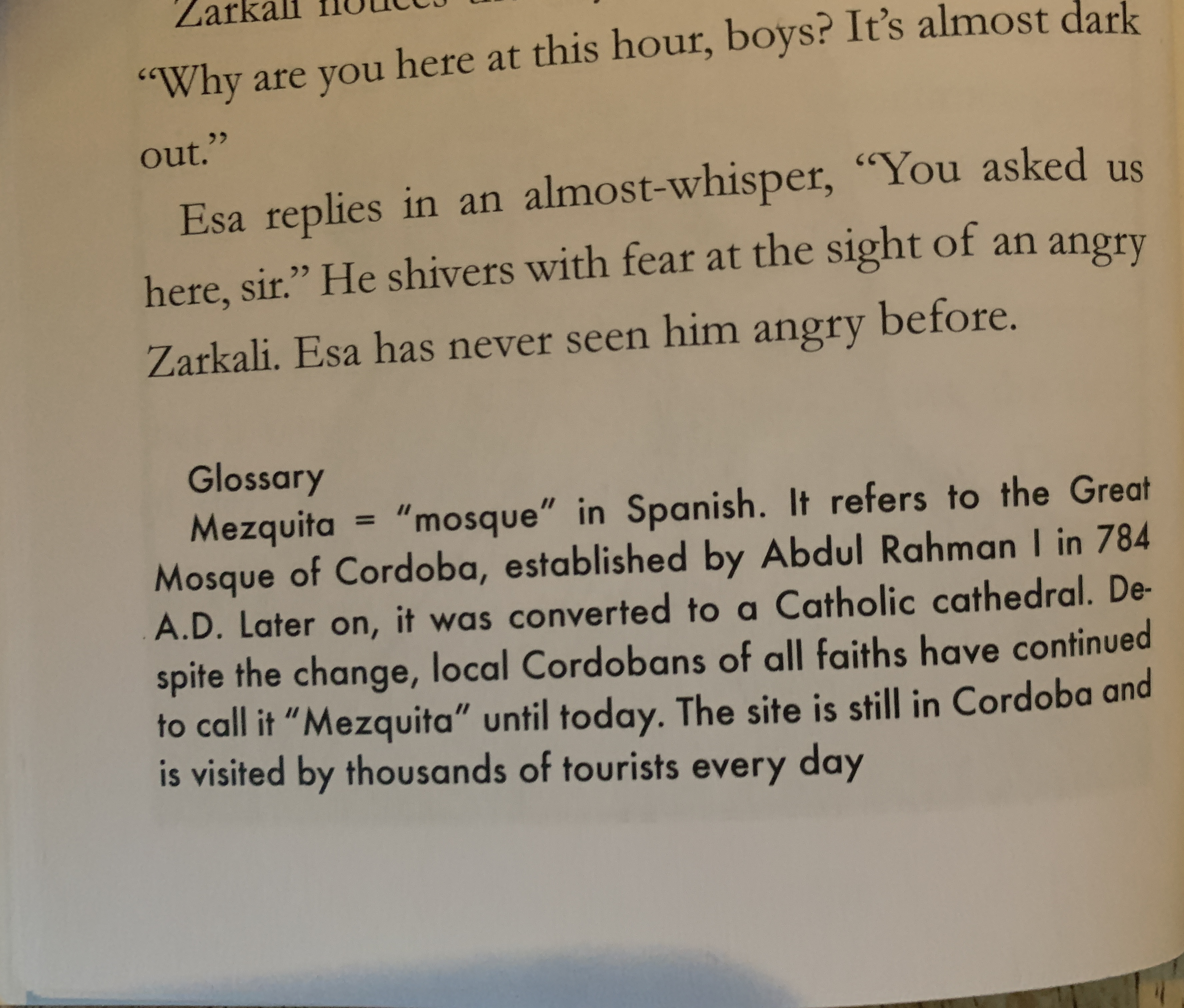
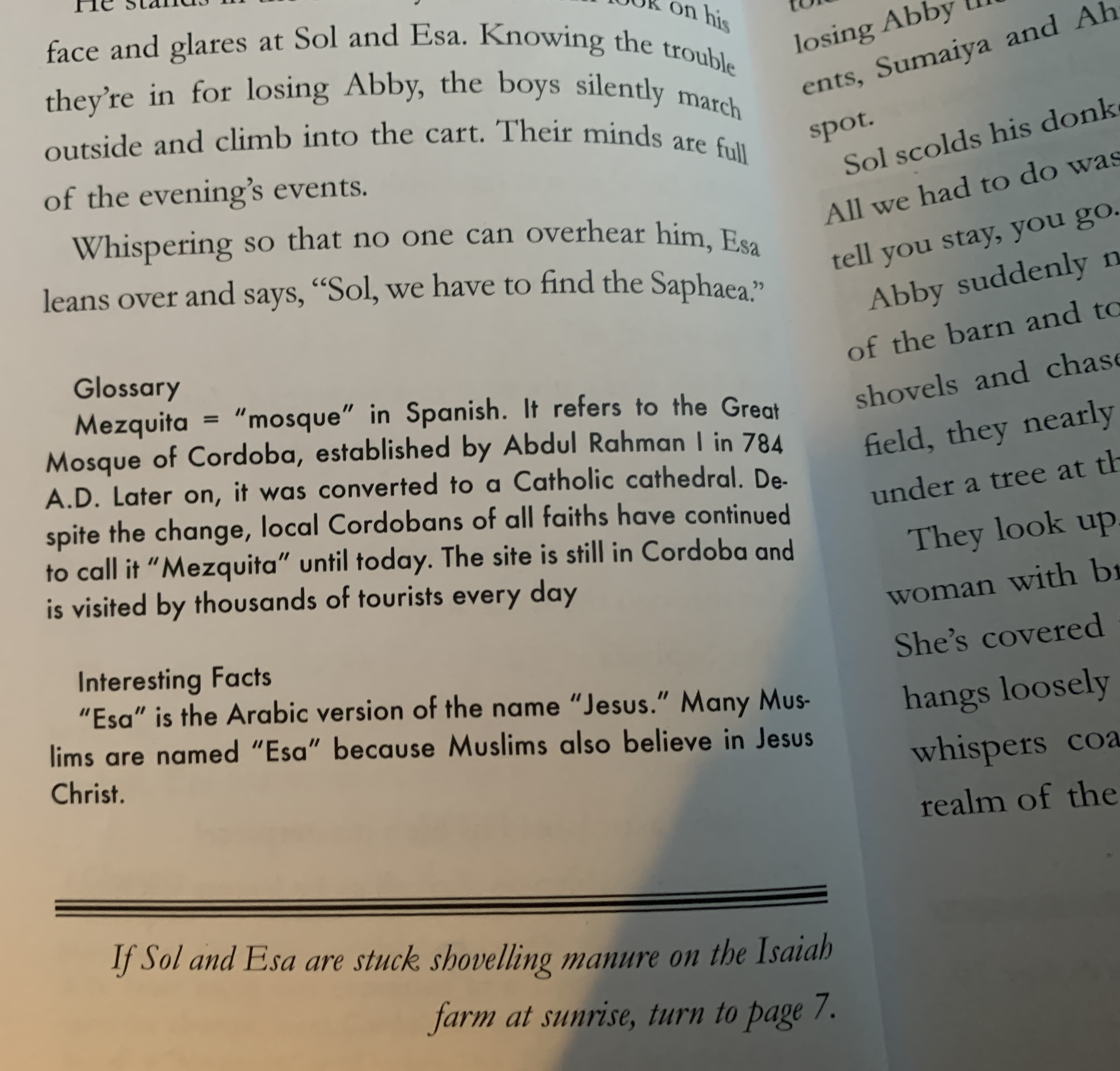
It is a bit tricky to review a choose-your-own-adventure style book, as each story twists and turns and leaves the reader with a different ending and thus, a different impression. I tried to explore every story line in a book that I had little expectation of, it is an intentionally splintered story after all, but even at that, this fell really short. The core of the story: a Muslim and Jewish boy in Cordoba, Spain in 1080 exploring real facts in a fictionalized story about hunting down a missing astrolabe, really had a lot of potential, unfortunately the tiny size (maybe 3.5 x 5.5 inches) and only being 76 pages, the frightening cover, and the misprinted footnote glossy right at the start, set the tone for a weak forgettable book, and by the time you get to the actual story and plot, you really have very little substance to change your mind.

SYNOPSIS:
Two nine-year-old boys start off the story chasing after their donkey who has run off and sent their oranges spilling over all around the square. They should clean up the chaos, but they remember that they are supposed to meet Zarkali, the greatest astronomer in all of Spain, as he finally has a job for them after months of waiting. His latest work is a brilliant astrolabe, but when they get to his workshop he isn’t there. When he finally arrives with his assistant Aleho they are frantic as the astrolabe, the Saphea, is missing. The boys were to be asked to help transport it, as they would blend in unnoticed, but now that it is missing what should they do? Should they search for it? Investigate if it was stolen? Accept their punishment for the mess with the oranges and their donkey? Let the first choice of many begin the adventure.

WHY I LIKE IT:

I love the author’s knowledge about Muslim Spain and how she tries to introduce it to children perhaps unaware of the rich history. The inside illustrations are wonderful, the cover truly misleads readers, and naturally I wish the book was larger in size and longer in length. The foundation of the story, the getting to know the characters and their world, needs to be longer. The story should be established before you have to make decisions. It is historical fiction, but needs the world building attention that a fantasy book would require, and this book just doesn’t have it. As a result the choices and endings, are all over the place, not just twists in the stories, but huge changes. Some of the paths no longer focus on the astrolabe that is missing, and seem to offer both threads of something far more sinister at play and choices that keep the boys lives mundane. The book counts on the reader re-reading the tale and making different choices, otherwise your interaction with the book could truly be over in nine pages, nine tiny pages at that. And like I said above regarding the cover and size, they don’t entice one to pick it up and read, then if your adventure is only a few pages long, and you already notice the repeated definition on pages 4 and 6 (before any choices are offered), chances are you won’t revisit the book, learn about real people, marvel at scientific discoveries, travel the region, appreciate interfaith harmony, and get swept up in a historically fictionalized tale that puts you in the drivers seat.

FLAGS:

Fine for middle grades and up.

TOOLS FOR LEADING THE DISCUSSION:

I highly doubt the book would even be looked at on a classroom library shelf, I have been trying for days to get my own children to read the book: they love to read, they love history, they love books with options, but they have yet to open the front cover.

My Laugh-Out-Loud Life: Mayhem Mission by Burhana Islam

Standard
My Laugh-Out-Loud Life: Mayhem Mission by Burhana Islam

mayhem

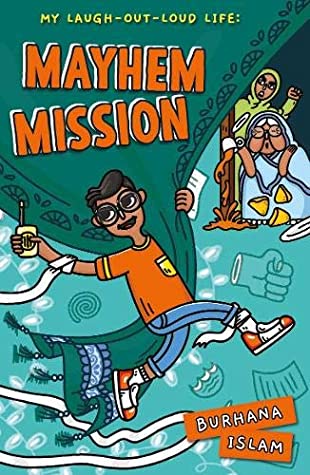
Fairness aside, any book about a genuine Muslim British boy written in first person with doodles, lists, and hilarity for middle grade readers is going to be compared to the Planet Omar Books, and not only do they have the advantage of being first, but they also have set the bar really high.  This 266 page book is decent and fun, and if your children enjoy Omar, they will enjoy this, but even my kids compared the two and found this one just a bit lacking.  The story is outrageous and funny and has a lot of heart, the writing is sufficient, it just feels like the story gets away from the author.  Information is given for no reason and to no purpose, the story loses its way and fumbles around for a bit in the middle, seems to get off track at points, and is a bit weak in character development.  That being said, would I purchase and read future books in the series? Absolutely! I love that the standard and quality for books with Muslim characters by Muslim authors for our children are at this level.  There is no apologizing for Islamic Bangladeshi culture in this book, and the mainstream publication means Muslim and non Muslim children are seeing a nutty, loving family that they can relate to in a myriad of ways, alhumdulillah.

img_4078

SYNOPSIS:

Yusuf’s much older sister is getting married, and she remarks that he now needs to be the man of the house.  Unsure of what that means, he asks Sheikh Google, and is not prepared to do what it entails.  Not at all, he is only nine, but rather than discuss it, he decides instead that he must stop the wedding. So, with a bit of help at times from his cousin Aadam, it is full steam ahead to sabotage the upcoming nuptials.  With little time, he attempts to make his sister unwanted in her inability to cook, keep her hidden in her room by removing all the hijabs in the house, spreading rumors that she has died, ruining her wedding dress, and more, so much more.  It is cringe worthy at times, and hard to put down at others, but alas there is a happy ending, and lucky us, we get to read all about it in Yusuf’s year five what I did over summer vacation essay.

img_4077

WHY I LIKE IT:

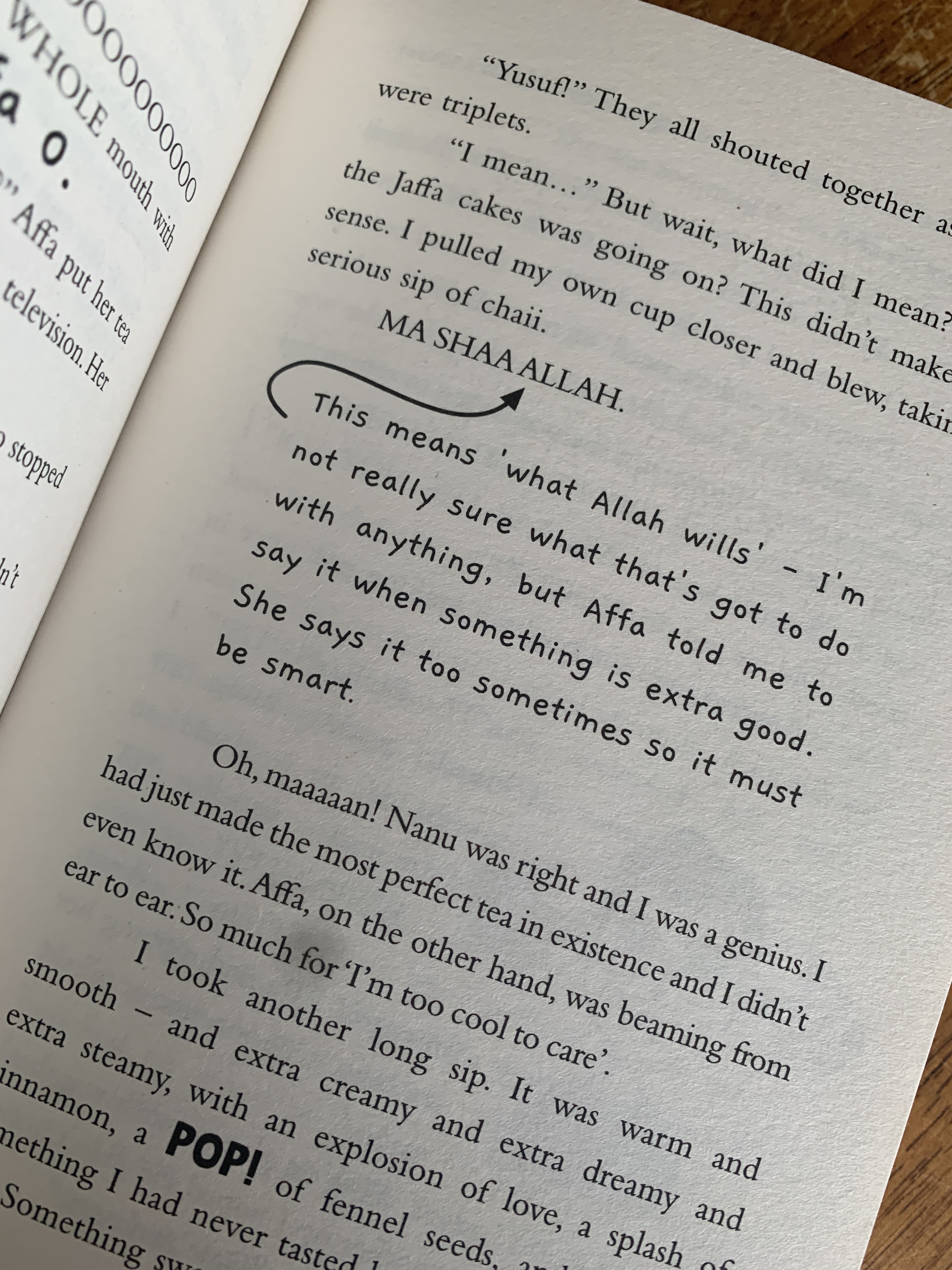
I love that the family dynamic is a single mom, her mom, and the two kids.  I think it is important to show some diversity that reflects the family situations of many Muslim children that have thus far been a bit down played.  The book is relatable and contemporary with Marvel references, while tossing in everyday cultural references too.  The family prays, does tasbeh, memorizes Quran, covers, etc.  The book tries to give some depth to the characters, such as Yusuf’s eczema, but it kids don’t get it and the text muddles it to the point, that it misses connecting to the readers.  Also, even kid readers get that a simple conversation could have prevented most everything in the book.  Time is tight, but not that tight for things to get so outrageous.  The book is a British, but I think US readers can handle it, they may, like me, have to Google Jaffa Cakes, but I think they will be fine.
img_4076

FLAGS:

Deceit, sneaking, lying, gossip, destruction of food and property.

TOOLS FOR LEADING THE DISCUSSION:

I don’t think the book would lend itself to a book club, but I think home and classroom and library shelves will benefit from hosting this book.

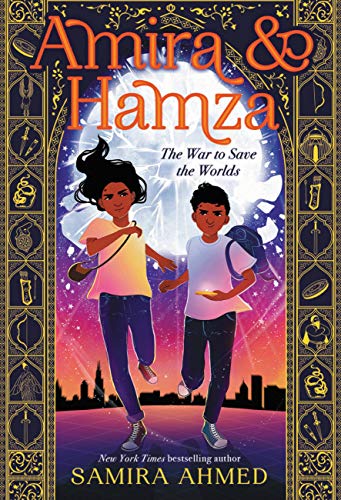
Amira & Hamza: The War to Save the Worlds by Samira Ahmed

Standard
Amira & Hamza: The War to Save the Worlds by Samira Ahmed

amira and hamza

Make sure you are sitting in a comfy spot when you crack open this middle grades fantasy adventure, because it hits the ground running from the very beginning and doesn’t let up over 368 pages.  The like-able and relatable brother sister duo snarkily banter and bicker about everything from cultural Indian (Desi) folklore, religious stories, Marvel, Lord of the Rings, He-Man, Arabic Sesame Street, Star Wars, hygiene, fears, potential science fair projects, and food, all while battling jinn, devs, peris, and reality as they work to save the worlds.  The book is chalked full of STEM concepts, cultural touchstone, Islamic footholds, pop culture, and fun, as one character remarks, it is the ultimate fan fiction. I regularly Googled people, references, and concepts, and ended up learning quite a bit.  And don’t fret if you ever get lost or confused, or something doesn’t make sense, you don’t have to worry that you missed something or that the author left a gap in the narrative, the book moves quick and Amira’s constant dialogue and commentary points out all the ridiculousness of what they are experiencing and the questions that she wishes she had time to ask, explore, and discover.  The author never loses control of the narrative, and keeps the world building on level without skimping on details and understanding.  I have not loved any of the author’s previous books in their entirety, I think this one, however, is her best one yet, and the switch to middle grades is a good fit.  

SYNOPSIS:

Twelve-year-old Amira and her 10-year-old brother Hamza are heading to the Shriner’s Madinah Temple in their hometown of Chicago to explore the exhibit of Ancient Astronomy artifacts, or as Hamza calls it “tools that belonged to dead Muslim Astrologers.”  Hosted by the Islamic Society of Ancient Astronomy corresponds with the eclipse viewing party of the incredibly rare super blood blue moon.  In typical Hamza fashion however, a Nerf gun is brought and things are touched.  When Amira is tasked with bringing her brother up to the roof to learn how to use the telescopes, the two scuffle over a small box with a tiny moon inside, a series of snatching and tussling between the siblings cause the Box of the Moon to break, or rather start working.  As day turns to night, the moon seems to be breaking a part, and everyone in the world is suspended in sleep except for Amira and Hamza, and an entire jinn army is heading their way.

When jinn leaders Abdul Rahman and Maqbool reach the children they must convince them that they are not there to harm them, but rather to recruit them as the chosen ones to save the worlds: Qaf and Earth and the barrier, the moon, that keeps the realms separate from destruction at the hands of Ifrit.  The confusion over there being two of them creeps up, but is squashed as Suleiman the Wise left tests to prove that the chosen one is properly equipped to battle Iftrit as it has been prophesized.  The children must work together to prove themselves they must then actually seek out and defeat Ifrit.  As tests and challenges arise, it becomes clear (pun intended) that the two are not the chosen ones, but with no option of turning back they must forge ahead none-the-less.

“What? We’re Indian, dude, we were basically born half doctor.”

WHY I LIKE IT:

I love Amira and Hamza’s banter.  The references are at times laugh out loud funny.  Similarly, I was impressed by all the historical and STEM concepts intertwined in the story, there is even a tiny bit about mental health.  I learned about parts of the moon, historical figures, folklore, and more.  The characters are Muslim, Amira wears Ayatul Kursi around her neck and they talk of Sunday school.  The book isn’t religious though, in they aren’t saying Bismillah before they embark on things, or supplicating when in danger, but they greet different beings with peace, and the framing is clearly from an Islamic paradigm.  I think the high speed pacing works for most of the book, and somehow you still get to know and connect with the characters, but at times a slight pause to clarify a point would have been nice.  I would have liked to have the kids proving they were the chosen ones a bit more articulate and dramatic before hand rather than in retrospect.  I feel like the jinn transportation of cauldrons could have used a bit of backstory as well.  And a little fleshing out of the scroll, the government structure and communication methods of Qaf, would have helped some of the transitions between the action.  I read a digital ARC and it had a page reserved for a map, and I think when the physical book comes out that will be really helpful, as I didn’t quite fully understand the 18 realms and their locations  in comparison to the locations the children encounter.  

FLAGS:

UPDATE:  I TOOK THIS BOOK AS COMPLETE FICTION. THAT THE ISLAMIC PREMISE WAS A STARTING OFF POINT, AND DIDN’T DWELL TOO MUCH ON THE ACCURACY.  I READ AN ADVANCED READER COPY OF THE BOOK THAT DID NOT HAVE ALL THE SUPPLEMENTAL AUTHOR’S NOTES AND RESOURCES AT THE END.  I WAS UNAWARE THAT THE AUTHOR FELT SHE WAS INCOPERATING FACT AND ACCURACY IN THIS INCREDIBLY FICTIONALIZED BOOK. AND AS A RESULT I AM NERVOUS TO SUGGEST THIS BOOK TO THE MIDDLE GRADE INTENDED AUDIENCE.  IF YOU HAVE A MUSLIM CHILD THAT IS WELL VERSED ON PROPHET SULAIMAN, THE CONCEPT OF FICTION, AND IS OLDER THAN THE IMPRESSIONABLE EIGHT OR NINE YEAR OLD INTENDED AUDIENCE, ONLY THEN PERHAPS WOULD THIS BOOK WORK FOR YOU.  IT WOULD BE VERY MISLEADING IF YOUR CHILD TAKES THE TWISTED STORY AS FACTUAL AND BASED ON THE NOTES AND RESOURCES AT THE END, THIS VERY WELL COULD HAPPEN. To read more about the concerns you can click here and head over to Muslim Mommy Blogs take on the book.

There is magic and magical beings. A transgendered jinn.  It mentions Amira and Hamza celebrating Halloween. Death and fighting.

TOOLS FOR LEADING THE DISCUSSION:

I think this would be a great audio book to listen to with the family or a read aloud in a middle grades classroom.  It is too young for middle school readers to not find it slightly predictable, but if you had it on a classroom or home shelf I am sure it would be picked up, read, enjoyed by middle grades and middle schoolers alike.  It reads much like the Rick Riordan Presents series and I hope that there are more books featuring Amira and Hamza in the future.


The Tale of a Tiny Droplet by Ally Daanish illustrated by Oana Cocheci

Standard
The Tale of a Tiny Droplet by Ally Daanish illustrated by Oana Cocheci

droplet

I would imagine if you were to pitch the idea of this book it would go very favorably.  A raindrop goes on an adventure to a desert kingdom after facing adversity for being small, an ocean wave wants to consume her, a chance encounter with a grain of sand and confidence in Allah swt to keep them safe leads to refuge being offered in an oyster who journeys them through the ocean to salam its inhabitants only to wash up near the palace and at the feet of a prince who has been searching for a treasure for his mother’s crown.  The problem comes in its delivery.  It is told in rhyme that is incredibly forced and trying to do too much.  It is a 32 page children’s picture book trying to blend religion, science, adventure, and two points of view.  It needs to be clear, not concerned with a rhyme scheme that muddles the themes.  The book has potential and with the QR code and online teaching resources I could see an Islamic school teacher using this to explain how a pearl is formed and the incredibleness of one of Allah’s creations, but it will take a lot of outside explanation.  I am confident that no four to six year old is going to independently understand clearly what is going on.  I myself had to read it multiple times to figure out what was going on, and even then I found more holes, inconsistencies, and head shaking then there should have been in a large, glossy, well illustrated, effort filled book.

img_3589

A tiny droplet wants to be free, but this personified little water being’s friends tell her only great things live in the kingdom and she is too small.  Not sure how greatness and physical size become synonymous, but they do apparently.  So, on a windy day, the raindrop jumps out of the sky to join the ocean as a means to reach the kingdom.  A hurricane, or wind gale, catches her and she collides with a grain of sand.  But the pov switches, and the sand collides with her and it hurts the sand.  Grain apologizes and Droplet says not to worry she she is heading to the ocean too.  Grain warns her that the ocean isn’t safe, that there is a big wave who will consume them.  Droplet says she isn’t afraid and trusts Allah swt will keep them safe.  The wave threatens to chase them with all its pride (?) if they dare to run and hide.  The pair find an oyster to hide in and they swim with the tide. The oyster is bothered by their tiny feet so he throws them a blanket.  The wave continues to give chase, but they trust Allah swt and after months and days they wash up on the kingdoms shore.

img_3590

The book then pivots and focuses on a young prince who is searching for a gem for his mother the Queen.  Her crown has lost its shine.  He has travelled for months and day through mountains and valleys to no avail. One day while walking, back home on the beach, he hears voices hoping for safety from the wave.  Droplet and Grain think the wave has perhaps finally got them, but it is the prince opening the oyster and finding just the gem he needs. The book concludes with the pearl saying “Alhumdulillah” to the distant stormy sky, “All things can live in the kingdom and its palace rising high.”

img_3591

So my questions, first I’m not sure how a droplet isn’t free, is there only one wave in the ocean? Who is talking at the end, obviously the anthropomorphism as a science lesson kind of hits a dead end, it went from two talking objects to one new talking object, so thats creepy.  Wouldn’t it have been better to end when the gem was found and then have an info or fact page highlighting how pearls are made, having two distinct characters morph into one is a bit jarring story wise. The concept of the kingdom not allowing in little things, and then concluding that all things are welcome, is also so painfully underdeveloped.  Even little readers are going to find that assumption so off the mark.  I like that they trust Allah, but Droplet keeps saying she isn’t scared, but continues to run? swim? The duo don’t want to be consumed, but essentially aren’t they consumed by the oyster? The Pearl feels like it beat the wave despite its size, but it was the other drops that were telling Droplet she was too small, not the wave.

img_3592

All confusion aside, my kids and I might just not be the ideal readers.  My six year old didn’t know what a pearl was, so he was incredibly confused.  I thought the book was going to be about the water cycle, so it took me a minute to realize that wasn’t where the story was going. There is a QR code on the front and if you go to the website a number of resources are available https://www.lotehouse.com/product-page/the-tale-of-a-tiny-droplet. I wish there was info within the binding though to explain the process of sand and water in an oyster making a pearl and I wish a heavy handed editor would have cleaned up the text.  Sadly, a potential great book mixing adventure, science and deen just really missed the mark.

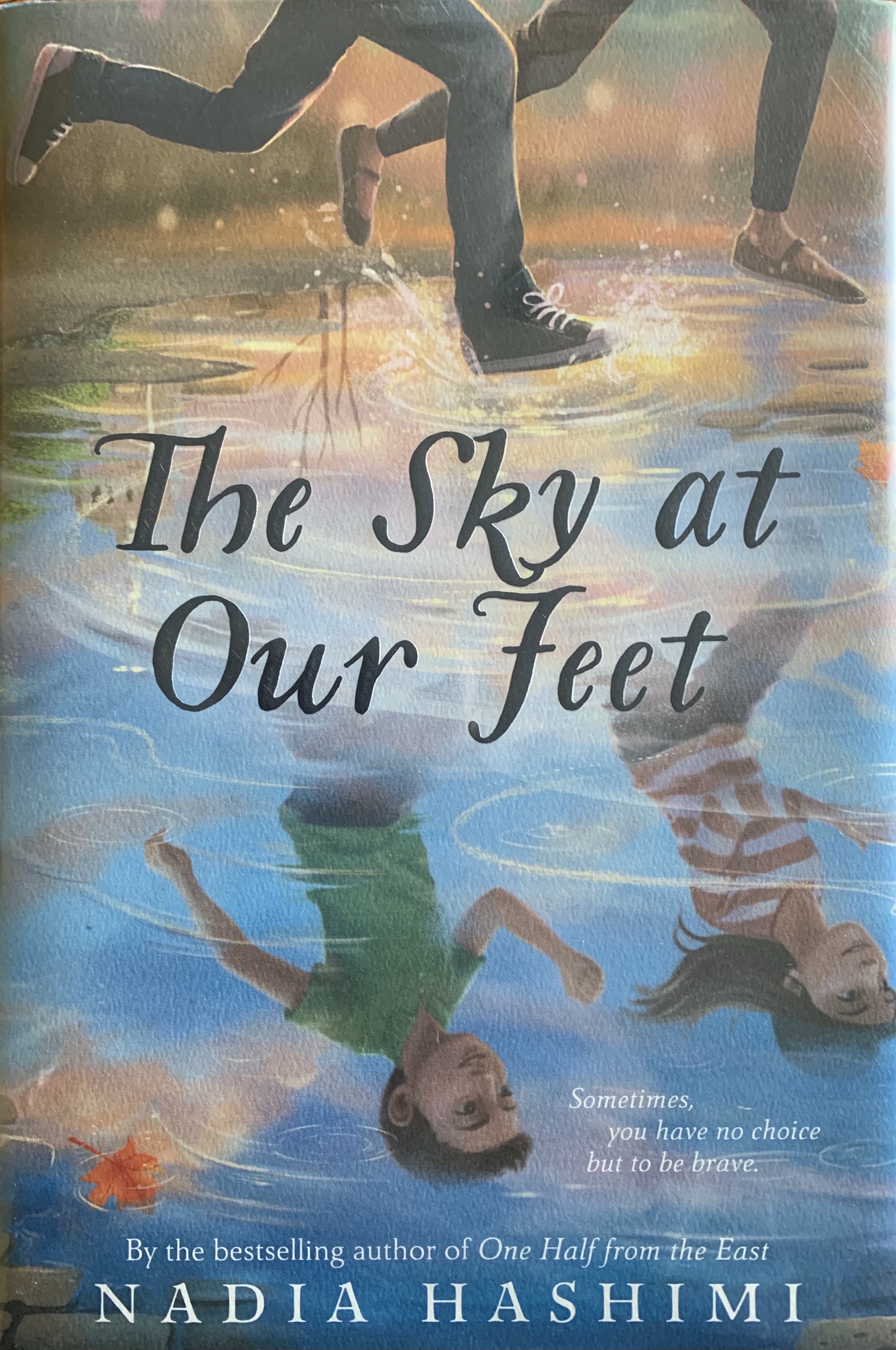
The Sky at Our Feet by Nadia Hashimi

Standard

This 295 page middle grades AR 4.8 book is a fast passed romp through New York City as two 12-year-old kids explore freedom and fear in a new city while grappling with their own sense of identity and what it means.  The OWN Voice story features immigration, chronic disease, family, bravery, and friendship.  There is lying and avoiding police, sneaking and “borrowing” a horse, but it is all for a good cause, and third grade and up will enjoy this read.  There is very little religion in it, but the main character does say salam, notice the similarities between amen and ameen, and reference eid as his holiday. 

SYNOPSIS:

Jason D, known only to his mom and aunt as Shah, was named by a nurse when his mom wanted to make sure he had an American sounding name, and his middle initial D is for December, which comes from her staring at a calendar when asked if she wanted her son to have a middle name.  Life is fairly simple, he enjoys sneaking on to the roof of his apartment building to imagine training pigeons, his mom works at a dry cleaners, they walk where they need to go, money is tight, but they do ok, and his dad passed away before he was born.  His mom is from Afghanistan, but he doesn’t speak much Dari and his mom speaks English, but not confidently.  On her birthday as they are about to enjoy a cupcake he saved up for, the news in the background is covering protestors chanting for illegal immigrants to go home, and Jason’s mom starts to tell him about how she ended up overstaying her visa and  is living in the US illegally.  

Jason’s dad worked with the US military in Afghanistan and with his work came the promise of visas to America for him and for his wife to study.  Many of the locals though didn’t like that he was cooperating and vowed to take their revenge.  With the family in the US and Jason’s mom starting to study medicine, Jason’s dad had one more job in Afghanistan and sadly was killed by anti American Afghans.  Fearful to return, she chose to stay, but with a new baby, few resources, no family and friend support, eventually she was forced to drop out of school and remain undocumented knowing that to return would be at great peril to her and her son.  At some point she befriends an Indian lady, Seema and to Jason, she is Aunt Seema, the only family other than his mother that he knows.  

When a few weeks later Jason sees his mother being taken away by two officers, he knows that this is what she warned him about when she told him the truth about her legal standing.  Terrified and alone, Jason only knows that somehow he has to get to New York to Aunt Seema so that they can figure out how to save his mom.  He grabs a few pictures of his father, whatever money he can find a broken address and heads to the big apple from New Jersey.

Having never been to NYC or really out of his hometown, he loses his backpack to a dog, and struggles to figure out how to get a ticket to get in to the city.  When he arrives at Penn Station he is overwhelmed and exhausted and passes out, hitting his head, and landing himself in the hospital.  

When he awakens he is met by doctors making sure he is ok, and police trying to locate his parents, he opts to pretend he has amnesia and can’t remember anything.  This buys him time, and also acquaints him with Max, a girl with wires coming out of her head and who claims they are running tests on her to understand her level of genius.

The two hit it off and hitch a plan to escape the locked hospital floor, have a day of adventure in the city, and get Jason D to his aunts house.  Naturally this plan is going to have all sorts of obstacles, but thats the story and that is where the fun and discovery unfolds.

WHY I LIKE IT:

I was impressed at how emotionally cathartic the conclusion was.  I hadn’t realized how invested I had become in these two kids and their run through the city.  It was touching, and heartfelt, and a big sigh of relief when it all wrapped up.  I like that both kids are so very different, yet dealing with similar thematic issues from different perspectives.  Max is an epileptic and is kept on a short chain to ensure her safety. She is trying to find and define who she is outside of the medical diagnosis.  Jason is trying to understand if he can be American and Afghan and what that means about where he belongs, and where home is.  There is a lot that they ponder over as they run through central park and the zoo, duck into subways, and get all sorts of turned around on the streets.  Through it all though the kids show just how clever and smart they both are with the quick thinking, riddle solving abilities, and perpetual optimism.  It is at times far fetched, stealing a horse and bumping in to your doctor in the New York City Marathon, and at other times completely plausible, sneaking in to a zoo with a field trip group and ducking through turnstiles to get on the subway.

FLAGS:

Lying, stealing.

TOOLS FOR LEADING THE DISCUSSION:
This is a bit young for even early middle school readers, but would make a great addition to a summer reading list.  I think kids will marvel at the riddles and determination of the two protagonists and imagine a world where kids could maybe get away with such a bold adventure.

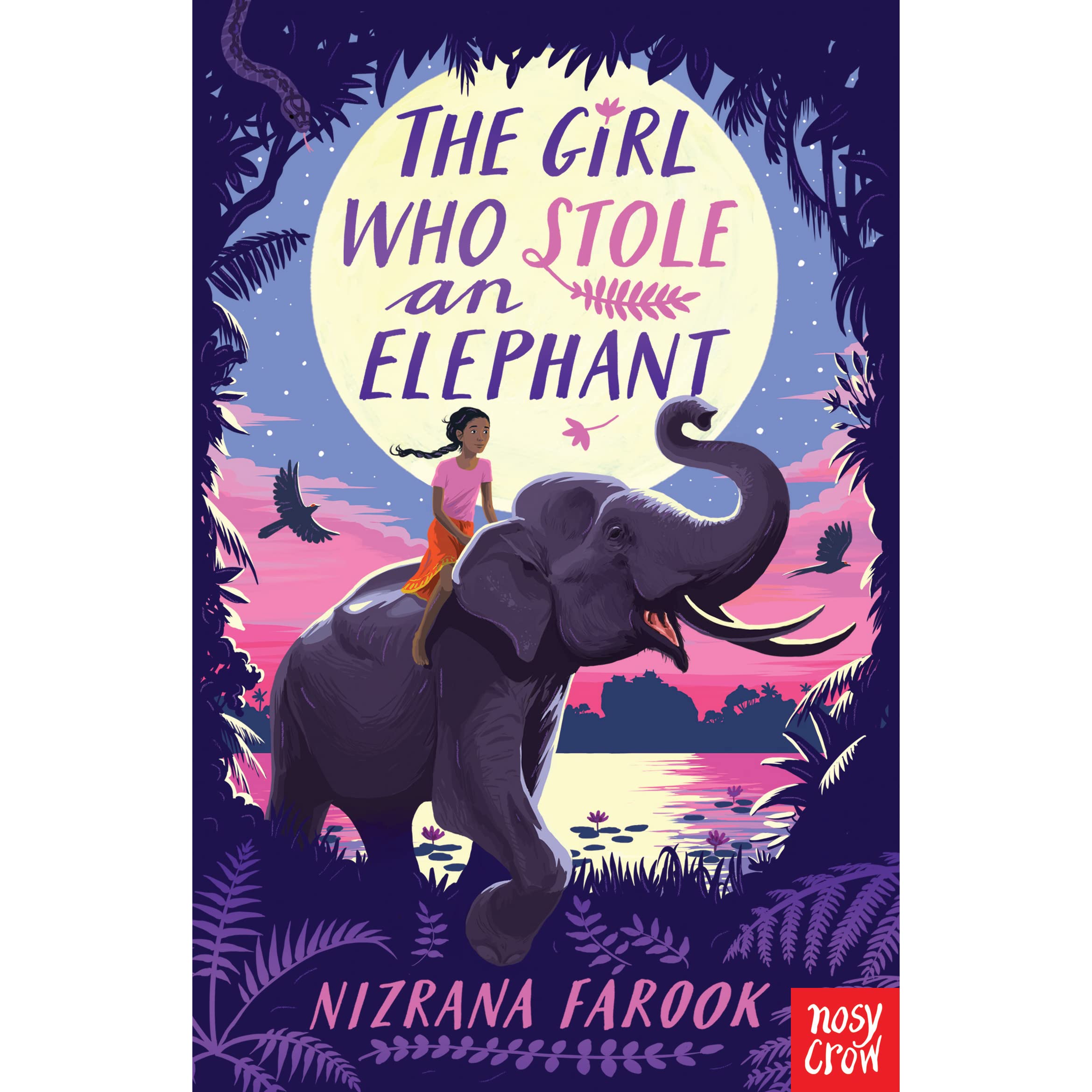
The Girl Who Stole an Elephant by Nizrana Farook

Standard
The Girl Who Stole an Elephant by Nizrana Farook

elephantI have to admit this 240 page middle grade OWN voice book had me invested and glued to the pages.  I was swept away to Sri Lanka and in disbelief at the boldness, cleverness, and spunkiness of the Robin Hood-esque 12-year-old protagonist.  I could not put it down as my head worked over time to figure out how this trio of children, one being a Muslim girl, was going to get out of the heap of trouble they had caused.  Yes, admittedly it wraps up a bit too quickly and simply, the main character Chaya doesn’t learn her lesson and is a terrible friend, and there isn’t a good moral of lying and stealing being bad.  But all that aside, the book is a fun adventure that while written pretty straightforward and clearly, is rich in adventure, culture, and excitement for second to fourth grade readers (and 40 year old moms that love strong girls).

SYNOPSIS:

Chaya is the daughter of a tribal representative, whose mother has passed away.  She goes to school, attends the temple once a week to learn Sanskrit, and at dawn is known to steal things to give to those in need.  At night time, people are on guard, expecting trouble, but dawn seems to be the perfect time to take what she needs from people that won’t even notice.  The book starts out with her stealing jewels from the Queen with the hopes of helping a friend who was bitten by a crocodile get medical help in the next town over.  The people in Sarendib have an unjust king, and stealing from his wife to help take care of people that need assistant is a job Chaya takes seriously.  Her heart is in the right place, but when a guard sees her she stops to visit a friend who works in a wood shop to hide the jewels until the heat dies down.  The box they hide the stolen goods in is purchased by a young Muslim girl, and now Chaya has to steal them back from her to get them to people that are in need.

The chain of events is just getting started, and when the jewels are discovered the wood working Neel takes the blame and is imprisoned, and the new girl in town, Nour, is determined to help free Neel from prison and save the villagers from being tormented by the royal guards.  Chaya devises a plan to free Neel from the palace dungeons, but nothing ever quite goes to plan and all the prisoners are freed.   As she runs to escape her own doom, she steals an elephant to get away, the king’s elephant.

The entire story is a series of follies and at each turn the children have really good intentions, they just keep snowballing into situations beyond their control with the stakes constantly multiplying.  I really don’t want to give it away, but they might just bring down a monarchy as they tromp through the jungle on an elephant, accidentally burn down villages, and find that even though Nour is a wealthy meat eater, they can in fact be friends.

WHY I LIKE IT:

I love that the story is outrageous, yet grounded.  I was sucked in from the first few short chapters and didn’t look back.  Chaya is oh so plucky and her fallibility and flaws make her so endearing.  She is a bit of a mean girl to Nour, but I think she shows growth.  The slight raised eyebrow regarding her, is that she didn’t learn some grand lesson, and in fact is possibly emboldened by her thieving and getting away with it.  There probably should have been some humbling at the end, but she is bold and outspoken, and not one for regrets.  I absolutely love the letter she left her father owning up to her role in the whole hullaballoo, and as an afterthought acknowledging that she skipped two days of school.  She is a cheeky one, but her heart is huge and she has her own sense of integrity that is unwavering.

I like that Nour is acknowledged as being Muslim, eating meat, and going to mosques before she moved.  It doesn’t articulate that Chaya doesn’t like her for her faith, but it isn’t helping the two girls befriend each other either.  I love the elephant, and the plants, and fruits, and animals that bring the story to life.

FLAGS:

Lying and stealing. Some destruction of property.

TOOLS FOR LEADING THE DISCUSSION:

I can’t see me doing this as a book club selection, it is just too young of a target audience, but it would be a blast to read aloud to a second or third grade class, or to assign in a classroom setting.  The chapters are really short that early chapter readers will feel accomplished when they complete the book, and the subject matter will compel them to keep turning the pages to find out what happens next.

City of the Plague Gods (Rick Riordan Presents) by Sarwat Chadda

Standard
City of the Plague Gods (Rick Riordan Presents) by Sarwat Chadda

I was excited to hear that another Rick Riordan/ Rick Riordan Presents books featured a Muslim character and was anxious to see how the multi god genre would account for Islamic tenants.  But I was completely giddy (that’s putting it mildly), when I found out that Sarwat Chadda is aka Joshua Khan, author of the Shadow Magic Series and that this book has practicing Muslim Characters front and center.  In his own words, “it has taken be twelve years and eleven books to get around to writing a Muslim tale.” That isn’t to say that it is Islamic fiction, there is gay romance that is there if you want to see it and has been confirmed by the author outside of the book, there are  numerous fake gods in Mesopotamian mythologies, there is death and violence, but it is fun, oh so fun.  It has salat, and going to the mosque, and an imam, and saying surahs and discussing jihad an nafs, and sadaqa and it says the shahada in Arabic and English, it presents Muslims authentically in their words and actions, and it isn’t just the characters’ backstories it is who they are and how they see the world.  The book is an AR 4.5 with 383 pages and like all Rick Riordan books, full of humor, sentiment, family, growth, and ancient mythology.

SYNOPSIS:

Sikander “Sik” Aziz is 13 and when not at school is at his family’s NYC deli working away.  The son of Iraqi immigrants, he is dedicated to helping his family especially since his older brother Muhammed, Mo, has passed away.  Mo’s lifelong friend Daoud has moved in to Mo’s old room and helps out in the deli, but is really an aspiring actor who does anything to get out of work.  When the book opens, Sik and Mo are closing up when the deli is attacked by rat faced men demanding to know where it is.  Sik has no idea what they are talking about and the two demons tear apart the family restaurant until a mysterious girl appears and sends them and their stream of insects, disease and destruction from the deli.

The next day at school Sik’s injuries are healing remarkably quick and he and the new girl, Belet, find themselves getting sent to the principal’s office together.  When he learns that Belet’s mom is Ishtar, goddess of love and war, or rather passion, and was the girl at the deli, he can no longer deny that the tales Mo used to tell him about Gilgamesh, Enkido, Nergal, Kasusu, and Mesopotamian mythology are very real.  

As Sik, Belet, Ishtar, Daoud, and an army of cats, Lamassu, learn that the plague god Nergal is behind what is going on and that he plans to destroy Manhattan, it is up to them to stop the destruction, save Sik’s parents who are in the hospital, and ultimately the world.

WHY I LIKE IT:

The book was written before Covid 19 and the idea of a plague or pandemic was not yet on everyone’s mind, but when it was published in 2021 it sure become that much more relatable and close to home.  I love that some of the reactions of the characters and community to being around infected people and the backlash was so accurate to what we have all seen since 2020.  

The way that the oneness of Allah swt and the multi fake gods is reconciled is that the Mesopotamian cast are old and powerful, but not ALL-powerful, as Ishtar tells Sik, someone had to create us.  She also says that today people might call them something else.  It seems to leave open the idea that they have abilities and because of their abilities people worshipped them and the name stuck, not that they are creators or even claim to be. The concept of being between alive and dead is explored when Sik visits Kurnugi, he asks where Muhammad Ali is and Mo tells him he isn’t there, he went straight to Jannah.  It might not be a clear explanation, but it at least hints that Muslims in real life have a different view than the mythological one being explored.

I love the snark, and the humor, it flows so well and incorporates pop culture with ancient references very smoothly. I love that they say InshaAllah and AllahuAkbar and when Sik is presumed dead at one point and awakens he can’t go to the mosque because they are having his janaza and it would be awkward.  I love that there is a glossary that denotes if words are Arabic, Islamic, or Mesopotamian.  Muslim kids reading this will feel so seen and proud to be openly Muslim and inspired that they too can be heroes.

FLAGS:

Mythology, fighting, death, the use of the term badass.  Daoud and Mo’s relationship.  Daoud and Mo became friends in 5th grade and when Sik sees some photos of his brother that Daoud had taken, he says that he sees love.  When Sik and Mo are reunited in Kurnugi, Mo hints that there is more to the friendship, it is subtle.  In online interviews Chadda says they were in a romantic relationship.  It is not explored or heavily detailed.  The only other romance mentioned is that Gilgamesh in his prime refused Ishtar.

I think fans of Rick Riordan already know that there is going to mythological characters, creatures, battles and violence and a character or two that are LGBTQ+, some possible romantic angst between main characters, death, and unfaithful flirty gods.  This book is much “cleaner” than most, so 4th graders and up that are fans, will be fine reading this.  

TOOLS FOR LEADING THE DISCUSSION:

I don’t know if I could do this as a book club selection.  The romance is minor, but once you sense it and know it is there, it is a factor.  I don’t know if it would have to be discussed and how an Islamic school would want me to handle it, because both Mo and Daoud are practicing Muslims.  I think the book does a sufficient job of not committing shirk and shirk like messages with the mythology, but as always with these types of books it is a judgement call if the children (and their parents) can understand where the lines of fiction are and where they stand.

Fandom: https://riordan.fandom.com/wiki/City_of_the_Plague_God

The Unicorn Rescue Society: The Secret of the Himalayas by Adam Gidwitz and Hena Khan illustrated by Hatem Aly

Standard
The Unicorn Rescue Society: The Secret of the Himalayas by Adam Gidwitz and Hena Khan illustrated by Hatem Aly

unicorn

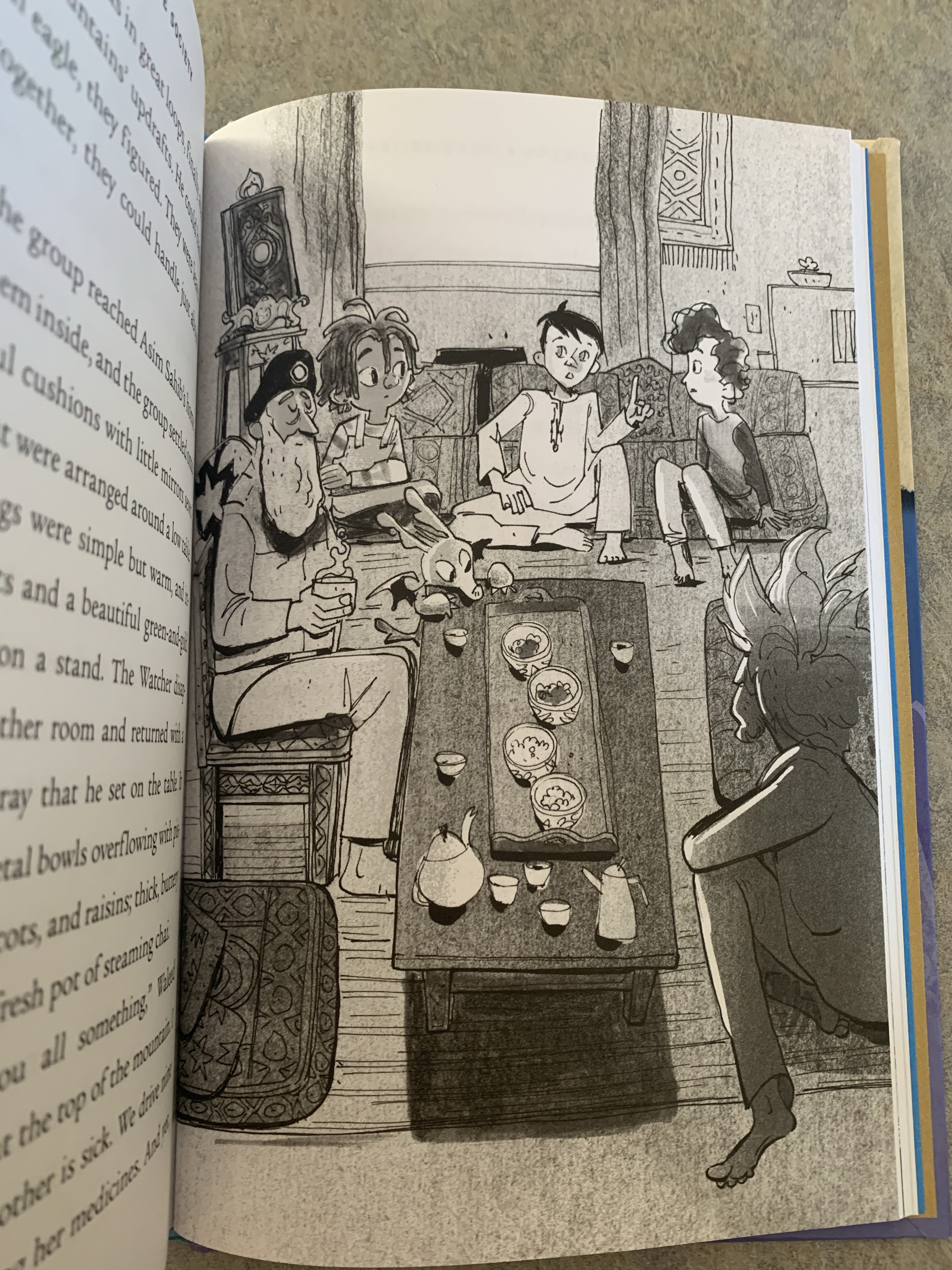
This middle grades 208 page book is part of a series, but this particular installment is co-authored by Hena Khan, takes place in Pakistan, and features Muslim side characters in the quest to find and protect the mythical, magical, and illusive unicorns.  The adventure is quick, the cultural and religious references sincere and appreciated, the characters quirky and fun, and the writing smooth and enjoyable.  I can’t speak for the whole series, but I think second to fourth grade readers will enjoy the eccentric teacher, the clever kids, and the knowledge about animals, culture, and geography that is woven in to the story to keep it engaging.  I don’t think you need to read the books in order, but I would encourage it.

img_0785

SYNOPSIS:

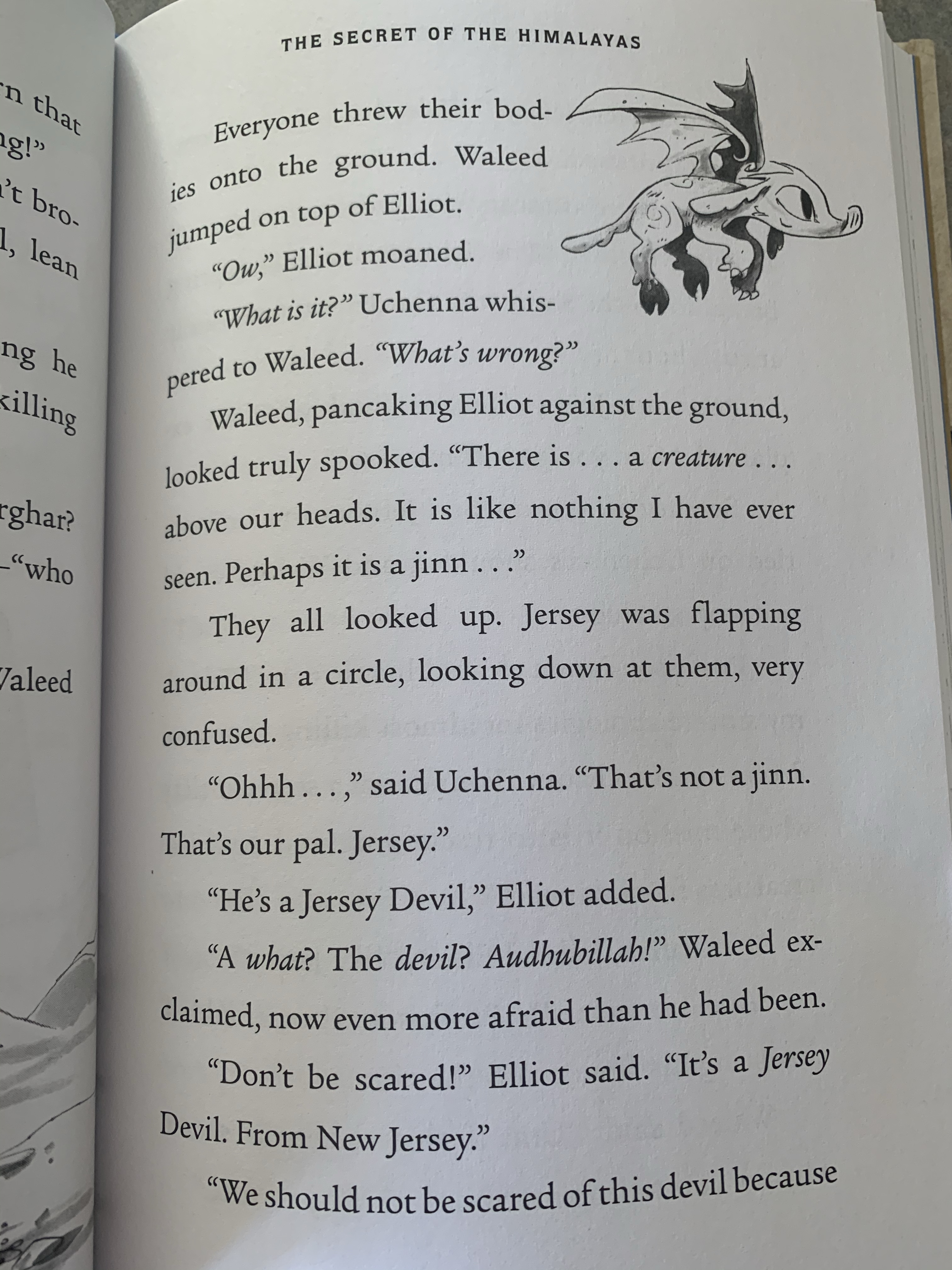
Elliot and Uchenna are elementary aged students and also members of the secret, Unicorn Rescue Society.  When a classmate starts a newspaper and interviews local businessman, the kids teacher, Professor Mito Fauna spots what he thinks is a unicorn horn in an accompanying picture and is determined to go and protect, once found, the imaginative creatures.  He enlists the kids and Jersey, a creature with a blue body, red wings, a goat face, clawed front legs and hooved hindlegs, to set off in his single propeller plane for the Himalaya mountains of Pakistan.

They arrive in Torghar, Pakistan and make a rough landing that nearly kills a local boy.  Alhumdulillah, Waleed is fine, and in true Pakistani and Islamic tradition the boy takes the visitors to his grandmothers home to be fed and welcomed.  Waleed agrees to help the Americans find a man known only as the “Watcher,” to see what he knows about unicorns and the hunters that come to poach for sport.

Hiking the mountains and getting short of breath makes each act that much more difficult, but alas the kids find the Watcher, aka Asim Sahib, but sadly *SPOILER* don’t find unicorns.  Rather a species of mountain goats, markhors, that have two long twisted magical looking horns. The wealthy businessman brothers also show up in their helicopter to capture, not kill the markhors.

The rescue society follows them and learn that the sinister brother are testing out the magical properties of a bezoar on pit viper bites.  Needless to say it doesn’t work and the rescue society must rescue the dying butler, and captured markhors.  All is not lost, even if they didn’t find any unicorns, at least they made new friends, and know that if they haven’t found the unicorns yet, hopefully no one else has either.

img_0778

WHY I LIKE IT:

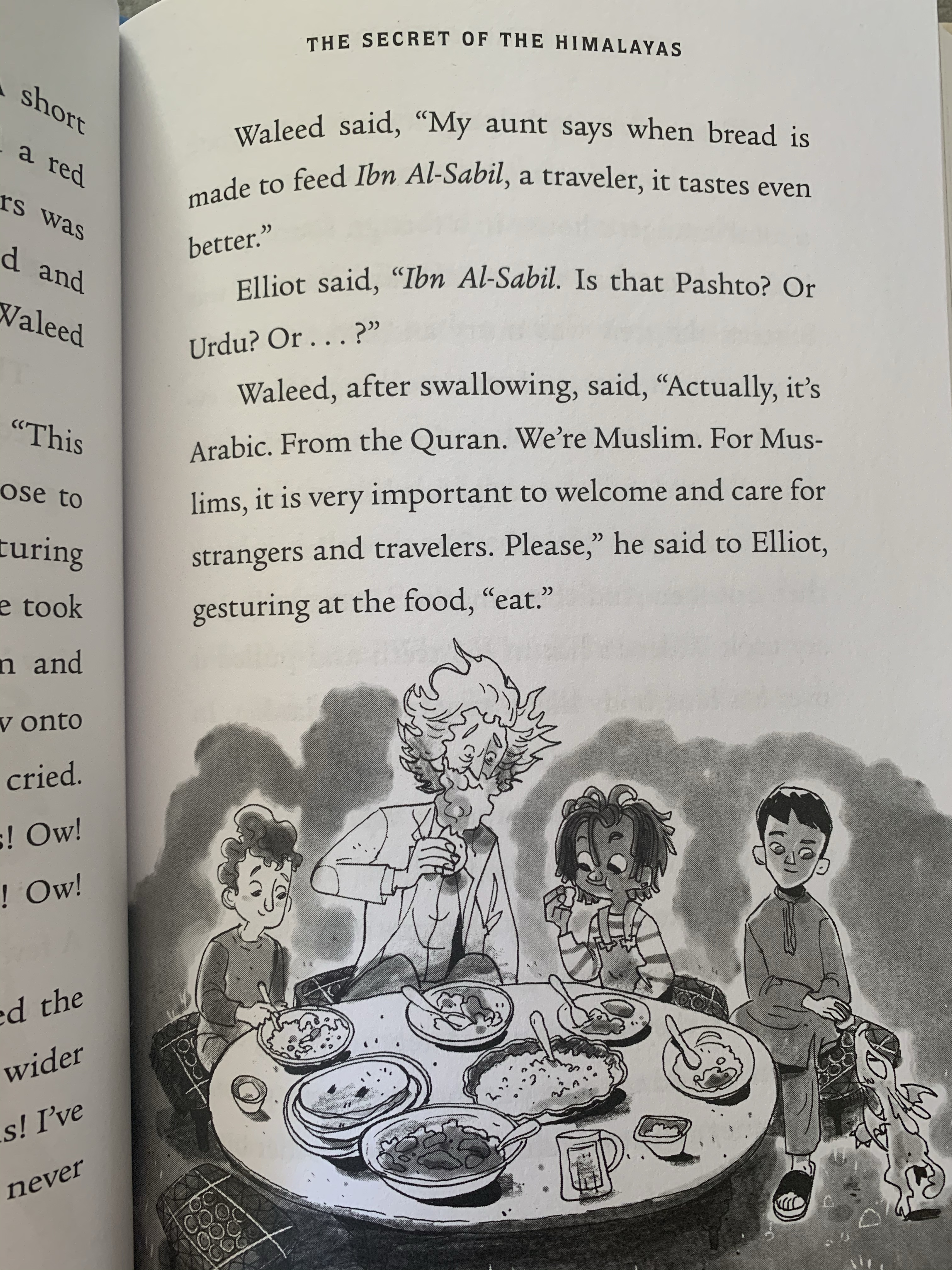
I love that there is praying, and thikr, and ayats from the Quran quoted and explained in the book regarding saving animals, caring for each other and trusting Allah swt.  There is culture regarding taking gifts, welcoming guests, drinking tea and even breaking stereotypes of what a boy from Lahore visiting his family in the mountains knows and doesn’t know.  It isn’t preachy on any accounts, but the messages relayed in their silly way are very well woven in and leave a wonderfully represented impression of Islam, Muslims, and Pakistan.

The diversity featured in the book is nice, even within the main characters: one is an African American girl, one a Jewish boy, and the teacher is Hispanic.  The story at the end, A History of The Secret Order of the Unicorns, takes place during the reign of Charlemagne at a monastery, and features a boy named Khaled and his little sister Lubna. It is clearly intentional and a reflection of the author and illustrator.

img_0776

FLAGS:

There are some possibly gross moments featuring the goats licking urine, tea being made from the markhors’ saliva and the near death of a man requiring venom to be sucked from his leg.

img_0777

TOOLS FOR LEADING THE DISCUSSION:

The book is definitely below a middle school book club level, but I think younger elementary teachers and parents would see students get hooked on the series and would benefit from having the books around.

img_0780

Ayesha Dean- The Lisbon Lawbreaker by Melati Lum

Standard
Ayesha Dean- The Lisbon Lawbreaker by Melati Lum

img_8735

In this third Ayesha Dean book, that can be read as a stand alone, the Australian teen sleuth finds herself on the other side of the law in the beautiful city of Lisbon in Portugal.  Over 333 pages, she must understand what she is being accused of and figure out how to clear her name, all while marveling at the beautiful historic sites, diving into the delicious food, and looking fabulous while she does it all.  Middle grade to early middle school readers will enjoy the fast pace mystery that has history, crime, adventure, and friendship.  There, as always, is a twinge of romance, but it all stays halal as Ayesha is a proud and practicing strong Muslim young woman.

SYNOPSIS:

Ayesha Dean is now 18 and has just arrived in Lisbon for three months as part of an internship program to help little kids with their english.  This is her first international trip without her beloved Uncle Day and her two closest friends Jess and Sara.  Not to worry, there are a lot of young people participating in the internship program and she will be rooming with two girls, Mara and Aveline. Things start of routine enough as Ayesha gets to know the handsome and kind Raimy from America and tries to figure out why Aveline doesn’t seem to like her.  But on her way to the school she will be working at, she finds a wallet filled with money and no identification, just a phone number.  When she calls the number and a meeting is setup, the stage is set for a series of events that will include telling Raimy off for mansplaining things to her, a man murdered, a chase scene, a necklace stolen, no memory of it all, and Ayesha being arrested.

Knowing only a few people in the city, and having just met them at that, Ayesha makes bail by getting help from her friend’s Aunt in Spain who comes to provide Ayesha a place to stay as well. She has some time before her formal hearing, and Ayesha is determined to figure out what she is being accused of and how to clear her name.  With the help of Mara, Raimy, a young girl in the elementary school Ayesha was working at, and some chance encounters, Ayesha finds herself risking her own safety in an underground environmental gang ring. I won’t spoil all the ups and downs and ultimate ending, but Ayesha Dean’s tae kwon do, faith, and wits will all be used and the last page will definitely leave you wanting more.

WHY I LIKE IT:

I feel like the writing has finally found the perfect balance between description and action, the first chapter was a bit choppy, but once it hit its stride it was smooth.  I was intrigued by the historical detail that was all new to me, and am pondering how to convince the author to lead a tour group through all these places that Ayesha visits.  As always the descriptions of food and architecture and fashion are all so spot on that you feel like you are there.  I absolutely love that religion is so genuinely a part of Ayesha, but it is for her, she doesn’t do it for any one else.  She prays, she wears hijab, she doesn’t drink, she clarifies to Raimy what she can do, she acknowledges possible stereotypes and discrimination, but chooses to move forward and not get bogged down by it.  She is physically and mentally strong, but doesn’t come off as arrogant or judgmental or unrealistic.

I like the diverse characters in this book, and in all of them.  The multi ethnic protagonist has friends from all sorts of backgrounds and it is really refreshing and natural.

FLAGS:

There is murder, assault, crime, drinking and alcohol.  Nothing is glamorized or anything a third grader couldn’t probably handle.  There is a hint of possible romance, but nothing that crosses any lines or standards.

TOOLS FOR LEADING THE DISCUSSION:

I would consider this for a middle school book club if the majority of the participants are 6th graders as it would not have the same appeal to older 8th graders.  I think they would benefit the most and enjoy the strength and cleverness of such an inspiring lead.  Of the three books in the series, I think this one would work the best for insightful discussion and empathy.  It would great to hear them imagine themselves in her shoes: a foreign country, no family, no longtime friends, minimal language skills and accused of a serious crime. Oh I can’t wait to share this book with my reading friends!