Tag Archives: 2025

The Slightest Green by Sahar Mustafah

Standard
The Slightest Green by Sahar Mustafah

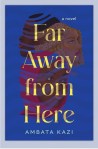
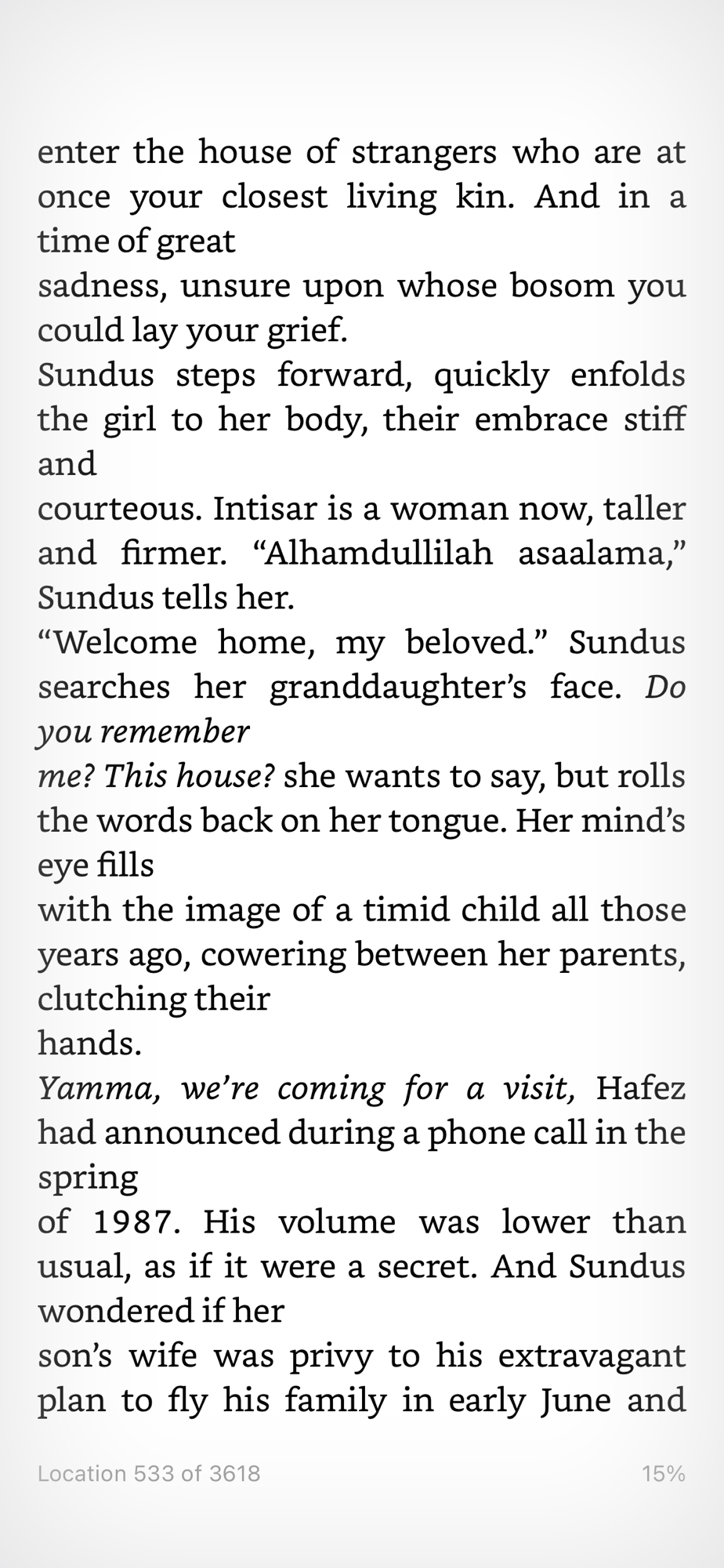
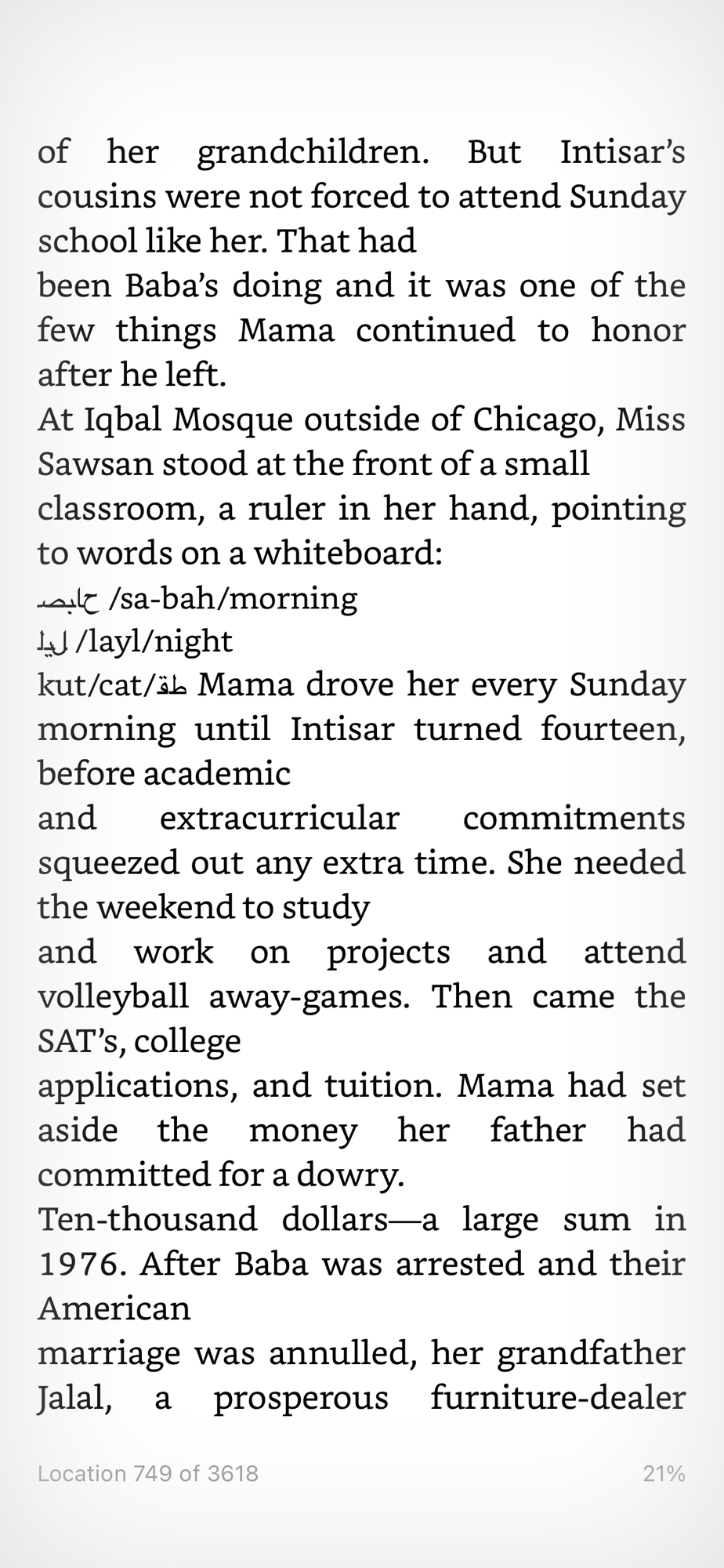
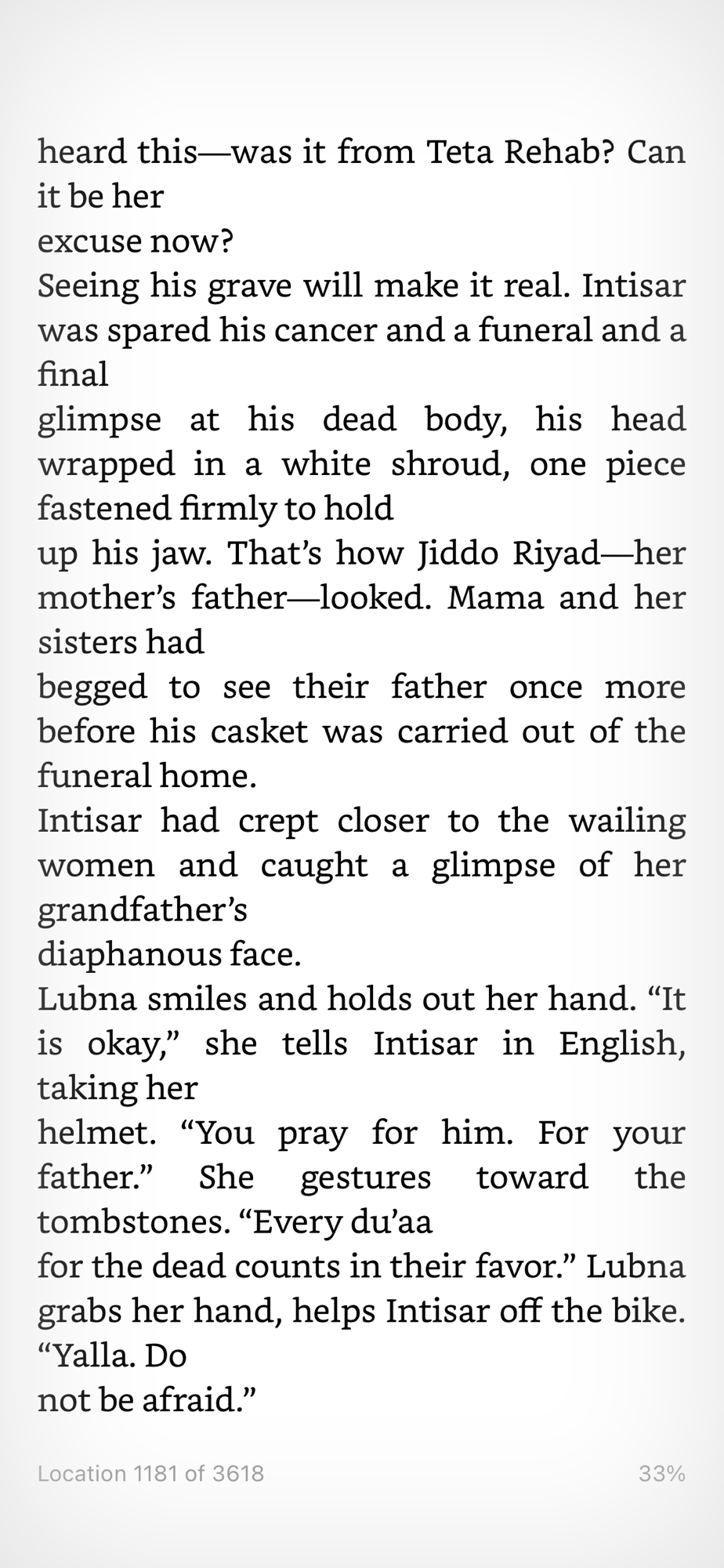
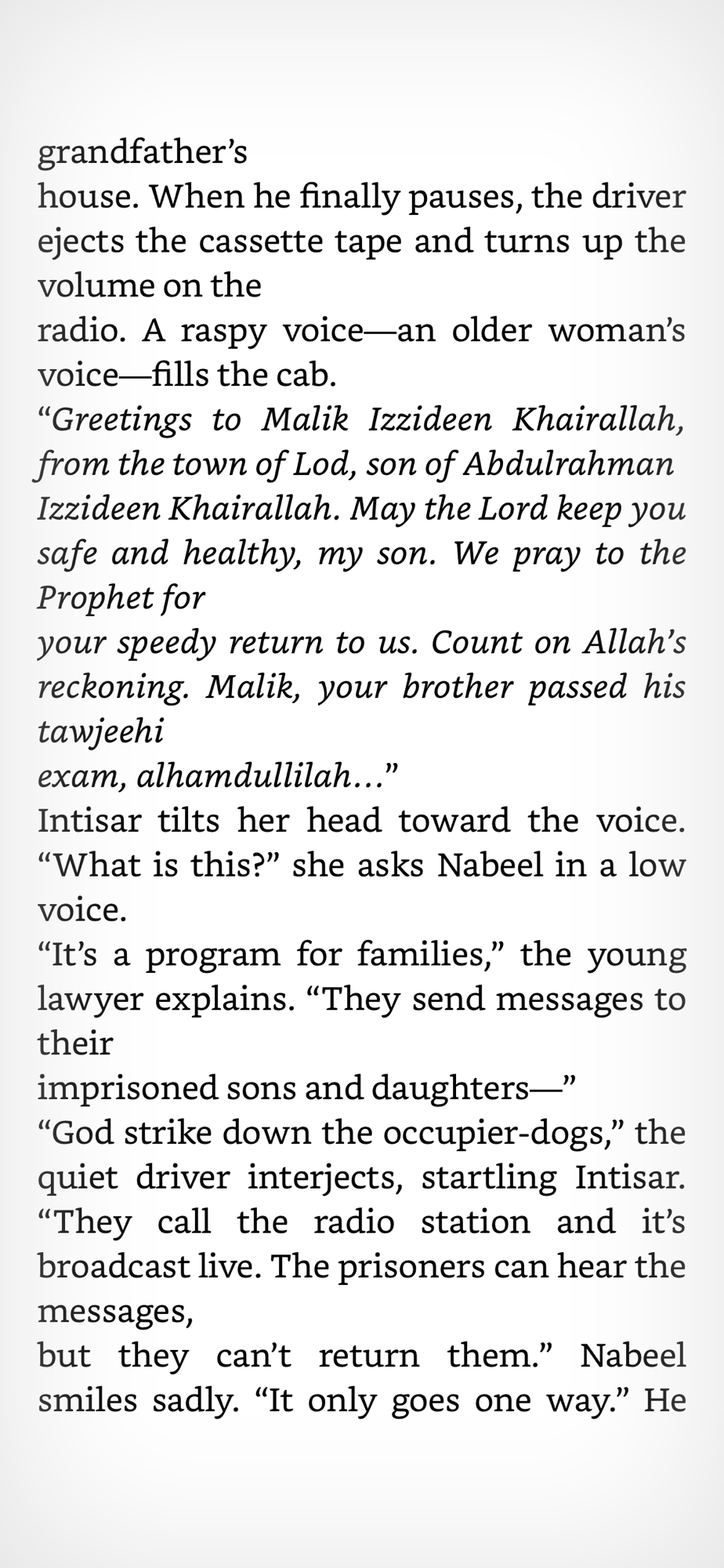
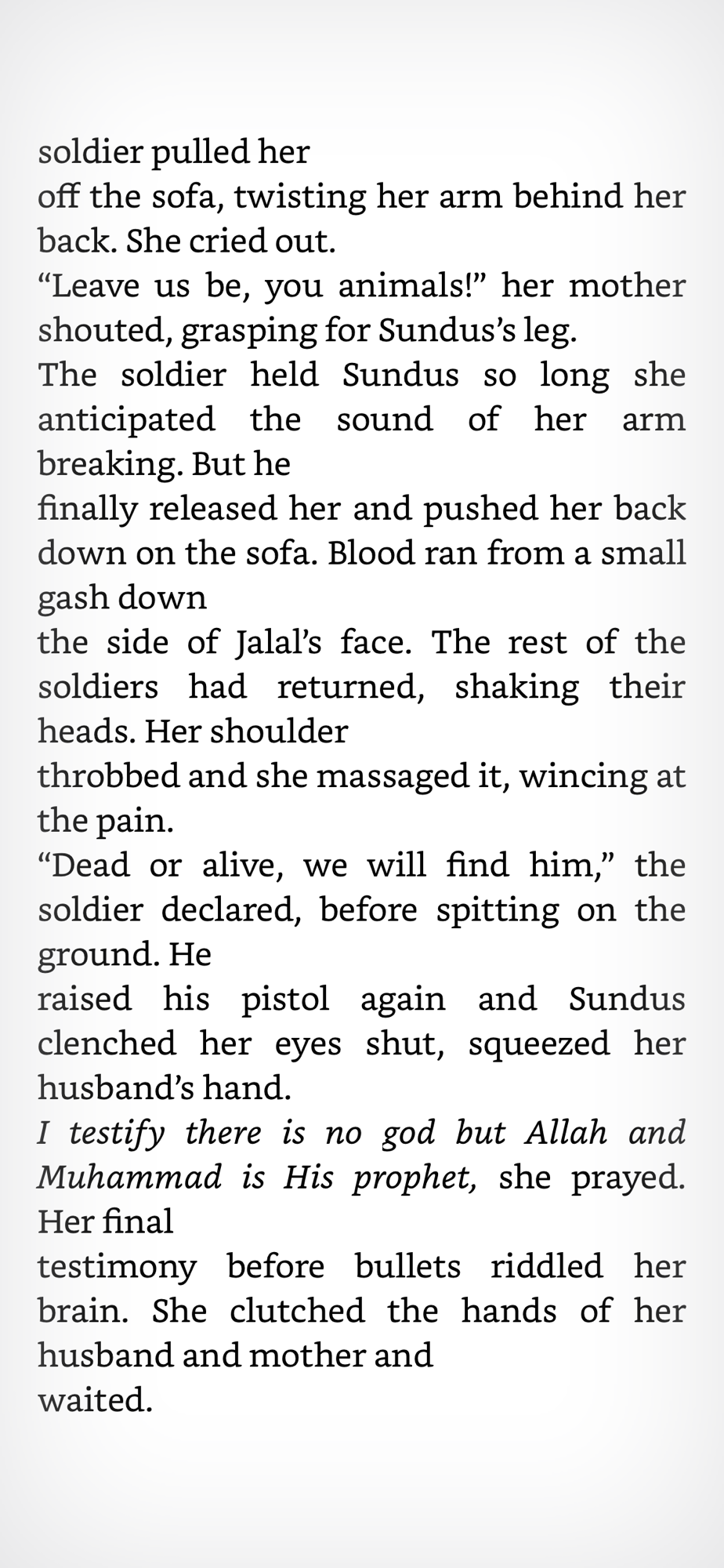
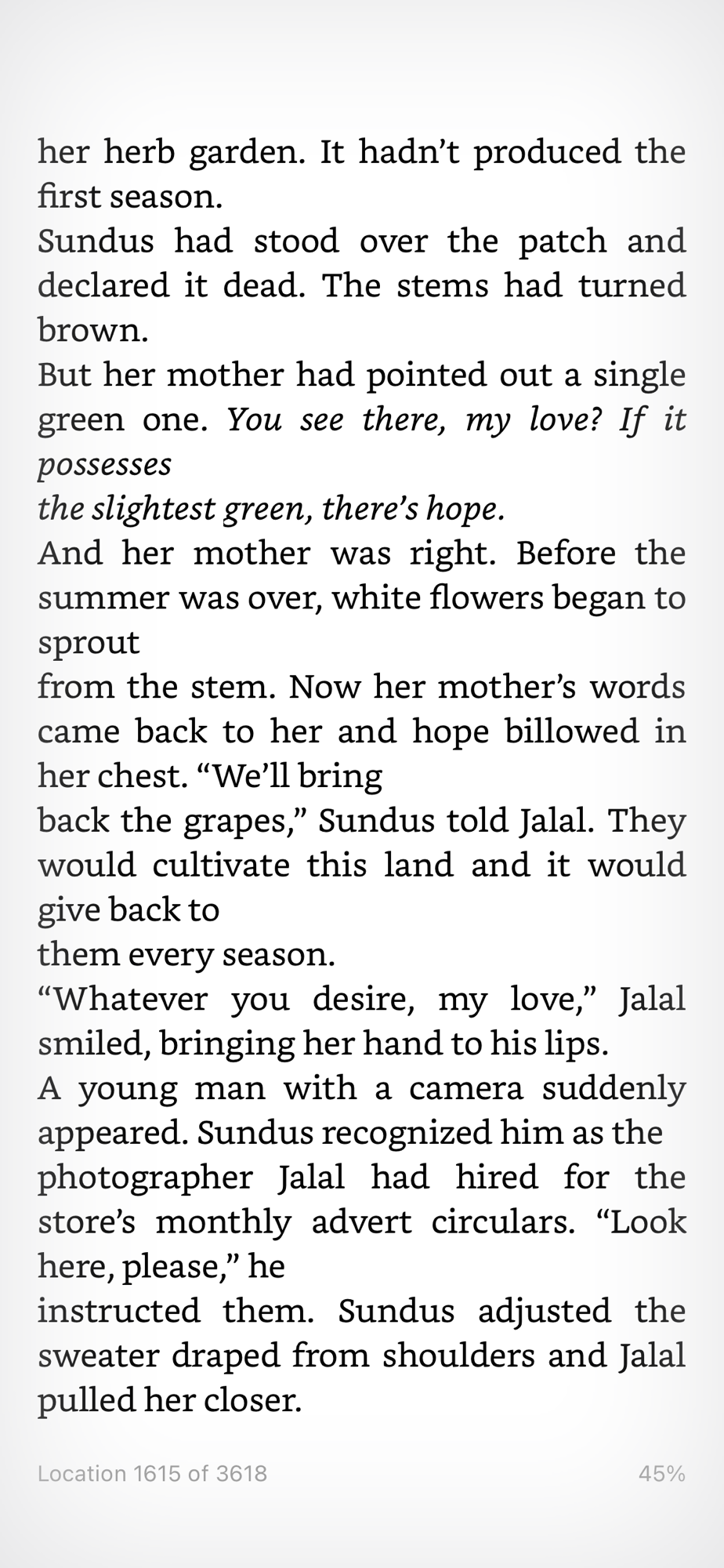
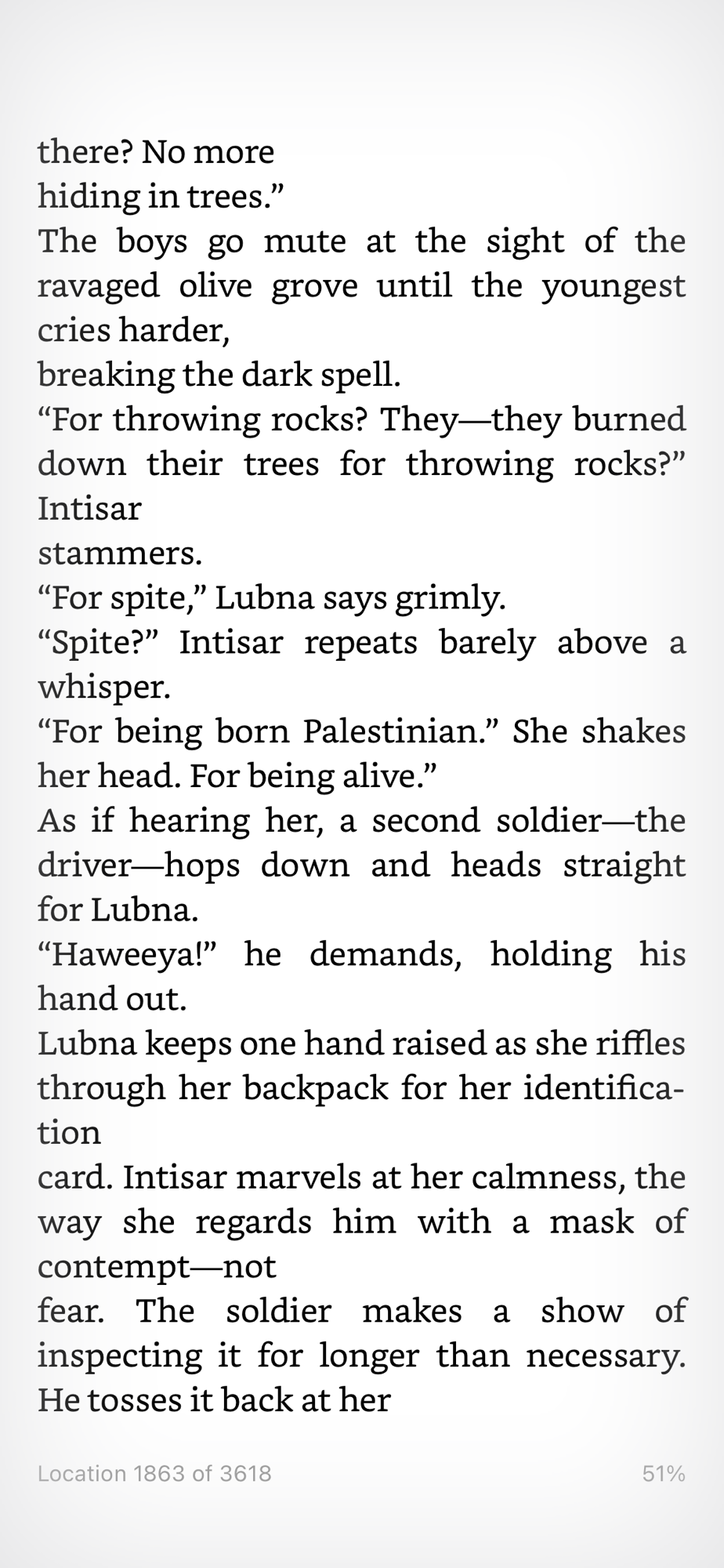
This adult multi generational novel weaves a narrative that will stay with the readers for the warmth and depth it explores of a fictional family that over the course of 248 pages becomes very real, and in many ways familiar through its personal focus. The book is deliberately slow as it glides through different members of the family, their backstories and different points in time. The prose highlights the plight of Palestinians but not in a didactic or call to action sort of way. The characters and their stories, and their trauma and dreams are very tied to Palestine and the occupation, but the focus on the individual and the ripple effects is what will linger. I do not know when the book was written, (it is published in November 2025) as I read a digital arc which had very minimal backmatter, but this book is set before the recent genocide and is all the more important for today’s readers in pushing back against attempted erasure of Palestinian voice, culture, and history.

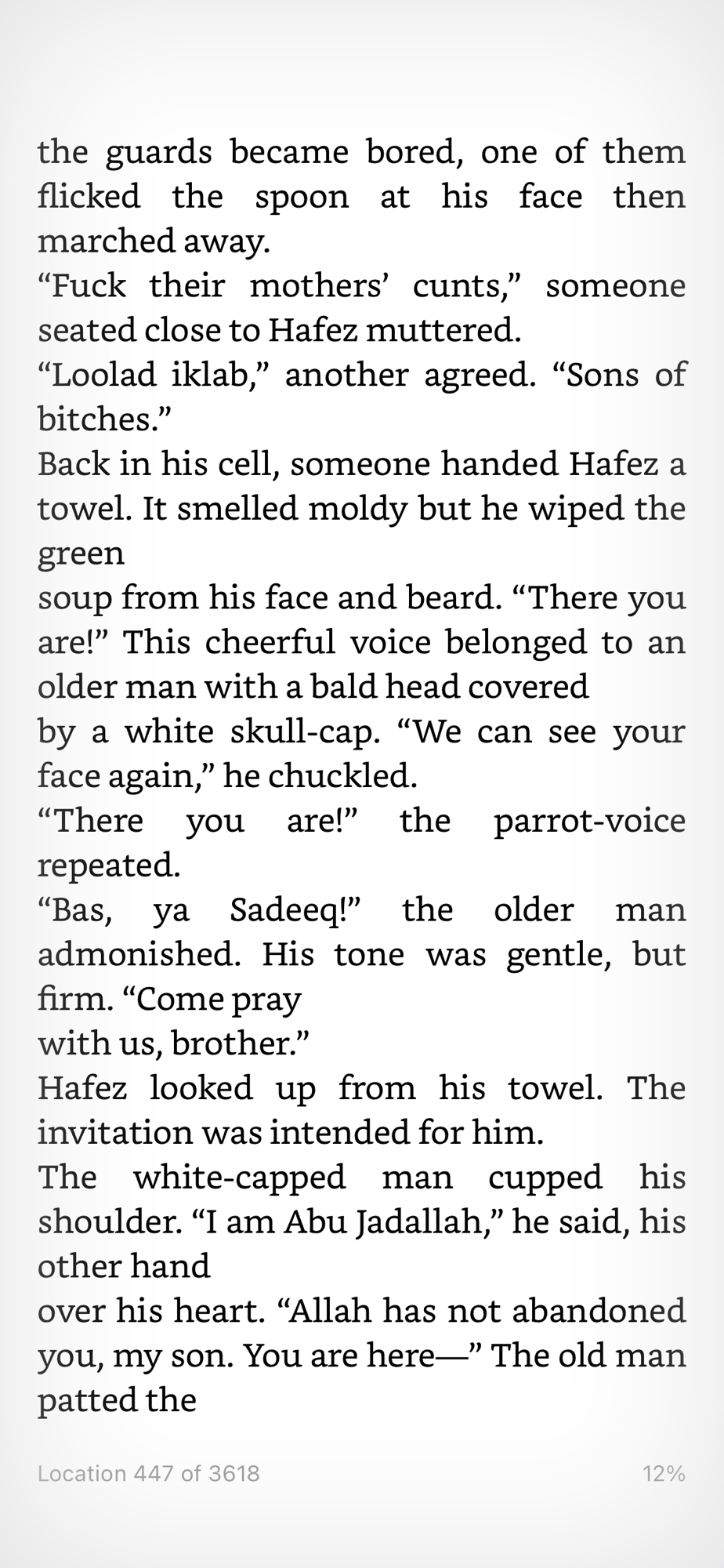
Intisar is a nurse in Chicago, the only daughter of divorced parents. She lives with her mother and has not seen her father in over 20 years. Not since he left the family to return to his home in Palestine, join the resistance and after a fateful mission is forced to serve a life sentence in Gahana Prison. When he is released to live his final days before he succumbs to cancer, Intisar heads overseas to see him one last time. Her grandmother Sundus additionally needs Intisar, the only heir, to fight for her to keep her land and home, a task that Intisar is not willing to pursue. As family history is shared, daily atrocities witnessed, Intisar starts to see herself differently, and considers if she could feel at home in her father’s homeland.

Again I read an arc, but there are a few sentences that really have me hoping line edits will still occur before the final version. The book is adult, it has a Muslim drinking and serving alcohol, there is assault, sexual and physical mentioned, and yet I didn’t feel like it was sensationalized, actually felt that the author was deliberately holding back to keep the story about the family and not the larger issues. Their is quite a bit of Islam, not from every character, but it is woven in and not an identity issue. Actually one line used frequently is my only real gripe with the book. “Pray to the Prophet,” is regularly said by a few characters, so I though perhaps it is something unique to them, up until about the midpoint, where many characters start to say it and I don’t like it. It makes it clear other places that Allah swt is One and who we pray to, it has the shahada in English and verses from the Quran, so I’m guessing it is a colloquialism perhaps, or maybe a poor translation, I honestly don’t know, but it bothered me, so I am sharing.

Muzoon: From Refugee to Leader by Muzoon Almellehan illustrated by Asma Enayeh

Standard
Muzoon: From Refugee to Leader by Muzoon Almellehan illustrated by Asma Enayeh

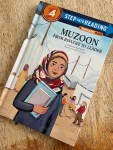
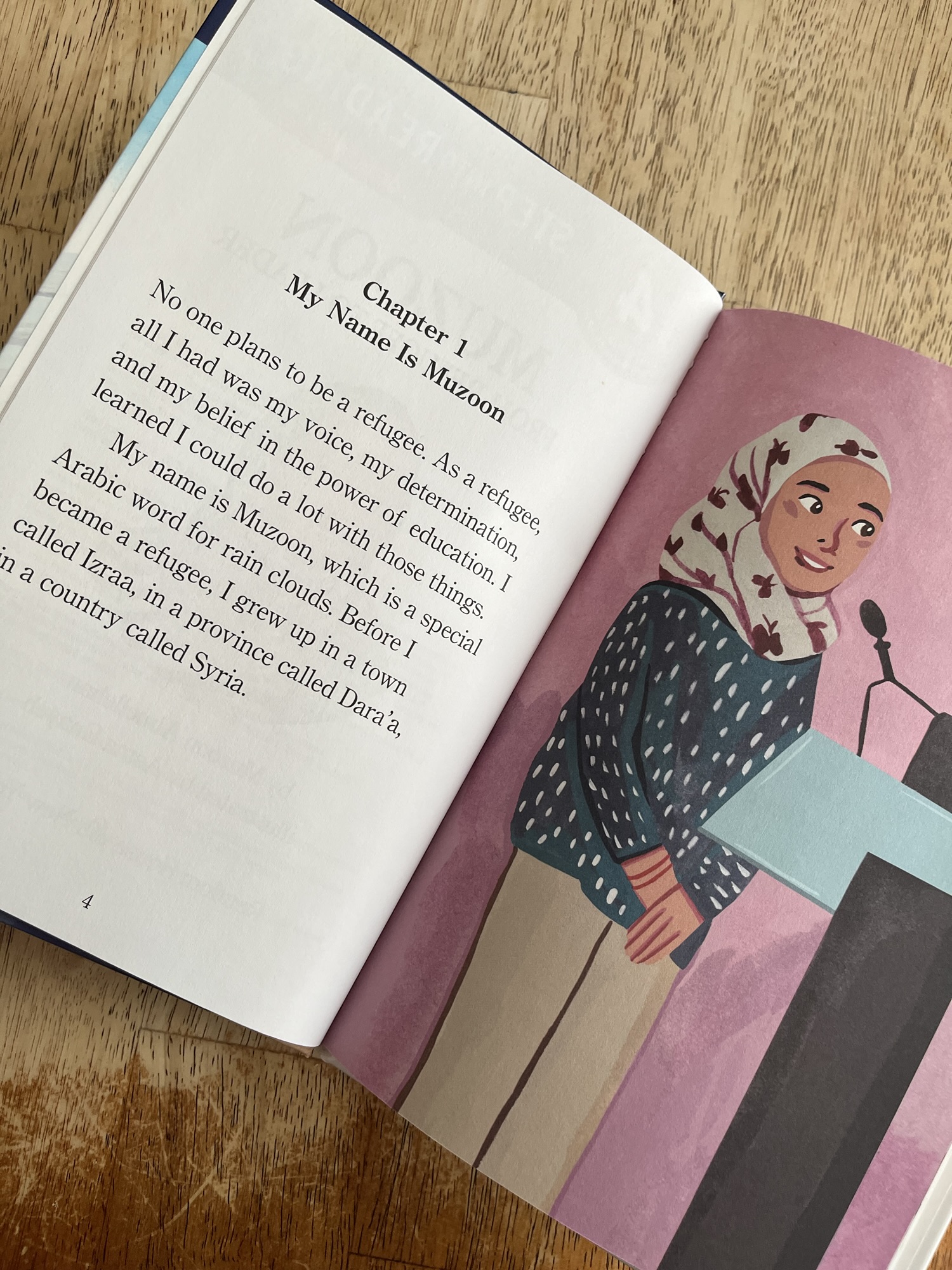
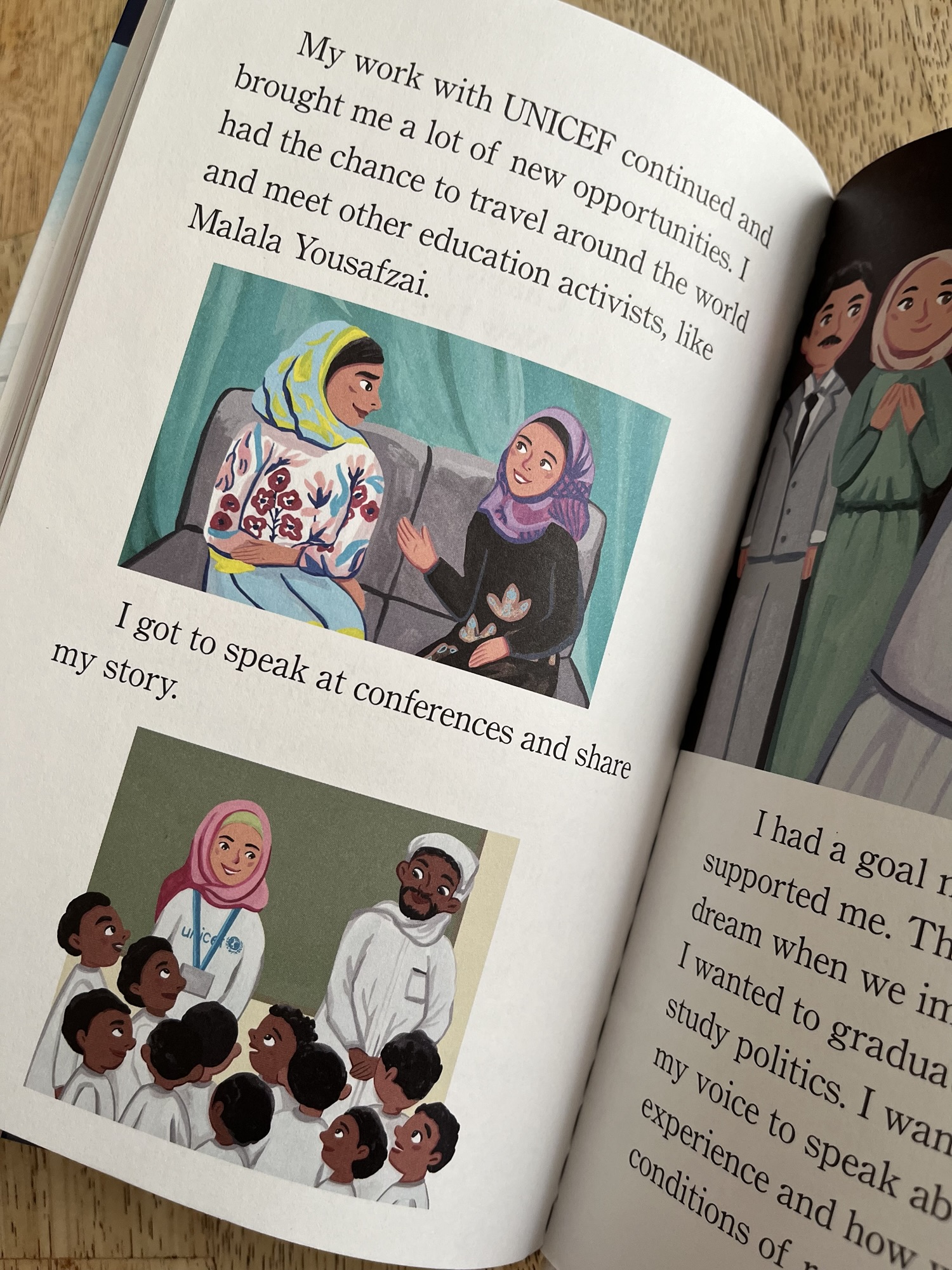
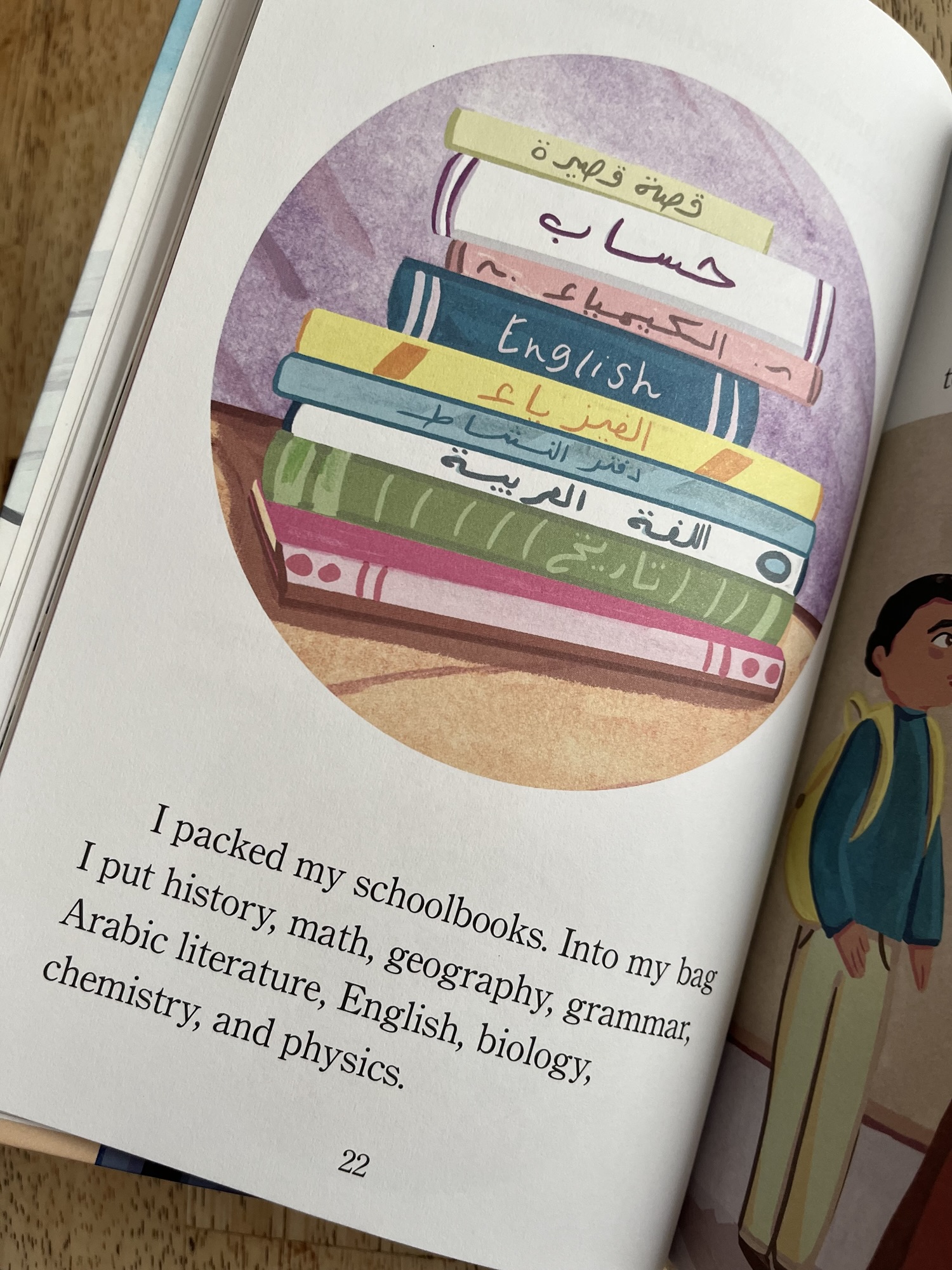
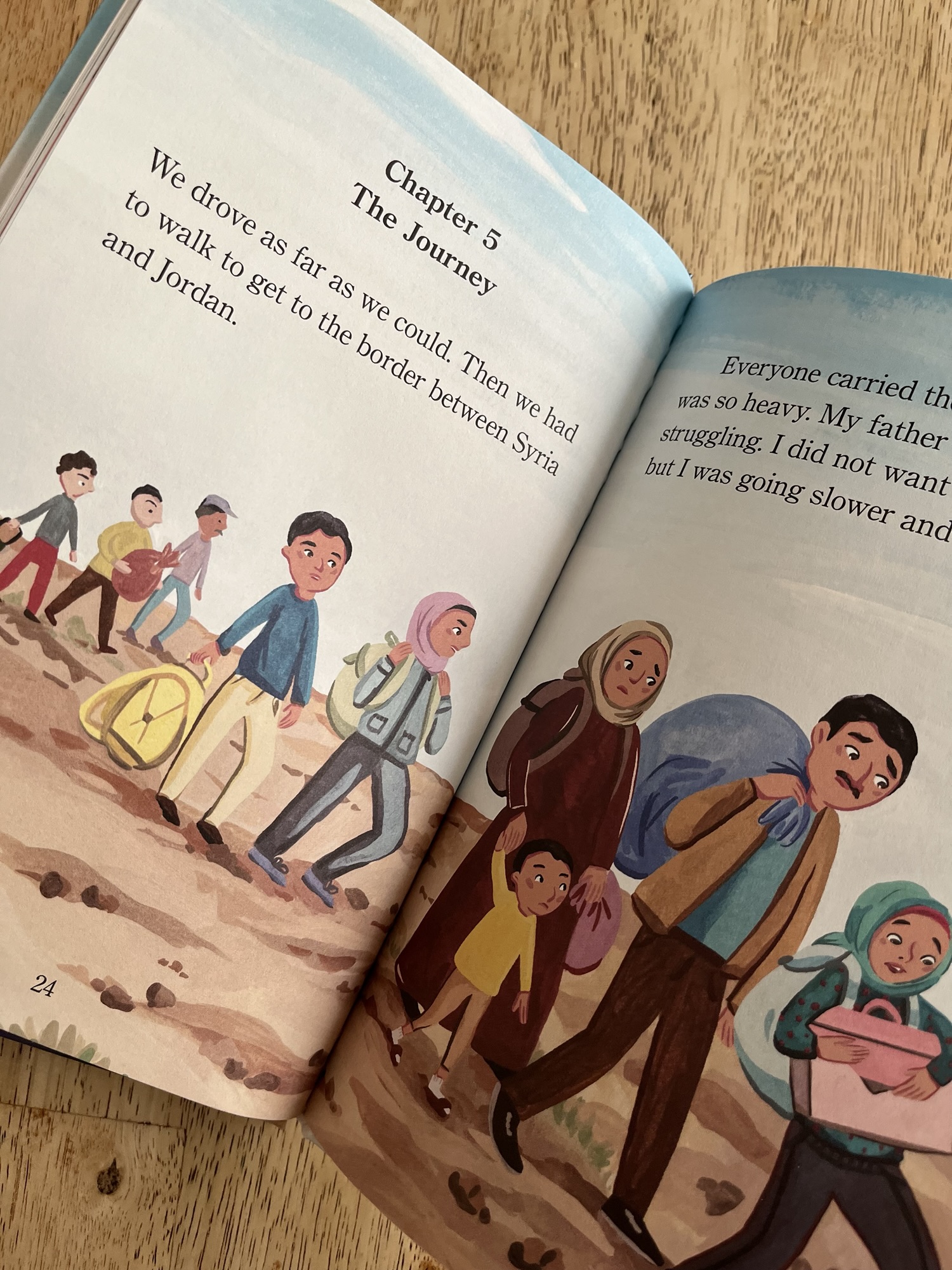
Such a delight to see Muzoon’s story coming to children in the West in the form of a Step into Reading Biography. The approachable format aimed at second and third graders reading paragraphs tells Muzoon’s story with quotations from her middle grade biography, Muzoon: A Syrian Refugee Speaks Out.  From her life with extended family, playing soccer, studying and enjoying Ramadan, to the changes that turned her country unsafe and forced them to become refugees. It follows her to refugee camps trying to find routine and hope and the role education and encouraging other’s to study plays in her life.  Eventually her activism and efforts catch the attention of UNICEF and today she works as a UNICEF Global Goodwill Ambassador and travels the world advocating for education and refugees and rebuilding Syria.

Divided into eight chapters, the 48 page book shows how relatable Muzoon’s life is and how the political events forced her family to abandon all they knew.  The presentation, in both the text and the illustrations, show the unexpected and hardships Muzoon and her family face as they make their way to the refugee camps and work to adjust. The book is not graphic, but the weight is conveyed as readers also see the power education and learning has in providing hope and opportunity. In a fictional story, a protagonist using their voice for the good of society is something to cheer, to see it from a real life person in the middle of a war, is something to admire and be inspired by.

I particularly like the inclusion of Ramadan in the story and the details showing her family joyfully gathering to break their fast together, as well as conveying some details about the Islamic holiday.

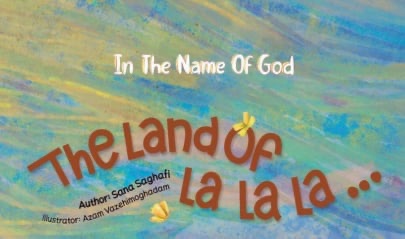
The Land of La La La by Sana Saghafi illustrated by Azam Vazehimogadam

Standard
The Land of La La La by Sana Saghafi illustrated by Azam Vazehimogadam

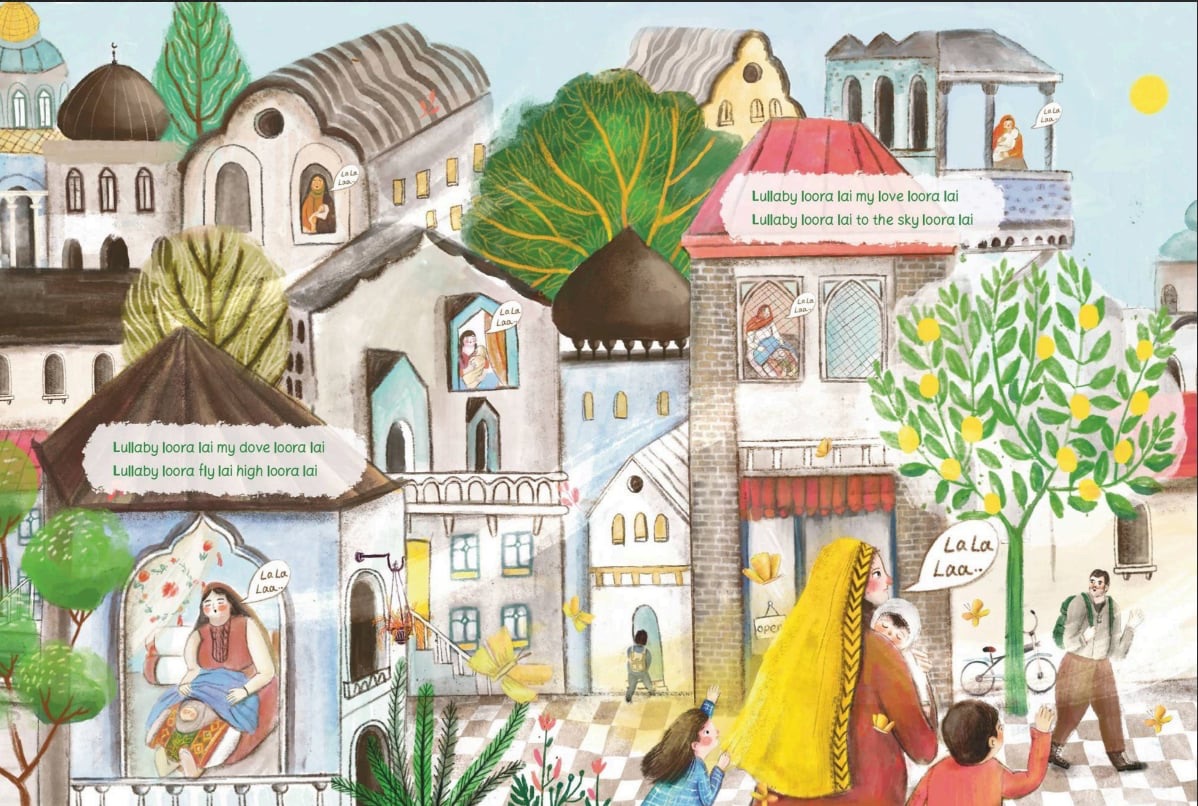
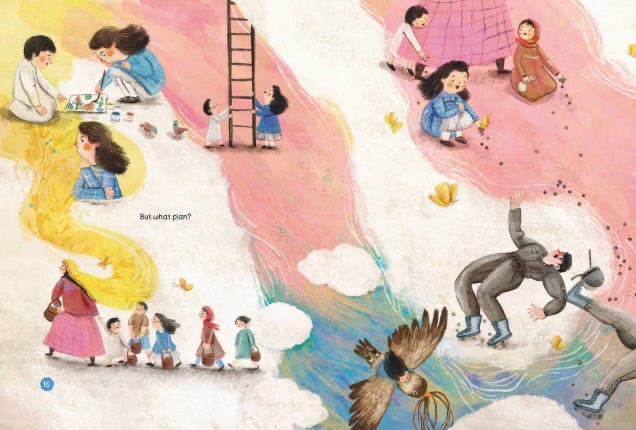
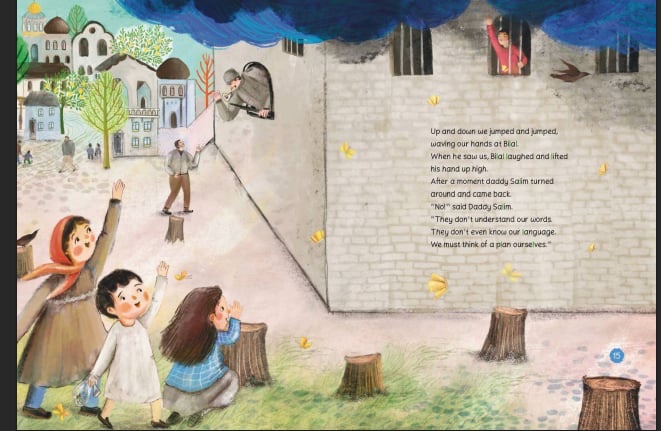
This gorgeous and powerful 36 page picture book goes back in time to a Palestine where the struggles of today are still found, along with the resilience of the people, determination of the women, ingenuity of the children, love and hope.  The book is so strongly unapologetic in its portrayal of marbles representing strategy of kids to battle the giants aka soldiers, of children being imprisoned, of the occupiers being outsmarted by the people, and the joy that persists despite the attempts of erasure. The story within a story…within a story(?), doesn’t name Palestine until the very end, after the stories at hand have wrapped up, and doesn’t disclose that it is based on a true story, except for in the blurb.  It is also worth highlighting that the book is not OWN voice or sourced.  I still am sharing though because it is positioned as happening long ago, and thus hopefully not further erasing a Palestinian voice, but rather sharing a story to prevent it from being lost.  I do not know the author, illustrator, or publishers’ intent, this is simply my view and I am happy to be corrected if I have arrogantly overstepped.  


The book starts with a lullaby lilting through the air, the la la las, connecting the women caring for their children. Mama Laya is busy so Big Brother Bilal is playing with the children, marking which soldiers have been defeated on the paper that matches the marble game in the lane. When the giants take him away the children run to find Daddy Salim.

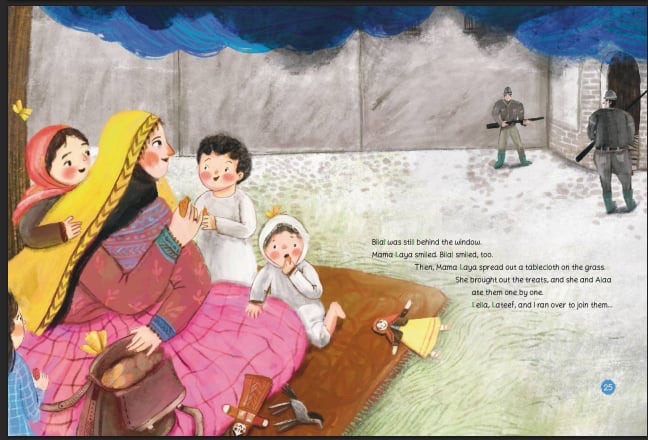
The searching children and family find Bilal in prison, and the giants don’t speak the language of the people to be reasoned with, so they must figure out a way to free him on their own.  Mama and the children have a picnic outside the prison and secret filled lullaby conveys the plan right under the giants’ noses. With Bilal free, the women gather to teach each other a secret way to communicate, to resist, to hope, in the lullabies that they sing.

There is no religion mentioned, but the title page begins, “In the Name of God,” and numerous characters are depicted wearing hijab.  I read a digital arc and I hope the printed version has backmatter to highlight that the author is not Palestinian, when this would have taken place, and if it is accurate.  Authenticity and accuracy are important, and I hope the book clarifies what is real, what is imagined, an where the information came from.


A Tariq Twins Mystery: Murder for Two by Niyla Farook

Standard
A Tariq Twins Mystery: Murder for Two by Niyla Farook

I don’t know what I was expecting, but woah once the actual crimes started piling up and the sleuthing began, I was invested in Riri and Ani working out their differences, solving the case, and freeing their accused dad.  At 336 pages, a full on murder, attempted murder, arson, thieving, and arrests all taking place, the book is definitely for older middle grade readers. The premise and dual points of view of 11 year old twins being reunited after 3 years apart by their divorced parents, getting to know how their OCD, ADHD, and autism factor in to their personalities, learning about TUSC, the town of Castlewick, and the side characters that will turn suspects, result in it taking the story a while to get going.  But if you can get through it, and can suspend belief, the book is a fun mystery that takes on heavy topics, and crime, but somehow keeps it light and consumable by the intended audience. The twins are Muslim, one wears hijab, and there are Islamic references, but once the identity is established, it really doesn’t play a role, or shape the characters’ view of the world or approach to dealing with their grief, anxiety, and obstacles they face.  There is mention of halal marshmallows and hijab, but they never say a quick dua or pray, and by the end is not really even shown to be a big part of their daily lives.  I have no idea if the neurodivergent rep is accurate, but the tone and approach is very positive and normalizing.  Parents may want to know that the book starts on the last day of school and the teacher is non binary, referred to as Mx Henderson with they/them/theirs pronouns. The character is mentioned a lot in the first nine pages, and then never again.  Pronouns for other characters are listed on their profile cards.  There is teasing of a girl having a crush on a boy, a few couples dating, a character being born out of wedlock, and a male character being in a relationship with someone named Toby that is mentioned a few times, but only on the final mention in the last few pages of the book, does it clarify that it is a boyfriend.  The book seems to be intentionally diverse in ethnicities, religions, identity, and orientation, but the story is a murder mystery, and a family reconnecting, and the mentions in passing are not detailed, or overly explored.  I mention all this for adults to determine what is best for their children.

SYNOPSIS:

Supersleuth Imani Tariq aka Ani lives in Castlewick with her father, Abderrazzak and spends time at Cafe Vivlio with Mrs. Kostas.  The small town is Ani’s stomping grounds for sleuthing and carrying out the cases her TUSC (Tariq Ultrasecret Supersleuth Centre) organization takes on.  She knows everyone, and everyone knows her, and she is not looking forward to spending the summer with her “evil twin” visiting from California.  Riri short for Noori, lives with her mom and is heading to the UK so her mom can set up a new office for her company, and the twins can reconnect after being apart for three years.  There is a lot of animosity in the former family of four, but the girls slowly start to rely on each other when they find Mrs. Kostas’ dead body in the secret garden, alibis not checking out, relationships coming to light and their dad being arrested for the murder.

WHY I LIKE IT:

I naively thought it would be a murder of a distant side character that the girls tried to solve, or maybe a trick and it looked like a murder, but ended up not being one, so I was really kind of shocked that in fact a murder occurred, that the girls found the body, and that the story of lies, deceit, art theft, secret identities, relationships, and webs of coincidences and manipulation was just getting started. The girls’ voices are distinct, but as they pop around doing what they do, the reader is often just expected to go along with it an not over analyze. I kind of liked that the ending spelled it all out, like a good villain in cartoons the culprit gets their moment to detail and confess what they did, how they did it and why.  In full disclosure though, with about 30 pages left in the book, I was genuinely still curious who the guilty person would be.

The book balances very real mirroring threads with absolutely bonkers ones.  The girls get counseling for grief, talk about their OCD and ADHD.  They also run circles around the police, unravel the plot through research, interviews, crime scene analysis and get the murderer to confess to only them.

The Islamic rep at the start really got me excited, but it stopped rather abruptly and there was no longer even any Assalamualaikums or walakumsalams after about the first 40 pages or so. The characters are of Pakistani decent, but I have never heard “hudafiz” as a farewell before, Allah hafiz and KhudaHafiz, yes, but never with an H.  It appears a few times in the book, and even the internet, for whatever it is worth, says it is probably a mistake.

FLAGS: (Things parents might want to know the book contains):

Murder, attempted murder, assault, framing, deceit, lying, arson, teasing, close boy/girl friendships (Muslim characters), hetero and lgbtq+ relationships, romantic interests, child out of wedlock, jealousy, revenge, name calling, parents are divorced, therapy/counseling, ADHD, anxiety, grief, abandonment, loss, OCD, autism, unemployment.

Sameer and Snazzy: Kindness Counts by Emma L. Halim illustrated by Herry Prihamdni

Standard
Sameer and Snazzy: Kindness Counts by Emma L. Halim illustrated by Herry Prihamdni

The 32 page faceless picture book for toddlers and up, is set in Australia and follows Sameer and his cat Snazzy on a bushwalk.  At first I felt like it might be a little bit like the classic, “And to Think that I Saw it on Mulberry Street,” but the structured story with a repetitive refrain adds in Islamic phrases, silly encounters, and examples of kindness that make it unique.  Add in a fun surprise at the end, and like many other books by the author, be prepared to have it memorized as your little ones ask for it over and over again.

The book starts with Sameer look forward to his grandpa coming to visit, but wishing he had something exciting to share with him.  Snazzy suggests he shares that he can talk to animals, but Sameer knows no one would ever believe that, so the two set off on a bushwalk to find something exciting.

When they hear an “A-choooooo!” in the trees, the fun is just getting started with Miss Koala sneezing and making eucalyptus leaves fall. The duo finds a way to help, but the fallen leaves mean ants are stuck in their home and can’t get out.  Once again, Sameer and Snazzy, find a way to help.  After each episode the refrain of, “‘Imagine if I told Grandpa this!”‘ I say to Snazzy.  ‘He’d never believe you! he smiles.  ‘NO-ONE WOULD!’ We laugh together and continue along the path, when suddenly…”
The book ends with a surprise, that I won’t spoil. The backmatter has a reference to Surah An-Naml and explains that Prophet Sulayman peace be upon him, really could speak to animals.  There is also a glossary of the Islamic phrases and a QR code to continue to the fun after the story ends.

The book is a bit more text heavy than some of her others, but the illustrations are fun, and will keep kid’s attention.  It does not rhyme, but has a cadence that makes reading it aloud easy. The small size makes the book better suited to bed time, but could work in a story time, and would be wonderful tuned into a story board/felt board read aloud.  The book is a universal story, but at some point in Islamic fiction self published and small published books, I think we will need to have open dialogue and discussions if having characters that are not the same race as the author or illustrator is appropriate and beneficial, or is misleading and better to avoid.

***EDIT: The author reached out to me asking me to remove this generalized opinion of me calling upon the need to have discussion, I opted to amend, as I think we need to have conversation and believe intention and purpose in whatever one decides is a benefit.  So, to avoid errors in interpreting her ask, I will simply post the screen shots, and my response.  Please note I did not tag the author in my Instagram post, she reached out to me.  I purchased the book, it was not gifted.

Steet Puppy, Masjid Cat by Moniza Hossain illustrated by Wastana Haikal

Standard
Steet Puppy, Masjid Cat by Moniza Hossain illustrated by Wastana Haikal

I was a little nervous opening the book, I didn’t know if it was going to be a “Lady and the Tramp” type retelling, and I was unsure how dogs would be presented, but I sure was not prepared for the absolute adorableness that unfolded.  The simple rhyming lines contrasting the street puppy’s life to that of the pampered cat in the masjid, to their meeting, and the sweet imam leading with kindness warmed my heart.  The real chef’s kiss is the backmatter that doesn’t source, but references the sunnah of “acts of charity to every beast alive,” and notes that dogs, unlike cats, are not allowed in the mosque for religious reasons.  I love that “masjid” is in the title, that the author’s note and glossary explain adhan, imam, and the Quran, and ultimately that friendship amongst differences is the takeaway for all readers.  I don’t love that the adhan in the text is described as ringing and the imam as singing, but I acknowledge my pickiness.  And while I love that Prophet Muhammad saw is mentioned in the author’s note, I do wish salutations were given afterward.  The illustrations on every one of the 32 pages are delightful, and I love that the image on the jacket is different than the one on the book itself.  For ages 3 and up, and even emerging readers, this book has a lot of heart, and my 6 year old has read it aloud so many times, I just might have it memorized.

The book starts with simple rhyming lines showing the contrasting life of the cat and the dog, from their daily activities, to how other’s treat them.  When they meet, the cat is not too welcoming, but the imam shows the puppy kindness and the cat follows suit.  As simple as sharing and giving each other a chance, creates a friendship between the two animals, and a beautiful conclusion even the littlest children will understand.

The book is not didactic, and the role of the imam and setting of the masjid, for Muslim kids will be such a spark of joy, but in no way will it limit non Muslim children from connecting with the story.  The benefit for all is seeing a masjid environment and a Muslim in action, normalizing both, and inshaAllah reminding us all to be a little kinder to our animal friends.

All the Ways to be Pretty by Shamaila Khan illustrated by Reyhana Ismail

Standard
All the Ways to be Pretty by Shamaila Khan illustrated by Reyhana Ismail

The premise of this book is fabulous, an Islamic approach to internal beauty to counter the societal emphasis on external appearance, by drawing on the examples of Ai’shah (RA), Khadija (RA), Sumayyah (RA), Maryam (RA), Hajar (RA), and Rufaidah (RA), may Allah swt be pleased with them all.  The illustrations are decent, focusing on the girl understanding what her mother is saying and her imaging herself with those qualities.  The part that I struggled with, is I flipped through it before I started reading it, and the pages are often walls of text.  Additionally, I didn’t realize it is rhyming text over 34 pages.  SubhanAllah though, somehow, it works.  I can see this book being shared at preteen gatherings in masajids, homes, and schools everywhere.  The rhyme at times is forced and lacking, but the flow makes the walls of text zoom by and the information shared is not overwhelming and Alhumdulillah, it doesn’t stray too far from the central messaging. You could share it with younger readers, but I think it works best if the audience knows some of the women and facts highlighted, and the information shared is a mix of reminder and new tidbits urging further exploration. The publisher lists the reading age at 7-10 which is probably a good fit based on the amount of text, but the rhyme, mirrors at the end, and starting point of battling beauty standards on the screen and “Princess” messaging is a bit of a target audience disconnect, which is why I point it out so consumers are aware.

The book starts with a lengthy author’s note before the rhyming scene of a mother and daughter walking to school and discussing what the daughter would like to be.  The girl doesn’t answer a profession, but rather responds that she wants to be pretty, and gives some justifications.  The mother gently then encourages her not to just want to be pretty, but rather pretty smart, pretty wise, pretty brave, pretty pious, pretty resilient, and pretty kind, before concluding with the girl throughout the day thinking of how to be like them, and her mother, to earn Allah’s pleasure.  Each attribute is a two page spread with one of the historical women featured.  The book ends with a hadith and six mirrors with the characteristics beneath them.

I like that the book does not try to give an entire biography about the women featured.  I also like that Islamic references are also brought in, some explained some not. It is “Islamic fictionalized non fiction” it is meant for Muslims with Islamic framing, not just Muslim characters, and it has substance.  Lately so many self published or even Islamic published books seem to not feature Islamic foundational themes, and I realize how much I have missed reading books that do.  Yes, I normally would have a solution to offer as to how to make the pages less text filled and I know I should say that maybe it shouldn’t rhyme, because it makes for some awkward phrasing, over explaining, and useless lines, but alas, I have no suggestions.  We need books that present our Sahabas and Prophets in a manner that allow our kids to know them and think of them and emulate them. Alhumdulillah, I can see this book being read and shared and discussed, and that to me is a “pretty “good thing.

The Misadventures of Mina Mahmood: School Trip by Farhana Islam illustrated by Simran Diamond Singh

Standard
The Misadventures of Mina Mahmood: School Trip by Farhana Islam illustrated by Simran Diamond Singh

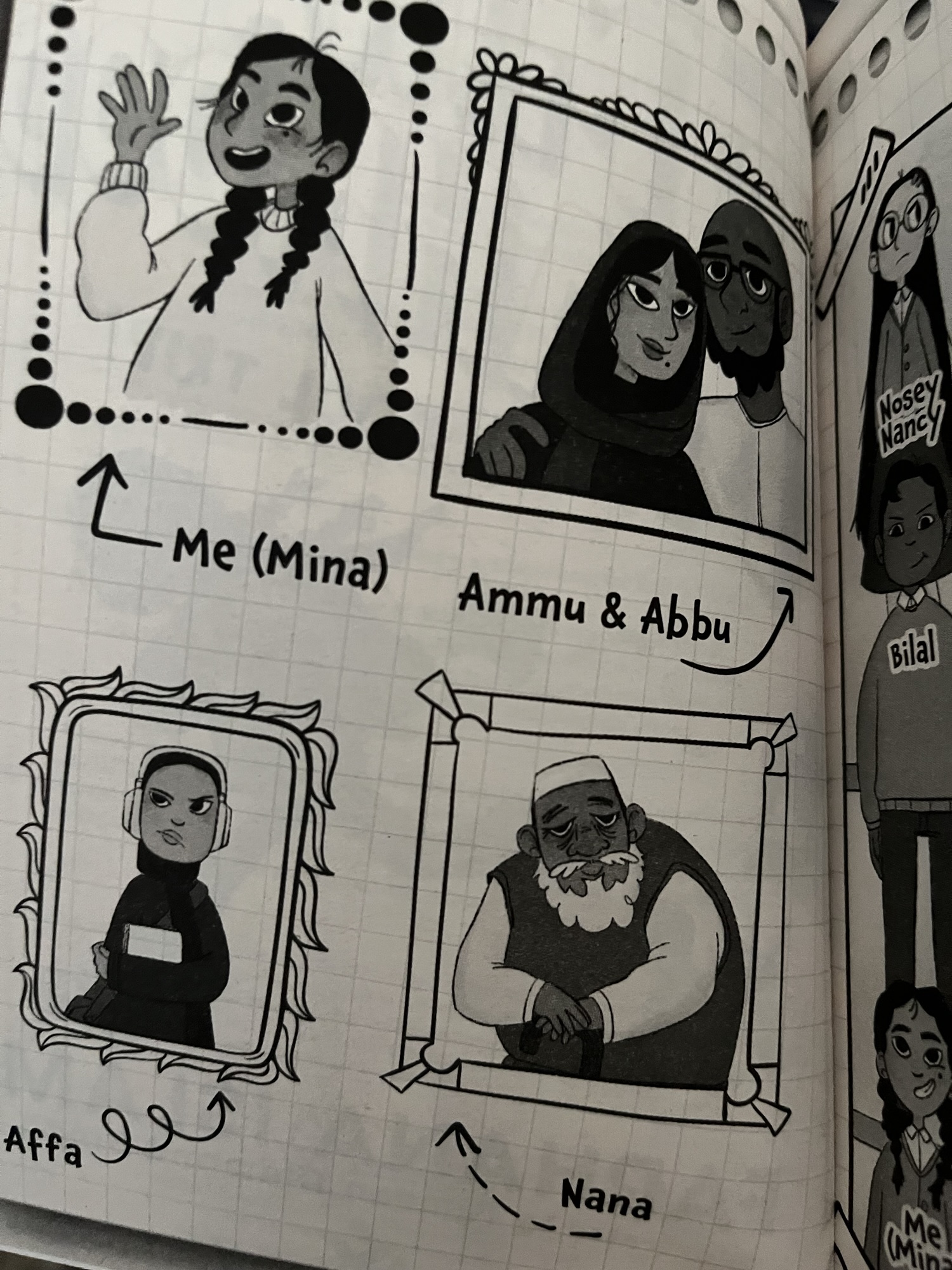
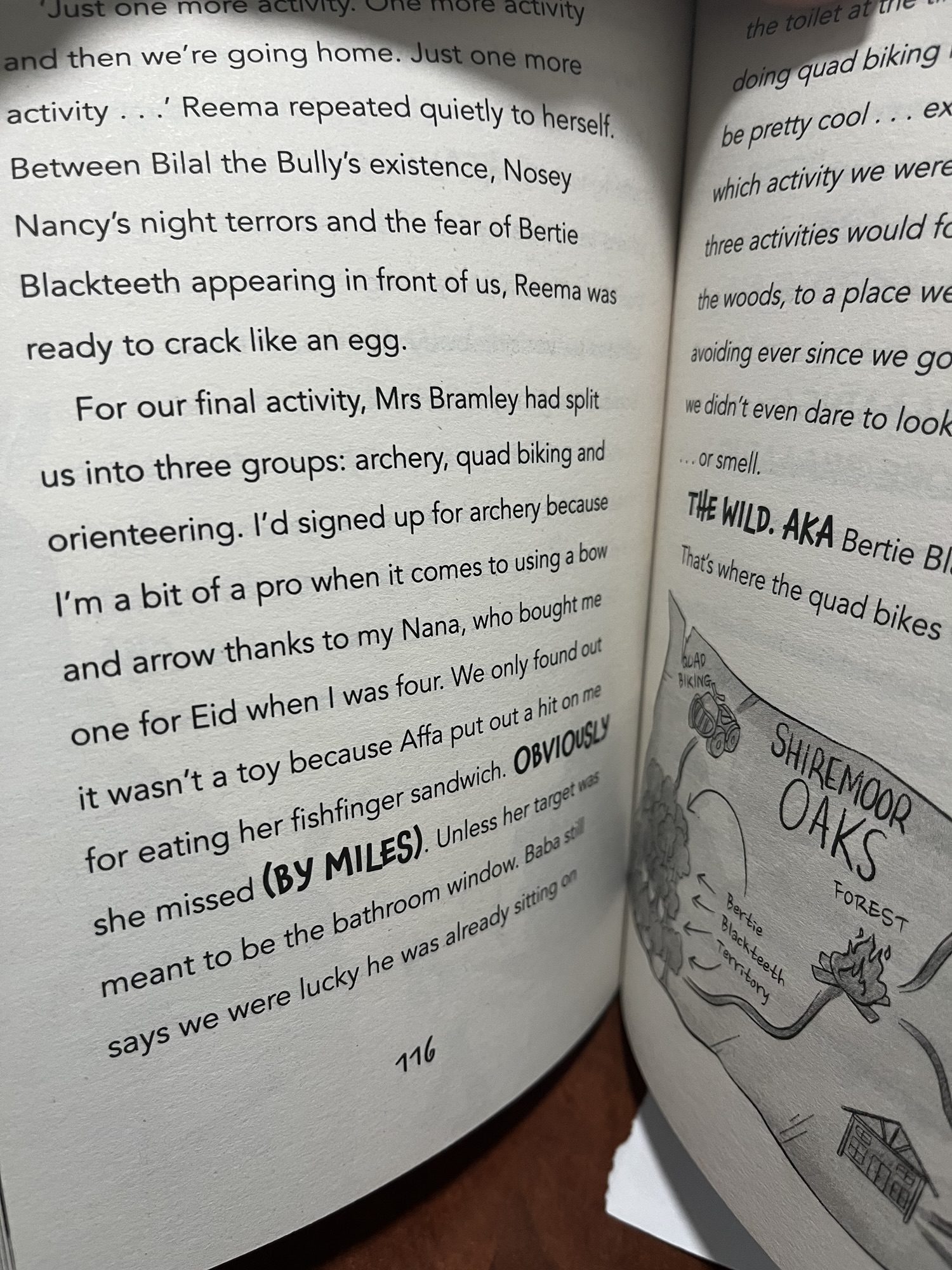
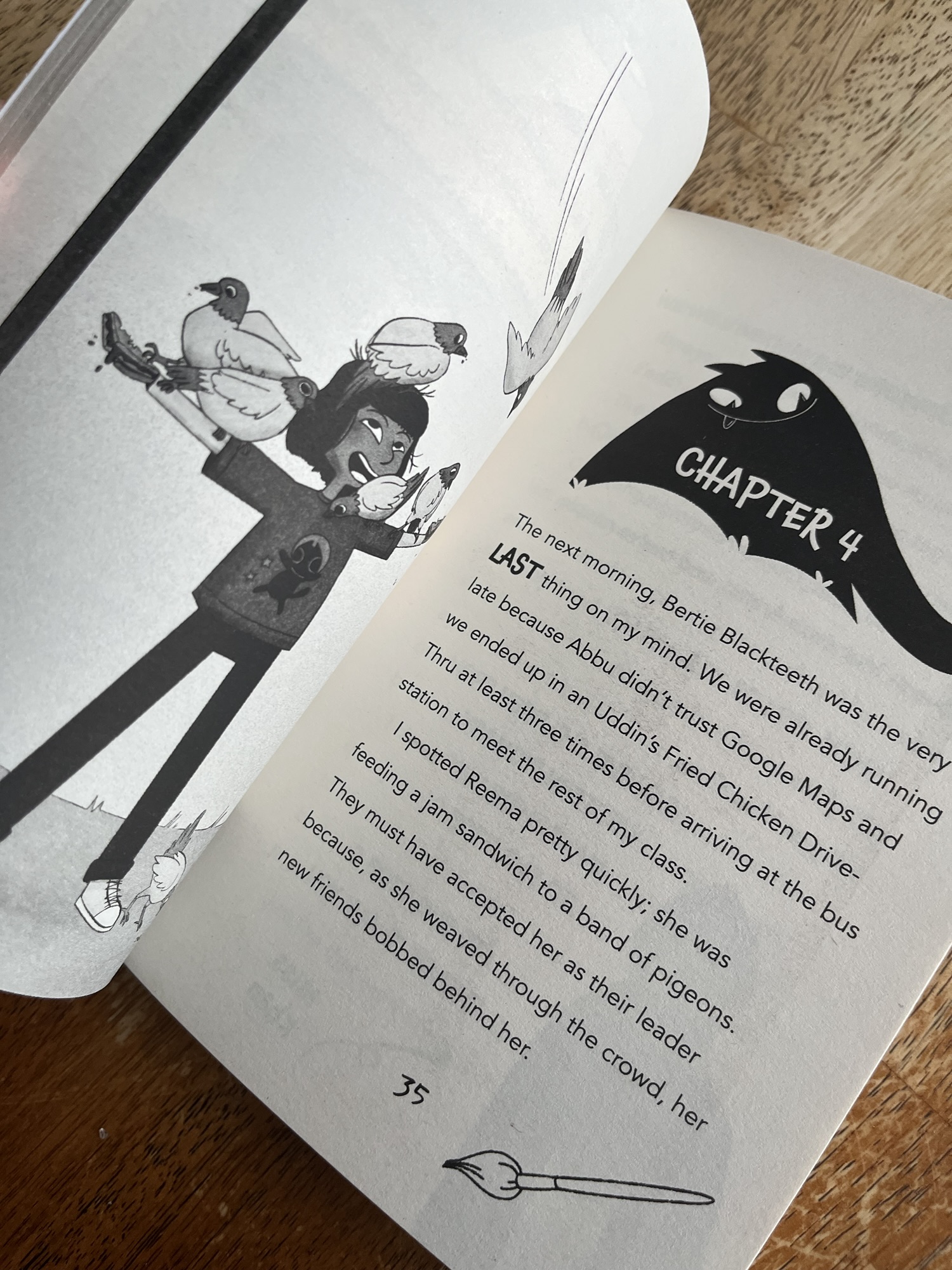
The illustrations in this book, by a Muslim author featuring Muslim characters, are impressively fun and complimentary to the story.  Yes, the 184 page book is highly illustrated.  The publisher says it is MG, and I can see that based on the length, but I think it is a solid second grade to fourth grade read.  The storyline is singular and surface level, and the scary silly bits are just meant to be funny and not taken too seriously.  I enjoyed the book, the normalizing of the Muslim kids in a non Muslim setting just living their life, and the main character’s voice had me smiling throughout.  A school camping trip is overshadowed by bullies and then consumed by the ever growing out of control scary story of Bertie Blackteeth.  An epic laser tag battle, quad adventures, and the comical banter of Mina and her friends, Mobeen and Reema, make for a light engaging read.  Sensitive kids might find the fright to be too much, but I think most will finish and be glad to learn there are more books to come in the series.

SYNOPSIS:

Mina Mahmood and her friends are ecstatic, it is finally their turn to head off on the annual camping trip to Shiremoor Oaks.  A weekend of laser tag, orienteering, archery, and quad biking without adults, well teachers, but no parents.  All Mina has to do before the fun begins is get through a family dinner with Auntie Selma and her cousins.  Mina doesn’t believe anything her cousin Abbas says, so when he mentions he went camping in school to Shiremoor Oaks and heard about a girl, Bertie Blackteeth who vanished there, Mina pays him no mind.  When her older sister Affa, also mentions that she heard the story, Mina starts to wonder if there could be some truth.  The next morning on the bus, when Bilal the Bully and his minions Owen and Brodie are also talking about Bertie Blackteeth and her need for a new body, Mina and the rest of the class are properly spooked. The fear hangs over all the activities, ruins the midnight snack extravaganza, and makes this a camping trip they will never forget.

WHY I LIKE IT:
I enjoy when Muslim kids drop mention of Eid and Ayatul Kursi in their adventures. When a character wears hijab, but she is the teacher, so the book isn’t about her identity, it is just a part of who she is.  I also really like when books are funny, characters are snarky, there is a plot, a climax and a resolution.  The book doesn’t have layers and heavy themes, sure you could discuss bullying, and fear and friendship.  At times Mina is tasked with saving Mobeen and other times advised to sacrifice him.  But considering he feels to young to be a father if the spider that just landed on him lays eggs in his eyebrows, it is probably best to just enjoy the story for what it is and not look to make it more.

FLAGS:
Could be a little scary, it is a little imaginative in the lies and embellishments of Bertie Blackteeth.  Bully and dealing with bullies.

TOOLS FOR LEADING THE DISCUSSION:
I handed it to my 10 year old and said enjoy, not much more than that is needed. A fun addition to elementary shelves, and one that will be picked up often.

Aarzu All Around by Marzieh Abbas

Standard
Aarzu All Around by Marzieh Abbas

I was hesitant starting this 384 page middle grade novel in verse, because the stereotype of having to disguise yourself as a boy to make things happen, seems like a western performative troupe that reinforces stereotypes, and has been done a fair amount in literature.  Pushing down my disdain, I opened the book to numerous pages of cricket terminology and rules, which further served as a barrier.  I do not understand the info dumping, literally, at the start of the book, and to top it all off it is not needed.  The book is blurbed as being a cricket loving, girl dressing as a boy in a patriarchal society, but really those are the most forced aspects of the all over the place narrative.  Cricket is underdeveloped and her actually playing is very minimal and lacking. Aarzu disguising herself as a boy is a blip that she admits to a few pages after she gets the job, and thus the story that remains is an orphaned girl with a mean uncle trying to find a way to help pay for her younger sister’s medical bills. Which isn’t a bad story it is all just so very disjointed.  And the verse is not written well, there are no beats or flow, it just seems to be a few decent poems in a sea of jumbled ones.  About 40% when the Islam starts to shine, I felt a brief connection to the book and the characters, but the loose threads and telling over showing, found skimming the pages to find out if the sister survived, if Aarzu got in trouble, and how cricket fit into it all.  The weak climax and sloppy resolution, combined with the premise, marketing, and info dumping, makes me recognize that I am not the target audience as a cynical Pakistani American reader, but truly makes me wonder who is.  I don’t know that the words on the page or the story at hand are going to resonate with middle graders.  I appreciate that Islam and culture are separated, that the mean uncle is confined to him and him alone, not a label on Pakistani men, but it feels like the editor took a day off or didn’t want to help the author make the story cohesive, which is unfortunate.

SYNOPSIS:

Aarzu and her younger sister have come to live with her poor maternal aunt’s family in Karachi after her parents are killed in an earthquake.  She is treated like a servant by the family, not allowed to watch cricket let alone play, and her government public school is hardly a challenge.  When Sukoon’s kidney failure worsens and dialysis is needed, as they wait for a kidney transplant match, Aarzu decides to find a way to make money.  She starts frying onions and selling them at the local market, the labor intensive and odorous job helps, but not enough.  When a nearby bungalow preparing for a wedding, needs laborers, her friend Nazia encourages her to cut her hair to look like a boy and apply.  Lying to her aunt about where she is, she spends her time after school getting to know the kids that live at the bungalow, confessing that she is a girl, and playing cricket.  The money helps her sister and things are starting to look up, until the truth comes out, Sakoons health worsens, finances at home hit rock bottom, and friendships frazzle.  Luckily though SPOILER the wealthy family likes her and solves all her problems and bribes the right people for her to make the cricket team.

WHY I LIKED IT:

Some parts, mostly the Islam, really spoke to me. I love that distinctions were made between religion and culture, that she taught the wealthy girl how to pray, that Aarzu is Muslim and loves her faith and relies on her relationship to Allah swt in handling every aspect of her life. The rep feels real and sincere and while it made me force a friend to read the book, it also highlighted how weak the other aspects were.  We, the reader, see so little of what Aarzu’s world is, we are just told. There are no flashbacks to her life with her parents juxtaposing her current situation that would have connected us to her.  The poverty, the mean uncle, the cricket, the sick sibling, they all just seem like plot points, not pieces to this girl. She compartmentalizes them in a way that make it hard for the reader to see the overlap, or that she is keeping all of these parts close to her heart at all times.

The resolution was disappointing, it felt half hearted. Why have wealthy saviorism? Dreams coming true from bribery? It took the grit out, and made the messaging fall less on hard work and perseverance, and more on, don’t be poor.

I did appreciate the kidney disease representation, having seen a loved one endure failure and daily dialysis, I appreciated the mention of dietary changes, and swelling, and lethargy, it was well done.  I wish the emotional impact, though not just the sibling love, but the fear of demise, could have come through stronger.

FLAGS:
Lying, physical abuse, theft, fear, illness

TOOLS FOR LEADING THE DISCUSSION:
I don’t know of a kid I would recommend the book to, but I would shelve it, let nine and up read it, and happily discuss with whoever wants to chat about it.

Sabrena Swept Away by Karuna Riazi

Standard
Sabrena Swept Away by Karuna Riazi

The gorgeous cover of this 205 page middle grade fantasy is a great motivation for kids to pick up the book and dive into a story filled with characters from the One Thousand and One Nights. Descendant from Sinbad, Sabrena’s ailing grandma is sometimes present, and sometimes suffering from dementia, but her stories have power, they always have. As Sabrena battles her own self doubt at her new Islamic school, her ability to find her voice and speak up, and her desire to protect her grandma from being taken from her home, she will be swept off to a world far away, where she must be the hero of her own story to help her new friends and find her way back.  I was nervous to embark on an Alice in Wonderland world building framed story, but the short book, the enjoyable characters, and the consistent presence of Islamic representation actually made me forget that I don’t like that style, until the text itself drew the correlation.  In many ways the story and the predictability should also have been a turn off for me, but I absolutely loved the writing of the prologue and the first two chapters, and then I switched to the audio book, and the story just pulled me in and flew by.  The characters pray, call out to Allah swt when scared, greet one another with salaam, discuss qadr, encounter jinn and ifrits, the women wear hijab, there are mentions of Bangladeshi foods and clothes, but the book is for everyone, it isn’t preachy, it is just who Sabrena is, and in the quick paced fairytale like adventure, you will be glad you spent time with her on her adventure in both worlds.

SYNOPSIS:

The Bhuiyan family loves stories, Sabrena’s grandma spins them, and her father studies and teaches them.  Sabrena feels connected to them, but when water keeps appearing, calling out to her, and showing her visions of palaces and gates, she starts to wonder what is truth and what is just family lore about Sinbad the Sailor.  As grandma’s memory slips, Sabrena and her parents move to be closer, the new Islamic school is nice, but Sabrena seems to get tongue tied when her kind classmates try and include her.  When her mom and aunt fight about what to do about grandma, she hides away dreading their arguments.  When the sea sweeps Sabrena to a new world though, she finds herself “so alone” and forced to step up.  With new friends, a longing to return to her family, and her growing confidence, Sabrena is swept away, but determined to find her voice, save the day, and find her way home.

WHY I LIKE IT:

There weren’t really any twists or surprises for me, other than the beautiful Islamic rep inclusion and the cleanliness of the book.  I think I’ve become so cynical that the bar has dropped, and it was nice to read a tale that was decently written, with characters owning their Islam in way that made them just part of who they are and how they view the world.  Sabrena doesn’t have an identity crisis, or internalized Islamophobia, everyone is just Muslim doing their things and living their lives.  I also felt the voice and tone of the grandmother dealing with her dementia was accurate.  Having my father-in-law in our home battling memory issues, I often find rep in children’s books to be performative and saccharine, this felt grounded and used to serve an important plot point in the text, which I appreciated.

The adventure was ok, honestly nothing super memorable, but I really enjoyed the voice actor on the audio book, and was not worried if the holes were big, or adequately overcome, or probable. I was just enjoying being in the story.

FLAGS:

Mention of music, there is magic, jinn, ifrit, a talking head, some trickery and deceit, and it uses the word harem a few time without going into detail.  Disclaimer with audio books I may have missed something, but I think for the genre there is nothing too ,red flag, it is a fantasy adventure.

TOOLS FOR LEADING THE DISCUSSION:

I think discussion and maybe reading of the original One Thousand and One Nights, and then talking reading, and discussing some of the retellings, and character inspirations of Aladdin, Ali Baba, Scheherazade, Sinbad, Marjana, Duban, etc would be a delightful class or book club plan.  This book is solid middle grade, but depending on the framing, could be used for discussion in broader conversations and enjoyed by readers of all ages.