Tag Archives: 2024

Hawa Abdi by Emna Ennaifer illustrated by Anastasiia Bielik

Standard
Hawa Abdi by Emna Ennaifer illustrated by Anastasiia Bielik

This picture book biography starts with Dr. Hawa Abdi being born in Mogadishu, Somalia and shares with readers pivotal moments that helped define her academic and humanitarian journey as Somalia’s first female gynecologist and the founder of the Doctor Hawa Abdi Foundation.  The large horizontal pages with brightly colored illustrations help draw the readers in to the often advanced vocabulary filled text.  According to the publishers, the book is meant for ages 5-9, but I think seven and up, with some assistance, will better understand some of the diction, accomplishments, and what made her such a globally recognized figure.  I was surprised that Islam, and her being a Muslim is not mentioned at all in the book.  I actually doubted my knowledge of her and when I finished the book, I Googled to verify her religious association.  The book starts with a map and concludes with actual photographs that are referenced, but none of the facts about Hawa Abdi or where the information came from are sourced.  While I appreciate that her story is being brought to children through this book, I feel sourcing should have been included, and as a book that is part of a series meant to highlight “inspiring people from the Arab-Muslim world,” I was disappointed that there was no Islam whatsoever articulated in the text.

The story begins by showing little Hawa as an independent girl walking miles alone to get water from the river.  She loved school and often “stayed after school to look at the terrestrial and celestial globes.”  When her mother was in the hospital, Hawa spent months staying with her and observing the doctors.  When her mother passed away she decided she would become a doctor.  She took care of her four little sisters, and studies hard, eventually earning a scholarship to study medicine in Kiev. Her family supported her and she was off to study, promising to return.  When she returned she set up a clinic that soon become a large hospital.  When war broke out her hospital became a village of hope as she took people in, started schools, and kept the inhabitants safe from intruders.

The book really focuses on Hawa becoming a doctor and a humanitarian, thus making any personal remarks about her generalized and lacking.  For example the jump from taking care of her siblings to getting a scholarship is very abrupt, the book doesn’t mention marriage or having children, her daughters are just suddenly there helping run the hospital.  As a result the timeline is non existent and readers don’t know how old she was when her mom died, how old she was when she went to Kiev, when the war started, etc..  With any biography certain facts undoubtedly must be left out, but even a timeline in the backmatter would have been beneficial. 

The Last Man in Paradise by Syed M. Masood

Standard
The Last Man in Paradise by Syed M. Masood

paradise

I’ll be honest, if I would have read the blurb (see below) about this book from another author, I probably would not have read the book.  From the description alone, I could assume that it will undoubtedly be uncomfortable, it is an adult read, it is going to be irreverent, and I will disagree with probably whatever messaging the impossible situation the characters are placed in, come out with. But, having read his two YA books, and really liking More than Just a Pretty Face, despite the raised eyebrows I get from Muslim book fans when I say that, I felt pretty confident that Islam would not be othered or villainized, and that the writing quality would make the cringey situations worth getting through to hear the commentary that would be forth coming.  I’ve felt with the author’s other work that the Muslim characters, own their flaws as individuals, not as representatives of their faith, so, I was willing to give this book a read.

The first quarter of the book was a little stilted, but by the midpoint, I could not put the book down, as the writing did not disappoint.  Would I recommend this book? No, not to the majority of followers of my platform, much like the satire of Zarqa Nawa’s Jameela Green Ruins Everything, I know that this style of ridiculous situations to reveal humanity, consideration, and introspection, while being entertained by very Islamic concepts, is not for everyone. Did the make-out scenes in the masjid parking lot, child abuse, sleeping around, drinking alcohol, talk of pubic hair and board games, grandpa on masjid grounds watching porn, hate crimes, involuntary manslaughter, and impersonating an imam giving khutbahs and performing ghusl, cross lines? Probably, but it is fiction, it is raising the stakes to show extremes, and let the reader opine on their perspective when faced with it. And no, I won’t write my typical review about Islamic rep, because reviewers like me got called out for that too, about policing representation and confining Muslim experience to looking like one thing.  The author went really meta and called himself out for the ending of his other adult book (that I haven’t read, but probably should), The Bad Muslim Discount, so clearly no one was out of the line of fire.

Suffice it to say, this book literary wise is an easy read, the craft is on point, it flows and is compelling (except for the end, SPOILER, who was going to look after Baba, that thread just dropped), for Muslims though it will be very uncomfortable. For non Muslims, or Muslims that don’t read to see themselves represented with the fervor that I do, I think Islam is not painted in a negative light or insulted by the text.  The characters are messed up, their flaws their own, but because they are Muslim, religion is part of their understanding and view of their existence.  I do wish there was at least one Muslim character that had it together, that might hint that as a whole we are not all one extreme or another.  I don’t like labels of “liberal” or “extreme” and the book provides commentary and nuance to those flawed dichotomies as well. The book is not heavily moral, (SPOILER) the protagonist does not come back to Islam (might not have been an identity to even come back to), but identifies as Muslim, there is no YA or MG revelation or singular take away. The book centers Islam, but somehow is not Islamic rep, it simply has Muslims dealing with the messiness of life, expectation, family, relationships, and honesty.

————————————————

Blurb copied from Goodreads:
A decade ago, Azaan, a rebellious teenager with dreams of becoming an actor, was exiled from Redding, California to a religious academy in Egypt by his imam father. His crime? Getting caught kissing Madison, the girlfriend he isn’t supposed to have.

But while letting his family believe he is studying to become a preacher, Azaan ditched school and embarked on an acting career. Given that he has minimal contact and nonexistent plans to return home, he figured no one would ever know. Now, however, Azaan’s grandfather has a dying he wants to see his grandson one last time. In order to maintain the story he’s told his family for years, Azaan decides to become a fake imam. Playing at being a religious leader, he finds a community in Redding on the brink of a scandal involving his family. It’ll be the most challenging role of his life.

Navigating his new identity and old relationships, Azaan reunites with Madison, connects with old friends, and uncovers a shocking truth about his family history that threatens to expose his father as a fraud. It turns out, Azaan isn’t the only one pretending to be something he isn’t.

Before he can finish weighing the consequences of exposing his father or protecting him, an untimely death shakes Azaan’s priorities. He is forced to grapple with his religion, future, and family in a way that is sure to break hearts, but might heal a few along the way.

Farrah Noorzad and the Ring of Fate by Deeba Zargarpur

Standard
Farrah Noorzad and the Ring of Fate by Deeba Zargarpur

img_5607-1

This 323 page middle grade fantasy written by a Muslim author features Muslim characters in a jinn filled adventure, but is not very Islam filled.  Jinn are widely accepted these days in western literature even by non Muslims, so it doesn’t hold the Islamic rep weight it perhaps once did, and while the characters mention prayer once or twice, they are never shown to rely on faith, practice it, or have it be a central part of their identity.  None-the-less, at times I truly could not put the book down, the fast paced adventure coupled with the compelling characters really hooked me and pulled me in, until it didn’t.  I’m not entirely sure of why the rapid unravel of my connection to the book happened, but I’m guessing it is because of A: I struggle with fantasy. B: the plot was really kind of weak. C: the “Alice in Wonderland” style world building is not a style I enjoy. D: So much of the tension in the book is predicated on conversations not happening because the time is not right, but ultimately I’m pretty sure it is E: A little bit of all of the above.  The book is fun, I think kids will like it even though so much wasn’t clarified, resolved, and seemed unnecessary to me, I’m not the target audience, and I recognize that.  It is worth noting that the premise of the book stems quite heavily on the fact that Farrah is a “harami” as it is called, she is a child born out of wedlock. The details of the parents’ relationship prior to her birth are glaringly absent, but that stigma affects her relationships and is central to the story.

SYNOPSIS:

Farrah only sees her father one day a year on her birthday, Yalda, the winter solstice.  While hiking and climbing her father presents her with a gift, a ring, and when she hears a voice and makes a wish, her world will never be the same.  Her father, who she thought was a judge in the UAE, is actually a jinn king, who is now trapped in the ring that Farrah wished upon.  When he is imprisoned, a jinn boy named Idris is freed and together the two of them set out to free her father and get some answers.  They journey to the jinn world where they meet the other jinn kings and learn they are next to be imprisoned by the ring. While there they meet Farrah’s half brother Yaseen, who joins Farrah and Yaseen before returning to Earth, picking up Farrah’s human friend Arzu, and heading to battle Azar in the underworld.  New friends, new worlds, and new perspectives give readers a lot of reasons to cheer for Farrah and her found family as they take on jinns and try to make sense of it all.

WHY I LIKE IT:

I like the main characters: Farrah, Yaseen, Idris and Arzu.  I need more answers and more development of Farrah’s mom, dad, their relationship, Yaseen’s mom, Idris’s parents and situation, though a lot was resolved plot wise in the last 19 pages, the unresolved character arcs nagged at me.  I’m guessing there is going to be a second book, so perhaps some insights will come, but for as enjoyable as the main character’s voice is in understanding her own motives, and those of her friends, the lack of development for the remaining characters was quite a contrast.

I felt that the plot was a little weak as well, why did they go to the jinn world, just to return, whey did they seek the protection charms but then abandon them, why was Idris imprisoned in the first place, even if they got the ring back at the mall what were they going to do with it, what was the answer to the first riddle, who was making the rules about the riddles and the trades? I’m not saying some of that wasn’t answered and I just didn’t get it, but it is a sample albeit a small sample of all the unanswered questions I had about what was going on, at all times.

I’m biased against Alice in Wonderland type stories where the reader is just taken from one climax to the next without any world building showing or hinting at why this is now happening.  Like falling down a rabbit hole, it seemed like each event was building the fantasy world for Farrah and the reader in real time and I would have like a little grounding.  It worked for a large part of the book, but I think not understanding enough about the jinn and jinn world, is what made the climax fall a little short for me unfortunately.

I needed people to have conversations, I know when characters are fighting shadow creatures, they can’t explain their family dynamics, but when the same literary device happens again and again, and the characters never have conversations, never get answers, it gets a little frustrating for the adult reader reading a middle grade book, i.e. me.  Maybe kids don’t care, but mom and dad and the grandparents all needed to have a conversation, and that sadly never came.

FLAGS:

Lying, poisoning, entrapment, fighting, mention of being born out of wedlock, sneaking out, near death experiences, stealing.

TOOLS FOR LEADING THE DISCUSSION:

I don’t think I understand the book well enough to teach it, but I would absolutely have it on a classroom, library, and home shelf.

A Map for Falasteen by Maysa Odeh illustrated by Aliaa Betawi

Standard
A Map for Falasteen by Maysa Odeh illustrated by Aliaa Betawi

img_5521-1

This 40 page OWN voice written and illustrated picture book for kindergarten to elementary, addresses the question and provides some answers that Palestinian diaspora children have faced for years, about the attempted erasure of Palestine by way of not labeling the country on maps.  The book does not name the occupiers, so hopefully it will avoid bans and censorship, as it does not shy away from articulating the taking of land, theft of homes, and renaming of villages.  The refrain is that “Palestine lives in you and me,” and that can never be taken away.  That the book stays on level and is traditional published is quite impressive for the contents contained. I love that their are resources as the beginning for adults to learn more, that Isha prayer is mentioned, The Proudest Blue is in an illustration, that rohi, omri and habibti are woven in, and the Author’s Note is detailed. 

img_5522-1

The book starts with little Falasteen at school, the class has a new map of the world and everyone is taking turns telling about where their families are from.  Let me pause here and say, this was my biggest, only real problem with the book, the illustration hints that the map is the rug, and the rug is just shapes of the continents, it is not a political maps that shows country boundaries, but I also read an e-arc so maybe something will change in the illustrations, but none-the-less, I note it here because it is the first page.  Moving on, when it is Falasteen’s turn she doesn’t see Palestine and when she asks her teacher, her teacher tells her, “I think there is no such place.” I wish I could say this is extreme, but I’ve been hearing similar conversations from friends for over 30 years, at least in the book the teacher isn’t mean about it, just ignorant, real life sadly, is often much more aggressive.  This is the catalyst though that prompts Falasteen to start asking her question.

When she gets home, she asks her Jido, who is tending the grape vines, why Palestine is not on the map, and he draws her a map to take to school the next day to share with her friends and teacher.  He tells her, her “teacher needs teaching.” Let me pause again her, I was initially a little surprised at this tone, and SPOILER that at the end it doesn’t circle back to her teaching her teacher and class, but on the second reading, I was glad for it.  No one should have to prove their existence, that is my bias of wanting to be accepted or palatable to an outside gaze.  Teachers all the time get asked something they don’t know and if it on topic will go and find an answer, to dismiss little Falasteen intentionally or out of ignorance regarding her home country, is not something that needs outside approval, or that needs to be proven.  Outside acceptance is not required in this example of reality. 

She then asks her Teta who is cooking in the kitchen, why Palestine is not on the map.  Teta tells her about when soldiers came with their tanks and guns, and burned their fields, and she had to leave with Falasteen’s mom in her arms to keep her safe.  She shows her the key that she keeps from her home that was taken, and how she longs to return.

img_5524-1

After Isha prayer, Falasteen asks her mother the same question.  Her Mama tells her that some places don’t need a map to be found, and that “Palestine lives in you and me.”  That even though Falasteen has never seen Palestine it is within her.  When she tells her mother that her teacher told her it doesn’t exist, her mom explains that those that say it doesn’t exist, that make the maps, cannot erase them, their memories, their culture. 

The remainder of the book is more hopeful and prideful of the places where Palestine is found and the hope that someday they can visit. I enjoyed the read, it is important, it is needed, and I hope you will preorder/order it to show your support.

The Story of Hajj and Eid Al-Adha by Humera Malik illstrated by Basmah Syadza

Standard
The Story of Hajj and Eid Al-Adha by Humera Malik illstrated by Basmah Syadza

img_5367-1

This early chapter book discusses some of the key parts of Hajj and Eid al-Adha in a fictionalized manner.  A young girl, Sumayyah, spending the weekend with her grandparents finds an old photo album of their trip to Hajj, and bed time, walks to the park, and baking muffins, all provide great opportunities for grandma and grandpa to share their experience, the Islamic concepts, and the historical roots of this pillar of Islam.  The book is presented in a gentle way with concepts explained in broad terms, some related to experiences Sumayyah can relate to, and kept light and age appropriate.  The book is not particularly detailed, or even as informative as many picture books, but allows early independent readers to emerge themselves in the story, pick up on familiar and new facts, and hopefully gain a bit of an overview about Hajj and Eid al Adha.  Their isn’t a plot, it is characters and their dialogue providing a framing for the concepts to be shared.  The illustrations are sweet and make it accessible to the target audience, and while the author’s note acknowledges that further information can and should be sought from people of knowledge.  I really wish this book would have sources or a scholars approval, or where to go for more information.  Overall, a good book for our kids, and an easy read that they will benefit from, alhumdulillah.

The book starts with establishing the characters, the photo album, and the curiosity surrounding it all.  There are nine chapters in the book: The Photo Album, Prophet Ibrahim, Ihram, Tawaf, Sayy, Mina, Arafah, Muzdalifah, and The Ka’bah.  The titles really outline the book and what it covers.  The rituals are explained and the historical concept given and often linked to something Sumayyah and her grandparents are doing.  For example, Sumayyah is inspired by Hajarah’s bravery running between As-Safah and Al-Marwah and uses that to fuel her determination to tackle the zip line at the park.

I enjoyed the approach to the content, it doesn’t just list everything as steps or facts.  The history, the acts of hajj, blend together to make it read like a story, even with the predictable framing of teaching the character to teach the reader.  My 8 year old knows a lot of the facts and details, but could chat about them a bit more after reading this book, alhumdulillah.

Sam(ira)’s (Worst) Best Summer by Nina Hamza

Standard
Sam(ira)’s (Worst) Best Summer by Nina Hamza

img_5254-1

The first 15% of this 336 page book were rough, the internalized Islamophobia/othering, the excessive discussion of Halloween and being toilet papered, but then I don’t know, something suddenly changed, and I was hooked.  There really is no plot, the reader just spends the summer with Samira, the highs the lows, you see it all through her tween eyes, which worked great for me because I truly loved her voice.  Her dry witty humor, the short choppy chapters, once the forced Islamic rep faded (I know, the irony is not lost on me), the book was hard to put down.  It has Muslamic flags: music is a HUGE part of the book, there is lying, mention of beer, parties with boys, Halloween, dancing, bullying, racism, ageism, Islamophobia, stereotypes, but it also has a lot of heart, finding yourself and voice, amazing sibling support, community, a super grandma, a little brother who is on the spectrum and absolutely a star who holds his own. It is very idyllic even for middle grade, but I think if you are ok with the aforementioned flags and have a middle grader trying to find their place or has had some friend trouble, this book will resonate and be well loved.

SYNOPSIS:
Sam/Sammy/Samira is wrapping up a school year that did not go as planned even though she found she loved being a photographer for the yearbook. She had a huge falling out with her best friend Keira, and she cannot wait for a summer of never leaving her room.  Her parents and older sister are heading to India, leaving her with her little brother Imran, and Umma, their Grandma who came from India to watch them. The end of school culminates with the yearbooks being delayed, her house being toilet papered, the talent show performance that she quit- being completely changed and incredibly racist, Keira spreading lies, and a new girl moving in to the neighborhood.  It is a lot for Samira, and summer is just getting started.  Umma knows the whole neighborhood before the week is out, and starts building a community that rallies around the three of them.  Samira becomes a roadie for a band, Imran gets an old artist to teach him to paint, parties are planned, voices are found, friendships are established, and videos are made celebrating the success and obstacles of it all.  Every time they call the rest of the family in India, even the reader realizes just how much they all have grown.

WHY I LIKE IT:

I just love Samira, she is relatable, funny, and you just cheer for her. I wish her lens though was Islamic.  She doesn’t wear a swimsuit because she misread the dress code, but had no Islamic perspective hesitation of going to a swimming party with boys.  She gets blamed for sneaking beer to a gathering and it says she doesn’t drink, but doesn’t stress, that it would be a huge, huge deal Islamically, not just because she is underage.  Music and dancing aren’t even blips on the radar. Umma prays, Sammy finds it annoying that her prayers seem to take longer when Sammy is waiting for her.  Once it mentions that Sammy was told to pray, but it never shows her praying.  Islam seems very forced, just enough for the character to mention Islamophobia in other instances where the label creates stress for the family.

The character development of Imran and Umma, even though they don’t change at all, has depth and grounds the story. I read a digital copy that doesn’t have any backmatter, but I do hope that the autistic rep is accurate.  Imran’s perspective and heart are so engaging and his and Samira’s relationship is very tender.  There is no pity, or looking down, he legit is fully fleshed out and awesome.  Umma is incredible too, her magic network of getting things done really is a super power.  She connects with people, has a huge heart, and picks her battles.  I wish I could take an internship from Umma.

I can’t figure out if the resolution to the “climax” is intentionally understated because Samira has moved on and grown, and having a big explosion doesn’t fit her character, or if it was just not written strong enough.  That is why I put climax in quotations, because there really isn’t a lead up, or rising action, it is a progression, but it is like the rest of the smaller ups and downs, it is just a stress of the day-to-day living of the protagonist.  The other thread of the “climax” being Alice’s grandma coming home from the hospital, really just seemed weak.  She should have come to the party in her wheelchair, I really didn’t get why it centered the party for being for her, but then let her leave.

I like that Keira wasn’t given redeeming qualities, and her treatment of Samira was never justified.  Often the bullies are shown to have hard lives, which is fine, but sometimes they are just mean.  Samira really takes the high road in handling Keira and what she wants their interactions to look like in the future, which is much better messaging than most books about bullies contain, and I really appreciate that.  

FLAGS:

Bullying, racism, stereotypes, lying, Islamophobia, agism, mocking, teasing, music, dancing, vandalism, mention of Halloween and beer.

TOOLS FOR LEADING THE DISCUSSION: It wouldn’t be possible to do this as a book club selection in an Islamic school because of the music element, but depending on the school, it might still be ok to shelve in classrooms and the library.

Birthday Kunafa by Rifk Ebeid illustrated by Noor Alshalabi

Standard
Birthday Kunafa by Rifk Ebeid illustrated by Noor Alshalabi

img_4902-1

This 50 page wordless picture book allows readers to make up their own words to describe the progression of what is shown in the illustrations. With no right or wrong, the backmatter helps give context and points out key images that allow the story to resonate on multiple levels.  On the surface it is a birthday girl who is upset she cannot have kunafa, but when you truly look at the pictures, and see what is preventing her from moving from Jerusalem to Nablus, the reader is shown, she is not just a child wanting something she can’t have, but that she is being denied basic rights by an occupying force.  I love that the little girl represents so much more than just herself, and that her determination to cross checkpoints, is not just about acquiring dessert.  The book starts with a little girl on her birthday that could represent a little girl with her friends and family anywhere, but as the pages are turned you witness how beautiful Palestinian joy is, how much we take for granted the freedom to move, and how desperately we need to stand up for a free Palestine.  With no words, Islamic representation is limited to two hijabis in the illustrations.  The author and illustrator are Muslim. The book centers a birthday, there is dancing dabkah and an oud shown leaning up against a wall.

So often when thinking about Palestine, not just since October, we all find ourselves speechless.  There are no words, only tears when watching the news, reading headlines, or scrolling, and I find it incredibly timely for a wordless picture book about Palestine to be published.  There are a few labels so to speak throughout the book that I didn’t particularly find necessary, but they do not distract from the story, so they didn’t bother me.  I like that the book showed restraint in terms of the oppression that could have been shown.  It allows for the story of the little girl and her family to maintain the narrative.

The story that I understood the images to be telling is that it is a little girl’s birthday, the family is having a party, they have a birthday cake, but she wants kunafa, she tries to get some and along the way sees joy everywhere, until the checkpoints turn the images gray, and prevent her from moving forward.  So mama and her problem solve, they try and make their own, but it is not the same, so they devise a plan, and they try again.  They do not give up. There is no giving up.

The backmatter provides a recipe for kunafa, a two page spread about “Why Wordless Picture Books,” another spread about “Context Matters” giving information about Zionism and Palestinian resistance.  It is then followed by four pages entitled “Did You See?” where symbols are shown that appear in the pages and described.  Warning there are numerous sweet and savory foods shown, and it will make you very hungry.

The book is available here from Crescent Moon or here from Amazon.

Allah Made Me Beautiful by Layla Izruna illustrated by Laila Radhani

Standard
Allah Made Me Beautiful by Layla Izruna illustrated by Laila Radhani

img_4555-1

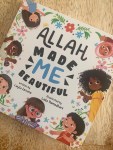
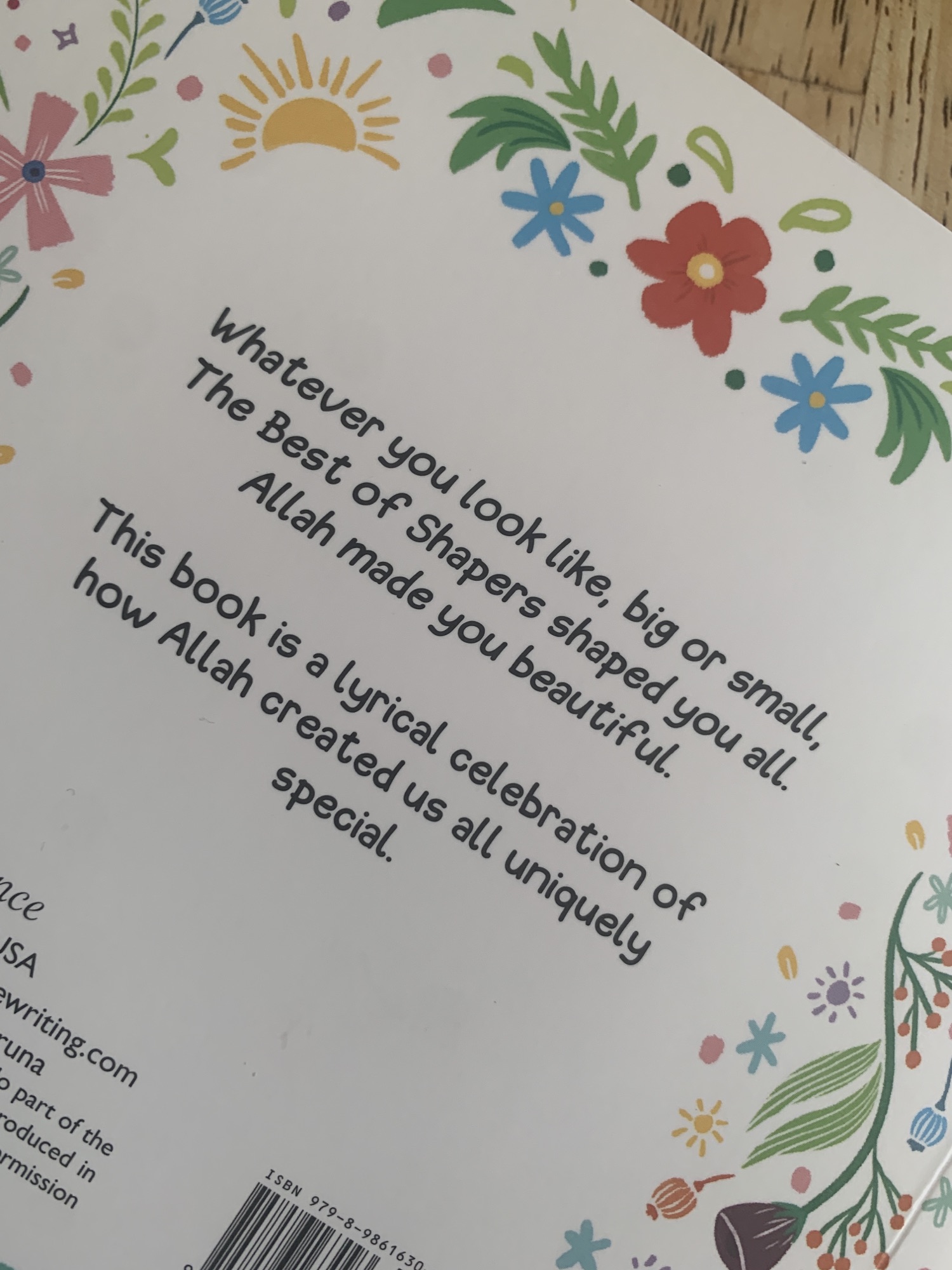
This 6×6 board book is 18 pages of affirming and celebrating that no matter what we look like, “the Best of Shapers, shaped us all.” The little size, the rhyming lines, the repetition of the phrase “Allah made me beautiful” on the right page of each spread, is what you would expect from a board book meant for newborns and up.  The rhyme and cadence levels out after the first page, and makes for a sweet easy read.  The mirror on the last page with a hadith in English and Arabic is particularly nice.  The illustrations and text are intentionally diverse and inclusive and with the Islamic centering the book is good for starting discussions as well.

The book is no literary masterpiece, but sometimes it doesn’t need to be, to be a staple read on repeat to our little believers.  This book dives right in on the first page, there are no copyright or dedications that have to be flipped through.  It is numerous pages of examples of how Allah swt made us all different: straight hair, curly hair, twins, larger body size, skin color, mobility, freckles, glasses etc. The end spread, before the mirror, is the conclusion that our “looks have been perfected by Him, tying it all together.

The illustrations are engaging, and simple, but detailed enough to foster dialogue if desired and while the small size would make using it at story time impossible, I think little hands and little hearts will benefit from knowing that we are different, but just as Allah swt intended us to look.

The book is available from the publisher Prolance directly, or here on Amazon 

img_4560-1


This Book Won’t Burn by Samira Ahmed

Standard
This Book Won’t Burn by Samira Ahmed

burn

It is clear that this 384 page contemporary YA book is about the hot topic of burn banning in America, and I would imagine most are aware that the overwhelming number of books that have been recently banned or pulled because of objection, are by BIPOC and queer authors featuring BIPOC and queer themes and representation.  So I read it not so much to see the author’s perspective, but more to see how the Muslim author had the Muslim identifying characters in the book approach the topic.  The book is very black and white: book banning is wrong, Republican right wing MAGA members are fascist, and liberal freedom of speech supporters are LGBTQ+ identifying and allies and upholder of first amendment rights.  Islam and the character’s Indian heritage is ingrained in the characters’ being, and a label they are comfortable with, unfortunately, it has no impact on how they act, think, or the lens in which they view their world. Every 50 pages or so some vague mention of Ramadan, or a tasbeeh, or mosque appears, only to disappear just as abruptly. The Muslim protagonist, Noor, likes two different boys, is often alone with one or the other, nearly kisses both, and with the support of her family attends prom. Her younger sister, Amal, is unsure if she wants a boyfriend or a girlfriend, it is not a major part of the story and is just mentioned in passing.  A major side character is lesbian, and starts a bit of a relationship with another girl, they hold hands, and there are a few kisses on cheeks, nothing overly detailed.  There is profanity in the book, arson, threats, racism, and stereotypes.

SYNOPSIS:
Noor and her family move to a small town from Chicago when her dad abruptly abandons the family.  It is the end of Noor’s senior year, and with the grief, stress, and emotional upheaval of her family, Noor just wants to get to graduation.  Quick friendships with Faiz and Juniper, and realizing that she is the daughter of her activist parents though, thrusts her into making enemies her first week in the conservative town by questioning the school’s book banning policies. Add in her strained relationship with her mom, her conflicting feelings for Andrew and Faiz, and her sisterly concern for Amal, and Noor has a lot on her plate as she shakes up a small town.

WHY I LIKE IT:
The first chapter is incredibly written, no doubt.  I hated the dad, actually more than that, I was so disappointed in him, and so concerned for Noor, Amal and their mom.  To feel such strong emotions for characters just introduced is a testament the author’s abilities.  Sadly, insight into why their dad left never came, and  perhaps no answers is something the characters had to grapple with, but as the reader, I felt it wasn’t really explored, or articulated, it just was unresolved, and I really wanted some closure.  In terms of literary quality, the book went down hill pretty quick for me.  The middle was slow and repetitive with the heavy handed views on book banning.  Some shades of gray, or some discourse would have prodded the readers to maybe think about the implications of banning books, but the narrative never allowed for that.  It is right vs wrong, us vs them from the start.  There really is no growth of the protagonist, she doesn’t have much of a character arc, and the supporting cast is not fleshed out.  I wanted to see more of Noor and her Mom, not just be told repetitively how absent she is, I wanted to see Faiz as a full person, not just the only other brown Muslim at the school and who likes to cook. Where are his parents, do they support his activism, that he is going to prom? Truly, there is no Islam in practice it is just a label that gets dropped when it furthers the notion of raging against an established bias system.  I’m not saying they need to be praying and reading Quran on every page, but I don’t know that the story would be much different if the family was not Muslim Indian American. Really the catalyst is that they are a new family, and a visible minority.

FLAGS:

Straight and LGBTQ+ relationships, arson, threats, stereotypes, racism, bullying, cursing.

Honk Honk, Beep Beep, Putter Putt! by Rukhsana Khan illustrated by Chaaya Prabhat

Standard
Honk Honk, Beep Beep, Putter Putt! by Rukhsana Khan illustrated by Chaaya Prabhat

img_4493-1

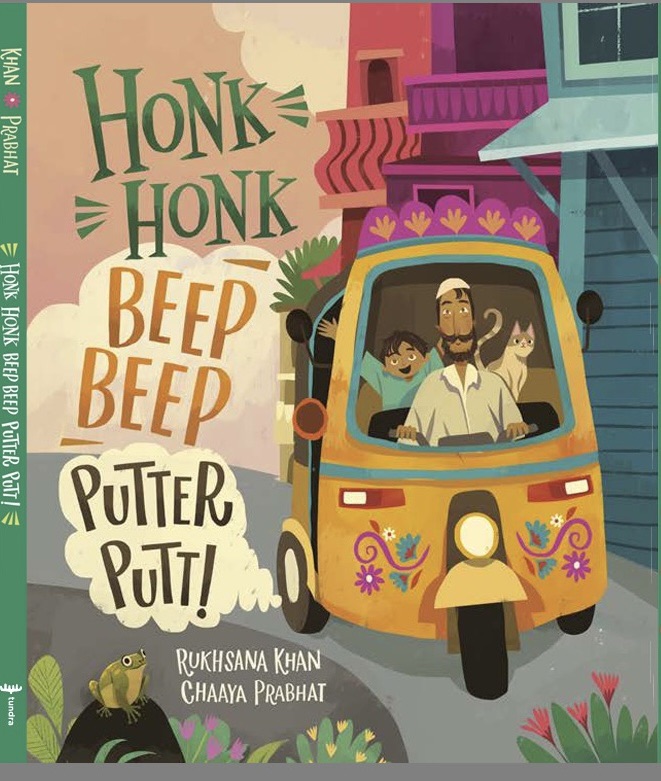
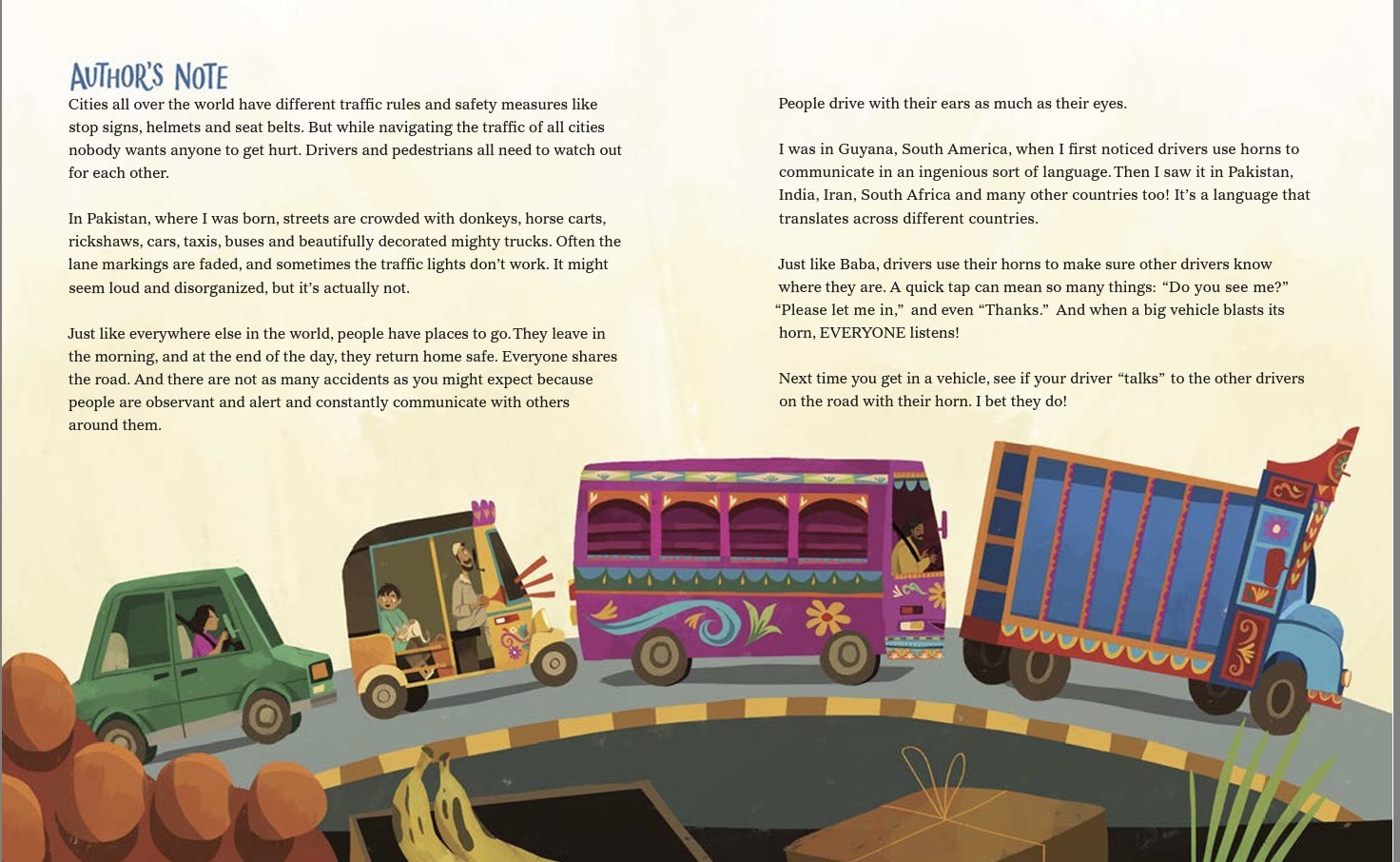
This adorable 32 page book is noisy and colorful and forces you to smile.  Granted I had dreams as a child of being a rickshaw driver, and even as a teen my father tried to arrange for me to take one for a spin early one hot Karachi morning, but alas, my dreams never came to fruition.  Cue the power of books, to take you right back to those busy streets, boisterous noises, colorful vehicles, and happy memories.  Even if you have never ridden in a rickshaw, or heard of one, this book is a fun adventure for toddlers and up as they catch a ride with Ibraheem, his Baba, his cat Mitu, and learn the language of the road and how to make room for everyone.  “Big and small, short and tall, everyone shares the road.” The book is by a Muslim author, and their are visible Muslim women with their heads covered in the illustrations.  There is nothing religion, country, or city specific in the text. 

img_4494-1

The book starts with Ibraheem and Mitu joining Baba on an important mission.  Baba is a rickshaw driver and he reminds Ibraheem that everyone has to share the road.  With his little rickshaw going “putter put,” the trio are off.  With a  “beep, beep” Baba tries to turn, but a little car responds, “honk, honk,” and in a hurry speeds ahead.  

img_4495-1

Up hills and down, a big colorful bus joins the road with a “toot, toot” as they go over the bridge, under the bridge, through a cricket game, all sharing the road.  A big truck joins the fun with a “rumble, rumble” and it isn’t long before they all come to a screeching halt.

img_4496-1

“Big and small, short and tall, everyone shares the road,” really means everyone as the mission is completed.

img_4497-1

The backmatter is an author’s note about her experiences of vehicles “talking” to each other.  The book comes out in September and is available for preorder/order, here,