Category Archives: Uncategorized

Love from Mecca to Medina by S.K. Ali

Standard
Love from Mecca to Medina by S.K. Ali

mecca to medina

This book is a game changer, or better yet: an industry changer.  It is about Muslims, for Muslims, by a Muslim- but it is MAINSTREAM and a huge panoramic window for anyone and everyone to see a “halal” fictional Muslim love story in action.  With every page proudly mirroring various Muslim experiences this sequel-ish standalone-ish book is unapologetically real, without compromising good storytelling, interesting characters, and engaging plot points.  In much the same way Reem Faruqi’s Golden Girl raised the bar for upper MG/lower YA, this book shows that upper YA Muslamic stories can be told.  That the publishing world isn’t always limiting OWN voices, and that it is up to us, the consumers, to purchase these particular books, pre-order them when announced and spread the word so that the message is loud and clear that we want more books like this.  I have no doubt S.K. Ali had to fight for her vision and advocate for her book at every turn, but now that it is here, we need to step up and show support with our purchasing power.  I’ve pre-ordered mine, and I hope you will do the same before the book releases on October 18, 2022, if you cannot, please purchase it when you can, and if that is not an option please request your libraries to shelve the book (and all of her books) and put them on hold so that the gate further opens for mainstream Islamic fiction.

Preorder link on Amazon

SYNOPSIS:

Adam and Zayneb are back after falling in love in Love from A to Z and getting their nikkah done.  They aren’t living together yet, though, and they are worlds apart with Adam jobless in Doha, and Zayneb homeless in Chicago.  When communication breaks down, exes show up, and a trip to Umrah is underway with the couple divided into gender segregated groups, the couple might fall apart in the same fashion that brought them together in the first place.  The steps of Umrah are beautifully highlighted and experienced, and characters from Misfits and A-Z come back to tie it all together and help the couple, keeping hope alive.  Throw in some marvels and oddities, artifacts and interpretive labels, a unifying cat, and a whole lot of love, and you have a sweet conclusion to a Muslamic love story.

WHY I LIKE IT:

So, I obviously love the standard of unapologetic Islam that this book offers on every page while still being accessible to the larger audience.  It took a little bit for me to be sucked in to the 352 page story, but by page 100 or so, I couldn’t put it down.  The steps of Umrah brought tears to my eyes and the awesome Sausun is fierce feminist friendship goals.  I honestly didn’t love the cat narrative that frames the story, but luckily it is sparse so I could see past it. I love that this book exists, I think I love the Misfit based duology a tiny bit more, but loved that this book had crossover characters and gave many of them a final bow of sorts as well. I read the book in two days and will probably re-read it when I receive my physical copy.  It really is remarkable how much Islam is present in a fictionalized story: not a oppressed Muslim story, or biographical memoir, or refugee story, but in a solid fiction story.   There is no “othering,” this is us, and this a love story about a Muslim couple trying to make it work with outside support and stresses, and beautiful writing.  Alhumdulillah, very well done.

FLAGS:

I’d encourage mature, older YA because the characters are married and sexually active and while it isn’t graphic or depicted it is often just the words mentioning them kissing, and sleeping together and sexting.  Nothing titillating or anywhere near inappropriate, but I think a bit of maturity would help it better reflect the values of Islamic marriages and relationships.  There is some minor language and hate speech.

TOOLS FOR LEADING THE DISCUSSION:

I would absolutely use the book for high school book club if it is mostly juniors and seniors.  I think it gives a good look at what a relationship can look like; the characters’ religious lens and lives will resonate with Islamic school students.
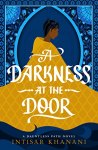
A Darkness at the Door by Intisar Khanani

Standard
A Darkness at the Door by Intisar Khanani

darkness

Y’all I was devastated when Theft of Sunlight ended on a cliffhanger, but Alhumdulillah, this conclusion was well worth the wait.  My heart is at ease, even if I am trying to figure out how to get the “Blessing” so that I can forget I read the book, and enjoy it all over again for the “first” time.  I don’t normally review second books in the series, and this won’t be a typical review, but truly if you have not read Thorn or Theft, what are you waiting for, go get those books and start reading.  I don’t know a lot about the publication drama of this fantastic book, but I do know that it was not published in the USA by the same publisher as the first book in the duology, and the thought that we, the readers, could have stepped up the pre-sales and shown our love for the series, the author, and the characters weighs heavy on me.  Thankfully, the UK publisher kept the book and the author found a way to get Darkness to us in the US (it publishes later this summer), but truly we have the power to support good, quality stories, and we must actively show it so that they get published, rather than simply complain about what options are made available to us. This is the author’s website: http://booksbyintisar.com/ if you sign up for her newsletters you can get all the bookishly delicious info.  She is not asking me to promote her or her books, but I happily share and direct support to her, because her stories really are great, and from what I can fangirl find out about the author, so is she.

The book picks up where Theft leaves off, and manages to remind readers what might have been forgotten in the interim.  It had been over a year since I read book one and while I fumbled a little at the beginning, the author caught me up to speed and didn’t let me lose a beat in Rae’s latest and ongoing adventures.  It starts with Rae aboard a slavers ship with children bound for a horrible fate.  More than just her life is at stake, as the information she has recently discovered implicates palace officials, the Circle of Mages, an heir to the throne and so much corruption.  With the help of street thief Bren, Rae gets herself in and out of trouble quicker than most expect.  Her clubfoot, sharp brain, and genuine values, force anyone who underestimates Rae to find themselves scrambling to keep up.  She has grown to love her body and the strengths that it affords her, and in her actions and dedication to changing the world she becomes a formidable river Pirate Queen that you genuinely care for, cheer on, and hope gets a happy ending.

Yes, if you have read Theft and are wondering why I didn’t mention Princess Alyrra, Red Hawk, the Cormorant, Niya, Stonemare, Artemian, and everyone else, fear not, they are all present, and get their story arcs, I just don’t want to risk a single spoiler.  If you’ve waited for this conclusion, you will find yourself desperately dreading the final pages, and wishing the story would never end.  The fantasy, action, characters, world building is all incredible and so hard to put down.  The author is Muslim, but there is no Islam present in the stories, although hints of desi culture do seem to present in the Sweetening atleast. 

The book is YA, but I think 15 and up or so would be a good fit. Like the others in the series, it has magic, murder, killing, lying, thieving, alcohol, corruption, implications of sexual abuse, assault and threat of rape, but this book also has some language, talk of infertility, and some implied banter about marital relations. The romance is very halal and clean, but the violence is graphic as dealing with the implications of murder and slavery are grappled with and thus a thematic element of the story.

Thank you Netgalley UK for the arc, if the book looks interesting and fun for you, please preorder the book wherever you are.

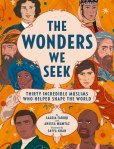
The Wonders We Seek: Thirty Incredible Muslims Who Helped Shape the World by Saadia Faruqi and Aneesa Mumtaz illustrated by Saffa Khan

Standard
The Wonders We Seek: Thirty Incredible Muslims Who Helped Shape the World by Saadia Faruqi and Aneesa Mumtaz illustrated by Saffa Khan

wonders we seek

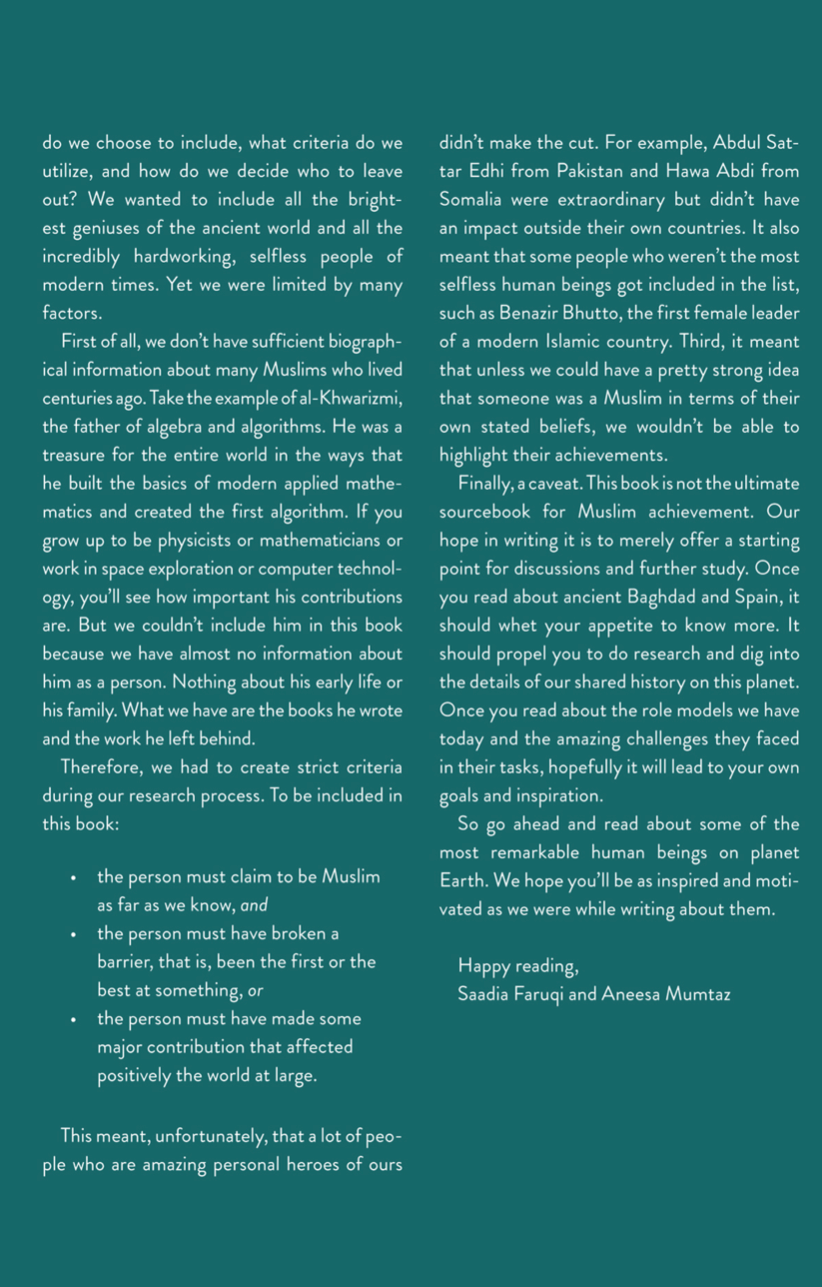
I’ve noted over the years how much I want to love these type of collections, but ultimately I just don’t.  The reason I gave this one a try was quite simply the reassuring introduction.  The book immediately detailed the checklist required to make it into the book, the criteria required, and acknowledged the limitations that the book overall, and personalities included, would have in the presentation. There are sources at the end for each of the 30 people included as well.  Unlike most books in the genre, this book got out in front of my most common complaints: the lack of transparency for how the people were selected, where the primary source information was obtained from, how the order is organized, and the Eurocentric and pop culture framing that is both pandering and renders the book cumbersome a few years after it is published.  For the most part, this book is the best I’ve seen yet, but that isn’t to say I loved it.  While the requirements to be included were made apparent, there is still a lot of opinionated statements about how “religious” or “conservative” or “devout” or “mainstream” or “strict” a person is or was, that rubbed me the wrong way.  Also knowing that the person had to identify as Muslim to be eligible seems like a black and white issue, but a few of the personalities are very controversial (some noted and some not), and I am not an expert at all.  One of the problems with books like this is they present as non fiction, and no matter the transparency, just the mere fact of who is included and who is not is a judgement call and wrought with bias.  It is nice to thumb through, but I don’t know that it would get repeated use, or that it could really be used as a reference.  It is informative and I recognize that I went in to it very skeptical, but only a few text passages connected faith to the person’s accomplishments, and so while they identify as Muslim, it doesn’t necessarily radiate pride or admiration for Muslims as a whole.  For better or worse, if anything, it made me want to conduct my own research on many that were featured. 

img_9998

The 30 included in the book:


A few I was concerned by, which made me question the ones that I learned something new about. Clearly there are reasons that I shy away from non-fiction.  I wish the book would have had Muslim beta readers, I am willing to assume that it did not.  Take for example the section on Saladin, I absolutely get why his name is shown as both Saladin and Salah al-Din, the book is in English presumably for western readers and that is how he is known.  But why when it says that his real name is Yusuf, is Joseph in the parenthesis? No one else’s names in the book are given the English equivalents of their Arabic or Persian or other native language. Similarly so few tied back to Islam or an Islamic perspective being credited for having a role in their noteworthy accomplishments.  Even Muhammad Yunus when it discusses how interest was not a part of the micro loan process- it didn’t add even one more sentence explaining that interest is not allowed in Islam, why leave that out?  

I liked that the parameters required that the person was influential more globally than just to their own country, but Rebiya Kadeer seemed to be more localized in her work with Muslims in China even when she moved out of China, blurring the rigid standards of who was to be included and who was to be left out.  

img_9968

I do like that it mentions Rumi’s religion is often conveniently ignored as the west has made him a hero and chosen to forget his faith.  Similarly, I like that it tries to correct when Ibn Battuta is called the Marco Polo of Islam, for in reality Marco Polo was the Ibn Battuta of Europe.  And I appreciated that Benazir Bhutto was noted as being controversial and not well liked. 

If this type of book appeals to you, you can purchase it here.


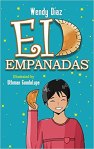
Eid Empanadas by Wendy Diaz illustrated by Uthman Guadalupe

Standard
Eid Empanadas by Wendy Diaz illustrated by Uthman Guadalupe

empanadas

I love books that show, not tell how diverse Muslims are and celebrate the unique ways that Islam and culture come together.  This early elementary chapter book beautifully blends, Islam with Spanish words and phrases that all come together to celebrate Ramadan and Eid in America.  At 79 pages, with illustrations sprinkled in, this is a great book to share all year long.

img_5450

SYNOPSIS:

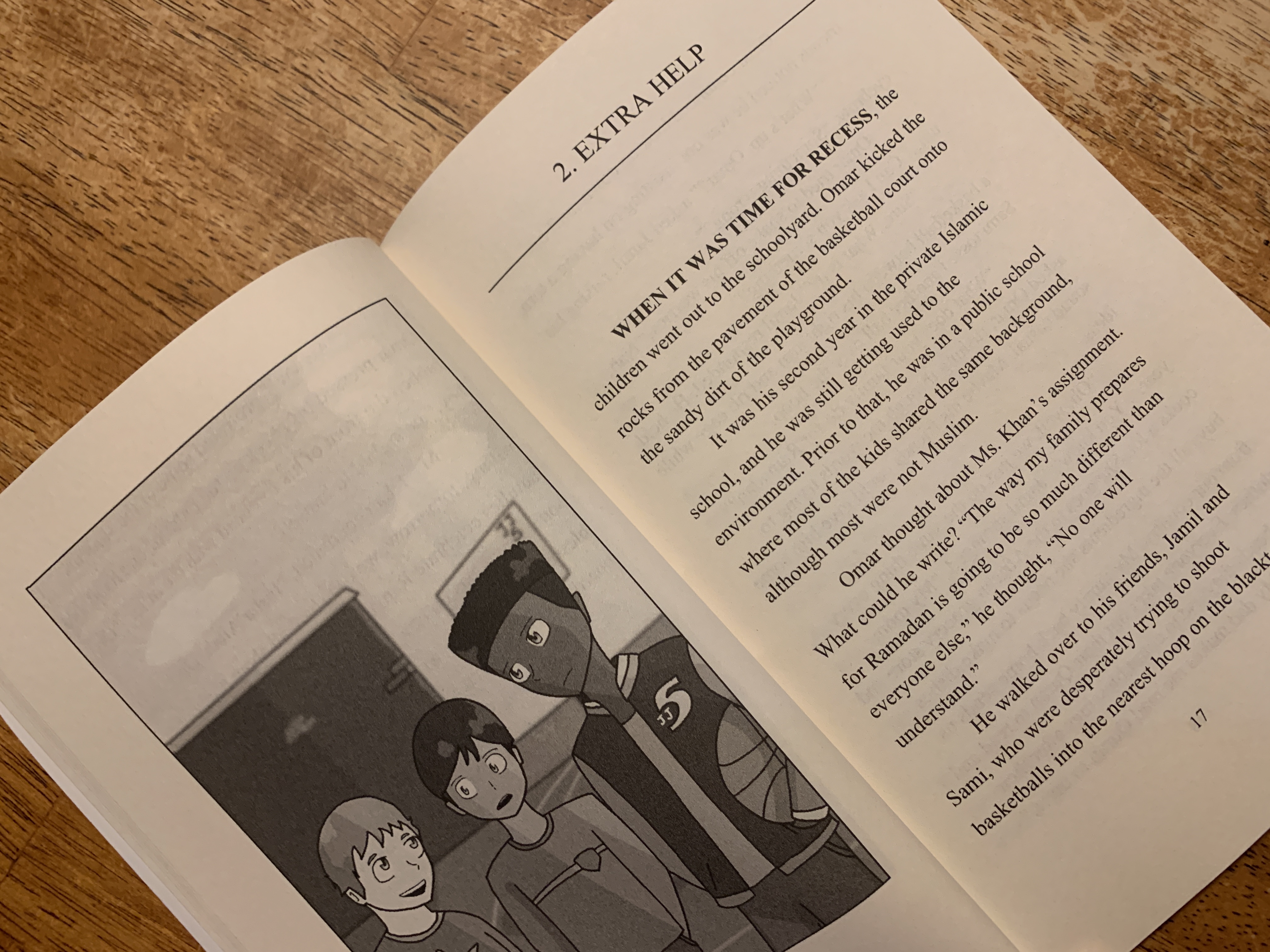
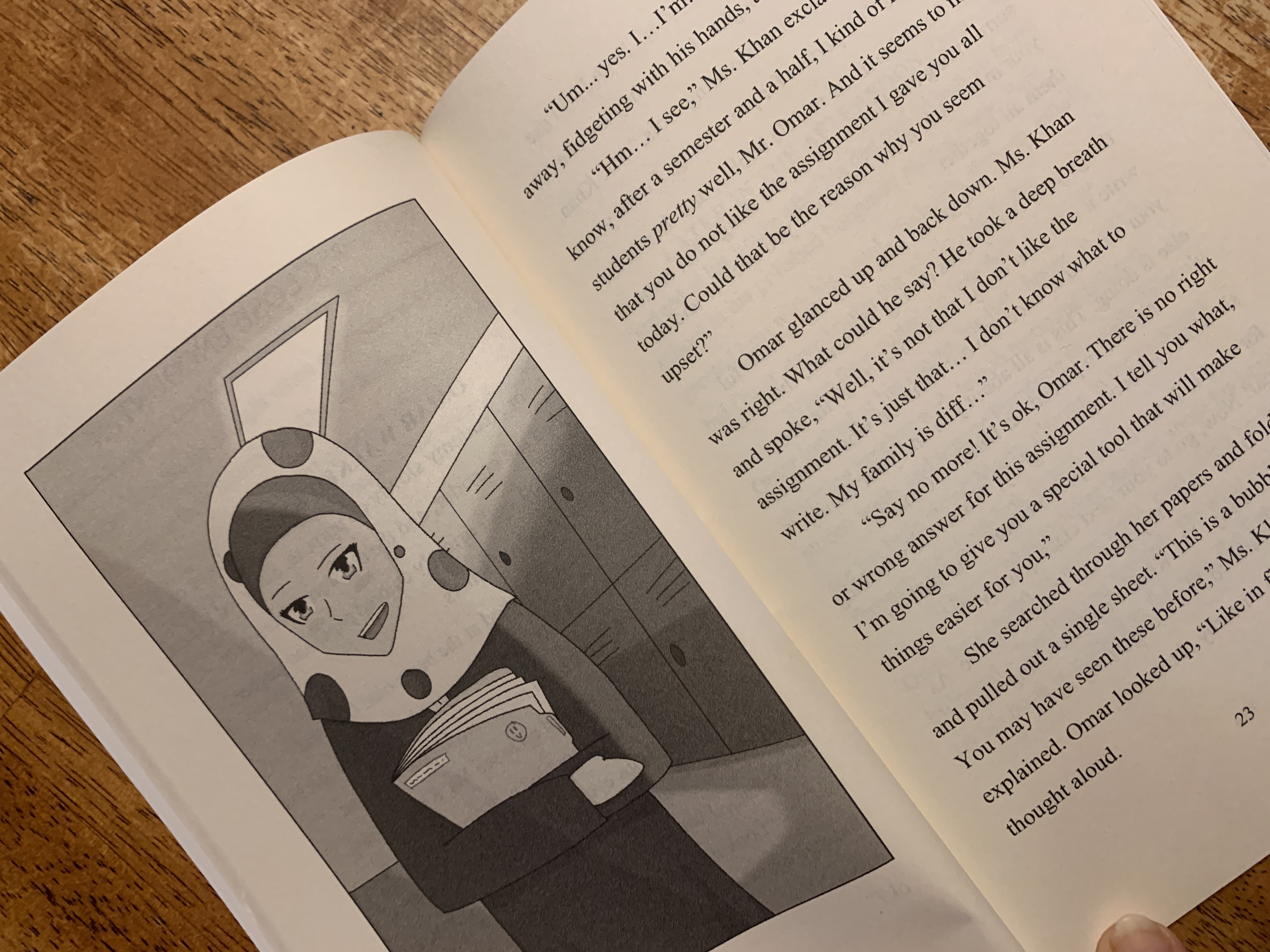
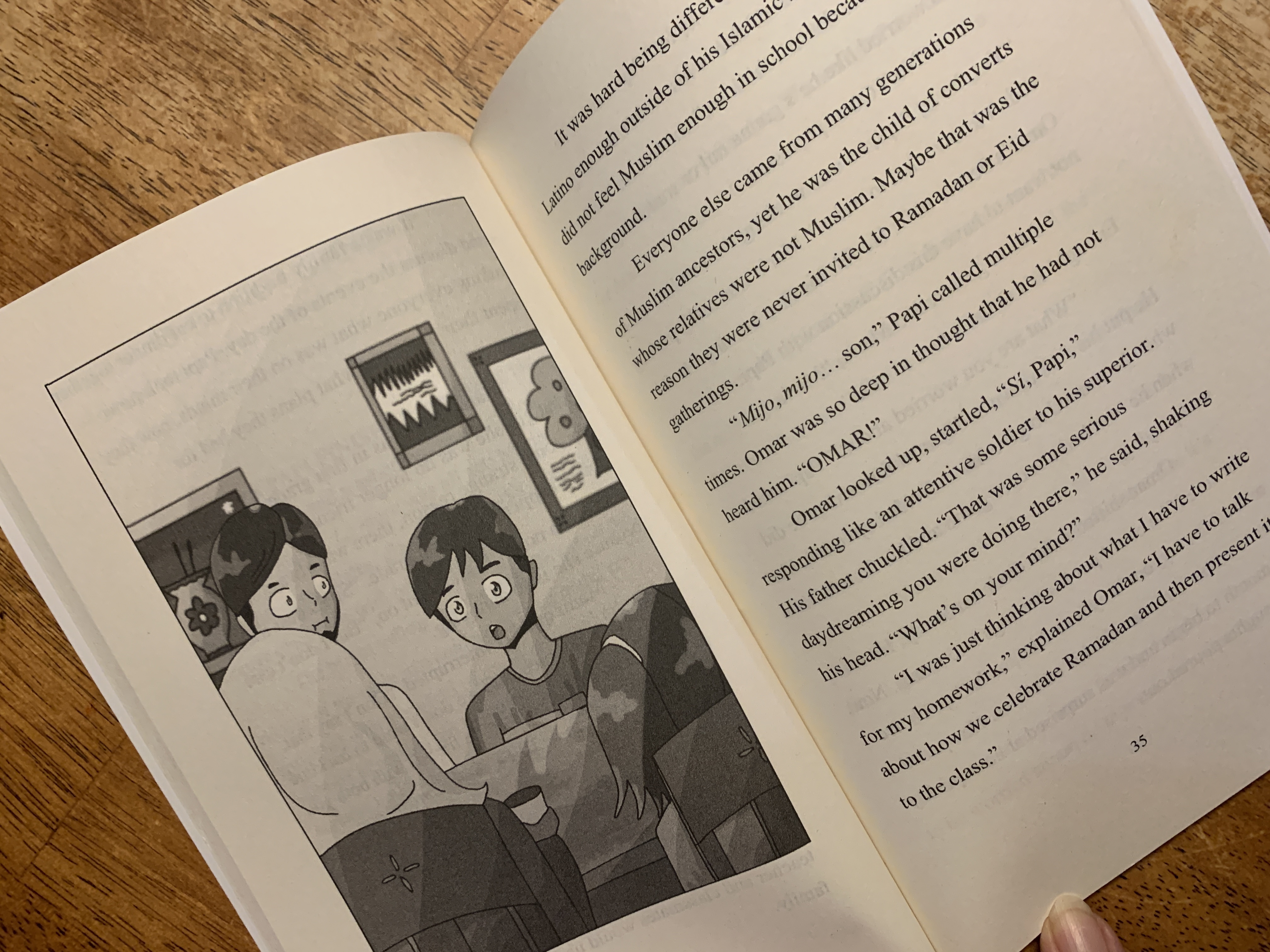
Omar is in 5th grade and when his teacher assigns the entire class to write an essay about their Ramadan and Eid traditions he is nervous that his family’s way of celebrating is very different than everyone else’s.  Omar’s mom is from Puerto Rico and his dad’s parents immigrated from Ecuador, even after a year and a half at the Islamic school, though, he still feels like the new kid, and doesn’t want to draw attention to himself.

Sensing that Omar is nervous, his teacher Ms. Khan offers ways to brainstorm and organize his thoughts.  Once home, in his casa, his little sister and parents join in to give him enough ideas, if only he can be brave enough to share them.

img_5449

WHY I LIKE IT:

I love that there is so much joy and love in this little book.  The twist of having a kid not feel like he is fitting in at an Islamic school, is also so fabulous to read.  The OWN voice narrative and recipe at the back will help kids like Omar everywhere feel confident to share their culture, and those that know kids like Omar (even if only fictiously) anxious to learn more about Latino Muslims.

The only thought that did cross my mind, when Jummah was being explained as the congregational prayer on Friday, was why not use the word Jummah, just like all the Spanish words were used, and then defined.  I would love to ask the author who the intended audience is, and how that shaped her word choice, what was defined and what wasn’t.

img_5448

FLAGS:
None

img_5447

TOOLS FOR LEADING THE DISCUSSION:

I’m hoping to get copies to the first grade and second grade teacher to read in Ramadan to their classes. This book has the potential to really excite kids, expand their understanding, and show them how beautiful and diverse Islam really is.

Beta & Sensitivity Reading with MBR

Standard

Color of blue background #80A7E2 Color of yellow font #FDD24E

Muslim Book Reviewers is a collective of four book reviewers that have joined forces to offer BETA READING and SENSITIVITY READING SERVICES.  

When you hire us, you don’t just get one person’s feedback on your manuscript.  Instead you get four experienced, knowledgeable, enthusiastic perspectives before you publish.  

Please contact us at muslimbookreviewers@gmail.com or on Instagram @muslimbookreviewers to discuss specific details and get more information.

We are happy to work with large publishers, self publishers, and everyone in between.

BETA READING:

Beta reading is the final step before publication. Alpha readers read early manuscripts and help shape the formation of the text, the story, the presentation, and the development. Beta readers are the last set of outside eyes (not including the author and publisher) before a book goes for printing. We look for specific errors of continuity, illustration accuracy, illustration and text alignment, target audience reception, and overall specific fixable literary mistakes.  Books need to have already been professionally edited before seeking our services.

SENSITIVITY READING:

We also serve as sensitivity readers to help ensure accurate representation, portrayal of Muslims, Islamic teachings, and some cultural perceptions.  Our team specializes in ​​Pakistani, Desi, South African, Albanian, Balkan, Syrian, Middle Eastern, American, and Canadian cultures.  We have linguistic knowledge of Arabic, Albanian, Urdu, and English.

PLEASE NOTE:

  • This service is NOT an editing service and the MBR will NOT do line edits or rewrite words of the manuscript.
  • This service does NOT take the place of a scholar verifying and approving Islamic content and representation.
  • This service should NOT be sought until the following steps have been taken:
    • Manuscript has been through multiple revisions
    • Manuscript has been professionally edited for grammar and content
    • Illustrations have been completed and are just awaiting final approval
    • Nonfiction concepts have been sourced

To check out the website of the individual members or find them on Instagram:

https://www.muslimmommyblog.com @muslimmommyblog

https://www.muslimkidsbooknook.com @muslimkidsbooknook

https://linktr.ee/bintyounus @bintyounus

https://islamicschoollibrarian.com @Islamicschoollibrarian

Huda F Are You? by Huda Fahmy

Standard
Huda F Are You? by Huda Fahmy

huda f

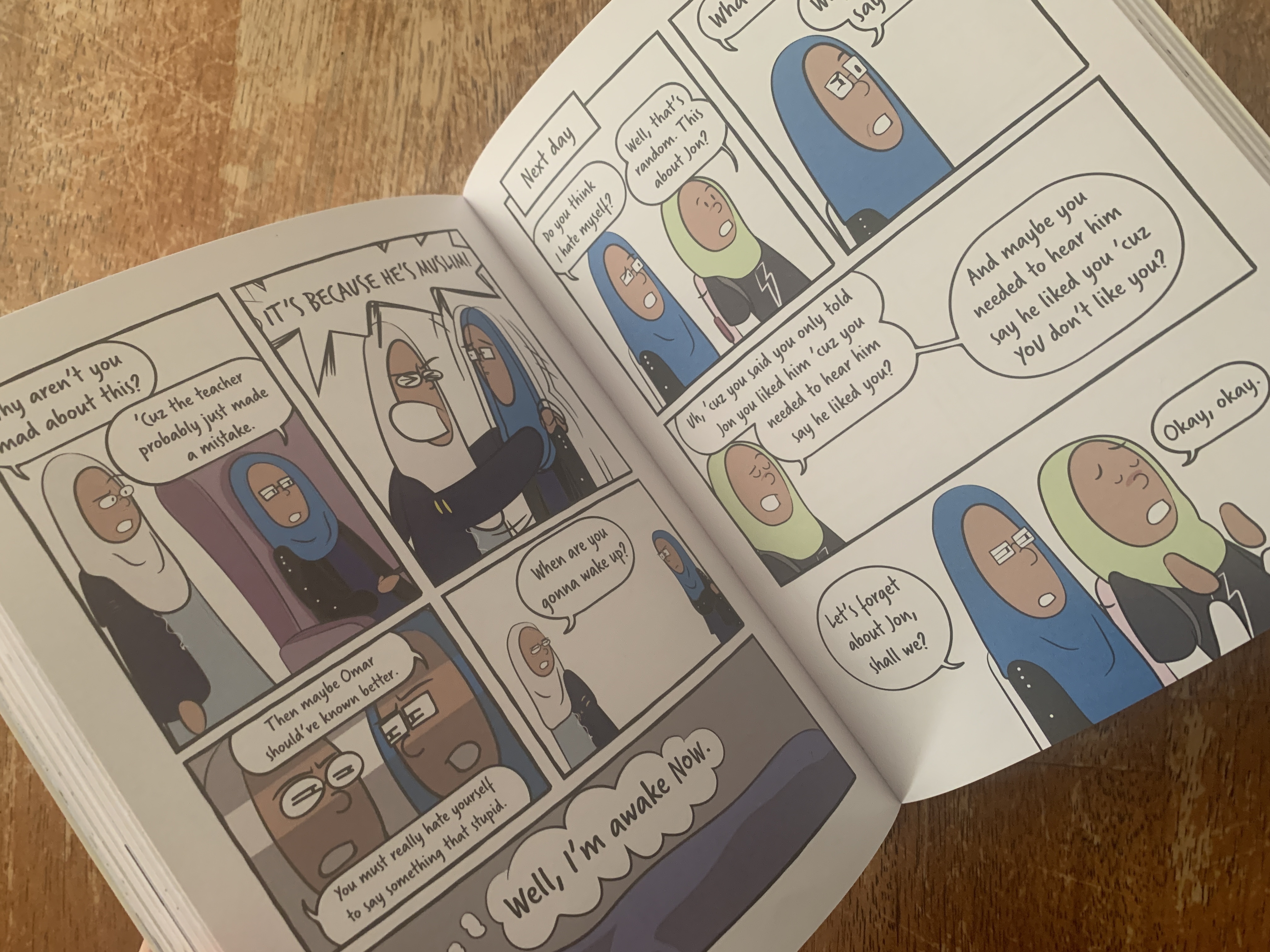
I think everyone has heard about this book by now and how fabulously fun, real, and relevant Huda’s life  is for so many.  I am happy to jump on the praising bandwagon, as this teen/YA 192 page graphic novel really is a great OWN voice unapologetically Islamic mainstream tale.  It does mention periods, relationships, hate crimes, and finding yourself, so probably 14 or 15 year olds and up.  My middle school boys read it, so it isn’t that it is inappropriate, just the target audience is more teen girl.  I know a lot of people, including Huda’s mom according to the inscription, have issues with the title, but I think it is brilliant.  She takes ownership of her name and it isn’t just for shock value, the book is about figuring out who you are, how you feel about Islam, establishing your friend circle, and growing and learning along the way.  My public library has it, as do major outlets, so what are you waiting for, go read, laugh, and feel seen.

img_5036

SYNOPSIS:

Huda has just moved to a new school and she is no longer the only hijabi.  She has moved to Dearborn, Michigan and there are A LOT of Muslims.  She is no longer defined by the cloth on her head, she has to figure out who she is.  Who she really is.  And sometimes the best way to do that, is to figure out who you are not.  

Huda tries different clubs, and different circles of friends, both at school and at the masjid.  Along the way she learns how much she craves approval and who is always in her corner.  When a kid at school is targeted for being Muslim, Huda will have to see how much internal hate she carries as well.  Her clothes change, her outlook changes, she tries new things, and she grows, all while the laughs help the story bounce from one serious topic to the next without coming across as arrogant or stereotypical.  This is Huda’s story and we are just along for the ride.

img_5035

WHY I LIKE IT:

I love that there is nothing to critique, it reads autobiographical even if parts are exaggerated or only based loosely in reality.  By being so real, and so well done, you are excited when you see yourself staring back, but you feel like you’re a friend learning about Huda even when you can’t relate exactly. Her comics online and her previous two books are all amazing, and I love that she is continually creating new material for us all to enjoy and benefit from.

img_5037

FLAGS:

She tells a boy she likes him that she doesn’t really like.  Periods are referenced and blood and a pad are shown, not graphic and gross, but the sentiment is there.  Discrimination is present, as is Islamophobia and stereotypes.

TOOLS FOR LEADING THE DISCUSSION:

Just keep the book out and around: it will be picked up, read, and mentioned, no tools needed.

Muslim Bookstagram Awards 2021

Standard
Muslim Bookstagram Awards 2021

Calling all Muslim publishers, Muslim Authors and Kid Lit enthusiasts:

It’s BACK and BIGGER and BETTER than ever!!!

The 2021 Muslimah Bookstagram Awards are here and we are open for nominations!

Requirements to apply:
⭐️Muslim Author
⭐️Muslim Character in book
⭐️Islamically Appropriate
⭐️Published in 2021
⭐️English Language

Who can apply for their book to be included?

📚Publishers
📚Authors
📚Readers
📚Anyone with a favorite 2021 book!

🖇Link to apply: https://muslimmatters.org/2021/10/15/muslim-bookstagram-awards-2021/Applications close December 1st.

🧕🏻🧕🏻🧕🏻🧕🏻
Reviewer Judges include @muslimkidsbooknook , @islamicschoollibrarian @bintyounus , and @muslimmommyblog.

🕌Hosted by @muslimmatters

🎁This year’s rewards will include generous gift cards from our incredible list of sponsors!

🎁Awards for each category announced in January 2022!

Salaam: Mindfulness for Muslims by Humera Malik illustrated by Najwa Awatiff

Standard
Salaam: Mindfulness for Muslims by Humera Malik illustrated by Najwa Awatiff

img_3300

I had planned to wait until the physical book comes out on the 15th to offer up my thoughts, but the Kindle version has released and I want to help put it on everyone’s radar.  My own kids went back to school today and emotions and feelings are all over the place: excitement, nerves, anxiety, worry.  Changes in general cause heightened feelings, throw in Covid cases on the rise, puberty, friends, more open discussions about mental health, etc., and kids need tools to be successful.  Alhumdulillah, the Qur’an and Sunnah offer guidance, reassurance, and direction, and this book helps organize and present coping tools for ages seven to adult.  Thirteen emotions over 85 pages follow a pattern of a title page, a “Remember” page with an ayat from the Qur’an (except in one case it is a hadith), then an affirmation to be said that is either a verse, a dua, or dhikr, followed by an adorably illustrated spread of simple activities to do and try in a checklist manner.  Not only will young Muslims find reassurance and direction in the text provided, but inshaAllah, they will also be comforted knowing that what they are experiencing is very human and that Allah swt and Prophet Muhammad saw have provided insight and acknowledgement of such emotions.

The 13 emotions highlighted are: afraid, angry, disappointed, grief, jealous, lonely, overwhelmed, sad, shy, sorry, upset worried, grateful.  There is an author note to parents at the beginning that mentions that the book is meant to be read “cover to cover in peaceful times and to be dipped into to find specific advice” when needed, and I couldn’t agree more.  There is also a note for the readers normalizing big emotions and reassuring them that Allah swt does not want them to despair.

The diverse character illustrations are absolutely heartwarming and I hope that they will be made in to pictures or charts to be purchased so they can be hung.  They are really well done, and the visual mapping will help kids retain and put the tips in to practice.  I’m not sure what the sizing will be in the physical paper back book, but I hope it is large enough for them to be properly enjoyed.


Guantanamo Voices: True Accounts from the World’s most Infamous Prison by Sarah Mirk, introduction by Omar Al Akkad, illustrated by Gerardo Alba, Kasia Babis, Alex Beguez, Tracy Chahwan, Nomi Kane, Omar Khouri, Kane Lynch, Maki Naro, Hazel Newlewant, Jeremy Nguyen, Chelsea Saunders, and Abu Zubaydah

Standard
Guantanamo Voices: True Accounts from the World’s most Infamous Prison by Sarah Mirk, introduction by Omar Al Akkad, illustrated by Gerardo Alba,  Kasia Babis,  Alex Beguez,  Tracy Chahwan,  Nomi Kane,  Omar Khouri,  Kane Lynch,  Maki Naro,  Hazel Newlewant,  Jeremy Nguyen,  Chelsea Saunders,  and Abu Zubaydah

guantanamo voices

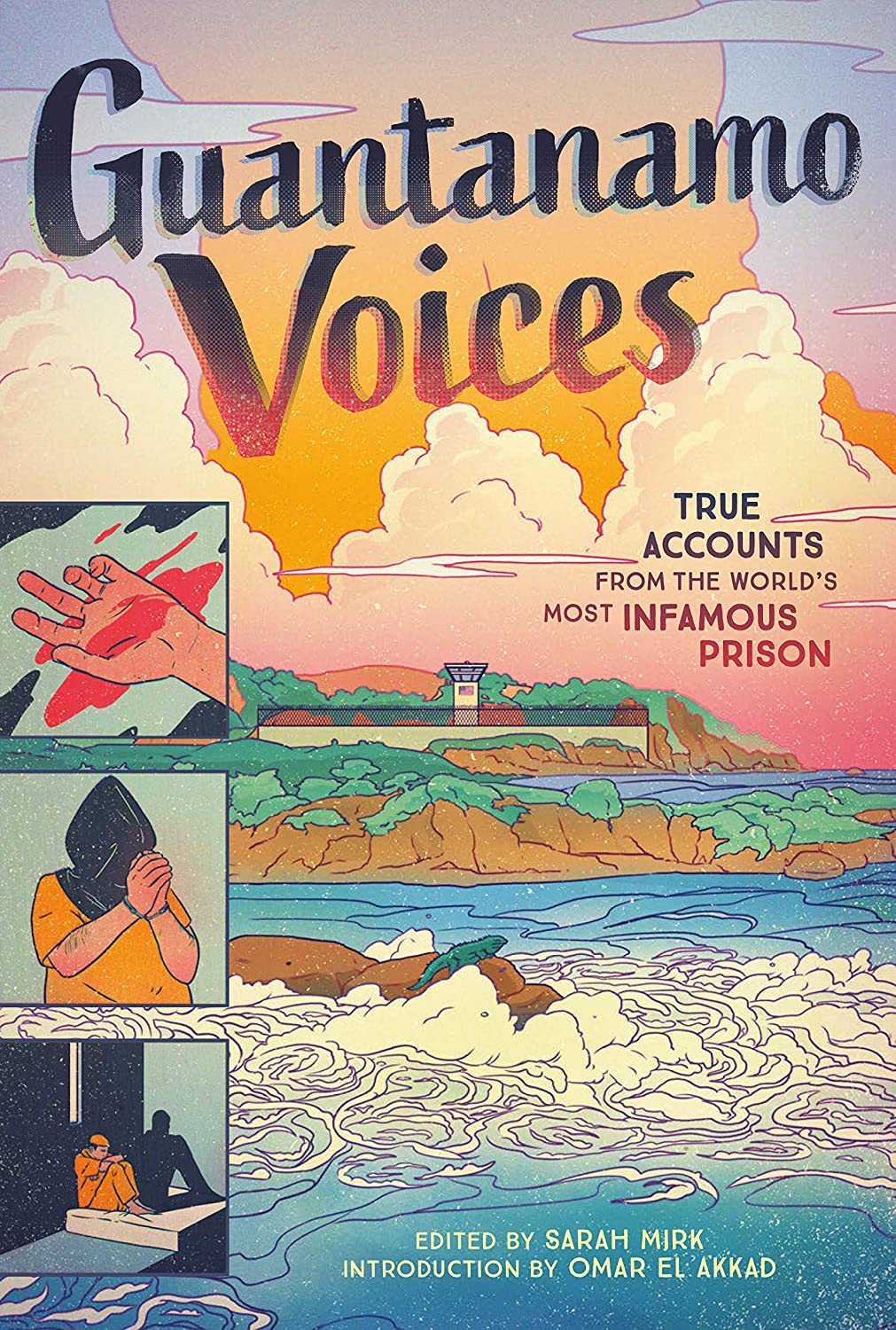
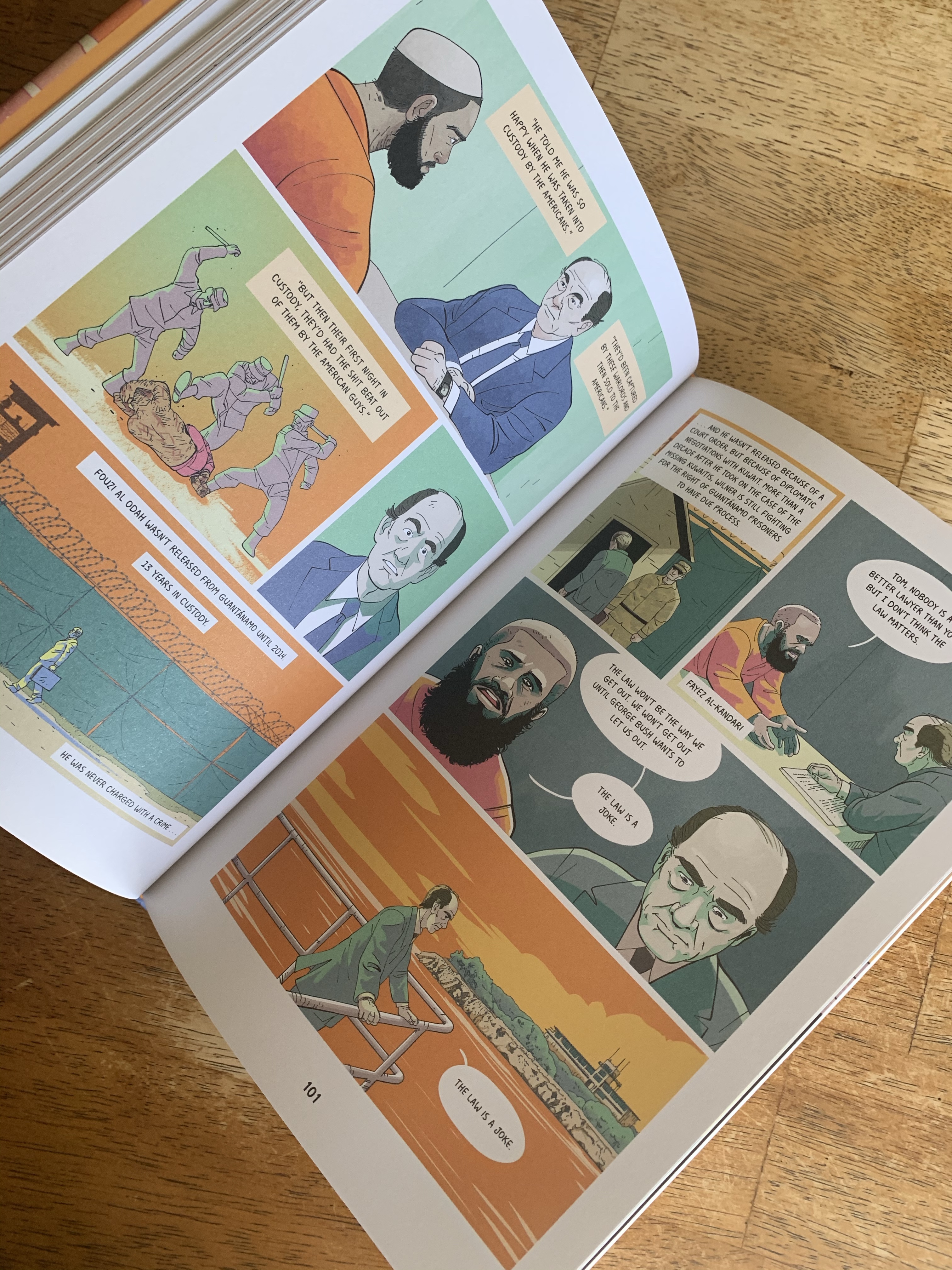
This 208 page graphic novel, is indeed graphic.  The unbelievable horrors detailed in the stories shared are all sourced and referenced in the nonfiction anthology. The intent isn’t shock and awe like the war that created such abysmal breaches of justice to be done in our name (Americans’), but is definitely a painful reminder of how fear and mismanagement allows the US treatment of individuals to grow and continue outside of the rule of law, and all that the US claims to represent.  The careful use of words such as “detainees” instead of “prisoners,” “enemy combatants” instead of “terrorists” or “criminals,” have allowed Muslim men to be held since 2002 without charges, legal representation, habeas corpus, or basic human rights.  When the prison was being filled, you’d hear about it in the news, when the government released heavily redacted reports on torture, you’d catch a headline or two, but there are still people being held, and for the most part, we, the world, have perhaps forgotten.  This book is a reminder, it is insight, it is so important that high school and college aged children are aware of what we are capable of, that adults are not allowed to forget what we are doing.  As it says in the intro, “To indict the people who did this is to indict the country that allowed it to happen.” We are all guilty, and this book is not an easy to read as it will make you angry, and devastated, and exasperated.  Don’t let the graphic novel format and simple text fool you, this is a difficult read, emotionally, and you should force yourself to sit with it- sit with the outrage and frustration, and see if it can spur you to action.

img_0435

SYNOPSIS:

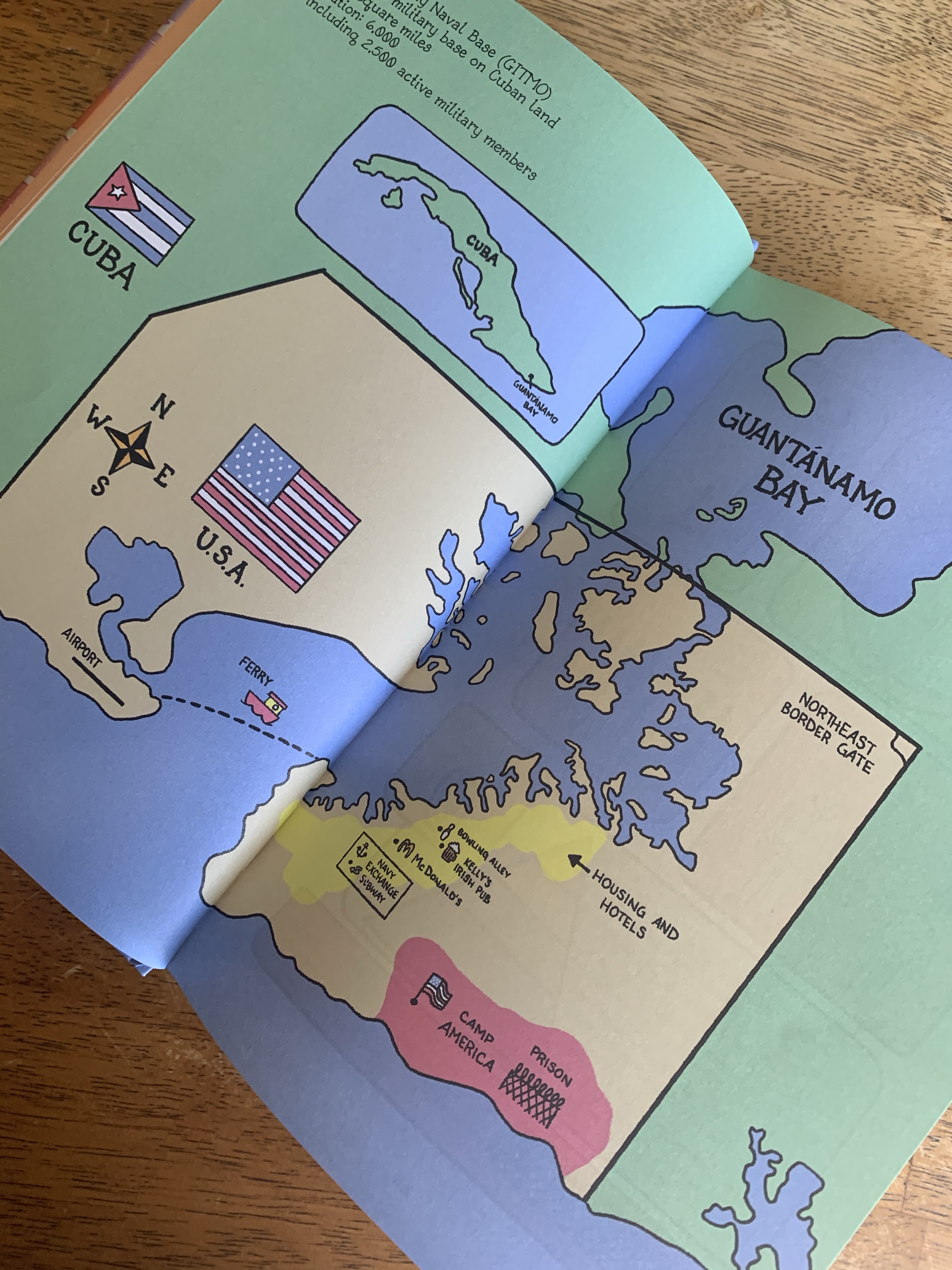
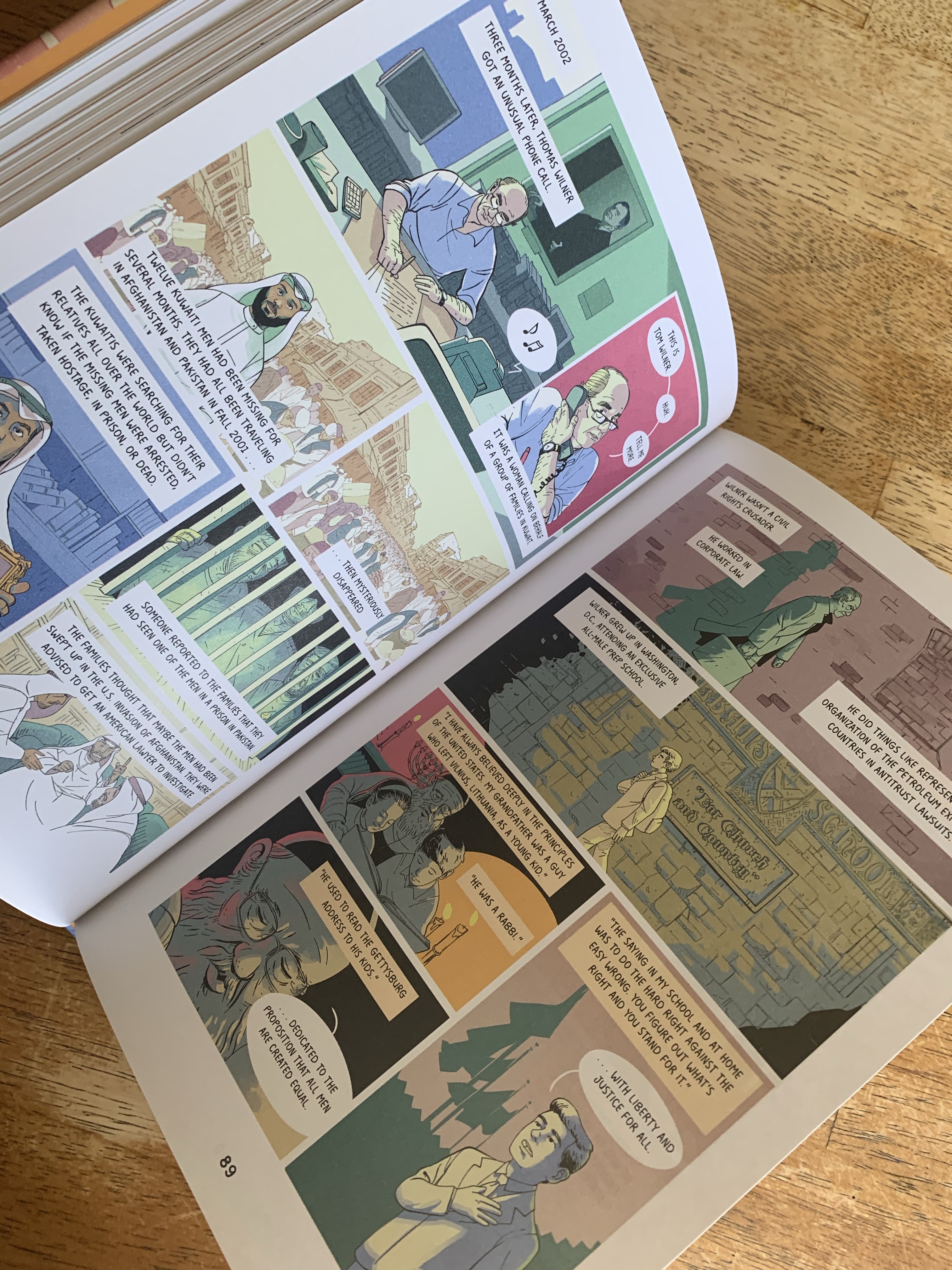
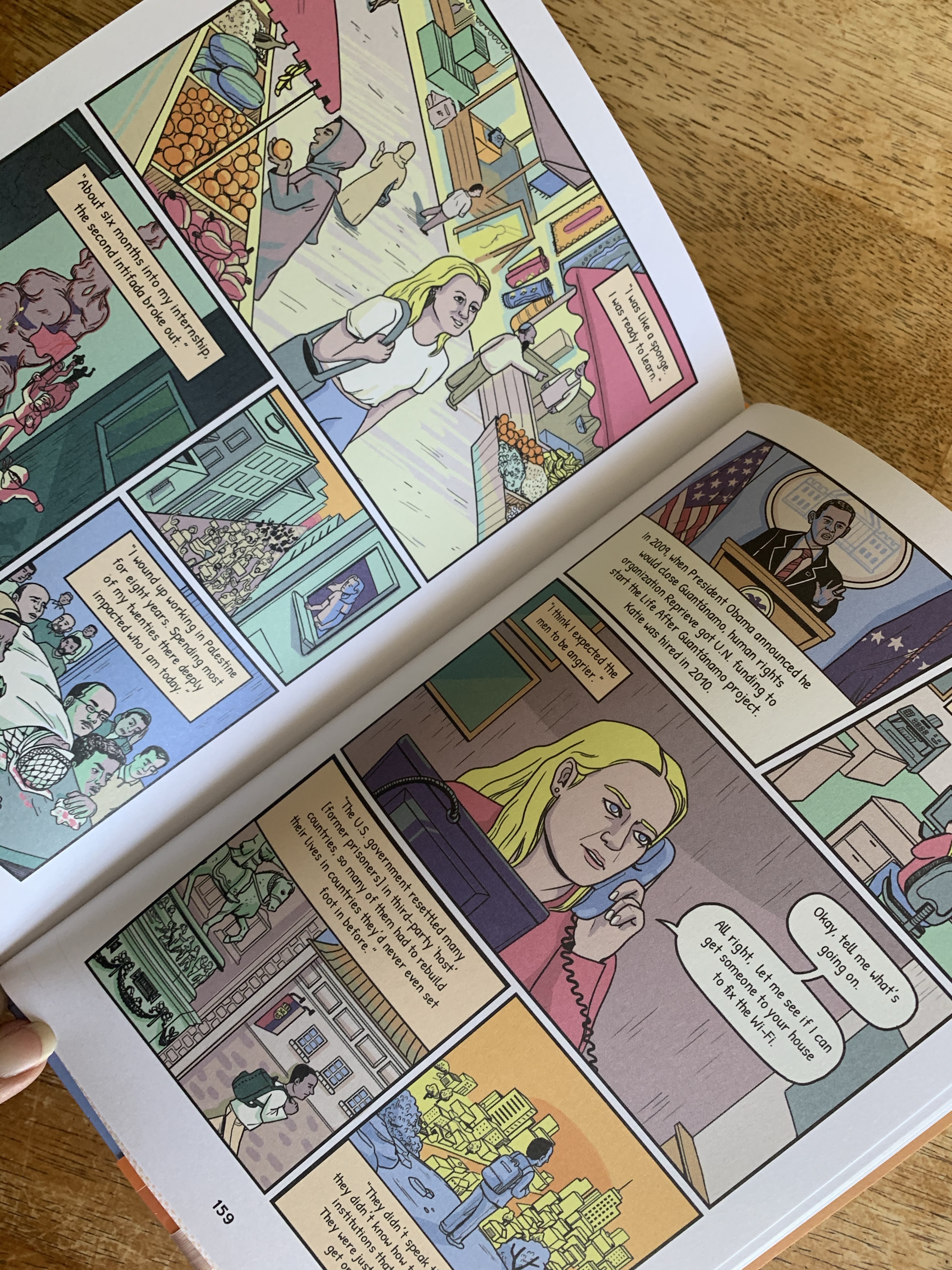
The book is broken up to provide an introduction, map, facts, and a timeline, it then starts with the author arriving for a media tour to Cuba.  Some background stories about key individuals in understanding the effects of torture and better and more accurate ways to interrogate, and then the fateful day September, 11, that changed everything.  From here the stories are individual accounts of prisoners, lawyers, politicians, etc., each depicted by a different illustrator, to show a very rounded view of the effects of the prison, and thoughts by different people in a  variety of associations. 

img_0434

Some of the prisoners were swept up by neighbors responding to leaflets promising wealth for turning people in.  Some were taken from their homes for no reason, a few were taken from the battle field, but every single one has never had charges against them, nor a day in court, the few that have been able to be represented have been released without being accused of anything, hence, found to be innocent.  The doubling down on the concept of Guantanamo being the worst of the worst, administration after administration has made it so prisoners have to be released to countries they have never been to, with unknown rights or a way forward.  Those that are still detained have been there for nearly 20 years. 

img_0437

WHAT I LIKE ABOUT THE BOOK:

I like that the book is personal, it is harder to dismiss or forget, or be unaffected when you are looking at images and surrounding yourself with guards and lawyers that are saying over and over, that these prisoners are innocent.  I like that it challenges Americans to demand more of America, it isn’t just putting the USA down nor does it read like the narrative has it out for the USA, it is very much an personal calling out, that we have made errors and continue to make errors out of arrogance.    

img_0440

FLAGS:

The images and language are at times graphic and one should be aware of the potential triggers of torture, and abuse. There are curse words spoken, and violence detailed.  High school and up.

img_0439

Piece by Piece: The Story of Nisrin’s Hijab by Priya Huq

Standard
Piece by Piece: The Story of Nisrin’s Hijab by Priya Huq

piece by

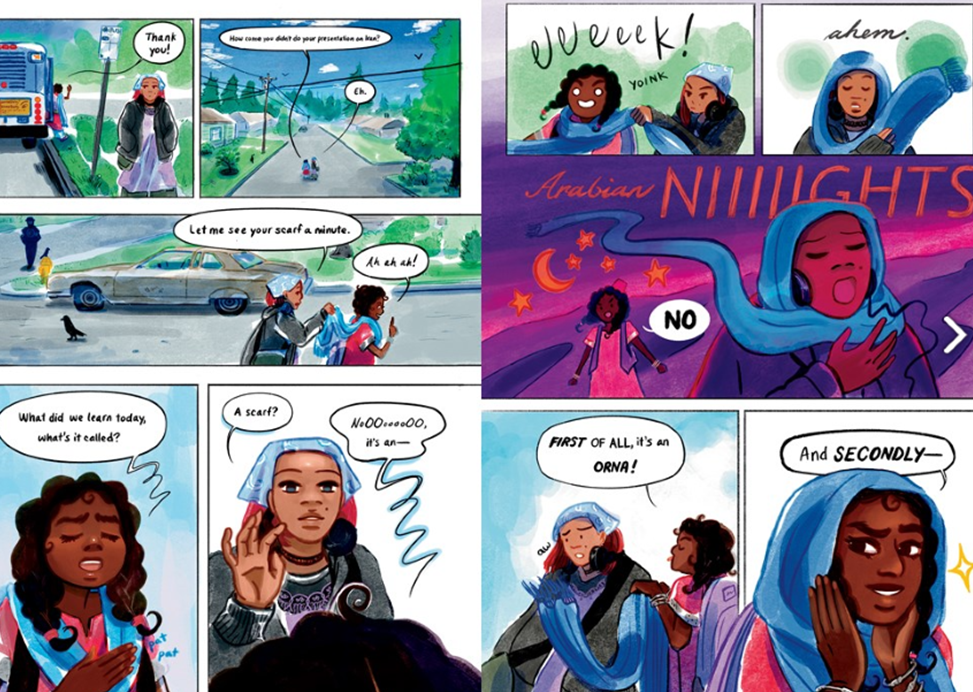
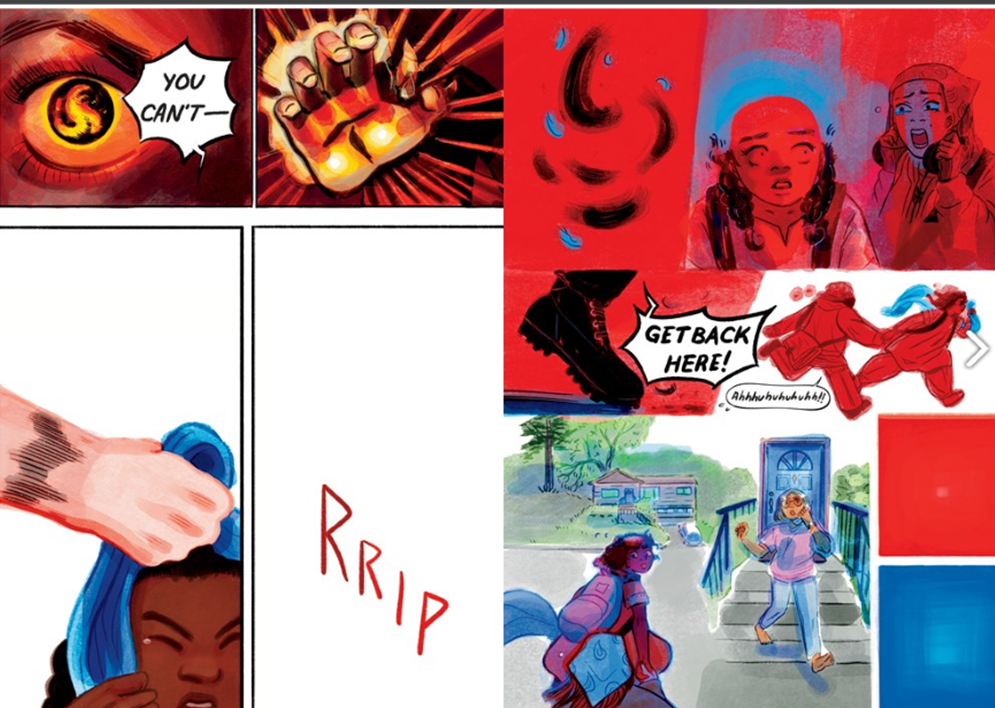
At 224 pages, this graphic novel tells an important OWN voice story in beautiful and powerful illustrations, but despite reading it multiple times, I ultimately found the pacing off, the narrative and plot holes quite large, and the conclusion too forced.  It claims to be for middle grades which would explain the happy ending, but the assault, trauma, mental health, Bengali history, language, and protagonists age (13), make it more suited for upper middle school readers.  I read a digital ARC in predominately black and white images, so I’m hopeful that part of the problem is on me, and that I simply missed or misunderstood parts that seemed to jump around and assume, or that because it was an uncorrected proof, some revisions are still to come.

piece by1

SYNOPSIS:

Nisrin is 13 and lives in Oregon with her mother, and maternal grandparents.  Her mom travels a lot and she seems to spend most of her time with her loving Nani, grandmother.  The story opens with Nisrin in 8th grade giving a presentation about her Bangladeshi heritage to her school.  On the way home with a friend, Firuzeh, she is still wearing the cultural clothing and they are playing around with the scarf, when they are violently attacked and the scarf is ripped off of Nisrin’s head.  Her hair is pulled out in the process and the two girls are taken to the hospital and when released maintain professional counseling to process and deal with the assault.  Nisrin fears leaving her house and is increasingly isolated within her home.
pice by 2

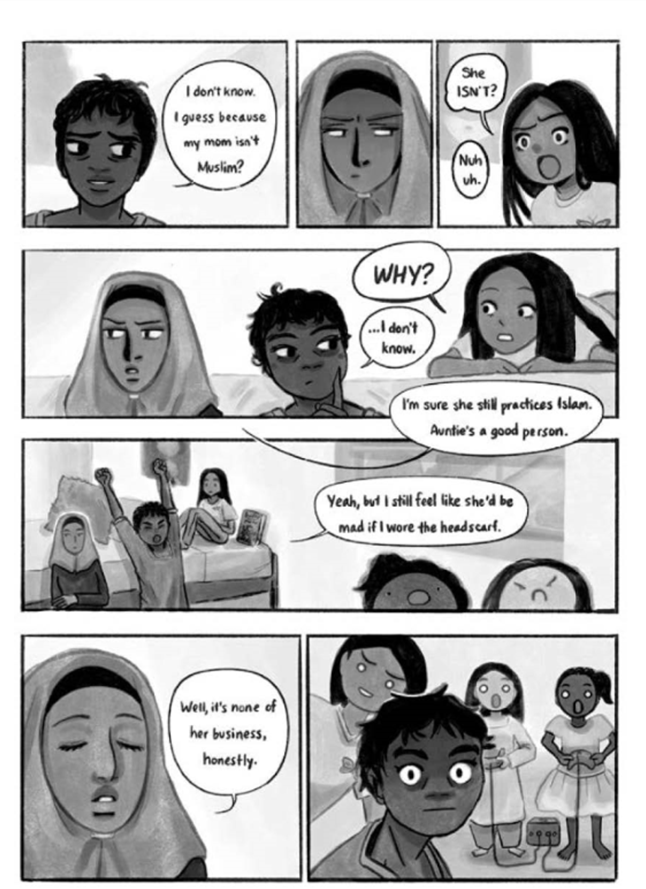
Over the summer we see her and her Nani go over to some cousin’s house where Nasrin is gawked at with her short hair and everyone is unsure how to act around her.  She joins some cousins playing video games where she asks about a cousin in hijab who says that it is essentially her choice between her and Allah (swt), that it isn’t any one else’s business.  A younger cousin tells that she plans to start hijab soon and is surprised to learn that Nisrin’s mom is not Muslim.
As summer comes to an end, Nisrin will be starting high school and exits her room the night before wearing a hijab, or in Bengali, an orna.  Her family freaks out, her Nana, maternal grandfather, is furious claiming that she should have been raised better, and Nisrin is scooted off to her room by her Nani, so that her mom and grandfather can argue.

piece by 3

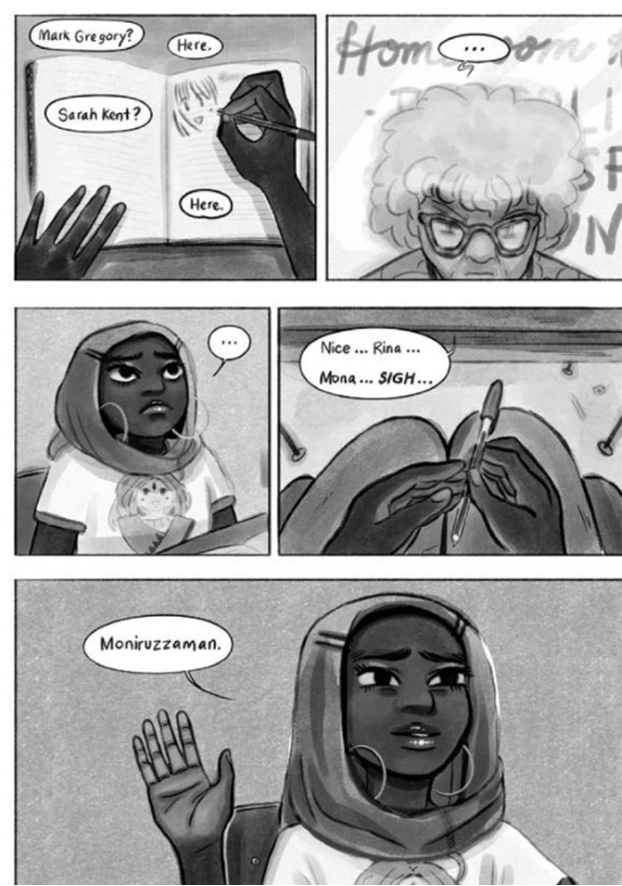
On the first day of school, Nisrin tries to talk to Firuzeh, but once again things are awkward between the two girls.  A teacher refuses to try and say Nisrin’s name and becomes angry and aggressive, and at PE she is called a slut and asked if she will be beat for showing her legs.  Nisrin goes home to research Islam and hijab, but everything is so angry and opinion based that she is more confused than when she started.

The next day she meets a nice girl, Veronica, and the two work on an assignment in class and then have lunch together.  Veronica suggests that Nisrin learns about Islam like she would a school assignment and go research it at the library.  Later at home, Nisrin starts to understand what her grandparents and mother saw and endured in the war of 1971 when Bangladesh became independent from Pakistan.  Her mom and Nana argue over what was seen and Nisrin starts to find her voice in her family.

Nani takes Nisrin shopping for long sleeved clothes and scarves, things are worked out with Firuzeh and Nisrin’s family accepts that Nisrin is not asking permission to wear her scarf, but is hoping they will accept it.

piece by 4

WHY I LIKE IT:

The book is such a flip on the over-used-stereotype that Muslim girls are forced to wear hijab, in truth many are encouraged not to.  At one point Nisrin says, “If I can’t be safe…then can’t I at least be proud.”  She was attacked for just playing with a scarf and putting it on her head, so she reasons, that there is not safety from racism and hate, she might as well be proud of who she is.  I also love the strength in the idea that she doesn’t need anyone’s permission, it is her faith, her head, her choice.

There is a lot of good in the book, but I struggled understanding quite a bit of it.  It mentions that she was at Texas and she loved it, but there was bullying? No idea what it was in reference to or what purpose it served.  At the beginning the two girls seem like they have been friends for a while, but yet Nisrin warns Firuzeh that her Nani will force her to eat.  Nisrin seems to really love her sleep overs, and I don’t know if it is just to show at the end the healing by coming full circle, but it seems a bit juvenile to be that excited about it to me.

The family dynamic and history, left me very confused.  Nisrin doesn’t know her cousin wears hijab, and is confused that her aunt doesn’t.  Nor do her cousins know that Nisrin’s mom isn’t Muslim?  These cousins call Nisrin’s Nani, Dadi, and since there is no father in the picture it is obvious to even none desi folk that these cousins are related through the mom’s family and the cousins father, so why when Nisrin decides to wear hijab is the maternal side so upset? Why does Nasrin’s mom ask if her cousins have put her up to it? Ok if the mom isn’t religious, but does she actively practice another faith? Why in one of the portraits on the wall does the woman seem to have a bindhi? The Bangladesh independence admittedly is something I should know more about, but I don’t, and this book, didn’t really fill me in.  How is the grandfather both siding? He doesn’t like invader nationalism, but I still don’t completely understand why he left, and what that solved.

The pacing and tone at times are off too me too.   I didn’t feel the strain on Nisrin and Firuzeh’s relationship, the text suggests that they are and were best friends, but when Veronica asks if Nisrin’s stress is in part to the cute girl she was staring down, I was curious too if there was more to their relationship.  A lot seems to happen between the attack and Nisrin starting to wear hijab and I wish we were allowed inside Nisrin’s head to know how she feels about her mom, her nana, starting high school, her attack, her desire to wear hijab, it seems a bit rushed.  Which is odd since, the story spends a few pages detailing when Nisrin feels like everyone hates her after Nani picks her up on the first day of school and Nani points out that not everyone hates her, the squirrels don’t, and the dogs don’t, etc..  It seems really childish for the incredible ordeal she has been through.

I like the informative section at the end about Bangledesh. I wish the book would have shared some of what Nisrin learned about Islam in her own research, she goes to the mosque, but doesn’t detail if she plans to pray regularly, fast, etc..

piece by 5

FLAGS:
Language, violence, war imagery, rape mentioned, physical assault. Use of the word slut.

piece by 6

TOOLS FOR LEADING THE DISCUSSION:

I don’t know that this would work for a middle school book club at an Islamic School, graphic novels are often to quick of reads, but I have a few friends from Bangladesh and I really want them, and their daughters, to read it and clue me in to what I am missing, their view of independence and their impression of the book.