Category Archives: Picture book

Yusra Swims by Julie Abery illustrated by Sally Deng

Standard
Yusra Swims by Julie Abery illustrated by Sally Deng

yusra

This 32 page biography told in sparse rhyme about Yusra Mardini is powerful in its minimal text and realistic illustrations.  Children as young as six could easily read it, but I think older kids will be more moved by the story of a 17 year old girls Olympic swimming dreams being derailed by war, and the difficult journey her and her sister took to escape.  With no more than 10 words on each two page spread, the vocabulary is more suited to perhaps third grade and up.

Yusra lives in Syria and dreams of the Olympics.  She trains even as conflict grows in the country.  When it gets bad, she has to flee, her father can only afford to send her and her sister.  Smugglers are paid and they leave.  They take on the open sea, and her and her sister steer the boat through the water when the engines stall.  Once they reach land, and pray, they are stared at.  A kind stranger offers her shoes. They continue on land by foot, bus and train.  They finally reach Berlin.

Once settled, she resumes her training, and a fact page at the end shares how the International Olympic Committee invited her in 2016 to join the Refugee Olympic Team and compete in Rio de Janeiro.  And thus she achieved her dream and was able to swim in the Olympics.

83175260-2878-4DDF-AA9F-3618FEEF41A5

There is nothing religious in the book, except when she is leaving and is hugging a woman in hijab.  Presumably it is her mother, and thus I’m assuming that she too is Muslim. When you google it some articles say she grew up in a muslim family while others say she is Christian, so I really have no idea.

DCAB592B-C32C-4FDB-AF1D-8CF13F36F164

The Ghoul by Taghreed Najjar illustrated by Hassan Manasra

Standard
The Ghoul by Taghreed Najjar illustrated by Hassan Manasra

the ghoulThis 36 page book for ages five through eight is a cute story about being brave, facing your fears, challenging your perceptions, celebrating differences and giving friendship a chance.  Recently translated and published in English, this Arabic inspired folktale is timeless and important for readers of all ages to learn from.
8B5F2DF2-9E4D-41B0-B9CE-3220C01849D3

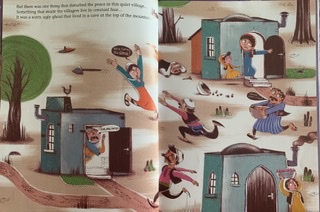
Hasan the Brave is a young boy that lives in a mountain village.  The children are told not to laugh out loud, the adults tiptoe to their fields, and the fear of being eaten by the ghoul that lives in a cave on top of the mountain consumes them all.

397BB0D0-FE53-491D-997C-F0A69FA851BE

But Hasan isn’t buying it and starts asking questions. Why is everyone afraid of the ghoul, he asks his aunt one day in the olive grove? She tells him because he is covered in hair, has one eye, long claws, sharp teeth and his favorite food is little boys and girls.  Unconvinced Hasan asks his dad if anyone in the village has been hurt by the ghoul.  His dad can’t think of anyone.  He asks his mom if the Ghoul ever ate anyone in the village? She can’t think of anyone, but has heard plenty of rumors and wants him to not disturb the ghoul none-the-less.

BA9EE74E-0AEA-4418-8265-146E1DFF7682

Hasan is tired of being scared and decides he will climb the mountain.  Everyone in the village tries to warn him against it, but he is Hasan the Brave after all and is determined to go.  When he gets to the top of the mountain and relishes at the beautiful view he proclaims that he is fearless and that he won’t be afraid of the ghoul.  Then he sees the ghoul, and after the ghoul sizes him up, the ghoul runs away.

76499216-F79A-45D1-8BD5-E7559269F315

Hasan goes to investigate why such a monster is scared of him and learns that the ghoul is scared of people because they have two eyes instead of one, they do not have thick hair like him, they have strange hair, small teeth, and they eat ghouls.  Ghouls, Hasan finds out are vegetarians.

A3D05D5F-10FB-42D3-866F-5863CEEDE484

The two laugh at their assumptions, and run off to play together.  From that day on the two are best friends and the people in the village pass on stories to remind future generations to celebrate differences and not let fear rule them again.

There are a few women in hijab, the villagers say inshaAllah, but there is nothing religious in the book.  The illustrations are detailed and colorful in a muted manner.  Overall a fun book with a great lesson.


Yeti and the Bird by Nadia Shireen

Standard
Yeti and the Bird by Nadia Shireen

yeti

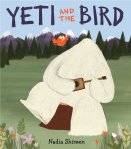
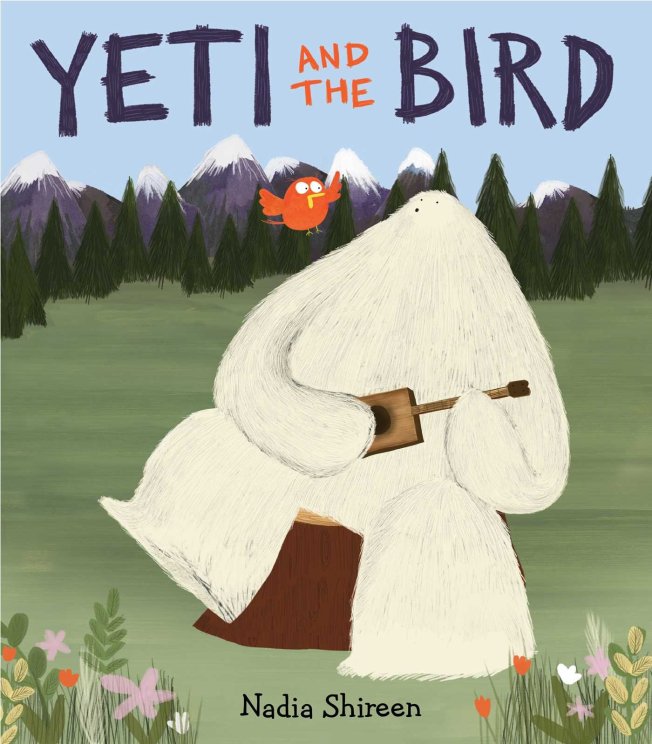
What a sweet story about assumptions, loneliness, friendship and kindness.  An AR 2.0, this 32 page simple picture book tells the story of an accidental meeting, making friends, and the opening of hearts of the forest critters as a result.  Written and illustrated by a Muslim author, the adorable illustrations make the story come to life and provide smiles for kg-2nd graders along the way.

84128316-9DAA-4B13-9391-E41C19804A57

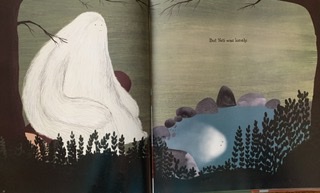
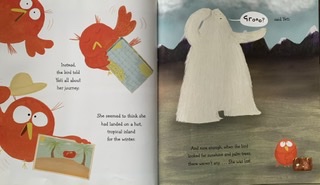
Yeti is the biggest, hairiest, scariest beast anyone has ever seen.  So no one comes near him, making him very lonely.  But one day a lost bird thunks him on the head.  The Yeti growls, but the bird doesn’t get scared. At all. Instead the little bird tells Yeti about her journey and how she was headed to a hot tropical island for the winter.

9794A3B4-1DEF-4183-B784-67190ED94037

Yeti doesn’t know what to do with the sad little bird, so he picks her up and takes her home.  The next day the two play and laugh.  The forest animals look on in surprise and curiosity.

51FA79D6-1ABE-4C09-8E2B-31023FC4E69A

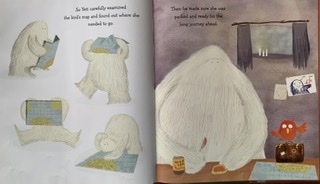
As it gets colder, Yeti knows his new friend will need to leave so he studies the map and helps give her directions for the long journey ahead.  Once she leaves, Yeti is even lonelier than before.

41A015EF-3798-41D6-BEF9-395197E9401B

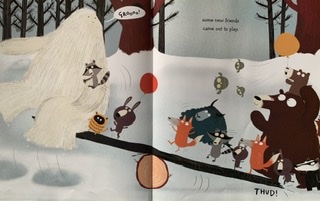
But, alas, new friends are ready to play and the little bird stops by to play when she can.

587A7DA5-DE9A-4270-B8B4-202C6943F846

Cute and fun and great for littles, to be brave and give a new friend a chance.

The Bee Tree by Stephen Buchmann and Diana Cohn illustrated by Paul Mirocha

Standard
The Bee Tree by Stephen Buchmann and Diana Cohn illustrated by Paul Mirocha

bee treeThis is one of those books that it is hard to know who the target audience is and who would most enjoy the text heavy 40 pages about a boy coming of age in Malaysia by harvesting honey in a traditional manner.  The two page spread illustrations are rich and inviting, and with an AR 5.7 level, the book would work well for children that enjoy other cultures, honey, insects, or children that you hope will be inspired to start seeing the world a little differently than they are used to doing.

5BD37914-E9B7-4D0B-BB0A-1286A8BC4C72

The story starts with a boy talking about his grandfather and how every year he goes to collect the honey from the tualang trees.  The bees travel hundreds of miles and arrive just as the rainforest starts to bloom.  The trees that they build their nests in are higher than the eye can see and grandfather, known as Pak Teh, is the leader of the honey hunting clan.

7CA311E6-B1B6-40E7-B735-FAACAD76597F

He tells everyone what their jobs will be: some will carry ropes, others pails, others torches.  One day, he tells them, someone will have to take his place as the one who climbs all the way up to the top to gather the honey.  He believes Nizam, the narrator, is the one.

To prove himself, Nizam has to practice climbing 120 feet into the sky.  Nizam and grandfather spend a lot of time together praying five times a day and walking through the dense rain forest.  He reminds Nizam that the forest doesn’t belong to them, but to the unseen protector. They enter the forest as if they are visiting a neighbors home.

837003A0-ED16-4CA9-9CD8-3CEBA7846D0A

At night all the hunters sit together and Grandfather tells the traditional story of the bees.  A story that involves a beautiful servant girl named Hitam Manis who worked in the Sultan’s palace and how the Sultan’s son and her were in love.  When the Sultan found out he ordered the girl run out from the kingdom.  As she and her loyal friends fled she was hit by a metal spear.  She did not die, but her and her friends were magically transformed into a swarm of bees.  Because it was metal that harmed her, she ruled that metal was never allowed to touch the honey.  Hence, when the bee hunters harvest they use a bone knife, leather pouches, and a wooden ladder.

2637F18A-FB0A-424D-AACF-58285BE31EC5

When it is time to enter the forest, it is pitch dark with no moonlight.  The hunters tap their glowing torches against the trees sending light sparks to the ground to tempt the bees and leaving their nests free for Nizam to collect the honey from.  For seven nights they climb the trees, and then they return home.  With greetings of salam, peace be upon you, Grandfather informs the family that when he can no longer climb the tree, Nizam will carry on the tradition.

908CAC37-2CCE-477A-93BC-B3EEF723C2BF

The book ends with factual information about Malaysia, the rainforest, giant honey bees, honey hunters, and the future.

The World is Not a Rectangle: A Portrait of Architect Zaha Hadid by Jeanette Winter

Standard
The World is Not a Rectangle: A Portrait of Architect Zaha Hadid by Jeanette Winter

rectangle

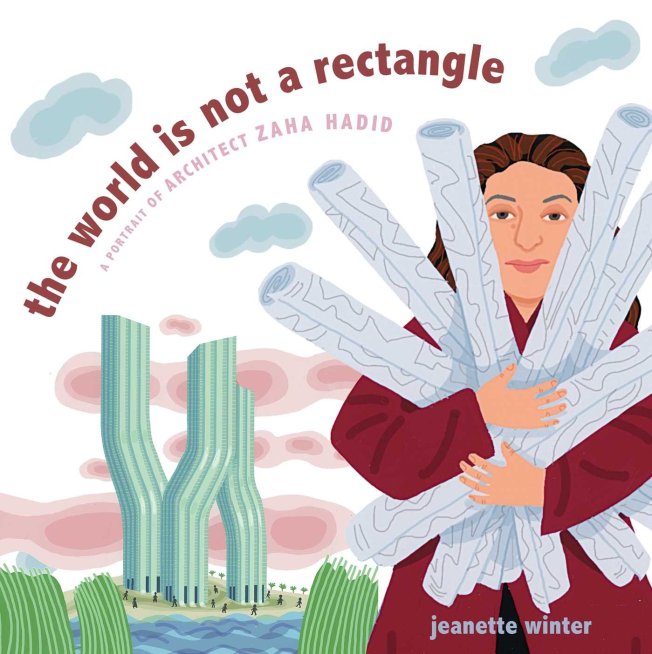
This non fiction book spread over 56 pages on an AR 4.0 level is the biography of the famed Iraqi architect’s inspiration, triumph over obstacles and accomplishments.  It doesn’t go in to great detail of her life, but gives enough information for children to become familiar with her and be inspired by all that she accomplished not only as an Arab, Muslim woman, but as an architect and trail blazer of design and structure.  The pages are beautifully illustrated and the simple text flows and dances around the pages like her buildings in real life.

0BE54CFC-BBDB-4507-9DDA-FDA54576B014

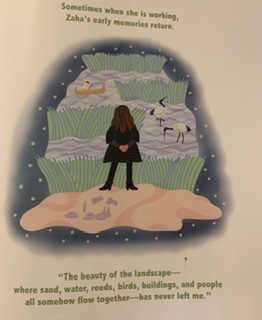
Born in Iraq where rivers flow, wind swoops across sand dunes, and cities existed thousands of years ago, Zaha finds designs and shapes throughout her home and the city of Baghdad.  She has ideas about arrangements of furniture and designs of clothing, she loves that dunes and rivers and marshes don’t have corners.

CEE97AF8-91A3-46AC-A63E-E3484F1790B1

She is a Muslim that attends Catholic school and loves math.  She goes to London for college to study to be an architect. She is relentless in her passion and fills notebooks with plans, paintings with what she sees in her mind and graduates with honors.

94EC3F0A-2584-4786-9FF8-9FE173CB04A5

She opens her own office and with a few friends, she designs buildings that swoosh and zoom and flow and fly.  The world is not a rectangle, but unfortunately no one wants to build her designs.  She keeps entering competitions, and winning, but they refuse to build her buildings.

FE2B9584-E1C6-4B19-94B8-9684A9F6BC0C

She designs buildings that come from her memory of grasses swaying, and wind blowing over dunes, and shells being cradled.  She designs an opera house like a pebble in the water, with the singer the pearl.  A ski jump that reaches the sky like a mountain.

91BAFF18-340B-4334-B856-5984A4CF1060

One by one, Zaha’s designs become buildings all over the world.  She has over 400 employees and designs buildings, shoes, doll houses, furniture, she does what she likes and urges others to do so as well.  Zaha passed away in 2016, but her visions are still carried out.


Your Name is a Song by Jamilah Thompkins-Bigelow illustrated by Luisa Uribe

Standard
Your Name is a Song by Jamilah Thompkins-Bigelow illustrated by Luisa Uribe

song

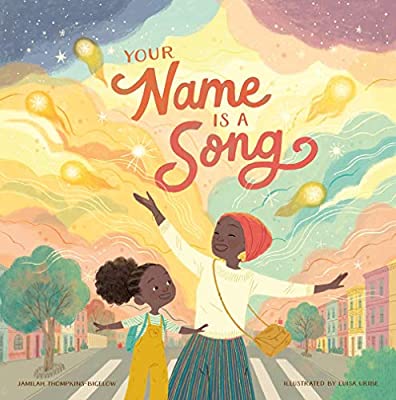
An amazingly empowering simple story that breathes pride and beauty in to names and our identities.  The 40 pages are a celebration of the rhythm of our names and the dreams and hopes that they contain for us.  Perfect for kindergarten to second graders, readers of all ages will find something valuable in this book.  Those with “common” names might reevaluate what their names mean or why they were so named, children with “unique” names will find the music and confidence to ask others to learn their name correctly, older kids might reconsider shortened nick names, and we all inshaAllah will make more of an effort to get people’s names pronounced right.

3A20341F-991D-4929-9A52-D9794E284880

A little girl has had an awful first day of school.  As she stomps toward her mom at dismissal.  No one could say her name.  Not even the teacher, it got stuck in her throat.  Her mom gently reminds her stomping is only for dancing, and tells her that her name is a song.

034DED6F-D931-4FB1-ADC0-15006AC8EAC2

The little girl is skeptical, but as they say people’s names on their way home, and find the magic and rhythm and beat in each one, they address the horrible things that have happened to the girl that day regarding her name.  At lunch girls pretended to choke on her name, and later one boy said her name was scary, some even tell her, her name sounds made up.

86E8B8E7-5336-4D72-BAC3-174F2B5B9AA2

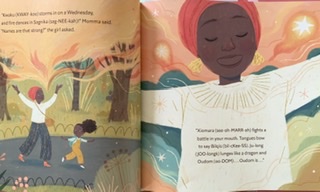
Her mother explains that some names come from deep in the heart, not the throat and cannot be choked on, that names are fire and strong, and that names are made from the sky when our real names were stolen and so new ones have to be dreamed.

8D42050F-B9BA-4813-8BD6-CB543566748A

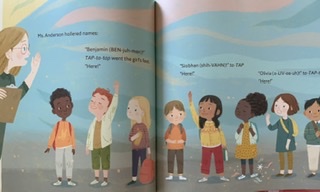
All the way home they go through names, diverse names, beautiful names.  The next day she doesn’t want to go to school, but she has a song to teach.  When her teacher starts calling  out names, the little girl starts tapping the rhythm, when Ms. Anderson starts to struggle on the little girl’s name, she starts to sing it.  She explains that her name is a song, and that she will teach it to them.  The other children then ask her to sing their names. And with a smile on her face, it is music to Kora-Jalimuso’s ears.

58B39FE0-63CA-4196-9452-4C64B517BAAA

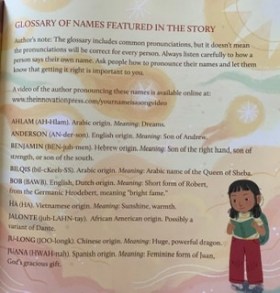
I love that there are three pages of the names mentioned in the story and their origins and meanings listed.  I also like that the little girl’s name is not revealed until the end.  The pronunciation of the names is in the text, all of them, even Bob.   And when I read the name Trayvon, I felt an added weight of saying people’s names, breathing them into our lives and not forgetting them.

74247213-AEE1-464E-A8C4-DE0ECB824335

The family could be Muslim based on the mom’s head wrap.  The author is Muslim and there are Arabic and Islamic names included in the story.

Let it Go: Learning the Lesson of Forgiveness by Na’ima B. Robert and Mufti Menk illustrated by Samantha Chaffey

Standard
Let it Go: Learning the Lesson of Forgiveness by Na’ima B. Robert and Mufti Menk illustrated by Samantha Chaffey

let it go

1AA90D6C-5528-4766-B486-219F31FF7AEC

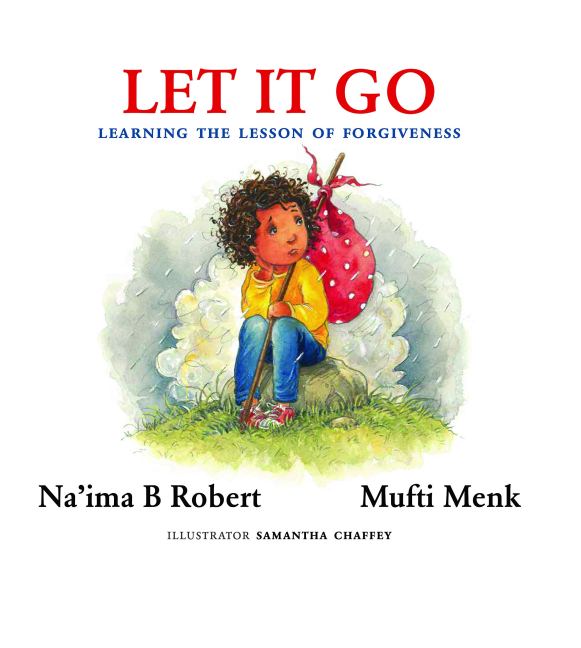
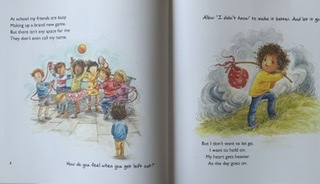
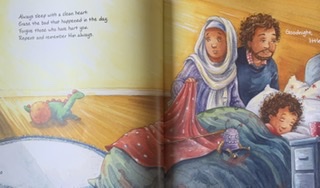
This 32 page rhyming book follows a little boy around as he is weighed down by a lot of things not going his way.  He doesn’t want to forgive until he is the one that hurts someone else and realizes we all make mistakes, forgiveness is not a weakness, and we all feel angry at times.  The book breaks from the story to ask the reader to think about their emotions in various situations, and encourages the reader to talk about their feelings.  The framework is Islamic and the repenting to Allah swt is part of the message. I found it awkward to read independently, but I read it to a small group of my own kids and their cousins, seven in all, ages four to thirteen, and it worked very well to discuss what the boy was feeling and how they would react.  I think this book would be great in a classroom or as a book an adult reads to a child at bedtime to encourage conversation.  I had to point out to the little ones, that the knapsack was getting bigger with the little boys anger, and explain what it was, but as a tool to foster dialogue it was incredibly powerful.

AF3C685C-9745-42B2-96C3-53F2B28B50B7


The book starts out with a poem/du’a by Mufti Menk that sets the tone for the book.  It makes clear that we are all human and feel things and that this book is a tool to understand and emotionally grow from.  No one is going to get in trouble or be reprimanded.

997B392B-E053-4EB3-AAAE-B40023247F90

The story stats with the little boy waking up happy and ready to have a wonderful day.  But then when he comes down for breakfast, his sister has eaten the last piece of toast.  The book asks the reader, “how do you feel when things don’t go your way?” and asks the little boy to let sorry make it better so that he can let it go.  But the little boy doesn’t want to let it go, he wants to hold on, and as a result it makes his heart feel heavy.

71B6DCC3-5B85-423E-A3F7-6F1F3DC80136

This pattern is followed throughout the book giving examples when the boy doesn’t get included in a game at school with his friends, when his friend kicks his football (soccer ball) in to the road and it gets popped by a passing car, and at dinner when his older brother laughs at him.

5BAA4271-891B-4D25-8451-B1A787D4C1F9

He then picks on his sister at bedtime, and doesn’t even know why he is doing it, and realizes that he too has made a mistake.  He learns that “it takes a strong person to let it go,” and that “forgiving is like taking off a heavy bag that I’ve been carrying all day long.”

4D498CEE-6886-40ED-925B-6D230205CB6C

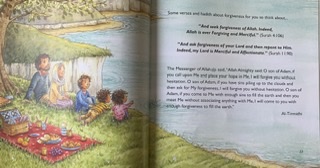
The book ends with some verses and hadith about forgiveness.  Has some facial expressions with emotions to discuss, and space to write down things that make you feel angry, hurt, or sad as well as a place to share what makes you happy, grateful, and safe.  There is also a glossary of Islamic Arabic terms on the inside back cover.

D5E111E7-2791-466B-9343-B362E7D4EB23


Our Favorite Day of the Year by A.E. Ali illustrated by Rahele Jomepour Bell

Standard
Our Favorite Day of the Year by A.E. Ali illustrated by Rahele Jomepour Bell

favorite day

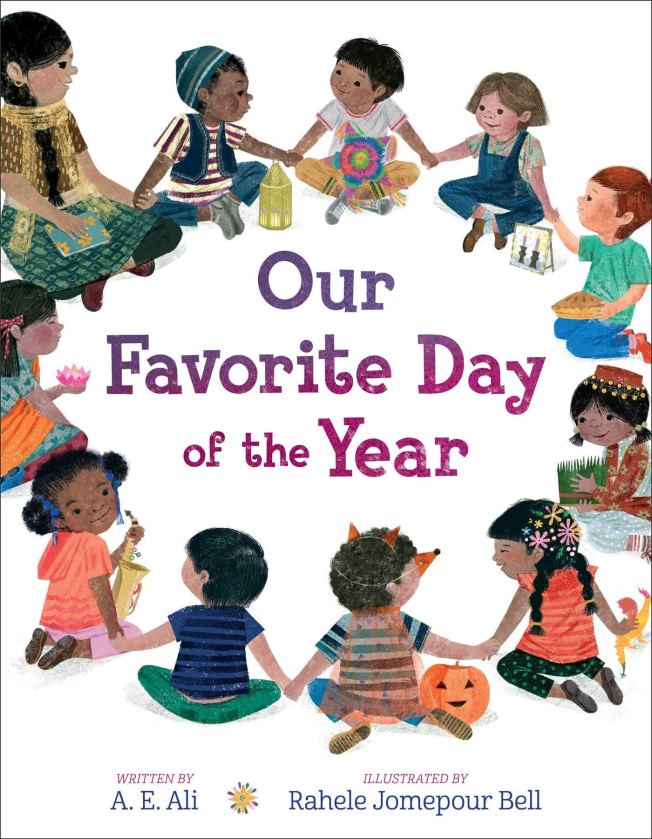
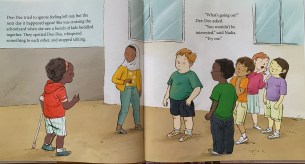
A great book about inclusion for back to school, except well with Corona, we aren’t doing things how we always have.  None-the-less this book about the first day of kindergarten for Musa and the friendships and celebrations of diversity (Eid al-Fitr, Rosh Hashanah, Las Posadas, Pi Day) that will take place over the school year, connect the kids and their cultures in a beautiful and heartwarming way.  The book is 40 pages with engaging illustrations and text perfect for 5-7 year olds.

EDFC15B2-0A7C-4B7F-ACAD-E019DBDEDEC4

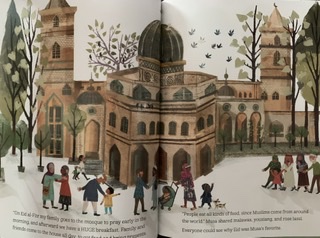
It is the first day of school and Ms. Gupta tells the class it is her favorite day of the year.  She also tells the children that the people around them will become their best friends.  Musa doubts this as he looks around at the strangers at his table.

EFE30123-CA0D-41E9-BAFB-2ADFA7CE811F

He also wonders how the first day of school can be any ones favorite day, clearly Eid al-Fitr is the best holiday.  Luckily, every show-and-tell will be about someone’s favorite day, so that the class can join together in celebrating it.  Moises can’t believe that Christmas isn’t the most fun until he learns that not everyone celebrates it.

011E4F77-4479-412E-AF9E-D37B9B870308

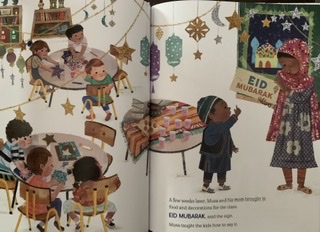
When it is Musa’s turn to teach about Eid, his mom and he bring in food and decorations and teach the kids to say Eid Mubarak.  They learn what Eid is like and can see why it is his favorite.

6B5884B2-A9ED-42D1-A624-B8100CE0D160

Up next is Mo’s turn.  He tells everyone about Jewish New Year and how to say Shanah Tovah.  On Rosh Hashanah they light candles and share food with friends and family.

DAC82C2A-06CC-485B-B589-F34682F0914E

Moises explains how Las Posadas is how his family celebrates Christmas.  It lasts nine days and there are songs and pinatas and presents.

2CECB33E-AFBD-4118-B893-8B9D2B81385C

In the spring it was Kevin’s turn and he shared his love of Pi Day as his family celebrates science.  On March 14 (3.14) they make different pies and learn about scientists and their discoveries.

A657B13B-02A0-4E75-95D0-25513C8788F6

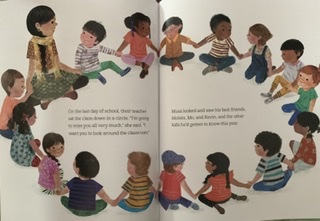
On the last day of school, the children are sad, but their teacher hopes they will remember each other always throughout the year as she hands out calendars for them to keep.

83CC82E2-4045-4F02-8202-D6E6124A0E5F

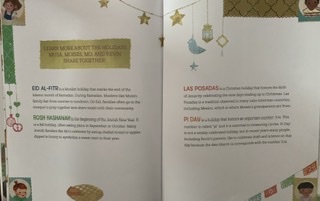
The book concludes with information about each of the four holidays mentioned. It is possible that on the Rosh Hashanah page the family is two gay men with two children, but it could be just two men as well, and doesn’t say anything in the text that suggests who and how the family is comprised.

731DE17E-FCD5-4B41-9209-3EEB21052101

A Girl Called Genghis Khan: How Maria Toorpakai Wazir Pretended to Be a Boy, Defied the Taliban, and Became a World Famous Squash Player by Michelle Lord illustrated by Shehzil Malik

Standard
A Girl Called Genghis Khan: How Maria Toorpakai Wazir Pretended to Be a Boy, Defied the Taliban, and Became a World Famous Squash Player by Michelle Lord illustrated by Shehzil Malik

maria

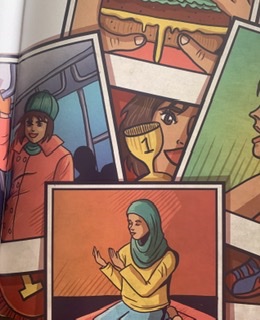
This children’s biography of Maria Toorpakai Wazir, Pakistan’s world famous squash player, is simplified and suitable for children 2nd grade and up.  At 42 pages with bright illustrations older kids will understand a little bit more about the cultural norms that were being oppressive and the strength and risks Maria took to play a sport she loved and defy the Taliban while disguising herself as a boy. Younger children will probably only get her determination and perseverance, which is impressive in its own right.

C9A2CED0-B2A4-43F9-942A-B5A32B0B7E9C

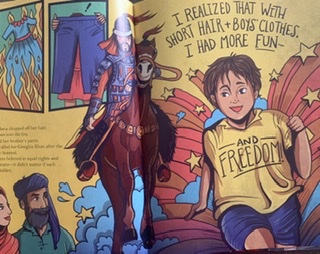
In 1990, Maria was born in the mountains of the Tribal Areas in Pakistan.  Conservative society and strict gender roles amplified by the control of the Taliban in 2001.  Maria’s parents supported rights for their sons and daughters, and allowed Maria to cut her hair, dress like a boy, and play sports.

9C7E2AE9-5668-48C6-8E41-304F1583B644

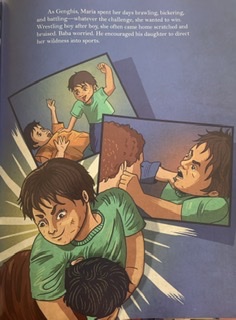
Her father called her Ghenghis Khan after the great warrior and when the family moved to the city of Peshawar he even introduced her as his son to people.  As Ghenghis, Maria was always picking fights and encouraged instead to play sports to channel her wildness.

2FB5AF13-2468-44A6-ACD2-1A118F69F9C6

She fell in love with the game of squash, and when she went to join the Squash Club she had to submit her birth certificate which revealed that she was a girl.  The director let her join the club, as the only girl among 400 boys.  But now her secret was out.

713C71CE-338C-4241-BD6F-05091868E560

She was bullied and her family ridiculed, but she kept playing and kept winning.  The President of Pakistan awarded her honors for her outstanding achievements, but that infuriated the Taliban and they threatened her family.

FF2A709B-F539-44B0-92FB-48C336C2213B

As a result Maria had to hide, and would practice at night, in secret, and for 3 years she played against the wall in her bedroom.  Appealing to squash clubs around the world for help, she finally heard from Jonathon Power in Canada, willing to help her get away from the Taliban and be able to play.

3915AD01-442F-4473-9571-9D798C8B1389

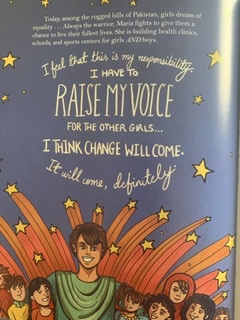
She left behind everything she knew at 20 years old to train in Toronto.  She still represented Pakistan in tournaments.  She studied, she prayed, she succeeded.  She now is back in Pakistan establishing health clinics, sports clubs, and schools for girls and boys.

The story is inspirational, and well told, it shows how culture limited her, not religion, and that in a larger city, culture was a little less conservative.  Muslim and non Muslim children will be inspired by her efforts, her willingness to look like a boy and her determination to excel.  Muslim kids will enjoy that it shows her praying, but might be surprised to see her in shorts and tank tops.  The book would be a great conversation starter about women’s rights and how it isn’t just in Pakistan that women struggle to have equal opportunity and respect.  It also might many children’s first exposure to the sport of squash.

138B3D8B-B868-437B-B7C8-5674879B81DA

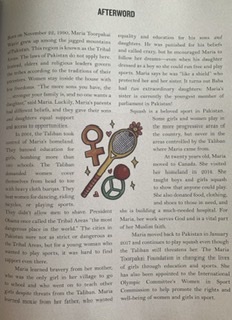
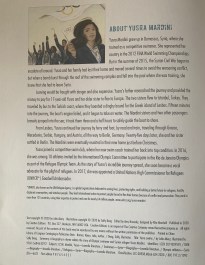
There is an afterward at the end with more information.  A list of additional reading about other inspirational women, a selected bibliography and a highlight timeline of female firsts in sports.