Tag Archives: Picture book

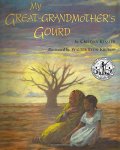
My Great-Grandmother’s Gourd by Cristina Kessler illustrated by Walter Lyon Krudop

Standard
My Great-Grandmother’s Gourd by Cristina Kessler illustrated by Walter Lyon Krudop

gourd
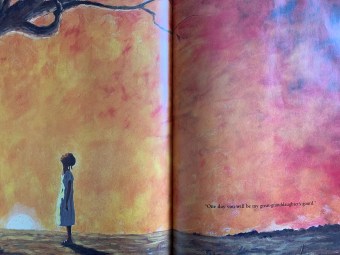
A beautiful story based on a true event in Sudan, this 32 page AR 4.2 book contains lessons about tradition, new technology, village life, culture, family, love, and community.  Unfortunately it is one of those books that I doubt any child would pick up and want to read.  Meant for fourth graders, there is a lot of text on each page, and the story is not quick and light, it is thoughtful and memorable. The book is a powerful one in opening one’s eyes to a different culture, environmental challenges, and innovations making it an important one for parents and teachers to share with younger children and encourage older ones to spend some time with.

8A5303D5-525F-4D37-A886-F22F18D0FE0B

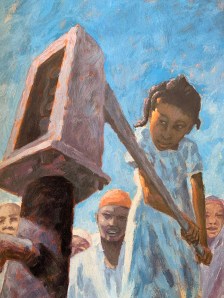
Fatima’s Sudanese village has just installed a new pump, and to show how easy it is to use, Fatima is chosen to try it out first.  With all the excitement over new technology, life for the village is about to get easier.  No more hauling the water with camels and filling the baobab trees to store the water in for the dry season.

104E36DC-E27A-47BB-8C4C-A510198CE604

Easier for everyone except Fatima’s grandmother.  She refuses to abandon the methods of the past so easily, and independently begins to prepare her tree, her great-grandmother’s gourd.  Fatima tries to talk her out of it, and the other villagers mock her refusal to accept technology.

DCB3DBD3-7EC3-4631-9A9D-EC34DE46055F

When Fatima hears the neighbor louder than the call to prayer calling her grandmother a fool and laughing at her, Fatima boldly and defiantly joins her grandmother in preparing the tree for when the rains come.

84F665EB-EFD6-49A6-BFDA-FF348CD80D00

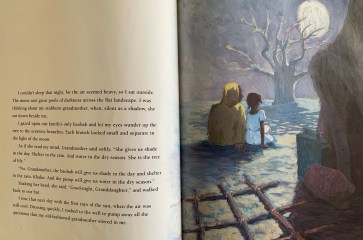
The two dig a circle, a necklace, around the old tree to catch the water in the hard red clay, when the rains come, it catches the water, and when it stops, the two move the water to the inside of the tree with buckets. All the while, the villagers shake their heads at the two hard at work.

56BA11B5-7314-4D88-BDAA-50FE61765467

When, in the middle of the dry season, the pump breaks and it will be days before it can be repaired, the chief, Ibrahim, declares they must resort back to the old ways and Fatima and her grandma offer to share their water to hold everyone over.  “Maybe it’s wise to mix old with the new,” Grandma poignantly notes.  The following year the village works together to prepare the trees, just in case the pump breaks.

E4443445-EDEA-4C9C-99E4-4BE6AFB96C1A

There is a glossary of Arabic Words at the beginning of the book and an Author’s note about the “Thirst Triangle” and the use of the baobabs or tabaldi trees used to store water.

F429299A-BFD4-4BCC-9DA4-134FEAF09E4F

There is nothing overtly religious in this culturally rich story.  The women cover their head, they say “inshaAllah,” the call to prayer is mentioned and they have Islamic names: Fatima, Ibrahim, Musa, Ahmed, Ali, Osman etc..

The Mighty Head of Moustafa by Rania Emara illustrated by Fruzsina Kuhari

Standard
The Mighty Head of Moustafa by Rania Emara illustrated by Fruzsina Kuhari

moustafa head

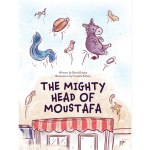
This fun new twist on “The House that Jack Built” uses the same style of building sentences on to a repeated story that the classic uses, as well as the silliness of it all, but is made unique with the Middle Eastern setting and cultural aspects.

90A73EFF-DE4E-4D30-9AF6-3353B0E0B979

The 8.5 x 11 size gives ample room to see the fun engaging illustrations that bring the comical rhymes to life in both small to medium sized groups.  I won a digital version, and will probably end up purchasing a paperback copy for my bookshelf, as the pictures and text will be easier to pour over in physical form.

1F6DDDD0-6F9D-4AFC-B8CF-8F5418D7DAD7

The book is 22 pages of text and perfect for toddlers to listen to, on up to 2nd or 3rd graders to read on their own and still be entertained.  There is nothing religious about the book, the boy is named Moustafa obviously, and there is a girl whose veil is the climax of the story, but nothing in the text is religion specific.

D7820AEC-BBAE-40AC-A521-79BDD19AD815

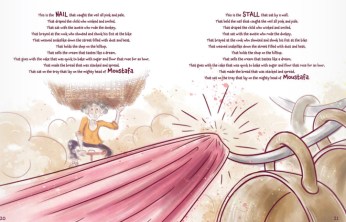
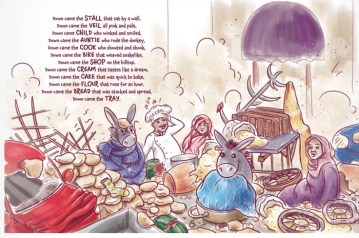
It all starts out with a tray on the mighty head of Moustafa.   Upon that tray is bread stacked and spread that goes with cake that was quick to bake, and before you know it, there is an aunty who rode a donkey next to a child with a veil, and then a nail, oh that tricky nail that caught the veil. . .

9568D24E-1062-4EA4-AA69-64DD4D6DCB7E

Moustafa and his tray and everything along the way are all brought to a tumbling halt, all because of a nail. The crash and falling down undoes the entire build up, and the smiling face of Moustafa makes you want to read it all over again.

266C3E0C-6233-41B9-ABE2-20C6E4307EA5

Alhumdulillah!

E2A54CA5-A964-4405-8181-F73EA84649BF

Like the Moon Loves the Sky by Hena Khan illustrated by Saffa Khan

Standard
Like the Moon Loves the Sky by Hena Khan illustrated by Saffa Khan

moon

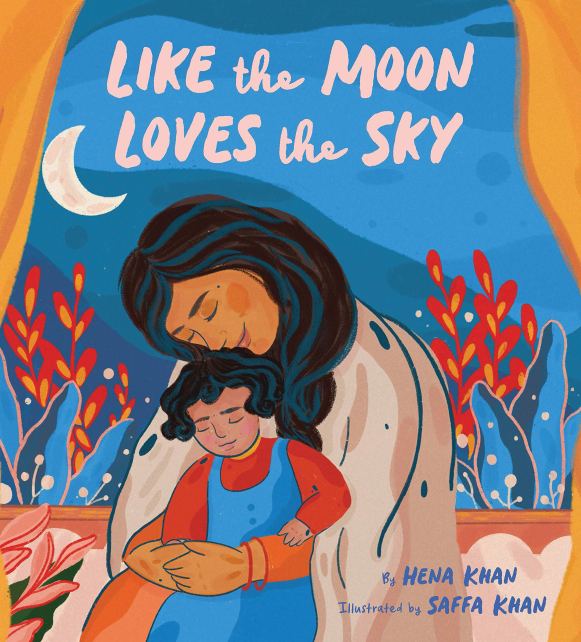
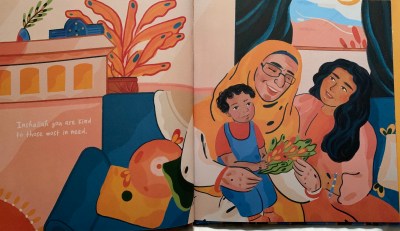
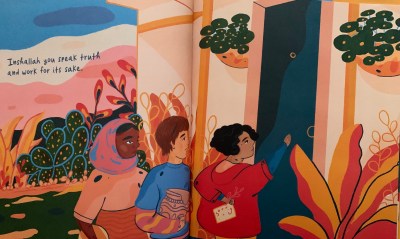
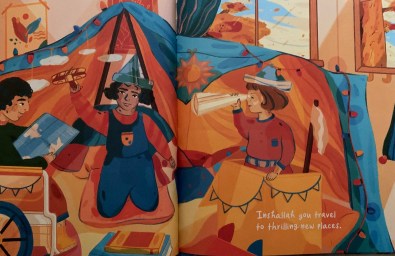
This 40 page book of prose begins each stanza with “InshaAllah” and reads as a beautiful prayer from parent to child.  Each two page spread is filled with warm vibrant colors and illustrations that radiate love while complementing the slow pace the book is meant to be read with.D900B288-5527-4519-8EDF-EE830D3A464D

The book is clearly from an Islamic perspective, yet I think any religious family would find beauty in the book.  The author has a note on the title page that defines inshaAllah as meaning God willing in Arabic and explains how it is a common wish/prayer for people of other cultures and faiths as well.  She also explains that that each line is inspired by the Quran, but universal for people everywhere.

94EE8AC2-8754-46F4-AF50-9CDB7BDFF145

Some of my favorites are:”InshaAllah you seek knowledge, reflect, and read, InshaAllah you speak truth and work for its sake. InshaAllah you have faith that won’t waiver or bend. InshaAllah you are kind to those most in need.”

287D37BD-90E8-4464-B075-524E842A4B43

The illustrations show a family that at times wears hijab and at others does not.  It shows multiple generations, and diverse characters in terms of skin color and mobility.  The illustrations at first weren’t my favorite, but they definitely grow on you.

70D903DA-9763-44CA-B765-2FE15AE34C10

Over all the story reads like a lullaby, and is soft and sweet at bedtime particularly.  The 10 x 10 size would make it work well in groups as well, and I could see it used to lull kids to sleep at nap time with great success for the youngest baby to early elementary.

F6B4AB6F-E13A-4C05-836B-24CD28BAC21C


Saffron Ice Cream by Rashin Kheiriyeh

Standard
Saffron Ice Cream by Rashin Kheiriyeh

saffron-ice-cream_1600_c.jpg

The book may seem to be a lighthearted diverse read about a little girl comparing a beach in America to those of Iran, BUT there is also some pretty charged portrayals about gender divided beaches, religious police, and hijab.  I’m not saying this own voice book is exaggerating or saying anything that isn’t true, but it is an oddly belittling perspective to slip into a brightly illustrated children’s book with the words “ice cream” in the title.  The 40 page book for ages 4-8 is not one I would recommend for its negative undertones and dismissal of understanding another culture.

6BC28B43-0CB0-468A-A866-35A02C7DE210

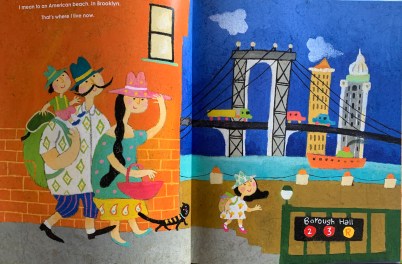
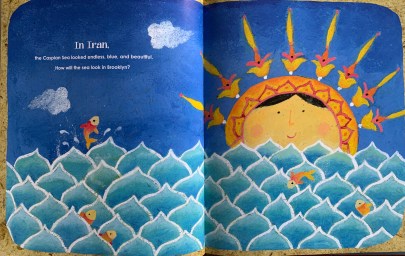
Rashin’s first trip to a beach in America has her and her family getting ready to go to Coney Island.   She remembers past trips to the Caspian Sea in Iran.  Trips where they would wake up early, her mom would prepare halim and they would drive through the countryside stopping for a picnic lunch.  Often her best friend Azadeh would come along and they would listen to Persian music and share kebabs.  On this trip they are going on the subway and there is diversity and music and excitement too.

6EC8AC6A-577A-4D94-B7EA-85AF22BDE8EC

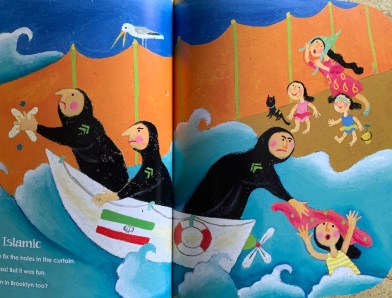
The next few pages detail and depict the curtain that would divide the women’s side of the beach from the men’s.  While the words say how fun the women’s side is and that even the ice cream vendor is a woman and the beach goers can remove their covers and get a tan, the inclusion of the Islamic guards with their aggressive faces and full black abayas and hijabs, is a stark contrast to the happy faces throughout the other pages.

4DA05BB7-D867-4E6C-BA2D-2D0C4BB10222

Rashin then recalls one trip where little boys poked holes on the men’s side to look at the female’s side. While it might be taken as silly to children, there is a lot to unpack with such “peeping,” the concept of respect and of covering.  It then seems to make the whole situation seem ridiculous by having the women covering themselves with umbrellas, newspapers and whatever they can find.

1B468F58-7A51-4523-9973-D1DA5F935B3B

When Rashin finally gets to Coney Island, the ice cream stall doesn’t have saffron ice cream and another little girl suggests she try chocolate crunch, she concedes and discovers it is pretty good, and the beginning of a new friendship is implied.  She then asks the girl about the rules of the beach and the accompanying illustration has the Islamic police seeming to try and stop the fun.

8C418BFD-96ED-4D1F-B065-C4EA97167CFF

It is natural to compare new things to those that we know, but this book has a very strong negative, judgmental tone to what could have simply been presented as different without the criticism.  The author is the illustrator as well, so there wasn’t a divide in continuity.  I appreciate that there is a visibly Muslim family at Coney Island, but it seems too little, in a book very aggressively passing opinion on a religion and how it is “enforced.”

3E7C76A7-22DE-4F8A-B87F-F3DC91982D33

I find it rather disappointing that Scholastic chose to publish such an angry book masked in smiling characters and a trip to the beach.  It may be how life is in Iran, but I don’t know that a children’s book is the platform to air grievances without explanation.  This book does nothing to open dialogue and acceptance, it definitely would cause more harm than good.

Azad’s Camel by Erika Pal

Standard
Azad’s Camel by Erika Pal

camel

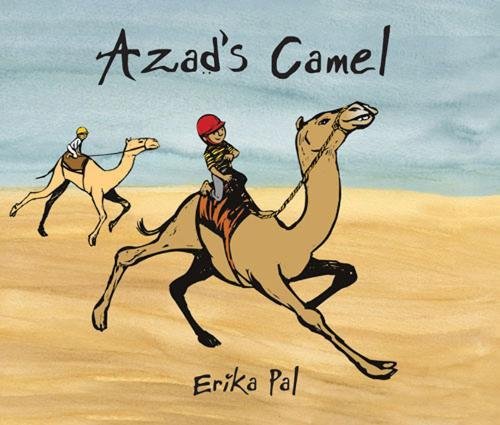
This beautifully illustrated picture book takes the reader in to the world of camel racing, children jockeys, mistreatment by adults, children being sold by their families and running away, all in a span of 40 pages and on an AR 3.5 level.  Yeah, its a lot for a kid’s book, but it has a happy ending and it does draw attention to an atrocity not often discussed or thought about.

IMG_8781

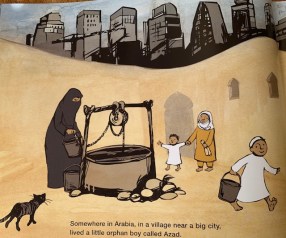
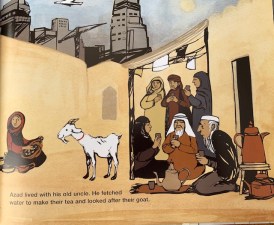
Young Azad lives with his old uncle in a village outside the city.  He helps take care of the goat and fetches water for tea in the mornings,  in the afternoons he plays with his friends.  One day he is doing handstands on a soccer goal post when a rich Sheikh drives by and sees him.

IMG_8780

The Sheikh comes back and convinces the uncle to let him take the boy to be trained as a camel rider to one day be famous.  The uncle agrees saying he can’t afford to keep him.

IMG_8782

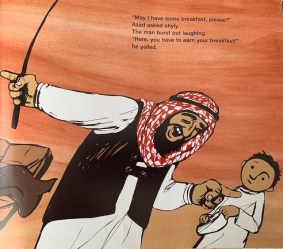
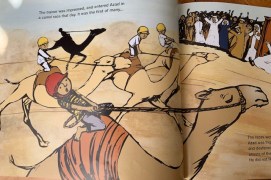
The Sheik takes Azad to the desert with other boys to live and be trained.  Azad learns that food is earned and chores are a must.  The races are dangerous and Azad doesn’t like them, but he is good and is forced to keep racing.

IMG_8783

One night the camel, Asfur, talks to Azad and the two plan to keep running past the finish line at their next race.  The pair are so fast that, they do just that, and no one can catch them.  They run through the city, and back to the desert.

IMG_8784

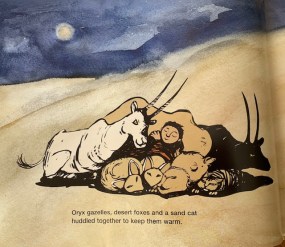
The other animals of the desert keep them warm when it gets cold and until a Beduin tribe discovers them and takes them in.  At last Azad and Asfur find a home.

IMG_8785

There is information about camel racing at the end including how robots are replacing child jockeys in some countries and how many young children are being returned to their families, school and a normal life.

IMG_8786

I like that the book takes on a real and sad occurrence, bringing camel racing and forced child labor in to light.  The story is truly written for younger elementary kids with short paragraphs on each page, large engaging illustrations, quick jumps in events and glossing over any truly graphic details.

IMG_8787

I do worry that stereotypes are reinforced with the use of calling the rich man who bought Azad a “Sheikh” and the Bedouins dancing at the end.  Culturally the book is a generic Middle Eastern country and doesn’t mention or emphasize religion at all with the exception of the women in the pictures being veiled.

I found the book at the library and think it has good information to discuss with your children, but I don’t know that I can see it being anyone’s favorite book, or a regular night time request.  While, yes, it does have a happy ending, you don’t really “feel” what Azad is going through, you are just glad he finds people that want him.


Bibi’s Blessing by Lela Usama Goldsmith illustrated by Samantha Morazzani

Standard
Bibi’s Blessing by Lela Usama Goldsmith illustrated by Samantha Morazzani


IMG_8209

A wonderful lesson packaged in a sweet story about a girl learning to thank God for blessings, especially ones that don’t seem like blessings at all.  The 36 page book is meant for children age 4 and up and with its large 8.5 x 11 glossy full color pages it works well at bedtime and in small groups at story time.

IMG_8211

On the island of Lamu, Mwana lives with Bibi, her grandma who’s livelihood depends on making Mofa bread every day.  It is Mwana’s job to sell the sorghum ground bread in the streets for people to enjoy at tea time.

IMG_8210

One morning a braying donkey frightens Mwana and she trips, spilling all the mofas on the ground.  When she tells her grandma what happened and how they have not made any money for the day, her grandma responds, “Thank God for this blessing.”

IMG_8212

Not believing Bibi, but being too excited to visit a friend, she doesn’t argue.  But then the power goes out and she can’t visit her friend and she gets grumpy. Grandma tells her to “Thank God for this blessing” and explains that sometimes not getting what you want is also a blessing.

IMG_8213

With nothing else to do, Mwana goes off to soak the rice pot, but instead accidently soaks the dusty mofas, to which her grandma again says it is a blessing.  She starts to feel she can do nothing right, and can’t believe there is any blessings in a pot of mushy mufas.

IMG_8217

But, with the power out many shops close and the owner of the donkeys has nothing to feed his animals.  He knocks on his neighbors door and Bibi and Mwana have just the thing.  He pays them for the food and alhumdulillah all is well, so many blessings from God.

IMG_8216

I love that the setting is a place many of us have never heard of and that there is information about Lamu at the end of the book along with a glossary.  The author is Muslim, the characters dress Islamically in the illustrations, and have Muslim names, but there is nothing Islamic specific in the text.

IMG_8214

Some of the sentences are worded awkwardly, for example, “We live in a small island by the Indian Ocean called Lamu.”  You typically say you live “on” an island not “in” it, and islands are in the ocean, not by them.  And some sentences read almost as run ons because of multiple conjunctions and their lack of punctuation.  I don’t love the illustrations.  The faces on many of the pages are really distracting and inconsistent, but the overall story is well done that I’m willing to over look my own critical opinions, and encourage y’all to give the book a try.


Common Threads: Adam’s Day at the Market by Huda Essa illustrated by Merce’ Tous

Standard
Common Threads: Adam’s Day at the Market by Huda Essa illustrated by Merce’ Tous

Common-Threads-Book-Cover.jpg

A lot of story is conveyed in this 13 word book for preschoolers about diversity, similarities, and love.  In 32 picture rich pages you meet a little family at an outdoor market, see Adam lose track of his parents as he follows a bird, and meet a lot of kind people as he mistakes them for his parents based on the clothing they are wearing.

A7AC0F6A-D891-4F4F-A537-0A10BA8F19A4

Naturally it has a happy ending, and it appears all the characters come together to get to know one another.  The pictures are beautiful and radiate with light and colors.

The market in general is diverse and the characters Adam meets show clothing similarities.  His mother wears hijab and he mistakes a nun in a habit for her, and then a lady in a kanga.  He thinks he sees his father, but it is a man with a yarmulke and a gentleman in a similar color shalwar kameez looks a lot like his dad’s kurta, but isn’t him either.

This is truly a picture book with sparse words of “Mama?” and “Baba?” being the bulk of the text.  It is visual and conversation sparking in its minimal and simplistic text.  By not having the author fill in the conversation, a preschooler gets to do it themselves, and hopefully broaden their mind in the process.

The beginning of the book has a beautiful Note to Readers urging children and adults to engage in diverse collaborations to increase empathy, innovation, social justice, and understanding to the benefit of us all.

6304D0EE-6710-44B9-9CF1-F6E5AD9359DC

The book concludes with a challenge to children to become cultural detectives.  It notes that what we wear sends a message about who we are, but it is just what you see on the outside.  It encourages us to ask questions respectfully and kindly to learn about one another.

E48812D3-A399-40B9-B903-3D366414827A

Bedtime Sunnahs Emaulating the Prophet one night at a time by Alia G. Dada illustrated by Robin Boyer

Standard
Bedtime Sunnahs Emaulating the Prophet one night at a time by Alia G. Dada illustrated by Robin Boyer

sunnah.jpg

A beautiful rhyming 11 page story for toddlers and up to learn parts of the Prophetic routine for bedtime.  Yes, 11 pages, the book in total is 28 pages, six are Appendixes, one is about the author, one is a dedication, and the rest are blank or title pages.  For a $15 book, I’m a little disappointed, which is unfortunate because the illustrations and information on those 11 pages is great.  The references are informative and important to see what Hadith the Sunnahs come from, but I think the story itself could have, and should have, been longer.

2D4EFF33-886B-46DB-92F6-74C7679D6F61

Each page has a different family getting ready for bed and doing various acts.  I love that moms and dads are involved in bedtime routines. The illustrations show diversity and the text is simple, flowing, rhyming and straight forward.

5EB6E7CC-3194-480E-9A58-EE259FAB9DB5

From brushing teeth to reciting Athkar, making duas to Allah and laying on our right side, each page has wonderful detail in the warm full color pages.  I love the decorations on the bedroom walls, signs with Allah’s name, statements saying “Strong like Zainab, Brave like Fatima, Smart like Khadija”, as well as “Smile! it’s Sunnah!”.

1DB8BDCD-6CEB-4104-B072-6A2D21951D71

The book is for Muslim children obviously, and makes getting ready for bed seem like a fun and bonding event.

The first Appendix is a Parents Notes on what the purpose of the book is and the second one is Islamic Terminology.  From the their Appendixes address the Ahadeeth about sleeping in a state of Wudu and on your right side, bedtime Atkhar, and reciting the three Quls,  I wish it would have including the Quls, seeming as the book is meant to provide information for caregivers to convey to a child, and many households may have non Muslims or new reverts in that role.

10500B30-4BF9-4473-94D5-F9D4EDFAEDD1

The remaining two reference pages are Additional Sunnahs for Advanced Children which include Reciting Ayah al Kursi, the last two verses of Surah al Baqarah, the dua before bed and when waking in the morning.  The dua texts are given, the Ayats are not. There is then a final page about the author.

F8DCC46D-0DFC-4A20-9E63-645B06FAE324

The hardbound glossy cover and thick inside pages are well done in this 8×8 perfect sized book for bedtime, I just wish there was more of it.


If Allah Allah Wills by Dr. Oz illustrated by Mariya Khan

Standard
If Allah Allah Wills by Dr. Oz illustrated by Mariya Khan

if allah wills

Not all books need to teach something, but when the book would lend it self so easily to dropping a fact or two, it seems like it would take it.  In 40 pages, preschoolers are taken on a highly imaginative journey to the Ka’ba, yet no information about the history of the Ka’ba, or any mention of Umrah or Hajj is shared, not even in passing.

IMG_6336

Faris wants to go to the Ka’ba but it is nearly his bedtime, so he has to act fast.  He asks his mom what he needs to wear, obviously knowing special clothes are required, but his mom prefaces the answer of white sheets as being “odd” and then adds that you need sandals.  For a book that wants to normalize Islam for children, I don’t understand why the mom would say that ihram is odd, why the word ihram isn’t used, why it doesn’t even specify the number of white pieces of unstitched cloths and why sandals would be included.

IMG_6337

Faris then finds two white sheets, but the illustration shows him getting towels out of the bathroom (possibly showing his imagination, but kids will just think it is an error, mine did), packing some food and jumping on his rocking horse to head off for the Ka’ba.

Faris finds himself among the stars without a map and starts to worry that he won’t find his way.  He then sees a flock of birds and wonders how they know where to go.  The book however, doesn’t answer how birds know, and just has him land and find someone to ask.

IMG_6338

Luckily Faris finds a camel to ask, and luckily he is a nice camel and he shows Faris to the Ka’ba.  Faris is surprised at how big it is and then supposes that Allah’s house has to be.  But he asks it as a question, which makes it a little off grammatically.  The camel points out that Allah swt is above and that the Ka’ba is for people to visit.  Faris asks what is supposed to be done at the Ka’ba and the camel answers, “We circle the Ka’ba, pray to Allah, and thank Him.”  This seems like a great place to sneak in some facts about who built the Ka’ba and why or mention Hajj or Umrah, it seems so misguided to just say we circle it.

IMG_6339

Faris makes some prayers that he can return for real one day with his parents before he finds a place to eat his snack and share his food with his camel.  It is nice that he shares with his new friend, but odd that when they part Faris asks him his name and he says he doesn’t have one.  Maybe give him a name, and detail its meaning or don’t include the exchange at all.  I seriously don’t understand the purpose of the exchange.

IMG_6340

Faris makes is home with a crash and his mom tidies him up and they say InshaAllah that Faris’ prayer inshaAllah will come to fruition.

The book has a great premise of imagination and tying in the Ka’ba, but truly there is no information about Islam or the Ka’ba or even Allah swt, it gives a mood of worship, but that is about it.  I get that it is for little kids and the book is supposed to be whimsical and light, but sneak in some facts, kids can handle it.

As for the illustrations, they are just ok.  They would have benefitted from being a little smoother and not looking home-done, but there is nothing terribly wrong with them aside from the towel and sheet imagery.    The glossary cover and large font inside is age appropriate, some pages are a bit text heavy, but overall sufficient.

IMG_6341

Lubna and the Pebble by Wendy Meddour illustrated by Daniel Egneus

Standard
Lubna and the Pebble by Wendy Meddour illustrated by Daniel Egneus

lubna.jpg

This beautifully illustrated book with simple text and story, is heartwarming and powerful in conveying emotion about child refugees. 

IMG_4993

The 32 pages tell the story of young Lubna who has escaped something horrible and picks up a pebble when she and her father reach their new home, a World of Tents.  She finds a felt tip pen and draws a face on the pebble and the pebble becomes her friend.  She tells it her secrets, her dreams, she keeps it warm as winter approaches.

IMG_4994

Then a little boy arrives, Amir, and Lubna and he become friends and she introduces him to Pebble.  One day Lubna learns she is leaving the tents to go to a new home and even though Pebble is still her best friend, she knows Amir needs him more.

IMG_4995

This book is truly a picture book, as the text is made magical because of the pictures.  The simplicity and love that Lubna feels for a rock reveals how much pain she has seen without details having to be given.  The fact that Amir doesn’t laugh or find being friends with a rock odd, cements the idea that these children have seen too much.  The compassion that Lubna displays by passing on her beloved Pebble also shows how much love and comfort they have, we all have, to give.

IMG_4996

The book has many layers, and the superficial one makes it a sweet story for children as young as four, the deeper understanding would appeal to kids up to 2nd or 3rd grade.  There is no mention of religion, culture, or a specific country.  I think Muslim children will assume Amir and Lubna are Muslim, but really the names could be from any culture or faith.

IMG_4997