Tag Archives: Love

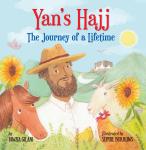
Yan’s Hajj: The Journey of a Lifetime by Fawzia Gilani illustrated by Sophie Burrows

Standard
Yan’s Hajj: The Journey of a Lifetime by Fawzia Gilani illustrated by Sophie Burrows

yans hajj.jpg

With less than a month until Hajj, this book should definitely start making an appearance in your children’s story selection rotation.  The focus is not on the parts of hajj, but rather the desire and intense yearning to go for the sake of Allah (swt).  Granted, it doesn’t take much to get me to cry these days, but this 27 page book for ages 5 and up, got me emotional.  Going for hajj is always something to plan for and hope for, and the sweetness of the reminder that we plan, and Allah plans and Allah is the best of planners is so beautifully brought to life, that I benefitted from the reminder and my kids from the lesson.

IMG_5485.jpg

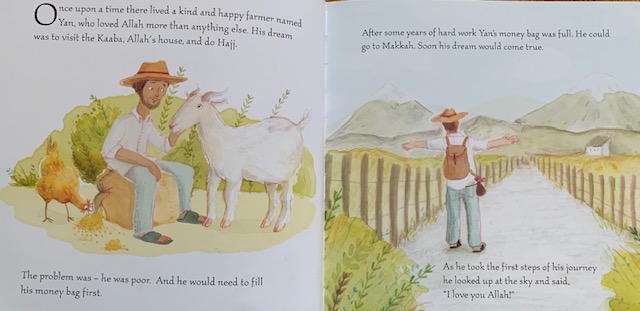
Yan is a farmer, a poor farmer, who loves Allah and wants to go for hajj more than anything else.  So he decides to work hard and fill up his money bag so that he may go.  After years of hard work his bag is full and he begins his first steps in his journey proclaiming his love for Allah.  After a few days of walking however, he comes upon some sad children who have recently lost their school to a fire.  Yan, uses his money and time to fix the school and returns back to his farm to start saving up again to go for hajj.IMG_5486.jpg

When his bag is full again and he sets out again, he is met by an injured boy who is being yelled at by his owner.  Yan, once again reaches into his money bag to generously do the right thing, in this case to pay off the boy’s debts and takes the boy home with him to be nursed back to health.

IMG_5487.jpg

After some time he again has a full money bag and sets off for Hajj.  Along the way he finds a village trying to build a mosque and after two months of helping with the funds and offering his own labor, the mosque is complete and Yan returns home.

IMG_5488.jpg

Now Yan is old, and after many years he looks in his money bag and it is not full and he sadly admits he cannot do hajj.  But then the boy he saved, Habeeb, returns with a horse cart to take him for hajj and they pass through the village where he repaired the school and is greeted with rose petals and gifts of ihram, they then pass by the mosque he helped build and the villagers gift him with food and water, they then arrive at Habeeb’s house and he is given a bag filled with money and at long last Yan’s dream comes true as he sees the Kaaba.

IMG_5489.jpg

The book shows how steadfast Yan’s love of Allah is and how generous and patient he is in pursuing that love. The illustrations of him aging are truly touching and gentle.  In some ways it reminded me of Shel Silverstein’s The Giving Tree, but with a happier ending, in bringing a large grown up concept down to size and presenting it in a genuine way.


Bilal Cooks Daal by Aisha Saeed illustrated Anoosha Syed

Standard
Bilal Cooks Daal by Aisha Saeed illustrated Anoosha Syed

bilal cooks daal

Aside from me desperately wanting to get Bilal’s family a pressure cooker this 40 page book does a good job, and follows a reliable tradition of using food to introduce a “foreign” culture while simultaneously showing universal themes that show how similar we all are when it comes to family, meals, friends and feeling loved.  

Bilal’s favorite food is daal, lentils, and when he is out riding his bike with his friends, his father calls him in to help him make it.  Confused as to why Bilal’s dad would need to start dinner so early in the day, Bilal’s friends join in, in helping make the slow cooking traditional asian subcontinent dish.

IMG_5306

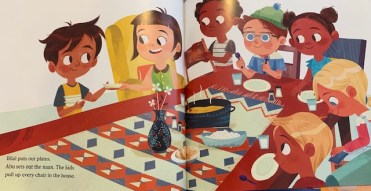
They line up the spices, they put it in the pot, and then they wait.  They put their shoes back on and play hopscotch, they go swimming, they go for a hike and it still isn’t done. 

IMG_5308

At one point Bilal is worried his friends won’t like it, but after waiting all day and gathering more friends at each activity, when the time finally comes they all dive in and love it.

IMG_5309

I love the diversity of the friends and that the dad is cooking and involving his son.  I also like that everyone is willing to try something new and give it a chance.

IMG_5307

The book would work for all kids ages 4 and up with the expressive colorful illustrations, diction, and amount of text on the page.  The book is 9×8 so it works well in small groups and at bedtime.  

IMG_5310

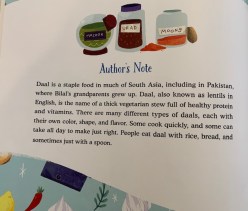
If you eat daal your kids will love seeing themselves in the pages, if you have never had daal there is a recipe at the end following an Author’s Note. 

IMG_5311

There is nothing religious in the book, and anyone from India, Pakistan, and Bangladesh could easily take ownership of the dish and story.  The Author’s note mentions that Bilal’s grandparents are from Pakistan and with a name of Bilal chances are he is a Muslim character.


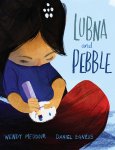
Lubna and the Pebble by Wendy Meddour illustrated by Daniel Egneus

Standard
Lubna and the Pebble by Wendy Meddour illustrated by Daniel Egneus

lubna.jpg

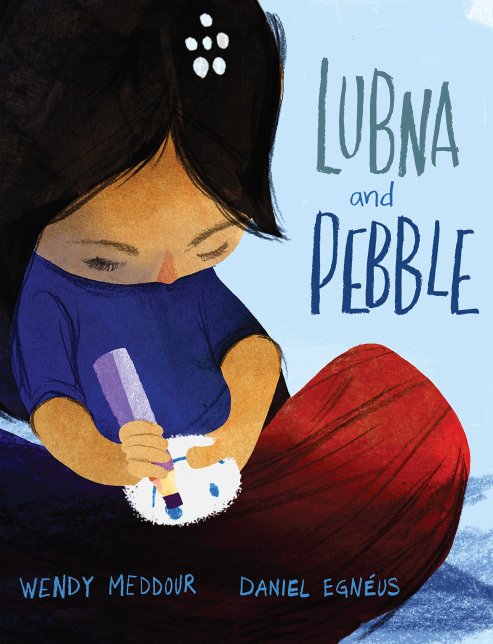
This beautifully illustrated book with simple text and story, is heartwarming and powerful in conveying emotion about child refugees. 

IMG_4993

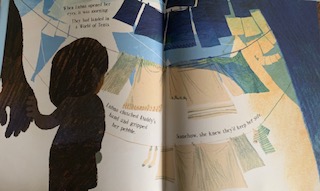
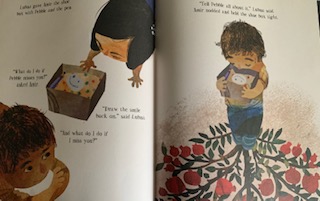
The 32 pages tell the story of young Lubna who has escaped something horrible and picks up a pebble when she and her father reach their new home, a World of Tents.  She finds a felt tip pen and draws a face on the pebble and the pebble becomes her friend.  She tells it her secrets, her dreams, she keeps it warm as winter approaches.

IMG_4994

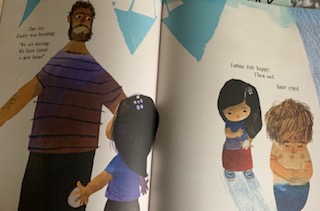
Then a little boy arrives, Amir, and Lubna and he become friends and she introduces him to Pebble.  One day Lubna learns she is leaving the tents to go to a new home and even though Pebble is still her best friend, she knows Amir needs him more.

IMG_4995

This book is truly a picture book, as the text is made magical because of the pictures.  The simplicity and love that Lubna feels for a rock reveals how much pain she has seen without details having to be given.  The fact that Amir doesn’t laugh or find being friends with a rock odd, cements the idea that these children have seen too much.  The compassion that Lubna displays by passing on her beloved Pebble also shows how much love and comfort they have, we all have, to give.

IMG_4996

The book has many layers, and the superficial one makes it a sweet story for children as young as four, the deeper understanding would appeal to kids up to 2nd or 3rd grade.  There is no mention of religion, culture, or a specific country.  I think Muslim children will assume Amir and Lubna are Muslim, but really the names could be from any culture or faith.

IMG_4997


Mommy Sayang by Rosana Sullivan

Standard
Mommy Sayang by Rosana Sullivan

sayang.jpeg

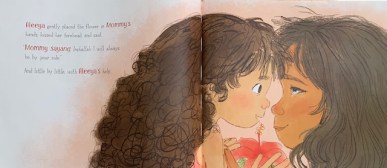
A Pixar Animation Studios Artist Showcase book which beautifully illustrates the bond of a mother and daughter.  Set in Malaysia, this diverse book shows a rich culture that readers will learn about, as well as relate to in 48 large 9 x 11 pages.

IMG_4975

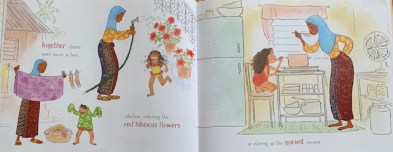
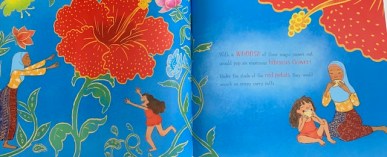
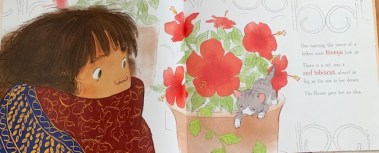
The simple text shows Little Aleeya watching her dear mother, Mommy sayang, pray five times a day, them doing chores together, cooking side by side, eating with friends and family, and smiling through it all.  Little Aleeya even dreams of her and her mother at night among the hibiscus flowers.

IMG_4976

Mommy Sayang, however, gets ill and Aleeya waits and waits for her to get better.  Day after day Aleeya grows sadder and sadder until one day she gets an idea of how she can help her mother.

IMG_4977

The change of perspective from Aleeya needing her mom, to her mom needing Aleeya is sweet and empowering.  The book doesn’t detail what makes her mom sick or why up until Aleeya’s idea takes form is she not able to hang out in her mother’s room with her.

IMG_4978

Listeners as little as 4 or 5 will enjoy the story and the tone provided by the minimal text and illustration style, older independent readers up to 2nd grade or so will learn new vocabulary and get a peek at a possibly new culture.

IMG_4979

I like that the mom wears hijab when they are out and about doing chores or people are over, but that when she is home in her bed she is not covered.  The illustrations are fabulous and gentle, as is the message.

IMG_4980

There is a small glossary of four words on the dedication and copyright page and there is a bit about the author, her inspiration, and what movies she has worked on at Pixar at the end.

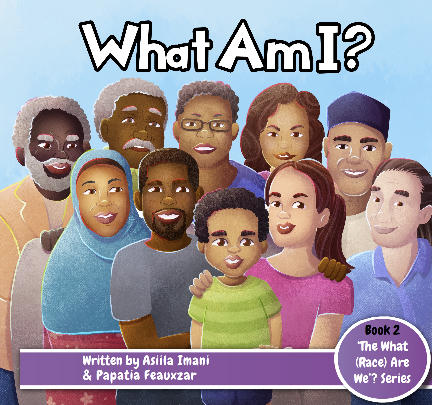
What Am I? Book 2 ‘The What Race are we Series’ by Asiila Imani and Papatia Feauxzar illustrated by Juliana Paz

Standard
What Am I? Book 2 ‘The What Race are we Series’ by Asiila Imani and Papatia Feauxzar illustrated by Juliana Paz

IMG_4825.jpg

This incredibly important 37 page picture book highlighting a little boys heritage will speak to children who see themselves in his quest to answer what he is, as well as (hopefully) inspire them to search out their own family ancestry and unique make up.

IMG_4828

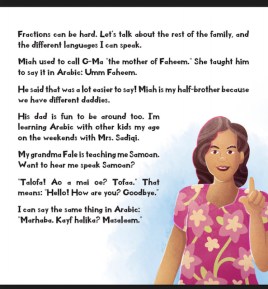
The book is not a traditional story book, in fact there isn’t much of a storyline, but the concepts presented show how beautiful and amazing multi-cultural and multi-ethnic families can be.  A lot of cultural information is conveyed and celebrated about Samoan and Pacific Island traditions as well as Islamic ones.

IMG_4831IMG_4832

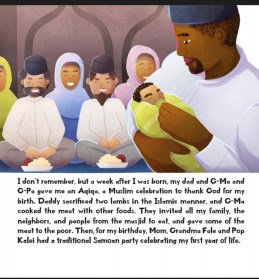
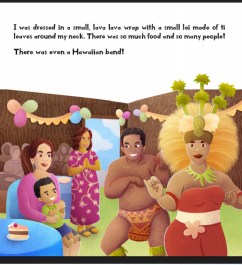
There is an aqiqa at the time of his birth as well as a Samoan party with a Hawaiian band.  Some members of his family cover, while other’s don’t.  He remarks how he has extra grandparents which equal extra blessings, and how he has a half brother because they have different dads.

IMG_4830

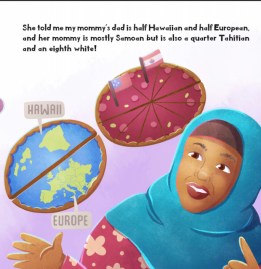
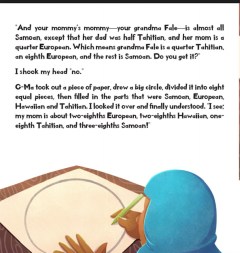
In addition to geography, there is also a STEM component as six-year-old Toa Idris learns he is a quarter this and half that through understanding fractions as visualized by slices of a pizza.  At one point Idris remarks that, “I can’t keep all those people and places straight,” and after reading the book half a dozen times, I honestly couldn’t either.  But, I think that is ok.  The point of the book is that being diverse is amazing, and having people love you is important, and culture and tradition and faith all make you richer.

IMG_4829 The text on each page is presented in a fun font, as are the pictures.  Really there is just one picture that makes Idris look angry and it is used in the story and the title page, which is unfortunate, I think it is supposed to have him look pensive, but it seems a bit off to me, where all the other pictures ooze with warmth and richness.

IMG_4826

I honestly don’t know what age group would benefit the most from the book.  Younger kids that may have been asked what their culture is will be empowered by having it reinforced that they are made just how Allah swt planned them to be, older readers will be able to create their own pizza slices, so to speak, and understand their own pieces, but I feel like both groups might need some coaching from an adult.  There are family trees at the beginning that almost become reference pages while reading the story and trying to keep everyone straight, that make the book almost interactive.  Muslim and non Muslim reader alike would learn about new cultures, and benefit from the “Extras” at the end.  Honestly, overall there is just a lot of information tossed around in the book, which isn’t a bad thing, it just might make it a bit more hit or miss if it will work for your child.

Love from A to Z by S.K. Ali

Standard
Love from A to Z by S.K. Ali

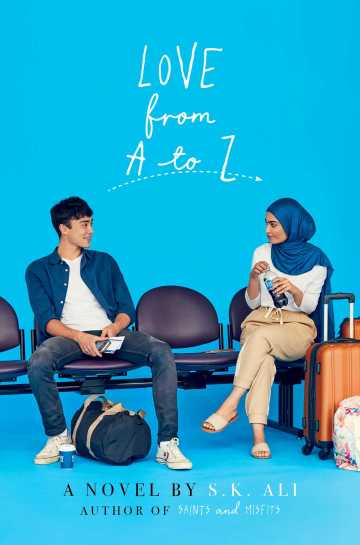
love from a to z.jpg

Now that there is legitimately a genre of YA Islamic Romance out there told in Own Voice, the expectations are high that a book is compelling, realistic, and unique somehow.  While the author’s first book, Saints and Misfits was pretty ground breaking, this 342 page was a great read, but not nearly as remarkable or memorable.  Granted it is not fair to compare the two books, and each day I do age out of the target demographic, but while the story reads authentic and true, albeit a bit serendipitous, it doesn’t have the teeth or grit I was kind of hoping for, and with a mother who suffers from multiple sclerosis my emotions were pretty invested.

SYNOPSIS:

Told from both Adam and Zayneb’s perspectives by way of their individual “Oddities and Marvels” journals, our two characters are presented by a narrator who keeps their story on track and interjects when their versions of an event differ. 

Zayneb is a high schooler and activist who has recently been expelled for threatening a teacher who consistently lets his Islamaphobic beliefs take over the days lessons.  In an environment filled with micro aggressions against Muslims, Zeynab’s parents are at a loss at how to keep their daughter from making waves, and thus allow her to leave her Indiana home a week before spring break to visit her aunt in Doha, Qatar.

Adam is at University in London where he has recently been diagnosed with MS and as a result has stopped going to classes, and is literally “making” the most of the time he has by making things.  As the term ends and he officially withdraws from school, he heads home to Doha to tell his dad and sister that he has the same disease that took his mother’s life years early.

The two characters meet at the airport briefly and then again on the plane and then at Adam’s house and the needless to say  their accidental meetings allow for friendship to grow, attraction to be built upon and a relationship to develop. Both characters have their own lives and own obstacles and own maturity that needs to occur in order for a happy ending to take place, and thus the book keeps you interested, invested and cheering them on.

WHY I LIKE IT:

I love the dynamic of how the book and characters are set up.  Both are practicing Muslims, both characters don’t cross a line, both characters have diverse mixed cultural backgrounds, and one is a convert and the other the daughter of a convert.  She is fiery and impulsive and emotional, he is pragmatic and calm and quiet.  While they have some background in common, their life experiences are rather different and it is very much a story about opposites attracting.  

I’ve been waiting for this book to come out, and so I knew my expectations would be too high.  That being said the book warns it is a love story and in some ways, that was what I kind of felt was lacking.  There was the physical attraction that was mentioned fairly often, but the deep connection of ideas or growing seemed a bit lacking.  

I really liked Adam, and his internal stresses and struggles and coming to grips with his disease seemed pretty developed.  Somehow though, and I’m probably in the minority, I didn’t love Zayneb.  She is impulsive and definitely learned and grew from the start of the book to the end, but I didn’t love her nuances with dealing with the Emmas and her friends back home and unraveling her teacher, it felt kind of forced and I can’t articulate why.  I’m glad she matured and she got answers about her grandmother, but maybe I should have felt so much in common with her and when I didn’t, I felt a little irritated.  Clearly I get too invested in fictional characters, I’ll admit that.

I like that Islam is presented in a non defensive way.  The parents aren’t evil, there is no rebelling, even the awful teacher spawns backlash and allies to Zayneb and her cause. There is no apologizing or overly explaining if the characters are pushing boundaries established by Islam or if they are establishing their own boundaries based on their understanding of Islam.  I like this, because it shows that Muslims are not a monolith, we are not one way good or bad.  Zayneb covers and prays and has friends that are boys and her family is kept in the loop of what she does, which alone breaks so many of the predominate stereotypes about Muslims.  Adam himself converted at age nine and plays the guitar and has friends that are girls, and is close to his sister, and likes dogs.  A side character is noted to be incredibly religious, but doesn’t cover.  The story takes place in an Islamic majority country, but attitudes at the swimming pool don’t allow Zayneb to dress modestly while she swims.  

Overall, the book is a delightful read that manages to keep the religious integrity in the characters and show their personalities as they come of age.  It may not be memorable years after reading, but what you do remember will be positive, and while you are reading it, you will have a hard time putting it down.

FLAGS:

There is angsty romance, and talk of sex.  The two main characters keep it pretty clean, but the side characters joke about hooking up, being horny, and sneaking off to hotel rooms.  The non Muslim aunt has a secret alcohol and cigarette stash that she gets called out on, but nothing more is mentioned about it. I think 9th or 10th grade and up will be perfectly ok to read.

TOOLS FOR LEADING THE DISCUSSION:

There is a lot to unpack in this book and I think if one just listens, teens will naturally add their own opinions and perspectives on EVERYTHING the characters experience, feel, question, and cope with.  The book just came out, but I would imagine that over time discussion questions will appear.

Author’s website: https://skalibooks.com/books/

Interview with the author: https://www.barnesandnoble.com/blog/teen/an-interview-with-s-k-ali-author-of-love-from-a-to-z/


Unlikely Friends by Sahar AbdulAziz

Standard
Unlikely Friends by Sahar AbdulAziz

unlikely friends.jpeg

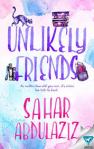
Another wonderful book by a Muslim author that doesn’t discuss Islam, but is expertly written and such a great read, that I wanted to highlight it here on the blog.  At 293 pages and involving a teen character I was really on the fence if this would qualify as “young adult,” so I reached out to the author to ask, and she, mashaAllah, responded! Unfortunately, she felt it wouldn’t quite qualify, even though it is a bit of a coming of age story.  So, why am I still reviewing it?  Because I think high schoolers (muslim and non) would really enjoy the book, and with finals nearly over, anyone in that demographic looking for feel good story that is pretty clean (Ramadan is nearly here), I think this book would be a great choice! And full disclosure, yes I’m biased, the librarian is the hero!

SYNOPSIS:

Told from multiple points of view the linear story brings together two introverts, Irwin and Harper, that have a lot of real and serious issues pressing them.  Their traumatic back stories are slowly revealed as the two unlikely friends come together to deal with their current predicaments.

Irwin is an old ornery librarian that doesn’t like people or change.  He is set in his ways and the stubborn Harper, a young high school student for some reason latches on to him.  He tries to shake her, but finds he is genuinely concerned about her and despite his better judgement finds himself helping her and getting tangled in to her messy home life.  

Surrounded by a cast of developed and diverse characters the fictional world of Irwin and Harper is both believable and realistic.  Irwin’s author neighbor is losing her memory, slowly, but noticeably, his deceased fiance’s daughter passes away shaking his routine, and his colleagues at the library are funny and annoying in their own ways.  Harper’s father is released from prison and her mother must make a stand to resist falling into old drug habits, all while trying to make ends meet and put food on the table.

WHY I LIKE IT:

I like that it reads so very smoothly.  You feel Irwin’s shell cracking and you see that he is so much more than just a stereotypical grumpy old man.  You also see Harper’s mother, Olivia concerned that her daughter and an old man are becoming friends.  You probably could predict how things will end up, but the way it is written you aren’t really worried, you are just enjoying getting to know the characters presented.  Overall, it really is a great lens to remind us all that friendship, real friendship is incredibly valuable.  In a world of filters and digital everything, sometimes our humanity is all we have.  I also like that people are given the chance to change and grow, the group of main characters are not stagnant or one dimensional, their challenges and dilemmas are brought in to the open and you feel for them as you would a real person.

The only two questions that stood out as inconsistent with the characters and story development are why didn’t Harper just get a job to help out her and her mother’s financial situation? Plenty of teens have jobs, so that seemed a little off to me.  Secondly, Olivia works at a supermarket presumably or a market of some sort, so it would seem that an employee discount or nearly expired food section would make their food insecure situation a little less severe.  Granted its fiction, but these two jarring concepts seemed to hold me back from completely being swept away.  

FLAGS:

The book is clean in terms of what is explicitly conveyed.  The details that make it possibly/probably not suitable for younger readers are the drug histories of Harper’s parents and what they did to acquire drugs, what they did when on drugs and what was allowed to take place around Harper when she was a child.  Darren, Harper’s father, believes that Harper was sexually abused by someone when he was high and this memory haunts him.  It isn’t explicit, but it is there.  Some mention of Olivia waking up in dealer’s beds is again mentioned in passing, but not detailed.  One could imagine two druggies trying to raise a child and get their next hit, but a lot of the understanding will come from the prior knowledge the reader has of such scenarios, not from the text itself. 

There is the idea that physical abuse was common between Darren and Olivia and is shown in Darren’s temper when he throws a vase against a wall after coming to Olivia and Harper’s home when released from prison.

There is some mention of Irwin’s fiance’s relationship with her ex-husband in that he cheated on her regularly.

So definitely, the book has elements for older readers, but the way the topics are discussed: drugs, abuse, infidelity, are not glorified or even detailed, more they set the stage in defining the current conflicts the characters face, the pasts they must over come, and the environments that they want to improve upon.  I think 15 and up could handle it.

TOOLS FOR LEADING THE DISCUSSION:

I’m thinking to recommend this book to the Sister that runs the high school book club.  I think there would be so much to discuss and myths to dispel that an older group would benefit from the experience and work the author does and writes about in this book.

Plus the fact that the author so easily responded to me, might inspire a group of teenagers to reach out and be equally inspired.


A Very Large Expanse of Sea by Tahereh Mafi

Standard
A Very Large Expanse of Sea by Tahereh Mafi

avleos

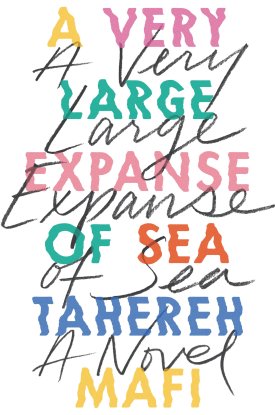
The book is often marketed as a Muslim coming of age story in a post 9/11 world.  The contemporary work is semi-autobiographical, but really I think the positioning is a bit misleading.  It’s a love story, and the main character is Muslim, and her environment is awful and she is angry. Its an engaging read, I read all 310 pages in one sitting, but I don’t know that the take-away will enlighten anyone about Islam, or really what it was like to be Muslim in the years after 9/11, I think people will remember how sweet the couple is and wonder how much of it mirrors the author and her husband, author Ransom Riggs (Miss Peregrine’s Peculiar Children), but not suddenly become knowledgable about more than what the main character experiences and endures.   I appreciate that the book challenges the stereotypes of Muslim women, there is authenticity as it comes from a writer who lives it, and I do think it shows evolution of attitudes that teens can benefit from.  The book is not yet in the AR database as it just came out, but I would imagine high school and up.  

SYNOPSIS:

Shirin’s Persian-American family moves a lot.  Her and her older brother are incredibly close as their parents are rather aloof to the day-to-day experiences the kids endure.  That isn’t too say her parents aren’t around, they eat two meals a day together and the parent’s are warm, but Shirin’s brother Navid is a much more present.  The story starts with 16-year-old Shirin starting her 12th new school.  Conditioned to not make eye contact, remember faces, or get affected by the trivialities around her, the reader sees how angry she is as she curses at a teacher that assumes she needs ESL not Honors.  Knowing how fleeting her time in any location can be, as her parents are constantly trying to find better jobs, Shirin doesn’t feel compelled to make friends or get attached to anyone or anything.  This intimidating vibe similarly keeps offers at bay, for the most part.  When she gets paired up with Ocean to dissect a cat, he tries to talk to her, and this throws her off her game.  Most every interaction she experiences at school are people making racist comments and being very one dimensional and bigoted.  Ocean tries to be nice, an attitude so foreign to Shirin that it begins to force her to change.  Simultaneously, Navid, who is charismatic and has no problem finding friends wherever they go, decides to put his and his sister’s dream into action and they start a break dancing club at school.  Three other kids join, and start becoming, not just Navid’s friends, but Shirin’s as well.  

Shirin and Ocean fall in love, despite Shirin fearing what the backlash will be for ocean.  She doesn’t really know anything about him, but feels strongly that all the racial slurs thrown at her on a daily bases will effect him and ultimately make them wish they didn’t pursue a relationship. She draws line after line in the sand, and crosses them all.  Only then does she learn how blind she has been, he is in two of her classes, not just one, he is a year older than her, and he is the golden star of the high school basketball team.  Being that the story is told from Shirin’s perspective, this is surprising to the reader as well.  The town turns on the pair and things get really ugly for Ocean who is willing to risk it all for Shirin.  Threats by the basketball coach, pictures of Shirin without her hijab being taken, accusations of terrorist ties and sympathies all challenge the couple and shape Shirin.

WHY I LIKE IT:

I really like the twist of having the relationship be difficult for the non Muslim, rather than going with the assumed Muslim girl having to sneak around.  Not saying that I support it, but interestingly she never mentions that what she is doing is going against anything religious.  She mentions twice that her parents wouldn’t like her with any guy, and that they view her as a child still, but she doesn’t explore Islamically any boundaries regarding their relationship.  She hides talking on the phone to Ocean, because her parents are adamant she gets enough sleep at night.  That is about it.  Shirin discusses that she wears hijab like an armor that she gets to pick who she shows her hair too.  I love the strength in that, but wish there was a bit of doctrine to back it up too.  At one point a Muslim, non hijabi, at school calls her out for wearing hijab and having a boyfriend, but she essential tells her it is none of her business, which it isn’t and who is to say that one sin is worse than another, but still it befuddles what exactly Shirin believes and why.  The book just paints her as a Persian Muslim, but never explores what that means other than the superficial outward appearance.  They do fast in Ramadan, no explanation about why is given, just that they not eat or drink during daylight hours, and right near the end, Shirin remarks how her mom asks her and her brother every morning if they have prayed and they lie and say yes, their mother sighs and tells them to make sure they pray the afternoon one, to which they lie and agree, only to have their mother sigh again.  AstagfirAllah, that is awful lying, and lying about Salat, but it is so real, I audibly chuckled.  

I like that the parents aren’t harsh, they just seem disinterested.  I didn’t want to read another book about the parent’s being the gatekeepers and bad guys, so that was really refreshing.  They mention they don’t celebrate Christmas, but they have an open door policy on Thanksgiving for any friends wanting to come.  I did hope for a bit more about them, why they don’t talk to the kids about moving, what makes them tick, because really they seem to have a solid relationship with the kids, they are just clueless to their social experiences and school environment stresses.

I love the growth and self reflection of Shirin, she holds a mirror to herself and she and readers are better for it.  She has to realize that she is doing so much of what she is accusing others of doing.  I love the support and genuine concern of the breakdancers and her brother.  It resonated to me as a girl with an older brother and the relationship feels very genuine. I just wanted to know more about Navid. 

FLAGS:

There is a lot of cursing. kissing, hand holding, romance, lying, and ditching school.  There is a brief mention of graffiti being sprayed.  There is racial slurs, threats of violence, violent physical outbursts by people of authority.  When a student throws a cinnamon roll at Shirin, Navid and his friends beat the kid up severely, it isn’t detailed, but it is mentioned.  Ocean  also gets suspended for a few games for a fight he engages in, and there is some detail of Shirin getting jumped in a previous city for wearing hijab.

TOOLS FOR LEADING THE DISCUSSION:

I don’t think I could in good conscience present this to a group of Muslim students.  I wouldn’t want them to think I was endorsing the violence and language and romance.  Like so many books of the genre though, if someone found it and read it on their own, I’d love to chat with them about it, as it is well written.

Youtube video about the book by the author: https://www.hypable.com/tahereh-mafi-a-very-large-expanse-of-sea-tour/
Allah Knows All About Me by Yasmin Mussa

Standard
Allah Knows All About Me by Yasmin Mussa

IMG_0013.jpg

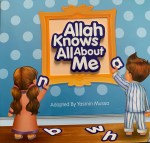
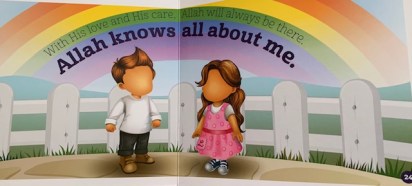
This adorable 24 page board book by Learning Roots has been adapted (with permission) from a book by Kate Toms called “God Knows All About Me.”  The 7.5 x 7 book is perfect for little toddler hands, and the repetition will help convey even to little ones that Allah is ever-present and all-knowing.

IMG_0015

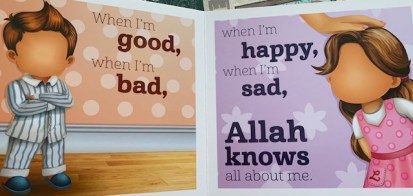
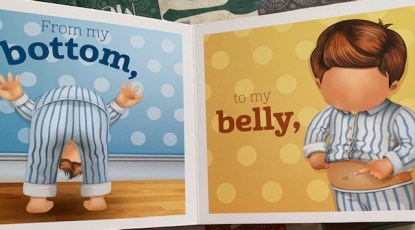
The illustrations are soft and warm and as with all Learning Roots books, I believe, the characters do not have faces.  The text is large and clear and many of the stanzas are silly is they show bottoms and talk of being smelly.

IMG_0016

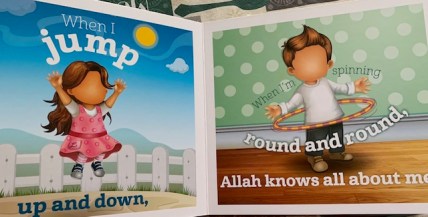
It covers Allah swt knowing us from our heads to our toes, when we are happy and sad, when it is raining or snowing, in all situations, all hours of the day, all environments, He knows and is always there.

IMG_0017

The reassurance that we are never alone or never apart from Allah’s love is a great message that is well done in this little book. A mention of Allah’s applicable 99 names might have been a nice addition at the end, but perhaps being the book is redone from an existing book, it wasn’t possible.  Hopefully parents will take the book to the next step and teach kids all of Allah’s many attributes in ways similar to how the presence of Allah is presented in this one.

IMG_0018

Ordinary Mary’s Extraordinary Deed by Emily Pearson illustrated by Fumi Kosaka

Standard
Ordinary Mary’s Extraordinary Deed by Emily Pearson illustrated by Fumi Kosaka

ordinary-mary.png

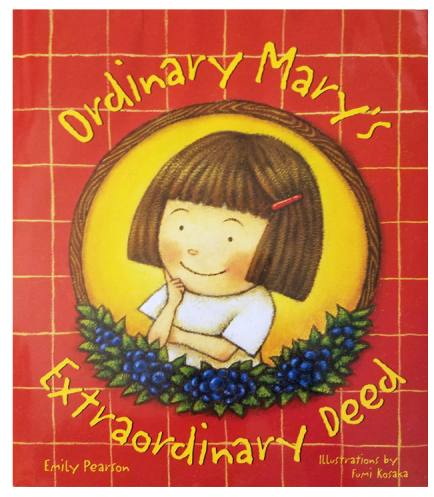
Once again I picked up a book for the message that it explored, making a difference, and found myself smiling triumphantly when a flip of a page revealed a Muslim lady depicted in an illustration, and her culturally Islamic name gracing the page. 

The book is an AR 4.2, and while there are a lot of words on each of the 32 pages, and the concept of an act multiplying might be hard for little ones to grasp, I think patient kindergarteners and first graders will grasp enough to make the story enjoyable.

IMG_2114

Ordinary Mary is so very ordinary, but she changes the world.  It all starts when she leaves berries for a neighbor.  And that neighbor, Mrs. Bishop, takes the berries and makes blueberry muffins and secretly gives them to five people.

IMG_2113

Each of those five people in turn give or do something kind to five people and over 30 billion people are impacted.  But there are not that many people on the planet, so there is love left over and extra to give.

IMG_2112

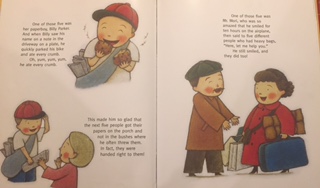
The book doesn’t follow all 30 billion obviously, but it picks and follows one person to show how the chain works before showing the mathematical growth in numbers.  Mrs.  Bishop gave a plate to the paperboy Billy Parker, who handed the next five people their newspaper personally instead of tossing it in their bushes.  One of the people that got their newspaper smiled for 10 hours on his flight, and helped people with their bags, etc etc.  

IMG_2109

The book shows that giving something can be something tangible, or a compliment, or a phone call, or a smile.  Over long distances,  the kind deed comes back to Mary and the message too, comes full circle.

IMG_2110

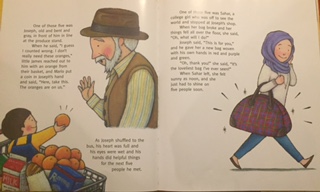
Along the line is Sahar, a college student who’s bag breaks and she benefits from a kind man who was just gifted oranges at the grocery store when he didn’t have enough money.  She in turn compliments a woman on a boat who is distraught and unsure. An important character in the link, and an import illustration of inclusion.

IMG_2111

There author mentions a variety of names, male and female, and the illustrator represents a fair amount of diversity of age, color, gender, religions, socio economic, ethnicity and mobility.  Truly, we all have the potentially to change the world.