Tag Archives: History

The Story of the Holy Prophet Muhammad (peace and blessings of Allah be on him): Ramadan Classics: 30 Stories for 30 Nights by Humera Malik

Standard
The Story of the Holy Prophet Muhammad (peace and blessings of Allah be on him): Ramadan Classics: 30 Stories for 30 Nights by Humera Malik

the story of prophet muhammad

I debated posting about this book for so long that Ramadan is more than half over.  But as a reference for years to come, I thought I should go ahead and throw my late support toward this Ramadan tradition and a book deserving of space on your shelf for children 4th grade and up.  I’ve seen people praising it for a few years, and finally I ordered it this year, however, I wanted to not only read it, but also test it out first: reading a story a day, discussing and asking the correlating questions with my own children, before reporting back.  I cannot and thus won’t comment on the accuracy of authenticity of the book, nothing stood out as erroneous to me and there is a bibliography at the back, but there is a reason I try and steer clear of non fiction, I’m just not qualified to comment.

SYNOPSIS:

The book starts with the birth of Prophet Muhammad (saw) and ends with the selection of Abu Bakr (ra) as the first Khalifah.  Each chapter is between one-and-a-half to two-and-a-half pages and the 30 chapters plus one Eid day chapter (so a total of 31), covers 103 pages in all.  There are a few pictures of where the Battle of Badr took place, the Cave of Hira, not many.  There are three questions at the back of the book for each of the chapters, but no answers.  The book is pretty linear, just the second chapter bounces back to Prophet Abraham (as) and Hagar and the story of Zamzam and then the rebuilding of the Ka’bah.  It is a glorified timeline, which in this case is a good thing.  It doesn’t go off on tangents or provide a ton of outside references, it is concise and general, but hits the key parts: marriage to Khadijah, first revelation, migration to Abyssinia, Taif, Hijrah, treatment of slaves, year of sorrow, Battle of Badr, Battle of Uhud, Treaty of Hudaibiyah, it talks of tensions with various tribes, coming to an agreement about the Khalifah, and more.

I think younger children might possibly be able to have the short chapters read to them and then explained, but really, it would be a lot to process.  The words are simplified and the gist of situations are conveyed, but topics aren’t necessarily shied away from.  It discusses that Prophet Muhammad (saw) had more than one wife, and that there were slaves, and there were tensions with the Jews, and Bilal was tortured, all things that picture books might skip over.

WHY I LIKE IT:

I like that even my young teen could read and involve herself without feeling like the exercise was childish.  Many of the answers are open ended in nature and require more than just a one word answer.  It allows for children to add other facts that they know about RasulAllah to the dialogue and make connections to our history with our current life very easily.  Even children that know the story of Prophet Muhammad (saw) will find the book engaging and smooth enough to read through again (and hopefully again each Ramadan) and learn new tidbits, understand concepts more clearly and be reminded about the beauty of our Prophet.

FLAGS:

Nothing

TOOLS FOR LEADING THE DISCUSSION:

If I was a teacher, I would definitely start each morning reading a chapter and doing the Q and A, whether it was Ramadan or not.  I think we need to be more connected to our Prophet and grow our love and appreciation for him, so books like this are such a great tool in accomplishing that goal.
 

Yusuf’s Ramadan Lantern by Jasmin Zine illustrated by Brad Cornelius

Standard
Yusuf’s Ramadan Lantern by Jasmin Zine illustrated by Brad Cornelius

yusuf ramadan lantern

The soft illustrations on 32 pages, surrounded by ample, large, well -paced text for second graders and up give life to a sweet story about a young boy, his grandfather, and the passing on of a Ramadan heirloom.  While not a chapter book, and a little too long for little ones to enjoy as a simple picture book, the book may not beg children to pick it up and read it, but if they do, they will enjoy a sweet story that parents won’t mind reading more than once.

10B43E53-3B8F-46E3-AE57-F9B372D1D282

Synopsis:

Yusuf’s grandparents have just returned from their trip to Egypt and Yusuf is excited to see them, and receive the electronic fanooz he asked them to bring back. But when Grandpa takes Yusuf outside to give him the gift, it isn’t the modern light up lantern he asked for, it is an old rusty, cracked metal fanooz.  Grandpa explains that the old fanooz used to be his when he was a young boy and begins his story of himself going out with his father to wake their neighbors for suhoor in Ramadan.  The subtle details of how he would be woken up, how his dad would beat the drum and the song they would sing as they would walk around, keeps the story slow and engulfing.  He then tells about returning and eating dates soaked in milk, and bread and fava beans before the white thread of light appeared.

Slowly the little boy, seeing how happy his grandfather is in his reminiscing, realizes that the fanooz he has been entrusted with is far better than the electronic one he asked for.  As he walks his grandfather out the door, he is surprised with the gift he originally wanted, the fancy new fanooz.  Not excited, his grandfather asks Yusuf what is wrong, and Yusuf, realizes that he likes the history filled one better.

The old fanooz finds a permanent place in Yusuf’s room, and he and his father fix the broken glass and polish up the metal to be regularly lit on Ramadan mornings and remind them all of grandfather as a little boy walking and waking people up before dawn.

26BA9466-BC9A-4153-AF82-313D43366B21

WHY I LIKE IT:

I love the subtlety and detail.  There are now so many books about the tradition of waking the neighbors up for suhoor, but this one focuses on the bonding of the grandfather and his father as well as the bond between the grandfather and Yusuf.  The story speaks of the tradition with the drum, yet somehow it is the lantern that ties it all together.

There is sufficient referencing about Ramadan and fasting to appeal to Muslim kids and inform non Muslims a bit.  The book is not preachy, it is cultural and religious in a narrative story sort of way.

My only main complaint is that I don’t know who the target audience is with the long pages of text, and full page pictures.  It is a hard book to place.  The illustrations are sweet and compliment the story, but in the pictures, Yusuf just seems too young.  His ability to appreciate his grandfather’s old lantern verses the electronic fanooz he asked for implies a bit older child.  In the pictures he looks like he is three or four years old, a disconnect that often distracted me from the story.  I also wish they would have used an Arabic word or title for the grandfather.

CE5EAF67-D73D-43EF-88CA-47DA31F098CC

FLAGS:

clean

60BAECF4-FF3A-4713-89DD-E22072503E47

TOOLS FOR LEADING THE DISCUSSION:

It is obviously too short and not the correct format for a book club, but I am hoping to share it at story time.  It will be a bit of a challenge for little children to sit through, but I’m thinking it is worth the effort, inshaAllah, bismillah…

DA2E16E8-7AD1-458F-BDD5-C6373BB5D04A

Ibn Yunus: The Father of Astronomy by Ahmed Imam

Standard
Ibn Yunus: The Father of Astronomy by Ahmed Imam

ibn yunus.jpg

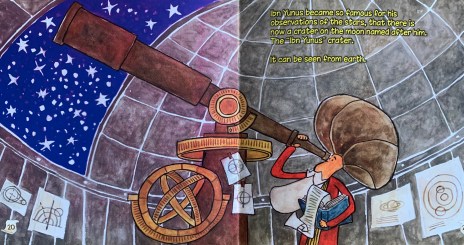
This book is part of a new Muslim Scientist Series featuring 24 glossy colorful 8×8 pages highlighting a great Muslim from the Golden Age of Islam.  Meant for Muslim children ages 4-7, the book sets out to teach and inspire little Muslims, and does a pretty decent job of presenting it in a memorable easy to understand way.  Adults might have to explain and help out a bit, but the book accounts for that too.

C6059DA8-08CC-41FE-9088-086C38EE07AC

The book starts off with some “Notes to Parents and Teachers” about supplemental activities and conversation starters to make the book relevant, and show how beneficial their contributions to science were and still are today.

A3210097-9DBA-49CC-B370-25187E4DCA3E

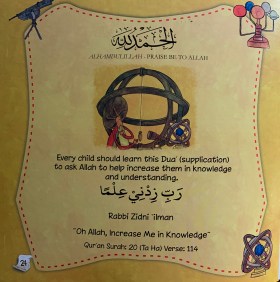
The book is a simplified biography of Ibn Yunus, and I would imagine the other books: Ibn Majid, Ibn Battuta, Ibn Al-Batar, follow the same pattern.  It tells about where he was born and when, and what he is famous for, before telling a bit about his family, an ayat from the Quran that inspired him is then given in English and Arabic and translated, before it shows how he worked toward his goal, and the accomplishments he made in his lifetime that still are used today.

938B76A9-E626-4B09-936E-446183F3141D

The fun illustrations make Ibn Yunus’s field of study easier to understand and will keep the littler listeners interested.  Adults will hopefully also learn something in the reading, and feel the same pride and inspiration of Muslim’s contributions to science.

13D95DDB-5EE2-4354-801D-85E561DABC86

It is critical to teach our children about the accomplishments and discoveries of Muslims, and this non fiction series is a great introduction to Muslim scientists, scholars, and adventurers, that they might not otherwise learn about.

The Chronicles of Bani Israil: The King, Queen, and the Hoopoe Bird by Dr. Osman Umarji illustrated by Sama Wareh

Standard
The Chronicles of Bani Israil: The King, Queen, and the Hoopoe Bird by Dr. Osman Umarji illustrated by Sama Wareh

the king

At 134 pages the fictionalized retelling of Prophet Sulaiman’s (AS) kingdom and interaction with Queen Bilqis comes to life from the point of view of a Hoopoe bird.  The book is marketed as a “Quranic fantasy adventure,” which I found a bit misleading.  The book is rooted in Quran and Hadith facts according to the author, and colored in to try and tie a story together, but even for 3rd and 4th graders I don’t know that there is much adventure or suspense.  As a prophet story it is pretty solid, but as an adventure book it seemed a bit scattered in its attempts to give history, draw in unrelated anecdotes and make it seem intense, when the dialogue suggested otherwise.

IMG_9137

SYNOPSIS:

The book starts with the narrator setting the stage to tell his story of being in Prophet Sulaiman’s army nearly 3,000 years ago in the land of Sham.  Told in first person and  limited to what he saw, the Hoopoe bird (Hud-hud) addresses the reader and begins his tale.  He first gives some information about Hoopoe birds and Prophet Dawud (Prophet Sulaiman’s father), before lovingly describing Jerusalem and how the Bani Israil came to the land of Sham.

The first real glimpse of what kind of ruler Prophet Sulaiman is, is given with the detail allotted to how he repaired Masjid Al-Aqsa.  The bird then tells of Prophet Sulaiman’s many powers and gifts from Allah (swt), the ability to control the wind, control liquid metal, speak with animals, and of course the Jinn.  Slowly, the reader begins to understand how impressive Prophet Sulaiman’s kingdom is, not just by being told, but being shown, so to speak, and reminded pointedly by the Hoopoe that despite so much power how humble towards Allah swt, Prophet Sulaiman remained.

There is a tangent about his love of horses, before the Hud-hud takes center stage again as a spy in the powerful army of men, jinn, and animals. The story of the ants is shared and about half way through the book it is on one of the bird’s scouting missions that he sees a Queen and her people worshipping the sun.

The back and forth between Prophet Sulaiman and Queen Bilqis as Prophet Sulaiman urges the Queen to allow her people to worship Allah or risk invasion is a familiar tale and one the author asserts he tried to use only Islamic sources to include.

The book ends after the Queen has visited, embraced Islam, more anecdotes about Prophet Sulaiman’s wisdom are shared and how even in his death he attempted to show the doubting people the power and oneness of Allah swt.  The revelation of the termite breaking his walking stick and the retirement of the bird who had lived a most wondrous life, conclude the story before an Author’s Note at the end of the book.

IMG_9117

WHY I LIKE IT:

I love Prophet stories and especially ones that are easy to read, memorable, and factual.  I think the book does a decent job in a fictionalized retelling of getting a lot of the important information in, albeit sometimes a bit forced, but keeping it on level for upper elementary and being clear and concise.  I didn’t stumble on grammatical mistakes or find parts confusing, it was well told and presented.  More than once in the book, I felt like it would have made a better oral story than written one.  The bird had to articulate how he knew stuff if he wasn’t there, and he kept asking the reader questions or telling them to pay attention.

The book is meant for Muslim kids and I wish there would have been footnotes or sources.

The illustrations were nice, they are full color but I am admittedly bias as I grew up writing letters to the illustrator who was my penpal for a few years.

IMG_9043

FLAGS:

None

IMG_9092

TOOLS FOR LEADING THE DISCUSSION:

Doesn’t fit my book club criteria, but definitely think kids would benefit from reading the story and discussing how the author shared the information, what they think the Hud-hud’s life was like and then maybe trying to retell a story of their own from a different perspective.


Lissa: A Story about Medical Promise, Friendship, and Revolution by Sherine Hamdy & Coleman Nye illustrated by Sara Bao & Caroline Brewer

Standard
Lissa: A Story about Medical Promise, Friendship, and Revolution by Sherine Hamdy & Coleman Nye illustrated by Sara Bao & Caroline Brewer

lissa-1440x2122

When I first started teaching I wasn’t a big fan of graphic novels, slowly I saw their benefit for struggling readers, and eventually I came to appreciate them as an enhanced tweak in story telling for everyone.  This book however takes the concept to the next level, for me anyway.   As the inside flap claims, it is a book “that brings anthropological research to life in comic form, combining scholarly insights and accessible, visually-rich storytelling to foster greater understanding of global politics, inequalities, and solidarity.” As a coming of age story of two friends at its core, yet taking on breast cancer, kidney failure, parental loss, different cultures, different religions and with a back drop of the Egyptian revolution, I’d say the book is meant for high school and up.  Not so much for content as for understanding and appreciation of all that went it to creating this ethnographic book.

SYNOPSIS:

Unlikely friends Anna and Layla cross economic, religious, and cultural differences to build a life long friendship.  The book is divided into three parts: Cairo, Five Years Later, and Revolution.  In the first part we see Layla’s family serving as the caretakers of a building and the two young girls bonding over pranks, arrogant tenants, and just being silly.  Anna’s family is American and the father works for the oil companies, thus they are financially very well off, however, the father is rather distant and the mother is dying of cancer.  The section concludes with the passing of Anna’s mom and the family going to Boston for the funeral.

Five years later finds the girls in college.  Layla in medical school and Anna at a university in Boston.  Layla’s father is suffering from renal failure and is unwilling to consider a transplant.  While Anna is trying to see if she carries the same genes as her mother and if insurance will cover it.  She also has to decide if she would want to have a complete double mastectomy, if she would want her breasts reconstructed, if she should do it now or later.  She gets a lot of opinions, but ultimately decides to find a way to pay for it and have it done.  Her father doesn’t understand, and Layla dismisses it forcing Anna to have to handle it alone.  But when news come that Layla’s father isn’t going to make it, she rushes back to Egypt to offer her support.
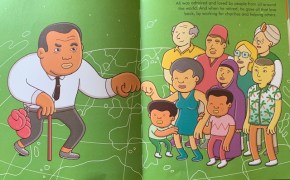
In the final section, the revolution has spread and Dr. Layla is helping those injured in Tahrir Square during the protests, and Anna is helping to identify bodies despite being attacked for being a foreigner and part of the problem.  Anna has kept the secret of her mastectomy from Layla and Layla assumes she has cancer.  At odds with their roles in the revolution, and with keeping secrets from each other and their differences in financial opportunities coming to a head, Anna returns to Boston.  When Layla’s brother is shot and loses an eye, however, Anna returns to Egypt and the two friends work to keep their relationship.

IMG_8951

WHY I LIKE IT:

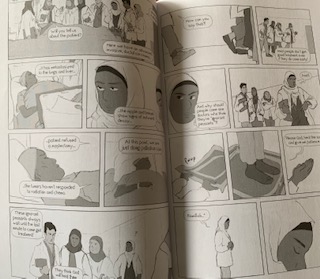
The book is grounded in so much conflict and turmoil, but fights hard to keep a character based narrative.  With two illustrators and two authors trying to convey medical approaches, two cultures, two religion, two friends, and a revolution, the last 70 pages of the 302 page book are details about how the book came about, interviews with the various contributors, a timeline of the revolution, discussion questions, key references and a teaching guide.  The book at times was confusing to me, and I’m not sure why, it quickly resolved itself or a flip back a few pages would clarify it, but I think some of the illustrations were just off enough that it complicated things.  Anna by and large is depicted oddly on a few pages along with her family as well.

IMG_8950

Layla’s family is definitely religious and at times has to challenge their thoughts to understand Anna and their own circumstances too.  I think it is handled really well and allows the reader to consider things without answers being clear cut, is it Allah’s will to not have a transplant and accept death as being written for you or to have the transplant and ask Allah to make it successful?  By and large the book poses questions through the juxtaposition of the two characters and the experiences they endure, and while it shows the choices they made, it draws the reader in to wonder what they would do in their shoes without judgement.  The book provides a lot of facts and leaves them there making it more thought provoking than a simple story.

The characters are often composites of real characters the academic author’s learned about, yet some are directly based on activists and leaders of the revolution.  The graffiti artwork is attributed and powerful.  There is a lot of information in the notes after the comics end.

FLAGS:

There is death and revolution, Layla’s brother is taking Tramadol, and their are sketches of breasts as Anna learns about her disease and prognosis.

TOOLS FOR LEADING THE DISCUSSION:

I wouldn’t do this as a book club as I don’t know how much middle schoolers would get out of it and the book is pretty pricey.  I would recommend people read it though as it gives a different perspective on numerous things many of us take for granted.

Home


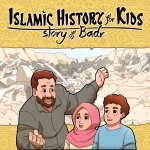
Islamic History for Kids: Story of Badr by Qasim Riaz

Standard
Islamic History for Kids: Story of Badr by Qasim Riaz

badr.jpg

This fictional story of a non-fiction-historical event over 37 large, 12×12, pages really brings the battle of Badr to life for readers ages seven and up.  The book is engaging and keeps chidden focused, excited, and clear as to what is unfolding, why the battle was important for Muslims, and why it still has lessons today.  Unfortunately, there are no source notes, bibliography, or references in the book, so I’m not sure how accurate the details are, and I haven’t yet had a chance to have someone more knowledgeable than I check it for accuracy.  The ayats from the Quran quoted are identified in text and yes, I understand it isn’t a reference book, but even having some imam or scholar give their approval would reassure people considering purchasing the book.  Additionally, fairly prominently there is a disclaimer at the beginning of the book that says, “The characters in this book are entirely fictional.  Any resemblance to actual persons living or dead is entirely coincidental,” which is a common disclaimer, but in a book of this nature, it did strike me as odd.  So, you may want to read it first yourself before presenting it to your child as fact.

3A02CEE2-B385-4AF0-8091-BB9E54CBE579

There is also a typo that my children discovered rather quickly and pointed out to me, I was a little disheartened when I asked about it, to discover the author knew about it before mailing it out, but for some reason didn’t find it necessary to put a note or let the customer be aware of it. I put a post-it note in mine to show all of you, and will be taking a black marker to it shortly.  Mistakes and typos happen, but I felt that they should have let the consumer know, once they knew that it was there, for accuracy sake.

85C78105-8FD8-4B2F-B031-A49272D287DF

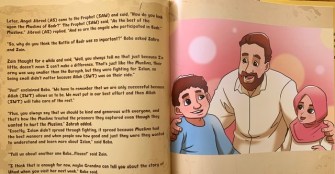
The book starts off with a brother and sister fighting, Zain and Zahrah.  When the father goes to stop them, Zain tells him that Prophet Muhammad (SAW) used to fight, and the father concedes the point, but points out it was not something he wanted to do.  He tells them that for the first 13 years he didn’t fight back even when the Quraysh made fun of him.

DA52115E-5314-4E5A-BE6B-9E38E6E88817

The kids ask who the Quraysh are and why they didn’t believe the Prophet, to which the father lovingly answers their questions before telling him about the verses revealed allowing them to fight from Surah Al-Baqarah.

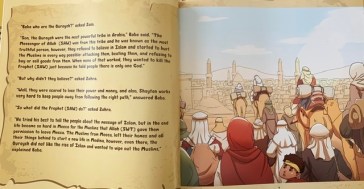
They learn about Abu Sufyan returning from Syria with a large caravan and how the Prophet wanted to surprise them. Only to learn that Abu Sufyan had arranged a much larger army from Mecca to come and attack the Prophet and his Companions.

There are details about how they determined the size of the army based on how many camels were being eaten, and how the Muslims camped near the wells to control the water.  The story reads smoothly and pulls out when the children have questions seamlessly.

FF278825-CA1F-4904-9F20-DF21DA7085BE

As the battle is set 1000 soldiers against 313 Muslims, the book explains how the battle starts with three duels and explains how Utbah, Shaiba and Walid battle Hamza (RA), Ali (RA), and Ubaydah (RA).  The Ansar win all three battles and the Quraysh charge.

5F4EFF83-0553-4FD0-919A-45814B973E9F

Prophet Muhammad (SAW) makes duas, and Allah (SWT) answers sending a thousand angels following one after another to help.

715028DE-D6FB-436D-88A1-65ACCA437AB2

When the dust settles the Muslims are victorious and the order is given for the prisoners to be treated kindly.  They are given food, rides, and the opportunity to pay a ransom for their freedom or they could teach 10 Muslims to read and write in exchange for their release.

With the story concluded the father then makes sure the children understand some of the many lessons from the battle.  Including having Allah on your side, trusting Allah, putting in your best effort, and being kind and generous even to those against you.

DE00F1A5-8C32-4CF9-8B6D-D880A4C77726

There is no illustrator listed, but the pictures are done really well showing modern relatable, squabbling kids getting drawn in to a historical story by their father.  The emotion on the characters faces adds depth to the story and engages the readers in seeing and understanding a desert battle so long ago.

The text on some pages varies quite noticeably, with some pages barely having a line to spare and some only being a line or two long.  It does slightly affect the rhythm (and aesthetic) of the book, but it is manageable as long as you remember to give the kids enough time to see the picture on the short pages, as the overall size makes the book perfect for story time to large and small groups.  The book stays on level, which is nice, and there is a glossary of abbreviated terms (AS, RA, SAW, SWT) at the end.

The company: Ghazi Production is planning Uhud to be the next book, and informed me a bibliography will be included in that one.  InshaAllah!


Little People, Big Dreams: Muhammad Ali by Isabel Sanchez Vegara illustrated by Brosmind

Standard
Little People, Big Dreams: Muhammad Ali by Isabel Sanchez Vegara illustrated by Brosmind

muhammad ali

A few things surprised me in this latest addition to the non fiction biography series Little People, Big Dreams. First that a police officer told him to learn how to fight if he wanted to face the thief that stole his bike.  Second, that the 32 page book targeting 5 to 8 year old children has an AR level of 4.8 and finally that it does mention his conversion to Islam and shows him praying.

IMG_7247

The biography hits a lot of major milestones in the boxer’s life after showing he once was a little kid too.  He was born in Kentucky, had a younger brother and after his bicycle was stolen he started learning how to box.  He wasn’t the strongest fighter, but he was fast.

IMG_7243

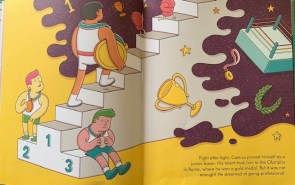
He won a gold medal at the Olympics in Rome, and then set his sights on being a professional boxer and becoming the world heavyweight champion.  Its nice that on this page the illustrations show that part of that pursuit involved physical training but the books and meditation show internal growth was valued and pursued as well.

IMG_7244

It shows how he used to taunt his opponents and that some thought it poetry, while other’s thrash talk. It also makes it clear that he used his voice to speak out for things important to him at a time when it was dangerous and accepted the consequences, whether it was African American rights or the war.

IMG_7246

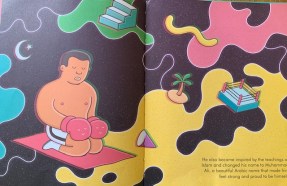
The page about him becoming Muslim explains that he was inspired by Islam, changed his name and “felt strong and proud to be himself.”  After his ban from boxing, he won the heavyweight belt three times before retiring and dedicating his life to community and giving back.

IMG_7248

The book ends with a timeline and some real pictures of Muhammad Ali, along with some other books you can turn to for more information.  The illustrations are comical yet detailed in their emotion and the information that is conveyed.  Kids will enjoy them and find they give life to the simple text on the pages.

IMG_7245

I got my copy from the library and my children aged 4-12 enjoyed the book as they have the other books in the series.

IMG_7249


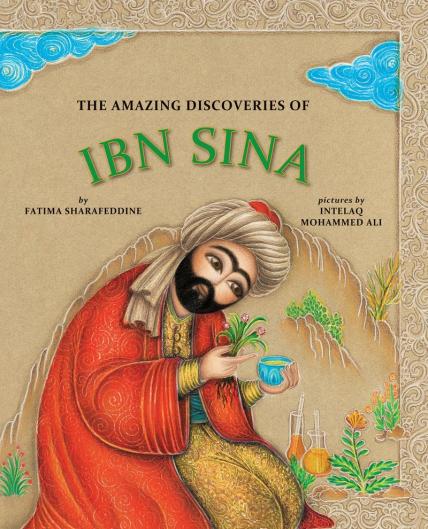
The Amazing Discoveries of Ibn Sina by Fatima Sharafeddine illustrated by Intelaq Mohammed Ali

Standard
The Amazing Discoveries of Ibn Sina by Fatima Sharafeddine illustrated by Intelaq Mohammed Ali

ibn sina.jpg

This non fiction, 32 page book is important in introducing 3rd graders and up to a very influential Muslim that shaped the world.  I try to keep to fiction reviews, but as someone who didn’t learn about Avicenna/Ibn Sina until college, I feel like the sooner we can inspire our Muslim children to know some of these remarkable historical figures and get their stories into western curriculums the better for us all.

IMG_5007

The book is told in first person and is translated from Arabic so parts are a bit awkward, such as when he is telling when he died, and parts do sound a little arrogant, but all that aside the book stays on task in describing Ibn Sina’s accomplishments and not getting distracted by historical, political, or cultural influences.  Some could argue that some context would be nice, but for 8 and 9 year olds, the facts are impressive enough and the streamline approach I think makes it something they can grasp.

IMG_5008

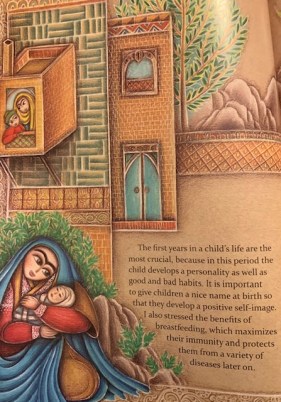
The book is beautifully done with a 9×12 hard cover and glossy pages.  The colored pencil pictures are beautiful and rich on most pages, with the neck and eyes a bit distracting on others.

IMG_5009

The book of course mentions his contributions to medicine but also includes his Islamic knowledge of memorizing the Quran and studying Islamic Law, cultural knowledge of knowing volumes of Persian poetry, architecture, literature, music as well as his extensive studying of philosophy, logic, linguistics, and more.

IMG_5010

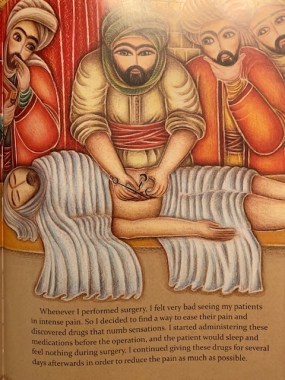
It also mentions some of his findings, which do a great job of showing readers how relevant and important his work was then and now.  Understanding how children should be educated, how infections passed, that light travels faster than sound, anesthesia for surgical patients, to name a very, very few.

IMG_5011

I checked out the book from the public library and made my kids all read it, well not the 3 year old, and I think Islamic school teachers and Muslim parents really need to try and expose their kids to his accomplishments, get them excited about how their faith promotes questioning and education and then work on getting historical figures such as Abou Ali al-Hussein ibn Abdullah ibn al-Hassan ibn Ali ibn Sina more widely known in the greater society.

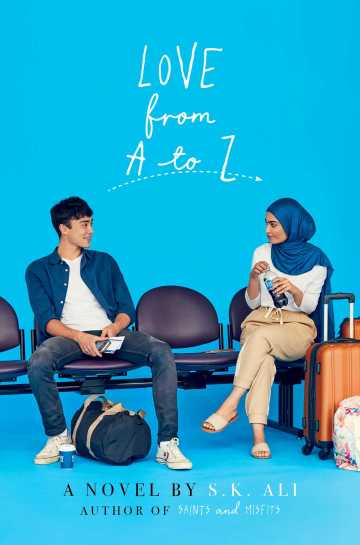
Love from A to Z by S.K. Ali

Standard
Love from A to Z by S.K. Ali

love from a to z.jpg

Now that there is legitimately a genre of YA Islamic Romance out there told in Own Voice, the expectations are high that a book is compelling, realistic, and unique somehow.  While the author’s first book, Saints and Misfits was pretty ground breaking, this 342 page was a great read, but not nearly as remarkable or memorable.  Granted it is not fair to compare the two books, and each day I do age out of the target demographic, but while the story reads authentic and true, albeit a bit serendipitous, it doesn’t have the teeth or grit I was kind of hoping for, and with a mother who suffers from multiple sclerosis my emotions were pretty invested.

SYNOPSIS:

Told from both Adam and Zayneb’s perspectives by way of their individual “Oddities and Marvels” journals, our two characters are presented by a narrator who keeps their story on track and interjects when their versions of an event differ. 

Zayneb is a high schooler and activist who has recently been expelled for threatening a teacher who consistently lets his Islamaphobic beliefs take over the days lessons.  In an environment filled with micro aggressions against Muslims, Zeynab’s parents are at a loss at how to keep their daughter from making waves, and thus allow her to leave her Indiana home a week before spring break to visit her aunt in Doha, Qatar.

Adam is at University in London where he has recently been diagnosed with MS and as a result has stopped going to classes, and is literally “making” the most of the time he has by making things.  As the term ends and he officially withdraws from school, he heads home to Doha to tell his dad and sister that he has the same disease that took his mother’s life years early.

The two characters meet at the airport briefly and then again on the plane and then at Adam’s house and the needless to say  their accidental meetings allow for friendship to grow, attraction to be built upon and a relationship to develop. Both characters have their own lives and own obstacles and own maturity that needs to occur in order for a happy ending to take place, and thus the book keeps you interested, invested and cheering them on.

WHY I LIKE IT:

I love the dynamic of how the book and characters are set up.  Both are practicing Muslims, both characters don’t cross a line, both characters have diverse mixed cultural backgrounds, and one is a convert and the other the daughter of a convert.  She is fiery and impulsive and emotional, he is pragmatic and calm and quiet.  While they have some background in common, their life experiences are rather different and it is very much a story about opposites attracting.  

I’ve been waiting for this book to come out, and so I knew my expectations would be too high.  That being said the book warns it is a love story and in some ways, that was what I kind of felt was lacking.  There was the physical attraction that was mentioned fairly often, but the deep connection of ideas or growing seemed a bit lacking.  

I really liked Adam, and his internal stresses and struggles and coming to grips with his disease seemed pretty developed.  Somehow though, and I’m probably in the minority, I didn’t love Zayneb.  She is impulsive and definitely learned and grew from the start of the book to the end, but I didn’t love her nuances with dealing with the Emmas and her friends back home and unraveling her teacher, it felt kind of forced and I can’t articulate why.  I’m glad she matured and she got answers about her grandmother, but maybe I should have felt so much in common with her and when I didn’t, I felt a little irritated.  Clearly I get too invested in fictional characters, I’ll admit that.

I like that Islam is presented in a non defensive way.  The parents aren’t evil, there is no rebelling, even the awful teacher spawns backlash and allies to Zayneb and her cause. There is no apologizing or overly explaining if the characters are pushing boundaries established by Islam or if they are establishing their own boundaries based on their understanding of Islam.  I like this, because it shows that Muslims are not a monolith, we are not one way good or bad.  Zayneb covers and prays and has friends that are boys and her family is kept in the loop of what she does, which alone breaks so many of the predominate stereotypes about Muslims.  Adam himself converted at age nine and plays the guitar and has friends that are girls, and is close to his sister, and likes dogs.  A side character is noted to be incredibly religious, but doesn’t cover.  The story takes place in an Islamic majority country, but attitudes at the swimming pool don’t allow Zayneb to dress modestly while she swims.  

Overall, the book is a delightful read that manages to keep the religious integrity in the characters and show their personalities as they come of age.  It may not be memorable years after reading, but what you do remember will be positive, and while you are reading it, you will have a hard time putting it down.

FLAGS:

There is angsty romance, and talk of sex.  The two main characters keep it pretty clean, but the side characters joke about hooking up, being horny, and sneaking off to hotel rooms.  The non Muslim aunt has a secret alcohol and cigarette stash that she gets called out on, but nothing more is mentioned about it. I think 9th or 10th grade and up will be perfectly ok to read.

TOOLS FOR LEADING THE DISCUSSION:

There is a lot to unpack in this book and I think if one just listens, teens will naturally add their own opinions and perspectives on EVERYTHING the characters experience, feel, question, and cope with.  The book just came out, but I would imagine that over time discussion questions will appear.

Author’s website: https://skalibooks.com/books/

Interview with the author: https://www.barnesandnoble.com/blog/teen/an-interview-with-s-k-ali-author-of-love-from-a-to-z/


Ayesha Dean: The Seville Secret by Melati Lum

Standard
Ayesha Dean: The Seville Secret by Melati Lum

seville.jpg

This is the second middle grade mystery story for globe trotting sleuth, Ayesha Dean, and much like her first adventure in Istanbul, this Spanish setting is infused with rich history, delicious food, relatable characters and quick paced action.  

SYNOPSIS:

Once again Ayesha and her two friends Jess and Sara are tagging along on a business trip with Uncle Dave, Ayesha’s uncle who has raised her since her parent’s passing.  As they wait in line to board the final flight of their lengthy journey from Australia, a young man drops his contents and Ayesha and him chat, later they are seated next to each other on the plane where he discloses his travels from England to Seville are to help locate his missing grandfather.  Ayesha volunteers herself and her friends to help him and they hit the ground in Spain determined to solve the case.

The boy, Kareem, is staying with the friends his beloved grandfather was staying with when he went missing, so that is where the detectives start their work.  In searching his room, Ayesha uncovers a 400 year old diary written in Arabic, and a pamphlet from the Archeology Museum with a necklace circled, the Collar de Pajaros.  Just enough to get them started and set their adventure in motion.

The group of teens rely on Kareem to translate the Arabic in the diary and Ayesha’s wit to decide what to follow up on and how to incorporate their sightseeing with the task at hand.  As they journey through the city of Seville, learning the history and tasting the food, nefarious characters start to notice the group and things get intense.  From Cathedrals, to cafes, to Museums, and even to an ancient city uncovered in Cordobo, Madina Al-Zahra, the chase is on, not only to find Kareem’s grandpa, but to also avoid being caught themselves and maybe even solving a centuries old mystery about treasure and a necklace along the way.

WHY I LIKE IT:

I love that Ayesha in any situation stays true to her self.  She wears hijab, she prays, she is aware of the good looking guy, but doesn’t cross her own line, she is a good friend, an inquisitive person, and confident.  All amazing attributes for a fictitious hero and real ones too.  

Much like Nancy Drew and other middle grade novel series, the books don’t need to be read in order, and while they reference other adventures, they stand alone sufficiently too.  Also, like the aforementioned books there is definitely a formulaic pattern to how the author writes her books.  And while reading it I didn’t notice it intensely, as I write the review I do.  Ayesha travels abroad, she has her sidekicks that are not developed at all and truly have no barring on the story plot wise or as comic relief, they are simply foils to bounce conversation off of, there is a cute boy who could be pursued, but isn’t, someone passes out while she and her friends are sight seeing, and the spouses provide added clues, Ayesha gets locked in a small dark space, there is a twist and a surprise, a trap, and they all live to repeat the adventure in another city another day.  I don’t think I have a problem with it, but maybe because I am not the target audience age, I might get bored with it about book four or so.  As it stands right now, I’m anxiously waiting for book three.

While reading I was a little irked that Sara and Jess weren’t any more developed in Spain than they were in Turkey.  One of them could have been the one to administer CPR or to stumble on the diary in the room, something to give them some plot significance, but alas, the books do not bare their names.  I wish Kareem would have at least said “Salam” on occasion.  I like that the author shows he doesn’t know much about Islam and shows that his grandfather admits its been so long since he has prayed, but the boy is a Morisco and his parents immigrants from Algeria, he translates Arabic, he should say Salam when he meets Ayesha in her hijab wrapped head. 

The author does a much better job in this book staying with the characters and showing the city through their eyes rather than pulling them out of their scenes to convey something.  Only once at the end of a chapter did I feel there was some forced foreshadowing that was not needed, as the book is quick and chapters may end, but the pages still turn until the end is reached.  I had more trouble putting the book down than picking it up, and that is saying something as I read it online and I definitely favor physical books.

I wish there was an afterword or author’s note explaining what was real and what was fiction.  I googled Madinat al-Zahra and found it fascinating, but couldn’t find anything in English about the Collar de Pajaros.  Also a map or two would be great.

FLAGS:

None.  This book is clean and even the fights are not gory or over the top. Yay!

TOOLS FOR LEADING THE DISCUSSION:

I would absolutely do this as an elementary book club selection, and can’t wait to get a copy to my children’s school library and their classrooms.  The book is an easy read and the history and culture is seamlessly interwoven in to the story that kids will enjoy the action and find they learned something about a culture along the way.   I think boys and girls will enjoy it, even if it appeals more to the girls.   The cover, the binding, the font is all spot on for the age group and I eagerly await Ayesha’s next adventure.