Tag Archives: hijab

That Can Be Arranged: A Muslim Love Story by Huda Fahmy

Standard
That Can Be Arranged: A Muslim Love Story by Huda Fahmy

arranged

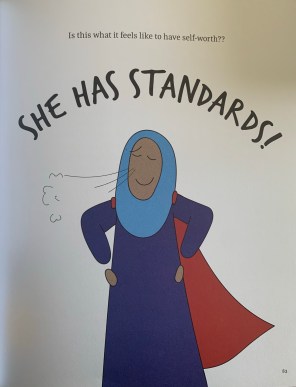
I’m not entirely sure why I didn’t review and highlight the first book, “Yes, I’m Hot in This: The Hilarious Truth About Life in a Hijab” I really should have, so to cut to the chase if you don’t follow the author/illustrator on social media you really should and you should read both her books.  Both are for all ages and while meant for adults, teens and tweens love it as well, I should know I’ve purchased and gifted over a dozen of them. I find my kids thumbing through both books a lot: my (early) teen girl and my tween boys.  Part of is it because the comics are funny, relatable, but more importantly as I’m learning from my kids, because they are curious.  In this book particularly, it is a great example of how Muslim marriages can happen, sure my kids know how my husband and my marriage was “arranged,” but they are constantly surrounded by ideas of dating and crushes and even divorce that I never realized that a book like this, featuring Muslims, actually Islamically contextualizes some of their gleamed information.  The fact that the book is hilarious and clean and rings with such honesty, makes it easier for them to articulate their questions and removes some of the taboo as well.  So, buy it for yourself to enjoy and if you have kids 11 and up in your home, you are ok to let them read it too.

img_6586

SYNOPSIS:

It isn’t a chapter book, it is part comic book, part story, part info-graphic, and all biographical.  The book opens with an ayat about spouses from the Quran and follows with an informative and funny message to the reader.  Seriously, I laughed as she explained about drawing herself with hijab in bed and noting that most people don’t read the notes to the reader at the beginning. There are also a list of helpful terms before the introduction begins.  Her story is broken up in to sections to pace and move the story along.  It starts with the ground work of expectations and cultural norms and then tells her story of how she eventually met and married her husband.  Not that it is straight forward, the book is 192 pages.  There is a decent amount of explaining Islam and the role culture plays in the many pitfalls and big decisions along the way.

img_6587-1

WHY I LOVE IT:

I think any female, born Muslim, over the age of 20 will relate to a lot in this, lots of others will as well, but that demographic specifically will find parts very reflective of their own experiences.  I love that it shows the banter between the protagonist and her mother, truly that to me was the heart of the story.  I love that it shows female empowerment and vulnerability at the same time within an Islamic context and unapologetically.  This book is by a Muslim for Muslims, but non Muslims will enjoy it as well.  It dispels and illustrates what an “arranged marriage” can mean for Muslims and shows that there is more than one way to understand the label.

I love the size of the book, the binding and the page quality.  I had no problems with “Yes, I’m Hot in This,” but after seeing the larger size of this book 7 x 8 and the thicker pages, I really preferred this presentation.

img_6589

FLAGS:

Clean

TOOLS FOR LEADING THE DISCUSSION:

Obviously not really a candidate for a book club, but I think teen girls would enjoy reading this and laughing about it with a group of friends.

img_6590

So fun and so good, alhumdulillah.

A Galaxy of Sea Stars by Jeanne Zulick Ferruolo

Standard
A Galaxy of Sea Stars by Jeanne Zulick Ferruolo

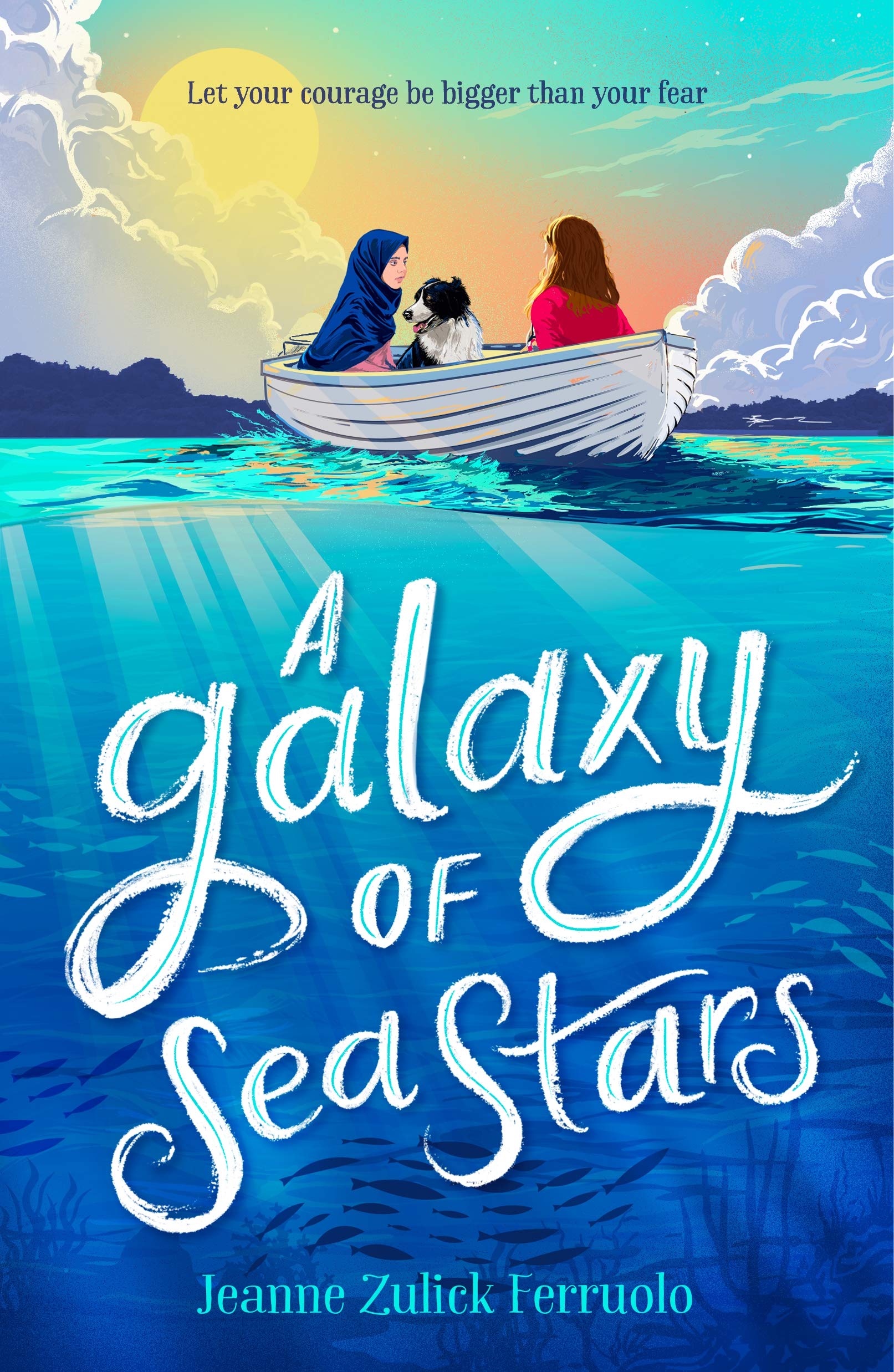
This middle grade, 330 page book is an easy read that touches on concepts of change within friendships and families with the back drop of life in a coastal town, finding courage, and Islamaphobia. While early middle school readers might find the book a bit predictable and cliche’, the characters, lessons, and fluid storytelling would still make the book worth their time.

SYNOPSIS:

Eleven year old Izzy spends her summer days in Rhode Island on her skiff mapping out the floor of the pond that runs next to the ocean. Fearful of the open ocean, she is, however, confident and independent in her abilities to navigate the calmer water and understand what is beneath the surface. Her father has recently returned from Afghanistan and with his post traumatic stress disorder making him angry and not the same as before. Izzy is further thrown into turmoil when the family moves out of their house and into the marina, her mother extends her already summer long absence to Block Island and middle school at a new regional school is about to start. As always she hopes to lean on her fellow sea stars, Zelda and Piper, best friends since kindergarten, however, things with them don’t quite seem the same either. Add in that her father’s translator from Afghanistan and his family have just moved in upstairs with their two young boys and 11 year old daughter Sitara, and Izzy has a lot to handle and navigate.

Piper and Zelda decide to take television production class first period to make sure they have at least one class together, Izzy is incredibly shy and while she appreciates that this has all been arranged she isn’t confident that it is a good fit for her. Dragged along, as it seems she often is by her much more confident friends, It is arranged that Sitara will also be in the class. Right away Piper and Zelda decide that they don’t like Sitara and her hijab and her “different-ness” and exclude her and by extension Izzy from their lives. As Sitara and Izzy get closer and start to learn from one another, Piper and Zelda lash out and go from ignoring to being mean to Izzy and Sitara. Sitara explains to people on the announcement show why she covers and helps Izzy to understand that her father was in danger after helping the Americans and that they had to leave Afghanistan. The anniversary of 9/11 however, turns many students into verbally berating Sitara and her having her hijab pulled off in the lunchroom. When Izzy figures out that her former sea stars were involved in the planning she is devastated and must take the lessons from Sitara and her Czech Grandma to have more courage than fear, find her voice, and do something to make things right.

WHY I LIKE IT:

I love that Izzy has a lot going on in her life and in many ways Sitara has been through a lot, allowing them to encourage each other to keep moving forward. There are some parallels in losing their homes and dealing with change that they comfort each other with, but the two characters combined show readers that strength and bravery occurs when you are afraid, and that most people aren’t truly fearless. I really feel for Izzy, her friends may have been there for her on occasion, but by and large they seem kind of dismissive of her and her fears. I think she sees them as equal, but I don’t get the feeling that they see her that way, they may be protective of her, but they kind of bully her in to doing what they want. Every few chapters is a flashback to a pivotal point in the sea stars friendship and even before Sitara enters the dynamic, I started to question Piper and Zeldas sincerity. Their best friend just moved, her dad came back from serving in Afghanistan, and her mom is not coming home, they should be concerned, not belittling her for liking art and wearing old clothes. The mom is another painful plot point, like lady I get that you have stuff going on in your life, but really you are just going to leave your child? Ya, I wasn’t a fan of hers.

I like that the story addresses Islam and Islamaphobia, and while it is very much in the story, it isn’t really about it. Izzy is front and center, and even she takes a while to warm up to Sitara. I love that it shows what Afghanis that helped fight against the Taliban went through and how painful it is for them to resume life after doing so. I think this point is so lost in mainstream understanding whenever there is a terrorist attack, that this is what the refugees are leaving, that people in Afghanistan and Iraq and Syria are running from, and when they get called terrorist it hurts that much more, because their whole lives and people they care for have suffered from the real terrorists.

I really wish there was a map, I wanted to visualize better the breachway and had I not lived in Rhode Island for a few years I probably wouldn’t have understood Block Island’s location to to the mainland. Like with so many middle grade novels I wish there was some more depth to the characters, but I truly appreciated that there wasn’t a completely happy ending, and that growth occurred in so many characters, but at different rates. It really made it clear that we all need to continuously work to get to know one another, find our voice, our courage, and be willing to change.

FLAGS:

Clean.

TOOLS FOR LEADING THE DISCUSSION:

I don’t do an elementary book club, but I think this would be a great recommendation for those that do. There is a lot to discuss and explore that kids can relate to. The majority of the characters are female, but I think the themes are universal enough that boys will enjoy the book as well. I’m confident all readers will learn something new about sea stars and possibly even television production in this sweet story.

Solar Story: How One Community Lives Alongside the World’s Biggest Solar Plant by Allan Drummond

Standard
Solar Story: How One Community Lives Alongside the World’s Biggest Solar Plant by Allan Drummond

Set in Morrocco, the fictionalized framing of a children’s story about solar energy and sustainability at the the world’s largest solar plant in Ghassate will appeal to curious children in kindergarten and up. Told through the every day life of Jasmine, a little girl living near the plant, the concepts are not technical, but give a broad overview allowing readers to understand how impressive solar energy is, as well as the disparity that exists in the world. Over 40 pages with factual sidebars and an author’s note at the end, children who enjoy the story and are curious about the reality of it all will find an easy opportunity to learn more.

Jasmine and her friend Nadia live in Morocco between the High Atlas mountains and the huge Sahara desert. It is always sunny where they live.

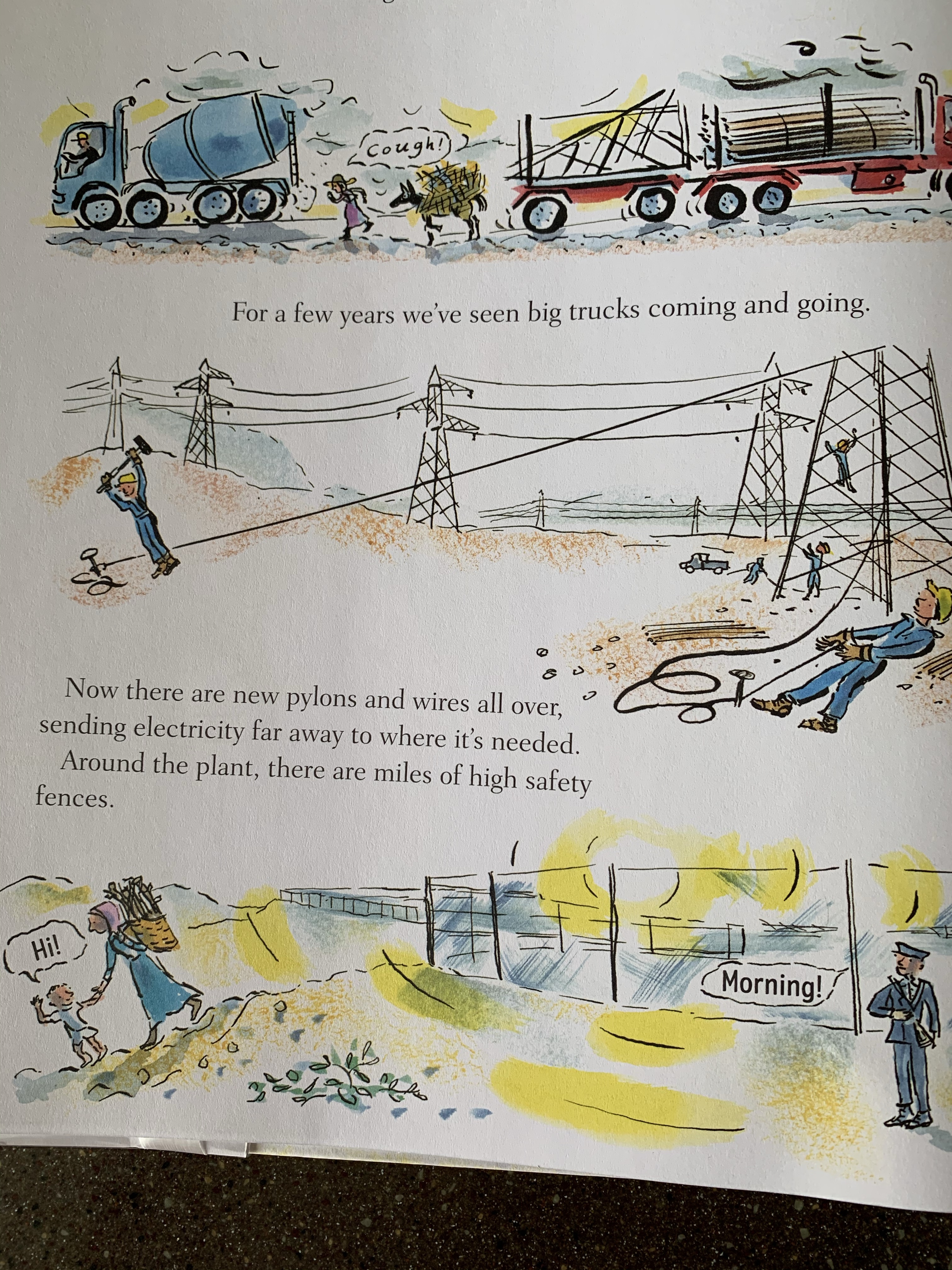
They talk a lot about making energy from sunshine as they watch trucks going and coming from the world’s largest solar plant. Their teacher likes to ask them about the big changes happening in their world.

As the villagers tend to their sheep and cows, they cook on open fires and bake bread in clay ovens all while keeping an eye on the workers making the largest solar tower in the world. Jasmine’s dad rides a mule to work and many classmates parents work at the state of the art plant. The contrast is obvious.

The next day at school Miss Abdellam the teacher asks the students about sustainability. And the book doesn’t define the concept right away. First the class goes on a field trip to the solar plant.

At the plant the size of 3,500 soccer fields they see the 660,000 mirrors that follow the sun like sunflowers and bounce the rays to the 800 ft tower. The tower gets to a thousand degrees on top and heats water whose steam powers turbines and is turned into electricity.

The kids go home to work on their sustainability homework. With no internet or computers even, they have to think for themselves. The remaining pages define and provide examples of how solar power is changing life for the villagers and improving life for people not just in Morrocco or Northern Africa but potentially the entire world.

I love that the concept of sustainability isn’t just a definition it shows how it is in every day things, and those every day things lead to big things that are both tangible and ideological. The author/illustrator acknowledges his own surprise and bias when he learned that the largest solar power plant was in Nothern Africa. I love that some of the females wear hijab, and some do not, and that the teacher and some of the parents at the solar plant are female. There is nothing religious even mentioned in the book, but the visibly Muslim characters are empowering and honest for a story about science and Morocco.

Poe Won’t Go by Kelly DiPucchio illustrated by Zachariah Ohora

Standard
Poe Won’t Go by Kelly DiPucchio illustrated by Zachariah Ohora

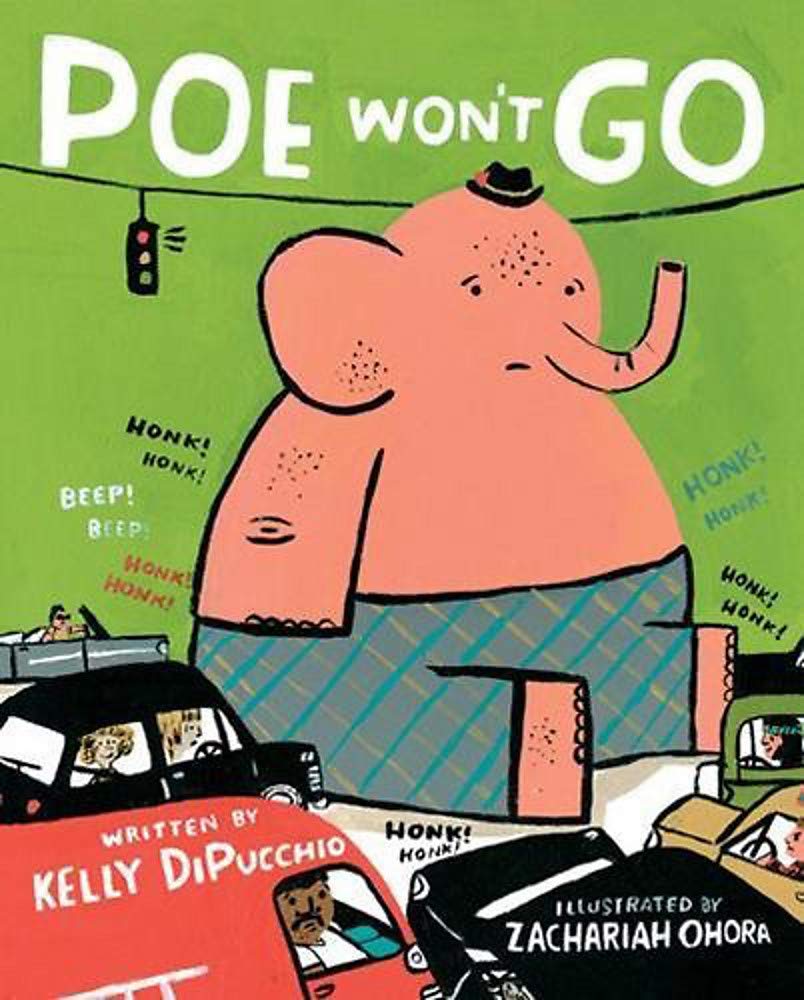
poe

This silly book has an abrupt ending, but plenty of giggles along the way that make you forgive the sudden conclusion.  Additionally there is a lot of diversity in the illustrations, a little hijabi girl of color that steals the show, and a lesson about asking and listening that children 4-7 will find sweet and enjoyable.  It is an AR 2.5 and has 36 pages.  Some are text heavy, but my 4 year old had no problem sitting through it with the silly pictures and large 9 x 11.5 size.

383F79FA-EB31-4C0B-B305-BF7F3CDE9759

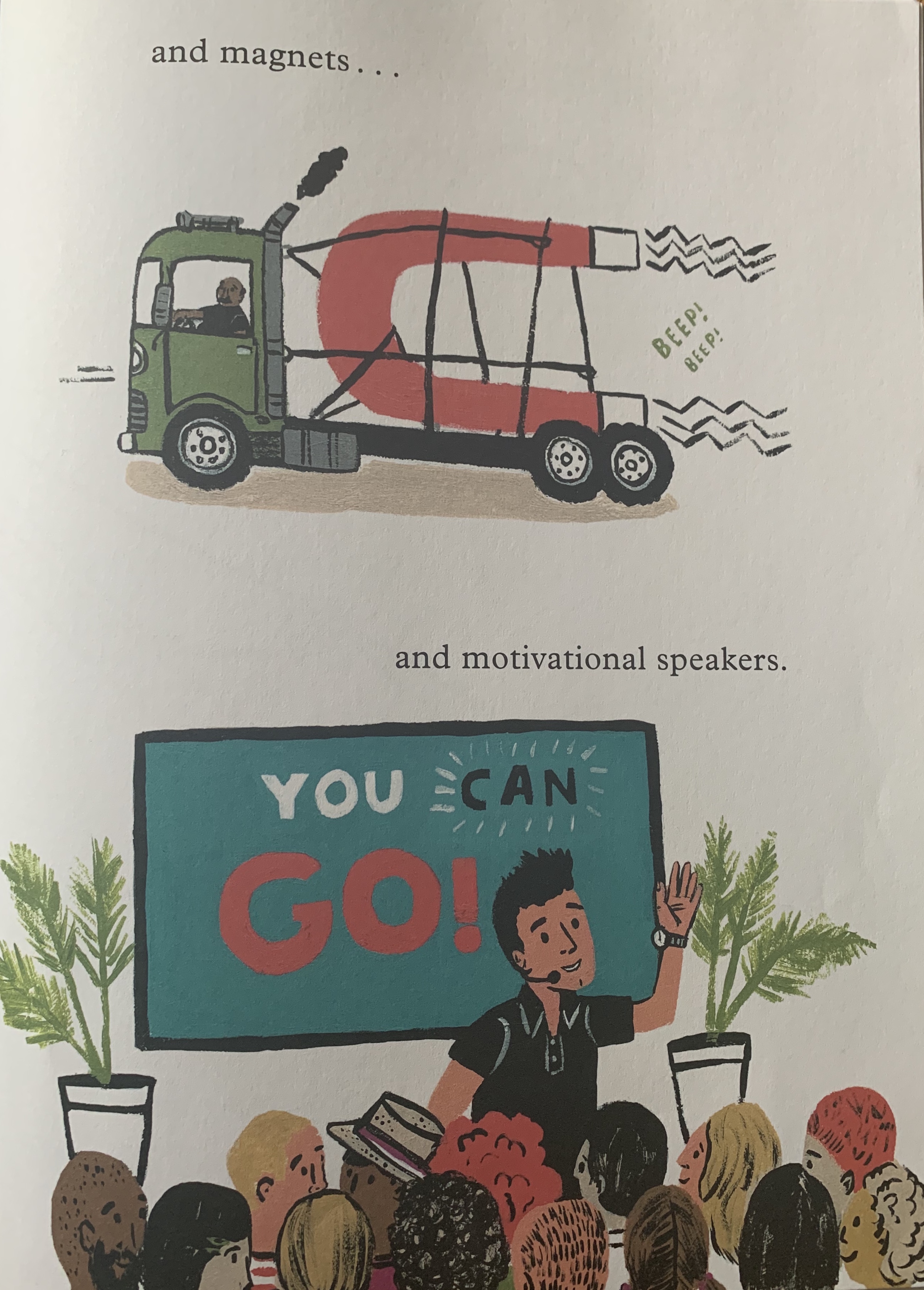
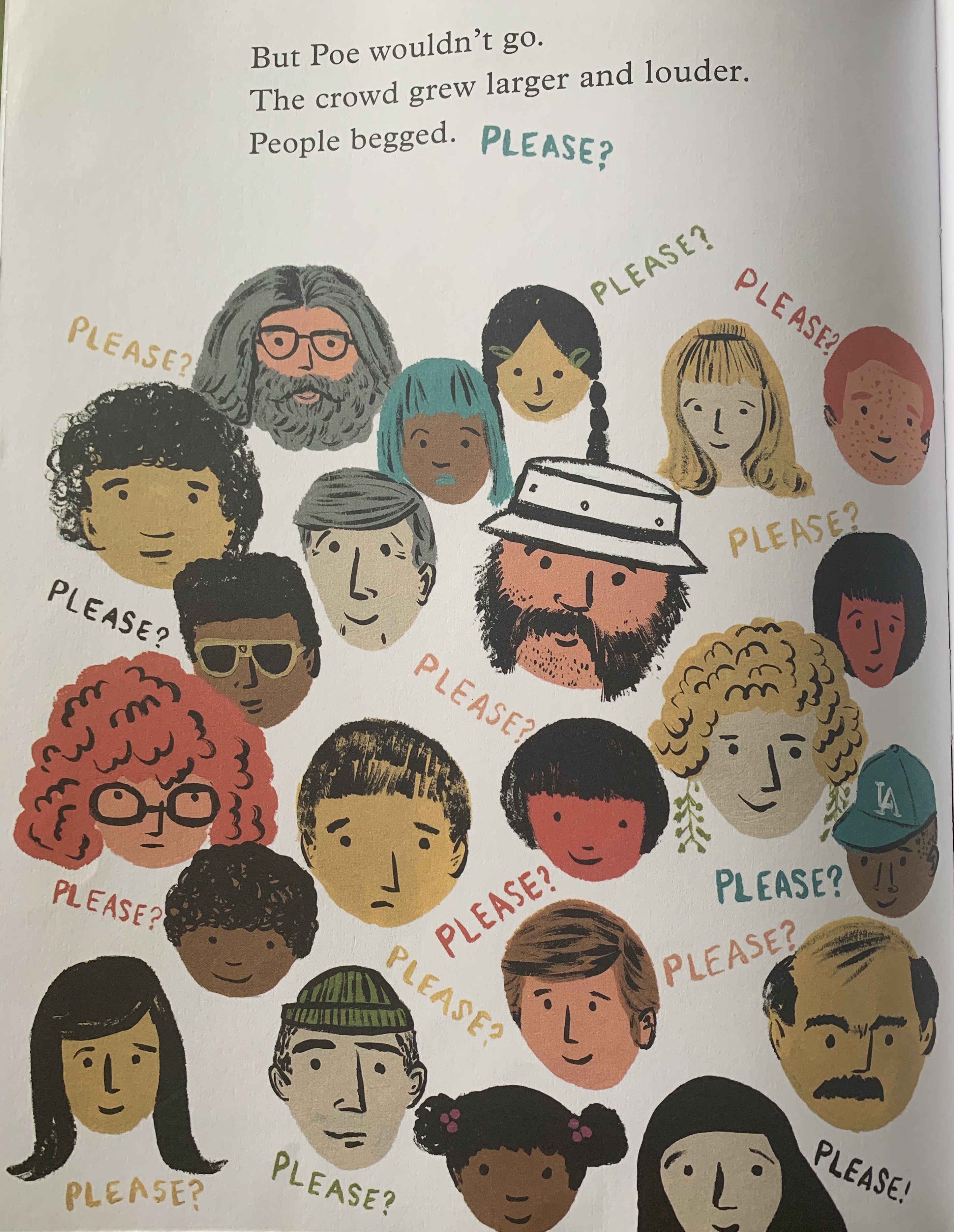
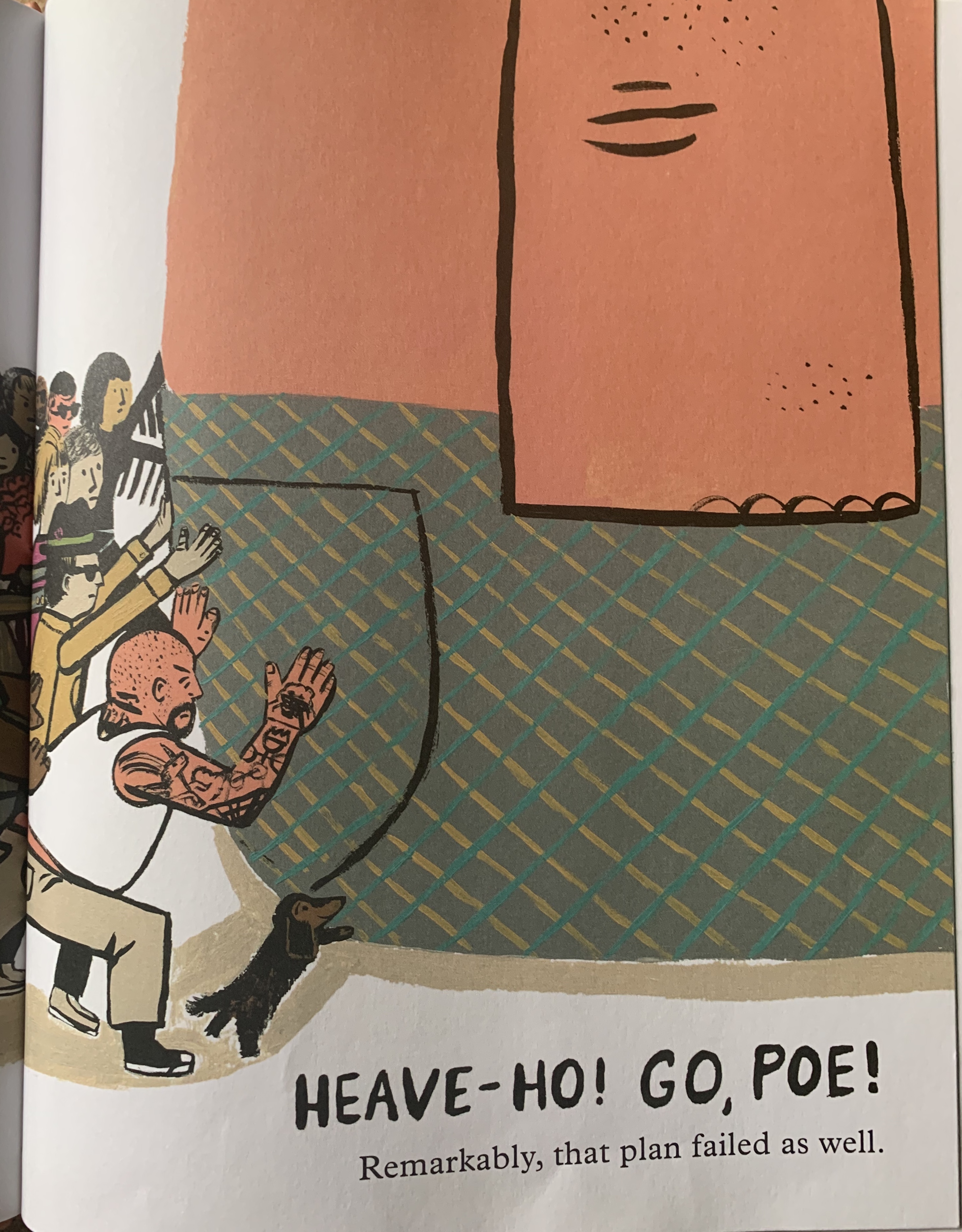
Poe is an elephant that has planted himself in the middle of the only road in Prickly Valley.  The citizens do everything they can think of to get him to move.  They honk, write him a ticket, bang pots and pans, play trombones, blast megaphones, tickle, beg, and bribe.  They even bring in mice, and magnets, and motivational speakers.  Clowns and copters, cranes and pastors, magicians and the mayor, no one can get him to move.

5376BF1C-4727-4160-8C52-6F360EE19055

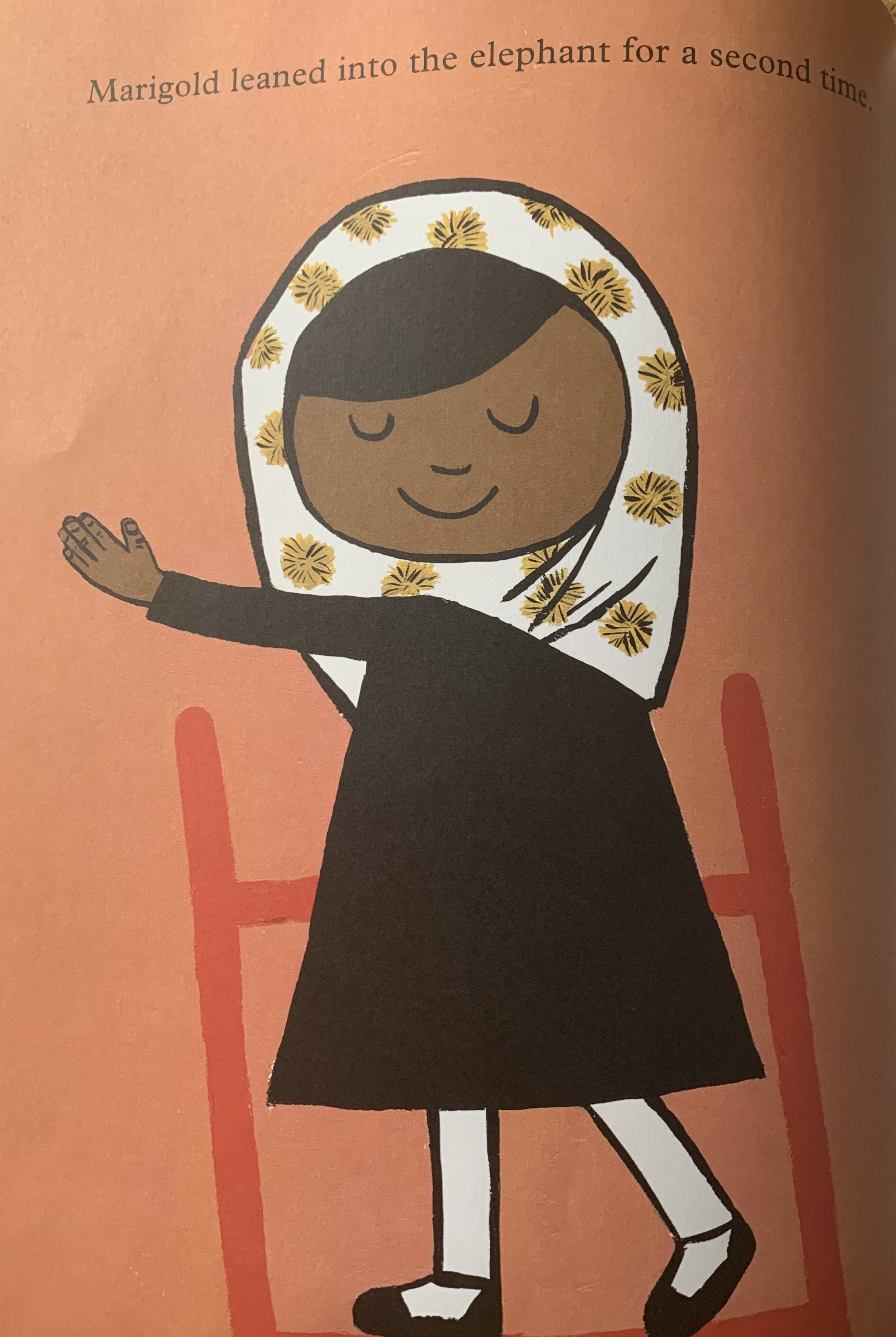
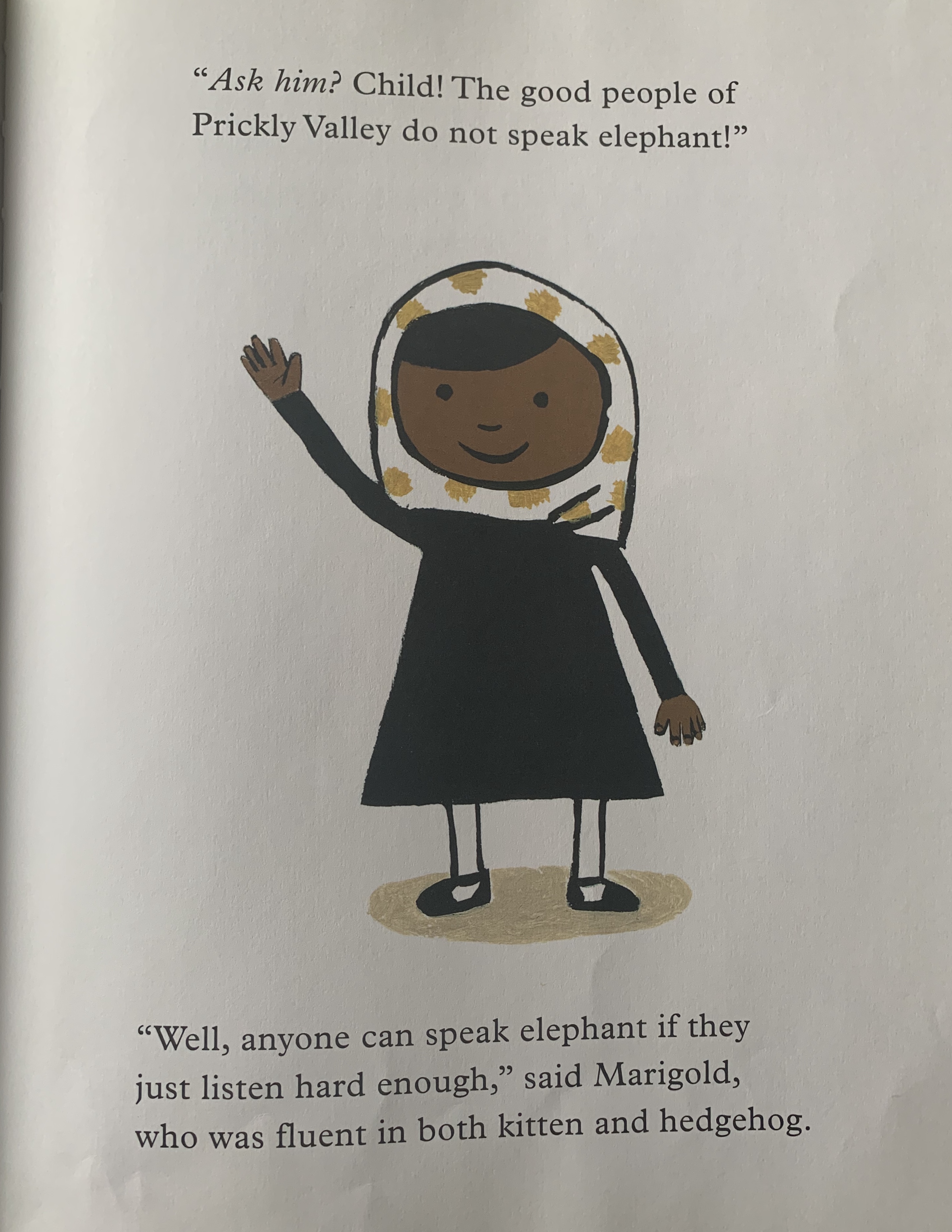
After lots of discussions involving coffee in stryrofoam cups, a little girl named Marigold, asks the mayor if anyone has asked Poe.  Such an obvious suggestion, the Mayor laughs and says she doesn’t speak elephant.  Little hijabi Marigold says, “anyone can speak elephant if they just listen hard enough.”  She is also fluent in kitten and hedgehog.

C34B829A-CA57-4C1F-94B8-ACD7258CE1F0

Marigold discovers that Poe is waiting for a friend that is very late.  A reporter asks if the friend could be wearing a polka-dot-tie, it is determined that it is possible and that also perhaps he is sitting on his friend. At that Poe stands up, finds his friend Mo and the two walk off.

The randomness of Poe sitting on his friend made me have to read the story a few times checking to see if a page was missing or stuck together, but alas no, it just suddenly is resolved and ends with no clues indicating that the elephant is sitting on a monkey.

6FDD18F5-94B3-45FA-9A15-C1299B318EEF

I love that the name in the text for the little girl is Marigold, and that the illustrator chose to depict her as a little Muslim girl of color.  On many of the other pages with the town folk trying to move the elephant, there are people of all colors, body shapes, hairstyles, head gear, eye wear, facial hair, body art, etc shown.  Marigold seems to be at work with her father at their flower shop, and the mayor is a female.

397E7902-B48D-4C1F-982E-F090955F9258

There is nothing religious in the book, save a pastor trying to persuade the elephant to get behind him, and it doesn’t appear that the author or illustrator are Muslim (it is published by Disney Hyperion) which in someways makes the normalizing of a girl in hijab all the more sweeter.  Sure, someone her age wouldn’t be required to cover, but the message and representation is deliberate and appreciated.

Running Overload by Jake Maddox illustrated by Tina Francisco

Standard
Running Overload by Jake Maddox illustrated by Tina Francisco

5870B613-F406-493B-8203-FAB9869DE555

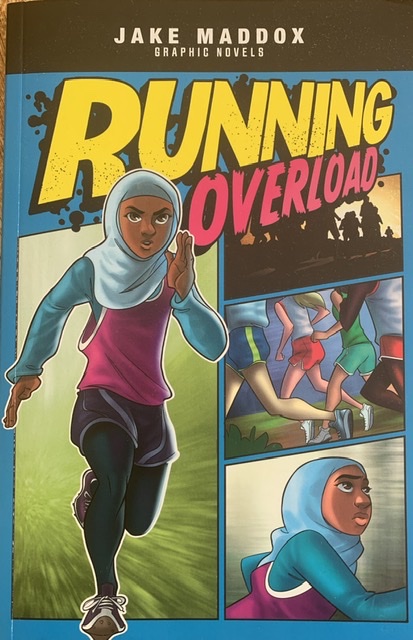
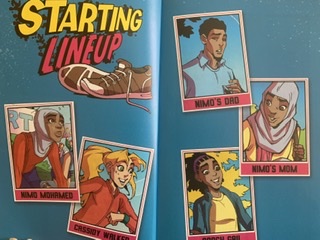
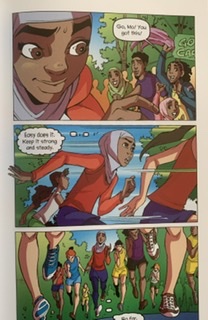
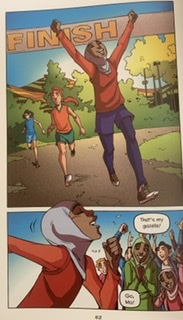
This 72  page graphic novel features a female Muslim protagonist trying to balance her desire to be a great cross country runner and the rest of her life.  Meant for 3rd graders, the lessons are applicable and relevant for readers in middle school as well.

6B290892-6842-45D4-88FE-7FE4D82BAEC6

SYNOPSIS:

Nimo Mohamed has made the varsity track team, and is determined to keep up with the older girls.  She is training too hard which her coaches and parents warn her against, but she doesn’t listen.  As a result she is lying to her family about what she is doing, her grades are suffering, and her body is exhausted to say the least.  After coming dead last in a meet, getting a D on an English test, and injuring her knee, the truth comes out and her dad has her quit the team.  Can she convince him to give her one more chance? Can she learn to pace herself?

253551C1-18E4-4A86-8BD2-315C79A685DA

WHY I LIKE IT:

There is nothing Islamic in the book except for the main character’s family.  The women wear hijab when out, not at home and they have Islamic sounding names.  I like that she is modestly dressed when she runs and that no one seems to care that she is Muslim.  This story is not about her faith, it is a universal story of balance, and the character highlighting the moral is Muslim.  Her parents are divorced, but are on the same page regarding her running and school balancing act, and they come together to support her.  I also like that the book is a sports book and has a female girl of color as the lead.  There is a lot of very intentional diversity in the book and it is refreshing to see.

There are questions at the end, and running vocabulary and tips for running as well.

B555F927-C2E0-433B-8F6B-ED1E58486CD3

FLAGS:

None

F050C711-00AF-4581-93AB-C0E440C1FDD8

TOOLS FOR LEADING THE DISCUSSION:

The book wouldn’t lend itself well to a book club, but would definitely provide one-on-one discussion opportunities.  The short linear story is all about imparting teachable moments on the reader, which isn’t a bad thing, but I think the real strength is that the book is one of a larger series that should really be in every classroom and library to show how balance and integrity and strength and diversity are values that we need to hear over and over, not just in one running book, but from a lot of different sources.


You Must Be Layla by Yassmin Abdel-Magied

Standard
You Must Be Layla by Yassmin Abdel-Magied

layla

This OWN story, upper middle grades book, is heavy on the pop culture, relatable on the Islamic family presentation and honest in its portrayal of Islamaphobia, yet somehow the tidiness in which everything wrapped up seemed too forced and a bit flat.  At 293 pages, including a three page glossary, the book is a quick read meant mainly for girls.  It involves robotics, academic achievement, and invention, while also discussing crushes, a character coming out to his family and friends, and mention of girls not praying at certain times of the month.

SYNOPSIS:

Layla lives in Australia and goes to the Islamic School of Brisbane. Her Sudanese family: older brother, younger twin brothers, and parents, her Doctor mom and medical machine tech dad, are active Muslims and proud of their culture.  They assimilate to Australian norms in varying degrees, but with all the kids at ISB, Layla doesn’t feel all that different in her school and social life.  Unfortunately she wants more, she wants to be an adventurer, and when she meets Adam over the break and learns about the various opportunities he has it his school, Layla decides she wants to prove herself on a larger stage.  Going in to “shut down” mode Layla has tunnel vision to ace the scholarship and entrance exam and go to a new school.

She gets in to Mary Maxmillion Grammar School and when she goes to meet the board they let her know that the decision to accept a girl like her was not unanimous.  Layla is an immigrant, she is black, she wears hijab, she is loud and proud, and apparently very smart, but as one trustee asks, is she brave?  On the first day of school she arrives late to first period, insults the teacher repeatedly and also makes friends with a group of slightly diverse boys.  At the end of the day however, Peter, a boy who had insulted her earlier, reinforces his disapproval of her being allowed at their school and pushes her.  Standing her ground, she verbal attacks and then head butts the boy in front of a large portion of the school at dismissal.  No one offers any help, nor speaks up when she is suspended for a week, her scholarship and admission put on probation, no one even asks for her side of the story, Peter, is let off completely free, as he is also the son of the Board Chairman.

Layla decides to prove she belongs at the school she is going to win a prestigious robotics competition and since everyone already is on a team, she decides to go for it solo.  The only problem, is she doesn’t know what to invent.  When she returns to school, her friend that she is crushing hard on is acting weird, and she gets caught up in a lie of sorts that serves as both the idea and silliness turned cleverness of the book.  While choking on gummy worms, she says she is working on an edible actuator for her robot, and somehow has to make that come to fruition.

The rest of the book is Layla making a lot of silly errors of judgement: missing classes being in SD mode in the workshop, forgetting to file the paperwork and registration to actually compete in the competition, and leads up to the resolution between her and Peter, learning her crush is gay, and deciding to be herself and proud of it.

WHY I LIKE IT:

I actually like the majority of the book, I really like how Islam is presented and lived.  They pray and say salam and cover, and recite tasbeeha to reflect, and quote hadith very naturally, even how others attack them, and the anger that Layla’s brother Ozzie feels at his inability to get a part time job reads and feels very authentic.  I also like how one of the teacher’s own experience as being a descendant of the forgotten generation and being a first nations ethnicity is woven in.  I felt the side character being gay was added and forced in as an after thought and I don’t know why, as it didn’t show Layla to be a particularly good friend.  She handled his coming out well, but when he was miserable she was wrapped up in her own stuff and didn’t reach out very well, even though he ended up being the spark for her invention.  Her friend at ISB is also an under developed character, that while I get is used to show another side of Layla, in many ways also showed her to be a rather poor friend.

I found the pop culture references annoying, not in and of themselves, but in knowing that they will date and make the book irrelevant in a few short years.  There is a lot of repetition of phrases and ideas that a few times when I put the book down I struggled to re-find my place (I know bookmarks, right?) but certain refrains and paragraphs seem so very similar.  I

There is a lot of good information about Sudan and their food and culture and traditions.  There is also a decent amount about Muslims in Australia.  I like that even within her family there are different views on how much to assimilate, and how much to fight back against perceptions, the fact that there is a lot of gray makes non Muslims and non immigrants reading the book hopefully realize how diverse all people are and to not assume anyone is only one way.  I would have liked more about Layla’s mom and being recruited to come to Australia, and how she was perceived at work, by patients and colleagues.  I also would have liked some sort of resolution about Ozzie and his job search.  Really though my biggest complaint is Layla, herself.  What does it even mean to want to be an adventurer? I like that she is fallible and human and in some ways she does grow, but I felt like her being smart and a go-getter is the foundation of the story, but that she didn’t seem to have much common sense seems a bit off.  Yes she is loud and funny and puts in hard work, but the way she talks to teachers, and misses classes and deadlines, and behaves seems like a disconnect from the pages constantly telling me how smart she is.  To me, part of being smart is knowing when to lash out and when to listen, I don’t feel like her growth arc was all that great, in a nut shell, she changed schools and confronted a bully, that is the story, while not a bad story, it could have been so much more.

FLAGS:

There is crushing, violence, a gay character, mention of alcohol at a party Layla didn’t attend, talk of hooking up in passing and some language.  There is lying but it is acknowledged guiltily, and not familiar with Australian slang, regular use of the phrase, Janey Mack, which according to google is a replacement for Jesus Christ.

TOOLS FOR LEADING THE DISCUSSION:

I don’t know why I wouldn’t use this book as a book club selection.  It just didn’t strike me as something they would benefit from.  I wouldn’t be opposed to someone picking it up and reading it in my house, but I doubt I’ll recommend it to my daughter and she is the ideal reader: she wears hijab, is in 8th grade at an Islamic school, and loves to read.  The book is really not memorable as good or bad, it just fell flat and I doubt I’ll read it again, luckily it only took two sittings to read, so I don’t feel like it was a waste of time, but seeing as I had to pay cover price and international shipping, I kind of regret rushing to buy it.

Teacher guide: https://www.penguin.com.au/content/resources/TR_YouMustBeLayla.pdf

You Can Control Your Voice: Loud or Quiet? You Choose the Ending by Connie Colwell Miller illustrated by Victoria Assanelli

Standard
You Can Control Your Voice: Loud or Quiet? You Choose the Ending by Connie Colwell Miller illustrated by Victoria Assanelli


you can controlA choose your own adventure picture book, that doesn’t have anything Islamic specific, doesn’t seem to be written by a Muslim or illustrated by a Muslim, and that was found at the public library, starring a Muslim mom and daughter.  Oh hurrah for beautiful illustrations, teachable moments, volume control in a library and the fun to read the story and have control over what happens next.

91F3712F-C173-46C0-BD30-6B6814B951BA

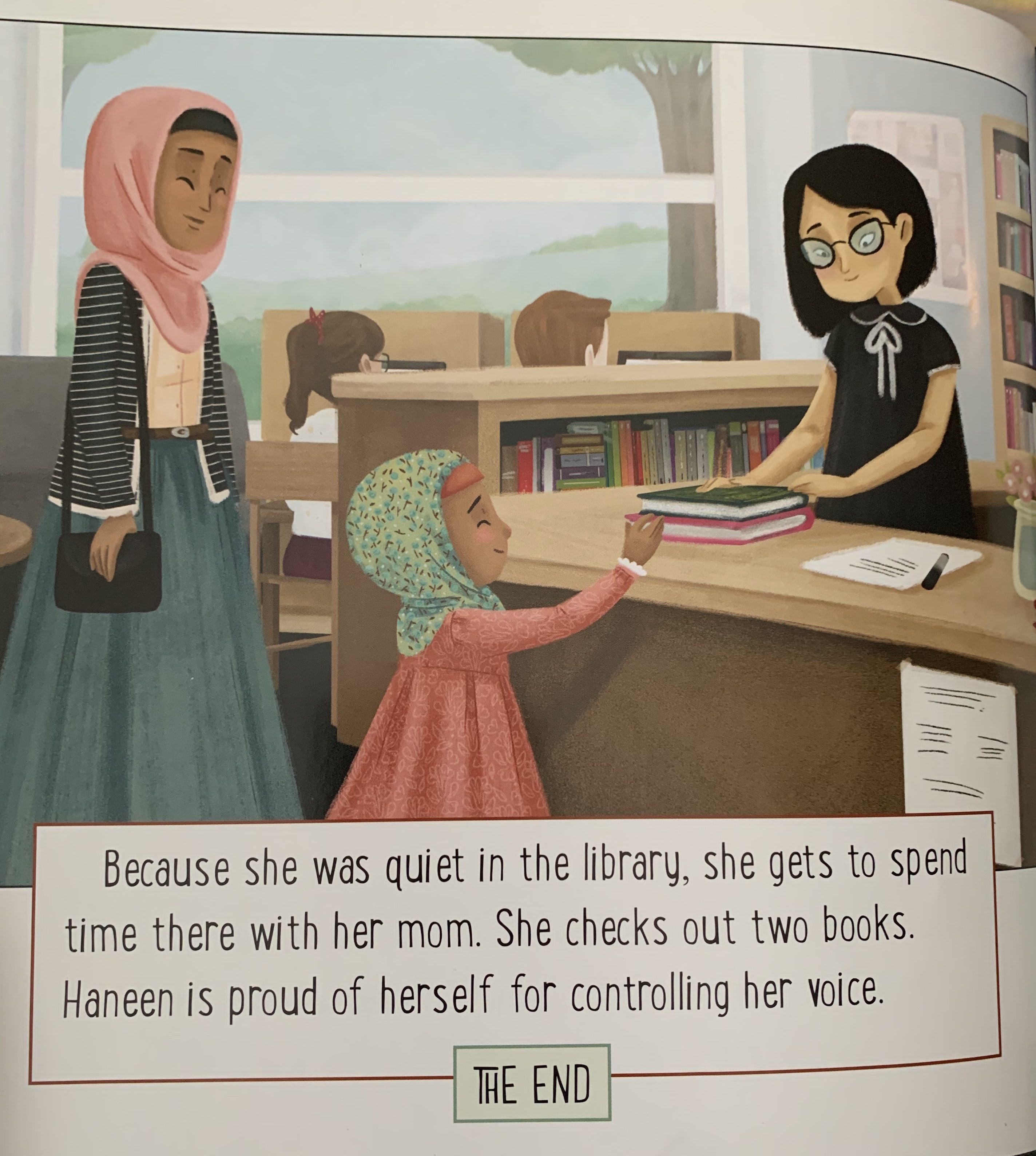
This 24 page book meant for kids in kindergarten to second or third grade is part of a series featuring diverse characters learning universal manners and making good choices. To see Muslims represent a universal lesson in a relatable environment is a great way to normalize seeing women in hijab in real life.

685B4BFC-16EB-437A-842F-ED10B2580851

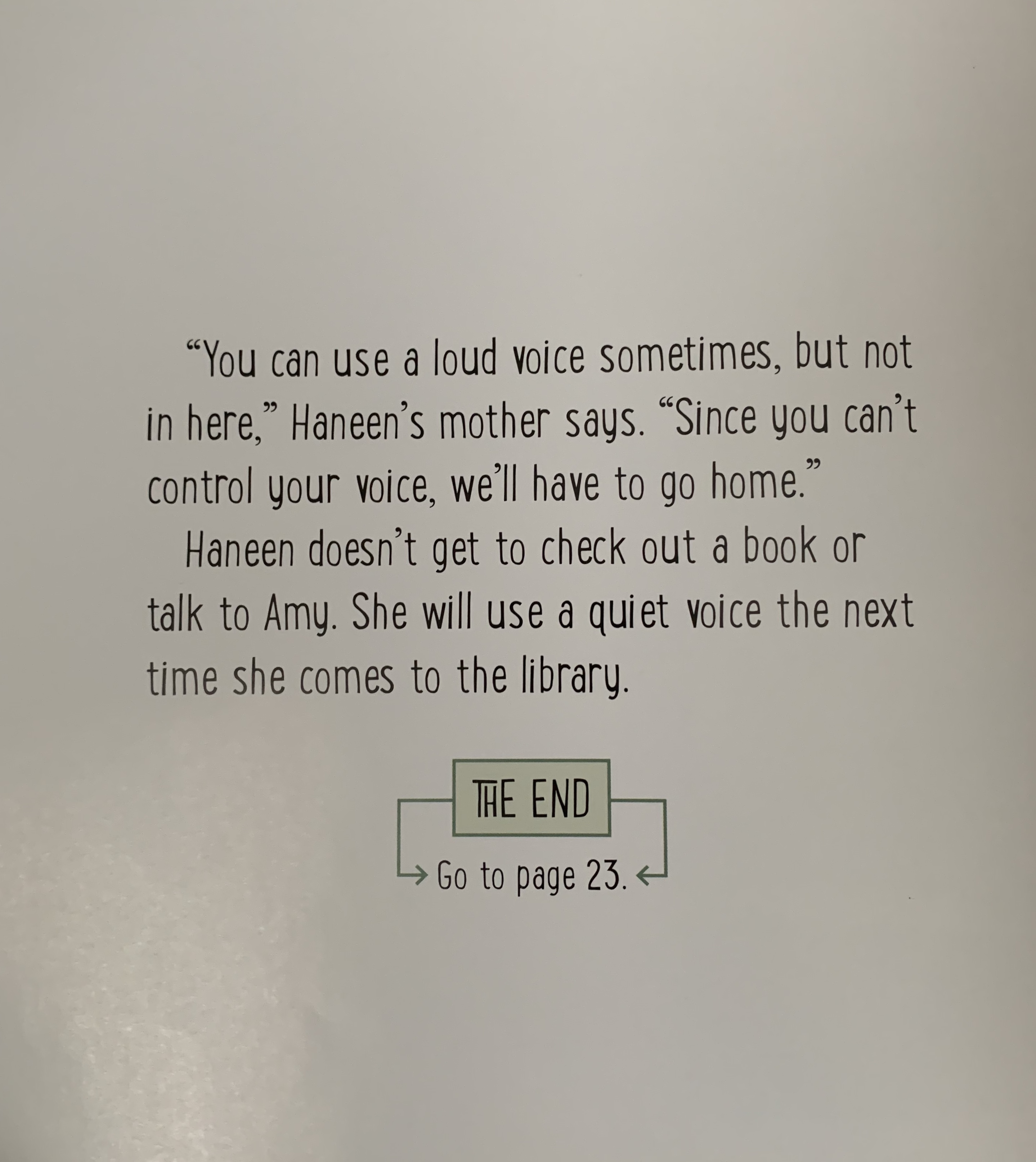
Haneen and her mom are at the library, and Haneen finds a book about fairies and cannot contain her excitement.  Immediately the reader has to choose what Haneen does next.  If she stays loud, the story ends rather quickly, but if she tries to keep her voice down, she might get to stay at the library a little longer.

9E7FC801-D531-42AA-9542-81C4BAF75364

There is a big test when she sees a friend, and disturbs a gentlemen working on the computer, but if you make good choices Haneen gets to check out two books.  If your choices aren’t ideal you might have to just get the fairy book and get out, and if you really struggle to know how loud or quiet to be, you’ll have to come back another day and try again.

C00E287A-E463-427B-9AC4-C748681CC0F5

At the end of the book are some things to think about, to drive the point home.  I love the line, “We are all free to make choices, but choices have consequences.”  A great lesson for little ones, and a great reminder for older readers too.

3EF9066A-60F4-4A31-9E1C-19F228A0D7F4

The book is 9×8 and the expressions on the characters faces make the book a great option for circle time, story time, bedtime, and just to have on hands for kids to thumb through and enjoy.  Well done!

90F0B566-EE2F-490B-8D8C-3AD148BC0CE5

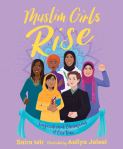
Muslim Girls Rise: Inspirational Champions of Our Time by Saira Mir illustrated by Aaliya Jaleel

Standard
Muslim Girls Rise: Inspirational Champions of Our Time by Saira Mir illustrated by Aaliya Jaleel

rise

Women you have heard of, some you are meeting for the first time. Some you like, some you disagree with, women that cover, women that don’t, some young, others older, some athletic, some academic, some a little bit of both.  One fictional, a few political, but in the end, all strong women of today, all Muslim, all unique, from all over the world, all known for paving the way for others to follow.

C51C5834-B3C5-4D19-94B3-99B21ADF83EA

In 42 pages, 19 females are highlighted and illustrated to inspire Muslim and non Muslim boys and girls alike, but really Muslim girls will get the most out of it.  Sure a female gets mentioned here or there in other compilations of influential people of our time, but this one, well, this one seems mostly for us.

2D8175C8-0798-4AC1-BF15-D0A9C284AEA9

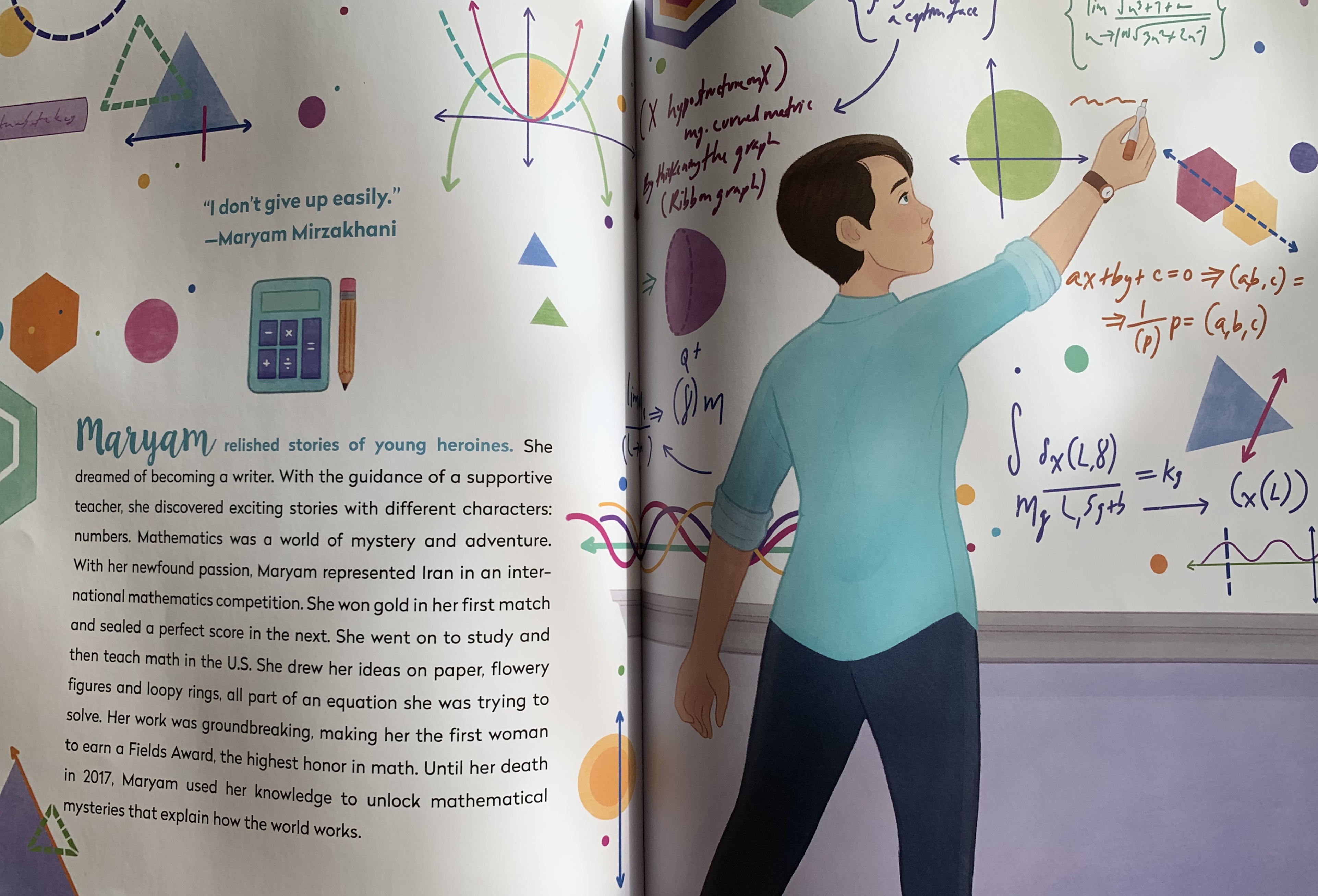
There are famous females in science, activism, fashion, film, sport, education, media influencers, make-up artists, you name it, and Muslim’s participate, so finally a book shining a light on the best of the best.  With each person getting a full two page spread, a few tidbits about who they are and what they are “famous” for are detailed in easy to read sentences that inspire, and if you haven’t heard of them before, enough general knowledge to get acquainted.  A few felt a little generic, but once you have a name, Googling them or researching them, is obviously, not difficult.

6D798E55-709C-442A-8DFF-4BA184C960E1

I wish there was a bit more information detailing who was chosen and why.  At first I thought it was  US or “western” movers and shakers, but then you have Maria Toorpakai Wazir, the tennis player in Pakistan, and Shirin Ebadi from Iran.  So then I thought ok, they are all contemporary, but Maryam Mirzakhani passed away in 2017.  Needless to say, one could argue that the list is arbitrary, and I think I would agree.

85FF7A9C-FD80-4F37-A1DE-B8726762E9CB

One could also argue, that these women may make history for notable things, but that they might say or do things that you might take issue with, and again, I agree.  They are people, they are fallible, and diverse, and have different perspectives and life experiences, but that’s ok, infact I think that might even be the point.  We all have different passions, and paths, and views and yet at the end of the day we should be able to lift each other up and inspire.  I think every person who reads this book will find someone that sounds or feels or looks like them, and that is a good thing, no, a great thing!

9C6EB606-F612-40BF-A947-092D2B76F1FE

My favorite was the Kamala Khan entry, because I didn’t realize the G. Willow Wilson was Muslim.  I erroneously assumed the other co-creator, Sana Amanat gave Kamala’s back story and home life its sense of OWN Voice, and I love that I learned I was wrong from a book.

2EC5EAF4-87F4-406C-B4D1-C95341536B66

The illustrations are right on and do an amazing job of conveying the character and the inspiration of the collection.  The book is much needed and I hope they do a similar style book for Muslim women in other time periods.

Special gratitude and appreciation to Gayartri Sethi (IG @desibookaunty) for gifting me this book for no other reason than to share the power and strength of women, and being a leader in that, by sending me a beautiful book.  May I learn from your generosity and pay it forward! Thank you.

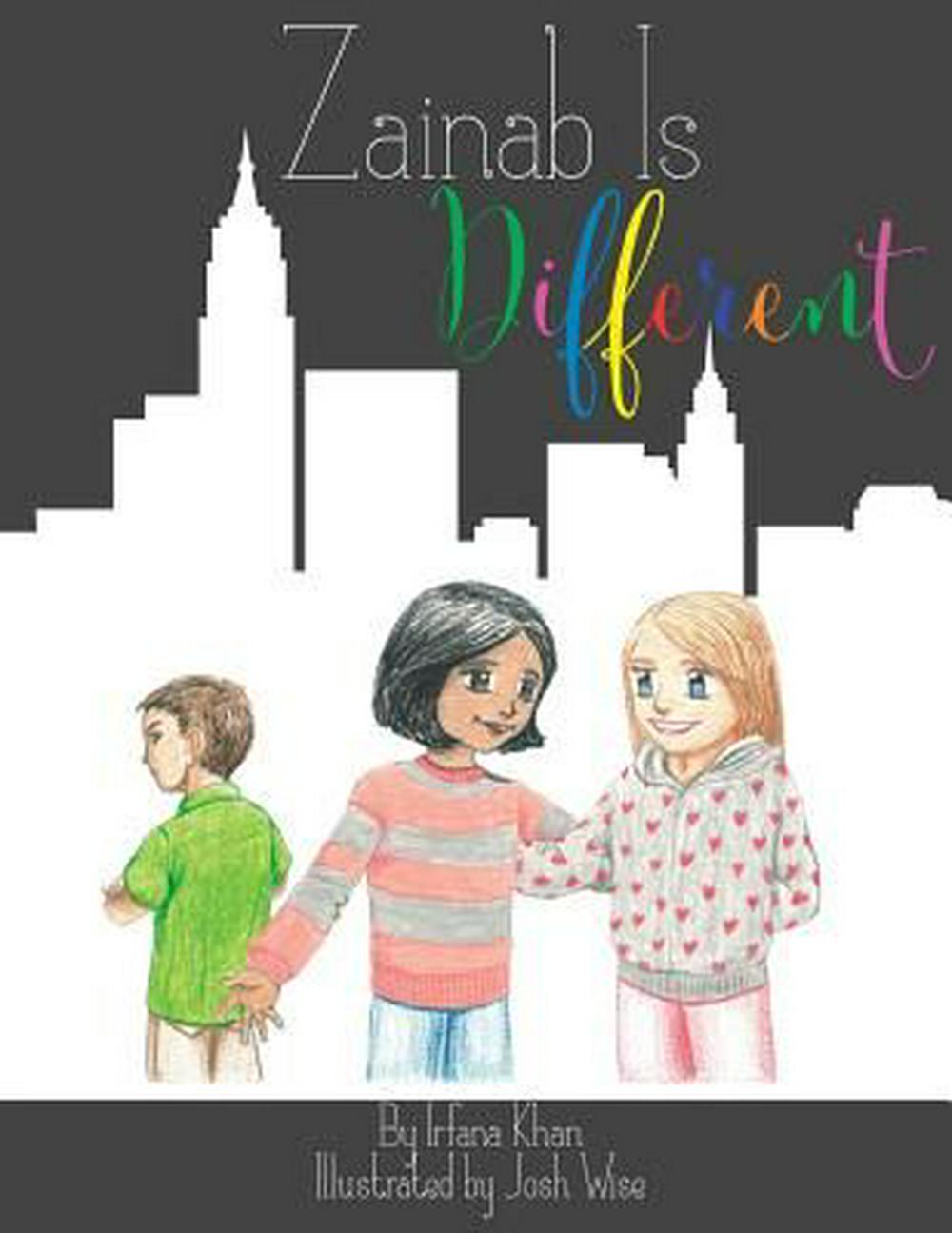
Zainab is Different by Irfana Khan illustrated by Josh Wise

Standard

zainab is different book

This 24 page picture book for kindergarten children and up, is sweet in its handling of being labled “different,” without getting overly negative or caught up in the manifestation of discrimination.  Unfortunately, with so much emphasis on different religions: the places of worship, the holidays celebrated, the manner of dress, etc., faith becomes inadvertantly highlighted as the root cause for the division and discrimination.  Perhaps I am reading too much in to it, and the book just needs a few more examples to make the author’s point that we are all different and unique, but as it is, I didn’t love it, my kids all thought it was cute though, especially my daughter named Zainab.

IMG_0555

Zainab walks to school every morning with her mom.  She says hi to the neighbor and can’t wait to get to school to her best friend Melissa and her amazing teacher Mrs. Sperber.

IMG_0556

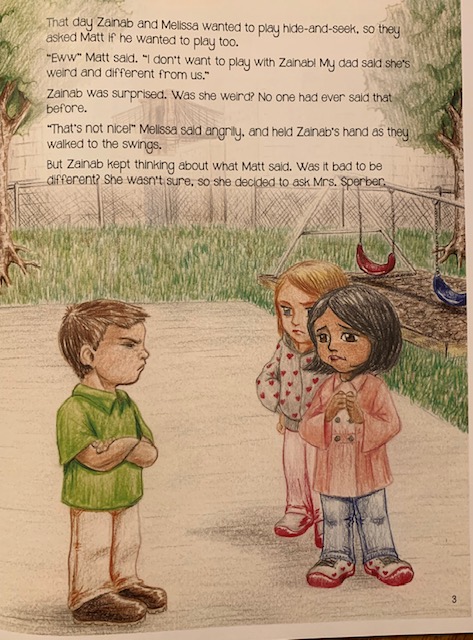
One day Melissa and Zainab want to play hide-and-seek and ask Matt if he wants to play too.  He responds, “Eww, I don’t want to play with Zainab! My dad said she’s weird and different from us.”

IMG_0557

Having never been called that, Zainab is bothered by the words and tells her teacher.  The teacher points out that they have different colored hair, but can see that Zainab is still hurt and tells her not to worry, she has an idea.

IMG_0558

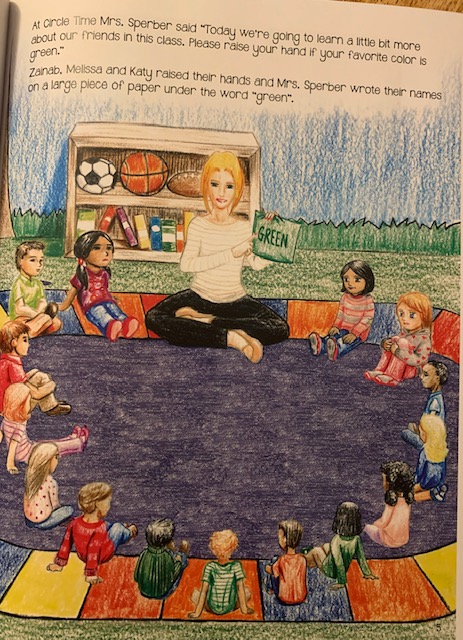
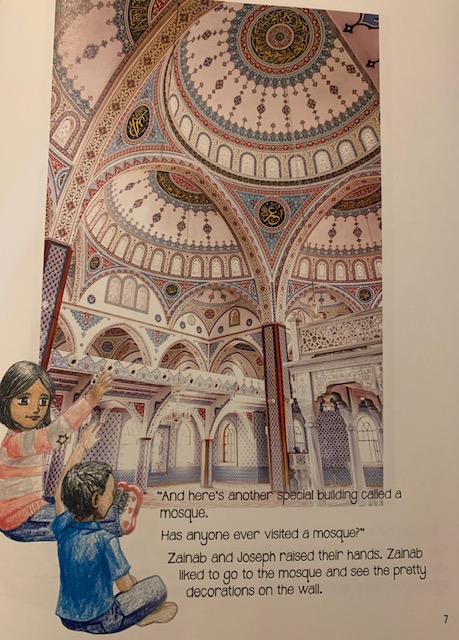
At circle time the teacher starts of by highlighting differences with the kids identifying their favorite color, and her writting their names on the ones they like best.  She then asks about places of worship they visit: churches, mosques, synagogues, temples, and again writes their names on the ones they have been to or frequent.

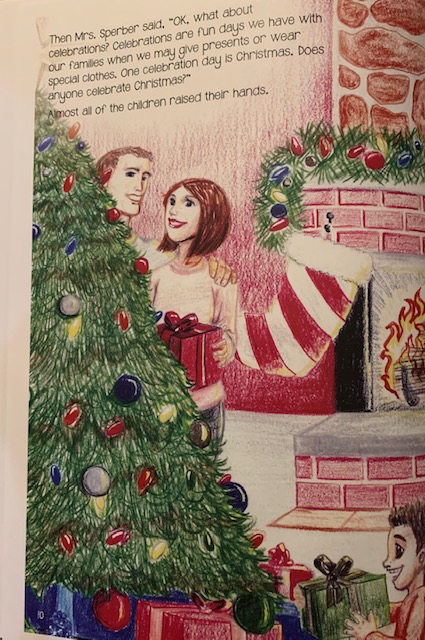
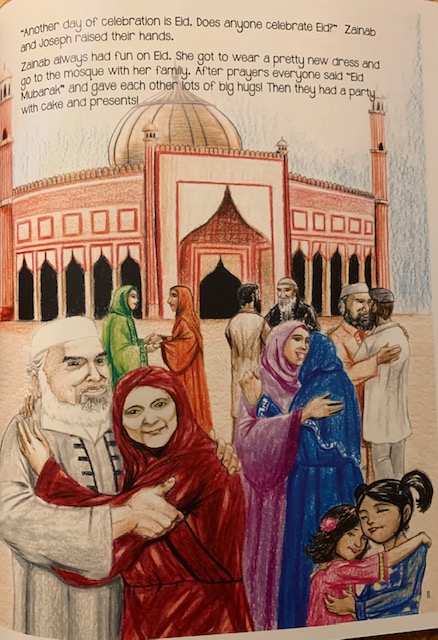
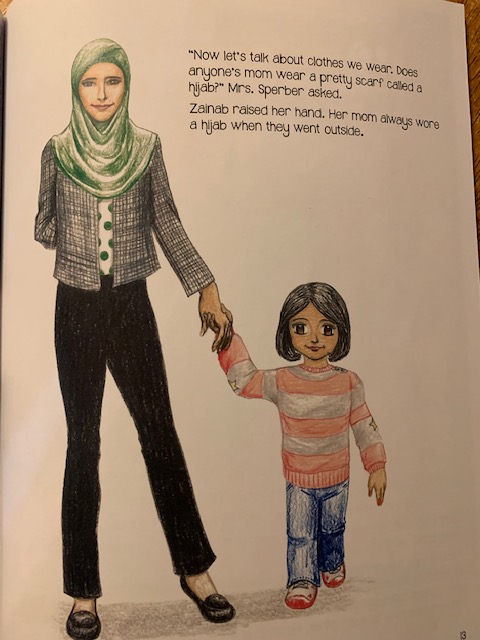
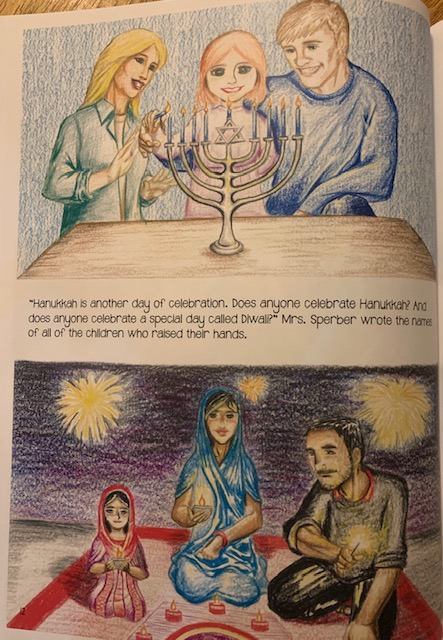
IMG_0559 Next she moves on to holidays celebrated, and then special clothing, only hijab is mentioned though.  The teacher then discusses feelings and how things about us might be different but our feelings are the same.  We like it when we are all nice to each other, and are sad when someone is mean.
IMG_0560

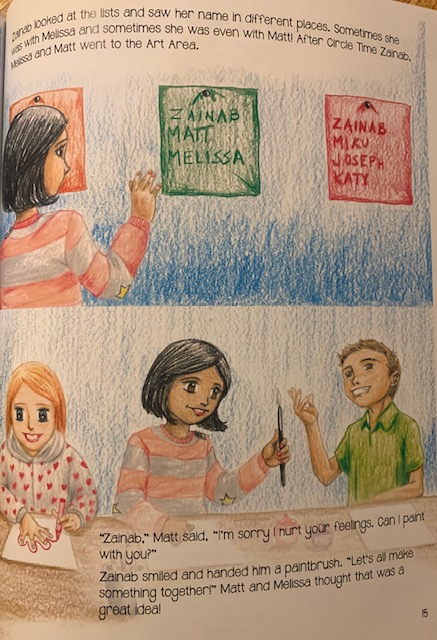
Zainab sees her name with different people’s names on the pictures now hanging up and Matt comes and apologizes for being mean earlier. The teacher also mentions that maybe some haven’t visited any of the buildings discussed.

IMG_0561

The pictures appear to be done in colored pencil and are colorful and detailed with the pictures of the places of worship bein actual images.  The 8.5 by 11 pages are large and would work well at story time or bedtime.

IMG_0562

The fact that Matt’s words are assumed to be about religion seems presumptious to me.  Maybe they are, maybe they aren’t, I feel like there needed to be more there.  A few pages about things other than faith, in my opinion, would make the message of us all being different in some things and the same in other things a bit more powerful.   The pacing too is a bit off. It is a big jump from what is your favorite color to do you go to a church?  The resolution is really quick too, as it is tied into feelings, a little bit more of showing the reader, rather than just telling them, would amplify the process and the message.