Tag Archives: hijab

Odd Girl Out by Tasneem Abdur-Rashid

Standard
Odd Girl Out by Tasneem Abdur-Rashid

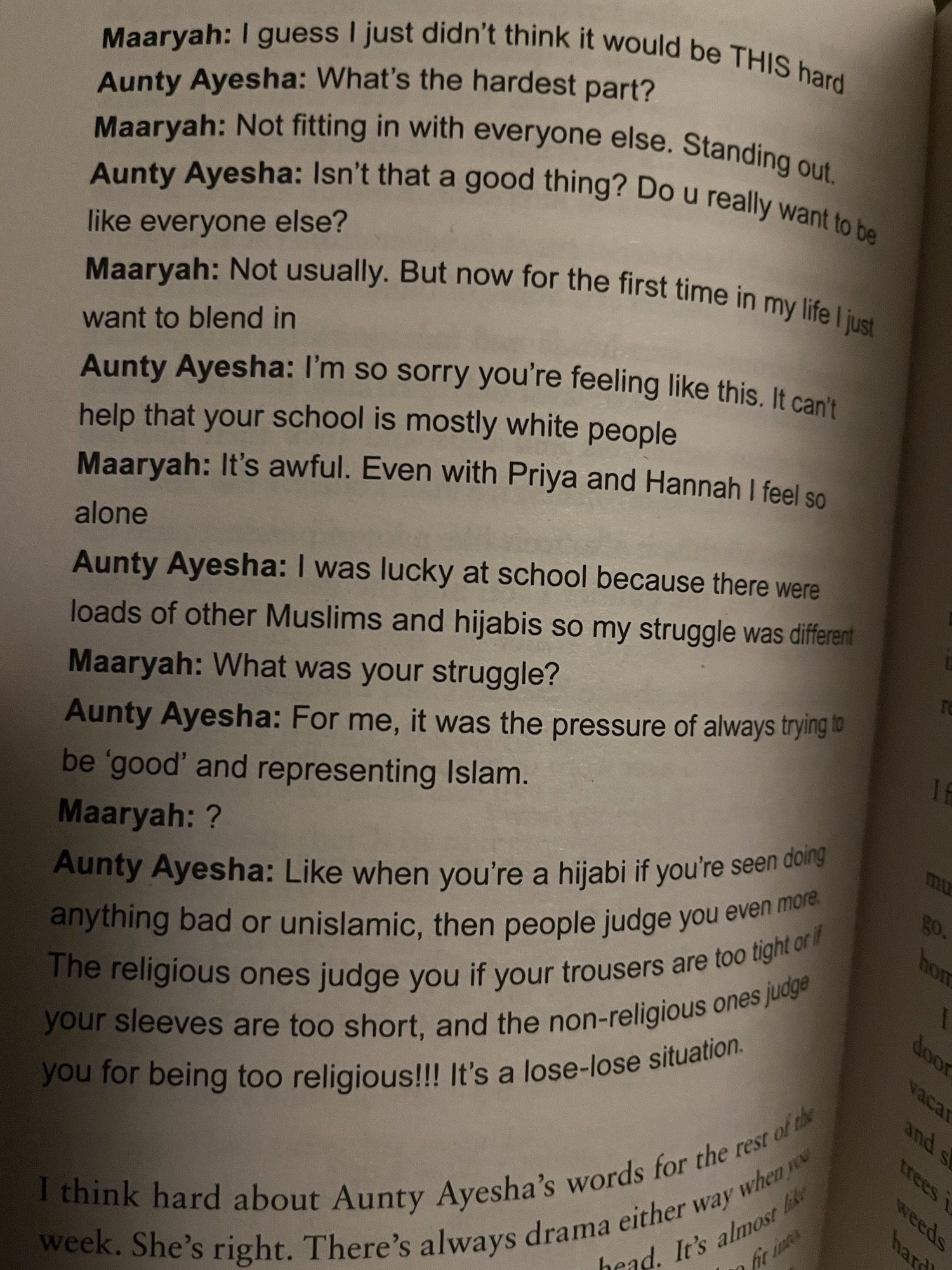
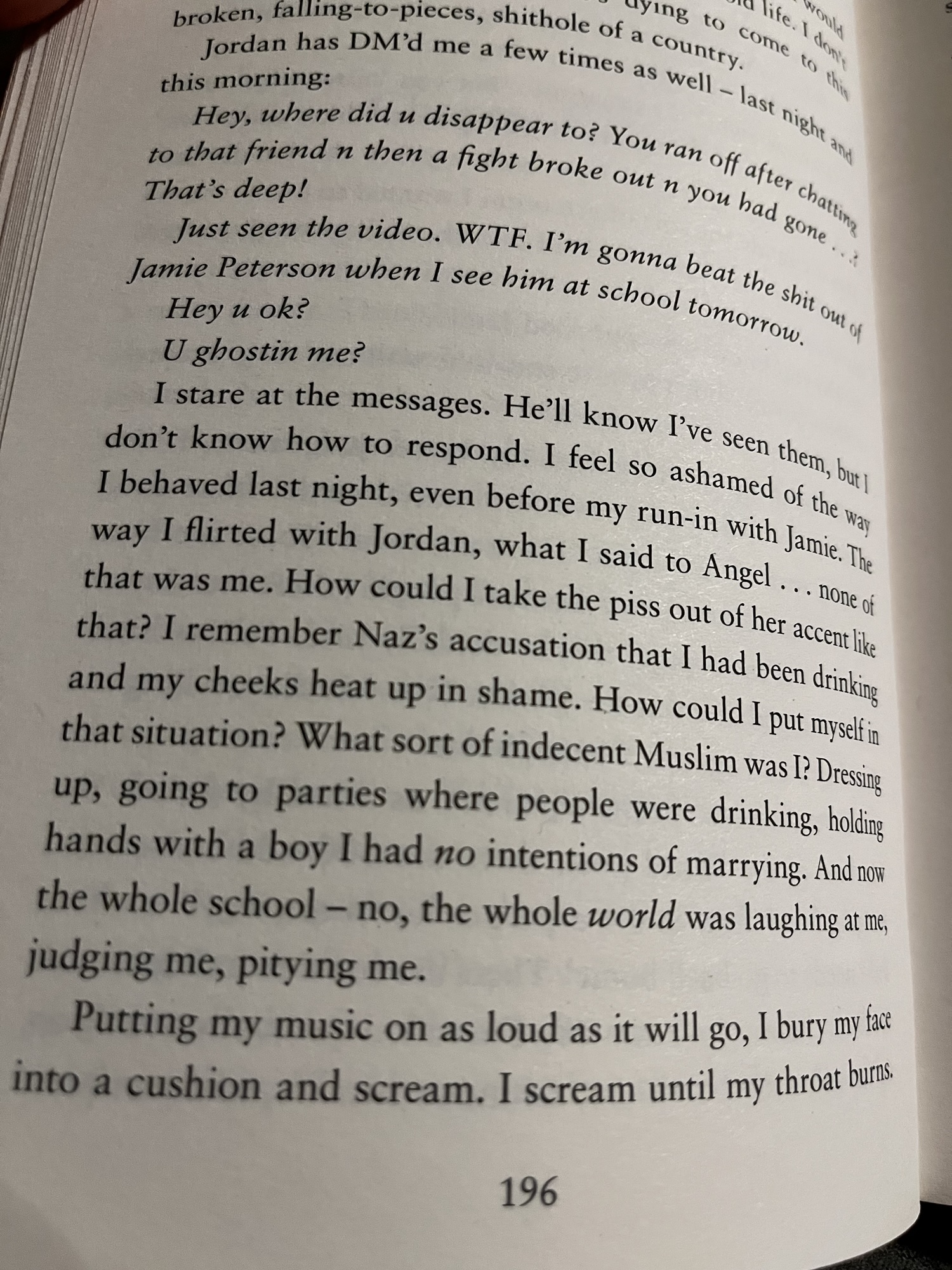
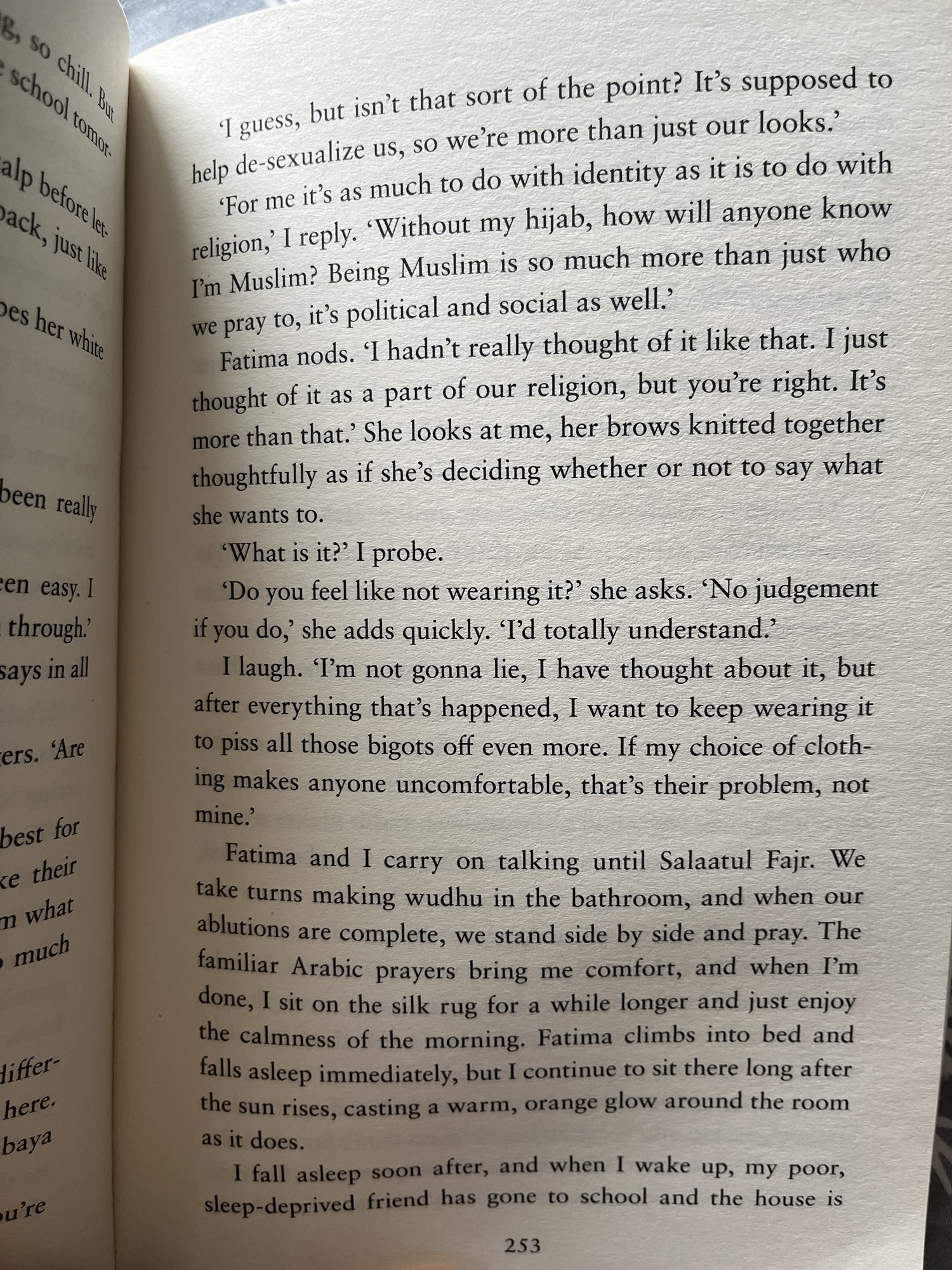
At 368 pages this identity centered mature YA book really hooked me and had me invested, which is impressive because Islamophobia stereotypes and being the new kid in a new place tropes are pretty frequently done, and often after a while, feel repetitive.  For me the charm of this book is actually not Maaryah and her peers/friends/bullies storylines, but the protagonist’s relationship with her parents and what caused her mom and dad to divorce.  Obviously as a mom of teens, I’m not in the target audience, but I feel like I benefited from the Muslim authored, Islam centered book, and think older teens, perhaps 17 and up, will also find the book enjoyable and reflective of views they have, challenges they face, and boundaries they have to establish.  I don’t want to spoil it, but SPOILER, had my dear friends that have read the book clued me in that the book will toe and slightly cross the haram lines, but ultimately show Maaryah deciding to re-establish her boundaries after being tempted not to, i.e. making a poor choice to attend a party with boys and alcohol present, and dressed in a way not typical to her hijabi style, I wouldn’t have read the last hundred and twenty pages or so with my jaw clenched in fear. The book shows a lot of Islam in practice, salat, duas, discussions about hijab, but not everyone will agree with decisions Maaryah makes or the rationale behind them as they vacillate between culture, religion, and family expectations.  I love that Maaryah is fallible and never abandons her faith, and that who we are is more than a singular mistake or instance of poor judgement. The book is not preachy, most will just take it as a girl finding her place in her new family dynamic in a new country, who happens to Muslim.  I think, an assumption really, based on what the author has said about her previous adult books, something along the lines that they are not meant to be Islamic fiction, but are stories with Muslim characters, and I think this book should probably be viewed the same.  There is swearing, hand holding, a side hug, normalized boy girl friendships, lying, running away, deceit, cheating, alcohol, mention of hookups, dating, vaping, music, flirting, hijab questioning, bullying, physical assault.  My biggest concern about the book is that it brings up Palestine, but doesn’t discuss Palestine. A side character is a non practicing Jew that visits Tel Aviv and Maaryah wants to discuss the occupation with her, but hesitates and the moment passes.  It is never revisited which I really wish it would have.  It could have modeled a bit how to have those conversations, I know it isn’t that type of book, but Maaryah mentions repurposing kaffiyehs in her designs and so it hints that it matters to her, but never pulls on that thread.  At one point it also mentions another character posted something pro Isr@*l during the genocide, which I can only assume the author thought that by the time of publication would have ended.  SubhanAllah ya Raab.

SYNOPSIS:
The tag line on the cover “From Dubai Girl to London Nobody…” very succinctly summarizes the plot.  Maaryah had an idyllic life in Dubai with her parents and close friends, spending her holidays with her mom’s family in London, and securing an internship with a famous designer.  All is going well until her parents get divorced, her mom moves her to the UK, not near her extended family, and the lack of Muslims, let alone hijabis, at her high school has her bullied with no friends to have her back.  With her mom in survival mode, their once close relationship is non-existent, and the 15 year old is left to sort through it all on her own.

WHY I LIKE IT:

There is a little pulling of punches so to speak of asserting that the boundaries are Islamic, but for the most part I think Muslim readers will see that Maaryah does view a lot of what she experiences through an Islamic lens which I appreciate. I also like that the protagonist’s connection to salat and faith is hers, it isn’t forced on her and I think for this demographic that is good micro messaging and framing.

I was very grateful that the book answered the questions about Maaryah’s family dynamic, so often parental problems are pushed to the void and let to be resolved or understood off the page. And while in the first half it was teased a little as we aren’t having that conversation right now, I did ultimately by the end feel like it was sufficiently resolved.  I also felt the mom was blaringly absent at weird times and I get that it was a plot device to get her out of the way, but if you are dragging at the 100 page mark, I do encourage you to keep reading, it does pick up.

This book isn’t meant to be didactic, and I recognize I’m putting that on it a bit, but I do think the Gaza framing missed an opportunity to show readers how to navigate that very real scenario through the power of fictional characters.
FLAGS:

Copied from above: There is swearing, hand holding, a side hug, normalized boy girl friendships, lying, running away, deceit, cheating, alcohol, mention of hookups, dating, vaping, music, flirting, hijab questioning, bullying, physical assault.

TOOLS FOR LEADING THE DISCUSSION:

I would shelve this in an upper high school classroom, I think that decision to be at the party is clearly shown to be a mistake, to put herself in that situation is something she regrets, and I think showing that she comes out from it offers a lot to be discussed.

My Perfect Family by Khadijah VanBrakle

Standard
My Perfect Family by Khadijah VanBrakle

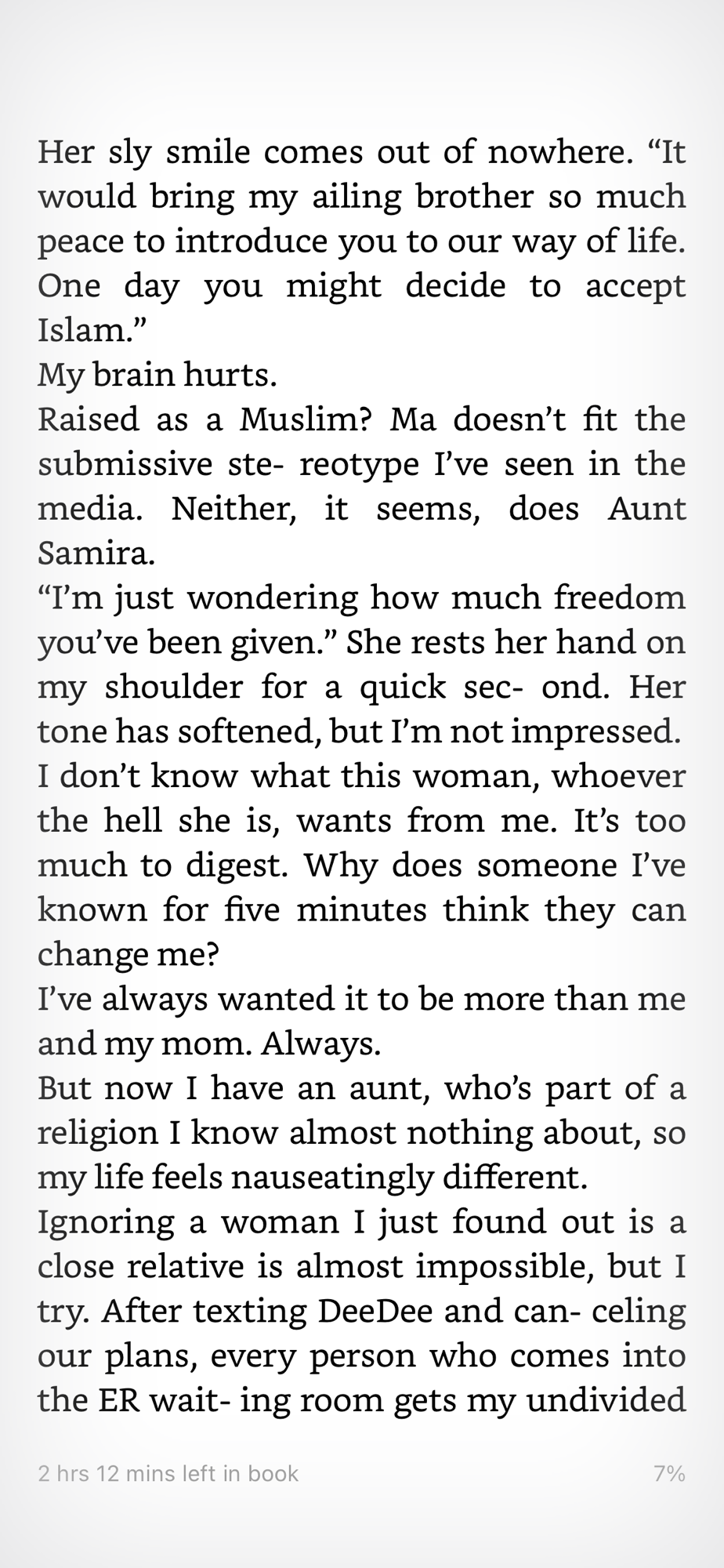
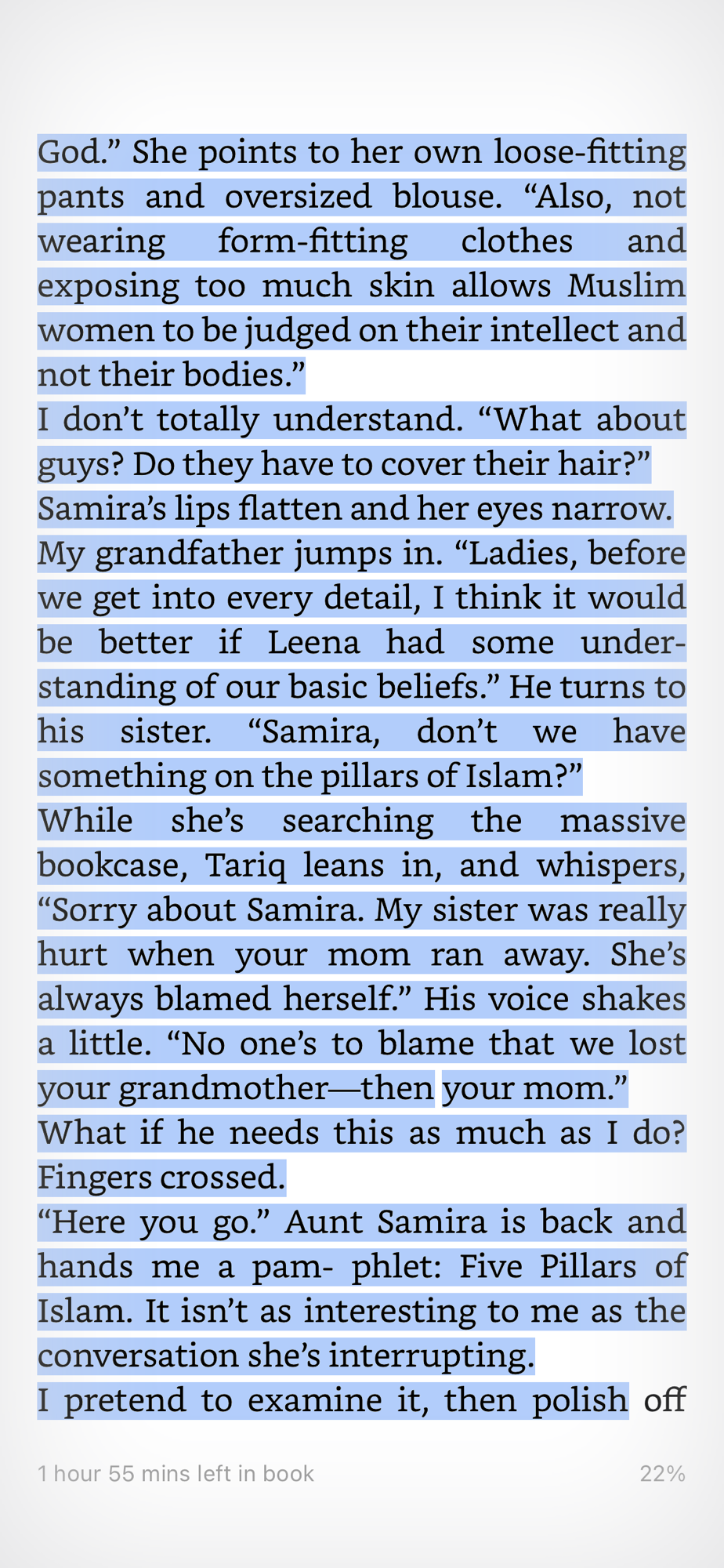
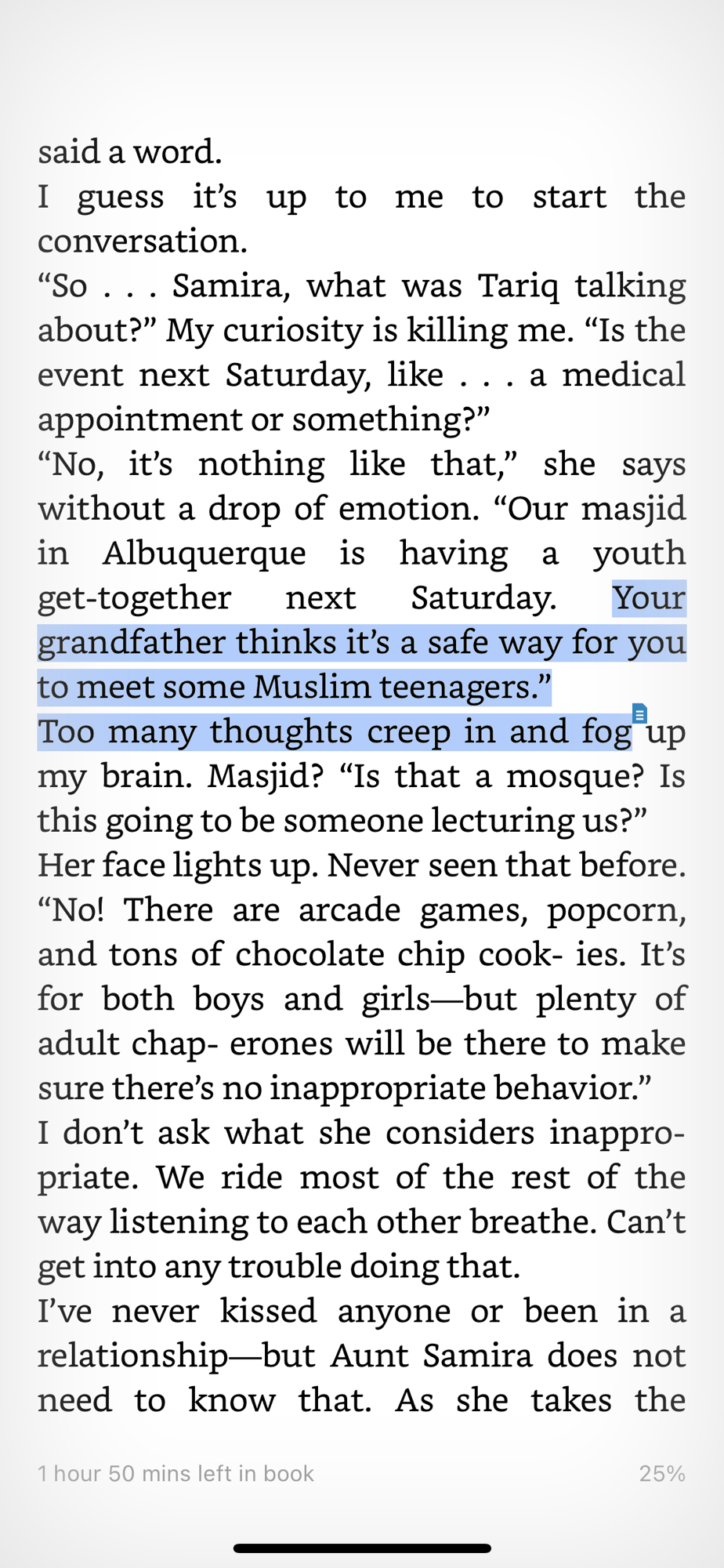
Oh Dear. The very premise alone of this book requires the author to expertly thread the needle of numerous pitfalls, which in my opinion did not occur.  A girl, Leena, learns about family members at age 16, who are Muslim, and the practice of Islam being the “reason” her mother ran away from her family when she herself was 16, means that for Muslim readers the representation needs to be clear that the family’s interpretation is to blame and not the religion itself.  It also means that as Leena learns the reader learns, and non Muslims (or honestly even Muslims) are not going to want a heavy handed preachy 256 page YA book. The Islam “taught” to Leena has to align with the readers interpretation or show why the characters believe as they do, and the conclusion regarding religion and identity needs to make sense for the character aside from what reader wants to have happen.  Unfortunately the copy I read contained numerous errors, repetitive paragraphs, a weak resolution, dropped plot threads, and had me cringing at how harsh Islam was being presented through the great aunt character, that honestly if Islam was just presented as no dating and dressing modestly, or else you will get married off, I can see why one would run away.  The book contains a lot of cursing, and features dating, having a child out of wedlock, death, and gambling by non Muslim characters.

SYNOPSIS:
Leena has always wanted a big family, but her and her single mom, Asiyah tackle life together.  Leena and her best friend Deidre are employed by Asiyah’s in home daycare and are as close as sisters, but she wants more.  When Asiyah finds out her father has had a heart attack, Leena learns she has a grandfather and great aunt that live an hour away, in Santa Fe.  From the moment Leena sets foot in the hospital, under the gaze of her Aunt Samira, the judgmental overtones begin regarding clothing, education, food choices, and dating.  As a result Asiyah is reassured that she made the right decision all those years ago to leave Islam and her family.  Leena however, has had her entire world changed, and is willing to endure the abrasive Samira to get to know her grandfather Tariq.

WHY I LIKE IT:
I like that family drama and secrets were teased, even if I didn’t think that they were presented and resolved well. I wish they took more of the focus and that Islam being a reason for the animosity was downplayed.  I think religion could and should have been one of many factors, having it be the ONLY factor put a lot of pressure on the presentation, which fell short.  It also means that the resolution needed to resolve the Islam hanging in the air, SPOILER,  it didn’t.  The conclusion has Asiyah realizing her father never stopped loving her, but how did that resolve the relationship with her and Samira? And suddenly Samira just backed off her singular Islamic identity? A bit of whiplash with it all happening off the page, left me unsatisfied.  Speaking of pages, the book spends a lot of page space having characters drive the one hour one way to have conversations that are less than 15 minutes and could have been done over the phone or even texted.  Nothing exciting or revealing comes from these drives, they just make the story drag. Tariq should have ridden along, so we could see why he was “such a great man,” see why Leena kept enduring the harshness of her Aunt to get to know him, and have the family she always dreamed of.

Islam is presented through the harshest of harsh characters, a few side characters are brought in that make Islam more realistic in practice and fleshed out, but it really feels like it is too little too late.  I think a non Muslim would feel Islam is just modest dress, no interacting with boys, marrying early, and rigid rules.  Leena is harassed from the first moment she meets her family, no easing in to it, she is even handed brochures on her first visit to her grandfather’s home.  Yet, Leena never shows any interest in learning about Islam, she could Google it if she was curious, even when at the masjid, she doesn’t go and watch them pray, no connection to Allah is ever discussed, it is just dos and do nots.  Consistently throughout it feels like Islam is weaponized and perhaps that is the author’s experience or intent, but it is odd coming from a Muslim writer in a fictional setting.  We get enough of that stereotyping from the non Muslim real world.

The emphasis on Islam being the only thing that matters for these characters means that whether they are religious or not, the characters are painted very one dimensional. Leena is a terrible friend, she counts on Deidre to drive her around, she never follows up on asking about her dates or reciprocating the effort for her other than feeding her.  Asiyah has an ex-boyfriend show up, and then goes out with a friend, but there is no context for their abrupt arrivals and then departures from the story, they do not serve as a foil to reveal any pertinent information or connection. A plot device used quite often in the book, and one I am not a fan of, is when things can be solved by characters simply having a conversation.  It is never the right time, they will talk later, even the fruition that started the family fracturing could have been eased by, you guessed it, the characters talking, not even agreeing, just talking.  While I’m running through my top gripes, might I add, that I have spent a few too many minutes on the cover as well.  Presumably Leena is in the middle, her young single mom Asiyah on the right, but who is the young hijabi? Her aunt does not read young at all, and she would not have her neck showing, that would go against her core characterization. So before you come at me that I have no right to my opinions and that I’m too mean, please solve the mystery of who is on the cover, thank you.

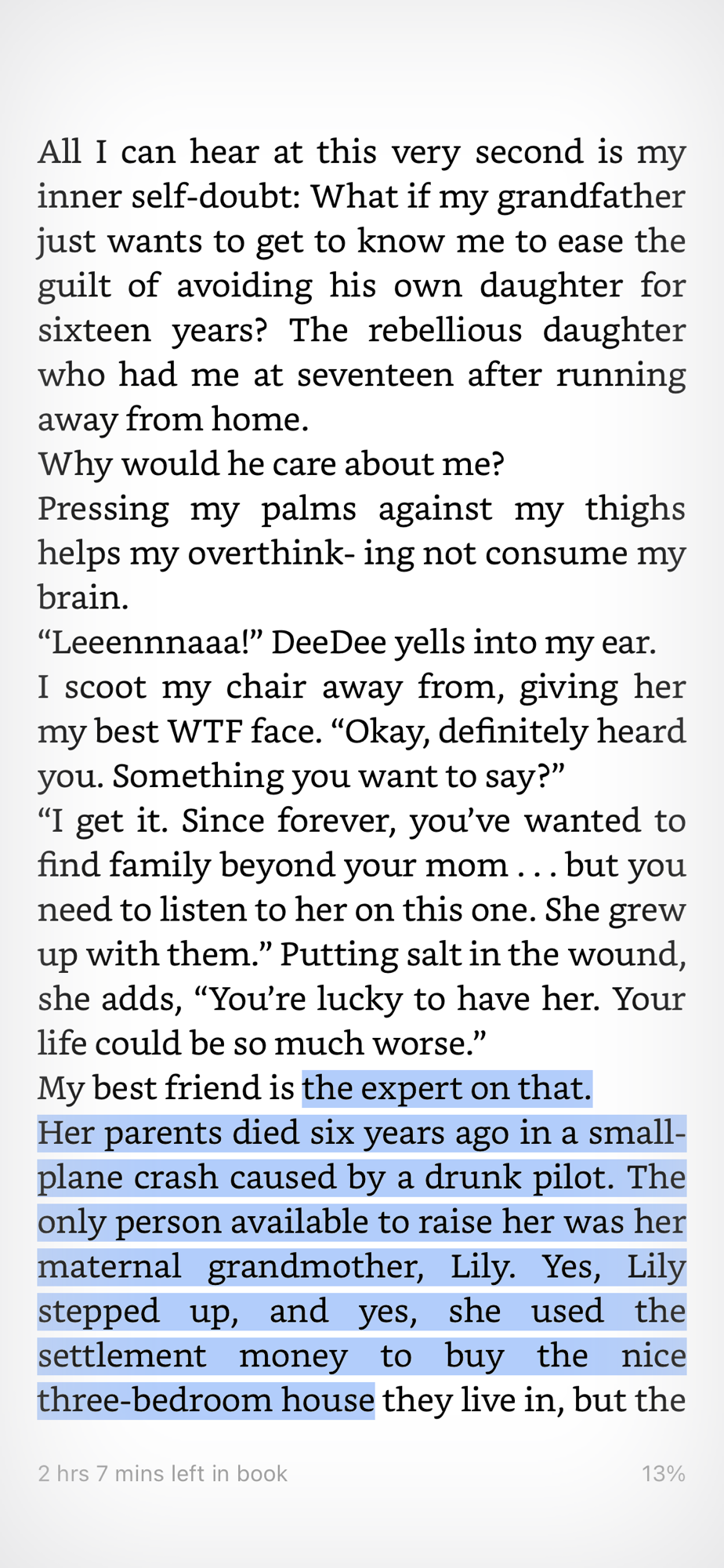
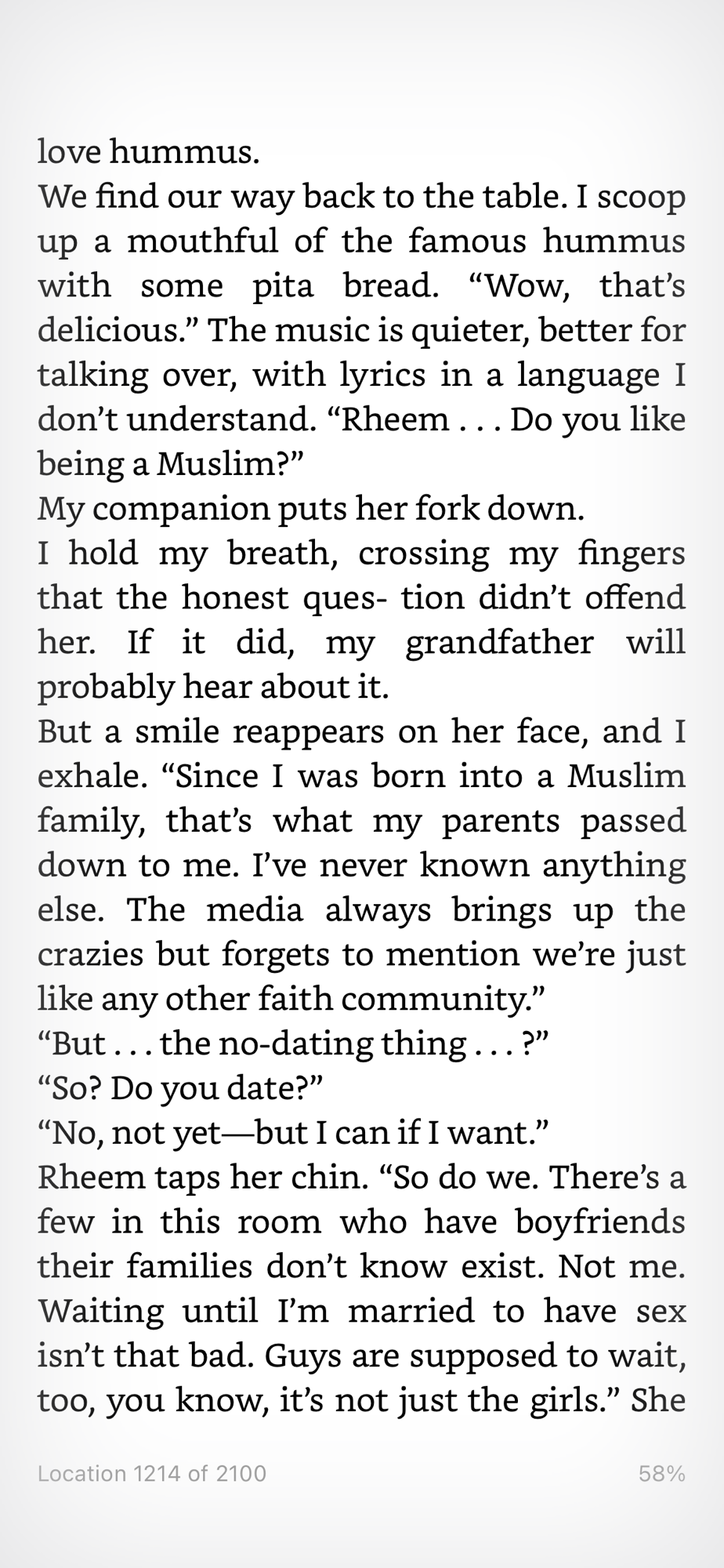
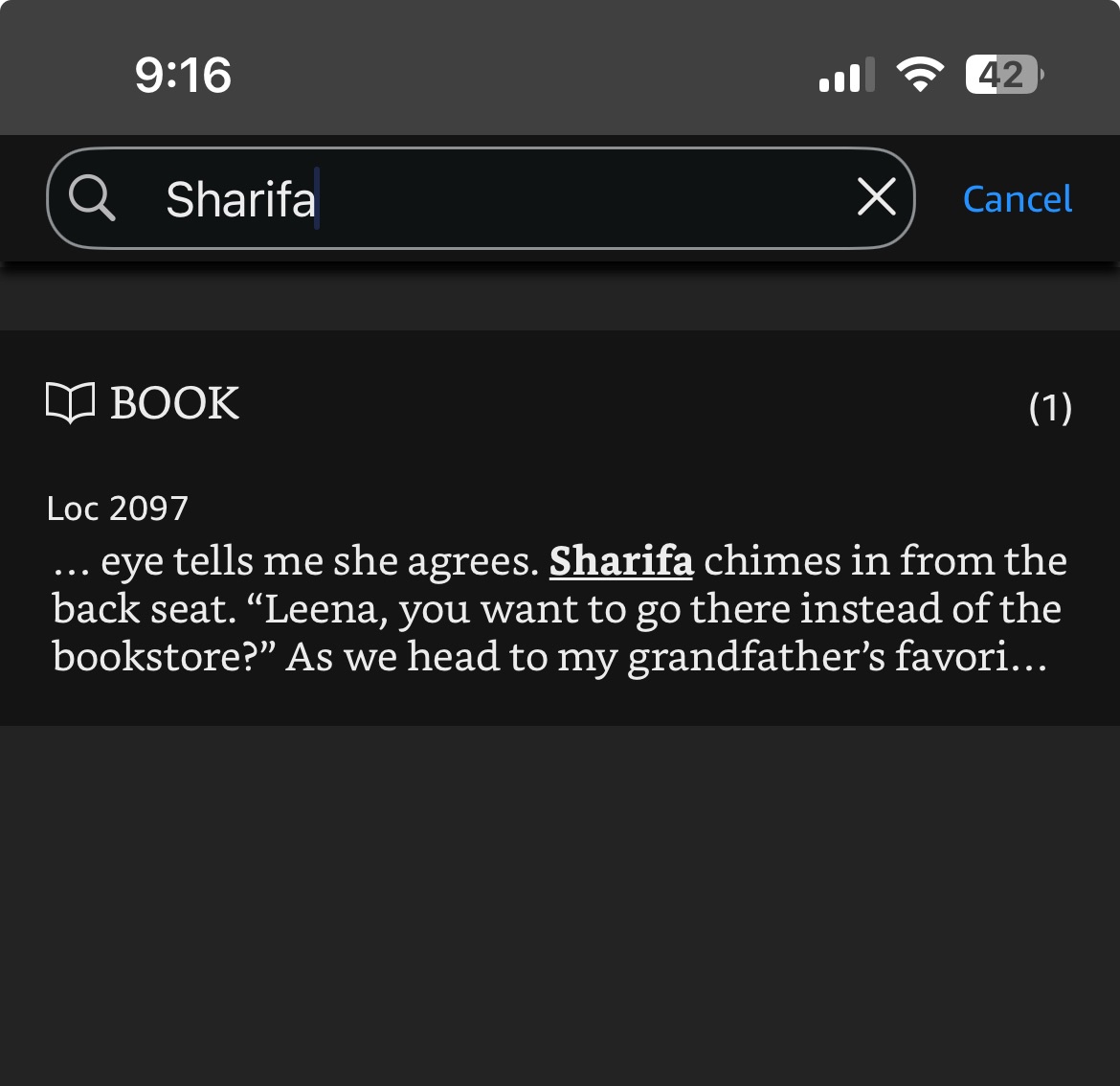
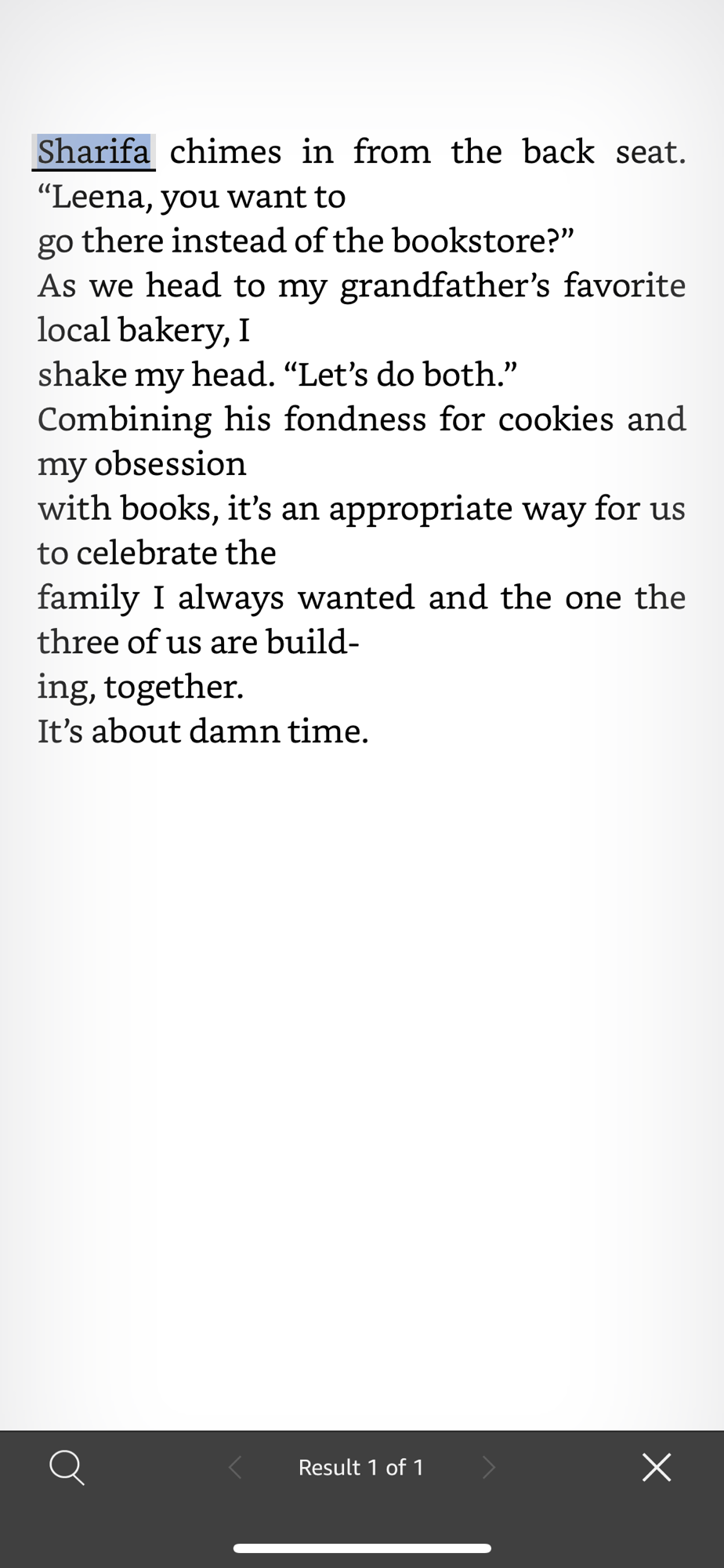
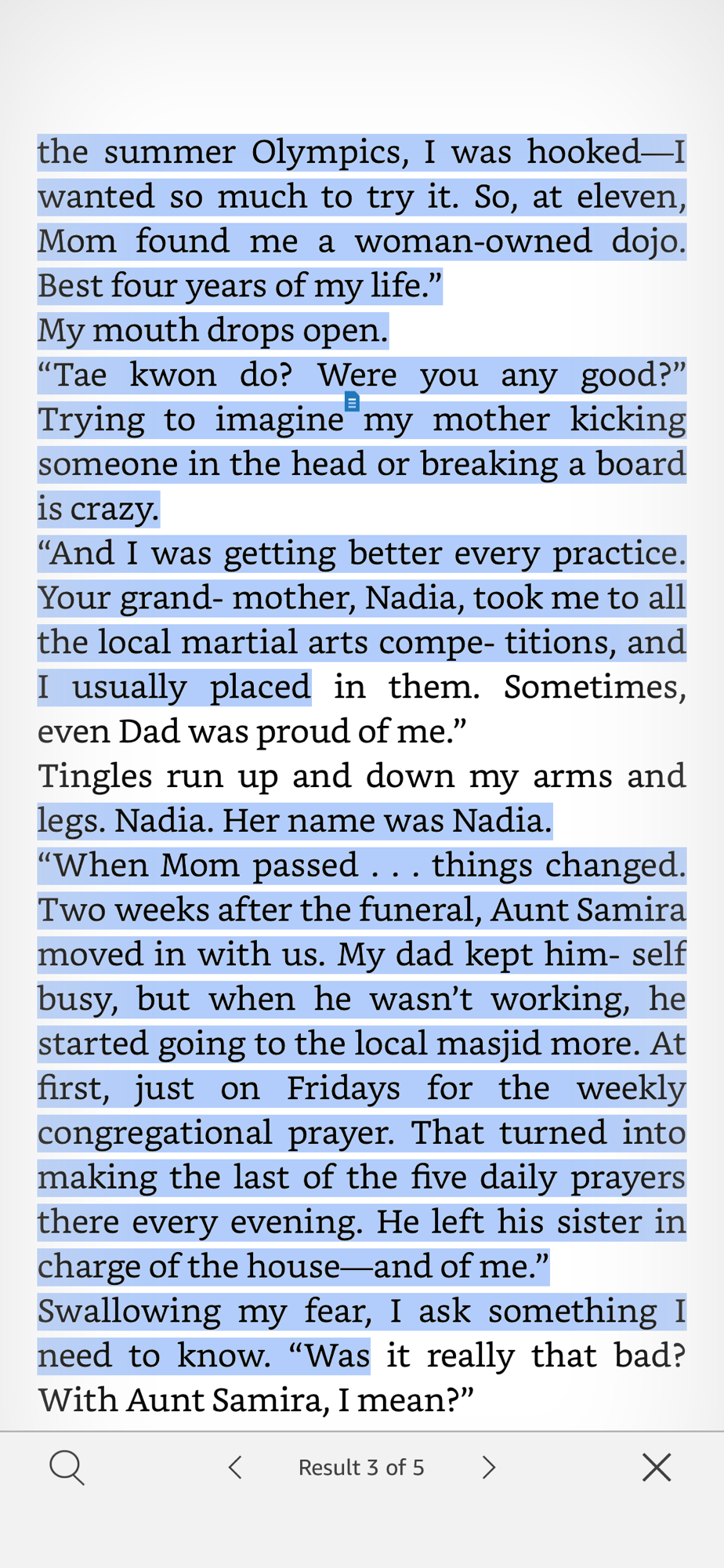
I read an ARC so I am aware that changes could have occurred, I’ve requested the book from my library and it is on order, and I will come back and correct this paragraph if needed.  The story of tae kwon do is repeated in two different spots almost word for word as if the information that Asiyah was good at tae kwon do both times is news to Leena.  Clearly it is in error.  It also has Deidre’s grandmother getting their house with the insurance money from Deidre’s parents dying and then a few lines later saying how the grandma doesn’t let Diedre forget that the spare room was changed to a bedroom for Diedre when she moved in.  A friend, Rheem, is brought in guide Leena academically, and is described as being homeschooled and changing to an online program for her senior year to also take dual enrollment classes, a few chapters later they are going to her Islamic High School for a party.  Side note, the sign on the high school says, “ALHIDAAYAH ISLAMIC SCHOOL: Grades sixth through twelfth.  We want our children learning it’s okay to be both American and Muslim.” The last page of the book also has a “Sharifa” in the back seat, and there is no Sharifa previously mentioned in the book.

FLAGS:
Cursing, judgement, dating, running away from home, anger, death, loss, lying, flirting, gambling, child out of wedlock, cutting family ties, clothing shaming, music, othering.

TOOLS FOR LEADING THE DISCUSSION:
I wouldn’t shelve or use this book for a book club read.  I think Muslim kids would be annoyed by the way Islam is presented.  I think they would be ok that Leena SPOILER didn’t take an interest in Islam, but I think they would be bothered by the flat, angry portrayal that it has in the book.

Rainbow Fair by Diana Ma

Standard
Rainbow Fair by Diana Ma


If you see this 224 page middle grade book, the title might hint that the content is LGBTQ+ as the rainbow often symbolizes such, but if you look closely at the cover you don’t see a rainbow flag, just a Chinese scene on one side and on the other you will see crescent moon lights being hung up above a masjid silhouette, merging together with a little girl holding a rehal, a book and some art supplies. If you then turn the book over, or search the internet, and read the blurb, you will learn that the book is about Sophie, a Chinese Muslim girl learning and sharing her heritage at the school’s Rainbow Fair. As a result, I requested an arc to read and review. No where does it reveal that the book centers queer characters, LGBTQ+ support and allyship, consistently parallels Islamic faith with sexual and gender identities, and prioritizes intersectional identities and agenda over plot and insight. Had I known this, I wouldn’t have read the book, I share this review simply as a heads up to its contents, so families can decide for themselves if it is for them. The book is MG and honestly, it feels misleading and intentional that it is not articulated in a book meant for nine to 12 year olds.  With identity exploration of being Chinese, a child of immigrants, a main character being bisexual, the protagonist repeatedly claims to want to learn about her Muslim identity, but very little information or interaction with the knowledge is sadly ever shown.  The plot seems to just become a forced juxtaposition of two marginalized communities: Muslim and LGBTQ+, to make the point that we are all more than one label. I understand that my view and practice of Islam, is not every Muslims, but trying to have a faith identity and sexual/gender identity parallel one another by having the protagonist “coming out as Muslim,” and being “outted” as Muslim by her bisexual friend before she is ready, is an awkward read. It continues in this approach comparing a trans character being misgendered in a locker room to a Muslim character not having a space to pray, and likens the diversity of a mosque BBQ to the pride parade. I support finding common ground, but when questions about Muslims stoning gays are left hanging, the reader never getting a convincing answer to why her parents hide their Islam, and there is no real rising action, climax, or character arcs- I feel like the labels and the author’s agenda, even if OWN voice, are the point of the book, and it doesn’t make for a compelling read.

SYNOPSIS:

Sophie and Katie did their school’s Chinese booth together last year at the Rainbow Fair, they are best friends and do everything together, but since Katie has come out as bi, she has new friends and is petitioning to add an LGBTQ+ booth, and the rules say she can only be at one booth.  When a sleep over breakfast calls attention to Sophie not eating bacon, it comes out that she is Muslim, not something she meant to keep secret all these years, but something not even Katie knew about.  When discussions about being Muslim spill over into class when booths are being assigned, Sophie decides to do the Muslim booth. She is afraid her parents will be disappointed, and even though she knows nothing about Islam, she is ready to learn.  A new kid at school, Anna, is Muslim and joins Sophie at the booth, and as the two become friends, Anna tells Sophie there “is more than one way to be Muslim” and of course she is a “real Muslim.”  Empowered by not having to pick one identity, Sophia and Katie and all the other kids change Rainbow Fair and show how everyone is more than just one label.

WHY I LIKE IT:

The premise on the back of the book is promising, I just feel like the book missed meeting its own stated intention. The characters are not developed, there are no moments of growth or self reflection, they have no arc or relatability outside of a label.  Sophie paints her parents to be strict, but the precious little that is shown, never backs that up. As a result the reader has no idea why Sophie doesn’t just tell her parents she is doing the Muslim booth and ask them about Islam. After they see the booth at the fair, they say they don’t talk about Islam because of Islamophobia in America and feeling othered in China, but that is it.  Exploration of that would be a far more interesting story: Why did they leave China for Taiwan? When did they migrate to America, was it recent, or did they slowly start to hide their Islam? Dad learned to read Arabic in Taiwan, what was the Chinese community like? Why don’t they celebrate Eid, but have a Christmas tree, did something happen? Why do they not eat pork but drink alcohol? Sadly the two dimensional parents are not fleshed out and Sophie faults them, while constantly trying not to let Chinese stereotypes define them, but the repetitive contradiction, just leans into the labels and fails to make them feel real and relatable.

The book is all talk and no show, and with no real plot, the talking gets repetitive. Breaking the fourth wall we are taken in circles of the same talking points that more than once had me checking if I had bumped the screen and gone back to pages already read. Threads are introduced and then abandoned: what is the point of the whole roller derby thread aside from showing Sophie makes powerpoints, and her parents give in? The girls never go roller skating, it is not something that bonds them. We only know they are close because we are told they are. The beginning and end show Sophie can smell food and decipher its contents, so why isn’t that part of the story as she is trying to figure out Eid foods, cooking, the lunch offerings at the mosque? It hints that the Black culture booth is being suppressed, but it never develops it, nor articulates any real push back, it just skirts the issue. Why the judge-y competitive aunt and uncle? Is their inclusion meant to make Sophie’s parents more or less likeable? Does it reinforce or dispel Asian stereotypes?

From the very start the book feels forced.  Sophie has never gone to a sleep over, her best friend plans a sleepover birthday, but is willing to change it if Sophie can’t come.  What kind of stilted set up is this, why wouldn’t these bffs plan the birthday together, and get Sophie’s parents on board first? It makes no sense that if she can’t come it will be changed and not be a problem because they are so close and she has to be there. It also immediately contradicts the looming conflict of the book, that the parents are strict.  They gave in to roller derby, they give in to this sleep over, and have no problem that two of the girls are dating that sleep over, and “Shane is non binary and doesn’t identify as a girl or a boy.” Clearly the parents are very supportive.

Consistently Sophie drops words, or cultural practices, but doesn’t explain them or engage with them, both the Chinese historical and cultural rep, and Islamic, quick example, she has a Quran but never reads it, we don’t learn about the immortals her dad wants her to feature at the Chinese booth.  It makes it seem superficial and further distances the reader from connecting with Sophie, with culture, with faith, with the book.  Speaking of books, it really bothered me that two books mentioned as being intersectional, Black Muslim Author, Autumn Allen’s All You Have to Do, and Queer Muslim Author Adiba Jaigirdar’s Hani and Ishu’s Guide to Fake Dating are YA books, isn’t that off to mention repeatedly books that your target audience won’t know, or be in the demographic yet to read?

I could go on and on, but I will stop, I think it is clear I didn’t enjoy the book. 

FLAGS:

Islamophobia, alcohol, LGBTQ+, microagressions, racism, labels, stereotypes

TOOLS FOR LEADING THE DISCUSSION:
There is no way I could shelve this in an Islamic School.

Our Neighborhood: Excited for Eid by Marzieh Abbas illustrated by Anoosha Syed

Standard
Our Neighborhood: Excited for Eid by Marzieh Abbas illustrated by Anoosha Syed

img_8357-1

Like the first book in the Celebrating Islam from the Our Neighborhood series, Friday Fun, this 26 page 7 x 7 board book is delightfully done in capturing the joy, sentiments, and traditions of the day. The mix of specifics and generalized parts of an Eid day experience offer both a window and mirror for toddler to early preschool kids. My concerns is that while maybe families will sense that henna/mendhi is cultural fun, and balloons and ice cream are not a religious requirement of the holiday, the two page spread dedicated to gathering at graves is a lot of space given to a cultural practice, not an Islamic one. I’m not a scholar and the book with its minimal words does not indicate if these families are visiting all graves, if they visit on days other than Eid, if they are grieving recent deaths and acknowledging that holidays can be hard. It shows multiple families at multiple graves some with flowers, some bare, some placing flowers, under the words, “gather together” and “love forever.” It is uncomfortable to me because of the space it takes up and the implication that it is a major part, or perhaps that it is a requirement of the religious holiday, when it is not.

img_8360-1

Similarly, the absence of going to the masjid or even praying is also glaringly missing. The family goes past the “lit up mosque” to get to the “fun kiosk” later at night for fun and games, but again no Eid prayers, five daily prayers, or really any worship is shown to take place on Eid other than in the illustrations reading Quran and making dua at graves. Hijab is shown on numerous women and mentioned in the text. For a book about a religious holiday, positioned to celebrate Islam, I would have hoped for some clear religious acts to be shown and articulated as being joyous parts shared by a global faith.

I enjoyed the little baby’s desire for ice cream that stretches through the story. It will add a layer of joy to even the youngest audience members. The gathering to eat and share and have fun is beautifully illustrated under the simple rhyming text, but Eid is a religious holiday, and that point seemed unfortunately absent.

The Boldest White: A Story of Hijab and Community by Ibtikhaj Muhammad and S.K. Ali illustrated by Hatem Aly

Standard
The Boldest White: A Story of Hijab and Community by Ibtikhaj Muhammad and S.K. Ali illustrated by Hatem Aly

The third and final book in the standalone series is finally out and I absolutely love that Islam, salat, and the masjid are front and center. Faizah is once again brought to life through the incredible illustrations that provide all the emotional beats and make the book memorable.  The story though is only just ok, to be honest, it is clunky and disjointed.  I have read the book a half a dozen times to myself and twice aloud and I do not understand the Eid story line.  I doesn’t fit the themes of fitting in, being a leader, being bold, it just seemed to be there to motivate a white hijab being purchased, and it was very distracting to the cadence and continuity of the story. Every time Faizah is self reflecting on her fear, suddenly a conversation about Eid with a friend named Sophie disrupts the story. Even the refrain that “Bravery grows in your mind.  But its roots are in your heart,” sounds lovely, but is never explained or developed, so what are you to water it with? What are the right reasons?  I’m sure most will be fine with the concepts and presentation and not be bothered, but this book is an auto buy for Muslims and non Muslims alike, and while I appreciate the packaging, I wish the story itself was more, well “Bold.”

The book starts with Faizah going to Jummah with her mom and sister, and loving being part of the crowd, she then goes to fencing and loves being part of the crowd, “it feels right.  I feel right,” she says.  But then the coach calls her name and she starts to worry.  She doesn’t like when people stare at her, she worries she did something wrong. The coach has already reminded her to “saber first, then move forward,” so I’m not sure why she worries after if she did something wrong, it is a class, reminders and corrections are what happen in a class.

Then on Sunday, the trio is back at the masjid for salat before Asiya’s fencing lesson.  The coach asks Faizah if she wants to come in for extra practice before the tournament.  Faizah isn’t planning on participating in the tournament though and would rather think about Eid.  Thinking about getting together in the future with Sophie to pick out Eid clothes, is more fun than fencing.  The reader doesn’t know when Eid is, or why Faizah seemed to break into a day dream when asked about fencing.  Furthermore the reader doesn’t feel the worry of being in a competition because Faizah is not shown to be worried.

Later that night Asiya teaches Faizah the moves she learned and Faizah practices alone.  There is then a two page spread that I do not understand, on one page she is saying, “When no one is watching, I ‘m the best fencer in the world,” three lines later it says Even when others are watching, I can do it.  I can be the best.”  What happened in between? I get the following line, “but it’s hard to be my best when I have to stand out to do it,” but the the line in the middle makes no sense.  What is the point of the book if she can do it and knows it at the mid point?  And no, I’m not reading an arc, I checked out this copy from the library.

The family is back at the masjid on Friday and reassuring Faizah as they head to fencing, that she can do it even when people are watching, that bravery will come.  She hasn’t been nervous at class before, and hasn’t signed up for the tournament, so why is she suddenly uncomfortable, when at the start she loved fencing class as she felt she fit in.

Then it is Saturday, and Sophie finally comes, but not to prepare for Eid, just to discuss, how they will prepare for Eid.  At least now we know it will be next week. The next Friday, I know I feel like a calendar should have been included, it is fencing class again and Faizah is called up to demonstrate.  She finds her strength and she is shy, but realizes they are not just looking at her, but looking at what she can do.  She is leading, she is helping, she is being brave.

Finally it is Sunday, and Sophie and Faizah are at the hijab shop, and Faizah picks a white hijab because it matches the fencing clothes, and she is going to the tournament.

Yeah, sorry I spoiled it, I just really am sad that the book wasn’t as great as it could have been.  It connected the dots eventually, but not in a memorable way, and for the team responsible for this book, it really could and should have been amazing.

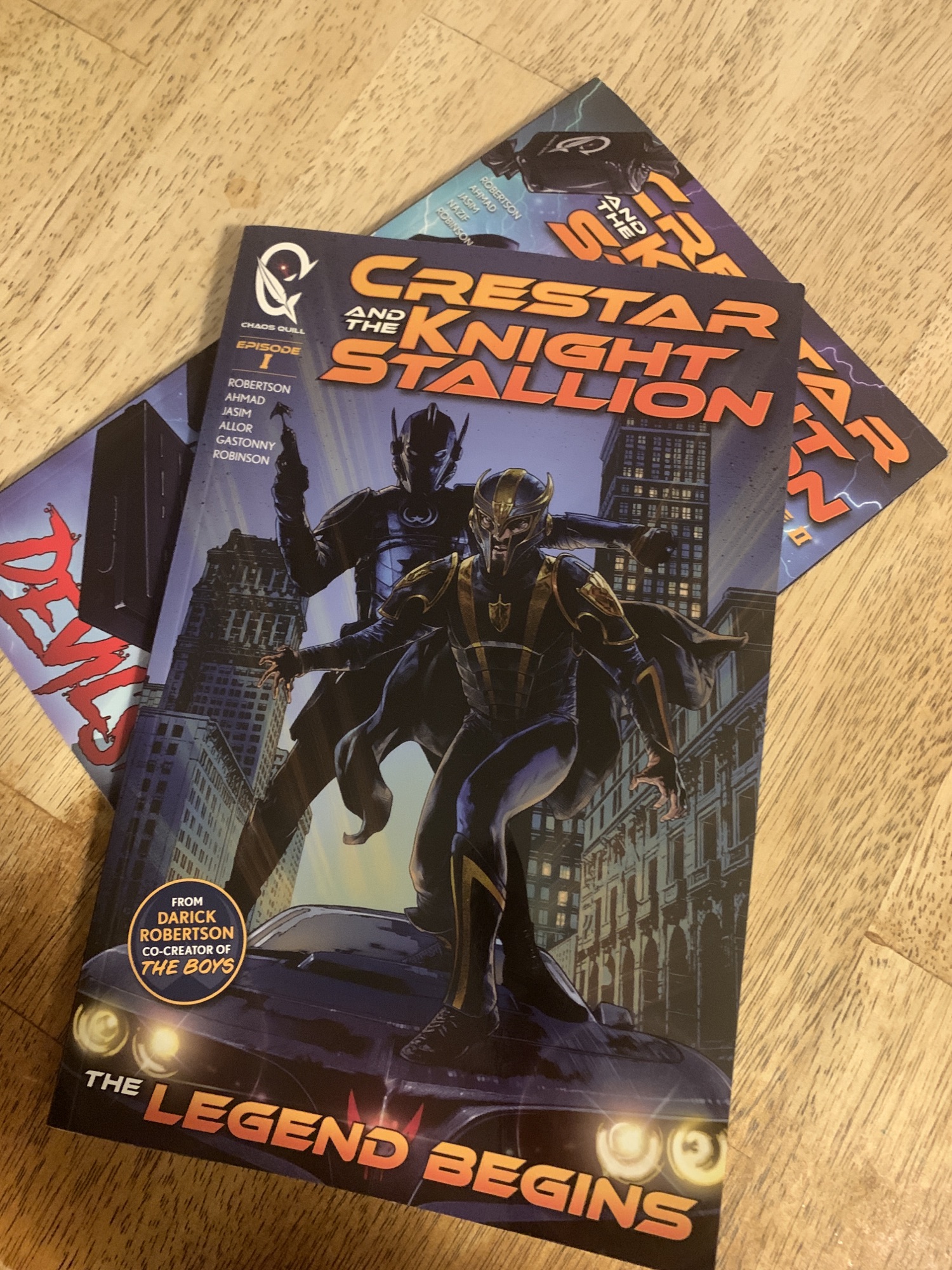
Crestar and the Knight Stallion: The Legend Begins by Robertson, Ahmad, Jasim, Gastonny, and Robinson

Standard
Crestar and the Knight Stallion: The Legend Begins by Robertson, Ahmad, Jasim, Gastonny, and Robinson

This new comic book series combines a lot of exciting elements.  It is a comic book and soon to be live action movie, it is both action and comedic,  it features Desi (Pakistani) and Arab (Iraqi) representation in the title roles, as it is in part written and created by the “characters” themselves. There are Muslim hijabi side characters, cultural Islamic phrases, and a whole lot of saving the day in a plagued Dearborn, Michigan setting.  I admittedly am still very much an outsider to comic books, what all goes in to them, their target audience, and what norms and expectations they carry.  So, I say what I am about to say from a very non critical, simply informative stance, when I say it has what I would consider mature content for elementary aged kids.  The comedy found in the offhand comments, the profanities that are substituted with symbols, surprised me. I anticipated a level of violence and killing, and appreciate that this book doesn’t have the near naked females being shown as many comics do, but I don’t think it is appropriate for younger audiences, probably more middle school and up.  I have not seen the live action, in a different format it might hit different so to speak, but I’m sharing some pictures of the text so that families can decide if the comic books are a good fit for their readers or not.

I love the idea of Muslim rep superheroes, that one is an Iraqi immigrant having to find himself in American society and accept himself, that Crestar is mysterious and his background and motives not known, the cultural and religious infusions, and matchmaking stresses are all amazing subplots to the evil that is destroying the community.  Theft and killings are the norm, Crestar is fighting back, when he discovers Ali has survived an explosion, he begins testing him with the hopes he will join him as the Knight Stallion. The first book is an introduction to the characters, the setting, and the protagonists meeting, it ends hinting that Crestar and the Knight Stallion will be working together, which isn’t much of a surprise given the title of the series, but it sets the stage.

I am not going to write a full review, because I can’t. I just really don’t know if the superhero parts are new and unique or tired and tropey because I don’t know enough about comics to have a valid opinion.  There are trailers online and the first two comic books available are top industry quality in terms of graphics, binding, length etc.

Game Changers: Stories of Hijabi Athletes from around the World by Charlene Smith illustrated by Natalya Tariq

Standard
Game Changers: Stories of Hijabi Athletes from around the World by Charlene Smith illustrated by Natalya Tariq

This 80 page compilation of hijabi athletes from around the world focuses on 13 women that the author interviewed first hand.  Featuring athletes, sports and even countries that might be relatively unfamiliar to the targeted middle grade audience, the book will appeal to both boys and girls, Muslims and non Muslims.  Many included were the first to play with hijab, or the first female to play in their country, but each journey and experience is unique.  Each hijabi athelete and their sport is introduced to the reader over four pages with beautiful artwork, and pulled quotes.  A common issue I have with these types of books is wondering how those featured were chosen, and while this book doesn’t articulate it clearly, at least it sets some parameters in the forward and introduction, that for me at least, allowed me to appreciate the book that much more.  The book ends with four pages of “More Hijabi Athletes” that could have been included, as well as information on perseverance, hijab, modest sportswear, a glossary, resources, index, and acknowledgements.  There are real photographs included at he beginning and end of the book of various featured athlete in action. 


I can’t really review this non fiction book in my normal style, so I will simply say that the writing is clear and easy, at times details seemed overly vague, but to keep the continuity of the tone, and the reader engaged, I understand why specifics perhaps were not included.  In the first feature, I wish the infamous photograph would have been shared so the reader could see for themselves what the text was discussing.  Overall, this resource to inspire our Muslim girls is much needed and beautifully done.  I absolutely love the artwork. LOVE IT. The women are beautiful, strong, and the artwork conveys that for each of the 13 athletes.

The athletes featured:

Egyptian beach volleyball player Doaa Elghobashy
UAE hockey player Fatima Al Ali
Basketball player Fitriya Muhamed
Afghani soccer player Hajar Abulfazl
Syrian-American runner Rahaf Khatib
Basketball Player Kiandra Browne
Pakistani weightlifter Kulsoom Abdullah
Parkour Sara Mudallal
Downhill Mountain Bike Racer Sumayyah Green 
Iranian Triathlete Shirin Gerami
Kenyan Archer Shehzana Anwar
Wrestler Latifah McBryde
Skateboarder Nadeen Alhamad


We Are Big Time by Hena Khan Illustrated by Safiya Zerrougui

Standard
We Are Big Time by Hena Khan Illustrated by Safiya Zerrougui

With themes of being new in school, balancing sports and school, teamwork, focusing on the positive and pushing back on media stereotypes, this 240 page middle grade graphic novel inspired by a true story is a feel good story that can be enjoyed by all.  The all hijab wearing Muslim high school girls’ basketball team is researched and noted in the backmatter, and while often Hena Khan books feel performative, the tone of this is not identity based. The characters are Muslim, they are not questioning their religion, and in fact push back on the media who try and make it about what they have to overcome by practicing their faith, rather than on their abilities on the court.  That isn’t to say that the Islamic representation is strong.  For characters in an Islamic school, a whole page is dedicated to being the new kid in each class, but only one “salaam” is offered.  The team informs their non Muslim coach when they need to pray which is nice, but surprisingly with a Muslim author and Muslim illustrator when the protagonist prays at home with her family, the men and women erroneously stand together.  The framing, the setup, the accomplishments are all Muslim centered, but the book is not particularly Islam centered. The take away of teamwork, hard work, and normalizing Muslim hijabi women in sports is well done, and I think an easy book for kids to identify with as they read the panels of Aliya dealing with stresses and changes, on and off the court. This book releases next month, and I encourage you to consider for yourself if you feel the author has done enough with her platform to speak about Palestine before supporting or not supporting the book.

SYNOPSIS:
The book starts with Aliya, her two brothers and parents stuck in a car headed from Tampa to Milwaukee.  They are relocating to be closer to her grandparents, and the kids are not excited.  The first day for the trio at Peace Academy stands out because the school is big.  Aliya who has played rec basketball in the past, now decides to try out for the school team.  Tryouts are a bust, only nine girls show, so they all make the team.  With hopes of turning a failing program around, the school has hired a new coach, a non Muslim who used to play Division 1 ball.  It seems Aliya might start to make friends with her teammates, but then she is named co-captain which ruffles some feathers, her grades start slipping, and the team still isn’t winning. When the media takes an interest in the team, the pressure mounts to represent themselves, their school, their faith, and show what they can do on the court.

WHY I LIKE IT:
I love that identity is not in question and that the characters articulate the worries they have about their representation in the media, not because of something they’ve said or even Islamophobia, but just based on the framing of the questions, and assumptions that abound.

I read a black and white arc, so at times I didn’t know who was the dad and who was the older brother, but even with that confusion, the beginning is a bit stilted.  The dad doesn’t know if his daughter was any good at basketball, and the dialogue is so flat to set the stage, that I was glad it only lasted a few pages.  I appreciated that the parents were stressing grades, but were not overly narrow minded, they were presented in a very level headed supportive way as to not fall into a common desi/immigrant stereotype.

I don’t know why the prayer scene is wrong, but the more I try and tell myself it was just a mistake, the more mad I get.  This is why beta reading is so important, Muslim kids will notice, it will make the book feel just that much less authentic, and it so easily could/should have been fixed.

FLAGS:

None, a little bit of Islamophobia, but it is pretty clean

TOOLS FOR LEADING THE DISCUSSION:

The graphic novel format makes the book a pretty quick read, and most of the discussion points are handled in the text, so I don’t know that a book club would benefit.  I do think having it on the shelf for kids to pick up and read, will keep the book bouncing from one reader to the next.  I know my kids have all read it…that’s the beauty of graphic novels, just having it around means it gets picked up, read, and often finished, despite the readers age or even interest.

Leena Mo, CEO by Deena Shakir illustrated by Nez Riaz

Standard
Leena Mo, CEO by Deena Shakir illustrated by Nez Riaz

img_5445-1

For ages four to eight this 40 page picture book really introduces great concepts of leadership, business, support systems, and dreaming big.  Before Leena Mo, leads a company though, she thinks up ideas to solve a problem, she turns her ideas into a plan, tests her hypothesis with her prototype, and takes her invention to the next step when demand grows.  Investors, employees, storage, sales, Leena Mo has not only created a product and a company, but she is leading a business, and inspiring others, even back in her Mama’s home in Iraq. With a Mama wearing hijab, a singular mashallah in the text, and the Arabic word for “my dream” Helmy being what she names her snow clearing robot, children everywhere will be inspired and encouraged to think a little bigger than they may have done before.

I love that this business concept is brought down to an early elementary age (and even younger), in a way that they not only will understand, but also be inspired by.  Younger kids might not get the steps, but the fun engaging illustrations, and simple text builds to show that the idea is also growing, and even four and five year olds will grasp that this is exciting.  There are books about science, inventions, even increasingly more about financial literacy, so this is in many ways a next step, that touches on those concepts, but really focuses on the investors, growth and leadership.  The story and concepts weave together, and that culture finds a place as well, is a testament to the quality of this solid, joyful OWN voice read.

The book starts with Leena playing outside in the snow with her friends, when her Mama asks her to shovel before it gets dark.  Leena hates shoveling.  She finds it worse than raking leaves, doing the dishes, and even taking out the garbage.  Instead of complaining though, she starts to dream up an idea of something that would make clearing the snow easier.  She decides on a robot, and gets to work designing and building and testing.

Once it works, a neighbor, Miss Irma, asks to borrow Helmy, and when she returns it, the rest of the neighborhood wants to know where they can purchase one of their own.  When Miss Irma invests in Leena and her team, the next phase begins and as parts turn into products, and equations determine cost, the team of Leena, Olivia, and Lily starts rolling out Helmies.

The sweet ending of inspiring others, will also hopefully inspire readers to think bigger, dream bigger, and recognize the role support,  teamwork, and leadership all play in bringing ideas to life.

The book can be preordered and soon ordered anywhere and everywhere books are sold.

Lion on the Inside: How One Girl Changed Basketball by Bilqis Abdul-Qaadir with Judith Henderson illustrated by Katherine Ahmed

Standard
Lion on the Inside: How One Girl Changed Basketball by Bilqis Abdul-Qaadir with Judith Henderson illustrated by Katherine Ahmed

This nonfiction picture book memoir is about Bilqis Abdul-Qaadir’s love of basketball, accomplishments, and ultimate decision to choose her hijab over her career.  For elementary readers the 40 page book reads like a story, and shows what it means to work hard, be talented, stay true to yourself, and be willing to fight for what you believe in.  As the Massachusetts State high school basketball scoring record holder and the first NCAA hijab wearing Muslim basketball player, she was forced to leave the fight on the court and instead fight to change the rules regarding headgear for women playing international professional basketball.  She won the fight, but unfortunately it was too late for her, she now advocates for Muslim girls in sports to not have to choose to cover or play.

The book has a flow as it starts from her being born into a basketball family, and shooting hoops at three.  She plays with her brothers with her grandma, Mudgie, always cheering her on.  Her mother’s strength grounds her and at age 12 she puts on her mother’s hijab and heads out to play ball.

At 14 she is wearing her own hijab and playing on the high school team, her hijab is her super power, and reminder to be fierce, faithful, and kind. When the ref halts the game and says she can’t wear her hijab, her team stands with her, until the game resumes.

She gets a full scholarship to the University of Memphis and plays her final season at Indiana State.  She meets President Obama and beats him in a game.  When she decides to play international though, again she gets told she can’t unless she removes her hijab. She chooses her faith, and when she finally gets the ban overturned, it is too late for her, but not for other Muslim girls.

The book concludes with some photographs, additional information, discussion questions, and places to discover more.  I appreciate that it shows her praying, but I wish it gave just a little insight as to why Muslim women cover, why it is part of our faith.

I found my copy at the library, it is available to purchase here.