Tag Archives: Early chapter book

The Last Resort by Sumayyah Hussein illustrated by Rania Hasan

Standard
The Last Resort by Sumayyah Hussein illustrated by Rania Hasan

Once I got over my disappointment that the no parking sign on the bottom left of the cover was a deer and not a unicorn (clearly it is a deer, no shade to the illustrator), the 149 page early chapter book with illustrations was a decent read.  The messaging about family time was a little didactic, but the twist of having the child want it, opens it up to be both reflective for kids also craving family routine, and those that don’t appreciate what they have.  I do wish that the climax of the “noise” was amplified and built upon to add some urgency and tension. And the resolution a little more explained as I don’t know that most target readers will quite grasp what was going on in the resolution.  I know I would probably complain if it was over explained, but here we are.  The book is not preachy in its portrayal of faith, the family is Muslim and they pray and worship as part of their daily routine. The text and spacing, along with the full page black and white illustrations that present once nearly every chapter, make the book accessible and inviting for 2nd and 3rd graders.  I know I sound like a broken record, but the book really just needed a bit more polishing to truly shine, it isn’t a bad read, but based on my own kids interaction with the book, once they put it down, they forgot about it, and just weren’t motivated to pick it back up.

SYNOPSIS:

Mahmoud’s family has recently moved to Edmonton, and everyone is busy.  It is summer vacation and he is already bored. When he finds out his one friend is going away all summer, he devises a plan to force his family to come together. He finds a hotel near Banff, marks the calendar, and hopes for the best.  The family comes together, but the hotel has broken beds, toilets that don’t flush, roaches in the kitchen, and an elevator that they are told is out of order, but is still in use.  The family starts to turn on Mahmoud, but when he explains how everyone is too busy to spend together, they decide to make the best of the situation.  Weird noises and details that don’t add up, send Mahmoud exploring and ultimately make it a vacation to remember.

WHY I LIKE IT:

The story is sweet, and I am always a sucker for kids that solve problems. I hope that one day, self sufficiency in fictional characters will rub off on readers, but alas it hasn’t happened to mine yet.  The book is fine, the pieces are there, the writing is decent, it just needs a bolt of energy to make this a book that kids really would gravitate to and read over and over again.

FLAGS:

None: maybe a little anxiety and gross factors, and a kid books a hotel without permission.

TOOLS FOR LEADING THE DISCUSSION:

The book should be on shelves in libraries (I wish Ruqaya’s Bookshelf Books were in public libraries), but definitely in school libraries, classrooms, and homes. I don’t think it has enough to discuss in a book club setting as it is a simple linear story with only one plot line. SPOILER kids may need a bit of help understanding what a front is and what was being done with the animals, and why a hotel in Canada outside of a National Park all came together to make it an ideal criminal headquarters for such activities.

Amal Noor: Mission: Fasting for the First Time by Merve Ozcan translated by Muhammad Izzaddin Seif

Standard
Amal Noor: Mission: Fasting for the First Time by Merve Ozcan translated by Muhammad Izzaddin Seif

Any one who has followed my reviews for very long, knows I really dislike “first fast stories,” so when this one came recommended as being different, and funny, I was hesitant to give it a try, but I caved and purchased it.  And well, it definitely is different in that it is not a picture book, the protagonist knows what fasting and Ramadan are, and she doesn’t just stumble upon her family being up at sahoor one random day, Alhamdulillah. The funny though, well, it just feels really forced, and I can’t tell if it is part “lost in translation” or if  having read early chapter books that have literary value made this one seem, thrown together.  By the end it had a bit of heart, but getting through 93 highly illustrated pages, took a lot of effort.  Amal is obnoxious, doesn’t read her age, and doesn’t have any character growth by the end. If your child likes it, there isn’t anything “wrong” with it, it reads like an attempted imitation of Planet Omar with an annoying Clementine, Junie B. Jones type personality.  The character breaks the fourth wall speaking to the reader, and labels nearly everyone in unequivocal extremes: her mother is the most perfect, the most beautiful, etc., and accomplishing the first fast doesn’t seem to change her at all, despite all the buildup.

SYNOPSIS:

The book starts with Amal proclaiming that she is going to fast the next day, she has tried before but continually fails.  She tells everyone she knows, not just her family, but neighbors, the imam, everyone, and she imagines that it will be a defining day of life before and life after.  Her confidence and arrogance, is put to the test though when she actually has to do it.  At seven-years-old she has done a lot, she runs a charity out of the mosque, she sells items and used goods, and she wanders around independently. Fasting though has alluded her, as has praying more than a couple of rakats of taraweeh, but she is eating and drinking in anticipation of tomorrow, and determined to be successful.

WHY I LIKE IT:

I do like that she messes up and gets through it, I wish though she would have been determined to have a second fast and a third fast, the idea of the first fast being a one and done still doesn’t sit right with me, when Ramadan is a whole month of fasting.  I liked that nothing was overly explained, it is a book by a Muslim for Muslims, and presumably you know what is going on, but I do wish there would have been a little information threaded in about fasting not just being about food.  Amal and her brother Obaid tease and prank each other and with no reminder about being nice being a part of Ramadan included, it seemed like a missed opportunity.  I also thought she was mean to her grandma.  I did like the full circle of her realizing other neighborhood kids her age fasted their first fast without telling anyone, or everyone. But ultimately the book is just not the level of quality that books today have risen too.  If I read this book a few years ago, I might be a lot kinder or happier with my purchase, but even traditionally published books today by Muslim authors have a lot of normalized Islam, that this didn’t feel like it brought anything new to the shelf, and what it brought was not that well done.

FLAGS:

Mean, bragging

TOOLS FOR LEADING THE DISCUSSION:

Since I have the book, I’ll shelve it, but the small 8 x 5 inch size might mean it gets lost fairly easy, and had I not already purchased it, I’d probably not rush out to get it.

Amina Banana and the Formula for Friendship by Shifa Saltagi Safadi illustrated by Aaliya Jaleel

Standard
Amina Banana and the Formula for Friendship by Shifa Saltagi Safadi illustrated by Aaliya Jaleel

img_8365-1

I have five children, I have taught second grade, I have shelved, recommended, and read aloud a number of early chapter books for the better part of the last 20 years, so when I say that this book changes the standard of what a book (series) for this demographic can and should be, I do not say it lightly. Yes, I am bias, the author is a dear friend, but Amina has layers, growth, insight, struggles, warmth, heart, and all the other glowing adjectives normally associated with beloved books and characters for older readers. This book is the first in a series of four, and each book is somehow better than the previous. At 126 pages with a robust backmatter that includes scientific extensions, a recipe for ful mdamas, and a note from the author, I am confident that children of all ages, everywhere, caregivers, parents and educators alike will all fall in love with Amina, cheer for her, laugh with her, and be enamored with her attitude, perseverance, and joy.

SYNOPSIS:
Amina loves having a plan, a formula in fact, and when she arrives in Indiana as a refugee from Syria she is determined to make friends in 3rd grade.  Things don’t always go as expected, but alhumdulillah Amina doesn’t stay down: classmates, family, and determination combine to help the clever, yellow-loving protagonist find a way to rework her experiments, accept what she can and cannot control, and succeed in making this new country feel a little bit like home.

WHY I LOVE IT:
I adore the humor, unapologetic Islam, the rich Syrian culture woven in, and Amina’s approach to life.  So often early chapter book protagonists are obnoxious, annoying, crude almost, bratty, arrogant, and repetitive, Amina is none of those things.  She is vulnerable and strong, confident, yet nervous, hopeful, but worried, she is tangibly real in a way that readers will see themselves and relate.  I love the humor of idioms being confusing, and the heart of seeing what the parents have sacrificed and are willing to sacrifice by starting over in a new place.  The illustrations add to the experience of drawing reluctant readers in and will help those transitioning from picture books to chapter books be immersed by the story.  As always the author’s writing is impeccable and the story well-crafted.

FLAGS:

There is some teasing, reflections on why Syria was left, the journey to America, and hardship.

TOOLS FOR LEADING THE DISCUSSION:
This book is ideal for classroom, library, and home shelves.  It would be a wonderful classroom read aloud and works equally as well at bedtime.  My children college to elementary have all read and loved Amina, and I highly encourage preordering so that your children will get a chance to fall in love with her too.


The Story of Hajj and Eid Al-Adha by Humera Malik illstrated by Basmah Syadza

Standard
The Story of Hajj and Eid Al-Adha by Humera Malik illstrated by Basmah Syadza

img_5367-1

This early chapter book discusses some of the key parts of Hajj and Eid al-Adha in a fictionalized manner.  A young girl, Sumayyah, spending the weekend with her grandparents finds an old photo album of their trip to Hajj, and bed time, walks to the park, and baking muffins, all provide great opportunities for grandma and grandpa to share their experience, the Islamic concepts, and the historical roots of this pillar of Islam.  The book is presented in a gentle way with concepts explained in broad terms, some related to experiences Sumayyah can relate to, and kept light and age appropriate.  The book is not particularly detailed, or even as informative as many picture books, but allows early independent readers to emerge themselves in the story, pick up on familiar and new facts, and hopefully gain a bit of an overview about Hajj and Eid al Adha.  Their isn’t a plot, it is characters and their dialogue providing a framing for the concepts to be shared.  The illustrations are sweet and make it accessible to the target audience, and while the author’s note acknowledges that further information can and should be sought from people of knowledge.  I really wish this book would have sources or a scholars approval, or where to go for more information.  Overall, a good book for our kids, and an easy read that they will benefit from, alhumdulillah.

The book starts with establishing the characters, the photo album, and the curiosity surrounding it all.  There are nine chapters in the book: The Photo Album, Prophet Ibrahim, Ihram, Tawaf, Sayy, Mina, Arafah, Muzdalifah, and The Ka’bah.  The titles really outline the book and what it covers.  The rituals are explained and the historical concept given and often linked to something Sumayyah and her grandparents are doing.  For example, Sumayyah is inspired by Hajarah’s bravery running between As-Safah and Al-Marwah and uses that to fuel her determination to tackle the zip line at the park.

I enjoyed the approach to the content, it doesn’t just list everything as steps or facts.  The history, the acts of hajj, blend together to make it read like a story, even with the predictable framing of teaching the character to teach the reader.  My 8 year old knows a lot of the facts and details, but could chat about them a bit more after reading this book, alhumdulillah.

An Eid Story: Husna and the Eid Party by Fawzia Gilani-Williams illustrated by Kulthum Burgess

Standard
An Eid Story: Husna and the Eid Party by Fawzia Gilani-Williams illustrated by Kulthum Burgess

img_3309-1

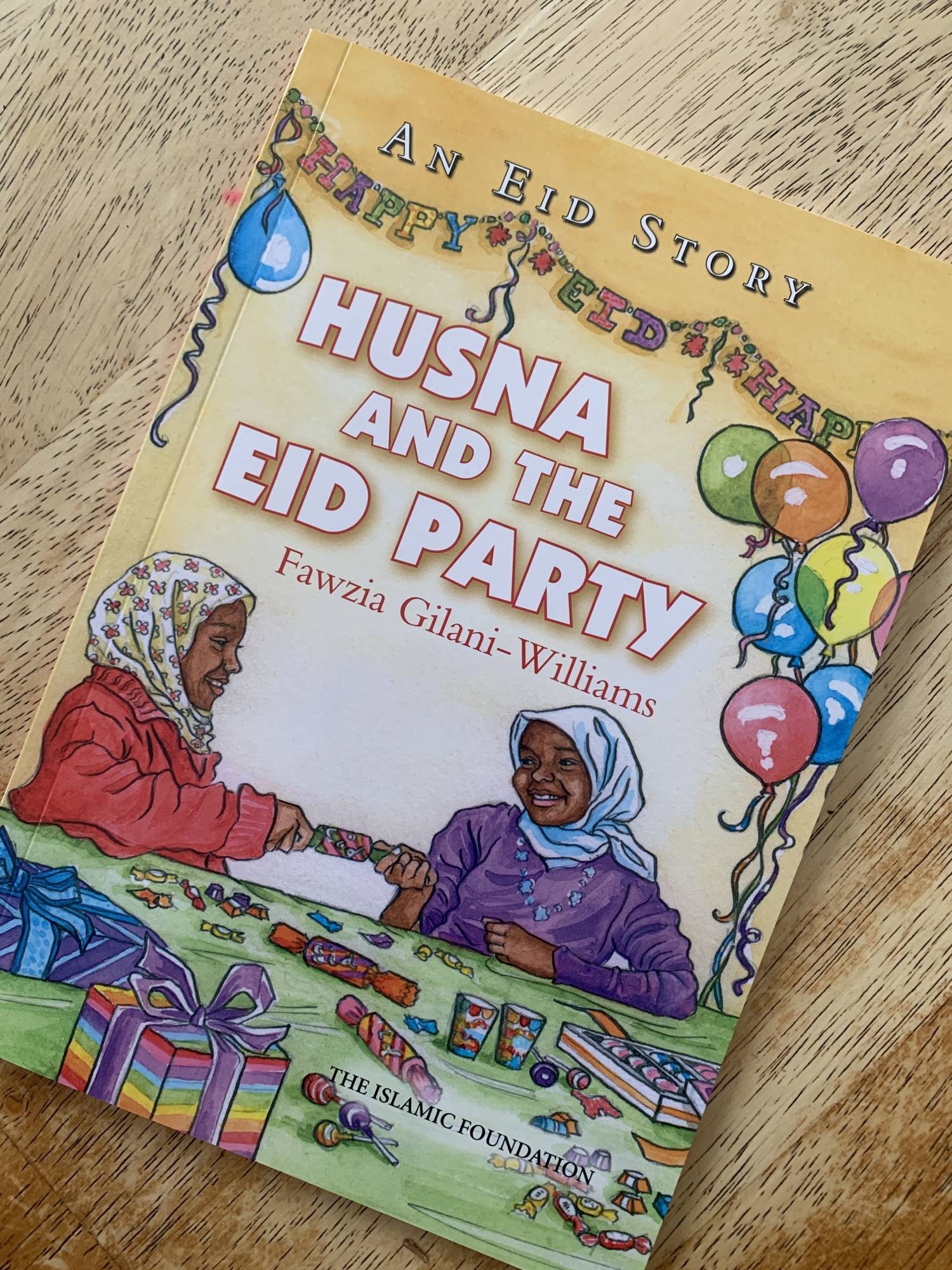
This 27 page book is old, published in 2007, and one that I kept an eye out for on occasion since reviewing a similar early chapter book by the same author, The Lost Ring, that I found in a public library in 2016.  Somehow it found its way to me in 2024, and I’m reviewing it because it has been a while since I’ve indulged in older books that shaped the foundation of Muslim literary representation so many years ago.  It is the epitome of Islamic fiction and what Islamic fiction looked like when I started teaching.  It has a Muslim protagonist, with a universal stress, framed in Islamic acts, perspectives, information, and morals.  It is unapologetic, it is at time preachy, and while the writing isn’t remarkable, an engaging story is laid out with numerous lessons along the way.  You may not want to rush out and purchase this book, but if you have it on your shelf, it would be worth pulling out, dusting off, and sharing with a child. At times the details feel a little dated, but there is a timelessness to stresses with friends, being left out, assuming the worst, and wanting to be included.  This book will offer a chance to be seen in the text and illustrations as Husna waits to be invited to her friend’s Eid party.  The book does not specify if it is Eid al-Fitr of Eid al-Adha, but it really isn’t impactful on the story, as it simply sets the time, mood, and draws all the threads together.

SYNOPSIS:
It is the week after Eid and students are back at their Islamic school, Husna has lots of friends, but Maryam is her favorite.  While on the playground, someone asks Maryam where the party is going to be, and she responds, “probably at the house.”  Excited Husna waits for her invitation, that unfortunately never comes.

WHY I LIKE IT:
Even though the book has a happy ending and is based on a misunderstanding, the feelings are very real.  I remember feeling left out, I’ve seen my own kids and students feel it, and that the book is a snapshot of that feeling from a Muslim perspective, really makes it hit home.  Husna makes dua in sujud at Maghrib and Fajr that she will be invited, conversations begin with As-Salamu ‘Alaikum and end with Barak Allahfi-ki, homework is learning Hadith and memorizing ayats, jumah is prayed, and every page is filled with Islam.

FLAGS:

None

TOOLS FOR LEADING THE DISCUSSION:
The book is an early reader, a text heavy one at that, but none-the-less meant for ages seven and up. I can see it being read today in small groups in an Islamic school or if you have a young one who is perhaps feeling something similar.  You might have to explain invitations in the mail, or calling on a house phone, but it still has relevance.

Yusuf and Yusra’s Spooky Dilemma by A. Dawood illustrated by Fatimah Farooqi

Standard
Yusuf and Yusra’s Spooky Dilemma by A. Dawood illustrated by Fatimah Farooqi

This 54 page early chapter book about a Muslim kid being tempted by Halloween somehow didn’t really center Islam much, it didn’t explain the origins of Halloween, and it meant well, but I didn’t get the messaging, it actually felt othering.  Young Yusra lies to her parents, gets a costume, attends a school Halloween party, and then once caught goes out to lunch and taken to a museum with her brother and friend Fatima. At the museum the vibrant room is the “From Around the World” exhibit, and the depressing room is “The World Around Me.” the dichotomy is stereotypical and presumptuous without sufficient insight.  The book’s concluding lesson being, don’t give in to peer pressure and feel like you have to celebrate something that isn’t right, “think of all the millions of Muslims in the world not celebrating.”  Wait? What? That is the exact same thing- do or not do something because other people are doing or not doing it! Literary wise there were numerous paragraphs and pages I had to reread to know who was talking, the side characters were underdeveloped as they would get mad and storm off and then be chatting shortly after, and at the end, Umar completely ceased to exist.  Having already reviewed the other title in the series Merry Dilemma, I’m going to allow myself a little forgiveness in comparing the two books, as I would imagine many consumers will buy both, and I found the messaging and presentation in the Christmas book, a lot stronger in facilitating conversation and reflecting Muslim kids’ stresses, than this Halloween book was able to do.  The discussion of Isa (A.S.) and the messaging of what Christmas means and why it is problematic for Muslims was more clear and allowed me to overlook some of the literary inconsistencies and weaknesses; I’m glad I read it first.  If you read this with your kids plan to supplement and discuss because the book does not leave you feeling like you really know why Yusra, or Muslims, don’t celebrate Halloween.

SYNOPSIS:

Halloween is here and Cedarcrest Elementary is throwing a huge party.  Yusuf isn’t going, he knows Halloween isn’t for him as a Muslim.  Family friends, Fatima and Umar, aren’t going either.  But Yusra’s best friend Amanda is really excited, and Yusra thinks she can just help Amanda celebrate, it is just for fun any way right? It isn’t like she is celebrating, she will just be there.  She tells her parents she can’t miss school, her dad buys her a costume, not for Halloween, just for dress-up, and now she is at the school party with glitter and candy and a whole lot of guilt.

WHY I LIKE IT:

I like that the parents try and meet the kids where they are.  I think a lot of Muslim parents buy candy and costumes on clearance the day after Halloween so their kids can still have treats without partaking in trick or treating and enjoy imaginative play after the holiday.  The book having the costume being purchased before the holiday, thus is a relatable occurrence.  Yusra wanting to go is also believable.  But, the parent’s letting it play out to their fourth grade daughter actually lying about a quiz and going to school is a bit of a stretch.

I struggled with the lack of explaining why Muslims don’t celebrate Halloween and what the origins of Halloween are.  It said I don’t do it because I’m Muslim, I don’t celebrate because my parents told me not to, and thank you for explaining it aunty- but in fact, there was no explanation.

The writing wasn’t great.  At one point it says, “Let’s go to the frozen food section we need milk and cereal.”  There were multiple places I didn’t know if Yusra or Yusuf were talking, they sound the same age and I don’t think they are twins, but maybe they are, they are family friends with a brother sister: Umar and Fatima at their school, but Fatima is not in Yusra’s class either, the school vibes feel more junior high than elementary. Back to Fatima though, she gets mad when Yusra doesn’t take a firm “Muslim’s don’t celebrate Halloween position” with Amanda and she walks off being labeled a party pooper, but after school everything seems fine. The plan is all four Muslim kids will hang out instead of going to school for the party, but Umar is not with Yusuf and Fatima when they bust Yusra, or at the museum, so where did he go?

The messaging hinges on Yusra’s guilt.  I don’t know that the book explores it enough, doesn’t have her struggling with it a lot, so it comes across that it is more the getting caught that caused the realization.  She remembers Allah swt when caught, she apologizes to her mom, which is good, but not celebrating Halloween then seems more a family expectation not a religious no-no.  Ultimately the book felt a bit like a missed opportunity to explain the origins of Halloween and let the child decide what to do based on their understanding of Islam and the holiday.

FLAGS:

Lying, going to a Halloween party.

TOOLS FOR LEADING THE DISCUSSION:

I have a few teenagers and a 3rd grader and a toddler, I don’t think this book will do much to foster communication and deepen their understanding about Muslims and Halloween.  For my oldest three when they were in early elementary, we would listen to a NoorArt CD Qu’an for Little Muslims it had a track about Halloween that seemed to work when they were young: you can listen to it here.

If you think this book will work for your needsthough, you can order it here.

Nadia and Nadir Eid Surprise by Marzieh A. Ali illustrated by Lala Stellune

Standard
Nadia and Nadir Eid Surprise by Marzieh A. Ali illustrated by Lala Stellune

img_7058

This is another holiday book in the Nadia and Nadir series for early readers, this one focusing on Eid al Fitr, but also celebrating Muslim American athletes Ibtijaj Muhammad and Muhammad Ali, sadqa, and the love of grandparents.  The 32 page book with four chapters shows Desi American siblings enjoying both their Pakistani and American cultures while consistently embodying their Islamic faith.  They pray salat, wear hijab, discuss sadqa, and say Salam and Eid Mubarak.  I am not sure why they pray Eid prayers at home, and not in a community congregation, no it is not a Covid set book, they then go to the mall, but the pride in their faith, culture, and family is enjoyable.  Early readers will enjoy the colorful pages, large illustrations, and relatable story situations.

img_7062

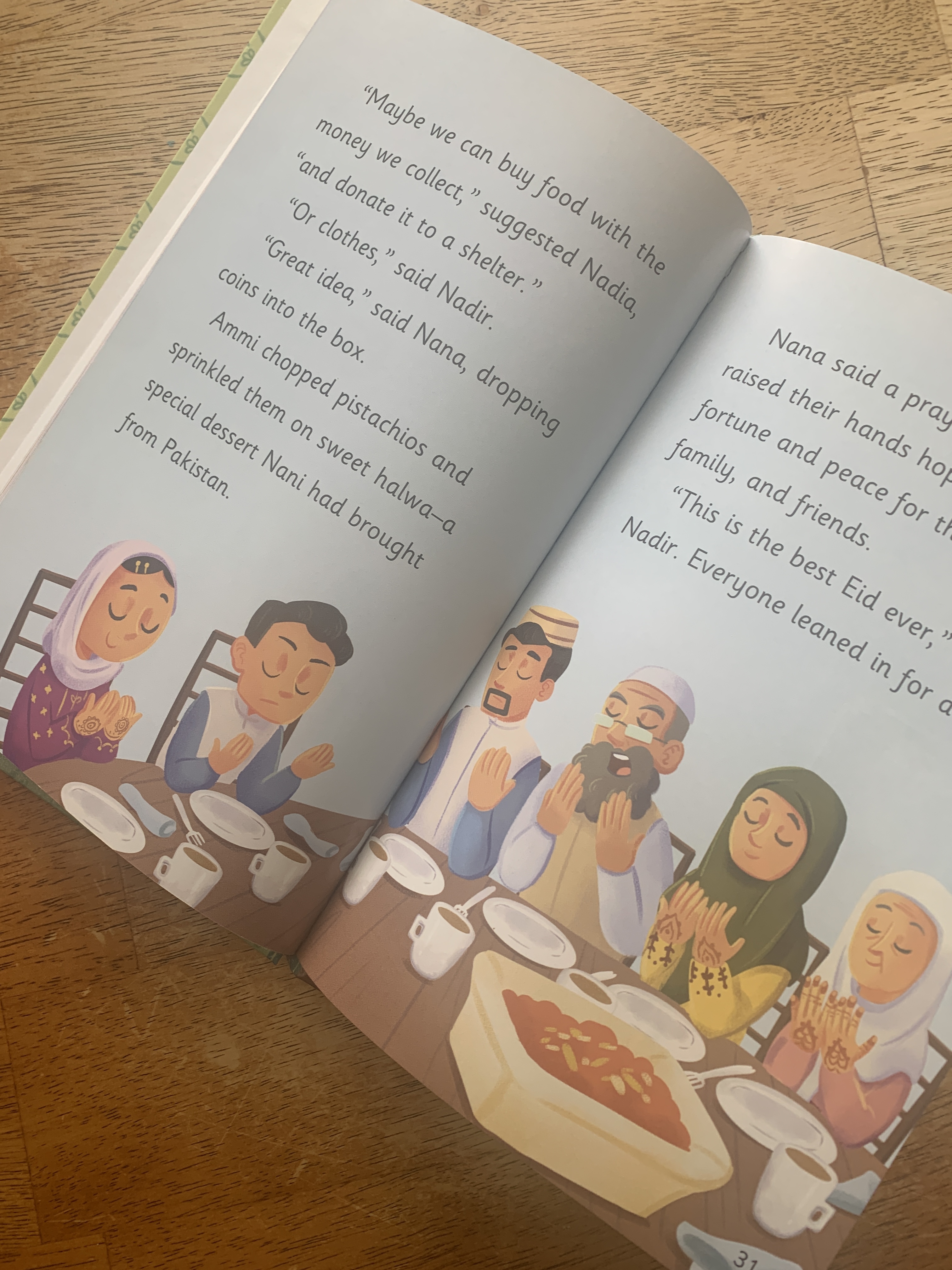
The book starts with the siblings hearing laughing downstairs, then seeing suitcases, and being surprised by their Nani and Nana coming from Pakistan to surprise them on Eid.  The family eats paratha and chai together before praying and making duas.

img_7061

After presents are passed out, the kids receive eidee and are off to the mall to pick out a toy.  Nadia sees an Ibtihaj doll, and Nadir points out that she is wearing a hijab just like his sister.  Nadia recognizes her and shares some facts since she has read her books.  Nadir wonders if Ibtihaj knows it is Eid and the family reassures him that Muslims everywhere in the world are celebrating.

img_7060

When it is Nadir’s turn to choose what to buy, he picks some boxing equipment with marketing images by Muhammad Ali.  Nana fills him in on the activism and accomplishments of Ali and how impressive his fearlessness really was.  When the change is given after paying, the kids and their grandparents discuss sadqa, charity, and this gives Nadia an idea.

The book concludes with a glossary of new words and information about the illustrator and author.  You can purchase your copy at all major retails such as here at Amazon, or you can support small business owners like Crescent Moon store and purchase your here.

Anisa’s International Day by Reem Faruqi

Standard
Anisa’s International Day by Reem Faruqi

international

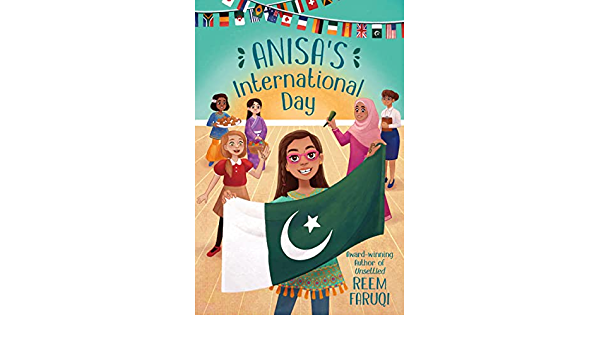
Full of determination, creativity, culture, misunderstandings, and learning from your mistakes, this story will resonate with readers 6-10 who want to solve problems on their own, stand out and be special, and who must own up to their mistakes when they happen.  In just under a hundred pages of story, the characters are developed and made memorable, the voice realistic, and the story engaging and enjoyable.  I love that there is no cultural or religious identity crisis, no parental fixing of problems, and no preachy moral overtones.  There are many lessons learned, explored, and threaded through the book, but the incredible writing never lets the threads overpower the story.  The emotional attachment to Anisa has you cringing when she messes up, cheering for her to solve a problem, and sighing in relief when amends are made.  The backmatter is quite robust with recipes, a glossary, numerous activities, and notes from the author.  I know the book says it is meant for grades 3rd through 7th, but I think early chapter book readers will enjoy it the most.  There is not a lot of Islam in the book, but enough that Muslim readers will appreciate the representation and OWN voice authenticity.

SYNOPSIS:

Anisa is an artist, a baker, and pushes herself to be ingenious in all she does.  With her aunt’s wedding coming up, her and her sister and their A-Z Bakery are tasked with making cookies for a party, and her Nani in Pakistan has even sent clothes for her to wear.  Included in the package is a beautiful kurta that Anisa decides to wear to school.  Inspired by her pride in her culture the teacher, Miss Torres, decides the class will have an international day.  Anisa can’t wait to bring samosas, but Prerna from India commits to bringing them first and ingenious Anisa can’t copy her.  To make matters worse, Anisa’s best friend Katie doesn’t seem to like the mehndi Anisa got put on at the dholki.  Misunderstandings, assumptions, and hurt feelings get amplified when Anisa takes action, and when everything gets put out in the open, she will have to find a way to make things right.

WHY I LIKE IT:

I love that the drama is not over sensationalized, it is on par for 3rd grade and the solutions are as well. The teacher and Anisa’s parents are supportive and present, but they don’t solve the problems or force reflection, the children in the story do.  I love the subtle backstory of Anisa and Prerna seeming to be in competition, but finding support in one another as the story moves through.  I also love that no one puts pressure on Anisa to be the most creative or the best at anything, it genuinely feels like her personality and a standard she expects for herself.  I was glad that there was no cultural (or religious) self doubting.  The problems with a friend is communication, approval, and misunderstanding.  The mehndi is the catalyst, but it is not meant or perceived to be a symbol of a whole culture and identity.  It is just mehndi. Of course I also love that the apologizing is not just saying sorry, but rather making things right.

There is mention of the aunt wearing hijab and taking it off because Anisa’s dad is not home, that is tucked in and appreciated.  There are black and white illustrations sprinkled throughout that show women in hijab (#muslimsintheillustrations) as well.  The pictures are not finalized in the arc I received, so I will update the included images in this review at a later time.

FLAGS:

There is mention of music, not sure if it is just drums, or other instruments as well. Makeup is also worn by the adult women and mentioned a few times.  Anisa is mean, but she does apologize.

TOOLS FOR LEADING THE DISCUSSION:

I think fans of the Yasmin series (Saadia Faruqi) will move on to this book, and also enjoy the upcoming Marya Khan series also by Saadia Faruqi. The book fills a gap for this reading demographic, and will add relatability, representation, and warmth to whatever shelf it is placed on.

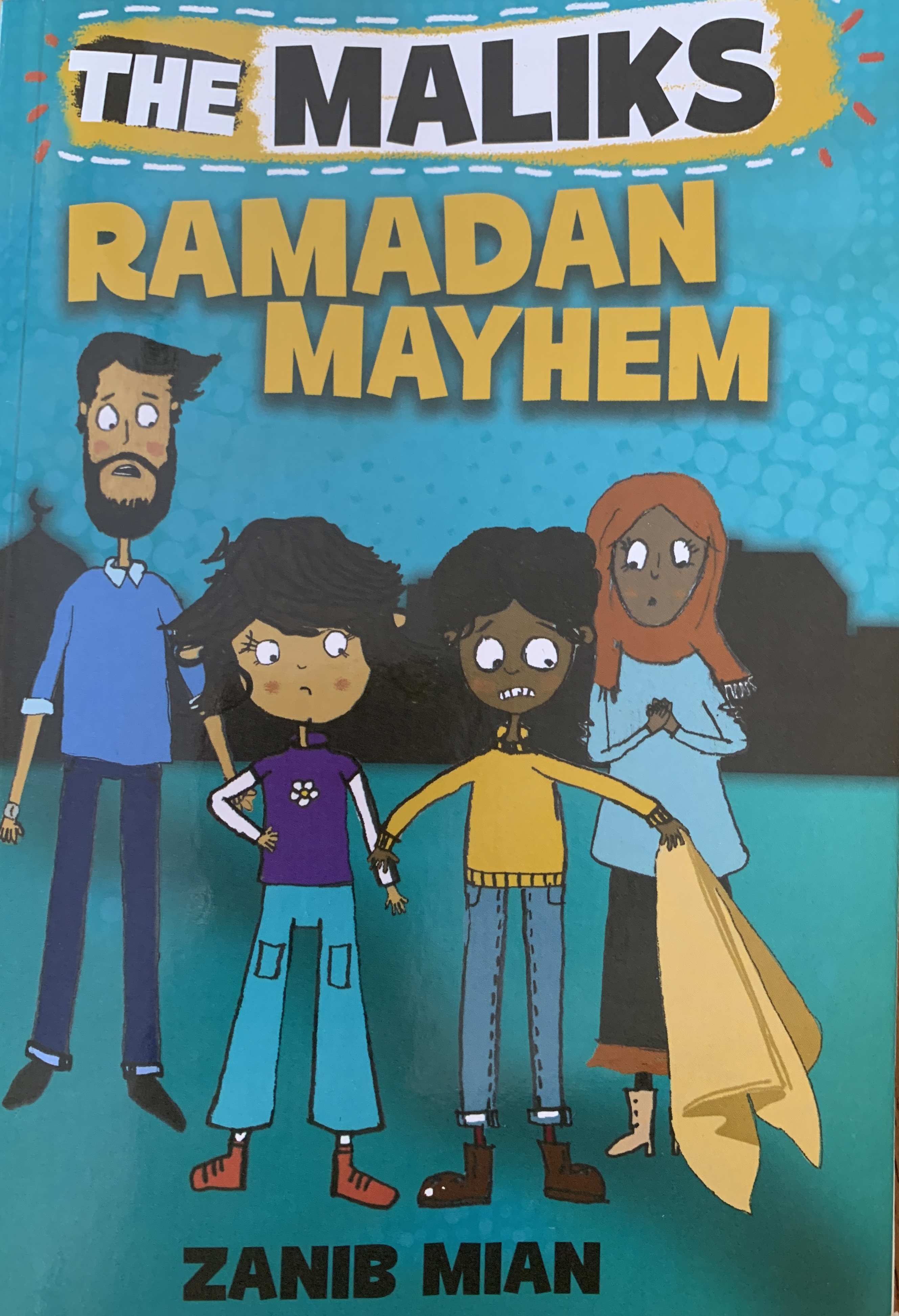
The Maliks Ramadan Mayhem by Zanib Mian

Standard
The Maliks Ramadan Mayhem by Zanib Mian

This 93 page Islam centered, action packed, humor filled book was written as a gift by the fabulous Zanib Mian for her readers. The book was to be free, all you had to do was pay shipping. Well, if you lived outside of the UK, that would make the book pretty expensive, so like any entitled book lover, I started annoying the author, my friend Noura the owner of Crescent Moon Store, and any and all connections I could muster to get the book during Ramadan. I wasn’t trying to get it for free, I just really wanted it in my hands. So, when the author did a second printing for purchasing, and my US stockist was on the list, I was giddy. Then I went out of town to be able to spend Eid with family and the lovely book sat on my neighbors dining table until the blessed month and the festivities of Eid, had come and gone. But guess what, it is ok. This book is fun, no matter what time of year you read it. It is as silly and informative and relatable as all the Omar books, and the characters just as delightful, the mystery just as teasing, and the quirkiness just as charming for readers 7 to 100. Thank you for this gift, thank you dear friend for stocking it at an incredibly affordable price and getting it to me with such speed and love. And dear readers, don’t wait until next Ramadan to get your copy, you and your children will enjoy the book now, repeatedly, and as they get excited for Ramadan next year (and the year after, and the one after that too), inshaAllah.

SYNOPSIS:

Maysa Malik is often misunderstood, and crossing lines at school, with friends, and at madrassah that get her in trouble, even while making others laugh. Her twin brother Musa doesn’t have Maysa’s penchant for getting in trouble, and so their parents are letting him go on the school trip, but not her. Maysa is determined to prove to her parents that she isn’t a class clown and can stay out of trouble. With help from Musa and their neighbor Norman, a cookie tower competition might be just the thing to raise money for charity and get in her parents’ good graces. But, a little lie to avoid teasing has big consequences and destroyed cookie towers mean her plan to go on her residential trip is failing. And no, I’m not going to spoil the plan b the kids come up with, or reveal the snowballing implications of the lie, I wouldn’t want to ruin it for you.

WHY I LIKE IT:

I love that the Islamic tidbits are woven in and made a part of the story. It doesn’t pull out to give facts about Ramadan, salat, and charity, it is all part of the story and works well for both Muslims and non Muslims without compromising or watering down important aspects of our faith. I absolutely love that Norman makes wudu before doing anything and everything related to Islam, and is very aware that farting is a wudu popping act.

There is a “moral” about honesty and self confidence, but it doesn’t come off preachy, and as I’ve grown to expect from the author, her voice reads very genuine and true. The lessons from one character to another and from within internal reflection of a character, feels organic and age appropriate.

The only thing that bothered me initially, but perhaps not so much at the end (I’m going to try not to spoil anything here). Is that the one character that speaks “broken” English is painted as being strict, mean, and short tempered. There is redemption for him, but I wish the characters were more aware of their own impressions of Mr Saleh, and that the stereotype wasn’t perpetuated.

FLAGS:

Lying, accusations, some retaliation against a bully, gossip, gambling is mentioned, butt jokes, fart and bathroom mentions. Nothing offensive, but it is funny.

TOOLS FOR LEADING THE DISCUSSION:

I won’t do this as a book club selection, but I am hoping to read it aloud to 2-4th grade next year before or during Ramadan. It would probably just take a few library sessions and I think the kids will love it.

Zara’s Rules for Record-Breaking Fun by Hena Khan illustrated by Wastana Haikal

Standard
Zara’s Rules for Record-Breaking Fun by Hena Khan illustrated by Wastana Haikal

zara

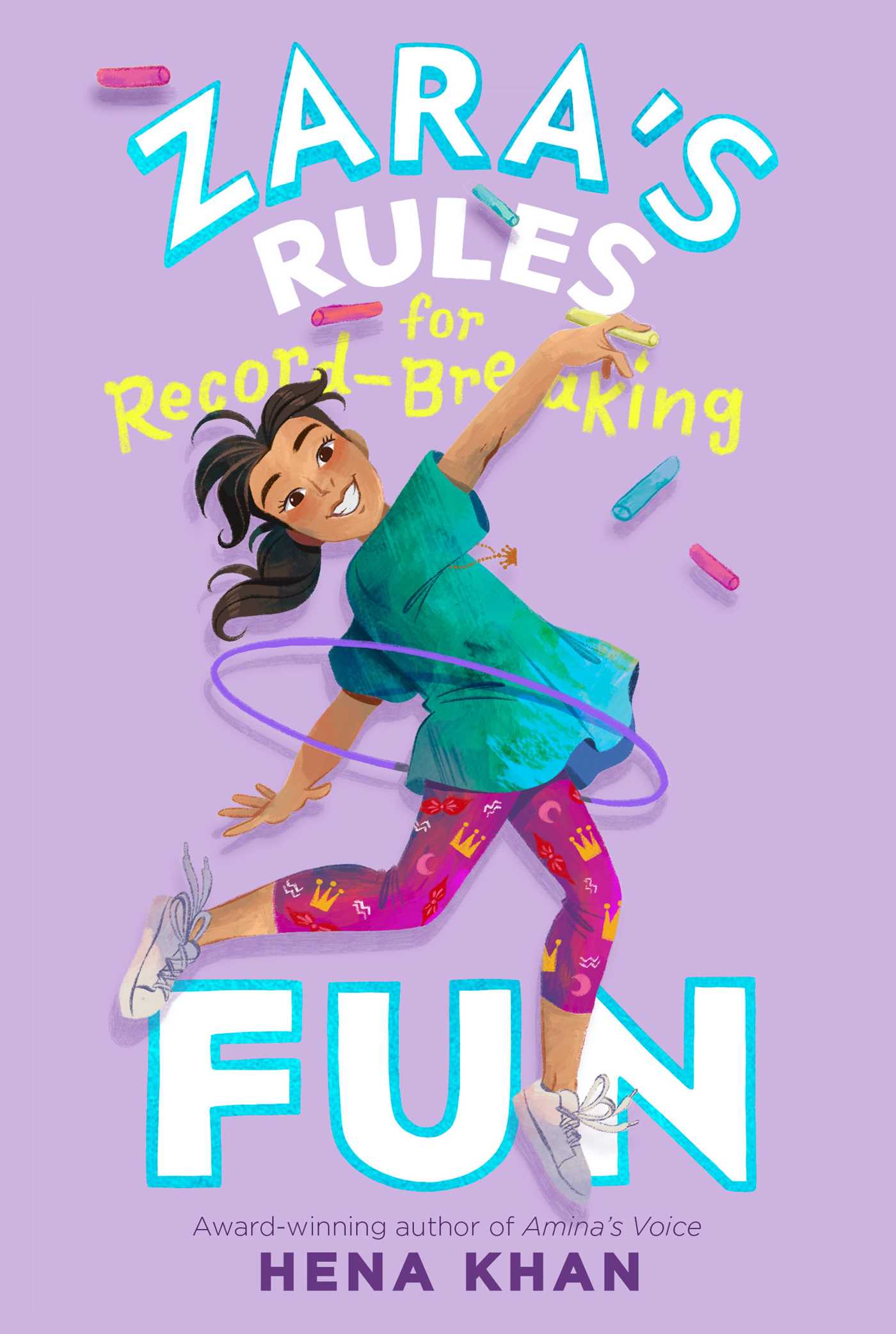
This early chapter book packs a lot of personality, growth, and fun into 127 pages.  The writing quality is engaging and the characters relatable.  If you have read the Zayd Saleem books you will recognize the family in this new stand alone series.  Either way though, from the surprising Naano to the fun Mamoo, the neighborhood children and the desire to maintain her reign as Queen of the neighborhood, the book may be meant for 7-10 year olds, but based on the kids in my house, anyone that picked it up, read the entire book before putting it back down.  The grandma covers her head, it mentions she reads Quran, there is a Salaam or two, an InshaAllah, and desi cultural foods mentioned.  The focus is not on religion or culture, but the layer adds depth to the characters, and normalizes names and practices in a universal plot.

img_9060

SYNOPSIS:

Zara’s neighborhood has a lot of kids in it, and Zara has the reputation of being the leader who rules with grace and fairness.  It is a position she takes very seriously.  When Mr. Chapman moves out and a new family moves in, Zara fears losing her place.  The new girl Naomi has a lot of ideas and everyone seems to like them.  Zara has a grand idea to set a Guinness World Record, but with her little brother Zayd messing her up, nothing is going as planned for the summer.
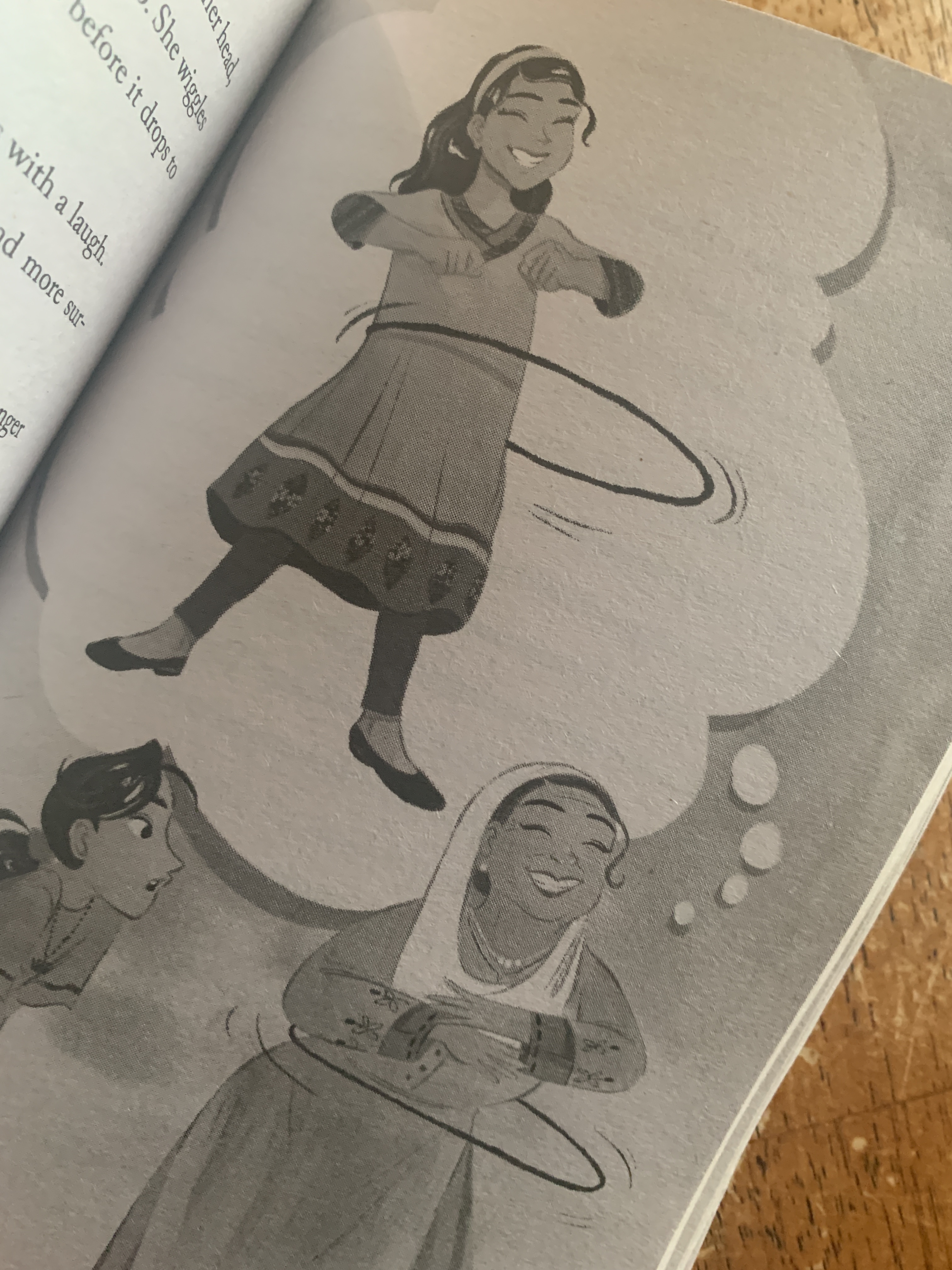
As she finds her self alone a lot and not having much fun, she decides to change things up.  She works to be less bossy, less controlling, more willing to to share her crown.  With a lot of heart, internal growth, recognizing her strengths and weaknesses, the neighborhood kids just might have a record-breaking summer.

img_9059

WHY I LIKE IT:

I love that the story wasn’t just surface level, it acknowledged some emotions and stresses and introspection, that I was pleasantly surprised to see played out in an early chapter book.  I really just enjoy the family, they read relatable and fun. The Nanoo’s surprise ability to hula hoop and her pettiness over a cooking competition genuinely made me smile.  The neighborhood kids and the politics of the different aged children having to find ways to compromise reminds me a lot of my summers as a kid, and the nostalgia was sweet.  I like the Islamic touchstones, I would have loved if they had to go in at sunset to pray or something of the like, but I was glad that at least that Nanoo reads Quran and an inshaAllah in the text made me feel seen.

FLAGS:

Music, dancing, frustration, jealousy

TOOLS FOR LEADING THE DISCUSSION:

I think this book should definitely be on every library and class shelf.  It releases tomorrow on Amazon, but Crescent Moon Store already has it.