Category Archives: Story Time

Colours of Al Quds by Jenny Molendyk Divleli illustrated by Merve Ozcan

Standard
Colours of Al Quds by Jenny Molendyk Divleli illustrated by Merve Ozcan

img_0810-1

I have not posted a review since the latest genocidal escalation in Gaza, my heart just cannot carry on as before, but I keep being asked about Palestinian books that I have featured in videos, but not reviewed, so here we are.  This rhyming book is not OWN voice, but I think these days we are all Palestinian, and the tone of this book is accurately love, and beauty, and strength.  It is based around colors with beautiful illustrations for each two page spread focusing on one color.  Meant for toddlers and preschoolers this book works well in small groups and story times alike.

The book starts with an introduction to the narrator, Iman, from the land of Falasteen.  The first page spread talks about olive trees and the color green, then the blue of Dome of the Rock, orange of Quds Ka’ak and brown dates.  Over 32 pates, it also presents the keffiyeh, Masjid al Aqsa, knafeh, kaftan, keys, and Masjid al Qibly. The picture glossary at the end focuses on the Palestinian points, not the colors, keeping the focus on Al Quds.

The Little War Cat by Hiba Noor Khan illustrated by Laura Chamberlain

Standard
The Little War Cat by Hiba Noor Khan illustrated by Laura Chamberlain

img_0521-1

Even though the book is told from the cat’s perspective, the book never overshadows the human cost of the Syrian war.  The beautiful illustrations and clear text do not shy away from the pain and destruction, but allows for young preschool children and up to see the affects of war through the cat’s eyes, as well as the kindness and hope that prevails. Over 32 pages readers are taken to the streets of Aleppo to see the marble mosques give way to boots and destruction.  The little cat observes the changes, notes the differences and when kindness is shown to her, she finds a way to pay it forward.  I had not intended to post another book by Hiba Noor Khan so close to another book of hers, but as atrocities in Idlib increase I felt it a good time to remind us all, that the war is not “over” in Syria and the destruction and loss of life still requires our awareness, help, prayers, and attention.

The book begins with a warm scene of a little grey cat playing and lounging under the sun in a masjid courtyard. When the boots come, though, it all disappears. The cat begins to notice the changes and the fear becomes real.  

But then one day the cat sees humans that are different than the ones with boots, and she follows one. He cares for her, and she starts to feel like herself again, when she sees someone that also is afraid, the cat is determined to help.

img_0527-1
The book concludes with a note from the author telling about the inspiration for the story, The Cat Man of Aleppo,” and challenging readers to find ways to share kindness.


We Know What to Say: Phrases Commonly Used by Muslims by Sabria Chao

Standard
We Know What to Say: Phrases Commonly Used by Muslims by Sabria Chao

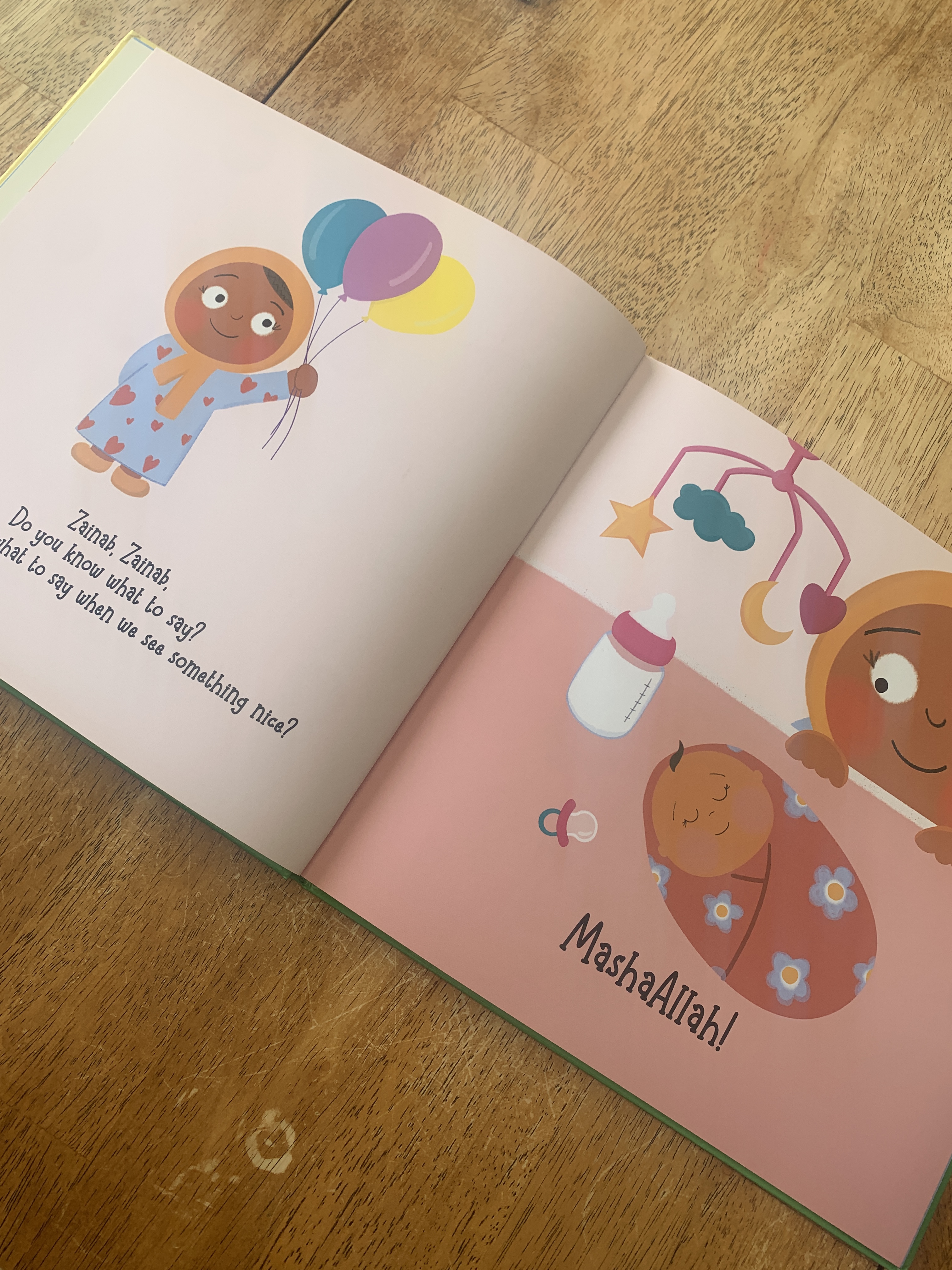
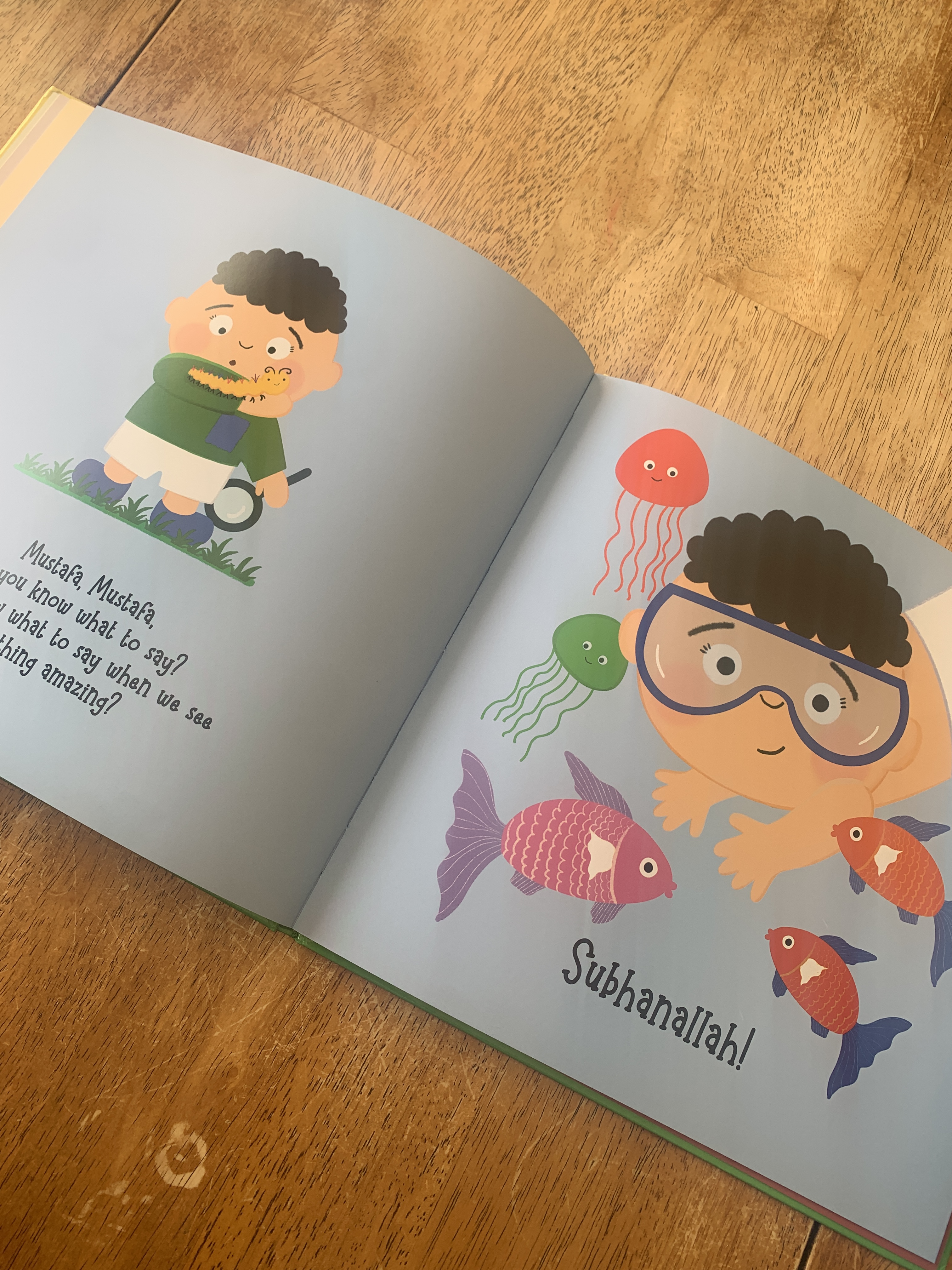
The concept behind this 42 book is really nothing new, but the presentation is wonderful.  The large hardback size, the clear inviting illustrations, and the repetition allow the book to be a delight at story time and bedtime alike.  Each Islamic term is introduced by a diverse character with a common Muslim name being asked if they know what to say in a situation.  The child gives the word, the following two-page spread restates the term and when to use it. All the terms are shown at the end in a two page spread along with a glossary and a Note to Parents.

I love the relatable scenarios: zoom calls, rain, getting sick, etc..  I also like the rhythm of the book, it reminds me a little bit of Brown Bear, Brown Bear.  The bright colors, the simple engaging illustrations and the big size make me ecstatic to share this at story time.  So many of the books that focus on Islamic terms for toddler to preschool level are small board books.  They serve a purpose, but we have long needed a large clear book for groups of children to learn, practice, and review together.

This book was nominated for the 2023 Muslim Bookstagram Awards, but you can purchase a copy here

A Boy Named Ibrahim by Sitti Aminah “Flexi” Sarte illustrated by Aaron Asis

Standard
A Boy Named Ibrahim by Sitti Aminah “Flexi” Sarte illustrated by Aaron Asis

img_9818

This 24 page Filipino book originally published in 2014 was republished with a new traditional publisher earlier this month and reads and feels like solid Islamic fiction.  The book focuses on the five daily prayers throughout the day of a young boy’s life, with the repetitive refrain being the steps of wudu. Ibrahim leaves his activities to pray, wakes up early to join his parents in salat, loves his mother, and listens to her reminder about prayer being an important way to remember Allah swt.  The book is preachy, religious, and unapologetic.  The timing of fajr is a bit questionable, but roosters do crow at all hours, and the light outside the window might be a street lamp and not the rising sun.  Islamic phrases are used, but it does say “Alaikum Salam” in response to “Assalamu Alaikum” which is a variation of the norm.  Overall, the book is a nice addition to share with young children highlighting the importance of prayer, it also works well to learn and review the steps of wudu, and the names and order of salat, alhumdulillah.

The sun is about to rise, Ibrahim says, “Bismillah,” makes wudu and joins his father for prayer.  It is the first day of school and Ibrahim is excited.  He spends half his day at school, then prays Dhuhr.  He makes wudu and prays.  While playing soccer in the afternoon, he leaves the game to pray his Asr, but first he makes wudu.

Once home he chats with his mother about prayer, and coming closer to Allah swt, while he enjoys a snack and then makes wudu and prays maghrib.  Baba then comes home, they eat and pray isha all together.

I enjoyed the illustrations and the simple story.  The book is straightforward, and the contentment and unapologetic portrayal of prayer in a person’s day is sweet and important to highlight. For preschool to early elementary this book would be a great addition to shelves, story time, and bedtime as well.

The book can be ordered on Amazon here

img_9830

Zain’s Super Friday by Hena Khan illustrated by Nez Riaz

Standard
Zain’s Super Friday by Hena Khan illustrated by Nez Riaz

img_9576

I love the joy and normalizing of mainstream titles celebrating salat, Jummah, and the masjid becoming increasingly available for us to read and share.  This particular book is great for preschool to early elementary aged children that enjoy going to the masjid, but sometimes want to put on a cape and be the hero battling aliens, that know how to behave during salat, but sometimes have a hard time sitting still, and parents that want to play with their kids, but sometimes have to get some work done first.  With  threads of patience, kindness, and determination woven in to masjid activities, the book is both a mirror for Muslim kids and a window for those that wonder what a Friday prayer service looks like.  The 32 page book is unapologetic, joyful, and a great addition to book shelves.

img_9578

Zain wakes up early Friday morning and is ready to save the world. Dad greets Zain with a “Jum’uah Mubarak,” but has to pass on battling the aliens taking over the kitchen.  At lunchtime, when dad takes a break from work, Zain tries again to engage him in heroic play, but it is time for Jum’uah.  Zain slips on his cape and vows to protect everyone.

When they get to the mosque, aka command central, Zain tries again, but dad redirects him to make wudu before salat. Heat action dries his feet, but the adhan starts and giant shoes and aliens will have to wait, yet again.  During the khutbah, wiggly Zain sits by his dad, but when the Imam encourages them to stand for salat and fill any gaps, Zain takes it as a call to duty and races to the front announcing, “Here I come, Commander Imam, reporting for duty.”

The kind Imam knows just what to do, and as Zain controls his focus, even dad finds time to be a hero and battle the aliens on this super Friday at the mosque.

img_9580

I love that wudu, athan, khutbah, Imam, are all used without a glossary and that the Author’s Note is informative and unapologetic in tying it all together and making the terms clear.  I wish masjid was used instead of mosque, but I know that is just my personal preference.  I love that the Imam is kind and the dad is gentle and playful.  Even when Zain is not getting to do what he wants, he is not unhappy with being at Jumuah, or making salat, or being redirected, he just wants to indulge his imagination.  The warmth and joy of the illustrations reinforces the tone of the book, and with the inclusion of charity, and the happy ending, I can’t wait to have a physical copy of this book in my hands.

The book releases on October 10, 2023 and can be preordered/ordered here on Amazon and I’m sure will be available once released at Crescent Moon Store, where my initials ISL at checkout will always save you 10%.

img_9582

The Together Tree by Aisha Saeed illustrated by LeUyen Pham

Standard
The Together Tree by Aisha Saeed illustrated by LeUyen Pham

img_7924

Being the new kid, not having friends, and being teased are not new themes in literature (or life), so if you are going to write a book about them, take a lesson from Muslim author Aisha Saeed and make sure the story is heartfelt, emotional, and well-told.  There is no Islam in the book, no foreign culture, or teasing because of skin color, it is a boy named Rumi who has moved from San Francisco to the other side of America and his shoes, with their drawings and colorings, that cause the kids to stare and start bullying.  Rumi seeks solace under a willow tree and fellow classmate Han has to be brave to put a stop to the mistreatment by finding his voice and not simply staying silent.  The text and illustrations provide a lot of opportunities for children to see themselves in the story, in the various characters, and ruminate over the actions and feelings from different points of view.  The book is lyrical, it is not heavy handed or preachy, and the Author’s Note at the end is equally touching and hopeful.

img_7925

Rumi is quiet, and on his first day in Ms. Garza’s class the kids stare at him as he stares out the window.  At recess he wanders off to sit beneath the willow tree when Asher, Ella and Han leave the swings to see what he is up to.  Asher and Ella start to make fun of Rumi, Han is uncomfortable, but stays quiet.

Rumi recalls coloring his shoes with his friends, and how different it was to where he is now, he picks up a twig to twirl as the hurt grows. In music class when the giggling starts, he tries not to cry.  At recess he retreats to his refuge under the tree.

When the bullying escalates, and tears fall, Han speaks up and breaks the cycle. Others follow and see the world Rumi has created with his twig and are drawn to it and to Rumi.  Forgiveness is asked for, and granted and the tree becomes a place of friendship and togetherness.

img_7928

The Author’s Note shares the real life observations of the author about her son in kindergarten and how while heartbreaking, there was also hope in the concern shown by other kids that simply weren’t sure what to do.  I love that even though Rumi is being teased for his shoes and being different, he doesn’t stop wearing his shoes or try and clean the drawings off.

img_7926

I think this book is a must read in classrooms and homes were kids can slowly peel back the pieces and see where they can relate, how they can plan to act, and what parts they identify with.  The book is deliberate and slow, and while a child could read it on their own and enjoy the story and illustrations at hand, the real power it has, is being a catalyst for discussion and empathy and speaking up.

Pre order/order here on Amazon

img_7927


Egyptian Lullaby by Zeena M. Pliska illustrated by Hatem Aly

Standard
Egyptian Lullaby by Zeena M. Pliska illustrated by Hatem Aly

There was a time in college when my friends and I would gift each other Cinderella retellings and versions from all over the world, that was nearly 20 years ago, and I haven’t thought much of it, until this book reminded again of “This is the House that Jack Built.” Having just read and reviewed “The Masjid that Kamal Loves” which is structed similarly, I can confidently say forget Cinderella, I’m loving this new trend, of a repetitive layered story conveying love and excitement and joy to little readers in such an engaging way. This book has more of a story than the original and shows relationships and longing, even though it is primarily a love letter to Cairo.  The swapping out in some verses for Arabic words and English translations, the sound affects and the connections really elevate the OWN voice details in the text and make the book an absolute treat to read and share even for those of us who are not Egyptian and have never visited.  The Auntie who visits wears hijab, the muezzin calling Allah u Akbar is a repeated refrain, their are numerous illustrations of women in hijab and a masjid is shown repeatedly throughout allowing Muslims everywhere to feel seen with this culturally specific story.  The Glossary with the Arabic script and pronunciation guides and Notes from the Author and Illustrator really radiate with love and invite the reader to participate in the celebration on the pages.  I have no doubt children (and their parents) three and up everywhere will fall in love with the 40 page story and delightful illustrations.

Auntie Fatma comes to visit a little girl’s family from Egypt and brings sahlab and changes for two weeks to the home.  Arabic is spoken, and a nightly lullaby of the sounds of Cairo are among the beloved additions to connect the little girl to her Auntie and her culture.

The lullaby begins with the sound of the Nile, the boats floating through the city, the athan calling to prayer, the carts on the streets, the traffic.  The halawa ya battekh, swish, swoosh, swish, Allah u Akbar, beep honk toot, all add layers to the bustle of the city as the little girls memories of the sights and sounds of Egypt soothe her to sleep.  When it is time for Auntie to return the little girl’s sadness is palpable, but Auntie finds a way to reassure her and all those that have drunk from the Nile and long to return.

It is hard to say if the text adds to the illustrations or the illustrations to the story, both combine to make this book impossible to read without smiling.  I love that the mosque is shown in the daytime and at night implying that the call to prayer is not a one time thing without articulating that Muslims pray five times a day. I don’t know if the author identifies as Muslim or if the inclusion of the athan and Allah u Akbar is just an environmental reality of Egyptian daily life and thus featured.  The illustrator could have very well added the hijabs on his own as there is nothing religious or explanatory in the text.  Perhaps it is worth noting that there is a dog in the family’s home that seems to sleep with the little girl.  The book is a cultural heartfelt portrayal, and that Islam is prominently featured so beautifully made for a lovely surprise.

I hope you will consider preordering the book here, requesting it at your library, and sharing it on classroom and home bookshelves.  Happy Reading!

The Masjid Kamal Loves by Ashley Fraklin illustrated by Aaliya Jaleel

Standard
The Masjid Kamal Loves by Ashley Fraklin illustrated by Aaliya Jaleel

img_7811

I don’t normally post about upcoming releases this far in advance (2.5 months), but I am hoping that if I share the link for preorders, I just might help in signaling to the traditional publishing world that books like this are so so so important and that we will support unapologetic, well written, Muslim centered, Muslim and Black joy featured books with our purchasing power.  This book is incredible for toddlers to early elementary in its “This is the House that Jack Built” format.  Muslim kids will giggle with excitement as they see themselves happy to see their friends at Jumu’ah, flinging shoes a little too hard before entering the musallah, splashing a bit when making wudu, playing while helping put out the prayer rugs, and getting a little wiggly or tired during the khutbah.  The happiness and love radiates off the pictures and through the text that even non Muslim readers will feel our connection to our Masjids and the prayers that occur within.  Muslim authored, Muslim illustrated, masjid not mosque, and a beautiful Author’s Note, makes this book a must have on every shelf where young children need books that mirror their experiences and provide windows into the beauty of Islam.

img_7814

The book starts out describing Kamal’s smile and offering the reason for such joy as being Jumu’ah at the masjid. It then starts with describing the masjid and all that is contained with the lines adding on the refrain of “the masjid Kamal loves.”  The friends, the shoes, the feet, the rugs, etc.. Terms such as imam, ummah, salaam are in the text and the illustrations show wudu, salat, khutbah, conveying a Jumu’ah experience.

img_7813

Each page is brightly illustrated across horizontal orientated scenes.  The expressions on the kids faces, are engaging and smile inducing and the lyrical text has a rhythm and strength that makes you feel proud to also have a masjid to love like Kamal.

img_7816

I have an arc, but have preordered a copy for myself here and hope you will do the same. Please also request your public libraries to order it, and if they have already you can place the book on hold, inshaAllah little steps to show support.

What Color is My Hijab? by Hudda Ibrahim illustrated by Meenal Patel

Standard
What Color is My Hijab? by Hudda Ibrahim illustrated by Meenal Patel

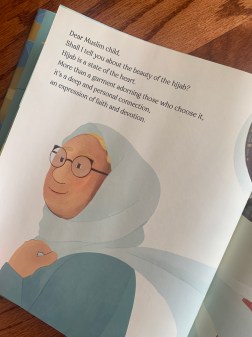
When this book arrived I flipped through it and loved that it tied hijab colors to careers, when I asked my seven your old to read it to my three year old and I overheard snippets, I was impressed that positive characteristics associated with the professions were articulated and embodied by the main character to inspire young girls everywhere.  When I finally sat down to read the book my self, I enjoyed the joy, diversity, and backmatter, but unfortunately felt like a page was missing at the end.  Over 32 pages the book introduces a color as seen on someone the narrator knows hijab, and identifies the woman’s job and a couple of characteristics.  The facing page highlights that when the girl wants to have strength or show kindness she too will wear that color hijab.  The text on the first page and the last page is the same, “Hijab is the crown/I wear every day./It is worn many ways, and it comes in every color.”  I absolutely love the premise of the book, but it seems that the conclusion should perhaps broaden that we can be anything and everything no matter the color we wear.  The blurb on the back of the book actually uses language of wearing “yellow, ‘like’ my doctor’s hijab, brown ‘like’ my teacher’s hijab,” etc.  that allows for a more interpretive and less literal view of I have to wear this color or that to be a leader or athlete or loving. I know I know, I’m probably overthinking it, but I’ve read the book so many times, and each time I just feel like the conclusion tying it together is missing and makes the book primarily a color book and thus preventing it from transcending into being more.

The book text is like a poem with the opening and conclusion reading the same.  The patterned body of the book works very well in establishing the links between hijab, color, occupation, empowerment, characteristics and implementation.  The pictures also allow the reader/listener to broaden their knowledge about various careers and see what they look like in action and what attributes they draw upon.

At times the wording gets a little loose with “give kindness” and “show wisdom” but the overall tone conveys the sentiment and allows for the stronger, “get results” and “be a leader” to balance out the flow of the book.  The illustrations amplify the color being presented, but it is worth pointing out that the hijab’s are all patterned and could be a little confusing to little readers.  Similarly, the yellow hijabs appear more orange and the purple more pink.

I love that the book is authored by a Somali woman and that the illustrations show diversity (skin color, mobility, body shape), but focus on strong black women inspiring the young protagonist.  The backmatter hints that it is the author’s niece and also explains hijab, and hijab styles.

I purchased mine from Book Depository, but they are going out of business, you can also purchase it on Amazon, here.

Not Now Noor! by Farhana Islam illustrated by Nabila Adani

Standard
Not Now Noor! by Farhana Islam illustrated by Nabila Adani

img_7621

This 32 page book is incredibly adorable and silly, and yet so vague in the answer that is the whole premise of the book, that it really has me wondering why we are so afraid (in children’s books and possibly in our daily lives) to say that we wear hijab because Allah swt commands it?  The book articulates that we are Muslim and that hijab defines us, which I love, it just seems that while the rest of the book is incredibly direct and funny, the answer is fuzzy and lyrical.  It is by no means wrong, it just at the end presents what hijab means, the benefits of wearing it, and one’s personal feelings toward it, while skirting the answer the girl keeps asking of why? It seems to be a common approach lately, and I wish that more picture books about hijab would clearly articulate that the commandment to cover is in the Quran.  It isn’t for any other reasons. It may have perks of keeping your ears warm, fashion, or hiding your earbuds, but that isn’t why Muslim women wear hijab.  Perhaps the trend has me more frustrated than this book on its own warrants, it really is sweet and I don’t regret purchasing it and having it sent from the UK.  It allows for a serious conversation about hijab to occur after, and it intentionally pushes the humor, which I definitely think we need more of in Muslim centered books.

img_7623

The book starts with Noor identifying what her Ammu’s hijab is and isn’t, how she wears it and how she doesn’t.  The next page shows Noor’s bustling family and she compares how her Ammu’s hijab is not the same as her Nanu’s or Dadu’s or Aunt’s or even her sister’s, but she doesn’t know why any of them wear it.  Yes, I’m sure there is some pointed criticism I should make about how can a child her age not know, but I think for the sake of it being a book and being comically done, I am willing to let it slide.  I do wish that the spread had the women and their style of wearing a scarf shown.  I appreciate that they are in the dining room at home and thus not wearing a scarf, Nanu is because Dada is in the picture, authenticity which I love seeing, but children need a little more hand holding to see which person the text is talking about. Yes I know there is a family tree on the inside cover, but at story time, it is cumbersome to flip back and forth.

img_7626

Back to the story, Noor starts by asking her sister, the coolest hijabi she knows, if she wears it to hide her snacks in, or hide her big ears, but Affa brushes her off with a, “not now, Noor” and she is off to the next family member to ask.  Each time the rationale gets more outrageous: hide the eyes on the back of your head, prevent you from getting nits, etc..  And each time the person she asks sends her on her way with a “not now, Noor.”

When Noor finally gets to her mom it is she who answers with poetic lyricism, “We are Muslim women, my Noor, Unapologetic and true.  We are believers.  We are dreamers.  We are thinkers. We are leaders. We can wear our hijabs on our heads like our hearts on our sleeves.  Whether you choose to or not, my Noor,, we are so many things…and we are more than enough.” On the next page it continues, “My hijab is not just a scarf.  It means more to me.  It is a reminder of who I am, where I’m from, and where I’m going to be.  And perhaps one day you’ll understand what I mean.  Because, most of all without my hijab, my Noor, I don’t feel like me.”

img_7622

A flowery sentiment, but little Noor and the reader never got the answer as to why Muslim women wear hijab, and I think that it is unfortunate.  The book is beautifully illustrated, the size is great to be shared, the text funny, the voice playful, the joy contagious but the answer for me, just missed the mark, not by a lot, but by enough that I think an adult would need to supplement the overall takeaway message.