Category Archives: Story Time

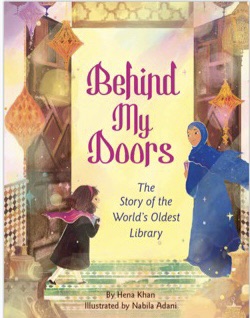
Behind My Doors: The Story of the World’s Oldest Library by Hena Khan illustrated by Nabila Adani

Standard
Behind My Doors: The Story of the World’s Oldest Library by Hena Khan illustrated by Nabila Adani

img_3557-1

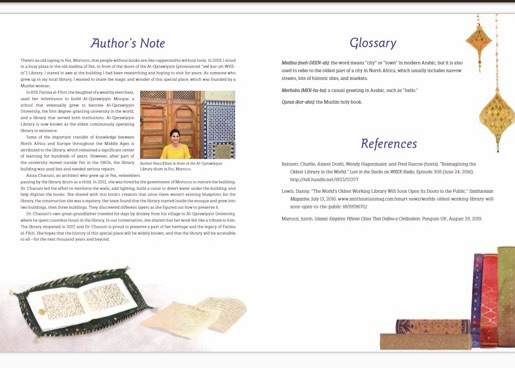
The world’s oldest library proudly stands in Fez, Morocco: started by a Muslim woman, restored by a Muslim woman, and in this 40 page book the library itself tells its own story in a book authored by a Muslim woman.  The personified library shares a few highlights from its early start as a corner in Fatima Al-Fihri’s masjid and university to collections spanning multiple buildings, from a bustling center of learning and knowledge to a place of disrepair and neglect.  Staying on an early elementary level, the informative author’s note and references make the book engaging for older readers as well, and an incredible addition to bookshelves everywhere.

img_3558-1

The book starts with the library introducing itself and welcoming the reader. “Merhaba! I am Al-Qarawiyyin Library–the oldest library in the world.” At over a thousand years old, the library begins at the hands of Fatima Al-Fihri in 859 who dared to dream big and created a space of learning and worship in Morocco.

img_3559-1

As the courtyards and collections grew, seekers of knowledge, from all backgrounds, gathered to discuss, debate, and learn.  Special rooms with special locks kept books safe: a Quran written on camel-leather, a philosophers drawings in gold ink.

img_3561-1

Nearly destroyed once by a fire, the library endured, but over time the rooms were no longer filled with the bustle of people.  One day a small girl, Aziza, paused at the door, but did not enter for many years.  When she did return, she came as an architect with a team to restore the library and invite people back in to read, learn, and dream.

img_3565-1

It delights me that such an important story is available to be widely learned from and appreciated.  You can preorder a copy here from Amazon.

img_3566-1

Until You Find the Sun by Maryam Hassan illustrated by Anna Wilson

Standard
Until You Find the Sun by Maryam Hassan illustrated by Anna Wilson

I don’t know that this book is particularly unique or mind blowing, but I read a digital copy a few weeks ago and was surprised when some tears fell, I read it when I got the physical copy to my kids and my throat caught again, and here I am writing this review and feeling all vulnerable.  It is as if I too am a little girl in a new place missing her grandfather on the other side of the world, which clearly I’m not.  The book is sweet, and moving, and I find myself emotionally invested every time I read through the 32 pages and get lost in the large sweeping illustrations.  The book is not Islamic, there are a few hijabis in the background and text that articulates friends saying salaam before the girl moves.  Additionally, the main character’s name is Aminah, and the author is of Pakistani decent, and has a Muslim sounding name.  The story though, at its core is universal, heartfelt, reassuring, hopeful, and lovely to share in all spaces. It begs to be read aloud and holds the attention of toddlers to early elementary aged children.

The book starts with a happy little Aminah in a bright sparkly environment of sunshine, mangoes, and salaams.  Every night she listens to Da’s stories of adventure as she snuggles next to her grandfather.  One day she finds out they are moving, going on an adventure.  Only Da won’t be joining them and Aminah is devastated.

The new home is gray, and cold, and no adventure at all.  She wants to go back, but Da reassures her during their nightly conversations that things will get better.  And sure enough, with a bit of bright yellow inspiration, she starts to discover the adventures awaiting in her new home.

Kids will find the end hopeful and resolved, but I somehow found it a little bittersweet.  Da loves his grand daughter and wants her happy, but the adult me, realizes their relationship will never be the same, and Da will miss her in many ways, alone, as she embarks on her own life.  I know I’m projecting, but the ability to see both perspectives adds a nice layer to the book.

The book is available here from Amazon and will be in local libraries in June 2024.

Ilyas & Duck: Spectacular Salah by Omar S. Khawaja illustrated by Mattia Cerato

Standard
Ilyas & Duck: Spectacular Salah by Omar S. Khawaja illustrated by Mattia Cerato

img_3321-1

It has been a minute since we have had a new Ilyas & Duck book to read and share with our kids, and this one focusing on prayer is informative, fun, and was well worth the wait.  It is also long, 48 pages long to be exact.  There is a lot of information and works best for ages six or seven and up.  The clever rhyme and engaging illustrations tell about wudu, the times of the five daily prayers, Surah Al Fatiha, facing the Kabah, having the right intention, connecting with Allah, and not being distracted. I love the framing that salah is not just an obligation, but is an opportunity to talk to Allah swt and should be spectacular.  The author reads his books aloud a lot to kids, so if you have ever seen one of his readings, I highly recommend channeling the voices and energy, to hold the audiences attention if using the book at story time.  If reading at bedtime, or if handing to an independent reader, take the opportunity to discuss the points, check understanding, and reflect upon what Duck is learning.  As always the banter between Duck and Ilyas keeps the kids laughing, the story moving, and the information flowing, alhumdulillah.

The book starts with two verses from the Quran and the hashtag #freepalestine, before entering the world of Ilyas and Duck one summer afternoon,.  An alarm goes off and Ilyas heads off to make wudu and pray.  Duck couldn’t get up though, he prayed earlier, so he thought he was done.  Ilyas explains that there are five prayers in the day, and Duck is seriously worried that Fajr, Dhuhr, Asr, Maghrib, and Isha are going to cut in to his game time, snack time, and movie time.

When Ilyas tells Duck that prayers don’t take long and it is when you speak to Allah swt, Duck in his enthusiastic way is determined to make each and every prayer spectacular. He drafts a plan, learns the steps and what to say, finds the direction, makes his intention, says Allahu Akbar and starts training. 

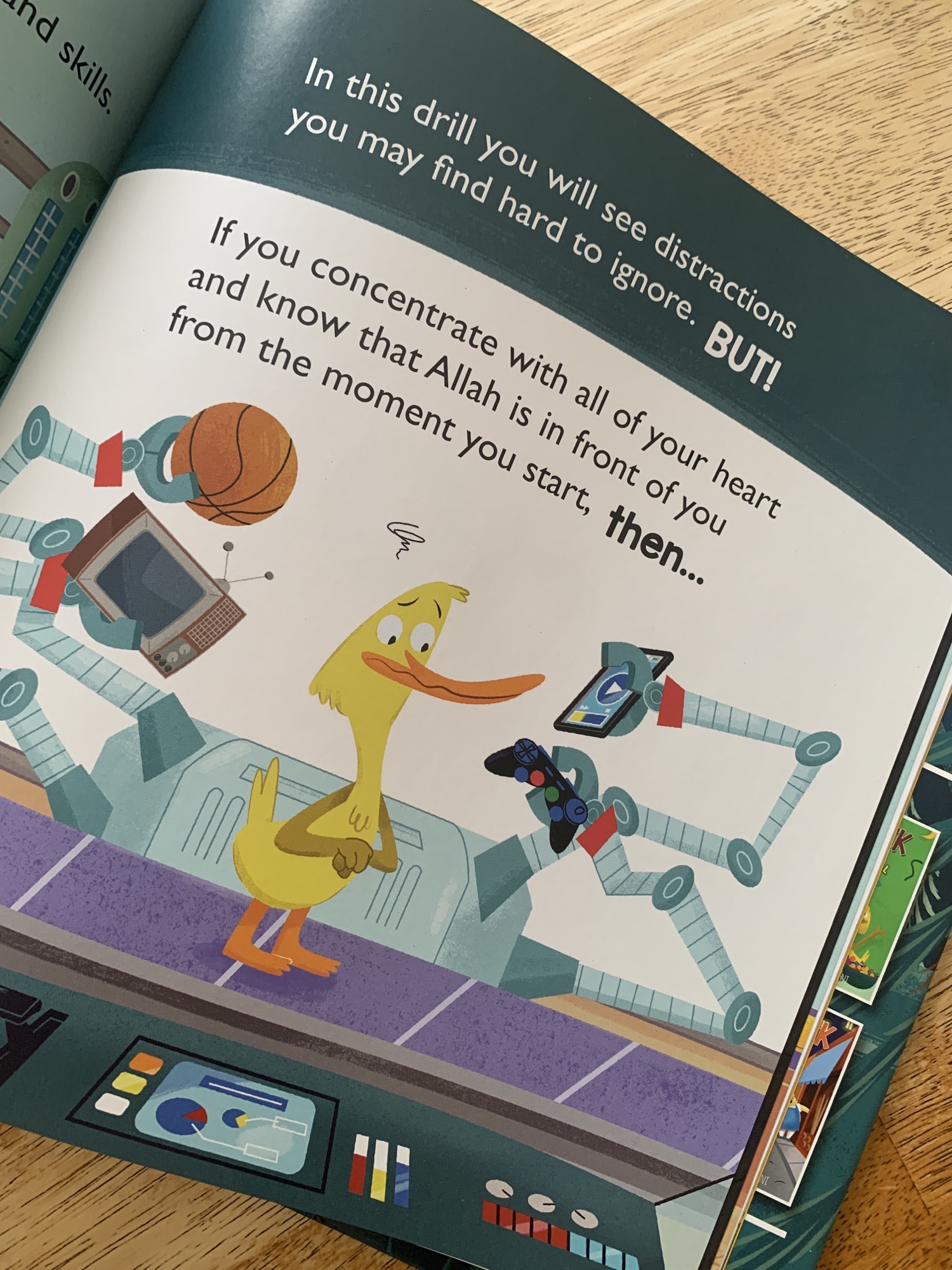
He is praying all over the Earth whenever the time comes, but then he learns he can do more and goes to visit the Professor.  He learns about connection and closeness to Allah.  He also learns about using his heart and staying focused, before rushing back to tell Ilyas all that he has learned.

The book covers a lot of ground, and gets kids excited to pray.  I like that the information is a mix of highly detailed specifics, general knowledge, and humor.  The way the salah times are described and the emphasis on connecting with Allah swt and making your prayers heartfelt is not often seen in books for this age group, and I think it gives the book a wider lasting appeal.  My 8 year old did point out after reading it independently and laughing, that if Duck prayed Fajr didn’t he know a little bit about prayer already?  Also, given the length of the book, a line clarifying that infact not all places on Earth are ok to pray upon, would have been nice. 

img_3327-1

I hope this book signals more books in the series are heading our way.  I notice that the illustrator is not the same, but the pictures are similar enough I doubt most kids will notice. The book is widely available and can be purchased from Amazon here or from Crescent Moon here

Trouble at Taraweeh by Rosalind Noor illustrated by Rania Hasan

Standard
Trouble at Taraweeh by Rosalind Noor illustrated by Rania Hasan

img_3132-1

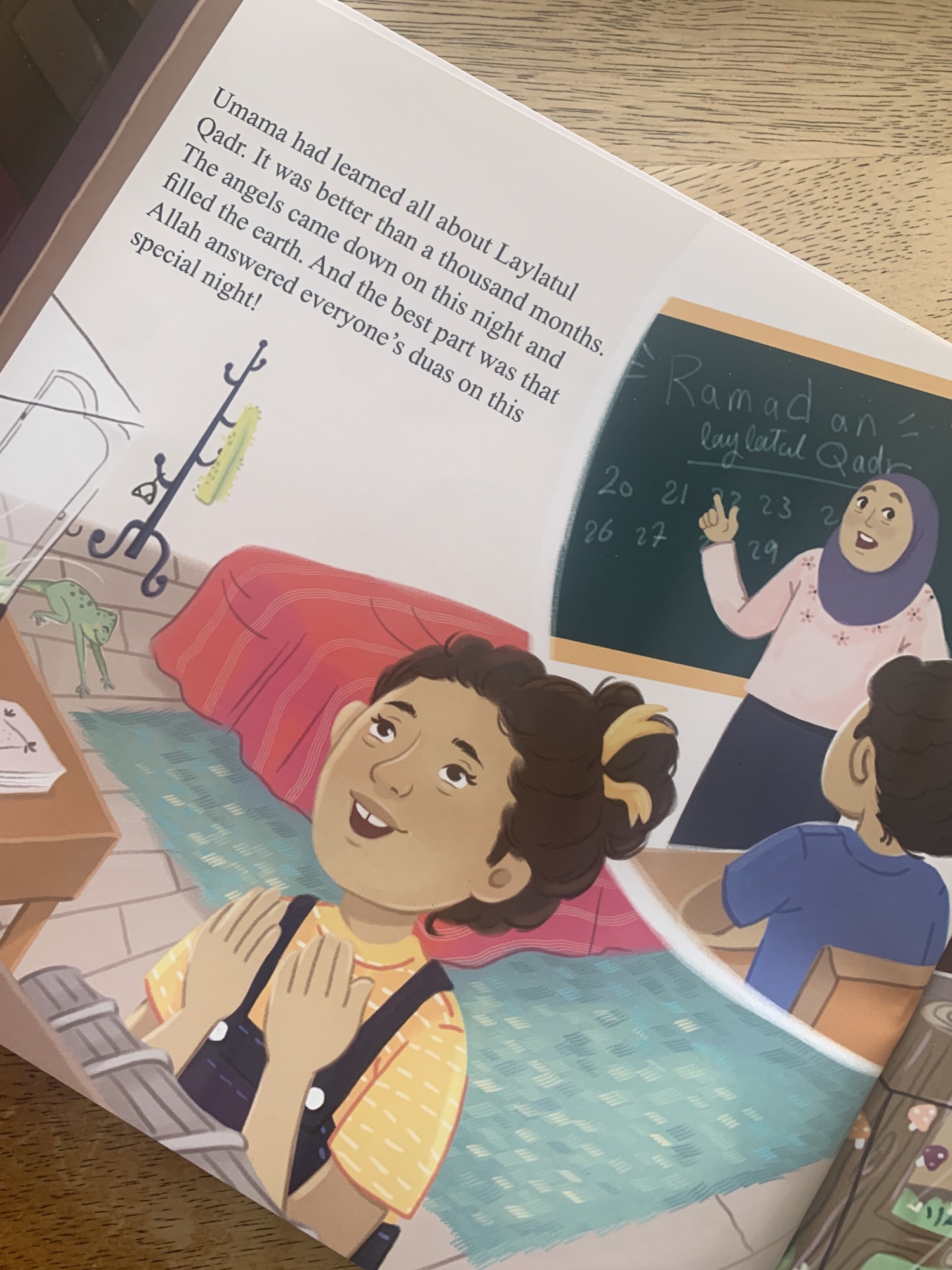
I love funny books that are Islamically accurate, Muslim filled, and informative as well.  Alhumdulliah for this outrageous Ramadan tale, that gets kids laughing and parents horrified.  A frog on the loose at Taraweeh on the 21st night, and a little girl who is a self proclaimed “trouble magnet,” focuses on Laylatul Qadr, good intentions, and Allah swt hearing our prayers.  It is text heavy, so for a read aloud, think slightly older children, seven or up, would be the ideal audience, but in a bedtime story setting the illustrations will keep younger ones engaged.

img_3133-1

The book starts with Umama looking forward to Laylatul Qadr.  She knows duas are answered that night when the angels come down and fill the earth, and she has a special dua to make, she really wants a little sister.  It is the first odd night of the last ten days and she has had an eventful Ramdan so far.  She accidently flooded the wudu area, she tripped on her prayer skirt and knocked people over, she even tried to organize the shoes, but then no one could find their shoes.

img_3134-1

Tonight she is determined will be trouble free, which naturally means, it won’t be.  Fluffy, her frog, gets loose.  She apologizes to the woman as she scoops him off her head, but then…he gets away from Umama, and the chase is on.

img_3135-1

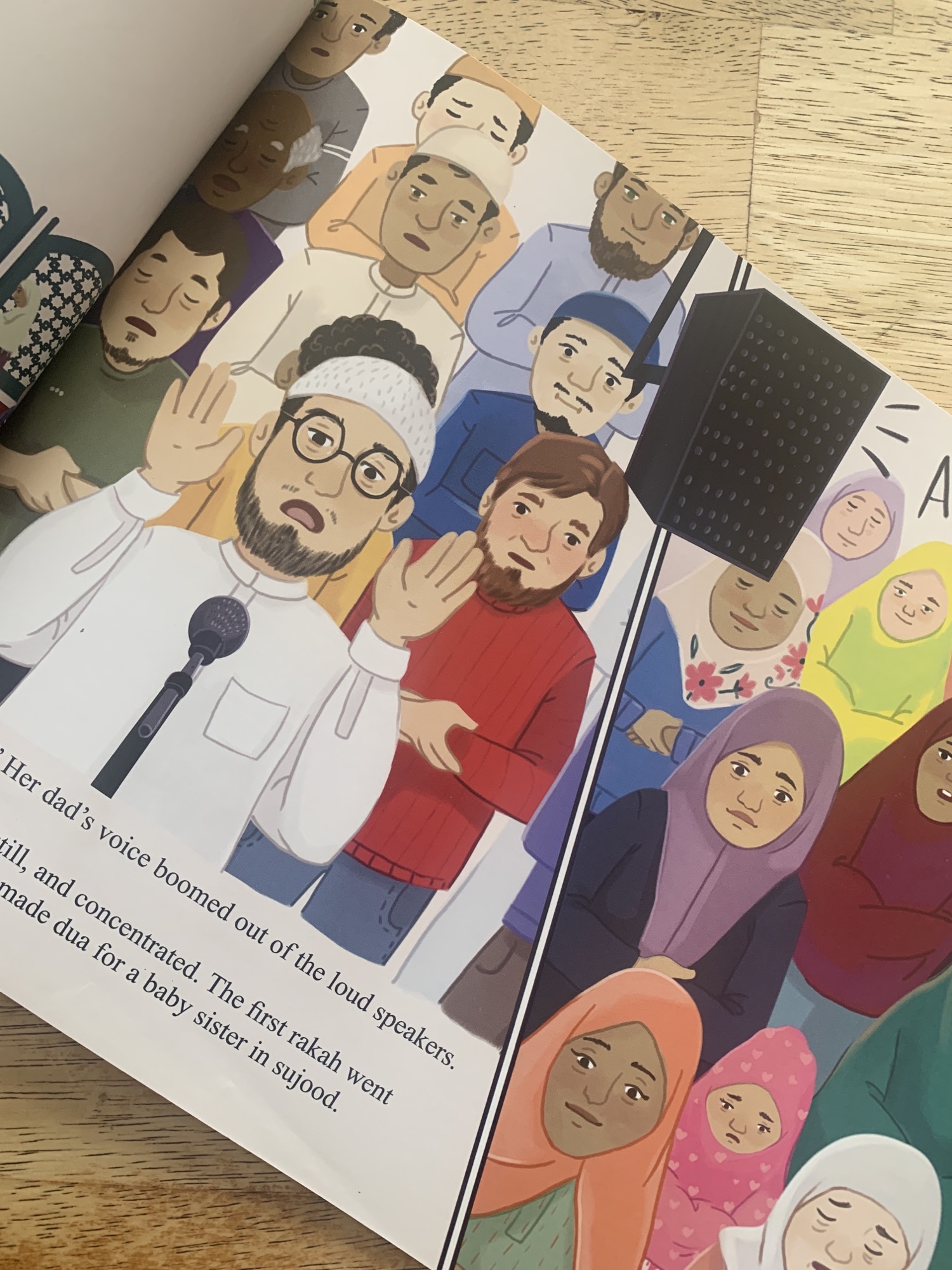
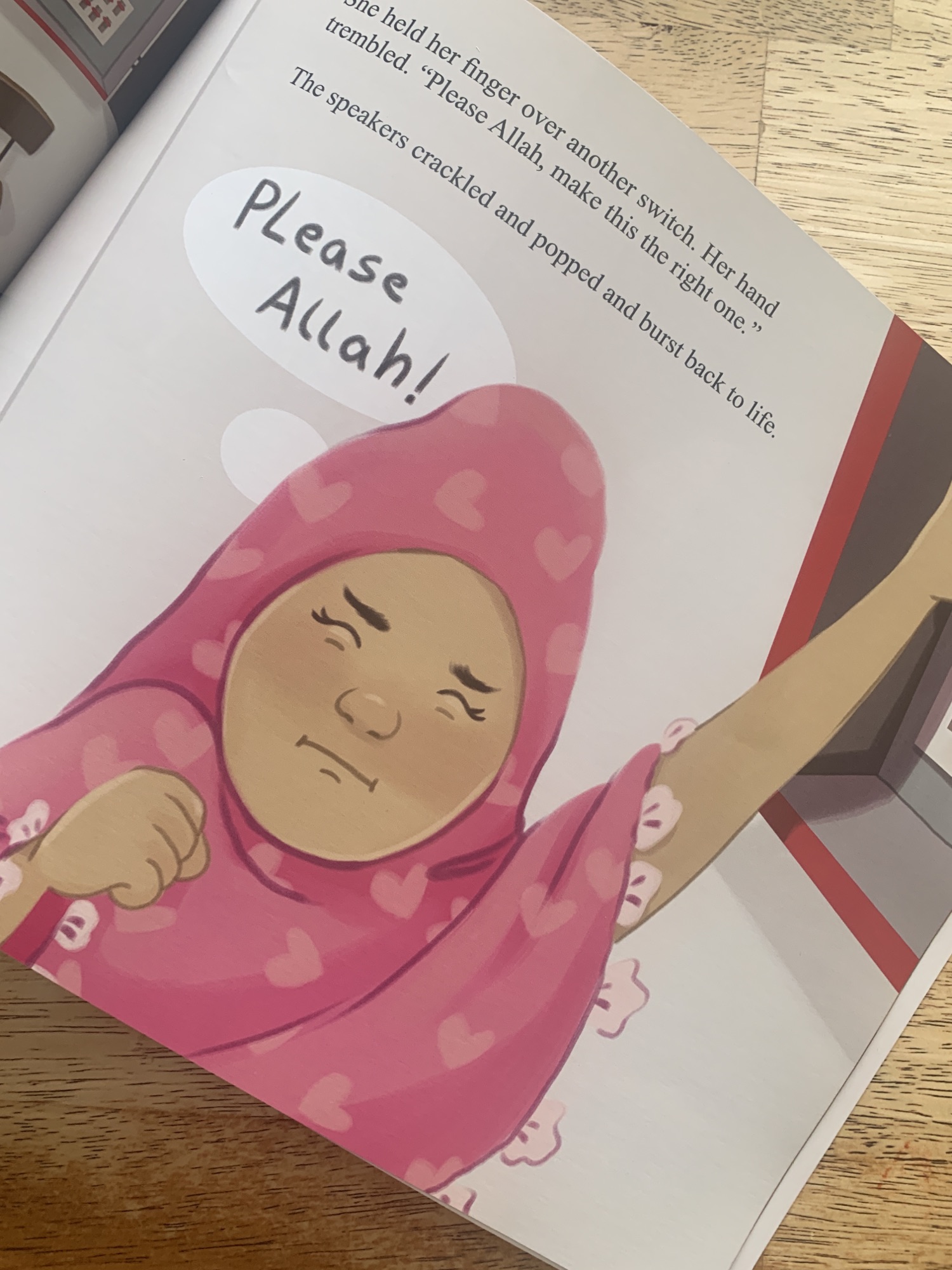
With plugs getting yanked, breakers being flipped, and little Umama asking Allah swt to help her make it right. The imam, her dad, keeps his cool and somehow you find yourself, parents included, feeling bad for Umama and hoping she has a smooth remaining Ramadan.

img_3136-1

The expressive illustrations are  bright and complementary to the story.  Kids enjoy looking at them and they really do help hold the kid’s attention as the story unfolds.  So many of my Ramadan staples come from Ruqaya’s bookshelf, and this is a great addition to the shelf.

The book is available here at Crescent Moon Store

img_3137-1

Noura’s Crescent Moon by Zainab Khan illustrated by Nabila Adani

Standard
Noura’s Crescent Moon by Zainab Khan illustrated by Nabila Adani

img_3075-1

I know, I know, another Ramadan book about the moon and a little girl’s first fast, but this one is slightly different.  The moon they are searching for is the Eid moon and the focus is on whether they will see it and Eid will begin, or if there is one more day of fasting.  The story itself would not make sense if it wasn’t Ramadan and the characters Muslim, but the story only subtly sprinkles in bits of Islam, the backmatter though, is where the Islam really shines.  The tone of the book with the lyrical text and full color illustrations is very relatable to Muslims that both want to see the moon and celebrate, while at the same time being sad the the blessed month of Ramadan is over.  It comes from a Desi centric approach to the foods, and traditions, but their aren’t a lot of Urdu words used either, and those that are, are defined at the end.  The book works for Muslims and non Muslims, and would benefit both groups with a bit of discussion. Overall, not a particularly memorable book, but one that stands out for focusing on the tradition of looking for the moon and being together as a family.

I love that the notes at the end do mention that Muslims fast to “show love and obedience for the Creator,” under the Ramadan header.  The other backmatter headings are Eid ul-Fitr, Suhoor, Iftar, Chaand Raath, Pakora, Gulab Jamun, Sheer Khurma, and The Islamic Calendar and the New Moon.  A lot of space is dedicated to food, explaining those mentioned in the story.  It gets it right that Muslims begin fasting at dawn, it shows mom not wearing hijab at home, but wearing it when they go out, yet, it doesn’t just say the maghrib athan it refers to it as the “call for the twilight prayer.”  And it doesn’t mention or show them praying, which would have been a nice inclusion.

img_3080-1

The book starts with Noura playing outside and her tummy rumbling on this 29th day of Ramadan, and her first fast.  Mama, Papa and Noura all help make and pack up iftar, as they get ready to go look for the Eid moon.

img_3079-1

Before they go, Mama shows Noura her new dress, and they add some henna cones to the items they are taking, they then set out to the countryside.  All along, Noura is hoping to see the moon and her parents are reminding her how rare it is to see it.

When they get to the hill there are other families already there, and Noura has done it, completed her first fast.  Unfortunately the moon is not there as hoped, or is it?

img_3078-1

I wish some duaas or Islamic expressions, and salat would have made it into the book, but the large hardback size makes this a good book to read at story times, and a nice way to explain why we don’t know when we will miss school to celebrate Eid, or how many days we will fast.

Made from the Same Dough by Laura El Alam illustrated by Passant Ablal

Standard
Made from the Same Dough by Laura El Alam illustrated by Passant Ablal

img_3052-1

Not all books about Ramadan have to be lists of facts. It is ok to show Ramadan and Islamic elements in stories that have their own plots, character arcs, conflicts and resolutions that are not just about abstaining from food and water, or losing your temper.  This book set in Ramadan is a story about a  Muslim boy and his Christian grandfather, and a whole lot of heart.  As a child of a convert, this book spoke to me, and I saw myself in that relationship, not only as a child, but even as an adult bringing my grandparents to my kids Islamic schools, friends’ lunches, and asking them to wait on the side while we pray.  I absolutely love the perspective of the protagonist, that he is worried about what Muslims will think of his grandfather not fasting or praying, as opposed to the often shown character worrying about what non Muslims think about us. The paradigm shift is subtle, but empowering to Muslim readers to see that they are not “other” in any environment.  The authenticity and how it all comes together in the clear text of the book is beautiful, but I must say, I really struggle with the illustrations.  I know art is subjective, and I am no artist, but yikes, I feel like the pictures actually distract from the story unfortunately.

The book starts with Papa coming over to his daughter’s family home and smelling something cinnamon-y delicious.  He dives in to the harira soup and recalls the cinnamon Christmas cookies they used to make.  Rayan wonders if Papa even remembers that the rest of them are all fasting.

Mama invites him to join the family at Auntie Hana’s for iftar the next night, and Rayan worries what Papa will do when they all pray, or if his friends will wonder why he came to iftaar if he is not fasting.

img_3054-1

Papa agrees and offers to make cinnamon cookies to share.  Rayan doesn’t like the idea of Christmas cookies at iftar and tells grandpa that Santa won’t be there.  The next day when Grandpa comes over to bake, Rayan refuses to help. Part scared, part frustrated, part anxious, Rayan hears everyone having fun, but stays in his room.

When they arrive at the iftaar potluck, Rayan reminds Papa to take of his shoes and then devises a plan to keep the Christmas cookies from causing any embarrassment. Only his sister Aliya foils his plan and Rayan will have to face his own feelings and make things right.

I’ve read this book easily close to twenty times, since ordering it, evaluating it for the Muslim Book Awards 2023, (it won the Holiday category), writing this review, and reading it to my littles at bed time, and it still hits close to the heart every time.  It reminds me of my own grandpa, who has been gone almost exactly a year, who may not have always understood our actions as Muslims no matter how often we tried to explain them to him, but never loved us any less.

img_3056-1

You can purchase your copy here at Crescent Moon

Ramadan Kareem by M.O. Yuksel illustrated by Hatem Aly

Standard
Ramadan Kareem by M.O. Yuksel illustrated by Hatem Aly

The lyrical text that shows joy, Muslim joy, all over the world during the most wonderful time of the year is felt, truly truly felt in this rich, beautiful book. The illustrations, the text, the sentiment, it all comes together so splendidly, that when you turn the last page you want to start over again. Hundreds of people are wondering what book to read to their children’s public schools this year, what book to start off masjid story times this Ramadan, what book to read every night leading up to the blessed month to get their children excited, what book to hand to your children to look through so they can have a few more minutes of sleep and alhumdulillah to all the above, I whole heartedly suggest, this one. Even with the errors.  The book states “the Night of Power is better than a thousand nights,” and should read, better than a thousand months.  The backmatter says “by not eating or drinking anything from just before sunrise until sunset.”  The story itself though has it correct and says “suhoor is a predawn meal” and notes the “sun is still sleeping.”

A universal story of celebrating Ramadan, with waking up for suhoor, greeting neighbors, having self control, praying, volunteering, iftar, community.  It is a singular story, but each two page spread showing a child in a new country continuing the narrative.  The worship uniting us all as Muslims even while our unique traditions add diversity and layers to the acts that we share.

It starts with gazing at the new moon in Turkey and mom saying that the narrator can fast. The drummer than beats her drum and it it time to wake up in Egypt. The call to prayer and remembering you are fasting reaches Syria, and donations are given in Indonesia. In Spain Qur’an is read in abuela’s lap and neighbors are visited in the United States.  Donations are packed in Australia,  friends and family are visited in Pakistan, and kimchi after dates for iftar in South Korea.  It is then off to Iran for prayers, Laylatul Qadr in Senegal, and getting ready for Eid in Uzbekistan.  Palestine is the final stop as Eid joy erupts for Muslims everywhere.

The book is widely available, you can order yours here at Crescent Moon or here on Amazon

A Ramadan to Remember by Marzieh A. Ali illustrated by Najwa Awatiff

Standard
A Ramadan to Remember by Marzieh A. Ali illustrated by Najwa Awatiff

img_2876-1

A problem solving kid that loves his faith, finds himself in a new neighborhood at the beginning of Ramadan without a mosque or a Muslim community.  I appreciate that this 32 page book actually has a bit of a plot, not just the overly done fictional story crafted around basic Ramadan facts of a child’s first fast.  Sure, it mentions most of the expected concepts in a similar manner, but it also centers acts of ibaada, shows more than tells, is brightly illustrated, and is unapologetic. The kid is a doer, a problem solver, and isn’t unsure about who he is, which is refreshing. That isn’t to say that it gets everything right, it still attributes fasting to feeling compassion for the poor.  Even when a side character challenges the notion, the character doubles down that it makes us more appreciative, which inshaAllah it does, but it isn’t WHY we fast.  Overall though, I think the book still is a benefit in Muslim and non Muslim spaces. The story and illustrations make it appealing at story times and bed times, and the backmatter is equally engaging.

img_2877-1

The book starts with Zain getting excited for his favorite time of year, Ramadan.  Only this year the decorations are still in boxes, Mama and Baba are busy with their new jobs, and there is no mosque or Muslims in the neighborhood.  Zain knows, he rides around looking for clues, has even checked the newspaper, and had his dad look on his phone.  It is a big change from the Islamic school he used to go to, and the busy mosque he used to volunteer at.

img_2879-1

Then Zain gets an idea, to build a mosque with all the moving boxes.  Neighbor kids come and ask questions, and Zain is happy to explain as they join in the building.  One night while praying outside under the stars in the cardboard mosque, a friend joins the family, and this Ramadan just might turn out to be pretty wonderful after all.

img_2878-1

I love that Zain doesn’t wait around for his parents to figure everything out, he is motivated. I also really like that he knows who he is, is comfortable sharing his faith and beliefs, and that the neighbor kids find connections to him, not the other way around.  I wish he would find a place to volunteer at, our charity isn’t restricted to helping only Muslims, though I might be the only one to pick up on that unresolved thread.  I also get that the kid that joins the salat for story purposes, is seen after prayer, but he didn’t join the prayer right and my older kids were sure to point that out.

The backmatter has a glossary, but in a more engaging format that I think kids will actually stick around for, and the Ramadan essentials and crafts make for a nice extension for those wanting to add a craft to the story time activity.

img_2882-1

The book is traditionally published and widely available.  You can find it here at Amazon, or here at my favorite store Crescent Moon.  It is also available in public libraries and would be a great addition to classroom and school library shelves.

Insha’Allah, No, Maybe So by Rhonda Roumani, Nadia Roumani illustrated by Olivia Aserr

Standard
Insha’Allah, No, Maybe So by Rhonda Roumani, Nadia Roumani illustrated by Olivia Aserr

img_2711-1

Not every funny thing a child says can be copied and pasted into a children’s book.  And while I have no doubt that this book was edited and revised numerous times, it sure feels like a conversation or 20 that I’ve had as a mom, a teacher and a librarian over the years.  Well, I take that back, the mom in this book, is very articulate, and not nearly as exasperated as I’m sure I always am.  It is so on point that it makes me truly wonder, are you even a Muslim parent if you haven’t been asked what Insha’Allah means? The backmatter articulates that Muslims and Arabs of all faiths use Insha’Allah. The text and illustrations themselves are not Islam specific, but the authors are Muslim, and the term always on the tip of our tongues. It is very relatable and impossible to read without smiling, I can’t wait to share it, insha’Allah. (See what I did there? ya.)

img_2715-1

The book starts simple enough, a little girl asks her mom if they can go to the park as they walk near one, and mom says, “Insha’Allah,” and keeps on walking.  Ranya gets upset asking why she said no, and the mom explains that insha’Allah doesn’t mean no, it means God willing.

img_2712-1

Ranya doesn’t just accept the answer and move on, she tells her mom it always feels like no, until her mother explains that we can want something to happen, but sometimes Allah has other plans.  Ranya presses her mother a little more trying to understand if insha’Allah means, maybe.  A few more examples are shared, and the definition is expanded to also mean, hopes and dreams.

img_2713-1

Ranya wants to pin down her mom on some of the insha’Allahs, making cookies, a sleepover, a trip to Disneyland.  Mom does her best, but Ranya is spunky and makes sure she gets the last word in.

I love the note at the end that ties it all together and shows the universal appeal of the word.

You can preorder your copy here

img_2714-1

Dear Muslim Child by Rahma Rodaah illustrated by Aya Ghanameh

Standard
Dear Muslim Child by Rahma Rodaah illustrated by Aya Ghanameh

img_2280-1

The flow, poignancy, and lyrical verses force you to slow down, take a deep breath, and immerse yourself in the concepts and ideas so beautifully presented in the text, and illustrated on the pages.  Whether you are reading it alone, snuggled up with a little one, or in a boisterous story time, this book pulls you in as it speak directly to the reader (or listener), burrowing inside and inspiring reassurance and confidence.  The tone of the text melds with the illustrations making the book appeal to those looking to understand, be seen, or to be empowered.  The short stanzas with the opening refrain of, “Dear Muslim child,” are a delight to read and share again and again, alhumdulillah.

The book does not have a story or a plot, but has an organization that keeps the pace moving in a poetic way. It starts by mentioning that we were meant to be, even “before Allah spoke the universe into existence.”  It then tells us about Islam, nur, names, the power of words, purifying our hearts (with wudu), listening to the adhan, and praying.  It talks of the beauty of hijab, and community, and purpose and mattering.

img_2282-1

The centering of Allah (swt) is not shied away from, yet the book is not preachy or overly religious.  For example wudu is shown, but not named; adhan is named but not defined.  If you wish to discuss each page, there is a lot to unfold, but if you want to just read the surface it is beautiful just the same.  The book is traditionally published, and a true accomplishment of the author, and the authors that have come before that this book, this type of book, is widely available for us all to enjoy.

img_2284-1