Category Archives: Picture book

My Grandma and Me by Mina Javaherbin illustrated by Lindsey Yankey

Standard
My Grandma and Me by Mina Javaherbin illustrated by Lindsey Yankey

grandma and me

I absolutely love that this 32 page picture book for children five and up breaks so many stereotypes and highlights so many commonalities between all people, everywhere.  I strongly believe that books like this, can change people’s perspective, and as a children’s books can prevent negative biases from forming in the first place.

IMG_8078

Set in Iran, a little girl absolutely loves and adores her grandma.  They pray together, they buy bread together and they share that bread with their best friends, their Christian neighbors next door.  While the little girl and her friend Annette play, the two grandmas chat, drink coffee and knit blankets to donate to the mosque and Annette’s Grandma’s church.

IMG_8079

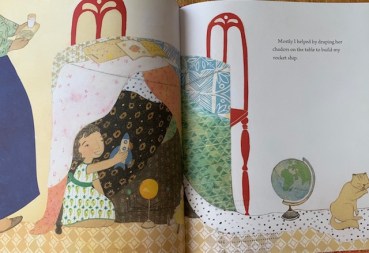
Grandma sews chadors to wear, and Mina helps.  But, mostly she uses the scarves to make rocket ship forts, and capes to fly to outer space in.  When she returns to base camp grandma has cookies for her and wants to hear about her adventures.

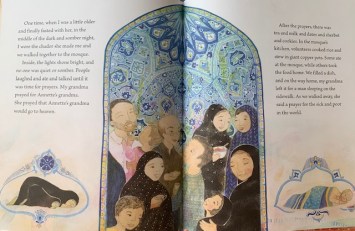
In Ramadan, the little girl wakes up early to eat with grandma even though she is too young too fast.  When she gets older, they go to the mosque together at night too, after they have broken their fast.

IMG_8082

One time she hears her grandma praying for Annette’s grandma to go to heaven.  The next day Annette tells Mina she heard her grandma praying at church for her grandma to go to heaven.  The little girl imagines the two grandmas knitting and laughing together in heaven, on Mars, on Earth, anywhere.

IMG_8081

The book ends with the little girl stating past tense how wonderful her grandma was and  that she still wants to be like her.

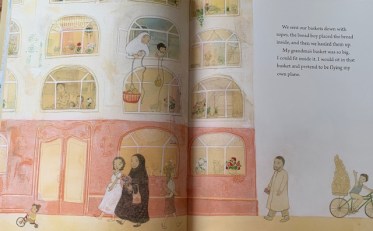
The book touches on family, interfaith, love, helping others, faith, religion, friendship, culture, and is just really really sweet.  I wish I loved the pictures, as much as I love the story, but I don’t.  I think I like most of them with their texture and details, unfortunately the faces in some just seem a little off to me.

I absolutely love that there is no over explaining, and no glossary, the author seamlessly brings words like namaz, and Ramadan and chador in to the story, normalizing them as the pretend play, and familial bonds are so universal.

IMG_8083


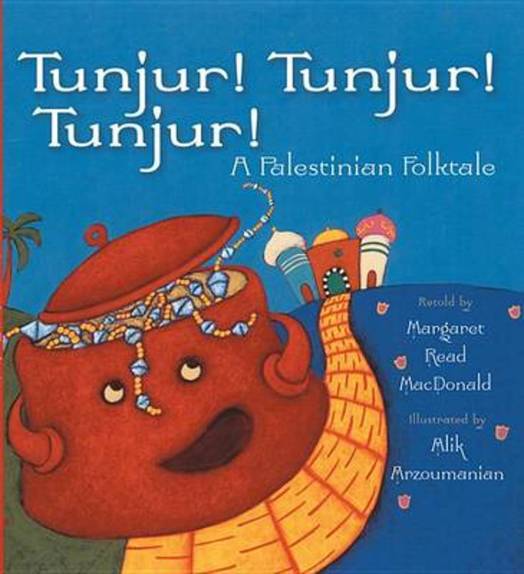
Tunjur! Tunjur! Tunjur! A Palestinian Folktale retold by Margaret Read MacDonald illustrated by Alik Arzoumanian

Standard
Tunjur! Tunjur! Tunjur! A Palestinian Folktale retold by Margaret Read MacDonald illustrated by Alik Arzoumanian

tunjur.jpg

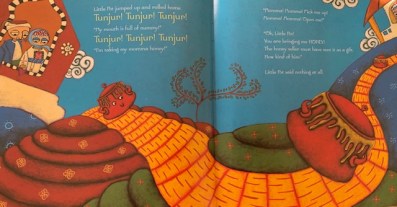
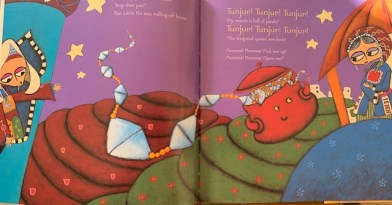
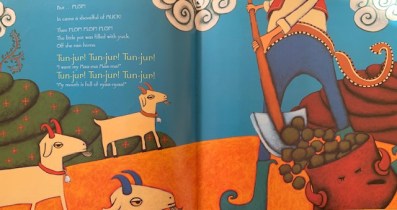
This delightful little folktale is beautifully presented in 32 pages on an AR 1.7 level.  Perfect for little ones to listen to and early readers to tackle on their own.  The pictures are fun and engaging and the story teaches a great lesson of right and wrong in a silly memorable fashion.

IMG_8036

A childless woman asks Allah to bless her with a child, even if it is just a cooking pot, and “Willa! She had a child! And it was a little pot!”

At first taken aback, the little pot professes her love for mama and thus the woman decides to take care of the little pot.  Every day the little pot bumps against the walls as she rolls and jumps around making the sound, Tunjur.

IMG_8037

One day the pot wants to go to the market by herself.  Mama refuses as she is too young and doesn’t know right from wrong, but alas she talks her mom in to it, and off she goes.

She meets a rich man who wants to fill her with honey for his wife.  The pot loves honey so she doesn’t protest, but she refuses to release her lid when the man gifts the pot to his wife.  Angrily he throws the pot out the window and the little pot finds her way home. Mama assumes the honey seller sent it as a gift and little pot says nothing at all.

IMG_8039

The next time little pot heads out she finds herself filled with the queen’s jewels and when she returns Mama is not happy that her little pot has taken things that do not belong to her.

IMG_8038

When little pot heads out again to apologize, the rich man takes her to the king and queen for a reward,  and they fill her with something to teach her a lesson.  When she comes home to Mama, she has definitely learned her lesson.

IMG_8040

The women in the story seem to wear hijab, most notably the wealthy man’s wife.   The Mama asks Allah swt for a child, but other than that there is nothing religious in nature in the book and seeing as I checked it out from the public library, I think it appeals to all kids.


Islamic History for Kids: Story of Badr by Qasim Riaz

Standard
Islamic History for Kids: Story of Badr by Qasim Riaz

badr.jpg

This fictional story of a non-fiction-historical event over 37 large, 12×12, pages really brings the battle of Badr to life for readers ages seven and up.  The book is engaging and keeps chidden focused, excited, and clear as to what is unfolding, why the battle was important for Muslims, and why it still has lessons today.  Unfortunately, there are no source notes, bibliography, or references in the book, so I’m not sure how accurate the details are, and I haven’t yet had a chance to have someone more knowledgeable than I check it for accuracy.  The ayats from the Quran quoted are identified in text and yes, I understand it isn’t a reference book, but even having some imam or scholar give their approval would reassure people considering purchasing the book.  Additionally, fairly prominently there is a disclaimer at the beginning of the book that says, “The characters in this book are entirely fictional.  Any resemblance to actual persons living or dead is entirely coincidental,” which is a common disclaimer, but in a book of this nature, it did strike me as odd.  So, you may want to read it first yourself before presenting it to your child as fact.

3A02CEE2-B385-4AF0-8091-BB9E54CBE579

There is also a typo that my children discovered rather quickly and pointed out to me, I was a little disheartened when I asked about it, to discover the author knew about it before mailing it out, but for some reason didn’t find it necessary to put a note or let the customer be aware of it. I put a post-it note in mine to show all of you, and will be taking a black marker to it shortly.  Mistakes and typos happen, but I felt that they should have let the consumer know, once they knew that it was there, for accuracy sake.

85C78105-8FD8-4B2F-B031-A49272D287DF

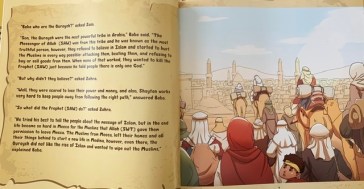
The book starts off with a brother and sister fighting, Zain and Zahrah.  When the father goes to stop them, Zain tells him that Prophet Muhammad (SAW) used to fight, and the father concedes the point, but points out it was not something he wanted to do.  He tells them that for the first 13 years he didn’t fight back even when the Quraysh made fun of him.
DA52115E-5314-4E5A-BE6B-9E38E6E88817

The kids ask who the Quraysh are and why they didn’t believe the Prophet, to which the father lovingly answers their questions before telling him about the verses revealed allowing them to fight from Surah Al-Baqarah.

They learn about Abu Sufyan returning from Syria with a large caravan and how the Prophet wanted to surprise them. Only to learn that Abu Sufyan had arranged a much larger army from Mecca to come and attack the Prophet and his Companions.
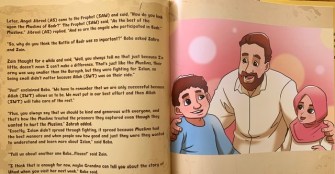
There are details about how they determined the size of the army based on how many camels were being eaten, and how the Muslims camped near the wells to control the water.  The story reads smoothly and pulls out when the children have questions seamlessly.

FF278825-CA1F-4904-9F20-DF21DA7085BE

As the battle is set 1000 soldiers against 313 Muslims, the book explains how the battle starts with three duels and explains how Utbah, Shaiba and Walid battle Hamza (RA), Ali (RA), and Ubaydah (RA).  The Ansar win all three battles and the Quraysh charge.

5F4EFF83-0553-4FD0-919A-45814B973E9F

Prophet Muhammad (SAW) makes duas, and Allah (SWT) answers sending a thousand angels following one after another to help.

715028DE-D6FB-436D-88A1-65ACCA437AB2

When the dust settles the Muslims are victorious and the order is given for the prisoners to be treated kindly.  They are given food, rides, and the opportunity to pay a ransom for their freedom or they could teach 10 Muslims to read and write in exchange for their release.

With the story concluded the father then makes sure the children understand some of the many lessons from the battle.  Including having Allah on your side, trusting Allah, putting in your best effort, and being kind and generous even to those against you.

DE00F1A5-8C32-4CF9-8B6D-D880A4C77726

There is no illustrator listed, but the pictures are done really well showing modern relatable, squabbling kids getting drawn in to a historical story by their father.  The emotion on the characters faces adds depth to the story and engages the readers in seeing and understanding a desert battle so long ago.

The text on some pages varies quite noticeably, with some pages barely having a line to spare and some only being a line or two long.  It does slightly affect the rhythm (and aesthetic) of the book, but it is manageable as long as you remember to give the kids enough time to see the picture on the short pages, as the overall size makes the book perfect for story time to large and small groups.  The book stays on level, which is nice, and there is a glossary of abbreviated terms (AS, RA, SAW, SWT) at the end.

The company: Ghazi Production is planning Uhud to be the next book, and informed me a bibliography will be included in that one.  InshaAllah!


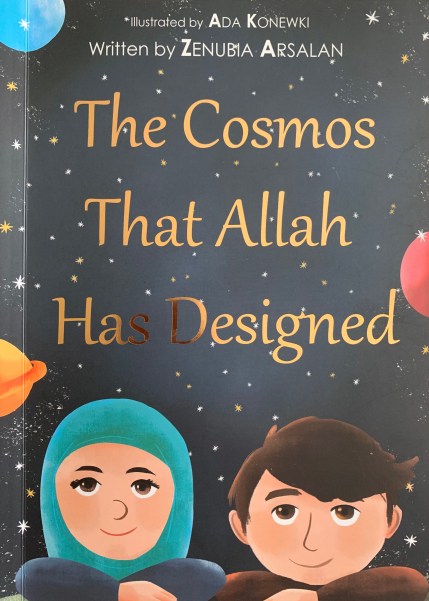
The Cosmos That Allah Has Designed by Zenubia Arsalan illustrated by Ada Konewki

Standard
The Cosmos That Allah Has Designed by Zenubia Arsalan illustrated by Ada Konewki

2E77412C-8D86-40DC-AC49-0409390CAD93

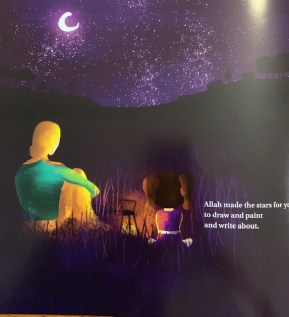
This 22 page beautifully illustrated picture book clarifies that it is not a science book, but rather an invitation to think deeply.  For ages 4 and up the rhyming pages will appeal to children’s sense of wonder and Allah’s perfection and precision.  Older kids will appreciate the journey through the cosmos and how limitless Allah swt is in all things.

1CE0C4F4-1AE9-4738-9D3E-BFAACA4A8186

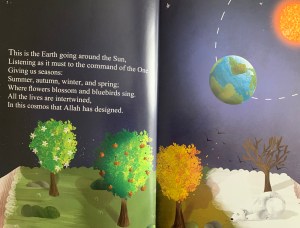
The book starts with Earth and how the spinning of our planet on its axis allows for the alternation of night and day, it then moves to how going around the sun at Allah’s command gives us our seasons.  But because it rhymes and is not a science book, the text is more imagery and tangible in nature, rather than a list of facts.

68DD1DA3-102B-417D-B24D-435B8DFC3FF0

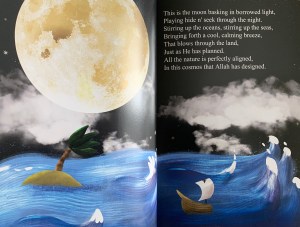
It touches on the moon reflecting borrowed light and the power and strength of the sun before moving on to the planets and gravity.

53909F77-D035-4FB9-BB77-3429E64A948E

It then extends out to the Milky Way and has a page on black holes before coming back to Earth for us to recognize how we only are a small part of something so much bigger.

31117DCF-73A0-4ABE-BD01-80AC92AA3843

There are two pages at the end with talking points, an ayat from the Quran, and emphasis that science and Islam are not at odds as Allah is the creator and governor of all things.

EFCD5023-940B-4D63-88FA-338A7F76C2D3

The book is 6×9 and with the beautiful illustrations I truly wish the book was larger.  Not only to dive in to the glossy pages easier, but also so that the book could be used at story time to small groups.  The tone is contemplative and marveling as it challenges the readers to find mistakes or flaws in the perfection of outer space. I love that science-y Islamic kid books are now available that appeal to children’s sense of wonder and understanding.  Really the only other suggestion I would have liked to see, would have been a page defining the word “cosmos” as it is used on every page, and while I think kids will figure it out as the continue through the book, I think it is a bit of a block for the younger readers.

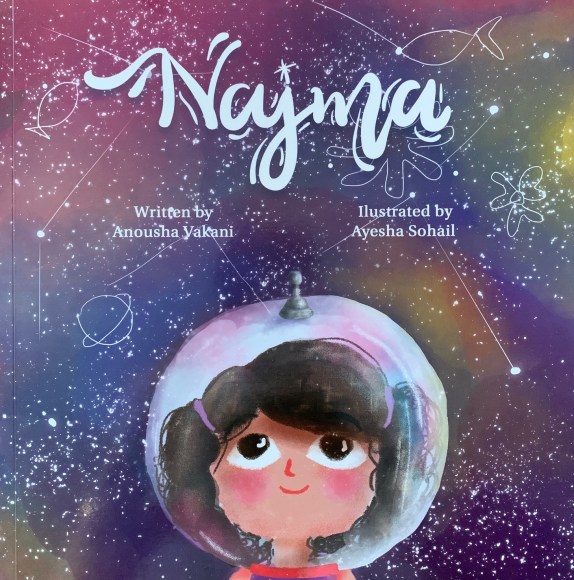
Najma by Anousha Vakani illustrated by Ayesha Sohail

Standard
Najma by Anousha Vakani illustrated by Ayesha Sohail


IMG_7194

In a world of new STEM books and female powered books, this 28 page fact driven story adds one more empowering element, Islam.  With beautiful pictures on thick glossy pages, the 10×10 book is both educational and endearing for boys and girls ages 6 and up.

IMG_7183

There isn’t a story with a climax or moral, but there are characters, Najma and her astronomer Mom, who move the book along, and keep it “grounded” so to speak.

IMG_7184

Little Najma loves the stars and space above her, she knows Allah created them, but she wants to know more about them, what they provide, and how Allah made them.

IMG_7185

Mama and Najma look through a telescope as Mama teaches the life cycle of a star in simple terms over 11 pages.


Najma then asks what stars are for, and Mama tells her the benefits of the sun that Allah swt made for us and the stars as well.  Mama explains Allah only has to say, Be and it is.

IMG_7188

Every scientific concept, and daily life example is tied back to Allah swt.  And with Najma’s adorable little face, and the beautiful complimentary illustrations, the book conveys facts about the universe, love between mother and child, and awe at Allah’s signs.IMG_7189

Thank you Crescent Moon Store for amazingly fast delivery of this brand new book.  InshaAllah there will be more books like this combining science, Allah, and strong females for us all to learn from and enjoy.


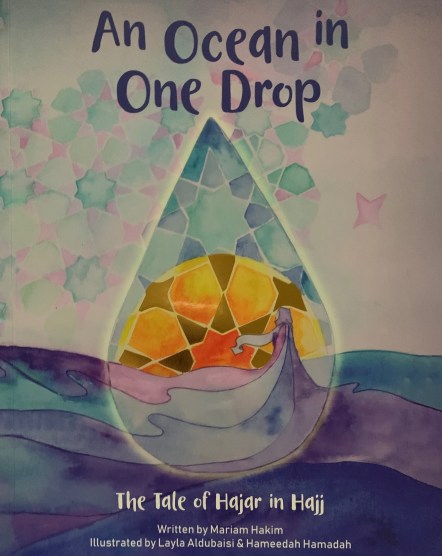
An Ocean in One Drop: The Tale of Hajar in Hajj by Mariam Hakim illustrated by Layla Abdubaisi & Hameedah Hamadah

Standard
An Ocean in One Drop: The Tale of Hajar in Hajj by Mariam Hakim illustrated by Layla Abdubaisi & Hameedah Hamadah

IMG_7027A story about Hajar (saa), about Zamzam, about Hajj, and how we are all connected through our faith in Allah.  In 32 water color adorned pages, the rhyming couplets tell a well-known historical story for children of all ages, with Hajar front and center.

IMG_7021

The book is framed with a young girl, Jamila sitting with her grandmother who has just returned from Hajj.  She is giving Jamila some Zamzam water as she tells her the story of Hajar, and how at the heart of our Hajj we honor and follow in Hajar’s footsteps.

IMG_7022

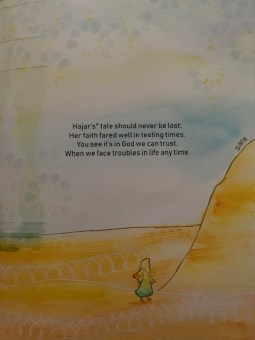
Left in the desert with her son Is’mail (as) she runs between two hills, Safa and Marwa looking for water and help. This step of Hajj, Sa’ee, is required by all pilgrims to perform as Hajar did. Grandma explains to Jamila, that after praying to Allah (swt) and after the seventh run, water appeared and still flows today, Zamzam.

IMG_7023

Jamila learns from her grandma the value of the water, and the power trusting Allah has in our lives.  She also learns how the well attracted people and is now the  city of Makkah.  “You see the sacred Sa’ee has many lessons within: Courage, patience, faith and love.” the grandmother tells Jamila before quoting Rumi and liking the desert water to an ocean of history.

IMG_7024

The book contains a two page Glossary of names and terms at the end as well as information about the author and illustrators.  As expected there is also an ayat regarding Prophet Ibrahim and his family from the Quran at the end, and somewhat surprisingly, Bible verses about Hagar.

IMG_7025

I’m not sure that the link to Rumi’s quote and hence the title of the book is smooth, it seems a bit forced.  Also, I’m not sure why the Bible verse and the Bible entry appearing in the Glossary is present.  It seems like an Islamic story for readers of all faiths to know what Muslim’s believe, so I’m confused why the interfaith angle at the end is there.  Perhaps, if there was an explanation or an Author’s Note or a tie-in to the story, but without any of that, it seems inconsistent and random.

IMG_7026

As far as the illustrations on the 8.5 x 11 thick soft bound pages are concerned, they are rather mediocre.  The anime’ style people, the texture, shimmery bits, and the flowing deserts, make me feel like I should love them, and there is truly nothing wrong with them,  I just wasn’t overly wowed by them.  I actually found the illustrations off for the story at hand.  I’m  certain everyone will disagree with me, and some really are gorgeous, but overall I found them collectively, to be just ok.


Bedtime Sunnahs Emaulating the Prophet one night at a time by Alia G. Dada illustrated by Robin Boyer

Standard
Bedtime Sunnahs Emaulating the Prophet one night at a time by Alia G. Dada illustrated by Robin Boyer

sunnah.jpg

A beautiful rhyming 11 page story for toddlers and up to learn parts of the Prophetic routine for bedtime.  Yes, 11 pages, the book in total is 28 pages, six are Appendixes, one is about the author, one is a dedication, and the rest are blank or title pages.  For a $15 book, I’m a little disappointed, which is unfortunate because the illustrations and information on those 11 pages is great.  The references are informative and important to see what Hadith the Sunnahs come from, but I think the story itself could have, and should have, been longer.

2D4EFF33-886B-46DB-92F6-74C7679D6F61

Each page has a different family getting ready for bed and doing various acts.  I love that moms and dads are involved in bedtime routines. The illustrations show diversity and the text is simple, flowing, rhyming and straight forward.

5EB6E7CC-3194-480E-9A58-EE259FAB9DB5

From brushing teeth to reciting Athkar, making duas to Allah and laying on our right side, each page has wonderful detail in the warm full color pages.  I love the decorations on the bedroom walls, signs with Allah’s name, statements saying “Strong like Zainab, Brave like Fatima, Smart like Khadija”, as well as “Smile! it’s Sunnah!”.

1DB8BDCD-6CEB-4104-B072-6A2D21951D71

The book is for Muslim children obviously, and makes getting ready for bed seem like a fun and bonding event.

The first Appendix is a Parents Notes on what the purpose of the book is and the second one is Islamic Terminology.  From the their Appendixes address the Ahadeeth about sleeping in a state of Wudu and on your right side, bedtime Atkhar, and reciting the three Quls,  I wish it would have including the Quls, seeming as the book is meant to provide information for caregivers to convey to a child, and many households may have non Muslims or new reverts in that role.

10500B30-4BF9-4473-94D5-F9D4EDFAEDD1

The remaining two reference pages are Additional Sunnahs for Advanced Children which include Reciting Ayah al Kursi, the last two verses of Surah al Baqarah, the dua before bed and when waking in the morning.  The dua texts are given, the Ayats are not. There is then a final page about the author.

F8DCC46D-0DFC-4A20-9E63-645B06FAE324

The hardbound glossy cover and thick inside pages are well done in this 8×8 perfect sized book for bedtime, I just wish there was more of it.


The Proudest Blue by Ibtihaj Muhammad & S.K. Ali illustrated by Hatem Aly

Standard
The Proudest Blue by Ibtihaj Muhammad & S.K. Ali illustrated by Hatem Aly

blueLOVE! Yes, usually when I’m so anxious for a book it disappoints, but not this one, it warmed my heart and soul and made me smile.  In 40 pages surrounded with absolutely adorable illustrations, the reader feels the love between siblings, the strength of self confidence, the power of being true to yourself, the beauty of hijab, and the awesomeness of light-up sneakers and five cartwheel recesses.

C7E95032-E080-4057-BC93-6B25CBCAAA29

It is the first day of school for sisters Asiya and Faizah, and Faizah’s first day of wearing hijab.  The book starts out with the girls and their mom picking out a new scarf at the store.

677BD5F0-0C6E-472A-B086-05F93D4F17CC

The first day of school has the girls walking to school hand in hand, Asiya in her beautiful blue scarf, and Faizah in her new shoes admiring her sister as if she were a princess.

DB80D90A-289E-4F35-A763-24526723E650

In line a classmate whisper asks Faizah about her sister, and Faizah has to find her voice to speak up about her hijab.  She then likens the blue hijab to the sky, special and regular before recalling that their mom had told them “The first day of wearing hijab is important. . . It means being strong.”

DFA253F0-16BC-464A-B630-BB93AFBFCF94

Throughout the day at school Faizah checks on her sister, sees other kids make fun of her, liken the blue to something beautiful, and then recall something their mom has told them to give her solace and strength.

06E90E71-3375-4E26-9F0A-F31DCA8058C4

As Faizah puts into practice the lessons from her mom about being strong, knowing who you are, and not carrying around hurtful words, she, like her sister finds strength.  A strength which radiates to those around them, and further connects the two girls.

C62B2893-3E2B-4628-BAAE-C195FBD3AB7A

Faizah has an amazingly sweet and authentic voice as she counts her light up steps and looks up to her older sister.  I love that the story stays on track and has its own rhythm of a school incident, a strong declaration about blue, a lesson remembered from Mama and a resolution.  With lots of mini climaxes the reader sees the strong perseverance and how being authentic will be challenged repeatedly.  The subtly of the hijab being whispered about and then proclaimed loudly is really tender and emotion filled.  Little reminders why OWN Voice stories are so important.

The illustrations are absolutely amazing on their two page spreads: the colors, tone, expressions, are perfect and a huge part of the narrative.  I love that when a boy points at Asiya, not just Faizah, but Asiya’s friends too are unhappy with the boy.  I also like that the boys being mean are not depicted clearly, but rather are shown in the shadows, furthering the point that mean words and those that spout them are not worthy of your time.

There are Authors’ Notes at the end and a picture of Ibtihaj  and her two sisters Asiya and Faizah. I think the book should be on every shelf, truly.  To be yourself and be proud of who you are is universal, as is kindness. The book does not discuss religion or mention Islamic reasons for her covering, and girls and boys alike will benefit from multiple readings of the book.


Leila in Saffron by Rukhsanna Guidroz illustrated by Dinara Mirtalipova

Standard
Leila in Saffron by Rukhsanna Guidroz illustrated by Dinara Mirtalipova

leila

I had really wanted to love this book about a young Pakistani girl living outside of Pakistan learning to love all her different parts.  Unfortunately, the book was so scattered that no point was made, no message conveyed, and sadly, no excitement at being represented in literature really felt, .

IMG_6403

This 32 page book isn’t bad, it just really isn’t memorable.  It starts out with Leila arriving at her Naani’s house for dinner as her parents and her do every Friday.  Her maternal grandmother comments that she likes Leila’s saffron buttons.  Leila beams at this because she doesn’t know that she always likes being herself.

IMG_6404

Tonight, they are joined by lots of extended family and Leila is on the lookout for parts of herself that she likes.  She feels safe with her family, and likes being told she looks like her aunt when she smiles.

IMG_6405

The book then kind of abandons the theme of finding parts of oneself to like, and moves on to cultural trinkets to enjoy.  She identifies camels on shelves and Arabic books too, and can’t wait to go on her first trip to Pakistan someday to get her own “Arabic books” and “special ornaments.”  I’m not sure why they books aren’t in Urdu, but none-the-less without any written connection to Islam, they are in Arabic, thus giving, erroneously, the reader the impression that is the language of Pakistan.

IMG_6406

Leila then helps her Naani cook which almost seems like an additional theme of the book: the passing on of traditions.  The book doesn’t really stay here though either, and has Leila running outside to get cilantro from the neighbor Miguel.  Possibly another theme in addressing multicultural neighbors or just how to be a good neighbor, is now being brought up, but nope, the book bounces back to dinner with the family.

IMG_6407

When it is time to leave, Naani invites Leila upstairs while her parents wait to leave.  Here she goes through fabric and scarves rich in color and textures and likens them to ethnic foods.  She then tries on her favorite one, but acts like she has never tried it on before or seen it before, I’m really not sure, the language is a bit awkward to me.  Anyway she opens her eyes in a surprise and likes what she sees, she likes her self, all her parts.

IMG_6408

I wish this book for preschool and kindergarteners, would have streamlined the message it wanted to convey most.  I like finding pieces of yourself and liking the completed you, but I don’t know what the pieces really are in the book.  Yes I could assume and figure it out, but I’m not 5 years old.  The book should have articulated it clearly.  Or if the book wanted to celebrate culture and family traditions, it should have stuck to that.  It really seems all over the place no matter how many times I read it.

IMG_6409

The illustrations are rich and vibrant.  They definitely give a lot to look at and the expressions on the characters faces will probably make the little ones giggle.  There are a few Urdu and Arabic words used in the story that are defined on the back cover.

IMG_6410

The characters aren’t identified as Muslim, none of them wear hijab, but they say Salam and have Arabic books, so one can assume. I picked up the book at the library and don’t regret it, but I probably wouldn’t buy it or unfortunately, check it out again.

If Allah Allah Wills by Dr. Oz illustrated by Mariya Khan

Standard
If Allah Allah Wills by Dr. Oz illustrated by Mariya Khan

if allah wills

Not all books need to teach something, but when the book would lend it self so easily to dropping a fact or two, it seems like it would take it.  In 40 pages, preschoolers are taken on a highly imaginative journey to the Ka’ba, yet no information about the history of the Ka’ba, or any mention of Umrah or Hajj is shared, not even in passing.

IMG_6336

Faris wants to go to the Ka’ba but it is nearly his bedtime, so he has to act fast.  He asks his mom what he needs to wear, obviously knowing special clothes are required, but his mom prefaces the answer of white sheets as being “odd” and then adds that you need sandals.  For a book that wants to normalize Islam for children, I don’t understand why the mom would say that ihram is odd, why the word ihram isn’t used, why it doesn’t even specify the number of white pieces of unstitched cloths and why sandals would be included.

IMG_6337

Faris then finds two white sheets, but the illustration shows him getting towels out of the bathroom (possibly showing his imagination, but kids will just think it is an error, mine did), packing some food and jumping on his rocking horse to head off for the Ka’ba.

Faris finds himself among the stars without a map and starts to worry that he won’t find his way.  He then sees a flock of birds and wonders how they know where to go.  The book however, doesn’t answer how birds know, and just has him land and find someone to ask.

IMG_6338

Luckily Faris finds a camel to ask, and luckily he is a nice camel and he shows Faris to the Ka’ba.  Faris is surprised at how big it is and then supposes that Allah’s house has to be.  But he asks it as a question, which makes it a little off grammatically.  The camel points out that Allah swt is above and that the Ka’ba is for people to visit.  Faris asks what is supposed to be done at the Ka’ba and the camel answers, “We circle the Ka’ba, pray to Allah, and thank Him.”  This seems like a great place to sneak in some facts about who built the Ka’ba and why or mention Hajj or Umrah, it seems so misguided to just say we circle it.

IMG_6339

Faris makes some prayers that he can return for real one day with his parents before he finds a place to eat his snack and share his food with his camel.  It is nice that he shares with his new friend, but odd that when they part Faris asks him his name and he says he doesn’t have one.  Maybe give him a name, and detail its meaning or don’t include the exchange at all.  I seriously don’t understand the purpose of the exchange.

IMG_6340

Faris makes is home with a crash and his mom tidies him up and they say InshaAllah that Faris’ prayer inshaAllah will come to fruition.

The book has a great premise of imagination and tying in the Ka’ba, but truly there is no information about Islam or the Ka’ba or even Allah swt, it gives a mood of worship, but that is about it.  I get that it is for little kids and the book is supposed to be whimsical and light, but sneak in some facts, kids can handle it.

As for the illustrations, they are just ok.  They would have benefitted from being a little smoother and not looking home-done, but there is nothing terribly wrong with them aside from the towel and sheet imagery.    The glossary cover and large font inside is age appropriate, some pages are a bit text heavy, but overall sufficient.

IMG_6341