Category Archives: Muslim Author

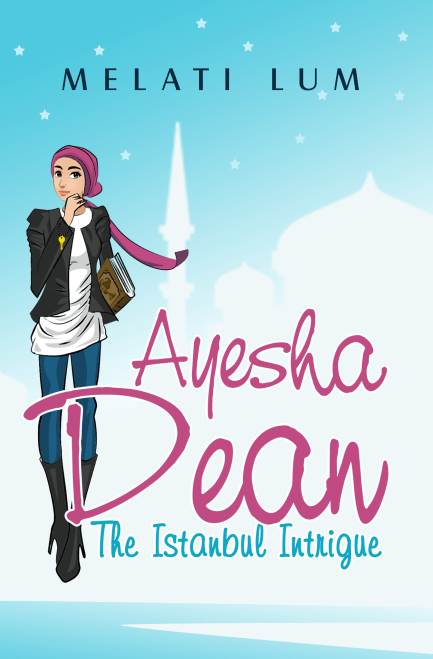
Ayesha Dean: The Istanbul Intrigue by Melati Lum

Standard
Ayesha Dean: The Istanbul Intrigue by Melati Lum

ayesha dean.png

I’ve tried numerous times to get my preteen daughter to read a Nancy Drew book with little success, yet she devoured this mystery and is eagerly waiting for more.  The protagonist is relevant, resourceful, fun, and a practicing Muslimah too.  At 240 pages, the spacing and large font make the book easily accessible, and tempting to dive in to.  The pacing is pretty good, and while there are a few hiccups with storytelling style, the book overall is worth adding to yours and your child’s reading list.

SYNOPSIS:

Ayesha’s parents are deceased, but her Uncle Dave has raised her as a Muslim following her parent’s wishes.  Having graduated high school she is off on a celebratory trip with her two closes friends: Jess and Sara, her uncle and her friend’s dad to Istanbul, Turkey.  The adults have a business conference and the girls are hoping to explore and enjoy all the sights of the Turkish Bazar, the Hagia Sophia, the Blue Mosque and more.  While looking for a book to gift Uncle Dave, Ayesha and her friends discover a secret message sewn into an old book of maps and set off to collect clues and solve a 100-year-old ibn-Arabi mystery.  Obviously, I don’t want to give too much away but there are villains, and shady characters, and dear friends, and lots of yummy food.

WHY I LIKE IT:

I love that the heroine is a hijab wearing, salat praying, Tae Kwon Do trained, fashionable, kind, young lady.  She has integrity and resourcefulness, that make the reader want to cheer her on.  Her friends are significantly less developed, I really couldn’t tell you much about them, and honestly had to look back to recall their names.  I understand why they are in the story for Ayesha to play off of, but I’m hoping that they will have a bit more substance in future novels.  Other side characters had more depth than Sara and Jess did, and even getting them out of the way for the climax seemed to further diminish their roles and importance.

I loved learning about Turkey through the characters, the history, architecture, the food.  The author really shined when talking about Islamic history as well.  When Ayesha and Emre explore the Sultan’s Privy Chambers at the Topkapi Palace, and look at Prophet Muhamad’s (saw) sword and bow, the excitement and reflection is palpable.  In other places however, I felt like the narrator’s voice was completely jarring and distracting to the engaging story at hand.  In the midst of pursuing a lead, the story comes to an almost standstill to say, “the friends chatted amiably as they walked, admiring the city as they went (69).”  The majority of the descriptions are so vivid that the few places where they cease are noticeable and awkward.

I also loved the diversity of the friends, even Ayesha’s own personal makeup adds some depth and appreciation that she has chosen to practice Islam.  Ayesha prays and tries to make sure she is not alone with a boy, she is conscious of her hijab and notes the Islamic elements in her own life and in her environment.  Obviously the book takes place in Turkey and she is unraveling an Islamic mystery of sorts, but I think the book works well for Muslim and non Muslim middle schoolers alike.  The book is not preachy, and the translations of prayers and poetry are framed in a historical or inspiring, not doctrine manner.  Similarily, I think you might be able to get boys to read it too.  It inspires girls who perhaps can identify with the main character, but I think even boys will be impressed with what Ayesha can accomplish.

FLAGS:

The book is fairly clean, there is some intense moments with kidnapping and having guns drawn, but nothing too haunting.  Ayesha obviously makes a good “friend” but nothing happens or is even detailed as wanting to happen between her and Emre.  Just Emre’s dad regularly teasing them as he looks for a wife for his son.  The only real flag for me was the exploring of the harem at the palace and the mention of concubines, and eunuchs.  A lot of detail is not given just that the women must have felt trapped, but it is a heads up if your child asks you about it, to be ready to answer.

TOOLS FOR LEADING THE DISCUSSION:

I think this would be a fun book club book to explore deeper some of the sites and history of Turkey.  I would have to explain the harem before hand I think, but I think it can be done factually to avoid to much over thinking for the young readers.  I think to track the clues and “map” out the trail in a group completely with pictures of the real places would really bring the story to reality.

Interview with the author: http://mvslim.com/meet-melati-lum-criminal-lawyer-who-also-has-a-passion-for-writing/

Why we need more heroines like Ayesha Dean: http://www.muslimkidsguide.com/why-do-we-need-more-muslim-heroines-like-ayesha-dean/
 

The Gauntlet by Karuna Riazi

Standard
The Gauntlet by Karuna Riazi

the gauntlet

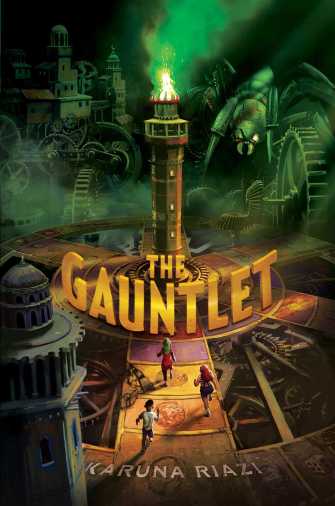
Take Jumanji, turn it into a chapter book, flavor it with steam punk, set it in a Middle Eastern inspired marketplace, and have the protagonist be a Bengali-American, hijab wearing Muslim on a quest to save her little brother with her two BFFs from New York. Bam, you now have a 298 page AR 5.4 reading level booked called The Gauntlet.  

Published by Salaam Reads (Amina’s Voice) this book is written for all kids, the main character’s religion and culture just add depth and a connection to the game they have fallen in to.  I found this book on Scholastic, and when I got it, I handed it to my daughter to screen for me.  I asked her once she finished if it had any Muslims in it and how were they presented, to which she gaped at me and said, “umm mom the whole thing is about a Muslim girl and it is awesome!” So naturally I moved it higher up in the “to be read pile” and while I agree with her assessment, the book is more plot than character driven, and there isn’t a lot of theology in it, just a race against time to get out of the game alive.

SYNOPSIS:

It is Farah Mirza’s 12th birthday and while she should be downstairs visiting with her guests from her new school, she is holed up in her bedroom with her little brother Ahmad and her best friends from the old neighborhood, Essie and Alex, playing board games, the Mirza family’s favorite pastime .  When Aunt Zohra tries to coax them from the room she mentions a gift for the birthday girl is in her room, and the kids sneak off to get it.  Only it isn’t the book she brought to give Farah that they find, it is a bewitched game called the Gauntlet of Blood and Sand that lures kids in, and keeps them if they cannot out play the Architect.  When Ahmed falls in, the trio has no choice but to follow him in to try and rescue him and escape, before time runs out.

Once inside the game, they are in a city called Paheli. It resembles an old Middle Eastern city with large souks, market places, even a small masjid, surrounded by sand and levels absolutely breathtaking in both their beauty and in their threat to the children.  The inhabitants are those that played the game and lost. The challenges the kids must face range from a life size game of mancala to a taste test of Bengali/Indian sweets.  As they rush from challenge to challenge they meet a kind tea shop owner, giant lizards, spies and police of the architect and see fairly detailed descriptions of different parts of Paheli. The gamemaker/designer known only as the Architect senses that the kids will win, so he starts to cheat, and then feels bad and arranges to meet the players.  When the children meet him, and hear his story, they feel some sympathy for him, but not for the Jinn that holds the ultimate power over the game.  Obviously they do escape, but I won’t spoil the fun the process is, nor the sweet surprise of the reunion.  

WHY I LIKE IT:

I like that at the core, the story is driven by love for a sibling and requires the teamwork and cooperation of friends.  The rest is just frills from this central and clear message that is woven throughout the book.  While it is idealistic, there are hints that it isn’t overly so.  Yes Ahmad with his ADHD is a lot to handle at times, and the friends do have their squabbles, but ultimately both friends and family are worth risking it all.  I love that Farah is Bengali, many of the foods are Indian, and they are set in the Middle East, but yet somehow it seems interchangeable, this made me laugh, and while in other instances might have annoyed me, I liked how connected it made everyone seem, more alike than different.  Essie and Alex know some of the foods and cultural lexicon from growing up in New York.  They don’t find things different, they had lots of kids in school that wore hijab. Readers unfamiliar with some of the words and names found in the subcontinent and Islamic history might be put off a bit by the regular use of these words and the lacking glossary, but if you identify with any of it, you will celebrate seeing yourself in this book, just as Farah relished in seeing something of familiarity in Paheli.  

The book is fast paced and the detail given to the setting and cultural aspects are fun, but I really don’t feel like I connected much with the characters as a result.  There is very little character development and I actually had to look back in the book for some of the names to write this review.  There also isn’t much religion in terms of belief or practice.  The buildings and the food and the tone all hint at Islam, but I would have loved to hear an athan, or even her pausing to pray.  Not even that is there.  She wears hijab and that is about it in terms of religion.  

Ultimately I love that it is a mainstream book, with a strong storyline that is action packed and fun for older elementary and early middle schoolers that is clean and familiarizes and thus normalizes a culture not often seen in young adult fiction.  

FLAGS:

None, it is clean, at times possibly a bit scary with human bones, but not anything overly haunting.

TOOLS FOR LEADING THE DISCUSSION:

This would be an amazing book for a book club, and I would play the games that they play in the gauntlet at the meeting.  There isn’t a ton to discuss in terms of introspection and growth, but there is enough, and it is fun.  Plus, there aren’t a lot of books like this for Muslim kids to see themselves in, that I think it would be a blast for them to read, and enjoyable for the adults to watch them get swept away.

Interview with the Author: http://ew.com/books/2017/03/27/karuna-riazi-gauntlet-jumanji/


It Must Have Been You! by Zanib Mian illustrated by Fatima Mian

Standard
It Must Have Been You! by Zanib Mian illustrated by Fatima Mian

it must have been you.jpg

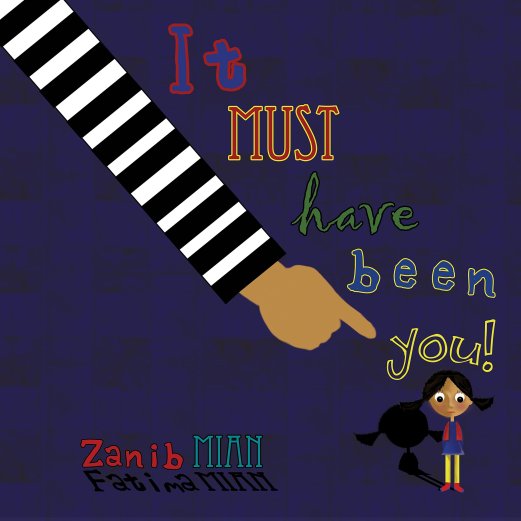
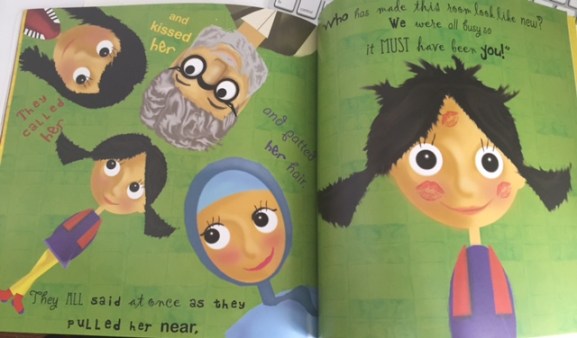
This rhyming 32 page book follows around a small girl, “about the same age as you,” who seems to make a mess every where she goes.  She never lies or even responds to the accusations of her unintentional messes, as she gets caught each time by someone in her family who points their finger and identifies the clues that led them to their answer. Luckily, she uses this pattern to her advantage as she cleans up and makes her family a card resulting in hugs, kisses, and love.

FullSizeRender (34)

Written for younger kids (4-6), the book is bright and colorful and very well done.  Even two and three year olds will enjoy the sing-song rhythm and chunky engaging illustrations.  The pages are thick and the binding solid, especially for a soft back book.  The 10 x 10 square size works well for story time and bedtime alike.  However, because the text is incorporated into the illustrations, if you are reading to a group, you will want to read it a few times before you present.  Looking at it straight on, the word order is much more clear and if you are reading it with emerging readers, I would recommend pointing to the words as you read, so as to help guide your listeners.  The fonts get a little crazy, which is part of the fun, but again may require some assistance to help the younger readers decipher the words.  Older independent readers (up to age 7 perhaps) might like the slight challenge of figuring out what word comes next, so that the story makes sense.

FullSizeRender (33)

The mom wears hijab and that is the only islamic reference or overt implication.  A fun book that thus far with multiple readings has yet to get monotonous and boring, yay!

FullSizeRender (32)

The Man with Bad Manners by Idries Shah illustrated by Rose Mary Santiago

Standard
The Man with Bad Manners by Idries Shah illustrated by Rose Mary Santiago

bad manners.jpg

This story has a good moral, but the path there is a little twisted.  A village is annoyed by a man with awful manners and when he leaves for vacation, a clever boy convinces everyone to teach him a lesson and get him to change his ways when he returns.  They replant his field, paint his house, and rearrange his furniture to convince him upon his return that this is not his village or home or fields.  

bad manners1

When he does come back, he is confused and sad that he doesn’t know where he comes from, at which time the village tells him what they did, and agree to put everything back if he promises to change.  

bad manners2

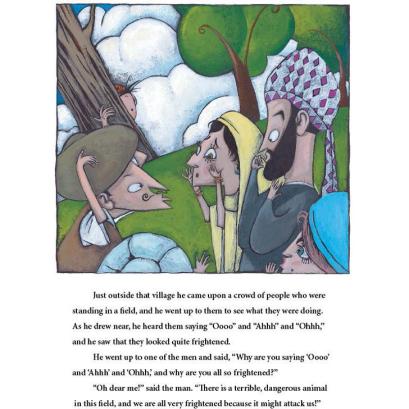
The 32 page brightly illustrated book tells an Afghani tale in a western setting.  The chunky cartoonish illustrations show great imagination and encourage the reader to look at the effects of bad manners in a different way.  The clever boy, also goes about things in an extreme manner, which hopefully gets the reader to question if it was successful and perhaps how they would have handled the situation.  Another book that urges, thinking outside the box, with some discussion and reflection.  There is some lying, breaking and entering and other questionable actions, but I think most kids will realize it to be a silly story to teach a lesson, and all is forgiven because in the end they did live happily ever after.

bad manners4

The book is not AR but easily works for Kindergarten to 3rd grade.  There is nothing in the text or illustrations that suggests the book has any religious or cultural ties.

manners


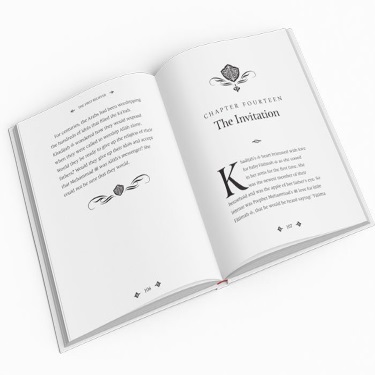
Khadijah: Mother of History’s Greatest Nation by Fatima Barkatulla

Standard

khadijah.jpg

I depart from the Islamic Fiction that I enthusiastically seek out and read, to share and review a work of non-fiction that swept me off my feet.  Perfect for children eight and up, and particularly ideal for girls, this book is absolutely physically beautiful and the content is as well.  This 176 page book flows like a story not a history book, and at times a love story between Khadijah (RA) and our beloved Prophet (SAW).  The font and spacing invites young readers to absorb each word without feeling rushed or overwhelmed.  

SYNOPSIS:

The book is a biography of our mother, Khadijah bint Khuwaylid.  It starts just before she is made aware of Muhammad and ends with her death, followed by a few reflections of RasulAllah missing her.  For the most part the story keeps her at the focus and for the age group the slips into seerah are no problem.  But I wanted more about her.  I learned that she was married twice before she wed Prophet Muhammed, but I wanted to know more of her children with these other men.  I wanted to know if they ever accepted Islam.  I wanted to know of Khadijah’s childhood and her parents, and her tribe.  I wanted to know more about her sister who sounded like her, and if she had any other siblings.  It scratched the surface, and even my 10-year-old daughter wanted more, in a good way.

It covers their marriage, and it reads like a sweet fairy tale that is absolutely full of noor and love.  It shares how she supported the Prophet at every turn and the hardships of the boycott.  It drops names and places, but not in an over burdening way. In many places I actually wanted more detail as to how they all fit together in time and place. As she has children and grows ill and time passes, the story comes to an end.  Almost too quickly, as her day-to-day life as a mother and wife are missing, and I was hoping there would be more.  Yes the  growth of Islam and the plots of the Quraysh are so important, but I wanted more Khadijah, in a book claiming to teach us about our “legendary mother.”

WHY I LIKE IT:

Obviously the story is great, and really the way it is presented is how our kids need to know our history: with love and compassion and enthusiasm.  You feel the love between Khadijah (RA) and Prophet Muhammad (SAW) you see how patient and devoted she is in a very emotional way.  Truly the author has given life to a story many of us know, and filled us with a connection and relationship that is very personal and inspiring in nature.  When you finish the book, you feel like Khadijah is a friend, an amazing friend, but someone you know intimately and proudly, not just as a historical figure.

innerpages2_1024x1024

FLAGS:

None

TOOLS FOR LEADING THE DISCUSSION:

I would absolutely do this for like a 4th -6th grade book club.  I think it should be mandatory reading.  I would probably invite someone well versed in the seerah and Khadijah to answer the children’s questions.  How wonderous it would be to hear the kids discussing her life and offering parallels, lessons, and inspiration to one another from their new found knowledge of Khadijah (RA).


The Silly Chicken by Idries Shah illustrated by Jeff Jackson

Standard

silly-chicken.jpg

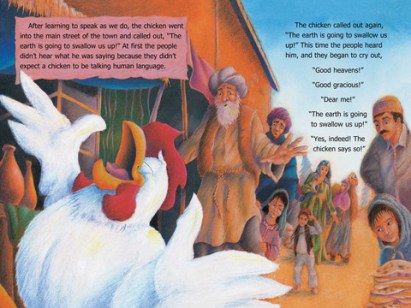
This story reads wonderfully aloud as it is silly, repetitive, and the message is more clear than in some of Idries Shah’s other Sufi inspired teaching books.  Written on an AR 4.0 level with 32 pages.  Some pages are heavily text laden while others just sprinkle a few words across a beautifully illustrated page.  Like his other books, the illustrations are truly spot on.  The lively faces on the characters, and colorful scenes bring the story to life and keep the audience engaged and giggling.

chicken

A man decides to learn how to speak “chicken,” when that doesn’t work, he teaches the chicken to speak our kind of language.  Fluent and conversational, the chicken then tells the villagers that, “The earth is going to swallow us up!”.  Everyone runs in all directions, up the mountain, down the mountain, across the meadow, around the world, but they can never get away from the earth.  When they return, they are upset with the chicken and ask how he knows that the earth is going to swallow them up, to which he replies that he doesn’t.  After they recap all the trouble he has put them through he poignantly laughs at them and asks, ” You think a chicken knows something just because he can talk?” Realizing how foolish they have been the chicken begins telling more outlandish things, just to make the people laugh, and isn’t taken seriously again.

silly chicken1

The message is clear, the characters funny, and the illustrations engaging. I finally found an Idries Shah book that I like! Yay, I guess for me they are hit or miss, and this one was definitely a hit!

chick

The Clever Boy and the Terrible, Dangerous Animal by Idries Shah illustrated by Rose Mary Santiago

Standard
The Clever Boy and the Terrible, Dangerous Animal by Idries Shah illustrated by Rose Mary Santiago

clever-boy.jpg

This book makes me forgive the author for his other books that left me puzzled as to his popularity.  This is wonderful, timeless and so simplistic, yet full of wisdom, lessons, and reflection that I’m thinking of gifting it to many of my teacher friends.  In its 32 pages written on an AR third grade, 2nd month level, the simple and powerful lesson of how ridiculous it can be to be afraid of what you don’t know is driven home.

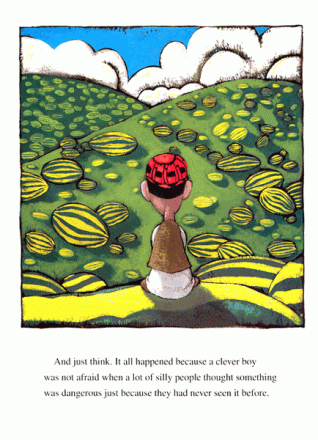
And just think. It all happened because a clever boy was not afraid when a lot of silly people thought something was dangerous just because they had never seen it before.

A boy goes to a neighboring village and finds the villagers afraid of, wait for it, a watermelon.  The boy laughs and laughs, and pulls out a knife to cut it and enjoy its sweet juices.  The villagers then fear the boy, until experience and knowledge about what it is and how to grow it, change everyone’s opinion and the village renames itself Watermelon Village. Oh, the power of knowledge.

clever 2

I can see this book being so great to introduce kids to how a little knowledge, asking questions, trying something can do everything from finding something you like, to breaking down stereotypes, to shifting your paradigm.  I feel like Islamaphobia, among so many other things, could be done away with by and large if people would just get to know us!

clever 3

The villagers depicted wear kufis and hijabs and kurtas, and the author writes to share his stories from his oral Sufi tradition, but there isn’t anything overtly Islamic in the text.  The kids as young as preschool will enjoy this at storytime.  They will find being afraid of a watermelon preposterous and silly, making the point that much stronger.

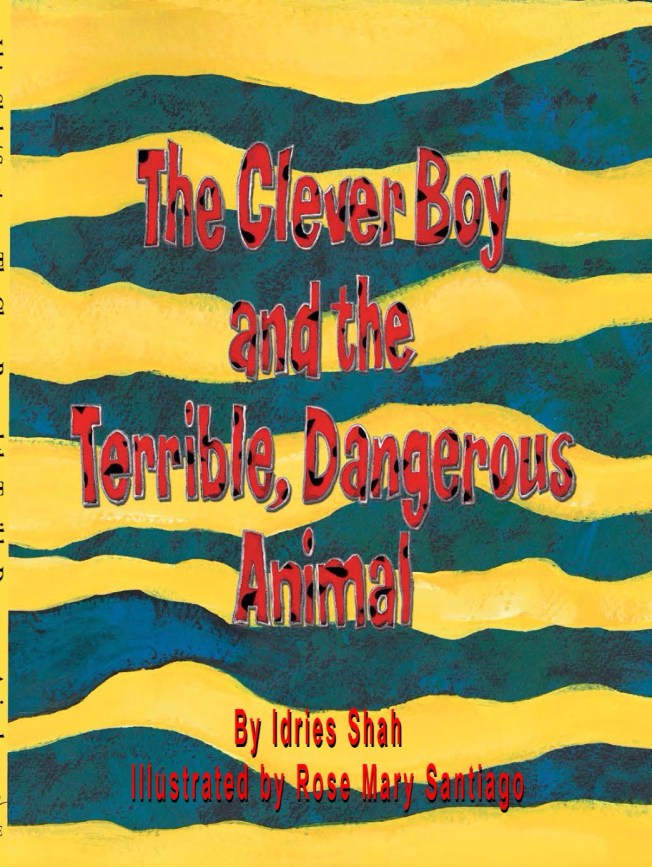
I like that the cover doesn’t given much away, and most children will take the title at its word and think that it is an animal.  Getting student’s ideas of what the terrible animal will be adds to the creative thinking and discussing after as well.  The pictures are wonderful and endearing and many editions come in two language formats.

clever1

Salam Alaikum: A Message of Peace by Harris J illustrated by Ward Jenkins

Standard
Salam Alaikum: A Message of Peace by Harris J illustrated by Ward Jenkins

salam alaikum.jpg

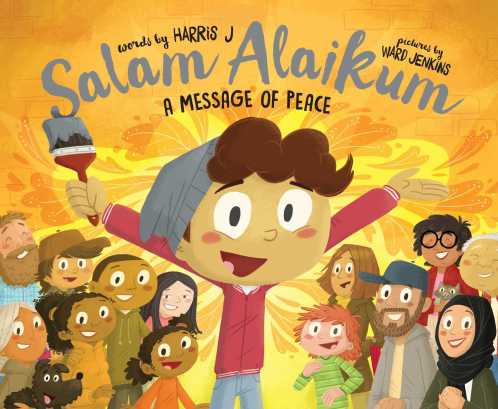
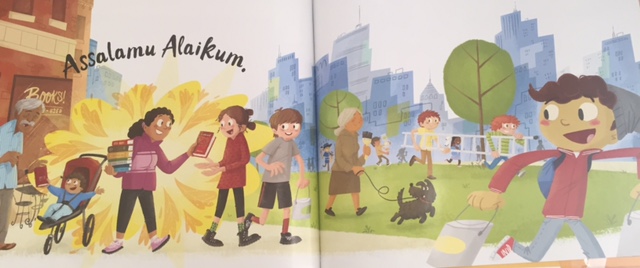
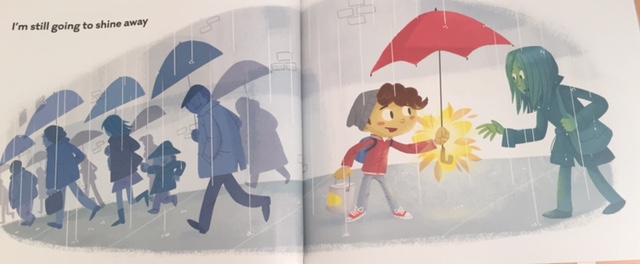
Harris J’s song by the same name gets stuck in my head because it seems like “Salam Alaikum,” is the only words in the song, so when I heard that he had written a book based on the lyrics, I was a little skeptical. But, total credit to the illustrator, the book is adorable, and the lyrics aren’t too bad either.

salam1

Thirty big pages, that radiate with light and happy faces and a big clear font that celebrates peace, love, and coming together.  The words “Salam Alaikum”  is a Muslim greeting, but there is nothing overtly religious. There is one muhajaba that appears on a few pages, but with the content matter, there is a lot of diversity in the book.  A variety of skin tones, ages, clothing, genders, sizes, all come together to hold hands and work for peace.

salam2

The content isn’t ground breaking, but the number of words on the page are good for 3-6 year olds.  And it does introduce that the world is more fun when we all work together and are kind.  Kids will like the illustrations and return for them undoubtedly.  It is hard to know if the books these days are truly better, or are just done better.  But, while I checked this one out from the library, I think I just might want a copy of my own.

salam3


Saints and Misfits by S.K. Ali

Standard
Saints and Misfits by S.K. Ali

saints-and-misfits-9781481499248_hr.jpg

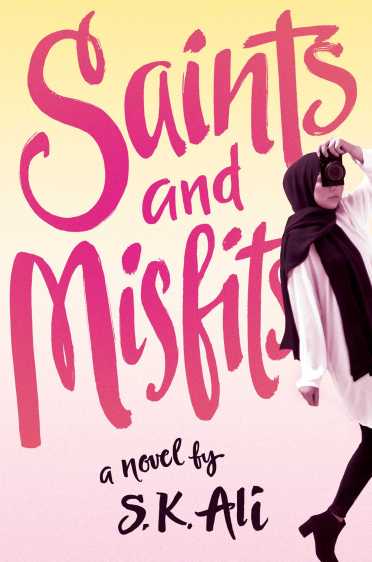
I enjoyed this book a lot. I had a bag of halal gummy bears, a rainstorm raging outside, and an excuse to snuggle in bed with a book, and I couldn’t put it down, even when I ran out of gummy bears.  I think mature 16 year olds and up could read it, and probably should, it is an important book, but I don’t know that I could recommend it to a young adult Muslim. Maybe, but probably college and up.  Not because high school students don’t read a lot about heavy stuff in English class. I mean Scarlet Letter, I Know Why the Caged Bird Sings or anything by Toni Morrison or Shakespeare are heavy, but they are removed from most Muslim teens.  They are old books, or about people from a different time and place. This book is real, and relevant, and relatable, and in 325 pages you feel connected to the characters as if you know them, or knew them, or more importantly for me, a 36-year-old Muslim American born and raised in America, as if they knew me.

SYNOPSIS:

Jannah Yusuf is 15 and in the opening chapter, less than 5 pages, she has to defend her choice to wear a burkini to her father, who assumes his ex-wife, her mom, has forced it upon her.  In the second chapter, we see that she has gone to visit her father to get away from a monster, her friend’s hafiz cousin Farooq, who attempted to rape her.  From there Jannah pursues a relationship with her crush, Jeremy, with the help of her best friend at school, Tats.  This pursuit involves intentionally having Jeremy see her without her hijab in gym class, and sneaking off to meet him.  Throw in the fact that he too is friends with the monster, Farooq, and the tension, anxiety, guilt, and shame that Jannah feels about her suddenly drama filled life is palpable.  Feeling increasingly isolated from her very amazing friends and family, she finds strength and support from a group of kids she is on an Islamic Quiz competition team with and an elderly Hindu man she helps once a week.  Eventually finding her voice, and reclaiming her strength to face her attacker is like a caterpillar coming out of her cocoon and you hope she soars and flourishes in reaching new heights and happiness.  The message of standing up against such acts and standing by those victimized by sexual predators helps puts the blame and shame where it should be, on the attacker, not the victim.

WHY I LIKE IT:

I like that it shows everyone in shades of gray. No one is good or bad or right or wrong, everyone is somewhere in the middle.  Even the most religious can be scum, and friends can both surprise you for good or for heartache.  At one place, Jannah considers telling her non-Muslim friend Tats about what is going on. “Almost.  The 60 percent reason that I hold back has to do with something I’m 100 percent sure of: I can’t handle people thinking I come from a messed up community.  I’d rather close the hamper lid on that one.” I think this is kind of where we are right now in real life and in literature. We want to be seen as complex characters, we aren’t a monolith, but we don’t want to celebrate our failures either.  This book does this really well, most of the time.  There is a girl who has memorized the Quran and wears niqab (a face veil) and has a vlog of stirring up stereotypes.  She helps Jannah get her revenge, and it doesn’t work, but at the same time she is never really nice.  Her friend Fizz, Farooq’s cousin, seems almost like family, but when told what has occurred, doesn’t believe her lifelong friend, and becomes rather disappointing and shallow.  Some of the friends, seem pretty stereotypical for the genre, the great non muslim side kick that supports and celebrates the protagonist, the endearing, yet annoying brother, the friend turned romantic interest when the dust settles, the Asian girl good at math, and the elderly neighbor who is wise, etc.. Yet, somehow I really wanted to know what happened to all of them.  I understand that for literary reason’s the book ended where it did, and there isn’t an epilogue, but from a reader point of view, I would like to know if Jannah’s brother got married, if her mom did, what course of action Jannah took against her assailant, what happened between her and Fizz, and if Jeremey and her became friends.

I think it is important to note, that Jeremy was awesome, like really a great respectful guy who knows about Islam and even that the hotdogs should be halal.  Jannah is figuring out who she is, and what direction to go in, which reinforces the female empowerment, but I think his attitude also deserves some credit in not taking her story and control away from her. The story doesn’t wrap up in a nice and tidy way, but I’d like to think they remain friends.  The reason the book gives that they can’t be more than that, is that he isn’t Muslim. It is echoed throughout that if he were Muslim, it would somehow magically be ok.  So, when at the end she realizes her feelings for the funny supportive friend Nuh, everyone seems ok with it.  Well, I’m not, yes I get that in real life people date and marry on their own and often people of different faith backgrounds. But, she is a Sophomore, who obviously isn’t looking to get married. She prays and covers, and seems to be an active and intentional Muslim. So, again, I get that it is more the norm than not, in the real world, but this is where I feel nervous about suggesting a teen to read it.  Muslims still are not regularly represented in print, and when you see an active and engaged Muslim doing so much, I feel like that does subconsciously form a connection to a reader and the line between right and wrong is blurred as a result.  Yes, I realize this contradicts the whole, we are not a singular entity, but I don’t know that many Muslim parents would encourage dating to their high school daughters as long as the boy is Muslim, despite it happening often.  I think we still want to see good idealistic messages from fictional Muslim characters in books that we suggest our children read.  And while we would want them to be inspired by Jannah’s strength to speak out against the crime commited against her, we may not want to give the message that we would also want them to be doing some of the other things she does.  Yes she is fictional, yes, most YA novels don’t have a moral theme, but like Jannah, I still want to keep the hamper lid on it all, even though I know that isn’t realistic.

There are a few plot inconsistancies, like how Jannah’s dad cuts the funding for her brother’s education, but when they are in Chicago visiting, their doesn’t seem to be any tension.  Saint Sarah’s background and motivation for change seemed a little choppy to me and the mom could have been fleshed out a bit more.  Overall though, even the visitors to the Mosque’s Open House ring relatable and comically true.  You can tell the author knows what she is writing about because it is familiar and funny, yet not judgemental.  I love that her characters are flawed and that it doesn’t define them wholey.  I love the way the author sneaks bits of practical Islam into the website updates Jannah does for her uncle and I love how the friends at school don’t read like an after school special.  Some attempts at getting people to change work, and others don’t, furthering the relatabilty of the book and keeping the preachiness at bay.

The book would work for Muslims and non Muslims and is a good entertaining read. There isn’t a religious or moral agenda that the author is trying to convince the reader of, but rather it is about reclaiming your voice when someone has tried to take it.  A message that never gets old.

FLAGS:

There is profanity, sexual assault, boy girl relationships, lying, mention of drugs and alcolhol, and bullying.  Its got it all.

TOOLS FOR LEADING THE DISCUSSION:

I wouldn’t do it as a book club read, not a youth one any way, adult one possibly.  But if a teen read it and wanted to discuss it, I would jump at the opportunity.  I think the book speaks pretty well for itself, but I’d love to speak to a teen to know it through their eyes.  To see what they found believable or far fetched, what they could relate to, how they process the crime and the recourse, what they would have done in a similar situation, what kind of friend they would have been, and ultimately what stereotypes the book forced them to confront.

I read something the other day that the way Muslims judge other Muslims on hijab is so inconsistent with our thoughts on praying or fasting or any other act of worship. If someone messes up we encourage them to try again, or ask for forgiveness or say it is none of our business and we will pray for them, but why with hijab do we feel justified in criticizing if they “try it out” or change their mind? For me, this book really drove the point home.  She is 15 and she lets a boy see her hair, I was bothered, and had to realize that, that really said more about me, than the fictional character I was reading about.  I like books that challenge my thoughts.  Like I said, I’d reserve suggesting someone read it, but I hope they find it and read it none-the-less, and then contact me so we can tear open a bag of gummy bears and discuss.

The Magic Horse by Idries Shah illustrated by Julie Freeman

Standard
The Magic Horse by Idries Shah illustrated by Julie Freeman

the magic horse

I didn’t get it.  I read it to my kids they did’t get it. I know it is written on an AR 5.8, but even with that, we didn’t get it.  I had to google it to see what the deeper meaning of the story was and all I found is that it is a teaching tale of two princes and how one found his heart’s desire in a fish and the other in a horse.  Which, I did get, but didn’t really get more than that.  The details in the story seem to wander and meander around to no point and not in an entertaining way. I never felt a connection to the characters, so their side stories didn’t appeal to me.  It is possible that I would have viewed it more favorably as a short story rather than as a really long picture book, but its hard to say.  I guess I feel like if forced, I could write an essay explaining all the small lessons, and moral guidance, but as a children’s book, I don’t want to dig so deep or spend hours at bed time trying to convince my children that the story made sense.  Ideally the book should have been shorter and more streamlined, or longer and fleshed out.

horse1

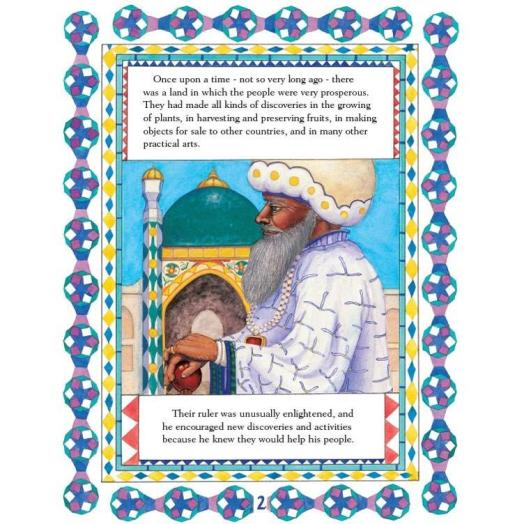
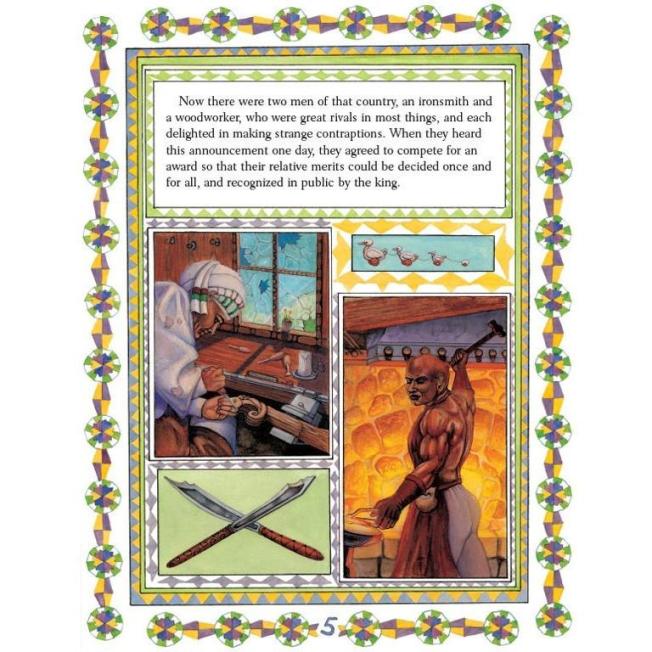
It starts out with an enlightened king encouraging his subjects to make new discoveries to promote quality of life, wealth and knowledge. He has two sons, one is an expert in strange devises and one is a dreamer.  The king puts out a call to have something new made, and an ironsmith makes a fish out of metal than can fly and swim and carry things.  A woodworker makes a magic horse that interprets the desire of the rider and carries the rider toward it.  The king suddenly becomes cruel and finding this a waste of time has the woodworker tied up.

horse

The dreaming Prince Tambal rides the horse on many adventures, which kind of disjoints the story and makes it like a fairy tale about Tambal falling in love and trying to persuade a king to let him marry his daughter, and in turn having to trick the intended suitor instead. Along the way there are poisonous fruits, turning into a beast, and eventually returning home to prove that, “Those who want fish can achieve much through fish, and those who do not know their heart’s desire may first have to hear the story of the wooden horse.” Huh? Exactly.