Category Archives: Muslim Author

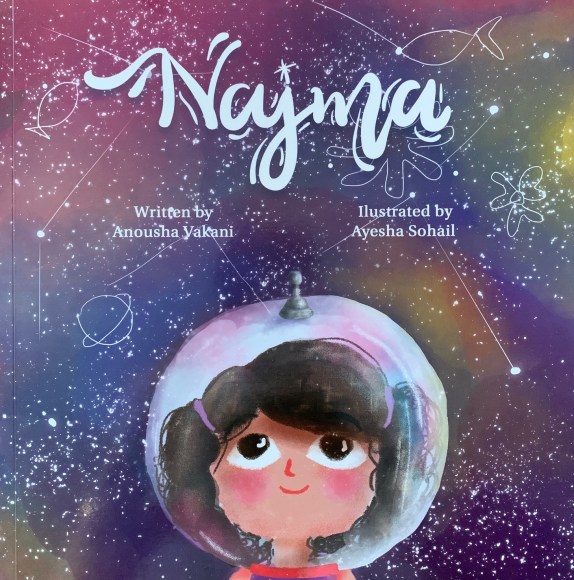
Najma by Anousha Vakani illustrated by Ayesha Sohail

Standard
Najma by Anousha Vakani illustrated by Ayesha Sohail


IMG_7194

In a world of new STEM books and female powered books, this 28 page fact driven story adds one more empowering element, Islam.  With beautiful pictures on thick glossy pages, the 10×10 book is both educational and endearing for boys and girls ages 6 and up.

IMG_7183

There isn’t a story with a climax or moral, but there are characters, Najma and her astronomer Mom, who move the book along, and keep it “grounded” so to speak.

IMG_7184

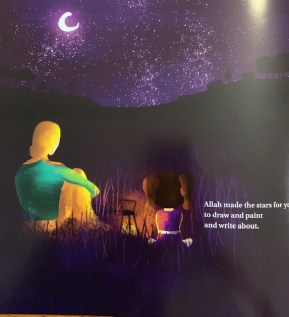
Little Najma loves the stars and space above her, she knows Allah created them, but she wants to know more about them, what they provide, and how Allah made them.

IMG_7185

Mama and Najma look through a telescope as Mama teaches the life cycle of a star in simple terms over 11 pages.


Najma then asks what stars are for, and Mama tells her the benefits of the sun that Allah swt made for us and the stars as well.  Mama explains Allah only has to say, Be and it is.

IMG_7188

Every scientific concept, and daily life example is tied back to Allah swt.  And with Najma’s adorable little face, and the beautiful complimentary illustrations, the book conveys facts about the universe, love between mother and child, and awe at Allah’s signs.IMG_7189

Thank you Crescent Moon Store for amazingly fast delivery of this brand new book.  InshaAllah there will be more books like this combining science, Allah, and strong females for us all to learn from and enjoy.


Tried & Tested by Umm Juwayriyah

Standard
Tried & Tested by Umm Juwayriyah

66C2F327-DA67-4853-AF6A-03998C5C0C30

In 337 pages I fell in love with the Johnson family and all their drama and hardships, while marveling at their resiliency, love of family, and determination to own their mistakes, right them, and move forward.  I don’t know that this Urban Islamic Fiction book is classified as YA (the author didn’t respond when I reached out), but I think high school juniors and up will appreciate either/both seeing themselves in it or/and reading an engaging story about indigenous American Muslims.

SYNOPSIS:

A naïve teen, Iman Johnson, ran away from home and her Islamic life to be with a boy offering her the world.  After twelve years of being away from home, she sees a window to escape the oppression and abuse of her husband and return to her family who she has had no contact with in Pittsburg, PA.  The story is linear as it follows Iman as she deals with the stresses she currently faces while dealing with the consequences of her actions and mistakes of her past. She must reconcile her family, deal with the passing of her father, the failing health of her mother, the tumultuous relationship her younger sister is in, the incarceration of her older brother, and the impending arrival of her little brother’s first child.  Ultimately she must also face her husband to get a divorce, keep safe from his mafia like family of drugs and violence and control, find a job, get her alcohol addiction in check, and forge ahead.  She also must reconnect with Allah swt, her community and find herself.

WHY I LIKE IT:

It has been over a week since I finished the book, and I can’t decide if the author failed to be consistent with a certain character, or if she made him fallible intentionally to show that there are no saviors and we all have our own weaknesses and humanity, or if I’m just really irate with a fictional character and his poor choices, ahem Jibril.  That being said the characters really stay with you, and I feel like I could chat about them as if they are real and I am ready to go start a gofund me campaign to help them out.

The characters at every single step are Muslim and the book feels like a labor of love from the author.  I don’t think this is a book that could be researched or written from outside, I’m guessing the author has loved this community and been loved by them in return.  For all the Islam in it, I think a non Muslim could read it and enjoy the story, but if you are Muslim you are in for a treat.  From the Eid morning bathroom schedule, to the annoyance of having a brother in law staying over and thus forcing you to cover when you run to the kitchen for a snack.  Yes, at times, there might be too much information, like how many times does it say she relieved her self and made wudu, but the consistency makes it all so worth it.

I’m being vague about some of the details and not telling too much about the characters, because you really have to immerse yourself in it, and thankfully the author does a great job in keeping it clear who all the characters are, how they are related and what life experiences they bring to the table.  Every single character has issues, no one is perfect, yet somehow the story is never sad or hopeless.  No one is looking to be saved or playing the victim card, they are all fighting the fight, and taking it one day at a time.  It is really impressive.

Sure, most of it is predictable and I wanted more of a showdown between Iman and her ex, Mateo, but yet somehow I was sad when the book ended and I had to leave the characters and their world. I absolutely love how the brothers take turns guarding Iman as if they do this all the time for their sisters.  Sure it may not be realistic that they can find someone free at all times, and whatnot, but I really want this to be true.  That people still look out for one another, and not perfect people who don’t have their own issues, but real people, family, just people who have made it a priority to care.

FLAGS:

There is lying, deceipt, affairs, drugs, drinking, violence, abuse, smoking.  But, nothing is glorified or detailed, it is mentioned to make a point and then the story moves on.   The book is about succeeding despite all the negative and finding your way to hold on to your deen, no matter what.

TOOLS FOR LEADING THE DISCUSSION:

I think this would be a great book club for like young college girls.  There is a tint of romance, a whole lot of pulling yourself up and moving forward, and conversation about what tempts us, and how to persevere.  I hope if you read it you’ll shoot me a message, I’d love to hear how much of it rings true for you, and what characters you cheer on and are most annoyed with as well.


An Ocean in One Drop: The Tale of Hajar in Hajj by Mariam Hakim illustrated by Layla Abdubaisi & Hameedah Hamadah

Standard
An Ocean in One Drop: The Tale of Hajar in Hajj by Mariam Hakim illustrated by Layla Abdubaisi & Hameedah Hamadah

IMG_7027A story about Hajar (saa), about Zamzam, about Hajj, and how we are all connected through our faith in Allah.  In 32 water color adorned pages, the rhyming couplets tell a well-known historical story for children of all ages, with Hajar front and center.

IMG_7021

The book is framed with a young girl, Jamila sitting with her grandmother who has just returned from Hajj.  She is giving Jamila some Zamzam water as she tells her the story of Hajar, and how at the heart of our Hajj we honor and follow in Hajar’s footsteps.

IMG_7022

Left in the desert with her son Is’mail (as) she runs between two hills, Safa and Marwa looking for water and help. This step of Hajj, Sa’ee, is required by all pilgrims to perform as Hajar did. Grandma explains to Jamila, that after praying to Allah (swt) and after the seventh run, water appeared and still flows today, Zamzam.

IMG_7023

Jamila learns from her grandma the value of the water, and the power trusting Allah has in our lives.  She also learns how the well attracted people and is now the  city of Makkah.  “You see the sacred Sa’ee has many lessons within: Courage, patience, faith and love.” the grandmother tells Jamila before quoting Rumi and liking the desert water to an ocean of history.

IMG_7024

The book contains a two page Glossary of names and terms at the end as well as information about the author and illustrators.  As expected there is also an ayat regarding Prophet Ibrahim and his family from the Quran at the end, and somewhat surprisingly, Bible verses about Hagar.

IMG_7025

I’m not sure that the link to Rumi’s quote and hence the title of the book is smooth, it seems a bit forced.  Also, I’m not sure why the Bible verse and the Bible entry appearing in the Glossary is present.  It seems like an Islamic story for readers of all faiths to know what Muslim’s believe, so I’m confused why the interfaith angle at the end is there.  Perhaps, if there was an explanation or an Author’s Note or a tie-in to the story, but without any of that, it seems inconsistent and random.

IMG_7026

As far as the illustrations on the 8.5 x 11 thick soft bound pages are concerned, they are rather mediocre.  The anime’ style people, the texture, shimmery bits, and the flowing deserts, make me feel like I should love them, and there is truly nothing wrong with them,  I just wasn’t overly wowed by them.  I actually found the illustrations off for the story at hand.  I’m  certain everyone will disagree with me, and some really are gorgeous, but overall I found them collectively, to be just ok.


Bedtime Sunnahs Emaulating the Prophet one night at a time by Alia G. Dada illustrated by Robin Boyer

Standard
Bedtime Sunnahs Emaulating the Prophet one night at a time by Alia G. Dada illustrated by Robin Boyer

sunnah.jpg

A beautiful rhyming 11 page story for toddlers and up to learn parts of the Prophetic routine for bedtime.  Yes, 11 pages, the book in total is 28 pages, six are Appendixes, one is about the author, one is a dedication, and the rest are blank or title pages.  For a $15 book, I’m a little disappointed, which is unfortunate because the illustrations and information on those 11 pages is great.  The references are informative and important to see what Hadith the Sunnahs come from, but I think the story itself could have, and should have, been longer.

2D4EFF33-886B-46DB-92F6-74C7679D6F61

Each page has a different family getting ready for bed and doing various acts.  I love that moms and dads are involved in bedtime routines. The illustrations show diversity and the text is simple, flowing, rhyming and straight forward.

5EB6E7CC-3194-480E-9A58-EE259FAB9DB5

From brushing teeth to reciting Athkar, making duas to Allah and laying on our right side, each page has wonderful detail in the warm full color pages.  I love the decorations on the bedroom walls, signs with Allah’s name, statements saying “Strong like Zainab, Brave like Fatima, Smart like Khadija”, as well as “Smile! it’s Sunnah!”.

1DB8BDCD-6CEB-4104-B072-6A2D21951D71

The book is for Muslim children obviously, and makes getting ready for bed seem like a fun and bonding event.

The first Appendix is a Parents Notes on what the purpose of the book is and the second one is Islamic Terminology.  From the their Appendixes address the Ahadeeth about sleeping in a state of Wudu and on your right side, bedtime Atkhar, and reciting the three Quls,  I wish it would have including the Quls, seeming as the book is meant to provide information for caregivers to convey to a child, and many households may have non Muslims or new reverts in that role.

10500B30-4BF9-4473-94D5-F9D4EDFAEDD1

The remaining two reference pages are Additional Sunnahs for Advanced Children which include Reciting Ayah al Kursi, the last two verses of Surah al Baqarah, the dua before bed and when waking in the morning.  The dua texts are given, the Ayats are not. There is then a final page about the author.

F8DCC46D-0DFC-4A20-9E63-645B06FAE324

The hardbound glossy cover and thick inside pages are well done in this 8×8 perfect sized book for bedtime, I just wish there was more of it.


Bismillah Little Leyla by Qura Abid illustrated by Mona Ismail

Standard
Bismillah Little Leyla by Qura Abid illustrated by Mona Ismail

leyla

I thought this book might be leveled- reader type based on the binding and page numbers (26), but it reads more like a picture book with its repetitive refrain, and honestly the awkward small size (5×8) makes it feel like a pamphlet.  So, I’m not sure who it is trying to appeal to, and unfortunately is a great example of how the outward presentation killed an otherwise decent book.  I also don’t know who is to blame for the final physical product, the author, the publisher, the printer? But at a $10 price point, I’m not sure anyone who purchases this book is going to be happy with the size and binding, and the book will simply get lost on a book shelf, and be forgotten.

D2F8834B-35BD-4EDA-AD61-7DBBE81379C0

The premise of the book is good.  Rather than just tell kids to say Bismillah before they do anything, Little Leyla actually does it in the course of a morning.  I like that it shows that we say Bismillah before we do all types of things, not just before we eat or get in a car, but even when we swing and play a game or put on a jacket.

66AC3E97-BC82-4A6E-8E25-8E22F728E46E

The climax of the book is Leyla saying bismillah, shooting a goal and scoring against her dad.  The lesson being that Allah is always there to help us.

017585B3-7AD4-4769-AD6A-C218ECAE4A33

I’ve read the book a dozen times, to myself and aloud, and I think the book has a natural cadence based on the diction and sentence length, and I think it wants to rhyme.  Additionally, after each example and on nearly every page, the refrain at the end of the paragraph is (nearly) the same:  “What must she say? Leyla knows! Do you? It’s Bismillah!”  The repetition makes it memorable, but with the sing song beat and on and off, often forced, rhyme, I find myself tripping over the words a lot, and I cant quite put my finger on why.  If the book were larger, and I were using it for a preschool story time, I would just have to practice it a few times, but there is no way, sadly,  you could read this book to a group if you want them to see the pictures.

857FA476-B9FF-46D0-BBBA-035CBFADD7B1

The illustrations might be ok, it might also be a presentation thing that makes them look washed out OR maybe that is how they are, I’m not sure. The detail and expressions are there, they just kinda seem faded.   Concept wise I like that they show the dad cooking and Mom playing soccer. The mom wears hijab she the family seems warm and happy.

DD72FDED-2FB4-4E08-8275-22E7E7202728

Thanks again to crescentmoonbooks.com for the excellent customer service and selection.


The Sign of the Scorpion by Farah Zaman

Standard
The Sign of the Scorpion by Farah Zaman

scorpion

This is the second book in the Moon of Masarrah series, but can be read as a stand alone book if you are looking for a linear story with fast paced action, intense twists, decently developed characters and quality writing that brings the sleuthing of Muslim characters to life.  At 229 pages including the glossary, the book reads to me as a middle grades book, but the last 50 pages place a lot of emphasis on accusations of a character molesting servants in the castle and another character having an affair, which might be more appropriate for older readers.  Perhaps middle school readers would be a better target audience, but I’m waiting to hear back from the author regarding who she had in mind when she wrote it.  The author said she wrote it for Young Adult, ages 12 and up in mind.

SYNOPSIS:

Brother and sister, Adam and Layla are reunited with their friends, siblings, Zaid and Zahra after last summers intense adventure involving a diamond.  This summer as a result, they are the honored guests of Shaykh Sulaiman at his dessert home, Dukhan Castle. They arrive to find out that the Shaykh is bedridden from a stroke after learning his son has died.  With a house full of relatives with reasons to want their claim to the Shaykh’s fortune, the four teenagers start putting odd occurrences of a ghoul in white, a hooded horseman, a gypsy woman’s tale, and the idea that there has been foul play, together to try and arrive at the truth of what is going on.  As they piece more and more together about the tutor, the cousin, the fiance, the grandson, and a mysterious mole-man following them, they themselves get tangled in the sinister plot of revenge and must keep an eye out to figure out who the scorpion, Al-Aqrab, is before one of them ends up dead.

WHY I LIKE IT:

Set in a fictious land, the detail is the perfect balance between setting a stage and over describing it.  The book did not drag for me at any place, nor did I find myself confused about what was going on and why.  Granted I probably could not tell Adam apart from Zaid and Layla from Zahra, but the book is about their adventure and figuring out whats going on, not about their relationships or back story.  And with the focus on all the possible perpetrators and their motives taking center stage, having four people gathering clues makes the information come easier and smoother.

All the characters are Muslim.  Some of the women cover and some do not, some stop to pray and make regular references to Islamic hadith or Quranic Ayats, and some are suspects.  For example when they are exploring the dungeons beneath the castle, they liken the caves to the Sleepers in the Cave mentioned in Surah Kahf.  The book never gets anywhere near preachy, nor do the few references ever get annoying, they just flesh out that the characters are Muslim, and thus they see the world through that lens.

FLAGS:

The book has murder, lying, deception, all the ingredients for a good who done it.  And while the details are all clean regarding how the four teens interact with the opposite genders, the climax of the book is the coming to light of allegations of molestation and a failed marriage is attributed to a presumed affair.  No definition of the words is given, and I reread many of the passages and I don’t know that there is even enough context clues to decipher what the word molest means in the text.  Most kids however, could easily ask Siri or Hey Google or whatnot and may have more questions about what it means to sexually assault a person, specifically a woman or child, and why someone would do it.  I leave that for parents to decide at what age those in their charge can grasp such a word and concept.

TOOLS FOR LEADING THE DISCUSSION:

I’m torn on teaching the book as the linear telling might not appeal to older kids, but the motive and revenge isn’t appropriate for younger kids.  I think if used to discuss broader issues the book could be really powerful, and not just a fun read.  I could see discussing with 9th graders or so the seriousness of false accusations, drawing on the Me Too movement and how sexual crimes and transgressions should be handled and treated.  I think the book could be a springboard for those discussions and seeing the effects of believing or not believing, and perhaps suspending judgement until research can be done.  In the case of the book, it would not have been difficult to pursue the allegations, while protecting any potential victims.


NOTE:

The first book in the series, The Moon of Masarrah, was originally published under the title, The Treasure at Bayan Bluffs, some changes have been made in the new printing, so while I don’t normally review second books in a series, I felt this book might bring attention to the new title of the first book and drum up interest for the upcoming third book in the series.  No, I don’t benefit in any way and I purchase my copies just like you, the stories are just really well done and I want readers to give them a try.  Happy Reading!

If Allah Allah Wills by Dr. Oz illustrated by Mariya Khan

Standard
If Allah Allah Wills by Dr. Oz illustrated by Mariya Khan

if allah wills

Not all books need to teach something, but when the book would lend it self so easily to dropping a fact or two, it seems like it would take it.  In 40 pages, preschoolers are taken on a highly imaginative journey to the Ka’ba, yet no information about the history of the Ka’ba, or any mention of Umrah or Hajj is shared, not even in passing.

IMG_6336

Faris wants to go to the Ka’ba but it is nearly his bedtime, so he has to act fast.  He asks his mom what he needs to wear, obviously knowing special clothes are required, but his mom prefaces the answer of white sheets as being “odd” and then adds that you need sandals.  For a book that wants to normalize Islam for children, I don’t understand why the mom would say that ihram is odd, why the word ihram isn’t used, why it doesn’t even specify the number of white pieces of unstitched cloths and why sandals would be included.

IMG_6337

Faris then finds two white sheets, but the illustration shows him getting towels out of the bathroom (possibly showing his imagination, but kids will just think it is an error, mine did), packing some food and jumping on his rocking horse to head off for the Ka’ba.

Faris finds himself among the stars without a map and starts to worry that he won’t find his way.  He then sees a flock of birds and wonders how they know where to go.  The book however, doesn’t answer how birds know, and just has him land and find someone to ask.

IMG_6338

Luckily Faris finds a camel to ask, and luckily he is a nice camel and he shows Faris to the Ka’ba.  Faris is surprised at how big it is and then supposes that Allah’s house has to be.  But he asks it as a question, which makes it a little off grammatically.  The camel points out that Allah swt is above and that the Ka’ba is for people to visit.  Faris asks what is supposed to be done at the Ka’ba and the camel answers, “We circle the Ka’ba, pray to Allah, and thank Him.”  This seems like a great place to sneak in some facts about who built the Ka’ba and why or mention Hajj or Umrah, it seems so misguided to just say we circle it.

IMG_6339

Faris makes some prayers that he can return for real one day with his parents before he finds a place to eat his snack and share his food with his camel.  It is nice that he shares with his new friend, but odd that when they part Faris asks him his name and he says he doesn’t have one.  Maybe give him a name, and detail its meaning or don’t include the exchange at all.  I seriously don’t understand the purpose of the exchange.

IMG_6340

Faris makes is home with a crash and his mom tidies him up and they say InshaAllah that Faris’ prayer inshaAllah will come to fruition.

The book has a great premise of imagination and tying in the Ka’ba, but truly there is no information about Islam or the Ka’ba or even Allah swt, it gives a mood of worship, but that is about it.  I get that it is for little kids and the book is supposed to be whimsical and light, but sneak in some facts, kids can handle it.

As for the illustrations, they are just ok.  They would have benefitted from being a little smoother and not looking home-done, but there is nothing terribly wrong with them aside from the towel and sheet imagery.    The glossary cover and large font inside is age appropriate, some pages are a bit text heavy, but overall sufficient.

IMG_6341

Piece by Afshan Malik

Standard
Piece by Afshan Malik

Pieces.jpg

This 168 page young adult book from Daybreak Press focuses on a small Muslim family in Texas, that has their own stresses and interpersonal relationships, but are thrown in to a whirlwind when the father of the family returns home from a medical mission to Syria and finds himself in the psych ward broken and troubled.  The effects each of the character’s struggles have on them as well as those they care about, makes for a haunting yet relatable read for fourteen year olds and up.

SYNOPSIS:

The Jamal family is made up of Hannah and her older high school aged sister Noreen and their physician parents Dahlia and Adam.  Hannah runs track and is more introverted in handling friends and her father’s life altering condition.  Noreen on the other hand is ultra organized and rational in her approach to life, much more like her OB mother.  To cope with the stress of her father’s return she commits herself to more clubs at school and staring at her phone.

Hannah doesn’t seem to have a lot of friends, and when the track team understands that Hannah’s dad is dead and Hannah doesn’t correct them until later, her comfortable acquaintances turn on her and she will have to learn to stand up for herself and use her voice in the course of the book.  Noreen’s character arc is a bit more dramatic as her involvement in yearbook club brings new people in to her life, mainly a boy, who might not be as a genuine in his goals as she is, and thus their climax results in a trip to the police station.  Dahlia has a close friend, and Adam has a few as well, but the story really stays pretty streamline in exploring the relationships of the family and how little things and big things affect them all.

WHY I LIKE IT:

I love that the book takes on a serious issue like PTSD and is framed in such reality.  The scene where the dad blurs his past memories with the current real happenings, is done very well.  It conveys how fractured his brain is while showing the stress his situation lends to the mood of the home is powerful. There is also a very real situation of attempted physical and sexual assault that occurs when Noreen finds herself in a position with a male classmate who attempts to take advantage of her.  The book holds back in details, and she is able to defend herself, keeping the book clean, while still implying what his intent was, and how fortunate she is to get away.

More superficially, but also more relatable is the girls bickering and fighting and pushing each other’s buttons, and the mom trying to help, but is alas is frequently at a loss at what to do with them.  The situations the girls face at school are probable and relatable that I think a lot of middle school and high school readers will see themselves trying to balance extra curricular activities, friends, finding a quite place to pray and keeping their hijabs coordinating.  The family is Muslim and they dress the part, talk the talk, and pray together regularly.  Islam is very present, but not preachy, it is just what the characters believe and what they use to shape their view of many of the tests they are facing.

There are a few hiccups that are worth noting, but don’t overly deter for my appreciation of the story.  I struggled with the writing style in the first few chapters.  It took a bit to feel a connection to the characters and get what was going on sorted out.  It is written in 3rd person omniscient (I believe, it’s been a while) with each chapter more or less focusing on one of the four main characters.  As a result a handful of times the narrative gets awkward in explaining what one of the characters is doing or thinking, because the focus is on someone else, or the timeline overlaps a bit.  It doesn’t happen an awful lot, but the book is under 200 pages, so it is annoying that it happens at all, let alone more than once.

Story wise the characters seem oddly isolated.  The book tells us how small the town is, and shows us how everyone knows the parents regularly, the girls seem to be pretty lonely.  There isn’t any warmth from the schools or neighbors in helping them deal with their dad coming home so wounded.  In a town they have lived in for so long, this seems off to me.  Also if the town is so small, and the family so religious, there is an imam who visits once, you’d think there would be more of an Islamic community presence for the mom and girls to find support from.

FLAGS:

There is violence in the remembering of what happened in Syria.  There is some Islamaphobic talk as Hannah endures some verbal bullying and the attempted physical and sexual assault on Noreen.

TOOLS FOR LEADING THE DISCUSSION:

I would consider this as a possible middle school book club choice.   It tackless some big things, and uses Islamic boundaries to talk about mental illness and sexual violence which is a huge plus when addressing our youth.  Noreen isn’t in a relationship or even overtly infatuated with the guy who puts her in a compromising situation.  But even if she was doing something “wrong” what he did is not ok, and the fact that the authorities believe her, and she plans to discuss it with her mom, and she is not further victimized by speaking out, is something our kids need to see and understand.

There are discussion questions at the end and I think males and females will benefit from reading and discussing this book.  Unfortunately, and possibly the only other disappointment in the book is the price.  Nearly twenty bucks for a short YA paperback book makes it hard to buy classroom sets for such activities, and I’m sure will even keep the avid reader debating whether they should purchase it or not.


Malala’s Magic Pencil by Malala Yousafzai illustrated by Kerascoet

Standard
Malala’s Magic Pencil by Malala Yousafzai illustrated by Kerascoet

malala

I’m going to try my best to review a nonfiction autobiographical book and focus on the story, not on the author because yikes, Pakistanis have strong opinions about Malala, and I have no desire to get pulled in to an argument.  I’m half Pakistani, I know the position of both sides.

IMG_6245

I have read both the Young Readers Edition and original I Am Malala books, so I didn’t jump to review this book in 2017 when this AR 3.6 40 page re-re-telling of her story came out.  After reading numerous other children’s books about girls in the subcontinent striving to go to school and be educated, I thought maybe the controversy had calmed down and I could read this large hardbound book a bit more objectively, and thus focus on the story a bit more.

IMG_6246

The book is listed as a biography, not an autobiography, so I’m not sure Malala even wrote the book, but none the less it is a synopsis of her story for younger elementary children.

IMG_6247

Starting off a bit like Harold and the Purple Crayon, Malala asks if the reader believes in magic, and then tells what she would do if she had a magic pencil to draw things that would make other’s happy like a proper soccer ball for her brothers and a way to stop time so she could sleep in a little longer in the morning.

IMG_6249

Every night she hopes for a magic pencil, and every morning she is sad one hasn’t appeared.  As she starts to notice the world around her she realizes that the kids looking for food and metal scraps in the junk yard, have it much much worse.  She asks her father about it and learns that if the children were in school their family’s might go hungry.

IMG_6250

As she notices “real” problems around her, her ideas for what her magic pencil could fix, evolves and develops into a burgeoning social conscience.  But quickly her naive outlook is changed when dangerous men start to appear on the streets and girls in her class stop coming to school.

IMG_6251

Her magic pencil finds real world power when she uses her words and her voice to make a stand and people start to pay attention.  The rest of the book highlights how she made progress despite the attempt to stop her and how she now uses her “magic pencil” to work to make a more peaceful world.

IMG_6252

The surface story is incredibly hopeful and would motivate young children to notice the world around them and do what they can to improve it. Inquiring children might be alarmed at children going through trash, or want a lot more information about who the scary men are and why they don’t want girls going to school and why she gets to travel around and tell her story. Information that is given at the end of the book in an afterwards of sorts.

IMG_6253

Most pages have sparse text and the ones that have a lot are kept on level and avoid being preachy.  Even the attempt on her life is present, but not detailed, sufficing to say that they tried to silence her, but failed.

The illustrations are beautiful and tell the story as much as the words do.  The book does not mention religion, but in the pictures where she is out of the house her hair is covered, but not when she is at home in bed and whatnot.  Obviously it is how she carries her self in real life.

Overall, I think the book is incredibly well done and inspiring to young readers.  Anytime a modern day figure can show children that they too have a voice and can use it, I think it is a good thing.  The fact that the voice comes from a minority, a female, a person with a name and culture different than the ones in most western children’s text books is also a plus.  I hope if nothing else it opens a window to children that there are a lot of amazingly strong and courageous people in all cultures and to seek out their stories.

IMG_6254

Jasmine Falling by Shereen Malherbe

Standard
Jasmine Falling by Shereen Malherbe

jasmine

This 184 page book about a girl figuring out her past, to accept her present, and plot her future. is not marketed, or perhaps even written as a YA novel, but I’m reviewing it because while the protagonist is in her 20s the book could be enjoyable to ages 15 or so and up, if they are willing to stop trying to understand a lot about the book and are content to just go along for the heartfelt ride.

SYNOPSIS:

Jasmine is half Palestinian and half British and when her wealthy mother passes but stipulates to claim her inheritance Jasmine must find her father, the book leaves England and heads to Palestine.  To further complicate things she has only 10 days to find a father who has been missing for years, in a land she has only visited once before many years ago.

Once in Palestine, the story takes her from one city to the next and one village to another with pit stops at various historical sites along the way.   With lots of fragmented memories, the shadow world of Jinns, and a race against time and around the obstacles of the occupation, Jasmine rediscovers Islam, her family history, and the fears that haunt her.  She also meets Josh, a character of questionable allegiances, motives, and background himself, that constantly finds himself able to help Jasmine and possibly himself.

From Jericho and Jerusalem and Batien, Jasmine hears stories about her father from people that know her family,  as she pieces it all together and reunites with her family members, she understands her past and works to determine what path her future should take.

WHY I LIKE IT:

I love the backdrop of Palestine and the history and the richness of culture that is brought to light in a surprisingly non political way.  The interaction of the different faiths among the villagers and the love of the land is truly palpable.

The part I struggled with was the holes in the story telling, for each page that brought Jasmine closer to answering her one question of where her father is, the reader was given 27 new ones that would never be answered.  Where did the wealth come from, how did Jasmine’s parents meet, what were the circumstances that made Jasmine’s dad leave, who is Richard, who was Ali, how old is Jasmine, why are there so many Jinns every where, why is there secret passages in the mountain, how come she trusted Josh, how could Josh get from one city to another in record time, why did the soldiers at the check points know of her family and specifically her father, and most importantly why every time she meets someone that knows her family, why does she run away.   It is incredibly frustrating that every time the story hints at what makes her father so famous, or sought after or memorable, or hint at why he disappeared, something interrupts them and the reader is left in the dark, only to have the book end and no really understanding conveyed.

I get why the story is told in pieces, but really the story is confusing in how it is told, and it doesn’t need to be.  The author can write and the last 50 pages are really great.  For as confused as I was so often, I kept reading because the story is good.  There is just a tad too much with diving in to the past to understand the present, the supernatural of the jinn, the reemergence of faded memories and dreams, the political climate, the letters from World War II, that the character dynamics are lost until the end.  I care about Jasmine and am curious about Josh, but a little more detail to the relationships the two main characters have with all the other minor characters that they encounter would really make the story soar, and clarify so much.

One thing I didn’t love was the presentation of Jinns, I know it is to add cultural richness and a bit of muddled confusion, but really the story I think is strong enough without the supernatural and character building could have benefited in its place. I also really, really, really wished there was a map and an afterward telling what parts about Palestine and history and the Holy Cities is fact, for those of us that have never been.
FLAGS:

Jasmine attempts suicide, jumping out a window.  Jasmine also gets drunk a few times in the book before deciding to stop drinking as she doesn’t like who she is when she does.  There is some violence and killing talked about but not overtly detailed.

TOOLS FOR LEADING THE DISCUSSION:

I don’t think I would do this as a book club book, but I definitely would encourage those with connections to Palestine to read the book.  And I am really hoping that someone, anyone, that has read the book will chat about it with me.  For all the questions I have, I’m optimistic that I just missed the answers and that they were in fact there.