Category Archives: middle grades

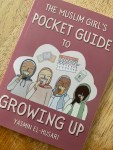
The Muslim Girl’s Pocket Guide to Growing Up by Yasmin El-Husari illustrated by Noon Eltoum

Standard
The Muslim Girl’s Pocket Guide to Growing Up by Yasmin El-Husari illustrated by Noon Eltoum

I still get asked fairly frequently about maturation books for Muslim kids. Boys are another story, but for girls, I’ve always had to settle on a non Muslim book that gives an introduction and some conversation starters, bur rely on the adult to provide the Islamic perspective.  Alhumdulillah, those days are over, I can now recommend this 47 page book as a great resource to hand to a young Muslim girl to read independently and/or together with a trusted adult.  The conversational text, the Islamic centering, the complimentary subtle illustrations, allow the book to be informative, but not intimidating.  For girls on the cusp of puberty it shows them what to expect and it normalizes what they are going to experience in terms of body changes and hygiene, all within an Islamic framework.  I do wish that it noted if scholars approved the text.  The author is a teacher and the illustrator an MD, but a statement at the beginning asserting the accuracy would give additional credibility to the contents.  In full disclosure, the author was my daughter’s teacher, but none of my kids are currently in her class, and I purchased the book on my own.  Truly the book is so desperately needed, the fact that it is well done is something I am happy to share, and inshaAllah, inshaAllah a book for boys will be forthcoming.

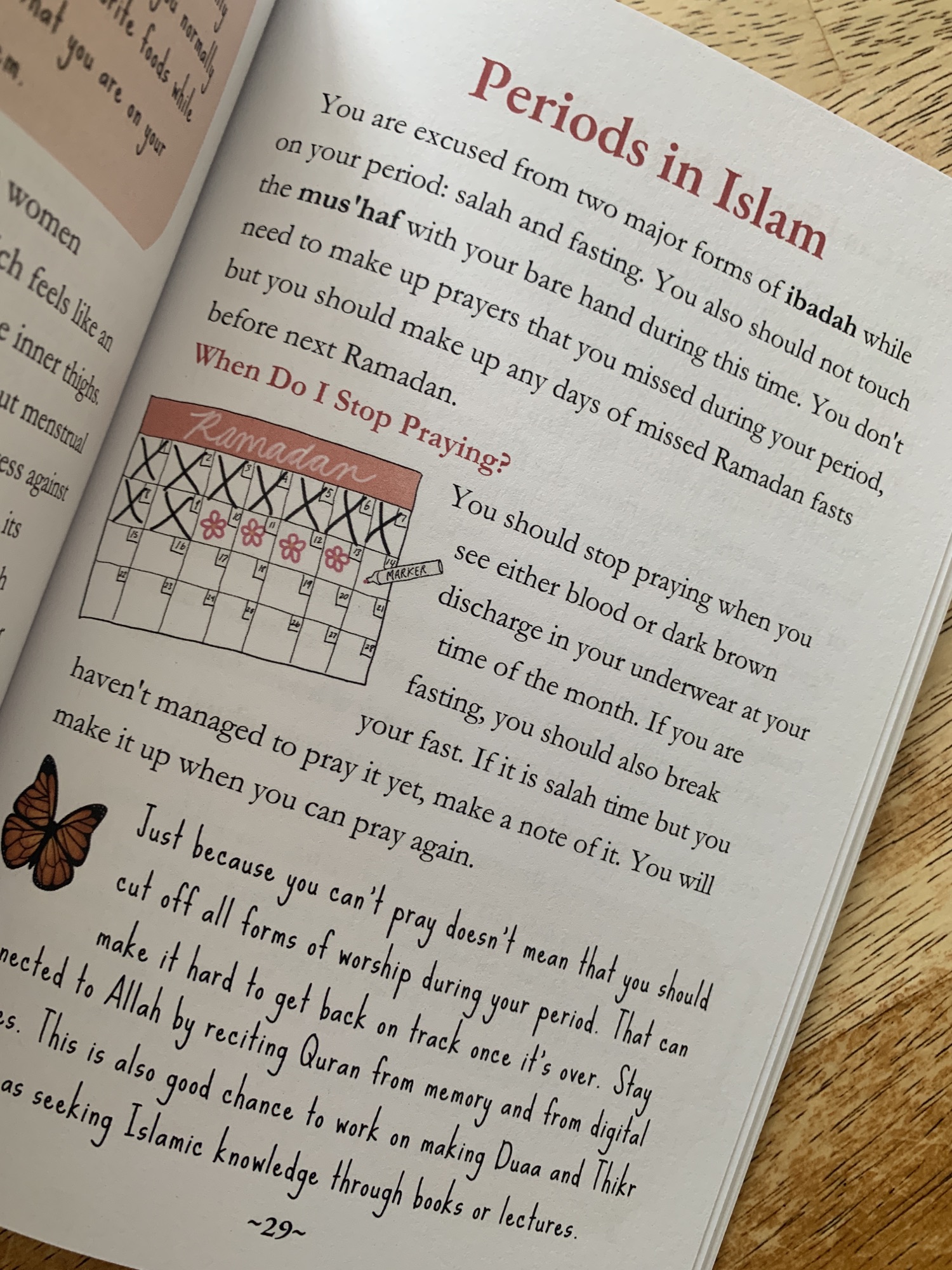
The book starts with an introduction from the author and then a table of contents.  Growing Up, Seeing Spots, A Hairy Situation, Body Safety, A Sweaty Dilemma, Tahaarah!, Periods: The Big Change, Periods in Islam, Discharge, Feminine Protection, Bra Measuring Guide, and Glossary.  There is not a lot of talk about moods, emotions, friendships (relationships), it really is streamlined to cover the body’s changes and practical tips through an Islamic lens.

The tone is very reassuring that what a girl is experiencing or about to experience is normal, something all women go through, nothing to be embarrassed about, and nothing to feel isolated by.  Even the glossary reinforces this this tone by explaining the medical terms and Islamic terminology used.  If a girl reads it alone, she will get that messaging, and hopefully feel empowered to embrace her changes and reach out if needed.  If one is reading it with an adult, the book lends itself easily to discussions that can be more specifically tailored to the young girl, or even a group of girls.

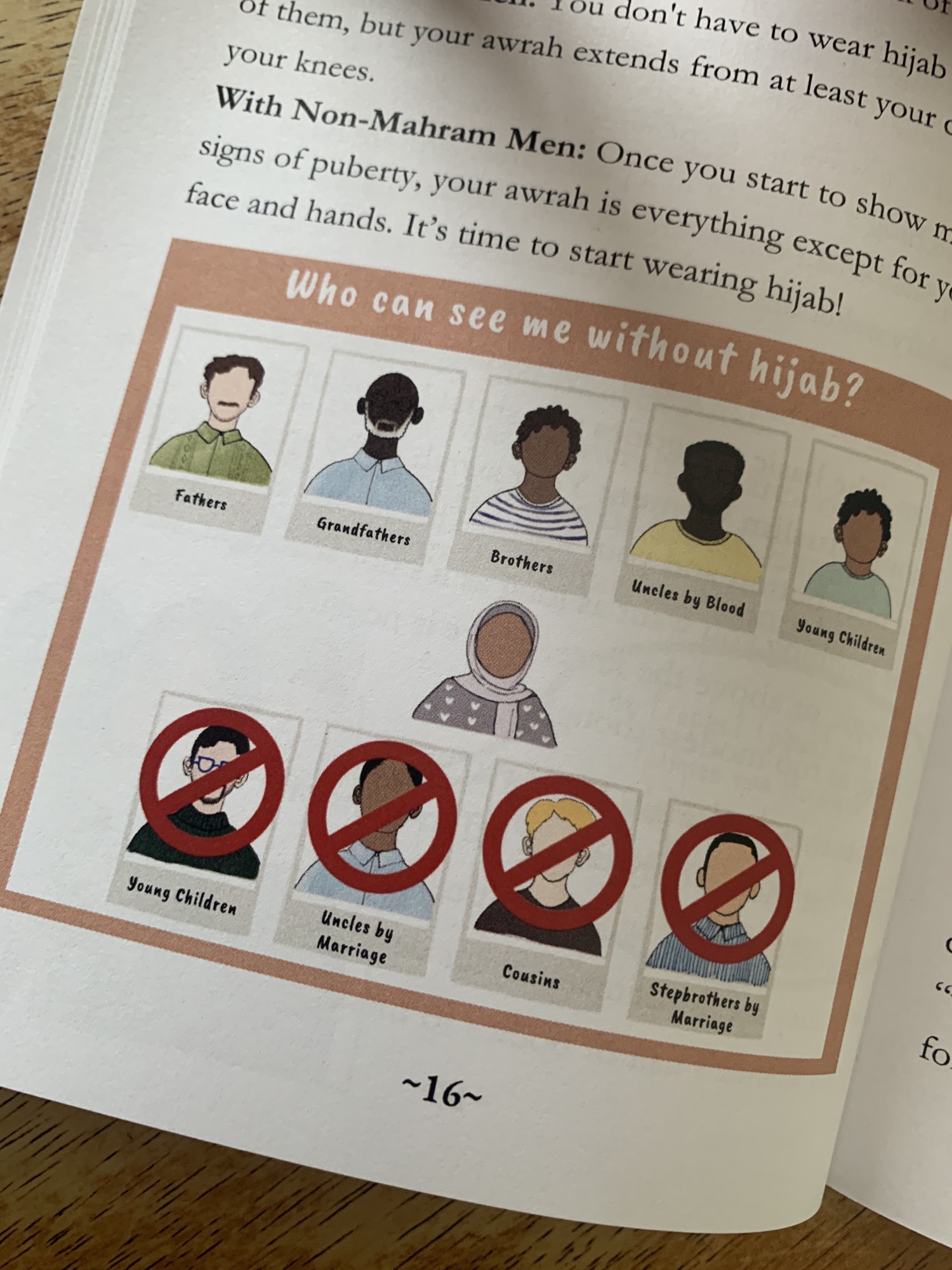
It talks about hijab and provides a chart about who can see you with and without, I’m a bit confused by young children being in both categories, I’m not sure if I am missing something or if it is a mistake.** I also feel like the chapter headings and the section subheadings are not clear as the font, color, and text size are often the same.  The book is small and short, it can be read in one sitting or thumbed through, so the chapters are not particularly necessary, but if it has a table of contents and headings, I feel they should be different in appearance for consistency and ease.

The book is currently available here on Amazon.

**UPDATE FROM AUTHOR:

*Correction Post
Assalamu Alaikum readers both past and present. Jazakum Allahu Khairan for your support and engagement with The Muslim Girl’s Pocket Guide. We had a reader reach out to us pointing out a typo in the text last week. Alhamdulillah that mistake is now corrected. Any book ordered after March 14th should be the correct version of the text. If you bought a copy with the printed mistake it can be returned to Amazon and repurchased inshallah. Again, I appreciate all of your support and Jazakum Allahu Khair 🦋

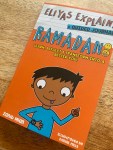
Eliyas Explians Ramadan by Zanib Mian illustrated by Daniel Hills

Standard
Eliyas Explians Ramadan by Zanib Mian illustrated by Daniel Hills

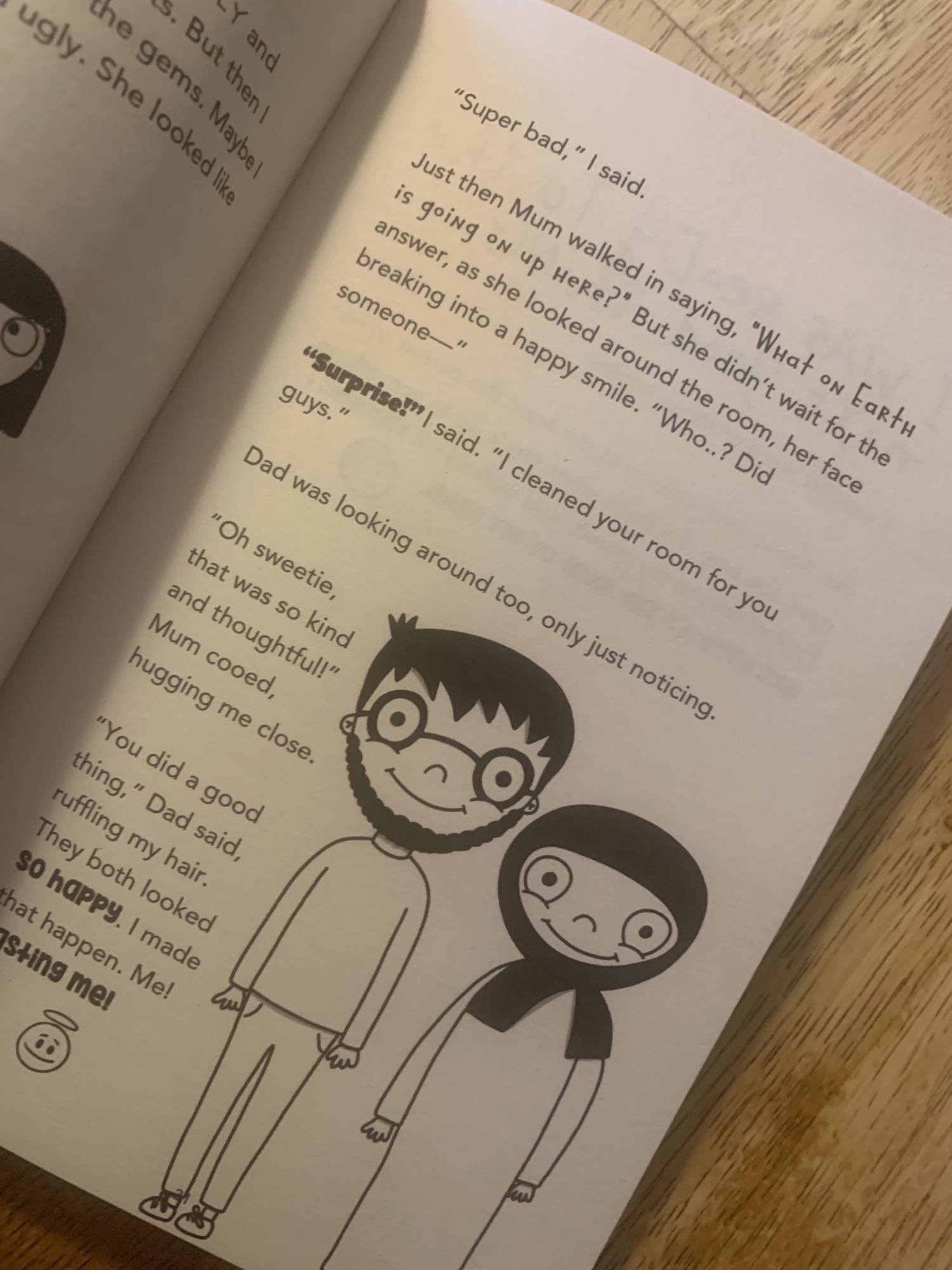
This is the fifth book in the Eliyas Explains series, and it really is what you would expect and hope, a book about Ramadan from Zanib Mian would be.  Eliyas’s voice is funny, relatable, engaging, and yet somehow manages to find a clear way to inform too.  The framing is fictional, but the book is meant to be lesson, moral, and information filled.  The voice did seem to break when Eliya’s didn’t know what “Ramadan Mubarak” meant, but it is clear that the book is meant to teach and remind middle grade kids about Ramadan from moon sighting to Eid, so I don’t think anyone other than an old reviewer would notice.  Parents might notice though that Eliyas loses his cool at one point and starts to presumably call his sister stupid, it stops at “st,” but then says he “started to cuss” which in America would be taken to mean a profanity much stronger than stupid, so just be aware, so you don’t panic if your child asks.  Overall the book is great, it is a solid 80 pages before the guided journaling begins and concludes at 115 pages.  The illustrations, changing font, and humor really make it perfect for the age group.  I gave it to my eight year old to read and I could hear him laughing, saying a few dua’as aloud, and he even came and asked me a few questions making sure he understood new information correctly.  This book would work as an independent read, a read aloud, or even an elementary reading assignment in an Islamic or weekend school.  The book is remarkable for the simple fact that it starts by naming the scholar that proofed the book, truly this is revolutionary, please can we normalize sourcing already.

The book is divided into chapters, with chapter one reintroducing Eliyas and his family to the reader. They are out on a bike ride and Eliya’s wants to know why everyone is so excited for Ramadan and giving up food and water.  Mom and dad explain taqwa and good deeds being multiplied and prayers being answered and big shaytans being locked up and Eliyas is excited (to put it mildly) to get closer to Allah swt and be a better version of himself.

Chapter two explains the moon, making intention, and waking up for suhoor.  With nine chapters before the journaling, the book discusses doing good deeds, fighting, forgiveness, shaytan being locked up, taraweeh, Laylatul Qader, and Eid.

The journaling guides readers through forgiveness, ibadah, goals, duas, kindness, feelings, connecting with Allah swt and more.  The beauty of this book is that it does pack a lot of information, but it shows a lot too, and gives kids a way to see Ramadan in action.

You can order your copy here at Crescent Moon store 

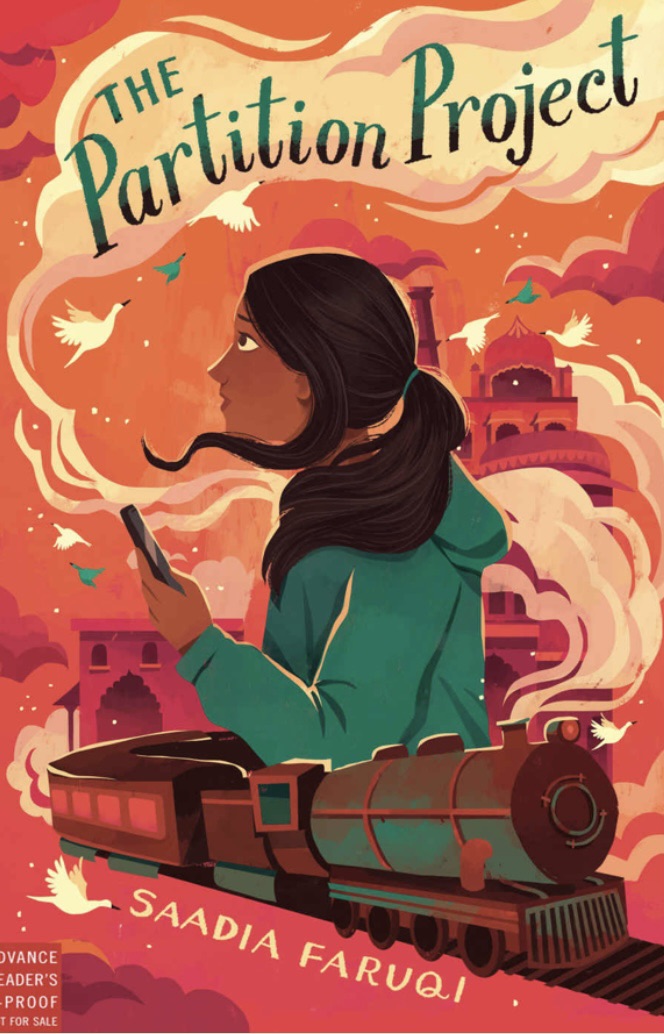
The Partition Project by Saadia Faruqi

Standard
The Partition Project by Saadia Faruqi

Screenshot

I have always maintained that my reviews are not personal, and for over 10 years, I kept to that. I recently made a public exception however, for Palestine. I cannot and have not checked every author, every illustrator, every publisher, or every agent, to see who has spoken up about the genocide, but there are a few prolific authors that are standards in the niche of Islamic fiction literature. Who have elevated our representation with a standard of quality and consistency across multiple age groups over the years, whose stature made their silence, seeming or actual, to the occupation, the apartheid, and the ongoing attempted erasure of a people and culture impossible to miss. No there is no standard or bare minimum, this is all emotion, and if you are thinking who am I to judge, or maybe I missed something, yes you are right. None-the-less it definitely caught my attention that an author who remained silent, wrote a 416 page middle grade book about partition, a historical event impossible to separate from colonization. I know the timeline for books to be published is not quick, but when I read the characters discussing that, “If we only read books by perfect authors, we’d read…nothing, I guess.” It felt a little defensive, and while I never set out to shame anyone, I have written this disclaimer to hold to my word, and to acknowledge that as much as I have set out to write the remainder of this review as I would review any book, my own disappointment in the author, may show through. Literary wise the book is moving, heartfelt even, but the performative othering, the internalized Islamophobia, and the catering to a western gaze, are subtle, but undeniably there. Perhaps the biggest example is the word “British,” the whole reason for partition, is only mentioned a grand total of six times.

SYNOPSIS:
Mahnoor, aka Maha, is in seventh grade, and her whole world has just flipped upside down. Her Dadi, her paternal grandmother, has just moved in from Pakistan, taking her room, and her free time. Plus Dadi is old and grumpy, and Maha is not amused. With parents that are too busy to spend time with her, Dadi slowly but surely starts to fill in a lot of pieces that Maha didn’t know were lacking in her life. Through food and stories and the start of Ramadan, Maha learns about Islam, Pakistan, friendship, and with a school documentary assignment, partition. A historical event she had never heard about before, starts to be all she can think about. It also seems to hang over everything she encounters from a book on a novel study English assignment list, to the train in their neighborhood, everyone at the senior center, and even Texas history. With dreams of being a journalist, Maha’s singular focus because almost obsessive, according to her friend Kim, but the more she learns, the more she changes. And the changes are for the better, even if there are some stumbles along the way, fighting with Kim, making Dadi runaway, calling out her parents preoccupation with work, missed fasts. The book has a happy ending though, as the unlikeable privileged Maha at the beginning, transforms to being someone the reader is cheering for at the end.

WHY I LIKE IT:
I am Pakistani-American, being half Pakistani and half American, the hyphen for me signals both my parents. So I was thrilled a year or so ago when I first heard about this book. I am a bit removed from partition because my father was the first in his family to be born in Pakistan, and my in-laws did not move from India until much later. That being said, I know it is a part of me, as all desis do, and was eager to read this middle grade book. Please note though, I am also white passing American (albeit with a hijab), so I can tell when I am being pandered to as well.

Do I feel the book did the topic justice? Absolutely not, by not discussing colonialism and British occupation, a huge part of the setup is conveniently ignored. It also is very placating of what the Muslims, Seikhs and Hindus seemed to want as Jinnah and Nehru are only name dropped once. Gandhi not at all. I get that the book presumably isn’t about that, but by ignoring it all together, there is some intent there, possible watering down for a white audience, that doesn’t sit right with me.

This book feels like it is written for non Muslims. The dialogues about being a good person even though they don’t follow Islam as they should, and pray and fast and eat halal, seem like internalized Islamophobia, that is trying to normalize not practicing. When the text goes so far as to call those that do fast all 30 days “ultra-religious” it seems to walk back the numerous passages of Maha loving fasting and finding peace in prayer. The takeaway for a Muslim reader will be a little self doubt, for a non Muslim reader it will reinforce the labels of “those Muslims” and “extremists.” It makes what many Muslims find basic faith requirements, come across as optional here in America, like taking off shoes when entering your house. With that being said though, the book does have a lot of heart, and in many places Islam and Pakistani culture are warm, but that warmth often comes through attempts to appeal to a non Muslim western lens. Similarly the stereotypes do as well. Pakistan is considered conservative, which is dismissed as meaning, “code for no swimsuits.” Wow, a whole culture and religion, so easily labeled and stereotyped. Stings a bit, not gonna lie.

Maha’s parents are not religious, so much of Maha’s knowledge of Islam is coming from what she sees her Dadi do, pray, fast, read Quran, etc. Except, Maha knows how to read Quran, and pray, she just needs practice. So explain, how she doesn’t know what inshaAllah means? This is just one example of inconsistency bumps in the text. At one point they eat iftar, and then a few hours later have dinner, I mean sure it is possible, but it seems weird. Her frail grandma runs away on a hiking trail? She wants the archive curators approval for her documentary and not her Dadi’s? Ahmed says he only eats hala, Maha is eating a non halal chicken salad and then they share it. Overall, Maha rarely reads like she is 12. At the start when she is whining, is about it, the rest of the book she reads much much older.

FLAGS:
Boy girl close friendships, angry mobs with guns, death, cholera, internalized islamophobia, talk of gods and demigods in Percy Jackson, mention of J.K. Rowling negative comments on trans community, fear.

TOOLS FOR LEADING THE DISCUSSION:
I cannot in good conscious purchase, recommend, or even check this book out from the library. I received an advanced digital arc, but my heart is too heavy by the author’s silence in the face of the atrocities occurring in front of us regarding Palestine.

Daughters of the Lamp by Nedda Lewers

Standard
Daughters of the Lamp by Nedda Lewers

img_2600-1

This 352 page middle grade fantasy grounded in Egypt and America didn’t initially impress me.  In fact the first few chapters felt a little forced, the voice a little off, and the threads of Islam were making me a little bit nervous, but I was advised to keep reading by a trusted friend (@muslimmommyblog), and so I did.  And I really don’t know when it happened, perhaps when Sahara finally got to Egypt, but truly the slow quiet book won me over.  It has a lot of heart and I found myself throughout the day thinking about the story, trying to sneak a few minutes here and there to read just a little bit more, and staying up past my bedtime to finish.  That isn’t to say the book is perfect, but it is a solid read despite some plot holes, and a 12-year-old protagonist who seems to not really practice Islam even though her dad and family do. If you do not feel that Islam allows for fantasy books with magic, then steer clear of this.  If you are fine with it or on the fence, know that the book quite often articulates that Allah swt is always the creator in charge of everything, but there are magical elements, fortunes told, and evil deception.  I’ve never seen anyone read tea leaves or coffee grounds, let alone believe in them, if it is something that culturally you have seen and find reflect sihr, know that it is present in the story, but it absolutely clarifies, that Allah swt is the one who controls the future.  I don’t think any reader of any age would think this story is or could be real.  I would be comfortable with middle graders reading this book.  It is long, and a bit dense for early middle graders, but it is clean, and really centers family, being a good friend, and working together to save the day.

SYNOPSIS:

Sahara Rashid is tired of being teased as being the only kid who hasn’t gone to Merlin’s Crossing, when 6th grade comes to an end, she is hoping the surprise her dad has for her is a trip to the amusement park.  Instead they are going to Egypt, her first trip there ever.  Her maternal uncle is unexpectedly getting married and her dad and her haven’t been back since her mother died giving birth to Sahara.  Shocked by the news and desperately disappointed, Sahara goes to bed and dreams of her mother. When she awakes, her aunt, her father’s sister and mom’s friend, has a necklace for her and a message that matches her dream.  Interspersed with Sahara’s story is Morgana’s.  A girl long ago who is a servant to a mawlay, Ali Baba, who has been tasked to guard treasures: lamps, apples, flying carpets, and the like.

When Sahara gets to Egypt her adventures begin, she meets her cousins, Fanta and Naima, and Sittu, her grandma, who she has always feared blames her for her mother’s death, but finds instead a loving matriarch who welcomes her wholeheartedly.  She also meets the bride-to-be a woman named Magda, a woman the cousins call, El Ghoula, the witch.  When someone tries to break into the family’s grocery store, Sahara’s necklace goes missing, and El Ghoula starts to act suspicious, Sahara and Naima formulate a plan that backfires tremendously and will test their trust, determination, and ability to save the day.

WHY I LIKE IT:
I love that Islam is woven in, but I truly do not understand how Sahara’s dad prays five times a day, her aunt in the USA who lives with them prays, but not regularly, but Sahara doesn’t pray.  Her mom wore hijab, but she doesn’t know much about hijab, yet is incredible self-conscious that she doesn’t wear it, while simultaneously being comfortable in shorts.  She also questions her dad why she needs to cover her head in front of the imam, and she brings it up a lot with her cousin Naima, who does cover.  It feels like it comes from a place of love and respect, and probably real conversations, but it seems stilted and vague which I feel like some sensitivity reading perhaps would have helped with.

The beginning of the book really sounds outdated, but I’m not sure why.  It reads like an older person trying to write a young protagonist contemporary voice and it doesn’t work, it is even cringey at times.  Once the action picks up, the voice and tone and pacing is fine, but truly the first few chapters of Sahara are cumbersome.  I do not understand why Sahara is constantly homesick.  She is on vacation and is not going to be in Egypt for two weeks, and the regular insertion that she is missing home and counting down days, is very odd.  If she was suddenly living there, or staying months, perhaps it would make sense, but truly it initially really makes liking Sahara yet another obstacle in the early chapters, that has to be overcome.  By the end, she is very likeable, but those early chapters don’t connect her to the reader which is unfortunate.

The story and action are fun, the relationship building with the family is very tender and sweet.  Her helping her cousin in a street dance battle and feeling the love from her grandma are cathartic and memorable.  Plot wise there are some holes, like how did all the sleeping victims get home, where is the dad’s family, why didn’t the mom know the family secret, why did the family let Sahara’s mom leave, how did Sahara’s mom and her paternal aunt know each other, and why doesn’t Sahara pray and why hasn’t she ever heard the fajr athan before?

FLAGS:
Magic, lying, music, dancing, evil, plotting, scheming, killing, murder, dying, theft, poisoning, attempted kidnapping, slander.

TOOLS FOR LEADING THE DISCUSSION:

This would be a fun book to read aloud in a classroom setting during lunch when it is too cold to go outside.  I think it would be fun for an upper elementary book club as well.  I think kids will reach for it, and with a recommendation will get through the first few chapters to be swept away on a magic carpet,  enjoying the story.

Tagging Freedom by Rhonda Roumani

Standard
Tagging Freedom by Rhonda Roumani

20801TaggingFreedom

This 282 page OWN voice middle grade book weaves together two points of view that shed light on the recent events in Syria and life as a Syrian American without self-othering or over-explaining.  The characters are Muslim and while yes, I wish there was more Islam woven in,  when it did present itself in more than just a passing “inshaAllah” or “ya rab” it was heartfelt and sincere.  The book has a few plot holes, a plethora of underdeveloped characters, and the religion and cultural components take a backseat to the tropey MG themes of finding your voice, friendships, crushes, fitting in, and having hope. Despite my critiques though, I still found the book focused around graffiti and spirit squad, engaging and hard to put down.  The pacing makes for an easy read, and while the adult reviewer in me wishes there was more depth, insight, consequences, and Islamic references, I definitely appreciated the emotion and framing of this story.  The book does contain a lot of lying, crushes, sneaking out, “vandalism,” breaking laws, and mentions bombings, disappearing, and fear.  The connection though of what has been left behind and experienced in Syria is moving, and I’m glad that a book so relatable to western kids is widely available to be shared with them.

SYNOPSIS:

The chapters alternate between Kareem and his cousin Samira, aka Sam. At the beginning of the book Kareem is in Syria, spending time with his friends graffitiing in protest of Bashar al-Assad and in support of the boys from Dara’a.  They are covering their tracks, sneaking out to join rallies and finding their strength in their art, common goals, and the change that is taking over the country.  Unfortunately, his parents don’t see it that way and decide he needs to be sent to live with his uncle’s family in Massachusetts for his own safety.

Sam is Kareem’s cousin, she is great at reciting Quran, she has a best friend Eleanor who lives across the street, and is an amazing artist.  She sees people as fonts, and dreams of being a part of the school spirit squad.  Her only real problem is Cat, a girl that has bullied her for years and spread rumors about her in the past.  It is never quite articulated what was done and how bad it was, but the fact that Cat is the head of spirit squad, the daughter of influential parents, and the twin sister of Sam’s crush Dylan, has Sam trying desperately to fit in.

When Kareem arrives, he is not happy to be in America.  He calls Sam out for her inability to speak up and with Sam and her bff Ellie on the outs, Sam heads off to her new friends that have allowed her into spirit squad, and Kareem and Ellie start sharing their art around town.

Kareem’s character arc is more subtle, but Sam/Samira, finds herself with the help of her cousin as she channels the yearning of Syrians to set her free in America.

WHY I LIKE IT:
I love that it is Syrian American OWN voice MG, the news cycle has moved on, but stories are so critical to reminding the privileged outsiders what has occurred and continues to endure, so just that this book exists, is a positive for me.  I like that the code switching of being Samira and speaking Arabic at home is so clearly contrasted with Sam at school.  I struggle with the idea of dating not being a religious, but rather a cultural no-no, and her being so obsessed in the beginning with Dylan and then Amari is a bit of flag. By the end they feel like friends, but it is definitely a big part of the first half of the book that could have used some context, same with when she goes out in a tank top.  I wish there was a Muslim conscience that enters the story, to see Sam grappling with who she is from a faith perspective would have been nice.

I love that Kareem comes to America and starts school, it doesn’t have him being meek, or struggling to transition, it really is empowering that he breaks that stereotype just by allowing him to be seen from the very first day as strong and fully fleshed out.  Yes, in real life and in some books the adjustment is a plot point, but in this book it is not, and the author seems to not indulge in it deliberately.

I struggled with a few plot holes. I get that Kareem was frustrated and wanted to educate and be heard, and when Sam can’t stick up for herself and he calls her out, they are both annoyed, but to go from that to graffitiing is a big step.  A few instances of maybe trying to talk about Syria being shut down by teachers, or friends, would have made it a more logical leap.  I worry a little that there wasn’t enough hand holding regarding graffiti as a whole seeing as it is an MG book.  I understand it is expression and art, but there is some element of vandalism to it as well, and because it didn’t connect the dots that street art was the only way to be heard, I bring it up for awareness.

I needed closure on Cat, I didn’t like that we didn’t know more specifics about her torment or her thoughts at the end.  I know the story is not about her, but she was important for much of the story and to have her fade seemed a little short sighted.  I liked Ellie, but her wanting to sticker everything seemed in contradiction to her environmental activism.  Sam’s parents are barely a blip on the radar, and even some details about the supporting cast, really would have made the story that much better.

FLAGS:

Crushes, immodest clothing, lying, sneaking out, boy/girl friendships, boy/girl hugging, vandalism, breaking the law. Hearing about bombings, being taken away by the police, death.

TOOLS FOR LEADING THE DISCUSSION:

I don’t think I would use this for book club, but I would have it on the library and classroom shelf.

Drawing Deena by Hena Khan

Standard
Drawing Deena by Hena Khan

This 232 page middle grade read with a beautiful cover, has a beautiful heart as well.  A Muslim girl in a Muslim family is struggling with anxiety and family financial stresses, remarkably the book avoids tropes of blaming immigrant parents, culture, or religion.  It also doesn’t have any relationship crushes, or catty friends, bullies, or annoying sibling squabbles.  It was refreshing to see a strong character that seemed to not lack a voice, really find her voice,  advocate for herself and those she loves, apologies when in the wrong, and be surrounded by friends and family members that truly love one another.  I also appreciate that a licensed school psychologist was consulted and named in the backmatter.  As with nearly all Hena Khan chapter books, there is Islam and culture, but as an Islamic school librarian, I long for more.  There are a few inshaAllahs, mashaAllahs, salams, and references to praying, there is one solid paragraph that mentions dua, dhikr, and the Quran, but that is about it in a book that focuses a lot on fashion, make-up, social media, drawing portraits and hanging them in the home.  The protagonist is in middle school, but this is a solid middle grade read that teachers and librarians can feel confident having on the shelves and sharing with students.

img_2301-1

SYNOPSIS:

Deena loves art and to draw, she’s also really good at it.  She longs to take extra classes outside of school, but she knows it isn’t a priority with her bite guard already causing a lot of stress on the already financially strapped family.  Overhearing her parents fights about money adds to her anxiety and makes her nauseous every morning before school.  Determined to help her mom grow her basement clothing boutique, and increase the family income, she dabbles in social media, designs a logo, and sets up a website.  One of the new customers is a real life artist, who encourages Deena to look at art differently, and offers to take her under her wing to teach her about the power of art and decolonizing her mind. Things are starting to look up for Deena, but a disagreements with her cousin Parisa, feeling like she let a close friend down, and being overwhelmed at an immersive Van Gogh exhibit culminate with her having a panic attack at school.  The school counselor wants her to attend some therapy sessions at the school, but first Deena will have to convince her parents that this is something she needs and wants.

WHY I LIKE IT:

I mentioned a lot of my likes and loves above, but really it is a solid middle grade read where the character just happens to be Pakistani American and Muslim.  I like that Deena is just a sweet girl.  I think a lot of kids that have the emotional intelligence to know how fortunate and privileged they are, often push down their emotions and troubles, because they know others have it worse, don’t want to worry their parents, and/or seem ungrateful, and that this book can normalize getting help, advocating for yourself, and communicating with your parents, is really quite impressive.  Deena has a diverse group of friends, religion doesn’t come up much or seem to shape her perspective which is unfortunate, but it doesn’t make things harder for her either.  She isn’t bullied, there is no Islamophobia, or self-othering or stereotypes.  Deena is who she is, with a good head on her shoulders, and throughout the book you find yourself cheering for her and her success.

FLAGS:

She does draw faces, and they talk of hanging up the images in the living room.  There isn’t lying, but it kind of skirts the line at times. Anxiety.

TOOLS FOR LEADING THE DISCUSSION:

For even a young middle school book club, I think this book would be a quick read, but open the door for some quality discussion about anxiety that would benefit middle graders and up.  The book on the shelf will tempt readers, and handing it to kids will yield results.

The book goes on sale February 6, 2024 and you can preorder/order it here.

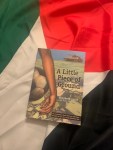
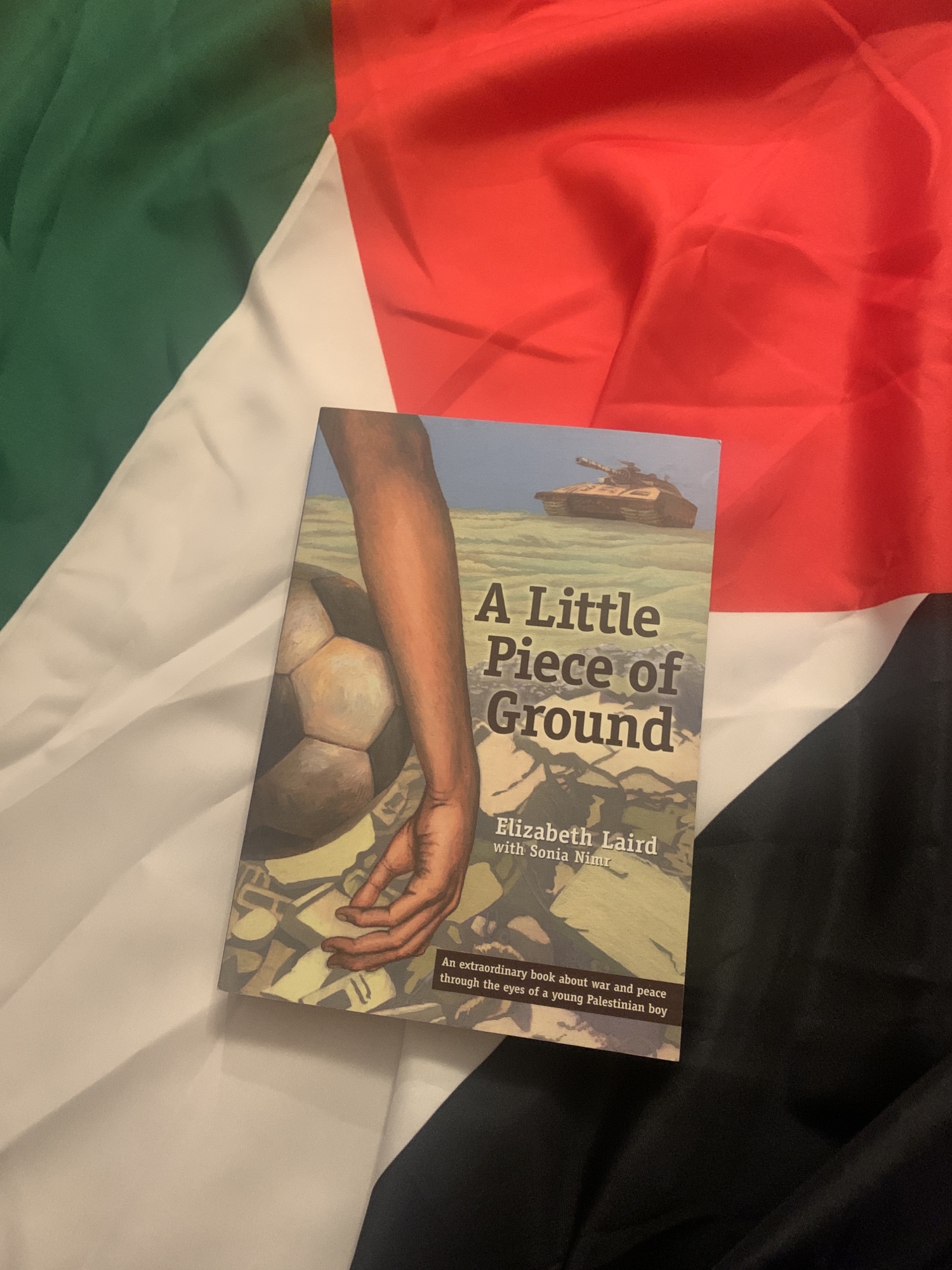
A Little Piece of Ground By Elizabeth Laird with Sonia Nimr

Standard
A Little Piece of Ground By Elizabeth Laird with Sonia Nimr

img_2165-1There are so few Palestinian middle grade books, so on that premise alone this 216 page book has a lot of value.  Because I am not Palestinian, I do not live, nor have I ever lived under occupation, I can argue some of the concerns from a point of privilege, and I acknowledge that is not my right.  I have been asked numerous times about this book and how it frames the suicide bombing mentioned in the text and blurbed about on the back of the book. It honestly is not a large part of the story, that being said, in my outside privileged view, I do not know that a 10 year old in the west will have context to understand the act of this level of desperation from the oppression and humiliation mentioned in the book. This is why I have held off my review.  The truth does not need to be defended or explained, and I fear my reservations will be taken as such, which is not my intention.  Would I let me 8 year old read this, yes, but we will read it together and discuss.  My children are aware of what is going on in Palestine, but Karim, the 12-year-old protagonist supports the bomber, and that notion is not clearly pushed back on. With discussion, absolutely, I think readers, will truly get Karim’s perspective that something has to be done to change the status quo.  The fear when Karim is alone and the target of soldiers, the settlers forcibly seizing the family land, the humiliation of strip searching men at checkpoints, the curfews, and constant fear of attack and imprisonment are all presented through the main character’s eyes, and would also do better with some discussion, so that empathy and duas and action can result.  But, the commentary as to the suicide bombing are minimal, there is even a prank package bombing that is presented as rebellion by a side character, and I would worry how a young child, without guidance, would internalize it.   Additionally, this is yet another difficult book for me to review, primarily because it was first published in 2003, and because I don’t know how much comes from a western gaze and how much the Palestinian voice played into it. Islam is clear on the prohibition of suicide.  In the early 2000 the news out of Israel was often about such attacks, but as an outsider, I honestly do not know if it was simply Israeli propaganda and stereotypes amplifying the idea as part of their public relations strategy or reality, seeing as now that Palestinians have direct outlets to share their daily life under an oppressive occupation, there is rarely talk of suicide bombing attacks. The author states on her website:

“I first visited Israel in 1968, and enjoyed a warm welcome from many Israeli friends. Later, I lived in Beirut with my husband and son during the civil war there, and became aware for the first time of the tragedy of the Palestinian refugees. I visited both Gaza and Ramallah, in the occupied territories, in 2002, while leading workshops for Palestinian writers. I was appalled by the circumstances in which people were living, and became aware that we in the West know very little of what life is like for Palestinians living under military occupation.

I have written A Little Piece of Ground in collaboration with Sonia Nimr, a Palestinian archaeologist, storyteller, writer and translator, who lives in Ramallah. We have tried to make our story as true to life as we can.”

The book is a hard read at times, but the joy is there.  Just as we as adults scroll through the devastation, the humanity persists.  The world may try and forget that they are attempting to erase a rich culture, but even in this book, their is laughter, and crushes, and sibling squabbles, and soccer games and friendship, and food, and joy.  There is a little Islam, not much, the main character is Muslim, a best friend is Christian.  It isn’t present in their everyday thoughts and actions, more just in identifying their faith.

SYNOPSIS:

Karim and his friends are not so much different than 12-year-olds everywhere, he loves video games, playing sports, isn’t so sure what he wants to be in the future, wonders what he will look like as he grows up, and is often annoyed with his family who he loves dearly.  Karim’s life in Ramallah is also unique, he lives under curfew, he doesn’t have freedom of movement, opportunity, or equal rights, and a simple family outing can be life altering.

The book follows Karim and his group of friend as they discover a patch of land they decide to turn into a soccer field, to claim as their own.  They work on it on days they can sneak away after school, in windows of time between curfews, and before long start to take pride in what the land can be. Adopting cats, learning about new friends from the refugee camp next store, teasing siblings about their crushes is all in contrast to Karim watching his father be stripped searched at a check point, being chased off their family land when they are harvesting olives by settlers shooting at them, and pranking soldiers in desperation of fighting back against oppression.

When soldiers roll in and occupy the land the boys have claimed, symbolic of their whole country, Karim gets stuck barricaded in an old abandoned car for days, with soldiers aiming their sights on him, and wondering if he will survive.

FLAGS:

Suicide, systemic abuse, oppression, humiliation, dehumanization, killing, beating, apartheid, genocide, violence, stripping, lying, crushes, occupation, shootings, injuries.

TOOLS FOR LEADING THE DISCUSSION:

This book does not need tools to be discussed.  It itself is a tool, to help middle grade kids be aware that this cruelty has been occurring for 75 years, this book took place 20 years ago, and today we just have social media sharing these stories more widely.  InshaAllah soon, Palestine will be free.

You can purchase this book here at Crescent Moon Store where code ISL at checkout saves you 10%

We are Palestinian: A Celebration of Culture and Tradition by Reem Kassis illustrated by Noha Eilouti

Standard

img_1887-1

The book is non fiction, the author not Muslim, but here I am reviewing this book because, we are all Palestinian and my heart enjoyed reading this 112 page book that covers Geography, Cultural Symbols, Creative Minds, Agriculture, Cuisine, Performing Arts, and History and Religion for middle graders and up.  The book is a celebration rooted in information and expressed with beautiful illustrations, fun facts and text blurbs to break up the text.  I do wish it was sourced, and I desperately wanted a map, particularly in the section on geography- it seems odd in fact that it doesn’t have one.  The book contains information about the nakba, but doesn’t let it control the narrative or overshadow the culture that thrives in Palestine and in all Palestinians. Undoubtedly, this is an important book to spend time with and share, especially as the global media is currently working overtime in attempts to erase the richness, joy, and even basic humanity of an entire population.

img_1888-1

The section on Geography covers Jerusalem, Gaza, Jericho, Akka, Haifa, Yaffa, Nazareth, Hebron, Nablus, Bethlehem, and Ramallah.  Some cities are combined and are featured on a full two-page spread after an introductory page for the section.

img_1889-1

Cultural Symbols covers the national anthem and flag, Handala, tatreez, thobes and gold hat, hatta and egal.  I enjoyed learning more about cultural items that have become increasingly familiar, but whose origins, importance, and displays were new.

img_1891-1

The Creative Minds section focuses on people both currently still living and deceased.  I always struggle with books that highlight important people because how they are chosen is always such a mystery, and this book at least acknowledges that this is just a tip of the iceberg cross-section of people influential, talented, and noteworthy.

The Agriculture and Cuisine sections are a celebration of food and resources that most of us who have been privileged to have Palestinian friends sharing their lunch and dinner with will find particularly enjoyable.

img_1892-1

Performing Arts was informative and new to me, and I think further shows the depth and richness of the culture.  It highlights specific people, dances, cinema, and instruments in this section.

The final section of History and Religion starts with ancient history, followed by the Nakba, al Naksa, and then a two page spread on Islam and a two page spread on Christianity.

img_1893-1

Notably not mentioned in the entire book is Israel, and in the religion section there are no other faiths shared except Christianity and Islam.  The author seems to be making a point, by what is included, and what is focused on, and keeping the light shined on Palestine. There is an index, but no sources.

Safiyyah’s War by Hiba Noor Khan

Standard
Safiyyah’s War by Hiba Noor Khan

safiyyah

A.M.A.Z.I.N.G! SubhanAllah the subject matter is incredible, but the characters, writing, and Islamic inclusion really make this 327 page book a must read for all upper middle grade and lower middle school aged children everywhere. The book is historical fiction, set in Paris during WWII, the Nazis are invading and the Muslims at the Grand Mosque of Paris are covertly helping, hiding, and saving their Jewish neighbors.  Based on real facts, the book does not get lost in politics, or propaganda, or the enemy, the story stays on level for an MG reader with character arcs that are not confined to the atrocities at hand. The familial love, the friendships, the bravery of so many, really lingers long after the last page is read. Knowing that Muslims in France did this and that their stories have by-and-large been lost over time, makes this book all the more important to share with our own children.  This book fills such a void for children in Western countries wondering why WWII lessons in school never mention Muslims, and that this is traditionally published in the UK, soon to be in the USA, really is a benefit to us all.  I do wish the book was more strongly sourced, there are Historical Notes at the end, but I’d love to know where to go to get more facts about it all.  Little kid me would have been obsessed, adult me can’t wait to share this book with teachers and book clubs to discuss, teach, enjoy, and be inspired by, alhumdulillah.

SYNOPSIS:

Safiyyah lives in the apartments in the compound of the Grand Mosque and while Muslims are more-or-less safe from the imminent threat of the Nazi’s, because of their connections to North Africa, their world is still changing quickly. Safiyyah loves maps, helping run errands for her father, Ammo Kader, and Ammo Imam, and spending time with her Setti.  She also loves spending time with her best friend, Isabelle at school and on weekends.  When the Nazi presence is no longer avoidable, Isabelle and her family leave, errands are no longer safe and Setti’s beloved oranges are harder and harder to get. To top it all off, her father starts acting secretive and Safiyyah starts sneaking around to find out what is going on, unraveling a clandestine network helping those needing to get away.  Her family has no intention of involving her, but when soldiers start getting suspicious of the Muslims assisting the Jews, Safiyyah takes on dangerous roles that just maybe a young girl can accomplish without drawing too much attention to herself, the cause, and the Muslim community’s commitment to helping the innocent.

WHY I LIKE IT:

I love that the book is fast paced and the fear of being caught is always present, yet the book is able to flesh out relationships, character growth, and religious understanding.  Little details weave in and out, and the confidence that the writer is in control of all the threads allows the reader to be swept away, completely. The interfaith aspects are not just check marks, the story shows the ease in which the communities work together and their connections are tangible.  There is no internalized Islamophobia or othering, and the way that Islam emboldens the characters’ actions is so beautiful: from the larger commitment for justice, to the personal internal reflections of wearing of hijab, praying, listening to the athan, making duas for the deceased, etc..  Spending time to ruminate on the idea that breaking an unjust law to save lives through an Islamic lens is empowering, and knowing that this is the risk that real Muslims in Paris took is so very humbling. I love that the conflict of France and Algeria is not left out as the Kabyle protagonist and her grandmother note that they are now supporting those wearing French uniforms to fight the Germans.

FLAGS:

Wish making, lying, death, fear, occupation, war, destruction, oath taking on a Quran, tasbeehs, working with wine barrels and smugglers.  There is a strong familiarity with Christian and Jewish holidays, some crossover celebration.  Some Christian angel imagery being used by Safiyyah for Ammo. Sneaking, hiding, forgery, skipping school.

TOOLS FOR LEADING THE DISCUSSION:

Having only ever read one other book on this topic, The Grand Mosque of Paris, that would definitely be a reference I would present when introducing the book.  Whether in a classroom, a library, a home, a book club, I hope this book gets read, passed around, shared, and discussed.  Muslims and non Muslims alike will fall in love with persistent over-eager Safiyyah and hopefully remember the resistance the characters in the book and real life sought with courage and dedication for the good of humanity.

I own my UK copy and have preordered US copies for myself, my mom, my teacher friends and hope you will do the same (you can preorder here).  Please also request your local public libraries to shelve this important book.

Saving Sunshine by Saadia Faruqi illustrated by Shazleen Khan

Standard
Saving Sunshine by Saadia Faruqi illustrated by Shazleen Khan

img_9623

The themes, messaging and Islamic and cultural representation in this upper MG/lower middle school graphic novel are wonderfully unapologetically present.  Yet somehow, I never connected with the characters, and the plotting seemed stiff.  I don’t regret reading the book, and I’m sure most readers will be delighted with the main story of sibling annoyance, a sick turtle, and independent kids with reflective flashbacks and OWN voice threads of Islamophobia, immigration, starting to wear hijab, identity and othering.  I just felt the tropes were predictable, stereotypical even, and when the dad takes a stethoscope to a medical conference and the TSA agent doesn’t know what it is, I cringed.  Seriously, who takes a stethoscope on vacation? Who doesn’t know what one is? I normally love the author’s characters and wish for more Islam, this book gave me the Islam, but I really disliked the siblings, they were mean, angry, and annoying.  I own that reading a book about bickering kids a few days before my own five children returned to school may have jaded me, and I do think I found the religious touchstones predictable because I do read a lot of kid lit and I’m older, so while I’m not gushing in my praise for this book, I will be preordering a copy for myself and the school library. How is that for having an opinion and then completely walking it back? Yeah, it happens.

SYNOPSIS:

Twins Zara and Zeeshan bicker, a lot.  Zara loves animals and nature, Zeeshan space exploration, and both love their phones.  When the family heads to a medical conference in Key West where their mom is getting an award, the kids get their phones taken away by their parents when the two won’t stop fighting. The parents stick to their policy and the two are forced to stick together and entertain themselves while their parents attend lectures.  At one point they find a turtle and Zara takes the lead to try and help Sunshine, but will need her brother along the way.

WHY I LIKE IT:
I love that the characters identifying as Muslim was central and unapologetic.  I liked the flashbacks that provided a little bit of depth to the parents coming to America and their life in Pakistan, along with the personal reflections about starting to wearing hijab and when the kids started to go their own way.  But the airport scene, the identity issues, and the Islamophobia seemed a little superficial and over done.  The heart to hearts with the dad and his son and mom and Zara were sweet and insightful about belonging and where you come from, and not being so angry, but they also seemed very natural and in-character for the parents which is a disconnect from the anger the kids seem to carry.  If the parents are talking to them and modeling all this, it is a bit of a stretch that they are reacting as they are in the book.

I have a brother, it is just the two of us, we aren’t twins, but growing up in the 80s as the only Muslims in the area with a convert mom and immigrant dad, we came together a lot because only each other could understand the stresses we faced in and outside our home.  I thought this book would draw on that universal theme, and I was surprised that the point of the book felt a little underdeveloped.  I know MG can handle more than we give them credit for, but I felt like this book built up to have more of a warm hug, than I felt.  I wanted more of them plotting together, I didn’t feel like Zara really needed her brother to stick up for her, she wanted it sure, but that was a foot in the door that I think was missed.  She is strong, yet was being vulnerable with her brother, and he was able to step up for her, but it needed a few more beats to be appreciated.  I also wanted more connection to the turtle, his name is in the title, I thought he’d have a bigger role.

FLAGS:

Disrespect, lying, anger, yelling, bullying, teasing, Islamophobia, stereotypes, prejudice

TOOLS FOR LEADING THE DISCUSSION:

The book would allow for discussion for middle grade readers who might see themselves in the family dynamic or be able to relate to some of the Islamophobia.  It could also cause some worry for some children that being visibly Muslim or having cultural names, and wearing cultural clothes will bring negative differential treatment to them.

Available for order here