Category Archives: Kg-2nd

The Jiu-Jitsu Ponytail by Mir Khalid Ali illustrated by Taahira Halim

Standard
The Jiu-Jitsu Ponytail by Mir Khalid Ali illustrated by Taahira Halim

IMG_2909

A determined girl battles her ponytail, her own self-doubt and her opponents on the jiu-jitsu mat in 38 beautifully illustrated pictures and clear every day language.  Perfect for little girls and their dads ages five and up.
IMG_2910

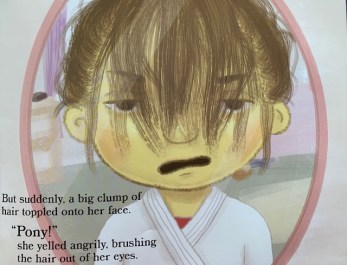
Noor has been counting down the days until her first jiu-jitsu tournament, but the morning of the tournament a battle first takes place between her and her unruly hair.  Determined to tame it on her own, even when her father offers her help, she steps on to the mat for her first fight.
IMG_2911

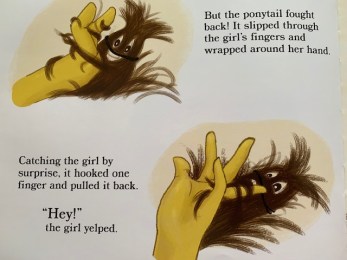
Squirming with nerves, her ponytail breaks free from the desperate tape used to keep it contained and covers Noor’s eyes forcing her to tap out and concede the match.

IMG_2912

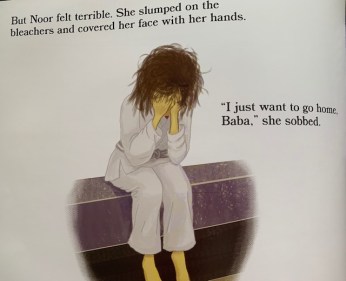
Walking off the mat, Noor’s Baba hugs her and compliments her on her bravery.  Noor is having none of it and just wants to go home.  Rather than argue with her, Baba goes to talk to her coach giving Noor some space to battle her self-doubt on her own.

IMG_2913

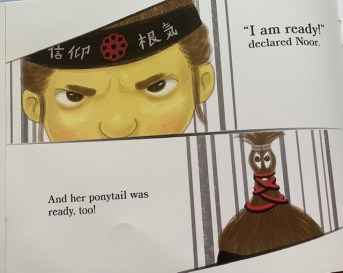
Deciding she has worked hard and trained hard, and been supported every step of her way she asks her baba to help her tie up her hair.  Together her and her jiu-jitsu ponytail take on the remaining opponents and persevere.  
IMG_2914

The book shows great heart in the supporting cast each of us have around us, in this case the father takes his cues from his daughter, never wavering in his support, but not forcing her to do anything either.  The little girl is determined, but also learns that it is ok to ask for help and above all to not give up on yourself.

IMG_2915

The personification of the ponytail adds a layer of humor to the story that works well for little kids that might just take the story on face value.  Even they will learn something about jiu-jitsu with the visual displays of the different moves and of martial arts tournaments in general.  Two of my children thought the ponytail hilarious, and two slightly creepy.  The subtlety of its personification allows its role of being a separate entity and just feeling like it has a mind of its own to be determined by the reader.
IMG_2916

There is nothing Islamic in the book, but the author and illustrator are Muslim, and the use of the little girls name, Noor Kareem, and her calling her father Baba will have a special appeal to Muslim children (plus her name written in Arabic on her bedroom wall), just as children who do jiu-jitsu will find themselves in the pages.  The book appeals to all children and reminds them they can overcome and inshaAllah be supported in the process.

IMG_2917

The illustrations in this 8 x 10 horizontal hardback book are beautiful and detailed.  They allow the reader to understand what is going on without the book being overly burdened with text.  The font is clear and well sized making the book ideal for both bedtime and story time, alhumdulillah.

IMG_2918

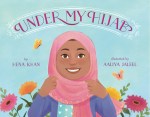
Under My Hijab by Hena Khan illustrated by Aaliya Jaleel

Standard
Under My Hijab by Hena Khan illustrated by Aaliya Jaleel

UNDER MY HIJAB final front cover JPEG.JPG

I know, (sigh) another hijab book, but I promise it is good and you won’t be sad you bought…”another hijab book,” and  alhumdulillah, it’s a Hena Khan book, so public libraries will have it or at least they should be willing to order it if requested.  

IMG_2878

Written in rhyming four line stanzas the story is told from a young girl’s perspective about the women in her life.  The first two page spread shows the strong female as she interacts in the world and covers her self, with the following two page spread, showing her in her home, uncovered.

IMG_2879

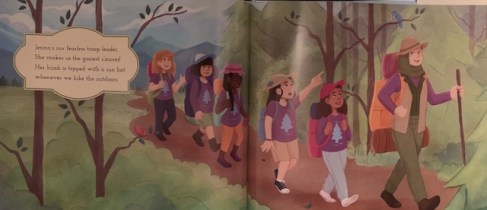
From Grandma, to Mama, to Auntie, to troop leader, to siblings and friends, the reader sees hijabs wrapped in styles as different as the person wearing them.  They also see Muslim women as doctors, artists, Tae Kwon Do students, bakers, leaders, and everything in between.

IMG_2880

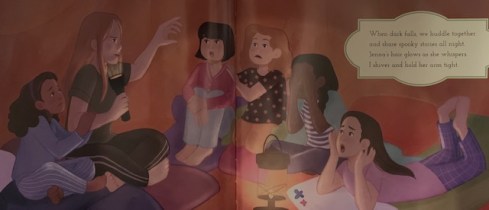
The illustrations are beautiful and perfect.  They radiant warmth and familiarity, while adding details to make the pages hold your attention a few minutes longer and smile with the diversity presented. The martial art scene is spot on!

IMG_2876

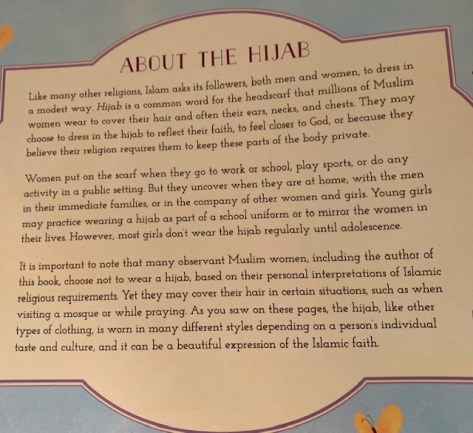
I wish they showed a niqabi, and maybe someone that doesn’t cover all the time, but at certain times of prayer or entering a mosque, like the author, who talks about herself and hijab in general in the afterward entitled: About the Hijab.  

IMG_2882

I love that the book is for children and I desperately hope adults will read it too.  It breaks down so many stereotypes, and answers so many questions in a seemingly effortless presentation.  How many times have all hijabis been asked if we sleep in our scarves or shower in them.  I love that there are shades of brown skin tones, and blond haired hijabi’s too.  

IMG_2877

And most importantly I love that it shows Muslim women to be strong and varied and to have full, independent beautiful colorful lives.  That hijab is a choice and it is strength and beauty and personal.

IMG_2881

The book does not talk about the reasons for wearing hijab, or get into the religion.  The book is a great size for story time and bedtime at 10 x 8 horizontal, hardbound, and 32 pages.  Ages four and up will enjoy this book repeatedly,  and older kids, especially girls considering covering or just starting to cover will enjoy it as well.

Alhumdulillah! Well done!

Forgive the glare in the pictures, they aren’t in the book 🙂

We’re off to make ‘Umrah by Sana Munshey illustrated by Eman Salem

Standard
We’re off to make ‘Umrah by Sana Munshey illustrated by Eman Salem

img_2719

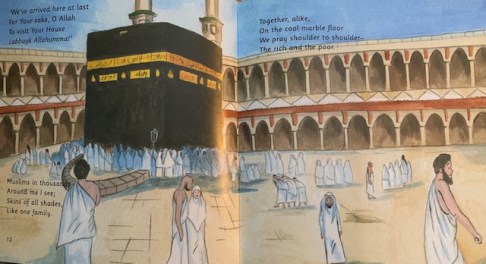
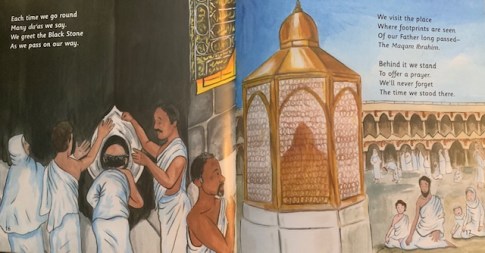
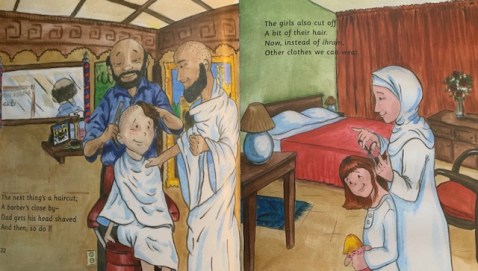
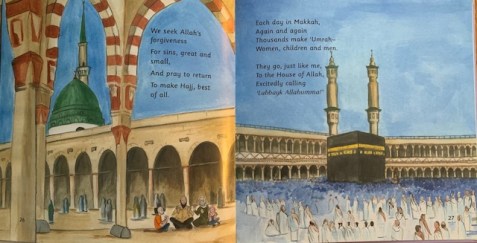
Its surprising how few books about Umrah there are for children.  As a religious act that many children are included in, there really should be more, but alhumdulillah this fun one exists, and conveys the steps of Umrah in rhyming fashion for ages 4 and up.

Told from a little boy’s perspective about his family’s journey, a little history is given, before the major parts of Umrah are explored.  The book prefaces the story with a note to parents and teachers making sure they know the book is a semi-fictional narrative meant to reinforce learning, it isn’t a comprehensive guide. 

img_2720

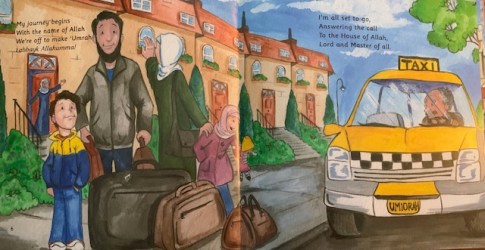
Full page pictures with four line stanza groups detail the steps about the journey and flight to Mecca, including defining and using the arabic words for the talbiyah, putting on ihram, crossing meeqat and praying rak’atayn.  The step-by-step approach is warm and exciting, as the pictures show smiling faces and the words balance information and enthusiasm of being in Mecca for the first time.

img_2721

Details about praying, rich and poor, side by side are included, making tawaf, seeing the black stone, seeing Maqam Ibrahim, drinking Zamzam water, a bit of history about Sa’i, and the little boy feeling tired going back and forth between Safa and Marwa are all given in a well paced narrative that is neither rushed, nor overly forced (just a little to keep the rhyme scheme :)).  The steps of Umrah conclude with the family members getting hair cuts and then a quick trip to Madinah.

img_2722

There is a glossary at the end of the 32 page book, that is nice for older kids, or as a way to reinforce words used to describe the journey.  I think the strength of the book is really that it shows what to expect during Umrah.  Children about to go will benefit from the mapping of the events and getting a heads up on what awaits them.  Children that have gone will have a handy way to remember what they did.  Children learning about Hajj perhaps, will be able to see how Umrah is shorter and be able to see what the similarities and differences are in a simple manner.  Even children who have no connection yet to Umrah will benefit from the vocabulary and excitement shared in the story.  While the story is aimed at younger kids, even middle elementary age kids will enjoy reading it once or twice.

img_2723

The book claims to come with a poster and paper dolls to reinact the steps of Umrah, but I purchased my book second hand and they weren’t present.  Hence, I didn’t comment on their quality, but it sounds like a wonderful supplement to the book.

img_2724


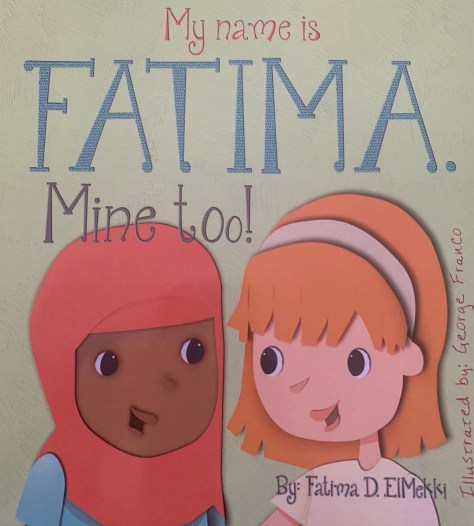
My Name is Fatima. Mine Too! by Fatima D. ElMekki illustrated by George Franco

Standard
My Name is Fatima. Mine Too! by Fatima D. ElMekki illustrated by George Franco

IMG_1926

This book is interfaith, and learning your own roots, and asking questions about your heritage and faith all rolled in to a cute little package for children.  But despite it’s length, 28 pages, and cute little girls on the cover, the book is for more first grade/second grade and older children, rather than toddlers. 

IMG_1927

The message that we are more alike than different is a great message, even for the littlest of readers, but this book goes a little deeper, and the didactic approach will bore them a bit.  Older kids for sure 2nd and up will benefit from the exchanges between Fatima and Fatima and learning both valuable religious lessons about their namesakes as well as respect and friendship for those with different beliefs.

IMG_1928

Fatima is from the Democratic Republic of Congo and on her first day of school in a America she tries to remember her father’s advice, that meeting new people can be a challenge, but also an opportunity.  

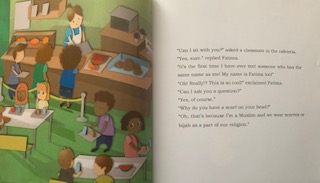
At lunch a little girl asks to sit with her, excited to meet someone with her same name.  Fatima asks her why she wears a scarf, and listens to her explain it is because she is Muslim and the hijab is part of her religion.  

IMG_1929

At recess, Muslim Fatima tells non Muslim Fatima that she is named after Prophet Muhammad (saw)’s daughter and asks her who she is named after and if asks she is Muslim, too.  The other Fatima says that she is Catholic and that she doesn’t know why her parents named her Fatima, but that she will find out and let her know.

IMG_1930

That night Catholic Fatima learns that her mom had gone to Fatima, a city in Portugal, a famous city for all the miracles that have happened there and the apparition of Mary, the Mother of Jesus.  Fatima’s mom had gone there to pray for a baby and promised if she got pregnant that she would name the baby Fatima.

IMG_1931

The next day Catholic Fatima tells Muslim Fatima and also asks her if she has heard of Mary, the mother of Jesus.  Muslim Fatima says she has heard of her, but doesn’t know much and that she will ask her parents and let her know.

Muslim Fatima learns that Mary is one of the four virtuous women in Islam and that there is a chapter in the Quran named after her.  When she tells Catholic Fatima the next day at school, the girls marvel at how much they have in common.  They are BFFs despite their differences and beautiful ones at that.

IMG_1932

I love that the book is framed in opposites to show similarities.  I also love that it shows women in our respective faiths with similar values, similar names, and Mary’s role in both our traditions.  So often, when we are building bridges we discuss how Yusuf is Joseph and Musa is Moses, Yahya is John and we go through the old Prophets, this was a nice change in perspective.

IMG_1935

The illustrations are nothing to get excited by, but they do show smiling warm characters and family members.  They serve as a distraction from the text heavy pages that do nothing to grasp the reader with their plan font and majority white backgrounds.

IMG_1933

This book would work for Muslim children, Catholic children, really all children.  It talks about faith, but as the characters view it, not in a one is better or more right than another.  There is a second book in the series about Fatima inviting Fatima to an Iftar party  that I look forward to checking out soon.  I hope it is a little more rich in dialogue and character building instead of just a foil to disseminate the information between the two faiths, but even if it isn’t I still think the book has value and you should check it out.

IMG_1934


Layla’s Head Scarf by Miriam Cohen illustrated by Ronald Himler

Standard
Layla’s Head Scarf by Miriam Cohen illustrated by Ronald Himler

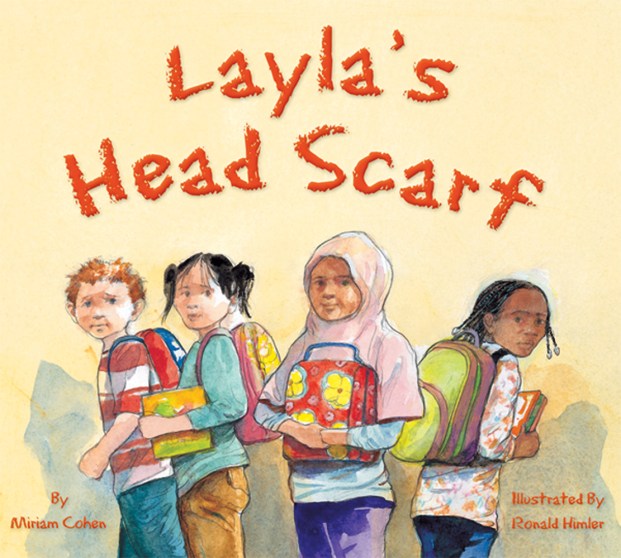
cover layla

It isn’t often that I feel compelled to list all the things I like about a book and all the things I don’t like about a book and count them up to see what I think about a book.  Especially when the book is only 32 pages and an AR 3.2, but this book has me on the fence.

layla2-e1543798774981.jpg

It is Layla’s first day of school and presumably she is shy.  That’s what the other kids say at least.  The story follows her and the class throughout a typical first grade day, there is no climax or problem, there is just her and her classmates moving from circle time, to the library, to lunch, to recess, to art, and then her joining in at circle time the next day.  

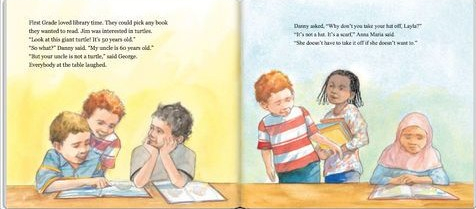
Along the way the kids comment on her scarf, the librarian brings her a book about her country with pictures of sun and sand and veiled women.  The lunch lady looks at her rice and pea pie and says it looks yummy, the kids tell her to take off her hat to play easier, other characters stick up for her and try to correct other classmates that it isn’t a hat, it is a scarf. 

layla

During art time, she paints her family and the women all wear hijabs, a few kids say they look funny, a few others stick up for her, she ends up crying, but the kids come together to make her feel better and to articulate that in America people can wear what they want.  Some kids talk about family members wearing yarmulkas and others about braiding their hair, but there is no reason given for why Layla wears a hijab.

I don’t think any of the kids are intentionally mean or malicious, they are curious and not given any answers by Layla or any of the adults.  As a result when the book is over, the reader similarly has no answers.  Despite that though, I think readers will get the power of kindness and with some (a lot of) discussion, understand how we can help people feel comfortable and celebrate differences.

layal

Here is my pro and con list about the book:

PROS:

Book about hijab is included in a mainstream series meant for 1st graders (We Love First Grade!) 

Kindness comes through.

Kids stick up for each other.

Librarian found a book about Layla’s country and read it to the kids.

Kids include Layla while playing.

Illustrations are soft and realistic.

Diversity in the classroom.

CONS:

The book is about hijab, but nothing is learned about hijab.

Lots of stereotypes: girl doesn’t speak englishF from the desert, different food. 

Focus is on differences not similarities.

1st graders aren’t required to wear hijab.

Islam isn’t mentioned, but the Jewish kid mentions his faith.

Don’t learn what her lunch is called or what country she is from.

If she doesn’t speak English how did she label everyone in her picture?

Clearly she understands English, she is just shy, so why does she mess up the song at the end?

layal1

Luckily the book was in the public library, so I don’t feel like I bought something that I am unhappy with.  I don’t know that I would recommend it to anyone, but it is always nice to see a muhajaba in a story, and there isn’t anything “wrong” with the book, it just lacks a lot of detail unfortunately.

The Blessed Bananas: A Muslim Fable by Tayyaba Syed illustrated by Melani Putri

Standard
The Blessed Bananas: A Muslim Fable by Tayyaba Syed illustrated by Melani Putri

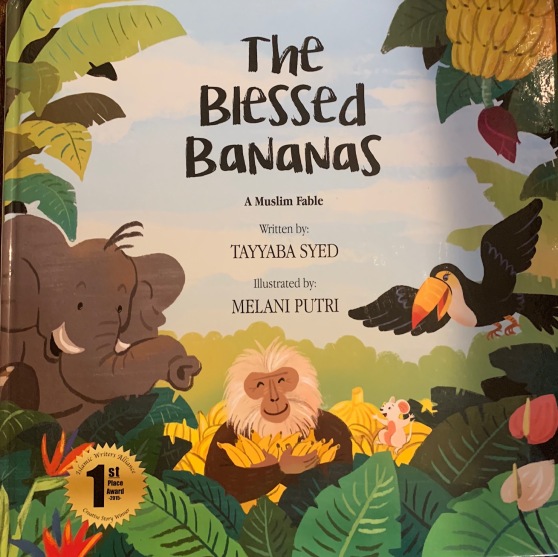
IMG_1798.jpg

 A fable with lessons of kindness centered around the Salawat, definitely is a great premise and for the most part I really enjoyed the book. 

IMG_1799

The 8.5 by 8.5 hardcover, 50 page book feels great in your hands and the illustrations are sweet and expressive.  The book is long, and is text heavy so I’d say the target audience is maybe 6 to 10 years old.   The font is incredibly small and irritating.   It should have been larger and more inviting to children in my opinion.  It doesn’t match the size, binding, and illustrations, and actually becomes a distraction if trying to read it in a group setting.  

IMG_1801

The story itself is smooth and intentional.  Rico, a blessed, yet ungrateful monkey, lives atop an ever abundant banana tree.  However, he attributes his blessings to his own hands and does not thank Allah swt.  He is mean and greedy toward people and animals alike.  Yet, something is missing in his life and he doesn’t know what. 

IMG_1800

When a little mouse, Chico, comes to him to ask for a banana and gets scolded at instead.  Chico makes dua for Rico asking Allah to guide the monkey to goodness.

IMG_1802

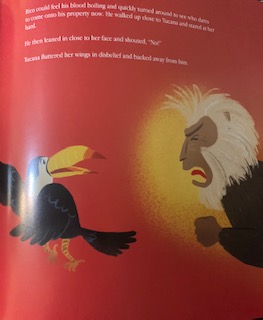
Tucana, a toucan, then stops in Rico’s banana tree after a long flight to be rebuffed by a foul tempered monkey who wants to be left alone.  When Tucana  leaves she forgives Rico for his rudeness and asks Allah to be merciful to him as well.

IMG_1803

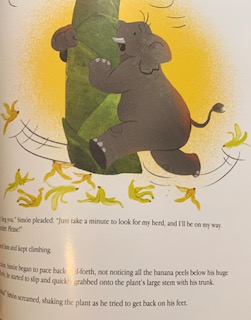
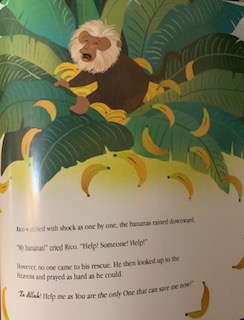
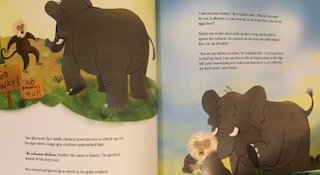
Rico then makes signs to keep people and animals away.  Which works for a while, but along comes Simon, an elephant, one afternoon to ask the monkey to climb his tree and help direct him back to his herd.  Rico of course refuses, and Simon reminds him that they are brothers in Islam and to please help. He begins shouting at the elephant to leave, and as Simon is pacing back and forth, he slips on the banana peels, grabs the tree to support himself and shakes the tree back and forth in the process.

IMG_1806

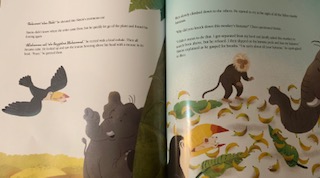
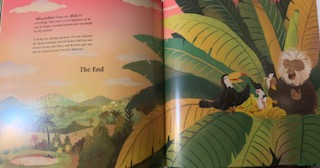
Rico begins hollering for help and sure enough the animals he had turned away previously, return to help him.  They had forgiven him as they hope Allah will forgive us all.  To calm the monkey, chico shouts, “Salawaat’alan Nabi!” in Simon’s ear and when he recites “Allahuma sali’ala Sayyidina Muhammad,” peace and calmness is restored.

IMG_1811 (1)

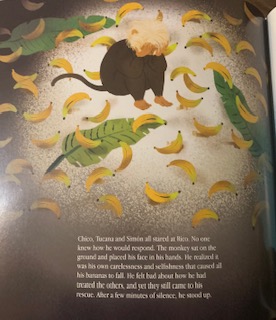
With all the bananas on the floor, many mushy and trampled, Rico has to decide if he learned a lesson, and how he will put his new knowledge into action, or if he will resume his life of ungratefulness.

IMG_1807

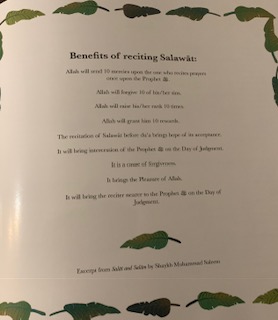
The book ends with each animals favorite banana recipe, information about the author and illustrator and benefits of reciting Salawat and an ayat from the Quran.

IMG_1810

The story and how it weaves Islam into the lessons is beautifully done, my only hiccup is the constant refrain of Rico counting his bananas.  I realize it is a fable, and maybe with talking animals interacting with humans, reality is notably suspended.  But, it seems misplaced to me.  How do you constantly count a perishable item? Does Rico only eat a certain amount a day? How many new ones grow a day? What is the number that he is adamant to have at all times? So, many questions, that I didn’t get why he was counting them, why he was irritated when he lost count, and why this detail was in the story and a big part of the story none-the-less.  Like the font, its a minor detail, but a distracting one for me unfortunately.  Clearly, however, I’m in the minority as the book has won the Moonbeam Children’s Book Award and the Islamic Writer’s Alliance Creative Story, so give it a read, and let me know your thoughts, jazakhAllah kher.

IMG_1809


A Race to Prayer: Sulaiman’s Rewarding Day by Aliya Vaughan

Standard
A Race to Prayer: Sulaiman’s Rewarding Day by Aliya Vaughan

a race to prayer

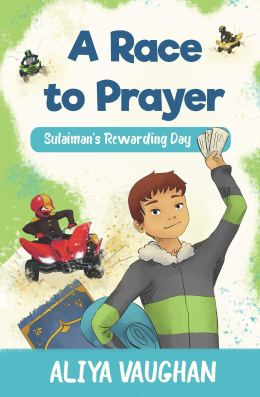
This 56 page (only 38 pages of story) early chapter book is a simple book with a lesson.  For kindergarten to 2nd grade readers the book could be a short story, but the added minuscule details (how he got in the car, slid over, and buckled up) and the illustrations, flesh the book out in to seven chapters with a note for parents/educators at the beginning, and sections of: evidence from the Quran and Sunnah, comprehension questions, inspiration behind the story, glossary and information on the author at the end.  The book isn’t bad, just kind of dry and bare bones.  Satisfactory for young readers that enjoy quad races, and ideal for those that whine whenever it is salat time.

SYNOPSIS:

Sulaiman loves watching quad races and playing football (soccer, the book is British), but feels like, “Every time I want to do something exciting, it either rains or it is time to pray.” one afternoon when he is feeling particularly grumpy, his dad offers to take him to watch the quad races at a nearby stadium.  Grandpa joins them and grandma sends them off with lunches and duas.  First the car won’t start, then they take a bus and wait in line.  Once they are inside the day looks up, the races are fun and then it is Thuhr time.  Sulaiman wants to wait until a break, but it is winter and the days are short meaning Asr will be approaching fast.  They go find a place to pray and when they return their seating section is closed.  Part of the roof fell in due to the rain.  Feeling fortunate that they had left to pray, Sulaiman sees the value of praying on time in this duniya.  They later are given better seats and Sulaiman feels blessed that they had gone to pray.

The story was inspired by a real event, according to the “Inspiration Behind the Story” at the end, where the author says that her husband was at a football match in Algeria when an earthquake struck.

IMG_0029

WHY I LIKE IT:

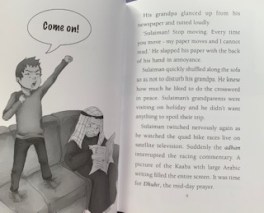
I love that the character is relate-able to most of our young Muslim children.  He is a good kid, but has a hard time stopping what he is doing to pray.  He has to be reminded to make wudu and brush his teeth.  I like that grandpa gets to come along, but I wish he would get to tell some of his stories, rather than just have Sulaiman shush him and be annoyed.  Similarly, I like that the dad is a “fixer” but some character development would have been really great.  I understand the reading age isn’t tempted by back story, but a little investment in the characters would make the climax that much more intense.  I was surprised by the roof falling in, but it snuck up so quick and was resolved equally fast, that I didn’t really feel it.

Also, I am not entirely sure what quad racing is. I mean I get that they are 4 wheelers racing on a stadium track.  But, I didn’t realize it was such a thing to be watching it on tv and then heading to watch it live nearby.  I’m glad I learned that kids dig it in Britain, but I’m thinking that it might be a little foreign .  A soccer match or another race, might have made the story a bit more appealing.

The book is for Muslims by a Muslim despite the glossary at the back. The pictures aren’t great, but they make the page breaks appeal to the younger kids.  The font, binding, and presentation makes for a nice looking and feeling book.

IMG_0030

FLAGS:

None, alhumdulillah.

TOOLS FOR LEADING THE DISCUSSION:

This book would be really great in small groups.  I can see it being used in Sunday schools or in Islamic schools, where Language Arts teachers and Islamic Studies teachers crossover to drive the importance of salat home.  I think this would easily inspire this age group to then write their own copy-cat stories of why salat is important.  The questions at the end could even make it like an extra credit novel study or a read aloud story with the questions used to verify comprehension.

Burcu: No One Wants to Play with Me! by Nursen Sirin illustrated by Nese Inan

Standard
Burcu: No One Wants to Play with Me! by Nursen Sirin illustrated by Nese Inan

IMG_2348

This 32 page, 9×12 story book, for ages five and up, focuses on character education and is meant to be a relatable story with clear lessons about how to behave and deal with situations in life.  The opening page bullets all the lessons readers should learn from the story and the end of the book offers directions to make a balloon craft.  

IMG_2354

I don’t mind books with lessons and morals so clearly delineated, and I like that the morals come from such an adorable character with a whole cast of supporters, and a number of books to her series.  

IMG_2353

My problem is more the story itself, for a lesson on how to make new friends, and dealing with the universal struggle of moving and feeling like ‘no one wants to play with me.”  The book spends nearly seven pages on Burcu making a surprise breakfast for her family before hearing the news that she is moving because the landlord says they should.

IMG_2352

They pack and move seemingly the same day, and then the point of the book gets going.  Burcu has to say goodbye to her friends and doesn’t feel like even going out at the new house to make new ones.

IMG_2351

Her brother, Alper, has no problem making new friends, and finally Burcu gives it a try.  Only a little girl attempts to get to know her and Burcu dismisses her because she is so young.  She tries to be included with the other children, but they don’t know her and aren’t willing to let her play.

IMG_2350

Burcu finally confides in her dad, that she can’t get anyone except the little girl to play with her.  Her dad encourages her to give the little girl a chance.  Burcu does and finds out they are the same age, she just looks really young, and then all the kids are friends and happy.

IMG_2349

The real hero to me is the little girl, Katherine, who didn’t give up on an ageist Burcu that didn’t want to play with her.  Seems odd that Burcu wanted a friend, and then was arrogant to complain about the one she got.  Plus, I would imagine kids who have moved and don’t have friends, would turn to a book like this for tips and hints, and ways to feel less alone.  The book offers none of that.  It doesn’t tell how finally Burcu makes friends, or gets included, other than it took time.  Which is great, but not exactly helpful if you are five and crying everyday because no one will play with you.

The writing is very dry.  I think it has been translated from Turkish, many of the sentences are passive voice, and the sentences choppy.  The book doesn’t have any glaring errors, it just seems like it would work as a story time, or as part of a lesson, and  maybe once as a bedtime story, but not a book that kids will clamor to hear over and over again.

IMG_2355

There is nothing Islamic in the story, but most of the major online Islamic bookshops carry the Burcu series, so I would imagine the authors, and publishers are Muslim.

Overall, the book sets off to teach a great lesson, but falls a bit short.  The illustrations are adorable and the large size and playful font are very well done, the diction, not so much.  The books are reasonably priced and if you see a title that works for a lesson, or theme you are discussing, I think you can make the books work.  If you are looking for a book to read over and over to your kids, you might, however, be disappointed.
 

Ordinary Mary’s Extraordinary Deed by Emily Pearson illustrated by Fumi Kosaka

Standard
Ordinary Mary’s Extraordinary Deed by Emily Pearson illustrated by Fumi Kosaka

ordinary-mary.png

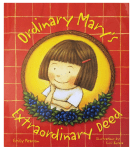
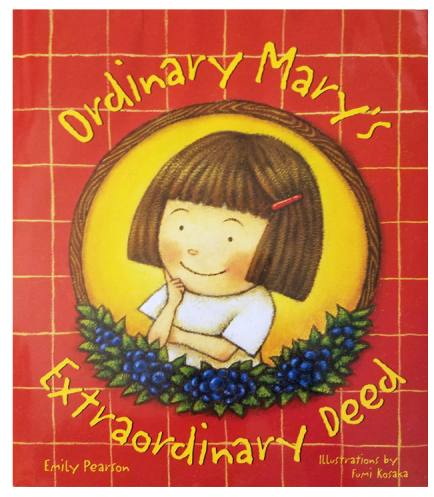
Once again I picked up a book for the message that it explored, making a difference, and found myself smiling triumphantly when a flip of a page revealed a Muslim lady depicted in an illustration, and her culturally Islamic name gracing the page. 

The book is an AR 4.2, and while there are a lot of words on each of the 32 pages, and the concept of an act multiplying might be hard for little ones to grasp, I think patient kindergarteners and first graders will grasp enough to make the story enjoyable.

IMG_2114

Ordinary Mary is so very ordinary, but she changes the world.  It all starts when she leaves berries for a neighbor.  And that neighbor, Mrs. Bishop, takes the berries and makes blueberry muffins and secretly gives them to five people.

IMG_2113

Each of those five people in turn give or do something kind to five people and over 30 billion people are impacted.  But there are not that many people on the planet, so there is love left over and extra to give.

IMG_2112

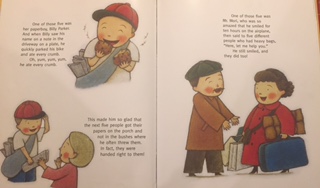
The book doesn’t follow all 30 billion obviously, but it picks and follows one person to show how the chain works before showing the mathematical growth in numbers.  Mrs.  Bishop gave a plate to the paperboy Billy Parker, who handed the next five people their newspaper personally instead of tossing it in their bushes.  One of the people that got their newspaper smiled for 10 hours on his flight, and helped people with their bags, etc etc.  

IMG_2109

The book shows that giving something can be something tangible, or a compliment, or a phone call, or a smile.  Over long distances,  the kind deed comes back to Mary and the message too, comes full circle.

IMG_2110

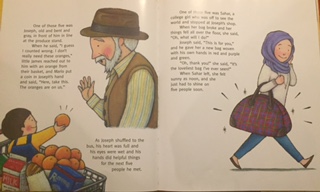
Along the line is Sahar, a college student who’s bag breaks and she benefits from a kind man who was just gifted oranges at the grocery store when he didn’t have enough money.  She in turn compliments a woman on a boat who is distraught and unsure. An important character in the link, and an import illustration of inclusion.

IMG_2111

There author mentions a variety of names, male and female, and the illustrator represents a fair amount of diversity of age, color, gender, religions, socio economic, ethnicity and mobility.  Truly, we all have the potentially to change the world.


Meet Yasmin! by Saadia Faruqi illustrated by Hatem Aly

Standard
Meet Yasmin! by Saadia Faruqi illustrated by Hatem Aly

yasmin.jpg

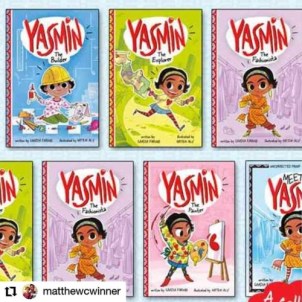
Yes! Yes! Yes! A strong and relatable 2nd grade, Pakistani-American Muslim girl, with stories written on a AR 2.4 -2.5 level, learns lessons and grows in everyday scenarios.  Seriously, this book is overdue and so well done, I can’t wait for the author, illustrator, and publisher, to team up to do more.  The book I have, Meet Yasmin! contains all four stories: Yasmin the Explorer, Yasmin the Painter, Yasmin the Builder, and Yasmin the Fashionista. You can buy each of the books separately in a larger format, and possibly a longer story.  The version I have is 5.5 x 7 and 96 pages long which includes a Think About It, Talk About It section at the back as well as a glossary of Urdu words, some facts about Pakistan and a recipe for Mango and instructions to make a bookmark craft .  The individual stories are 6 x 9 and 32 pages, and whether you buy the collection or the individual stories, they are under $6. Fabulous all the way around.

lots of yasmin

SYNOPSIS:

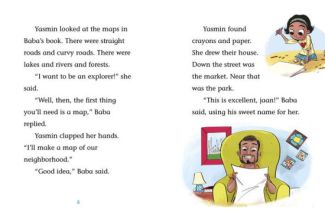
Yasmin the Explorer:  The book starts out with Yasmin’s dad telling her about explorers and maps.  Inspired, Yasmin decides to make her own map of the neighborhood, which gets really exciting when her mom asks her if she wants to join her on a shopping trip to the farmer’s market.  While they stop at different stalls and Yasmin adds to her map, the temptation of a playground draws Yasmin away from her mom, but luckily her map can guide her back.

Yasmin the Painter:  Yasmin’s school is having an art competition and Yasmin is nervous because she doesn’t consider herself a very good artist.  Her parents show her videos and gift her supplies.  Unhappy with how her attempts are turning out, she decides to find her own style and with the support of her parents she enters her painting and waits nervously to see who wins and what the mystery prize is.

Yasmin the Builder:  I think this story is my favorite because she really had to rely on herself when the class is building a city and Yasmin can’t figure out what to build.  She perseveres and works hard, and ends up connecting the dots and making the city come to life by finding a way to make her favorite part of the city, going for walks, a part of the class project.

Yasmin the Fashionista:  Mama and Baba have gone out for the evening, so Yasmin is hanging out with her grandparents.  When Nani and Yasmin play dress-up and Mama’s shirt gets ripped, Yasmin and Nani have to solve the problem!  Not only that, they get inspired to transform Yasmin’s pajamas, and when Mama and Baba come home they are treated to a fashion show!

meet-yasmin_1

WHY I LIKE IT: 

There is a lot to love about these stories.  Yasmin is not great at everything, and things don’t necessarily come easy for her.  But she is bright and surrounded by people that love her, and she is allowed and encouraged to shine in her own way.  I like that her painting wasn’t great, and that she stayed in from recess to figure out what to build.  I love that her dad is involved in her projects and ideas as much as her mom, if not more.  I love all the little nuances that accurately show a Pakistani-American family and a Muslim one; not an exaggerated version, or a dumbed down one either.  Yasmin has to wait for her mom to put on her hijab, it doesn’t explain that she isn’t wearing a hijab in the home, but it is shown.  It shows the characters in ethnic clothes and in western clothes.  It shows Yasmin’s classmate building a church, and one building a castle.  Yasmin is spunky, she makes mistakes, she works hard, and she is a breath of fresh air, that I think kids of any and all backgrounds will relate to her and enjoy the stories.

The pictures are bright and colorful and detailed. They are age appropriate and make the chapters within the stories really come to life and keep new readers engaged.  The font and binding and layout is well done.

meetyasmin1

FLAGS:

None.  

9781684360222_p1_v2_s550x406

TIPS FOR LEADING THE DISCUSSION:

I honestly think little kids could read this and discuss it and might actually enjoy having a discussion about Yasmin: what they like about her, what things they have in common, what she does that makes them laugh.  It might come across as a girl book, but really, it isn’t she is relatable for everyone. 

There is nothing Islamic mentioned, just depicted in her mother’s and grandmothers hijabs.