Category Archives: Kg-2nd

Burcu: No One Wants to Play with Me! by Nursen Sirin illustrated by Nese Inan

Standard
Burcu: No One Wants to Play with Me! by Nursen Sirin illustrated by Nese Inan

IMG_2348

This 32 page, 9×12 story book, for ages five and up, focuses on character education and is meant to be a relatable story with clear lessons about how to behave and deal with situations in life.  The opening page bullets all the lessons readers should learn from the story and the end of the book offers directions to make a balloon craft.  

IMG_2354

I don’t mind books with lessons and morals so clearly delineated, and I like that the morals come from such an adorable character with a whole cast of supporters, and a number of books to her series.  

IMG_2353

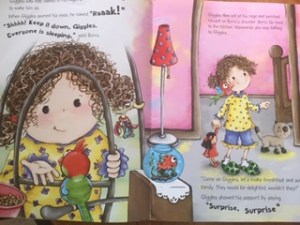
My problem is more the story itself, for a lesson on how to make new friends, and dealing with the universal struggle of moving and feeling like ‘no one wants to play with me.”  The book spends nearly seven pages on Burcu making a surprise breakfast for her family before hearing the news that she is moving because the landlord says they should.

IMG_2352

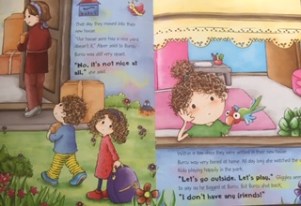
They pack and move seemingly the same day, and then the point of the book gets going.  Burcu has to say goodbye to her friends and doesn’t feel like even going out at the new house to make new ones.

IMG_2351

Her brother, Alper, has no problem making new friends, and finally Burcu gives it a try.  Only a little girl attempts to get to know her and Burcu dismisses her because she is so young.  She tries to be included with the other children, but they don’t know her and aren’t willing to let her play.

IMG_2350

Burcu finally confides in her dad, that she can’t get anyone except the little girl to play with her.  Her dad encourages her to give the little girl a chance.  Burcu does and finds out they are the same age, she just looks really young, and then all the kids are friends and happy.

IMG_2349

The real hero to me is the little girl, Katherine, who didn’t give up on an ageist Burcu that didn’t want to play with her.  Seems odd that Burcu wanted a friend, and then was arrogant to complain about the one she got.  Plus, I would imagine kids who have moved and don’t have friends, would turn to a book like this for tips and hints, and ways to feel less alone.  The book offers none of that.  It doesn’t tell how finally Burcu makes friends, or gets included, other than it took time.  Which is great, but not exactly helpful if you are five and crying everyday because no one will play with you.

The writing is very dry.  I think it has been translated from Turkish, many of the sentences are passive voice, and the sentences choppy.  The book doesn’t have any glaring errors, it just seems like it would work as a story time, or as part of a lesson, and  maybe once as a bedtime story, but not a book that kids will clamor to hear over and over again.

IMG_2355

There is nothing Islamic in the story, but most of the major online Islamic bookshops carry the Burcu series, so I would imagine the authors, and publishers are Muslim.

Overall, the book sets off to teach a great lesson, but falls a bit short.  The illustrations are adorable and the large size and playful font are very well done, the diction, not so much.  The books are reasonably priced and if you see a title that works for a lesson, or theme you are discussing, I think you can make the books work.  If you are looking for a book to read over and over to your kids, you might, however, be disappointed.


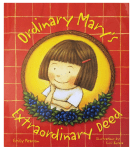
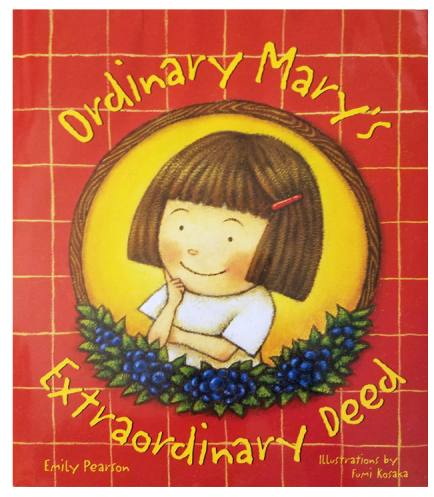
Ordinary Mary’s Extraordinary Deed by Emily Pearson illustrated by Fumi Kosaka

Standard
Ordinary Mary’s Extraordinary Deed by Emily Pearson illustrated by Fumi Kosaka

ordinary-mary.png

Once again I picked up a book for the message that it explored, making a difference, and found myself smiling triumphantly when a flip of a page revealed a Muslim lady depicted in an illustration, and her culturally Islamic name gracing the page. 

The book is an AR 4.2, and while there are a lot of words on each of the 32 pages, and the concept of an act multiplying might be hard for little ones to grasp, I think patient kindergarteners and first graders will grasp enough to make the story enjoyable.

IMG_2114

Ordinary Mary is so very ordinary, but she changes the world.  It all starts when she leaves berries for a neighbor.  And that neighbor, Mrs. Bishop, takes the berries and makes blueberry muffins and secretly gives them to five people.

IMG_2113

Each of those five people in turn give or do something kind to five people and over 30 billion people are impacted.  But there are not that many people on the planet, so there is love left over and extra to give.

IMG_2112

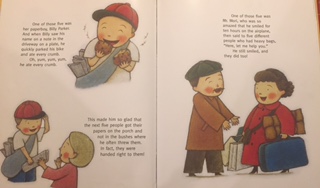
The book doesn’t follow all 30 billion obviously, but it picks and follows one person to show how the chain works before showing the mathematical growth in numbers.  Mrs.  Bishop gave a plate to the paperboy Billy Parker, who handed the next five people their newspaper personally instead of tossing it in their bushes.  One of the people that got their newspaper smiled for 10 hours on his flight, and helped people with their bags, etc etc.  

IMG_2109

The book shows that giving something can be something tangible, or a compliment, or a phone call, or a smile.  Over long distances,  the kind deed comes back to Mary and the message too, comes full circle.

IMG_2110

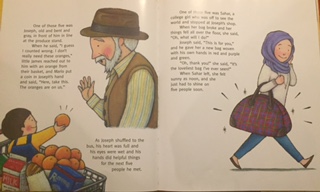
Along the line is Sahar, a college student who’s bag breaks and she benefits from a kind man who was just gifted oranges at the grocery store when he didn’t have enough money.  She in turn compliments a woman on a boat who is distraught and unsure. An important character in the link, and an import illustration of inclusion.

IMG_2111

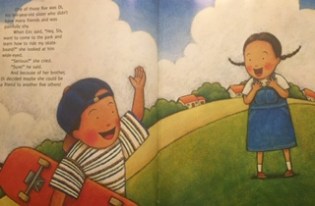
There author mentions a variety of names, male and female, and the illustrator represents a fair amount of diversity of age, color, gender, religions, socio economic, ethnicity and mobility.  Truly, we all have the potentially to change the world.


Meet Yasmin! by Saadia Faruqi illustrated by Hatem Aly

Standard
Meet Yasmin! by Saadia Faruqi illustrated by Hatem Aly

yasmin.jpg

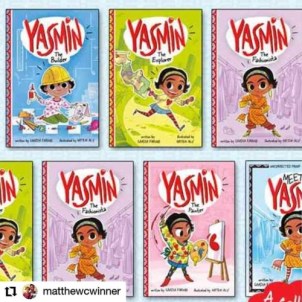
Yes! Yes! Yes! A strong and relatable 2nd grade, Pakistani-American Muslim girl, with stories written on a AR 2.4 -2.5 level, learns lessons and grows in everyday scenarios.  Seriously, this book is overdue and so well done, I can’t wait for the author, illustrator, and publisher, to team up to do more.  The book I have, Meet Yasmin! contains all four stories: Yasmin the Explorer, Yasmin the Painter, Yasmin the Builder, and Yasmin the Fashionista. You can buy each of the books separately in a larger format, and possibly a longer story.  The version I have is 5.5 x 7 and 96 pages long which includes a Think About It, Talk About It section at the back as well as a glossary of Urdu words, some facts about Pakistan and a recipe for Mango and instructions to make a bookmark craft .  The individual stories are 6 x 9 and 32 pages, and whether you buy the collection or the individual stories, they are under $6. Fabulous all the way around.

lots of yasmin

SYNOPSIS:

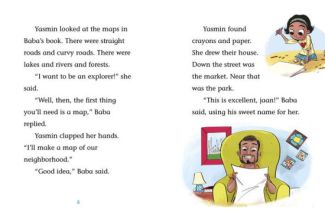
Yasmin the Explorer:  The book starts out with Yasmin’s dad telling her about explorers and maps.  Inspired, Yasmin decides to make her own map of the neighborhood, which gets really exciting when her mom asks her if she wants to join her on a shopping trip to the farmer’s market.  While they stop at different stalls and Yasmin adds to her map, the temptation of a playground draws Yasmin away from her mom, but luckily her map can guide her back.

Yasmin the Painter:  Yasmin’s school is having an art competition and Yasmin is nervous because she doesn’t consider herself a very good artist.  Her parents show her videos and gift her supplies.  Unhappy with how her attempts are turning out, she decides to find her own style and with the support of her parents she enters her painting and waits nervously to see who wins and what the mystery prize is.

Yasmin the Builder:  I think this story is my favorite because she really had to rely on herself when the class is building a city and Yasmin can’t figure out what to build.  She perseveres and works hard, and ends up connecting the dots and making the city come to life by finding a way to make her favorite part of the city, going for walks, a part of the class project.

Yasmin the Fashionista:  Mama and Baba have gone out for the evening, so Yasmin is hanging out with her grandparents.  When Nani and Yasmin play dress-up and Mama’s shirt gets ripped, Yasmin and Nani have to solve the problem!  Not only that, they get inspired to transform Yasmin’s pajamas, and when Mama and Baba come home they are treated to a fashion show!

meet-yasmin_1

WHY I LIKE IT: 

There is a lot to love about these stories.  Yasmin is not great at everything, and things don’t necessarily come easy for her.  But she is bright and surrounded by people that love her, and she is allowed and encouraged to shine in her own way.  I like that her painting wasn’t great, and that she stayed in from recess to figure out what to build.  I love that her dad is involved in her projects and ideas as much as her mom, if not more.  I love all the little nuances that accurately show a Pakistani-American family and a Muslim one; not an exaggerated version, or a dumbed down one either.  Yasmin has to wait for her mom to put on her hijab, it doesn’t explain that she isn’t wearing a hijab in the home, but it is shown.  It shows the characters in ethnic clothes and in western clothes.  It shows Yasmin’s classmate building a church, and one building a castle.  Yasmin is spunky, she makes mistakes, she works hard, and she is a breath of fresh air, that I think kids of any and all backgrounds will relate to her and enjoy the stories.

The pictures are bright and colorful and detailed. They are age appropriate and make the chapters within the stories really come to life and keep new readers engaged.  The font and binding and layout is well done.

meetyasmin1

FLAGS:

None.  

9781684360222_p1_v2_s550x406

TIPS FOR LEADING THE DISCUSSION:

I honestly think little kids could read this and discuss it and might actually enjoy having a discussion about Yasmin: what they like about her, what things they have in common, what she does that makes them laugh.  It might come across as a girl book, but really, it isn’t she is relatable for everyone. 

There is nothing Islamic mentioned, just depicted in her mother’s and grandmothers hijabs.


Little Brother for Sale by Rahma Rodaah illustrated by Fuuji Takashi

Standard
Little Brother for Sale by Rahma Rodaah illustrated by Fuuji Takashi

IMG_1867.jpg

Oh how I love to read sweet books and repeatedly thumb through warm engaging illustrations.  This book is beautiful, fun, and (possibly) very relatable.

IMG_1860

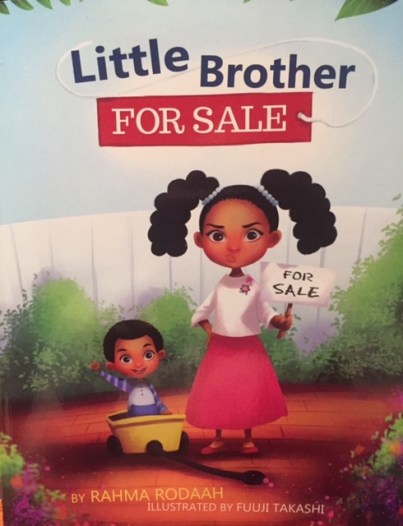
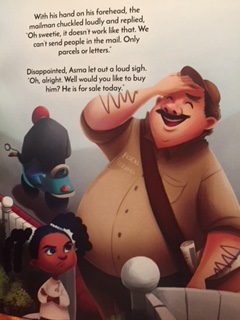
A big sister, Asma, is ready to get rid of her little brother, Hamza, so that she can enjoy all her parent’s attention.  But when the mailman won’t let her ship him to grandma, and neither the lady walking down the street nor the neighbor next door want to buy him, she is determined to find someone to take him off her hands.  Alas though, it is Hamza’s nap time and while mom makes salat Asma finally gets some time to herself.
IMG_1862

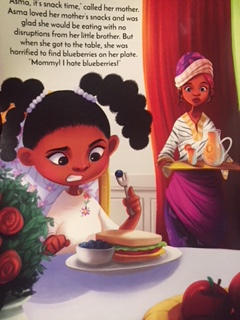
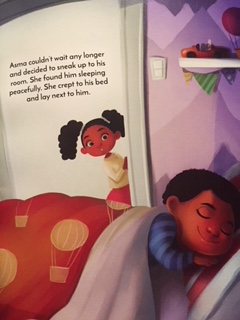
Except she misses having someone sharpen her crayons, or eat the blueberries she doesn’t like, and there is no one to dance with her around the living room.  She decides that maybe she does like her little brother, and lays down next to him with promises of loving and protecting him forever.  Ahhh…..

IMG_1866

Yeah, the book is pretty predictable, but the details make it charming.  I love the diverse characters and the love and warmth they all exude.  I love that when she drags her brother out in the wagon and holds up the for sale sign, mom is peeking out from the kitchen.  I reassured myself that she was there, so it was ok for Asma to be talking to the mail man, a potential stranger, and the lady walking down the street, muslimah or not. 

IMG_1861 

The only slight hiccup to me was what one-year-old, he was seemingly taking his first steps in the first picture, can sharpen crayons? Maybe I just failed to prepare my children, but other than that, the book is smooth, and well done.

IMG_1864

The binding quality, the font, the amount of text on the 26 pages, is definitely preschool to first or second grade, and the illustrations will mesmerize even toddlers who won’t understand why the book is so silly. 

IMG_1863

The book has been floating around my house and I’ve seen my 11 year old pick it up and read it on her own, and then read it to the three year old mutltiple times.  She possibly was getting ideas, but maybe it also reminds us that siblings really can be both annoying and lovely as well.

IMG_1865

All Are Welcome by Alexandra Penfold and Suzanne Kaufman

Standard
All Are Welcome by Alexandra Penfold and Suzanne Kaufman

all are welcome

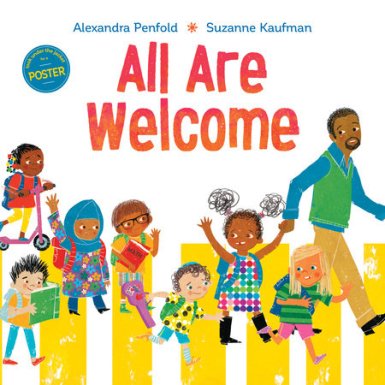
This is the perfect book for back to school.  It can set a beautiful tone of letting all children know that they are welcome, that they are accepted, that they are safe, that they are wanted and that they have value in your classroom.  It could also work to allay children’s fears heading in to a new environment, assuming of course that the environment is as fabulous as the one presented in the book.  

IMG_1788

The large, hardback 44 page book with a poster and large pullout concluding page, is fantastic for ages preschool and up, but would have value as part of any grades back to school message.  

IMG_1789

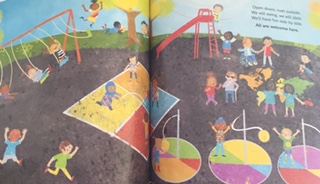
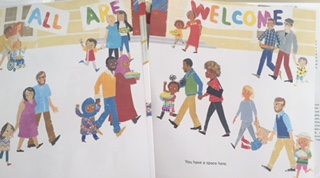
While the rhyming couplets are sweet and sincere, the real beauty of the book are the illustrations.  Bringing all that diversity to life in smiling kids faces, children with hijabs, and yarmulkes, patkas, baseball caps, glasses, curly hair, straight hair, every color of the rainbow, various physical abilities, all show what a day of inclusion can look like.  No one culture or background is articulated or placed higher than another and the coming together of the kids and then their parents and community is inspiring.

IMG_1787

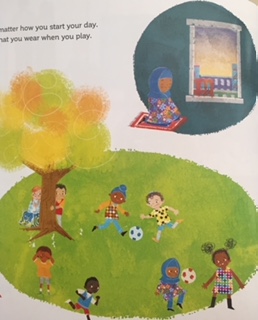
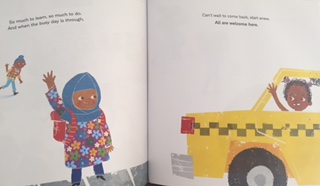
I love that their is a little muhajaba on the the cover and included in the cultural acceptance of the book.  It shows her praying in one picture and then joining in and smiling with the rest of the diverse group of characters in the other pictures.  Feeling included and accepted whether in a classroom, or in a children’s book, feels good, at any age, alhumdulillah. 

IMG_1790

A special shout-out to all the educators and people in positions of power who go the extra mile to create a safe and accepting space, thank you.

IMG_1791

Tilt Your Head, Rosie the Red by Rosemary McCarney illustrated by Yvonne Cathcart

Standard
Tilt Your Head, Rosie the Red by Rosemary McCarney illustrated by Yvonne Cathcart

rosie.jpg

This book is nearly the mirror of Nanni’s Hijab, just told from a different perspective and swapping out the heroine.  Written in 2015 this book definitely came out first, and while the 24 page book is targeted for  4-8 year olds, if your teaching point of view, this book and Nanni’s hijab could be used for older kids to make for a great lesson.  
IMG_1753

I love that this book is written by a non Muslim and the main character is non Muslim.  The binding the pictures, the size, all make this a wonderful addition to any library in showing that differences can and should be celebrated.

IMG_1752

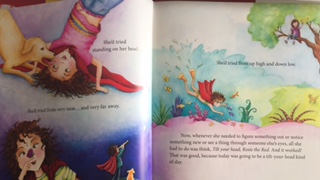
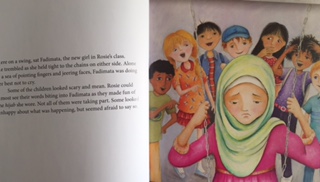
Rosie loves wearing her red cape, and she loves looking at things from all angles and perspectives.  One day at school she arrives at school to see kids making fun of the new girl, Fadimata and her hijab.  

Unable to stop the kids she reaches out to Fadimata, and transforms her cape into a hijab in solidarity.  After the teacher also talks to the class about being kind, the next day is a surprise for Rosie, when many of the girls are wearing scarves and hijabs in a variety of manners to show acceptance and celebrate differences.

IMG_1751

This is the first book in a Rosie the Red Series, and I kinda really love that in the second book, Being Me, about volunteering at a food pantry and helping a friend, Fadimata is minor character.  She is now one of Rosie’s best friends and is both mentioned by name and illustrated.  This is awesome to me, because while books about Muslims are great, having us be in books as supporting characters solving other problems, learning lessons, and going on adventures, makes us more mainstream and inshaAllah part of the accepted landscape.

rosie1

*Side note, if you look at this book on Amazon, and read the comments you can see how truly upset many people are by this book calling it “indoctrination” and criticizing it for not encouraging assimilation.  If you read the book and like it, and like the tone and message it promotes, maybe write a review, and make the world a little warmer.
There is Greatness in Me by Ameenah Muhammad-Diggins and Amaya Diggins

Standard

IMG_1522.jpg

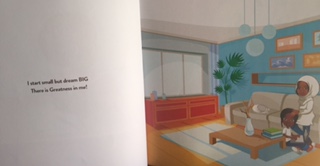
This book is powerful.  The repetition, the message, the rhythm, it is something kids of all ages need to hear, and hear often. 

IMG_1526

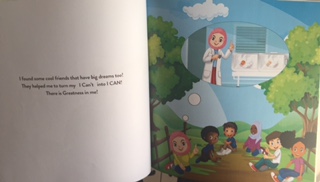
The concept of positive self-talk, is brought to life in the short, simple, straightforward sentences per page, and shown with illustrations of children dreaming big.  If you can dream it, you can achieve it.  Turning impossible to “I’m possible,” and not getting brought down by others laughing at your dreams.  The book shows that hard work is needed too.  You start with Bismillah, help others when you can, and brush yourself off and get back up when you fall.

IMG_1523

With a forward by Muhammad Ali’s daughter, Maryum “May May” Ali, and written by a Mother and her daughter who at 10 started her own hijab brand for Teens and Tweens, the book isn’t just reassuring words, it is meant to inspire action and confidence.

IMG_1524

I could see teachers reading this 32 page book weekly to their students, aged preschool and up.  It might start to get cheesy for older kids, but they need it too, possibly even more.  I have read it to my children, and when they’ve had hard days asked them to read it to them selves.  It helps, it really does.

IMG_1525

My only criticism of the book is the superficial stuff.  The binding, page quality, and size are fine, but the text is small, and the illustrations are a bit off.  Not bad per say, what they show is actually wonderful, but the faces on some of the kids are misshapen and not uniform in size, and when they are all standing next to each other they look like they have been copy and pasted together, not that there was a single illustrator.  I hesitate to criticize the illustrations, but the book is an important one, and the diversity the pictures show is powerful, really powerful, that I would have hoped for a $15 book the pictures would have been a bit better.  While at the same time, I understand that the book may only have gotten published going this route and for that I am grateful that it exists.  InshaAllah if more people support these types of books and messages, the publishing quality will improve, and all of us will benefit.


Snatched Asmaa Hussein illustrated by Svaitoslav Diachyk

Standard
Snatched Asmaa Hussein illustrated by Svaitoslav Diachyk

snatched

The premise is simple, Omar ate something that didn’t belong to him, and the guilt is weighing on him heavily.  The beauty of the book is how, with his mom’s help and his own determination, he makes things right.  

snatched3

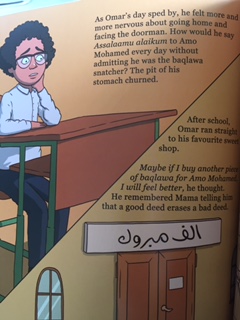
Set in Egypt, Omar eats the doorman’s baqlawa, and while he knows he shouldn’t have, he doesn’t know what to do about it.  The doorman, Amo Mohamed, blames the cat and Omar tries to move past the theft.  But the guilt builds up and he even dreams about baqlawa, eventually telling his mom so he can start to fix things.  

snatched1

After isha prayer, the two of them make some new baqlawa.  I love that the mom doesn’t get mad, but she is firm that while, “we made the baqlawa together,”  she tells him, “you have to talk to Amo Mohamed on your own.”  

Omar confesses his crime to the door man and apologizes, Amo Mohamed in turn apologizes to the cat, and all enjoy a piece of baqlawa together with smiles.

snatched4

The last page in the 38 page book is a glossary and is headed by a hadith by Prophet Muhammad, “Be conscious of God wherever you are.  Follow the bad deed with a good one to erase it, and engage others with beautiful character.”

The illustrations aren’t amazing, but they are sufficient and help walk the reader through the story.  I like that the mom covers when out and about, but not in the home.  The story is great for ages 4 and up, but the amount of text on the page and book length might make independent reading more geared to second and third graders. 

snatched2

The book would work for muslim and non-muslim children a like and does a good job of showing a universal situation in a culturally rich environment.


Ali and the Moon by M.I. Kafray illustrated by Aaliya Jaleel

Standard
Ali and the Moon by M.I. Kafray illustrated by Aaliya Jaleel

IMG_1421

I originally bought this book in Ramadan and had hoped to review it so that those looking for Ramadan books could benefit. But it isn’t Ramadan specific, just moon themed, and I really was so disappointed with the binding quality for the amount I paid for it, I didn’t think it was fair to review the story until I could get over the number of blank white pages in the book, and the overall copy-shop self-printed and bound vibe that the book emits as soon as you hold it.

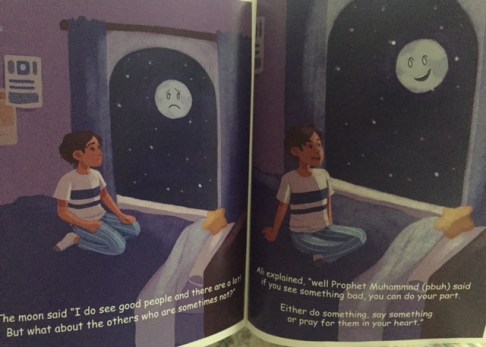
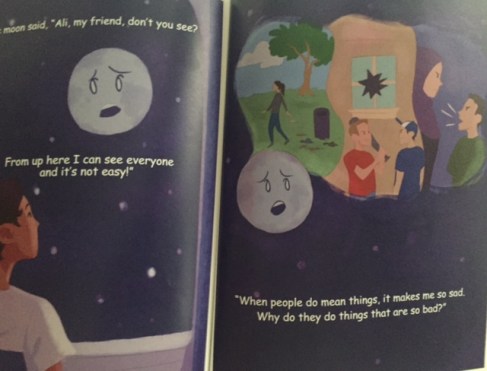
The premise of the book is the hadith that if you see something bad you should change it with our hands, and if you can’t, then change it with your tongue, and if you can’t do that, then pray for them in your heart. 

The 16 page book starts off a bit awkward, with the boy just staring at the moon, but by page five, the story hits its stride and is sweet.  The moon dims and is sad about the state of the world.  Ali starts talking to the moon in rhyming lines, and convinces him that there is still good in the world.  The moon and Ali decide that at night they will pray for the world and the people in it.

ali inside2

The end of the book has the hadith and the surahs one should say before going to sleep: Surah al-Ikhlaas, Surah al-Falaq, then Surah an-Nas and lastly, Ayatul Kursi.

The illustrations are cute, they are expressive and the moon and boy sweet.  I just wish the paper had more weight and that the story a bit longer.  A lot could be discussed with the premise of the Muslim boy talking to the moon with a great vantage point.  More specifics and more inspiration would have made this mediocre, albeit expensive book, great.

ali inside


The Most Pleasant Festival of Sacrifice: Little Barul’s Eid Celebration by Munise Ulker Illustrated by Beyza Soylu

Standard
The Most Pleasant Festival of Sacrifice: Little Barul’s Eid Celebration by Munise Ulker Illustrated by Beyza Soylu

batul.jpg

This book is beautiful, it feels great in your hands, the raised glitter embellishments in the illustrations, the price point, everything except the text.  The gist of the story is even fine, the execution is just off.  It reads very much like it has been translated from another language in to English, and yes my privilege might be showing, but the phrasing, the passive voice, the orphanage, all make the book with its massive text passages hard to convince kids younger than 7 to sit through.

batul9

The story starts off with parents and two kids , Murad and Batul, driving to a friend’s house for dinner, commenting on the Christmas decorations that they see.  The parents ask what the kids know about Eid al-Adha that is coming up and the kids remember how much fun they had in Turkey.  Except it is really awkward to get this bit of information out.  They discuss Eid last year, and then remind each other that they were in Turkey, and how it was much more fun.  Noting that international travel is expensive and they won’t be able to go again, the Mom over dinner discusses how they can make Eid fun for the kids with her friend.

batul2

It is decided that the Muslim and non Muslims will celebrate together and include a local orphanage.  “Each Muslim family would be responsible for buying new clothes for two children from the orphanage, and they would take their own children along to do the shopping.” This would teach the kids to thank Allah and learn about community and sharing.  A great lesson overall, again just a concept presented in a really wordy, round about, awkwardly forced manner.

The Mom contacts the library and gets permission to decorate an information table, the kids make Eid cards for their grandfather in Turkey, at Sunday school they make gifts for friends.  They learn about Zakat and sacrificing an animal like Allah commanded Abraham to do, they even send cards to their neighbors.  Oddly though remarking how fun it is to get candy outside of Halloween.  After the first two pages explaining Christmas and telling that Muslims don’t celebrate it, I found it odd that they would, 15 pages later, be referencing Halloween. 

bat

Some of the sentences also don’t made sense.  About half way through I didn’t understand what the author meant by the boys “celebrating each other’s Eid” after they put their new clothes on and went to Eid prayer.

Once at the party, they give specific details of how much they charged everyone, yet no details about the food they all brought.  The kids enjoy a pinata and everyone including the orphans get Eid gifts.  Despite everyone’s fun the party has to end, and the orphans return to the orphanage and Murad and Batul declare they “will always remember this Eid.”

batul3

The illustrations are great, it is really yet another example of a book just needing a good editor.  From the very beginning, even the title isn’t really right, the book isn’t even mainly about Batul, to the random details shared, the book is just too long and too unpolished.  It is really unfortunate, because it has so much going for it on its 32 pages.  The main points however, I feel are lost about Eid and the reason it is so dear to Muslims everywhere.