Category Archives: 5th grade and up

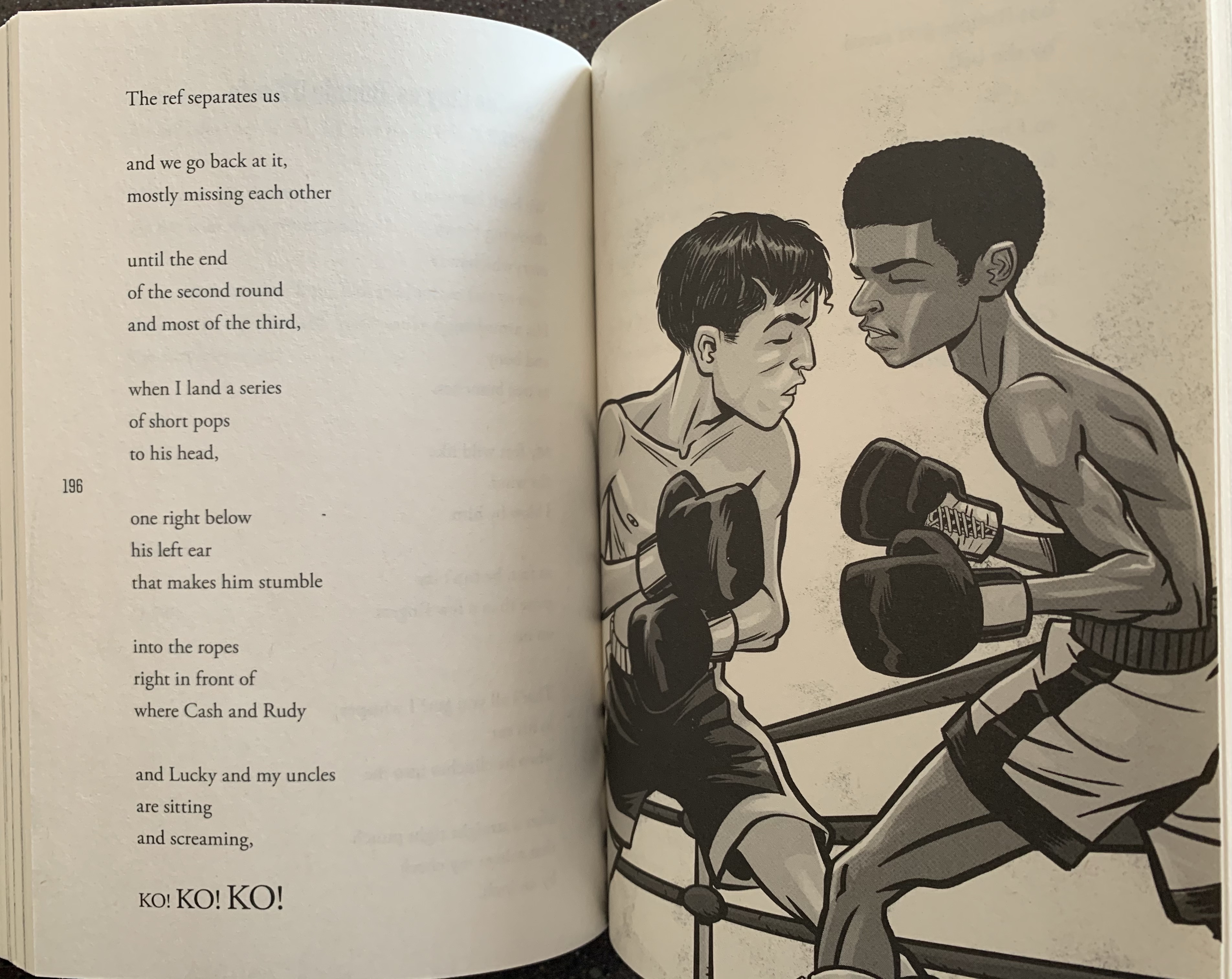
Becoming Muhammad Ali by James Patterson and Kwame Alexander illustrated by Dawud Anyabwile

Standard

img_8575

This 310 page, AR 5.4 biography reads like a dream being remembered and flowing with newly awakened images presented in a lyrical way. The changes in point of view and writing style keep the book bouncing like a boxing match, and flesh out the early life of Muhammad Ali for middle grade readers.  Only at the very end does it mention that he changed his name when he converted to The Nation of Islam, it doesn’t detail much about it, and it doesn’t mention his eventual conversion to Islam, even though it does mention him being diagnosed with Parkinson’s and his death.  I understand that the book focuses on his preteen and teen years, but it seems like The Awakening of Malcolm X also intentionally cut that footnote out of the book, and having read that book a few weeks ago, it seems a deliberate exclusion in both cases and that bothers me.  It could be coincidence, as both 2020 published middle grade coming of age books have familial support in the writing and research, admittedly it just might be my timing of reading them makes it seem that something larger is at play.  Ultimately, this book gives insight into who Cassius Clay was, and what his life and friend circle looked like as a boy in Kentucky. The verse and flow of the text make the book an easy and enjoyable read.

SYNOPSIS:

Lucky is Muhammad Ali’s friend growing up and is the narrating voice that sets up each chapter and overall framing of the book.  The bookish friend is a writer and eventually a journalist that moves the story forward.  The verses that follow each intro are the imagined voice of Muhammad Ali.  There is a bibliography at the back, but the story starts with this warning, or disclaimer, or wink of sorts:
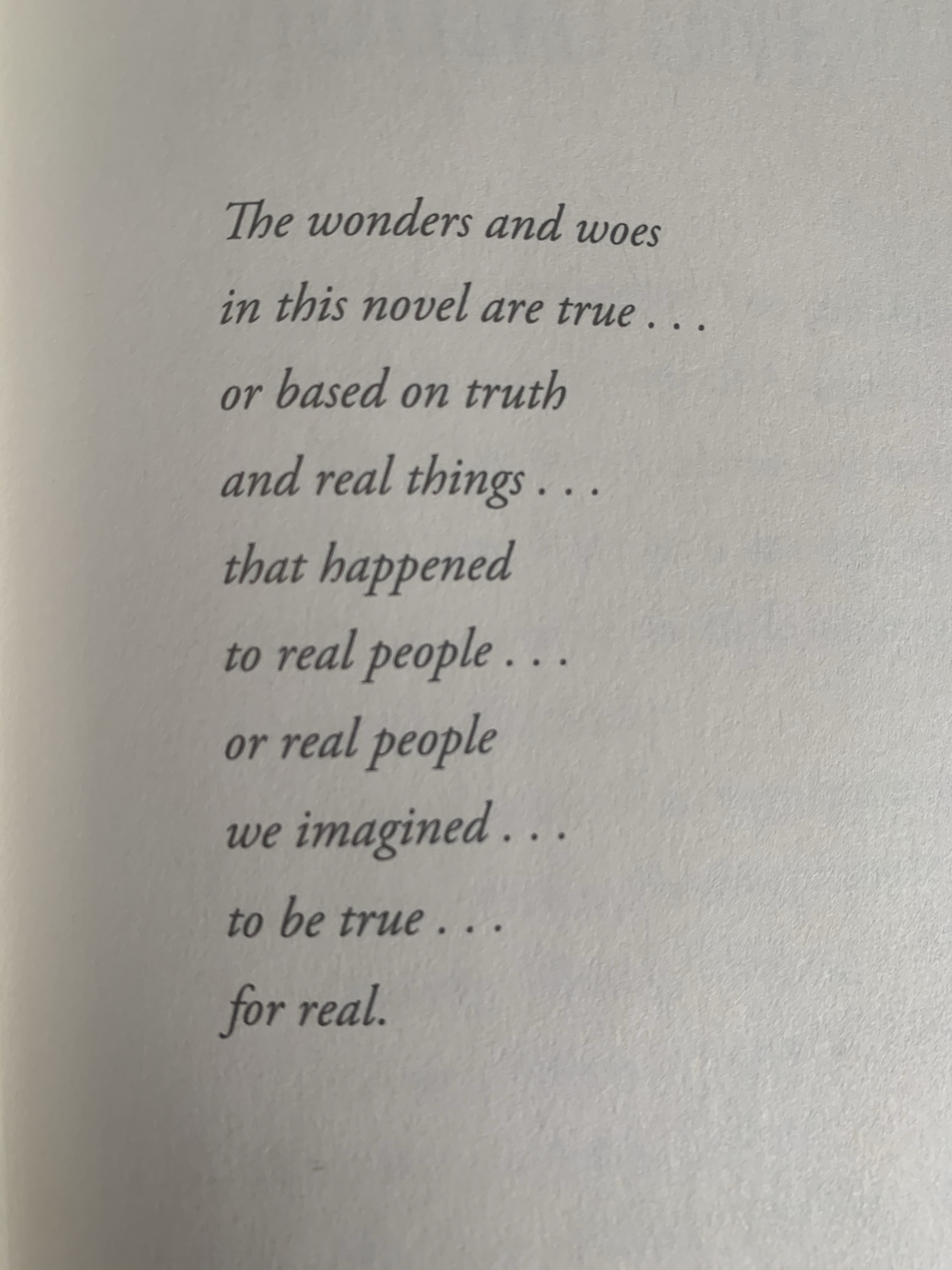
img_8621

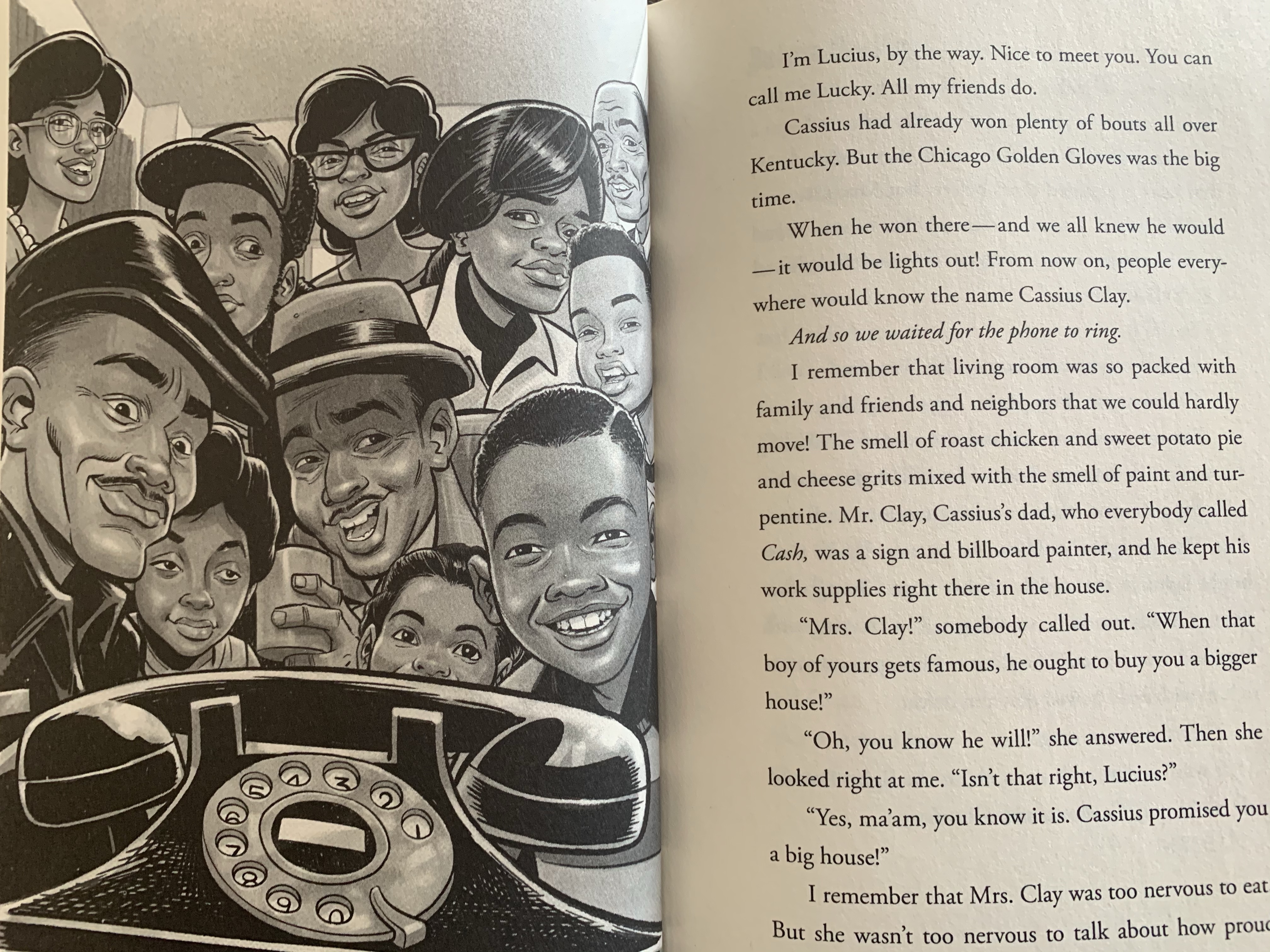
The book opens with Lucky and the Clay family waiting for the phone to ring in 1958 to find out if Cassius has won in Chicago.  He is there fighting for the National Golden Gloves.  He eventually loses the tournament, but he doesn’t stay down.  The book then rewinds and starts back before Cassius ever enters the ring.  The reader gets to know about Granddaddy Herman and the bond that the two share.  He is Cassius’s church and source of pride.  We also learn about how Cassius sees the world and the racism that exists in it. His humbleness and frustration with seeing how hard his mom has to work for so little reward.  We see how his friends shape him, but more importantly how he shapes them, and we see how although he struggles in school how he is articulate and respectful and beloved by so many.  His younger brother is a constant in the story, as is the narrator Lucky.  The book gets inside the character Cassius and if you didn’t know it was a biography, you would think it was a fictional coming of age book.  The ups and downs, the setbacks, the frustrations, the dreams, it all flows and makes you feel for this determined kid, who despite all his bravado, is really a down to earth human being.
img_8577

WHY I LIKE IT:

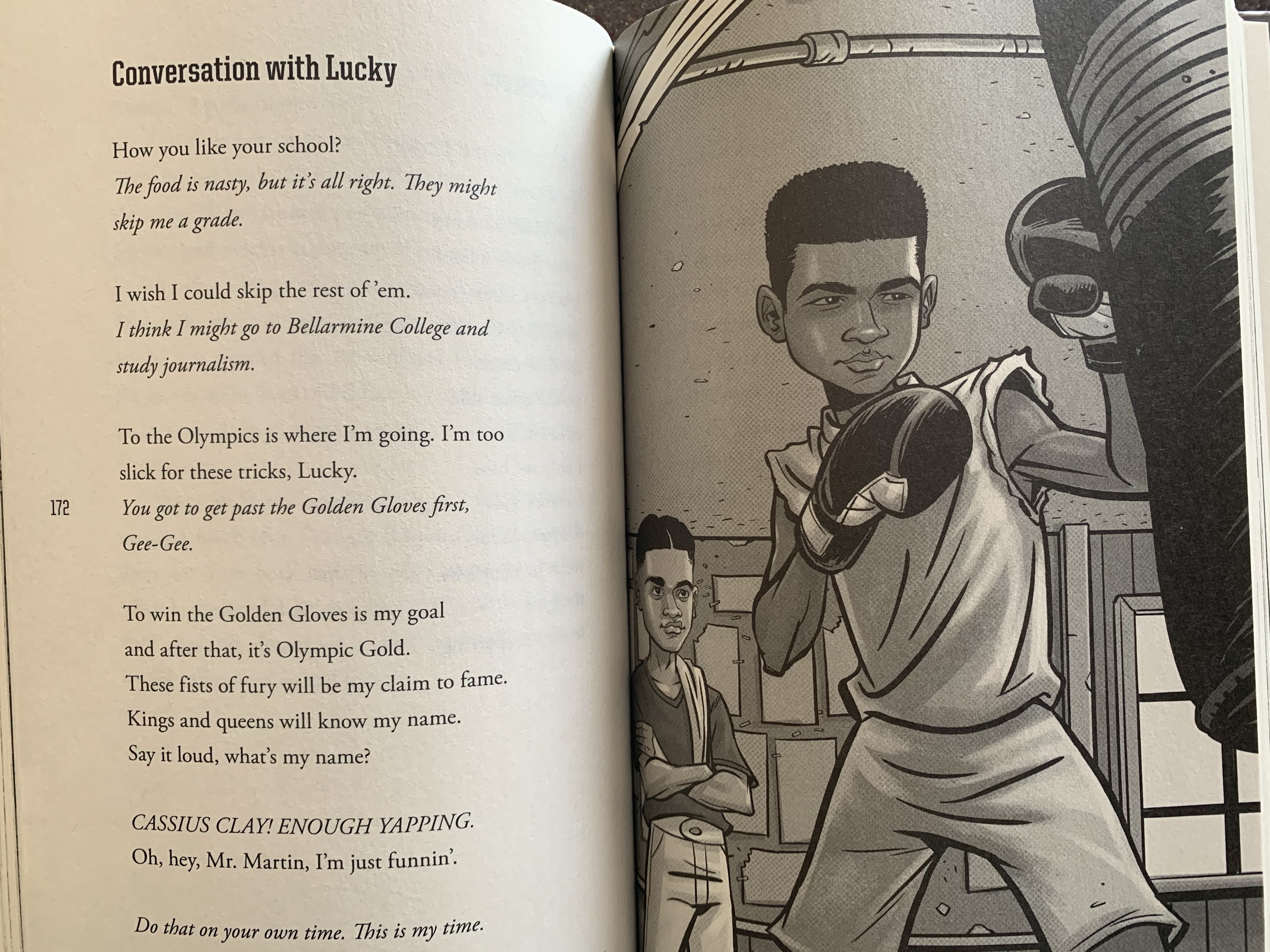
I don’t think I learned anything ground breakingly new reading this book, but I felt like I got to know the material in a more fleshed-out way.  It isn’t a list of facts or hight lights, it is the nuanced day-to-day that lift him off the page and out of the headlines.  I like the change of voice and style of writing, it made sense to me, and allowed the book to resonate differently than a traditional biography would.   I think it will also appeal to a wider audience because of the verse and easy flow.  I similarly enjoyed the illustrations that pepper the book.  I appreciate that the story is told from a friend looking in on someone that he knows well, but I almost would have preferred his brother being the voice and bringing the reader even closer to the boxer. Ultimately I want to know more about his parents and his brother and how they felt about his success.  The book didn’t answer a lot of question, but hopefully it will spark the curiosity of readers to go and learn more.
img_8578

FLAGS:

He slightly mentions crushes and dating, that his dad is out galavanting Friday nights until Saturday.  There is mention of a side character having part of his face damaged in an explosion, there is reference to the N word.
img_8576

TOOLS FOR LEADING THE DISCUSSION:

I would consider the book as a book club selection if it served a larger purpose or the group had a preexisting interest.  I think if I were to meet with a group of kids more than just once a month for an hour or so for a book club discussion, this book would have a lot of potential for introducing the athlete, writing styles, historical implications and so on.  I just don’t know that we could get to all that in such a limited time. If they had already learned about his boxing accomplishment,  his protesting of the war, his conversion for example, this book would be a great discussion extender to supplement basic knowledge of him.
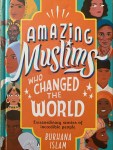
Amazing Muslims Who Changed the World: Extraordinary Stories of Incredible People by Burhana Islam illustrated by Reya Ahmed, Deema Alawa, Nabi H. Ali, Saffa Khan, Aaliya Jaleel and Aghnia Mardiyah

Standard
Amazing Muslims Who Changed the World: Extraordinary Stories of Incredible People by Burhana Islam illustrated by Reya Ahmed, Deema Alawa, Nabi H. Ali, Saffa Khan, Aaliya Jaleel and Aghnia Mardiyah

img_8359

The 30 stories presented over 197 pages are inspiring, and this compilation so desperately overdue. The book is not chronological it is completely random, and at first I was confused, but as I made my way through the book, I actually grew to love not knowing who I would be reading about next.  Yes, there is a table of contents, but the point being that you don’t have to be born into royalty, or be a warrior, or have lived a long time ago to be amazing, you just have to follow your passion.  I learned so much about people I thought I knew about, and was tickled to learn about people I have never heard of: bakers, athletes, actors, educated slaves, architects, spies, singers, scientists and politicians.

img_8360

At the end of each six page illustrated blurb is an “Interesting Fact” and at the end of the entire book are some activities in the “Amazing Extras” section.  Readers can crack a code like Noor Inayat Khan who helped the Allies decode and send secret messages from France to Britain or write a poem like Rumi, a song like Yusuf Islam (Cat Stevens), draw a superhero like G. Willow Wilson, make a camera following the science of Hasan Ibn Al-Haytham, or color a picture of Muhammad Al-Idrisi.

img_8361

My favorite biographies were those that I knew little or nothing about before hand.  If I had to pick two favorite among all of those sections, I’d pick Khawlah bint Al-Azwar and Ayuba Suleiman Diallo.

img_8362

In 600 CE Arabia, Khawah, the masked knight, learned how to fight along side her brother and eventually served with Khalid ibn Waleed in battle.  It is said that she killed the Byzantine leader that captured her and then asked for her hand in marriage.

img_8365

Ayuba Suleiman Diallo in the 1700s in modern day Senegal was a highly educated man who was captured and forced in to slavery in Maryland, USA, interacted with James Oglethorpe, found himself being sent to England and with the help of a Thomas Bluett was able to be freed and eventually return home a free man. SubhanAllah!

img_8363

This book has it all: famous Muslim men, famous Muslim women, Black Muslims, Arab Muslims, European Muslims, American Muslims, Asian Muslims, African Muslims, Muslims who lived a long time ago, Muslims who are still alive all jumbled up and beautifully presented by a Muslim author and a handful of Muslim illustrators. This book is wonderful for 3rd graders to adults and would be a benefit on any book shelf.  It is worth noting there are no sources given, and doesn’t explain how the people were chosen to be included in the book.

Ahmed Aziz’s Epic Year by Nina Hamza

Standard
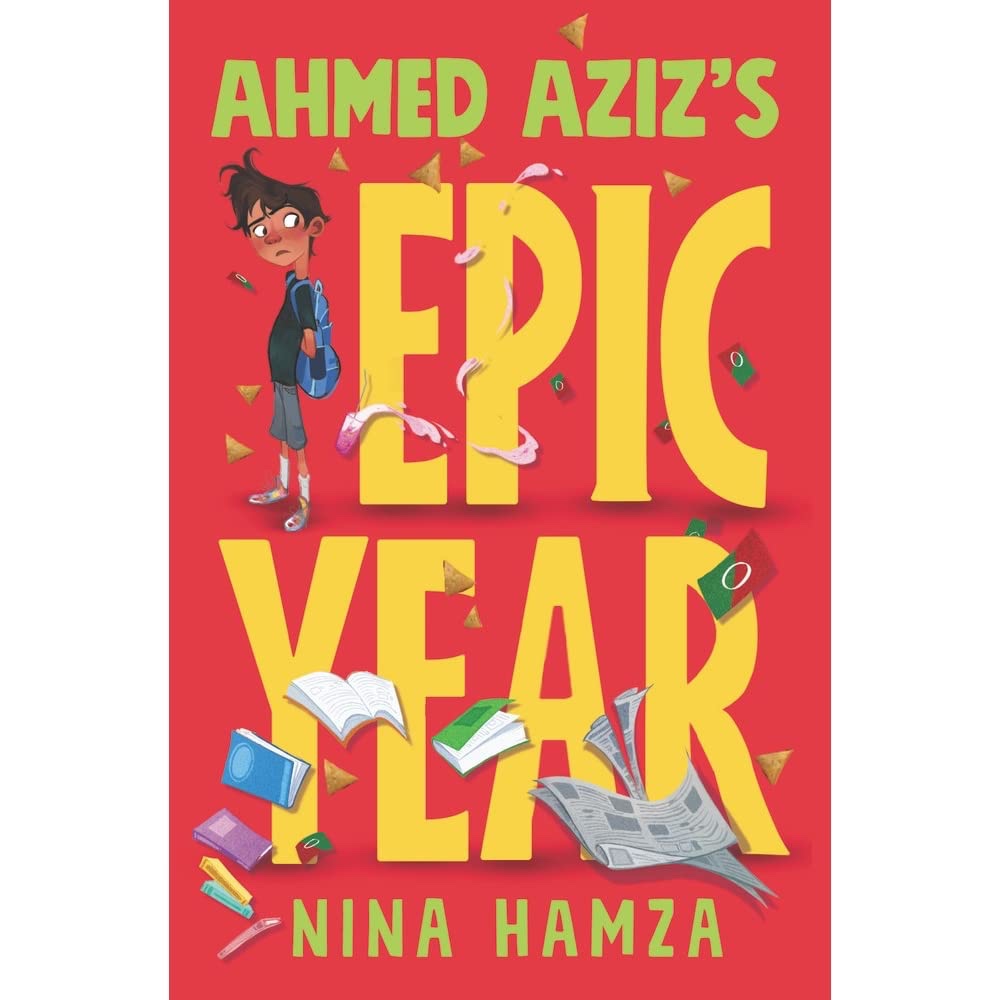
Ahmed Aziz’s Epic Year by Nina Hamza

img_7992

There is such a shortage of male Muslim protagonist middle grades books that I have been waiting quite impatiently to get my hands on this one, and alhumdulillah, it didn’t disappoint.  I’m not sure if it qualifies as OWN voice, being it has a female author, but the authenticity in the little religious and cultural details would suggest that it should.  The 320 page book is meant for ages 8-12, but the weight of Aziz’s father’s illness, the plot pivoting around three classic books (Holes, Bridge to Terabithia, and From the Mixed-Up Files of Mrs. Basil E. Frankweiler), and the clever reflections of Ahmed along with his quick wit and thoughtful choices, might make the book’s sweet spot be 5th to 7th grade readers (as well as us moms who are suckers for elementary literary references, teachers who are heroes, and kids realizing their potential).  The book has a bully, but is clean and wonderful, and I thoroughly enjoyed it.

SYNOPSIS:

Twelve-year-old Ahmed is leaving the only home he has known in Hawaii to move to Minnesota.  His dad has Cirrhosis, a result from a rare genotype of hepatitis C, and Minnesota is one of the top options for treatment.  The family is nervous to move in general, but more so to move to Minnesota.  It is where Ahmed’s dad Bilal grew up, and where his dad’s younger brother passed away at age 12. Ahmed’s younger sister, Sara, is perhaps the only one excited for the new adventure.

The family arrives and is greeted by Bilal’s old friends, and when school starts he realizes one of his dad’s best friends, is his English teacher, and somewhat of a legend at the school in getting kids to try and beat her at an end of the year quiz show like competition.  The school is also where Bilal and his brother Muhammed went to school and a picture of Muhammed hangs right above Ahmed’s locker.  The biggest stress at school is Jack. Jack who lives a few houses over, Jack who rides the same bus, Jack who is in Ahmed’s English group, and Jack who has a lot of followers at school.  Jack is a bully.  One who makes Ahmed’s life miserable at every turn, not just socially, but even the police.

Ahmed is a laid back kid that doesn’t like to read, but loves words, who wants to blend in yet is the only brown kid in a sea of white, who enjoys attending  Jummah salat, but ultimately hates going because of the shoe chaos afterwards.  Ahmed has no intention to read the books assigned in class, but some how the three classic books assigned do get read, and  Holes, Bridge to Terabithia, and From the Mixed-Up Files of Mrs. Basil E. Frankweiler tie together and weave in and out of Ahmed’s epic year.

I don’t want to spoil much, but Ahmed’s dad is in the hospital a lot, there is a lot of plotting to survive being bullied, as well as getting revenge on the bully in Ahmed’s own way without involving parents.  Ahmed slowly grows to love Minnesota, his small circle of friends, and his school while learning about his uncle and the kind of person he wants to be as he grows up.

WHY I LIKE IT:

Ahmed is Muslim and while his mom prays five times a day and his dad is an occasional prayer it doesn’t specify how often Ahmed prays or how he feels about religion, other than going for Jummah.  At first Ahmed thinks he is being bullied by Jack because he is brown, his mom is an immigrant from India, his father the son of immigrants from India, but learns that Jack picks on anyone new.  I like that for as much as Ahmed hates stereotypes and assumptions, he acknowledges that he makes them too.  I like that Ahmed doesn’t like to read, but is smart, and eventually comes around to reading.  He is tech smart and very mature in how he views the world and himself in it, cares for his sister and parents, handles things on his own, and builds others up.  Ahmed is a good kid, not in that he doesn’t make errors or is a teacher’s pet, but in that he has a really good heart and a good head, and I think would make anyone better for knowing him.  I love that the book is smart too.  If you have read the three books mentioned you will love the discussions and questions about the books, if you haven’t read them, you will be tempted to after you finish this book.  I wish there was a tad more religion, there is a sprinkling of culture, primarily the mom’s tragic cooking, but a bit more religion in a book that has illness and death would seem natural to me.  The storytelling is superb, I was so curious where the father’s parents were, but alas it did answer that, I would have liked it sooner, but I was glad it made it in none-the-less.  I would have liked a bit more from the parents about why they wanted Ahmed at his dad’s old school, or how they were comfortable constantly leaving the two kids home alone at night, but Ahmed like I said is pretty mature.  I particularly love the brother sister relationship.  Ahmed is a good older brother and it reminded me in some ways of my older brother, which made my heart warm, good siblings are a blessing.

There are multiple climaxes, but while I expected the dad’s health to be a big one and Jack getting what was due to be a close second along with the outcome of the literary contest, I was not prepared for the level of Jack’s torture to climb to, and was pleasantly surprised by the unresolved thread of Jack and Ahmed’s future relationship.  Things in life don’t magically resolve and I love when middle grade novels keep that in mind.

FLAGS:

None

TOOLS FOR LEADING THE DISCUSSION:

I would absolutely do this in a heartbeat for a middle school book club selection.  Even if the book is more middle grades, I think the students will enjoy it and be surprised by the emotional investment the dad character extracts.  I think they will also benefit from the literary references, relatable characters, and the overall great storytelling.

Unsettled by Reem Faruqi

Standard
Unsettled by Reem Faruqi

img_7503

This book is a great OWN voice, middle grade coming of age book that rings with truth and hope in its poetic lines that sweep you up and keep you cheering.  Over 352 pages the author’s semi-autobiographic story of coming to Peachtree City, Georgia from Karachi, Pakistan beautifully unfolds.  I absolutely loved this book and the way it is told, in verse.  The details, often small, ring with such sincerity that even those that have never moved to a new country, or been to a new school will feel for young Nurah Haqq and be inspired by her success, touched by her hardships, and disappointed in her mistakes.

img_7544

SYNOPSIS:

Nurah’s best day is spent on the beach with her best friend Asna, playing in the warm waves and riding camels.  However it ends up also being her worst day, when she returns home to her father’s news that they are moving to America.  Strong, confident Nurah who spends time with her grandparents, swimming with her older brother Owais, and excelling at math in school is reluctantly leaving it all behind to start anew.

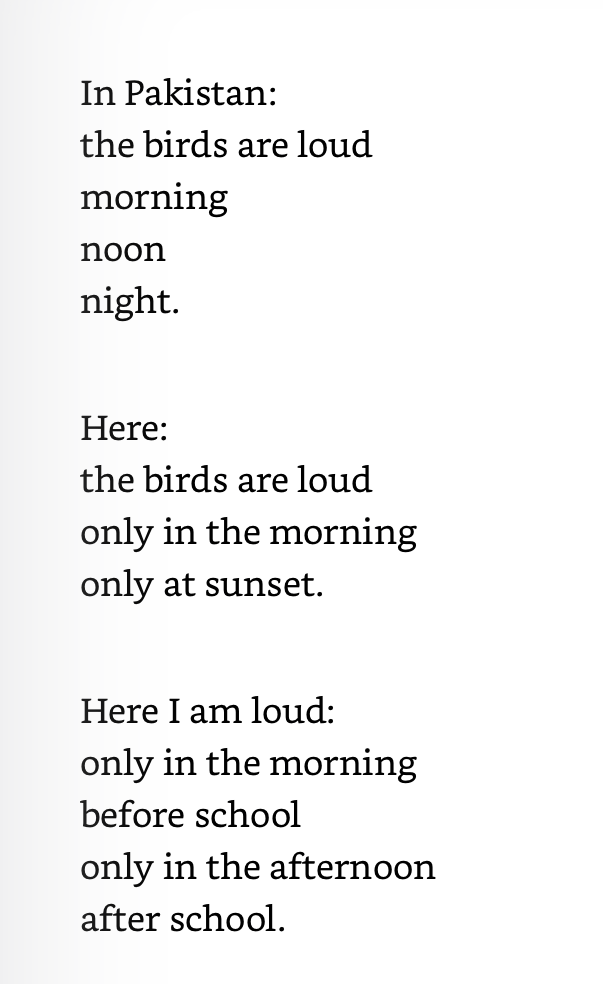
When they arrive in Georgia the family of four settles in a hotel until they find a house.  Everything is different and new, and the transition with no friends and family difficult for the entire family.  The way words are pronounced, the way the air feels and the birds chirp all make Nurah long for home.  When they find a swimming pool at the rec center, things start to slowly change.  Owais was a medal winner in Karachi, and will be one here too, people start admiring him, and Nurah tries to bask in his light.

School starts and math is a relief, but people are white, so white, and a boy reaches out to shake her hand.  She feels betrayed that she has been told the schools in America are better, and lunchtime, with no one to sit by is a huge stress.  She questions her clothing, her appearance, and the weather.

Her and Owais try out for the swim team and make it, and Nurah makes her first friend, Stahr. Stahr lives a few houses down from their new house and when Nurah’s mom has a miscarriage, it is Stahr’s mom who comes to show support and give comfort.  The support is reciprocated when Stahr and her mom need help escaping from her abusive father.

As Nurah works to win swimming races and be more like her brother, she works to find her voice and use it to defend others and herself.  A terrorist attack committed by someone claiming to be Muslim sets the family up to be targets.  In a moment of jealousy, Nurah doesn’t intervene to help her brother and the consequences are huge.

img_7502

WHY I LIKE IT:

I love the details and how they are articulated.  I related to so much of Nurah’s feeling and impressions, that I reached out to the author and found her to be just as endearing as her character.  The feeling of being different when swimming because of your decision to be modest, the role of food to comfort you and make you feel at home, the older brother that you so desperately want to resemble and be like: All of it hit close to home for me.  I love how religion and culture are so much a part of the story and about the character’s identity, not to be made preachy, just to understand her and her experiences.  She goes to the masjid, she prays, she starts to wear hijab. I love how she finds her voice and defends those that can’t, but that her path is not easy.  She makes mistakes and she has to challenge herself to do what is right.  The backdrop is always trying to “settle” in a new place, but the story has it’s own plot points that are interesting and simply made more impactful by Nurah’s unique perspective.

There are lots of little climaxes and victories for Nurah that show her to be well-rounded and relatable.  You cheer for her early on and enjoy the journey.  The only slight hiccup I felt was the name confusion of her Nana and Nani (Nana), it is explained, but it was a little rocky for me, it might be based on a real thing in her family, but once that is resolved, the book flows beautifully and smoothly.

img_7545

FLAGS:

Nothing a 3rd/4th grader would find alarming, but none-the-less:

Crushes: Nurah has a crush on a boy at school when he shakes her hand and picks her for a lab partner, but she moves on from him while still maintaining a crush on her brother’s friend Junaid.  Nothing happens, she just thinks they are cute.

Miscarriage: Her mother has a miscarriage and it details a blighted ovum and the mental strain on the mom and family in the aftermath.

Abuse: Stahr’s father is abusive

Hate: There are bullies, discrimination, physical violence.

TOOLS FOR LEADING THE DISCUSSION:

The book is a little below level for my middle school book club, but I think it it was on a bookshelf and a middle schooler picked it up, they wouldn’t set it down until they were done reading it.

Flying Over Water by Shannon Hitchcock and N.H. Senzai

Standard
Flying Over Water by Shannon Hitchcock and N.H. Senzai

This middle grades, upper elementary book is a character driven contemporary story of two friends with their own fears coming together: one a native of Tampa, the other one a refugee from Syria arriving in the US on the day Trump’s ‘Muslim Ban’ goes in to effect. In 272 pages of alternating narratives, two 12 year old girls find strength and kindness in themselves, in each other, and in many around them. Islamaphobia is focused on in the story, but the inclusion of diversity, Black Lives Matter, anti semitism, mental health, social justice, and US immigration makes the book relatable to everyone and interesting to explore. The book is remarkably similar to another book published this year, A Galaxy of Sea Stars, and I wish I had not read them so close together. Both are well done, and I honestly don’t know if one is better than the other, but space them out so you don’t find yourself comparing them. I got my copy from Scholastic, and I’m always happy when the school market shows accurate strong Muslims, so if you see this in the book order forms that come home or book fairs and are wondering if you should get it, do it, it is worth your time and your child’s, inshaAllah.

SYNOPSIS:

Noura’s family has escaped Syria and had been living in Turkey when they learn they have been granted assylum in Tampa, Florida, USA. When the book opens Noura is practicing controlling her fear of water as the plane flies over the ocean. Her twin brother, Ammar, her parents and baby brother Ismail are greeted with protesters when they land. Whisked away by a church group and local Muslims, the family is given support and assistance in a new country.

One of the members in the church group that have volunteered to help the Alwan family, is Jordyn and her mother. Jordyn is going to be Noura and Ammar’s Student Ambassador at Bayshore Middle School and Jordyn’s mom has offered to help Noura’s mom learn English. Jordyn is the state title holder in swimming, but while she was swimming her fastest race, her mom was having a miscarriage, and both have a lot to work through to function as they once did.

The two girls immediately hit it off, and the families follow. Noura’s love of birds is mirrored in Jordyn’s love of water and fish, and both have their fears and mental health coping skills to bond and confide in with one another about. The girls and Ammar are assigned a Social Studies assignment and Jordyn getting close to the Alwans is not well received by Jordyn’s close friend Bailey who’s brother was killed while fighting in Afghanistan. Other classmates also show bigotry and with the real incidents of 2017 incorporated in to the story of a mosque being burned, Jewish cemeteries being ransacked, pedestrians being run-over in France, and more, the Alwans are questioning their new country, and their friends are wondering how America has gotten this way.

While praying at school Ammar and Noura are constantly harassed no matter where they relocate to, and finally ask the administration if there is a safe place they can worship. Florida law says a space can be set aside for all faiths to have the same access as clubs do (I’m overly simplifying), and many different and diverse students come together to turn an old closet into a place of peace, worship, freedom, reflection, and meditation. As expected, the space is destroyed, the culprits never caught and complaints to the school board mount. The ultimate climax involves the kids speaking up about what the space means to them, and waiting to see what the final school board vote is. Along the way there are smaller victories, such as Jordyn teaching Noura to swim, Ammar speaking about the white helmets saving him, and Jordyn and her mother working together to heal.

WHY I LIKE IT:

I love that the Muslim Ban is discussed in a way that it is personal, not political. By highlighting a fictional manifestation of refugees affected by such policy, even people that don’t know anyone affected, I’m certain would feel a connection to a concept and its affects in a very real way. I love that N.H. Senzai was brought on to make the story’s Islamic elements ring true and that the prayer room, a very American Muslim construct ends up being at the center of the story. Noura and her family eat halal, wear hijab, and pray. I enjoyed that other diversity and acceptance issues were carried in to the story by the supporting cast including a Jewish boy, a Cuban girl, a Hindu and more. Overall the book is well written and solid, the mental health and coping skills are so beautifully normalized. Both girls have sought help and found success with it, and both are brave in addressing their fears and opening up about them to those around them. It really is empowering.

The end of the book features more information about the real Syrian children heroes mentioned in the book: the ten year old model builder Muhammad Qutaish, the Olympic swimmer Yusra Mardini, and education activist Muzoon Almellehan. There is also information about the two authors and how their collaboration came to be.

I would love to not compare this book to A Galaxy of Sea Stars, but just to highlight a few of the near exact similarities would prove my point that had these two books not been published the same year, one would definitely be accused of copying the other. Both feature middle school girls, both have a refugee arriving to a coastal town with their families (one Afghan one Syrian), both have the American born protagonist loving water, being an only child, and have mothers going through their own life changing crisis. Both have two side kick friends, one that is very anti Muslim and one that is on the fence. Neither have a completely resolving happy ending with the three girls’ friendship and there is doubt in both books of friend’s possible involvement of hate motivated actions. Both feature a side character’s brother being killed in conflict in a Muslim majority country. Both feature an amazing teacher that is very involved in opening minds and facilitating growth regarding prejudice. Both feature PTSD issues, and fear of water issues as well as a major hobby being destroyed by an angry classmate character. The ‘ethnic mom’ in both stories is rather one dimensional but loves to cook and feed everyone. Sure they also have their differences, one alternates point of view and is tied closely to current real events, but both have remarkably similar themes of friendship, overcoming fear, and finding similarities over differences.

FLAGS:

Some mention of violence as the Alwans recall the destruction and fear of war in Syria. Mention of a cartoon drawn by a classmate mocking Jordyn getting her first bra, but it isn’t detailed. The swimming coach is a lesbian and she mentions her wife at one point.

TOOLS FOR LEADING THE DISCUSSION:

I would definitely encourage elementary teachers to have this book on their shelves and encourage students to read it and respond. I think it would be too predictable for middle schoolers to read in a critical manner, however, they would probably enjoy it as a light read. With Covid 19 still keeping me from starting up book clubs again, I have been asked to consider helping put together some side reading lists/suggestions, and this book would definitely find its way on that.

Happy Reading!

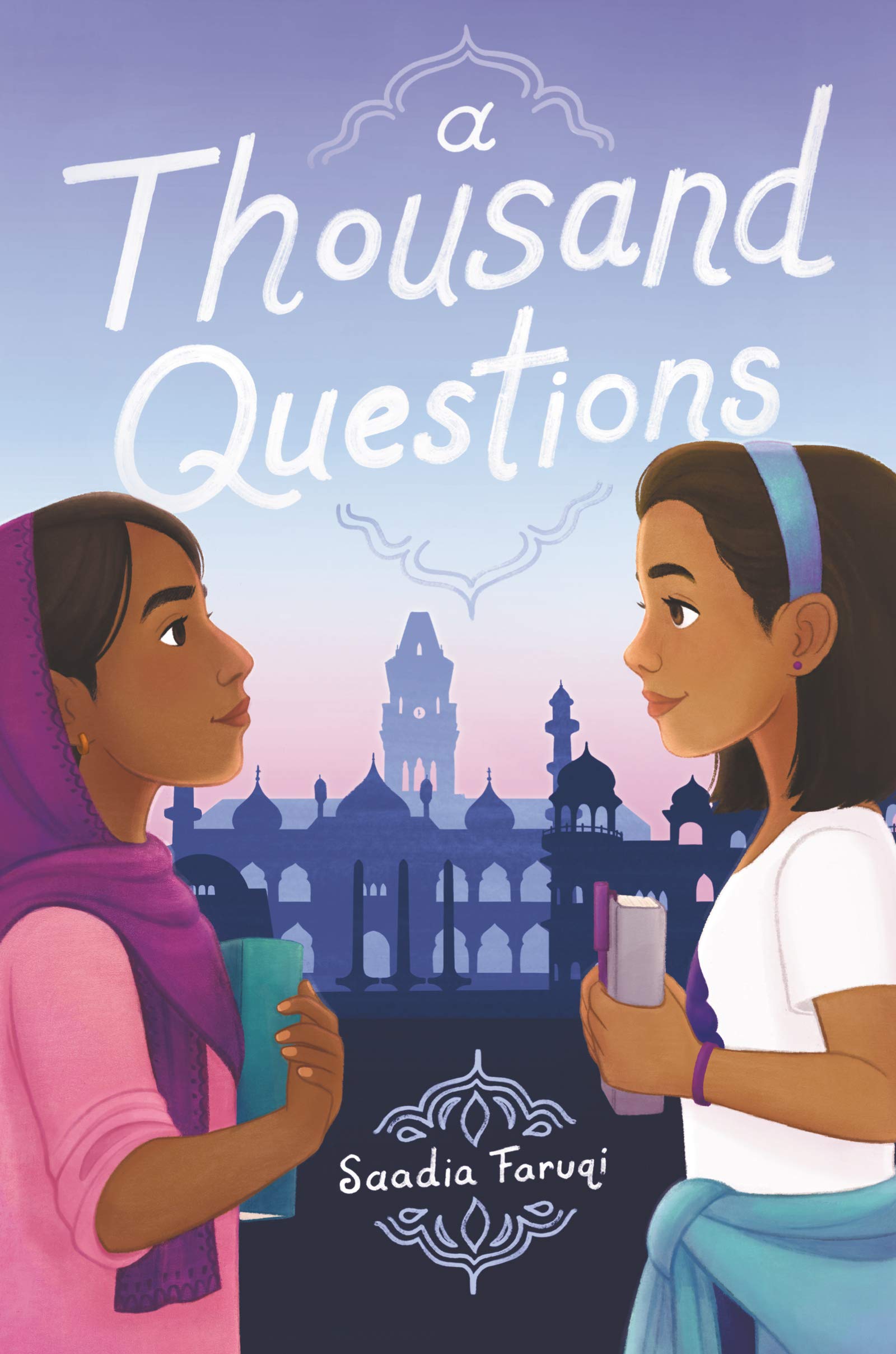
A Thousand Questions by Saadia Faruqi

Standard
A Thousand Questions by Saadia Faruqi

This 320 page middle grade novel with alternating point of view chapters engulfs you like a warm genuine hug. It does not have a clear climax, it is predictable, and some characters and cultural touch points could have used more detail, but honestly, I couldn’t put it down. As a half American kid who spent my summers in Karachi, so much of the author’s love of her homeland flows so effortlessly from the pages and took me back to my childhood and how the transformation of comparing the two countries moves to seeing the best in both causes growth within your heart and makes leaving so devastatingly hard. Readers of all backgrounds will seamlessly fall in to the story and enjoy the growth of the main characters, while learning a bit about a culture and the similarities of people.

SYNOPSIS:

The back drop is the sweltering heat of a Karachi summer in the middle of elections. Mimi, Maryam, is visiting Pakistan for the first time in her life. It is her mother’s home land, but her grandparents, and her mom aren’t close. They didn’t approve of Mimi’s dad and mom getting married, and even though they have been divorced for years and he has left, Mimi’s mom hasn’t been home in 12 years.

Sakina narrates the other chapters. She is the daughter of Mimi’s grandparent’s cook. She dreams of going to school, but needs help with her English to pass the admissions test. And even if she passes her family needs her income to survive, and her father’s failing health means that she has to take over his job too.

When Mimi arrives at her grandparents home, it is awkward at best. She doesn’t really know her grandparents, she has never had servants before, and her mother is rarely around. That leaves her to get to know Sakina. Sakina finds this odd as the owners of the home rarely “chat” with her and here this American girl wants to get to know her and is fine with helping in the kitchen. The two strike a tentative friendship as Mimi agrees to help Sakina with her english, and Sakina with the permission of Mimi’s grandmother and with the use of the driver, agrees to show her some of the city.

As Mimi takes in the traditional tourists sites she gives Sakina her first taste of ice cream and soda and other “luxuries” she has never experienced. Sakina introduces her to bun kabobs and other local foods. The budding friendship isn’t smooth, mostly because Mimi constantly compares Pakistan to America and Sakina doesn’t understand why Mimi doesn’t have a father. When the girls find out that Mimi’s dad, a journalist, is in Karachi covering the elections, the girls work together to try and find him.

Throughout all of this, Mimi keeps a journal and the entries are letters to her father.

WHY I LIKE IT:

I love that the girls have to navigate their friendship without and often despite interference from adults. I also like that while societal wise one girl is seen as economically privileged and one is not, the book gives enough for even elementary aged children to see that in America Mimi and her mom are financial struggling, but in Pakistan they are not and how that disparity is arbitrary. They also see that family and safety and security are also a part of life’s quality and not country specific. Things that one girl takes for granted are envied by the other, and it goes both ways.

Even for a middle grades book, there were some plot holes. If Mimi had been late night googling and plotting on a secret map all the places her dad had been writing articles from, she should have had a heads up about Pakistan. She knows so little about Islam and has like one shelwar kamees, so it seems a bit of a stretch that she speaks urdu pretty proficiently. I feel like some stumbling with the language or some back story on that would have been great.

Religion is handled as a cultural touch point, neither girl prays, but both find solace in visiting a masjid. Various characters are in sleeveless tops, the athan is heard in the back ground. I wish there would have been a bit more finding of Islam as Mimi found her culture too, but alas it isn’t there.

The majority of the book takes place within the grandparent’s home with the elections being a big part of why they can’t go out, yet the mom goes out a lot, which really rubbed me the wrong way. She took her daughter shopping once to meet an old friend and that is it. Who travels across the world to spend zero time with her kid. I didn’t like the mom at all, and wish there was some background or even some growth on her part. A lot of the minor characters seemed to fizzle as well in terms of having some depth.

There are some cultural and country facts at the end of the book, but within the text I was surprised that more wasn’t shared. I like that it mentioned Karachi was the original capital, but it should have also in the same sentence mentioned that Islamabad is the current, I think readers would assume that Karachi is still the capital of Pakistan.

The book is an OWN voice through and through and the value of that is felt in every sentence. It isn’t all positive and rosy, but it is genuine. The author loves what she is writing about and it shines through leaving the reader with a favorable sense of Pakistan: the country, the culture and the people.

FLAGS:

The book is clean, possibly some tense moments when Sakina’s family is robbed. There is also discussion of marrying someone your parents don’t approve of, divorce, and Mimi’s mom possibly having a boyfriend. Mimi’s mom is an artist and paints pictures of people. There is lying and scheming.

TOOLS FOR LEADING THE DISCUSSION:

I think the book would be a fine choice for an elementary book club, I think any one older will find the book a tad bit predictable. I plan to have my children read it so we can discuss points of view, experiences, universal traits and social economic classes. There are a lot of wonderful lessons wrapped up in a heartfelt story that I can see 4th and 5th grade children benefiting from over and over again.

Playing Atari with Saddam Hussein: Based on a True Story by Jennifer Roy with Ali Fadhil

Standard
Playing Atari with Saddam Hussein: Based on a True Story by Jennifer Roy with Ali Fadhil

atari

This 165 page AR 3.9 book about the 42 days in 1991 that Iraq was at war with the United States is told from an 11 year old half Kurdish Christian boy’s perspective, but he mentions that he has friends that are Muslim and culturally and historically the book is relevant, important, and engaging as well.  I had my 9, 11, and 13 year old read it to gain perspective of the Gulf War, the difference between politics and people, and to see diverse religions co-existing despite stereotypes, especially in the middle east.

SYNOPSIS:

Ali gets the highest score on his Atari console the day that the bombs start falling.  Ali and his brothers Shirzad and Ahmed, and sister Shireen along with their parents retreat to the safest room in the upper middle class home to hopefully stay safe.  With experience of surviving the Iran-Iraq war which ended just three years earlier, the kids camp out at night in the room farthest from the nearby school and spend their days playing soccer in the abandoned streets.  The safe room was determined by knowing that Saddam uses his own people as human shields and places military installments in public service locations so that he can use propaganda to try and convince people that the enemy is bombing schools and hospitals intentionally to harm the innocent.

When the electricity goes out and the water cuts off, the family is forced to accept government rations.  Their dad is a dentist, but as he is essentially property of the state, he is forced to work as a medic and is often absent from home.  The family lives in Basra, which is in southern Iraq and near to the invaded Kuwait, thus all the troops pass through the city and the children spend their days keeping up their house, playing soccer with their friend Mustafa and trying to avoid the bullies Omar and Umar who’s father is in Saddam’s Ba’ath Party.

Ali speaks English because of his love of American TV and feels that if he can meet some US soldiers he will convince them that he should be in America not in Saddam’s Iraq.  He loves Superman, video games, soccer, his family, and his country, but the people, not the leader, he loathes Saddam, even though he knows he can’t ever speak ill of him.

A trip to get rations results in Ali seeing public executions and a colleague of his math professor mother’s getting hauled away.  A visit from their cousin gives them news that their father is missing. Life is not easy for the family, and yet they know they have it better than a lot of other people.  After the war, once again the family will have to put back together their lives and carry on.

The book concludes with a 14 year jump and Ali translating at the trial of Saddam Hussein where the leader who has been hiding is found guilty and sentenced to be killed by hanging.

WHY I LIKE IT:

I love that Ali is so relatable, he could really be a kid anywhere which makes what he sees and hears and experiences all the more intense.  The way that the book shows how the soldiers are forced to be soldiers, the citizenry at the mercy of the government, and the inability to speak freely so very real and frightening, is strong, but not traumatizing to the reading audience.  Even Ali being forced to observe the killing of  people in the street is handled with the target audience in mind.  They are Kurdish and had to deal with that within Iraqi society, which is a nice added layer to understanding that Iraqis are not a single monolith.  I love how the family had to go to the governor’s house and how nice his son was, even though, they are all Ba’ath Party members and part of the larger oppressive system.  It shows that things aren’t always black and white, and to convey all this to eight and nine year olds so clearly is quite remarkable.

I also like that the book holds up over time.  My kids had no idea what Atari is or was, but they could understand that it is a video game, and that it was an escape during the night for Ali to imagine he was playing a game trying to catch the falling bombs as a way to be brave and endure.

FLAGS:

Execution, death.

TOOLS FOR LEADING THE DISCUSSION:

I would consider this for a middle school book club, it is a bit short and definitely more middle grades, but it would allow kids to identify and imagine and discuss war through the fictional characters and voice their understandings of an authoritarian government structure, which would be interesting.

Author’s Reading Guide: http://www.jenniferroy.com/wp-content/uploads/2017/05/Playing-Atari-Teacher-Guide.pdf


Marvel Avengers Assembly: Orientation by Preeti Chhibber illustrated by James Lancett

Standard
Marvel Avengers Assembly: Orientation by Preeti Chhibber illustrated by James Lancett

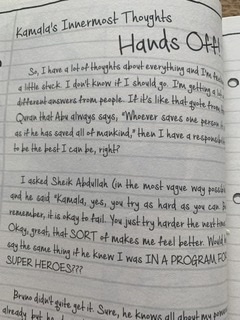
This is the first book in a new middle grade Marvel series told from Kamala Khan’s perspective. Part graphic novel, part screen shots, emails, diaries, fan fiction and doodles, the book features a diverse group of young marvel characters and even some quotes from the Quran. At 175 pages the book has action, humor and themes of team work, self improvement, friendship, second chances, and balancing life that will appeal to boys and girls that are fans of comics, but might be a little scattered for those that only know the main superheroes from pop culture.

SYNOPSIS:

Kamala Khan aka Ms. Marvel is doing a good job keeping villains out of her New Jersey neighborhood, but she is also causing damage to property in the process. When she gets caught on camera destroying a building, a letter from Captain Marvel follows with an invitation to join the Avengers Institute. Already balancing school, her writing of fan fiction and her super hero obligations, Kamala worries if she can handle one more thing and if she is up for making new friends. But, it is Carol Danvers asking, so she reflects on a quote from the Quran her dad always says and talks to Sheikh Abdullah, and ultimately decides to give it a try.

At the Institute she makes friends with Miles Morales (Spiderman) and Doreen Green (Squirrel Girl). The three of them are assigned to be a team for the Academic Decathlon at the end of the semester and to succeed they have to learn about trusting each other, team work, making smart decisions and communicating. Their biggest and most sinister rivals are Max Frankenstein, Kid Immortus, Death Locket and Kid Apocalypse. with the group leader, Kid Immortus being focused on Ms. Marvel and convinced that if he can clone her atoms he too can engorge. Kid Apocalypse however, has a class with Kamala and the two of them are kind of becoming friends. Throw in teachers like Beast from X-Men, Lockjaw teaching interdimensional travel and diplomacy, and an independent study class with Ant-man and there is a lot of fan girling going on.

WHY I LIKE IT:

I love that they are super heroes, but the book is about everyday real world struggles. The book doesn’t have a plot or climax so to speak, but more lays the foundation for the rest of the series and gives young readers a lot to relate to with new school awkwardness. There are strong themes of being a good friend, a good loser, seeing the good in others and really understanding what it takes to make a team work. There are some great lines, “politicians don’t have anything on aunties,” that speak to Kamala’s desi environment and I absolutely love that Kamala Khan mentions an imam, quotes the Quran twice, has a friend that wears hijab, and a mom that does too.

FLAGS:

The book is pretty clean.

TOOLS FOR LEADING THE DISCUSSION:

I don’t think it would work as a book club selection, but I think readers 3rd or 4th grade and up that love super heroes will enjoy the fun dynamic read.

The Bee Tree by Stephen Buchmann and Diana Cohn illustrated by Paul Mirocha

Standard
The Bee Tree by Stephen Buchmann and Diana Cohn illustrated by Paul Mirocha

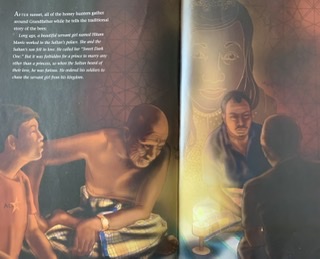
bee treeThis is one of those books that it is hard to know who the target audience is and who would most enjoy the text heavy 40 pages about a boy coming of age in Malaysia by harvesting honey in a traditional manner.  The two page spread illustrations are rich and inviting, and with an AR 5.7 level, the book would work well for children that enjoy other cultures, honey, insects, or children that you hope will be inspired to start seeing the world a little differently than they are used to doing.
5BD37914-E9B7-4D0B-BB0A-1286A8BC4C72

The story starts with a boy talking about his grandfather and how every year he goes to collect the honey from the tualang trees.  The bees travel hundreds of miles and arrive just as the rainforest starts to bloom.  The trees that they build their nests in are higher than the eye can see and grandfather, known as Pak Teh, is the leader of the honey hunting clan.

7CA311E6-B1B6-40E7-B735-FAACAD76597F

He tells everyone what their jobs will be: some will carry ropes, others pails, others torches.  One day, he tells them, someone will have to take his place as the one who climbs all the way up to the top to gather the honey.  He believes Nizam, the narrator, is the one.

To prove himself, Nizam has to practice climbing 120 feet into the sky.  Nizam and grandfather spend a lot of time together praying five times a day and walking through the dense rain forest.  He reminds Nizam that the forest doesn’t belong to them, but to the unseen protector. They enter the forest as if they are visiting a neighbors home.

837003A0-ED16-4CA9-9CD8-3CEBA7846D0A

At night all the hunters sit together and Grandfather tells the traditional story of the bees.  A story that involves a beautiful servant girl named Hitam Manis who worked in the Sultan’s palace and how the Sultan’s son and her were in love.  When the Sultan found out he ordered the girl run out from the kingdom.  As she and her loyal friends fled she was hit by a metal spear.  She did not die, but her and her friends were magically transformed into a swarm of bees.  Because it was metal that harmed her, she ruled that metal was never allowed to touch the honey.  Hence, when the bee hunters harvest they use a bone knife, leather pouches, and a wooden ladder.

2637F18A-FB0A-424D-AACF-58285BE31EC5

When it is time to enter the forest, it is pitch dark with no moonlight.  The hunters tap their glowing torches against the trees sending light sparks to the ground to tempt the bees and leaving their nests free for Nizam to collect the honey from.  For seven nights they climb the trees, and then they return home.  With greetings of salam, peace be upon you, Grandfather informs the family that when he can no longer climb the tree, Nizam will carry on the tradition.

908CAC37-2CCE-477A-93BC-B3EEF723C2BF

The book ends with factual information about Malaysia, the rainforest, giant honey bees, honey hunters, and the future.

Betty Before X by Ilyasah Shabazz with Renee Watson

Standard
Betty Before X by Ilyasah Shabazz with Renee Watson

betty

This 248 middle grades (AR 4.9) fictionalized biography of Betty Sanders, later to be Betty X and then Betty Shabazz, is the early years of her life in Detroit during the 1940s and how she understood her place in her family, and in the community.  Written by her daughter, the book hops around to major events in her life and doesn’t detail a lot of the whys, but rather keeps an 11 year-old-perspective, allowing readers to identify with her family stresses and anger at the racial discrimination and violence that is rampant.  Showing disagreements within the black community allows young readers to broaden their horizons and not see the civil rights as a monolithic point on a timeline, but something that is still ongoing and part of culture still today.  There is nothing Islamic in the book, as this is a glimpse of her childhood long before Nation of Islam, her conversion to Sunni Islam or her Hajj, in fact the majority of the book focuses on her involvement in the Bethel African Methodist Episcopal Church.

SYNOPSIS:

Betty was born in Georgia, as the story goes, but before she was even a year old, Betty’s grandma took her away from her mother and gave her to her aunt, Fannie Mae, to raise.  Having seen a bruise on the baby girl’s neck Grandma Matilda didn’t feel that the young mother was capable to care for Betty.  Fannie Mae showered Betty with love and consistency and treated her like her own daughter.  Betty saw her first lynching while in Fannie Mae’s care and the image stayed with her her whole life.  When Betty was seven her aunt died and Betty went to live with her biological mother, Ollie Mae, in Detroit.

In Detroit, Ollie Mae has married and has three daughters with her husband, Arthur, who also has two sons.  A full house that is religious and disciplined, but for Betty not full of love.  She prays that her mother will look at her the way she looks at her sisters, but that never seems to happen. The family attends Bethel AME church and at age 11 that is when the story gets going.  Betty and her friends sneak out of church to get candy and the cost will probably be a whipping.  Luckily a few of the church ladies like Betty and realize how hard Ollie Mae is on her.  They work to get Betty permission to hang out with girls her own age and try and convince her mother to let her join the Jr. Housewives’ League.  Ollie Mae doesn’t agree with the work of the Housewives, a strong group of women that work to convince others to only support businesses that hire Negroes.  This organization is a major division within the community and the church.  Mrs. Malloy and Mrs. Peck are leaders in the organization, and one of Betty’s friends is for it, while another is against it. This rift affects Betty in many ways.

At age 11 Betty leaves home to go and live with the Malloy family.  A husband and wife who have no children and own a shoe repair shop.  One night turns into two and then she is living there full time and only seeing her siblings and mom at church on Sunday.  She even gets to calling Mrs. Malloy, Mother.  As she comes of age with a new family, and splintering friendships she seeks to make her own family with those that love her, and seeing violence targeted against blacks when a young boy is shot by police in the back, and working with civil rights activists- the icon and leader we know Betty Shabazz to be, is shaped and inspired.

WHY I LIKE IT:

I love that she gets her own story and own voice, not just to be left as someone’s wife.   She is a force before she meets Malcolm and after he is murdered.  Her story is shaped by so many outside influences, but ultimately it is her own and even in her early years the reader feels that.  She seeks out those that love her the way she should be loved, but she doesn’t give up on those that try and leave her either.  She fights for her mother’s praise and doesn’t abandon friends that believe differently than her, which is powerful to see from an 11 year old.  She sees the world around her and takes a stand against that which is wrong, she feels and hurts and doubts, but she gets back up.

I like that she questions if what she is fighting for will make a difference, while simultaneously doesn’t want to take racism quietly.  The day-to-day nuances flesh out the struggle of the civil rights and give a unique perspective that biographies that cover adult lives or larger portions of one’s life don’t necessarily spend time on.  Seeing activism affect a young girl’s friendships will stay with readers,  as well as how desperate she is for her mother’s love, just as seeing how she is treated on a shopping trip will create a sense of universal struggle that make equality in society resonate as being the responsibility of us all, not just those that are being oppressed.

FLAGS:

Racism, violence, murder, lynching, abuse, Betty being born out of wedlock.

TOOLS FOR LEADING THE DISCUSSION:

The book would work for a book club, and would definitely be a great historical fiction touchpoint to bridge with the Black Lives Matter movement.  A classroom discussing Civil Rights and Malcolm X would perhaps get more value from it than a half hour lunch chat, but either way the book should be read, the ideas discussed, and people made aware of Betty Shabazz’s life.