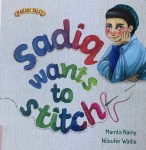
This 40 page AR 4.5 book touches on gender norms and breaking cultural expectations, as well as a mother’s love and a child’s determination. The beautifully illustrated pages show Kashmir’s landscapes and culture. The message is for third graders and up with its longer passages and understanding of gender roles, but younger children will enjoy the story just as well. My only concern is the timeline of the story, the mother has a week to make two embroidered rugs and worries when she awakens with a fever on the day the rugs are expected, exclaiming that she hasn’t even started the second rug. How was she going to meet the deadline even if she wasn’t ill? Even with the extension, she asks for a few days, not a few hours. That aside, the book is a lovely glimpse into a nomadic culture and people. There is no glossary at the end explaining namaz or Chacha or Bhai, but there is a bit of information about the Bakarwals of Kashmir at the end that provides context and enhances appreciation.
Sadiq wakes up to the sounds of the river Lidder, he prays and drinks his cha and heads to the meadow to milk the sheep and take them out to pasture. His father died two years ago, and now the responsibility of the flock is his. After his chores are done he sits and watches his mother embroider. He sometimes stitches his own patterns on the edges, but his mother does not like him sewing.
When an order from the city comes in for two rugs by the end of the week, Sadiq offers to help. His mother refuses his assistances claiming that the women stitch and the men tend to the sheep in their community. Sadiq dreams of the designs and colors he would like to sew and decides he will do so in secret.
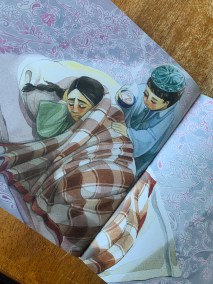
On the day when the rugs are to be picked up, Sadiq’s mother has a fever and cannot stitch. When the man comes, Sadiq’s mother starts to explain that they are not ready, but Sadiq surprises them both with his completed rug. The man likes it, but notes it is not what was ordered. Ammi wants to keep Sadiq’s rug and asks for a few more days to complete the second one, now that she has her son to help her.
Abdul agrees to a few more days, and the next morning Sadiq’s mom has hung Sadiq’s rug for everyone to see, and is proudly crediting her son’s work. She hugs him, just like she did in his dream, and chides him that she still expects him to do all his other chores before he sews.
As a partially brown person who enjoys camping and does it frequently, I have been anxiously waiting to get my hands on this beautiful 40 page, kindergarten to fourth grade picture book. So, trust me, I’ve read it multiple times to myself, to my children, and even to a Muslim storytime group to try and figure out why I like it, but, unfortunately, really don’t love it. Ultimately, I think it is because there is just too much going on.
Everything about this book is wonderful: the idea to encourage brown people to go camping, to highlight that time in the wilderness is for everyone and doesn’t have to look a certain way, that bullying and micro aggressions are oppressive, that immigrants have diverse and full lives in their home countries and work hard when they come to America, that culture and language and food and music is diverse, yet universal, that learning new skills and trying hard things makes you a super hero, that dad’s can cook and mom’s can be great fire starters and critter catchers, truly it is all so powerful and affirming, it is just a lot for one book.
It could easily be a three book series with just the information and layered themes presented, and I really wish it was spread out. If you are a 4th grade desi kid who has been camping or desperately wants to go camping this book is a great glimpse to mirror your place in the hobby without compromising your unique spin on it, but I think for anyone not in that demographic, many of the little celebrations, messages, themes, and cultural nuggets will simply be lost.
I wanted to hear the campfire stories and jokes, and laugh at the lyrics being belted out, not just told about them. I wanted to feel Fatima’s accomplishment at helping set up the tent and maybe see her struggle and rebound, not just be told she suggested reading the directions. The book has a ton of industry praise and personally came with a lot of expectation for me, so perhaps I’m overly critical, but kids in my storytime were struggling to stay focused when they couldn’t relate to the cultural touchstones being tossed out, they didn’t get the “not being good at math stereotype,” they needed the non text pictures to be explained to grasp their impact on the story, and they wanted to know why of all the Islamic things a Muslim family could do while camping, halal bacon was the only Islamic reference and came with precious little contextual defining.
The story starts with a Fatima and aapa waiting to be picked up after a terrible week of school to go camping for the first time. The Khazi family has immigrated from India and their father has told them that camping is an American pastime. During the week Fatima has been teased for her pronunciation and lunch, had her hair pulled and done poorly on a math test. But when her parent’s pull up with a packed car and the girls jump in to enjoy samosa and Bollywood songs, the weekend holds promise.
When they get to the campsite, Fatima and her dad tackle the setting up of the tent. Dad cannot seem to figure it out, and after the week she has had, Fatima is scared to help, but after a while she suggests looking at the directions and it seems that does the trick. The family enjoys shami kabab and rotis from home for dinner, before the girls climb in the tent.
A spider on the outside of the tent is magnified inside, and has the girls terrified it is a monster. Mom, the ever brave lizard and scorpion disposer in India reassures them that it is nothing and sends them off to brush their teeth before settling in for the night.
The next morning mom shows the girl the small spider keeping the mosquitos out and they all share a laugh while dad is cooking anda and roti on a gas grill. He calls the girls to come out in urdu to attempt a campfire to cook the halal beef bacon on like other American’s do. Dad and Fatima can’t get it to light, so mom, who is from a smaller town in India has to show them how it is done. Along the way Fatima looks at the other campers and is annoyed that they aren’t having trouble and that her family always is so different. The other families it is worth noting are white.
The Khazi family then starts to pack up and then they go for a hike, play in water and when the time to leave comes Fatima is sad. She doesn’t want to go back to the life they live where they are different and teased and her parents have to work two jobs each. But aapa suggests she share her fun at show and tell, and the family reassures her that they will be back.
The book ends with Fatima telling her class she is a superhero because she can build fires and tents and isn’t afraid of spider monsters. There is no glossary to define the urdu words used and spoken, but there is a reference at the end about the author’s @brownpeoplecamping initiative.
I think the book is rather remarkable and ground breaking because of its subject matter. The illustrations are wonderful, and the book a great reminder that camping and being outdoors is for all. I just wish it focused on a theme or two and highlighted them for this Indian American Muslim Family with relate-ability for other types of minority groups. The book set its own standard in what it wanted to achieve and convey, and sadly I think it missed the mark.
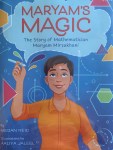
This 40 page nonfiction biography is beautifully illustrated and informative. I had never heard of Maryam Mirzakhani the Iranian born, first female winner of the Fields Medal. Her life from loving stories and not liking math, to becoming a student and later a professor in the United States is remarkable and inspiring. Second through fourth grade readers that both love and struggle with math will be drawn in to her unique way of looking at the world, and the math she found to serve as her magic wand in explaining it. I don’t know if she identified as Muslim, while in Iran she was forced to cover, but when she left, she no longer did. The illustrator is Muslim and religion aside, I am thrilled that a book like this exists, and that such a brilliant woman and her accomplishments can be presented to young readers.
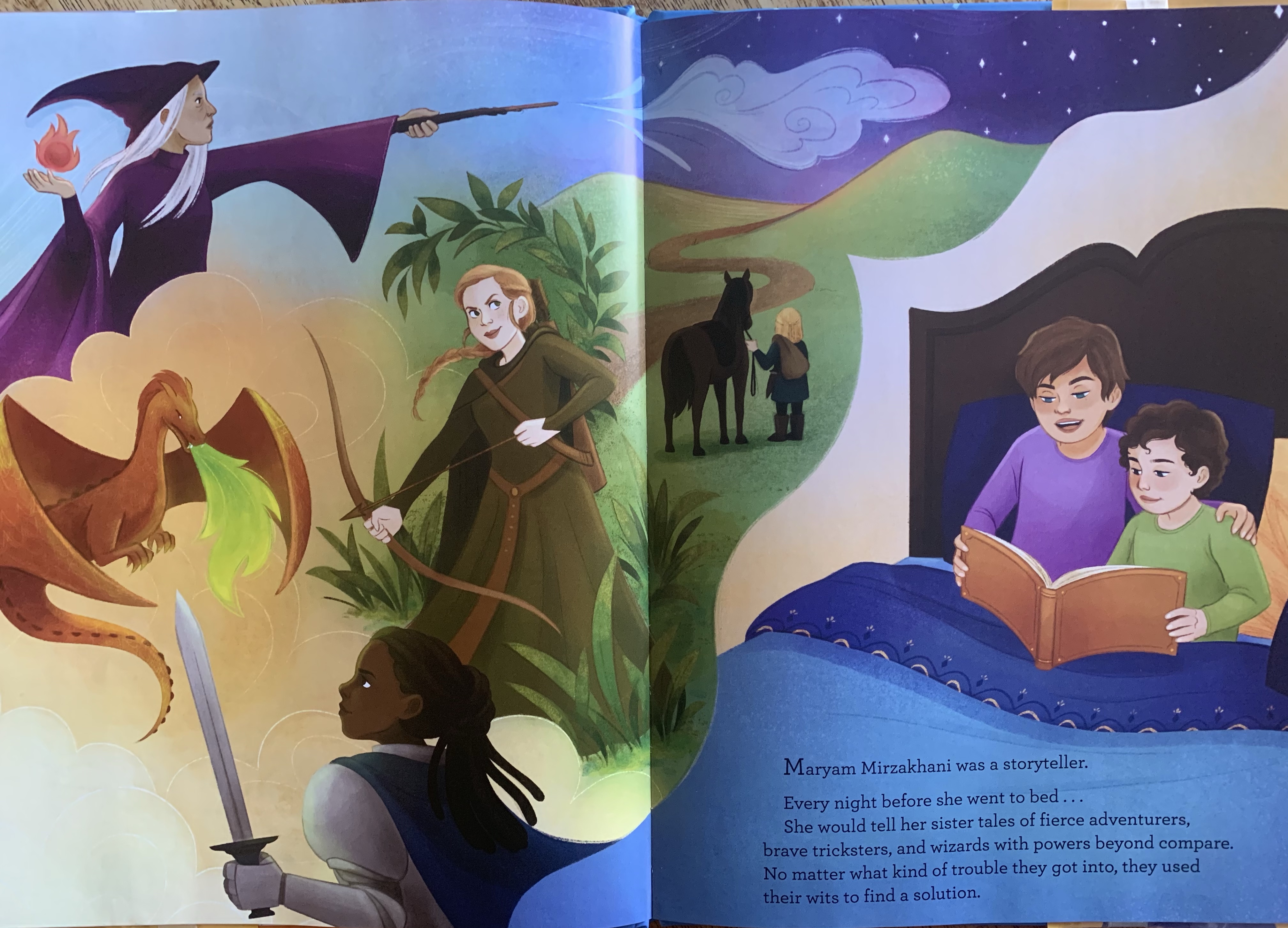
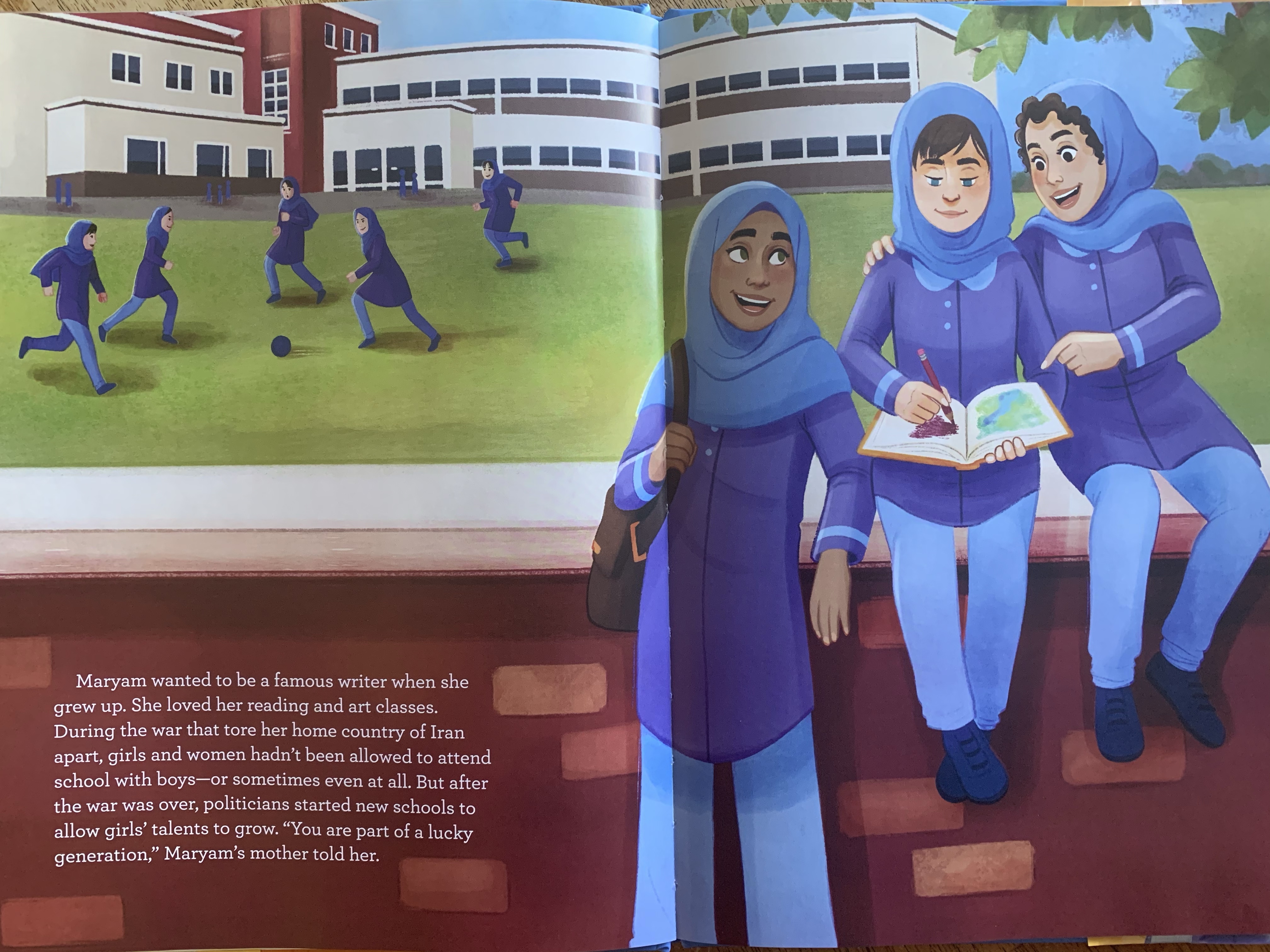
Maryam loves stories. She reads them to her sister, her best friend Roya and her browse bookstores and dream themselves into plots of their favorite stories. On the weekends she spreads long rolls of paper on the floor to draw and color her imaginary worlds. She wanted to be an author when she grew up and knew how lucky her generation was to attend school after the war that tore her country apart.
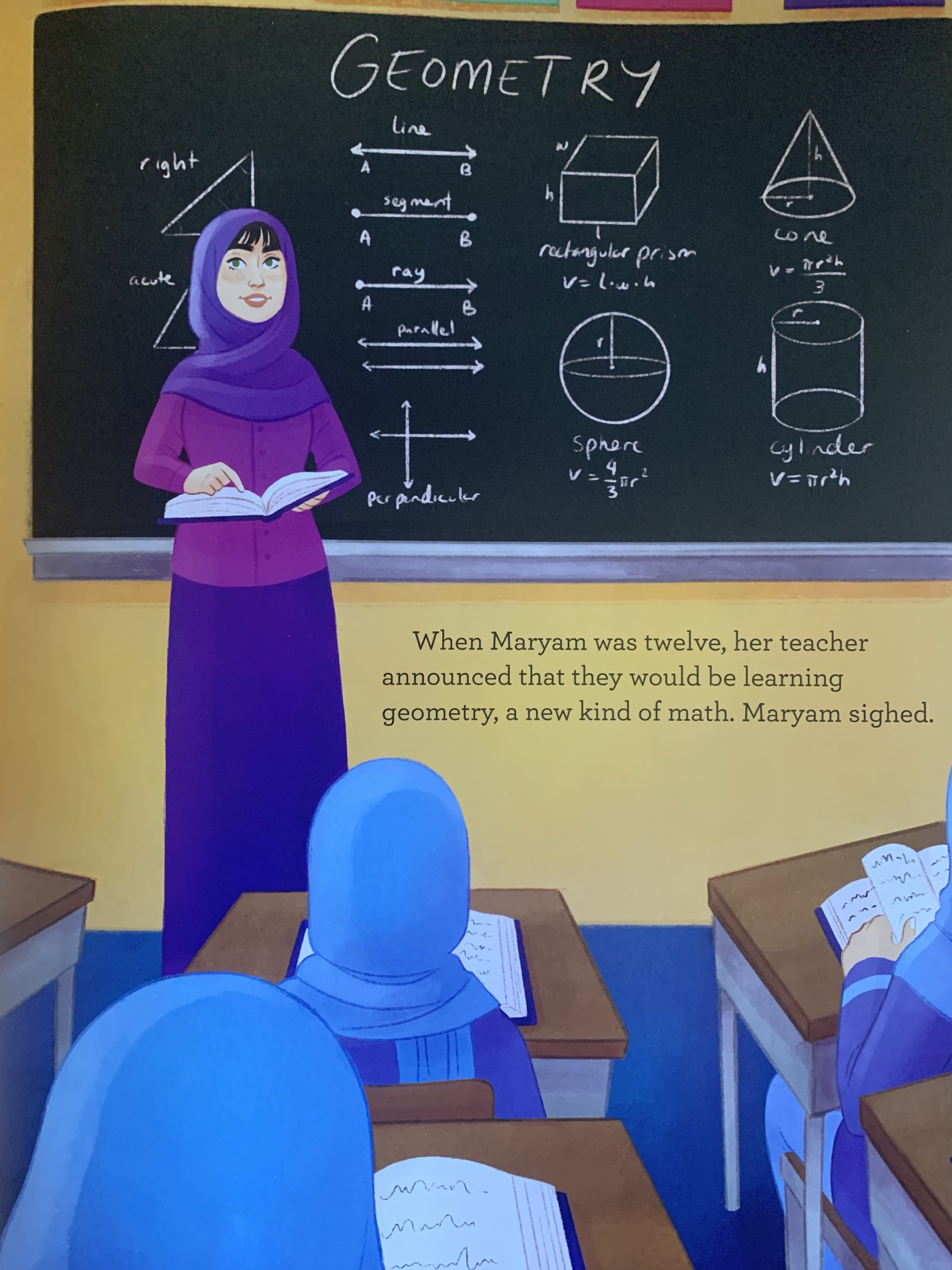
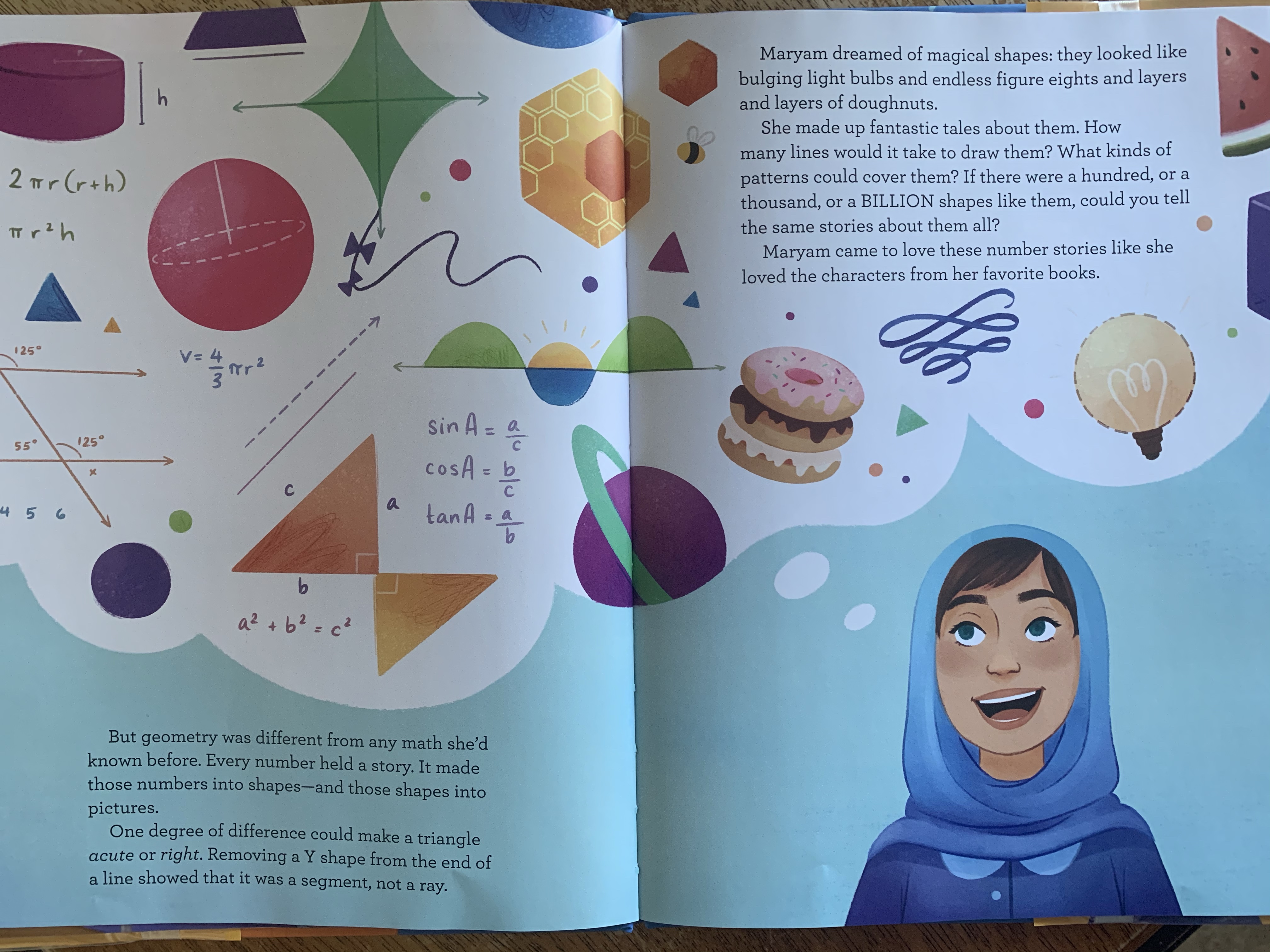
Math made her head spin, she would rather be doodling, but when she was 12 her teacher introduced her class to geometry. It was different, the numbers held stories and the shapes were pictures. She made stories about the problems and wondered about them as if they were characters.
In high school, Maryam and Roya entered the International Mathematical Olympiad. The first year they received participation medals, but the next year, Maryam won the grand prize with a perfect score. She finished her schooling in Iran devoting her life to the stories that numbers told and left Iran to start graduate school at Harvard in the United States.
When she had a hard time solving problems she would spread large rolls of paper on the floor and solve them. Her daughter would tell people she was a painter. She wanted to stretch the mind and how people went about solving equations. She became a professor and a lecturer and one of her discoveries became known as “the magic wand theorem.”
In 2017 she passed away from breast cancer and the world lost a remarkable storyteller, mathematician and human. The book concludes with an author’s note, important dates, and books to reference to learn more about Maryam Mirzakhani.
This 2021 nonfiction middle grade book about Ramadan and Eid al-Fitr breaks sections down by key concepts and the use of stock image photographs. The information is fairly accurate, no major flags, just a few awkward stresses: that kids look for the moon, that meat is so important at iftar, but most of the information is conveyed well. There is a glossary, more books to check out, internet sites to visit, an index, and pronunciation guide. The Capstone published, 32 page book, shows diversity in the pictures- some women with hijab and some without, different skin tones as well, and while it might not be the most tempting book to pick up, the text is inviting for non Muslims to understand Ramadan and Eid, how to join their Muslim friends in being kind and forgiving, and answers a lot of questions in a straightforward manner. Muslim children will also enjoy seeing their beliefs explained in a positive manner to readers in a book that stays religion focused and doesn’t get distracted by culture.
The book sections are: What is Ramadan?, When is Ramadan?, What does Fasting Mean?, Suhoor, Iftar, The Qur’an and Prayer, Acts of Kindness, Ramadan at School, and Eid Al-Fitr. It starts by introducing a fictional character named Ayesha reading the Quran with her family. It is the start of Ramadan, a month of praying, fasting, spending time with loved ones, and trying to be better people.
It then explains the lunar calendar before discussing that fasting is a choice to not eat or drink from dawn until sunset. It also notes that children and the sick and elderly are not required to fast.
It talks about eating healthy foods early in the morning before praying the first prayer of the day. It details iftar being dates and water, followed by the sunset prayer and then a large meal after that.
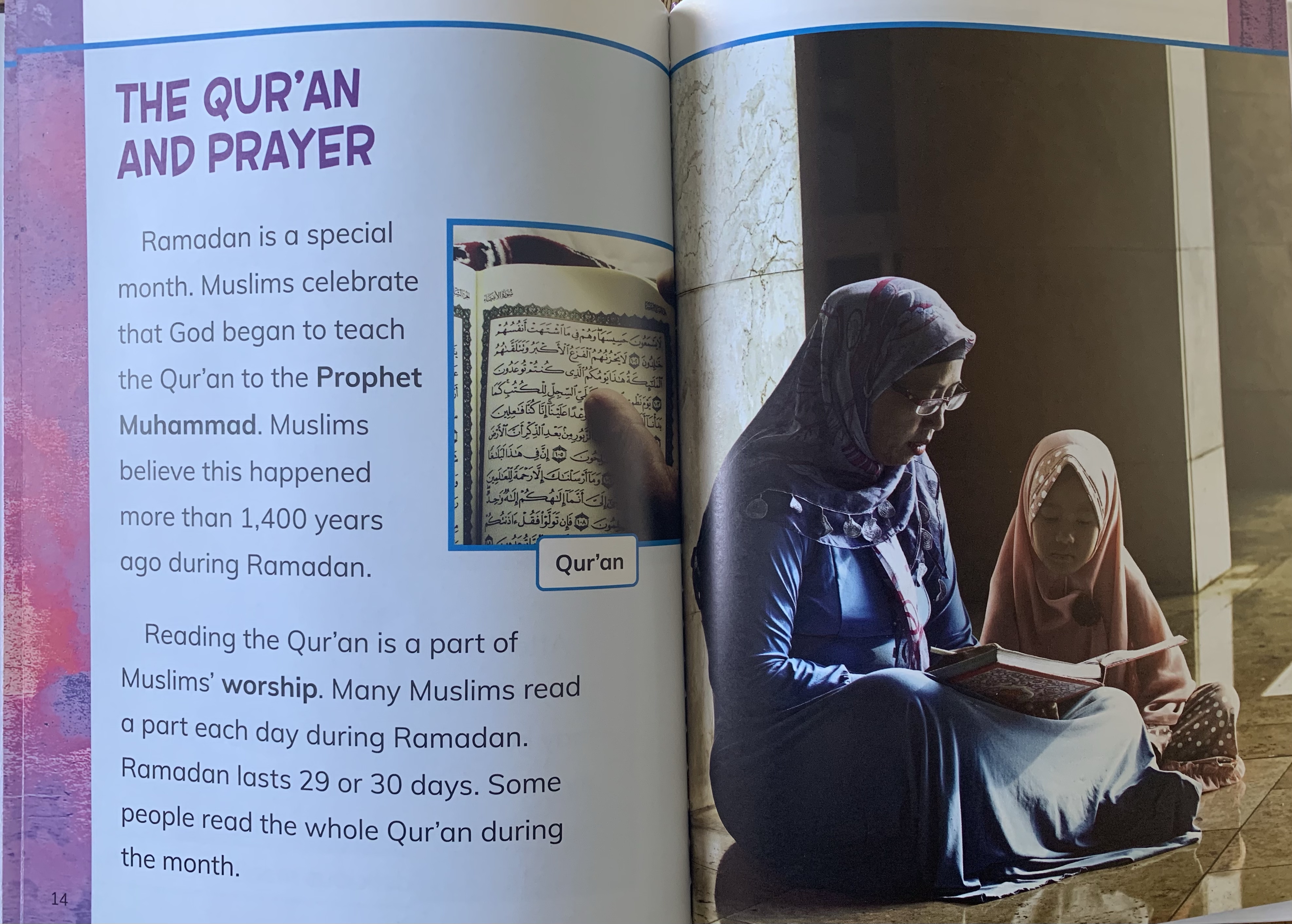
It is very clear in explaining that Muslims believe it was during Ramadan that God began to teach Prophet Muhammad the Quran more than 1,400 years ago. It identifies our five prayers and that people can pray at home or in mosques and that children learn to pray with their parents as they grow up.
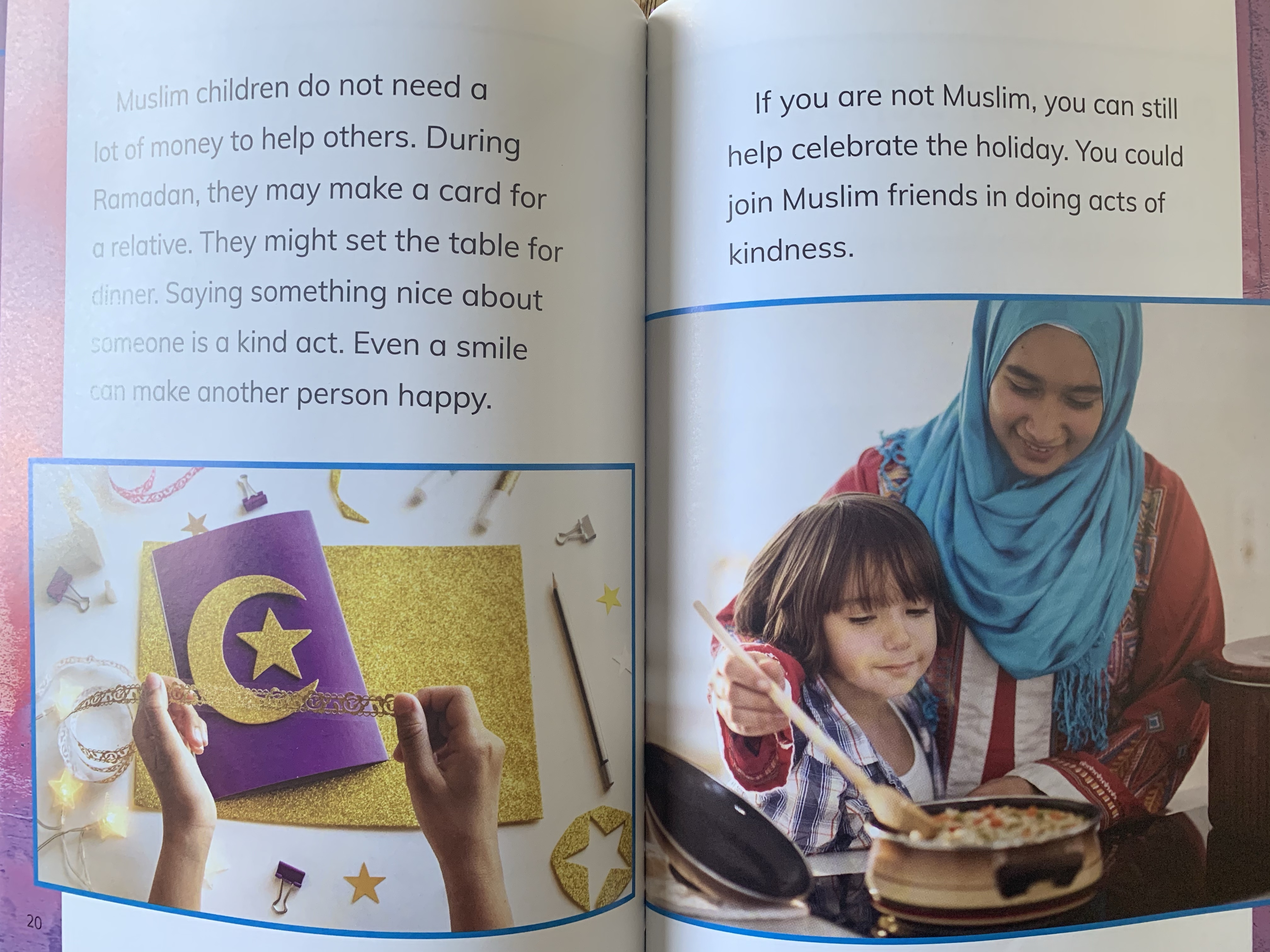
The book then becomes a little more unique as it gives time to the aspect of kindness in Ramadan. It gives examples of what Muslims do, from raising money and hosting large dinners, to buying and donating a toy. It even dedicates a whole page to children doing kind acts with little to no money: setting the table, making a card, smiling. It encourages non Muslims to join a Muslim friend in doing an act of kindness too.
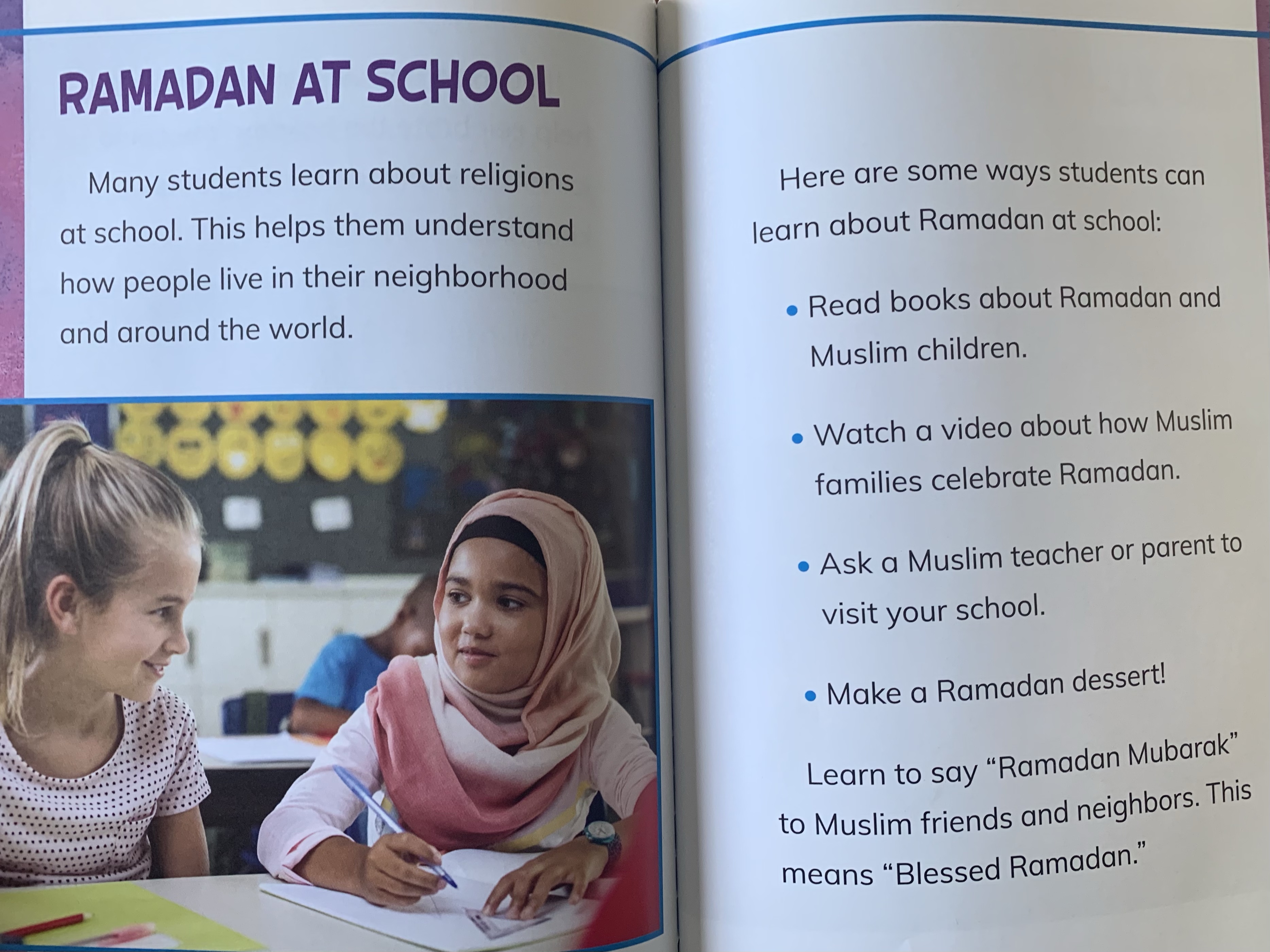
The next section, is similarly unique in talking about Ramadan at school and how often at school we learn about different religions in our neighborhood. It gives bulleted suggestions on how to learn about Ramadan in school and how to say Ramadan greetings. The book concludes with Eid Al-Fitr and coming back to Ayesha and her family celebrating.
NO! NO! NO! NO! NO! Seriously, astagfiraAllah! This 24 page middle grades non fiction book about Islam and Eid published in 2018 with smart-board connections and QR scan media enhancements on its surface would seem to be a great classroom all-in-one to learn about the basics of celebrations, Islam, Ramadan, and Eid. BUT, NO! The information is all sorts of off, and there is an illustration depicting Prophet Muhammad (saw). How is this sort of ignorance even possible? This isn’t even a Karen Katz My First Ramadan depiction where you can possibly argue and stretch that it isn’t a depiction of the Prophet, but just of the people. Every picture in the book is a photograph, except on the page talking about the first revelation, it is an illustration and there are no other people on the page, just a picture of the Quran. I encourage you all to see if your public library shelves the book and ask them to pull it. ****UPDATE: My library pulled it, and the publisher has halted sales of it. Alhumdulillah! We must remember we can use our voices to make a differences, that people are receptive and willing, not always, but we won’t know unless we try. ****
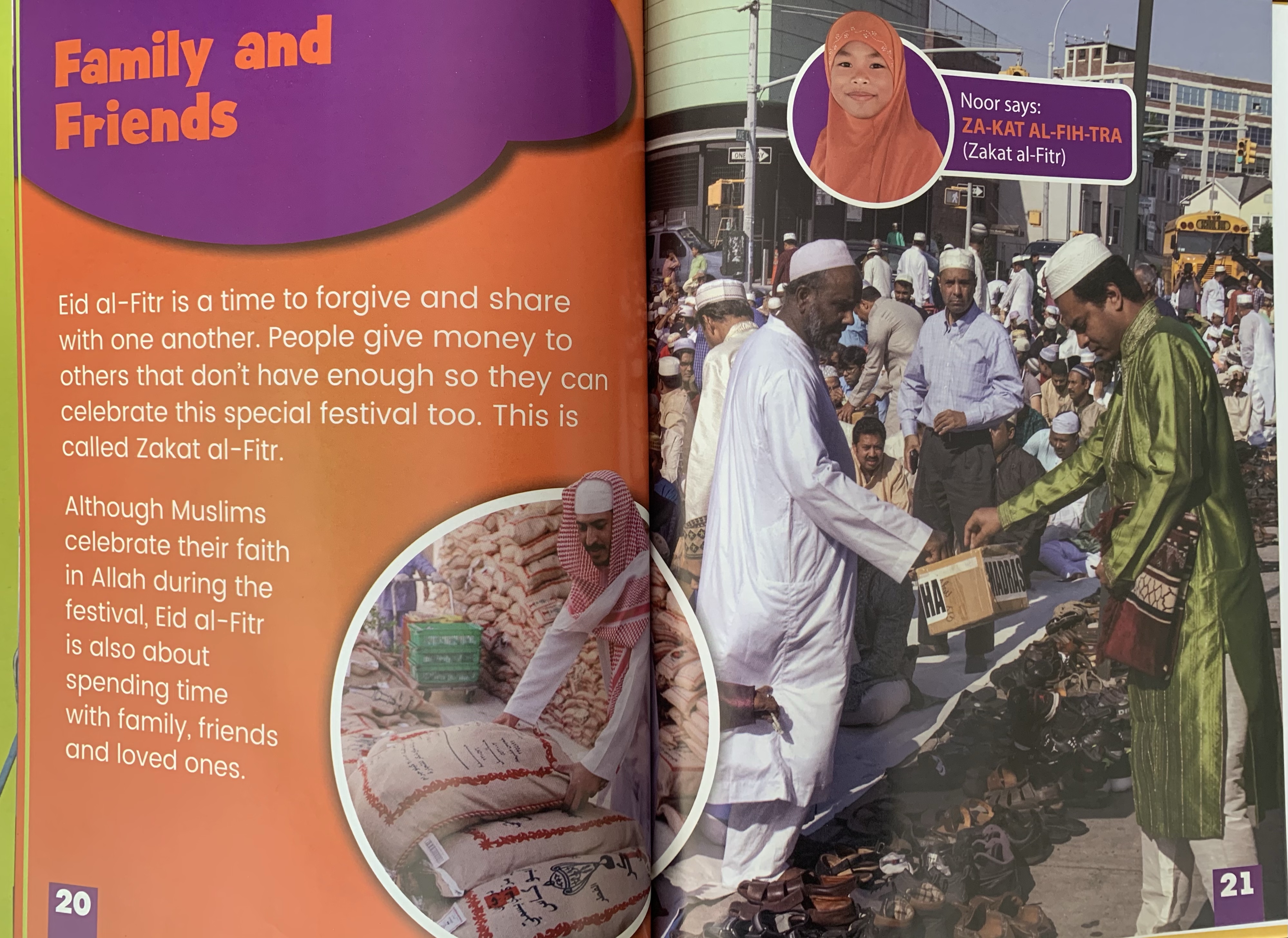
The book covers nine topics on two page spreads ranging from the generic what is a festival, to what is Islam to prayer and worship and festival food. The book has a little girl Noor that pops up on pages to tell you how to say a word and has a glossary with her definitions at the end. Even the definitions at the end about the foods are wrong, they seem to have switched ma’amoul and sheer khurma. To it’s credit the book has a photographs of a lot of diverse Muslims celebrating Ramadan and Eid, unfortunately so much is wrong, from little things saying that “Sheer Khurma is traditionally eaten for breakfast during Eid,” to “Muhammad spread Allah’s words to other people by writing them down in a holy book…”.
It has in quotes that a voice from the sky called to Muahmmad, “You have been chosen to hear Allah’s words.” This quote and its source are nor footnoted or referenced, clearly they are not from surah Al Alaq. I’m not sure where they are getting this from. There are no salutaions after Rasulallah’s name nor is Prophet before it.
Other informative sentences are vague and suggest misinformation. It says that we believe in Allah and pray to him in a mosque, which yes is fine, but we also pray to him in other places five times a day and the way it is worded, I don’t think that would be understood. I feel like the role of the imam is also overly elevated in the book. The takeaway I assume would be that only an Imam can lead a prayer and we must always pray in a mosque.
Ultimately the biggest problem I have in the book is the depiction of our beloved Prophet. I can forgive that they assume eating a random dish for Eid is religious and not just cultural, but I can’t forgive such basic ignorance in a book that presumably is trying to teach about a faith to reduce ignorance and misunderstandings.
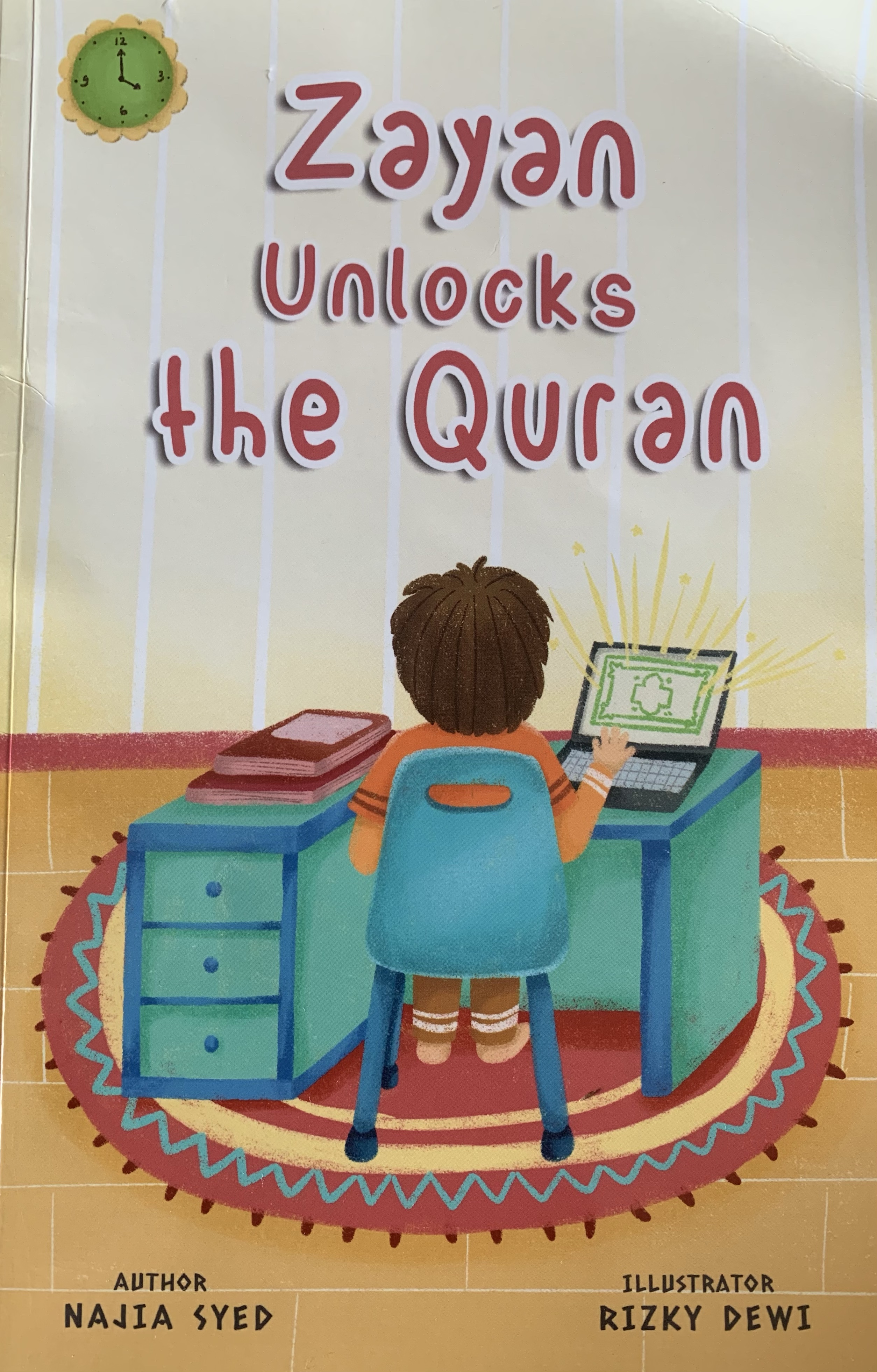
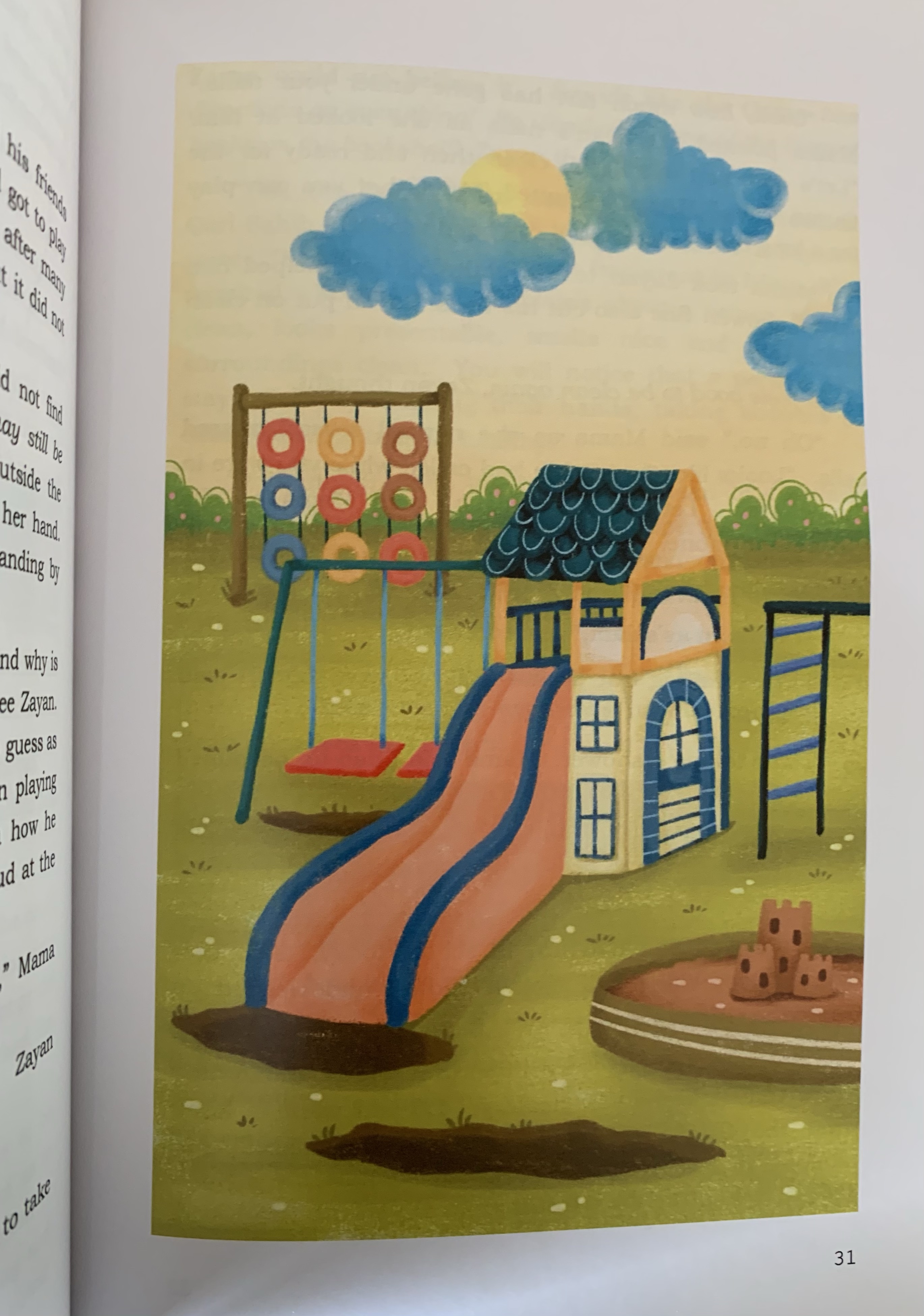
There is a lot of good information and relatable lessons in this 45 page didactic book encouraging children to get to know the Quran, and to not just recite and memorize it, but the presentation just doesn’t do it any favors. I can’t imagine that seven and eight year olds are going to identify with the five year old protagonist learning how to add and getting in fights over crayons at school, nor that five year olds are going to have the patience for the explanations and understand the story. The word story in and of itself is a stretch, it is a bunch of ayats from the Quran that are explained to teach young Zayan lessons that reflect his daily life and how he can succeed and inshaAllah earn jannah in the akhira. The intention is really good, I just wish there was a bit more plot and that the book’s appearance made more sense. Having the book look and feel like a leveled reader on the outside, but be completely tiny text filled, save a few entire page generic full-color pictures and green bannered meaning of the Quran’s translation, the book and its seven chapters are intimidating. Space it out, make it an early chapter book in look and feel, revise the premise that a child has no idea what the Quran is, and is completely shook by learning from the kind and patient Qari Sahib that the Quran has lessons and rules to make us better. It is a stretch to get the book going, it has some wonderful points along the way, and leaves a warm feeling when completed, but I can’t figure out the intended readers age, nor can I imagine many kids will willingly picking it up. Like the character in the book dreading Quran class, I’m afraid getting kids to read this would similarly be met with dread, which is a shame, because the lessons are strong, the story and presentation just need a bit of polishing.
SYNOPSIS:
Zayan does not want to leave his toys for Quran class which he attends one-on-one on the computer with his teacher, Qari Sahib. Reading the Arabic is hard and confusing, he doesn’t understand what he is reading and he would rather be playing. He has just built a fort and is afraid if he leaves it for class, his sister will destroy it, (over the first few pages I was convinced his sister was younger than him, and a little confused to learn that both are older). When he begrudgingly logs on, Qari Sahib can tell he is upset and tells him that being kind to his siblings is a good deed and that many good deeds are in the Quran. Zayan is shocked. Qari Sahib offers to read some ayats to him and he can just listen before they resume reading Surah Fatiha. Zayan is blown away at how pretty the Quran sounds when recited and his eyes sparkle when he learns that the Quran contains directions to get to jannah.
Chapter two explores how the ayats in the Quran about kindness can relate to Zayan’s life. Being kind to your parents, speaking in a low voice, and not making fun of each other. Ayats are pulled and connections made so that Zayan can inshaAllah implement his new knowledge in his life. Zayan returns to playing after class and tests out what he has learned.
This pattern continues with chapter three discussing respect, then anger and forgiveness, cleanliness, and honesty. The parables come when he doesn’t listen to his mother about finishing his grapes, a fight at school involving crayons, playing in the mud and lying about feeding his pet cat. At one point he remarks that much of what his teacher explains to him from the Quran are things that his mother also tells him, almost like she has read the Quran.
WHY I LIKE IT:
The first few lines are so relatable. The dread of the child putting the entire family on edge, it is real. I love that Qari Sahib is kind and gentle and patient. When the mom mentions things to him about Zayan he finds ways to talk to him about it, without lecturing or reprimanding. I think the Qari Sahim is the real hero in the book. I particularly like when he went in to detail about our responsibility to care for animals. I’m glad Zayan has him to guide him because clearly his parents have failed. Yes, I’m being judgey. The kid doesn’t know what the Quran sounds like, doesn’t know why he is being forced to read it in Arabic, doesn’t know what it even is about? I’m not so much judging the fictitious parents, more the inconsistent writing. If Zayan doesn’t know that his mom has read the Quran how does he know what jannah is and who shaytaan is?
FLAGS:
none
TOOLS FOR LEADING THE DISCUSSION:
Obviously not for a book club selection, but I’ve been trying to figure out if maybe my five year old and I could discuss some of the chapters together. I wouldn’t want to read the whole book because my child loves the Quran and doesn’t dread reciting, I have five children, I know tomorrow it can change, I’m not naive, I’m just saying for him particularly right now, it isn’t a chore and I think if I presented it as a boring thing, he will start to mimic that frame of mind (my older kids know not to ever bash certain teachers, concepts, spiciness of food etc. in front of their younger siblings for this very reason). But, while some of the lessons are really well thought out, they are just too much for a five year old. The pictures don’t engage and the text overbearing. I asked my 10 year old to read it and he found it really childish and didn’t finish. If the book works for you, alhumudillah, I’m glad, it is a benefit, I wish it worked for me too.
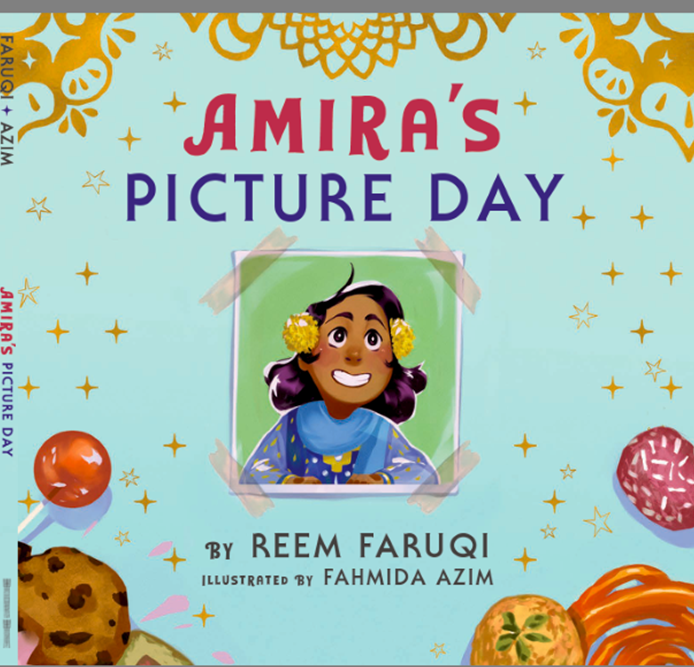
This book is the mirror so many kids are desperate to find in literature. A young Muslim girl is excited to celebrate Eid, while at the same time is sad knowing she is missing school picture day with her class. Not knowing what day Eid will be, not having it a scheduled day off in most school districts, and always feeling like you have your foot in two different doors starts early for children in non Muslim majority countries. This early picture book touches on those emotions, and even if you can’t always get a test rescheduled or a project due date moved, at least readers that face these dilemmas at any age and stage in life, will feel seen in this 32 page book perfect for ages 5 and up.
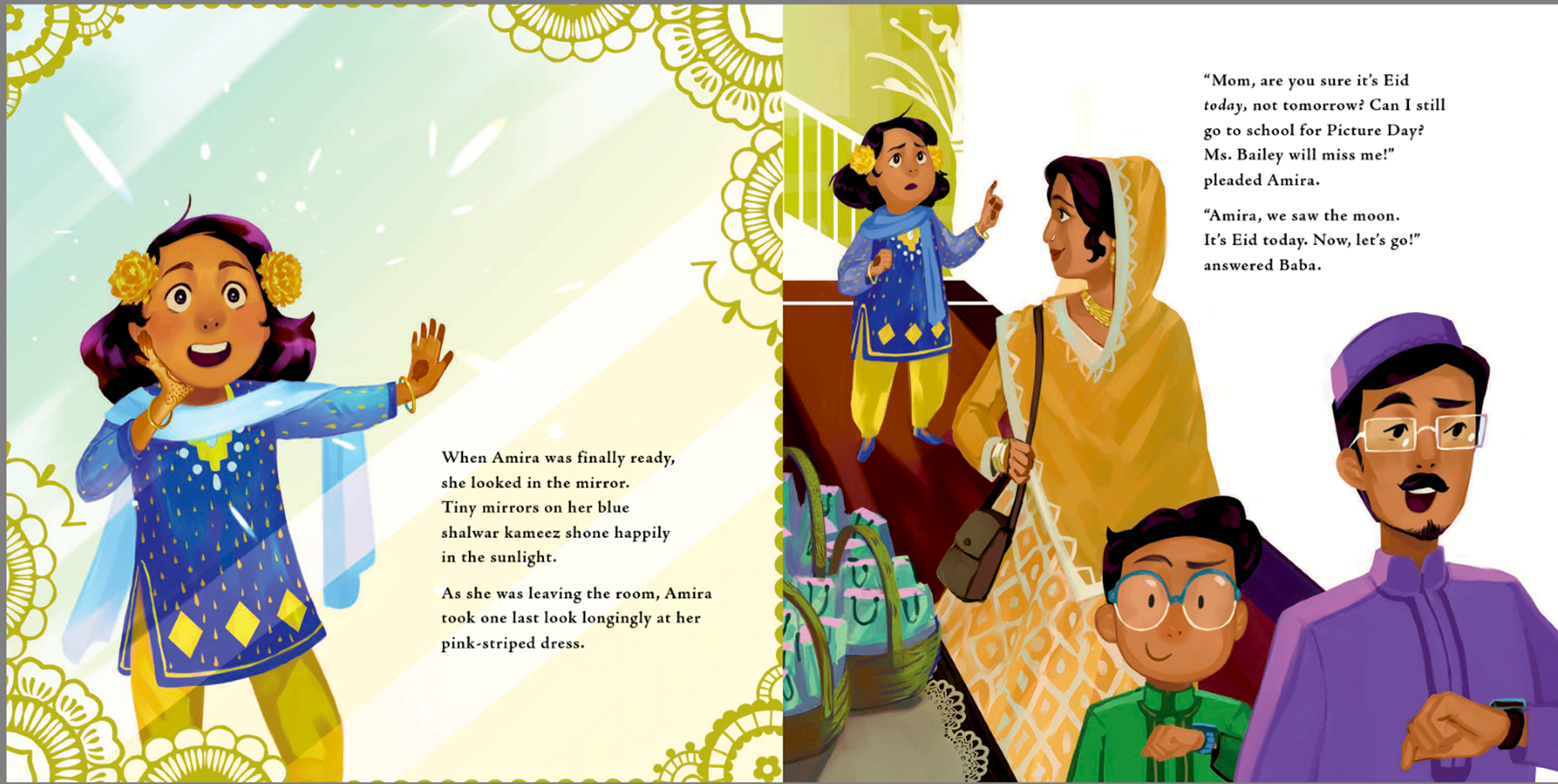
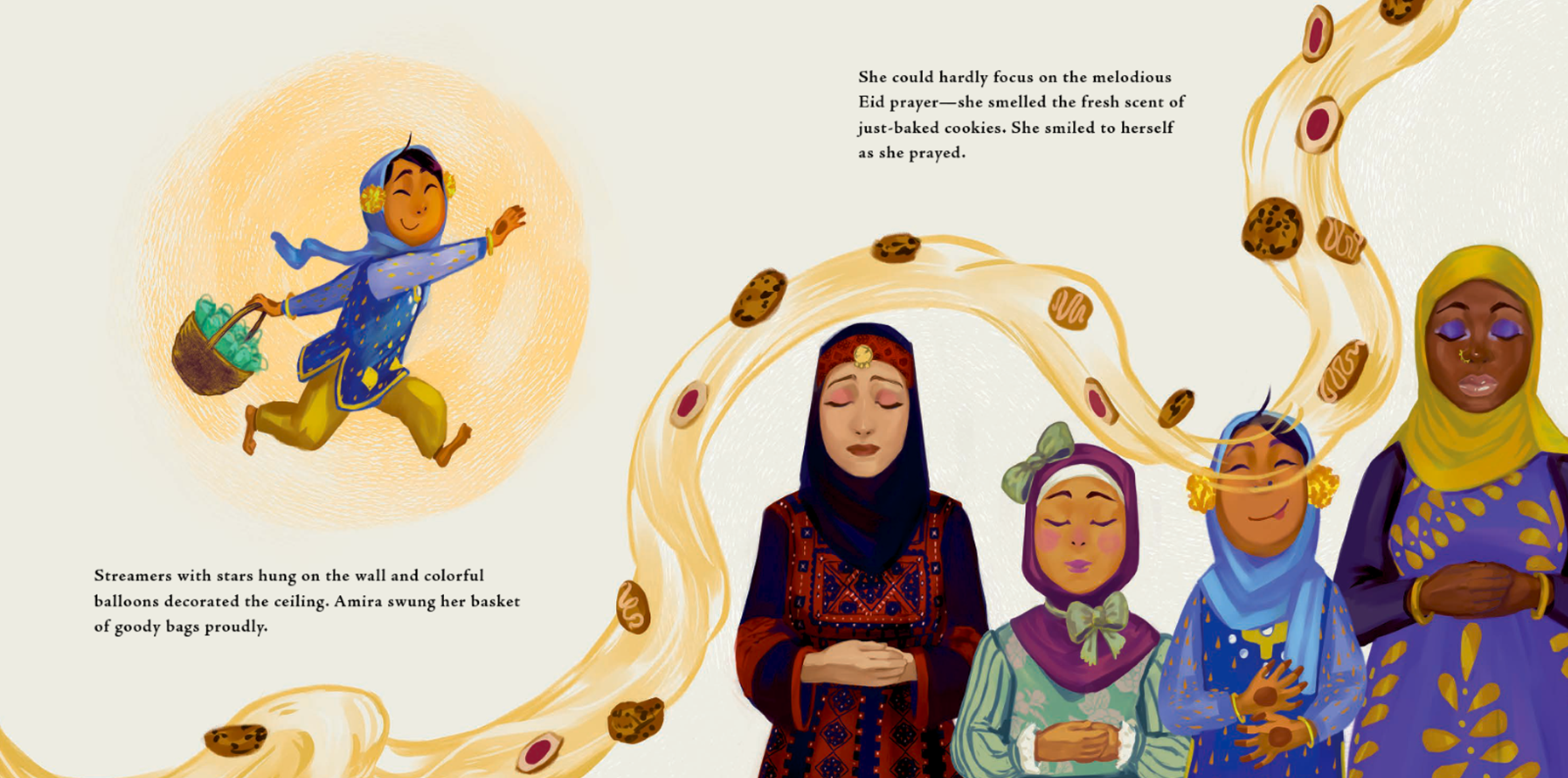
Amira and her brother Ziyad start the book looking out the window for the moon. They see it, which means Eid is tomorrow and Amira is going to have her mom put decorative Mehndi on her hands. She has her mom include a dolphin in the green swirls and hopes that by morning the color will be dark and beautiful. Ziyad is excited that they get to skip school.
Mom recruits the two kids to make goody bags and count out lollipops for the kids at the masjid, when the flyer for picture day catches Amira’s attention. Devastated that she will miss the class picture having already picked out a pink-striped dress for the occasion, mom reassures her that she will get to wear her new shalwar kameez, and they will take lots of pictures at the masjid.
Amira loves going for prayers and the party after, but she is kept awake at night worrying how her classmates will remember her if she isn’t in the picture. The next morning she is excited, it is Eid, but seeing her pink dress hanging next to her blue Eid outfit makes getting dressed a heavy process.
When they get to the masjid, Amira hardly recognizes it, it is all decorated and everyone looks beautiful. The smell of baked goods makes focusing on her prayers difficult, and after when everyone is taking pictures she remembers what she is missing and feels deflated.
On the way home Amira works to hold back the tears, when she suddenly has an idea to take the remaining goody bags to her classmates, and maybe catch her class pictures. Her parents agree and they stop at the school.
I won’t spoil if she made it in time, but the kids in her class love her clothes, and her mehndi designs. The book concludes with an Author’s Note, More about Eid and a Glossary.
I absolutely love the illustrations, little Amira is infectious and endearing. I wish the mom would have been a little more in tune with Amira’s feelings though, she definitely is upset and while I’m glad the family stopped after the Eid party, I feel like more could have been done beforehand to acknowledge Amira’s feelings, and see what could be done to accommodate both activities.
I love the diversity and brightness of the book to convey the absolute joy and happiness of Eid outside of presents. I think the book works for all children of all backgrounds and is a much needed addition to the repetitive Eid books available.
I’m a big fan of books featuring BIPOC leads in everyday situations, but when the quality of the product is subpar, I truly am conflicted if I should mention the book, or just tuck it away and pretend I never read it. I’ve had this book tucked away for a while now, but I am pulling it out to bring attention to the importance of editors, proofers and revising. The bar has been raised, Islamic fiction is becoming more and more mainstream. The quality of many self published books rival and exceed traditionally published options, that to be putting out content that contains grammar errors (missing words, punctuation, random line breaks), spelling errors, voice and point of view inconsistencies, illustration errors, and content mishaps in a 26 page picture book, is not acceptable. I feel like you are hurting the goal of representation and reflection, more than boosting it, when it is not well done. I know that is harsh, but sadly minorities always have to do things better, it isn’t right, but it is the way it is. You can argue my opinion that the story is too wordy or text heavy, but the technical components and final package in a $12 book, really need to be resolved. The overall concept of the story is lovely: the Islamic details, the reminders about the sunnahs of Jummah, the little girl being excited to wear her favorite scarf and see a friend at the masjid, it really had a lot of potential.
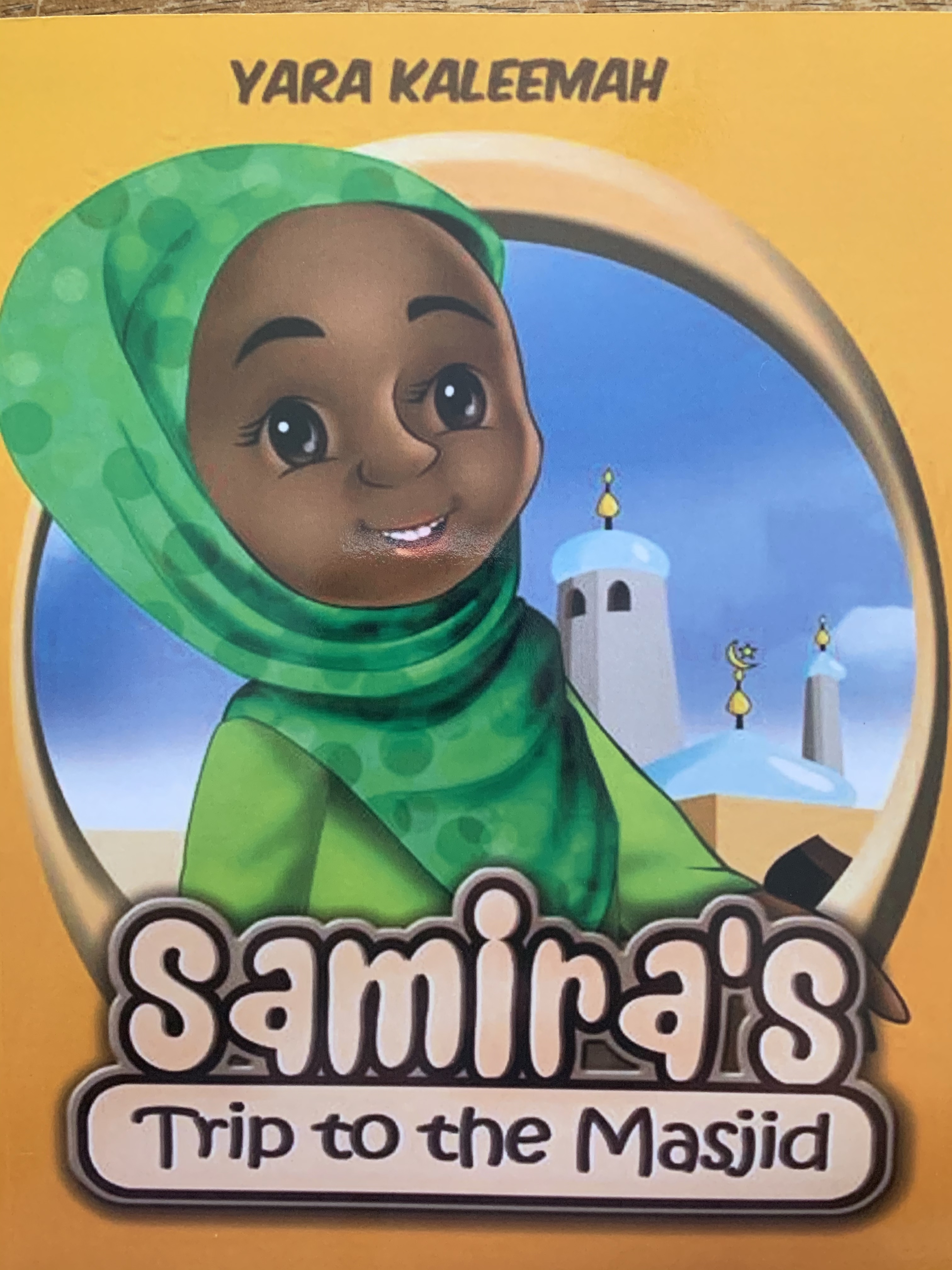
Samira greets the reader with As Salaamu Alaikum, as the fourth wall is breached and introduces herself as being a Muslim. She then explains what being a Muslim is and tells the reader it is Jummah. She asks her Ummi why we go to the masjid on Friday, before chiming in with all the information she in fact does know about Jummah.
The next page details wudu as she prepares to go to the Masjid. She then explains hijab as she tries to find her favorite green khimar with polka dots. The words hijab, scarf and khimar are used interchangeable, causing a bit of confusion, She explains that hijab is required by Allah swt to guard your chastity and that He also requires us to wear a khimar to the masjid. I wish it would have clarified that we have to be covered when we pray, not necessarily just going to the masjid as she is a child, and many masjids are more than just places to pray, often having community halls and gyms.
As the story continues she cannot find her favorite khimar no matter where she looks. Ummi tries to give her some places to check, but in typical mom fashion, Samira can’t find it anywhere, and mom can find it immediately. Samira shares some information about wearing your best clothes and they are off to the masjid not wanting to be late and hoping to get to the masjid first as the angels keep a record. She finds her friend, and settles in to listen to the khutbah (misspelled as “Iman’s lecture” in the book).
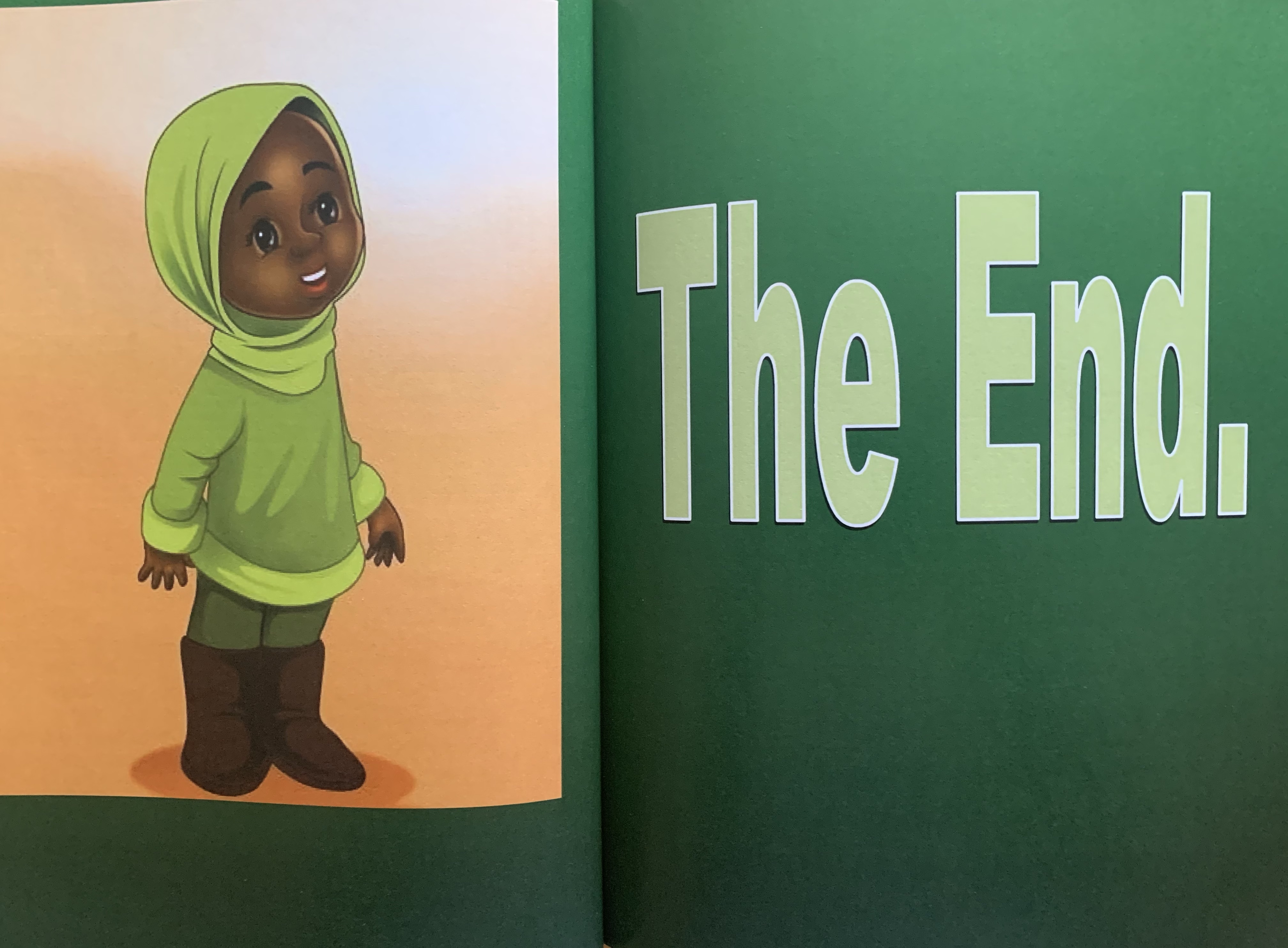
The conclusion of the book says “that even though Samira couldn’t find her favorite khimar, she was happy to take a trip to the masjid…”. But she did find her favorite khimar? And on the very last page she is wearing the same shirts as she was at the masjid, but the polka dots have vanished from her green scarf?
I’m hoping the author, illustrator, and publisher will clean up the book and someday republish it, we need these voices and images.
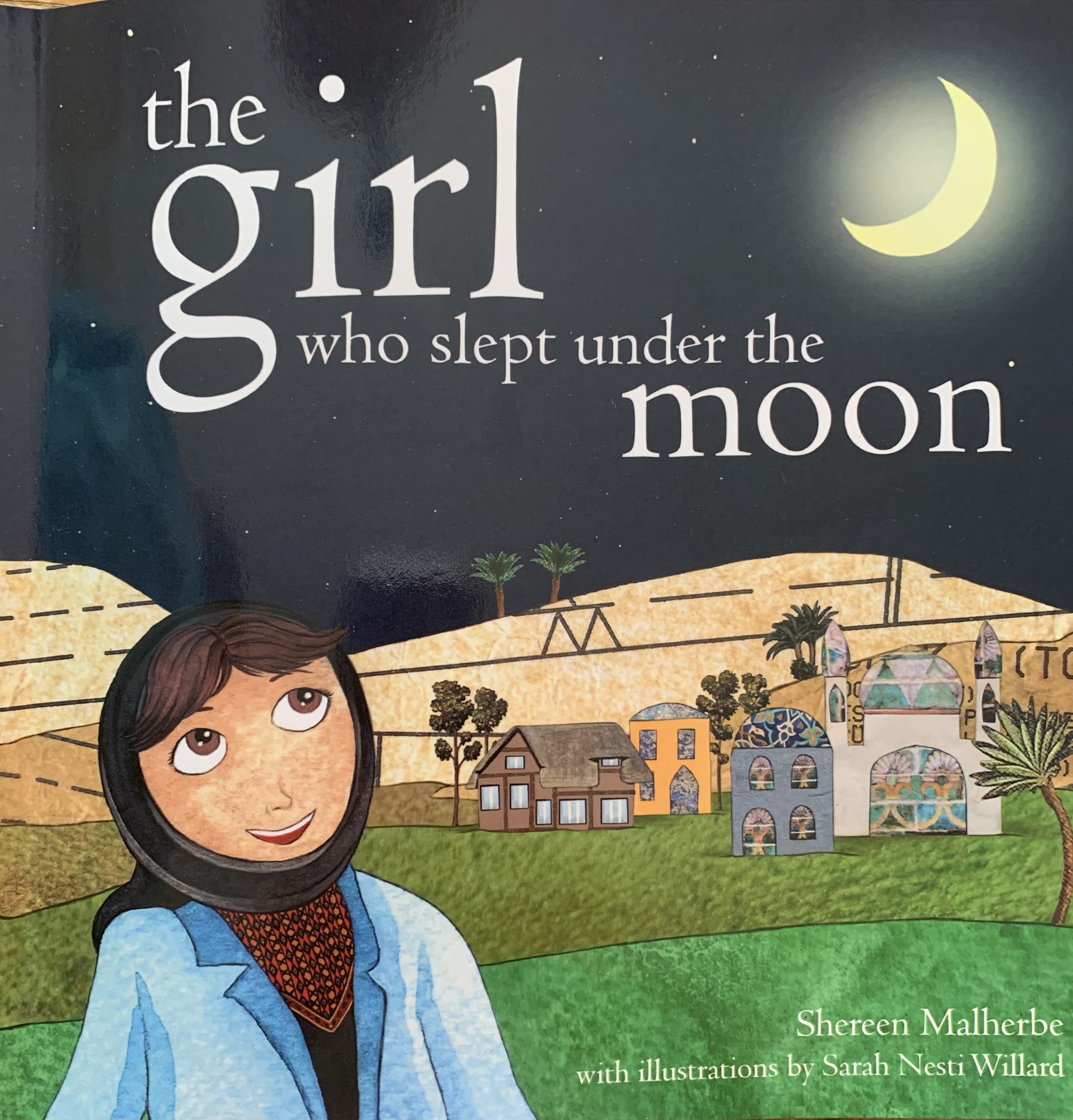
I was really surprised by the number of gaps in this 46 page story that is so adorably illustrated and seemingly planned out. I thought perhaps I was being overly critical, so as always I tested it on my kids, and they too were confused by the main character’s rational and choice of words, the holes in the narrative, and the inconsistency of the characters. The book is wordy, so conciseness cannot be the reason for the holes, and it is published by a publishing company, so I would assume it has been proofed. Really the point of stories connecting us and giving us comfort when we need it, is sadly lost. I had hoped to love this fictional story of a Palestinian girl using prayer to give her comfort in her new home, but alas it seemed to be trying to weave in too much, and as a result the story isn’t fabulous for me unfortunately.
Noor is new at school and stands out. She finds comfort in remembering the things that are the same. 1-Allah could still see and hear her. 2- The Angels were still by her side, and 3-She still slept under the same moon. She also wears clothes that remind her of home and provide an unspoken clue as to where home is for her.
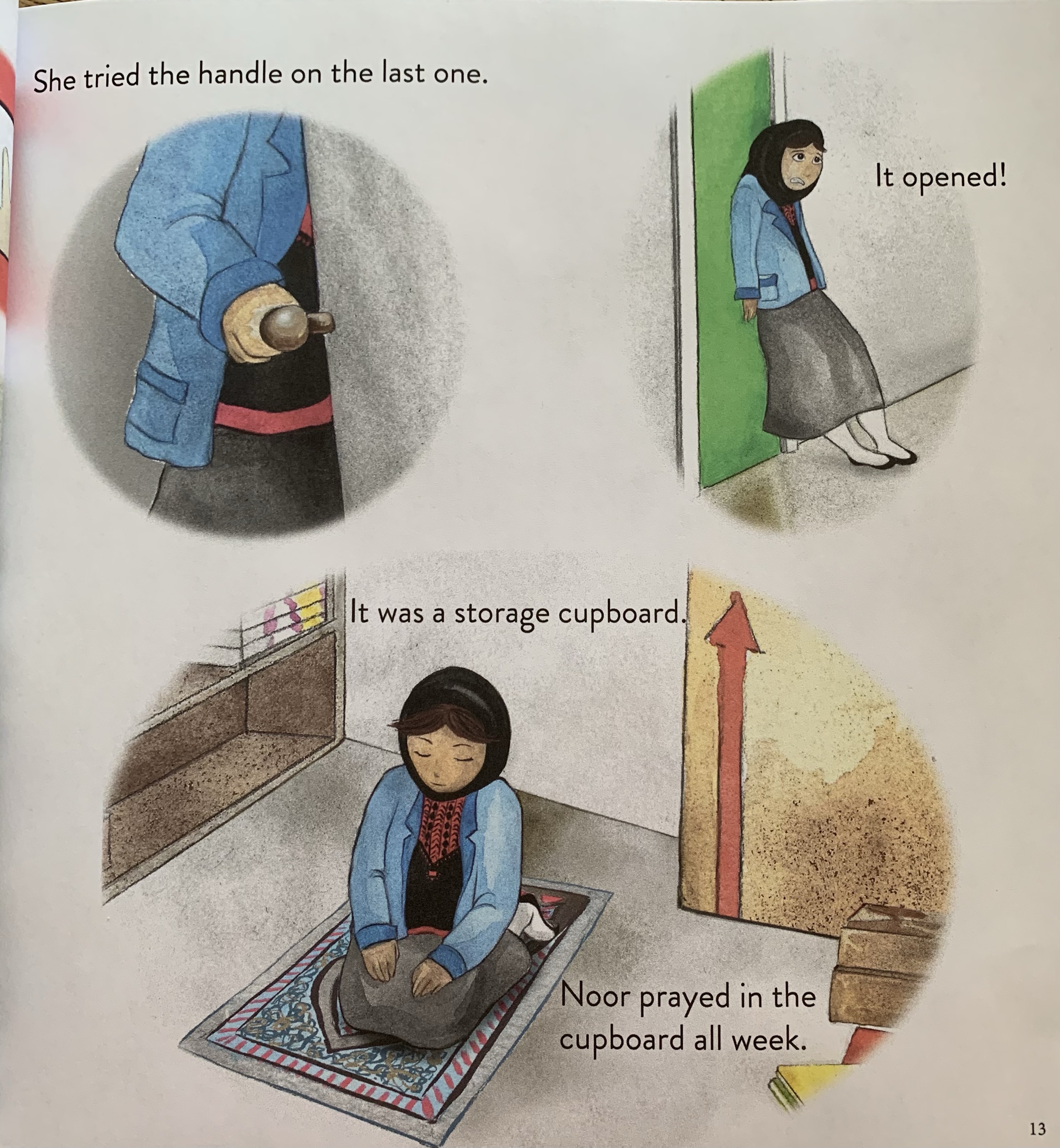
At school Noor has a problem, she needs a place to pray, but at lunch time the kids are not allowed to go inside and the dinner lady guards the door. Noor needs a distraction to sneak in the building and it isn’t clear if she provides the distractions, or just benefits from a baby bird falling out of a nest, a snake being in the grass, and a classmate getting hurt. Either way, when the teacher is occupied, Noor enters the building and finds a closet to pray in.
On one such visit to the closet she finds someone already in there, Hannah. Hannah is there because she doesn’t like being on the playground because she is different. Noor never asks why Hannah feels different, so the reader isn’t made aware either. Hannah asks her why she is there and Noor says she comes “to pray because it reminds me of where I’m from.”
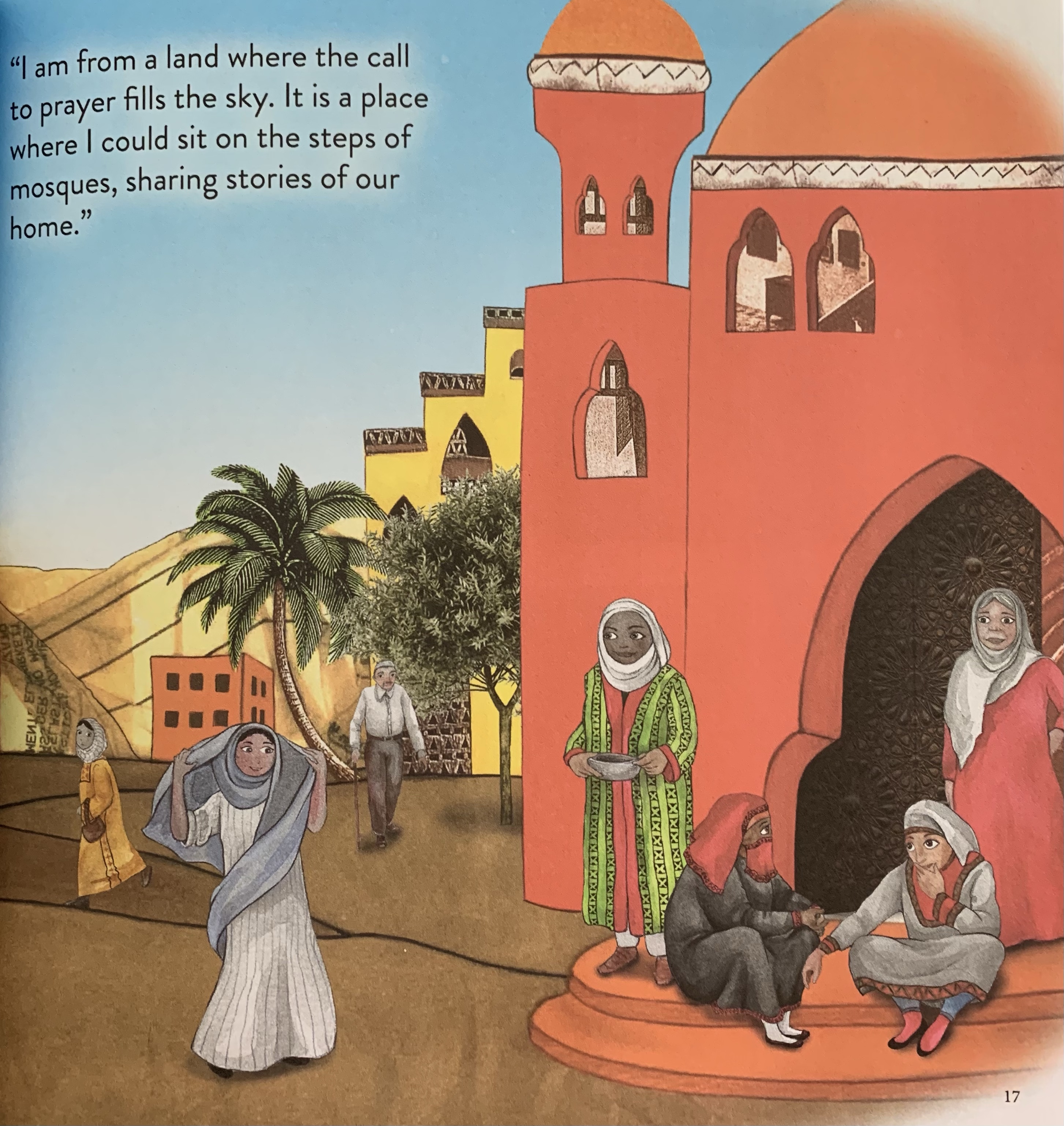
When Hannah asks where she is from, Noor doesn’t just simply answer, she tells her stories about her homeland, the mountains, olive trees, where the athan floats in the air and fisherman return to the shore with their catch. The next day Hannah is there again, and Noor tells her more stories and legends about her culture and lessons of the Prophets. Noor learns that through her stories she feels connected to her old home.
Weeks pass, and one day when she sneaks in to the school, she finds the door locked. With no where to go she heads back to the playground and starts to cry that she won’t be able to pray. She then sees Hannah disappear and she follows her in to the drama studio. When she enters she sees sets built that look like the setting of her stories, of her home. Hannah knew she missed home and built her sets to look like Palestine.
Other kids miraculously enter, and Noor begins telling them her stories, without praying first. The other kids seem to enjoy her stories and Noor learns that she can pray anywhere while holding on to her three reassuring thoughts.
The illustrations are engaging, although I’m not sure where the prayer rug seems to magically come from for Noor to pray on in the closet the first time. Had the book just been about prayer and finding a way to pray, or just about the stories connecting us to our past I think it would have been more powerful. I’m glad that Noor loves salat and that Hannah is a good friend, but I feel like by trying to do too much, the poignancy of the little things was lost.
And as for my questions: Can’t Noor ask for a place to pray? Can’t she pray outside? How is Hannah making the sets all by herself? Noor says she prays because it reminds her of home, she doesn’t pray for the sake of Allah or because it is required of her? Why did Hanna feel different, and why didn’t Noor bother to ask? It says that she needed to distract the dinner lady, isn’t that dishonest even for a good cause? Did she harm the baby bird so that it would need rescuing? Put the snake in the grass? Hurt the little girl so that she could get by the teacher? How was Hanna getting inside at lunch time? How is the school ok with a kid coming inside to build a whole set with school materials, but can’t let another child inside to pray for less than 5 minutes? And if Noor didn’t feel comfortable asking for a space to pray, clearly Hannah had connections to get permission to create a huge scene, couldn’t she have asked, or helped Noor ask?
This lyrical journey through Palestine’s major cities, shares historical facts, geographical information, cultural richness, and love for a homeland that will inspire and educate all readers. There is a lot of information pressed in to 32 pages and at times the rhyming text, illustrations, and maps are powerful, and at other times overwhelming. The 8.5 x 11 horizontal paperback bound book needs to be bigger to hold all that the pages contain, and hard back to hold up to the details that need to be poured over to be appreciated. The content about the names and places in Palestine is priceless and well done, but I really wanted to love the book a bit more than I ended up feeling for it. I think trying to make it all rhyme was just a bit too much for my liking, but I would buy this book again in a heartbeat to share with my children. Even though we are not Palestinian, I think all Muslims have a piece of Palestine in our hearts and feel a deep need to celebrate the culture, fight for their freedom, and demand a quality of life that they are brutally being denied by their oppressors.
The book starts out at bedtime with a little girl, Saamideh asking her baba what her name means. He explains to her that it means “one who is patient, persistent and one who perseveres.” She is named this because she is Palestinian, he explains and then he shows her the key to their ancestral home in Palestine. He asks her to close her eyes and imagine a white dove, named Salam, taking her on tonight’s journey.
Salam and Samamidah prepare to journey across Palestine’s mountains, hills, deserts, and plains. They start in Areeha, one of the oldest cities in the world, and one one of the lowest points on Earth.
They journey next to Al-Quds, the capital. They see the old city, Al-Aqsa, and more, before heading off to Nablus, Yafa, Haifa and the Akka. Learning about the cities, the food, and the history of each.
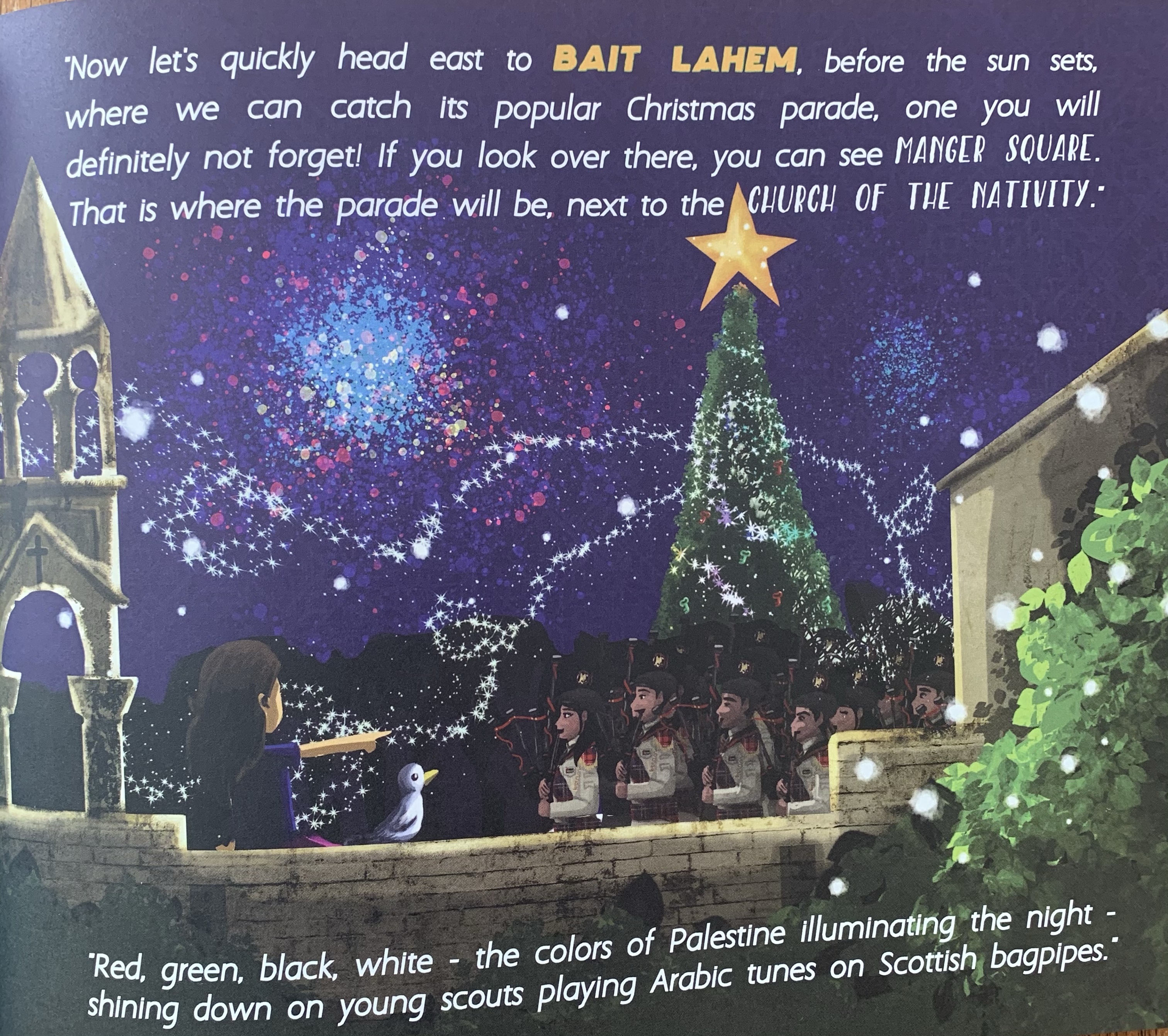
They learn about the dabkah, and the weaving in Gaza and head to Bait Lahem too. They learn about glass blowing in Al-Khalil at the Ibrabhimi Mosque, and finally they conclude their journey with the little girl dreaming of flying around the world to use her key and open people’s hearts and minds.
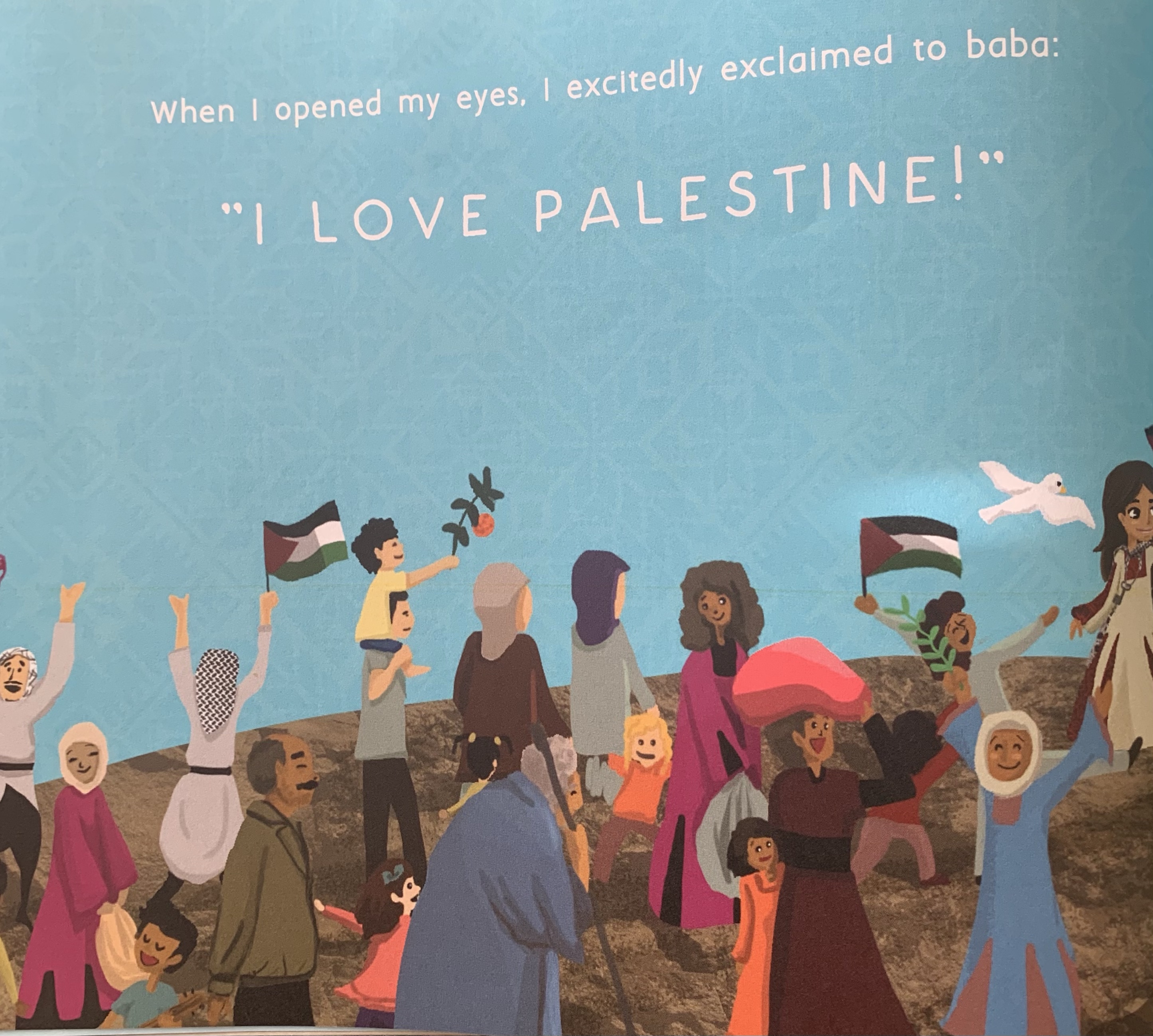
She proudly exclaims her love of Palestine and her and her baba pray that one day they will be able to return. Saamidah then asks her baba why they are refugees, and he promises to save that conversation for tomorrow’s beditme story.
The book concludes with a list of the city names in Arabic, trasliterated in English, and then the English names. It then has discussion questions at the end.
The book is not outwardly political, nor critical. It is a celebration of a people, a culture, and land. Happy Reading!































 Islamic School Librarian