Category Archives: 2nd through 4th grade

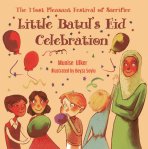
The Most Pleasant Festival of Sacrifice: Little Barul’s Eid Celebration by Munise Ulker Illustrated by Beyza Soylu

Standard
The Most Pleasant Festival of Sacrifice: Little Barul’s Eid Celebration by Munise Ulker Illustrated by Beyza Soylu

batul.jpg

This book is beautiful, it feels great in your hands, the raised glitter embellishments in the illustrations, the price point, everything except the text.  The gist of the story is even fine, the execution is just off.  It reads very much like it has been translated from another language in to English, and yes my privilege might be showing, but the phrasing, the passive voice, the orphanage, all make the book with its massive text passages hard to convince kids younger than 7 to sit through.
batul9

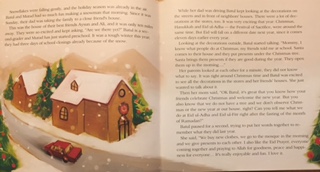
The story starts off with parents and two kids , Murad and Batul, driving to a friend’s house for dinner, commenting on the Christmas decorations that they see.  The parents ask what the kids know about Eid al-Adha that is coming up and the kids remember how much fun they had in Turkey.  Except it is really awkward to get this bit of information out.  They discuss Eid last year, and then remind each other that they were in Turkey, and how it was much more fun.  Noting that international travel is expensive and they won’t be able to go again, the Mom over dinner discusses how they can make Eid fun for the kids with her friend.
batul2

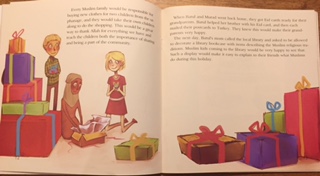
It is decided that the Muslim and non Muslims will celebrate together and include a local orphanage.  “Each Muslim family would be responsible for buying new clothes for two children from the orphanage, and they would take their own children along to do the shopping.” This would teach the kids to thank Allah and learn about community and sharing.  A great lesson overall, again just a concept presented in a really wordy, round about, awkwardly forced manner.

The Mom contacts the library and gets permission to decorate an information table, the kids make Eid cards for their grandfather in Turkey, at Sunday school they make gifts for friends.  They learn about Zakat and sacrificing an animal like Allah commanded Abraham to do, they even send cards to their neighbors.  Oddly though remarking how fun it is to get candy outside of Halloween.  After the first two pages explaining Christmas and telling that Muslims don’t celebrate it, I found it odd that they would, 15 pages later, be referencing Halloween. 
bat

Some of the sentences also don’t made sense.  About half way through I didn’t understand what the author meant by the boys “celebrating each other’s Eid” after they put their new clothes on and went to Eid prayer.

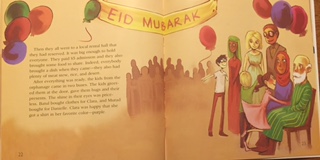
Once at the party, they give specific details of how much they charged everyone, yet no details about the food they all brought.  The kids enjoy a pinata and everyone including the orphans get Eid gifts.  Despite everyone’s fun the party has to end, and the orphans return to the orphanage and Murad and Batul declare they “will always remember this Eid.”

batul3

The illustrations are great, it is really yet another example of a book just needing a good editor.  From the very beginning, even the title isn’t really right, the book isn’t even mainly about Batul, to the random details shared, the book is just too long and too unpolished.  It is really unfortunate, because it has so much going for it on its 32 pages.  The main points however, I feel are lost about Eid and the reason it is so dear to Muslims everywhere.

No Ordinary Day by George Green

Standard
No Ordinary Day by George Green

no ordinary day.jpg

I was really, really excited to get this book in my hands.  An early chapter book, about Islam and sports, with diverse characters, that seemed to be the start of a series featuring the “Childhood Champions,” seemed to have the potential to fill a gaping void in Islamic fiction.  And while the book shows promise and has a lot going for it, it falls short of what it could be, and perhaps with the ever growing book options, what it should be. 

To be clear the Islamic lessons and values are on point as are the pictures, it is the holes in the story, the random text layout inside and the lack of depth that keep this book from reaching its full potential.

SYNOPSIS:

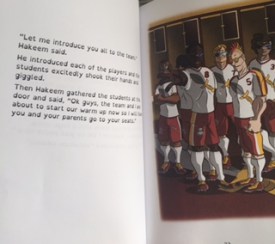
Ibrahim normally needs help to get up for school on Mondays, but not on this day. On this day they were promised a surprise at school and Ibrahim can’t wait to see what it is.  When the 8-year-old gets to school he and his friends are delighted to meet Hakeem Muhammad a soccer star on the California Spartan’s Team in town to play against the local Harlem Knights.  To win one of the five tickets that he is giving away the students have to recite some ayats from Juz Amma and tell why it is important that they study the Quran.  Ibrahim goes first, and we don’t know what he recites, but he says that studying Quran makes him feel happy and inspired.  Which to me didn’t really meet the criteria of the competition.  The next student is also a member of the “Childhood Champions,” but we know nothing about Jannah, other than the one page bio at the beginning of the book.  Jannah recites some mystery ayats and says that knowing the meaning helps her with reciting, a bit more of an appropriate answer, but still kind of not fulfilling the question in my opinion.

ordinary1

All five kids in the crew win tickets for them and their families for the game that night.  A limo picks them up and they get to meet Hakeem in the locker room.  When they arrive  he is praying, so they wait, say salam, chat, and then are shown to the VIP box.  The game is close, Hakeem scores the winning goal for the Spartans and the kids go home happy. No real problem or solution, the climax is just the game.

WHY I LIKE IT:

I love that the font was chosen to help kids with dyslexia and the full color internal pictures are a nice plus.  I don’t understand how it was determined how much text is on a page, as it is so varied and inconsistent, that it seems like a draft rather than a final copy.

I love that this book is about Muslims and for Muslims, the star athlete prays, and connects with Allah swt, and is proud of it.  His praying before the game is not weird to his teammates, which is awesome for kids to see.  The conversation after his salat with the kids is also pretty powerful, but the setup is incredibly awkward. Yasin won a ticket for reciting Quran, so why the answer about why he is praying before the game started with explaining that he prays five times a day, seems jarring to the flow of the book and story.  I liked the insight about praying and being grateful whether they win or lose, but the catalyst for the exchange was really forced.   Loved that Hakeem made sajood when he scored and that Ibrahim was asking Allah for help.

I wish the ayats the kids recited would have been shared.  I think the book is for muslim kids, so it would have helped if they really inspired something tangible that the readers could relate to.  The book is very bland and it could be much more memorable.  I’ve read the book three times, and couldn’t tell you any of the students names.  I had to look back to write this review.


I’m not a soccer expert, but I think the winning goal would have been called back for offsides, I’m hoping I’m mistaken.  The breaking a world record for loudest fans seemed a stretch, but kids 6-8 probably would be bothered by it or find it out of place.  The book says it is for ages 6-12, but I can’t see kids 12 years old getting much out of this 40 page book.  

FLAGS:

None the book is completely clean.

TOOLS FOR LEADING THE DISCUSSION:

The book wouldn’t work for a book club selection, but I would probably have it in a school library for kids transitioning to chapter books, and in a classroom for excitement and novelty.  There isn’t anything “wrong” with the book, it just needs a good editor and a little more.  It really is almost there.

https://www.launchgood.com/project/childhood_champions__no_ordinary_day_a_book_for_muslim_children#!/


Muhiima’s Quest by Rahma Rodaah illustrated by Daria Horb

Standard
Muhiima’s Quest by Rahma Rodaah illustrated by Daria Horb

IMG_0976

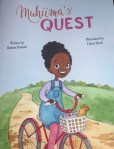
This picture book for ages 7 and up, reads incredibly smooth for the amount of text on each page, and the pictures are warm and expressive in this large (8.5 x 11) 32 page book.  Clearly the author is talented in writing and passionate about empowering her character to hold on to her culture and faith, however it seems overly forced at times.  

muhima

The premise is that it is Muhiima’s birthday, but that she doesn’t celebrate birthdays, her family only celebrates both Eids.  So when her mom hands her a surprise on the morning of her birthday and Muhiima asks if it is a birthday gift and her mom says, “kinda” it seems a bit like she is walking back from the premise. The tie-ins throughout the book as she journeys from location to location on her quest as a result seem forced.

muhima1

The map first leads her to her father’s book store to get wisdom and love and a gift that she can’t open until the end.  She also journeys to her Grandparent’s house, her Uncle’s basketball game, her Aunt’s beauty salon, and oddly her Masjid Quran Class, which apparently she is skipping, but stops to get the wisdom and gift from her teacher at, none-the-less.  Oddly enough, but at least noted, she reaches home to find everyone on her quest already there.

muhima3

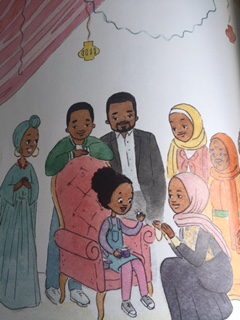
On her way home, she sees her non-muslim friend Rosie celebrating her birthday and wishes she could have a birthday gathering with gifts and family too.  When she opens the door to her own home, she gets just that.  The passages detailing why it is hard to be different are incredibly relatable and poignant, but to then have Muhiima get the same thing with a different name, again seems like the author is walking back on her premise.

muhima2

The wisdom and advice the family gives to Muhiima is wonderful and powerful. I love that the character is a strong girl of color, and that her family is supportive and consistent.  They say Salaam, they pray, they go to the mosque.  Some of the little details were jarring, like why it didn’t specify what prayer, why it was her class that she visited at the mosque, how all the people got to her house before her, etc.  This minor glitches with the forced premise of relating the quest to her birthday, make the book overall a bit awkward.  This is so unfortunate because the advice and the quest are so endearing, while not being judgementat or preachy.  I don’t know how to fix it, I just hope, like really really really hope, that the author keeps writing and that her next book is a little more revised and editted.


Mikaeel and Malaika: The Quest for Love

Standard
Mikaeel and Malaika: The Quest for Love

mikaeel.jpg

The beautiful hardback book is pricey, but fun.  I didn’t have any expectations when I read it, but now that I’ve read it three times and had my children read it, and my mom a reading specialist/teacher of 45 years read it, I feel pretty confident in saying, its a well-done book.  I think it can get a bit cumbersome when reading aloud, because some lines rhyme and some don’t, but on the third read through I read it to six kids ages two to nine and all throughly enjoyed it.

maandm

The sibling superhero duo are on a quest to find out how to have a pure heart.  They try praying aloud, praying quietly, then they go and talk to the Big Boss, their dad, who speaks in rhyming clues.  The play on words might make the book utterly confusing to children younger than five, or kids of all ages if full attention isn’t being given when read aloud.  For independent readers, they will delight in the words that sound the same yet have completely independent meanings.

mandm2

Eventually their quest also takes them to Agent M.O.M who loves them more than anyone else they can imagine, but the big reveal is that Allah (swt) loves us even more.  I don’t know that it is crystal clear that getting a pure heart involves loving the one who loves us most. But, I think by the end, the readers are just entertained that they figured out Allah loves them more than anyone else in the world and is the creator of us all.  The last page has an ayat from Surah Rehman, ” So which of the favors of your Lord would you deny?” Which again adds one more thing to the story about being grateful for all that Allah has given us, keeping it from being a completely streamlined story, but adding to the overall love and appreciation for Allah.
mandm1

The illustrations are absolutely beautiful and engaging, the amount of text and the font is perfect for ages 6-8 and the messages is fun and educational.  I hope that there are more in the series, alhumdulillah.


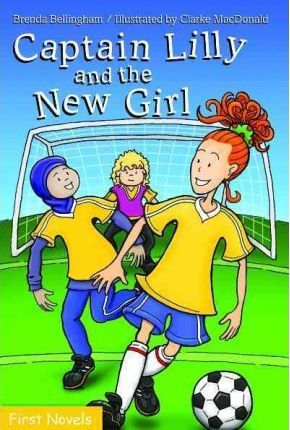
Captain Lilly and the New Girl by Brenda Bellingham illustrated by Clarke MacDonald

Standard
Captain Lilly and the New Girl by Brenda Bellingham illustrated by Clarke MacDonald

lilly.jpg

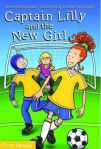
This book is part of First Novels, a collection of books in Canada that focuses on easy to read early chapter books that encourage kids to transition from leveled readers, while getting to know a single character in a realistic contemporary world.  There are a lot of Lilly books, but this one caught my attention because of the hijab wearing girl on the front, presumably the “new girl.”  At an AR 2.8 this 64 page book is great on so many levels, and really does meet the First Novel goal of presenting a simple theme and showing the main character grow.

SYNOPSIS:

Lilly is changing soccer teams, and only finds solace when many of her school friends will also be joining.  While each of the girls has different opinions and levels of enthusiasm about the team, they all are committed to one another as the “Wolves” stick together in a pack.  This loyalty is tested when a new girl is brought in to fill in for an injured wolf.  The foreigner, from America, wears a scarf, and just like with soccer, there are a lot of differing thoughts on the matter.  The reader see what Lilly feels as it is told from her perspective, which makes the issue not so much about the hijab itself, but about how a 9 or 10-year-old thinks and processes new concepts.  Ultimately, the Wolves as individuals and a team, have to decide what to do when an opposing team says that Sara has to take off her hijab if she wants to play.  

WHY I LIKE IT:

I love that the book is real, with strong independent girls.  The side characters aren’t cookie cutters of each other, they all have personalities and quirks, and I love that they don’t all agree, yet they all can make it work.  The book’s catalyst is the hijab, but it isn’t preachy and it is presented and understood through a non-muslim elementary-age character.   I don’t think Islam or Muslim is even mentioned, nor any culture, she is American, and the book takes place in Canada.  It addresses safety regarding the hijab, comfort in wearing sweats and not shorts, and being hot in a long sleeve shirt, issues that any reader can understand and ponder about.  The book isn’t gripping, but for the age group and the intent, it is spot on.  The font, spacing, size of the book, and simple illustrations, urge kids to read a “chapter book” and think about something they may not have ever thought about before.

FLAGS:

Clean, it does say words like “suck,” but it isn’t disrespectful.

TOOLS FOR LEADING THE DISCUSSION:

I wouldn’t use this as a Book Club book, because the kids can read it fairly quick, but I would probably read it aloud to kids and have them discuss, or have them somehow read it in groups and discuss.  There are a few websites that can help facilitate the discussion, but kids would definitely have opinions on how the situation was handed, how they might handle it, and what they think of the team’s sponsor.  

https://www.teachingbooks.net/tb.cgi?a=1&tid=40533

Click to access FirstNovels_Series_ActivityGuide.pdf

http://www.formac.ca/firstnovels


Ramadan Around The World by Ndaa Hassan illustrated by Azra Momin

Standard
Ramadan Around The World by Ndaa Hassan illustrated by Azra Momin

IMG_0251

I started this blog because I know the value fiction can have in empowering and exciting people when they see themselves reflected in story lines.  As Muslims, it is a needed tool both for our own children and for teaching other children about us.  So, imagine my surprise when I felt my back straighten up and a smile stain my face for a long while after I finished reading this beautiful book about Ramadan traditions all over the world.  Not because it showed so many beautiful Muslims from rich colorful backgrounds sharing the common bond of loving Allah in Ramadan, that was expected.  Nor was it for the diversity of skin tones, and cultures, and ages, and head coverings, throughout.  No, it was because there are characters with autism, and one that is hearing impaired, one in a wheel chair, and a little girl with diabetes who cannot eat all the candy, just a few.  I didn’t realize how strong that notion hit me.  Me, an adult, a type 1 diabetic since I was 11, there in print, in a book about Muslims.  Yes, I may have had tears, I might still as I write this review.  It is powerful people, to see yourself in a fictional character, at any age.  May Allah swt reward all the authors out there writing books for our children to feel proud of who they are, one beautiful page at a time. You are making a difference.

FullSizeRender (90)

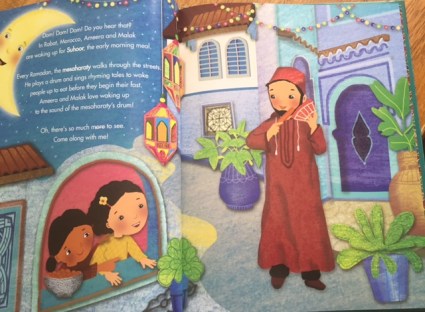
Emotions aside, this book is wonderful in and of itself.  It starts with the moon telling a bit about how Ramadan is fasting from sunrise to sunset, doing good deeds, being kind, and how it is celebrated all over the world.  The moon then takes us on a journey to twelve countries: The US, Turkey, Mexico, Brazil, Australia, Scotland, Malaysia, Egypt, Morocco, Madinah, Palestine, and Senegal.  Each location gets a two-page spread of text and gorgeous illustrations that tell about a Ramadan celebration, or tradition, and stress something about the month in general such as iftar, or sadaqah, going to the mosque, helping orphans, the adhaan, saying salaam.  The book concludes with Ramadan ending and the moon signing off.  There is a glossary followed by more information about Ramadan. 

FullSizeRender (89)

In all the book is 40 pages, hardbound, and large enough to make it perfect for story time and bedtime alike.  In small bursts the book would work for 4 year olds and up and first graders and up will understand how universal Islam is and relish at the diversity in celebrating “the most wonderful time of the year.”

FullSizeRender (92)

My hope is to read this book at a Masjid Ramadan Storytime and to have a few of the countries set up as “stations” for the children to visit.  I can’t wait to try it out and see if we can remind ourselves how blessed we are to be united all around the world as Muslims, alhumdulillah.  For non Muslims this book is not preachy, it shows how a holiday is celebrated in different places, and would do a great job of showing the joy Ramadan contains for Muslims with universal core principals, but how culture and traditions of celebration make it a diverse experience.  

FullSizeRender (91)


Zak and His Little Lies by J. Samia Mair illustrated by Omar Burgess

Standard
Zak and His Little Lies by J. Samia Mair illustrated by Omar Burgess

zak and lies

In the first Zak book, Zak had good intentions that just never went his way and we, as the readers, really felt bad for him.  In this new book, it takes a few pages to feel sympathy for Zak as his little lies get him in trouble, but sure enough when he finally changes his ways, it is cause for relief, celebration, and a great lesson to teach kids something that they do without much thought.

ZakLies2

The book claims to be for 3 to 7 year olds, but I think it works best for 3rd graders who seem to be testing honesty out.  Yes, it is great to introduce it to younger kids, and you really should, but like the first Zak book, the pages are a bit text heavy and the concept really should be understood without too much hand holding.  For me, the power of the book is the way that Zak’s little lies snowball in to a habit, and the climax really is something that you want the child to feel from within, not as just an adult once again telling them to be honest and not lie and to listen.

zak lies 1

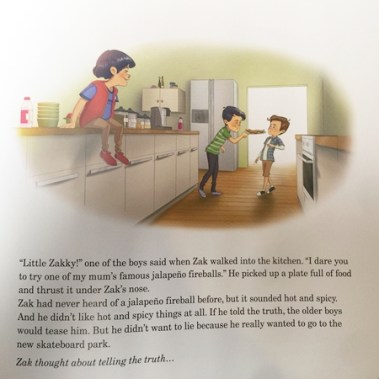
Zak starts the book with one more chore to do until he can go to the skate park with his Baba to play.  But, he gets caught in a lie about his bearded dragon, Dwayne, and the stage is set for him to get through the day honestly.  The next test doesn’t involve lying to his parents, but rather some kids from school that tease him, he doesn’t tell the truth and consequences ensue.  Next up he lies to his sister, again a great addition in showing that honesty is not just important when dealing with parents or adults, but that it needs to be the standard in all our dealings.  At the end, it is his sister getting in trouble for something that he has done that forces his to come clean about his whole day and to learn that truly, “Nothing in the earth and in the heavens is hidden from Allah” (Surah Al-Imran 3:5).

The hardback book is 29 pages with the last two pages being Discussion Questions and more information about the Quran Ayats and Hadiths mentioned.  The illustrations are not too busy, but the characters facial expressions are spot on, and often where the emotional cues for the text are found.

Nanni’s Hijab by Khadijah Abdul-Haqq illustrated by Vitchapol Taerattanachai

Standard
Nanni’s Hijab by Khadijah Abdul-Haqq illustrated by Vitchapol Taerattanachai

Nanni's Hijab

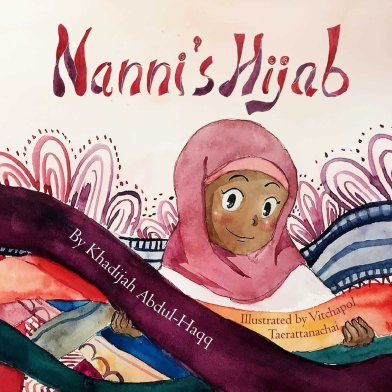
MashaAllah, there are so many things to like about this 36 page, brightly illustrated, elementary aged story.  Nanni, the main character, is spunky.  Not only is she strong enough to wear hijab to school, but she also is brave enough to confidently handle a bully on her own.  Surrounded by a supportive teacher, friends, classmates, and her mom, Nanni’s creativity and understanding that Allah swt will help her find a way to handle her predicament results in a happy ending, and many empowering messages.

nannis-hijab-childrens-book-review-L-Yo6YBS

The book would work for most children, but I think second grade and up would get the most out of it.  The girl might be young to be wearing hijab, but it seems like she wears it because she wants too.  I like that the illustrations have her and her mom uncovered at home, and that there is a glossary at the back, opening up the book to muslim and non muslim kids alike.

DVBz_rcVwAILbLM

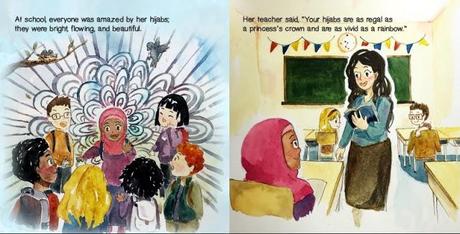
I also really like the larger messages of acceptance, trying new things, and doing better when you know better.  The supporting cast in the book resonates with muslims who go to schools where they are the minority, but have support and encouragement to practice their faith none-the-less.  Nanni’s teacher remarks that her “hijabs are as regal as a princess’s crown,” and the other students like seeing what color or design she is wearing each day.  Although a children’s book, the author does very clearly explain that the hijab is part of Nanni’s faith, although not mentioned by name, and that it is an act of worship. Nanni wants to handle the problem on her own, and for as bad as she wants to punch Leslie, she knows it isn’t the right thing to do.  As she wrestles with what is the best approach, she puts her trust in Allah, swt, which perhaps is the greatest lesson for us all in the book, alhumdulillah.

The Man with Bad Manners by Idries Shah illustrated by Rose Mary Santiago

Standard
The Man with Bad Manners by Idries Shah illustrated by Rose Mary Santiago

bad manners.jpg

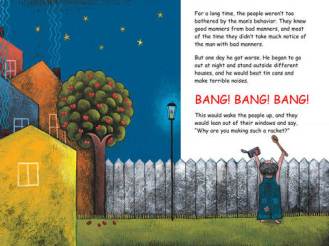
This story has a good moral, but the path there is a little twisted.  A village is annoyed by a man with awful manners and when he leaves for vacation, a clever boy convinces everyone to teach him a lesson and get him to change his ways when he returns.  They replant his field, paint his house, and rearrange his furniture to convince him upon his return that this is not his village or home or fields.  

bad manners1

When he does come back, he is confused and sad that he doesn’t know where he comes from, at which time the village tells him what they did, and agree to put everything back if he promises to change.  

bad manners2

The 32 page brightly illustrated book tells an Afghani tale in a western setting.  The chunky cartoonish illustrations show great imagination and encourage the reader to look at the effects of bad manners in a different way.  The clever boy, also goes about things in an extreme manner, which hopefully gets the reader to question if it was successful and perhaps how they would have handled the situation.  Another book that urges, thinking outside the box, with some discussion and reflection.  There is some lying, breaking and entering and other questionable actions, but I think most kids will realize it to be a silly story to teach a lesson, and all is forgiven because in the end they did live happily ever after.

bad manners4

The book is not AR but easily works for Kindergarten to 3rd grade.  There is nothing in the text or illustrations that suggests the book has any religious or cultural ties.

manners


Museum Mysteries by Steve Brezenoff illustrated by Lisa K. Weber

Standard
Museum Mysteries by Steve Brezenoff illustrated by Lisa K. Weber

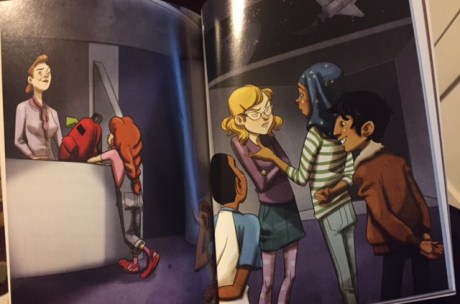
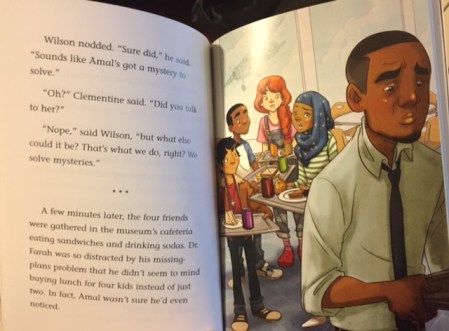
I’m going to review two of the eight books in the Museum Mysteries Series that have Amal on the cover:  The Case of the Missing Museum Archives and The Case of the Stolen Space Suit.  The series focuses on four characters of diverse backgrounds who have a parent that works in one of four Capital City museums.  Amal Farah is Somali American and her dad works at the Museum of Air and Space, Raining Sam is Native American and loves the American History Museum his mom works at, Clementine Wim’s mom works at the Art Museum, and Wilson Kipper’s favorite is the Museum of Natural History.  The kids solve mysteries and introduce the readers to real facts and tidbits of real information.  The AR level is 4.0 and 4.1 respectively, but I feel like they really are on a 2nd-4th grade level.  When a child is done with Ron Roy (A-Z Mysteries & Capital Mysteries) and Magic Treehouse, they are ready for these.  Much like those series, readers are similarly introduced to new vocabulary, but not overwhelmed with back story, detail, explanation, or much character development.

FullSizeRender (29)

SYNOPSIS:

In The Case of the Missing Archives, (the second in the Museum Mysteries Series), eleven-year-old Amal and her friends have to figure out who stole the plans for the German “Bat Wing” Plane, and fast.  If they don’t Amal’s father, Dr. Ahmed Farah, a museum archivist, is going to lose his job.  Luckily in 117 pages the kids suspect and rule out a “friend,” identify a mystery subject, and finally solve the case by piecing together the security guards clues and being perceptive.  Along the way you learn a bit about the characters, but nothing substantial.  You don’t feel a connection to the characters, and are only slightly annoyed when Clementine kind of takes over. 

IMG_7532

The second book where the Museum of Air and Space, and thus Amal are leading the plot is The Case of the Stolen Space Suit (#6 in the series).  I didn’t like this book as much as the earlier one because while yes, I learned about Sally Ride and how women in space are often over looked, I felt like the culprit was let off the hook with little reprimand for stealing Sally Ride’s space suit.  Once again the four kids come together to solve a mystery this time it involves two of the museums: Air and Space and American History Museum.  There is a bit more blatant lying in this book, which is normal in this genre as the kids have to snoop around and not get caught, but they seem a little less apologetic this time around.  The red herrings aren’t as believable, and the real culprit is only spotted by chance, no real sleuthing.  

FullSizeRender (31)

WHY I LIKE IT:

Obviously I like that a Muslim girl is included in this very diverse foursome.  She wears hijab, has a muslim name, tucks her phone in her hijab to go hands free, and is of Somali heritage.  Her father is educated and not over bearing or stereotypical, and her background is just detail.  Her group of friends seem to appreciate each other’s cultures and talents as well as their passions and hobbies.  The kids vary in age from 10 to 13 with two girls and two boys.  The only lack of diversity is perhaps that they seem to all be middle class and fully able bodied.  Faith, family structure, culture, all run the gambut.  

There is no religious reference at all.  The book mentions her scarf only as a hands free life saver, and we learn her favorite hijab is blue with little stars on it.

I like that all the books are full color about 120 pages.  There is factual information at the begining and at the end.  There is also a summary on each kid at the begining.  The story concludes with a glossary,  writing prompts, discussion questions, and information about the author and illustrator.

I love the covers.


FullSizeRender (30)

FLAGS:

There is lying, but the rest is clean.

TOOLS FOR LEADING THE DISCUSSION:

I probably wouldn’t use this book as a book club selection because there isn’t really much to discuss.  I would definitely have this series in the classroom or recommend it to other early chapter book readers.  Like Brezenoff’s other series the book is satisfying in its simplicity and a good book to build interest in a variety of things while feeling accomplished at reading a book.