Category Archives: 2nd through 4th grade

Museum Mysteries by Steve Brezenoff illustrated by Lisa K. Weber

Standard
Museum Mysteries by Steve Brezenoff illustrated by Lisa K. Weber

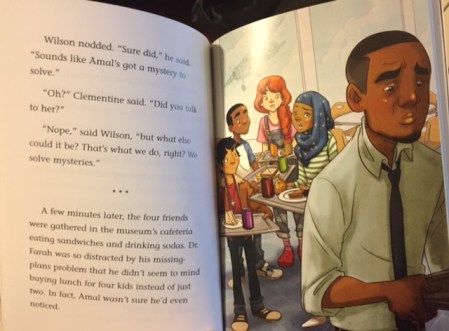
I’m going to review two of the eight books in the Museum Mysteries Series that have Amal on the cover:  The Case of the Missing Museum Archives and The Case of the Stolen Space Suit.  The series focuses on four characters of diverse backgrounds who have a parent that works in one of four Capital City museums.  Amal Farah is Somali American and her dad works at the Museum of Air and Space, Raining Sam is Native American and loves the American History Museum his mom works at, Clementine Wim’s mom works at the Art Museum, and Wilson Kipper’s favorite is the Museum of Natural History.  The kids solve mysteries and introduce the readers to real facts and tidbits of real information.  The AR level is 4.0 and 4.1 respectively, but I feel like they really are on a 2nd-4th grade level.  When a child is done with Ron Roy (A-Z Mysteries & Capital Mysteries) and Magic Treehouse, they are ready for these.  Much like those series, readers are similarly introduced to new vocabulary, but not overwhelmed with back story, detail, explanation, or much character development.

FullSizeRender (29)

SYNOPSIS:

In The Case of the Missing Archives, (the second in the Museum Mysteries Series), eleven-year-old Amal and her friends have to figure out who stole the plans for the German “Bat Wing” Plane, and fast.  If they don’t Amal’s father, Dr. Ahmed Farah, a museum archivist, is going to lose his job.  Luckily in 117 pages the kids suspect and rule out a “friend,” identify a mystery subject, and finally solve the case by piecing together the security guards clues and being perceptive.  Along the way you learn a bit about the characters, but nothing substantial.  You don’t feel a connection to the characters, and are only slightly annoyed when Clementine kind of takes over. 

IMG_7532

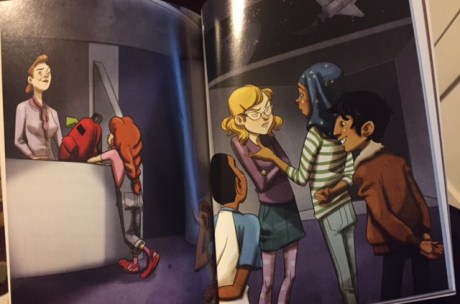
The second book where the Museum of Air and Space, and thus Amal are leading the plot is The Case of the Stolen Space Suit (#6 in the series).  I didn’t like this book as much as the earlier one because while yes, I learned about Sally Ride and how women in space are often over looked, I felt like the culprit was let off the hook with little reprimand for stealing Sally Ride’s space suit.  Once again the four kids come together to solve a mystery this time it involves two of the museums: Air and Space and American History Museum.  There is a bit more blatant lying in this book, which is normal in this genre as the kids have to snoop around and not get caught, but they seem a little less apologetic this time around.  The red herrings aren’t as believable, and the real culprit is only spotted by chance, no real sleuthing.  
FullSizeRender (31)

WHY I LIKE IT:

Obviously I like that a Muslim girl is included in this very diverse foursome.  She wears hijab, has a muslim name, tucks her phone in her hijab to go hands free, and is of Somali heritage.  Her father is educated and not over bearing or stereotypical, and her background is just detail.  Her group of friends seem to appreciate each other’s cultures and talents as well as their passions and hobbies.  The kids vary in age from 10 to 13 with two girls and two boys.  The only lack of diversity is perhaps that they seem to all be middle class and fully able bodied.  Faith, family structure, culture, all run the gambut.  

There is no religious reference at all.  The book mentions her scarf only as a hands free life saver, and we learn her favorite hijab is blue with little stars on it.

I like that all the books are full color about 120 pages.  There is factual information at the begining and at the end.  There is also a summary on each kid at the begining.  The story concludes with a glossary,  writing prompts, discussion questions, and information about the author and illustrator.

I love the covers.
 

FullSizeRender (30)

FLAGS:

There is lying, but the rest is clean.

TOOLS FOR LEADING THE DISCUSSION:

I probably wouldn’t use this book as a book club selection because there isn’t really much to discuss.  I would definitely have this series in the classroom or recommend it to other early chapter book readers.  Like Brezenoff’s other series the book is satisfying in its simplicity and a good book to build interest in a variety of things while feeling accomplished at reading a book.


The Silly Chicken by Idries Shah illustrated by Jeff Jackson

Standard

silly-chicken.jpg

This story reads wonderfully aloud as it is silly, repetitive, and the message is more clear than in some of Idries Shah’s other Sufi inspired teaching books.  Written on an AR 4.0 level with 32 pages.  Some pages are heavily text laden while others just sprinkle a few words across a beautifully illustrated page.  Like his other books, the illustrations are truly spot on.  The lively faces on the characters, and colorful scenes bring the story to life and keep the audience engaged and giggling.

chicken

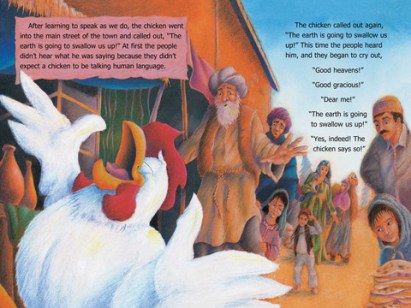
A man decides to learn how to speak “chicken,” when that doesn’t work, he teaches the chicken to speak our kind of language.  Fluent and conversational, the chicken then tells the villagers that, “The earth is going to swallow us up!”.  Everyone runs in all directions, up the mountain, down the mountain, across the meadow, around the world, but they can never get away from the earth.  When they return, they are upset with the chicken and ask how he knows that the earth is going to swallow them up, to which he replies that he doesn’t.  After they recap all the trouble he has put them through he poignantly laughs at them and asks, ” You think a chicken knows something just because he can talk?” Realizing how foolish they have been the chicken begins telling more outlandish things, just to make the people laugh, and isn’t taken seriously again.

silly chicken1

The message is clear, the characters funny, and the illustrations engaging. I finally found an Idries Shah book that I like! Yay, I guess for me they are hit or miss, and this one was definitely a hit!

chick

The Color of Home by Mary Hoffman illustrated by Karin Littlewood

Standard
The Color of Home by Mary Hoffman illustrated by Karin Littlewood

color of home

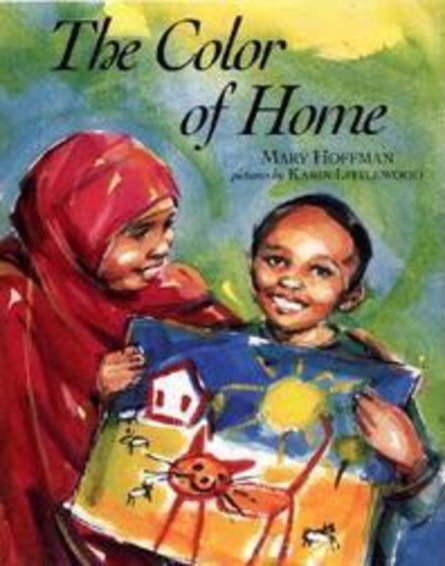
This powerful book about Hassan’s first day at school is a bit graphic, and incredibly important.  While it is a picture book, it is definitely not meant for small children.  The rich water color illustrations and the impactful text match the AR level 3.6 and would really appeal to thoughtful 2nd through 4th grade students.

A refugee from Somalia, Hassan finds it “tiring remembering even a few English words.”  He misses the color of Somalia, his cat, the warmth of the sun, and the freedom of learning out doors.  He doesn’t miss the violence though.

colour3(1)

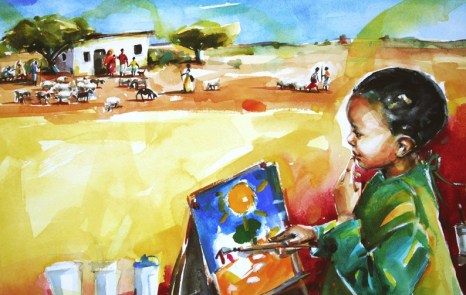
When it is time to paint, Hassan paints his home and his family, all 9 of them, and his pets, in bright happy hews, much to the delight of his teacher.  But then, Hassan, engulfs his house with the red paint of flames, smudges out his Uncle Ahmed when the black bullets that take him down, and Hassan communicates his sadness to his teacher.

Hassan doesn’t take his picture home, he knows it will upset his mom and little sister, Naima.  The next day, a translator comes to help Hassan.  Fela is Somali and wears a black hijab, like Hassan’s mom, but western clothes, a new concept to the young boy.

color

Through Fela, Hassan opens up to his teacher and explains what it was like when the soldiers came and he had to hide under the bed.  How they had to leave without any of their stuff, including his beloved pet cat Musa.  All they could take was his father’s prayer rug and the Quran, as they set off on foot in the night.  He tells about leaving his grandparents and cousins behind and being scared on the plane.

Being able to share his fears, seems to help as he paints a new picture to share with his mom.  This one filled with his animals, and not with fire and bullets.  There is hope for Hassan as he looks forward to adding color to his new life and reminds himself to learn the english word for “home.”

colour2(1)

The book  is great for seeing the experience through Hassan’s eyes, and taking the reader through some of his adult like fears, and childish stresses.  Older kids should appreciate that what he has lived through is horrific, but his understanding as a child is slightly limited.  It should increase empathy, compassion, and kindness.

While the illustrations are rich and detailed they are very realistic.  This adds to the somberness of the book, and keeps this work of fiction a very real reminder of the world and what trials so many go through.

The characters are visibly Muslim, but there is no mention of religious doctrine, and readers may not know what a prayer rug is or a Quran.  They will be able to use context clues to figure out hijab, but there is not a glossary in the back.
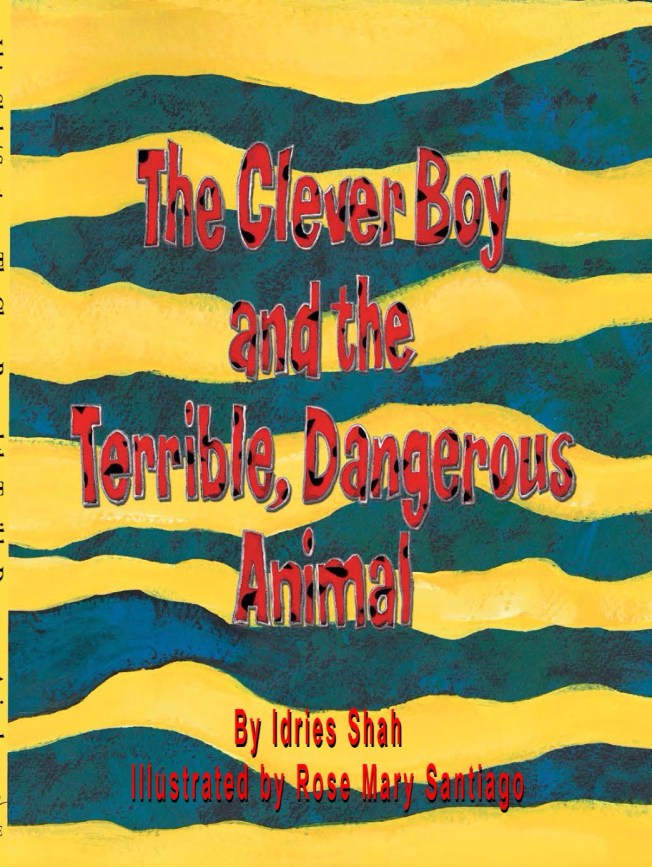
The Clever Boy and the Terrible, Dangerous Animal by Idries Shah illustrated by Rose Mary Santiago

Standard
The Clever Boy and the Terrible, Dangerous Animal by Idries Shah illustrated by Rose Mary Santiago

clever-boy.jpg

This book makes me forgive the author for his other books that left me puzzled as to his popularity.  This is wonderful, timeless and so simplistic, yet full of wisdom, lessons, and reflection that I’m thinking of gifting it to many of my teacher friends.  In its 32 pages written on an AR third grade, 2nd month level, the simple and powerful lesson of how ridiculous it can be to be afraid of what you don’t know is driven home.
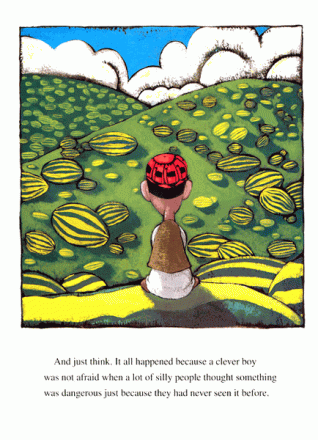
And just think. It all happened because a clever boy was not afraid when a lot of silly people thought something was dangerous just because they had never seen it before.

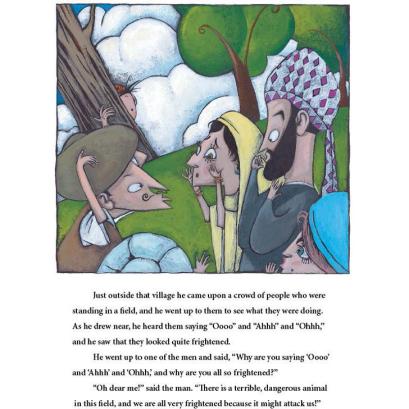
A boy goes to a neighboring village and finds the villagers afraid of, wait for it, a watermelon.  The boy laughs and laughs, and pulls out a knife to cut it and enjoy its sweet juices.  The villagers then fear the boy, until experience and knowledge about what it is and how to grow it, change everyone’s opinion and the village renames itself Watermelon Village. Oh, the power of knowledge.

clever 2

I can see this book being so great to introduce kids to how a little knowledge, asking questions, trying something can do everything from finding something you like, to breaking down stereotypes, to shifting your paradigm.  I feel like Islamaphobia, among so many other things, could be done away with by and large if people would just get to know us!

clever 3

The villagers depicted wear kufis and hijabs and kurtas, and the author writes to share his stories from his oral Sufi tradition, but there isn’t anything overtly Islamic in the text.  The kids as young as preschool will enjoy this at storytime.  They will find being afraid of a watermelon preposterous and silly, making the point that much stronger.

I like that the cover doesn’t given much away, and most children will take the title at its word and think that it is an animal.  Getting student’s ideas of what the terrible animal will be adds to the creative thinking and discussing after as well.  The pictures are wonderful and endearing and many editions come in two language formats.

clever1

The Boy Without A Name by Idries Shah illustrated by Mona Caron

Standard
The Boy Without A Name by Idries Shah illustrated by Mona Caron

the-boy-without-a-name_orig.jpg

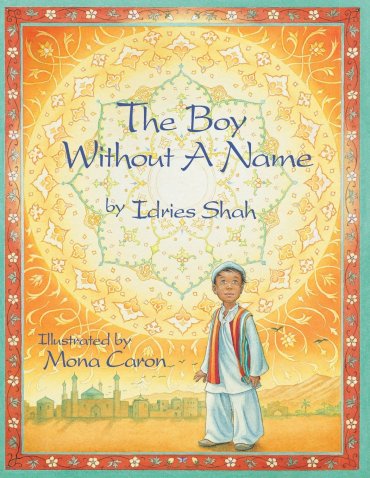
It is hard to know what a child would get out of this 32 page 3.2 AR level, but even if they just get lost in the pictures, and swept away by the idea of a boy searching for his name and a dream, I suppose there is value.  Some, ok most of Idries Shah’s, Sufi teaching stories are beyond my comprehension, but they are lyrical and often silly just the same. He has written over 30 and the libraries have quite a few, and people online seem to love so many of them, so perhaps I’m just not clever enough or philosophical enough to grasp them.  Which is neither here nor there, but maybe don’t buy one until you read one and see what you get out of them.  I keep checking them out and hoping I too will fall in love with one, I’ll keep you posted.

no name1

Before they can name their son an old man comes and tells the parents to not name him and to wait.  The boy grows up searching for a name, hoping someone has one he can have.  At one point he is made aware that he has nothing, even to trade for a name.  He responds that he has an old dream he no longer wants.  He and his friend Anwar then go to the wise man and he receives his name and a new dream.

The synopsis claims that patience and determination is learned, but I couldn’t get over the fact that the parents just didn’t name their child, and I never felt like I learned why he was such an important boy.

boywithoutname2

The pictures are wonderful with the scenic village’s tall minarets and colorful hijab clad women in the market place.  I particularly like the magic spilling out of the boxes in the old man’s house when the boys are finding names and dreams.  There is nothing overtly Islamic in the text, I’m not aware of how strong the Sufi origin is, not being Sufi, or having studied it.  But the illustrations definitely place the book in an Islamic cultural environment and the names reinforce this.


The Farmer’s Wife by Idries Shah illustrated by Rose Mary Santiago

Standard
The Farmer’s Wife by Idries Shah illustrated by Rose Mary Santiago

farmers-wife.jpg

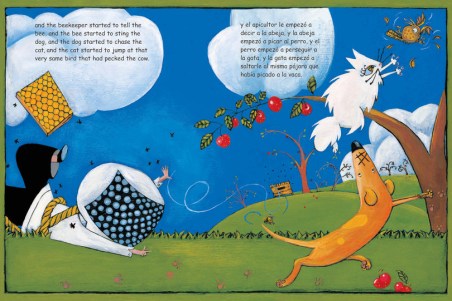
The book reads very much like the western children’s story/song, “I know an old lady who swallowed a fly,” but in this Sufi inspired repetitive story, An old Farmer’s wife can’t get an apple out of a hole.  

The silliness starts right away when she wants to get a bird to fly down the hole to get it for her.  When the bird says, “tweet,” which means no, she deems him naughty and then moves on to asking a cat to jump on the bird, to get the bird to get the apple.  The funny thing is the chain of events is funny and illogical at points. She wants water in a puddle, to put out a fire to burn a rope, the rope to tie up a bee keeper, and so on.  Luckily the wind finally blows the apple out of the hole and they all live happily ever after.

farmer2.jpg

The book supposedly is to teach patience, I am hoping to use it when I do a lesson on thinking outside the box and how sometimes that is great, but the trick is knowing when it might also be easier to reach down and pick up the apple.  

The book is AR 3.4 and 32 pages.  Many versions are dual languages.  The pictures are great with the abiya wearing woman and the chunky cartoonish side characters making the silly story fun to read a loud.  There is nothing “islamic” other than the illustrations showing the woman in hijab, and the author being a well known sufi writer who uses lessons from the Sufi tradition to teach lessons to children.

farmer1


A Little Tree Goes for Hajj by Eman Salem

Standard
A Little Tree Goes for Hajj by Eman Salem

little tree

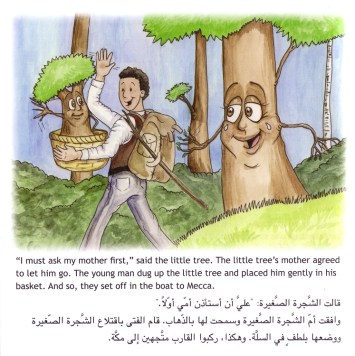
A friend loaned me this book with a bit of hesitation as to its quality, and although I needed one more Hajj book for an upcoming story time, it seemed that it was yet another book about the steps for Hajj, so I wasn’t stressing about acquiring it. Luckily we were both wrong, at least from my perspective.  The book is so sweet, and not so much about the steps and details of Hajj, but more about the longing to go.  To seal the sweetness deal, it is about the friendship between a man, and a tree, and perfect for 3 year olds and up.

tree1`

The little tree dreams of traveling, but more than anything he dreams of going to see the Ka’aba.  Noting the logistical struggles of travel with roots, his mother encourages him to make duaa for his heart’s desires.  After a lot of patience and a lot of duaas, (alhumdulillah, it shows duaas take time and are not a magical instant granting of a wish) a young man walks by on his way to the coast to catch a boat for Mecca.  Startled by a talking tree, the clever boy just happens to have a basket and he uproots the tree and they head out together.

tree2

The book shows the two doing all the steps in a large two page illustration, keeping the text to a minimum.   On the next page though, it highlight the two praying and trimming their hair and leaves. When the tree is returned to his mother, she is watered with Zam Zam water and “they agree it is the sweetest water ever tasted.”

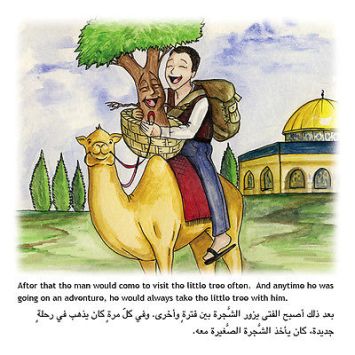
The friendship continues, as they journey on countless adventures, and in the end, when the man is old and the tree is too big, the old man returns to rest on the tree’s roots and tell stories to the nearby saplings.

a-little-tree-goes-for-hajj-islamic-story-book-for-muslim-children-in-arb-eng-8252bfb5e194e76cc8e2190c5c691211

Written in both English and Arabic, the story is a fast read that holds even the little one’s attention as they look at the expressive illustrations.  There is additional information on the Hajj rituals page, but it can be used according to need, like the glossary in the back.  The story is for Muslim children and families as it does not explain the requirements of Hajj, importance of the Ka’aba, or history of the rituals.


The Hajj Adventures of Jamila and Fasfoose by Ediba Kezzeiz illustrated by Abd al-Hayy Moore

Standard
The Hajj Adventures of Jamila and Fasfoose by Ediba Kezzeiz illustrated by Abd al-Hayy Moore

FullSizeRender (13)

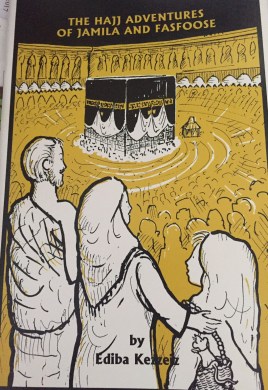
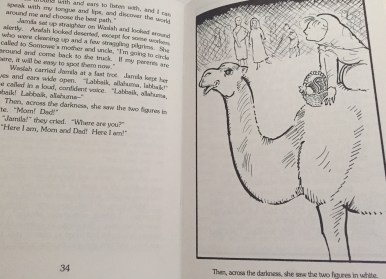
The book isn’t much to look at with its black and white, with yellow thrown in cover, and its 40 pages bound with a staple, but for independent readers between 2nd and 4th grade or so, the book is good.  In many ways it is an older kids version of Zaahir and Jamel, adding a fictional story to the learning about the steps of Hajj.  

SYNOPSIS:

The setting is Hajj and all of its different rituals, but the story is that Jamila and her pet mouse Fasfoose get lost in Mecca.  Along the way to finding Jamila’s parents and performing the requirements of Tawaf, Sai, Arafah, Mina, Muzdalifa, Jamrah, and Eid, a few duaas are thrown in, friendship with people of different nationalities and lessons in patience, speaking with your heart and finding your internal compass of wrong and right all come to light.

WHY I LIKE IT:

I like the target audience, and how it doesn’t ever feel preachy or like a How-to-perform-Hajj manual.  If a child is familiar with the rituals of Hajj the story gently reminds them of what they already know and the story takes center stage.  If they are unfamiliar, the book doesn’t talk down to them, and may prompt them to want to learn more.  Strong lessons of being kind and not hurting anyone or anything while in ihram are strong, as are the  beauty of multiple cultures speaking from their heart to find common threads.  There are illustrations to break up the text and not overwhelm the young reader, and the story is divided into seven chapters.  The font and size are all age inviting and even older middle school kids would probably pick it up if they saw it, read it in about 20 minutes and be glad that they did.

FullSizeRender (14)

FLAGS:

None, alhumdulillah

TOOLS FOR LEADING THE DISCUSSION:

The book is fun, probably not long enough for a book club selection, but a great read -a-loud. The length of the chapters make it a short read that ideally could be read the week before Hajj or Eid.  My 3rd grader read it and is enjoying listening to me read it to my 2nd grader.

FullSizeRender (15)

Stepping Stones: A Refugee Family’s Journey by Margriet Ruus Artwork by Nizar Ali Badr

Standard
Stepping Stones: A Refugee Family’s Journey by Margriet Ruus Artwork by Nizar Ali Badr

stepping stones

I usually have a running lists of books to check and see if the library has in their catalogue, and another list for when I have a few extra dollars and/or a reason/excuse to purchase books for my own.  I’ve seen this book recommend by countless critics, educators, refugee resettlement volunteers etc., and was thrilled that I could get it from the local public library.  However, it isn’t enough to have this book and mull over the artwork and prose for three weeks, it deserves a permanent place on the shelf.  Or better yet, open hands to pass the book around to within your home, to reflect on the humanity that binds us all, and the plight of so many in the world.

FullSizeRender (12)

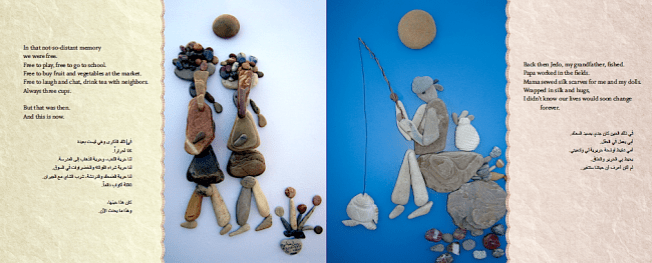
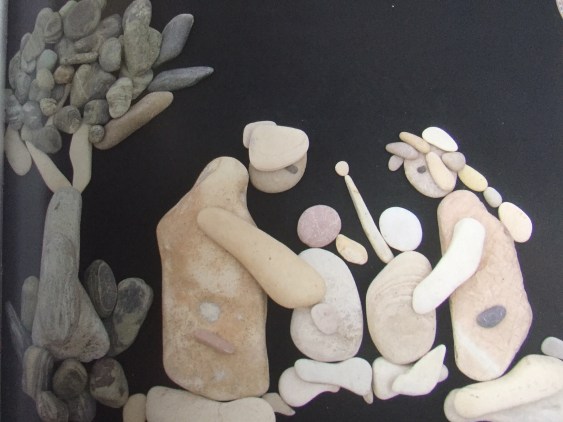
The story is fairly simple, Rama and her family have a good life in Syria and the war changes that, forcing her and her family to flee on foot to Europe with what they can carry.  The emotions on the other hand, are not that simple.  The book is illustrated in stone, but the reader would have to have a heart of stone to not be moved.  Written on an AR 3.2 with 28 pages, the book is written in both English and Arabic.  The book is not sensational, but it does discuss the shortage of food, and going hungry, how they are not free, not really, how bombs fall and kill people going to the market,  and it does show that people were lost in crossing the sea.  The family has to walk, there is no going to the airport or cars to take them across borders so easily, this is contrasted to the beginning of the book where Rama was free to play and go to school, things the reader can relate too.

stones

Ultimately the book is full of hope.  The fictionalized account of a horrific reality still on going, pales only to the story of how the book came to be.  The Foreword is wonderful and gives the book so much more warmth and heart.  How the author saw the artisans work, sought him out, and built the story around his pieces, gives even the youngest reader a sense of reality for an unfathomable situation.  After the story is more information about the author and the illustrator, as well as a list of resources to volunteer, donate and help.  Portions of the book sales go to help resettlement organizations across North America.

stones2

The publishers page gives info and has a youtube book trailer as well: https://steppingstonesthebook.com/

FullSizeRender (11)

The book would be great at story time or in a classroom setting followed by an activity with making pictures with stones previously collected.  At bedtime the book is great to read aloud and let the words sweep your listener toward empathy and compassion.  Check your library first, and if it isn’t there, I don’t think you’ll regret your purchase.

Alana’s Bananas by Mariam Hussein illustrated by Saima Riaz

Standard
Alana’s Bananas by Mariam Hussein illustrated by Saima Riaz

alanabanana

A silly, silly book about a girl’s love of bananas and her despair when a storm wipes out the banana crops in Costa Rica.  The moral of the story is to try new foods, and in 36 pages I think the reader will grasp just how over the top Alana’s obsession with bananas truly is and the lesson will be learned.

alana3

My only stumbling block is I’m not sure what age the book is for.  The bright silly pictures work well for ages 3 and up.  The theme works well for ages 4 and up.  The amount of text on the page, however, is more 6 or 7 and up, and the concepts of where banana’s come from, multiple uses for banana peels is about the same.  The character in the book, Alana, is eight and goes to the library and reads cook books and cooks independently, but the way her parents trick her into eating other foods is to hide eggs, peanut butter, rice, avocados and anything else they could find in banana peels, which keeps with the silliness of it all, but seems a bit off for 8 years old. Also talk about very patient parents allowing their 8 year old to only eat bananas for so long, and then not being upset when they have to resort to extreme levels of trickery.

alana1

There is nothing islamic in the text, and the only islamic elements are the author, illustrator, and the family based on the illustrations.  The mom wears hijab, but it is neither mentioned or referenced and no islamic vocabulary or phrases are in the story. In a scene at school, the girl sitting next to Alana is wearing hijab.

alana2

The book is about 10×10 and sturdy in its construction.  The back cover has a recipe for Alana’s Banana Breakfast Muffins. Enjoy!