Tag Archives: voice

Xavier’s Voice by Ashley Franklin illustrated by Tatiana Gardel 

Standard
Xavier’s Voice by Ashley Franklin illustrated by Tatiana Gardel 

img_5385-1

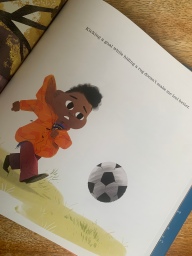
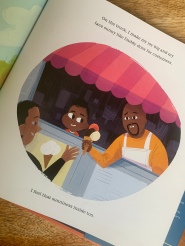
At 48 pages this picture book provides a tender window into a little boy with anxiety, a small voice, and a huge imagination.  I absolutely love that Xavier is the star, the other kids are not mean or overly nice, they are important, but at the story’s core is him finding his confidence, and accepting himself, through his love of superheroes, sketching, and imagining what-ifs.  Xavier is Muslim, there is an “Assalamu Alaika” on one of the pages from another character to him, a superhero by the name of Super Saleem, and Islamic decor in the illustrations in his home.  Religion is not centered or explored in this Muslim authored book, but Muslim readers will see the subtle hints and feel seen immediately.  I love that Xavier discusses coping techniques his therapist has taught him to help with his anxiety and that the tone is empowering and positive.  A good story for kindergarten through second grade, and a great way for kids with anxiety to see themselves represented, and a window for others to grow their empathy and compassion.

The book starts with Xavier at school, which is loud, and wishing that he could make his small voice big.  He notices the big voice kids, have lots of friends, and he can’t seem to find the words when people talk to him.  He gets nervous, and as a result, he is lonely.  One day he discovers Super Saleem and that inspires him to create his own superheroes that are unstoppable.  When raindrops start to fall, a new kid, comes to help, and BJ likes Xavier’s drawings.  Xavier wonders if he has finally made a friend.  The book shows that even when things are going well, there can be a lot of worries, stresses, over thinking, and missteps. But being brave to keep trying, can have super results.

img_5388-1

Tagging Freedom by Rhonda Roumani

Standard
Tagging Freedom by Rhonda Roumani

20801TaggingFreedom

This 282 page OWN voice middle grade book weaves together two points of view that shed light on the recent events in Syria and life as a Syrian American without self-othering or over-explaining.  The characters are Muslim and while yes, I wish there was more Islam woven in,  when it did present itself in more than just a passing “inshaAllah” or “ya rab” it was heartfelt and sincere.  The book has a few plot holes, a plethora of underdeveloped characters, and the religion and cultural components take a backseat to the tropey MG themes of finding your voice, friendships, crushes, fitting in, and having hope. Despite my critiques though, I still found the book focused around graffiti and spirit squad, engaging and hard to put down.  The pacing makes for an easy read, and while the adult reviewer in me wishes there was more depth, insight, consequences, and Islamic references, I definitely appreciated the emotion and framing of this story.  The book does contain a lot of lying, crushes, sneaking out, “vandalism,” breaking laws, and mentions bombings, disappearing, and fear.  The connection though of what has been left behind and experienced in Syria is moving, and I’m glad that a book so relatable to western kids is widely available to be shared with them.

SYNOPSIS:

The chapters alternate between Kareem and his cousin Samira, aka Sam. At the beginning of the book Kareem is in Syria, spending time with his friends graffitiing in protest of Bashar al-Assad and in support of the boys from Dara’a.  They are covering their tracks, sneaking out to join rallies and finding their strength in their art, common goals, and the change that is taking over the country.  Unfortunately, his parents don’t see it that way and decide he needs to be sent to live with his uncle’s family in Massachusetts for his own safety.

Sam is Kareem’s cousin, she is great at reciting Quran, she has a best friend Eleanor who lives across the street, and is an amazing artist.  She sees people as fonts, and dreams of being a part of the school spirit squad.  Her only real problem is Cat, a girl that has bullied her for years and spread rumors about her in the past.  It is never quite articulated what was done and how bad it was, but the fact that Cat is the head of spirit squad, the daughter of influential parents, and the twin sister of Sam’s crush Dylan, has Sam trying desperately to fit in.

When Kareem arrives, he is not happy to be in America.  He calls Sam out for her inability to speak up and with Sam and her bff Ellie on the outs, Sam heads off to her new friends that have allowed her into spirit squad, and Kareem and Ellie start sharing their art around town.

Kareem’s character arc is more subtle, but Sam/Samira, finds herself with the help of her cousin as she channels the yearning of Syrians to set her free in America.

WHY I LIKE IT:
I love that it is Syrian American OWN voice MG, the news cycle has moved on, but stories are so critical to reminding the privileged outsiders what has occurred and continues to endure, so just that this book exists, is a positive for me.  I like that the code switching of being Samira and speaking Arabic at home is so clearly contrasted with Sam at school.  I struggle with the idea of dating not being a religious, but rather a cultural no-no, and her being so obsessed in the beginning with Dylan and then Amari is a bit of flag. By the end they feel like friends, but it is definitely a big part of the first half of the book that could have used some context, same with when she goes out in a tank top.  I wish there was a Muslim conscience that enters the story, to see Sam grappling with who she is from a faith perspective would have been nice.

I love that Kareem comes to America and starts school, it doesn’t have him being meek, or struggling to transition, it really is empowering that he breaks that stereotype just by allowing him to be seen from the very first day as strong and fully fleshed out.  Yes, in real life and in some books the adjustment is a plot point, but in this book it is not, and the author seems to not indulge in it deliberately.

I struggled with a few plot holes. I get that Kareem was frustrated and wanted to educate and be heard, and when Sam can’t stick up for herself and he calls her out, they are both annoyed, but to go from that to graffitiing is a big step.  A few instances of maybe trying to talk about Syria being shut down by teachers, or friends, would have made it a more logical leap.  I worry a little that there wasn’t enough hand holding regarding graffiti as a whole seeing as it is an MG book.  I understand it is expression and art, but there is some element of vandalism to it as well, and because it didn’t connect the dots that street art was the only way to be heard, I bring it up for awareness.

I needed closure on Cat, I didn’t like that we didn’t know more specifics about her torment or her thoughts at the end.  I know the story is not about her, but she was important for much of the story and to have her fade seemed a little short sighted.  I liked Ellie, but her wanting to sticker everything seemed in contradiction to her environmental activism.  Sam’s parents are barely a blip on the radar, and even some details about the supporting cast, really would have made the story that much better.

FLAGS:

Crushes, immodest clothing, lying, sneaking out, boy/girl friendships, boy/girl hugging, vandalism, breaking the law. Hearing about bombings, being taken away by the police, death.

TOOLS FOR LEADING THE DISCUSSION:

I don’t think I would use this for book club, but I would have it on the library and classroom shelf.

Hope Ablaze by Sarah Mughal Rana

Standard
Hope Ablaze by Sarah Mughal Rana

This young adult book is an intense raw unflinching read, containing  incarceration, assault, politics, Islamophobia, immigrant pressure, and loss throughout the 384 pages that mix poetry and traditional writing.  At times the book is incredibly hard to put down as the commentary on two party politics and Muslims in America is articulated in a way that transcends the fictional constrains and affirms reality.  But unfortunately, it took me a long time to complete the book, because when I did put it down, I didn’t feel that relentless urge to pick it up and see what happens next.  I had been alerted to the fact that there were elements of magical realism, but even with that knowledge, I still felt it misplaced, and truthfully, unnecessary.  The pacing was inconsistent, and many points unnecessarily forced.  It often felt the author was simply trying too hard to tell the story and make sure the reader got all the messages intended.  As a result many characters are flat, many plot holes exist, and the reader is left wishing things were done just a little bit different to make the book what it could have been, not what it is.  I know it is a debut, so I’m not going to be overly detailed in my harshness, I am fairly positive I will read anything this author writes down the road, I took pictures and shared passages that I loved on my socials.  The book is good, it just really could have been great.

SYNOPSIS:

Nida is a poet, her uncle is a poet, and her uncle is in prison.  When Nida is frisked, her hijab removed by a political candidate’s team as she makes salat in a public park, Nida is forced to find her words, her voice, and her place in an unkind Islamophobic world.  High school friendships, immigrant Muslim community pressures and idiosyncrasies persist for Nida as she navigates media manipulation, injustice, slander, and political talking points.  Life was already complicated with her father’s departure, her maternal uncle’s wrongful incarceration, and the goats that her mother brings home to sacrifice, but with the support of the Poet’s Block, her Muslim community, family, and the thread tied to her family through generations, she will find she isn’t alone, and she has support, she just has to take a stand.

WHY I LIKE IT:

I love how much mirrors contemporary reality, the MIST competition, the politics, the media, the dirtiness of it all. I also like that it has a fair amount of humor, the Islamic accuracy, friends getting called out for boys and girls texting each other.  Overall though, it just felt so forced. I think some subtly and nuance and undercurrents would have given the reader the ability to connect the dots for themselves, so the book would have lingered and taken up space long after the last page was read.  It is hard to write a book about how great a writer is, how powerful poems are, so at times it really felt spoon fed that this is powerful, here read it, see it was powerful.  Additionally, I think when the author did try for subtlety, it just came across as lacking.  I still don’t fully understand any of the side characters, their relationships, or their purpose.  From the betrayal of a school friend, to the new friend from MIST, to the little brother, to the friend and his uncle who is imprisoned, there ultimately lacked a lot of emotional heart for minor characters, who remained stagnant, while passionately emphasizing issues at their expense.

The OWN voice Islamic rep is so spot on even if the evil eye passages seemed amplified and repetitive. Islam is centered, it is unapologetic, it is the characters identity, comfort, and soul.   Only one point really stood out as erroneous, but I read a digital ARC so it could have been fixed or it could have been a spacing issue since it was in a poem, but it has sajood in janazah, and I’m really hoping the final book will not have it wrong, as there is no sajood in janazah.

FLAGS:

Assault, frisking, incarceration, death, profanity (not a lot, damn, hell, shit), Islamophobia, racism, systemic abuse, lying, talk of terrorism, stereotypes, gaslighting.

TOOLS FOR LEADING THE DISCUSSION:
I’m on the fence about using this book for a book club read.  I love the Pakistani culture, the Islam, the contemporary relevance, and the political commentary.  I think it would have actually more success in a guided or required reading situation with teens than it would as a pleasure read.  Undoubtedly I will order a copy to put on my library shelf, but I might test it out a bit on a few readers to see how their thoughts before I present it as a book club selection or not.

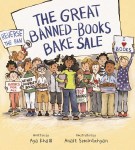
The Great Banned-Books Bake Sale by Aya Khalil illustrated by Anait Semirdzhyan

Standard
The Great Banned-Books Bake Sale by Aya Khalil illustrated by Anait Semirdzhyan

banned

This follow-up picture book to The Arabic Quilt, takes readers back to Kanzi’s school, but also works as a standalone for ages 7-10.  Addressing the hot topic of book banning, the fictional story brings the discussion down to an elementary level and shows kids speaking up and pushing back against something they don’t agree with.  The main character finds a connecting thread to events in Egypt, and with her class and family behind her, she finds her voice and takes the lead.  The story bounces around a bit and feels a little rough and underdeveloped at times, but the subject matter is important and can be used to help guide discussions, encourage peaceful protesting, and taking action.  There is nothing Islamic specific in the text, the main character’s mom and teita wear hijab and are in the illustrations (#muslimsintheillustrations), in a memory of Egypt there is a man holding a cross.  The author is Muslim and mentions it in the Author’s Note at the end.

banned1

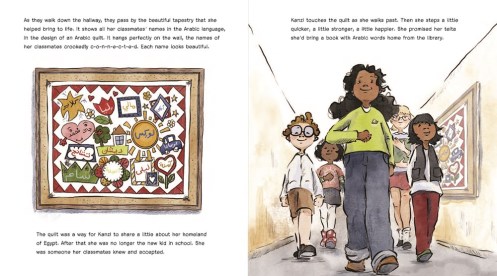
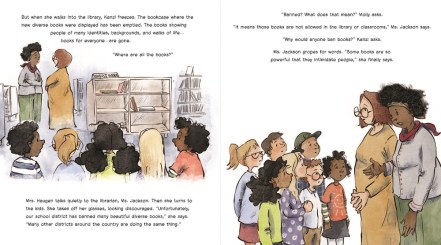
The book starts with Kanzi leading the class to the library, she passes the Arabic quilt she helped bring to life and walks a little taller.  She has promised her Teita she will bring home a book with Arabic words from the library, but when she walks in to the library, the “bookcase where the new diverse books were displayed has been emptied.”  The librarian explains that the books have been banned.  That the school district, like many others around the country, have decided certain books are not allowed. Kanzi is upset, but her classmates “gather near (her) in solidarity. They want her to know that they care, too.”

banned 2

Back in class the teacher opens up the discussion, and Kanzi can’t find her words.  Kareem says it is unfair and when the teacher explains that people are responding by protesting, writing letters, and buying more copies of banned books.  Kanzi finds her voice and suggests a bake sale.  Kareem suggests they raise money to buy books that are banned and call it “The Great Banned-Books Bake Sale and Protest.” Molly adds that they can put the books in Little Free Libraries. The class agrees that Friday will be the day, that baked foods inspired by books that are banned will be sold to raise funds to buy more banned books, and the local news station will be invited to broadcast the protest.

banned 3

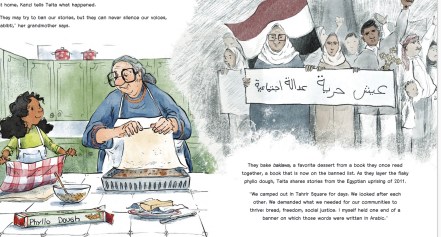
Kanzi helps Teita make baklawa from a book they once read, while her grandma tells her stories of protesting in Tahrir Square.  Teita held a banner and demanded rights for the people of Egypt. Friday comes, and the kids are determined to be heard, as the crowd grows, Kanzi’s nerves also grow, but her strength comes from those that support her and who have also spoken up to be heard.

I enjoyed the illustrations and the backmatter.  The inclusion of a baklawa recipe and insight to how this story came about with the banning of The Arabic Quilt, definitely adds to the book’s appeal.  I felt a little disconnect though from the emotions of the book, and oddly enough, little connection to the characters.

I wish it would have shown her joy when she first saw the diverse book display.  How it made her feel seen and valued and included to see books that reflected her and her classmates.  Then we, the readers,  would feel the pain too, now that they are gone.

I also was a little unsure of the scene when all the kids gather around Kanzi in solidarity, why is she the only one upset? Is it that they care about her or that they care that the books are no longer available? Sure it can be both, but again, as it is written, it isn’t particularly strong.

img_8594

I’m not sure why the three characters named in the book Kanzi, Kareem, and Molly, do not have their names shown on the Arabic quilt pictured in the illustrations, and I also don’t know why it bothered me that the book banned that had baklawa/baklava was not named.  I don’t care that it isn’t a real book, but I wanted a title to make the case of how ridiculous this ban is more articulate.  Additionally, I love Little Free Libraries, but it seemed tossed in without much fleshing out. The book doesn’t explain what Little Free Libraries are, so I’m not sure that kids will even understand the plan.

The book is a decent read, I don’t know that the climax or characters will be memorable on their own, which is unfortunate because connection with the success or failure of this fictionalized book ban really could have radiated out of the book and deeply inspired kids.  The reversal of the boards decision doesn’t directly link to the kids’ actions.  I had to provide that link to my own kid when I read the book to him (he is almost 8).  It is implied, but a line or two about how the kids protest encouraged other people to also speak up, or write letters, or that the school board attended the bake sale, would have shown that when voices amplify it is hard to ignore them.

The book has value on the shelf and can be preordered here https://amzn.to/3C5Baaj

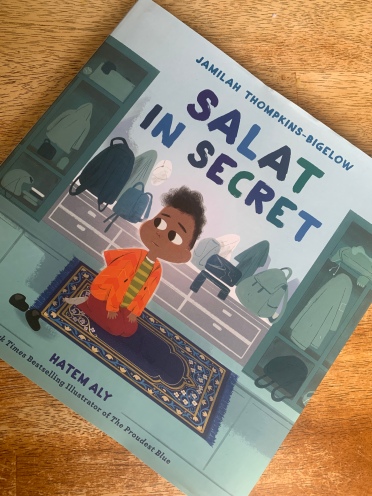
Salat in Secret by Jamilah Thompkins-Bigelow illustrated by Hatem Aly

Standard
Salat in Secret by Jamilah Thompkins-Bigelow illustrated by Hatem Aly

img_8430

It is quite remarkable in the course of 40 pages that so many themes, layers, emotions, windows, mirrors, and relevance can radiate with ease and entertainment for children four and up.  The authenticity of the text and illustrations create tangible feels in this book, that months after reading it for the first time, I am still moved to tears, both inspired by joy and as a cathartic release of being seen.  The true mastery is that even if you are not Muslim and cannot relate to the nervousness of praying publicly, you understand Muhammad’s hesitancy and feel for him as he battles not just finding a place, but watching onlookers reactions to his father, police proximity, and being brave enough to push yourself even when you are scared.  Usually when asked what my favorite book is, I stumble to narrow it down to just one, but truly this book has raised the bar of not just traditional publishing representation, but Islamic/Muslim literature across the board.  It is a gift to read, to share, to enjoy, and a blessing that such an unapologetic book is available so widely for our children to connect with, and our non Muslim friends to see us through.  Please spend time with this book and make it available to your children, your students, your community, it really is that good, alhumdulillah.

img_8431

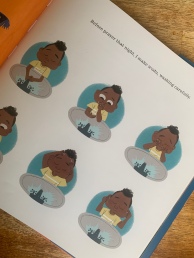
It is Muhammad’s birthday and he is seven, “Old enough to pray five times a day,” his father gifts him a prayer rug, and  Muhammad is ecstatic.  He makes wudu that night and offers salat with full attention.  He says the Sunday school words and shares his most wished for wishes to Allah swt, not even letting little sister, Maryama distract him.

After Fajr the next morning, he is determined to find a secret place at school to pray Dhuhr. Daddy doesn’t need secret places, if prayer time comes he pulls his ice cream truck over and prays on the sidewalk, “never delay salat.”  At school, Muhammad heads to Mrs. Baker to ask for a place to pray, but his confidence waivers and he returns to his seat.

img_8432

Anxiety about where to pray has him looking for spots throughout the morning, but when recess comes he finds he can’t take the prayer rug out from under his jacket.  He lingers when everyone returns to class and rushes through the words and motions in the coat closet.

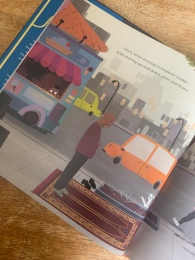
That evening he is with his daddy in the ice cream truck and the sunshine and smiles pour out of the two.  When the sun sets it is Maghrib time and Daddy heads to the sidewalk to pray, reassuring Muhammad that he can pray at home.  Muhammad watches his dad and various events spur him to make his decision.

img_8433

I love love love the way salat is approached with love and excitement and that the dad embodies safety and joy and does not pressure or force Muhammad.  The relationship is beautiful and allows for worship to be seen as both personal, as well as obligatory and merciful.  The duo also show a great parent child dynamic that warms the heart.

img_8434

I like that there really isn’t any “hate” given to anyone praying, it is hinted at, people do not understood, but the focus is not on the outside bystanders- it is what Muhammad thinks and feels.  I’m fairly certain every Muslim who has prayed in public has encountered a wide variety of responses, and this book keeps the gray to reflect and spark conversation.  It is often met with ignorance, with hate, with aggression, but it is also met with respect, apathy, and curiosity which the text and illustrations allow for.

img_8435

There is so much love and joy in the book as well as identity, that I don’t mind one bit that my littles ask me to read it over and over.  It is perfect for groups, one-on-one, and I cannot wait to share it in a story time, there is also an incredibly informative and heartfelt Author’s Note at the end.  If you haven’t preordered it yet, the book releases on June 6, 2023, please pre order it and signal the support for this book and future books that center authentic Muslim joy, Black Muslim representation, and OWN voice author and illustrator accuracy.  Request it at your library, put it on hold at your library, check it out, read it.  If you cannot preorder it, still purchase it when you can, inshaAllah it will be a beloved book in your home as well.

That’s Not My Name by Anoosha Syed

Standard
That’s Not My Name by Anoosha Syed

not my name

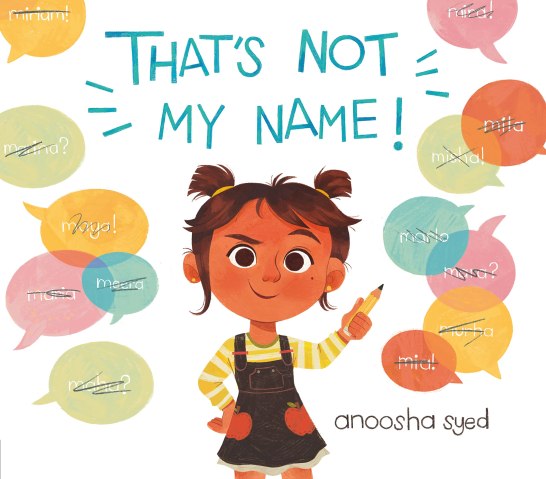
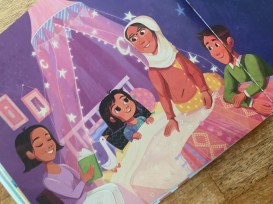
I have been looking forward to this book, as I’ve enjoyed so many of the illustrations the author has created for other authors, and was anxious to see what kind of story she would write for her own authorial debut.  Unfortunately, the book didn’t wow me.  It is rather forgettable, the book conflates notions of not being able to pronounce someone’s name with not being memorable and with not having a “normal” name, and then recognizing how so many classmates have unique names too.  A bit scattered in messaging, and overall reading like an adult talking, not a young girl of four or five, on her first day of school.  No doubt the illustrations are beautiful, and the book isn’t “bad” or a “waste of time,” but it isn’t a strong clear story.  I’ve seen reviews where people find the little girl rude, and I don’t know that I’d agree with that, she is frustrated and wants to scream, “that’s not my name” when people say it wrong, but I do agree that she could model what to say better and how to handle it.  Not that I expect those with uncommon names to have to carry the weight of making things easy, but the little girl at the end remarks that she has so many new friends at school with “unique, beautiful names, and she always makes sure she says them right,” implying that some dialogue, both about her name and about theirs, takes place to ensure pronunciation is correct, and some “showing” of how that is achieved would be nice.  Before the story starts, on the title page, there is a pronunciation breakdown of Mirha, but not in the text itself. There is nothing Islamic in the book, the Grandmother wears a scarf loosely draped over her head, there is a crescent and moon wall hanging in an illustration, and the girl’s name is claimed to be Arabic in origin.
img_2433

The book starts with it being Mirha’s first day of school.  She is excited to learn, to play, and to make friends, but when no one seems to be able to say her name, she starts to feel shy. Frustrated and sad she decides to change her name, and tells her mom when she gets home.  Her mother tells her, her name is beautiful and why she was named what she is named.  She builds her up and the next day armed with her mother’s words she is ready to make friends and teach them how to say her name. By the end of the book Mirha has friends, and wants to be your (the reader’s) friend too.

img_2434

The voice of the book is inconsistent at times it feels very older kid, almost adult, even though the 40 page book is meant for three to five year olds.  The examples read like an adult reflecting on their childhood struggles with their name, not as a young girl finding her voice and appreciation for the name she has.

img_2435

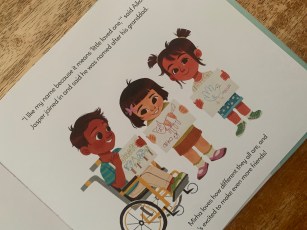
When Hayden asks if he can call her Maya instead of Mirha it is because Maya is easier.  Kids are hearing all sorts of names for the first time when they enter school, that conversation seems so forced.  Whether the kids are in preschool or daycare or kindergarten, most of the names they are hearing of their classmates are being heard for the first time.  If they watch a lot of tv and YouTube and movies, they have heard a whole variety of names, they are not going to have a dialogue that sounds like that, at that age, just not realistic.  Similarly after the first day of school she wants to change her name to something “normal?” What is a “normal” name even, then the mom even reinforces that notion when saying she knows she named her something “unique and different.”  A concept that returns at the end when asserting that Mirha has friends with lots of unique names.  Seems to go in circles.

img_2436

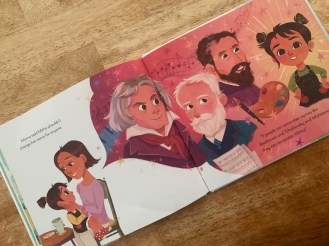
I appreciate that examples are given about not seeing your name on keychains or having the barista get it right, but again, she is under the age of five, are these really her points of reference for having a less common name than those around her?  When her mother is making the case that she shouldn’t change her name she references that names such as Beethoven and Tchaikovsky and Michelangelo are memorable.  First of all, what (under) five year old knows those names or who those people are, and second of all, now her name is not memorable? I thought it was hard to pronounce? Has she done something worthy of history books and admiration? I get what the author is trying to do, I often tell my students that they need to demand people say their names right.  If they can rattle off names from Pokemon, Star Wars, Lord of the Rings, and Beyblades, they can say the beautiful names they have been given.  But the kids I am saying it to are not in preschool, nor am I conflating the pronunciation of their names with being names of famous people that are memorable. Additionally, I do not speak Arabic, but a quick Google search does not show that Mirha means happiness in Arabic, and I have heard from native Arab speakers that they also found the meaning off.

img_2437

The illustrations are engaging, the broader message of getting people’s name right and demanding people get your name right is important, it just needed a more age aligning voice and connecting with the reader.
img_2438

Today I’m Strong by Nadiya Hussain & Ella Bailey

Standard
Today I’m Strong by Nadiya Hussain & Ella Bailey

strong

I really liked the way Nadiya Hussain’s book My Monster and Me discussed anxiety and was so eager for this book.   Unfortunately, I didn’t feel as connected to the characters, the little girls dread of dealing with a bully, or the resolution of channelling her imaginary tiger to find her voice strong enough.  With discussion I think the book would be a wonderful way to get young children, to open up about what is upsetting them, but on its own I feel like a bit more is needed to transition from thinking to action, from nerves to confidence, and from understanding what is bothering the little girl to understanding what needs to be done.

img_6852

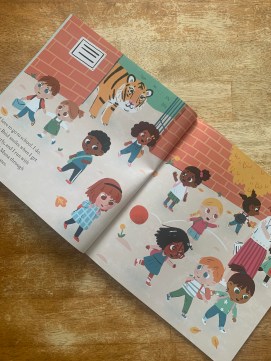
The story starts with a small girl going back and forth on whether she loves school or doesn’t and revealing that the tiger listens to her and doesn’t say a word.  It then starts the next few pages with the same line: “I love to go to school.  I do,” and detailing what parts of school make her happy.

img_6853

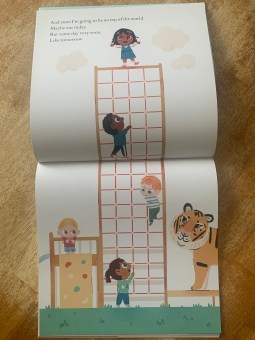
It then transitions to sharing why some days, the little girl doesn’t like school so much.  Days when her voice disappears, Molly laughs at her, or blocks her way to the climbing frame, or takes her cake.

img_6854

She then reinstates that she likes going to school most day, but not always, and then one day when Molly is mean, the little girl, thinks of the tiger, and knows what to do.  How to find her voice, and stand up to Molly. She then carries through on it, and realizes that soon she can be on top of the world.

img_6855

The messaging is universal and great, and while there is no religion shown, it is great to see a brown protagonist dealing with mental health.  The author is Muslim and I’m sure most everyone knows at least of her from the Great British Bake Off.

img_6856

Llama Out Loud by Annabelle Sami illustrated by Allen Fatimaharan

Standard
Llama Out Loud by Annabelle Sami illustrated by Allen Fatimaharan

llama

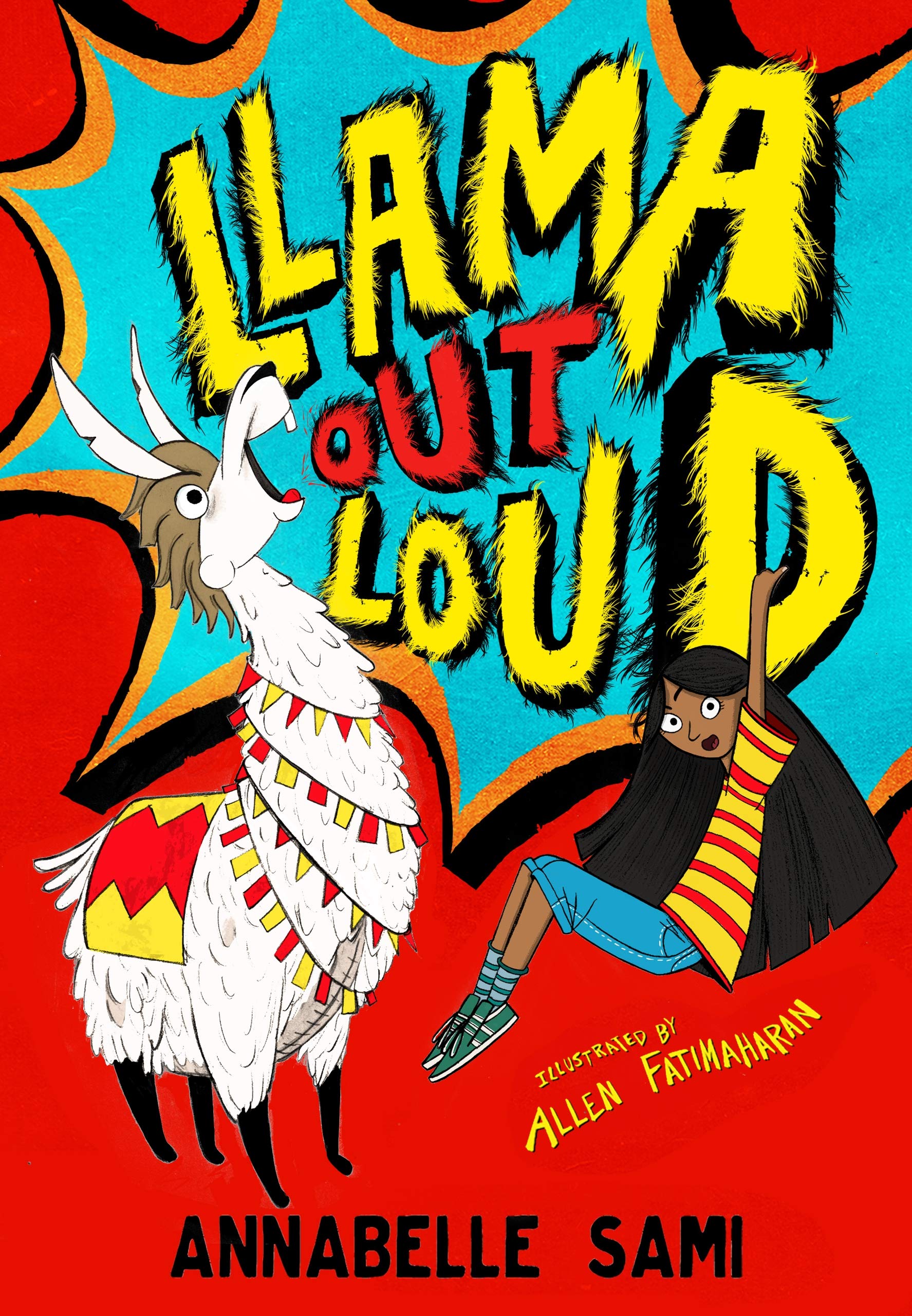
This 245 page middle grade doodle filled novel features a Pakistani-British protagonist as she endures life with a family that yells, brothers that prank, aunts that meddle, and now a magical talking obnoxious stuffed llama.  Yasmin Shah stopped speaking years ago, and a 10th birthday wish has brought about Levi, a llama who uses highly unconventional methods to help Yasmin stand up for herself and find her voice.  At times funny, tender, and relatable, the book similarly often feels really forced as it relies on predictable jokes for cheap laughs:  bum worms, wee wee taunts, the threat of being sent to Daadi in Pakistan as a punishment, bras and knickers being thrown around, etc..  The overall message is good and silly, and middle graders will probably feel some anxiety and frustration with Levi, but ultimately enjoy the book, and look forward to future books in the series.  

SYNOPSIS:

Yasmin lives in a full loud home.  It is her 10th birthday and she feels completely unseen.  Her mom has made her a lovely cake, but when her brothers use pepper to make her sneeze, the cake gets destroyed and she once again meets the wrath of her family.  She wishes she could stand up for herself, and just like that her life gets a whole lot crazier.  A stuffed old stained llama she saw in the market and her aunt decided to gift her, has sprung to life and won’t stop talking.  Levi seems determined to make Yasmin’s life even more miserable.  He shows up in her backpack at school and his misguided help gets her detention, he doesn’t want her to be friends with the octogenarians she plays checkers with at the local senior center and embarrasses her and gets her banned, life at home is more miserable too as he takes revenge on Yasmin who keeps trying to get rid of him.  At times it is hard to know if Levi is really trying to help and is just really misguided, or if he is out to get her.  As Yasmin loses her elderly friends and the chance to be checkers champion at the OLD home, she slowly lets new kid Ezra wear her down and possibly be her friend.  The climax reveals not just her voice, but a remorse for Levi that further helps Yasmin determine what her life will look like moving forward.

WHY I LIKE IT:

Antics aside, the story is about Yasmin being pushed/encouraged to be heard in her life.  The jokes amplify the need for her to find her voice and defend herself, her love of the old people and determination to win the checkers tournament is endearing, and her struggles with kids her own age shows real heartache.  I absolutely love Ezra and his mannerisms.  He is new at school, trying to meet Yasmin where she is at, and encourage her all while trying to focus, channel his energy, and fit in as well.  Yasmin’s family redeems itself and I think readers will get the exaggeration of much of the antics, but really Levi is annoying and while younger readers might find him hilarious and well-intentioned, I think anyone older than the intended audience will just want to strangle him.  

The illustrations, the comic strips, and the little flourishes on the pages are wonderful.  They bring the book to life and provide the charm and humor that the text needs to connect with the readers.

The only religious thing mentioned is Eid at the beginning.  Some of the women in Yasmin’s family wear a scarf on their head and her teacher wears hijab, it isn’t mentioned in the text.  I could not find if the author or illustrator identify as Muslim, I read that the author’s father is Pakistani so culturally and perhaps experience wise it is OWN voice, and reads with a lot of authenticity.  

FLAGS:

Possible verbal abuse, anxiety and bullying.  Mention and illustrations of undergarments.  Plotting and planning to harm/destroy a magical talking toy.  Practical jokes, threats, lying, deception, back talking, deceit.

TOOLS FOR LEADING THE DISCUSSION:

I don’t think I’d use this as a book club selection as it is for younger children than middle school.  But I think it is a fun book to have around the house and classroom for middle grade readers to pick up and chuckle over.

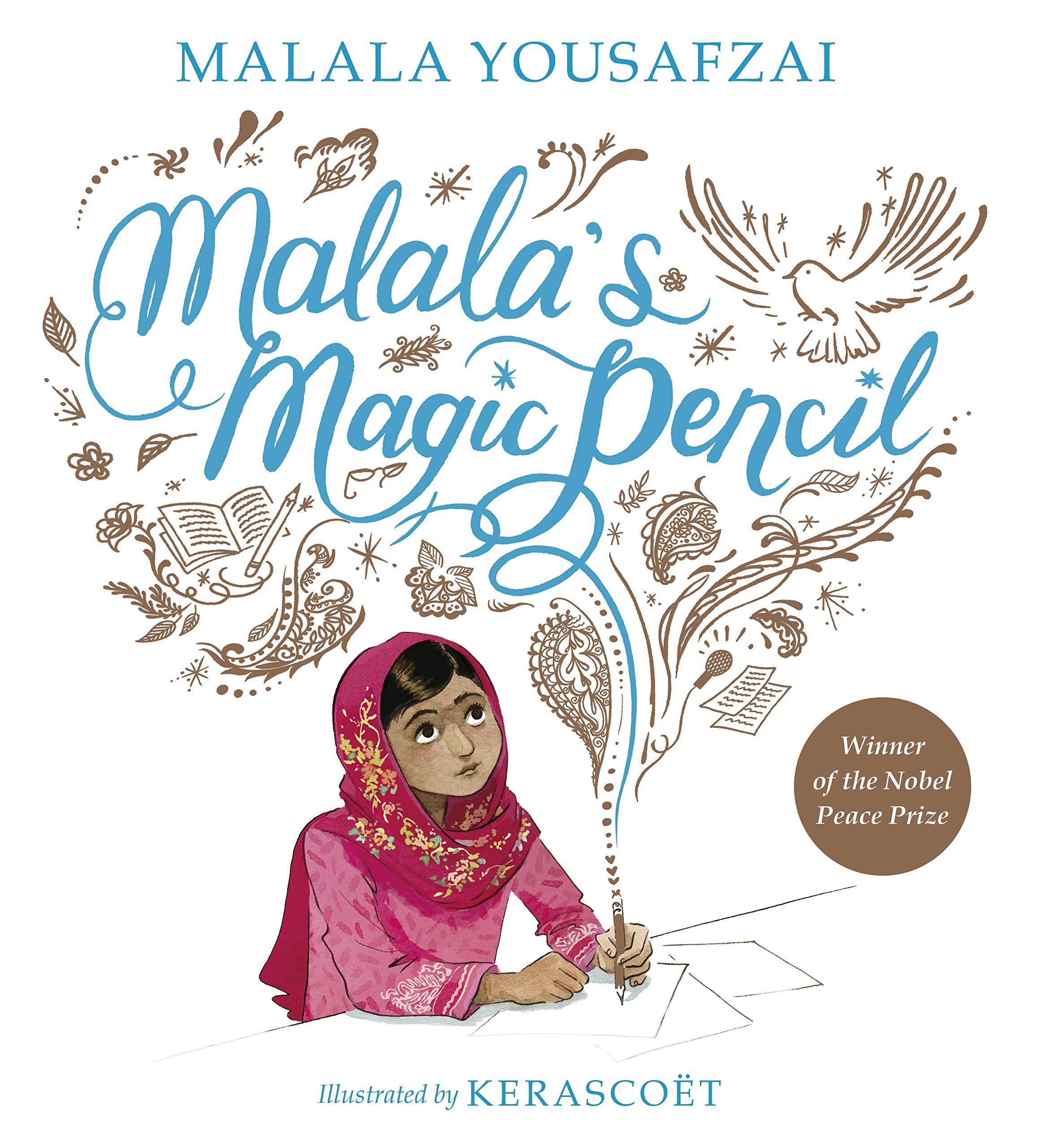
Malala’s Magic Pencil by Malala Yousafzai illustrated by Kerascoet

Standard
Malala’s Magic Pencil by Malala Yousafzai illustrated by Kerascoet

malala

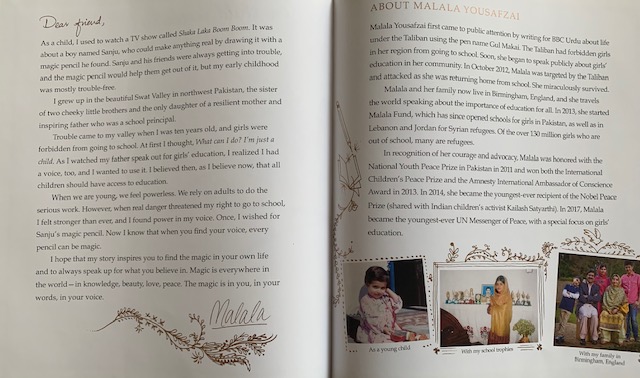
I’m going to try my best to review a nonfiction autobiographical book and focus on the story, not on the author because yikes, Pakistanis have strong opinions about Malala, and I have no desire to get pulled in to an argument.  I’m half Pakistani, I know the position of both sides.

IMG_6245

I have read both the Young Readers Edition and original I Am Malala books, so I didn’t jump to review this book in 2017 when this AR 3.6 40 page re-re-telling of her story came out.  After reading numerous other children’s books about girls in the subcontinent striving to go to school and be educated, I thought maybe the controversy had calmed down and I could read this large hardbound book a bit more objectively, and thus focus on the story a bit more.

IMG_6246

The book is listed as a biography, not an autobiography, so I’m not sure Malala even wrote the book, but none the less it is a synopsis of her story for younger elementary children.

IMG_6247

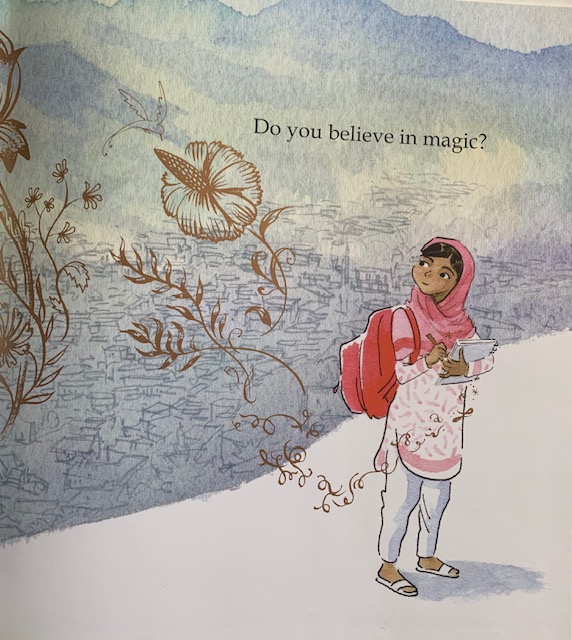
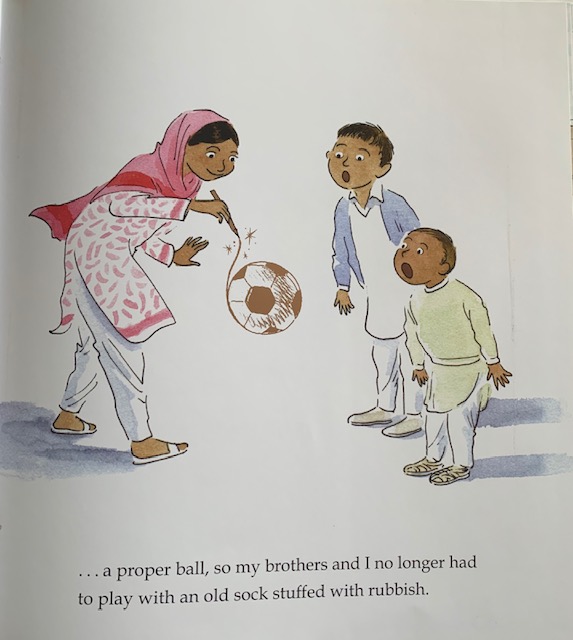
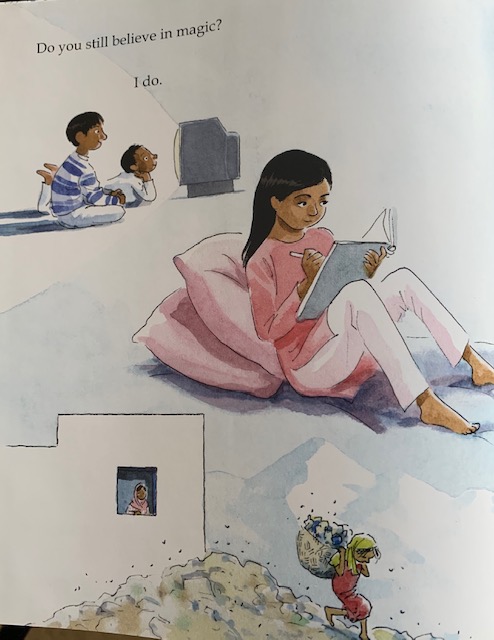
Starting off a bit like Harold and the Purple Crayon, Malala asks if the reader believes in magic, and then tells what she would do if she had a magic pencil to draw things that would make other’s happy like a proper soccer ball for her brothers and a way to stop time so she could sleep in a little longer in the morning.

IMG_6249

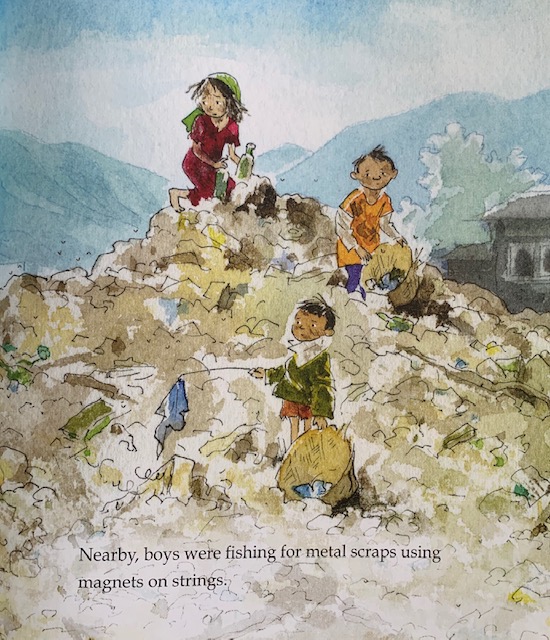
Every night she hopes for a magic pencil, and every morning she is sad one hasn’t appeared.  As she starts to notice the world around her she realizes that the kids looking for food and metal scraps in the junk yard, have it much much worse.  She asks her father about it and learns that if the children were in school their family’s might go hungry.

IMG_6250

As she notices “real” problems around her, her ideas for what her magic pencil could fix, evolves and develops into a burgeoning social conscience.  But quickly her naive outlook is changed when dangerous men start to appear on the streets and girls in her class stop coming to school.

IMG_6251

Her magic pencil finds real world power when she uses her words and her voice to make a stand and people start to pay attention.  The rest of the book highlights how she made progress despite the attempt to stop her and how she now uses her “magic pencil” to work to make a more peaceful world.

IMG_6252

The surface story is incredibly hopeful and would motivate young children to notice the world around them and do what they can to improve it. Inquiring children might be alarmed at children going through trash, or want a lot more information about who the scary men are and why they don’t want girls going to school and why she gets to travel around and tell her story. Information that is given at the end of the book in an afterwards of sorts.

IMG_6253

Most pages have sparse text and the ones that have a lot are kept on level and avoid being preachy.  Even the attempt on her life is present, but not detailed, sufficing to say that they tried to silence her, but failed.

The illustrations are beautiful and tell the story as much as the words do.  The book does not mention religion, but in the pictures where she is out of the house her hair is covered, but not when she is at home in bed and whatnot.  Obviously it is how she carries her self in real life.

Overall, I think the book is incredibly well done and inspiring to young readers.  Anytime a modern day figure can show children that they too have a voice and can use it, I think it is a good thing.  The fact that the voice comes from a minority, a female, a person with a name and culture different than the ones in most western children’s text books is also a plus.  I hope if nothing else it opens a window to children that there are a lot of amazingly strong and courageous people in all cultures and to seek out their stories.

IMG_6254