Tag Archives: Sisters

A Tariq Twins Mystery: Murder for Two by Niyla Farook

Standard
A Tariq Twins Mystery: Murder for Two by Niyla Farook

I don’t know what I was expecting, but woah once the actual crimes started piling up and the sleuthing began, I was invested in Riri and Ani working out their differences, solving the case, and freeing their accused dad.  At 336 pages, a full on murder, attempted murder, arson, thieving, and arrests all taking place, the book is definitely for older middle grade readers. The premise and dual points of view of 11 year old twins being reunited after 3 years apart by their divorced parents, getting to know how their OCD, ADHD, and autism factor in to their personalities, learning about TUSC, the town of Castlewick, and the side characters that will turn suspects, result in it taking the story a while to get going.  But if you can get through it, and can suspend belief, the book is a fun mystery that takes on heavy topics, and crime, but somehow keeps it light and consumable by the intended audience. The twins are Muslim, one wears hijab, and there are Islamic references, but once the identity is established, it really doesn’t play a role, or shape the characters’ view of the world or approach to dealing with their grief, anxiety, and obstacles they face.  There is mention of halal marshmallows and hijab, but they never say a quick dua or pray, and by the end is not really even shown to be a big part of their daily lives.  I have no idea if the neurodivergent rep is accurate, but the tone and approach is very positive and normalizing.  Parents may want to know that the book starts on the last day of school and the teacher is non binary, referred to as Mx Henderson with they/them/theirs pronouns. The character is mentioned a lot in the first nine pages, and then never again.  Pronouns for other characters are listed on their profile cards.  There is teasing of a girl having a crush on a boy, a few couples dating, a character being born out of wedlock, and a male character being in a relationship with someone named Toby that is mentioned a few times, but only on the final mention in the last few pages of the book, does it clarify that it is a boyfriend.  The book seems to be intentionally diverse in ethnicities, religions, identity, and orientation, but the story is a murder mystery, and a family reconnecting, and the mentions in passing are not detailed, or overly explored.  I mention all this for adults to determine what is best for their children.

SYNOPSIS:

Supersleuth Imani Tariq aka Ani lives in Castlewick with her father, Abderrazzak and spends time at Cafe Vivlio with Mrs. Kostas.  The small town is Ani’s stomping grounds for sleuthing and carrying out the cases her TUSC (Tariq Ultrasecret Supersleuth Centre) organization takes on.  She knows everyone, and everyone knows her, and she is not looking forward to spending the summer with her “evil twin” visiting from California.  Riri short for Noori, lives with her mom and is heading to the UK so her mom can set up a new office for her company, and the twins can reconnect after being apart for three years.  There is a lot of animosity in the former family of four, but the girls slowly start to rely on each other when they find Mrs. Kostas’ dead body in the secret garden, alibis not checking out, relationships coming to light and their dad being arrested for the murder.

WHY I LIKE IT:

I naively thought it would be a murder of a distant side character that the girls tried to solve, or maybe a trick and it looked like a murder, but ended up not being one, so I was really kind of shocked that in fact a murder occurred, that the girls found the body, and that the story of lies, deceit, art theft, secret identities, relationships, and webs of coincidences and manipulation was just getting started. The girls’ voices are distinct, but as they pop around doing what they do, the reader is often just expected to go along with it an not over analyze. I kind of liked that the ending spelled it all out, like a good villain in cartoons the culprit gets their moment to detail and confess what they did, how they did it and why.  In full disclosure though, with about 30 pages left in the book, I was genuinely still curious who the guilty person would be.

The book balances very real mirroring threads with absolutely bonkers ones.  The girls get counseling for grief, talk about their OCD and ADHD.  They also run circles around the police, unravel the plot through research, interviews, crime scene analysis and get the murderer to confess to only them.

The Islamic rep at the start really got me excited, but it stopped rather abruptly and there was no longer even any Assalamualaikums or walakumsalams after about the first 40 pages or so. The characters are of Pakistani decent, but I have never heard “hudafiz” as a farewell before, Allah hafiz and KhudaHafiz, yes, but never with an H.  It appears a few times in the book, and even the internet, for whatever it is worth, says it is probably a mistake.

FLAGS: (Things parents might want to know the book contains):

Murder, attempted murder, assault, framing, deceit, lying, arson, teasing, close boy/girl friendships (Muslim characters), hetero and lgbtq+ relationships, romantic interests, child out of wedlock, jealousy, revenge, name calling, parents are divorced, therapy/counseling, ADHD, anxiety, grief, abandonment, loss, OCD, autism, unemployment.
Yours, Eventually by Nura Maznavi

Standard
Yours, Eventually by Nura Maznavi

It has been a while since I’ve read Austen’s Persuasion, and I should probably remedy that, but alas, here I am reviewing another adult, Desi-fied, Muslim tinged retelling, and am embarrassed to admit I was absorbed and invested, as if I had no idea how it would play out. Sure there were author liberties, but the heart of the story hits the same beats (that I recall) and works so well when adapted for our faith and culture. It isn’t halal halal, nor is it Muslim focused, the culture and cultural expectations are definitely more centered for the Pakistani American Muslim cast. The characters are all Muslim, a few wear hijab, they abstain from alcohol, date with intent to marry, attend Bismillahs, but they aren’t shown praying, or viewing life through an Islamic lens, or Muslim conscience. There are a few kisses and hand holds, and male/female close friendships, but for an adult read, the Muslim authored 400 page novel is pretty notably clean.

SYNOPSIS:
Asma is in her final year of Emergency Medicine residency and the pressure to get married is ever mounting. With her father making poor financial choices, he and Asma’s oldest sister Iman, are moving out of their Palo Alto mansion and heading back to Sacramento. Culture won’t let Asma live alone, so she is forced to crash on an air mattress at her youngest sister, Maryam’s house in the room of her three year old twin nephews. Asma feels it is her responsibility to take care of everyone since her mother passed away, but with the family splitting up, she has to decide for once, what she wants. Eight years ago she did what she was told and broke off her engagement with Farook. Unfortunately, she has regretted it every day since and never moved on. When of all people, Farook’s sister moves into Asma’s old house, a chance encounter brings the two face to face. When Farook starts courting Maryam’s sister in law, things get particularly tense. Throw in a dozen or more side characters, amp up the drama, and settle in to see how it all unfolds.

WHY I LIKE IT:

If my recollection of the original source material holds, it takes a while to get all the characters in their desired place and position for the story to sweep the reader away, and this version does the same. At times I worried that threads and characters were being overlooked, but by the end, most everything felt resolved. I did feel Fatima’s story was underdeveloped and showed Asma as being a bit of a bad friend, and there is no way three year olds would recognize someone from a picture taken 8 years earlier, but I know, romance books require some suspension of reality to work. The premise of the plot is even a bit shaky, but once you are rooting for the characters you aren’t too worried about why they need a second chance. For the most part the writing is fairly smooth, a fair amount of characters the author managed to keep annoying, but not completely unredeemable, and I appreciated the restraint. The pacing at times was a little sluggish, with a lot of characters that the reader needed to connect with resulting in telling and not showing, so I was a bit disappointed that end felt rushed. I wanted to bask in the resolution of all that angst, longing looks, and obstacles being overcome.

There is quite a bit of commentary about pushing back on stereotypes, expectations, and cultural weight. There are aunties doing the match making and gossiping, and plenty of folks chasing wealth above all else, it doesn’t weigh down the storyline, but it at times does get a bit repetitive and shallow.

FLAGS:

Romance, kissing, hugging, holding hands, lying, death, pyramid scheme, alcohol, consumerism,

TOOLS FOR LEADING THE DISCUSSION:
I might let this be in a school library, it is clearly adult with the characters nearly 30 years old, but high school romance lovers will enjoy this, and it isn’t overly mature for ages 16 and up.

The Thread that Connects Us by Ayaan Mohamud

Standard
The Thread that Connects Us by Ayaan Mohamud


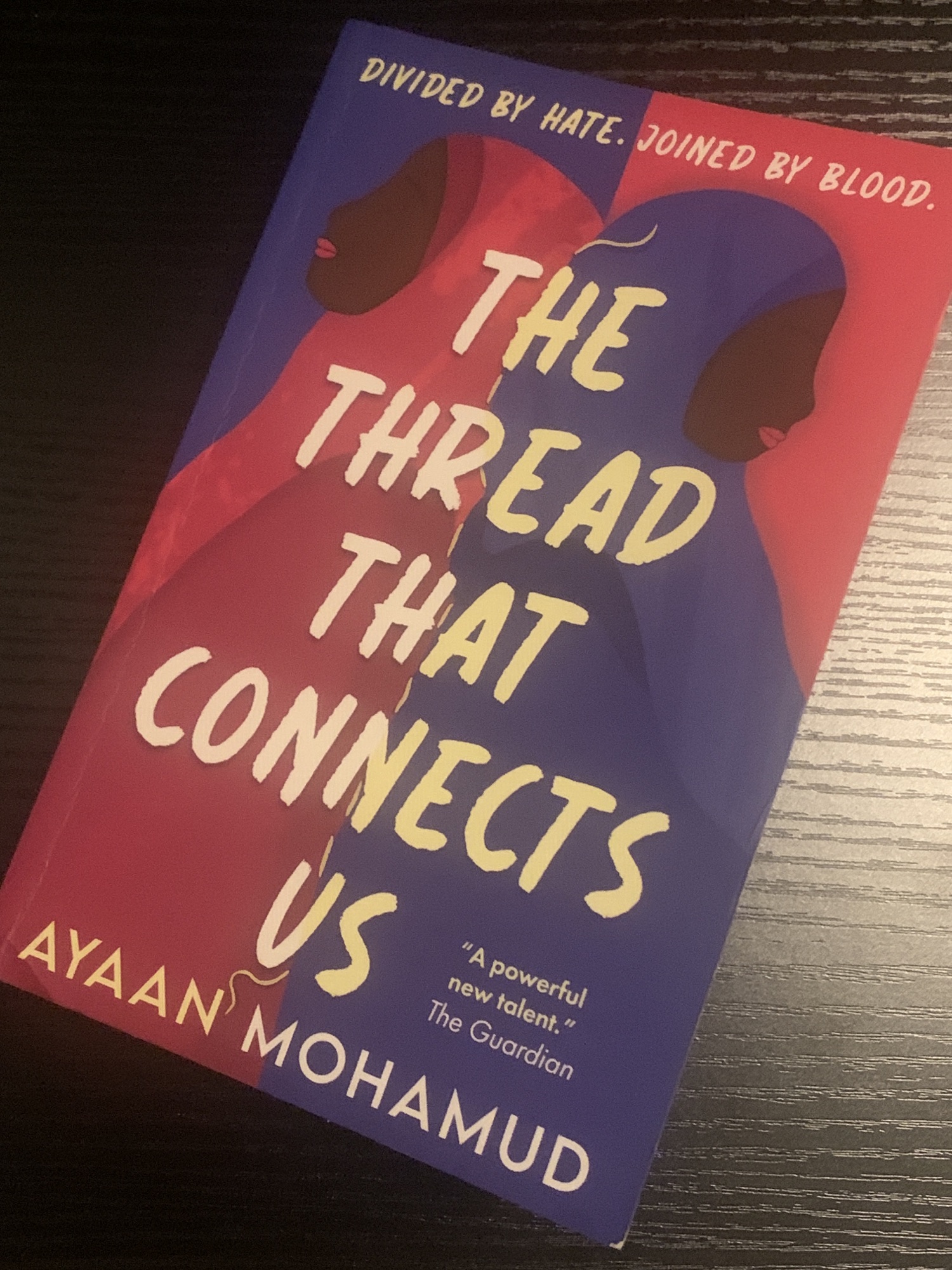
At just over 400 pages this book expertly blends the stresses of school, bullies, and friends in the UK with the twists and secrets of broken families, shattered hearts, and a past that needs to be reckoned with.  Told in dual perspectives from girls thrown together by the actions of their parents, Safiya and Halima maintain distinct voices that are rich with Somali culture, Islam, vulnerability, and ultimately love and hope.  The book is YA, but the premise is a bit mature and is better suited to older teens in my opinion, I think a high school book club would be wise to consider this book, as once you start reading, it is difficult to put the book down. 

SYNOPSIS:

Safiya is mature beyond her years.  Since her father abandoned her and her mother five years prior, she has managed the bills, the upkeep of the home, and for the most part her grades. Hooyo checked out and is rarely more than a silent being curled up unable to care for herself, much less her daughter.  With the the help from the community, particularly her best friends and neighbors Muna and Yusuf, Safiya has a found family that helps her weather the tough times.  When her dad moves back to London with his new family from Somalia, Safiya is forced to deal with not only all the painful memories of her past, but also the very real presence of her family living in her neighborhood, showing up to Eid prayers, and taking over the safe haven that school has often served as when home life has been so cold and lonely.

Halima’s father died when she was young, and life with her Hooyo in Mogadishu was good until her mother remarried, Safiya’s dad.  Her two younger half brothers that came further added to the rift between her and her mother, and now that they are moving to England with the husband, despite her protests, has her plotting a way to return to her home.  The language, the culture, the weather, are all added stresses to finding her way, and are compounded when she gets paired up to have Safiya show her around and help translate for her in school.  

The two girls hate each other, at least they have that in common, but their inability to avoid each other forces them to interact more than either wish to do.  As questions, and secrets are voiced, the two girls realize that they might have to work together to get what they want, and figure out their past.

WHY I LIKE IT:
I really enjoyed the owning of the characters’ language and culture and faith and how easy it was to be invested in their world.  Nothing pulls you out of the story, it is rich and lush and the reader can figure out why even though there is a crush, nothing is going to happen, and why they are wearing hijabs, and waking up to pray fajr, the balance is both inviting and educating, without the reader even realize it is happening, because hello, we are to busy trying to figure out what these two girls’ parents have done. 

The story has layers, and the emotional attachment I feel to both these girls, made me glad the story was over, they deserve some peace, but also desperate to know that they are going to be ok in the future too.  I can’t say too much without the risk of spoiling, but the writing is strong, the plot solid, the details intentional and relatable, and the characters very real.

FLAGS:

Lying, bullying, fighting, assault, crush, drug use, arrest, accusation, gossip, abandonment, relationships, edibles, affairs.

TOOLS FOR LEADING THE DISCUSSION:
This would be such a great upper high school read, the way the story unfolds will keep readers hooked from the first page and motivate those that start, to finish.  Students will see themselves in the characters, and be sleuths themselves trying to uncover what secrets are true and how do the pieces of the puzzle fit together.


Looking for the Eid Moon by Sahtinay Abaza illustrated by Sandra Eide

Standard
Looking for the Eid Moon by Sahtinay Abaza illustrated by Sandra Eide

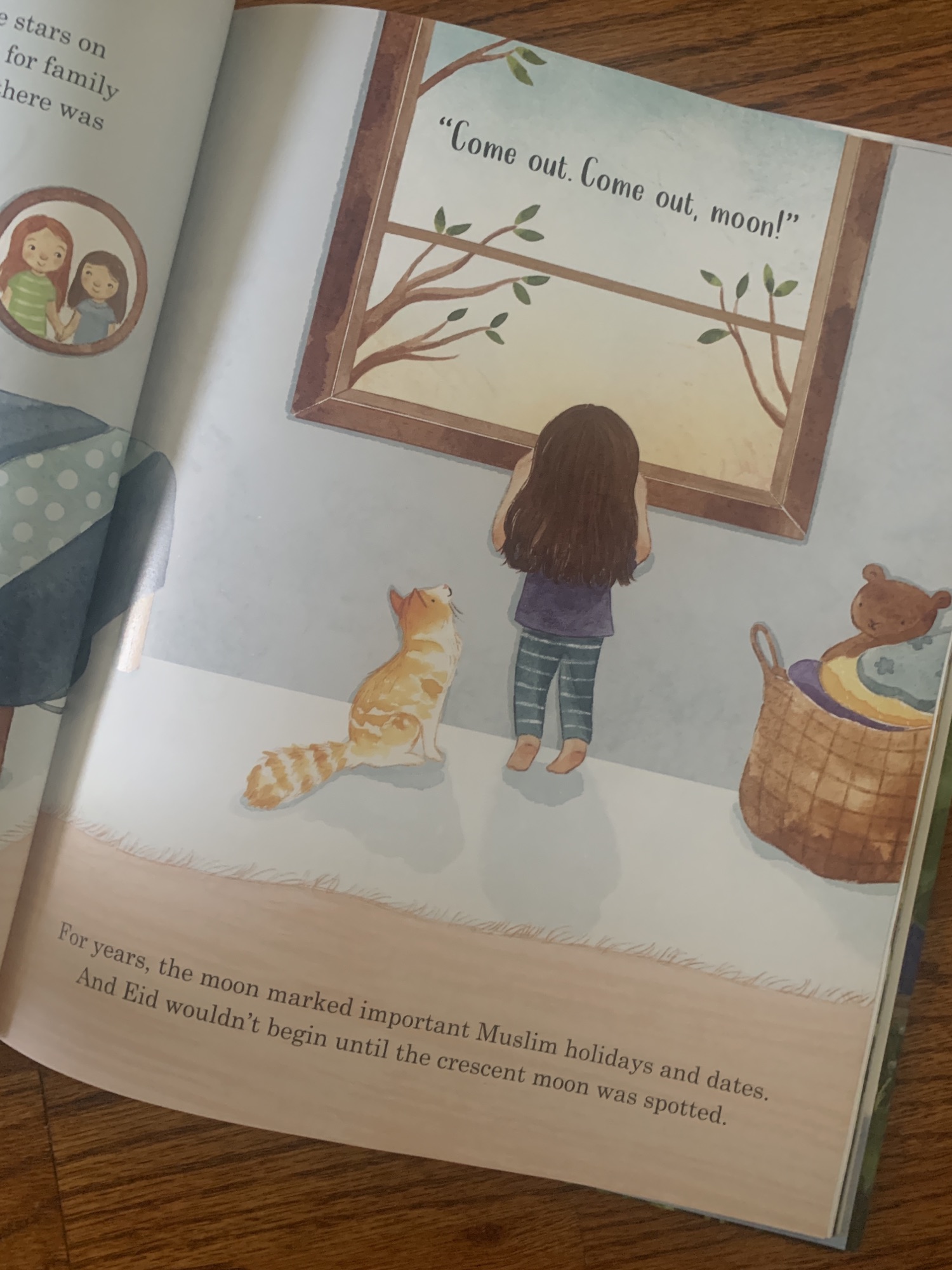
The illustrations and sister bonding in this story are sweet, but it isn’t exciting, and doesn’t feel very Ramadan or Islamic rep or even very purposeful.  I was really surprised that there wasn’t a craft activity or science tie in at the end, it seemed to be heading in that direction seeing as Eid joy, iftar, and anything religious are all completely absent. The plot really is just the title, “looking for the Eid moon.” The text feels abrupt, it doesn’t flow, and feels othering.  “For years, the moon marked important Muslim holidays and dates. And Eid wouldn’t begin until the crescent moon was spotted.” Numerous communities still rely on local sighting and have hilal committees marking all moon phases and months.   This framing of it being an antiquated practice, feels off.  The sisters are young, but Sara is old enough “to know the crescent moon is faint and hard to see,” yet she doesn’t even acknowledge iftar time, they don’t pray maghrib.  The complete removal of Islam makes looking for the Eid moon seem like they could just be looking for Mars or a comet.  It says they are excited for an Eid party, but clearly not enough to be excited it is Eid the next day, they are simply sad that they didn’t see the moon.  I’ve read the book a few times, and I truly can’t make it make sense, and I don’t understand how silver paint glows, shouldn’t it be glow in the dark paint? Sigh.
The book starts with Sara looking at her Eid dress saying she is excited for the Eid party, but first she has something to do.  She packs her flashlight and binoculars and grabs her little sister Lulu and the head out to spot the Eid moon. On their way out they pass mom hanging decorations, and she wishes them well.

In the backyard the girls watch the sky change colors and the sky is cloudy.  As it gets darker, the girls get a little scared, but mom finds them and tells them the moon has been spotted elsewhere.  The girls are sad and Sara comes up with a way to cheer up Lulu.  SPOILER she paints a ball silver, fills it with coins, and writes a note that it is from the Eid Moon, claiming this is a moon rock.  Lulu proclaims it the “best Eid ever.”

The Author’s note tells of the family’s tradition to hide and find moon rooks with coins in them, in what sounds akin to an Easter egg hunt.  It also erroneously says that Eid al Fitr is a three day holiday.  I don’t get the connection to the moon being brave and a source of light to refugees in the book, if that was the author’s intent, to show the moon as hope “when times are bleak and dark,” I’m sorry but the message was not conveyed.

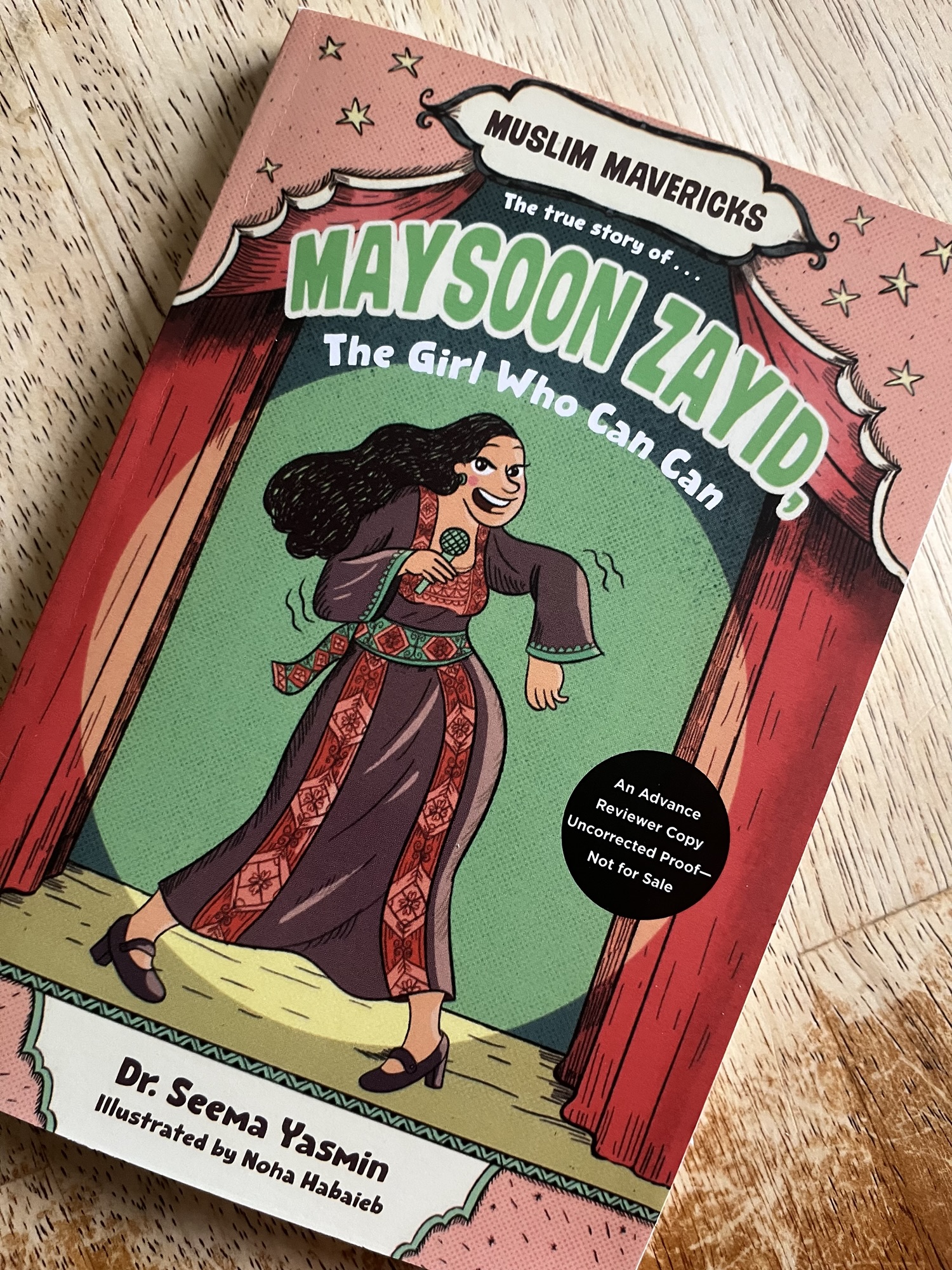
Huda F Cares? by Huda Fahmy

Standard
Huda F Cares? by Huda Fahmy

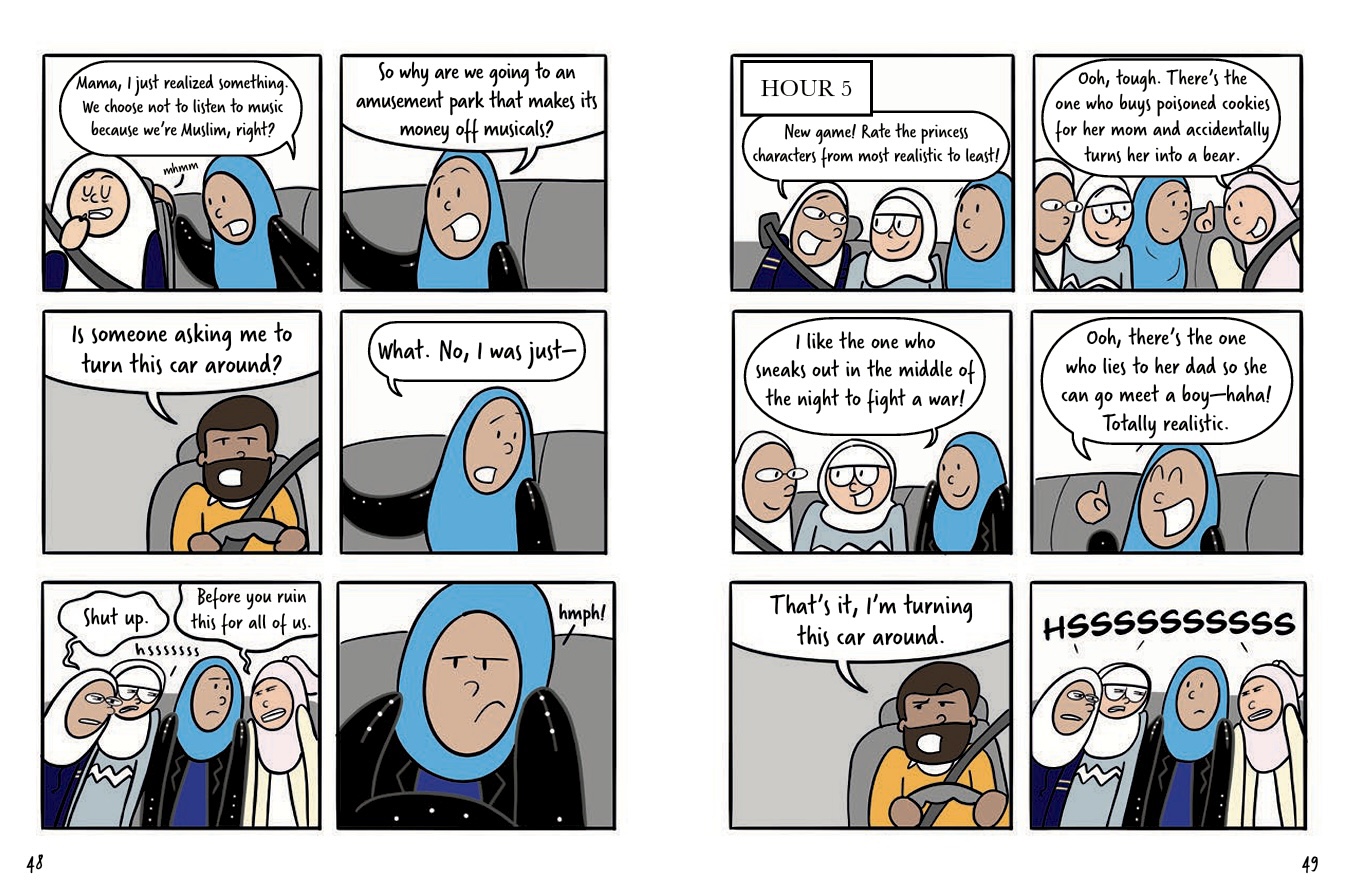
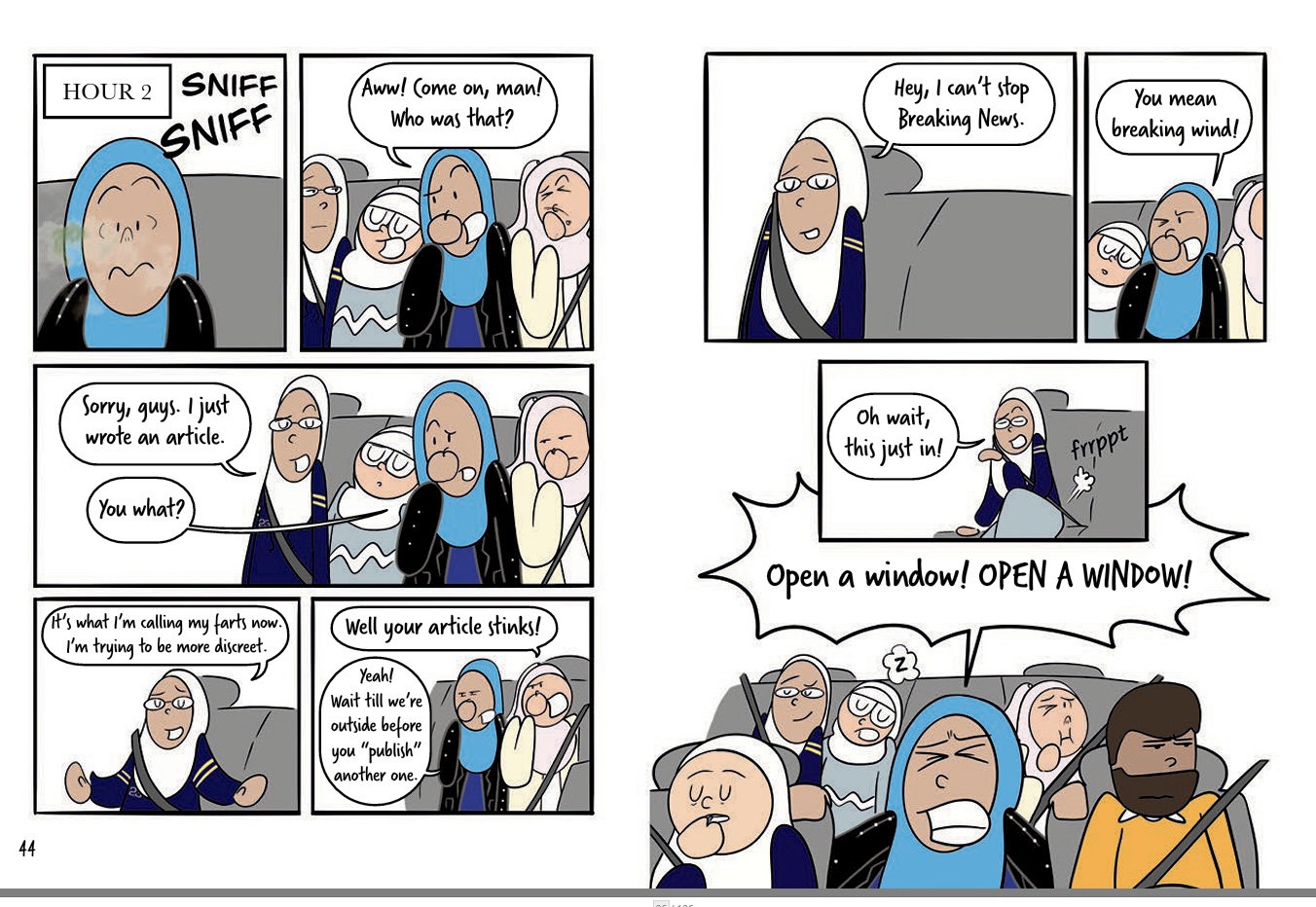
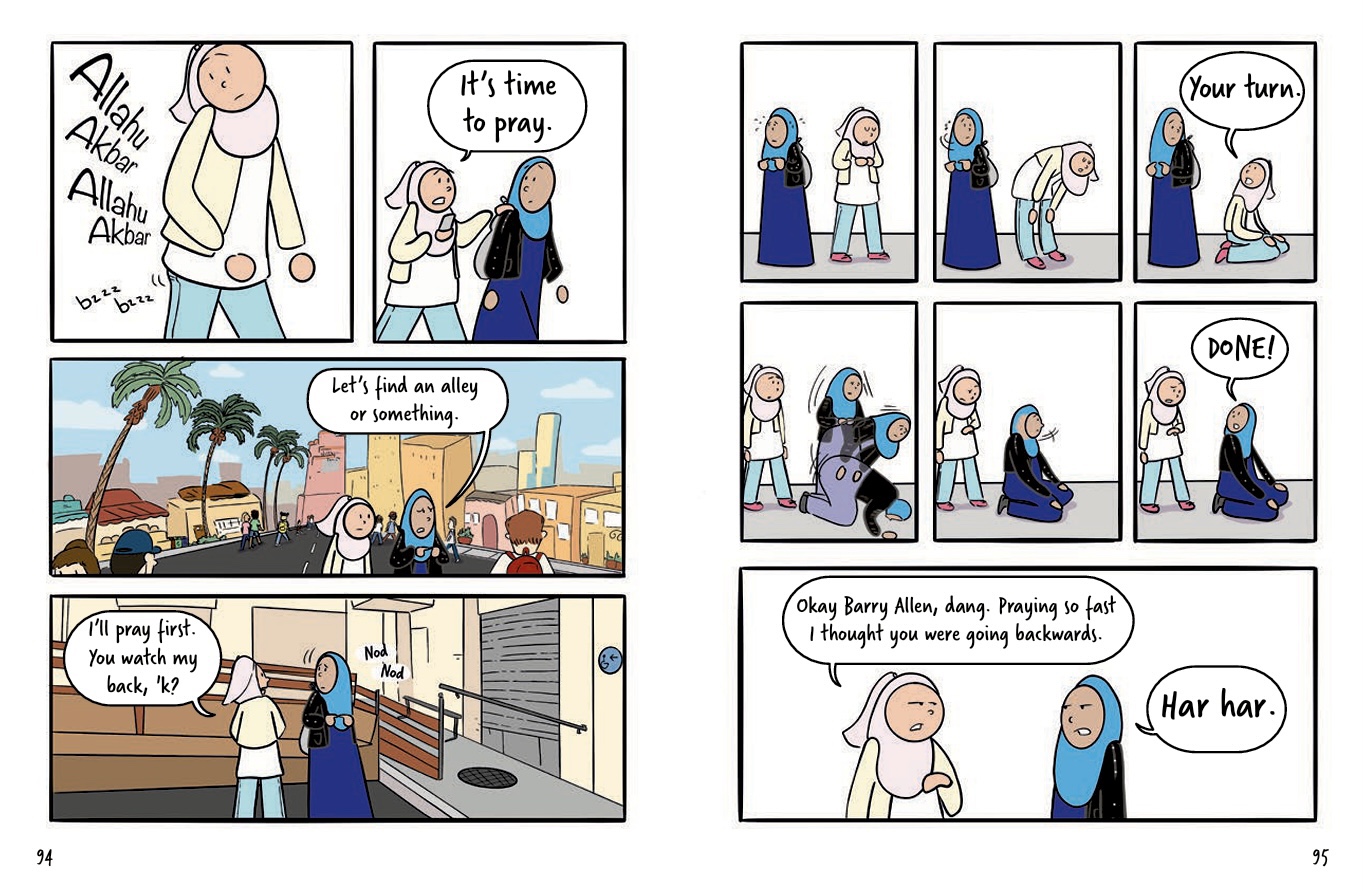
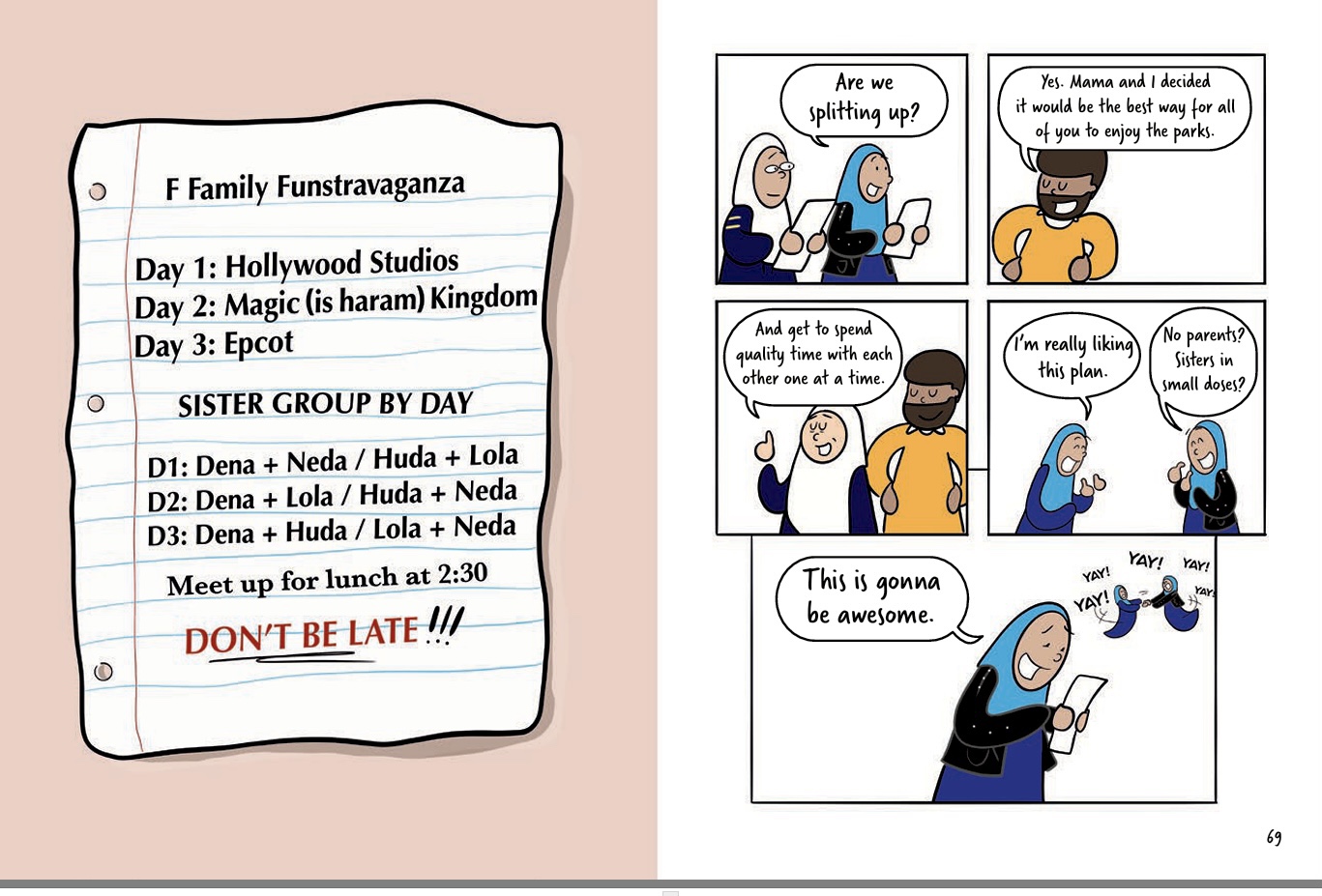
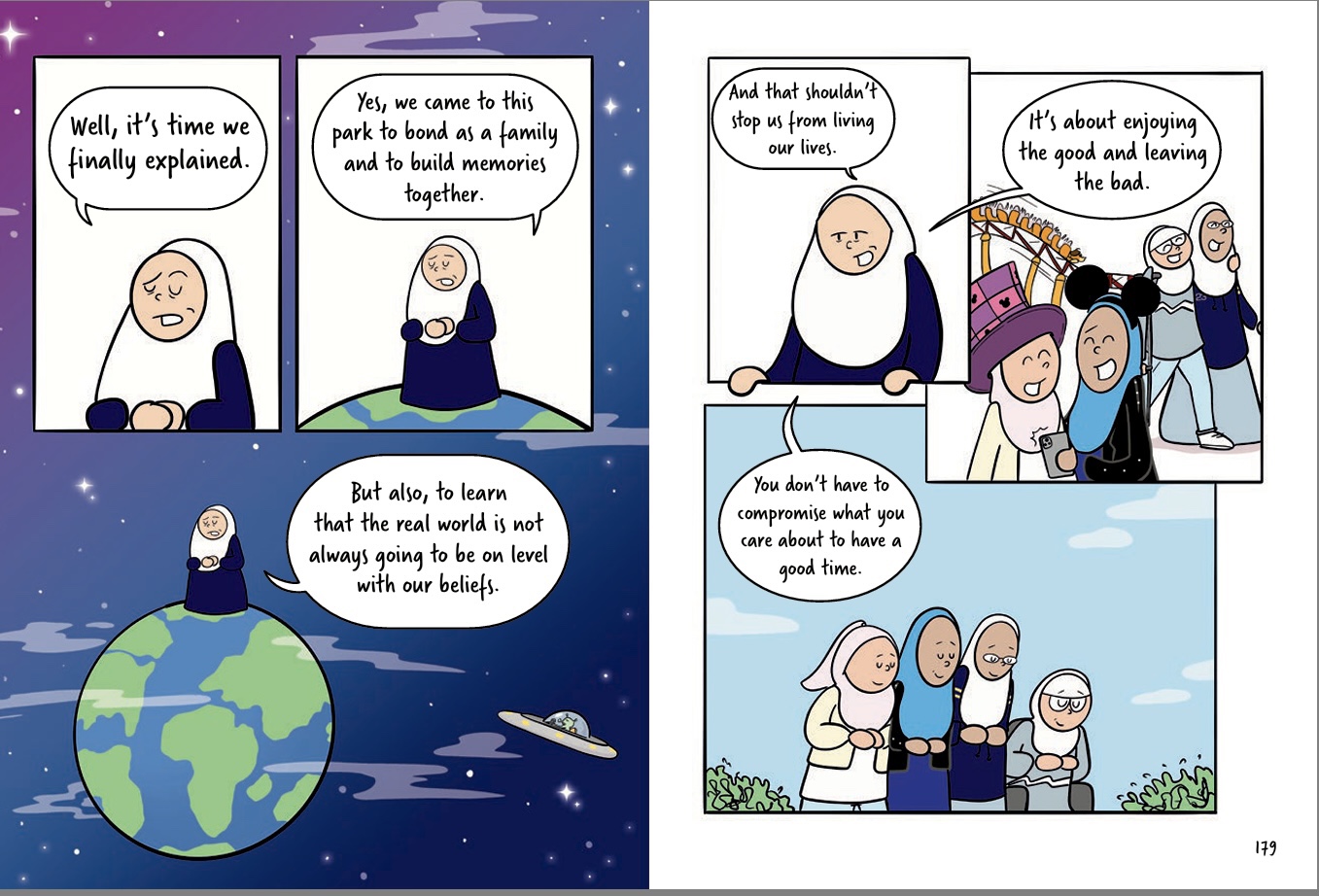
There is nothing quite like reading a YA graphic novel where you feel so completely seen, where you laugh out loud and snort at the shared idiosyncrasies, and where you don’t have to worry that the next page will normalize something haram.  This book, and the entire series, are such a gift to us all that I’m posting this review now, knowing full well that the book does not release until October, with the hopes that you will all preorder it.  This OWN voice authentic rep needs all the support we can offer it to signal to publishers that we want to see books like this published for our kids, ourselves, to share with our Muslim and non Muslim friends and that we want to see similar unapologetic voices in the future.  Huda loves Islam, she is Muslim, but that doesn’t mean she doesn’t feel uneasy at the idea of praying in public, or making wudu at a rest stop.  Her sisters sing Native Deen’s M-U-S-L-I-M to call her out, she fan girls about We Hunt the Flame, and the entire book reads like time spent with friends who can keep you laughing, comfort you when needed, and who are willing to share their very real relatable world with you as they take on Disney World.
SYNOPSIS:

It is summer and Huda and her family are heading on a road trip to Disney World. One sister hangs back for a Quran intensive, the one sister she likes.  Determined to make the best of it she piles in the back seat of the family car with her three other sisters and they hit the road.  The 24 hour one way trip is filled with sibling bickering, rest stop stresses, and parental gems.  Once they get to the park though, their parents have some surprises for them, and Huda finds herself bonding with her sisters despite herself.

FLAGS:

Fart jokes, bullying, punching, self defensive, hitting a boy in the privates for attempting to pull off a hijab, forced physical touch, lying, nothing YA can’t manage.  The title might seem crude to some, I, personally, love the ownership of one’s name, but the book is not offensive.

TOOLS FOR LEADING THE DISCUSSION:

This book won’t work as a book club selection, but I hope it finds its way to every home, middle school and up class and library.  Boys and girls will enjoy the content and I have no doubt, like the other books in the series preteens and teens will be regularly thumbing through the pages giggling and sharing their favorite parts.  You can preorder your copy here https://amzn.to/44Be87O

Please preorder if you can, and if you cannot please request your public library to shelve it, check it out, read, suggest, and enjoy!

Definitely one of my favorite books of the year, decade…..ever?

A Sari for Ammi by Mamta Nainy illustrated by Sandhya Prabhat

Standard
A Sari for Ammi by Mamta Nainy illustrated by Sandhya Prabhat

sari

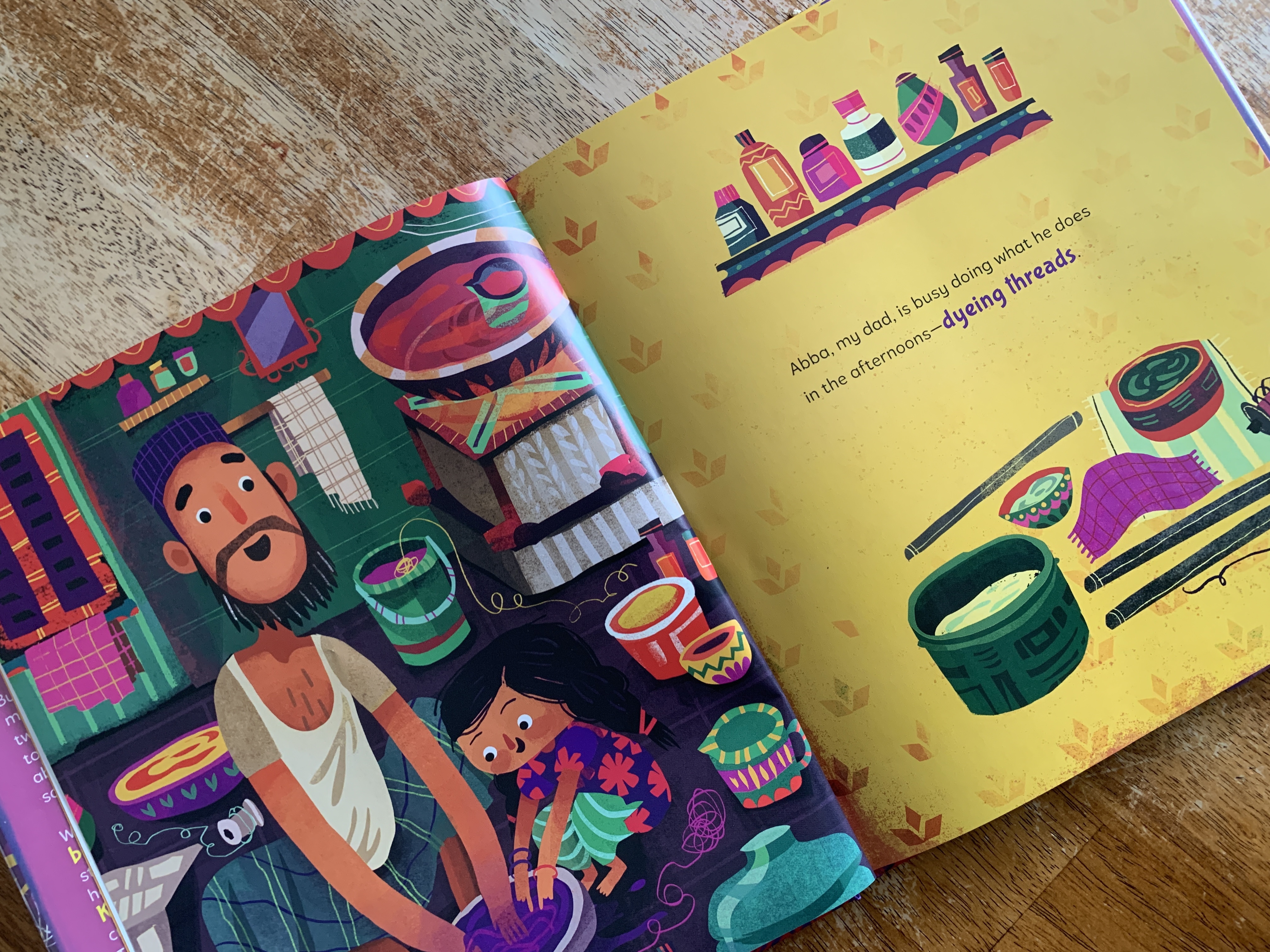
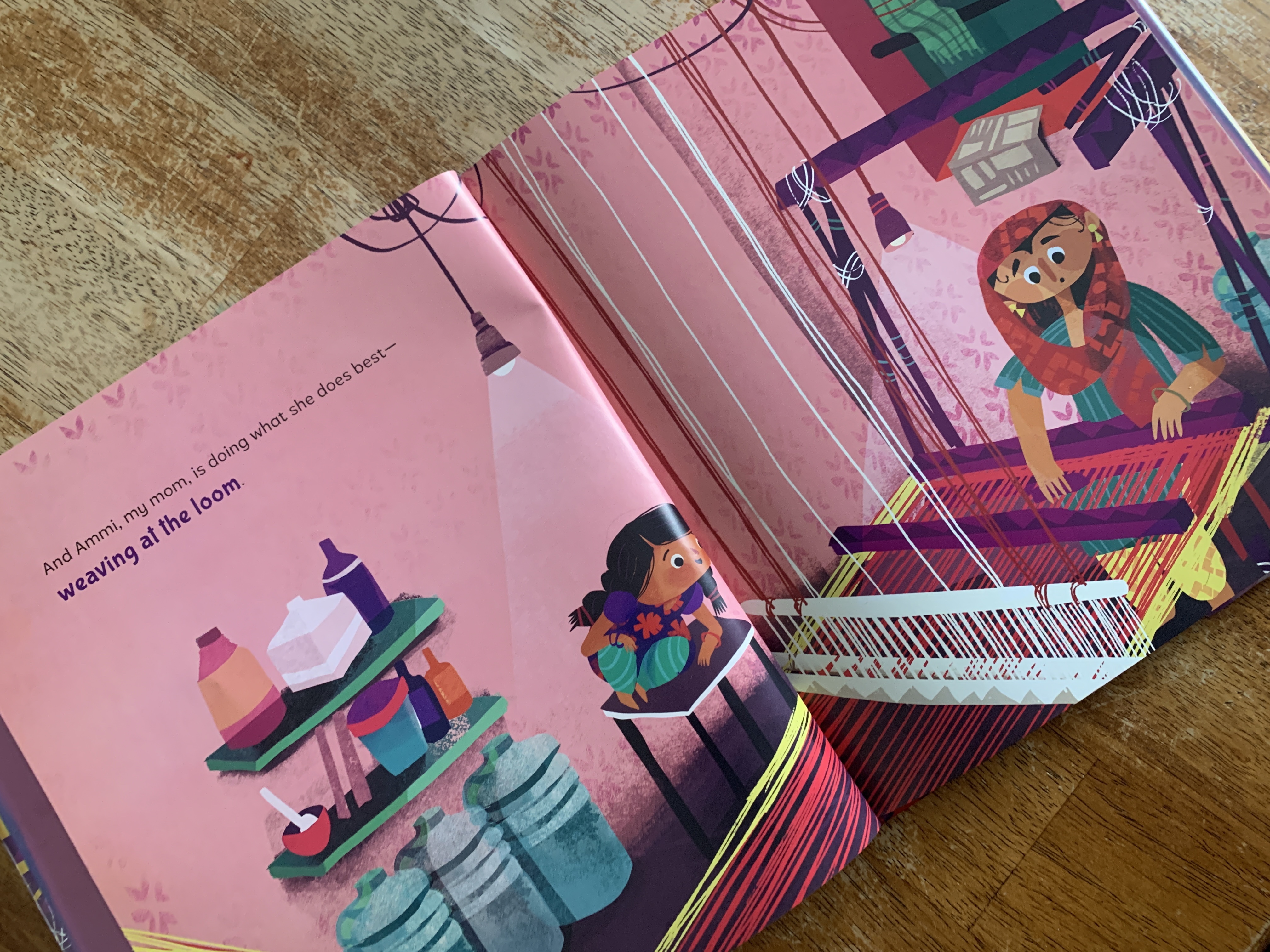
This book combines knowledge with a sweet story and a spunky narrator.  Over 32 brightly illustrated pages the reader learns about the art of dyeing yarn, weaving, and the tradition of weaving saris in India moving from Mysore to Kaithoon in Kota.  The little girl loves it all, helping her father dye the threads, and watching her mother work the loom.  It often takes a month to make a sari, and her mother makes beautiful saris, but she never wears them.  With the help of her older sister Sadaf, the little girl hopes to earn enough money to gift her mother a beautiful sari to wear.  It will take a lot of work, some community help, and some sacrifice, but Ammi is worth it and the girls are up for the challenge.  Preschool to early elementary readers will enjoy learning about the daily life of these amazing Indian Muslim artisans and a craft that they perhaps were not aware existed.

img_4662

The buffalo are sleeping, but in the afternoon Abba is busy dyeing threads, and mama is weaving colors into prints of mangoes, peacocks, birds, leaves, and flowers.  The whole family helps.  Abba goes to the haat to sell the completed saris.  Sometimes Mama goes as well, but she doesn’t wear the saris, she wears worn-out salwar-kameezes.

One day, when Ammi finishes a particularly beautiful sari the little girl asks her to keep it, but her Ammi says, “If we keep the saris, how will we eat?”  The little girl doesn’t understand, they don’t eat saris.

img_4663

Sadaf explains to her little sister that the only way their Ammi will wear a sari is if they buy her one.  So the little girl breaks her bank apart to count the money she has and convinces Sadaf that the things they wanted with the money are nothing compared to how much they want something for their mother.

But Sadaf says they only have enough money for a towel, not a sari, so the girls gather some items to sell to the junk man.  They have enough to buy Ammi a duputta, but still not a sari.

img_4665

They wander home through the wheat field trying to come up with other money raising ideas.  The wheat remind the little girl of worshippers on Eid day- all praying together at the mosque.  The little girl remembers that sometimes their neighbor Amina Khala purchases dyed threads from them and they rush over to see if she has any work for them.  Luckily she does, and they have just enough to buy a sari for Ammi and be rewarded with a smile and tears from their beloved and talented mother.

img_4664

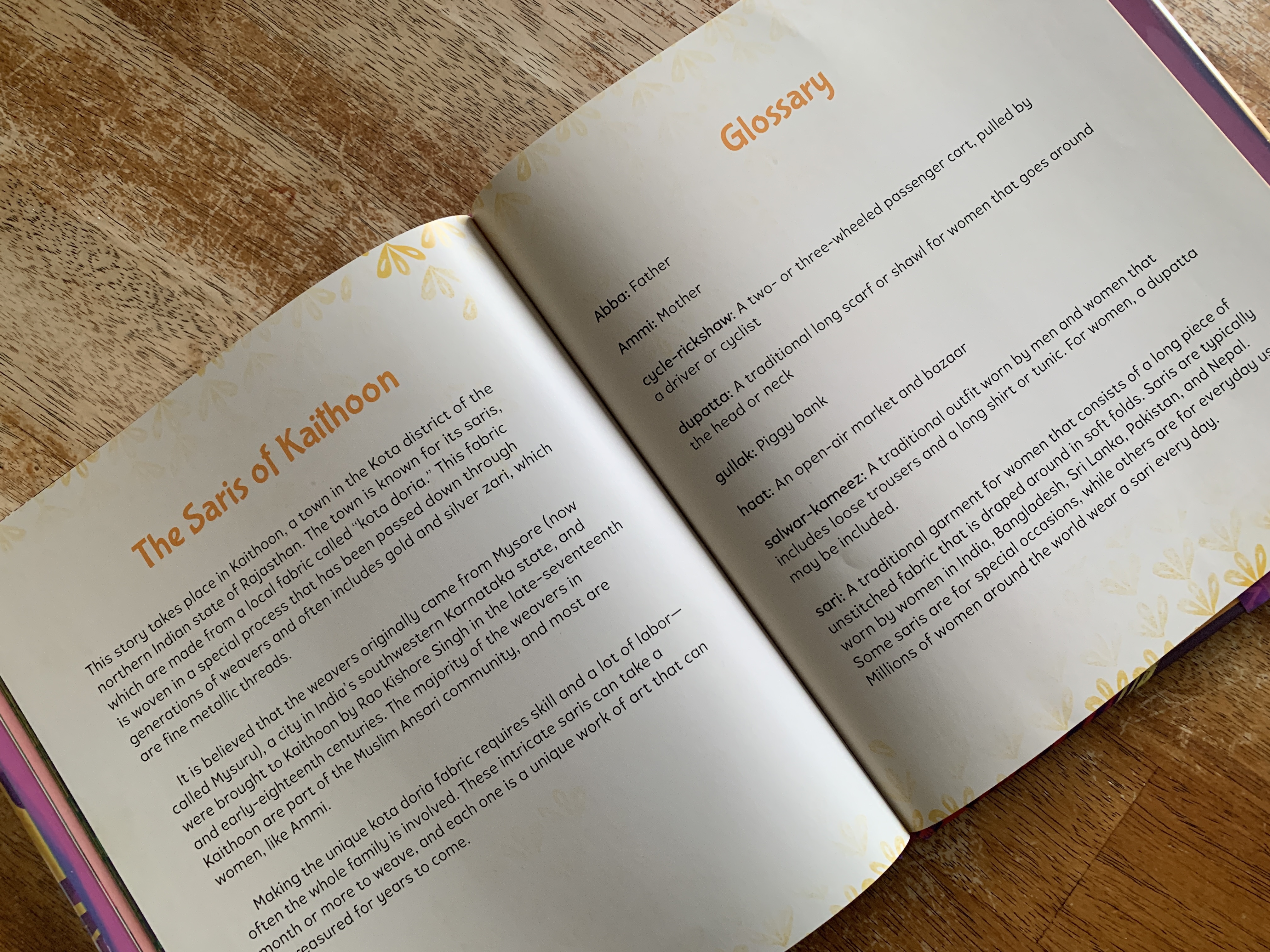
The book has an information page at the end about The Saris of Kaithoon, as well as a glossary.  The story ends a bit abruptly, but the teardrop in the illustrations, the hugging, and the smile, do provide a universal relatability to parents everywhere when their children gift them something so genuinely from the heart.  The illustrations also show women with their heads covered going about their daily life.

img_4666

Piece by Afshan Malik

Standard
Piece by Afshan Malik

Pieces.jpg

This 168 page young adult book from Daybreak Press focuses on a small Muslim family in Texas, that has their own stresses and interpersonal relationships, but are thrown in to a whirlwind when the father of the family returns home from a medical mission to Syria and finds himself in the psych ward broken and troubled.  The effects each of the character’s struggles have on them as well as those they care about, makes for a haunting yet relatable read for fourteen year olds and up.

SYNOPSIS:

The Jamal family is made up of Hannah and her older high school aged sister Noreen and their physician parents Dahlia and Adam.  Hannah runs track and is more introverted in handling friends and her father’s life altering condition.  Noreen on the other hand is ultra organized and rational in her approach to life, much more like her OB mother.  To cope with the stress of her father’s return she commits herself to more clubs at school and staring at her phone.

Hannah doesn’t seem to have a lot of friends, and when the track team understands that Hannah’s dad is dead and Hannah doesn’t correct them until later, her comfortable acquaintances turn on her and she will have to learn to stand up for herself and use her voice in the course of the book.  Noreen’s character arc is a bit more dramatic as her involvement in yearbook club brings new people in to her life, mainly a boy, who might not be as a genuine in his goals as she is, and thus their climax results in a trip to the police station.  Dahlia has a close friend, and Adam has a few as well, but the story really stays pretty streamline in exploring the relationships of the family and how little things and big things affect them all.

WHY I LIKE IT:

I love that the book takes on a serious issue like PTSD and is framed in such reality.  The scene where the dad blurs his past memories with the current real happenings, is done very well.  It conveys how fractured his brain is while showing the stress his situation lends to the mood of the home is powerful. There is also a very real situation of attempted physical and sexual assault that occurs when Noreen finds herself in a position with a male classmate who attempts to take advantage of her.  The book holds back in details, and she is able to defend herself, keeping the book clean, while still implying what his intent was, and how fortunate she is to get away.

More superficially, but also more relatable is the girls bickering and fighting and pushing each other’s buttons, and the mom trying to help, but is alas is frequently at a loss at what to do with them.  The situations the girls face at school are probable and relatable that I think a lot of middle school and high school readers will see themselves trying to balance extra curricular activities, friends, finding a quite place to pray and keeping their hijabs coordinating.  The family is Muslim and they dress the part, talk the talk, and pray together regularly.  Islam is very present, but not preachy, it is just what the characters believe and what they use to shape their view of many of the tests they are facing.

There are a few hiccups that are worth noting, but don’t overly deter for my appreciation of the story.  I struggled with the writing style in the first few chapters.  It took a bit to feel a connection to the characters and get what was going on sorted out.  It is written in 3rd person omniscient (I believe, it’s been a while) with each chapter more or less focusing on one of the four main characters.  As a result a handful of times the narrative gets awkward in explaining what one of the characters is doing or thinking, because the focus is on someone else, or the timeline overlaps a bit.  It doesn’t happen an awful lot, but the book is under 200 pages, so it is annoying that it happens at all, let alone more than once.

Story wise the characters seem oddly isolated.  The book tells us how small the town is, and shows us how everyone knows the parents regularly, the girls seem to be pretty lonely.  There isn’t any warmth from the schools or neighbors in helping them deal with their dad coming home so wounded.  In a town they have lived in for so long, this seems off to me.  Also if the town is so small, and the family so religious, there is an imam who visits once, you’d think there would be more of an Islamic community presence for the mom and girls to find support from.

FLAGS:

There is violence in the remembering of what happened in Syria.  There is some Islamaphobic talk as Hannah endures some verbal bullying and the attempted physical and sexual assault on Noreen.

TOOLS FOR LEADING THE DISCUSSION:

I would consider this as a possible middle school book club choice.   It tackless some big things, and uses Islamic boundaries to talk about mental illness and sexual violence which is a huge plus when addressing our youth.  Noreen isn’t in a relationship or even overtly infatuated with the guy who puts her in a compromising situation.  But even if she was doing something “wrong” what he did is not ok, and the fact that the authorities believe her, and she plans to discuss it with her mom, and she is not further victimized by speaking out, is something our kids need to see and understand.

There are discussion questions at the end and I think males and females will benefit from reading and discussing this book.  Unfortunately, and possibly the only other disappointment in the book is the price.  Nearly twenty bucks for a short YA paperback book makes it hard to buy classroom sets for such activities, and I’m sure will even keep the avid reader debating whether they should purchase it or not.


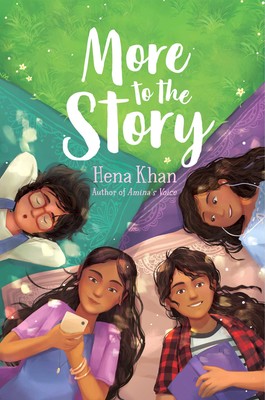
More to the Story by Hena Khan

Standard
More to the Story by Hena Khan

more to the story.jpg

For a book written by an accomplished author for 3rd to 7th graders focusing on a Muslim family, I was surprised at how despite wanting to absolutely love this book, I only kind of liked it.  For the first 100 of 271 pages, I really kept hoping there was going to be more to the story.  Luckily the story did pick up, but I couldn’t get passed how much crushing all the sisters were doing on the one boy in the story, and how much stronger I wanted the main character to become.

SYNOPSIS:

Told from Jameela, “Jam’s” perspective, the second of four daughters living with their parents in Georgia, the story focuses on the interpersonal relationships of the members of the family and their parents’ close friends who’s nephew has moved in with them from England, Ali.  All the kids are close in age and of Pakistani ethnicity, and are Muslim.  As the reader gets to know Maryam, Jam, Bisma, and Aleeza, you see the characters develop pretty well and their quirks and personalities emerge.  Jam is more tomboyish than the gorgeous Maryam who likes to bake.  Jam and Bisma share a room and are closer than Jam and Aleeza, the baby of the family who Jam finds is becoming a brat.  Jam also enjoys watching football and eating spicy food with her dad and desperately wants to be an award winning journalist like her grandfather.  She puts out a family newsletter and is ecstatic to be named the feature’s editor as she starts 7th grade.  Ali is a year older and has moved to stay with his aunt and uncle until his mom and sister can join them.  He spends a lot of time with the sisters and in Little Women inspired fashion the little ones want his attention, Jam is a little jealous to learn he finds himself tongue tied when talking to the beautiful Maryam and Maryam in 9th grade is drawn to Ali, but doesn’t vocalize it too much.  And then as the story picks up speed, Jam says, “In a matter of weeks, Baba got a new job and moved across the world, Bisma got sick and has to be in the hospital, and I messed up everything with Ali and the paper. How did my whole life get turned upside down so quickly?”  

The rest of the book is dealing with Baba working in the Middle East, Bisma being diagnosed with lymphoma, Jameela learning some journalistic basics, and Ali and Jameela becoming a bit more than just friends. 

WHY I LIKE IT:

I love that a Muslims desi family is being represented in an own voice novel that mentions religion as a natural part of their life, and doesn’t apologize or overly explain it.  That being said, I feel like the book is trying to present “us” to the outside so to speak, rather than empower our own.  And I point this out, because I feel like it could have done both.  Dialogue between Ali and Jameela about how they might date as they get older, how Ali can’t see any of the sisters having an arranged marriage.  How when Maryam gets asked to a dance her mom doesn’t mention any religious reason her daughter should say no.  None of the girls wear hijab, and they mention that they don’t wear hijab, at one point Jam knows she should get up and pray, but doesn’t.  I don’t expect a fictional story to teach our upper elementary age kids how to behave that is a parent’s job, but to have some basic Islamic tenants brushed aside after being mentioned is worth noting.  Had the book just been more cultural, maybe I wouldn’t be so critical, but Muslim girls are going to be excited to see themselves in this book and some of the messages might tilt a little more liberal than some parents would expect.  It is one thing when our girls read a book with a romantic twist and we say that, that is not for us, but when a book celebrates us not just crushing, but vocalizing those crushes and moving in to a gray area (they hug but it could be an innocent friend hug) and they make a point to be next to each other, Muslim parents should be aware.  In the larger society it wouldn’t even register on the radar, hence I point it out.

Another thing that kind of bothered me and was again related to Jameela and Ali’s relationship was that when Jameela cut her hair in support of Bisma losing hers with chemo treatments, she seems to need Ali’s approval.  I get that she wanted him to see her and all that, but I really wanted her to be strong enough in and of her self that even if she looked awful she would own it and not let it define her and not let a boy’s opinion about her physical appearance weigh that heavily on her.  Again I know 4th grade girls start noticing boys and having crushes and middle school is only worse, but I just was hoping that her strength and confidence would come from her own growth arc, not from someone else, let alone someone she likes. Side-note here too about the hair, it is donated to make a wig, which I know might also be a sensitive subject regarding if that is allowed in Islam or not.

In terms of the cancer and the sister’s rallying together all that I thoroughly enjoyed and found the most interesting passages in the book.  I think the understanding of a real subject and finding a way to help and deal with this was executed expertly and powerfully without sensationalizing the concern or simplifying the experience either.

FLAGS:

The book is clean, but there is a lot of mention of how Ali affects the girls.  And potentially depending your own opinions on the hair being donated.

TOOLS FOR LEADING THE DISCUSSION:

I wouldn’t do this as a book club book, I’m actually hesitant in even recommending it to my 12 year old daughter.  I know she has read worse, but again me handing her a book about Muslim girls might make her understanding of what we expect regarding boy/girl interactions to be a bit muddled.