Tag Archives: Muslim Character

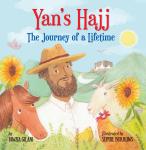
Yan’s Hajj: The Journey of a Lifetime by Fawzia Gilani illustrated by Sophie Burrows

Standard
Yan’s Hajj: The Journey of a Lifetime by Fawzia Gilani illustrated by Sophie Burrows

yans hajj.jpg

With less than a month until Hajj, this book should definitely start making an appearance in your children’s story selection rotation.  The focus is not on the parts of hajj, but rather the desire and intense yearning to go for the sake of Allah (swt).  Granted, it doesn’t take much to get me to cry these days, but this 27 page book for ages 5 and up, got me emotional.  Going for hajj is always something to plan for and hope for, and the sweetness of the reminder that we plan, and Allah plans and Allah is the best of planners is so beautifully brought to life, that I benefitted from the reminder and my kids from the lesson.

IMG_5485.jpg

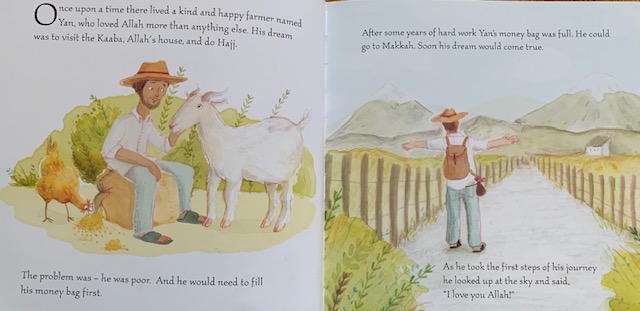
Yan is a farmer, a poor farmer, who loves Allah and wants to go for hajj more than anything else.  So he decides to work hard and fill up his money bag so that he may go.  After years of hard work his bag is full and he begins his first steps in his journey proclaiming his love for Allah.  After a few days of walking however, he comes upon some sad children who have recently lost their school to a fire.  Yan, uses his money and time to fix the school and returns back to his farm to start saving up again to go for hajj.IMG_5486.jpg

When his bag is full again and he sets out again, he is met by an injured boy who is being yelled at by his owner.  Yan, once again reaches into his money bag to generously do the right thing, in this case to pay off the boy’s debts and takes the boy home with him to be nursed back to health.

IMG_5487.jpg

After some time he again has a full money bag and sets off for Hajj.  Along the way he finds a village trying to build a mosque and after two months of helping with the funds and offering his own labor, the mosque is complete and Yan returns home.

IMG_5488.jpg

Now Yan is old, and after many years he looks in his money bag and it is not full and he sadly admits he cannot do hajj.  But then the boy he saved, Habeeb, returns with a horse cart to take him for hajj and they pass through the village where he repaired the school and is greeted with rose petals and gifts of ihram, they then pass by the mosque he helped build and the villagers gift him with food and water, they then arrive at Habeeb’s house and he is given a bag filled with money and at long last Yan’s dream comes true as he sees the Kaaba.

IMG_5489.jpg

The book shows how steadfast Yan’s love of Allah is and how generous and patient he is in pursuing that love. The illustrations of him aging are truly touching and gentle.  In some ways it reminded me of Shel Silverstein’s The Giving Tree, but with a happier ending, in bringing a large grown up concept down to size and presenting it in a genuine way.


Other Words for Home by Jasmine Warga

Standard
Other Words for Home by Jasmine Warga

other words for home.jpg

Three hundred and forty pages written in verse that beautifully consume you and leave you emotionally changed and vulnerable and humbled all at once.  The book claims it is for middle grades, but I think middle school will appreciate it more, and I sincerely hope everyone of all ages will take a couple of hours to fall under the spell that is woven to tell a story of a refugee leaving home and starting anew in America.

SYNOPSIS:

Jude is a 12 year old girl living on the beach in Syria, watching American movies with her friends and hanging out at her dad’s store.  With an older brother and a little sister on the way, life as told from her own perspective is pretty good.  Until it is not.  Until the crimes they only hear about happening in Aleppo and Damascus start to hit closer to home.  Until her brother starts sneaking out to meetings with other youth hoping to change the politics of their country.  Until a raid almost catches Jude and her brother and her parent’s decide it is time for Jude and her mother to journey to America, for a little while, to visit her mom’s brother and deliver the baby.

America is not like it is in the 90’s movies that Jude loves: Pretty Woman, Legally Blond, Miss Congeniality.  Her American aunt and her Uncle that seems to have forgotten his Syrian upbringing, are gracious and welcoming and their daughter, Sarah, who is less than a year older than Jude waxes and wanes in her approach to her cousin.  Adjusting to school, life without baba and her brother, and all the other adaptations that moving to a new country entail are brought to life through Jude’s eyes and understanding of the world around her.  As she comes of age and decides to wear hijab, as Islamaphobia shakes her sense of justice, and her little sister is born, the reader sees her grow and change and mature and find themselves hoping that she will soar.

WHY I LIKE IT:

I love that the style of the story telling somehow gives life to so much.  With verse some things are highlighted in detail and other things skimmed over and yet at the end, not only do you feel like you understand Jude, but a lot of the side characters as well, which caught me off guard.  Truly the writing is strong and deliberate.  A lot of the politics and war crimes occurring in Syria are not detailed, and I have to assume that is because the point of view is a 12 year old girl that is blissfully in her own world.  I imagine this is also why the target audience is listed as 8-12 year olds, because it simplifies a truly horrific situation.  Also because despite moments of raw vulnerability, the book stays pretty optimistic and hopeful.  

I like that the characters are Muslim, and that the mom scolds her brother for not going to the mosque.  The book does talk about Jude’s period starting and thus Jude starting to wear hijab, which is one of the reasons I feel like early middle school might be a bit more appropriate age group.  There isn’t too much talk about faith and Islamic beliefs, but a few tidbits are sprinkled in, prayer, not eating pork, modesty.  The book is not gender exclusive, but I think girls will gravitate much more to Jude’s perspective, experiences and voice.

The only thing I found a bit off is that the book takes place in modern time, present day, yet none of them have cell phones or social media.  Jude Skypes her dad, yet writes letters to her friend back in Syria and is distraught when they don’t have a forwarding address to send them to after her friend also leaves home.  It seems that social media, email, a cell phone number, something would be available for them to all keep in touch.

FLAGS:

There is mention of Jude and her friends having to sneak in to see Pretty Woman because Julia Roberts is a prostitute, and mention of blood between one’s legs and periods starting.  The book otherwise is pretty clean.  It hints at her kind of crushing on a boy that is in the play with her, but nothing more than friendship is explored.  Violence mentioned is minimal and language is clean even when dealing with hate crimes in America.

TOOLS FOR LEADING THE DISCUSSION:

There is a good chance that next year the students joining the middle school book club will be all girls, so if that is the case and the school counselor feels all the girls can handle the puberty aspects mentioned I would totally do this book.  The book reads very quick and might be a good way to get new kid to give a book club a try as well.

Author’s website: http://jasminewarga.com/about

Q & A with the Author: https://www.publishersweekly.com/pw/by-topic/childrens/childrens-authors/article/80127-q-a-with-jasmine-warga.html

Interview with the Author: https://www.hbook.com/2019/04/authors-illustrators/publishers-previews/spring-2019-publishers-preview-five-questions-for-jasmine-warga/


What Am I? Book 2 ‘The What Race are we Series’ by Asiila Imani and Papatia Feauxzar illustrated by Juliana Paz

Standard
What Am I? Book 2 ‘The What Race are we Series’ by Asiila Imani and Papatia Feauxzar illustrated by Juliana Paz

IMG_4825.jpg

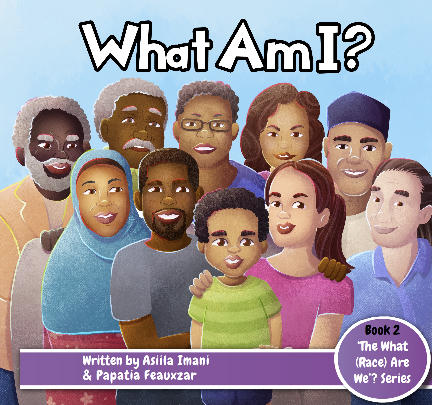
This incredibly important 37 page picture book highlighting a little boys heritage will speak to children who see themselves in his quest to answer what he is, as well as (hopefully) inspire them to search out their own family ancestry and unique make up.

IMG_4828

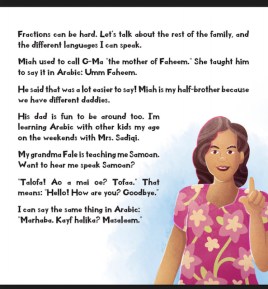
The book is not a traditional story book, in fact there isn’t much of a storyline, but the concepts presented show how beautiful and amazing multi-cultural and multi-ethnic families can be.  A lot of cultural information is conveyed and celebrated about Samoan and Pacific Island traditions as well as Islamic ones.

IMG_4831IMG_4832

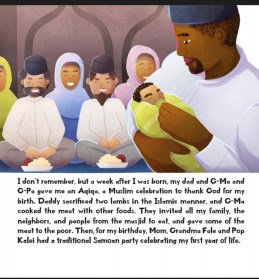
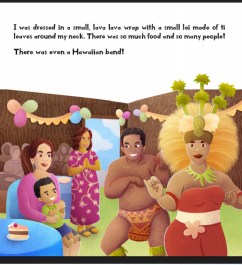
There is an aqiqa at the time of his birth as well as a Samoan party with a Hawaiian band.  Some members of his family cover, while other’s don’t.  He remarks how he has extra grandparents which equal extra blessings, and how he has a half brother because they have different dads.

IMG_4830

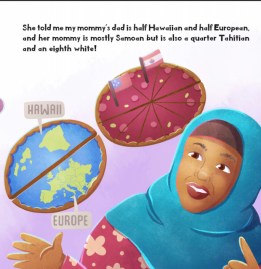
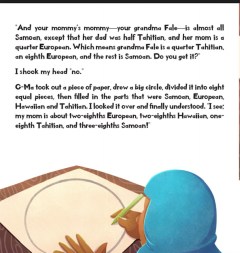
In addition to geography, there is also a STEM component as six-year-old Toa Idris learns he is a quarter this and half that through understanding fractions as visualized by slices of a pizza.  At one point Idris remarks that, “I can’t keep all those people and places straight,” and after reading the book half a dozen times, I honestly couldn’t either.  But, I think that is ok.  The point of the book is that being diverse is amazing, and having people love you is important, and culture and tradition and faith all make you richer.

IMG_4829 The text on each page is presented in a fun font, as are the pictures.  Really there is just one picture that makes Idris look angry and it is used in the story and the title page, which is unfortunate, I think it is supposed to have him look pensive, but it seems a bit off to me, where all the other pictures ooze with warmth and richness.

IMG_4826

I honestly don’t know what age group would benefit the most from the book.  Younger kids that may have been asked what their culture is will be empowered by having it reinforced that they are made just how Allah swt planned them to be, older readers will be able to create their own pizza slices, so to speak, and understand their own pieces, but I feel like both groups might need some coaching from an adult.  There are family trees at the beginning that almost become reference pages while reading the story and trying to keep everyone straight, that make the book almost interactive.  Muslim and non Muslim reader alike would learn about new cultures, and benefit from the “Extras” at the end.  Honestly, overall there is just a lot of information tossed around in the book, which isn’t a bad thing, it just might make it a bit more hit or miss if it will work for your child.

Adam & the Tummy Monsters by Zanib Mian illustrated by Maria M. Goncalves

Standard
Adam & the Tummy Monsters by Zanib Mian illustrated by Maria M. Goncalves

IMG_3157

Book two in the Adam Series was the first Zanib Mian book I ever read, and for the last three years I’ve been looking for the first book.  So, while thrilled to finally find it secondhand in the US, I realize my review of it is a bit selfish.  I’m hoping that if it appeals to you that maybe we can encourage the author to re-release it somehow or write more books in the series, I’m not entirely sure how publishing and copyrights work, but I feel like it is worth a shot.  There aren’t a lot of early readers with Muslim characters out there, let alone ones that are done well.  The book is 32 pages, hard back and is would work for 5 year olds and up that know their site words and are pretty fluent at sounding out new words. Ideally, kids that have had the story read to them a few time will be able to pick it up faster, as the story is compelling, the spacing between lines and the variety of fonts will hold their interest, but some pages do have a lot of text and some words are a bit complex. 

IMG_3158

SYNOPSIS:

Adam has a tummy ache, aka tummy monsters, and while he doesn’t want “yucky medicine” from the doctor, he is happy when his dad, puts on a silly hat and assumes the role of “Detective Doodle” to solve the case.  They determine that he ate porridge for breakfast, but so did Adam’s sister and brother, who are feeling fine, so that can’t be it.  He washed his hands before eating, and said “Bismillah” before he started too.  It seems he followed all the eating rules, but when Adam’s sister Mariam stumbles on a scene in the playroom, the culprit is uncovered.

IMG_3160

WHY I LIKE IT:

I love that the family has a silly approach to a very common childhood problem.  I also love that while, solving the case, reminders about eating etiquette are sneaked in without being preachy or cumbersome.  Once the reason for the tummy ache is uncovered, Adam’s parents don’t scold him, but it is safe to say he probably learns his lesson.

The pictures are engaging and colorful.  The mom wears hijab, and the characters are warm and happy.  The background color of the pages changes and sets a nice tone for the book.  

In the text, Adam isn’t asked if he said bismillah, but rather if he said, “in the name of God,” but in the illustration, a speaking bubble has him saying bismillah, which makes me wonder if the author was trying to make the book accessible to both Muslims and non Muslims alike.  It definitely could be, I think the story is fun and the consequences for gorging on chocolate pretty universal.

IMG_3159

FLAGS:

None

TOOLS FOR LEADING THE DISCUSSION:

Like the second Adam book, this book will work perfect for story time in small groups  and bedtime on repeat.  I think in a classroom it would be great to have small groups read the story and then discuss.  Not a traditional Book Club, obviously for the length of the book and the target audience, but I do think that even little kids will have a lot to say about Adam and his silly family.  More importantly, I think they all will have stories of their own “tummy monsters” to contribute and discuss.

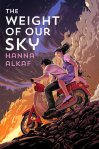
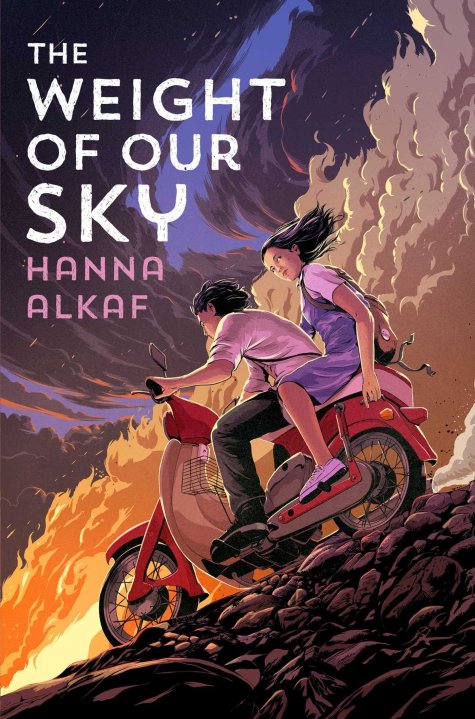
The Weight of Our Sky by Hanna Alkaf

Standard
The Weight of Our Sky by Hanna Alkaf

sky.jpg

This brand new middle school read is like a quick picture of a young girl’s life.  You get to know her as she is, you briefly meet those around her, you see a week or so of her life and then the book ends and you aren’t the same.  You wonder about her, you worry about her, and you find yourself wanting to reach out to those that maybe remind you of her.  Truly a wonderful book of 277 hard-to-put-down-pages that give insight into Malaysia in 1969, OCD, and the beauty of people willing to show their humanity in dire circumstances. My only concern is that I don’t know that there is anything relevant to the typical target audience western reader that would compel them to pick up the book and see it through.  All the reviews online that praise it seem to be from people older than the YA demographic.  Yes, I really enjoyed the book, but I know who the Beatles are, who Paul Newman is, I am a Muslim, I recently went to Kuala Lumpur, Malaysia and saw the diversity of religions and culture, I know people struggling with mental illness to the point of disability and the exhaustion that ensues; yet I don’t know if I could convince my 12 year old daughter to read it.  If I forced her, I don’t know that she would find the book as beautiful and powerful as I do.  I think a lot of it, she simply wouldn’t get, and even less of it she would relate to.  I probably will force her to read it at some point, and I’ll happily revise this review and swallow my assumption about what the youth these days can handle and identify with, but until then, please let me know if you are in the YA demographic and what you thought of the book. Thanks.

SYNOPSIS:

Melati is a 16 year old Malay girl in 1969, living with her mother, a nurse.  Her father, a police officer, has recently died, and with his loss, she has become crippled by OCD and the fear that her mother too, will die.  Counting numbers move from consoling her and keeping the horrific thoughts at bay, to becoming almost like an incantation that must be performed nearly constantly to keep her mother safe.  As race riots between the Chinese and ethnic Malays engulf the city one fateful afternoon when Melati and her best friend Safiyah are at the movie theater after class, watching the latest Paul Newman movie, the reader is shown how even in calm situations, keeping the OCD from consuming her is a full time job.  With no knowledge of treating and even diagnosing mental health, Melati tries to hide her visions and ticks from those around her as it has alienated extended family, and worries her mother.  The conclusion instead is that she is being haunted by a djinn and thus her mother takes her to different imams and healers, to no avail, and knowing that the common treatment at the time is to have those suffering carted off to an asylum and experimented on, something Melati’s mom, Salmah vows never to let happen, Melati suffers alone.

Once the movie ends, gangs enter the theater and Saf and Melati are separated.  Melati is saved by a stranger, a Chinese lady named Auntie Bee, and Saf is left at the hands of a Chinese gang.  Violence erupts, lasting for days, and curfews prevent Melati from searching for her mother.  While Auntie Bee and her family care for her and take in other neighbors, it is made clear that tensions between the two ethnic groups are high and have been for some time, but that good people exist on both sides too.  People who see people as people not just their culture. 

It is a YA book, so there is a little suspension of reality to reunite a number of the characters and give them the happiest ending such a gritty book can muster, but the author does warn the reader before the story begins that this book has violence and anxiety triggers, and death, she actually urges those that will be inversely affect by such things, to not read her book.  And it makes sense, it is graphic at times, and characters also die, and the tone is powerful, and the OCD is intense.

WHY I LIKE IT:

I love that the book embraces all its themes wholeheartedly, there is no happy ending, or magic cure for Melati’s illness, within one family there is racial tension and beautiful examples of selflessness, that two people can save each other but not like each other, and that families can be really disappointing.  At times the presence of the djinn is so annoying that the reader feels how crippling it must be to Melati, as it cripples the story as well, the balance is perfect though, it doesn’t drag the book to the point of wanting to put it down, if anything it makes you cheer harder when her little victories take place.  

I like that there isn’t a huge sappy reunion, because the danger is still going on and the characters presence of mind to the tasks still at hand is actually a subtle, yet powerful nod to the hope that Melati and her mom will be ok.  Can you tell I’m trying not to spoil too much, just suffice it to say, the women in this book are strong and determined and inspiring.

I like that Islam is present and that Melati has to grapple at times with her faith to find where it lies and how she accepts some of the events that have taken place, and the djinn fighting to consumer her. In many teens it is a right of passage, but for her it is amplified by the horrors she has lived through and seen and her own mental state.  Clearly the author is Malay and Muslim as she sprinkles words and phrases and traditions seamlessly into  the narrative that makes it flow with authenticity and vibrance.

I wish at times we knew more about the history of what lead up to the violence, or maybe even more about some of the characters, but alas I think this is Melati’s story and those that have turned their back on her and her mom really don’t deserve the ink needed to share their roles.  Some details about the resolution of the riots or how the country came back together might be nice, but a quick Google search can quell any curiosities.  I appreciate that the writing is smooth and intentional and well crafted and not a distraction to the internal turmoil and story being conveyed.

FLAGS:

Violence, racial tension, graphic death, anxiety triggers.  Melati and Vincent hold hands, it is a bit fuzzy if it is out of reassurance or something more.  There isn’t explicit sexual violence, but Melati does see a soldier pressing his body against a school girl who is of a similar age to her.  

TOOLS FOR LEADING THE DISCUSSION:

I want to do this as a book club, but I don’t know that the students will read it voluntarily.  I may have to bribe them and get permission from the school counselor.  I think they would benefit immensely from the insight in to mental illness and feel comfortable talking about their understanding of it, being it is presented in a fictional format.  I think the violence, because it is rooted in history can be understood and be discussed.  

Interview with the author: http://richincolor.com/2019/02/interview-with-hanna-alkaf-the-weight-of-our-sky/

Author’s website: https://hannaalkaf.com/the-weight-of-our-sky-2/


Ibrahim Khan and the Mystery of the Haunted Lake by Farheen Khan

Standard
Ibrahim Khan and the Mystery of the Haunted Lake by Farheen Khan

ibrahim-khan-and-the-mystery-of-the-haunted-lake.jpg

It has been over four years since I reviewed the first Ibrahim Khan book, and while I didn’t love The Mystery of the Roaring Lion, it was just ok, this book was more fun and adventurous and stayed relevant even for a book published in 2010.  At 68 pages the book works ideally for 2nd to 4th graders looking for a quick read, or advanced younger kids that will enjoy the short chapters, detailed illustrations and easy to hold book.

SYNOPSIS:

Third grade cousins, Ibrahim and Zayn, are off on a camping trip with their class. Thinking how nice it will be to take a vacation from solving crime, the boys enjoy hearing the story of the haunted lake around the camp fire and not thinking its more than just a story.  But the next morning when they wake up for fajr and hear some weird groaning from the woods, they realize they have a case after all.

The mysterious noise presents itself at different times and at different locations, as the boys and their friends work to unravel the clues.  The climax gets tense as the whole class is on a moonlight hike when the noise sends them all running and screaming “ghost.”  Ibrahim and Zayn, the smart sleuths that they are, find themselves at the culprits tent with the culprits near by.  Saved by a classmate, the boys now must now figure out how to prove that the “ghosts” are not just having fun scaring the campers, but are up to some serious crimes that will require police action and being patient.

WHY I LIKE IT:  

I love that the boys are Muslim and they wake up and pray and eat vegetarian to ensure they keep halal, and I love that they are also just friends and classmates and kids.  There are Muslim and non Muslim kids in the class, at least one girl  wears hijab, but it is a diverse group.  I like that the characters have their own personalities and they do annoy each other and have to apologize.  There does seem to be a lot of characters, and a few times in the short book I had a hard time keeping them all straight, but knowing the real story is the mystery I just keep reading, and figured all the details aside from the clues wouldn’t hold up the story too much.  

I don’t know why the author has only written two books in the Ibrahim Khan series, but I hope eventually more will pop up.  The books are fun little mysteries that show Muslim characters in action.  They learn good manners, cooperation, compromises, prioritizing, and problem solving without the book being in your face about learning all those things.  The kids embody them, by being good Muslims and having to rely on one another to save the day.

The book is written in British English and is set in Canada.  I bring this up because I didn’t know artifact is spelled artefact and I thought it was an error.  

FLAGS:

The book is clean alhumdulillah.

TOOLS FOR LEADING THE DISCUSSION:

The length is too short for a book club book, but I think it would be nice to have in a school or classroom library as the bright well-done cover will entice children to pick it up off the shelf and the short quick paced story will motivate kids that start the book to finish it.  

IMG_1920.jpg


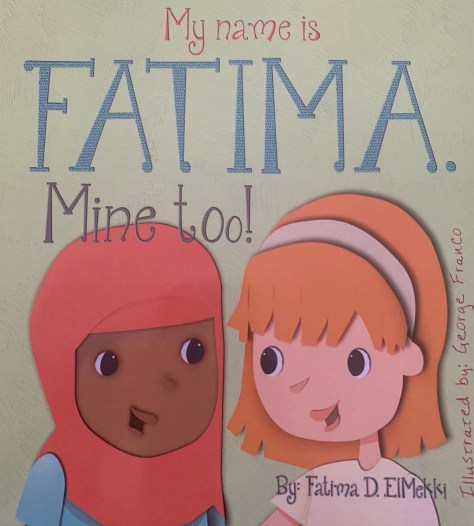
My Name is Fatima. Mine Too! by Fatima D. ElMekki illustrated by George Franco

Standard
My Name is Fatima. Mine Too! by Fatima D. ElMekki illustrated by George Franco

IMG_1926

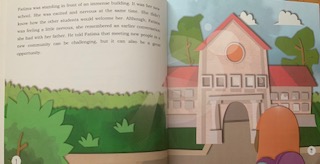
This book is interfaith, and learning your own roots, and asking questions about your heritage and faith all rolled in to a cute little package for children.  But despite it’s length, 28 pages, and cute little girls on the cover, the book is for more first grade/second grade and older children, rather than toddlers. 

IMG_1927

The message that we are more alike than different is a great message, even for the littlest of readers, but this book goes a little deeper, and the didactic approach will bore them a bit.  Older kids for sure 2nd and up will benefit from the exchanges between Fatima and Fatima and learning both valuable religious lessons about their namesakes as well as respect and friendship for those with different beliefs.

IMG_1928

Fatima is from the Democratic Republic of Congo and on her first day of school in a America she tries to remember her father’s advice, that meeting new people can be a challenge, but also an opportunity.  

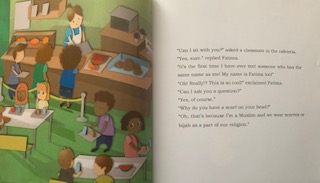
At lunch a little girl asks to sit with her, excited to meet someone with her same name.  Fatima asks her why she wears a scarf, and listens to her explain it is because she is Muslim and the hijab is part of her religion.  

IMG_1929

At recess, Muslim Fatima tells non Muslim Fatima that she is named after Prophet Muhammad (saw)’s daughter and asks her who she is named after and if asks she is Muslim, too.  The other Fatima says that she is Catholic and that she doesn’t know why her parents named her Fatima, but that she will find out and let her know.

IMG_1930

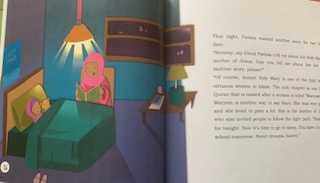
That night Catholic Fatima learns that her mom had gone to Fatima, a city in Portugal, a famous city for all the miracles that have happened there and the apparition of Mary, the Mother of Jesus.  Fatima’s mom had gone there to pray for a baby and promised if she got pregnant that she would name the baby Fatima.

IMG_1931

The next day Catholic Fatima tells Muslim Fatima and also asks her if she has heard of Mary, the mother of Jesus.  Muslim Fatima says she has heard of her, but doesn’t know much and that she will ask her parents and let her know.

Muslim Fatima learns that Mary is one of the four virtuous women in Islam and that there is a chapter in the Quran named after her.  When she tells Catholic Fatima the next day at school, the girls marvel at how much they have in common.  They are BFFs despite their differences and beautiful ones at that.

IMG_1932

I love that the book is framed in opposites to show similarities.  I also love that it shows women in our respective faiths with similar values, similar names, and Mary’s role in both our traditions.  So often, when we are building bridges we discuss how Yusuf is Joseph and Musa is Moses, Yahya is John and we go through the old Prophets, this was a nice change in perspective.

IMG_1935

The illustrations are nothing to get excited by, but they do show smiling warm characters and family members.  They serve as a distraction from the text heavy pages that do nothing to grasp the reader with their plan font and majority white backgrounds.

IMG_1933

This book would work for Muslim children, Catholic children, really all children.  It talks about faith, but as the characters view it, not in a one is better or more right than another.  There is a second book in the series about Fatima inviting Fatima to an Iftar party  that I look forward to checking out soon.  I hope it is a little more rich in dialogue and character building instead of just a foil to disseminate the information between the two faiths, but even if it isn’t I still think the book has value and you should check it out.

IMG_1934


Miss Never Pleased by Ayesha Marfani illustrated by Aisha Aamir

Standard
Miss Never Pleased by Ayesha Marfani illustrated by Aisha Aamir

IMG_1860 (1)

I’ve been accused of being brutal in my reviews.  And while I don’t enjoy being mean, I do take some pride in the attribute, as I am paying for these books myself (unless I get them at the library) and it takes time out of my day to write these reviews.  I don’t get paid, I do it because I love books, I like supporting Muslim authors and those including Muslim characters in their stories.  I take recommending books to others serious, and can’t remember things if I don’t write them down, so here I am.  With this review I don’t want to be rude, or overly critical nor do I want to sound pompous and arrogant and privileged, but at the same time, I ordered the book off of Amazon for $7.99 so a fair review shouldn’t hold punches to spare what the author is trying to do and appreciating that she is writing for a cultural audience. 

Please believe me it isn’t personal, I am reviewing it based on my same criteria I review all the books through, my own personal bias.  That being said, if the reader is living in Pakistan, or has recently lived in Pakistan and English is a second or fifth language the 70 page story with games and activities at the end is decent.  Meant for ages 7-12 in that situation, that are intrigued by the moral lesson presented, I think the plot holes can be forgiven.  For those without ties to Pakistan, or with loose ties like me (I’m half Pakistani and grew up spending my summers visiting family) the book will be choppy, culturally specific, confusing and lacking.

SYNOPSIS:

The book opens with Habiba being distraught over her world crashing down on her and the pain she has caused her relatives consuming her.  She then opens her diary that she has kept for six years, starting back when she was seven recounting how she as Miss Perfect justified her self in incident after incident.  Thirty-one incidents to be exact, detailing how she would rat out her cousins, or critique elders food, or her tell her friends how to dress and what to study because it was the honest thing to do.   How she would decide who should be friends with who, if her family should go on picnics and how she didn’t want gifts but didn’t want to not get gifts either.  All-in-all Habiba is a self righteous awful, awful girl, I don’t think it is her trying to be perfect, I think she is just awful.  At the beginning she attributes it to praise she received as a child from her mom and grandma, but for this behavior to have gone on for so many years, I don’t think it was their praise, it was their lack of discipline that leads up to her catastrophic moment.  She fails her exams and then learns what her family really thinks about her in a poem, with a way too forced rhyme scheme, left lying around.  The story then returns to her undoing and a faqeer coming to cure her and her parents taking the blame for her poor upbringing.  She crosses out the title on her journal from Miss Perfect to Miss Never Pleased, to presumably denote how nothing could satisfy her.  The story then skips forward to her returning after University as the best international psychologist.  

WHY I LIKE IT:

I love the concept of the book, that a girl thinking she was so perfect could realize in fact she is not.  The idea is great.  I think it is a bit sad that her parents and involved extended family took so little interest in correcting her behavior, but at the same time I didn’t think it believable that she was absolved of all responsibility either. 

I feel like this book was a great first draft.  It needs some fleshing out, and some continuity corrections.  Incident #3 makes no sense, it starts with a party, then her ruining the mood of everyone at the party, and then her crushing her cousin’s dream of being in a play for her own twisted reasons.  But the jump from one idea to another seems like something got edited out and the rest of the four-and-a-half-page story didn’t get altered to reflect the missing details.  I have no idea what the party was for, what a wish gift is, and why anyone in their right mind would take a child’s opinion regarding someone else’s life so strongly. 

There are also contradictions, for example on page 14 she makes a big huff about her cousin wanting to study to be a teacher saying she wouldn’t be good at it, then on page 49 saying she would be marvelous, and this is before her climactic change of heart.  There are some awkward passages as well, that I had to read a few times, which could have been do to a different style of English, but sometimes I think it was confusing on its own.  Page 24 was all over the place with her not wanting to thank people for giving her a gift because she deserved the gift, but then telling them she appreciated it, along with her saying the gift, a dress, appealed to her, but that they should not have gotten it because it was an inferior quality.  Inferior to what we don’t know. So she didn’t say thank you, but said she appreciated it, isn’t that the same thing?  She didn’t like the dress, but it had appealed to her? Very confusing and just one example.

I say it is for Pakistani’s because I don’t know that anyone outside the subcontinent would know what a faqeer is, yes there is a glossary at the back, but it seems assumed in the story as a religious practice, which I find some issue with.  When Habiba was trying to dress everyone she says that a fishtail would look nice on her cousins and she gets a blue one.  I have no idea what a fishtail is.  It is not really explained, an illustration would have been helpful, but is not provided. She also once refers to her cousin as “dark” in a negative connotation, and that seemed very out of place and inappropriate to me.  And ultimately, if you don’t know the Pakistani school system I’m not sure you would understand how important the exam she failed is, nor why the scores are in the newspaper,  or that they have to pick their fields of study so early.  That being said, how did she get to University and do so well? If at 13 they had to choose their college and she didn’t pass wouldn’t she not be allowed to continue? I am so confused. And then she comes back after University, but is already being written about in the papers as if she has had a long and successful career.

The book doesn’t tell how she makes things right with all those she wronged either, after so many incidents, I think a little self reflection and humbling should have occurred to those that felt her wrath for so many years.  There isn’t really even a solution, her dad comes and talks to her, she reads what people think about her and then boom, happily ever after.

The illustrations are sporadic, but not consistent in the book.  The style seems to be different in each sketch.


FLAGS:

The girl lies and is incredibly mean but there isn’t anything inappropriate in terms of language or violence.  Islam is mentioned at the end when she thanks Allah swt for His help.

TOOLS FOR LEADING THE DISCUSSION:

I wouldn’t do this as a book club because it is so short, and I don’t know that kids would be compelled to read past the first few pages if it was in a classroom library.  

Book Video https://www.youtube.com/watch?v=QWoCiEnvg5U

If this book would have been written 20 years ago or so, I think readers everywhere would have given it a try as there was so little to choose from in Islamic Fiction, but there are options now, and much better ones.  I feel awful that I didn’t love the book, but I can’t suggest it either.  I plan to read one more book of the author’s to see if this one just didn’t work for me, and I’ll let you know what I think.
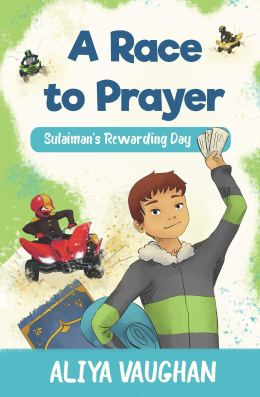
A Race to Prayer: Sulaiman’s Rewarding Day by Aliya Vaughan

Standard
A Race to Prayer: Sulaiman’s Rewarding Day by Aliya Vaughan

a race to prayer

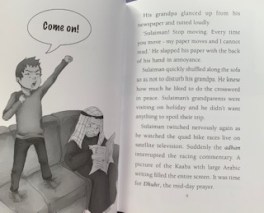
This 56 page (only 38 pages of story) early chapter book is a simple book with a lesson.  For kindergarten to 2nd grade readers the book could be a short story, but the added minuscule details (how he got in the car, slid over, and buckled up) and the illustrations, flesh the book out in to seven chapters with a note for parents/educators at the beginning, and sections of: evidence from the Quran and Sunnah, comprehension questions, inspiration behind the story, glossary and information on the author at the end.  The book isn’t bad, just kind of dry and bare bones.  Satisfactory for young readers that enjoy quad races, and ideal for those that whine whenever it is salat time.

SYNOPSIS:

Sulaiman loves watching quad races and playing football (soccer, the book is British), but feels like, “Every time I want to do something exciting, it either rains or it is time to pray.” one afternoon when he is feeling particularly grumpy, his dad offers to take him to watch the quad races at a nearby stadium.  Grandpa joins them and grandma sends them off with lunches and duas.  First the car won’t start, then they take a bus and wait in line.  Once they are inside the day looks up, the races are fun and then it is Thuhr time.  Sulaiman wants to wait until a break, but it is winter and the days are short meaning Asr will be approaching fast.  They go find a place to pray and when they return their seating section is closed.  Part of the roof fell in due to the rain.  Feeling fortunate that they had left to pray, Sulaiman sees the value of praying on time in this duniya.  They later are given better seats and Sulaiman feels blessed that they had gone to pray.

The story was inspired by a real event, according to the “Inspiration Behind the Story” at the end, where the author says that her husband was at a football match in Algeria when an earthquake struck.

IMG_0029

WHY I LIKE IT:

I love that the character is relate-able to most of our young Muslim children.  He is a good kid, but has a hard time stopping what he is doing to pray.  He has to be reminded to make wudu and brush his teeth.  I like that grandpa gets to come along, but I wish he would get to tell some of his stories, rather than just have Sulaiman shush him and be annoyed.  Similarly, I like that the dad is a “fixer” but some character development would have been really great.  I understand the reading age isn’t tempted by back story, but a little investment in the characters would make the climax that much more intense.  I was surprised by the roof falling in, but it snuck up so quick and was resolved equally fast, that I didn’t really feel it.

Also, I am not entirely sure what quad racing is. I mean I get that they are 4 wheelers racing on a stadium track.  But, I didn’t realize it was such a thing to be watching it on tv and then heading to watch it live nearby.  I’m glad I learned that kids dig it in Britain, but I’m thinking that it might be a little foreign .  A soccer match or another race, might have made the story a bit more appealing.

The book is for Muslims by a Muslim despite the glossary at the back. The pictures aren’t great, but they make the page breaks appeal to the younger kids.  The font, binding, and presentation makes for a nice looking and feeling book.

IMG_0030

FLAGS:

None, alhumdulillah.

TOOLS FOR LEADING THE DISCUSSION:

This book would be really great in small groups.  I can see it being used in Sunday schools or in Islamic schools, where Language Arts teachers and Islamic Studies teachers crossover to drive the importance of salat home.  I think this would easily inspire this age group to then write their own copy-cat stories of why salat is important.  The questions at the end could even make it like an extra credit novel study or a read aloud story with the questions used to verify comprehension.

Snatched Asmaa Hussein illustrated by Svaitoslav Diachyk

Standard
Snatched Asmaa Hussein illustrated by Svaitoslav Diachyk

snatched

The premise is simple, Omar ate something that didn’t belong to him, and the guilt is weighing on him heavily.  The beauty of the book is how, with his mom’s help and his own determination, he makes things right.  

snatched3

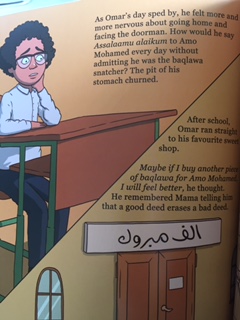
Set in Egypt, Omar eats the doorman’s baqlawa, and while he knows he shouldn’t have, he doesn’t know what to do about it.  The doorman, Amo Mohamed, blames the cat and Omar tries to move past the theft.  But the guilt builds up and he even dreams about baqlawa, eventually telling his mom so he can start to fix things.  

snatched1

After isha prayer, the two of them make some new baqlawa.  I love that the mom doesn’t get mad, but she is firm that while, “we made the baqlawa together,”  she tells him, “you have to talk to Amo Mohamed on your own.”  

Omar confesses his crime to the door man and apologizes, Amo Mohamed in turn apologizes to the cat, and all enjoy a piece of baqlawa together with smiles.

snatched4

The last page in the 38 page book is a glossary and is headed by a hadith by Prophet Muhammad, “Be conscious of God wherever you are.  Follow the bad deed with a good one to erase it, and engage others with beautiful character.”

The illustrations aren’t amazing, but they are sufficient and help walk the reader through the story.  I like that the mom covers when out and about, but not in the home.  The story is great for ages 4 and up, but the amount of text on the page and book length might make independent reading more geared to second and third graders. 

snatched2

The book would work for muslim and non-muslim children a like and does a good job of showing a universal situation in a culturally rich environment.