Tag Archives: Muslim Author

Momo & Bronty’s first book about Prophet Muhammad (saw) by Zanib Mian illustrated by Laila Ramadhani

Standard
Momo & Bronty’s first book about Prophet Muhammad (saw) by Zanib Mian illustrated by Laila Ramadhani

I’ve mentioned it numerous times over the years how few children’s books there are about Prophet Muhammad (saw), and I love that this new book by Zanib Mian is a wonderfully illustrated 14 page board book for toddlers introducing them to some of the basics about our beloved Rasulallah. Momo and his toy dinosaur Bronty are featured in the illustrations, but do not dominate the text, which keeps the focus on Prophet Muhammad (saw) being the last of Allah’s messengers sent to tell us Allah is One, that the salutation is said after his name, and that he is always smiling, truthful, and making duas for us all, his ummah. I read the book a few times to myself and stumbled over some of the short sentences, but oddly enough when I read it aloud to my kindergartner it flowed fine. I always read picture books aloud before writing my reviews, as I was taught to read my essays aloud in school before submitting them, to effectively find errors. So, I’m not sure why for this book, I stumbled when reading to myself, but not aloud, a first for everything I suppose. The last spread though I did benefit from reading beforehand, as the order of what text comes next is not clear on first look. The pictures contain a lot of accessible details and discussion points and even early elementary aged children will find themselves drawn to the book, the reminders, the messaging and the simple text.

The board book is not just a list of facts, but doesn’t have a plot either, it is somewhere in between as it stays on level and flows between ideas, keeping the readers engaged. It starts by explaining that Allah swt sent Prophet Muhammad to us, the Qur’an through him, the message he carried, and why we love him. It shows that he exemplifies what a Muslim is and gives some examples, it then highlights that “His face was more beautiful than the full shining moon” and that “he played with little ones and made them laugh.” It concludes with connecting us, his ummah, as being important to him as he knew “the message he brought from Allah,” would spread.

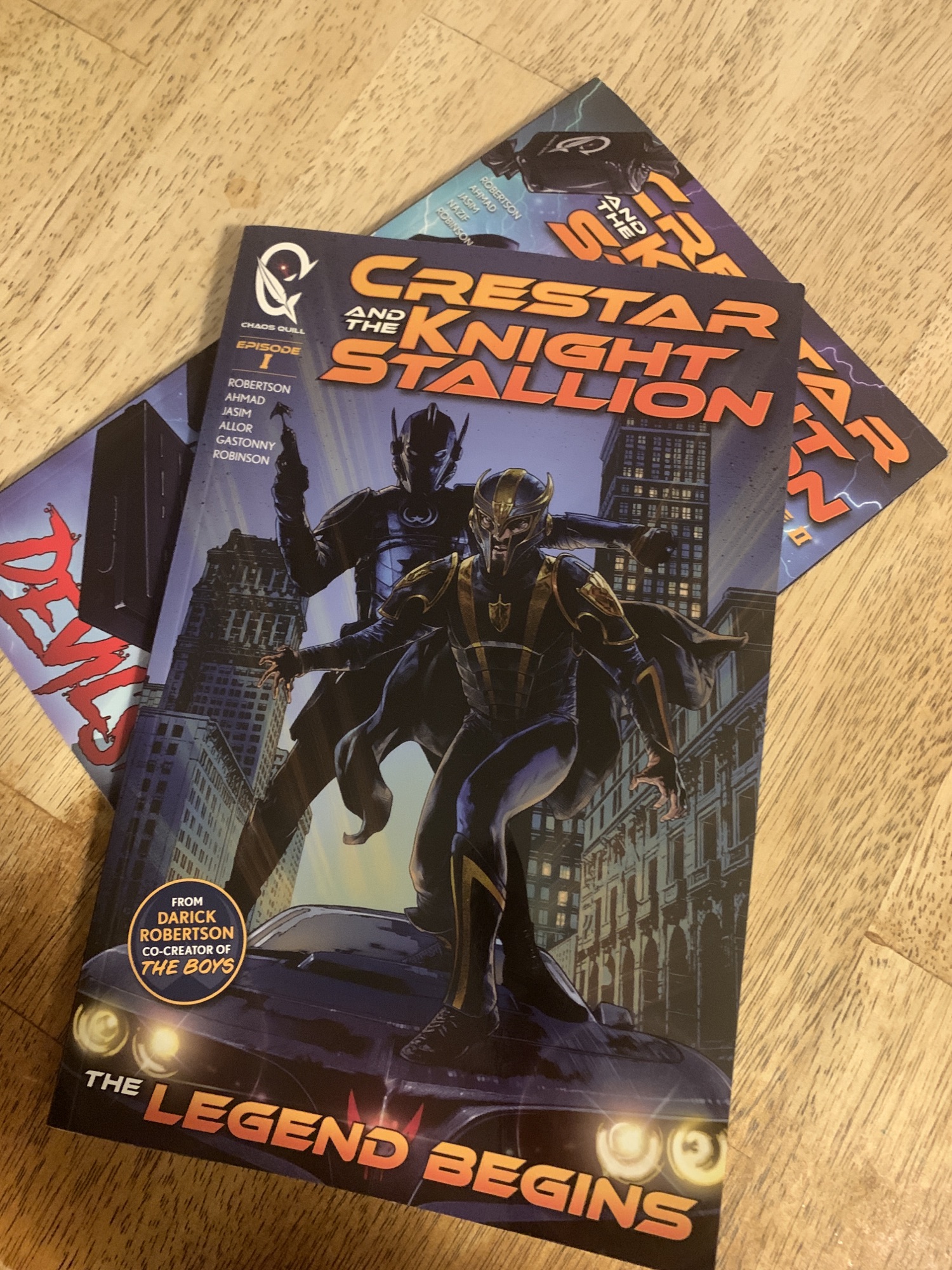
Crestar and the Knight Stallion: The Legend Begins by Robertson, Ahmad, Jasim, Gastonny, and Robinson

Standard
Crestar and the Knight Stallion: The Legend Begins by Robertson, Ahmad, Jasim, Gastonny, and Robinson

This new comic book series combines a lot of exciting elements.  It is a comic book and soon to be live action movie, it is both action and comedic,  it features Desi (Pakistani) and Arab (Iraqi) representation in the title roles, as it is in part written and created by the “characters” themselves. There are Muslim hijabi side characters, cultural Islamic phrases, and a whole lot of saving the day in a plagued Dearborn, Michigan setting.  I admittedly am still very much an outsider to comic books, what all goes in to them, their target audience, and what norms and expectations they carry.  So, I say what I am about to say from a very non critical, simply informative stance, when I say it has what I would consider mature content for elementary aged kids.  The comedy found in the offhand comments, the profanities that are substituted with symbols, surprised me. I anticipated a level of violence and killing, and appreciate that this book doesn’t have the near naked females being shown as many comics do, but I don’t think it is appropriate for younger audiences, probably more middle school and up.  I have not seen the live action, in a different format it might hit different so to speak, but I’m sharing some pictures of the text so that families can decide if the comic books are a good fit for their readers or not.

I love the idea of Muslim rep superheroes, that one is an Iraqi immigrant having to find himself in American society and accept himself, that Crestar is mysterious and his background and motives not known, the cultural and religious infusions, and matchmaking stresses are all amazing subplots to the evil that is destroying the community.  Theft and killings are the norm, Crestar is fighting back, when he discovers Ali has survived an explosion, he begins testing him with the hopes he will join him as the Knight Stallion. The first book is an introduction to the characters, the setting, and the protagonists meeting, it ends hinting that Crestar and the Knight Stallion will be working together, which isn’t much of a surprise given the title of the series, but it sets the stage.

I am not going to write a full review, because I can’t. I just really don’t know if the superhero parts are new and unique or tired and tropey because I don’t know enough about comics to have a valid opinion.  There are trailers online and the first two comic books available are top industry quality in terms of graphics, binding, length etc.

Fledgling: The Keepers Records of Revelation by S.K. Ali

Standard
Fledgling: The Keepers Records of Revelation by S.K. Ali

fledgling


This 544 page science fiction dystopian fantasy is in my humble opinion S.K. Ali’s best work, and that is saying something.  A lot actually, especially considering I am a Muslim book reviewer and there is no Islam featured in the book. As my author friend Shifa Safadi articulately put it, “it is Muslim coded,” a much more succinct term to describe my rambling thoughts of how Islam seems to be just below the surface, never breaking through, but making the book seem OWN voice and authentic. The book is for ages 14 and up and stays fairly clean, allowing for complete immersion in to the story, the world, the future, and the characters’ lives, without any fear that something drastically detailed and haram, would suddenly appear and pull me out of the flow of the story.  There is a bride market where women can be bought and mention of lovers being taken, but it isn’t normalized, it is for a purpose, and the acts are not detailed.  From start to finish this book is a gift to readers.  The writing quality is superb. The book is told from nine (?) points of view,  and I never once felt the need to flip back to see who was speaking, as each voice is clear and unique. The twists, the heartache, the triumph is all palpable and griping.  The mix of genres works because the characters have multitudes and incredible storytelling made the lengthy book, not nearly long enough. I can’t wait for the second part of the duology, from the Underground to Upper Earth, the world was not one I left willingly, and I look forward to returning for the conclusion.

SYNOPSIS:

I really am not sure how to summarize the book without giving much away, I’m actually surprised myself that I’m writing a full review for a book by a Muslim author with no Islam present, so here we are.  As with all S.K. Ali books, this book starts with a possible “romantic” relationship, in this case though, it is an arranged couple meeting, and it isn’t going well.  But where comedy and faith might normally then enter the story, this book, veers from her norm, drastically.  Set in a dystopian future where scalplinks and mind control allow the “enlightened” to live a vastly different life than those on Lower Earth who’s resources have been plundered, the union is to be between Raisa, of Upper Earth, and Lein the crown prince of Lower Earth as an attempt at achieving peace.  Politics, greed, loyalties, love, all add in to the mix of a rebellion and the hope that comes from the Fledgling.

WHY I LIKE IT:

The book starts with a character list which is an incredible tool for readers as the first half of the book is forced to simultaneously balances character development, world building, and plot progression with a lot of moving parts. The style of memory records, announcements, current events, flashbacks, and changing povs keep the book’s pacing moving, but it really took about until the midpoint for me to be unable to put the book down. What at times early on could be perceived as cumbersome, became truly what makes the book stand out.  To see each character through their own eyes, through their own lived experiences, and to see their thoughts and feelings grow and change, really pulls you in and brings the humanity to life in a book that could have become more plot than character. It also emotionally ties you to the characters and the twists and revelations and loss, hurt a little more than I would have expected as days later I am unable to stop my head from returning to parts of the story that still have a hold on me.

FLAGS:

Death, torture, abuse, killing, murder, hunting, manipulation, lying, a love scene between a coded married couple, oppression, colonization, bride markets, misogyny, cheating, it is YA dystopian, fantasy, sci fi, romance, adventure, so there is some grit at times, but not for sensational vulgarity, it is always for a point and not taken lightly.

TOOLS FOR LEADING THE DISCUSSION:

This book would be incredible to read in a high school class: Islamic school, home school, public school, private school, you name it.  There is so much to discuss about colonization, oppression, rebellions, politics, and yet none of it comes at the expense of good story telling.  I would love to hear students discuss their favorite characters, opine on their motivations, and argue right vs wrong with citings from the text.  No two people would feel the same, I would almost guarantee it.

If You’re Not the One by Farah Naz Rishi

Standard
If You’re Not the One by Farah Naz Rishi

I suggest one reads my ENTIRE review of this book before deciding if it is right for you, because just the first few lines might signal that I liked this book, and honestly it was just ok, but I really liked parts of it. The protagonist is Muslim, it isn’t something that guides her view of the world or dictates her actions, but she is unapologetic, and it is not something she is grappling with. She prays, makes duas, it mentions a hadith, so I appreciate that it is there and always just below the surface. The “romance” might not be halal, halal, but it definitely isn’t raunchy and stays close to the line even when it crosses it. The male and female character are very close friends, and spend a lot of time alone together even before SPOILER there is hugging and a kiss, it is a rom-com after all. I loved the annotations, especially reading an e-version flipping to the protagonists commentary of her thoughts and then flipping back was easy and fun. I think my favorite line in a long time in the book is her translating rice to chawal (see images). My biggest frustration though, with the book is how close it mirrors the author’s biography, Sorry for the Inconvenience, which I read just over a month ago. Truly, it was like the biography was the book and this was the movie adaptation. Sure the younger brother was switched out for a younger sister, and this wasn’t as gritty or traumatic, but the romantic literary beats were all more or less the same: childhood betrothed, falling for a friend who made a bad first impression, dad being sick, parents and their on again off again divorce, medical diagnosis, it really is two versions of the same story, which meant I was never invested in the fictionalized characters, or on the edge of my seat to see what would happen next. When you have seen the behind the scenes inside scoop so to speak, it is hard to get on board with the faded carbon copy. Add in the consistent lack of communication, telling instead of showing, unlikability of the protagonist, and the non existent foundation of any of the relationships, and it made it hard to get lost in the fluff of the moment.


Side note: I had a whole paragraph rant about the cover, but when I went to post my review on Goodreads (still banned from Amazon) I saw that there is a newer cover with Marlow wearing yellow crocs. I have no idea why the illustrator and publisher would have arcs with the male lead in flip flops, but I think by now it is common knowledge there is often a lack of communication between authors and illustrators. sigh.


SYNOPSIS:
Anisa is in college, she has worked hard to get in to the all girl’s school near where her almost fiancé Isaac is already enrolled. When she takes a class on Isaac’s campus she meets Marlow, who makes a poor first impression on the very “perfect” Anisa. When Marlow and Anisa get paired up for a class paper, Marlow also offers his services as a “love coach” to help Anisa reconnect with a drifting away Isaac. The more time Anisa and Marlow spend together, and the more Anisa learns about Isaac , the more she ultimately learns about herself and what she wants out of a partner.


WHY I LIKE IT: (SPOILERS)
I’ve read a few of the author’s books, so I know she can write, which irritated me even more that this book felt so flat. Anisa and Isaac have been “together” for over six years, but know nothing about each other, don’t talk or text, and as much as the book wants to make it seem like it is an all of the sudden thing, it provides no real tangible suggestion that they have ever had any sort of connection. So why did they decide to be potentially engaged???? All the parents are on board, but how did the two of them set this into motion? With the exception of Isaac visiting her one late night before he went to school, there is so little for the reader to be emotionally invested in. Anisa has terrible communication with every character in the book, not just Isaac, even with Marlow and her family, the side characters all keep in touch just fine, and it is never addressed as a quirk, it just is accepted. If your dad was sick, or your parents divorcing, wouldn’t you be texting them periodically, or non stop? And text between characters are shown on the page, so how is Anisa texting Marlow throughout the 352 pages, but then goes MIA the last 20? It didn’t work for me clearly.

Additionally, I was so tired about hearing how perfect Anisa is, when it never seemed to show it, sure the duplicity with her outward appearance and home appearance was well done, but it never really shows up in any other facet of her life. She is unorganized, has few friends, doesn’t seem to be a very present daughter and sister, the repetitive telling and lack of showing, gave the book no foundation. I know romance-y type books often have to fudge common sense at times, but with no foundation at all, it was hard to be invested in any twists or swooning gestures. I think I just didn’t really like Anisa, and I weirdly feel guilty about it, because she so closes mirrors the author, and I liked the author’s self portrayal in her earlier memoir.


FLAGS:
Close male/female friendships, hugging, kissing, lying, “cheating,” talk of titillating role playing video games (otome) not details so much as shaming and teasing about Anisa playing them (the word porn is tossed in a few times).

TOOLS FOR LEADING THE DISCUSSION:
I think I’d shelve this book in an Islamic school library for high school students. I don’t think I would promote it, but I think those romance loving high school girls will enjoy and be able to handle this story. It won’t work for a book club, but it does make clear that Anisa “dates” with intent to marry, there is reassurance that she wants to marry a Muslim, that Marlow has been reading about Islam, but that Anisa isn’t going to force him, and that societal expectations and appearances aren’t impossible to push back on- which I think are good considerations for 16 and up readers to see fleshed out.

Hilwa’s Gift by Safa Suleiman illustrated by Anait Semirdzhyan

Standard
Hilwa’s Gift by Safa Suleiman illustrated by Anait Semirdzhyan

img_6526-1

I’ve read a few children’s picture books about harvesting olives, and even some about Palestine’s olives, but this one really stands out because it is just so very joyful.  There is information about picking the fruit, processing, and making soap and oil with olives, but the book’s take away is just sore cheeks from smiling, and a full heart from feeling the importance, love, and tradition of olives, family, and being together.  The text and illustrations combine beautifully allowing the story of Hilwa, the olive tree, Ali and his Seedo to say a lot without having to spell it all out. And that it is traditionally published at such a critical time, is truly a gift.  There is nothing religious in the text, there are a few #Muslimsintheillustrations, and the author is Muslim. Additionally there is nothing about the current situation, the politics, the upheaval, or the occupation. The book follows Ali as he arrives after a long journey to his Grandparent’s home, it is harvesting season and  he is about to see all of the gifts that come from olives with the guidance of his grandfather, the cheering of his cousins, and the offerings of his beloved Hilwa.

The book starts with Ali and his parents arriving exhausted after their long flight to Palestine.  Greeted by Seedo, when Ali sees Hilwa, the olive tree his grandfather planted with his grandfather, the tiredness disappears.  When he hears Sitty whacking the trees and his cousins singing, “Zaytoon, ya zaytoon.”  He is ready to help harvest.  But, he doesn’t want to hurt Hilwa and decides to pick the olives one by one.  After his arms are tired and the basket is empty, he gently tries the traditional method and makes the zaytoon rain down with his grandparents and cousins cheering him on.

Hilwa has many gifts, and the next day they load up the olives to be taken to the press, they then prepare and enjoy the olives being pressed in to oil.  They bring the oil home to cook with, eat, turn in to soap, and the pulp is used to build the fire.  The best gift of all however, is the family, friends, and neighbors gathering to share and be together.

I read an early copy, and hope that the beginning will be smoothed out a bit.  It actually read as if a page was missing.  If the family had just arrived from overseas, and the grandfather was so excited, why wouldn’t the grandmother and cousins also leave what they are doing to great the just arrived family? It seemed a bit off, but once the story recovered, the text and story flowed without incident, so perhaps the disjointedness has been resolved.

img_6527-1

It is so important to show the richness of cultures to those that might be unaware, for a culture that is relentlessly villainized, even more so.  This 40 page picture book is great for ages 3 and up, and while it doesn’t detail Palestinian culture, it highlights a central component and shows the vibrancy and warmth of a people and their relationship to the land and the importance of olives and olive trees.  There is a glossary at the end with words in English and written in Arabic scripts as well as an Author’s Note.

Aisha’s Colors by Nabila Adani

Standard
Aisha’s Colors by Nabila Adani

img_6445-1

On first glance it seems this 32 page picture book is going to focus on colors from the perspective of a little Muslim girl in Indonesia, but it isn’t a basic color book, in fact only three colors are even explored.  The book is also not religious, aside from the hijab wearing mother and grandmother in the illustrations. And the writing isn’t really noteworthy, but yet, the book is endearing, and I can’t wait for my physical copy to arrive so I can share it with my kids and some classes for story time. The book has a plot, a little girl wishing she was spending her summer vacation seeing and going fun place like her friends.  Instead she is going to her Grandma’s house, the same place they always go.  She throws a bit of a tantrum, and then cools off and gains some perspective.  It is sweet, it is realistic, it shows growth and life lessons of appreciating the beauty around you, and not worrying about other people, all without preaching or talking down to the reader in the simple text.  It is joyful and highlights bits of Indonesian culture with beautiful images by the author-illustrator, a solid addition on bookshelves for ages 3 and up.

The book starts with Aisha bemoaning that her friends are going to fun far away places over the holidays, and she is going where they always go, from their home in Jakarta, to their Grandma’s village.  She tells her parents about her friend Jennie going to see snow this year, and imagines the cold white crispness that she doesn’t know.  Her parents respond by taking her to get es campur.  

She then laments about Dimas floating in turquoise water looking up at a blue sky, to which her father encourages her to look out the window.  When their car breaks down, and Aisha is encouraged to go cool down after her tantrum, her mom works on fixing the car, and a sky of kites shakes Aisha’s melancholy mood.  By the time they arrive at Grandma’s Aisha is seeing her own vacation in a different way, surrounded by colors, love, and family.

The book warms your heart, Aisha is grumpy, but not annoying, and the yellow warmth of Grandma is palpable.  I wish a few more colors were included and more culture shown that way, and I stumbled repeatedly over a few awkward sentences, not that they were wrong, but they just didn’t seem to flow when read aloud.  Overall, a good book. Preorder today, it releases September 3, 2024. 

Academy Story by Naim Hammami

Standard
Academy Story by Naim Hammami

I dnfed this elementary aged book a few months ago, and pulled it back out feeling obligated that the publisher sent it to me and, I ought to read it.  So, I did, and it is not well-written, but since I read it, I’m writing a review, and hopefully sparing y’all the same frustration.  The cover is pretty cool, so is the idea, and the Islam is centralized and prioritized, but the story reads like an introduction, yes a 152 page introduction.  It repeats itself so often, it contradicts itself within the repeated ideas, and then moves forward at a snails place before ending.  I think it wanted to end on a cliff hanger, but because so little is accomplished up until that point, it feels like it doesn’t end at a climax, but rather the start of the action, which is irritating.  It feels like the author started telling a story orally about a family in a kingdom that when they finish primary school either continue to secondary school or find themselves in a secret academy, and no one knows how they are chosen, or what the academy is like; someone heard that much and told the author to write a book, and they did.  There is no character development, drawing the reader in, suspense, imaginative language, or refinement, it reads rough and I don’t know if it is because it is translated, or because there was never much to work with, but if you have seen this book, and were excited to see an Islam centered adventure story, sadly I’d say pass, it misses the mark.

SYNOPSIS:

The book starts with centralizing three siblings, Fatima, Suhayl, and Harun.  Fatima is the oldest and is a second mother serving her family, cooking, and apparently enjoys reading, she was not chosen for the Academy and is still bothered by it.  Suhayl is the protagonist who hates school, and Harun is the little brother who is still in primary school.  The first few chapters are the repetitive circling of anticipation and excitement for finding out who gets in to the Academy at home and talking about what little is known about the Academy, and why it is important as today is the day Suhayl will find out.  Why they had no idea about the Academy before breakfast on the day he is going to find out, is beyond me, the world building was an info dump, repeated in the following chapter when Suhayl is now at school.  His friends all discuss that they are going to find out about the Academy, only then to contradict that whole build up and wonder IF they will find out about the Academy today.  We meet the friends, find out some of them have parents that went to the Academy, but do not talk about, as they are not allowed.  The reader is not told what the benefits of having gone to the academy are either, outside of knowing all educators have been trained there.  The book then says how Suhayl doesn’t have friends and proceeds to discuss how close he and his friends are.  When the assembly starts the class learns there is no Academy announcement and no end of the year field trip, instead they will have to come up with a challenge, that is optional, to do over the school holidays.  After rounds of voting and a weird power flex, a business challenge with rules is established and the winner gets to leave school if they want. Suhayl is determined to win, he and his buddy, Yusuf, decide to make fans using the Venturi Effect to sell at their stall and try and make the most profit and win.

WHY I LIKE IT:

I like the premise, the artwork, the Muslim characters, I even like the business, life-lessons and science explanation of the fan.  I don’t understand how it makes Suhayl’s fan more effective than a regular fan, but the book has bigger problems. I know for many author’s writing is figuring it out or making it up as you go, so I realize the ridiculousness of saying that this book feels like the book is being made up on the spot. It is writing quality that allows readers to get lost in a story, enjoy the words, and connect to the characters knowing that the author has control of a story and taken care of the required elements of a completed book.  The rules of the challenge and how they were to finalize the idea, seemed so scattered, that combined with the weak writing, and repetitive premise building, made the intrigue of a whispered about Academy seem like a completely separate story.

Additionally, I don’t understand the stressing of the three siblings, The book is only about one, Suhayl, and his friends, yet each have a “character profile sheet,” but they are not all together at the start, or even the end.  One profile sheet is at the end of chapter 2, one at the end of chapter 4, and then the third at the end of chapter 6.  If the point is that as the series progresses you will see the sibling more, and it is meant to garner interest, the choice assumed that readers will stick around for a series, and I don’t think the book at hand, will pull readers in to see how the series pans out.

FLAGS:
Secrets, business deception

TOOLS FOR LEADING THE DISCUSSION:

If the book were donated I would shelve it, but I would not seek it out to shelve.

Game Changers: Stories of Hijabi Athletes from around the World by Charlene Smith illustrated by Natalya Tariq

Standard
Game Changers: Stories of Hijabi Athletes from around the World by Charlene Smith illustrated by Natalya Tariq

This 80 page compilation of hijabi athletes from around the world focuses on 13 women that the author interviewed first hand.  Featuring athletes, sports and even countries that might be relatively unfamiliar to the targeted middle grade audience, the book will appeal to both boys and girls, Muslims and non Muslims.  Many included were the first to play with hijab, or the first female to play in their country, but each journey and experience is unique.  Each hijabi athelete and their sport is introduced to the reader over four pages with beautiful artwork, and pulled quotes.  A common issue I have with these types of books is wondering how those featured were chosen, and while this book doesn’t articulate it clearly, at least it sets some parameters in the forward and introduction, that for me at least, allowed me to appreciate the book that much more.  The book ends with four pages of “More Hijabi Athletes” that could have been included, as well as information on perseverance, hijab, modest sportswear, a glossary, resources, index, and acknowledgements.  There are real photographs included at he beginning and end of the book of various featured athlete in action. 


I can’t really review this non fiction book in my normal style, so I will simply say that the writing is clear and easy, at times details seemed overly vague, but to keep the continuity of the tone, and the reader engaged, I understand why specifics perhaps were not included.  In the first feature, I wish the infamous photograph would have been shared so the reader could see for themselves what the text was discussing.  Overall, this resource to inspire our Muslim girls is much needed and beautifully done.  I absolutely love the artwork. LOVE IT. The women are beautiful, strong, and the artwork conveys that for each of the 13 athletes.

The athletes featured:

Egyptian beach volleyball player Doaa Elghobashy
UAE hockey player Fatima Al Ali
Basketball player Fitriya Muhamed
Afghani soccer player Hajar Abulfazl
Syrian-American runner Rahaf Khatib
Basketball Player Kiandra Browne
Pakistani weightlifter Kulsoom Abdullah
Parkour Sara Mudallal
Downhill Mountain Bike Racer Sumayyah Green 
Iranian Triathlete Shirin Gerami
Kenyan Archer Shehzana Anwar
Wrestler Latifah McBryde
Skateboarder Nadeen Alhamad


More Hands by Jenny Molendyk Divleli illustrated by Ekinsu Kocaturk

Standard
More Hands by Jenny Molendyk Divleli illustrated by Ekinsu Kocaturk
img_6180-1

This 32 page picture book blends food and the concept that teamwork makes things better, when a young boy asks his grandfather why his pishmaniyah is so delicious, and Grandpa Yahya offers to share his secret ingredient. The book is a fun bedtime or story time read as the more hands needed builds and builds. As someone though who has now read the book over a dozen times, I do wish there was more backmatter. I would love a recipe for the cotton candy type sweet, maybe some history of what pishmaniyah is (I had to Google it), and how it is traditionally prepared. The text dances around the pages, and the fun illustrations will appeal to children and help explain the process. There is a “bismillah” in the book and it mentions “baraqah” on the back cover, athere are also a few hijabis in the illustrations, but the book is universal for all readers toddler and up.


The book jumps right in with Sami asking his grandfather about his pishmaniyah. It is unclear if grandpa was planning to make it, or if it was a question out of the blue, but either way, Grandpa Yahya offers to share the secret ingredient. The ingredients are pulled out, and then more hands are needed, and then more and more and more. Once the whole family, and neighbors, and their kids are all involved it is time to eat and enjoy the dessert together.


As an adult I wonder what would have happened if so many people were not available to help, and did they wash their hands, and how big is their house, but kids won’t care, kids will just think it is funny. And that is ok too, books that show family, community, and teamwork with humor are always great additions to share with our littles.

img_6185-1

Tales from Cabin 23: Night of the Living Head by Hanna Alkaf

Standard
Tales from Cabin 23: Night of the Living Head by Hanna Alkaf

img_6038-1

I was genuinely pulled in to this story within a story, 244 page middle grade scary read.  I was not expecting Islamic representation from the Muslim Author, I’m not sure why, but I was happily surprised all the main characters are Muslim and unapologetic, praying, reciting ayats when the fear mounts, and seeing the world through their Malaysian and Islamic perspectives. It was really well done, engaging, spooky, and then it came to a screeching halt, like slam on the breaks, story is over now we are going to talk and explain and make it about family and forgiveness.  I admittedly don’t read much “horror” if any, so perhaps the over explanation at the end is formulaic to put the target audience reader at ease, and prevent lingering nightmares.  Even if that is the case however, the climax in the book came way too early making the explanation way too long.  I would imagine most target readers don’t expect the same literary refinement in a scary book as they would in other genres, but the more “explaining” the book tried to do, the more holes were revealed. By the end, the book made no sense and I wished I would have stopped reading halfway through and had the unknown lingering vibes be the ultimate takeaway.
SYNOPSIS:

It starts at Camp Apple Hill Farm where Melur is for a two week summer camp, when she chooses “dare” and is forced into the woods alone to find the witch that tells stories in Cabin 23.  When she finds herself at the cabin, the story she is told is about Alia, her missing sister who has returned, and a penanggalan that is terrorizing the town.  Twelve year old Alia has moved from Kuala Lumpur to the city of her birth, she doesn’t have a lot of friends, and her missing sister has unexpectedly returned.  Something is off with her sister, she smells weird, and is too perfect.  Alia’s parents don’t seem to want to discuss it, and what is the whooshing sound that seems to follow Alia everywhere.  When kids at school start whispering about seeing things and hearing things, Alia is worried that her sister and the sightings, might be related. Yep no further spoilers here, sorry.

WHY I LIKE IT:
I love that the characters are Muslim and it is just who they are, it isn’t othering or explanatory, it is just part of the characters, that comes out as they try to figure out what is going on.  I really enjoyed the first half, I know that often in scary movies, at least the ones I can handle, the build up is usually fun, and the resolution a little bit of a let down, so I was anticipating that, but this book really seemed to fall apart as it tried to wrap up all the threads.  It ultimately ended up being rather disappointing and I’m honestly kind of mad about it. Despite it all, I will still shelve it for middle graders to read.  We need Islamic rep in all genres for all ages and this one I think is the first I have seen, and for that alone I do appreciate what it offers.

FLAGS:

It is “scary”, there is gore, abandonment, possession, creepiness, no one will accidently pick it up and be surprised.  The cover has a head with its entrails hanging out and the title is “the living head.”

TOOLS FOR LEADING THE DISCUSSION:
As stated above I would shelve the book, I think fans of creepy book will be delighted to see a Muslim protagonist, and the Malaysian rep is nice to see as well.