Tag Archives: inclusion

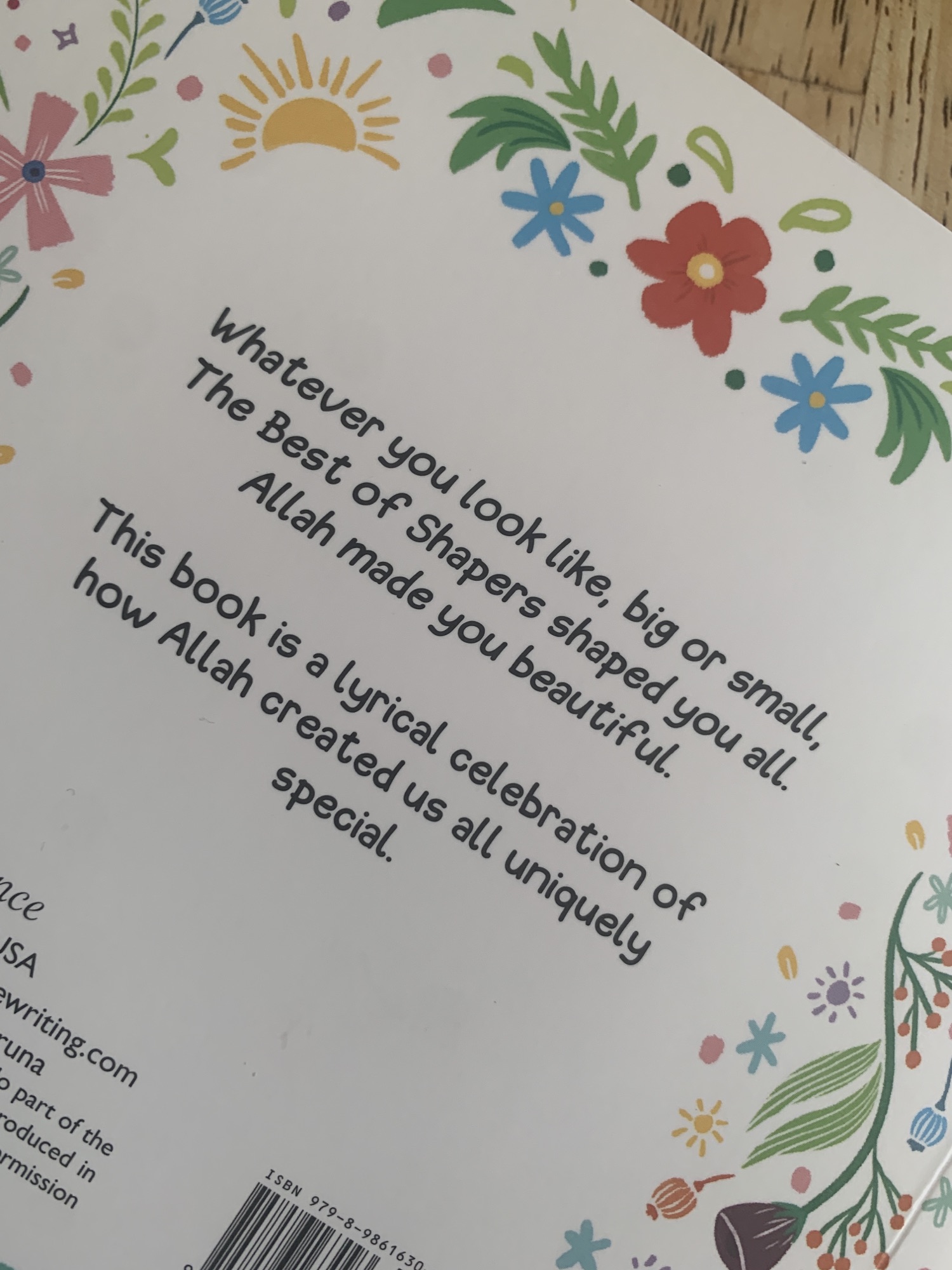
Allah Made Me Beautiful by Layla Izruna illustrated by Laila Radhani

Standard
Allah Made Me Beautiful by Layla Izruna illustrated by Laila Radhani

img_4555-1

This 6×6 board book is 18 pages of affirming and celebrating that no matter what we look like, “the Best of Shapers, shaped us all.” The little size, the rhyming lines, the repetition of the phrase “Allah made me beautiful” on the right page of each spread, is what you would expect from a board book meant for newborns and up.  The rhyme and cadence levels out after the first page, and makes for a sweet easy read.  The mirror on the last page with a hadith in English and Arabic is particularly nice.  The illustrations and text are intentionally diverse and inclusive and with the Islamic centering the book is good for starting discussions as well.

The book is no literary masterpiece, but sometimes it doesn’t need to be, to be a staple read on repeat to our little believers.  This book dives right in on the first page, there are no copyright or dedications that have to be flipped through.  It is numerous pages of examples of how Allah swt made us all different: straight hair, curly hair, twins, larger body size, skin color, mobility, freckles, glasses etc. The end spread, before the mirror, is the conclusion that our “looks have been perfected by Him, tying it all together.

The illustrations are engaging, and simple, but detailed enough to foster dialogue if desired and while the small size would make using it at story time impossible, I think little hands and little hearts will benefit from knowing that we are different, but just as Allah swt intended us to look.

The book is available from the publisher Prolance directly, or here on Amazon 

img_4560-1


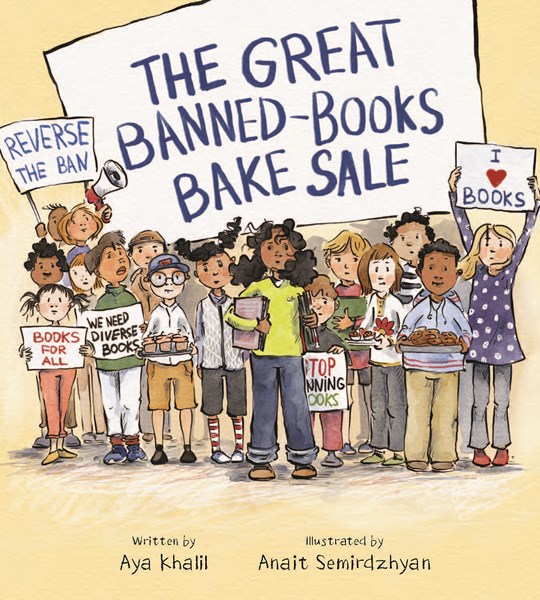
The Great Banned-Books Bake Sale by Aya Khalil illustrated by Anait Semirdzhyan

Standard
The Great Banned-Books Bake Sale by Aya Khalil illustrated by Anait Semirdzhyan

banned

This follow-up picture book to The Arabic Quilt, takes readers back to Kanzi’s school, but also works as a standalone for ages 7-10.  Addressing the hot topic of book banning, the fictional story brings the discussion down to an elementary level and shows kids speaking up and pushing back against something they don’t agree with.  The main character finds a connecting thread to events in Egypt, and with her class and family behind her, she finds her voice and takes the lead.  The story bounces around a bit and feels a little rough and underdeveloped at times, but the subject matter is important and can be used to help guide discussions, encourage peaceful protesting, and taking action.  There is nothing Islamic specific in the text, the main character’s mom and teita wear hijab and are in the illustrations (#muslimsintheillustrations), in a memory of Egypt there is a man holding a cross.  The author is Muslim and mentions it in the Author’s Note at the end.

banned1

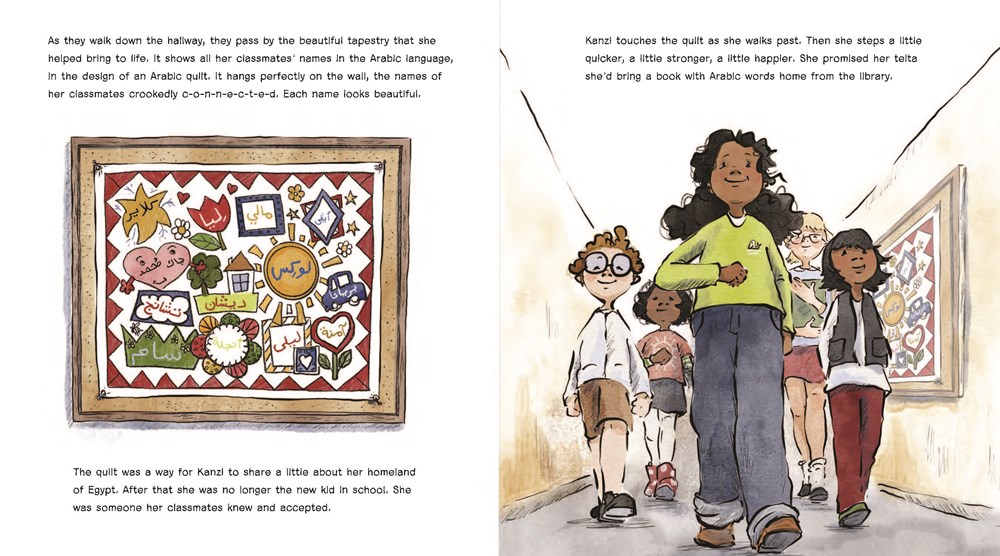
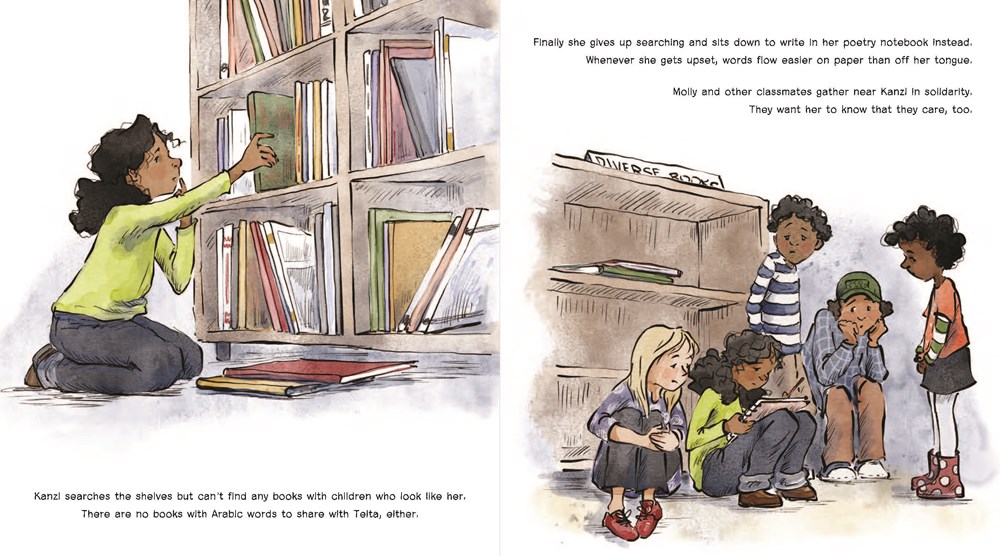
The book starts with Kanzi leading the class to the library, she passes the Arabic quilt she helped bring to life and walks a little taller.  She has promised her Teita she will bring home a book with Arabic words from the library, but when she walks in to the library, the “bookcase where the new diverse books were displayed has been emptied.”  The librarian explains that the books have been banned.  That the school district, like many others around the country, have decided certain books are not allowed. Kanzi is upset, but her classmates “gather near (her) in solidarity. They want her to know that they care, too.”

banned 2

Back in class the teacher opens up the discussion, and Kanzi can’t find her words.  Kareem says it is unfair and when the teacher explains that people are responding by protesting, writing letters, and buying more copies of banned books.  Kanzi finds her voice and suggests a bake sale.  Kareem suggests they raise money to buy books that are banned and call it “The Great Banned-Books Bake Sale and Protest.” Molly adds that they can put the books in Little Free Libraries. The class agrees that Friday will be the day, that baked foods inspired by books that are banned will be sold to raise funds to buy more banned books, and the local news station will be invited to broadcast the protest.

banned 3

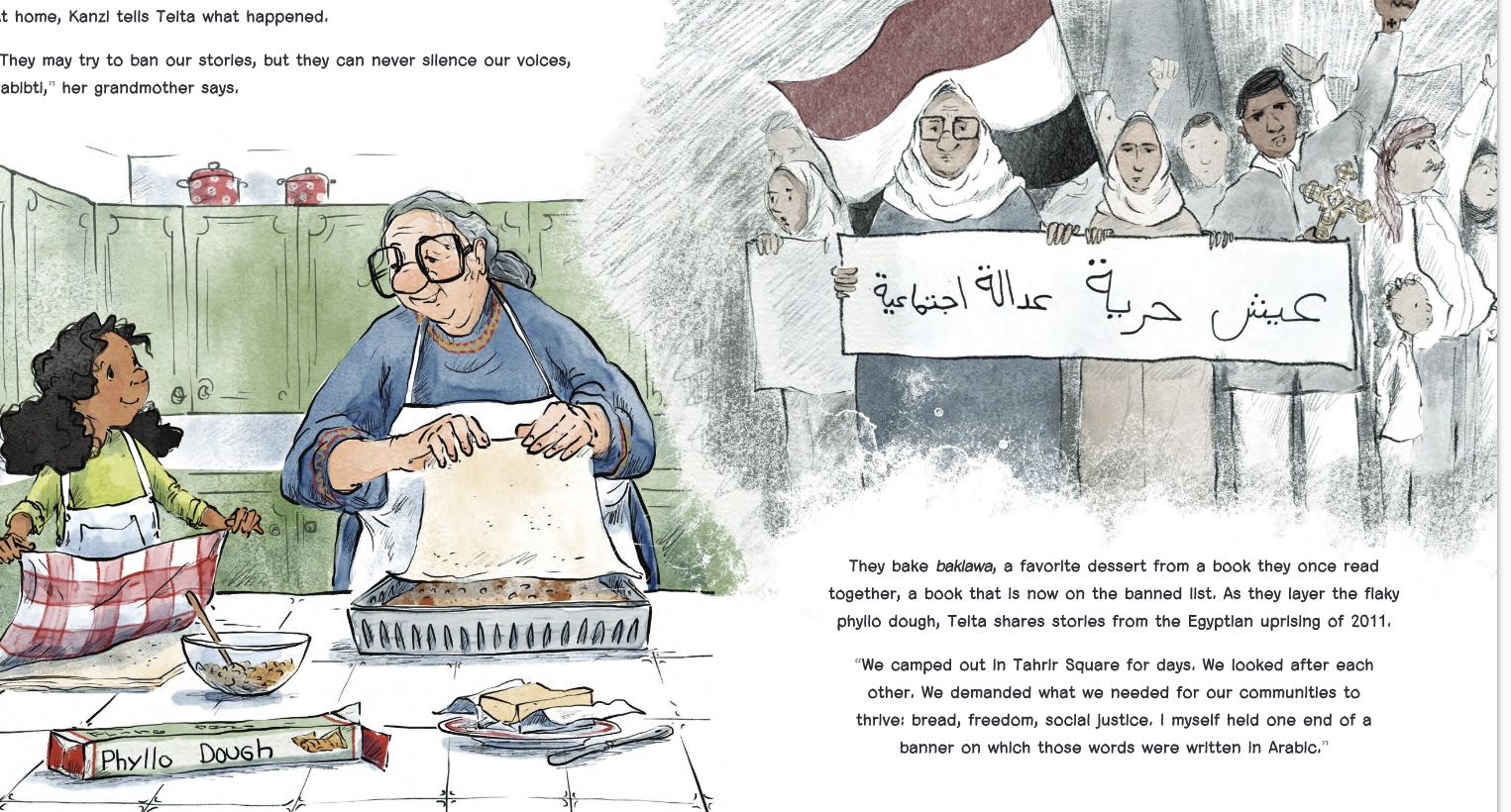
Kanzi helps Teita make baklawa from a book they once read, while her grandma tells her stories of protesting in Tahrir Square.  Teita held a banner and demanded rights for the people of Egypt. Friday comes, and the kids are determined to be heard, as the crowd grows, Kanzi’s nerves also grow, but her strength comes from those that support her and who have also spoken up to be heard.

I enjoyed the illustrations and the backmatter.  The inclusion of a baklawa recipe and insight to how this story came about with the banning of The Arabic Quilt, definitely adds to the book’s appeal.  I felt a little disconnect though from the emotions of the book, and oddly enough, little connection to the characters.

I wish it would have shown her joy when she first saw the diverse book display.  How it made her feel seen and valued and included to see books that reflected her and her classmates.  Then we, the readers,  would feel the pain too, now that they are gone.

I also was a little unsure of the scene when all the kids gather around Kanzi in solidarity, why is she the only one upset? Is it that they care about her or that they care that the books are no longer available? Sure it can be both, but again, as it is written, it isn’t particularly strong.

img_8594

I’m not sure why the three characters named in the book Kanzi, Kareem, and Molly, do not have their names shown on the Arabic quilt pictured in the illustrations, and I also don’t know why it bothered me that the book banned that had baklawa/baklava was not named.  I don’t care that it isn’t a real book, but I wanted a title to make the case of how ridiculous this ban is more articulate.  Additionally, I love Little Free Libraries, but it seemed tossed in without much fleshing out. The book doesn’t explain what Little Free Libraries are, so I’m not sure that kids will even understand the plan.

The book is a decent read, I don’t know that the climax or characters will be memorable on their own, which is unfortunate because connection with the success or failure of this fictionalized book ban really could have radiated out of the book and deeply inspired kids.  The reversal of the boards decision doesn’t directly link to the kids’ actions.  I had to provide that link to my own kid when I read the book to him (he is almost 8).  It is implied, but a line or two about how the kids protest encouraged other people to also speak up, or write letters, or that the school board attended the bake sale, would have shown that when voices amplify it is hard to ignore them.

The book has value on the shelf and can be preordered here https://amzn.to/3C5Baaj

The Together Tree by Aisha Saeed illustrated by LeUyen Pham

Standard
The Together Tree by Aisha Saeed illustrated by LeUyen Pham

img_7924

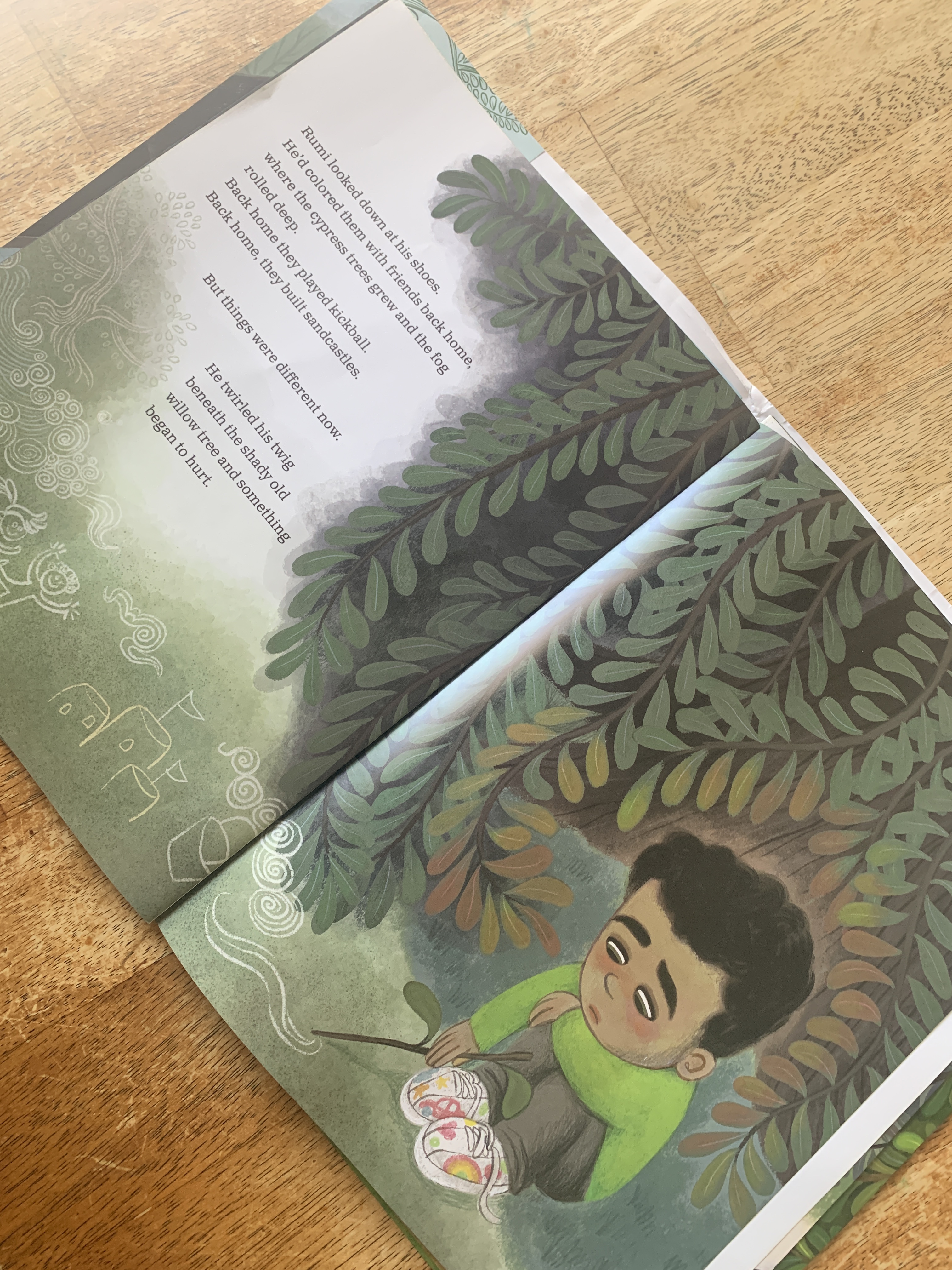
Being the new kid, not having friends, and being teased are not new themes in literature (or life), so if you are going to write a book about them, take a lesson from Muslim author Aisha Saeed and make sure the story is heartfelt, emotional, and well-told.  There is no Islam in the book, no foreign culture, or teasing because of skin color, it is a boy named Rumi who has moved from San Francisco to the other side of America and his shoes, with their drawings and colorings, that cause the kids to stare and start bullying.  Rumi seeks solace under a willow tree and fellow classmate Han has to be brave to put a stop to the mistreatment by finding his voice and not simply staying silent.  The text and illustrations provide a lot of opportunities for children to see themselves in the story, in the various characters, and ruminate over the actions and feelings from different points of view.  The book is lyrical, it is not heavy handed or preachy, and the Author’s Note at the end is equally touching and hopeful.

img_7925

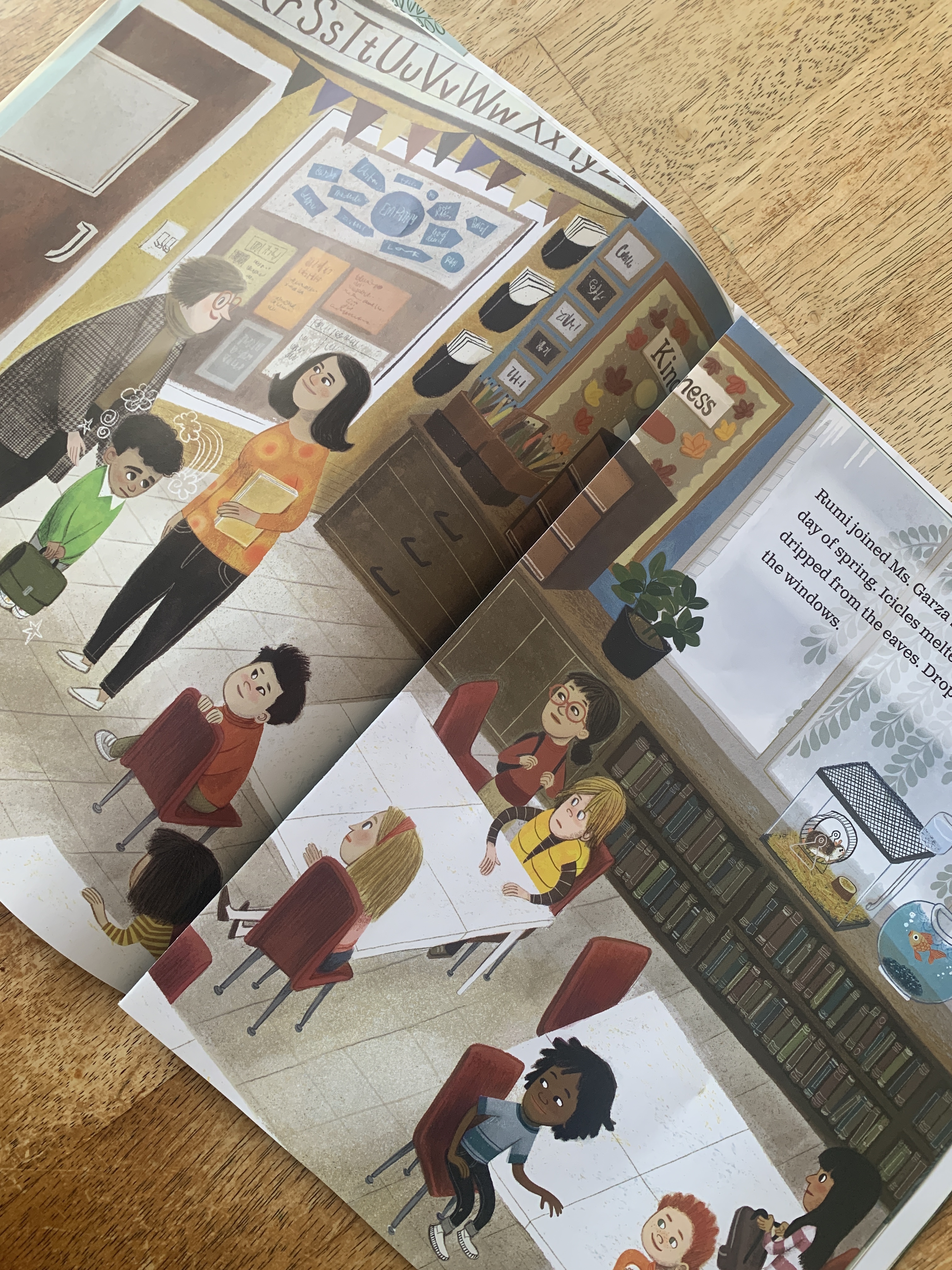
Rumi is quiet, and on his first day in Ms. Garza’s class the kids stare at him as he stares out the window.  At recess he wanders off to sit beneath the willow tree when Asher, Ella and Han leave the swings to see what he is up to.  Asher and Ella start to make fun of Rumi, Han is uncomfortable, but stays quiet.

Rumi recalls coloring his shoes with his friends, and how different it was to where he is now, he picks up a twig to twirl as the hurt grows. In music class when the giggling starts, he tries not to cry.  At recess he retreats to his refuge under the tree.

When the bullying escalates, and tears fall, Han speaks up and breaks the cycle. Others follow and see the world Rumi has created with his twig and are drawn to it and to Rumi.  Forgiveness is asked for, and granted and the tree becomes a place of friendship and togetherness.

img_7928

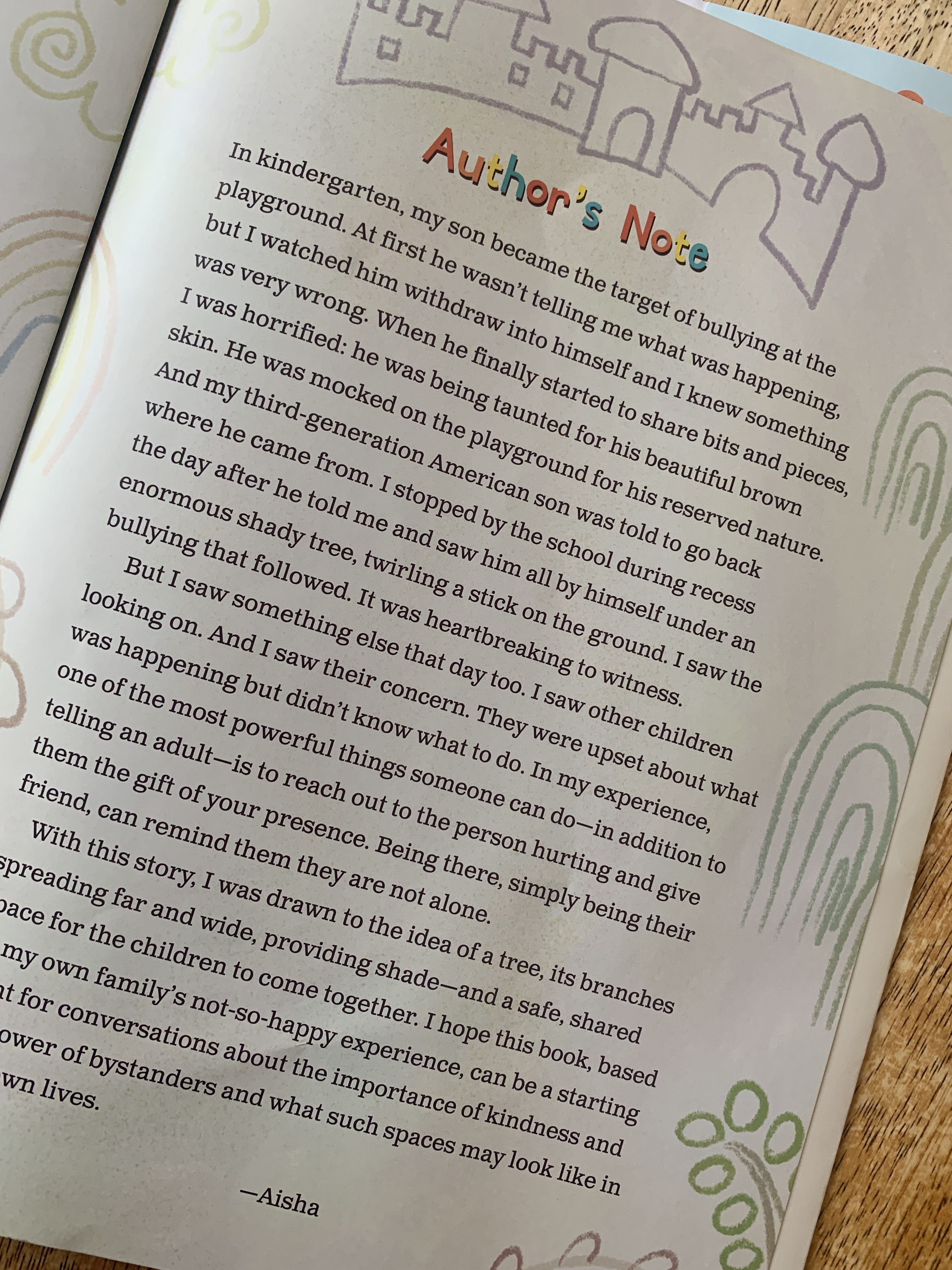
The Author’s Note shares the real life observations of the author about her son in kindergarten and how while heartbreaking, there was also hope in the concern shown by other kids that simply weren’t sure what to do.  I love that even though Rumi is being teased for his shoes and being different, he doesn’t stop wearing his shoes or try and clean the drawings off.

img_7926

I think this book is a must read in classrooms and homes were kids can slowly peel back the pieces and see where they can relate, how they can plan to act, and what parts they identify with.  The book is deliberate and slow, and while a child could read it on their own and enjoy the story and illustrations at hand, the real power it has, is being a catalyst for discussion and empathy and speaking up.

Pre order/order here on Amazon

img_7927


Gokul Village and the Magic Fountain by Jeni Chapman and Bal Das illustrated by Charlene Chua

Standard
Gokul Village and the Magic Fountain by Jeni Chapman and Bal Das illustrated by Charlene Chua

gokul

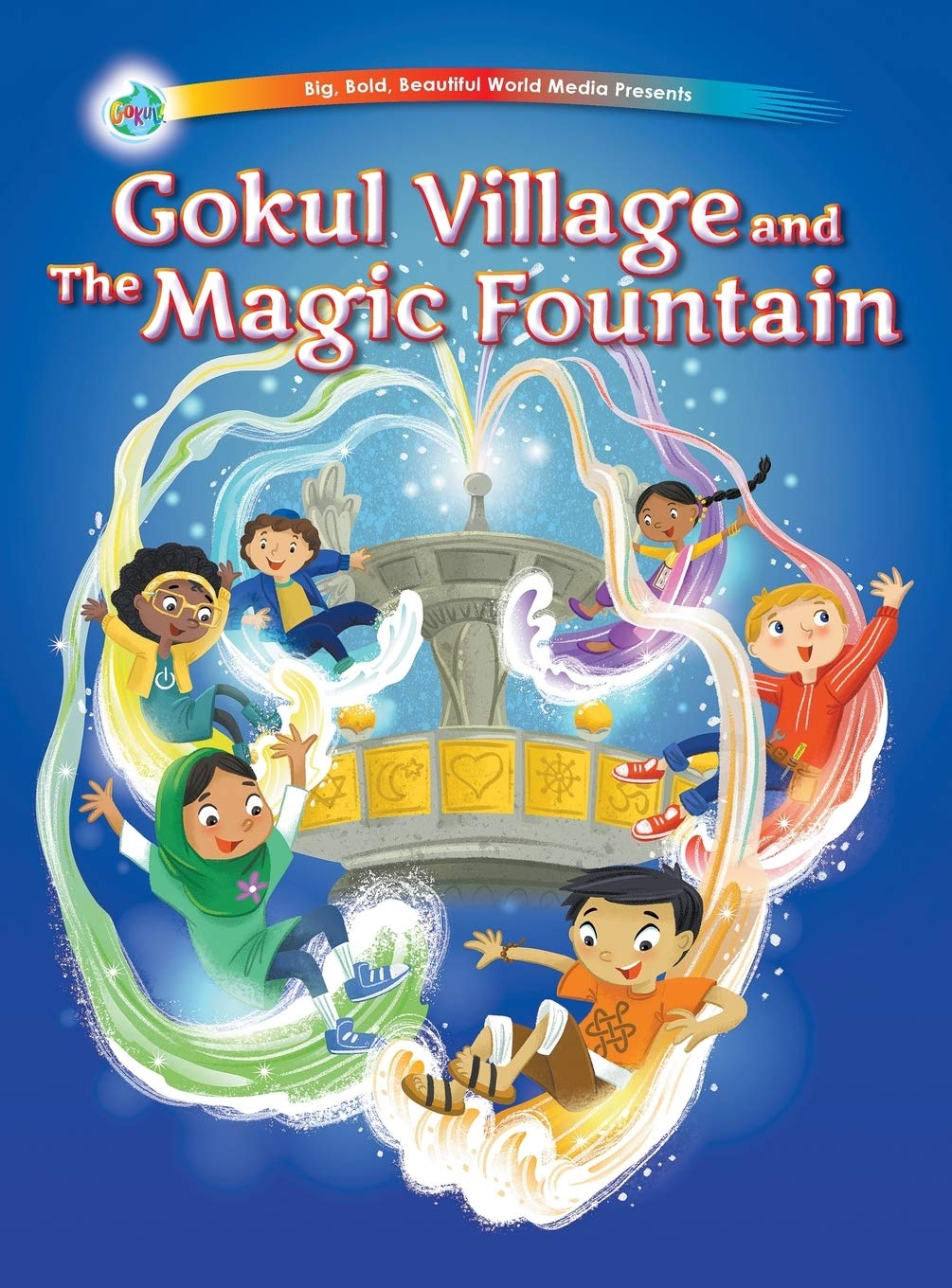
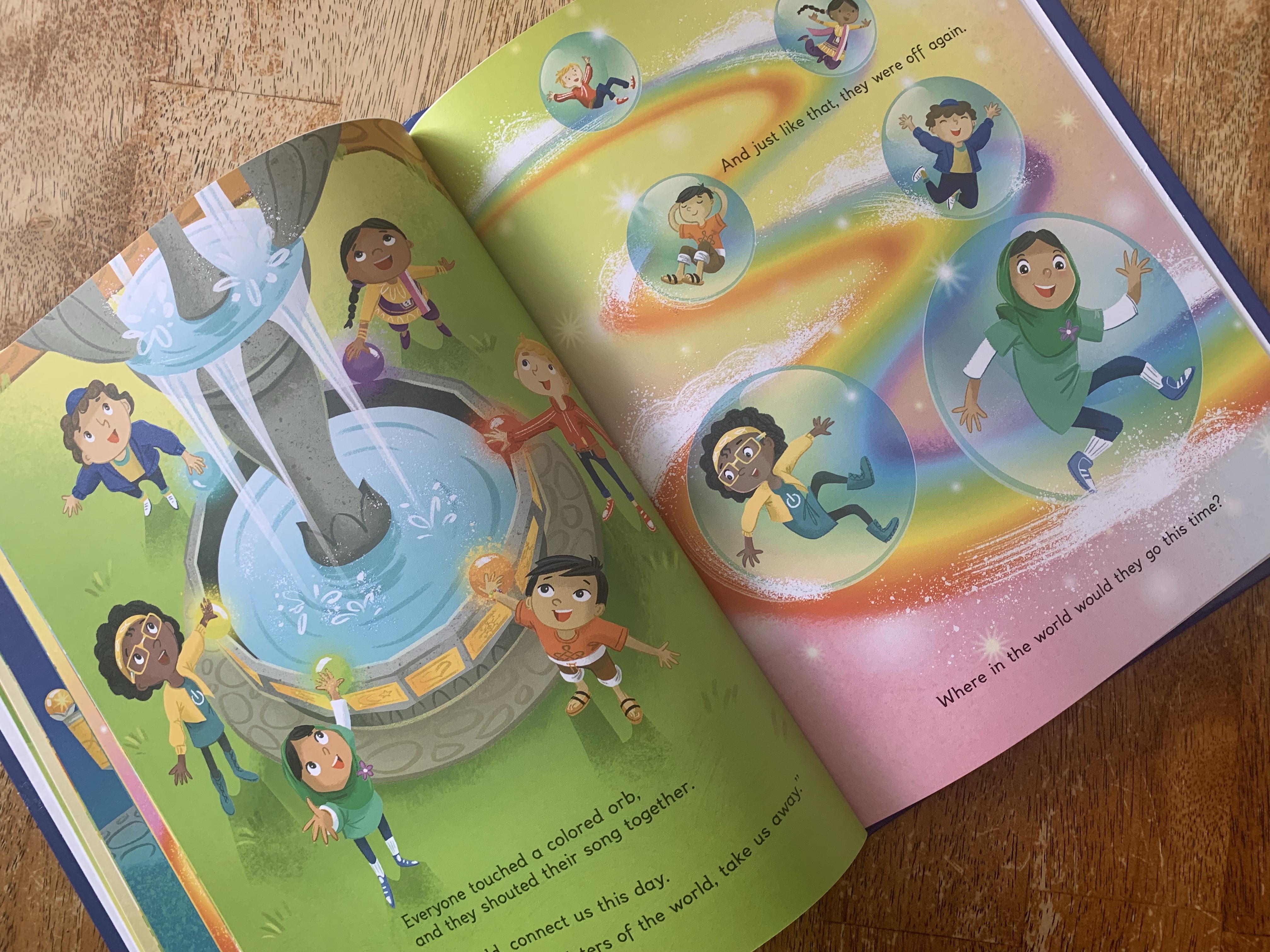
This 32 page book for preschool to second graders, 3-7, is very formulaic and reads like an episode of Handy Manny, or Dora the Explorer, or Paw Patrol.  Each of the six characters has a skill and represents a different culture, when they work together magic happens and they learn something in the process.  There is a girl with hijab and even a mayor that has to be convinced and the kids are successful and save the day.  Sure there is nothing wrong with it, but it is a bit cheesy, on the nose, and largely forgettable.  The book claims that the six kids are going to learn and celebrate other New Years festivals, as they travel to New York, China, and India for Diwali, except, nothing is really learned or even experienced at any of the festivals or the one that they are hosting in their own village.  The book is the first in a series, and I don’t plan to purchase the next one to see if it improves on showing, rather than telling, but if I could find it in a library, I would definitely read it and enjoy the bright illustrations of diverse kids.

img_2714

The book starts off showing a sad broken fountain that isn’t loved or used except by six kids every day who gather there to play.  Zoya to paint, Christopher to build, Riya to play her flute, Dalai to ride his bicycle, Noelle to fly her drone, and Jacob to share the treats he baked.  They like to pretend that the waters of the fountain are connected to all the water around the world and that they can go on adventures.

img_2715

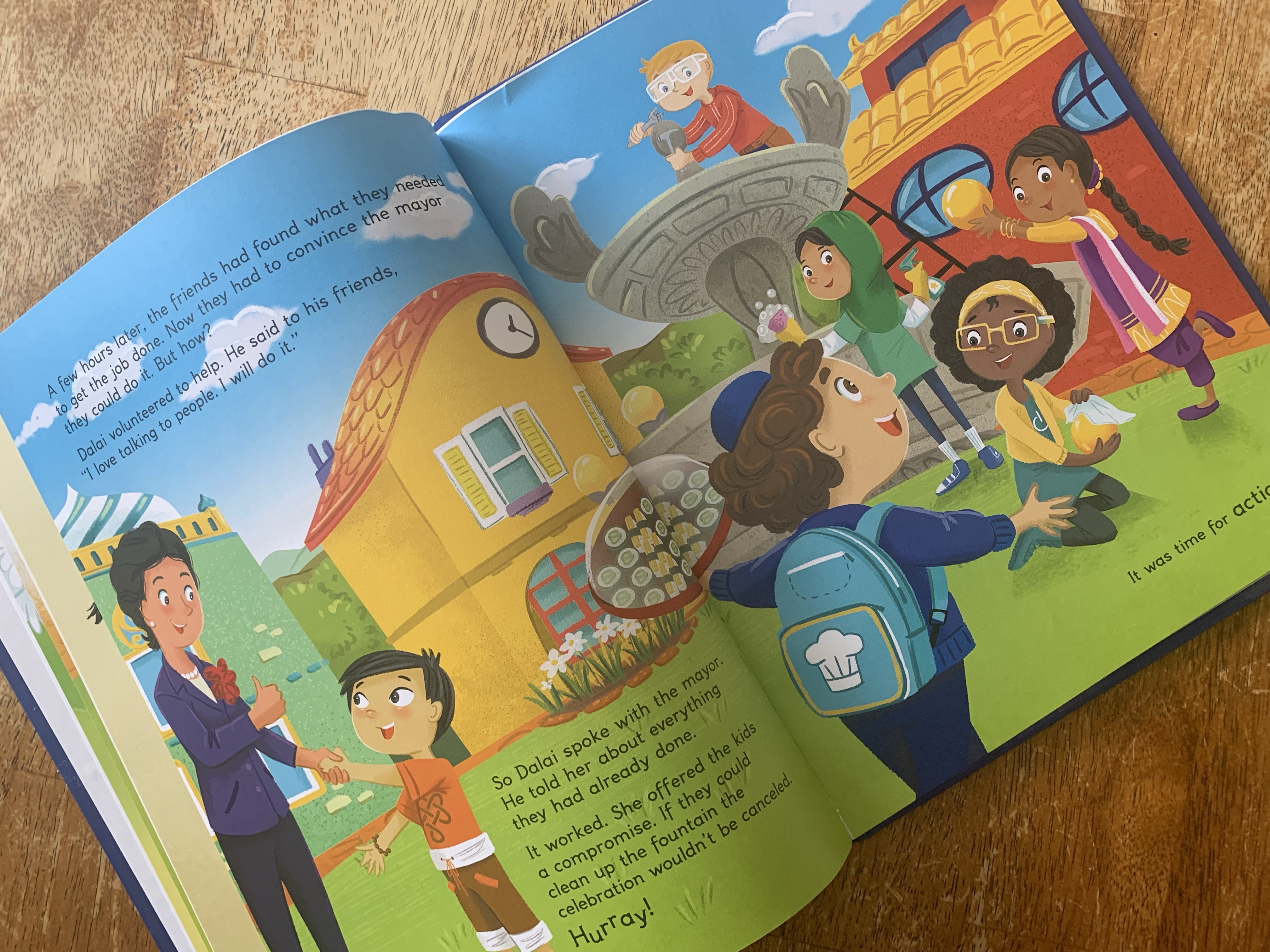
When the kids learn that the New Year’s party is canceled because the fountain can’t be repaired in time the kids decide to take action.  Time-out, I know, I usually give the entire summary then highlight the holes, but the book claims no one uses the fountain, now it is in the city center and needs repairs for a party, it seemed that it was old and crumbling, but last year it was fine? And if the kids could have always fixed it, why didn’t they? Any way Riya assigns everyone jobs to fix the fountain, AND THEN they go get the mayor and let her know they are going to fix it and she agrees saying if they can get it done in time the New Year’s Celebration wouldn’t be canceled.  The order seems off to me, they start fixing it, then work it out with the mayor and then have it all fixed in two days and the mayor clears it.  The illustrations show it pretty much fixed when the mayor arrives the first time, not sure what took two more days, and how it was ok for kids to fix a fountain prior to getting permission.

img_2717

With the festival back on, the fountain looks happy and the kids suddenly have enhanced skills: notes from the flute turn in to birds, Zoya can paint in the air, Dailai’s bracelet is glowing, tools are growing and multiplying, and the drone, iDea, speaks.  She tells the children to read the inscription on the heart of the fountain.  Somehow the kids know to each touch a glowing orb and sing a song verse together.  It reminded me of Dragon Tales.

The fountain whisks the kids to New York where they see a “jostling, jolly,” crowd celebrating.  Then they are off to watch “millions of people clap and sway together, hoping for happiness and good fortune for all,” at a Chinese celebration.  That is literally all it says, it doesn’t say that Chinese New Year would be at a different time because of the lunar calendar or anything, and then they are off to celebrate Diwali, in India, which also wouldn’t be at the same time as western New Years, and all they learn about it is that it is a celebration of light over darkness.  I’d guess readers wouldn’t even realize that it often coincides with the Hindu lunar calendar’s new year celebrations.
img_2716

The kids come back, name the fountain the Friendship Fountain, use some of the decorations they saw to decorate for their own new year’s party, and then they clean up after the party.  There is no showing how their village celebrated, there are no other villagers attending or helping or participating, it just says they agreed it was “the best party ever.”
img_2718

Perhaps  I am cynical because the book is $17, but even if the book was free, it really is lacking some depth.  If you are going to highlight some cultures, then highlight some cultures, don’t just name drop and move on. I love that the characters are diverse, but I hope in future book, their own cultures and beliefs are shared not just visually represented.  The formula works for little readers, but if even a talking hammer and screw driver in Handy Manny can have their own personalities, sadly these six kids missed a chance to show themselves and foster inclusive representation and teamwork in a celebratory manner.

https://www.gokulworld.com
Shirley & Jamila Save Their Summer by Gillian Goerz

Standard
Shirley & Jamila Save Their Summer by Gillian Goerz

img_7124

This graphic novel jammed pack with sleuthing, friendship, and diversity is perfect for ages 8 and up.  The inclusive cast shows motive and growth keeping anyone from being entirely good or completely villainous and strikes a wonderful balance of insight, community building, and relatable fun.  From the main character’s mom wearing hijab, and random hijabis in the background panels, to characters of color, and characters with social obstacles, there are also bullies, cancer survivors, a character with two moms, working parents, and a missing gecko all coming together over 221 pages to leave the reader waiting for the next book in the series.
SYNOPSIS:

Jamila has just moved to the neighborhood and with older brothers as role models, she just wants to spend her summer shooting hoops and taking it easy.  Her mom, on the other hand, wants to send her off to science camp.  Shirley, is incredibly perceptive and wants to spend her summer solving neighborhood crimes, the ones adults won’t or can’t help with, but her mother has signed her up for dance camp.  When the girls cross paths at a yard sale, Shirley uses her wits to convince her mom and Jamila’s mom to let them spend the summer together at the basketball courts, thus both girls get what they want.  The two girls aren’t exactly friends, but the arrangement benefits them both, and the days go smoothly, until a gecko goes missing and Shirley and Jamila have to decide to break their parents’ rules to leave the courts and venture to the swimming pool to investigate.  Jamila and Shirley hit a snag in their understanding of one another and realize they want to be friends, something neither of them currently have.  As they work Oliver and Vee’s case to find Enoch the gecko, the reader meets lots of neighborhood characters, from life guards to daycare informants.  And as the clues come together so do a group of kids, all needing friendship, kindness, and a little understanding.

WHY I LIKE IT:

I love the Nancy Drew, Great Brain, Encyclopedia Brown, vibe of the story.  It is funny and plausible and about so much more than just the case.  It is quick and well drawn, and really just a joy overall.  I love the diversity and teamwork and innocence of a summer and some good old fashion kids using their brains to save the day.

Other than the mom wearing a scarf when out of the home and a few hijabis in the background there is no textual mention of religion.  The mom at one point says something in Urdu and the family has Muslim names.

FLAGS:

One of the side characters mentions that she has two moms.  It is mentioned once, it isn’t dwelled on, and in many ways I think a great way to explain to your kids, if they mention it, that they might have friends and classmates with different family structures.  I love that fiction allows for this conversations to occur in the abstract so to speak, you can guide your children how to handle these differences while talking about fictional characters, and imparting your families view of such matters in an open and hopefully non judgmental or hateful way.

TOOLS FOR LEADING THE DISCUSSION:

As always with graphic novels, they just aren’t the best format for book clubs as they are usually quick reads.  The target audience for this is middle grades as well and while middle schoolers might enjoy it, they would read it in less than a half an hour and there really wouldn’t be much to discuss once the case is solved.  I would highly recommend checking your local public library for the book, that is where I found my copy, and happy reading!

Our Favorite Day of the Year by A.E. Ali illustrated by Rahele Jomepour Bell

Standard
Our Favorite Day of the Year by A.E. Ali illustrated by Rahele Jomepour Bell

favorite day

A great book about inclusion for back to school, except well with Corona, we aren’t doing things how we always have.  None-the-less this book about the first day of kindergarten for Musa and the friendships and celebrations of diversity (Eid al-Fitr, Rosh Hashanah, Las Posadas, Pi Day) that will take place over the school year, connect the kids and their cultures in a beautiful and heartwarming way.  The book is 40 pages with engaging illustrations and text perfect for 5-7 year olds.

EDFC15B2-0A7C-4B7F-ACAD-E019DBDEDEC4

It is the first day of school and Ms. Gupta tells the class it is her favorite day of the year.  She also tells the children that the people around them will become their best friends.  Musa doubts this as he looks around at the strangers at his table.

EFE30123-CA0D-41E9-BAFB-2ADFA7CE811F

He also wonders how the first day of school can be any ones favorite day, clearly Eid al-Fitr is the best holiday.  Luckily, every show-and-tell will be about someone’s favorite day, so that the class can join together in celebrating it.  Moises can’t believe that Christmas isn’t the most fun until he learns that not everyone celebrates it.

011E4F77-4479-412E-AF9E-D37B9B870308

When it is Musa’s turn to teach about Eid, his mom and he bring in food and decorations and teach the kids to say Eid Mubarak.  They learn what Eid is like and can see why it is his favorite.

6B5884B2-A9ED-42D1-A624-B8100CE0D160

Up next is Mo’s turn.  He tells everyone about Jewish New Year and how to say Shanah Tovah.  On Rosh Hashanah they light candles and share food with friends and family.

DAC82C2A-06CC-485B-B589-F34682F0914E

Moises explains how Las Posadas is how his family celebrates Christmas.  It lasts nine days and there are songs and pinatas and presents.

2CECB33E-AFBD-4118-B893-8B9D2B81385C

In the spring it was Kevin’s turn and he shared his love of Pi Day as his family celebrates science.  On March 14 (3.14) they make different pies and learn about scientists and their discoveries.

A657B13B-02A0-4E75-95D0-25513C8788F6

On the last day of school, the children are sad, but their teacher hopes they will remember each other always throughout the year as she hands out calendars for them to keep.

83CC82E2-4045-4F02-8202-D6E6124A0E5F

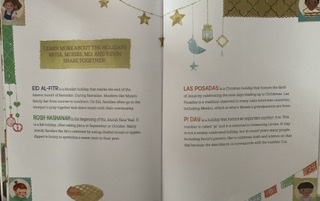
The book concludes with information about each of the four holidays mentioned. It is possible that on the Rosh Hashanah page the family is two gay men with two children, but it could be just two men as well, and doesn’t say anything in the text that suggests who and how the family is comprised.

731DE17E-FCD5-4B41-9209-3EEB21052101

Be Kind by Pat Zietlow Miller illustrated by Jen Hill

Standard
Be Kind by Pat Zietlow Miller illustrated by Jen Hill

be kind

I usually post chapter books on Fridays, but on this one week anniversary of the horrific Mosque attacks in New Zealand, my fragile heart is being kept together by the pictures and notes shared on social media about the kindness people are bestowing on one another.  Company’s setting up prayer spaces for Muslim employees, communities standing guard outside masjids, friends leaving flowers for their Muslim acquaintances, strangers donning hijabs in solidarity, individuals carrying signs of welcome and unity, truly the list goes on and on.  Muslims and non-Muslims reaching out to one another, Kiwis and the rest of the world coming together.  And yet I know so many people are at a loss at what to do, and how to respond to their feelings in an appropriate manner.  I know I often am.  Thats why books like this one are so important for children to learn how to be kind.  We often tell them to be nice or kind, but what does that mean? What does that look like? How do we know if it worked? As adults we often don’t know, so while this book isn’t written or illustrated by a Muslim, there are Muslims in it, and that is why after seeing another blogger a few weeks ago mention it, I want to share it with all of you.  The illustrations show a little girl saying hi to a desi garbed man named Omar, and two hijab clad girls in her view of the world, amongst so many other diverse faces and characters, because that’s the point right? We are one, each of us responsible to one another to be kind.  

IMG_3389

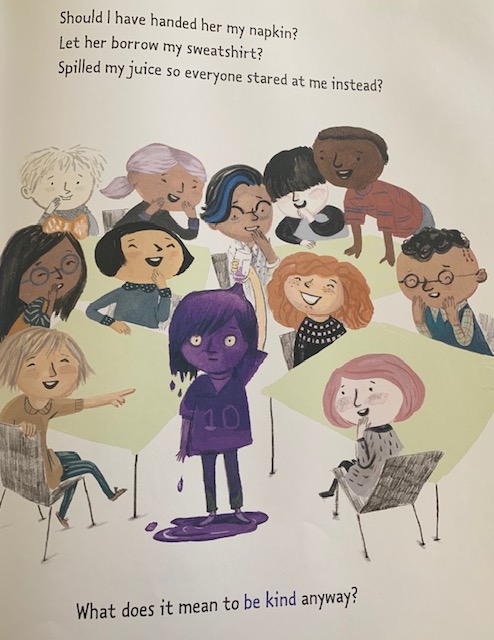
The book starts off with Tanisha spilling grape juice all over her new dress and a classmate being at a loss as to how to console her.  She makes what she thinks is a reassuring comment to Tanisha, but it isn’t received that way, and the little girl ponders and reevaluates what it will take to be kind to Tanisha and what kindness is in general.

IMG_3386

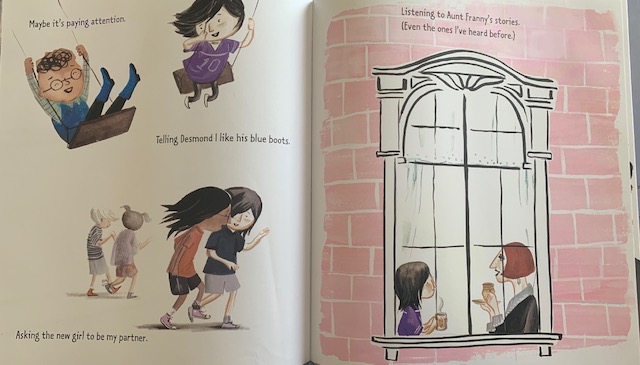
As she works to unravel what kindness is, she explores also what it can look like.  I love that it is seen in terms of action, giving ideas to stay with the reader.  It discusses that sometimes it is easy like saying hello, or not littering, and how important just using a persons name can make someone feel.

IMG_3388

But, it also talks about how sometimes kindness can be hard, requiring patience and a little bravery. I can only imagine how brave people had to be to enter a mosque for the first time and step out of their comfort zones to offer their support.  

The book then takes an important pause when it acknowledges that maybe all this little girl can do to help Tanisha is to sit by her.  I think Muslims around the world are in awe of the Prime Minister of New Zealand for all she is doing, but also for just showing up and hugging people and listening.  A rare gift in todays wold of soundbites.  

IMG_3390

The little girl then imagines her small acts of kindness joining others and making the world a better place.  My favorite part is actually the end.  Tanisha never smiles and tells the little girl thank you, there is no big praise for being kind.  In fact, I bet the little girl doesn’t even know the power her actions had on the little girl.  We the reader know because we see Tanisha hanging the picture up in her room.  But, that let down is real life.  We can’t be kind because of the reward, we must learn to be kind because it is the right thing to do.  And often when people are kind to us, the effect isn’t instantaneous, its weight manifests in the dark when we are looking for hope and reassurance and for this book to contain all of that, in 32 pages with only few words (AR 2.2) is truly amazing.

IMG_3391

The illustrations are gorgeous and engaging.  The hardback 9×10 format makes this book a great addition to any library and should be read regularly.  It isn’t enough to not be mean, action and intention need to be taught so that we all might be more kind, inshaAllah.


Love by Matt de la Pena illustrated by Loren Long

Standard
Love by Matt de la Pena illustrated by Loren Long

love.jpg

This 40-page-book may have a simple title, but most of us know, there is nothing simple about love, and this book shows love in many forms from a child’s perspective as they grow.  Sometimes picture books are basic and inspired to teach, or simply entertain.  Sometimes when picture books try to do more, the audience is confused when the pictures and amount of text on page don’t seem to align.  And sometimes, large pictures, with thoughtful poetry make the pages come to life and sing.  The book is written on an AR 3.7, so people thinking this book is for preschool aged children seem to be upset by the concepts hinted at and illustrated, but for older kids, this book has amazing power, and beauty that can show just how complex this universal feeling is.  

Love is your parent’s voice, love is burnt toast, love is the stars after your house burns down, love is in your grandpa’s wrinkles, love is staring back at you in the bathroom mirror.  But sometimes love also burns out and love is shielding you from things that might hurt you, and love separates people too. 


As humans, we can all relate to the same emotions, whether we give and receive love the same, the book shows the value and meaning it has to us all.  Hurray for illustrator Loren Long, because page after page, shows diversity of color, mobility, socio economics, age, and religion.  On a page where the love of the child is keeping her from seeing the TV that the family is crowded around a cross is present, and then a few pages later,bam, there is a girl in hijab looking up at the trees and listening to the love shared in their rustling. 

IMG_1901

I had no idea this illustration was present, and gasped aloud.  I said nothing to my daughter, finished the book, and handed it to her to read.  She turned the page and gasped aloud as well saying, “there’s a muhajaba, haha, we are in it too.”  Granted she is my daughter, so environment and genes account for something, but EVERY PAGE I think resonates with someone, and that gasp in my living room from me, from her, could come from anyone who turns a page in this book and bam suddenly feels represented, feels included, feels validated.  That my friends, is LOVE. 

IMG_1900

We are more alike than different.


All Are Welcome by Alexandra Penfold and Suzanne Kaufman

Standard
All Are Welcome by Alexandra Penfold and Suzanne Kaufman

all are welcome

This is the perfect book for back to school.  It can set a beautiful tone of letting all children know that they are welcome, that they are accepted, that they are safe, that they are wanted and that they have value in your classroom.  It could also work to allay children’s fears heading in to a new environment, assuming of course that the environment is as fabulous as the one presented in the book.  

IMG_1788

The large, hardback 44 page book with a poster and large pullout concluding page, is fantastic for ages preschool and up, but would have value as part of any grades back to school message.  

IMG_1789

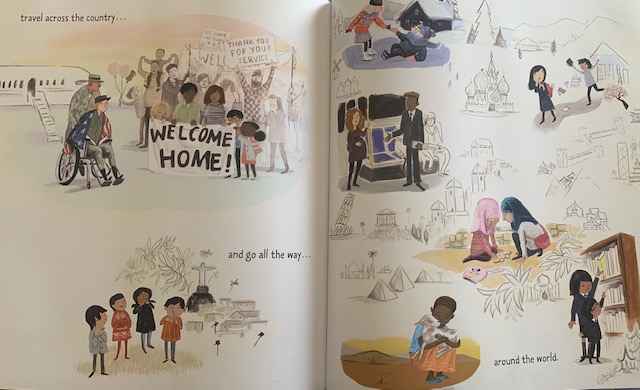
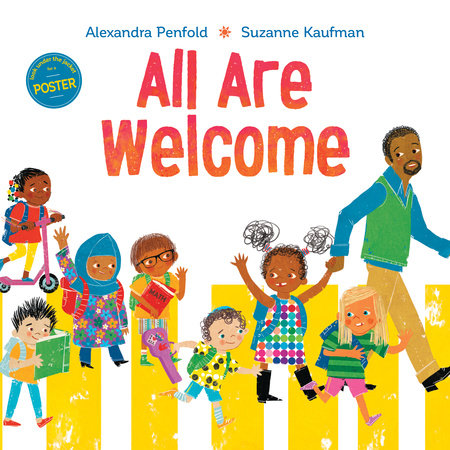
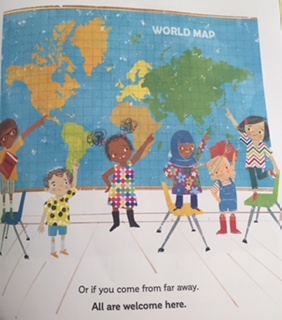
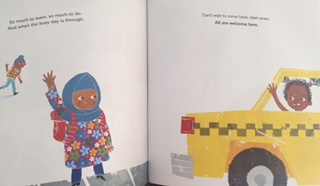
While the rhyming couplets are sweet and sincere, the real beauty of the book are the illustrations.  Bringing all that diversity to life in smiling kids faces, children with hijabs, and yarmulkes, patkas, baseball caps, glasses, curly hair, straight hair, every color of the rainbow, various physical abilities, all show what a day of inclusion can look like.  No one culture or background is articulated or placed higher than another and the coming together of the kids and then their parents and community is inspiring.

IMG_1787

I love that their is a little muhajaba on the the cover and included in the cultural acceptance of the book.  It shows her praying in one picture and then joining in and smiling with the rest of the diverse group of characters in the other pictures.  Feeling included and accepted whether in a classroom, or in a children’s book, feels good, at any age, alhumdulillah. 

IMG_1790

A special shout-out to all the educators and people in positions of power who go the extra mile to create a safe and accepting space, thank you.

IMG_1791