Tag Archives: Family

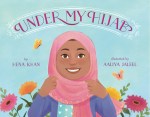
Under My Hijab by Hena Khan illustrated by Aaliya Jaleel

Standard
Under My Hijab by Hena Khan illustrated by Aaliya Jaleel

UNDER MY HIJAB final front cover JPEG.JPG

I know, (sigh) another hijab book, but I promise it is good and you won’t be sad you bought…”another hijab book,” and  alhumdulillah, it’s a Hena Khan book, so public libraries will have it or at least they should be willing to order it if requested.  

IMG_2878

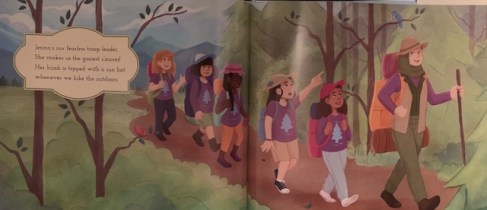
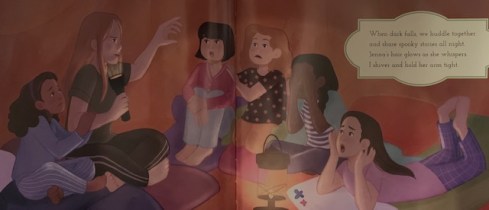
Written in rhyming four line stanzas the story is told from a young girl’s perspective about the women in her life.  The first two page spread shows the strong female as she interacts in the world and covers her self, with the following two page spread, showing her in her home, uncovered.

IMG_2879

From Grandma, to Mama, to Auntie, to troop leader, to siblings and friends, the reader sees hijabs wrapped in styles as different as the person wearing them.  They also see Muslim women as doctors, artists, Tae Kwon Do students, bakers, leaders, and everything in between.

IMG_2880

The illustrations are beautiful and perfect.  They radiant warmth and familiarity, while adding details to make the pages hold your attention a few minutes longer and smile with the diversity presented. The martial art scene is spot on!

IMG_2876

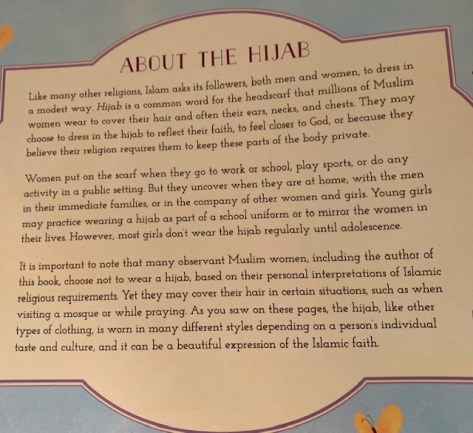
I wish they showed a niqabi, and maybe someone that doesn’t cover all the time, but at certain times of prayer or entering a mosque, like the author, who talks about herself and hijab in general in the afterward entitled: About the Hijab.  

IMG_2882

I love that the book is for children and I desperately hope adults will read it too.  It breaks down so many stereotypes, and answers so many questions in a seemingly effortless presentation.  How many times have all hijabis been asked if we sleep in our scarves or shower in them.  I love that there are shades of brown skin tones, and blond haired hijabi’s too.  

IMG_2877

And most importantly I love that it shows Muslim women to be strong and varied and to have full, independent beautiful colorful lives.  That hijab is a choice and it is strength and beauty and personal.

IMG_2881

The book does not talk about the reasons for wearing hijab, or get into the religion.  The book is a great size for story time and bedtime at 10 x 8 horizontal, hardbound, and 32 pages.  Ages four and up will enjoy this book repeatedly,  and older kids, especially girls considering covering or just starting to cover will enjoy it as well.

Alhumdulillah! Well done!

Forgive the glare in the pictures, they aren’t in the book 🙂

Lulu and the Very Big Meanies by Mac McGooshie illustrated by Alexis Hogwood

Standard
Lulu and the Very Big Meanies by Mac McGooshie illustrated by Alexis Hogwood

Lulu.jpg

I don’t know what is more frustrating: quality books that are poorly packaged (binding, illustrations, font, spacing, etc.) or beautiful books that miss the mark in storytelling and basic writing skills.  Both are equally annoying, and while yes, a good story should be the basis, this book is really well written that the presentation of it just makes me sad.  At 116 pages, the book is perfect for 3rd graders.  My daughter and son read it a few years ago when I first picked it up.  I made them read it.  And last week when I pulled it out to read myself, both remarked that it was a good story.  The fact that they remembered it and remembered liking it are huge pluses, and made the fact that I had to make them read it all the more disheartening.  I’m certain if you can get your kids to read eight maybe 10 pages they will zoom through the rest of the book.  It is the getting them to pick it up and start, that is the tricky part.  The book is paperback, thick and glossy, but the cover looks homemade almost.  If you thumb through it the font is too small, spaced too tight and the illustrations mean well, but don’t deliver.  Unfortunate, because like my children, I too think the story is fun and I’m disappointed that the book was published in 2013 as #1 in the Lulubug’s Week in the Life Series, and no further books have come out.

SYNOPSIS:

Laila (Lulu), and her family are American Muslims living in Southern Virginia.  Lulu’s mom is a lawyer and a convert, her dad is from Egypt and owns an Italian restaurant, and her older twin brothers are 12 and keep an eye on her.  Being incredibly bright Lulu has skipped third grade and is having trouble with some bullies in her new fourth grade class: Veronica B. and Veronica C.  aka the Veries.  Using help from her brothers, her neighbor and friend Toni, and some friends in class, a trap is set to get the bullies to confess to their evil mischief, but that unfortunately isn’t the only thing Lulu is going through this week.  Throw in her parent’s sudden decision to move closer to the masjid in another city, a litter of kittens abandoned on the side of the road, and some weird noises coming from the woods behind their house, and Lulu has a lot to deal with.

WHY I LIKE IT:

I love that it shows the day-to-day of a typical Muslim family in a normal presentation.  They pray together, they watch what they eat, they know their neighbors and worry about each other.  It doesn’t idolize the family, making them better than anyone or preachy, but makes them very relatable and likable in a realistic way.  When bees are discovered or the kittens need carrying for, sunnahs and ayats are identified, but very seamlessly, that non Muslim kids will learn a bit about Islam and Muslim kids will be excited to see themselves.  My favorite scene regarding this is when the mom finds out there will be a middle-school dance, and even though the boys are not planning to go, know that it isn’t for them, and don’t even seem tempted by it, they still have a family meeting about it, to discuss.  I also like that at one point Lulu meets another Muslim girl and they don’t hit it off right away, the girls work through it, but it is nice to see some diversity in even the way Muslims are presented and possibly misunderstood even amongst one another.

There is a lot going on in the book in terms of action items, but there still is a lot of character development and dimensions to Lulu.  Lulu has to navigate relationships with her family and friends that ring true and aren’t over simplified.  Her friend and neighbor, Toni, expects Lulu to act different at school now that they are in the same class, but returns to her silly self once they are home.  Lulu clashes a lot with her mom, but can smile and get her way super easy with her dad and manipulates that a lot.  She has to balance her sassiness with her teacher and principal, pick her battles with the Veries, and abide by other adults’ rules and expectations.  The book reads in a similar vein as Junie B. Jones, or Clementine, just maybe a more mature and less obnoxious reincarnation.

I wish the adventure involving the backyard noises, was a bit more dramatic, and maybe even the unveiling of the trap involving the dye was more resolved.  At times the book seemed rushed to wrap up all the stories introduced and I think they deserved a little more time to be explored and enjoyed.  If the font and spacing and pictures could be tweaked I think the book would really speak to kids in a fun way.  Third and fourth graders can easily handle a 150-160 page book that has good pacing and is packaged in a tempting, non intimidating way.  I’m holding out hope that maybe the author will write some more, tweak this one, and give it the chance at reaching an audience that would benefit from the smart, fun, grounded life of Lulu.

FLAGS:

Clean, it does mention that Toni likes a boy, but Lulu thinks that boys are trouble.

TOOLS FOR LEADING THE DISCUSSION:

If I still did an elementary book club, I think this book would work.  I think kids need a nudge to give it a try, but once the book gets going, girls and boys alike will enjoy it.  I may read it for a Lunch Bunch choice (I read once a week to 4th and 5th graders while they eat their lunch).  Kids will love seeing themselves, their stresses, their families, and their faith presented well.

An Ember in the Ashes by Sabaa Tahir

Standard
An Ember in the Ashes by Sabaa Tahir

Our local library automatically renews books, so I’ve had this 446 page AR 5.0 novel sitting on my night stand since October.  I got the online version when I went overseas, and I even downloaded the audio book.  Needless to say, I never opened it, in any form.  And then four days ago, I did.  I read the first page and then the second, and soon enough I knew that I would quickly be annoyed by my children needing food, and clean clothes and rides to school because, I was no longer present in the day-to-day functions of my life, I was in Serra hoping for happy endings and being really angry, like ready to contact the Muslim author during certain scenes, as I felt tears reminiscent of when Cedric Diggory was killed in book 4 of Harry Potter brimming.  The book was amazing, and yes, my kids are fairly well cared for, but there are two more books in the series out, and the fourth one apparently in the works.  I hope to read the series, but I have a feeling, this epic fantasy series will not be a happy read, it is dark, and violent, and definitely more suited for high school readers because of content then the AR level would suggest.  

SYNOPSIS:

Told from two different characters ‘perspectives: Laia and Elias, the world of Serra has tastes of the Roman Empire, current political headlines, Middle Eastern names, subcontinent ideas and lots of action.  Laia is a Scholar, an oppressed people who a half a millennium ago crumbled beneath the Martial invasion.  Her parents led a resistance and were killed a long with a sister.  She and her brother, Darin, are now raised by the grandparents: gentle people who heal others, keep their heads down, and don’t make waves.  The story quickly advances with Martials raiding the family home and Masks, the elite warriors of the Martials, killing Laia’s grandparents and imprisoning Darin.  Laia escapes by running, but hates herself for not staying and fighting for her brother, the only family she has left.

Elias on the other hand is a Martial soldier about to graduate as a Mask from Blackcliff Academy, a brutal (that’s putting it mildly) nearly all boy’s military school.  Abandoned by his mother as a baby, Elias is contemplating running away from the school, as his soul and conscience can no longer be pushed aside to complete the acts he is expected to do.  The complications abound, however, as the Commandant, is his mother, who wants nothing more than to see him dead, the penalty for desertion is death, but the penalty for most every infraction is a severe beating, and if death happens in the process, so be it.

The two characters come together as Laia reaches out to the Resistance to find help in rescuing her brother and in exchange is assigned to be the Commandant’s personal slave.  As the Empire is on the cusp of change, a new emperor is to be selected from the top four of the current graduating class, Elias, is the top of his class.  The four trials will leave one triumphant and the new leader, second place will be the Blood Shrike, the emperors blood bonded butcher, the others will be killed. 

The trails are named: Courage, Cunning, Strength and Loyalty and are administered by immortal, mind reading, cave dwelling Augurs.  The trails are vicious and cruel and evoke not only putting friends against friends, and test one’s fears, but they are amplified by creatures such as jinns, efrits, ghuls and wraiths.

WHY I LIKE IT:

The book is incredibly well written.  The way the author builds her characters’ worlds is seamless and smooth.  I didn’t get lost or confused, I never once felt bored by explanations or felt that something didn’t make sense, a feeling that makes fantasy stories cumbersome and daunting to me, and what I feared all those months looking at the book, too afraid to open it and dive in. 

The action and characters are well developed.  While the book is fast paced, I felt every character was given some nuance and depth.  It really isn’t a good vs. evil story.  Each character has more than one trait at any given time, and it makes them delightful to interact with and mull over.  There are strong females and sprinkled in ethnic names like Sana, Illyas, Tariq, Afya Ara-Nur, Mazen, Zain, Zara.  The subcontinent concept of Izzat, honor, is prominent among the Resistance and Scholars which is a nice bit of resonance in this fictional world as well.  And the concept of jinns, and the stories about their role in the book, reads like Arab folklore.

FLAGS:

The book has profanity, not a lot, but it is there, especially when talking about women.  The violence is incredibly graphic, killings, beatings, brutality, whippings, suffering, and death are on nearly every page.  The Martials are ruthless not only with those they occupy, but even amongst themselves: the students fight to their death, they lock their own children in cages without food so that only the strong of their society survive.  But even worse is that many of the people outside of the ruling elite are taken as slaves, and thus women are seen as property and rape abounds.  Rape by name is mentioned a lot, but it isn’t graphic, save one or two climactic points, if anything it is more disturbing because it is the norm and is accepted.  Prostitutes are mentioned, again, nothing detailed, but mentioned that the boys at the academy visit the docks to see prostitutes.  As Laia is being sold to a slave master, he considers placing her in the brothels rather than at the school.  Laia is nearly raped by a student, and a simmulated rape saves her at another time, in both instances the higher ups dismiss that there is anything wrong with raping a slave and the winner of the third trial is even given a slave for the night.  When the Masks kill Laia’s grandparents, one says he will rape Laia before he kills her.  So it is very much a part of the culture of the book, but it isn’t defined, just the words are used, which means I think high school kids could handle it, because it is not celebrated or graphic, but younger than that will have too many questions that can’t be swept away easily given the environment of the book.  

TOOLS FOR LEADING THE DISCUSSION:

This book could work for a high school book club, because there is so much to talk about.  It won’t work for middle school, and I will keep my daughter from reading it until she is in 9th or 10th grade probably, even though she has read Hunger Games and the Divergent series.  Just want her a little older to handle all the rape references, in more mature way.

As for teaching or presenting this book, this series has a HUGE fandom, you can find everything on the book online and with little effort (maps, character lists, chat groups etc.).

The Author’s website: https://www.sabaatahir.com/

Teaching Books: https://www.teachingbooks.net/tb.cgi?a=1&tid=42018&s=n

One of many book trailers: https://www.youtube.com/watch?v=sbvyCrkVT7M

Enjoy! Happy Reading!
Boy vs Girl by Na’ima B. Robert

Standard
Boy vs Girl by Na’ima B. Robert

9781847801500.jpg

I read this book a few years ago and was blown away that Islamic fiction could explore these topics compellingly in a YA package.  I remember loaning out the book to a mom with middle school kids to see if she could tell me how accurate the storylines were.  Yeah, I never got the book back, and never got the feedback, and the book slipped my mind and thus I never wrote a review on it.  Fast forward to last month and I’m trying to find a middle school book club selection and I can’t believe that I don’t have a blog entry of this book to look back on.  Clearly, this shows why 1- I don’t loan out books anymore and 2-Why I have a blog, cause I remember nothing about the flags, relevance or appropriateness of the book, thus I bought another copy, read it, and am now documenting my thoughts.

The book is 260 pages and an AR 5.3, but the drug use and violence I’d say would warrant an older reader, 9th grade and up perhaps.  And while by the end, the book leaves a pleasant taste in your mouth and you would place it back on the shelf in a contented manner, I would be misleading if I didn’t confess that it took much self motivation to pick the book up and keep reading more than once, that it honestly took me a month to read.  The last third was hard to put down, but you have to get through a fair amount of frustration, stereotypes, and extremes to get there.

SYNOPSIS:

Sixteen year old twins Farhana and her brother Faraz live in London and are incredibly different from one another.  Farhana goes to a school where she excels both academically and socially.  She is queen bee, beautiful, and articulate.  Faraz on the other hand, goes to a different school and doesn’t really fit in anywhere, but in the art studio.  One thing that unites them, however, is their determination to grow and learn about Islam this Ramadan, and their home environment of a large extended Pakistani family that places culture above religion.

Both twins are close with the “black sheep” of the family, their Aunty Najma, a niqabi rebel set on marrying a white convert.  But, both twins have their own stresses as well.  Farhana has recently called it off with a boy named Malik, but isn’t really over him and Faraz has gotten himself involved in a street gang to find a place to belong, but the stakes are getting higher.  Both twins on the eve of Ramadan and with the coaching of their Aunt are determined to get their lives straightened out, fast properly, reconnect with their faith, and with each other.  They do, alhumdulillah, however, the spiritual high only lasts so long, as earlier decisions come back to haunt them.

Farhana makes the bold decision to start wearing hijab, but once the novelty wears off, she starts to question her choice.  It isn’t helped by her mom who is very, very against the need to veil and makes it difficult for her daughter.  Faraz meets some street artists at the masjid and while it looks like he could find a place to excel, his alliance with a gang, also comes with enemies from rival crews.  Physical fights and drug runs have him out at all hours of the night and the priority of fasting and praying fade as the the pressures of not getting killed or caught prevail.

As each kid has their ups and downs, and the parents prove to be out of touch with the lives of those in their homes, tidbits of Islam come through, but unfortunately so does a lot of cultural dogma that isn’t always clarified or pushed back on, making there a lot going on in this book, and making me wish it was a just a bit longer and more fine tuned.

WHY I LIKE IT:

The book, I could argue set the foundation for the amazing pieces of literature currently available.  Published in 2010, the book really was a first of its kind.  Written by a Muslim, unapologetically written for Muslim and non-Muslims, and available in the mainstream.  The book tackles real issues, but seems to fall into stereotypes too.  That Farhana covers and is so beautiful, she looks like Aishwariya Rai, the Bollywood actress, why would she cover.  Malik decides to figure things out and wait for her, ahhh, so sweet.  There’s the rebel Asian girl who gets a lot of page space early on for her incredibly minor role, going on about Asian Girl Bachelor Parties and hooking up with everyone and anyone. There is the best friend who is religious and the Imam’s daughter and is also chubby.  The nice brother at the masjid who saves the protagonist.  I don’t know, they all seem predictable.  What I like about fiction is it allows Muslims to be seen in shades of gray not just black and white, and while this book tries to do it, I feel like only the main characters are allowed to grow and change, the minor characters hold on to their positions so resolutely that, they kind of seem dry.

I like that the tables on hijab are switched up, it isn’t the parents that want the girl to cover, but rather the girl her self, and some of the conversations about hijab and Farhana’s choice to do it compared to her friend who is forced allow for some powerful moments.  I also like, that she has doubts soon after opting to wear it.  I wish some religious reasonings were brought in to her understanding of hijab, but the aspects of choice and how to wear it, are present.  I’m grateful that Faraz’s storyline takes most of the action, so that it isn’t a romance novel, with Farhana pining relentlessly for Malik.  I had hoped for a little growth from the gang head, Skrooz, especially after Aunty Naj sheds some light on him, but his criminal act at the end after showing Faraz his cousin or maybe it was his brother seemed a bit off.  Again, it was only to benefit the protagonist, not to show that we all have our own battles.

The parents and extended family are irritating to say the least. To the extent of delaying iftar to get the food to the grandmas house and then serving the men first, like really? I don’t think so.  There is nothing that says the women have to eat after serving everyone else in religion and that is never challenged.  Yes, Farhana challenges her mom’s notion of women not going to the mosque, but the food bugged me.  I am Pakistani American, and the culture has its flaws, but the presentation in the book, is one big wide stripe of female oppression, which isn’t fair either.  Absolutely, their are families that the women cook all day and then eat in a corner, but I feel like the staging of this book as “authentic” either needs to show variation, or account that this is how one family views it, not that it is universal.

FLAGS:

There is talk of casual sex, physical violence with knives and fists, details about drugs: cocaine and heroin.  None of it is celebrated, but it is present and very much the norm in how it is presented.

TOOLS FOR LEADING THE DISCUSSION:

I still sway back and forth on if this could be done as a book club selection, and in the end I would opt that no it can’t.  Not for the drug use, or boy girl relationships, but ultimately for how the backwards and closed minded the Pakistani culture is presented as being.  If the group was high school Pakistani heritage kids maybe, but I think Arabs and non Muslims in general will not think very highly of the culture after reading this book, and I think that is a disservice to be promoting in a book club selection.  


Zara and Hakeem Learn ‘Alhumdulillah’ by Shabeena Rehman illustrated by Kevin Payne

Standard
Zara and Hakeem Learn ‘Alhumdulillah’ by Shabeena Rehman illustrated by Kevin Payne

IMG_2686.jpg

Board books from the UK! The glory of a well bound chunky book for toddlers to tote around, chew on and hopefully learn something from, with all the joy of international shipping.  I delayed buying these books for so long, because of it, and finally I gave in and just in the nick of time as I have started a weekly preschool story time, and this series is perfect for three and four year olds with limited attention spans and in need of repetition.

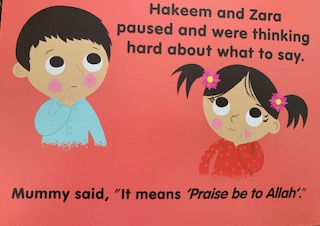
Zara and Hakeem, a brother and sister duo wake up to find their mother not feeling well, and instructions that they will have to help Daddy, Grandad and Grandma with the daily chores.  Then Mummy sneezes and says, Alhumdulillah.

img_2687

It seems the books  all have a pattern, something happens that sets the stage, then Hakeem and Zara pause and think hard about what to say, there is then an English translation/explanation about the meaning and then a universal, Muslims from all around the world say or do this, before the story resumes.

I don’t mind the break in the story, but the phrasing is a bit cumbersome and slightly off in this book.  Why are the kids thinking hard about what to say, when Mummy had just said it? If they were thinking hard about what she had said or where confused why she said it, I feel like it would make more sense. 

img_2688

I really like that the book shows that all Muslims say something the same, it is a good time to start to show this age bracket that they are connected to something bigger, without overwhelming them.  

The story continues with Hakeem helping daddy vacuum and Hakeem sneezing when some dust flies up.  Then Daddy and Zara mow the lawn when the grass makes Zara sneeze, everyone, Grandad, Grandma, all take a turn sneezing in different scenarios and everyone practicing to say Alhumdulillah.  

img_2690

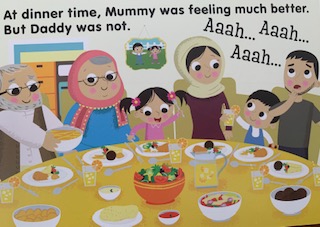
By dinner, Mummy is feeling better, but Daddy has a sneeze attack and takes to laying down as he is not feeling well, and tomorrow the kids will have to help Mummy with the chores.  A humorous full circle, that even toddlers will laugh at.

The kids I read the book to, loved the loud Atchoos and the cute illustrations, a few of the older four year olds, wanted to know why Yar Hamukumallah was not also said.  They also wanted to know why when the dad sneezed four times they only said Alhumdulillah three times.  I read a variety of books about being sick and we talked about using tissues and sneezing into our elbows, washing our hands, and not coming to school when we are sick.  The book was great to explore how mom was sick and dad must have caught her cold.  But that sneezing from pepper and cat hair, didn’t mean you were sick.  The kids also saw that everyone in the house has to help out, sick or not, old or young, male or female, which is always a great lesson to reinforce, Alhumdulillah.

img_2691

The book is 18 pages of text.  The illustrations show the mom and grandma in hijab, they are bright and colorful and engaging.  Children will enjoy getting carried away with the sneezes and the Alhumdulillahs when read aloud and will enjoy looking back at the pictures and details independently afterward.  This is a great story to put on repeat and then watch your own toddler retell the story on their own.

Overall, well worth the shipping! I hope US bookstores will stock the series as our little ones need books that are funny, clever, and well done.
img_2689

Furthermore by Tahereh Mafi

Standard
Furthermore by Tahereh Mafi

furthermore.jpg

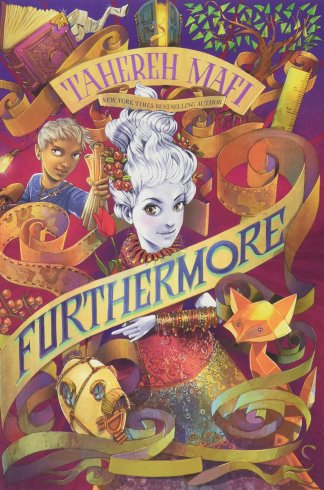
I put off reading this book (I read the companion, Whichwood, first) because I had heard that the audio book was great and I wanted to listen to it with my kids.  Read by Bronson Pinchot, Cousin Balki from Perfect Strangers, the audio book takes 8 hours to cover the 401 page book, and it is delightful.  While Mafi’s circular repetitive world building, takes some slowing down to get used to, listening to it made the story move along when a physical book may have been abandoned.  An AR 5.5 the book is clean, but not gripping until about two-thirds of the way through.  As the main character grows in maturity, the story gets better and better, a mix between Alice and Wonderland and A Wrinkle in Time.  The book will require some determination to get through, but the journey will be worth it in the end.

SYNOPSIS:

Alice Alexis Queensmeadow is missing her father who left 3 years ago with only a ruler in his pocket, and hasn’t been seen or heard from since.  Her life is a bit messy as she is being homeschooled by a mother who she doesn’t really think likes her and thus spends most of her days outside eating flowers and trying to avoid wearing clothes.  Alice lives in a world of magic and color, but Alice has no color, at least not externally, her magic, which she must learn to accept is to add and manipulate color to the world, to anything and everything, except herself.  As a 12-year-old she must surrender her magic and be given a task to prove her place in her world.  She thinks her best gift is dance and her surrender goes terribly wrong.  With no where to go after her humiliating performance, she decides to take Oliver Newbanks up on his offer to go with him to help him on his task, he is 13 years old, and find her father.  Their unlikely assistance to one another is fraught with mistrust and bickering as they journey to a world Alice didn’t even know existed, Furthermore.

In the land of Furthermore, magic is used very differently then in Ferenwood, and on their journey where up is down and paper foxes rip limbs off, and Time is actually a person.  The two companions will have to learn to be honest with one another as well as themselves in order to survive, let alone to find Alice’s dad.  With the threat of death and being eaten constantly plaguing them, they journey from village to village where the rules are different and the laws of logic ever changing, with the hopes of completing the task and reuniting a family.

WHY I LIKE IT:

The details in the story are luscious and beautiful, and once you fall into it, you really do want to stay and look around a while.  There were times when listening to it, that the kids would get bored, yet now that we have finished it, all have mentioned that maybe we should get the book so they can reread parts again.  Mafi’s writing style is very thick that you don’t feel like you are making any progress, yet when you start to digest what you know, you realize in fact you have.  

At the beginning Alice is very annoying, and she stays that way for a while.  Her whiney nature isn’t sympathy evoking, but rather gets you irritated with Oliver as well, that he doesn’t just tell her stuff.  Both combined need to be bopped on the head.  Seriously, a bit of communication would really have taken out a lot of the unnecessary frustration the readers feel for the characters, and let the personal stuff they were hesitant to share with each other have more value.  It is a middle grades book, the empathy of understanding Alice and Oliver’s own fears and reticent in opening themselves up is a great lesson to explore through fictional characters, but because the kids have such poor communication skills about anything, their own fears lose potency.  The pacing of the story, is just as random as the villages they pass through as well, while they always seem in a rush, some of the places they stop they could chat at, rather than while they are running to save their lives, or while they are walking they could talk to give description through their eyes, to build up the characters, not just the world they are in.

Like in Whichwood, the narrator talks to the reader which is fun, and provides information that otherwise couldn’t be shared.  The characters names in each of the villages are clever and while the story could be mapped pretty straightforward, girl journeys to a new world to find her father with the help of a boy, who will become her friend, the twists and details, make the book memorable and worth the strain to get to the climax. 

I know this review sounds back and forth, and I think a lot of it stems from what you expect from the story before you begin.  I had tried to read the book and got a little discouraged, but I had a good feeling the audio book wouldn’t disappoint, so I plugged through and found myself enjoying and loving the story.  If you are expecting an action packed fully fleshed out rational story, you will be let down.  If you can just enjoy the whimsy on the surface and let the little tidbits of the larger story come at different times to complete the larger puzzle, you will love Alice and Oliver’s magical world and the fantastic journey that they go on.

FLAGS:

The book is clean.  A bit disturbing is that the people of Furthermore want to eat Alice and Oliver to absorb their magic.  It isn’t vulger, but it is silly that Alice doesn’t like wearing clothes.  While one could be nervous that Alice and Oliver develop a romantic relationship, rest assured they do not, they become friends and are 13 and 12 years old, so phew.

TOOLS FOR LEADING THE DISCUSSION:

I can see me doing this as a book club selection, although I’d probably lean more to Whichwood, in an Islamic School environment because of the names. I think young Either one though, I’m positive Muslim kids will enjoy seeing a hijab wearing Muslimah pictured on the back flap and seeing that she can write a mainstream engaging fantasy novel about whatever she likes.

Author’s website: http://www.taherehbooks.com/book/furthermore/

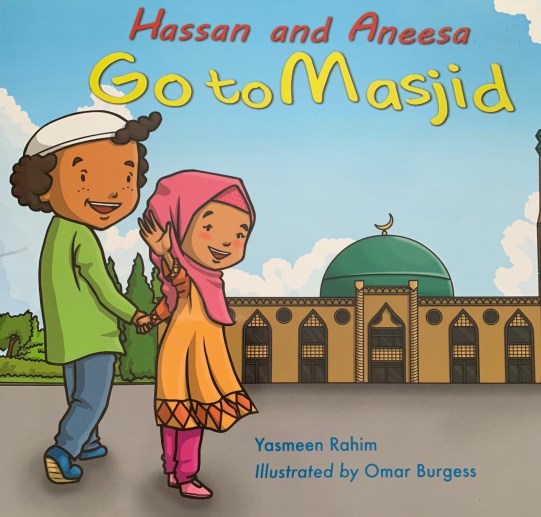
Hassan and Aneesa Go to Masjid by Yasmeen Rahim illustrated by Omar Burgess

Standard
Hassan and Aneesa Go to Masjid by Yasmeen Rahim illustrated by Omar Burgess

IMG_1911

I don’t often do two books in the same series, let alone three, but for as much as I enjoyed Hassan and Aneesa Love Ramadan and Hassan and Aneesa Celebrate Eid, I was a little disappointed in this story.  For starters, the title seems like it should read, Go to “the” Masjid, no? 

IMG_1912

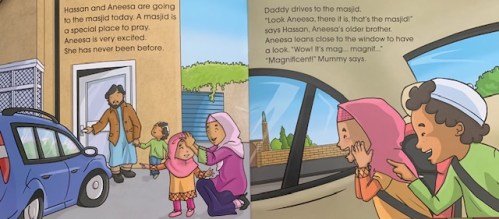
The story starts off with the notion that this is Aneesa’a first time to the masjid, which seems bit off.  Presumably mom and Hassan have been before, but mom’s excitement, and Hassan’s questions through the book, and knowledge about masjid etiquette make you wonder if it is their first time too.  A little odd, if you’ve read their other books, but ok, I’ll accept it and move on.

The family starts by marveling at the exterior architecture.  They enter and separate, Hassan going with his dad and Aneesa going with her mom, as it points out that men and women pray in separate areas.  It is a good tidbit of information, but again, it just seems a bit off in the way it is phrased that Aneesa wouldn’t know this.  

IMG_1913

The tone of the book is almost negative, again, a striking contrast to the other stories.  Aneesa splashes and wastes water when making wudu, doesn’t she make wudu at home? And the mom gets her clothes ruined in the process making her upset.  The illustration shows her to look really mad!

I would think a little context about not wasting water or even sharing the hadith about not wasting even if making wudu in a river, would have been a great lesson to convey, but instead the pictures show a lot of water by others also being wasted, and only mom looking really frustrated.

IMG_1914

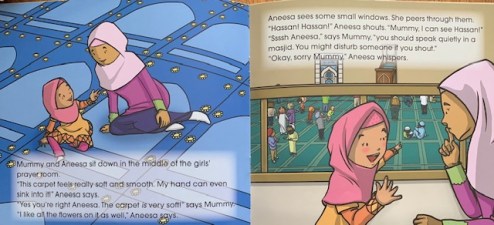
The two of them, put their shoes up and marvel at the dome and the soft carpet.  Aneesa then sees that the ladies prayer area over looks the mens and she begins screaming for Hassan.  Her mom corrects her and points out that “you should speak quietly in a masjid.  You might disturb someone if you shout.”

IMG_1915

Hassan turns and waves, and then rushes off to see a school friend.  But, first he is reproached for nearly walking in front of someone praying.  Again a good tidbit, but the phrasing of how the information is shared is rather negative, and these repetitive reprimands don’t make the book joyful.

IMG_1916

Hassan then learns about he mihrab and the mimbar before the athan is called and they all pray.  After salat they put some sadaqa in a box and the family heads home.

The illustrations are as sweet as ever, and the price very reasonable, but this book, compared to others in the series, is really wordy and there is a lot of text on EVERY one of the 20 pages.

IMG_1917

The framing of the book is awkward, thus making some of the behavior issues come off as negative, it is a minor thing that keeps the book from being great.  If the premise would have been maybe the kids talking about their favorite things about the masjid and reminding themselves to talk quiet and not waste water, the tone overall would have been lighter while still being really informative.

IMG_1918

If this is your first Hassan and Aneesa book, you might not be bothered, but if you find it a little off putting, try the other two.  The books says for ages 2 and up, but I think it would be better for 4 and up.  The younger kids you could tell them the story while showing them the pictures: what to expect at the mosque and how to behave, but there are too many words, and they will probably have a hard time staying focused.  Older four and five year olds, will enjoy seeing things they recognize and maybe learning some of the vocabulary for the architecture and being reminded on proper behavior at the masjid.


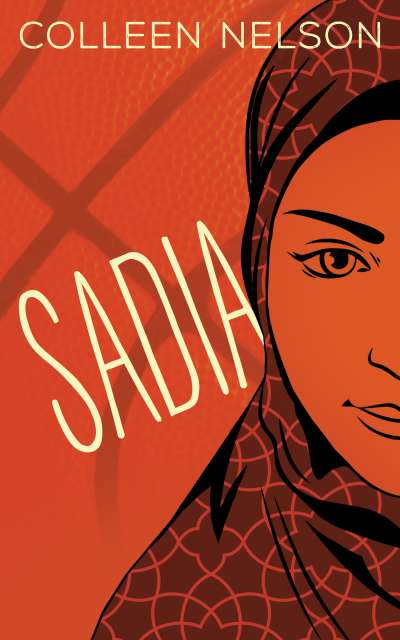
Sadia by Colleen Nelson

Standard
Sadia by Colleen Nelson

sadia.jpg

A middle school sports book with a female lead who wears hijab written by a non muslim.  The book could really go a lot of ways, I held my breath for all 239 pages waiting for something to go totally awry, and thankfully it never did.  In fact I read the book nearly straight through and while meant for ages 12 to 15, I quite enjoyed it.

SYNOPSIS:

Ninth Grader Sadia Ahmadi is an immigrant from Syria, her family left before things got “bad,” and while she has adjusted to life in Canada, High School is testing her in other ways.  Her best friend Mariam, an immigrant from Egypt, has started dejabbing, taking off her hijab to fit in it seems any chance she gets.  This is taken as a betrayal by Sadia and their friendship waxes and wanes throughout the book as each girl has to figure out who she is in relationship to hijab, and how to judge and/or accept each other and their choices.  Throw in a new refugee girl Amira from Syria who doesn’t speak English, a co-ed basketball tournament that doesn’t allow any headgear to be worn during games, a cute boy on the team and an awesome teacher with interesting assignments and you have the book in a nutshell.

WHY I LIKE IT:

I like Sadia, she is believable and strong.  She is well liked, athletic, she has a good relationship with her parents, brother and teachers, she prays and fasts and owns who she is, but she isn’t perfect.  She is hypocritical at times, and acknowledges it, she is tempted by parties, and boys and taking off her own hijab to play ball, and has to confront it about herself.  She doesn’t do things like pray on time, like she knows she should, but there she is and I am so impressed that the author picked up on so many nuances of Muslim life in her research or in her own observations as a teacher.  Yes, Amira has an awkward observation about Miriam being Muslim and not wearing hijab that seems really one dimensional considering large numbers of Muslims in Egypt and Syria don’t cover, but I don’t know if that was the author’s attempt to draw the issue to the light or if it was just a misstep.  

I like that there is a cute boy that accepts Sadia and who she likes as well, but they don’t do anything.  So often, these books become overrun by the romance story line and this one doesn’t, thankfully.  It seems to find a realistic balance, that she has feelings, but isn’t going to act on them, and based on her mom figuring out when she is lying that she won’t try and sneak behind her mom’s back.

Issues of halal food are mentioned in passing and it fleshes out that the girl is Muslim, not just going through the motions.  At times it is hard to know if her choices are based on belief and faith or expectation, but for an early YA/Middle School book, I think it suffices.  She mentions modesty as a reason for hijab, but also a lot of parental and cultural expectation.  One central theme the reader just has to go with, is that Sadia and the rest of the characters in the book, and there are a fair amount of Muslims, don’t know about any other ways to wear hijab for sports.  I get that Mariam and her sewing ability is a huge arc in the story, but they have smart phones, and its a contemporary piece, they have to know about Ibtihaj Muhammad in the Olympics, Bilqis Abdul-Qaadir, and Nike making athletic hijabs.  So, to make the story work you do have to turn a blind eye to the fact Muslima’s have taken to sports in the mainstream and that there is no way they can all be that clueless about her fabric, style, and covering options.

I love that the issue of refugees is addressed in the periphery, and the issues are given a human face.   I love that Sadia’s parents are religious, but not left as simple stereotypes, they deal with Islamaphobia, but aren’t looking for sympathy.

There is always the case, that the hijab becomes a stereotyped item as the story involves characters torn to wear it or not, but I loved how judgements were called in to questions and there wasn’t an easy answer.  The side friends in the story are all way too good to be true, but I think the whole book has a bit of a pollyanna feel to it, and in this case it was ok to error on the side of kindness than become overtly sensationalized and whiney.

The biggest hurdle this book faces is, is it the author’s story to tell. And I don’t know, I review a lot of books, and many are by Muslims and they get stuff wrong in my opinion, or they go so extreme to be accepted.  So, I don’t know, I think the book had heart, I didn’t know if the tournament would let Sadia play, I didn’t know if she would sneak off to the party, I didn’t know if she would cross the line with Josh, and I was curious, and invested and sucked in to it all.  Is it a book to teach others about Muslims or a book for Muslims to see themselves? I think all of the above.  Muslim’s should control their own narrative, but I think when author’s get so much right, we have to take some reassurance in the idea that we are being accepted by the larger society, and our stories are being told with love by other’s too.

FLAGS:

There is romance and lying, but no kissing, just hints at emotions or an errant arm flung over a shoulder during a huddle or photo.  There is mention of drinking at the parties, but Sadia doesn’t end up attending.

TOOLS FOR LEADING THE DISCUSSION:

I don’t know that I would do this as a book club selection, but if I met the right group of kids, I would definitely reconsider.  There is a lot of basketball, which I quite enjoyed, but I could see other’s maybe getting bored by the play-by-play.  I’ll make my daughter read it in a few years, and I look forward to discussing hijab and how she feels about it after.  It does raise the subject, and ask you to check your judgements on yourself and on others.

Author’s Website: http://www.colleennelsonauthor.com/


Miss Never Pleased by Ayesha Marfani illustrated by Aisha Aamir

Standard
Miss Never Pleased by Ayesha Marfani illustrated by Aisha Aamir

IMG_1860 (1)

I’ve been accused of being brutal in my reviews.  And while I don’t enjoy being mean, I do take some pride in the attribute, as I am paying for these books myself (unless I get them at the library) and it takes time out of my day to write these reviews.  I don’t get paid, I do it because I love books, I like supporting Muslim authors and those including Muslim characters in their stories.  I take recommending books to others serious, and can’t remember things if I don’t write them down, so here I am.  With this review I don’t want to be rude, or overly critical nor do I want to sound pompous and arrogant and privileged, but at the same time, I ordered the book off of Amazon for $7.99 so a fair review shouldn’t hold punches to spare what the author is trying to do and appreciating that she is writing for a cultural audience. 

Please believe me it isn’t personal, I am reviewing it based on my same criteria I review all the books through, my own personal bias.  That being said, if the reader is living in Pakistan, or has recently lived in Pakistan and English is a second or fifth language the 70 page story with games and activities at the end is decent.  Meant for ages 7-12 in that situation, that are intrigued by the moral lesson presented, I think the plot holes can be forgiven.  For those without ties to Pakistan, or with loose ties like me (I’m half Pakistani and grew up spending my summers visiting family) the book will be choppy, culturally specific, confusing and lacking.

SYNOPSIS:

The book opens with Habiba being distraught over her world crashing down on her and the pain she has caused her relatives consuming her.  She then opens her diary that she has kept for six years, starting back when she was seven recounting how she as Miss Perfect justified her self in incident after incident.  Thirty-one incidents to be exact, detailing how she would rat out her cousins, or critique elders food, or her tell her friends how to dress and what to study because it was the honest thing to do.   How she would decide who should be friends with who, if her family should go on picnics and how she didn’t want gifts but didn’t want to not get gifts either.  All-in-all Habiba is a self righteous awful, awful girl, I don’t think it is her trying to be perfect, I think she is just awful.  At the beginning she attributes it to praise she received as a child from her mom and grandma, but for this behavior to have gone on for so many years, I don’t think it was their praise, it was their lack of discipline that leads up to her catastrophic moment.  She fails her exams and then learns what her family really thinks about her in a poem, with a way too forced rhyme scheme, left lying around.  The story then returns to her undoing and a faqeer coming to cure her and her parents taking the blame for her poor upbringing.  She crosses out the title on her journal from Miss Perfect to Miss Never Pleased, to presumably denote how nothing could satisfy her.  The story then skips forward to her returning after University as the best international psychologist.  

WHY I LIKE IT:

I love the concept of the book, that a girl thinking she was so perfect could realize in fact she is not.  The idea is great.  I think it is a bit sad that her parents and involved extended family took so little interest in correcting her behavior, but at the same time I didn’t think it believable that she was absolved of all responsibility either. 

I feel like this book was a great first draft.  It needs some fleshing out, and some continuity corrections.  Incident #3 makes no sense, it starts with a party, then her ruining the mood of everyone at the party, and then her crushing her cousin’s dream of being in a play for her own twisted reasons.  But the jump from one idea to another seems like something got edited out and the rest of the four-and-a-half-page story didn’t get altered to reflect the missing details.  I have no idea what the party was for, what a wish gift is, and why anyone in their right mind would take a child’s opinion regarding someone else’s life so strongly. 

There are also contradictions, for example on page 14 she makes a big huff about her cousin wanting to study to be a teacher saying she wouldn’t be good at it, then on page 49 saying she would be marvelous, and this is before her climactic change of heart.  There are some awkward passages as well, that I had to read a few times, which could have been do to a different style of English, but sometimes I think it was confusing on its own.  Page 24 was all over the place with her not wanting to thank people for giving her a gift because she deserved the gift, but then telling them she appreciated it, along with her saying the gift, a dress, appealed to her, but that they should not have gotten it because it was an inferior quality.  Inferior to what we don’t know. So she didn’t say thank you, but said she appreciated it, isn’t that the same thing?  She didn’t like the dress, but it had appealed to her? Very confusing and just one example.

I say it is for Pakistani’s because I don’t know that anyone outside the subcontinent would know what a faqeer is, yes there is a glossary at the back, but it seems assumed in the story as a religious practice, which I find some issue with.  When Habiba was trying to dress everyone she says that a fishtail would look nice on her cousins and she gets a blue one.  I have no idea what a fishtail is.  It is not really explained, an illustration would have been helpful, but is not provided. She also once refers to her cousin as “dark” in a negative connotation, and that seemed very out of place and inappropriate to me.  And ultimately, if you don’t know the Pakistani school system I’m not sure you would understand how important the exam she failed is, nor why the scores are in the newspaper,  or that they have to pick their fields of study so early.  That being said, how did she get to University and do so well? If at 13 they had to choose their college and she didn’t pass wouldn’t she not be allowed to continue? I am so confused. And then she comes back after University, but is already being written about in the papers as if she has had a long and successful career.

The book doesn’t tell how she makes things right with all those she wronged either, after so many incidents, I think a little self reflection and humbling should have occurred to those that felt her wrath for so many years.  There isn’t really even a solution, her dad comes and talks to her, she reads what people think about her and then boom, happily ever after.

The illustrations are sporadic, but not consistent in the book.  The style seems to be different in each sketch.


FLAGS:

The girl lies and is incredibly mean but there isn’t anything inappropriate in terms of language or violence.  Islam is mentioned at the end when she thanks Allah swt for His help.

TOOLS FOR LEADING THE DISCUSSION:

I wouldn’t do this as a book club because it is so short, and I don’t know that kids would be compelled to read past the first few pages if it was in a classroom library.  

Book Video https://www.youtube.com/watch?v=QWoCiEnvg5U

If this book would have been written 20 years ago or so, I think readers everywhere would have given it a try as there was so little to choose from in Islamic Fiction, but there are options now, and much better ones.  I feel awful that I didn’t love the book, but I can’t suggest it either.  I plan to read one more book of the author’s to see if this one just didn’t work for me, and I’ll let you know what I think.

Burcu: No One Wants to Play with Me! by Nursen Sirin illustrated by Nese Inan

Standard
Burcu: No One Wants to Play with Me! by Nursen Sirin illustrated by Nese Inan

IMG_2348

This 32 page, 9×12 story book, for ages five and up, focuses on character education and is meant to be a relatable story with clear lessons about how to behave and deal with situations in life.  The opening page bullets all the lessons readers should learn from the story and the end of the book offers directions to make a balloon craft.  

IMG_2354

I don’t mind books with lessons and morals so clearly delineated, and I like that the morals come from such an adorable character with a whole cast of supporters, and a number of books to her series.  

IMG_2353

My problem is more the story itself, for a lesson on how to make new friends, and dealing with the universal struggle of moving and feeling like ‘no one wants to play with me.”  The book spends nearly seven pages on Burcu making a surprise breakfast for her family before hearing the news that she is moving because the landlord says they should.

IMG_2352

They pack and move seemingly the same day, and then the point of the book gets going.  Burcu has to say goodbye to her friends and doesn’t feel like even going out at the new house to make new ones.

IMG_2351

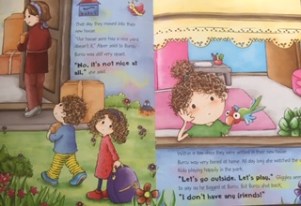
Her brother, Alper, has no problem making new friends, and finally Burcu gives it a try.  Only a little girl attempts to get to know her and Burcu dismisses her because she is so young.  She tries to be included with the other children, but they don’t know her and aren’t willing to let her play.

IMG_2350

Burcu finally confides in her dad, that she can’t get anyone except the little girl to play with her.  Her dad encourages her to give the little girl a chance.  Burcu does and finds out they are the same age, she just looks really young, and then all the kids are friends and happy.

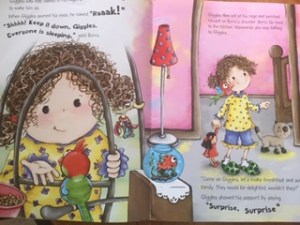
IMG_2349

The real hero to me is the little girl, Katherine, who didn’t give up on an ageist Burcu that didn’t want to play with her.  Seems odd that Burcu wanted a friend, and then was arrogant to complain about the one she got.  Plus, I would imagine kids who have moved and don’t have friends, would turn to a book like this for tips and hints, and ways to feel less alone.  The book offers none of that.  It doesn’t tell how finally Burcu makes friends, or gets included, other than it took time.  Which is great, but not exactly helpful if you are five and crying everyday because no one will play with you.

The writing is very dry.  I think it has been translated from Turkish, many of the sentences are passive voice, and the sentences choppy.  The book doesn’t have any glaring errors, it just seems like it would work as a story time, or as part of a lesson, and  maybe once as a bedtime story, but not a book that kids will clamor to hear over and over again.

IMG_2355

There is nothing Islamic in the story, but most of the major online Islamic bookshops carry the Burcu series, so I would imagine the authors, and publishers are Muslim.

Overall, the book sets off to teach a great lesson, but falls a bit short.  The illustrations are adorable and the large size and playful font are very well done, the diction, not so much.  The books are reasonably priced and if you see a title that works for a lesson, or theme you are discussing, I think you can make the books work.  If you are looking for a book to read over and over to your kids, you might, however, be disappointed.