Category Archives: Non Fiction

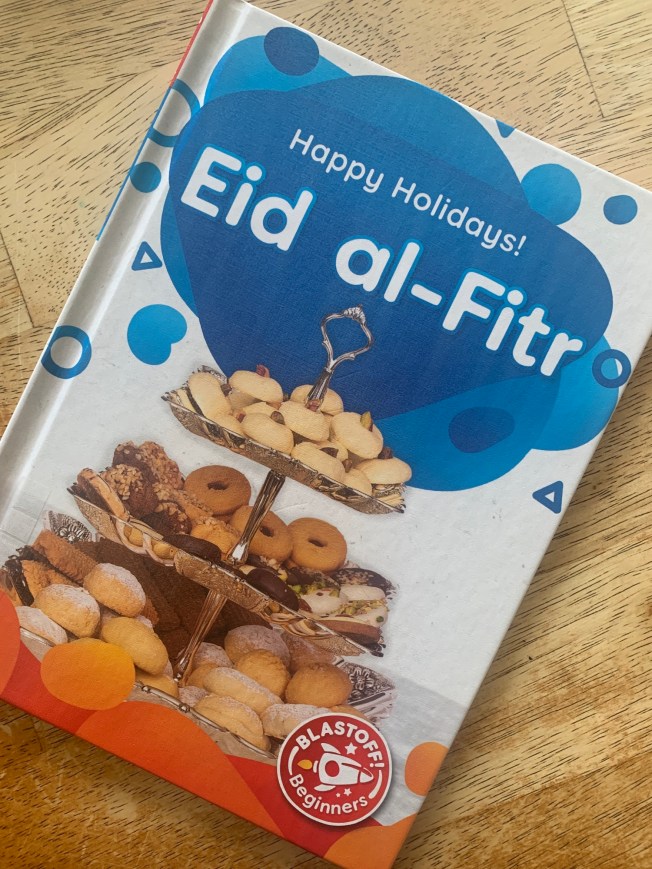
Happy Holidays! Eid al-Fitr by Rebecca Sabelko

Standard
Happy Holidays! Eid al-Fitr by Rebecca Sabelko

img_3127-1

This 24 page 2023 published non fiction book about Eid, is meant for babies to seven year old according to the publisher.  A large spread of comprehension abilities that is thus required to be vague, simplistic, and at times not very successful at conveying much of anything. The large font and bright colors are engaging, and it starts out strong with sight words, and identifying Ramadan is a Muslim holiday followed by Eid al-Fitr, but then erroneously states Eid is three days.  There is then unnecessary statements such as “They honor their beliefs.” That have no clear meaning, and in fact feel a bit othering.  It seems the book is scared to say “Muslims,” saying it only once, it prefers “they,” and “people.”  Some pages are clear and accurate, but many are just awkward, such as “Happy Eid! People pray each morning.  They go to a mosque.”  It seems so stilted.  The picture glossary at the end is mostly accurate, but it defines Muslim as “related to the Islamic faith.” Overall, it seems like a little editing would clarify, correct, and even make this book a benefit, but as it is it just feels like token rep to add to a holiday library series.

The book starts with a table of contents and divides a very short book into chapters.  The first three pages tell that Ramadan is fasting, Eid is after Ramadan, and a Muslim holiday.  It erroneously says Eid is three days, and then says “the dates move each year.”  If you are aware of the lunar calendar this makes sense, I’m sure a five year old would not understand that it isn’t just a randomly selected day.

img_3129-1

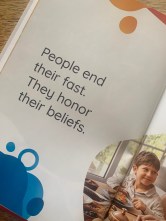
Pages 10 and 11 seem vague at best, “People end their fast.  They honor their beliefs.” The previous page was taking about Eid, the following spread is about Eid, it is almost like the pages were plucked from a similar Ramadan book and erroneously dropped in to this one.

We then are at the mosque, and told people pray each morning.  I’m not sure if this is on Eid day, or every day, we do pray five times a day, and while it is good to pray at the mosque it is not required, so ultimately another unclear page.

img_3131-1

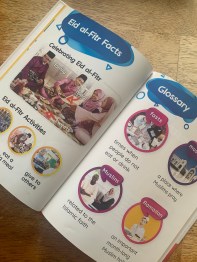
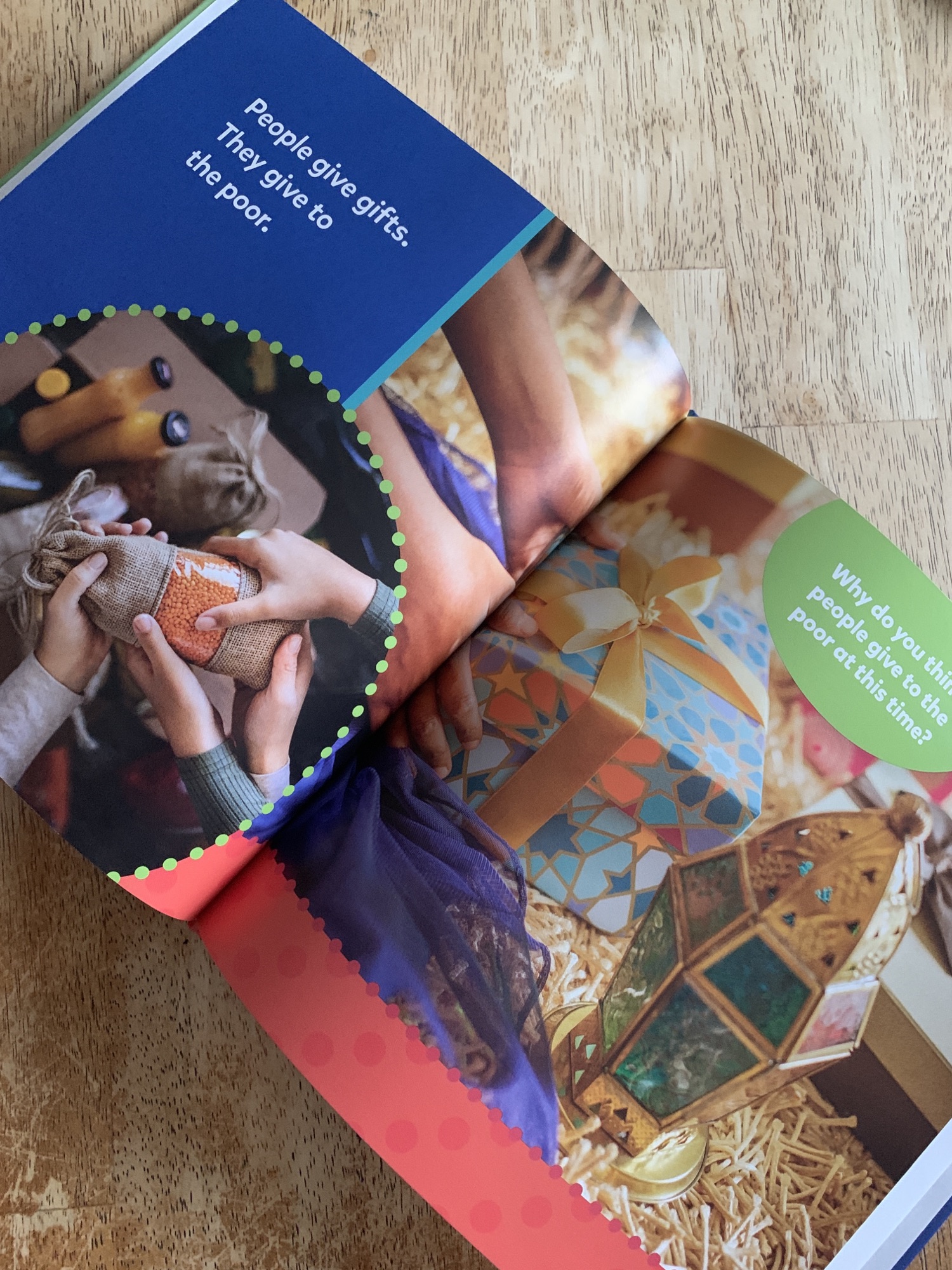
The remaining Eid tradition pages are accurate, visit family and friends and say Eid Mubarak, eating big meals and sweets, giving to others in need, and giving gifts and money.  The photographs show joy, and are bright and engaging. The Facts and Glossary at the end are then followed by an index and ways to learn more.

Read for a Better World: Ramadan and Eid Al-Fitr: A First Look by Percy Leed

Standard
Read for a Better World: Ramadan and Eid Al-Fitr: A First Look by Percy Leed

img_3108-1

I honestly don’t know who this 24 page book is for and to what purpose it would be read.  It is non fiction, it is listed for 5-7 year olds.  But the sparse text feels toddler-ish, and it is so simplified, that it doesn’t teach, educate, or inform anyone about Muslims or Ramadan, it does an ok job at showing Eid though, for the age level, I will admit that.  I know I struggle with non-fiction, it is a me problem, and I know children can handle more than we credit them for, think dinosaur and construction vehicles, but if the person reading this book with the child knows nothing to add, this book really doesn’t give even the most well-meaning adult, guardian or second grade teacher, much of anything to work with. They would do better with a fiction book and Google.  Sigh. 

img_3109-1

The book starts out with an Educators Toolbox before beginning, it encourages guidance to ask what children think the book will be about, asks them what they already know, and what they would like to learn.  It then encourages sounding out words, looking at pictures for clues, and praising the child.

img_3113-1

The first page of text has the headline of Ramadan and Eid al-Fitr with the line, “Ramadan last for one month,” immediately below, already kind of confusing an early reader, why Eid was mentioned and then not discussed.  The next page says “Muslims have a holy book.  They read it at this time.” Yes, we do, but we read it at all other times, too. The sparse words give extra weight to the words chosen, and in this case, it makes an erroneous assertion.

img_3110-1

I wish it said Muslims pray five times a day instead of “People pray five times a day,” same with when it says that People fast.  It does get it correct that we fast from dawn to sunset, so I do appreciate that.

It then moves to Eid al Fitr and does a decent job highlighting that people dress up, pray together, give gifts and give to the poor, which is clear and accurate.  Again I wish it said Muslims dress up, pray together, etc. since the word Muslim is only mentioned once in the book, Islam not at all, I don’t know that the connection will be made. 

img_3111-1

The last page I don’t even know what it means, “Ramadan is for faith.  Eid al-Fitr is for giving thanks.” Faith and thanks are intrinsic to both Ramadan and Eid, so I can’t make sense of the statement.

img_3112-1

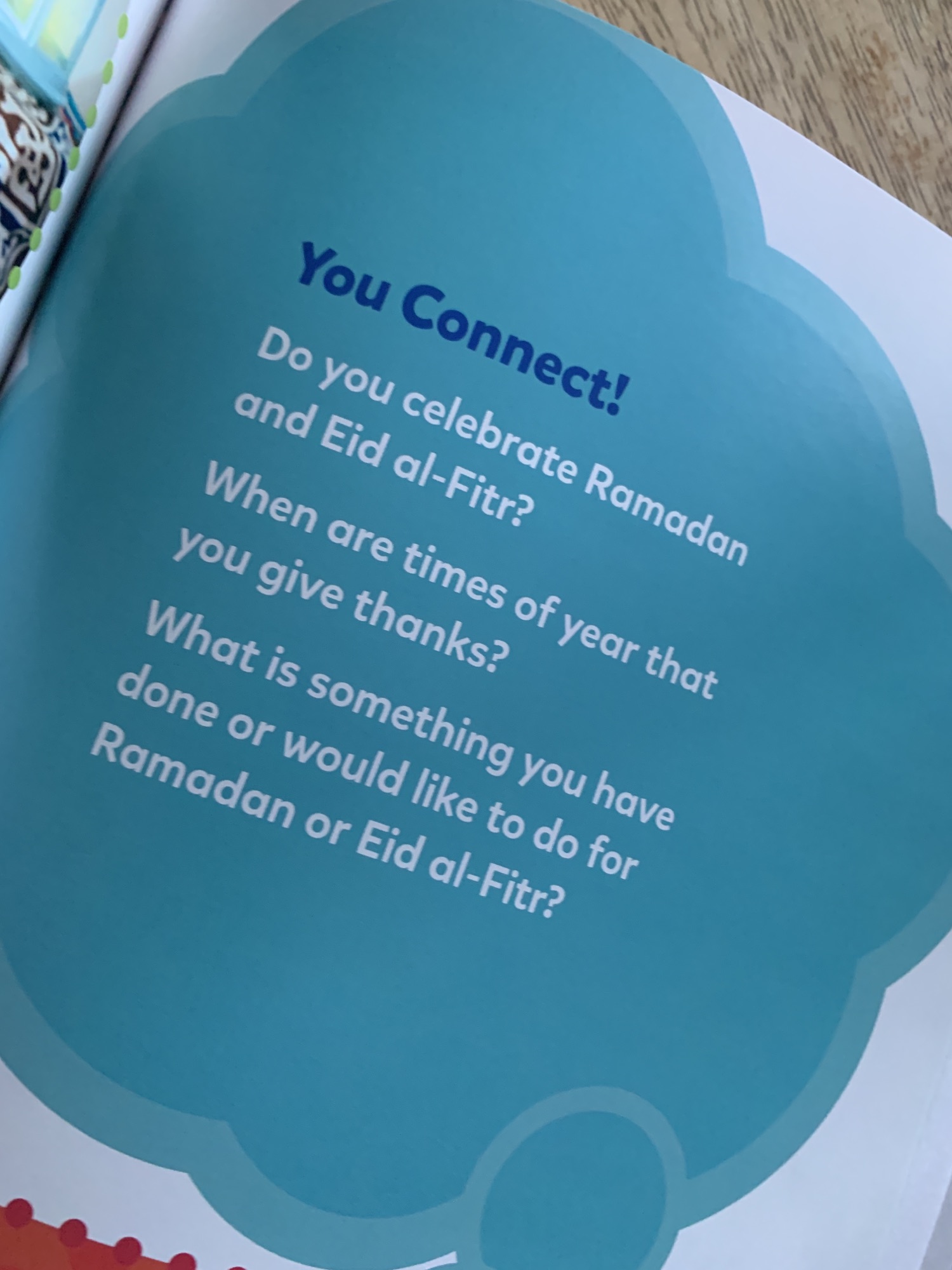
The book then has some connection questions, Social and Emotional Snapshot, Photo Glossary, and a Learn More section.  It seems like it is part of a series that ticks checkboxes for inclusion in well funded school and public libraries.  I don’t know where this book would be sought after, useful, or informative unfortunately.

The Ramadan Cookbook: 80 Delicious Recipes Perfect for Ramadan, Eid, and Celebrating throughout the Year by Anisa Karolia

Standard
The Ramadan Cookbook: 80 Delicious Recipes Perfect for Ramadan, Eid, and Celebrating throughout the Year by Anisa Karolia

img_3081-1

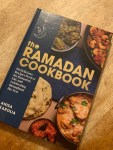
Another surprising library find, this 2023 published cookbook shares meals for all the time, but organizes them with Ramadan in mind.  Unlike many online recipe pages, there is not a lot of backstory about the culture behind the recipes, or how the author has made them her own, it really is pretty direct and to the point.  The author is Desi, and the bulk of the recipes Indian, but it isn’t all of them.  I found myself flipping through the pages hoping to be inspired, but sadly most of the recipes were fairly basic.  That isn’t too say they are not good, I have not tried them, but being of Pakistani decent and that I have been cooking multiple meals a day for too many years to count, I didn’t feel compelled to check the kitchen for ingredients.  I think a big part of it is, I need pictures of the food to spark interest, and not every page had images of the food.  I think the book is fun to look through, maybe remind you of something you tried once and enjoyed, or give you ideas of something you and your family might like to try.  I would say it is for beginner cooks, but without step-by-step directions, you have to have some basic skills, perhaps it is more a family friendly cook book as she makes comments of what her children like, or dishes them come together quickly and easily.

Clearly I am not a foodie, or a cookbook reviewer, I was just excited to see a Ramadan cookbook available at the library and wanted to share.  The author shares her thoughts on Ramadan, and interjects some thoughts on the section pages. Apparently she is a famous blogger, so if you follow the author and there is something I should try, please let me know.

A Little Golden Book: Ramadan: A Holy Month by Malik Amin illustrated by Debby Rahmalia

Standard
A Little Golden Book: Ramadan: A Holy Month by Malik Amin illustrated by Debby Rahmalia

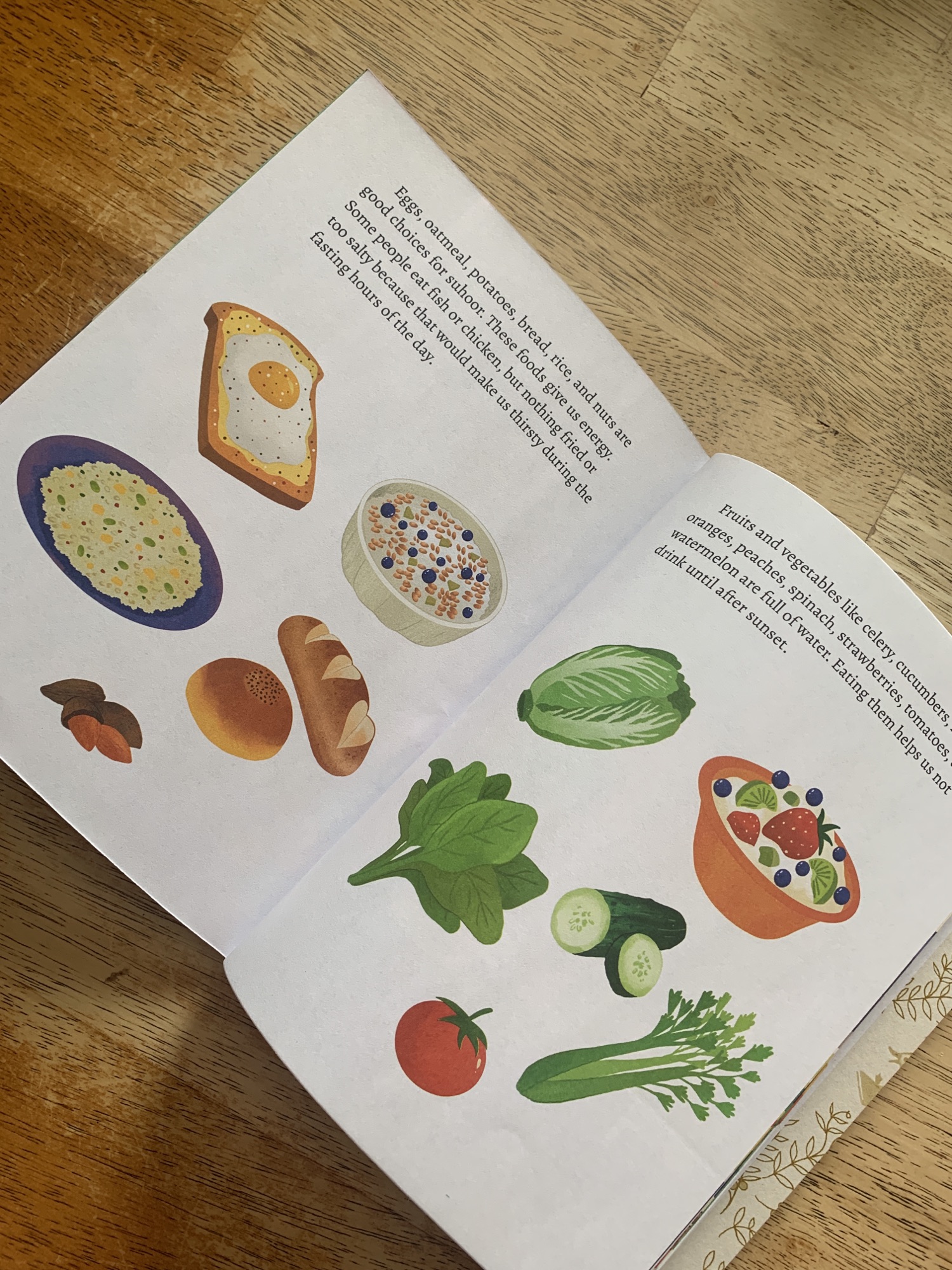
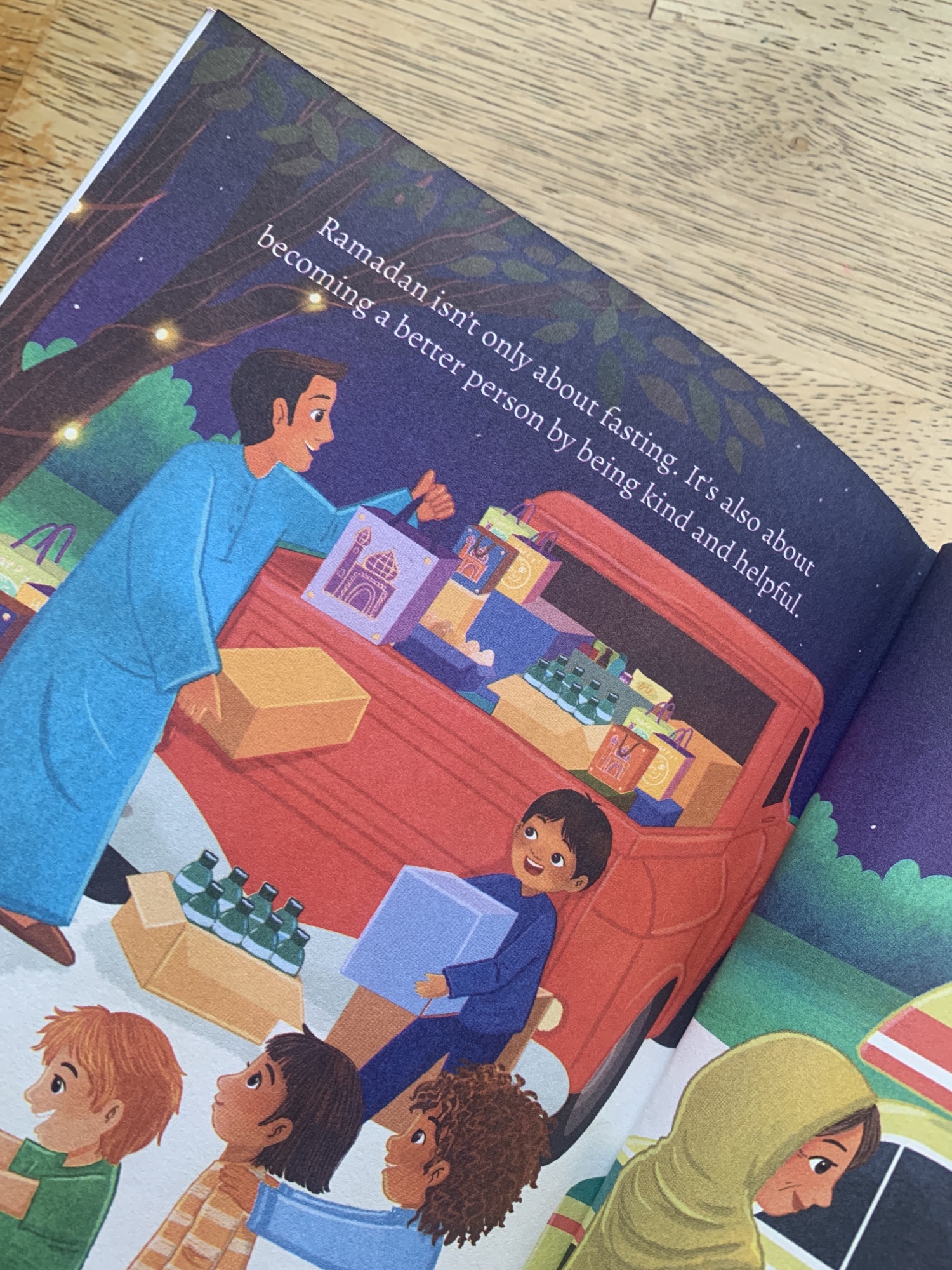
As a child I had a stack of Little Golden Books, my libraries always have a good part of a shelf with Little Golden Books, my own kids have a few dozen of them, but honestly I don’t know that I love any of them, aside from the Monster at the End of the Book.  They are a staple, they have spanned generations, but I always find them a bit abrupt, the text to small and dense, and the vocabulary a little too advanced. So, on the one hand I am thrilled that this timeless brand has a Ramadan title, but on the other hand, some of the food descriptions contain vocabulary a bit advanced for the recommended 2-5 year olds.  If you have been reading my 2024 Ramadan and Eid reviews, you will however be glad to know that this Ramadan book, does pack a lot of information into the pages, and when it asks why do Muslims fast? It says unequivocally “because it is written in the holy book called the Qur’an.” Suhoor is said to be before the sun even rises at one point, and then dawn at another, but then, however, it kind of equates dawn and sunrise, I’ll let it pass, cause it is a little vague with the equating, after saying when we eat clearly. My only real gripe are the food tangents, detailing not to eat fried and salty foods at suhoor, to they hyper specific “creamy curries, fresh soups, and rich stews. Fragrant rice dishes paired with grilled meat or kofta” at iftar.  Yeah it almost seems like the author wrote the book while fasting, with food heavily on his mind.   It does mention doing extra good deeds, more prayers, and it reads as an easy non fiction book.  It doesn’t try and interject the information into a fictionalized framing, it just tells about Ramadan.  It would be nice though, if it was sourced, but with the reasonable price point and accurate information, makes it a solid book to add to gifts and to share.
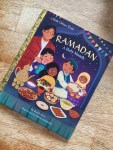
The story is told in the first person and opens with a family searching the sky for the moon. It then says in a single paragraph on a two page spread that “during Ramadan, Muslims eat and drink only when it is dark.”  It then asks why? Answering on the next spread with, “the Qur’an.”  It says that it is read in many different languages, which technically isn’t wrong, but I wish it would have said that it is written in Arabic. It continues to say that “the Qur’an tells us how to be Muslim.” To care for people, to pray. to fast, but that children and those that are sick aren’t required.

It then details foods to eat and foods to avoid for suhoor before returning to the more spiritual aspects and traditions of being kind and giving charity.  It explains Ramadan Mubarak and then finds its way back to foods, highlighting iftar drinks and foods.

Ramadan is a month, followed by Shawwal and then the celebration of Eid, making sure to note that on Eid we cook our favorite foods.

Overall, a lot of information clearly conveyed, with bright, fun, joyful illustrations.  The final page is a gloassary of words and phrases.  I purchased my copy here on Amazon.

Craft it Up This Ramadan and Eid by Zayneb Abdullatif photography by Sidoie Djunaedi

Standard
Craft it Up This Ramadan and Eid by Zayneb Abdullatif photography by Sidoie Djunaedi

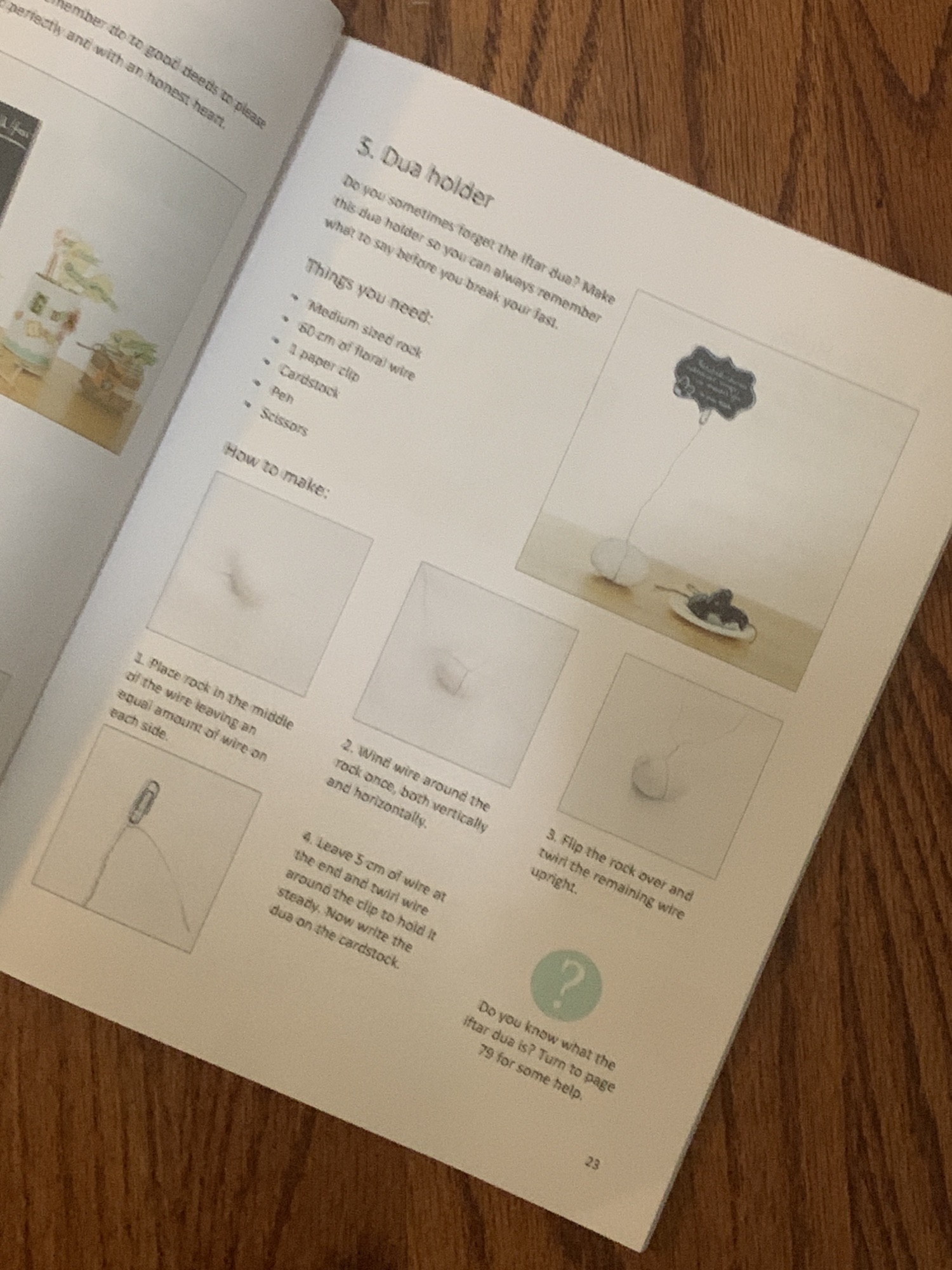
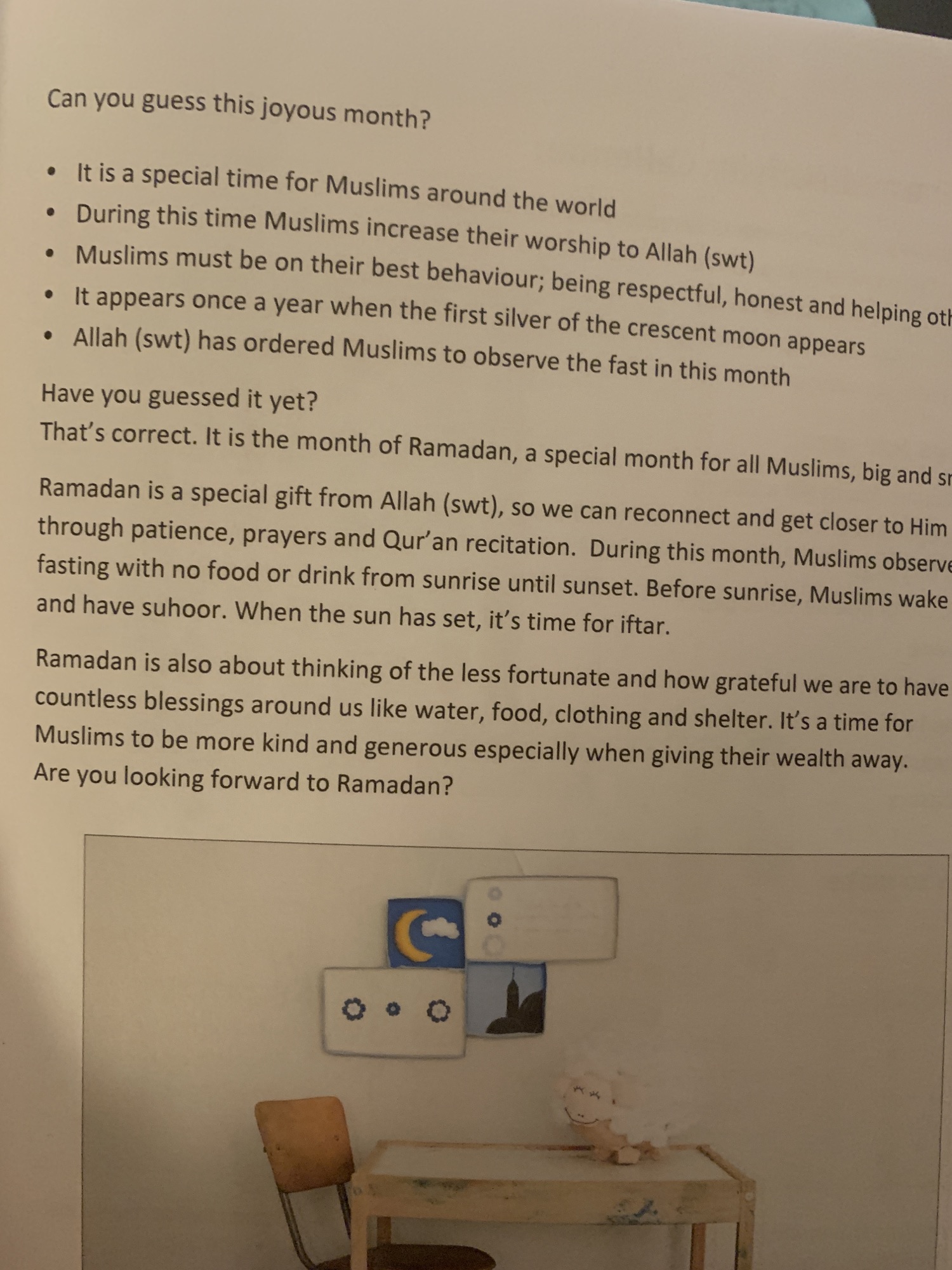
This book is not new, but I saw it at my library and thoroughly enjoyed looking through it.  I’ve hosted, helped, and attended numerous Ramadan craft fairs and story and craft times over the years, and I know everything can be found online.  Yet somehow this 79 page, 2015 published book was kind of fun to look at with my toddler.  It wasn’t overwhelming or super complicated, it was just a nice roundup of simple crafts that you could easily do with items around your home, while dropping little informative bits about Islam, Muslims, Ramadan, and Eid.  I doubt young parents today would even think to look in a library book for Ramadan craft ideas, it is a bit of an antiquated concept in todays day and age.  I highlight it today to remind us that so many have worked very hard to advance Muslim representation in books in all its forms, alhumdulillah, so that we can continue to see ourselves, make strides, and raise the bar.

The book starts with tips for parents and guardians, followed by the basics, crafts for the joyous month, crafts for Eid, a special festival, and concludes with templates, good deeds activity list, and a glossary.

It erroneously says we fast from sunrise to sunset, but does get right that we increase our worship and that fasting was ordered for us by Allah swt.  On the Eid section it discusses the takbirat and gives Eid al Adha a paragraph explanation as well.

A fun library find, that kept us off a screen and able to plan some little activities to do this Ramadan.

Eliyas Explians Ramadan by Zanib Mian illustrated by Daniel Hills

Standard
Eliyas Explians Ramadan by Zanib Mian illustrated by Daniel Hills

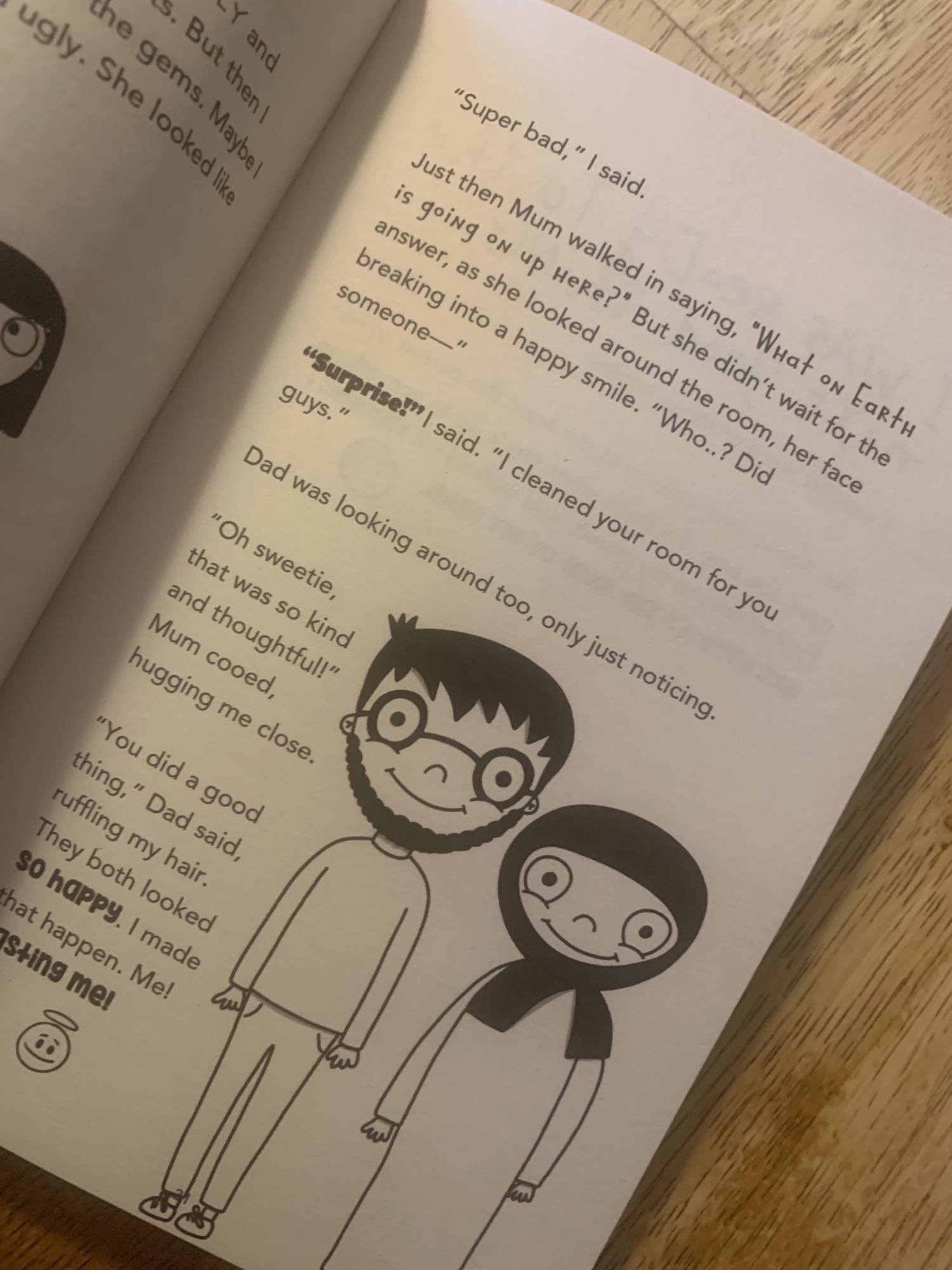
This is the fifth book in the Eliyas Explains series, and it really is what you would expect and hope, a book about Ramadan from Zanib Mian would be.  Eliyas’s voice is funny, relatable, engaging, and yet somehow manages to find a clear way to inform too.  The framing is fictional, but the book is meant to be lesson, moral, and information filled.  The voice did seem to break when Eliya’s didn’t know what “Ramadan Mubarak” meant, but it is clear that the book is meant to teach and remind middle grade kids about Ramadan from moon sighting to Eid, so I don’t think anyone other than an old reviewer would notice.  Parents might notice though that Eliyas loses his cool at one point and starts to presumably call his sister stupid, it stops at “st,” but then says he “started to cuss” which in America would be taken to mean a profanity much stronger than stupid, so just be aware, so you don’t panic if your child asks.  Overall the book is great, it is a solid 80 pages before the guided journaling begins and concludes at 115 pages.  The illustrations, changing font, and humor really make it perfect for the age group.  I gave it to my eight year old to read and I could hear him laughing, saying a few dua’as aloud, and he even came and asked me a few questions making sure he understood new information correctly.  This book would work as an independent read, a read aloud, or even an elementary reading assignment in an Islamic or weekend school.  The book is remarkable for the simple fact that it starts by naming the scholar that proofed the book, truly this is revolutionary, please can we normalize sourcing already.

The book is divided into chapters, with chapter one reintroducing Eliyas and his family to the reader. They are out on a bike ride and Eliya’s wants to know why everyone is so excited for Ramadan and giving up food and water.  Mom and dad explain taqwa and good deeds being multiplied and prayers being answered and big shaytans being locked up and Eliyas is excited (to put it mildly) to get closer to Allah swt and be a better version of himself.

Chapter two explains the moon, making intention, and waking up for suhoor.  With nine chapters before the journaling, the book discusses doing good deeds, fighting, forgiveness, shaytan being locked up, taraweeh, Laylatul Qader, and Eid.

The journaling guides readers through forgiveness, ibadah, goals, duas, kindness, feelings, connecting with Allah swt and more.  The beauty of this book is that it does pack a lot of information, but it shows a lot too, and gives kids a way to see Ramadan in action.

You can order your copy here at Crescent Moon store 

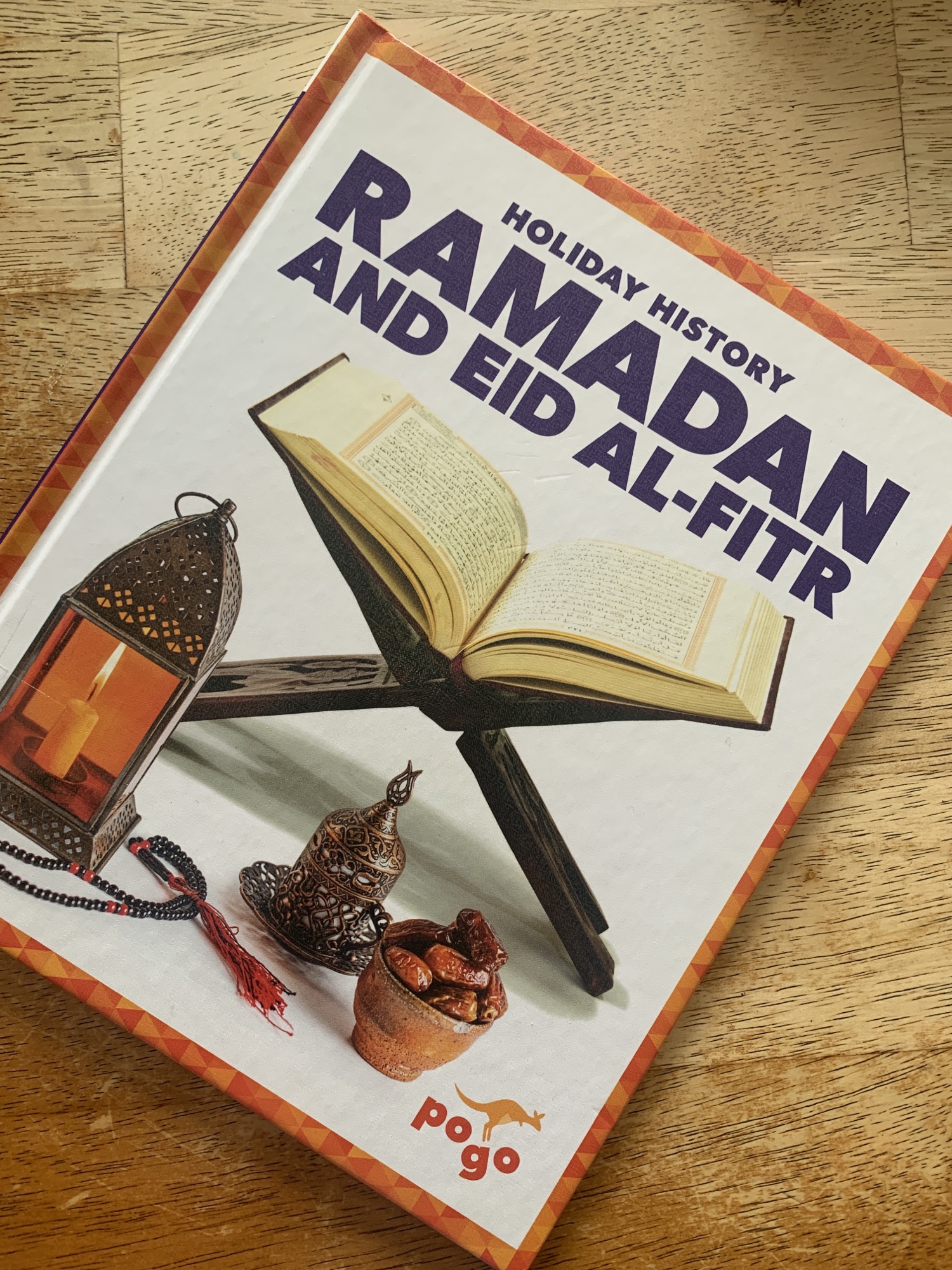
Holiday History Ramadan and Eid Al-Fitr by Marzieh A. Ali

Standard
Holiday History Ramadan and Eid Al-Fitr by Marzieh A. Ali

img_2952-1

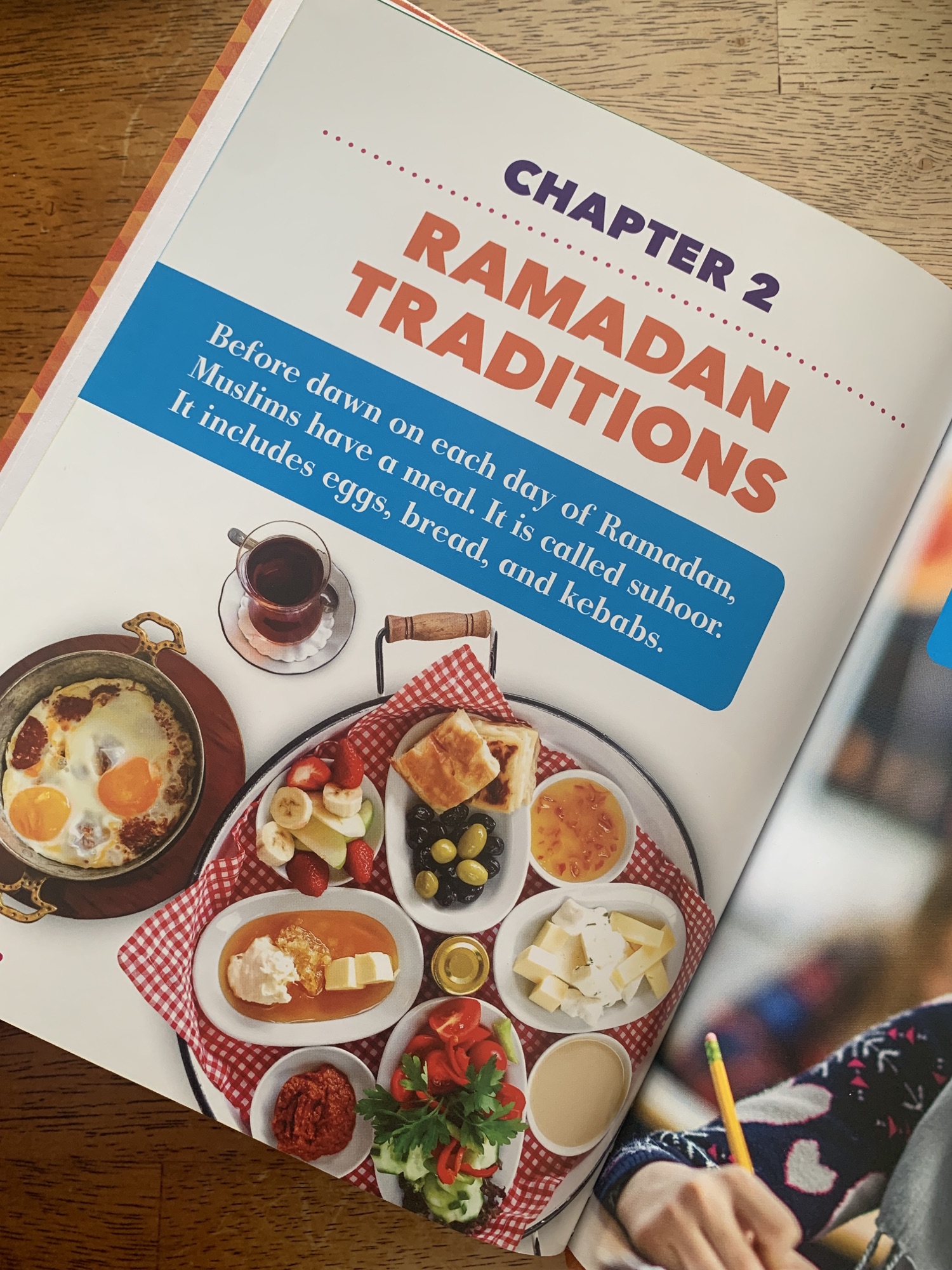
Traditionally published non fiction Ramadan and Eid books have more errors than they should.  I was hopeful with this one, the author is a Muslim and accomplished author, and it started out good, but then it hyper fixated on the foods eaten which can never be accurate.  Muslims are everywhere in the world, and no two people like the exact same foods anywhere, not even siblings  So why it would so clearly articulate, without qualifiers, what Muslims eat for suhoor or iftar is beyond me.  I do not eat eggs, bread, and kebabs for suhoor, we tend to enjoy brownie sundaes and pizza, and dates, broth, and fruit for iftar, sure makes me wonder if my nachos or pesto, rendered my fasts invalid?  Snark aside, it takes away from the quality information in the book that highlights that while fasting Muslim kids go to school and adults to work.  I also don’t like the suggestion that Ramadan is a time to reflect, pray, cook for others, and help those in need. It truly reads that this is when we do it, as if it is the only time we do it, and not that we do these acts all year, but do it MORE in Ramadan.  I know, I’m being picky, but these types of books are standards in public and school libraries, and in a world where Muslims are by-and-large having to prove their humanity, words have power, and need to be conveying that we pray five times a day, and more in Ramadan.  That we help those in need all year long, and more in Ramadan. The book is only 23 pages long, so when it spends so much space on these items worded in this way, it really becomes the takeaway message.

img_2953-1

The book starts pretty well, with clear precise sentences telling that “Islam is a religion practiced by Muslims” and that “they believe in one God” (note in the book God is not capitalized). It has that “Ramadan is the ninth month in the Islamic lunar calendar,” which I am ok with in non fiction books. And tells that “more that 1,400 years ago, the Prophet Muhammad received the first verses of the Quran” and that “they were sent by Allah through angel Gabriel.” 

img_2954-1

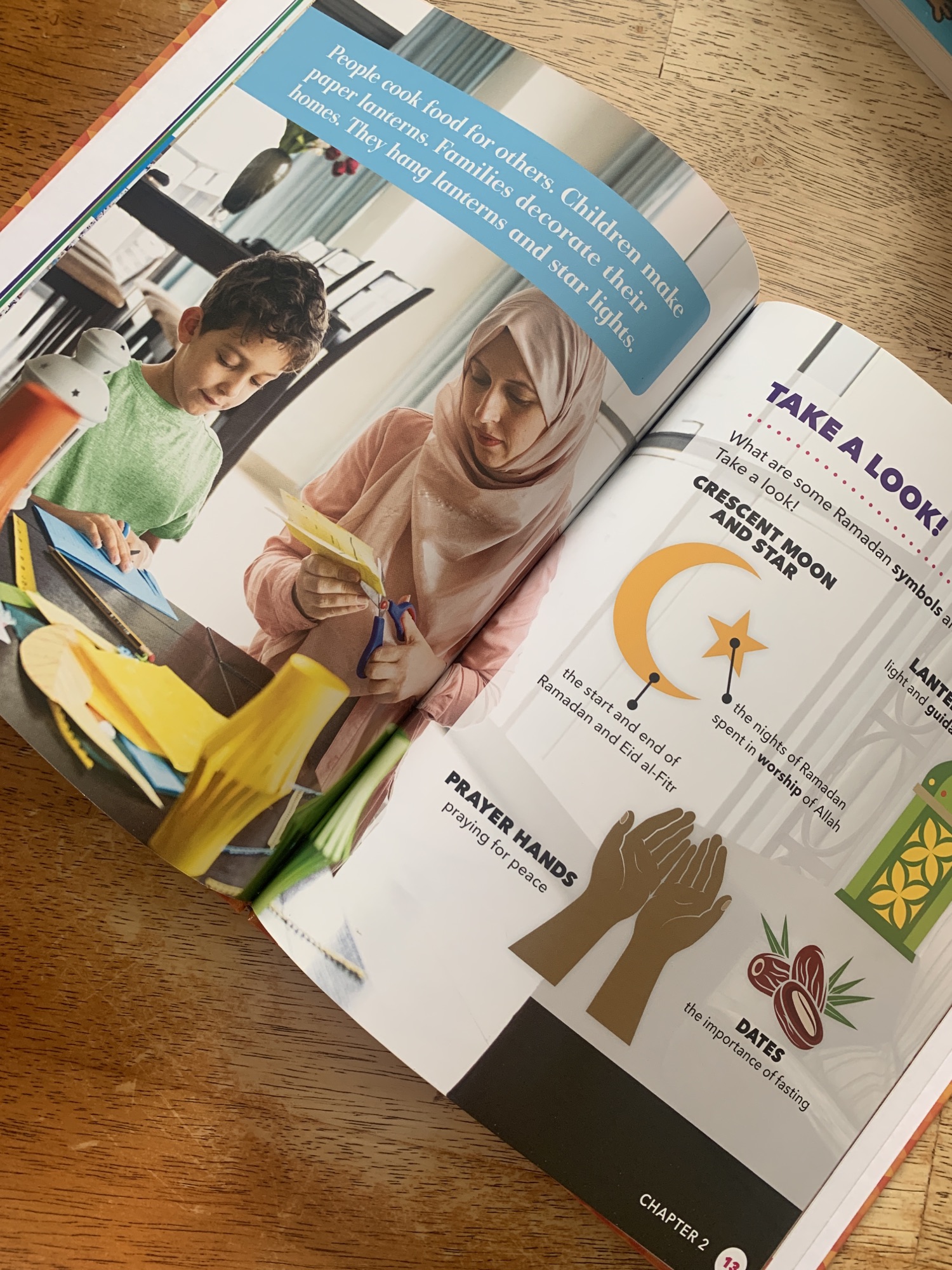
We then get two pages about specific foods, and told “Ramadan is a time to help.”  “It is also a time to pray and reflect.  People go to mosques.  They read the Quran.  They talk about Islam.” Stated just like that.  Making it seem that only in Ramadan are these things done. The unqualified statements make it seem that just as “They read the Quran” “Children make paper lanterns.” Apparently it isn’t optional, or a fun craft, it is just what is done.

I like that the five pillars are included, I wish it gave the terms of shahada, and sawm, and salat, and zakat and hajj, “journeying to Mecca” is a bit vague, and not at all sufficient.  I don’t know about they weight of the symbols either.  Dates show the “importance of fasting.” No they are the sunnah.  The star on the crescent symbolizes “the night of Ramadan spent in worship.” I think the symbols are a stretch to be honest.

img_2957-1

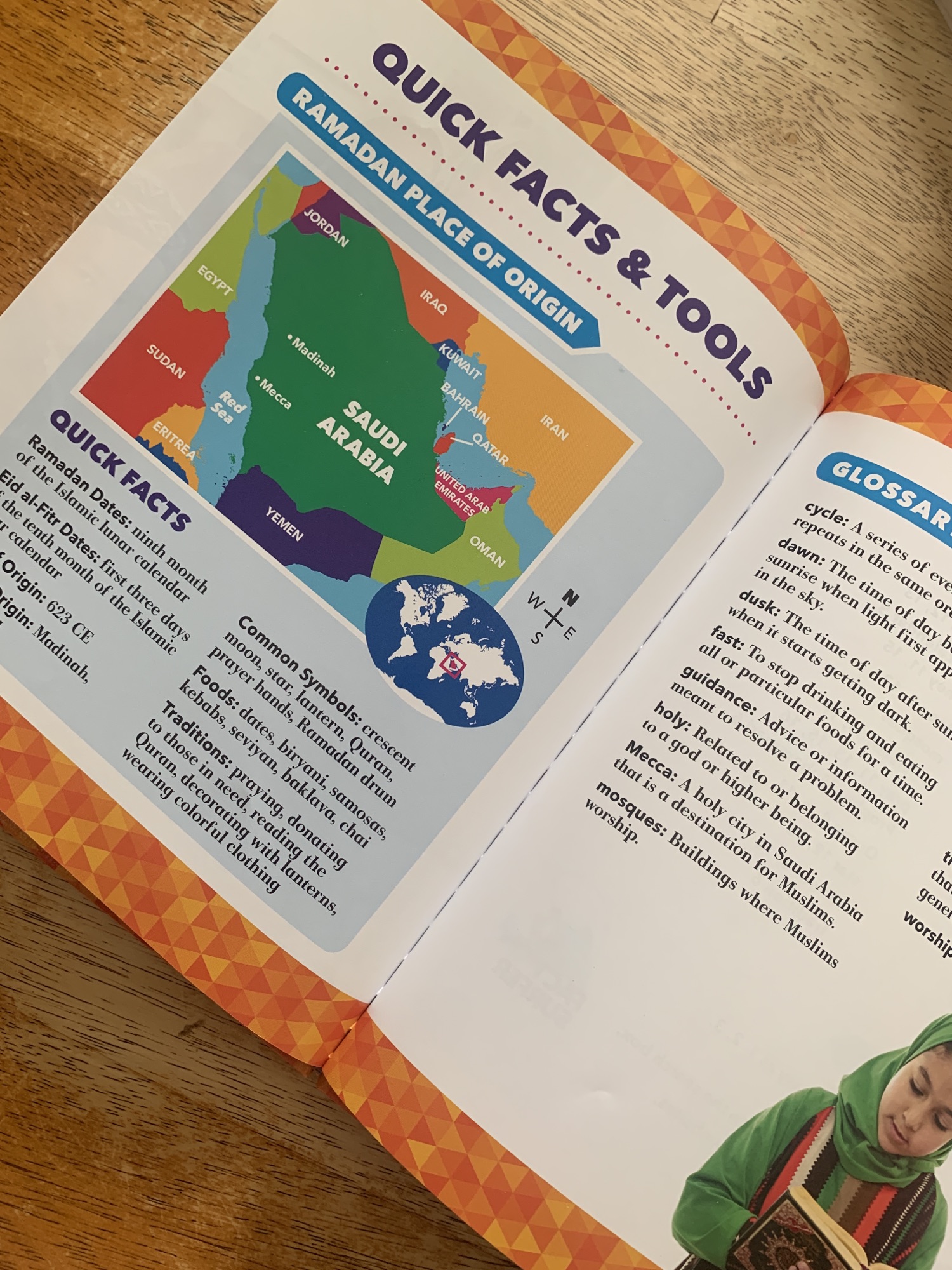
Eid al Fitr is one day not three as the book states.  The next spread then revisits the food, as if Biriyani is only eaten on Eid and all Egyptians make baklava.  The end is a one page Quick Facts and Tools and a glossary.  I have once again sent an email to the publisher asking them to edit future reprints of the book. 

img_2958-1


Festivals and Celebrations: Eid al-Fitr by Louise Nelson

Standard

This non fiction Eid book is not accurate, detailed, engaging, or something I would recommend schools or libraries shelve. It used to baffle me, but it now infuriates me that books like this continue to be published as non fiction, when they unfortunately perpetuate many of the same errors of similar earlier books, Muslim beta and sensitivity readers exist, why do publishers not seek them and out? At least Google the subject before you write and publish a book.

Lets begin with my favorite: Muslims fast because Allah swt has commanded it, yes it helps us “become closer to Allah,” but it is not so that we, “understand what it is like to not have enough food.” Sure that might be a resulting lesson, but it is not the reason. It states that “children and people who are old, pregnant or ill do not fast during Ramadan,” which isn’t always true and needs clarifying to say they may not be “required” to fast. Many children do fast, many pregnant women fast, by simplifying it to such a degree, students fasting may feel less seen when presumably reading a book like this in a school, classroom, or library setting. The exact places meant to help provide windows and mirrors and foster understanding and an inclusive environment.

Eid al Fitr is celebrated on the first of Shawwal, some countries, cultures, or families may extend the festivities for three days, but unlike Eid al Adha, Eid al Fitr is only one day. There is nothing about white being a holy color and there are no requirements to wear white on Eid.

The brief history of Prophet Muhammad ﷺ receiving the revelation from Angel Jibreel would be even better with proper salawat and respect given. It also seems to imply that he traveled far and wide spreading the message and became a Prophet all within the month of Ramadan. It completely erroneously states that “Muslims remember the meeting of Muhammad and Jibreel and the writing of the Qur’an by fasting during Ramadan.” How does remembering translate to fasting? Muslims make an extra effort to read more Qur’an in Ramadan, as blessings are multiplied, but the causation is incorrect.

The information about Zakat and charity is vague, not clarifying that Zakat al Fitr is required on all to pay not just adults. Unfortunately it clearly mistakenly states that Eid prayers is prayed, “just after sunrise.” It is not, it is prayed in the morning, but not “just after sunrise.” The phrasing about Muslims reciting prayers together to feel closer to Allah also seems off, why not just say Eid prayers are prayed in congregation. And while sure in some places the community might eat together after the khutbah, it doesn’t happen everywhere and is not required, nor is eating sheer-khurma. That is simply one of many sweet dishes made in the sub continent that has no religious role whatsoever. The remainder of the book is poorly written. “people play games and eat.” It then says that Eid is celebrated in many different countries because Muslims live all around the world, but only gives one example that “in Turkey, baklava is given as presents.” That does not show people in different countries all over the world, the legit, shows one country.

How is this terrible writing making it into a book? I am truly baffled that this is the quality of a book to be published. It is a disservice to anyone seeking information, and the time of Muslims just being happy to be included has long passed. Books written this poorly keep stereotypes about Islam and Muslims as other and backward going. I am very disappointed.

The book is not sourced, and I have sent an email to the publisher asking for corrections in future reprints.

Tipu’s Roar: A Freedom Fighter’s Tale by Subia J. Ali illustrated by Gabriel Sorondo

Standard
Tipu’s Roar: A Freedom Fighter’s Tale by Subia J. Ali illustrated by Gabriel Sorondo

This large (9×11) hardback book is for the most part gorgeously illustrated in sepia tones, but the story is only 11 pages long; a pretty steep price point for 11 pages.  A story nestled with in a story, the premise of bringing to light a not well-known historical figure is admirable, but with no sourcing, it is hard to know what is real, and what is legend.  The concept and angle of being a freedom fighter and resisting colonization is timely, sadly it lacks the inspiration that I feel the author set out to convey.  I read the book a few times, and still had to Google a map of Mysore, Tipu Sultan and the role of the French in the subcontinent in the 1700s.  It would seem a book dedicated to the children of Palestine, defining words of freedom fighter, colonization, and imperialism before the book even begins, would answer the basic questions about the hero at hand.  

The book starts with an old man feeling gentlemanly wearing a bush shirt, chatting with his grand daughter who is being corrected to call him Dada Jaan instead of Grandpa. He then gets lost in thought and begins to tell his grand daughter the power of names to emphasize his point.  Tipu Sultan, known as the Tiger of Mysore, he tells her, “fought the British, who had come to colonize the Indian subcontinent.”

He doesn’t so much as convey the information in an entertaining way, as he lists off details and then pulls out to make sure she is still listening.  He tells her about the British East India Company draining the wealth of the subcontinent by taking tea, cotton, gems and spices.  He tells how Tipu “studied Islam, spoke many languages, and was a pioneer in rocket artillery.”  He credits Tipu’s rockets as revolutionizing warfare all around the world, and connects India, France and America as fighting off their Imperial colonizers, with the French being close allies in India’s struggle against the British.

Once her Dada Jaan’s retelling is through, and Tipu has lost, and Mysore falls, the little girls ponders over the story and years later appreciates her Dada Jaan in his traditional tunic rather than his bush shirt from before.

The book is in many ways needs to be fleshed out, sourced, and the messages articulated for today’s readers. 

Palestine: The Special Edition by Joe Sacco

Standard

img_2164-1

Written between 1993 and 1995, and compiled as a complete set in 2001, this 285 page adult non-fiction graphic novel is not really something I can review, even if I knew how.  As we have passed 100 days of the escalation in Gaza, on top of the ongoing horrors of Israeli occupation, I am hoping to broaden my literary awareness to include not just children’s fiction and non-fiction about Palestine, but also adult works by those living it, those moved by it, and those reporting on it.

This particular “special edition” has a forward by Edward Said, and an introduction by the author and illustrator.  Once I started the actual story, I’ll be honest it took a few attempts to hook me, with the starting being in Cairo and being a little aggressive with alcohol and talk of women, but once I decided to just keep going, the book finds a bit of a rhythm.  It shows the author himself shaping his own opinion as he interviews, and sees, and reports on the events around him.  It is non-fiction, it is written by a journalist, at some points he acknowledges his bias, but the overall picture presented, is heart wrenching.  That the humiliation and torment and occupation of a people has been so well known and documented and ignored, in light of current events, and even in isolation, is devastating.  The exhaustion the writer feels just witnessing it, is palpable, and the complete ignorance of Israeli, former IDF soldiers none-the-less is stark.

The book is both a reflection of the time with internal political factions playing roles differently than they do in todays conflict.  There are also views about Iraq and Saddam Hussein, which might surprise readers today.  But the power of this book is what hasn’t changed, the torture, the imprisonment of children, checkpoints, illegal settlements, humiliation, restrictions from working, from moving, from being treated as equal.

I’m glad I read it, and spent time among the the ink filled pages. I am certain that many of the stories, particularly the ones from inside the prisons will stay with me and haunt me as I read headlines and scroll endlessly through the statistics occurring in real time.  How can we be so blind, for so long, how can a people endure so much and keep fighting, how does any of this make sense?