Category Archives: Elementary Fiction

The Proudest Blue by Ibtihaj Muhammad & S.K. Ali illustrated by Hatem Aly

Standard
The Proudest Blue by Ibtihaj Muhammad & S.K. Ali illustrated by Hatem Aly

blueLOVE! Yes, usually when I’m so anxious for a book it disappoints, but not this one, it warmed my heart and soul and made me smile.  In 40 pages surrounded with absolutely adorable illustrations, the reader feels the love between siblings, the strength of self confidence, the power of being true to yourself, the beauty of hijab, and the awesomeness of light-up sneakers and five cartwheel recesses.
C7E95032-E080-4057-BC93-6B25CBCAAA29

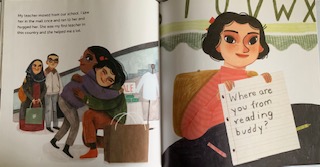
It is the first day of school for sisters Asiya and Faizah, and Faizah’s first day of wearing hijab.  The book starts out with the girls and their mom picking out a new scarf at the store.
677BD5F0-0C6E-472A-B086-05F93D4F17CC

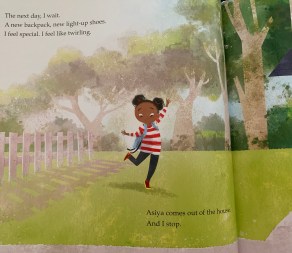
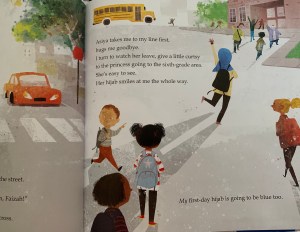
The first day of school has the girls walking to school hand in hand, Asiya in her beautiful blue scarf, and Faizah in her new shoes admiring her sister as if she were a princess.

DB80D90A-289E-4F35-A763-24526723E650

In line a classmate whisper asks Faizah about her sister, and Faizah has to find her voice to speak up about her hijab.  She then likens the blue hijab to the sky, special and regular before recalling that their mom had told them “The first day of wearing hijab is important. . . It means being strong.”

DFA253F0-16BC-464A-B630-BB93AFBFCF94

Throughout the day at school Faizah checks on her sister, sees other kids make fun of her, liken the blue to something beautiful, and then recall something their mom has told them to give her solace and strength.

06E90E71-3375-4E26-9F0A-F31DCA8058C4

As Faizah puts into practice the lessons from her mom about being strong, knowing who you are, and not carrying around hurtful words, she, like her sister finds strength.  A strength which radiates to those around them, and further connects the two girls.

C62B2893-3E2B-4628-BAAE-C195FBD3AB7A

Faizah has an amazingly sweet and authentic voice as she counts her light up steps and looks up to her older sister.  I love that the story stays on track and has its own rhythm of a school incident, a strong declaration about blue, a lesson remembered from Mama and a resolution.  With lots of mini climaxes the reader sees the strong perseverance and how being authentic will be challenged repeatedly.  The subtly of the hijab being whispered about and then proclaimed loudly is really tender and emotion filled.  Little reminders why OWN Voice stories are so important.

The illustrations are absolutely amazing on their two page spreads: the colors, tone, expressions, are perfect and a huge part of the narrative.  I love that when a boy points at Asiya, not just Faizah, but Asiya’s friends too are unhappy with the boy.  I also like that the boys being mean are not depicted clearly, but rather are shown in the shadows, furthering the point that mean words and those that spout them are not worthy of your time.

There are Authors’ Notes at the end and a picture of Ibtihaj  and her two sisters Asiya and Faizah. I think the book should be on every shelf, truly.  To be yourself and be proud of who you are is universal, as is kindness. The book does not discuss religion or mention Islamic reasons for her covering, and girls and boys alike will benefit from multiple readings of the book.


Towers Falling by Jewell Parker Rhodes

Standard
Towers Falling by Jewell Parker Rhodes

towers falling


I realize the inherent difficulty of writing books for middle grades about the events of September 11, 2001: the author lived through it, the readers did not.  Yet, it seems like at some point a book regarding it, will just feel right, and I don’t think for this age group, I’ve found it yet.  This AR 3.3, 228 page book is a quick read, and while some of the characters have spunk and personality, a few of the storylines seem incredibly forced and the overall timeline and holes in the story will be ultimately disappointing for most readers.

SYNOPSIS:

Deja is starting a new school now that her family has gotten a room at a homeless shelter.  Immediately her fifth grade classmates are given an assignment about home, with the end goal that eventually this project will transform in to being about the change of New York’s skyline fifteen years ago.  The details regarding the attacks of September 11, are not given forthright and as Deja knows nothing about the attacks, and the fall of the towers, her inability to get answers adds to her frustration at home and school.

Deja is angry as she bares a lot on her young shoulders.  Her dad can’t hold a job, and his moods and ill health put caring for her younger siblings on her.  Her mom works as a waitress and is always tired.  They lost their house, lived in their car for a while, and now occupy one room in a shelter.  Deja refuses to lie about her home life and thus her aggressive attitude is always on guard.  Another new kid, Ben, joins the class and he and Turkish American popular girl, Sabeen, all quickly become really good friends.  Each have something brewing beneath the surface that they are dealing with, but their friendship helps them cope and bonds them together.

As the trio of kids work on their projects together, Ben finally shows Deja online footage of the attacks and clues her in to what everyone else in their Brooklyn class seems to know and has failed to tell her.  Deja links her father’s declining health to that fateful morning and decides she needs to go to Ground Zero and get some answers.

She doesn’t really get answers, but at least it is the catalyst for an overdue conversation with her and her father, and hopefully a start on the road to healing the family rifts.

WHY I LIKE IT:

Much like the book Nine, Ten there seems to be the token Muslim girl in the story to offer her perspective on the Islamaphobia that occurred after the attacks.  In this case Sabeen doesn’t detail anything specific happening to her, other than a clerk at a store telling her to go back to Saudi and her uncle getting screened regularly at the airport.  Of all the characters I feel like Sabeen gets the short end of the stick.  She is incredibly flat, stereotyped and undeveloped.  Her family is Turkish, she is wealthy, her mom wears niqab and they are all overly kind and sweet, which is great, but when Deja goes over for lunch, they ask her if she prays, which seemed so random and off to me.  A lot of the basics about the character the author got right, she says that the terrorists were Muslim, but they weren’t, sharing a sentiment many of us Muslims feel. She wears hijab, and takes it off when she gets home.  I don’t like that the mom speaks English, Arabic and Turkish, but is first introduced having Sabeen translate for her with another parent.  Seems incredibly pretentious and misleading.  Ultimately her storyline is just overly forced.  She has to leave Ben’s house when they talk about September 11, because she is so affected by it.  She wasn’t even alive when it happened, and I get that when it is discussed us Muslims are on guard, but the author makes it seem like it is her whole world and influences everything around her.  If you live in New York, especially, I’d imagine at some point you’ve had to come to terms with it, no?

That’s why I also struggled with Deja’s dad.  He is so debilitated by the events of 9/11 he can’t function, yet they happened 15 years ago, presumably before he met Deja’s mom and they started a family.  So, really she fell in love with him in his current condition and thought having three kids with him was a good idea? He was fine and then wasn’t? For 15 years he hasn’t been able to get some sort of help for his PTSD type symptoms?  Seems like a stretch in the timeline, and one that is hard to excuse even for 3rd and 4th graders.

I really like how Deja’s homelessness is brought out and hopefully readers can learn some empathy from her.  Unfortunately the entire 5th grade class is so idyllic that I don’t know that most if any kids reading the book will relate to such a well behaved, so accepting, forgiving and generous group of kids. I mean yeah that’s the goal, but its way too overdone.  Ben, Sabeen, and Deja are best friends after the first meeting even though Deja is rude, mean, and doesn’t like them.  I’m not even sure what Ben and Sabeen get out of being friends with Deja?  Deja undoubtedly benefits from them, but there aren’t a lot of compelling reasons given why they’d be so drawn to her.

And finally, I struggled with the theme of how being “American” united them all.  It makes sense when discussing it as a class, that it doesn’t matter their color, income, life experience, whether they were immigrants or born in America, but the concept comes up again at a critical point when Ben and Deja are on the subway and seems so misplaced to me.  On the subway there would be plenty of tourists and visitors, that wouldn’t be American, no?

FLAGS:

The book is clean, it does mention some drunk people at the shelter, but nothing specific, just in passing.

TOOLS FOR LEADING THE DISCUSSION:

I wouldn’t do this as a book club selection because the target age is lower than who I meet with.  But, even despite some of my criticisms I’d recommend this book be in classrooms and school libraries as it does offer up a perspective on historical fiction that hopefully could lead to a slightly deeper understanding of the events at a young age.


Leila in Saffron by Rukhsanna Guidroz illustrated by Dinara Mirtalipova

Standard
Leila in Saffron by Rukhsanna Guidroz illustrated by Dinara Mirtalipova

leila

I had really wanted to love this book about a young Pakistani girl living outside of Pakistan learning to love all her different parts.  Unfortunately, the book was so scattered that no point was made, no message conveyed, and sadly, no excitement at being represented in literature really felt, .

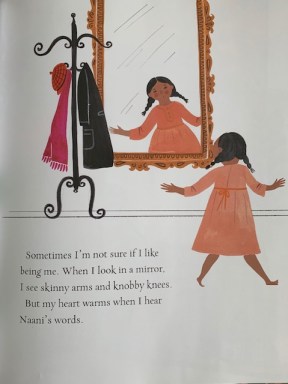
IMG_6403

This 32 page book isn’t bad, it just really isn’t memorable.  It starts out with Leila arriving at her Naani’s house for dinner as her parents and her do every Friday.  Her maternal grandmother comments that she likes Leila’s saffron buttons.  Leila beams at this because she doesn’t know that she always likes being herself.

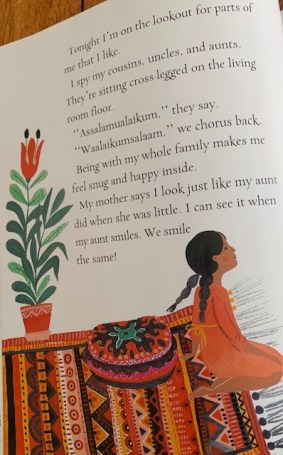
IMG_6404

Tonight, they are joined by lots of extended family and Leila is on the lookout for parts of herself that she likes.  She feels safe with her family, and likes being told she looks like her aunt when she smiles.

IMG_6405

The book then kind of abandons the theme of finding parts of oneself to like, and moves on to cultural trinkets to enjoy.  She identifies camels on shelves and Arabic books too, and can’t wait to go on her first trip to Pakistan someday to get her own “Arabic books” and “special ornaments.”  I’m not sure why they books aren’t in Urdu, but none-the-less without any written connection to Islam, they are in Arabic, thus giving, erroneously, the reader the impression that is the language of Pakistan.

IMG_6406

Leila then helps her Naani cook which almost seems like an additional theme of the book: the passing on of traditions.  The book doesn’t really stay here though either, and has Leila running outside to get cilantro from the neighbor Miguel.  Possibly another theme in addressing multicultural neighbors or just how to be a good neighbor, is now being brought up, but nope, the book bounces back to dinner with the family.

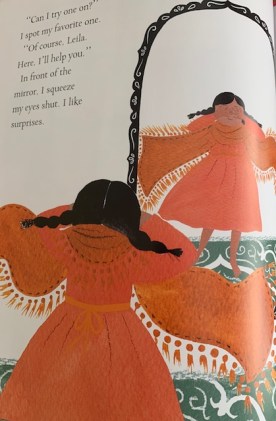
IMG_6407

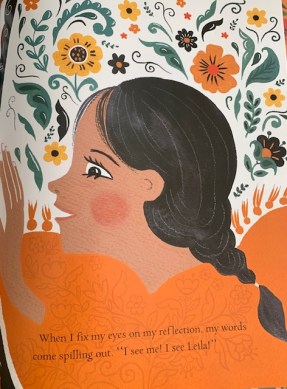
When it is time to leave, Naani invites Leila upstairs while her parents wait to leave.  Here she goes through fabric and scarves rich in color and textures and likens them to ethnic foods.  She then tries on her favorite one, but acts like she has never tried it on before or seen it before, I’m really not sure, the language is a bit awkward to me.  Anyway she opens her eyes in a surprise and likes what she sees, she likes her self, all her parts.

IMG_6408

I wish this book for preschool and kindergarteners, would have streamlined the message it wanted to convey most.  I like finding pieces of yourself and liking the completed you, but I don’t know what the pieces really are in the book.  Yes I could assume and figure it out, but I’m not 5 years old.  The book should have articulated it clearly.  Or if the book wanted to celebrate culture and family traditions, it should have stuck to that.  It really seems all over the place no matter how many times I read it.
IMG_6409

The illustrations are rich and vibrant.  They definitely give a lot to look at and the expressions on the characters faces will probably make the little ones giggle.  There are a few Urdu and Arabic words used in the story that are defined on the back cover.

IMG_6410

The characters aren’t identified as Muslim, none of them wear hijab, but they say Salam and have Arabic books, so one can assume. I picked up the book at the library and don’t regret it, but I probably wouldn’t buy it or unfortunately, check it out again.

Secret Recipe Box by Helal Musleh illustrated by Nalan Alaca

Standard
Secret Recipe Box by Helal Musleh illustrated by Nalan Alaca

recipe-box.jpg

The publisher suggests this book for ages 4 and up, but I think it’s a bit long (30 pages) and detailed for that age group, and first grade and up will benefit more from this heartfelt story.

IMG_5872.jpg

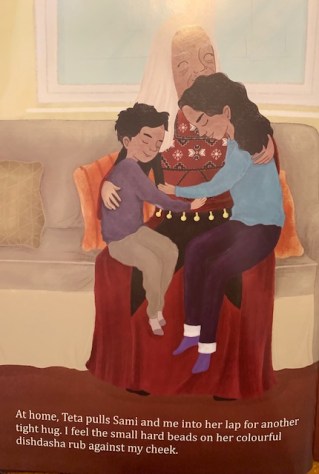
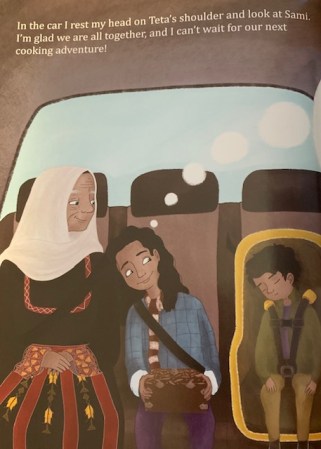
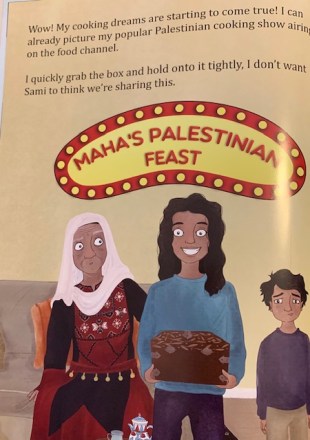
Maha is excited her Teta is moving from Palestine to live with her, her brother Sami, and parents in Canada.  Maha dreams of being a chef on a famous cooking show, and her Tata and her secret recipes will be a great way to practice.

IMG_5873.jpg

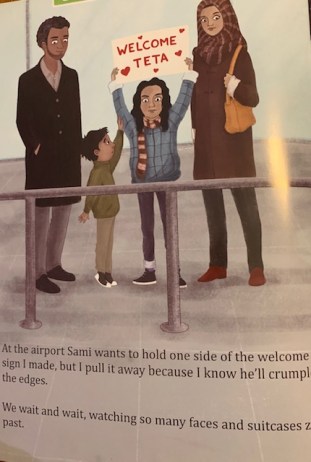
Her little brother Sami is always in the way though.  Whether it is wanting to hold a sign Maha has made, or is wanting to cook with her, she is annoyed by him at every turn.

IMG_5764.jpg

As Maha listens to Teta’s stories and learns about her life in Palestine, she starts to change in her approach to Sami and realizes that family has to take care of each other.

IMG_5874.jpg

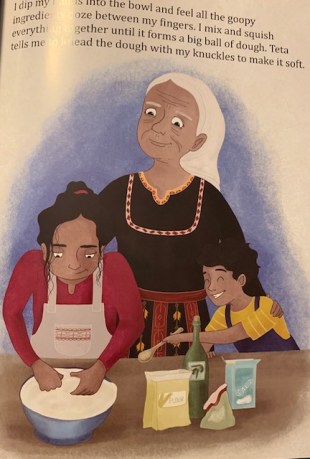
After a day of cooking together, Maha, Sami, and Teta have made too much food and decide to go and share it with those in need at the soup kitchen.

IMG_5763

The book addresses kindness, changing, compassion, immigration, taking care of one another, multi generational lessons and love, stories, life lessons, and some highlights of Palestinian culture, food, clothing, and tradition.

IMG_5761

The book is warm and well done, with the exception of a few of the pictures which seem a bit off to me.  Overall, it is a sweet story that presents with a lot of lessons, but doesn’t force them upon the reader.  The character growth is gentle and subtle and will resonate with readers.

IMG_5762

The characters mention Halal food, and the grandma wears hijab even in the house, where the mother is shown wearing it at the airport, but not in the home.  The book would work for Muslim and non Muslim readers.

The Night Diary by Veera Hiranandani

Standard
The Night Diary by Veera Hiranandani

night diary

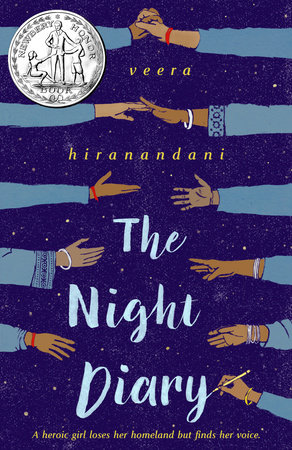
I was curious to see how partition would be presented in this book by an Indian Hindu author featuring characters who are half Hindu and half Muslim relocating to Hindu India.  Told in journal entries written by 12 year old Nisha to her deceased Muslim mother, the 264 page AR 4.5 book is wonderfully done, extremely compelling, and about so much more than the politics that birthed India and Pakistan.

SYNOPSIS:

Nisha and her twin brother Amil are opposites, yet they complete each other and care for each other in such a tangible and heart swelling way, that you can’t cheer for one while not rooting for the other one to find success and their place in the world as well.  As the twins turn 12 and Nisha is gifted with a journal from the families beloved cook Kazi, India and Pakistan too are about to come to fruition and Nisha’s journal entries detail her understanding of the larger events around her as well as her own struggles to come in to her own.

For Nisha words do not come easily.  She excels at school and loves to cook, but talking to people, or making friends eludes her and her longing for her deceased mother, make her a quiet reflective child.   She observes and  takes in so much around her, internalizes it, ruminates on it, and pieces it back together in a gifted way when she writes, that reading her entries, and the voice the author creates for her, is really amazing and fluid.  You feel like you really know Nisha and what makes her tick, what she fears, and how she thinks, you also get emotional attached to her and her world and find yourself surprised at how invested you are in not only her family’s successful migration across the new border, but also in her finding her voice and the confidence to use it.

Amil’s voice comes through Nisha, but her love for him and the way his strengths are her weaknesses and vice versa allows insight into the other family dynamics and attitudes to the two children.  Amil is an amazing artist, that suffers from dyslexia and does poorly in school.  He is weak and wiry, but fast, and he can talk and charm and ask all the questions that Nisha wants asked but can’t find the words for.  He and their physician father are rarely on good terms, as he isn’t the ideal strong boy with a medical degree in his future.

When it is decided that the family must leave their city where Muslims and Hindus and Sikhs live together and journey into Hindu India, the twins, their father, and their father’s mother, Dadi, must rely on each other to survive the riots and violence of the mass migration.  Nisha must also survive the understanding that with a Hindu father and Muslim mother there is so much about her own place in the world she doesn’t understand, and thus the journey is both an internal and external one, that will change Nisha forever.

WHY I LIKE IT:

I love that the protagonists voice is so steady and believable.  I truly fell in love with Nisha and felt her pain, happiness, anguish and overall got emotional for her, it was a rollercoaster.  The author does an amazing job of painting the politics of Jinnah, Nehru, Gandhi and Mountbatten in broad strokes, but believable ones to the understanding of a 12 year old.  She sees that one India held people of all faiths and that this breaking up of everything is leading to violence, upheaval, and horrors previously unimaginable.  She doesn’t understand why people had issues with her mother being of one faith and her father another, she loves her Muslim cook and loves listening to him pray five times a day as her paternal grandmother sings Hindu prayers in the other room.  She is both Hindu and Muslim and doesn’t see the contradiction within herself, suspending the reader’s own opinions on partition (if they have them), because how she sees it, does make sense for the story’s narrative.  The author takes Gandhi’s side of non violence and staying together, but balances very well and very intentionally that atrocities and humanity was seen from people of various faiths and political persuasions.  The role of British colonization and freedom from it, is slightly glossed over to the point of disservice, but again, being the target age of the reader and the age of the characters, I’m willing to over look it.  Families with Indian and Pakistani heritage will want to take the lacking information and help their children to fill in the blanks.

I love that the backdrop is the action of the story, but the relationship between the characters is truly the heart.  A lot of growth and compassion is conveyed very succinctly and powerfully.  Nisha wants so desperately to speak, but can’t, and her internal struggle and the pain she feels when she can’t speak up to help and participate in the world around her is gut wrenching.  As she confides in her diary, you realize that kids understand so much more than we adults often give them credit for.  The lesson is not lost on me.  I initially thought a book steeped in subcontinent history, with religious conflict and foreign words, wouldn’t appeal to a western elementary aged readers, after reading it, however, I now think this heartwarming story should be thrust upon them all.

FLAGS:

There is violence and death.  Not sensationalized, but detailed enough to set the tone of how serious the journeys were between the two countries when British rule stopped  There is some bullying and mention of the father smoking socially with friends.

TOOLS FOR LEADING THE DISCUSSION:

There is an Author’s Note, and a glossary at the back, and the inside covers have maps showing the journey the characters take.  I would absolutely do this as a Book Club selection for upper elementary, and will consider it even for middle school.  A lot of tools for teaching the book are available online, here are just a few:

Educator’s Guide: https://www.penguin.com/wp-content/uploads/2018/02/The-Night-Diary_Educator-GuideWEB.pdf

Children’s Discussion Questions: https://www.readbrightly.com/brightlys-book-club-for-kids-the-night-diary/

Classroom Bookshelf: http://www.theclassroombookshelf.com/2018/06/the-night-diary/


Our Granddad by Maryam Ahmed illustrated by Kulthum Burgess

Standard
Our Granddad by Maryam Ahmed illustrated by Kulthum Burgess

grandad.gif

This 29 page (four chapter) middle elementary book about understanding sickness, old age, and a bit of death, makes some good points about sabr and dua and Allah testing us with illness.  The story, however, is really dry and never becomes more than just a vehicle for conveying the author’s message of how Islam views elders and the challenges often brought upon as they age.

SYNOPSIS:

Hafsah, age 8, and her 11 year old brother Hasan are meeting after school so that they can join their parent’s in the long drive to Devon to check on their sick grandfather.  The drive is apparently really long, but being that we don’t know where the kids live or how long the drive is, we just know it is a long, painful, miserable drive.  The family is silent with worry about the grandfather on the trip, but no indicators as to what his diagnosis or symptoms are is given, just that he is ill and as the night and drive progress, the children worry he is dying.  Hasan, in the darkness of the car, sheds some tears about losing his fun granddad, but no details about the adventures they go on, or why he is fun are shared.  Their mom encourages them to continue to make dua and tells them that maybe the illness is a blessing, but the children don’t understand what she means by that.

When they arrive, the children are told it is too late bother their granddad and to wait til morning to see him.  The next day the doctor tells them he had an asthma attack and is on new medicines that are helping.  Seems like there should be more to the illness, as asthma once the attack is over can be controlled, and no other mention of heart problems or pneumonia or other diseases are indicated.  Hafsah and Hasan finally get to see him and are surprised he is awake and talking and they learn that sometimes Allah tests us by giving us hardships and that their duas and prayers were helping.  He shares the hadith, “No Muslim is afflicted with an ordeal, be it an illness or something else, without Allah thereby causing his sins to drop away just as a tree sheds its leaves.” Unfortunately, the hadith is not footnoted or attributed, but the characters and readers understand the lesson and find peace in knowing that every hardship is an opportunity not a punishment.

WHY I LIKE IT:

I love the concept of the book, just not the execution of the principles it instructionally conveys.  Kids need books that explain some of the big concepts that they can’t necessarily understand or even ask about, such is why do we get sick, what is going to happen to our grandparents etc.  The book really just needed more showing and less telling.  It details how the kids chase each other home from school, but doesn’t tell of the adventures that granddad and Hasan go on, it just tells us that they miss having these adventures.  There is no character development, and there is definitely space for the reader to feel for the grandpa and the concern of the kids, but it is glossed over in words not in anecdotal sharing.

The book is British, and some of the words and phrases might be confusing to American kids, such as the description of the grandfather being poorly used repetitively.

The book is presented well with clear font and spacing on glossy pages bound in a hard illustrated cover.  There are small detailed life-like pictures throughout the story that show the kids and family.  The females are in hijab and the family is clearly Muslim.


FLAGS:

None

TOOLS FOR LEADING THE DISCUSSION:

This is probably a decent book to have in an Islamic School library, it would function as a reference book more than a novel or book kids would naturally pick up.  If doing a theme on aging or sickness, or tests from Allah, this book would fit in nicely in adding to a discussion, but outside of that, I can’t see that kids will even remember the book or what it is about.


Yan’s Hajj: The Journey of a Lifetime by Fawzia Gilani illustrated by Sophie Burrows

Standard
Yan’s Hajj: The Journey of a Lifetime by Fawzia Gilani illustrated by Sophie Burrows

yans hajj.jpg

With less than a month until Hajj, this book should definitely start making an appearance in your children’s story selection rotation.  The focus is not on the parts of hajj, but rather the desire and intense yearning to go for the sake of Allah (swt).  Granted, it doesn’t take much to get me to cry these days, but this 27 page book for ages 5 and up, got me emotional.  Going for hajj is always something to plan for and hope for, and the sweetness of the reminder that we plan, and Allah plans and Allah is the best of planners is so beautifully brought to life, that I benefitted from the reminder and my kids from the lesson.

IMG_5485.jpg

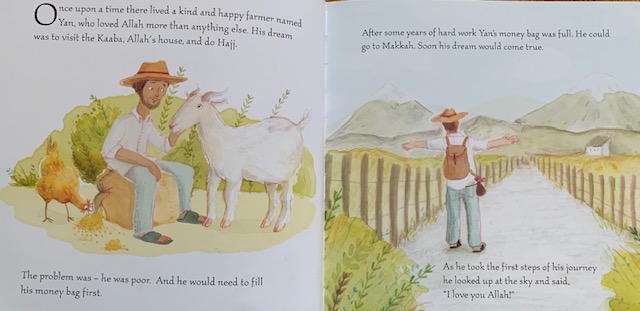
Yan is a farmer, a poor farmer, who loves Allah and wants to go for hajj more than anything else.  So he decides to work hard and fill up his money bag so that he may go.  After years of hard work his bag is full and he begins his first steps in his journey proclaiming his love for Allah.  After a few days of walking however, he comes upon some sad children who have recently lost their school to a fire.  Yan, uses his money and time to fix the school and returns back to his farm to start saving up again to go for hajj.IMG_5486.jpg

When his bag is full again and he sets out again, he is met by an injured boy who is being yelled at by his owner.  Yan, once again reaches into his money bag to generously do the right thing, in this case to pay off the boy’s debts and takes the boy home with him to be nursed back to health.

IMG_5487.jpg

After some time he again has a full money bag and sets off for Hajj.  Along the way he finds a village trying to build a mosque and after two months of helping with the funds and offering his own labor, the mosque is complete and Yan returns home.

IMG_5488.jpg

Now Yan is old, and after many years he looks in his money bag and it is not full and he sadly admits he cannot do hajj.  But then the boy he saved, Habeeb, returns with a horse cart to take him for hajj and they pass through the village where he repaired the school and is greeted with rose petals and gifts of ihram, they then pass by the mosque he helped build and the villagers gift him with food and water, they then arrive at Habeeb’s house and he is given a bag filled with money and at long last Yan’s dream comes true as he sees the Kaaba.

IMG_5489.jpg

The book shows how steadfast Yan’s love of Allah is and how generous and patient he is in pursuing that love. The illustrations of him aging are truly touching and gentle.  In some ways it reminded me of Shel Silverstein’s The Giving Tree, but with a happier ending, in bringing a large grown up concept down to size and presenting it in a genuine way.


Bilal Cooks Daal by Aisha Saeed illustrated Anoosha Syed

Standard
Bilal Cooks Daal by Aisha Saeed illustrated Anoosha Syed

bilal cooks daal

Aside from me desperately wanting to get Bilal’s family a pressure cooker this 40 page book does a good job, and follows a reliable tradition of using food to introduce a “foreign” culture while simultaneously showing universal themes that show how similar we all are when it comes to family, meals, friends and feeling loved.  

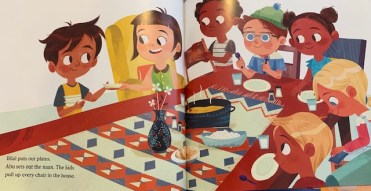
Bilal’s favorite food is daal, lentils, and when he is out riding his bike with his friends, his father calls him in to help him make it.  Confused as to why Bilal’s dad would need to start dinner so early in the day, Bilal’s friends join in, in helping make the slow cooking traditional asian subcontinent dish.

IMG_5306

They line up the spices, they put it in the pot, and then they wait.  They put their shoes back on and play hopscotch, they go swimming, they go for a hike and it still isn’t done. 

IMG_5308

At one point Bilal is worried his friends won’t like it, but after waiting all day and gathering more friends at each activity, when the time finally comes they all dive in and love it.

IMG_5309

I love the diversity of the friends and that the dad is cooking and involving his son.  I also like that everyone is willing to try something new and give it a chance.

IMG_5307

The book would work for all kids ages 4 and up with the expressive colorful illustrations, diction, and amount of text on the page.  The book is 9×8 so it works well in small groups and at bedtime.  

IMG_5310

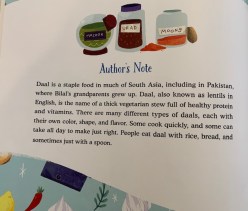
If you eat daal your kids will love seeing themselves in the pages, if you have never had daal there is a recipe at the end following an Author’s Note. 

IMG_5311

There is nothing religious in the book, and anyone from India, Pakistan, and Bangladesh could easily take ownership of the dish and story.  The Author’s note mentions that Bilal’s grandparents are from Pakistan and with a name of Bilal chances are he is a Muslim character.


Lubna and the Pebble by Wendy Meddour illustrated by Daniel Egneus

Standard
Lubna and the Pebble by Wendy Meddour illustrated by Daniel Egneus

lubna.jpg

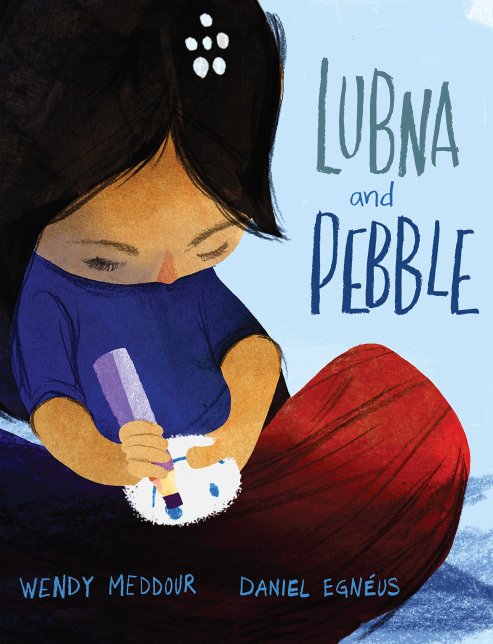
This beautifully illustrated book with simple text and story, is heartwarming and powerful in conveying emotion about child refugees. 

IMG_4993

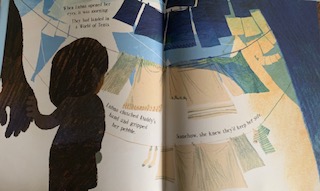
The 32 pages tell the story of young Lubna who has escaped something horrible and picks up a pebble when she and her father reach their new home, a World of Tents.  She finds a felt tip pen and draws a face on the pebble and the pebble becomes her friend.  She tells it her secrets, her dreams, she keeps it warm as winter approaches.

IMG_4994

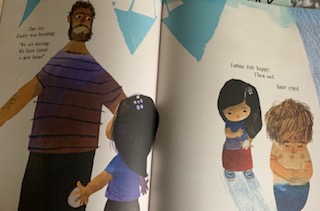
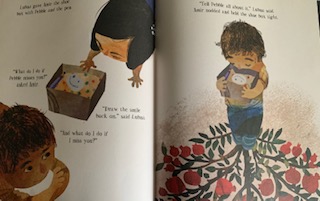
Then a little boy arrives, Amir, and Lubna and he become friends and she introduces him to Pebble.  One day Lubna learns she is leaving the tents to go to a new home and even though Pebble is still her best friend, she knows Amir needs him more.

IMG_4995

This book is truly a picture book, as the text is made magical because of the pictures.  The simplicity and love that Lubna feels for a rock reveals how much pain she has seen without details having to be given.  The fact that Amir doesn’t laugh or find being friends with a rock odd, cements the idea that these children have seen too much.  The compassion that Lubna displays by passing on her beloved Pebble also shows how much love and comfort they have, we all have, to give.

IMG_4996

The book has many layers, and the superficial one makes it a sweet story for children as young as four, the deeper understanding would appeal to kids up to 2nd or 3rd grade.  There is no mention of religion, culture, or a specific country.  I think Muslim children will assume Amir and Lubna are Muslim, but really the names could be from any culture or faith.

IMG_4997


From Far Away by Robert Munsch and Saossan Askar illustrated by Rebecca Green

Standard
From Far Away by Robert Munsch and Saossan Askar illustrated by Rebecca Green

from far away

Robert Munsch is a staple in most classrooms and libraries, but somehow, much to my embarrassment, I just learned about this book.  Originally published in 1995 with a different illustrator, I read the newer version that was rereleased in 2017.  I’m not sure how they differ, but they stem from an autobiographical experience of the co-author Saossan Askar, and her leaving of the war in Lebanon.  She wrote to the author and their letters back and forth are how the book came to fruition. 

IMG_4986

The 24 page picture book is an AR 3.5 and my guess it is because of the content a bit more than the reading level.  While it never gets graphic or sensationalized, she does leave a war zone of bombs and shootings, and the words may trigger fear in younger children.

IMG_4987

As the book progresses, the focus is much more on Saoussan settling in to her new life and the hiccups along the way.  From not knowing what anyone is saying, to sneaking out of class to go to the bathroom, and being frightened by a paper skeleton.  The book gives concrete examples that while silly, really show how someone unfamiliar with a new culture could be very confused and even scared.  

IMG_4989

The book has a happy ending with Saoussan adjusting and making friends and even becoming the best reader and speller in her class.  She also gets in trouble often for talking too much.  

IMG_4990

The book, like many in the genre of discussing war and refugees on a child’s level has its strengths and weaknesses.  The heart of the story I would say is wonderful, the illustrations lively and engaging, some of the transitions and details, however, are a bit abrupt and unsatisfying.  Once you know that it is based on reality and came about through letters, it makes more sense, but even that is a concept older readers will appreciate more than younger ones will.

IMG_4991

I checked the book out from the public library and I think does a great job of inspiring empathy.  It is vague as to what conflict is being left which makes it timeless in that I, unfortunately don’t see refugees disappearing soon.  The mom wears hijab, but there is no mention of religion in the book.

Here are the letters from his website: https://robertmunsch.com/book/from-far-away

From Far Away started with this letter:

To Robert Munsch
I am a little girl. My name is Saoussan. I am seven years old. I am in grade two now. I came to Canada one and half year ago. I didn’t know how to speak English at all. I was just sitting and listening. A lot of funny things happened to me.

Children were trying to talk to me, but I was not able to answer them. I began to talk a little by little.

I finished grade one and now I am in grade two. The teacher now is complaining to my dad that I am talking a lot in the class and I read and write a lot of stories.

One day I found a book called Thomas’s Snowsuit. I read it and I laughed with my family.

I went to the library and I brought some of your books. I enjoyed reading them. I even read them to my dad that he laughed so hard he could not stop laughing.

Please come to our school we want to hear a story from you and we want to see you.
I wrote back and asked her what “funny things” had happened. Saoussan wrote back telling me about her first Halloween in Canada:
To: Robert Munsch
Thank you for your letter. My teacher read it to the class and he said: I am not going to tell the class the funny thing that happened to her when she was in kindergarten and I am not going to embarrass you.

I don’t remember all of the funny things. But I remember one thing.

When I wanted to go to the washroom I didn’t know how to say I want to go to the washroom. That’s why I used to crawl to the door and when the teacher turns her head and looks at the other side I crawl under my friend’s desk and when someone opens the door I crawl out and go to the washroom.

When I come back from the washroom I wait beside the door and when someone opens the door I crawl in and go to my desk.

Once I crawled to the washroom. When I opened the washroom door I saw a skeleton. Then I screamed: Aaaaahhhhhhhhh!

Everybody came out. My teacher, Mrs. Garwan came, opened the washroom door and she tried to tell me that it is Halloween time and the skeleton is paper.

I didn’t understand her and I didn’t know what Halloween is.

She jumped up and down and danced around to explain to me that Halloween is just fun, but I thought the skeleton made her crazy and I screamed louder.

Then she hugged me to make me feel better and I jumped on her lap and the pee went down my knees. She put me down because she got wet.

Now I am in grade 2/3 and I am the best reader and speller in the class. This year when it was Halloween I weared a mask and a costume and we did a party at school. Then I went with my sister trick or treating to the neighbours.

Please, please, please, please, please, please, please, please come to our school.

I liked her letters so much that I decided to turn them into a book.

So Saoussan and I wrote a lot of letters back and forth and we made the letter into a book. Saoussan and I are both the authors and we split the royalties.