Miss Never Pleased by Ayesha Marfani illustrated by Aisha Aamir

Standard
Miss Never Pleased by Ayesha Marfani illustrated by Aisha Aamir

IMG_1860 (1)

I’ve been accused of being brutal in my reviews.  And while I don’t enjoy being mean, I do take some pride in the attribute, as I am paying for these books myself (unless I get them at the library) and it takes time out of my day to write these reviews.  I don’t get paid, I do it because I love books, I like supporting Muslim authors and those including Muslim characters in their stories.  I take recommending books to others serious, and can’t remember things if I don’t write them down, so here I am.  With this review I don’t want to be rude, or overly critical nor do I want to sound pompous and arrogant and privileged, but at the same time, I ordered the book off of Amazon for $7.99 so a fair review shouldn’t hold punches to spare what the author is trying to do and appreciating that she is writing for a cultural audience. 

Please believe me it isn’t personal, I am reviewing it based on my same criteria I review all the books through, my own personal bias.  That being said, if the reader is living in Pakistan, or has recently lived in Pakistan and English is a second or fifth language the 70 page story with games and activities at the end is decent.  Meant for ages 7-12 in that situation, that are intrigued by the moral lesson presented, I think the plot holes can be forgiven.  For those without ties to Pakistan, or with loose ties like me (I’m half Pakistani and grew up spending my summers visiting family) the book will be choppy, culturally specific, confusing and lacking.

SYNOPSIS:

The book opens with Habiba being distraught over her world crashing down on her and the pain she has caused her relatives consuming her.  She then opens her diary that she has kept for six years, starting back when she was seven recounting how she as Miss Perfect justified her self in incident after incident.  Thirty-one incidents to be exact, detailing how she would rat out her cousins, or critique elders food, or her tell her friends how to dress and what to study because it was the honest thing to do.   How she would decide who should be friends with who, if her family should go on picnics and how she didn’t want gifts but didn’t want to not get gifts either.  All-in-all Habiba is a self righteous awful, awful girl, I don’t think it is her trying to be perfect, I think she is just awful.  At the beginning she attributes it to praise she received as a child from her mom and grandma, but for this behavior to have gone on for so many years, I don’t think it was their praise, it was their lack of discipline that leads up to her catastrophic moment.  She fails her exams and then learns what her family really thinks about her in a poem, with a way too forced rhyme scheme, left lying around.  The story then returns to her undoing and a faqeer coming to cure her and her parents taking the blame for her poor upbringing.  She crosses out the title on her journal from Miss Perfect to Miss Never Pleased, to presumably denote how nothing could satisfy her.  The story then skips forward to her returning after University as the best international psychologist.  

WHY I LIKE IT:

I love the concept of the book, that a girl thinking she was so perfect could realize in fact she is not.  The idea is great.  I think it is a bit sad that her parents and involved extended family took so little interest in correcting her behavior, but at the same time I didn’t think it believable that she was absolved of all responsibility either. 

I feel like this book was a great first draft.  It needs some fleshing out, and some continuity corrections.  Incident #3 makes no sense, it starts with a party, then her ruining the mood of everyone at the party, and then her crushing her cousin’s dream of being in a play for her own twisted reasons.  But the jump from one idea to another seems like something got edited out and the rest of the four-and-a-half-page story didn’t get altered to reflect the missing details.  I have no idea what the party was for, what a wish gift is, and why anyone in their right mind would take a child’s opinion regarding someone else’s life so strongly. 

There are also contradictions, for example on page 14 she makes a big huff about her cousin wanting to study to be a teacher saying she wouldn’t be good at it, then on page 49 saying she would be marvelous, and this is before her climactic change of heart.  There are some awkward passages as well, that I had to read a few times, which could have been do to a different style of English, but sometimes I think it was confusing on its own.  Page 24 was all over the place with her not wanting to thank people for giving her a gift because she deserved the gift, but then telling them she appreciated it, along with her saying the gift, a dress, appealed to her, but that they should not have gotten it because it was an inferior quality.  Inferior to what we don’t know. So she didn’t say thank you, but said she appreciated it, isn’t that the same thing?  She didn’t like the dress, but it had appealed to her? Very confusing and just one example.

I say it is for Pakistani’s because I don’t know that anyone outside the subcontinent would know what a faqeer is, yes there is a glossary at the back, but it seems assumed in the story as a religious practice, which I find some issue with.  When Habiba was trying to dress everyone she says that a fishtail would look nice on her cousins and she gets a blue one.  I have no idea what a fishtail is.  It is not really explained, an illustration would have been helpful, but is not provided. She also once refers to her cousin as “dark” in a negative connotation, and that seemed very out of place and inappropriate to me.  And ultimately, if you don’t know the Pakistani school system I’m not sure you would understand how important the exam she failed is, nor why the scores are in the newspaper,  or that they have to pick their fields of study so early.  That being said, how did she get to University and do so well? If at 13 they had to choose their college and she didn’t pass wouldn’t she not be allowed to continue? I am so confused. And then she comes back after University, but is already being written about in the papers as if she has had a long and successful career.

The book doesn’t tell how she makes things right with all those she wronged either, after so many incidents, I think a little self reflection and humbling should have occurred to those that felt her wrath for so many years.  There isn’t really even a solution, her dad comes and talks to her, she reads what people think about her and then boom, happily ever after.

The illustrations are sporadic, but not consistent in the book.  The style seems to be different in each sketch.


FLAGS:

The girl lies and is incredibly mean but there isn’t anything inappropriate in terms of language or violence.  Islam is mentioned at the end when she thanks Allah swt for His help.

TOOLS FOR LEADING THE DISCUSSION:

I wouldn’t do this as a book club because it is so short, and I don’t know that kids would be compelled to read past the first few pages if it was in a classroom library.  

Book Video https://www.youtube.com/watch?v=QWoCiEnvg5U

If this book would have been written 20 years ago or so, I think readers everywhere would have given it a try as there was so little to choose from in Islamic Fiction, but there are options now, and much better ones.  I feel awful that I didn’t love the book, but I can’t suggest it either.  I plan to read one more book of the author’s to see if this one just didn’t work for me, and I’ll let you know what I think.
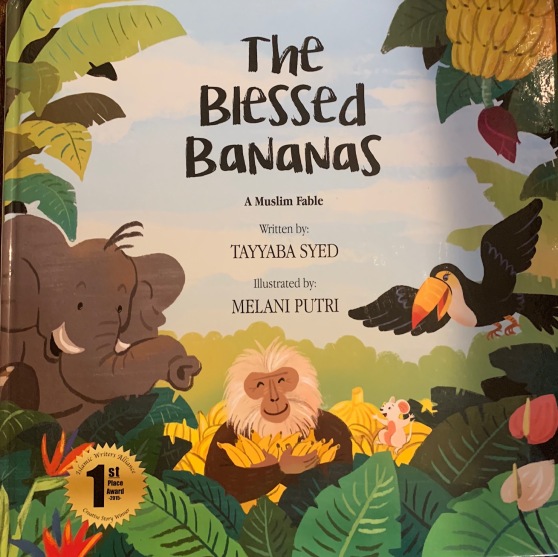
The Blessed Bananas: A Muslim Fable by Tayyaba Syed illustrated by Melani Putri

Standard
The Blessed Bananas: A Muslim Fable by Tayyaba Syed illustrated by Melani Putri

IMG_1798.jpg

 A fable with lessons of kindness centered around the Salawat, definitely is a great premise and for the most part I really enjoyed the book. 

IMG_1799

The 8.5 by 8.5 hardcover, 50 page book feels great in your hands and the illustrations are sweet and expressive.  The book is long, and is text heavy so I’d say the target audience is maybe 6 to 10 years old.   The font is incredibly small and irritating.   It should have been larger and more inviting to children in my opinion.  It doesn’t match the size, binding, and illustrations, and actually becomes a distraction if trying to read it in a group setting.  
IMG_1801

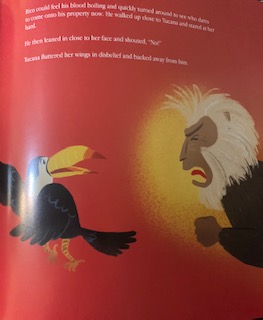
The story itself is smooth and intentional.  Rico, a blessed, yet ungrateful monkey, lives atop an ever abundant banana tree.  However, he attributes his blessings to his own hands and does not thank Allah swt.  He is mean and greedy toward people and animals alike.  Yet, something is missing in his life and he doesn’t know what. 

IMG_1800

When a little mouse, Chico, comes to him to ask for a banana and gets scolded at instead.  Chico makes dua for Rico asking Allah to guide the monkey to goodness.

IMG_1802

Tucana, a toucan, then stops in Rico’s banana tree after a long flight to be rebuffed by a foul tempered monkey who wants to be left alone.  When Tucana  leaves she forgives Rico for his rudeness and asks Allah to be merciful to him as well.

IMG_1803

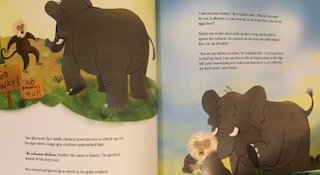
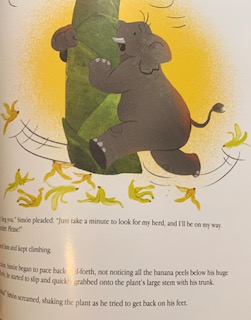
Rico then makes signs to keep people and animals away.  Which works for a while, but along comes Simon, an elephant, one afternoon to ask the monkey to climb his tree and help direct him back to his herd.  Rico of course refuses, and Simon reminds him that they are brothers in Islam and to please help. He begins shouting at the elephant to leave, and as Simon is pacing back and forth, he slips on the banana peels, grabs the tree to support himself and shakes the tree back and forth in the process.

IMG_1806

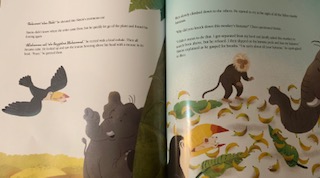
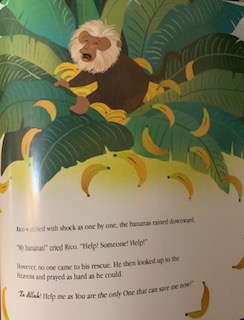
Rico begins hollering for help and sure enough the animals he had turned away previously, return to help him.  They had forgiven him as they hope Allah will forgive us all.  To calm the monkey, chico shouts, “Salawaat’alan Nabi!” in Simon’s ear and when he recites “Allahuma sali’ala Sayyidina Muhammad,” peace and calmness is restored.

IMG_1811 (1)

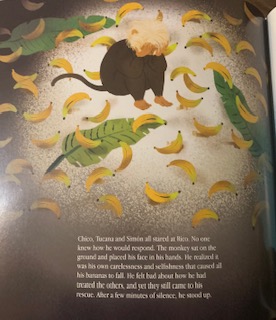
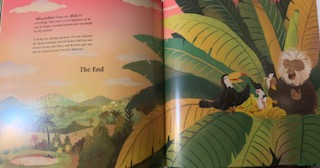
With all the bananas on the floor, many mushy and trampled, Rico has to decide if he learned a lesson, and how he will put his new knowledge into action, or if he will resume his life of ungratefulness.

IMG_1807

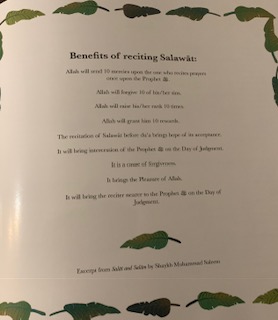
The book ends with each animals favorite banana recipe, information about the author and illustrator and benefits of reciting Salawat and an ayat from the Quran.

IMG_1810

The story and how it weaves Islam into the lessons is beautifully done, my only hiccup is the constant refrain of Rico counting his bananas.  I realize it is a fable, and maybe with talking animals interacting with humans, reality is notably suspended.  But, it seems misplaced to me.  How do you constantly count a perishable item? Does Rico only eat a certain amount a day? How many new ones grow a day? What is the number that he is adamant to have at all times? So, many questions, that I didn’t get why he was counting them, why he was irritated when he lost count, and why this detail was in the story and a big part of the story none-the-less.  Like the font, its a minor detail, but a distracting one for me unfortunately.  Clearly, however, I’m in the minority as the book has won the Moonbeam Children’s Book Award and the Islamic Writer’s Alliance Creative Story, so give it a read, and let me know your thoughts, jazakhAllah kher.

IMG_1809


The Boy at the Back of the Class by Onjali Q. Rauf illustrated by Pipa Curnick

Standard
The Boy at the Back of the Class by Onjali Q. Rauf illustrated by Pipa Curnick

boy at the back.jpg

A perfect introduction to the refugee crisis for upper elementary aged kids.  The story is told from the perspective of an unnamed 9 and 3/4 year old narrator about her friends and how the filling of an empty chair in the back of the room changed their lives.  Ages 7 through 12 will enjoy the plotting and planning of the friends, the awesome climax and the gentle opening of their eyes to the atrocities and bigotry around them.  At 297 pages, with a few pictures and some engaging notes and tidbits at the end, the book is both big, yet completely non intimidating at the same time.  

SYNOPSIS:

Right near the end we learn that the narrator’s name is Alexa, and not too much before that, I learned that she is a girl.  I kind of like that vagueness of it, especially as we also learn that she is half Indonesian and half Austrian.  You realize that it doesn’t matter, that it doesn’t change anything, and that we all bring our own assumptions to the story and learn a bit about our selves as the narrator’s identity is revealed.  But really, thats a tiny bit of the book, the book is really about a group of diverse friends battling bullies, bully teachers, and trying to help the new kid in their class Ahmet.

Ahmet is a refugee from Syria, but the information isn’t easy to establish, he doesn’t talk to anyone, he disappears at lunch and recess, so Alexa, Josie, Tom, and Michael, first have to figure out who he is, and how they can be his friends.  Along the way we learn the Tom is from America, the book takes place in England.  Josie is the best football player and her parents are nervous to have her interacting with Ahmet, Michael is incredibly wealthy and his parents are Nigerian and French, and Alexa lives with her mom a librarian who works really long hours, her dad passed away and money is incredibly tight.

Once friendships are established, Alexa learns that Ahmet’s mom and dad are missing and that his sister and cat died while fleeing Syria.  When she learns that the government is planning to close the borders to immigrants and refugees, the group of kids come up with plans to keep the gates open until Ahmet’s parents can be found and they can come to the United Kingdom.  The kids come up with a variety of plans, but “The Greatest Idea in the World,” is the one they decide to go with.  It involves a lot of danger, but the general gist is to get a message to the Queen of England, who will keep the gates open, find Ahmet’s parents and reunite the family.  

Naturally, there are a lot of moving parts to the plan, and a lot of naivety on the part of the 9 year olds, but they do get the Queen’s attention, and they do have a wonderful support system of parents and teachers and while their are bullies around every corner, they do come together to make the world a bit better for Ahmet and for us all.

WHY I LIKE IT:

I love that it is realistic, with the plotting, and understanding of war, alike.  The war and Ahmet’s journey is very very simplified, but the tone, introduces kids to the intensity without overwhelming them.  Just like the plot to get the Queen’s attention is not celebrated, but appreciated.  What the kids did was wrong and dangerous and they lied, and the kids don’t ever know after if they are in trouble or being praised.  I like that the integrity of both situations is upheld and the book doesn’t get too far fetched.  Similarly, the book is fun and adventurous, and in many ways Ahmet is just a catalyst for the kids to come together to solve a problem and save the day. 

There aren’t a lot of details about his life in Syria, because he doesn’t speak English, there isn’t anything about Islam, except he draws his mom with a scarf on her head.  But there is a lot of learning to accept each other, and stick up for whats right and to not give up on people.  I love the diversity of the friends and how they don’t expect each other to change, they accept each other and move along.  

There is a slight typo on page 3, “…could be half as useful as a Tintin’s dog, Snowy,” that had me afraid that this book was going to be unrefined, but alhumdulillah I was wrong.  The book reads easily and wonderfully, and my children loved it as much as I did.  The author is a first time writer, and I hope she has a bunch more stories in her, because I look forward to reading them.  

FLAGS:

The book is clean and reads believably from a 9 year old’s perspective.

TOOLS FOR LEADING THE DISCUSSION:

I would do this in an elementary book club in a heartbeat. I’ve suggested it to many and I hope to read it aloud to my 4th and 5th grade lunch bunch crew. It is well written, timely, and memorable.

Teacher’s Notes: https://www.hachetteschools.co.uk/wp-content/uploads/2018/07/The-Boy-at-the-Back-of-the-Class-Teachers-Notes.pdf

A bit about the author: http://beingthestory.org.uk/speakers/onjali-q-rauf


Raihanna’s Jennah by Qamaer Hassan illustrated by Yasushi Matsuoka

Standard
Raihanna’s Jennah by Qamaer Hassan illustrated by Yasushi Matsuoka

IMG_0047

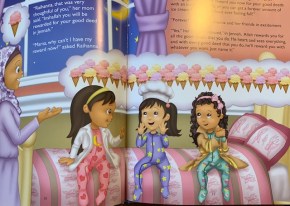
Raihanna is back and learning about Jennah with her two best friends, Safiya and her cousin Maryam.  In this beautiful 8×10 book, the character who last fasted her first Ramadan fast is now having a sleep over and learning just how wondrous and worth the wait heaven will be.

IMG_0048

The story starts with the three girls parallel playing as a veterinarian, firefighter and world class chef.  When hunger strikes and the cookie jar only has one cookie, Raihanna has to decide to eat it or divide it into thirds.  

With mom looking on as Raihanna decides to share, a teachable moment about jennah presents itself.  The mom, in her consistent purple uniform, tells Raihanna she will be rewarded in jennah for her good deed.  Which leads Raihanna to ask why she can’t be rewarded now.  The explanation is a bit text heavy, but using ice cream to explain a reward in this world, and having whatever you want in the next, sets up the format and story line for the rest of the book.

IMG_0049

The girls start off asking for pretty simple things like kittens and bikes.  But mom encourages them to think of something beyond their imagination.  The girls come up with castles and world’s made of candy, and flying like birds, and golden kitchens. 

IMG_0050

The mom responds virtually the same after each girl expresses what she would want.  She says, “…beyond your wildest dreams,”  then, “…beyond your imagination,” then “beyond belief,” then “beyond description,” then back to, “…beyond your imagination.”   It gets a bit repetitive, but not necessarily in a good way because it doesn’t function as a refrain that the little ones will pick up on.  It just gets annoying I think for the reader if the book is requested too often.  I wish she would have maybe picked one, giving the book a comforting pattern, and something that the young ones could remember and benefit more from.  The book is for preschool to early elementary kids, but because of the amount of text on the page, it will be read to that age group, not read independently.

IMG_0051

As with the first book, I love the warm colorful cartoonish illustrations, they both attract and engage children as young as two or three.  The hard back binding and glossy pages also make it sturdy and a wonderful gift.  This is a book for Muslim children that I think little girls especially will enjoy. I sincerely hope there will be more books in the Raihanna series.

A Very Large Expanse of Sea by Tahereh Mafi

Standard
A Very Large Expanse of Sea by Tahereh Mafi

avleos

The book is often marketed as a Muslim coming of age story in a post 9/11 world.  The contemporary work is semi-autobiographical, but really I think the positioning is a bit misleading.  It’s a love story, and the main character is Muslim, and her environment is awful and she is angry. Its an engaging read, I read all 310 pages in one sitting, but I don’t know that the take-away will enlighten anyone about Islam, or really what it was like to be Muslim in the years after 9/11, I think people will remember how sweet the couple is and wonder how much of it mirrors the author and her husband, author Ransom Riggs (Miss Peregrine’s Peculiar Children), but not suddenly become knowledgable about more than what the main character experiences and endures.   I appreciate that the book challenges the stereotypes of Muslim women, there is authenticity as it comes from a writer who lives it, and I do think it shows evolution of attitudes that teens can benefit from.  The book is not yet in the AR database as it just came out, but I would imagine high school and up.  

SYNOPSIS:

Shirin’s Persian-American family moves a lot.  Her and her older brother are incredibly close as their parents are rather aloof to the day-to-day experiences the kids endure.  That isn’t too say her parents aren’t around, they eat two meals a day together and the parent’s are warm, but Shirin’s brother Navid is a much more present.  The story starts with 16-year-old Shirin starting her 12th new school.  Conditioned to not make eye contact, remember faces, or get affected by the trivialities around her, the reader sees how angry she is as she curses at a teacher that assumes she needs ESL not Honors.  Knowing how fleeting her time in any location can be, as her parents are constantly trying to find better jobs, Shirin doesn’t feel compelled to make friends or get attached to anyone or anything.  This intimidating vibe similarly keeps offers at bay, for the most part.  When she gets paired up with Ocean to dissect a cat, he tries to talk to her, and this throws her off her game.  Most every interaction she experiences at school are people making racist comments and being very one dimensional and bigoted.  Ocean tries to be nice, an attitude so foreign to Shirin that it begins to force her to change.  Simultaneously, Navid, who is charismatic and has no problem finding friends wherever they go, decides to put his and his sister’s dream into action and they start a break dancing club at school.  Three other kids join, and start becoming, not just Navid’s friends, but Shirin’s as well.  

Shirin and Ocean fall in love, despite Shirin fearing what the backlash will be for ocean.  She doesn’t really know anything about him, but feels strongly that all the racial slurs thrown at her on a daily bases will effect him and ultimately make them wish they didn’t pursue a relationship. She draws line after line in the sand, and crosses them all.  Only then does she learn how blind she has been, he is in two of her classes, not just one, he is a year older than her, and he is the golden star of the high school basketball team.  Being that the story is told from Shirin’s perspective, this is surprising to the reader as well.  The town turns on the pair and things get really ugly for Ocean who is willing to risk it all for Shirin.  Threats by the basketball coach, pictures of Shirin without her hijab being taken, accusations of terrorist ties and sympathies all challenge the couple and shape Shirin.

WHY I LIKE IT:

I really like the twist of having the relationship be difficult for the non Muslim, rather than going with the assumed Muslim girl having to sneak around.  Not saying that I support it, but interestingly she never mentions that what she is doing is going against anything religious.  She mentions twice that her parents wouldn’t like her with any guy, and that they view her as a child still, but she doesn’t explore Islamically any boundaries regarding their relationship.  She hides talking on the phone to Ocean, because her parents are adamant she gets enough sleep at night.  That is about it.  Shirin discusses that she wears hijab like an armor that she gets to pick who she shows her hair too.  I love the strength in that, but wish there was a bit of doctrine to back it up too.  At one point a Muslim, non hijabi, at school calls her out for wearing hijab and having a boyfriend, but she essential tells her it is none of her business, which it isn’t and who is to say that one sin is worse than another, but still it befuddles what exactly Shirin believes and why.  The book just paints her as a Persian Muslim, but never explores what that means other than the superficial outward appearance.  They do fast in Ramadan, no explanation about why is given, just that they not eat or drink during daylight hours, and right near the end, Shirin remarks how her mom asks her and her brother every morning if they have prayed and they lie and say yes, their mother sighs and tells them to make sure they pray the afternoon one, to which they lie and agree, only to have their mother sigh again.  AstagfirAllah, that is awful lying, and lying about Salat, but it is so real, I audibly chuckled.  

I like that the parents aren’t harsh, they just seem disinterested.  I didn’t want to read another book about the parent’s being the gatekeepers and bad guys, so that was really refreshing.  They mention they don’t celebrate Christmas, but they have an open door policy on Thanksgiving for any friends wanting to come.  I did hope for a bit more about them, why they don’t talk to the kids about moving, what makes them tick, because really they seem to have a solid relationship with the kids, they are just clueless to their social experiences and school environment stresses.

I love the growth and self reflection of Shirin, she holds a mirror to herself and she and readers are better for it.  She has to realize that she is doing so much of what she is accusing others of doing.  I love the support and genuine concern of the breakdancers and her brother.  It resonated to me as a girl with an older brother and the relationship feels very genuine. I just wanted to know more about Navid. 

FLAGS:

There is a lot of cursing. kissing, hand holding, romance, lying, and ditching school.  There is a brief mention of graffiti being sprayed.  There is racial slurs, threats of violence, violent physical outbursts by people of authority.  When a student throws a cinnamon roll at Shirin, Navid and his friends beat the kid up severely, it isn’t detailed, but it is mentioned.  Ocean  also gets suspended for a few games for a fight he engages in, and there is some detail of Shirin getting jumped in a previous city for wearing hijab.

TOOLS FOR LEADING THE DISCUSSION:

I don’t think I could in good conscience present this to a group of Muslim students.  I wouldn’t want them to think I was endorsing the violence and language and romance.  Like so many books of the genre though, if someone found it and read it on their own, I’d love to chat with them about it, as it is well written.

Youtube video about the book by the author: https://www.hypable.com/tahereh-mafi-a-very-large-expanse-of-sea-tour/

Allah Knows All About Me by Yasmin Mussa

Standard
Allah Knows All About Me by Yasmin Mussa

IMG_0013.jpg

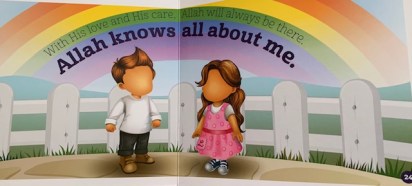
This adorable 24 page board book by Learning Roots has been adapted (with permission) from a book by Kate Toms called “God Knows All About Me.”  The 7.5 x 7 book is perfect for little toddler hands, and the repetition will help convey even to little ones that Allah is ever-present and all-knowing.

IMG_0015

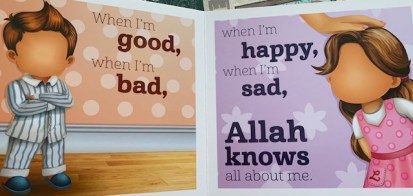
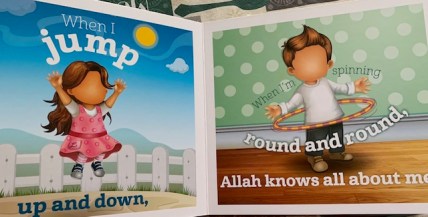
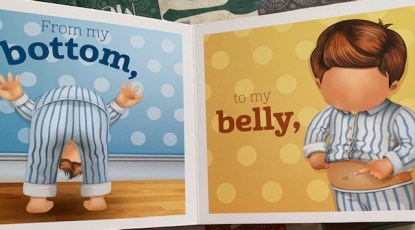
The illustrations are soft and warm and as with all Learning Roots books, I believe, the characters do not have faces.  The text is large and clear and many of the stanzas are silly is they show bottoms and talk of being smelly.

IMG_0016

It covers Allah swt knowing us from our heads to our toes, when we are happy and sad, when it is raining or snowing, in all situations, all hours of the day, all environments, He knows and is always there.

IMG_0017

The reassurance that we are never alone or never apart from Allah’s love is a great message that is well done in this little book. A mention of Allah’s applicable 99 names might have been a nice addition at the end, but perhaps being the book is redone from an existing book, it wasn’t possible.  Hopefully parents will take the book to the next step and teach kids all of Allah’s many attributes in ways similar to how the presence of Allah is presented in this one.

IMG_0018

A Race to Prayer: Sulaiman’s Rewarding Day by Aliya Vaughan

Standard
A Race to Prayer: Sulaiman’s Rewarding Day by Aliya Vaughan

a race to prayer

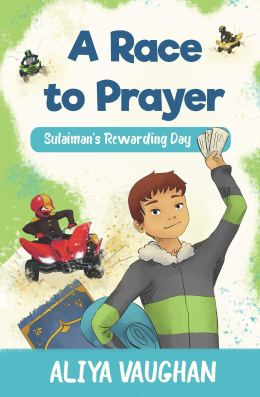
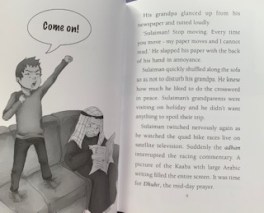
This 56 page (only 38 pages of story) early chapter book is a simple book with a lesson.  For kindergarten to 2nd grade readers the book could be a short story, but the added minuscule details (how he got in the car, slid over, and buckled up) and the illustrations, flesh the book out in to seven chapters with a note for parents/educators at the beginning, and sections of: evidence from the Quran and Sunnah, comprehension questions, inspiration behind the story, glossary and information on the author at the end.  The book isn’t bad, just kind of dry and bare bones.  Satisfactory for young readers that enjoy quad races, and ideal for those that whine whenever it is salat time.

SYNOPSIS:

Sulaiman loves watching quad races and playing football (soccer, the book is British), but feels like, “Every time I want to do something exciting, it either rains or it is time to pray.” one afternoon when he is feeling particularly grumpy, his dad offers to take him to watch the quad races at a nearby stadium.  Grandpa joins them and grandma sends them off with lunches and duas.  First the car won’t start, then they take a bus and wait in line.  Once they are inside the day looks up, the races are fun and then it is Thuhr time.  Sulaiman wants to wait until a break, but it is winter and the days are short meaning Asr will be approaching fast.  They go find a place to pray and when they return their seating section is closed.  Part of the roof fell in due to the rain.  Feeling fortunate that they had left to pray, Sulaiman sees the value of praying on time in this duniya.  They later are given better seats and Sulaiman feels blessed that they had gone to pray.

The story was inspired by a real event, according to the “Inspiration Behind the Story” at the end, where the author says that her husband was at a football match in Algeria when an earthquake struck.

IMG_0029

WHY I LIKE IT:

I love that the character is relate-able to most of our young Muslim children.  He is a good kid, but has a hard time stopping what he is doing to pray.  He has to be reminded to make wudu and brush his teeth.  I like that grandpa gets to come along, but I wish he would get to tell some of his stories, rather than just have Sulaiman shush him and be annoyed.  Similarly, I like that the dad is a “fixer” but some character development would have been really great.  I understand the reading age isn’t tempted by back story, but a little investment in the characters would make the climax that much more intense.  I was surprised by the roof falling in, but it snuck up so quick and was resolved equally fast, that I didn’t really feel it.

Also, I am not entirely sure what quad racing is. I mean I get that they are 4 wheelers racing on a stadium track.  But, I didn’t realize it was such a thing to be watching it on tv and then heading to watch it live nearby.  I’m glad I learned that kids dig it in Britain, but I’m thinking that it might be a little foreign .  A soccer match or another race, might have made the story a bit more appealing.

The book is for Muslims by a Muslim despite the glossary at the back. The pictures aren’t great, but they make the page breaks appeal to the younger kids.  The font, binding, and presentation makes for a nice looking and feeling book.

IMG_0030

FLAGS:

None, alhumdulillah.

TOOLS FOR LEADING THE DISCUSSION:

This book would be really great in small groups.  I can see it being used in Sunday schools or in Islamic schools, where Language Arts teachers and Islamic Studies teachers crossover to drive the importance of salat home.  I think this would easily inspire this age group to then write their own copy-cat stories of why salat is important.  The questions at the end could even make it like an extra credit novel study or a read aloud story with the questions used to verify comprehension.

Burcu: No One Wants to Play with Me! by Nursen Sirin illustrated by Nese Inan

Standard
Burcu: No One Wants to Play with Me! by Nursen Sirin illustrated by Nese Inan

IMG_2348

This 32 page, 9×12 story book, for ages five and up, focuses on character education and is meant to be a relatable story with clear lessons about how to behave and deal with situations in life.  The opening page bullets all the lessons readers should learn from the story and the end of the book offers directions to make a balloon craft.  

IMG_2354

I don’t mind books with lessons and morals so clearly delineated, and I like that the morals come from such an adorable character with a whole cast of supporters, and a number of books to her series.  

IMG_2353

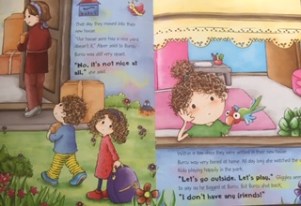
My problem is more the story itself, for a lesson on how to make new friends, and dealing with the universal struggle of moving and feeling like ‘no one wants to play with me.”  The book spends nearly seven pages on Burcu making a surprise breakfast for her family before hearing the news that she is moving because the landlord says they should.

IMG_2352

They pack and move seemingly the same day, and then the point of the book gets going.  Burcu has to say goodbye to her friends and doesn’t feel like even going out at the new house to make new ones.

IMG_2351

Her brother, Alper, has no problem making new friends, and finally Burcu gives it a try.  Only a little girl attempts to get to know her and Burcu dismisses her because she is so young.  She tries to be included with the other children, but they don’t know her and aren’t willing to let her play.

IMG_2350

Burcu finally confides in her dad, that she can’t get anyone except the little girl to play with her.  Her dad encourages her to give the little girl a chance.  Burcu does and finds out they are the same age, she just looks really young, and then all the kids are friends and happy.

IMG_2349

The real hero to me is the little girl, Katherine, who didn’t give up on an ageist Burcu that didn’t want to play with her.  Seems odd that Burcu wanted a friend, and then was arrogant to complain about the one she got.  Plus, I would imagine kids who have moved and don’t have friends, would turn to a book like this for tips and hints, and ways to feel less alone.  The book offers none of that.  It doesn’t tell how finally Burcu makes friends, or gets included, other than it took time.  Which is great, but not exactly helpful if you are five and crying everyday because no one will play with you.

The writing is very dry.  I think it has been translated from Turkish, many of the sentences are passive voice, and the sentences choppy.  The book doesn’t have any glaring errors, it just seems like it would work as a story time, or as part of a lesson, and  maybe once as a bedtime story, but not a book that kids will clamor to hear over and over again.

IMG_2355

There is nothing Islamic in the story, but most of the major online Islamic bookshops carry the Burcu series, so I would imagine the authors, and publishers are Muslim.

Overall, the book sets off to teach a great lesson, but falls a bit short.  The illustrations are adorable and the large size and playful font are very well done, the diction, not so much.  The books are reasonably priced and if you see a title that works for a lesson, or theme you are discussing, I think you can make the books work.  If you are looking for a book to read over and over to your kids, you might, however, be disappointed.


Whichwood by Tahereh Mafi

Standard
Whichwood by Tahereh Mafi

whichwood.jpg

I am admittedly late to the Tahereh Mafi fan club, and to rectify that I checked out all her books from the library (There’s quite a few).  Yeah, I have four kids and not a ton of time, so I decided to start reading Whichwood thinking then I could review it here due to it’s jacket claiming “Persian Fantasy,” plus noticing characters having names tinged with Islamic culture: Benyamin, Roksana, and Laylee Layla Fenjoon.  So, while I guessed the 368 AR 7.5 wouldn’t have anything Islamic, I figured it would at least give Muslim kids a taste of themselves in some of the words and representation by the hijab wearing author. And I think I was right. 

SYNOPSIS:

Laylee is a mordeshoor, which means she is responsible for caring for the dead and moving them to the next world. Its hard physical work, and since her Maman has passed away and her Baba has gone a bit crazy, the grueling job is left to her.  She is desperately tired and overworked and behind, and the people of the town, Whichwood, abuse and ridicule her relentlessly.  Laylee’s world is a frozen wonderland filled with odd characters and occurrences and magic of all random and gruesome sorts.  Two children, Oliver and Alice, from a different magical land show up unexpectedly to help Laylee with her burden, but Laylee is not well and is on the verge of death, and their help is not initially wanted.  As Laylee starts to die, it will take her living friends, with their variety of magical gifts to bring her back to life, and the dead ghosts that she can speak with, to help her live a life worth enjoying.

WHY I LIKE IT:

I love that Rumi is mentioned and quoted.  I love that words such as hamam and halva are tossed in, it gives flavor to a book that doesn’t need it, but is enhanced by it none-the-less.  The world created is so bizarre, that I was pleasantly surprised how the author kept the descriptions from becoming confusing albeit at times circular and tedious, the book starts out slow, but speeds up as you progress.  The narrator is telling the tale, and speaks often directly to the reader, which is a literary device that one doesn’t see that often in YA books, and I really enjoyed it.  It kept the book inline and avoided plot holes, as the narrator could just tell you how she knew and keep the timeline of the story intact.  

The characters are amazing.  Laylee is 13 and on her own, washing and scrubbing and pulling nails out of corpses before burying them in the frozen earth.  All while being harassed by the ghosts around her.  She has dropped out of school, the community doesn’t even pay her financially or with respect for the work she does, and yet she plugs along.  The reader wants to feel sorry for her, but there isn’t time, there is a lot going on.  Alice’s magic is she can color the world, and Oliver has the gift of persuasion.  Benyamin, Laylee’s closest neighbor on the peninsula, has insects and spiders that live in him and that he can communicate with.  His ailing mother can speak with whales, and rides inside them as a form of transport.  Yeah, it’s a bit nuts.  And because it is so fantastic, at times the story isn’t predictable or even really seeming to move to a clear climax, there is just so much to take in.  

I don’t really even know what to critique in terms of what I wish I would have seen or felt was lacking because there was no expectation.  The book is a companion book to Furthermore, which I think I will do as later as an audio book with my kids.  Perhaps once I read that one I’ll know more about Oliver and Alice’s gifts as the book is about them, as I do have some lingering questions about their whimsical abilities and backstories.  I would have also like a bit more on the mordeshoors, how they are trained, when they marry what enchantments that entails etc.  Seems like the concept in its most basic form could have benefitted from a little more detail.

The book is dark, and there is some darkness in Laylee, and I think that is what makes me like her as a character.  There are some emotions that she really has to work through, and I like that it is fuzzy and messy, I think the target audience of the book will really identify with some of Laylee’s internal struggles. The heart of the book is solid and is very grounded in reality even with all the fantasy on the surface.  I love that Laylee isn’t affected by what other’s expect her to be, there is amazing strength in this being brought to the forefront.  Also, the crystallization of giving someone what they need, not what you think they need is a lesson that will hopefully linger in the readers. 

FLAGS:

The book could be seen as grotesque, but I didn’t find it overly icky, I think middle school and up will  be perfectly ok with all the death.  Oliver is completely star struck and in love with Laylee and her beauty.  But, the book hints only at a future romance.  Similarily, Benyamin and Alice might have a future, but it isn’t mentioned more than a crush and isn’t dwelled on or annoying to the action of dead bodies coming out of their graves or anything like that.

TOOLS FOR LEADING THE DISCUSSION:

Author’s Website: http://www.taherehbooks.com/

A youtube review: https://www.youtube.com/watch?v=bgwtFqiFIi0

A Whale of A Wish by Razana Noor illustrated by Rahima Begum

Standard
A Whale of A Wish by Razana Noor illustrated by Rahima Begum

IMG_2254

I’ve seen this book on Amazon countless times, and not really been interested in a Prophet story written in rhyme.  It seemed like it would be overly forced and  there’s enough slightly creepy songs out there trying to be clever in their retellings, that I never added it to my cart.  But, when Noura over at Crescent Moon Store convinced me to take a look and hooked me up, I trusted her, and am glad I was so terribly wrong.

IMG_2255

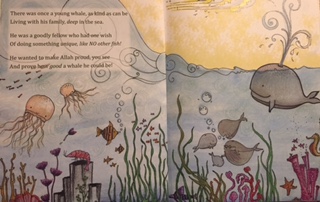
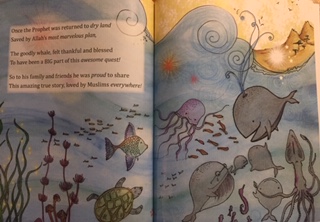
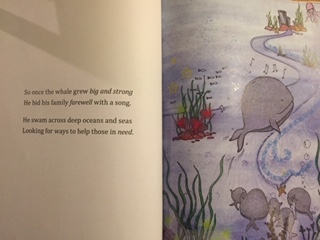
The story of Yunus (AS) is told from the whale’s perspective.  And shows how he always wanted to do something unique and swims around helping those in need.  He even befriends his foe, a giant squid.

IMG_2256

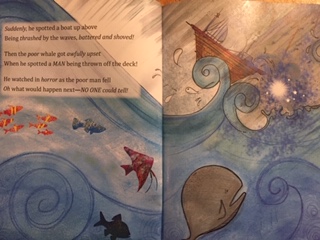
When he feels compelled to swim to the surface in the middle of the storm, Allah commands him to swallow Prophet Yunus and later commands him to return him to land.

The whale listens to Prophet Yunus praying all day and night and feels blessed to be part of Allah’s big plan.  His dua is also included at the end in english and arabic and arabic transliteration.

IMG_2257

The 18 page book is 8×10 inches in size and the illustrations are sweet, soft, happy and well done.  Children two and up will enjoy the story, and while it is meant for Muslim children, I believe Christian and Jewish children will recognize the story and with some oversight would enjoy it too.

IMG_2258

The rhyme is surprisingly not as forced as I feared.  On only one occasion the rhyme is a  stretch: squid, bit, but the meter is regular and flows easily making the story great for  story time and bedtime alike.