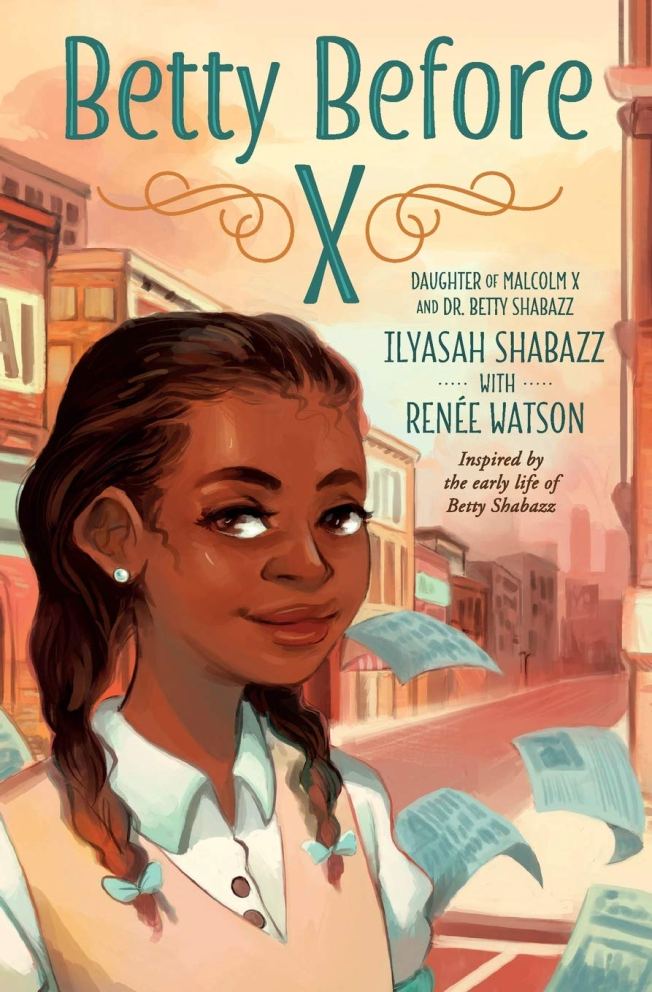
This 248 middle grades (AR 4.9) fictionalized biography of Betty Sanders, later to be Betty X and then Betty Shabazz, is the early years of her life in Detroit during the 1940s and how she understood her place in her family, and in the community. Written by her daughter, the book hops around to major events in her life and doesn’t detail a lot of the whys, but rather keeps an 11 year-old-perspective, allowing readers to identify with her family stresses and anger at the racial discrimination and violence that is rampant. Showing disagreements within the black community allows young readers to broaden their horizons and not see the civil rights as a monolithic point on a timeline, but something that is still ongoing and part of culture still today. There is nothing Islamic in the book, as this is a glimpse of her childhood long before Nation of Islam, her conversion to Sunni Islam or her Hajj, in fact the majority of the book focuses on her involvement in the Bethel African Methodist Episcopal Church.
SYNOPSIS:
Betty was born in Georgia, as the story goes, but before she was even a year old, Betty’s grandma took her away from her mother and gave her to her aunt, Fannie Mae, to raise. Having seen a bruise on the baby girl’s neck Grandma Matilda didn’t feel that the young mother was capable to care for Betty. Fannie Mae showered Betty with love and consistency and treated her like her own daughter. Betty saw her first lynching while in Fannie Mae’s care and the image stayed with her her whole life. When Betty was seven her aunt died and Betty went to live with her biological mother, Ollie Mae, in Detroit.
In Detroit, Ollie Mae has married and has three daughters with her husband, Arthur, who also has two sons. A full house that is religious and disciplined, but for Betty not full of love. She prays that her mother will look at her the way she looks at her sisters, but that never seems to happen. The family attends Bethel AME church and at age 11 that is when the story gets going. Betty and her friends sneak out of church to get candy and the cost will probably be a whipping. Luckily a few of the church ladies like Betty and realize how hard Ollie Mae is on her. They work to get Betty permission to hang out with girls her own age and try and convince her mother to let her join the Jr. Housewives’ League. Ollie Mae doesn’t agree with the work of the Housewives, a strong group of women that work to convince others to only support businesses that hire Negroes. This organization is a major division within the community and the church. Mrs. Malloy and Mrs. Peck are leaders in the organization, and one of Betty’s friends is for it, while another is against it. This rift affects Betty in many ways.
At age 11 Betty leaves home to go and live with the Malloy family. A husband and wife who have no children and own a shoe repair shop. One night turns into two and then she is living there full time and only seeing her siblings and mom at church on Sunday. She even gets to calling Mrs. Malloy, Mother. As she comes of age with a new family, and splintering friendships she seeks to make her own family with those that love her, and seeing violence targeted against blacks when a young boy is shot by police in the back, and working with civil rights activists- the icon and leader we know Betty Shabazz to be, is shaped and inspired.
WHY I LIKE IT:
I love that she gets her own story and own voice, not just to be left as someone’s wife. She is a force before she meets Malcolm and after he is murdered. Her story is shaped by so many outside influences, but ultimately it is her own and even in her early years the reader feels that. She seeks out those that love her the way she should be loved, but she doesn’t give up on those that try and leave her either. She fights for her mother’s praise and doesn’t abandon friends that believe differently than her, which is powerful to see from an 11 year old. She sees the world around her and takes a stand against that which is wrong, she feels and hurts and doubts, but she gets back up.
I like that she questions if what she is fighting for will make a difference, while simultaneously doesn’t want to take racism quietly. The day-to-day nuances flesh out the struggle of the civil rights and give a unique perspective that biographies that cover adult lives or larger portions of one’s life don’t necessarily spend time on. Seeing activism affect a young girl’s friendships will stay with readers, as well as how desperate she is for her mother’s love, just as seeing how she is treated on a shopping trip will create a sense of universal struggle that make equality in society resonate as being the responsibility of us all, not just those that are being oppressed.
FLAGS:
Racism, violence, murder, lynching, abuse, Betty being born out of wedlock.
TOOLS FOR LEADING THE DISCUSSION:
The book would work for a book club, and would definitely be a great historical fiction touchpoint to bridge with the Black Lives Matter movement. A classroom discussing Civil Rights and Malcolm X would perhaps get more value from it than a half hour lunch chat, but either way the book should be read, the ideas discussed, and people made aware of Betty Shabazz’s life.






















 Islamic School Librarian