Author Archives: islamicschoollibrarian

Before Birth, Beyond Life: A Muslim Mother’s Ode by Zenubia Arsalan illustrated by Heshan Gunasekara

Standard
Before Birth, Beyond Life: A Muslim Mother’s Ode by Zenubia Arsalan illustrated by Heshan Gunasekara

birthbefore birth

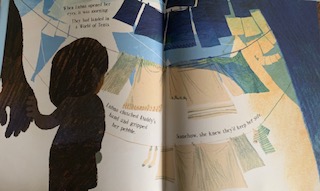
This 24 page book written in rhyme explains with love and Islamic oversight the circle of life.  From before birth and what happens after death, the tone and images of the book really are very beautiful and dream like.  The author suggests the book for ages 6-9, but I think even toddlers will enjoy the poetry and illustrations.

IMG_4378

The book is told from a mother to her child explaining that she is the answer to her  prayers, but that there is the One, the Creator, who knows and loves her even more.

IMG_4379

It details that everything about her is perfect and exact according to the will of Allah swt, even before her birth Allah knows and has decreed everything.

IMG_4380

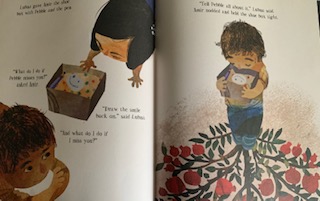
Once born, your mom loves and prays and watches you grow, but at an appointed time you, like all of us will leave this world for the next.

IMG_4381

And that in the afterlife, inshaAllah once again we will be reunited.

Children are rarely sad when loved ones pass away, often pointing out that they are with Allah Subhanawatala now, and this book stems from that peace and comfort in knowing there is a world beyond this one.  Not just for children, this book would make a perfect gift for expectant mothers or as a reminder for older kids in families suffering from loss.

I have the paperback 9 x 6 size book as I’m here in the US, but a larger hardback version exists elsewhere and I think the illustrations would benefit from the larger size.  Also, the pictures are a shoutout to Dubai and I think kids who have been there or live there will equally enjoy the skyline on a number of the pages.

There is a talking points ebook for the book that you can get for free at https://littlemutaqeen.com/talkingpointsbefore/ that will assist you in presenting the information and concepts explored to older and more curious kids.  It talks about how to broach potentially awkward concepts (pregnancy, birth, death) and a maintain body positive message, clarity of heaven and hell, and so much more. I highly recommend it.


Unlikely Friends by Sahar AbdulAziz

Standard
Unlikely Friends by Sahar AbdulAziz

unlikely friends.jpeg

Another wonderful book by a Muslim author that doesn’t discuss Islam, but is expertly written and such a great read, that I wanted to highlight it here on the blog.  At 293 pages and involving a teen character I was really on the fence if this would qualify as “young adult,” so I reached out to the author to ask, and she, mashaAllah, responded! Unfortunately, she felt it wouldn’t quite qualify, even though it is a bit of a coming of age story.  So, why am I still reviewing it?  Because I think high schoolers (muslim and non) would really enjoy the book, and with finals nearly over, anyone in that demographic looking for feel good story that is pretty clean (Ramadan is nearly here), I think this book would be a great choice! And full disclosure, yes I’m biased, the librarian is the hero!

SYNOPSIS:

Told from multiple points of view the linear story brings together two introverts, Irwin and Harper, that have a lot of real and serious issues pressing them.  Their traumatic back stories are slowly revealed as the two unlikely friends come together to deal with their current predicaments.

Irwin is an old ornery librarian that doesn’t like people or change.  He is set in his ways and the stubborn Harper, a young high school student for some reason latches on to him.  He tries to shake her, but finds he is genuinely concerned about her and despite his better judgement finds himself helping her and getting tangled in to her messy home life.  

Surrounded by a cast of developed and diverse characters the fictional world of Irwin and Harper is both believable and realistic.  Irwin’s author neighbor is losing her memory, slowly, but noticeably, his deceased fiance’s daughter passes away shaking his routine, and his colleagues at the library are funny and annoying in their own ways.  Harper’s father is released from prison and her mother must make a stand to resist falling into old drug habits, all while trying to make ends meet and put food on the table.

WHY I LIKE IT:

I like that it reads so very smoothly.  You feel Irwin’s shell cracking and you see that he is so much more than just a stereotypical grumpy old man.  You also see Harper’s mother, Olivia concerned that her daughter and an old man are becoming friends.  You probably could predict how things will end up, but the way it is written you aren’t really worried, you are just enjoying getting to know the characters presented.  Overall, it really is a great lens to remind us all that friendship, real friendship is incredibly valuable.  In a world of filters and digital everything, sometimes our humanity is all we have.  I also like that people are given the chance to change and grow, the group of main characters are not stagnant or one dimensional, their challenges and dilemmas are brought in to the open and you feel for them as you would a real person.

The only two questions that stood out as inconsistent with the characters and story development are why didn’t Harper just get a job to help out her and her mother’s financial situation? Plenty of teens have jobs, so that seemed a little off to me.  Secondly, Olivia works at a supermarket presumably or a market of some sort, so it would seem that an employee discount or nearly expired food section would make their food insecure situation a little less severe.  Granted its fiction, but these two jarring concepts seemed to hold me back from completely being swept away.  

FLAGS:

The book is clean in terms of what is explicitly conveyed.  The details that make it possibly/probably not suitable for younger readers are the drug histories of Harper’s parents and what they did to acquire drugs, what they did when on drugs and what was allowed to take place around Harper when she was a child.  Darren, Harper’s father, believes that Harper was sexually abused by someone when he was high and this memory haunts him.  It isn’t explicit, but it is there.  Some mention of Olivia waking up in dealer’s beds is again mentioned in passing, but not detailed.  One could imagine two druggies trying to raise a child and get their next hit, but a lot of the understanding will come from the prior knowledge the reader has of such scenarios, not from the text itself. 

There is the idea that physical abuse was common between Darren and Olivia and is shown in Darren’s temper when he throws a vase against a wall after coming to Olivia and Harper’s home when released from prison.

There is some mention of Irwin’s fiance’s relationship with her ex-husband in that he cheated on her regularly.

So definitely, the book has elements for older readers, but the way the topics are discussed: drugs, abuse, infidelity, are not glorified or even detailed, more they set the stage in defining the current conflicts the characters face, the pasts they must over come, and the environments that they want to improve upon.  I think 15 and up could handle it.

TOOLS FOR LEADING THE DISCUSSION:

I’m thinking to recommend this book to the Sister that runs the high school book club.  I think there would be so much to discuss and myths to dispel that an older group would benefit from the experience and work the author does and writes about in this book.

Plus the fact that the author so easily responded to me, might inspire a group of teenagers to reach out and be equally inspired.


I Love Ramadan by Taymaa Salhah

Standard
I Love Ramadan by Taymaa Salhah

IMG_3901

There is nothing wrong with this dual language book, but there it isn’t anything to get excited about based on the story alone, either.  If you are looking for a basic book with both English and Arabic telling what a little boy does in Ramadan, not elaborating on any reasons why he does them, then this book will adequately suffice.

IMG_3903

The book is just linear facts, I wouldn’t even say that it is information driven, as there isn’t really even a story, it is just a few simple sentences on each of the 20 pages of a boy telling in first person what he is doing.   “I finish my meal before athan alfajr and fast until sunset” it says on one page.   “When I hear athan almaghreb, I recite dua and break my fast with my family” it reads two pages later.  It does not define athan or almaghreb nor does it specify the dua.

IMG_3904

The book is on the dry side, but I would image the simplicity in the Arabic, might be what would appeal to parents looking for their kids to read and understand both languages independently.  I don’t speak Arabic so I’m unable to comment on the grammar complexities or smoothness.

IMG_3905

The illustrations are sufficient, again nothing super exciting or noticeably off about them.  The book is short, hardbound (8.5 x 8.5) and honestly, rather unremarkable or memorable, unfortunately.

IMG_3906

Shadow Magic by Joshua Khan illustrated by Ben Hibon

Standard
Shadow Magic by Joshua Khan illustrated by Ben Hibon

shadow magic.jpg

This book is fun and enchanting, whether you read all 321 pages and fall in to the occasional illustrations and pour over the map, or listen to the audio and get swept away.  It is an AR 4.1, and the first in the three part series.  Told by the point of view of two characters, the book’s short chapters and high action speed are expertly crafted to keep suspense and interest high, while maintaining solid world building events and making the character’s history come alive.  There isn’t anything Islamic in the books, save some critical and cleverly named characters and ideas, but the author in interviews has said he is Muslim, and that is enough for me to share a book I thoroughly enjoyed on this blog!

SYNOPSIS:

Thorn is a fugitive kid, on the run from something left intentional vague and possibly the son of an outlaw.  Raised on the edge of Herne forest (earth), he is good with animals, feels comfortable in nature, has a soft heart for doing what is right, and isn’t afraid of hard work.  He finds himself being sold as a slave to the executioner of Gehenna, Tyburn, and is off to Castle Gloom where he will meet and befriend the new ruler of House Shadow (death/darkness), Lily.

Lillith Shadow’s parents and brother have been murdered and she is now the ruler of Gehenna.  She is also still a child and events around her require her to grow up fast.  To end hostilities with House Solar she is to wed Prince Gabriel, a pompous idiot, who she despises in principle and in person.  

When an attempt is made on Lily’s life, Thorn and an unexpected ally, K’leef a Prince from the Sultanate of Fire, must work together to figure out who is trying to kill Lily, possibly who killed her parents, where Thorn’s father is, who is raising an army of zombies, and now how to get out of this wedding without causing continued war.

The history of the six founding houses that make up this world, and their elemental magical rules and limitations as magic dies out with each passing generation, come together and a tale is told that contrasts easy everyday language in a mystical proper world of royalty and dukes, colored by the dark of death and necromancy and shadows, while somehow remaining light, and funny, and completely relatable as the kids come of age and learn who they are and what they are capable of doing and accomplishing.

WHY I LIKE IT:

I love that the book is clean and that it has both Thorn and Lily’s perspectives to move the story along and give insight into the characters.  I love the world building and how the history of each of the houses is so well thought out and clear.  

“The whole idea of House Shadow is based on the Middle-East. Lily’s dad’s name is Arabic for the devil. Her mother’s the great villainess of the Old Testament and Lily is Lilith, a Hebrew demoness. The view people have of House Shadow mimics the fear the West has of East, and specifically Islam. For that reason all of House Solar is named after archangels. . . Some houses were easier to establish than others. House Djinn was fire as djinns are (out of Arabic lore) beings of smokeless fire. Herne’s an ancient English forest deity, so again a pretty easy fix” (http://www.cybils.com/2017/03/interview-with-joshua-khan.html).

A big plot point is that Lily is magical, and it is against ancient laws, meaning all six houses agree, that women cannot practice magic.  The irony is great, in that even kids can pick up on the fact that the six brothers and founders of the magical houses acknowledge that the source of their magic comes from their mother, a woman, and the hypocrisy of it all is frustrating.  I love that three very different characters have to work together, and pick their battles, it really is a testament to the strength of friendships even with people so very different than yourself.

FLAGS:

Pretty clean, not recalling anything cringeworthy as we listened to it in the car (kids ages 3, 8, 9, 12).  The book is dark in that it takes place in Gehenna and there is talk of the undead and bringing the dead back to life and they really celebrate Halloween in their own dark way.  There is murder and death and assassinations, but it isn’t overly morbid or gory or violent.

TOOLS FOR LEADING THE DISCUSSION:

I think I’ve already 90% decided to start next years middle school book club off with this book.  It is fun and engaging and the discussions would connect this fantasy story to so much in the kid’s lives and greater world that I get giddy just thinking about how fun a discussion it will be.  Sadly the school year is wrapping up and I’ll have to wait until fall.  Here are some of my favorite interviews online with the author:

http://www.cybils.com/2017/03/interview-with-joshua-khan.html

https://www.greenhouseliterary.com/authors/joshua-khan/

Author’s Website: http://www.joshuakhan.com/


R is for Ramadan by Greg Paprocki

Standard
R is for Ramadan by Greg Paprocki

IMG_3894

This book is fabulously fun, but incredibly puzzling.  The book without a glossary is presumably meant for Muslim children, with words like U is for Umrah and T is for Tasbeeh, and N is for Night of Power.  Which is interesting, because it seems to be written by a non Muslim, who writes and illustrates a lot of various alphabet books, and published by a mainstream company.  I’m sure this adorable book will appeal  to many non Muslims but after reading it, I’m fairly certain they will be 80% clueless as to what most of the letters are about.   Maybe they would be able to make a guess based on the pictures, but with the pronunciation for Arabic words being given underneath, it sure makes for an odd juxtaposition in a toddler board book.

IMG_3897

Additionally, if you are Muslim reading the book and can describe the Arabic to your 3-5 year old, you will possibly have to explain some of the “big” English words too.  H is for Hospitality, G is for Generous, O is for Obligation.

IMG_3898

Thrown in are also some completely silly, random letter prompts.  W is for Watermelon and Y is for Yay.  So, I probably shouldn’t like this book, but it is an absolute delight to look at and read through if you can account for all the aforementioned things.

IMG_3900

The illustrations are engaging and detailed and oh so happy and fun.  The book feels good in your hands reading it with a little one snuggled up beside you at 8.5 x 6.5 and 32 thick pages long. 

IMG_3896

I guess I can’t offer a finalized opinion on the book, just know what it includes (or doesn’t include) before you buy.  I was able to check it out at my public library, and online it is just under $10, so hopefully people won’t be disappointed with the purchase, if nothing else for the pictures alone.  But maybe don’t get excited to send it off to non Muslim friends and family this Ramadan, as it might not offer much in terms of understanding what the blessed month is all about.

IMG_3899

Yaseen’s Big Dream by Umm Juwariyah illustrated by Azra Momin

Standard
Yaseen’s Big Dream by Umm Juwariyah illustrated by Azra Momin

IMG_3404.jpg

Kids love to stretch their imagination and do the impossible, but for Yaseen Muhammad, his dreams at night are his favorite activity to see just how far his abilities can go.  In this 21 page paperback 8.5 x 8.5 square book, Yaseen Muhammad will imagine his best day ever as the President of the United States and share with kids 1st through 3rd grade exactly what he will make happen, inshaAllah, when he wakes up.

IMG_3401

In a very busy day as the first kid president, Yaseen Muhammad dreams of starting the day leading morning prayer in the Oval Office, and then getting his family to help him prepare a special lunch for everyone in every state.  He’ll visit schools all over America and play celebrity basketball with his cousin and vice President Jameelah. He’s Jedda will teach people to start their own gardens, and he’ll give a speech on TV, after all why not, “Nothing is Impossible.”
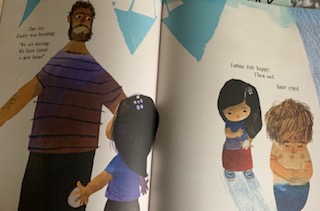
The pictures are lively and descriptive that the reader and listeners will enjoy looking at them.  The characters are visibly Muslim as the women wear hijab, and in the text it mentions the characters praying, and Yaseen Muhammad dreaming he is the imam.  There is a lot of text on the pages, but the story flows and the information serves a purpose in establishing who Yaseen Muhammad is and connecting him and his dream to the readers.  The text is uniformly on the right with the pictures on the left making the book very convenient if sharing during story time and you are like me and hold the book in your left hand when reading to a group.

IMG_3402

The only thing that struck me as off, was in the illustration of Jameelah and Yaseen playing basketball. Yaseen’s t-shirt has a Y on it and Jameelas an F. Not a J for Jameelah or a Y signaling they are on the same team.  It is minor, but all my kids noticed it too and wondered why.  

A couple of places I stumbled over some of the grammar and wording, but after reading it aloud a hundred times (exaggeration, slightly) to figure out why, I don’t think anything is wrong, it is just a bit awkward, but it is probably me.  For example when Yaseen is speaking to the whole world on TV he says “Every kid can make a difference in your community, in your state, in your country, and even in the world. Dream Big.”  Seems like it should be, Every kid can make a difference in “their” community, in “their” state, no?

IMG_3403

Overall, a good empowering story for all children and one that highlights African American Muslims in text and illustrations.  A great book to have in rotation to encourage kids to dream, make the world better, and believe in themselves.  Alhumdulillah.


Ayesha Dean: The Seville Secret by Melati Lum

Standard
Ayesha Dean: The Seville Secret by Melati Lum

seville.jpg

This is the second middle grade mystery story for globe trotting sleuth, Ayesha Dean, and much like her first adventure in Istanbul, this Spanish setting is infused with rich history, delicious food, relatable characters and quick paced action.  

SYNOPSIS:

Once again Ayesha and her two friends Jess and Sara are tagging along on a business trip with Uncle Dave, Ayesha’s uncle who has raised her since her parent’s passing.  As they wait in line to board the final flight of their lengthy journey from Australia, a young man drops his contents and Ayesha and him chat, later they are seated next to each other on the plane where he discloses his travels from England to Seville are to help locate his missing grandfather.  Ayesha volunteers herself and her friends to help him and they hit the ground in Spain determined to solve the case.

The boy, Kareem, is staying with the friends his beloved grandfather was staying with when he went missing, so that is where the detectives start their work.  In searching his room, Ayesha uncovers a 400 year old diary written in Arabic, and a pamphlet from the Archeology Museum with a necklace circled, the Collar de Pajaros.  Just enough to get them started and set their adventure in motion.

The group of teens rely on Kareem to translate the Arabic in the diary and Ayesha’s wit to decide what to follow up on and how to incorporate their sightseeing with the task at hand.  As they journey through the city of Seville, learning the history and tasting the food, nefarious characters start to notice the group and things get intense.  From Cathedrals, to cafes, to Museums, and even to an ancient city uncovered in Cordobo, Madina Al-Zahra, the chase is on, not only to find Kareem’s grandpa, but to also avoid being caught themselves and maybe even solving a centuries old mystery about treasure and a necklace along the way.

WHY I LIKE IT:

I love that Ayesha in any situation stays true to her self.  She wears hijab, she prays, she is aware of the good looking guy, but doesn’t cross her own line, she is a good friend, an inquisitive person, and confident.  All amazing attributes for a fictitious hero and real ones too.  

Much like Nancy Drew and other middle grade novel series, the books don’t need to be read in order, and while they reference other adventures, they stand alone sufficiently too.  Also, like the aforementioned books there is definitely a formulaic pattern to how the author writes her books.  And while reading it I didn’t notice it intensely, as I write the review I do.  Ayesha travels abroad, she has her sidekicks that are not developed at all and truly have no barring on the story plot wise or as comic relief, they are simply foils to bounce conversation off of, there is a cute boy who could be pursued, but isn’t, someone passes out while she and her friends are sight seeing, and the spouses provide added clues, Ayesha gets locked in a small dark space, there is a twist and a surprise, a trap, and they all live to repeat the adventure in another city another day.  I don’t think I have a problem with it, but maybe because I am not the target audience age, I might get bored with it about book four or so.  As it stands right now, I’m anxiously waiting for book three.

While reading I was a little irked that Sara and Jess weren’t any more developed in Spain than they were in Turkey.  One of them could have been the one to administer CPR or to stumble on the diary in the room, something to give them some plot significance, but alas, the books do not bare their names.  I wish Kareem would have at least said “Salam” on occasion.  I like that the author shows he doesn’t know much about Islam and shows that his grandfather admits its been so long since he has prayed, but the boy is a Morisco and his parents immigrants from Algeria, he translates Arabic, he should say Salam when he meets Ayesha in her hijab wrapped head. 

The author does a much better job in this book staying with the characters and showing the city through their eyes rather than pulling them out of their scenes to convey something.  Only once at the end of a chapter did I feel there was some forced foreshadowing that was not needed, as the book is quick and chapters may end, but the pages still turn until the end is reached.  I had more trouble putting the book down than picking it up, and that is saying something as I read it online and I definitely favor physical books.

I wish there was an afterword or author’s note explaining what was real and what was fiction.  I googled Madinat al-Zahra and found it fascinating, but couldn’t find anything in English about the Collar de Pajaros.  Also a map or two would be great.

FLAGS:

None.  This book is clean and even the fights are not gory or over the top. Yay!

TOOLS FOR LEADING THE DISCUSSION:

I would absolutely do this as an elementary book club selection, and can’t wait to get a copy to my children’s school library and their classrooms.  The book is an easy read and the history and culture is seamlessly interwoven in to the story that kids will enjoy the action and find they learned something about a culture along the way.   I think boys and girls will enjoy it, even if it appeals more to the girls.   The cover, the binding, the font is all spot on for the age group and I eagerly await Ayesha’s next adventure.


The Gift of Ramadan by Rabiah York Lumbard illustrated by Laura K. Horton

Standard
The Gift of Ramadan by Rabiah York Lumbard illustrated by Laura K. Horton

IMG_3804

A new 32 page hard back Ramadan book that shows a little girls excitement isn’t enough to get her to abstain from food and drink for the whole long day of fasting, but that there are other ways to enjoy the gift of the blessed month.  A great book that shows how Ramadan is a month of growing and learning and sacrificing and coming together too.  Perfect for ages 4 and up to be read in small groups or at bedtime.  The pictures are delightful and show diversity, and while the little girls love of sparkles might appeal more to little girls, I think the message will allow boys to enjoy and benefit from the book as well.

IMG_3806

Sophia is helping her family decorate for Ramadan and when they see the crescent moon, they know that fasting will start tomorrow.  Excited to be included Sophia can’t wait.  Sahoor, however, is really early and she is really tired.  She eats a little, but by fajr time she can’t even keep her eyes open and falls asleep in sajood.

IMG_3807

When she wakes up it is almost noon, and even though she is hungry she decides keeping busy will help the time pass.  Reading, cleaning, drawing, nothing is working.  Her little brother runs around waving a cookie, and Sophia can’t get away fast enough. 

IMG_3808

She caves and starts eating cookies, her grandma finds her and consoles her.  “There’s always tomorrow and the day after and the next.  You have a full month to keep trying.” The two then discuss other ways to enjoy the month.  Sophia knows her mom reads Quran, but Sophia can’t on her own.  Her father helps others and gives charity, but Sophia doesn’t have any money.  She is about to give up, but then sees her grandma’s hands covered in flour and realizes she can help her make iftar for those that are fasting.

IMG_3809

She helps with the salad and the pizzas for iftar, but when some of the pizzas burn, Sophia will have to show what she has learned and understood to make iftar a success and make everything sparkle.

IMG_3810

There are a lot of Ramadan books out there, but I like that this one doesn’t have the adults saying she can’t fast, but just the same grandma is there to encourage her to do what she can and take advantage of other parts of the month.  I also like that she doesn’t succeed.  Fasting especially on these long summer days can be hard and acknowledging that, and encouraging kids to persevere I think is a very valuable lesson.  Sophia also comes up with a way to help on her own.  Parents are tired and entertaining ways for the kids to be engaged in Ramadan is great, but can be exhausting.  This shows that kids with the right understanding of the month, inshaAllah can find ways on their own too.

IMG_3811

There is an Author’s Note at the end explaining Ramadan, and the book would work and appeal to Muslim and non Muslim kids alike.  Sophia reminds me a bit of Pinkalicious and Fancy Nancy and will probably appeal most to kids that also like those characters. The grandma covers her head, the mom does not, but does when praying and reading Quran.  It mentions and shows praying and breaking one’s fast with water and dates, yet stays focused on the story and does not get preachy or dry.


Who Will Help Me Make Iftar by Asmaa Hussein illustrated by Saliha Caliskan

Standard
Who Will Help Me Make Iftar by Asmaa Hussein illustrated by Saliha Caliskan

IMG_3796

This sweet story shows how even when people refuse to help, we should treat them with kindness, as our actions should be to please Allah alone, and inshaAllah in real life, much like in the story, people will fix their ways and offer their help in return.  This new story reads very much like the old(er) favorite Nabeel’s New Pants, where everyone is too busy to help, but then come around to realizing that helping one another is a way to show people we care.  This 32 page 8.5 x 11 soft back story is well bound with large glossy pages and clear text.  The story works well for ages 4 and up, as they will understand the moral message and inshaAllah feel inspired to find ways to help as well.  

IMG_3797

It is a 40 year tradition that Mustafa Amce and his wife Ayse Teyze feed iftar to their friends and families on the first day of Ramadan.  This year, however, Ayse is not well and Mustafa is confident he can enlist the help of neighbors and family to help him keep the tradition alive. 

IMG_3798

Unfortunately, everyone has an excuse.  His daughter is tired, his grand daughter is too busy with her video games and his neighbor doesn’t want to get his new shirt dirty.  Their sad reasons don’t stop old Mustafa Amce, and he makes the salad, and cooks the rice and beef by himself.

IMG_3799

When iftar time arrives, he offers sweet dates to those at the masjid and invites everyone to come to his courtyard to break their fasts together.  All those that had early refused to assist him feel incredibly guilty and don’t want to take advantage of a lovely meal. Mustafa reminds them that, “God loves those who are generous especially to their families, neighbors, and guests.  and I always want Got to love me.” So they join in the delicious meal.

IMG_3800

After food Ayse Teyze shows that while she might be ill, she can still save the day when her husband realizes he has forgotten to prepare dessert.  The guests then offer to wash the dishes and sweep the floor and take the leftovers to the poor.  And best of all when the athan for isha prayer calls out they all without prompting stand to join Mustafa Amce in praying salat together.

IMG_3801

The names are Turkish with a pronunciation guide at the end, as well as a paragraph about Ramadan.  The book would work for non Muslims and Muslims alike as the story is set in Ramadan, but more about coming together to help out.  The illustrations are large and detailed and descriptive.  You see the warmth between Mustafa and his wife as well as the apologetic feelings from those that were unwilling to help. 

IMG_3803

Forgiveness by Isa Beaumont

Standard
Forgiveness by Isa Beaumont

IMG_3669

This dual language book, is structured and feels like a leveled reader, but is more geared for fluent reading five to seven year olds.  It definitely has more complex diction and vocabulary than an emerging reader would be able to handle in English, I have no idea about the Arabic.  

SYNOPSIS:

The concept in 26 pages is how to forgive others and react calmly when we are upset.  The book is brightly illustrated on glossy sturdy softbound pages, and the characters are found in all of the company’s stories and plush figures at https://www.littlemaysoor.com/

IMG_3670

Little Zakariyyah has been behaving well, and as a result his mom gets him a new red toy car, he loves it and plays with it in the garden everyday. His sister Ruqayyah wants to play with it, he agrees and when he hands it to her, she accidentally drops it and it breaks.  In anger Zakariyyah begins screaming for her to “Go away from me!” Mom comes out to see what is going on and calm everyone down, she takes Zakariyyah inside and pours him some milk.  When she hands it to him, his hand slips and he drops the glass breaking it and making a mess. Mom forgives him and obviously highlights the similarities to what just happened with his sister and the toy car.  Mom then gently guides him to acknowledge his poor behavior and asks him what he things he should do.  Zakaraiyyah knows he needs to ask Allah swt for forgiveness and then apologize (apologise) to Ruqayyah.  Once he does this, his sister shares some sweets with him and reminds him of a hadith, “The strong one isn’t he who can overpower others.  Instead, the strong one is he who can control himself when he becomes angry.”

IMG_3671

WHY I LIKE IT:

Before the story begins there are six points you can implement before reading the story, and after the story, there are beginner and advanced concept questions and a place to write the answers provided.  The book has an agenda and it achieves its mark in showing a moral concept in an Islamic framework.

The book is written in British English which could make the spelling a bit confusing for new American readers, but manageable.  I honestly don’t know if the book was written in English then translated to Arabic or the other way around.  Some of the wording seems awkward so it could be attributed to it being translated from Arabic or it might just be the American/British difference.  For example Zakariyyah loves playing in “a small sand pit for children,” why not just say, sandbox? Again not terrible, but rationale for why I think children sounding out words might be a bit young for the target audience.  

I liked the story and how it lets the reader see the similarities to the events that unfold, just like I loved that the mom asked Zakariyyah what he should do, rather than dictate or scold him.  I was surprised when I read it, how smooth the ending was, because it really could have had Ruqayyah come across as a know-it-all and it didn’t.

The beginning of the book stumbled a bit with the set up trying to tell about Zakariyyah, why he got the toy and then staging the plot of the book.  If he had been playing with the car everyday, is it still a new car? Also the illustration before he drops the milk has him sitting at the table with a glass a milk in front of him.  Sure, maybe it was the second glass that he dropped, but it’s noticeable.

IMG_3672

FLAGS:

Clean

IMG_3673

TOOLS FOR LEADING THE DISCUSSION:

The book is obviously too short for a book club per se, but I think if you had a small group of readers, or are home schooling, you really could ask a child to read the book and then reflect back what they understood and what they learned and how they hope to put it in to practice.

Even with not reading the Arabic, the book is pretty solid in its approach and I plan to check out the other books in the series as I do a lot of story times with basic morals as themes.