Tag Archives: War

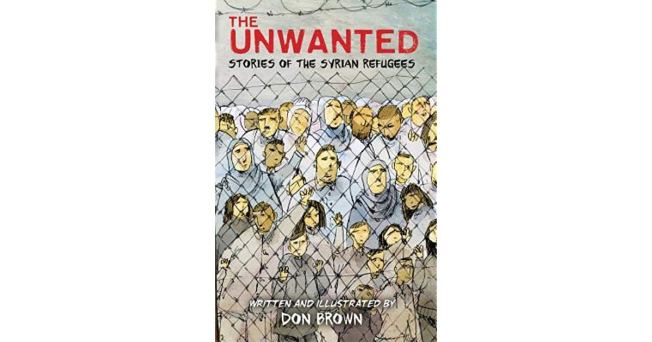
The Unwanted: Stories of the Syrian Refugees by Don Brown

Standard
The Unwanted: Stories of the Syrian Refugees by Don Brown

unwanted

I try and keep an eye on what is available at Scholastic regarding Muslim characters and Muslim authors since for many kids the Scholastic Book Orders might be the most interaction they have with seeing available books, and for others, they may see a book in a library or other book store that they have seen on a Scholastic flyer and pick it up for that reason of familiarity.  Granted I might be completely wrong in this assessment and just be trying to justify my review of a non fiction 103 page AR 5.7 graphic novel that talks about Muslims and refugees, but nonetheless I try and read the Scholastic books that feature Muslim representation to a very captive audience.
IMG_6981

SYNOPSIS:

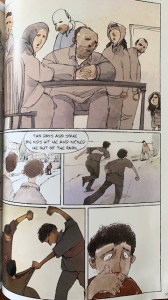
The book takes facts about the plight and flight of the Syrians as they are forced to leave their homes due to war, and the horrors they face on their journeys to finding a new place to call home, and illustrates them.  The book focuses more on the exodus than on the politics that forced them to leave.  There are no characters or story lines, but rather illustrations to the headlines, articles, and facts that detail the truths about the collective experiences of many Syrians.  It seems every single sentence is referenced at the back of the book, which is probably a good thing as it is non fiction and this is a researched book, not a book of anecdotal stories or an OWN voice retelling.

IMG_6985

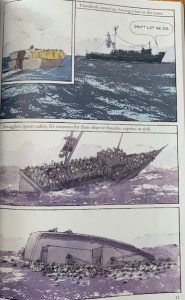
The book in muted tones tells how the young boys scrawling graffiti is what is attributed to the spark that set Syria ablaze with frustrated citizens standing up to an oppressive regime.  The pictures show different factions policing the people for trying to have pianos, to kicking people out of the homes and torturing them or killing them.  As the situation elevates and no end is in sight the book, then follows people leaving by foot into neighboring countries, and then fanning out as border countries refuse to let more people stay.  Eventually, many are forced on to rafts to countries further away, but as their resources deplete, many Syrians have no where to go and are unwanted.
IMG_6984

WHY I LIKE THE BOOK:

I like that it is real and graphic and violent, it doesn’t show everyone getting a happy ending.  I think many children’s books focus on the heroes trying to help or people having a happily ever after, but by upper elementary, readers need to know that the situation is dire and no resolution is in sight.  The author tries to explain the Sunni and Shia differences by using Christian divisions as examples, and he shows jihadists torturing people, and he does use statements about Islam and music, and I don’t know how a child would take these labels as they don’t come with much explanation.  On the other hand he does highlight that some countries would only take Christian Syrians, so I don’t think he is advocating one faith over another, but the details about Muslims for some reason seemed a little forced to me.
IMG_6983

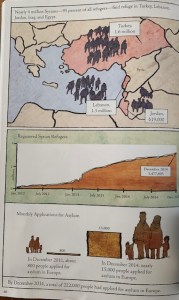
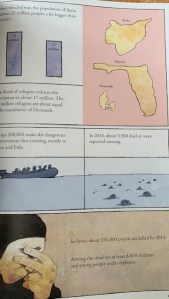
I think his agenda or purpose was to show how the world, with the exception of a few countries, have really turned their back on refugees.  It says in a footnote at the end “that in the first three months of 2018,” for example, “the United States has accepted 11 (refugees) for resettlement.” The facts, the maps, the diagrams, really drive home the point and do evoke an emotional response, which I think is needed.  A few of the pictures are also incredibly resonating, such as the one of the man stating he couldn’t save his family from drowning.

IMG_6992

FLAGS:

The book shows violence and death.
IMG_6982

TOOLS FOR LEADING THE DISCUSSION:

The shortness of the book, might not make it an ideal candidate for a Book Club, but the value in such a book makes it a great addition to any and every classroom.  I don’t know how many children will read this book on their own.  It isn’t fun or compelling, its factual and depressing.  But, I think it is important.  Nonfiction is often hard to convince children to read, so I like that it is a graphic novel and I like that the information can all be verified.  I think children need to be encouraged to read things that might not be easy and fun, and have a way to discuss how such readings make them feel.  Furthermore, If you are a teacher teaching references, this book is a great example.


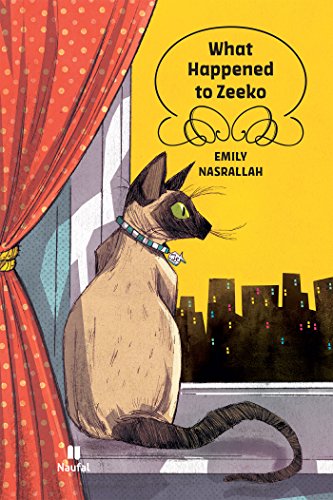
What Happened to Zeeko by Emily Nasrallah illustrated by Maha Nasrallah Kays

Standard
What Happened to Zeeko by Emily Nasrallah illustrated by Maha Nasrallah Kays

zeeko

Told from a cat’s perspective about living through parts of the 1982 war in Beirut, this translated from Arabic young adult book is 121 pages.  It reads to me more like a middle grades book, and while the story is fairly monotone and anticlimactic, I find myself oddly thinking about it and wondering about everyday events from different perspectives.

SYNOPSIS:

Zeeka as a young kitten is taken from his cat family and placed with a new human owner, Muna, a young girl who loves and cares, and seemingly understands her new furry friend.  The relationship between Muna and Zeeko is really the crux of the book as they get to know one another, trust one another, vacation in the mountains together and then seek refuge in the basement shelter of their building when the shelling starts and the bombs destroy the neighborhood.  

Through the relationship details, the reader learns a lot about what kind of person Muna is and why Zeeka is willing to perform a heroic act to try and help her escape the danger, while sacrificing his own comfort.  

WHY I LIKE IT:

I don’t know that I loved the book, but it was a quick read that I don’t regret spending time with.  It is translated from Arabic, so there are some hiccups, but nothing that impairs the story continuity or comprehension.  It almost starts out like an early chapter book with each chapter being two pages long.  But then all of a sudden a neighborhood cat is murdered by a group of naughty boys, and you realize that it is not for younger children. 

How the book handles war however, is very removed and not really detailed at all.  Much like The Cat at the Wall for about the same age group, the use of an animal to simplify the absurdity and details of war is used to show a different perspective, however, in this book there is no information given about the war.  The reader is never told who is fighting, why they are fighting, what sparked the fighting, nothing.  All we know is that there is fighting.  

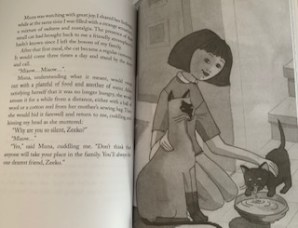
There is no mention of religion in the book, and I have no idea of the author’s faith, there really isn’t much culture in the book either. I didn’t learn much about Lebanon or the food or traditions.  I got the book from www. crescentmoonstore.com/ so I thought to review it as it seems available on Islamic websites.  Every dozen pages or so there are illustrations and sometimes there is a blank page before each new chapter and sometimes not.  There is a table of contents at the end of the book.

IMG_5938.jpg

FLAGS:

Murder of a cat, violence in general in terms of bombing and micro level of bullying and threatening.  

TOOLS FOR LEADING THE DISCUSSION:

I wouldn’t do this as a book club book, but I think if you are looking to learn more about Lebanon or point of view this book would have a lot of potential with guidance.  From a literary creative writing perspective the book would be a great tool to present complex events in simplified ways, it also would be a great read to get students to just look at things from different points of view.  If you have students that love cats and can handle the war aspects, this book would be fun for them.  In a social studies class if you are discussing affects of war or learning about Beirut in the 80’s the students will be able to fill in the gaps historically and politically.

IMG_5937.jpg


The Tower by Shereen Malherbe

Standard
The Tower by Shereen Malherbe

the tower

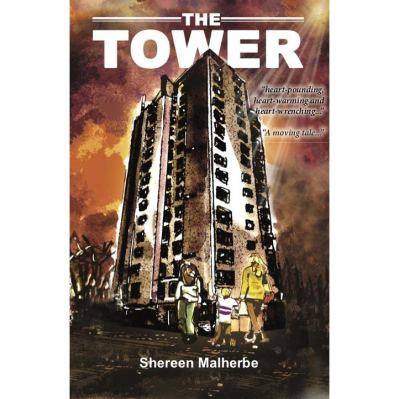
At 246 pages I’m not sure if this book would be classified as Young Adult, but I think it could be, as its message, focus and presentation makes it a valuable thought provoking read.  And the cleanliness of everything being resolved so neatly might almost be too coincidental for older, more jaded readers, where I personally wasn’t too bothered by how much emotional action was packed in to the book and how quickly it was resolved as the characters were compelling and the pacing made it an enjoyable quick read.

SYNOPSIS:

The story follows two women, Reem and Leah as their very different worlds and circumstances come together when they move in to the same apartment building.

Reem is a Syrian refugee whose past is presented in bits and pieces as her fragmented memories surface in the story.  She is searching for her 10 year old brother Adar, as well as trying to create a future for her self in London.

Leah has recently lost her husband, left her training as a doctor, and is trying to make a life for her and her son, Elijah, away from her parents’ shadow of expectation and demands.

When the two ladies meet, neither is completely settled or functioning, yet the desperation each is feeling causes Reem to ask for Leah’s help, and Leah agreeing.  The two become friends as they share parts of their world with one another and slowly start to heal.

Then Reem’s secret pregnancy comes to light, her abusive husband finds her, Leah’s posh friends abandon her, and their apartment building, the tower, catches fire.  Granted it doesn’t all happen that quick and there are lots of details that make their pasts, their friendship, and their goals for the future believable and inspiring, as well as making the pain for those lost in the fire emotionally wrenching.

As the two women once again try and survive hardship, this time together, they make progress before a terrorist attack on the mosque again sets them back.  Through all these major plot points details about how Reem got to England, and the atrocities she suffered that her mind blocked out are made clear.  Additionally, more about Leah and her families involvement in the tower fire and their friends’ involvement in human trafficking all tie the lose ends up. In the final pages there is hope and resilience and respect from the reader for the brave characters brought to life and their determination to persevere.

WHY I LIKE IT:

I love that it is a very personal, character driven story about a horrific fire, reminiscent of the Grenfell fire which claimed the lives of over 70 people.  I also absolutely love how Islam is presented.  The Muslim characters are tangibly real.  Reem wants to fast because it is Ramadan, but has the excuse that she is pregnant, but tries anyway.  She prays, she covers, she meets a Muslim that doesn’t cover, but they pray together at the mosque later and become great friends.  Leah is interested in Islam and asks questions and when she cooks for her Muslim friends she gets halal meat.  There is an amazingly helpful character Mo in the story who Leah is crushing on, but he refuses to be alone with her, or touch her, and when she tells him of her feelings, he says that everything she likes isn’t him it is his religion.  Leah and Reem discuss how the sunnah’s of the Prophet influence Mo and his brother and it is quite detailed.  Quranic ayats are quoted in character’s dialogues in natural presentations, not preachy or misplaced.  It hints at the end, when Leah has joined Doctors Without Borders and is in the Middle East that perhaps she has taken shahada, but it isn’t a plot point and isn’t mentioned explicitly.

My biggest complaint about the book is the random foreshadowing that pulls out from the story to hint that something more is going to happen between certain characters or be of more importance later.  I think it happened three times, and each time completely unnecessary. The story and characters and writing are clear and done well enough that needing the hint sells it all short and it wasn’t just annoying and irritating, it really kind of made me mad.  Here I was feeling an attachment for a character or what they were experiencing only to be reminded that there will be more, rather than letting me go along for the ride with the character.

I also was bothered by the font and spacing.  It is really tight on the pages, but with big margins, that a little breathing room would have been nice.  So, much happens in the book, that I wanted to be able to relish in each event and often I felt the presentation made it rushed and I found myself skimming, more than I would have liked.  I would have also liked to know what parts, if any, were based on or inspired by real events: the tower fire, human trafficking, stealing organs, artifacts coming out of Syria, refugee treatment in London, etc.

FLAGS:

There are memories of war and dead bodies.  The stealing of organs and dumping of bodies into the ocean.  There is a lot of death after the fire and after the shooting at the mosque.  There is a lot of blood, a terrorist act, a baby being delivered, a drunk man at a party.  Nothing is overly sensationalized, but it is a gripping book with some intense moments.

TOOLS FOR LEADING THE DISCUSSION:

I don’t know if middle school can handle the book, the characters are older, so it won’t resonate with them like a traditional YA book would, but I’m tempted to have my almost 13 year old read it so we can discuss.  I will most definitely suggest it to the high school book club adviser as there is a ton to discuss and relate to in this action packed book.

Author’s website and Q and A: https://shereenmalherbe.com/


Lubna and the Pebble by Wendy Meddour illustrated by Daniel Egneus

Standard
Lubna and the Pebble by Wendy Meddour illustrated by Daniel Egneus

lubna.jpg

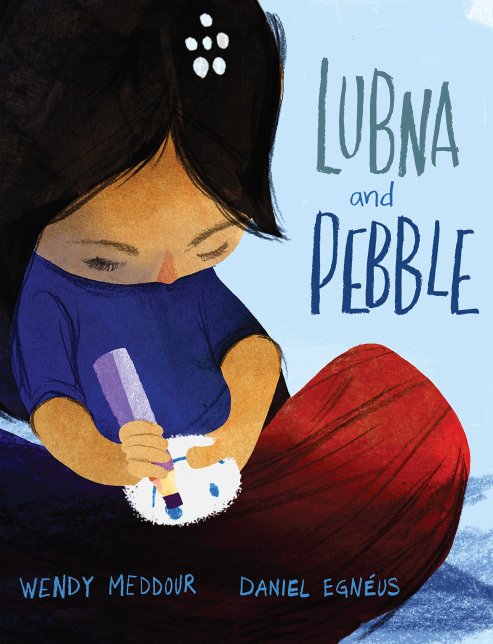
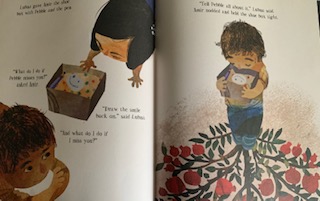
This beautifully illustrated book with simple text and story, is heartwarming and powerful in conveying emotion about child refugees. 

IMG_4993

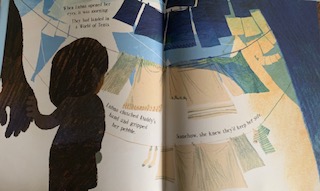
The 32 pages tell the story of young Lubna who has escaped something horrible and picks up a pebble when she and her father reach their new home, a World of Tents.  She finds a felt tip pen and draws a face on the pebble and the pebble becomes her friend.  She tells it her secrets, her dreams, she keeps it warm as winter approaches.

IMG_4994

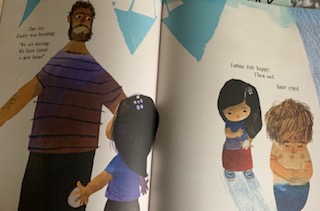
Then a little boy arrives, Amir, and Lubna and he become friends and she introduces him to Pebble.  One day Lubna learns she is leaving the tents to go to a new home and even though Pebble is still her best friend, she knows Amir needs him more.

IMG_4995

This book is truly a picture book, as the text is made magical because of the pictures.  The simplicity and love that Lubna feels for a rock reveals how much pain she has seen without details having to be given.  The fact that Amir doesn’t laugh or find being friends with a rock odd, cements the idea that these children have seen too much.  The compassion that Lubna displays by passing on her beloved Pebble also shows how much love and comfort they have, we all have, to give.

IMG_4996

The book has many layers, and the superficial one makes it a sweet story for children as young as four, the deeper understanding would appeal to kids up to 2nd or 3rd grade.  There is no mention of religion, culture, or a specific country.  I think Muslim children will assume Amir and Lubna are Muslim, but really the names could be from any culture or faith.

IMG_4997


From Far Away by Robert Munsch and Saossan Askar illustrated by Rebecca Green

Standard
From Far Away by Robert Munsch and Saossan Askar illustrated by Rebecca Green

from far away

Robert Munsch is a staple in most classrooms and libraries, but somehow, much to my embarrassment, I just learned about this book.  Originally published in 1995 with a different illustrator, I read the newer version that was rereleased in 2017.  I’m not sure how they differ, but they stem from an autobiographical experience of the co-author Saossan Askar, and her leaving of the war in Lebanon.  She wrote to the author and their letters back and forth are how the book came to fruition. 

IMG_4986

The 24 page picture book is an AR 3.5 and my guess it is because of the content a bit more than the reading level.  While it never gets graphic or sensationalized, she does leave a war zone of bombs and shootings, and the words may trigger fear in younger children.

IMG_4987

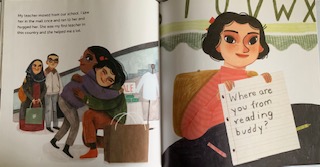
As the book progresses, the focus is much more on Saoussan settling in to her new life and the hiccups along the way.  From not knowing what anyone is saying, to sneaking out of class to go to the bathroom, and being frightened by a paper skeleton.  The book gives concrete examples that while silly, really show how someone unfamiliar with a new culture could be very confused and even scared.  

IMG_4989

The book has a happy ending with Saoussan adjusting and making friends and even becoming the best reader and speller in her class.  She also gets in trouble often for talking too much.  

IMG_4990

The book, like many in the genre of discussing war and refugees on a child’s level has its strengths and weaknesses.  The heart of the story I would say is wonderful, the illustrations lively and engaging, some of the transitions and details, however, are a bit abrupt and unsatisfying.  Once you know that it is based on reality and came about through letters, it makes more sense, but even that is a concept older readers will appreciate more than younger ones will.

IMG_4991

I checked the book out from the public library and I think does a great job of inspiring empathy.  It is vague as to what conflict is being left which makes it timeless in that I, unfortunately don’t see refugees disappearing soon.  The mom wears hijab, but there is no mention of religion in the book.

Here are the letters from his website: https://robertmunsch.com/book/from-far-away

From Far Away started with this letter:

To Robert Munsch
I am a little girl. My name is Saoussan. I am seven years old. I am in grade two now. I came to Canada one and half year ago. I didn’t know how to speak English at all. I was just sitting and listening. A lot of funny things happened to me.

Children were trying to talk to me, but I was not able to answer them. I began to talk a little by little.

I finished grade one and now I am in grade two. The teacher now is complaining to my dad that I am talking a lot in the class and I read and write a lot of stories.

One day I found a book called Thomas’s Snowsuit. I read it and I laughed with my family.

I went to the library and I brought some of your books. I enjoyed reading them. I even read them to my dad that he laughed so hard he could not stop laughing.

Please come to our school we want to hear a story from you and we want to see you.
I wrote back and asked her what “funny things” had happened. Saoussan wrote back telling me about her first Halloween in Canada:
To: Robert Munsch
Thank you for your letter. My teacher read it to the class and he said: I am not going to tell the class the funny thing that happened to her when she was in kindergarten and I am not going to embarrass you.

I don’t remember all of the funny things. But I remember one thing.

When I wanted to go to the washroom I didn’t know how to say I want to go to the washroom. That’s why I used to crawl to the door and when the teacher turns her head and looks at the other side I crawl under my friend’s desk and when someone opens the door I crawl out and go to the washroom.

When I come back from the washroom I wait beside the door and when someone opens the door I crawl in and go to my desk.

Once I crawled to the washroom. When I opened the washroom door I saw a skeleton. Then I screamed: Aaaaahhhhhhhhh!

Everybody came out. My teacher, Mrs. Garwan came, opened the washroom door and she tried to tell me that it is Halloween time and the skeleton is paper.

I didn’t understand her and I didn’t know what Halloween is.

She jumped up and down and danced around to explain to me that Halloween is just fun, but I thought the skeleton made her crazy and I screamed louder.

Then she hugged me to make me feel better and I jumped on her lap and the pee went down my knees. She put me down because she got wet.

Now I am in grade 2/3 and I am the best reader and speller in the class. This year when it was Halloween I weared a mask and a costume and we did a party at school. Then I went with my sister trick or treating to the neighbours.

Please, please, please, please, please, please, please, please come to our school.

I liked her letters so much that I decided to turn them into a book.

So Saoussan and I wrote a lot of letters back and forth and we made the letter into a book. Saoussan and I are both the authors and we split the royalties.

Other Words for Home by Jasmine Warga

Standard
Other Words for Home by Jasmine Warga

other words for home.jpg

Three hundred and forty pages written in verse that beautifully consume you and leave you emotionally changed and vulnerable and humbled all at once.  The book claims it is for middle grades, but I think middle school will appreciate it more, and I sincerely hope everyone of all ages will take a couple of hours to fall under the spell that is woven to tell a story of a refugee leaving home and starting anew in America.

SYNOPSIS:

Jude is a 12 year old girl living on the beach in Syria, watching American movies with her friends and hanging out at her dad’s store.  With an older brother and a little sister on the way, life as told from her own perspective is pretty good.  Until it is not.  Until the crimes they only hear about happening in Aleppo and Damascus start to hit closer to home.  Until her brother starts sneaking out to meetings with other youth hoping to change the politics of their country.  Until a raid almost catches Jude and her brother and her parent’s decide it is time for Jude and her mother to journey to America, for a little while, to visit her mom’s brother and deliver the baby.

America is not like it is in the 90’s movies that Jude loves: Pretty Woman, Legally Blond, Miss Congeniality.  Her American aunt and her Uncle that seems to have forgotten his Syrian upbringing, are gracious and welcoming and their daughter, Sarah, who is less than a year older than Jude waxes and wanes in her approach to her cousin.  Adjusting to school, life without baba and her brother, and all the other adaptations that moving to a new country entail are brought to life through Jude’s eyes and understanding of the world around her.  As she comes of age and decides to wear hijab, as Islamaphobia shakes her sense of justice, and her little sister is born, the reader sees her grow and change and mature and find themselves hoping that she will soar.

WHY I LIKE IT:

I love that the style of the story telling somehow gives life to so much.  With verse some things are highlighted in detail and other things skimmed over and yet at the end, not only do you feel like you understand Jude, but a lot of the side characters as well, which caught me off guard.  Truly the writing is strong and deliberate.  A lot of the politics and war crimes occurring in Syria are not detailed, and I have to assume that is because the point of view is a 12 year old girl that is blissfully in her own world.  I imagine this is also why the target audience is listed as 8-12 year olds, because it simplifies a truly horrific situation.  Also because despite moments of raw vulnerability, the book stays pretty optimistic and hopeful.  

I like that the characters are Muslim, and that the mom scolds her brother for not going to the mosque.  The book does talk about Jude’s period starting and thus Jude starting to wear hijab, which is one of the reasons I feel like early middle school might be a bit more appropriate age group.  There isn’t too much talk about faith and Islamic beliefs, but a few tidbits are sprinkled in, prayer, not eating pork, modesty.  The book is not gender exclusive, but I think girls will gravitate much more to Jude’s perspective, experiences and voice.

The only thing I found a bit off is that the book takes place in modern time, present day, yet none of them have cell phones or social media.  Jude Skypes her dad, yet writes letters to her friend back in Syria and is distraught when they don’t have a forwarding address to send them to after her friend also leaves home.  It seems that social media, email, a cell phone number, something would be available for them to all keep in touch.

FLAGS:

There is mention of Jude and her friends having to sneak in to see Pretty Woman because Julia Roberts is a prostitute, and mention of blood between one’s legs and periods starting.  The book otherwise is pretty clean.  It hints at her kind of crushing on a boy that is in the play with her, but nothing more than friendship is explored.  Violence mentioned is minimal and language is clean even when dealing with hate crimes in America.

TOOLS FOR LEADING THE DISCUSSION:

There is a good chance that next year the students joining the middle school book club will be all girls, so if that is the case and the school counselor feels all the girls can handle the puberty aspects mentioned I would totally do this book.  The book reads very quick and might be a good way to get new kid to give a book club a try as well.

Author’s website: http://jasminewarga.com/about

Q & A with the Author: https://www.publishersweekly.com/pw/by-topic/childrens/childrens-authors/article/80127-q-a-with-jasmine-warga.html

Interview with the Author: https://www.hbook.com/2019/04/authors-illustrators/publishers-previews/spring-2019-publishers-preview-five-questions-for-jasmine-warga/


Escape from Syria by Samya Kullab, Jackie Roche, and Mike Freiheit

Standard
Escape from Syria by Samya Kullab, Jackie Roche, and Mike Freiheit

9781770859821.jpg

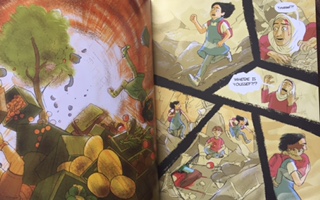
I have read a fair amount of fictionalized accounts of the war in Syria, the journey of refugees, and their resettling in various countries, but this was the first graphic novel on the subject that I have seen, and I was excited to wait my turn behind my kids to read it.  My 7th and 4th graders read it in about 20 minutes and said they really liked it, knowing that it was a quick read, I wanted to take it in slowly and examine each picture to grasp the full message that the author, a Lebanese journalist, was conveying.  Definitely meant, for ages 5th grade and up because of the content, I appreciated the book more than I loved it.  It seemed rather choppy and the fictionalized parts come across just as a front to convey facts.  The book definitely is a great introduction to the conflict, and the format will appeal to a broad range of individuals.  

SYNOPSIS:

Told from the voice of Amina, a bright young girl who rushes home to show off her latest A grade paper to her family, is met instead by a bomb striking the beautiful peaceful neighborhood.  The images on the first page are destroyed as her younger brother Youssef must be located in the rubble and debris.  Now in Canada, Amina tells the story of their journey from Aleppo.  The bouncing around of time, provides some context to how life became under the rule of Bashar al-Assad, how checkpoints and emergency rule changed everything about Amina’s life.  As war creeps in it isn’t just inconveniences and fear, but also death, as further shown through Amina’s uncle who has joined the rebel army.  The family decides they need to flee to Lebanon and truly believe it will be just for a little while. 

IMG_2082

They rent an apartment for a year, but when they cannot afford rent they relocate to a refugee camp, where they stay for two years.  Amina’s father is determined that Amina stays in school but as work remains scarce and Youssef’s health continues to deteriorate.  Amina is forced to take a break from school to try and find work.  Eventually her father arranges to go by raft to Europe to try and start a new life and bring his family there once he is settled.  The terms of the loan to pay the smugglers is steep and when the raft doesn’t make it too far before tossing its passengers, Amina’s father Walid is forced to return to Lebanon unsuccessful. 

It isn’t until Amina’s family considers, like many other families in the camp, to get her married to keep her safe.  That Amina upon picking up some aid at a UN reception center, spills everything to a worker there, and a week later the UNHCR contacts the family to help move them to Canada.  The readers at this point I would assume are relieved the family will be safe, and are surprised when the family isn’t sure if they want to leave.  Syria is there home, and before the mom will agree to anything, she wants to go back to Syria to see her newborn niece.  Once in Syria, she sees that her home is no more as she remembered it, and agrees to be resettled anywhere.  Through the same flashbacks and flash-forwards in time, we also see that life in Canada is not easy.  The family is welcomed and helped and grateful, but it isn’t yet home, and the ghosts of Syria are still present.

WHY I LIKE IT:

I kind of like how choppy it is upon further reflection.  At first it annoyed me, but as I thought about it more and more, I have decided I like that it isn’t easy and smooth and fleshed out, the tone of the unknown comes through by not over narrating the emotions and circumstances.  I also like that everything that happens to Amina and her family is anchored in reality and the footnotes, references, and facts are all in the Endnotes.  Having said that, I wish their was a little more character development, it reads like a bunch of facts strung together and connected by this fictional family.  There isn’t anything wrong with it, but a little more warmth for the characters would have added a beautiful level and would not have been hard to come by at all.  There are so many stories from this conflict out there, and the reason they resonate with so many isn’t from all the facts and numbers, but often from the individuals that make the numbers real and haunting.  I felt like this book fell short on the human element unfortunately.  The only character I really felt had some heart, was the dad, he was awesome, and his love for his family and determination for his daughter’s education was definitely felt.

The book does drop some acronyms and political alliances to add context but not overwhelm the reader.  It definitely hints that there are a lot of groups vying for power, and control: Assad, Russia, ISIS, US, rebels.

IMG_2084

I love that the flashbacks to pre-war Syria are so relatable.  Kids need to really understand that we are all so much more alike than different.  Not just in our hopes and dreams, but even in our daily lives.  The characters in the book are the same as us, their lives look great,  maybe even better.  They have friends, and families and jobs, and cell phones, they also unfortunately, have war.

There were a few surprises for me, for example that buses between Lebanon and ISIS held Syria took/take people back and forth.  Similarly,  I was surprised to see that the punishment of smuggling cigarettes was being beheaded, but maybe more surprised that the book included it.

IMG_2083

It is reassuring for readers to know that the family survives, but the harrowing journey of seeing body bags, cutting costs to survive, risking it all to trust smugglers with fake life jackets, paint pictures of a journey that will stay with the reader.  The book doesn’t talk down to anyone, if something seems too simplistic, it almost encourages the reader to go research more about it.  

There isn’t any mention of Islam or religion, the females wear hijab, that is the only indication along with their names that they are a Muslim family.

FLAGS:

The violence, is pretty haunting and while the images and text aren’t graphic, the splatter of blood and guns and death are very present.  There is also mention of cigarettes.  While not explicit and possibly over the heads of some readers, the book does show that the loan sharks would be willing to take Amina, “Something nice and sweet…like you,” to help pay off the family’s debts.  A former classmate of Amina also invites the family to her wedding.  At 13 Amina’s family is also considering getting her married as a way to help keep her safe.  

IMG_2085

TOOLS FOR LEADING THE DISCUSSION:

This book would be better in Social Studies class more than in a Language Arts one. It would be a great supplement to share even, when discussing current events.  Its a quick read, a factual account and a powerful one at that.  

Book Trailer: https://www.youtube.com/watch?v=AsZZwxM7YyQ

Publisher’s Synopsis: https://www.fireflybooks.com/index.php/catalogue/product/11566-escape-from-syria

The Day of the Pelican by Katherine Paterson

Standard
The Day of the Pelican by Katherine Paterson

pelican.jpg

There is a lot to be grateful for in this 145 page AR 5.2 book before you even begin reading it.  The fact that Katherine Paterson, of Bridge to Teribithia fame, would write a middle school book about the horrors that took place in Kosovo in the late 90s and conclude with the events of 9/11 is both bold, and daring.  There isn’t a lot of mainstream YA literature about the events that happened in the Western Balkans and this book is much needed in shedding light on a history that cannot and should not be forgotten.  While the book doesn’t compel the reader to pick it up, I think as a novel study in school, or as suggested reading, kids 4-8th grade will benefit from the story and retain the humanity presented in the characters.

SYNOPSIS:

The story follows 13-year-old Meli Lleshi, an ethnic Albanian, and how her world changes as Serbian atrocities escalate. The story opens showing how while there is tension in the air, a lot of the Lleshi family’s life is relatable to today’s western readers.  The children go to school, they have a big family and help out at home.  The dad owns a grocery store under the house and the neighborhood is made up of Albanians and Serbs, Muslims and Christians.  Quickly, however, bad news of the Serbs kidnapping people and destroying homes becomes reality as Meli’s 14-year-old brother Mehmet, goes missing.  The police refuse to help and with no other recourse the family is left to wait and see if he returns.   Luckily he does, but as fears continue to grow the family leaves home to go live at the familial farm in the country.  This stop is temporary and the first of many as the family moves from one refugee camp to another.  Fighting to stay together and look forward, as that their homes, livelihood, and material goods have all been destroyed, the Lleshi’s end up in America, only to be faced with the discrimination following 9/11.

WHY I LIKE IT:

I had the priviledge of helping with a lot of Bosnian and later Albanian refugee families that came through Salt Lake City, Utah in 1998-2001.  Not in any official capacity but as outreach to help get them settled, enrolled in school, a friendly face to call on for help, and eventually a friend.  Later, I even interviewed many of them in a series I did for my journalism classes at the University of Utah.  This story rings incredibly true to what I recall hearing them speak about.  What they saw, what they had to sacrifice, what they hoped to achieve in America.  So I was almost giddy to learn about this book knowing that it wouldn’t be a “fun” read, but an important one bringing a fictionalized account of a historical horror to children that probably have never even heard about it.  I only wish so desperately that the book had a map in it.  There is a great historical note, but a map would have made it so much more impactful. 

I like that the family is Muslim, they do not practice, but they identify as Muslim and are thus tortured both in Kosovo and harassed in America.  They are served a ham at one point in America, and they eat it, noting that culturally they don’t eat it, but don’t really see the big deal in doing it.  I remember the first time my family went to meet a Bosnian family and there were no men in the house, all had been killed at the children’s elementary school at dismissal for being Muslim, and they served us beer.  The ham incident reminded me of that, that these are so often the religious rules we tell others and children about what it means to be Muslim, but in the grand scheme how important are they compared to belief in the oneness of God?  I don’t want to turn this literary blog into my theological thoughts, but its hard over the years to forget that these people died for being Muslim, but yet really didn’t know a lot about Islam.  In my safe sheltered world, I know a lot of people that know a lot about Islam, but would we be willing to die for being Muslim?  The Lleshi family don’t pray or go to the mosque, but they do sprinkle their talk with Arabic words like inshaAllah (God willing), and their names are Islamic in nature: Mehmet, Adil, Isuf, etc., they are forced to relocate because of both their nationality and their religion, where the line is between one identity and the other isn’t clear in the book, nor is it in real life.  

FLAGS:

There is a bit of articulated violence, but the book is clean for 4th grade and up.  

TOOLS FOR LEADING THE DISCUSSION:

I would absolutely do this for a Book Club selection, and if I was a upper elementary or middle school teacher for a novel study.  The book balances character narrative and historical context to the point that the book is not boring, sensationalized or easily dismissed.  I think kids will need the school environment and structure to compel them to pick up the book and finish it, but will not fight the actual reading of it.

A guide for book discussion: https://media.btsb.com/TitleLessonPlans/454.pdfTeacher’s Lesson Plan: http://mrscarafiello.weebly.com/day-of-the-pelican.html


Escape From Aleppo by N.H. Senzai

Standard
Escape From Aleppo by N.H. Senzai

escape from aleppo.jpg

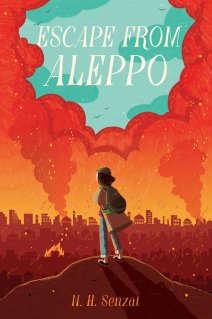
N.H. Senzai’s newest book (published in January 2018), gives a face and a voice to the grave situation in Syria.  Like Senzai’s other books, she uses the rich culture and history of a country to inform the reader, and a compelling front story to keep middle school readers entertained.  This 336 page book is not in the AR data base yet, but fourth grade and up should be able to follow the story and be able to handle the violence and destruction presented.  The story is unique in the genre, in that it doesn’t focus on getting to a safe country, but rather on the heroine’s journey to simply get out of a dangerous one, Syria.  The storyline is fairly linear with flashbacks of life before the war making the story informative, but not necessarily gripping.  I wanted to love it, but found myself forgetting about it when I stopped reading.  

SYNOPSIS:

Fourteen-year-old Nadia, has a fun full life in Syria: a large extended family, she stars in a commercial, has good friends, and a lot of opportunity and perhaps privilege.  All that, however, slowly disappears as civil unrest and ultimately war consume the country.  As a child she gets glimpses of the changes coming, but is able to still hide in her ignorance and focus on things like her nail polish and Arab Idol.  As food gets short however, she sneaks out to get bread with some cousins, and is hit by shrapnel.  While, her leg is able to heal, her anxiety of going out alters her life and makes her family’s attempt to get to the Turkish border later, a hard mental obstacle she must face.  Her inability to move quickly with the family on their covert escape route, and the bomb that hits their home, separates her from her family and leads to her getting left behind.  As she tries to remember how to get to the designated meeting location, she must navigate Syrian soldiers, rebel factions, ISIS, secret police, violence, hunger, and being lost.  With her cat, Mishmish, for companionship, Nadia reaches the location only to find that her family has left for Turkey and will wait on the border for her.  Luckily for Nadia, amidst this devastating news, she meets an old man, Ammo Mazen, and his Donkey, Jamilah, willing to help her reach the border.  Along the way the two face long odds of surviving, not only from the war around them, but also the weather, the old man’s illness and lack of food and water.  As they journey through Aleppo, snippets of history and culture are shared, two more children join their journey and mysteries as to who Ammo Mazen really is come to light. 

WHY I LIKE IT:

The book’s premise is simple, allowing the reader to focus on Nadia and her companions and not get bogged down in the political factions and names and alliances.  The book is not about all of the aggressors, it is about a girl trying to reach her family, and the growth and ability to choose kindness that she learns along the way.  The girl is not religious, but culturally it is a part of her environment.  Her companion Tarek, is religious and he spouts Islamic tidbits as they journey, adding some knowledge to be conveyed about Islam which is sometimes informative and sometimes comical as his character is often a bit awkward. 

I love the cultural beauty that is conveyed, and the heaviness in Syrian’s heart that “What had taken five thousand years to build had taken less than two to ravage.” The saving of historical artifacts, the showing of cooperation between people of different faiths as the characters meet in mosques and churches and meet people of all backgrounds, makes the loss of humanity and history so palpable. 

I also love that there is an Author’s Note at the end.  The whole book I kept having to shush my mind as I felt like this was the story of Mariam in Senzai’s book Shooting Kabul.  Yes that takes place in Afghanistan, but it was so similar in that it was a girl getting separated from her family in an escape attempt during a war, and sure enough she mentions that, that is where Nadia’s story grew from.  

FLAGS:

There is a lot of violence and death, but nothing gruesome or sensationalized.

TOOLS FOR LEADING THE DISCUSSION:

This would be a great Book Club choice, because it would encourage readers to keep at it and finish the book.  While reading it, the book is wonderful, but for some reason, I had to urge myself to pick it up and start it again.  Perhaps it is because I have read all of Senzai’s books and I was pretty confident all would end well, or because I’ve read quite a few books now about war and refugees and Syria, but while it reads quick it did take me longer than it should to finish it.  I think parts of the book that detail a lot of the skirmishes and fighting might be hard to visualize in the mind’s eye so as an assignment or Book Club selection would benefit the readers to allow them to discuss all the mini climaxes, understand the terrain and architecture, and to really put themselves in Nadia’s shoes.  The transformation in Nadia from a brat, more or less, to a compassionate, strong, determined young woman is a journey that I would love to hear feedback from other kids about.  I think they would definitely have thoughts and opinions that would really bring the humanity of us all out, and make us connect with the plight of those trying to get out of such horrific circumstances.

Publisher’s Page: http://www.simonandschuster.com/books/Escape-from-Aleppo/N-H-Senzai/9781481472173

Teaching Guide: https://www.teachervision.com/teacher-discussion-guide/escape-aleppo-reading-guide

Author’s Page: http://www.nhsenzai.com/escape-from-allepo/


Stepping Stones: A Refugee Family’s Journey by Margriet Ruus Artwork by Nizar Ali Badr

Standard
Stepping Stones: A Refugee Family’s Journey by Margriet Ruus Artwork by Nizar Ali Badr

stepping stones

I usually have a running lists of books to check and see if the library has in their catalogue, and another list for when I have a few extra dollars and/or a reason/excuse to purchase books for my own.  I’ve seen this book recommend by countless critics, educators, refugee resettlement volunteers etc., and was thrilled that I could get it from the local public library.  However, it isn’t enough to have this book and mull over the artwork and prose for three weeks, it deserves a permanent place on the shelf.  Or better yet, open hands to pass the book around to within your home, to reflect on the humanity that binds us all, and the plight of so many in the world.

FullSizeRender (12)

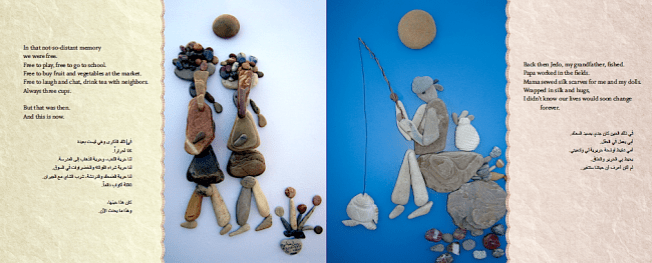
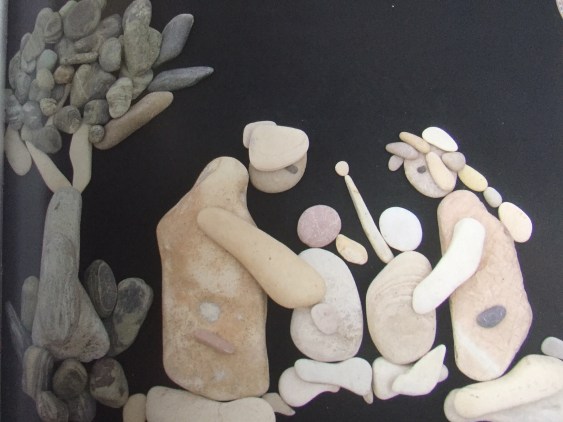
The story is fairly simple, Rama and her family have a good life in Syria and the war changes that, forcing her and her family to flee on foot to Europe with what they can carry.  The emotions on the other hand, are not that simple.  The book is illustrated in stone, but the reader would have to have a heart of stone to not be moved.  Written on an AR 3.2 with 28 pages, the book is written in both English and Arabic.  The book is not sensational, but it does discuss the shortage of food, and going hungry, how they are not free, not really, how bombs fall and kill people going to the market,  and it does show that people were lost in crossing the sea.  The family has to walk, there is no going to the airport or cars to take them across borders so easily, this is contrasted to the beginning of the book where Rama was free to play and go to school, things the reader can relate too.

stones

Ultimately the book is full of hope.  The fictionalized account of a horrific reality still on going, pales only to the story of how the book came to be.  The Foreword is wonderful and gives the book so much more warmth and heart.  How the author saw the artisans work, sought him out, and built the story around his pieces, gives even the youngest reader a sense of reality for an unfathomable situation.  After the story is more information about the author and the illustrator, as well as a list of resources to volunteer, donate and help.  Portions of the book sales go to help resettlement organizations across North America.
stones2

The publishers page gives info and has a youtube book trailer as well: https://steppingstonesthebook.com/

FullSizeRender (11)

The book would be great at story time or in a classroom setting followed by an activity with making pictures with stones previously collected.  At bedtime the book is great to read aloud and let the words sweep your listener toward empathy and compassion.  Check your library first, and if it isn’t there, I don’t think you’ll regret your purchase.