Tag Archives: teen

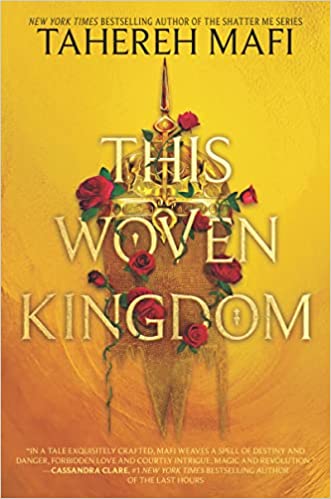
This Woven Kingdom by Tahereh Mafi

Standard
This Woven Kingdom by Tahereh Mafi

woven

At 512 pages this teen/YA fantasy book immerses you in the lives of two characters pitted against one another that are inevitably, drawn to each other.  The world building is slow, as it seems to spend more time character building and shaping the magical Jinn filled world around the characters, through their eyes, and their interactions, than simply building a world, and then dropping characters in it.  It never seems to drag, but the rising action is not concluded, it in fact ends on a cliff hanger raising the expectation for the next book in the series to take the story toward more action, emotion, and twists.  I absolutely love and applaud the author’s note that articulates and clarifies that this book is not religious in nature and that threads of Islam and Persian culture are just reference points for this completely fictionalized tale.  There is a passionate kiss, and violence, but this book is remarkably clean and an enjoyable read for ages 14 and up.

SYNOPSIS:

The story opens with Alizeh sitting by the fire sewing.  She is freezing, she is always freezing, she is a Jinn, but her veins are ice.  Completely alone, she is working as a maid, but as she is on probation, she lodges in a tiny closet away from the other service members, and is deathly afraid of the dark.  Her loving parents raised her and nourished her, she is educated and strong, but since their deaths she has been on the run, trying simply to survive in a world where Clays forbid Jinn from using their magic.  Alizeh is no ordinary Jinn though, the earth has chosen her to be the future Queen, her ever-changing eyes prove it, but for now, she has no kingdom, no family, no friends, no hope to lead.  Only cryptic riddles given to her by Iblees that she dreads and fears, but warn her of impending dangers.

Kamran is the second storyline that builds the world of Ardunia.  As the crown prince, and future king, he has returned from touring the country and has had his eyes opened to the forces threatening the empire, the inevitable war that is looming, and the shortage of resources that threaten them all.  He is irritable and brooding and acting out of character when he intervenes in an altercation in the streets between a servant girl and a young boy.  This sets off a series of events that will bring Alizeh and Kamran into direct conflict as their worlds intertwine and their passions build.

WHY I LIKE IT:

I love the clarification at the beginning, stating that this is not Islamic and that religious and cultural inspiration was just that, inspiration. It allowed me to get comfortable and enjoy the tale for what it is.  I wasn’t worried about checking things, or worrying about religious impressions and accuracy, it was so freeing, thank you.  I really hope that there is a map in the final physical copy, because I just really like maps.  I liked the Persian numbers and script on the chapters and the references make the book that much richer and fleshed out.

I am admittedly fairly new to fantasy, so I enjoyed the slower pace and character building.  I found it enveloping and smooth, there were small conflicts, but the subtle world building through understanding the characters, and their perspectives, was a nice framing for a story that very easily could have dragged, but in reality flew by.  The only point that I found unrefined, was how much Alizeh knew of her past and the impact it had on her current situation.  There seemed to be a bit of a disconnect in teasing that thread.  The reader knows who she is, so I’m not sure why she seems to not know, and then proves that she does, there is no subtlety in that regard.  And the only character, that seemed underdeveloped was that of Hazan, his banter with the Kamran grated on my nerves, and I didn’t understand the abruptness of his and Alizeh’s relationship, it seemed forced.  Nearly everything else in the book was very organic and gently referenced and established very deliberately, but it almost seemed like I missed a chapter or two, when all of a sudden Hazan emerges as being such a main character in Alizeh’s life.  Undoubtedly it was a surprise for the reader, but some nuance in the revelation through Alizeh’s eyes, would have assisted in the continuity of the character and tone of the book.

FLAGS:
A kiss, and attraction, talk of illegitimate children.  There is killing and violence, attempted assault: physical and sexual, not detailed, but referenced as a fear as she walks alone at night.  There is darkness and talk of the devil, deceit, lying, plotting.  Nothing an early teen could not handle.

TOOLS FOR LEADING THE DISCUSSION:

I would have to delay deciding if I could do this as a book club selection until I read the next book.  There is so much potential, that I truly hope that I can introduce the series to young readers to enjoy, get lost in, and discuss.

Salaam, with Love by Sara Sharaf Beg

Standard
Salaam, with Love by Sara Sharaf Beg

salaam

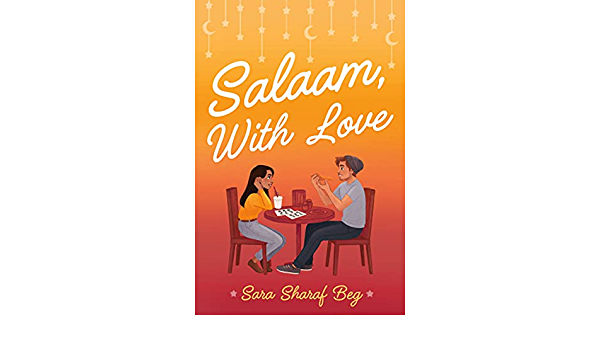
This 288 page YA contemporary Islamic romcom is very Islamic centered, and the storyline provides some nice twists along the way.  Unfortunately the writing is terrible.  Not the storytelling or even grammar per se, but the contradictions, errors, underdeveloped characters, and the inconsistencies. Yes I read an uncorrected proof, but this book is a mainstream major publisher presented book coming out in a few weeks, and it is in desperate need of some attention.  I really don’t think it is the author’s fault, it reads as if this was a manuscript that got shopped around and picked up and then never refined, polished, and made to sparkle.  The only saving grace is that as terrible as it is literary wise, once the main character starts to get over her “internalized islamophobia” (thank you @bintyounus for bringing this concept to my attention), the book as a whole presents a lot of unapologetic specific Islamic content on every single page: how Eid salat is different than normal salat,  the beauty of tajweed, the meanings of so many duas and surahs said regularly, the list goes on and on and doesn’t just cover the basics.  The flip side is that the characters are in a band that performs Islamic songs, but with instruments and everyone is fine with it, there are artists in the book drawing faces and portraits hang on walls, it is a romance, but it at most an arm or hand is touched and when tropes about Desi college choices are pushed back on the parents break the stereotype and relent.  There are threads of cultural-ism within Islam, Islamophobia and a violent near death experience, but the book is very clean and  honestly has a lot of potential, I have no idea why it is so sloppy.  SO SLOPPY, and I took notes, so buckle up.

SYNOPSIS:

Seventeen year old Dua is an only child and her doctor father and caterer mom are the only Pakistani and only Muslims in their small Virginia town.  They decide for Ramadan that they are all going to go and stay with family in Queens, New York for the whole month.  They have given Dua less than 48 hours notice to plan to spend the end of her summer with cousins she hasn’t seen in five years.  The parents hope that Dua will benefit from being around family, being closer to other Muslims in the month, and enjoy the cultural environment.  Dua is not excited, but when bear hugs and genuine smiles meet her at the door, she is sucked in to a bustling house and the happiness and drama that is bound to unfold.  Sharing a room with her older, law school bound cousin Mahnoor is by far the hardest relationship to cultivate.  Newly engaged, Mahnoor is quiet, reserved and deeply unhappy.  Dua makes little progress, but with Ramadan starting and her cousins setting goals for the month, Dua is determined to do better in all aspects of her life.  As she gets close to Mahnoor’s best friend, Haya, she also gets closer to Haya’s brother Hassan.   It is Ramadan though, and she isn’t good around boys, but Hassan is a hafiz and is helping her reach her memorization goals for the month, Hassan is also in a band and needs Dua’s help.  When Mahnoor’s engagement is called off to Haya and Hassan’s brother, everything comes to a standstill between the families, but when a cousin is shot, the families come back together to support one another and deal with their decisions and their outcomes.  By the end of Ramadan, every character has changed and grown and is sad the month is over and that Dua and her family are leaving.

WHY I LIKE IT:

Suffice it to say I love how Islam centered it is. I honestly checked the publishing information because of how much Islamic content is included, also for the amount of errors.  The book did not start off well for me with Dua trying to separate herself from her “religious” cousins.  The ones who practice communally and wear hijab.  She was not like “them” and the dichotomy of measuring religiosity as acceptable or not, too much or too little, enrages me.  It sets up that she practices Islam but in a relaxed manner and has been taught by her parents, and it is who she is, but it isn’t a huge part of her life.  As the story progresses, it seems that she just doesn’t know a ton of surahs, she actually is pretty religious, and devout, it is very awkward and not presented clearly, which is why I attributed it more to her being in denial or embarrassed by her identity, not about her level of belief.  Dua is also not like-able, she is incredible privileged and arrogant commenting on the size of houses and rooms, and her shoes.  About half way through she starts to comes across as clumsy, not sure then why is she always wearing heels.  Ultimately she is just not well-developed and often reads like an annoying helpless child.  The framing of Dua being a musician and not being so religious is quickly questioned as she gifts her cousins music paraphernalia, and looks at portraits on their walls.  If most are like me, and both families are praying, fasting, reading Quran, active musicians and artists and ok with hanging pictures, one would assume they are pretty in-syc with one another on their religious views and in practice.

Dua is not the only character that is poorly voiced, fractured, and inconsistent.  Her parents are so unrealistic and awkward in the beginning I physically cringed reading them telling her their reasons for going to New York.  In the car on the way, they even quiz Dua on her cousins names.  She hasn’t seen them in five years, she isn’t a toddler, she should know their names, she has clearly purchased incredibly personalized gifts for them, and is filled with detailed memories of when they all met up in Pakistan together, the whole scene is pointless. One of the cousins, Ibrahim, is blind and Dua says that a few years ago her parents had to explain to her what it meant to be blind.  Seriously?  I get the learning how to let him take the lead and how to interact, but you as a teenager didn’t know what it means to be blind? When you met him in Pakistan you didn’t know he was blind? The four year old cousin is cute and adorable, and has the vocabulary and mannerisms of a seven or eight year old at times, most times.  The 12 year old cousin has the wisdom of an old uncle and why do none of the adults in the book seem to work?  The book probably should have started at chapter five, it seems the book hits a bit of a stride that at least makes it readable.  

A huge plot of the book is the band, Sheikh, Rattle, and Roll, but the details about it are terrible.  Mahnoor is walking out the door and her mom tells her to take Dua.  The reader doesn’t know where they are going, but Mahnoor reluctantly agrees and they head out on the subway.  Mahnoor constantly is telling Dua to hurry so they aren’t late and miss it, when they arrive, the band performs one song and that is when Hassan and Dua and Haya all meet.  But the other two band members are her cousins, she is staying in their house.  What? Rabia is constantly talking, that is her character quirk, how does Dua not know that they are performing? Not know they are in a band?  No way would it not be mentioned.  And why only one song? That is so random.  At the end when they perform again on Eid, it is a concert, it is again only one song.  A concert is not one song.  Do they not practice or load up equipment, how is all this going on in one house and Dua is so clueless? 

The inconsistencies are aplenty.  A few examples: it says her cousin doesn’t wear make-up, a few chapters later has a whole face of make-up, on Eid she even does Dua’s make-up.  When they all are sitting down to write their lists of plans for Ramadan it says they don’t have to share their lists.  Yet a few lines later Dua is singled out in a very creepy way to share hers.  In a single paragraph it says that at home she prays fajr half asleep, or late and in a rush before school, but concludes the description by complaining that praying in congregation is more difficult for her to focus in.  Huh? praying while half asleep or in a rush gives you more focus than praying in jammah?  Even non Muslims are going to be scratching their heads.  At one point as Dua is trying to figure out what she wants to study and if she wants to start an MSA in her high school, since she is the only Muslim, she internally discusses how she wants to prove herself to her parents.  Then when she decides what she wants to do for her, she remarks that she isn’t just doing it to prove to her parents, but because she wants it for her.  The only problem is, no where have we seen or has it been established that her parents are requiring this proof.  

There are odd errors as well.  The athan on a phone goes off, the Uncle reaches in to his pocket for his phone and turns off his iPad.  That is a big pocket indeed.  Dua gifts Hassan a CD, really a CD? What is this 1999? Who gifts CDs in 2021? Dua starts playing a keyboard in someone elses house and no one mentions it other than the two people with her, how big is the house that you can’t hear it? The Uncle gets upset that Dua doesn’t pray Asr right at time, but a lot of people prefer Asr specifically to be prayed later within the time frame.  In a two chapter frame it mentions letting out a breath she didn’t realize she was holding three times, word for word the same.

I was genuinely surprised that music being questionable was not brought up at all, two of the bandmates are huffaz.  The author lets her own qualifiers slip in, perhaps her own desire to not take a stand that could seem alienating.  She says, “allegedly” the time right before iftar is the best time to make dua.  As Dua tries to figure out what is going on with Hassan she often remarks how it is hard or confusing “especially because he is Muslim.” Would a relationship with a non Muslim be ok, less hard, more hard? There is no lowering of any gazes, which for as religious as everyone in the book is, should have at least been mentioned even if not adhered to.  The book puts on odd stress on tasbeehs and kufis, not sure why.  

I do like the genuine love the characters have for Islam, Allah, Ramadan, salat.  It is so much a part of every thing they do, and it is lovely.  I also love Dua’s friend in Virginia, Kat, she is fasting in solidarity and wants to join the MSA even though she isn’t Muslim, but a seemingly amazing friend.

FLAGS:

The on-gain-off-again engaged couple do touch hands at Eid prayer.  Hassan touches Duas arm when she is perceived as helpless.  There are anti Islam protests and an angry man shoots Adam.

TOOLS FOR LEADING THE DISCUSSION:

If the sloppiness gets resolved, the book could be used as a high school book club choice.  Those girls love them some halal romance, and this book is incredibly religious and clean. 

Zenobia by Morten Durr illustrated by Lars Horneman

Standard
Zenobia by Morten Durr illustrated by Lars Horneman

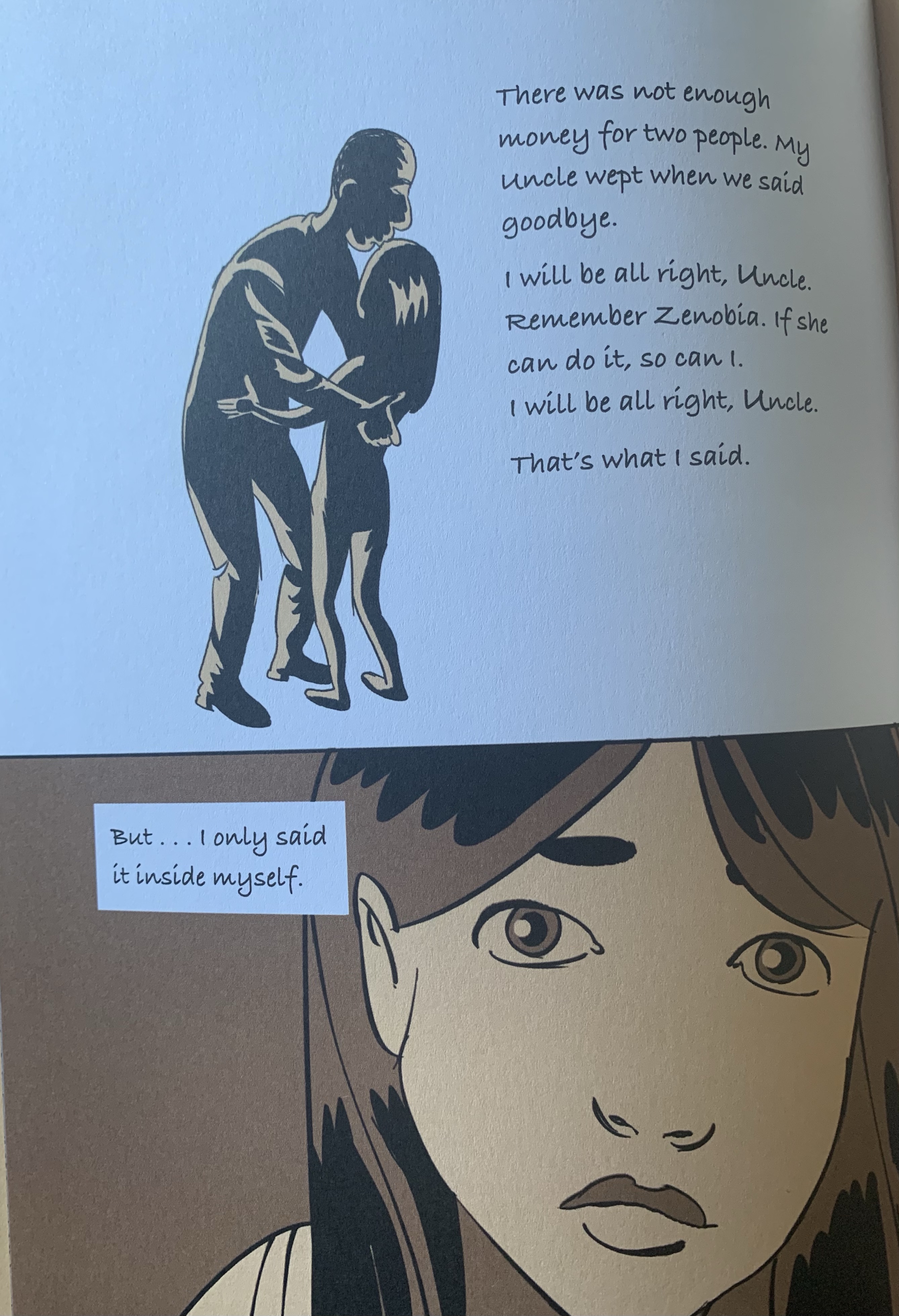
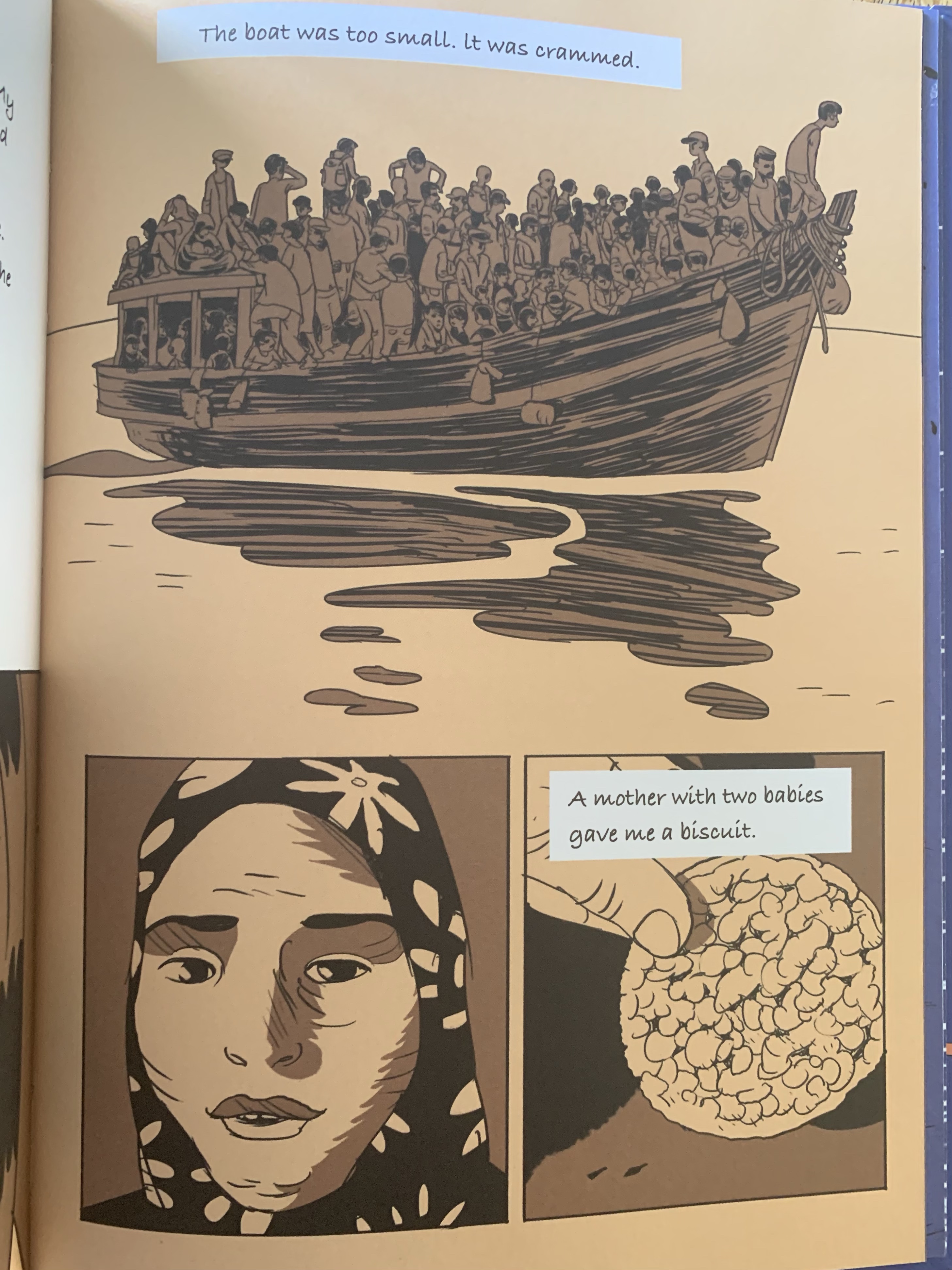
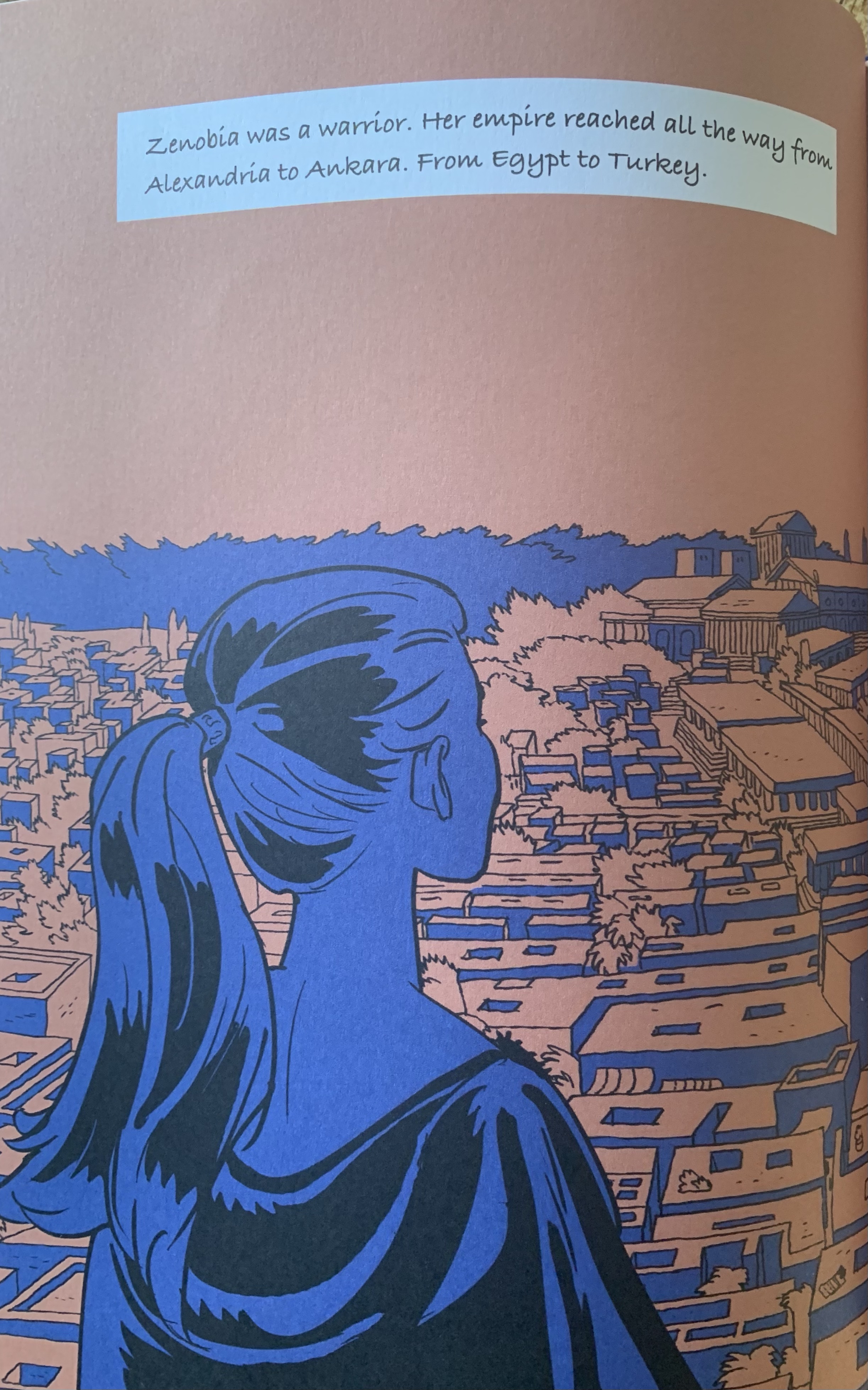
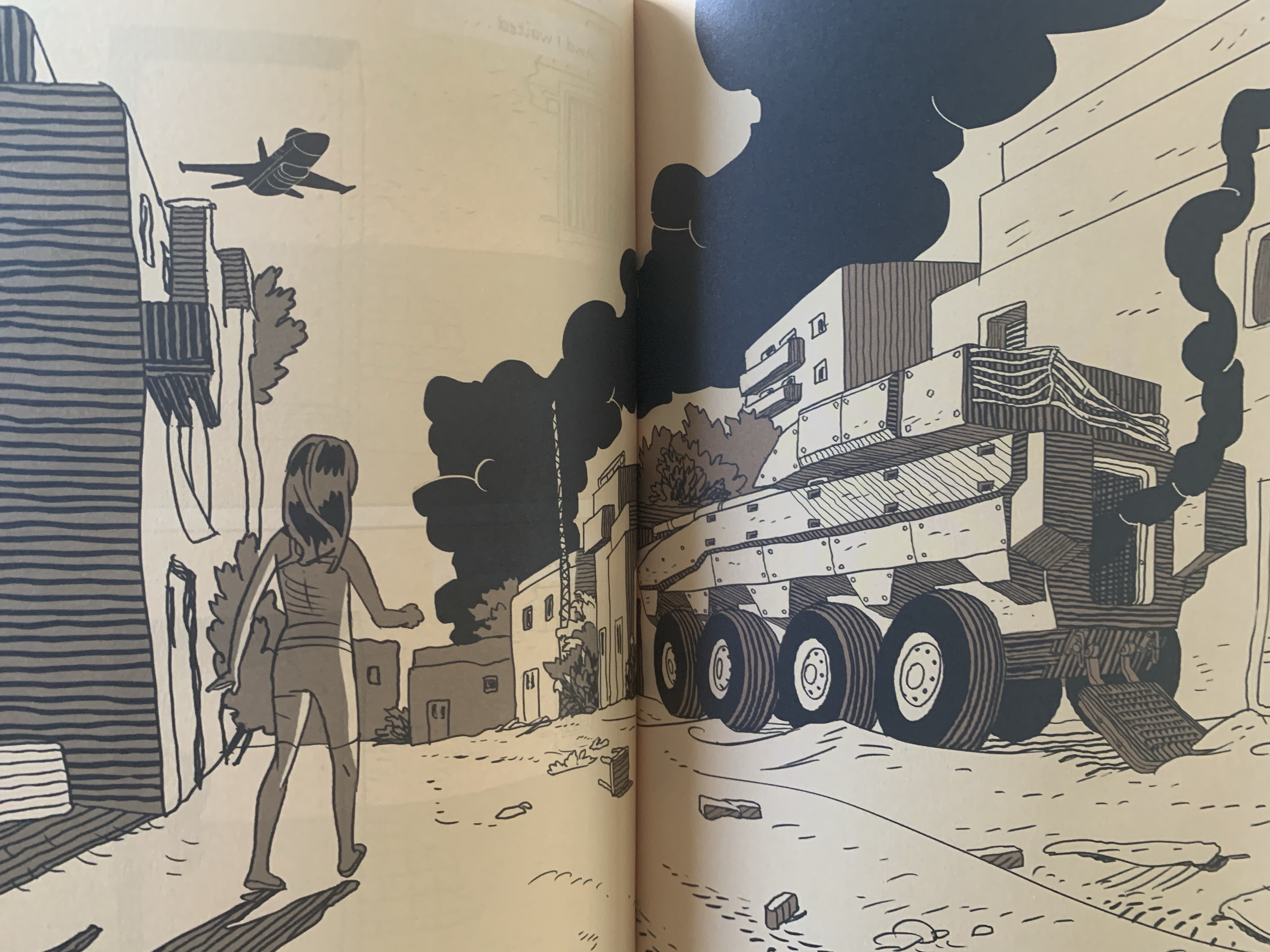
img_8794There is a reason that this 93 page graphic novel is labeled as “Teens.”  There may only be 300 or so words in the entire book, and the pictures at times are very basic, but oh subhanAllah is it devastating. Real, unfortunately, but I was not expecting my heart to be shredded and for me to be haunted by the framing and perspective of the story.  I read a fair amount of books both fiction and nonfiction regarding Syrian refugees and I try not to ever become numb to the plight of so many, but this book was such a reminder that things don’t always turn out well, that sometimes no matter how inspired your life is to follow in the footsteps of a warrior queen, there isn’t always hope.  That no matter how brave you are, horrible things will still happen, and that sometimes there is no one to hear your cries and pleas, and for so many in this cruel world, there is only silence.
img_8796

SYNOPSIS:

The book starts with Amina on a crowded makeshift book in the ocean, the boat capsizes and we are thrust back in to her memories of playing hide-and-seek with her mother.  The juxtaposition of her little body playing a game hoping not to be found with her limp body in the ocean begging to be found is stark.  The memories then take us back to her mom preparing dolmas with only rice and salt, since that is all that is left.  Her father jokes that they are too salty.  The ocean is salty as well, and the memories continue to flow.  Her parents go to the market and she is not able to go with them.  It doesn’t tell why, but her mother reminds her to be strong and brave like Zenobia. Her mother often reminds her of the Syrian warrior queen who was the most beautiful woman in the whole world, who ruled, fought, and rode like a man.

img_8797

Her parents don’t return.  She waits and waits.  There are attacks, an uncle comes to take her away.  They pass destruction and rubble and sleep in the road.  Her body starts to sink in the water.  Her uncle finds some fisherman, he gives them all his money, but it is only enough for one to go on the boat.  He sends her. A kind lady on the boat shares a bit of food, before the boat flips over.  Her body is lost in the ocean, hoping to be found, voiced only as a whisper inside her head.

img_8798

WHY I LIKE IT:

I really don’t like it.  That isn’t to say it isn’t well done and powerful.  It is hard to finish though.  You really hope she will be plucked out of the water even though a part of you know she won’t.  I made me kids read it.  It rocked them.  In a good way I think, I hope.  We can never forget how privileged we are, although we do all the time.  Books like this remind us how quickly it can all change and how we at the bare minimum need to be acutely aware of what others go through.  If it is hard to read, imagine living it.

The book is Danish, I don’t know if it is translated or originally in English.  It says that it won the Danish National Illustration Award in 2017, so I’m not sure how much to critique phrasing, but I wasn’t a huge fan of how Zenobia was presented as riding, leading, and ruling like a man.  I’m pretty sure she did those things better than MOST men.  Having her stature be glorified as being that equal to a man weakened her and her accomplishments.  Yes, doing what she did at a time when many women were not allowed to do it is impressive, but she was great in her own right, not just in comparison to the male gender.

img_8799

FLAGS:

For teens nothing. For younger kids, under 10, it is subtle, but too devastating in my opinion.  Tweens should read it with some discussion, they should know it isn’t always happy and hopeful, but use your discretion if they can handle a drowning, loss of parents, and destruction.

img_8800

TOOLS FOR LEADING THE DISCUSSION:

This book is too short for a book club, but I think families should consider it and talk about it.  Syria and many other nations may not be headline news at the moment in America, but that doesn’t mean wars and their far reaching implications have stopped.  It just means we have grown weary and changed the channel.

img_8801

Boy, Everywhere by A.M. Dassu

Standard
Boy, Everywhere by A.M. Dassu

boy

In a very crowded field of refugee themed books, this 400 page middle grades/early middle school novel sets itself apart by really focussing on the quality of life enjoyed in Syria compared to the life of a refugee on the move and in getting reestablished as an immigrant.  Where other books allude to how things in Syria got worse and then perhaps focus more on the horrific journey desperate individuals are forced to take, this book is very direct in showing the young protagonist’s daily life in Damascus and really cementing in the notion for western privileged readers, that losing everything could happen to anyone. The book does show hardships on the perilous journey by truck and boat as well as showing that life in England isn’t immediately better.  Side characters throughout the book show diverse opinions and strengths that for the preteen target demographic would provide starting points for wonderful discussion and dialogue to take place. Overall, the book does a decent job of not falling into the same cliche’ narrative even though the book does have a hopeful and happy ending.

SYNOPSIS:

Sami is the 13-year-old son of a surgeon and principal.  He has a little sister, a best friend, a desire to be on the football (soccer) team, the latest Air Jordans, a love of video games, his iPad, and a very comfortable life.  When he orders the newest soccer shoes to wear for tryouts and begs his mom to go pick them up from the mall, the Syrian civil war which has seemed an arm’s length away, comes to Damascus and to Sami.  The mall is bombed while his mom and little sister are getting his shoes and while they survive Sara is traumatized and stops speaking.  The family decides immediately and secretly that they have to leave.  Sami is kept slightly in the dark and thus, so is the reader as to how quick everything must be liquidated and how uncertain the future is for the family.  

Sami is forced to turn over his iPad to his parents, he stops going to school, and before he has time to talk to his friends, he is saying good bye to his grandmother and heading to Lebanon with his parents and sister.  The journey is perilous and fraught with danger.  The constant state of fear and silence, the peeing in bottles, the trust in smugglers is all so palpable.  The rooms they are locked in with other refugees and the the bonds and fears and squalor that Sami experiences is such a stark contrast to the life he has known of drivers and maids.  In one smuggler’s den in Turkey Sami befriends a boy slightly older than him that is traveling alone, Aadam.  Desperate to help his new friend, Sami tries to steal his father’s cell phone and some money to help Aadam ensure his seat on a boat, not a raft, to cross the Mediterranean.  Sami is used to his family helping others, this situation of not being able to help, not being able to help themselves, is very new to him, and causes a lot of stress and strain between Sami and his father.

Sami has a fear of boats and water, having nearly drowned years earlier, the idea of getting on a make shift boat in the night with rough water is not something Sami is mentally prepared to do and when a boat near them capsizes, the reader is made painfully aware that even those that survive this journey are not left unharmed.  The family makes it to England to claim asylum, they are put in a holding area, a prison more or less, to await the next stop in a long process.  Here Sami and his father are assaulted and the threat of physical violence and imprisonment start to really affect Sami.  When they eventually get to a distant family members house in Manchester, their struggles are far from over as the family is unwelcoming.  School brings out the racists, the parents take jobs as factory workers and cleaners and Sara is still not talking.  With the guilt of his family’s condition weighing heavily on Sami, the constant bullying by his family in England, and the sad condition of his family’s finances, Sami decides he needs to return to Syria to care for his Tete and unburden his family of his presence.  

Yah, sorry, I’m not going to give it all away.

WHY I LIKE IT:

I love that the book really articulates how Sami’s life is in Syria and has him remark multiple times in England how much nicer things were in Damascus.  It doesn’t come across as a criticism, but rather a rattling of the paradigm that the west is so much better across the board.  I love that Sami’s best friend in Syria is Christian and that they are so respectful of each other’s faith and it is a non issue.  I love that some of the refugees in the holding apartment are kind and some in the detention facility in England are criminal.  It allows for the reminder that people are people even when they are refugees and cannot be assumed to be a monolith.  It also opens the door to discuss how desperation changes people.  Sami’s family is usually very generous, but with their own futures in turmoil, they cannot afford to be, they also presumably are very social and yet, the silence between strangers and within their own family is very telling of the stress and worry that plagues them.  I like how the process humbles the characters.  Not that I enjoy or feel that the characters needed necessarily to be humbled, but it is a transition that the reader benefits from seeing.  Sami’s father is/was a doctor, a surgeon, but is loading boxes in a factory, the desire to take care of ones family trumps degrees and expectation.  The transition is conveyed to the reader and I think will plant a seed of empathy in even the hardest hearts.  

The family in Manchester, particularly the boy Hassan, is awful and the friend, Ali, from school is amazing.  These opposing Muslim characters also help break the stereotype of where bullying comes from, and who is welcoming, allowing for people to be seen more as individuals than they often are in literature and in real life.  Islam is presented as characteristics of the characters when it does appear.  They ask Allah for help and say salam, attend various mosques, but there are not heavy religious overtones.  

At times Sami is annoying, and as an adult reading the book, I had to remind myself that that is probably exactly how a 13 year old boy would behave.  He sees things in black and white and is often singularly focused on contacting his friends.  He doesn’t understand the bigger picture, nor is told a lot of the bigger picture.  It is a hard age of being kept from stuff because you are too young, and being expected to rise up and be mature because of the gravity of the situation.  The book is not overly political, it is character driven and very memorable thanks to Sami’s perspective and voice.

The book is researched, it is not an OWN voice story, and while it is a compelling and engaging read, that I hope is accurate, the framing of the story is not incredibly original.  Aside from other Syrian refugee focused books, the book reminded me quite a bit of Shooting Kabul, albeit the country being left is different.   Both plots focus on a boy leaving with his family and blaming himself for the tragedy that has befallen a younger sister and the repercussions it is having on the family as they reestablish themselves as immigrants.  In both books the character plans to board an airplane to return “home,” as well.  

I like that there is a map, a glossary, and an author’s note included in the beautifully spaced, visibly accessible book.

FLAGS:

The assault is intense as is the fear of physical assault.  There is nothing detailed in the bombing, but the implied stresses of war, the journey of the characters, and the situations that they are in would be best for ten year olds and up.

TOOLS FOR LEADING THE DISCUSSION:

I am hoping to use this book as a Middle School book club read to start next year off.  The book is not yet out in paperback, otherwise I would do it this year.  There are so many things to discuss: from Sami’s unhappiness, his strengths, his desire to help others, to considering life from Aadam’s perspective and Hassans.  This book begs to be talked about with young readers and I’m so excited to hear what their thoughts are and who they identify with.  They could be Sami, he is a boy, everywhere, and if we can all remember that, we all will be better humans, period, the end.

Home is Not a Country by Safia Elhillo

Standard
Home is Not a Country by Safia Elhillo

home is not a country

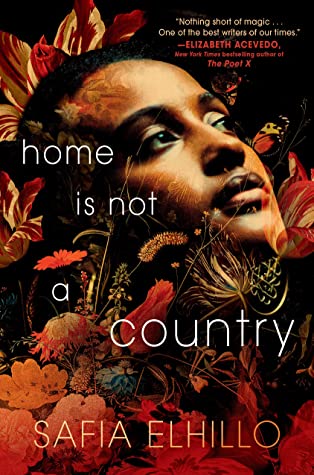
This upper middle school/high school 224 page novel told in verse touches on familiar themes of finding yourself and wondering about what could have been, but is anything but predictable.  Through magical realism, religion, culture, and phenomenal imagery, this book is haunting and powerful as it sweeps you into the possible alternate reality of a young 14 year-old-girl yearning to be someone else, consumed by a life that could have been, desperate for the other half of her mirrored existence, and for a home that she does not know, but so desperately longs for.  As a Muslim child of an immigrant, the daughter of a single mother, and nearly invisible at school, readers will feel her story, more than know it, and find themselves in her own awakening.

SYNOPSIS:

Nima feels like she exists in pieces.  No one understands her and she doesn’t feel comfortable in her own skin.  At school she is invisible, she is foreign and teased for it.  She has one friend, Haitham who is always there for her at home, but just a familiar wave in public.  At home Nima enjoys old Arabic songs and movies, hobbies she is teased for at weekend Arabic school, her hardworking mother is graceful and beautiful, Nima is neither.  Her world is the aunties and family in her building, but her Arabic is weak and she doesn’t fit in anywhere.  Her father passed away before she was born in a country she has never known.  Her twin sister died before birth, one for each parent in each world.  Nima imagines if she wasn’t Nima, but Yasmeen instead.  If she was bright and loud and loved and confident. The name she was nearly given, an alternate life she has become obsessed with.

When Haitham and her get in a fight, when her mother removes her headscarf and the bullying intensifies, Haitham ends up in the hospital, assaulted, barely hanging on and Yasmeen appears to help a floundering Nima escape a meal she can’t afford, a man that intends to assault her, and a world where she might find answers. The two girls travel to the homeland in the photographs to understand their parents, to understand why their mother left and Nima to the realization that only one of the girls can truly exist.  

WHY I LIKE IT:

I love that I had no idea where the story was going and how much would be spelled out and how much would be left for the reader to interpret.  It affected me in a way that I wasn’t expecting and reminded me of the blurred lines of reality from books like Beloved (Toni Morrison) and Her Fearful Symmetry (Audrey Niffenegger).  I love that the Arabic script is present and often not translated.  The unapologetic connection to the character and author is powerful and beautiful to see in a deeply introspective book.  I enjoyed that the “country” wasn’t named as it added to the concept of not knowing you home, it was frustrating, but for all the right reasons.

There isn’t a lot of practiced Islam mentioned, she doesn’t talk about praying, but does talk about the athan and longing for it.  Her mother wears hijab, but takes it off and wears a hat instead. The daily life of living in two worlds is taken to mean something very literal and the journey to both worlds is remarkable and memorable.

FLAGS:
There is physical assault, theft, lying.  Nima has to escape a man that intends to rape her, his intention isn’t detailed, but Yasmeen helps her escape when he brings her to a hotel.  Haitham’s dad has an affair with his mom and she is pregnant with him when the story flips back to the past and the couple are not married.  There is singing and music and dancing throughout. I think 14 and 15 year olds will be able to grasp the intensity of such situations while also not being shocked by them.

TOOLS FOR LEADING THE DISCUSSION:

I am on the fence if I could do this as a middle school book club, I might suggest it to the high school advisor.  There is so much to unwrap in the lyrical text that will draw the students in and force them to reflect on their own impressions to understand Nima’s reality.  I think there would be so many conflicting thoughts that the discussion would be amazing.  

Here is a better synopsis than mine: https://www.npr.org/2021/03/04/973389493/home-is-not-a-country-imagines-the-lives-we-could-have-led

Q and A with the Author: https://thenerddaily.com/safia-elhillo-author-interview/


https://www.npr.org/2021/03/04/973389493/home-is-not-a-country-imagines-the-lives-we-could-have-led

The Story of the Holy Prophet Muhammad (peace and blessings of Allah be on him): Ramadan Classics: 30 Stories for 30 Nights by Humera Malik

Standard
The Story of the Holy Prophet Muhammad (peace and blessings of Allah be on him): Ramadan Classics: 30 Stories for 30 Nights by Humera Malik

the story of prophet muhammad

I debated posting about this book for so long that Ramadan is more than half over.  But as a reference for years to come, I thought I should go ahead and throw my late support toward this Ramadan tradition and a book deserving of space on your shelf for children 4th grade and up.  I’ve seen people praising it for a few years, and finally I ordered it this year, however, I wanted to not only read it, but also test it out first: reading a story a day, discussing and asking the correlating questions with my own children, before reporting back.  I cannot and thus won’t comment on the accuracy of authenticity of the book, nothing stood out as erroneous to me and there is a bibliography at the back, but there is a reason I try and steer clear of non fiction, I’m just not qualified to comment.

SYNOPSIS:

The book starts with the birth of Prophet Muhammad (saw) and ends with the selection of Abu Bakr (ra) as the first Khalifah.  Each chapter is between one-and-a-half to two-and-a-half pages and the 30 chapters plus one Eid day chapter (so a total of 31), covers 103 pages in all.  There are a few pictures of where the Battle of Badr took place, the Cave of Hira, not many.  There are three questions at the back of the book for each of the chapters, but no answers.  The book is pretty linear, just the second chapter bounces back to Prophet Abraham (as) and Hagar and the story of Zamzam and then the rebuilding of the Ka’bah.  It is a glorified timeline, which in this case is a good thing.  It doesn’t go off on tangents or provide a ton of outside references, it is concise and general, but hits the key parts: marriage to Khadijah, first revelation, migration to Abyssinia, Taif, Hijrah, treatment of slaves, year of sorrow, Battle of Badr, Battle of Uhud, Treaty of Hudaibiyah, it talks of tensions with various tribes, coming to an agreement about the Khalifah, and more.

I think younger children might possibly be able to have the short chapters read to them and then explained, but really, it would be a lot to process.  The words are simplified and the gist of situations are conveyed, but topics aren’t necessarily shied away from.  It discusses that Prophet Muhammad (saw) had more than one wife, and that there were slaves, and there were tensions with the Jews, and Bilal was tortured, all things that picture books might skip over.

WHY I LIKE IT:

I like that even my young teen could read and involve herself without feeling like the exercise was childish.  Many of the answers are open ended in nature and require more than just a one word answer.  It allows for children to add other facts that they know about RasulAllah to the dialogue and make connections to our history with our current life very easily.  Even children that know the story of Prophet Muhammad (saw) will find the book engaging and smooth enough to read through again (and hopefully again each Ramadan) and learn new tidbits, understand concepts more clearly and be reminded about the beauty of our Prophet.

FLAGS:

Nothing

TOOLS FOR LEADING THE DISCUSSION:

If I was a teacher, I would definitely start each morning reading a chapter and doing the Q and A, whether it was Ramadan or not.  I think we need to be more connected to our Prophet and grow our love and appreciation for him, so books like this are such a great tool in accomplishing that goal.


She Wore Red Trainers by Nai’ma B. Robert

Standard
She Wore Red Trainers by Nai’ma B. Robert

red.gif

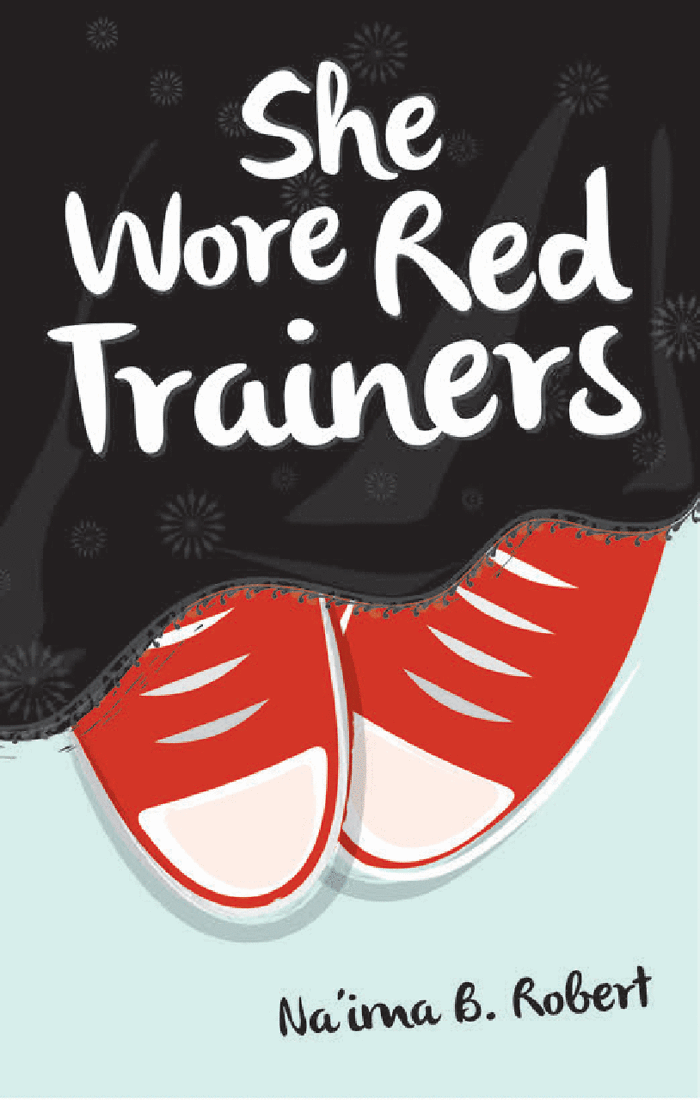
After having fairly good luck with the Muslim YA Romance Novel Genre in An Acquaintance and Saints and Misfits, I was willing to give She Wore Red Trainers a try.  Na’ima B. Robert has written a lot of books and this 261 page book was an easy and entertaining read.  There are no plot twists, deep thoughts, or intense drama, its a light read that infuses religion and environment into a story that will be great for 14-16 year olds that have slim pickings of relevant, Islamic, “halal” fiction options.

SYNOPSIS:

The story is told from two 18-year-olds’ perspectives, Ali and Amirah. It goes back and forth and while the perspective is obvious, the bottom of the page identifies the character so there is no chance for confusion.

Ali has begrudgingly moved to London with his brothers and father.  Not very religious before his mother’s death, he and his father and younger brother have made a new start and commitment to Islam since losing her to cancer.  The middle brother, resists this, but isn’t too critical in the story, other than to add a voice to the concept that people have to come to Islam on their own, that the relationship between a person and Allah is not cookie cutter or often simple. 

Amira too has a past and a lot on her plate as she strives to balance her chaotic family life and moving past decisions of her rebellious self.  The two meet and in the brief second before gazes are lowered, they fall in love.  Ok, so it isn’t that cliche’ but it is close.

The two, as the dedication of the book states, “are striving to keep it halal.”  They have a few encounters and the sparks are there, but they both have their own stories and supporting cast of friends as well. It isn’t until the very end, SPOILER, they get married.

Yup. impromptu wedding of 18 year olds.  It isn’t out of left field though, there are passages that contemplate the Islamic merits of a young marriage, and perhaps that is the depth of the book, as far as giving the reader something to think about. That and choosing Islam and actively living it.

WHY I LIKE IT:

The stuff that makes the book interesting, isn’t really even the two love birds, it is the context.  The struggle of Amirah’s complex family situation with a mom that has had multiple husbands, and is suffering from depression.  Amirah also has a creepy stepdad (makes her uncomfortable and seems to make sexual advances toward her) and a sketchy past that isn’t really articulated but is hinted at enough to know that she did rebel briefly by running away and experimented with drugs and alcohol before realizing it wasn’t the life she wanted.  She takes tremendous care of her younger siblings, one who is deaf, and respects her older brother tremendously.  Her friends are not overly developed but provide enough diversity that the reader will see themselves in someone even if just fleetingly.

Similarly Ali is fleshed out by the company he keeps.  He has very religiously devout friends, a few rebellious ones and countless opportunities to define who he is.  His home life is a little chaotic, but they’ve gone through the destruction and are in the rebuilding phase. 

I like that the characters are fallible and represent a wide spectrum of religiosity.  The book isn’t political, nor does it discuss culture really, but it is meant for Muslim readers.  The characters throw in Arabic terms and while there is a glossary at the back, the religious rules, the contemplation of hadith and ayats, understanding Islamic divorce and the stress to be well established before marriage make it a book for those that can relate.  I love that part of keeping it halal is that they don’t talk and text.  I know that makes it a bit unbelievable, but I like that the line is drawn and established.

I wish that the past of many of the characters was clearer.  Not overly sensationalized, but a tiny bit more.  I wanted more information on what Ali’s dad’s new job was, and how far away they would be moving.  I wanted to know how Amira’s family would manage without her and the creepy stepdad, would the mom be able to step up and care for her kids.  I wanted more details about Amira’s family in general and why her older brother had to leave his studies permanently in Saudi Arabia, and wasn’t able to just delay graduation.  

I can’t criticize the writing too much because I did read the book in one sitting and it kept my interest.  I didn’t expect it to be deep or thought provoking, so for a light summer read, it was good enough.  I felt like the ending was a bit rushed, and yes there are some far fetched ideas, but I think it’s a romance novel, halal or not, so yeah, there are going to be some places that forgiveness is needed.

FLAGS:

There is mention of hooking up, drug and alcohol use, virginity, and a creepy sexual predator in the stepdad. It isn’t appropriate for middle school, but not so vulgar that one would need to be 18 to read.  I think high schoolers won’t find it too cheesy, and not be shocked by the content either.  Granted it depends on the reader. but I think it is better to be safe than sorry.

TOOLS FOR LEADING THE DISCUSSION:

I would consider the book for a high school book club. Might have to get parental permission, but I think it works well to consider how to have it all so to speak.  How to live within Islam and be smart about your choices.  The book doesn’t offer a lot to think about and mull over, but if you were a teenager, I would imagine that the book presents a lot of what you are feeling.  There is a lot to relate to in the friends, the deen, the emotions, and the temptations.  It also shows that just because families are Muslim, doesn’t mean that they are not complicated and troubled, a scenario that many would find reassuring at least superficially in the book.

Interview with the Author: http://www.kubepublishing.com/an-interview-with-naima-b-robert-about-her-forthcoming-book-she-wore-red-trainers/