Tag Archives: Siblings

A Place at the Table by Saadia Faruqi and Laura Shovan

Standard
A Place at the Table by Saadia Faruqi and Laura Shovan

a lkace at the table

This fabulously fresh and honest book told in alternating OWN voices shows how two seemingly different 6th grade girls discover how much they have in common as they learn about themselves and their families along the way.  Sarah is a Muslim Pakistani-American, and Elizabeth is Jewish and has an English immigrant mom, the two come together over food, family stress, discrimination, and middle school social drama to form a solid friendship.  But fear not, it isn’t easy and the book will keep upper elementary/ early middle school girls hooked.  Not sure if boys will be as drawn to it, but if they can get over the brief mention of having a period, they too will enjoy the story.  The 336 page book shows how much we have in common, and how hard fitting in can be for everyone.

SYNOPSIS:

Sarah is starting a new school, a public one, having been at a small Islamic school prior to 6th grade.  She is not happy about it and to top it off, her mother is teaching an after-school cooking class at the school that she is required to attend.  Hoping to sit in the back drawing and go unnoticed, she finds she can’t sit quiet when her classmates start giving her mom a hard time.  Unaware of why she had to leave her previous school, and tired of her mom needing her help with her catering business, Sara also has to help her mom study for her citizenship test, handle two little brothers, deal with no friends at school and not being able to celebrate Halloween.

Elizabeth loves cooking. Her mother does not.   She is excited to learn Pakistani food at the cooking club even if her best friend thinks they shouldn’t be learning things from “them.” Elizabeth is admittedly nerdy, and struggling with a life-long friend finding others to spend time with, her life at home is difficult too.  Her dad is always traveling for work, and her mom is depressed with the recent passing of her mother in England, to the point of not really functioning.  With Elizabeth doing the cooking at home, and trying to get her mom to study for her citizenship test, Jewish holidays and obligations get neglected, and Elizabeth not knowing how to help her new Muslim friend handle racism,  is spiraling herself.

When the two girls decide to give each other a chance they find they might be able to be more than just cooking partners, but it seems like one of them always does something to mess it up.  Either saying something hurtful, getting defensive, or not sticking up for each other.   The girls get their mom’s together to study for their test, but it isn’t so easy for the girls, who are hesitant to trust one another.

An upcoming cooking competition, offers the girls a chance to make a cross cultural fusion dish that can wow the judges, help Sarah’s family’s financial situation, prove to the school that diversity is a good thing, and hopefully give the two girls a solid friendship.

WHY I LIKE IT:

I love how authentic it sounds and feels and how it doesn’t focus on boys or crushes, but on friendship between two girls at an awkward point in their lives and the family stresses they are experiencing.  The book is for all readers and does a great job of not going overboard with what the girls face.  I love how tolerant they have to learn to be with one another and that they have to learn to drop their defensive guards.

I read the book in two settings and didn’t want to put it down, it has enough pull that you really want to see where the book is going and are happy to overlook the slight repetitiveness of them stressing about the competition, but doing nothing but talking about the stress. Really the competition doesn’t even seem that important at the end, but considering everything going on, that to me is exactly as it should be.

I love the rich culture of Pakistan, England, Islam, and Judaism that seep in and never get preachy or dogmatic, but get celebrated and experienced.  This is why OWN voice books are so beautiful and powerful.  Admittedly, Elizabeth’s family is not super religious, but a few more similarities would have been nice.  Yes her brothers are eating pepperoni Hot Pockets, but a shout out about halal/kosher marshmallows would have really rung true for so many of us that stock up at Passover.

I also love how the side characters have substance and aren’t just used as a foil to show something about the main characters.  They get a little flesh on their own, and that enhances the richness of the story.  Seeing that they have their own struggles to overcome as well shows how none of us have it all together, and that we are all capable of improving ourselves.

FLAGS:

The girls meet during school hours when Elizabeth lies about her period starting to get out of class.  Sarah mentions that hers has already started.  Elizabeth mentions that her Jewish grandmother is visiting her son and his husband, nothing more is said, just that.  There are some derogatory things said about Sarah and being Muslim and Pakistani, but really mild.

TOOLS FOR LEADING THE DISCUSSION:

I want to find a way to do this book for a middle school book club.  I’ve already told my 13 year- old daughter it is required summer reading.  The Muslims have diversity within themselves, some wear hijab, Sarah does not.   The book is so relatable and the personas sound the age for their views and struggles and perspective.  The financial stress, the mental illness, the immigrant experience, the racism, the politics, are all wonderfully woven together, and the food, well, there is a reason I didn’t recommend this book at the beginning of Ramadan, you are welcome.  Happy Reading.


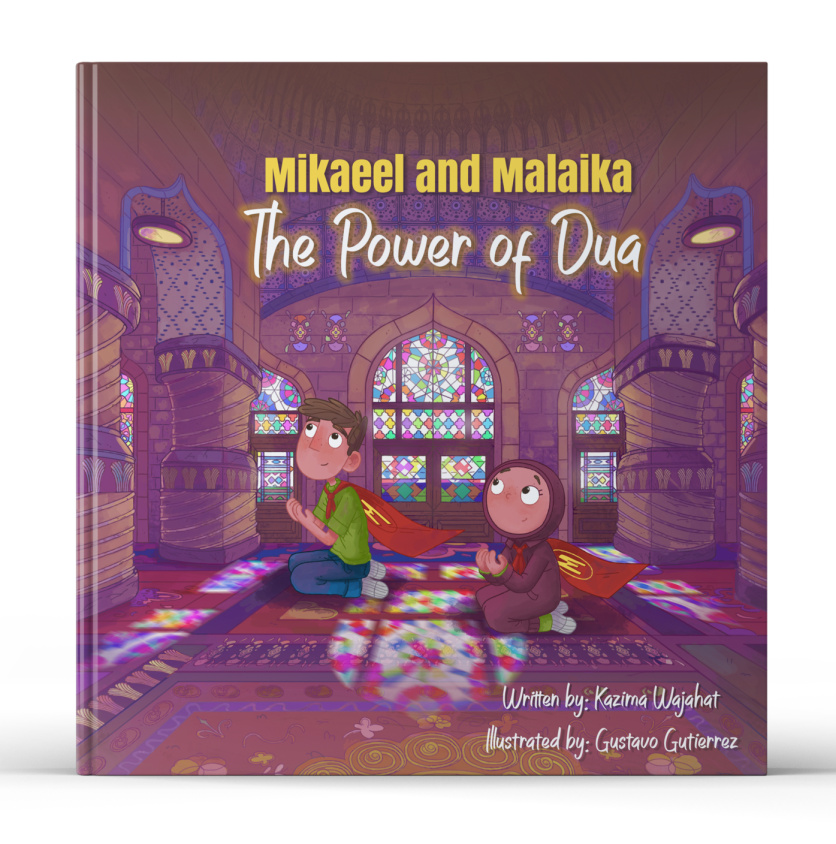
Mikaeel and Malaika: The Power of Dua by Kazima Wajahat illustrated by Gustavo Gutierrez

Standard
Mikaeel and Malaika: The Power of Dua by Kazima Wajahat illustrated by Gustavo Gutierrez

power of duaMikaeel and Malaika are back in this 32 page hardback book that explores why duas sometime seem not to come true.  Done in a hilarious manner that brings in riddles and problem solving elements, it is perfect for 6-8 year olds.  Younger children will enjoy the beautiful illustrations and silliness, and older children (and parents) will thoroughly enjoy Big Boss’s play on words and the illustrations showing his parenting style.  I’ve read the book multiple times to myself, my toddler, and even my older kids; each time surpressing a smile and enjoying the message lovingly and entertainingly conveyed: “rewards are best when the time is right.”
A8CB8717-C5BF-43A7-9A6D-AF90A8915A89

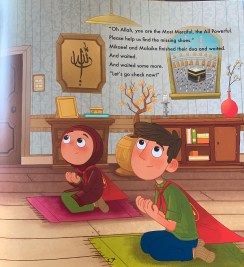
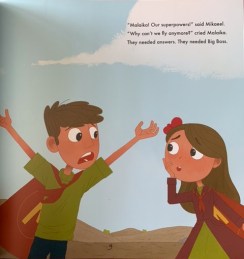
The book starts out with a problem to be solved, a mystery: who took the shoes from the masjid.  I know such a real world problem in a picture book, but fear not, super hero siblings Mikaeel and Malaika are on it.  There is just one problem, their super powers are gone.

04419E7B-4F57-4ACB-91CE-06F246F1C205

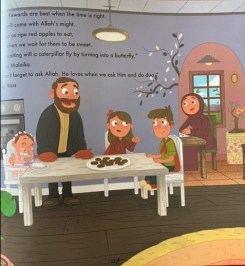
They head to Big Boss, aka their father, to find out what happened to their powers, only to learn they were part of a “14 day free trial” and their superjet? It was sold on Spamazon. At a loss of what to do, Big Boss reminds them that they have one super power left, the power of dua.

EA088D63-50D9-400D-A80D-A0C70FF1BF6A

The kids run to pray and then they wait.  When they can wait no longer, they go to see if the shoes have been returned, but…they haven’t. Big Boss gives them some sage rhyming explanaition that they don’t understand, but try to unravel in an apple orchard.  When that doesn’t work, he gives them more advice and they follow it up in a butterfly garden. With no answer insight, Mikaeel gets frusterated and wants to know why his dua won’t come true.

FE59775D-8071-4E5E-87FD-16CE71F341D5

Finally understanding that Allah (swt) does things at the perfect time and only at the perfect time, the children change their dua and the shoes are found, and the lesson learned and shared.

E5E3FE5E-EAA4-4B55-B192-BF82D8C69BA6

I love Big Boss, and this book makes it much more clear than in Mikaeel and Malaika: The Quest for Love, that his advice and riddles are in rhyme, but that the rest of the text is not.  I love that he is a hands on parent changing diapers, cooking, and guiding his kids. His steralizing of an infintile waste unit, and skimming a superhero manual are awesome and silly.

The book is about Muslim children, for Muslim children, but I think any child would enjoy the story to learn what Muslims believe, and any religious child who believes that there is one creator would be able to relate to the story as well.

671A295E-6B03-40AC-9172-C3F8085E7A73

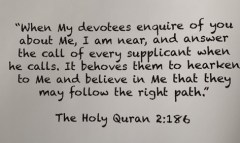
The book ends with an ayat from the Qur’an in English promising that Allah swt answers the prayers of the supplicants.  InshaAllah there will be more Mikaeel and Malaika adventures, and more of Big Boss and Super Agent M.O.M., too.


The Star Outside My Window by Onjali Q. Rauf

Standard
The Star Outside My Window by Onjali Q. Rauf

star outside.jpg

Woah! Domestic abuse, foster care, murder, astronomy, and above all hope and bravery. It is so, so much, and so beautifully dealt with from the perspective of a child, that I’m still living in Aniyah’s world and praying she is doing ok.  As the beginning of the book states, it is a story written for everyone, but it then goes on to say that there could be triggers and difficult things to read. So please, while it may be written for ages nine and up, you should know what your child can handle before suggesting they read such a heartbreaking 306 page book, and if they aren’t able to handle it yet, make a mental note to have a discussion when they are ready, it is important.

SYNOPSIS:

The book starts with a map of London and the chapters start with constellations, maps to the stars, and a little girl who wants to be a star hunter.  Drawing on Simba from the Lion King and wholeheartedly believing that stars are people who’s hearts were so big that when they die they light up the night, she maps the stars outside her foster house window, on the lookout for a new star, her mom.  Not remembering all the details that brought her to this foster home, she and her little brother Noah are trying to figure out their new life, the foster home rules, the loud pain they felt, and if they are winning the game of hide-and-seek with their father.

Unable to speak, Aniya, breaks her silence when a news story on TV tells of a star breaking the rules of gravity and flying by Earth.  Convinced it is their mom, Aniyah and Noah with the help of fellow foster kids Travis and Ben hatch a plan to go 73.6 miles from Waverly Village to the Royal Observatory in Greenwich, to make sure the star hunters name the star the correct name, and not the random computer generated one the contest rules dictate.

WHY I LIKE IT:

The book is inspired by the author’s aunt who was a victim of domestic abuse and killed by her husband.  The love and pain she feels at her loss, I believe is conveyed through the pages and felt by readers of all ages.  I had my 10 year old son and my 12 year old daughter read the book, because this book’s topics are heavy and weighty, but handled with such sensitivity and childlike innocence that it is a great introduction to the topic, without being overly heavy and weighty.  The author is amazing, and I was curious how she would follow up her amazing debut novel The Boy at the Back of the Class, and I think this one is just as powerful, if not more so. 

All of the foster kids suffer from some form abuse and there is even a note at the beginning about how the author does not like the term “domestic abuse” and there are resources and information at the end of the book for children or adults suffering or how to help someone they know suffering abuse.  There is also a page about Herstory, the constellations, and some personal anecdotes about the author’s aunt.

The book is truly heartbreaking because as an adult reading the book I could easily figure out what happened, that the father killed the mother, and that the games the mom would have the kids play were not games at all, but ways to mask what was going on. The book is very subtle in how it talks about what the mom and kids endured and some kids will not get it, and others will, either way, parents should be aware and available to discuss that abuse is never ok and that if their friends or someone they know is suffering/surviving, there is help.

The book is powerful also in the way the foster kids for the most part stick together, I think the way they are so willing to help and risk their own chances at adoption is selfless and memorable.  Also the way they put up with Noah, a little kid, who gets annoying, but handled lovingly,  because family means so so much when you don’t have one. 

On the surface though, it is an adventure story, can a ragtag diverse group of kids with little money, injuries and a deadline travel nearly a hundred miles to name a star?  Its fast paced, interesting, and emotional on many levels.

There is nothing Islamic in the book, not even a Muslim name in passing, but the author is Muslim and the story universal.

FLAGS:

Halloween is when they run away.  There is a lot of lying, but they know it.  Lying when the mom covers her bruises and marks, and how she is doing, lying when the kids run away and steal the bikes and sneak on a bus without paying, and break in to the observatory.  The kids feel guilty and know right from wrong in every instance, but when they opt to do something uncouth they rationalize it because they have to name that star!

TOOLS FOR LEADING THE DISCUSSION:

I’m seriously considering reading this as a middle school book club selection.  It is written for a younger audience, but I think I want to open up the topic of abuse and have the school counselor come and listen to the discussion.  The book is that good, and that important, and that powerful, that a discussion and lessons, will keep these characters’ stories in the middle schoolers’ minds as they grow and hopefully teach them empathy, compassion, appreciation, and patience.


Can Mustafa Control His Anger? By Hadeek Aziz and Katherine Bullock illustrated by Eman Salem

Standard
Can Mustafa Control His Anger? By Hadeek Aziz and Katherine Bullock illustrated by Eman Salem

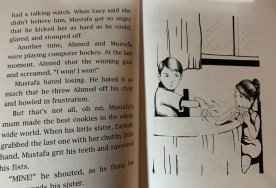
mustafa.jpg

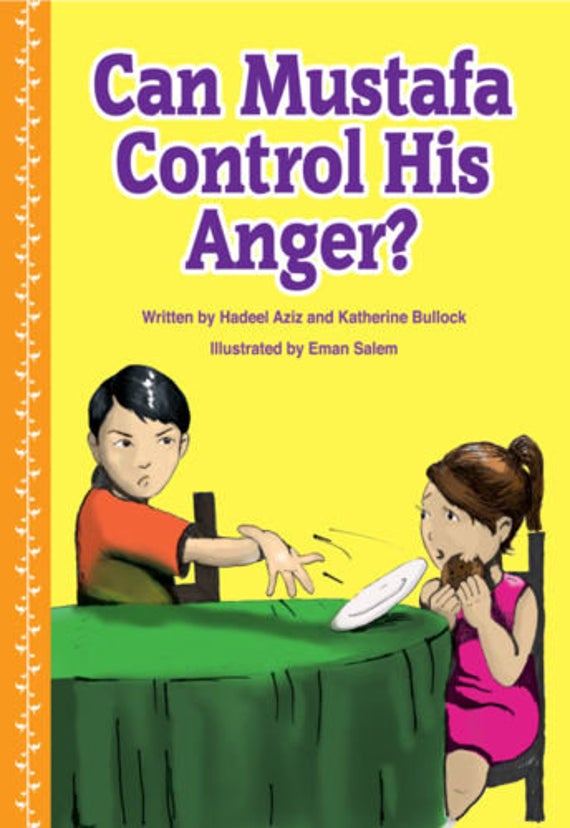
When I finished the 27 page Islamic fiction early chapter book, I thought, “It reads like a child wrote it.”  And sure enough as I flipped to the bio page I learned that indeed it is written by a secondary school senior.  I don’t want to be overly critical as a result of learning this, but as a published book that I paid for, I really wish some would have “corrected the book” and smoothed it out.  It has a lot of potential, and a good message, it just slightly misses the mark in details, some awkward tense changes, and crossing the line of what Mustafa does and says when he lashes out.  He doesn’t apologize and physically assaults people without consequences other than kids not liking him, and considering its for independent readers seven and up, that is a bit concerning.

SYNOPSIS:

Mustafa is a nice boy, except for when he isn’t.  Unfortunately he loses his temper a lot and as a result has no friends.  Whether it is losing a game, having someone not believe him, or even someone taking a treat he wanted, Mustafa resorts to physical violence and hateful words.  No parents or adults seem to ever correct him, so other kids just steer clear of him.

When a teammate won’t pass him the ball in soccer he punches poor Humza and when he goes to throw another punch he gets pushed off and bumps his head.  He storms off into the forest feeling alone, but not remorseful when a little red creature pops up and tells him he will be weak until he can control him.  Determined to show the creature he is strong he chases after it only to be scooped up by a giant named brother Haneef.

Brother Haneef and his giant friends live in a mud house in Makkah.  Shocked at how he got to the desert, he learns from his giant friend to ignore taunting, when another giant says you cannot learn Surah Al-Falaq in an hour.  Later when the giants race and Haneef loses, he says Audhu bilallahi min ash-shaitan ar-rajm and to sit down if standing and lay down if sitting as per the Prophet (saw) advice.  A giant girl gives Mustafa a strawberry tart and when he reaches to get a chocolate cupcake and someone else takes it, both he and Haneef scream, but Haneef goes and makes wudu reminding Mustafa of another hadith.  When Mustafa asks Haneef why he shouldn’t be mean to people that make fun of him or leave him out, Haneef tells him the hadith about how the strong man is the one who controls himself when he is angry.  As the giants go off to pray at the Kabaa, Mustafa finds himself at home in his bed with his sister waking him up and asking him where he has been.

41582EA9-516C-41FA-A337-C668F29C9F3A

WHY I LIKE IT:

I love the topic and that hadith are used and referenced in the book, as well as other resources. I also do like that it was written by a teen.  The pictures in the book are well done for the style and audience of the book, and the six short chapters are appropriate and inviting as well.

Oddly, the tense of the story changes at an awkward place on page 6 and I think it was intentional to go from telling about Mustafa to experiencing his “adventure” with him in the present tense, it just needs to be smoothed out.  Similarly, Mustafa is the protagonist, and we know his thoughts, but randomly at one point we know Haneef’s.  It isn’t technically wrong, but again, it is awkward as it is a short book, and everything else focuses on Mustafa asking Haneef to know things, not suddenly being in Haneef’s head.  I also felt like some resolution with shaytan, the red being, leaving or saying I’ll be back or something to continue his arc and role in the book is needed.  The details are hit or miss, vague descriptions about the giants lumps them all together, why they were at the Kabaa seems a bit random as well.

The biggest concern I have is a common one with these type of books, think Ahmed and Layla Deen books.  To make the point that he has a problem with his anger, the story goes way overboard.  Mustafa is genuinely hurting people, with kicking, punching, pushing, and throwing.  He lashes out and tells his little sister to shut up and calls her an idiot, and never once does he apologize even after his time with the giants.  Haneef makes the point that we all lose our temper, and need to simmer down, but Haneef also never apologizes for yelling or getting upset.  This is not ok, if you are teaching with the Prophetic method then that is a fairly large hole to have in the story.

There are no parents or adults which could make the point that kids won’t play with him stronger, but I feel like it really just means he gets away with a lot, and as a bully, that is not reassuring at all to the other characters in the book.  Some immediate consequences would be nice, or delayed guilt, something to make Mustafa not just seem like an awful person.  The moral is that he has learned his lesson, but I wasn’t convinced, nor where my 9, 10, and 12 year olds.

FLAGS:

Language and violence. Mustafa says, “shut up” and  “idiot,” he kicks a girl, throws a kid off a chair, throws a plate at his sister, punches a teammate,  and yells at everyone.

TOOLS FOR LEADING A DISCUSSION:

I wouldn’t recommend this book as a book club book, or even one to spend library or classroom library shelf space on.  It isn’t awful, there are just much better books out there and this one if not discussed might leave kids with the wrong impression.

3F32BB71-B114-48E9-978F-8B6031A2F88F


The Proudest Blue by Ibtihaj Muhammad & S.K. Ali illustrated by Hatem Aly

Standard
The Proudest Blue by Ibtihaj Muhammad & S.K. Ali illustrated by Hatem Aly

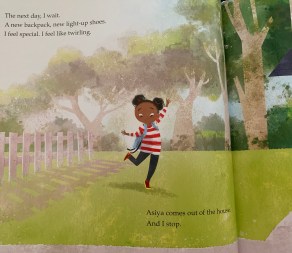
blueLOVE! Yes, usually when I’m so anxious for a book it disappoints, but not this one, it warmed my heart and soul and made me smile.  In 40 pages surrounded with absolutely adorable illustrations, the reader feels the love between siblings, the strength of self confidence, the power of being true to yourself, the beauty of hijab, and the awesomeness of light-up sneakers and five cartwheel recesses.
C7E95032-E080-4057-BC93-6B25CBCAAA29

It is the first day of school for sisters Asiya and Faizah, and Faizah’s first day of wearing hijab.  The book starts out with the girls and their mom picking out a new scarf at the store.

677BD5F0-0C6E-472A-B086-05F93D4F17CC

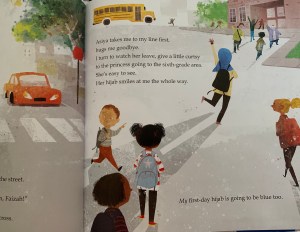
The first day of school has the girls walking to school hand in hand, Asiya in her beautiful blue scarf, and Faizah in her new shoes admiring her sister as if she were a princess.

DB80D90A-289E-4F35-A763-24526723E650

In line a classmate whisper asks Faizah about her sister, and Faizah has to find her voice to speak up about her hijab.  She then likens the blue hijab to the sky, special and regular before recalling that their mom had told them “The first day of wearing hijab is important. . . It means being strong.”

DFA253F0-16BC-464A-B630-BB93AFBFCF94

Throughout the day at school Faizah checks on her sister, sees other kids make fun of her, liken the blue to something beautiful, and then recall something their mom has told them to give her solace and strength.

06E90E71-3375-4E26-9F0A-F31DCA8058C4

As Faizah puts into practice the lessons from her mom about being strong, knowing who you are, and not carrying around hurtful words, she, like her sister finds strength.  A strength which radiates to those around them, and further connects the two girls.

C62B2893-3E2B-4628-BAAE-C195FBD3AB7A

Faizah has an amazingly sweet and authentic voice as she counts her light up steps and looks up to her older sister.  I love that the story stays on track and has its own rhythm of a school incident, a strong declaration about blue, a lesson remembered from Mama and a resolution.  With lots of mini climaxes the reader sees the strong perseverance and how being authentic will be challenged repeatedly.  The subtly of the hijab being whispered about and then proclaimed loudly is really tender and emotion filled.  Little reminders why OWN Voice stories are so important.

The illustrations are absolutely amazing on their two page spreads: the colors, tone, expressions, are perfect and a huge part of the narrative.  I love that when a boy points at Asiya, not just Faizah, but Asiya’s friends too are unhappy with the boy.  I also like that the boys being mean are not depicted clearly, but rather are shown in the shadows, furthering the point that mean words and those that spout them are not worthy of your time.

There are Authors’ Notes at the end and a picture of Ibtihaj  and her two sisters Asiya and Faizah. I think the book should be on every shelf, truly.  To be yourself and be proud of who you are is universal, as is kindness. The book does not discuss religion or mention Islamic reasons for her covering, and girls and boys alike will benefit from multiple readings of the book.


The Sign of the Scorpion by Farah Zaman

Standard
The Sign of the Scorpion by Farah Zaman

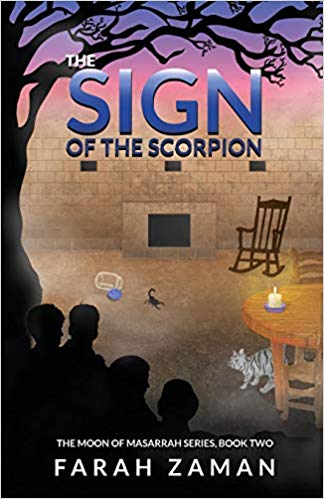
scorpion

This is the second book in the Moon of Masarrah series, but can be read as a stand alone book if you are looking for a linear story with fast paced action, intense twists, decently developed characters and quality writing that brings the sleuthing of Muslim characters to life.  At 229 pages including the glossary, the book reads to me as a middle grades book, but the last 50 pages place a lot of emphasis on accusations of a character molesting servants in the castle and another character having an affair, which might be more appropriate for older readers.  Perhaps middle school readers would be a better target audience, but I’m waiting to hear back from the author regarding who she had in mind when she wrote it.  The author said she wrote it for Young Adult, ages 12 and up in mind.

SYNOPSIS:

Brother and sister, Adam and Layla are reunited with their friends, siblings, Zaid and Zahra after last summers intense adventure involving a diamond.  This summer as a result, they are the honored guests of Shaykh Sulaiman at his dessert home, Dukhan Castle. They arrive to find out that the Shaykh is bedridden from a stroke after learning his son has died.  With a house full of relatives with reasons to want their claim to the Shaykh’s fortune, the four teenagers start putting odd occurrences of a ghoul in white, a hooded horseman, a gypsy woman’s tale, and the idea that there has been foul play, together to try and arrive at the truth of what is going on.  As they piece more and more together about the tutor, the cousin, the fiance, the grandson, and a mysterious mole-man following them, they themselves get tangled in the sinister plot of revenge and must keep an eye out to figure out who the scorpion, Al-Aqrab, is before one of them ends up dead.

WHY I LIKE IT:

Set in a fictious land, the detail is the perfect balance between setting a stage and over describing it.  The book did not drag for me at any place, nor did I find myself confused about what was going on and why.  Granted I probably could not tell Adam apart from Zaid and Layla from Zahra, but the book is about their adventure and figuring out whats going on, not about their relationships or back story.  And with the focus on all the possible perpetrators and their motives taking center stage, having four people gathering clues makes the information come easier and smoother.

All the characters are Muslim.  Some of the women cover and some do not, some stop to pray and make regular references to Islamic hadith or Quranic Ayats, and some are suspects.  For example when they are exploring the dungeons beneath the castle, they liken the caves to the Sleepers in the Cave mentioned in Surah Kahf.  The book never gets anywhere near preachy, nor do the few references ever get annoying, they just flesh out that the characters are Muslim, and thus they see the world through that lens.

FLAGS:

The book has murder, lying, deception, all the ingredients for a good who done it.  And while the details are all clean regarding how the four teens interact with the opposite genders, the climax of the book is the coming to light of allegations of molestation and a failed marriage is attributed to a presumed affair.  No definition of the words is given, and I reread many of the passages and I don’t know that there is even enough context clues to decipher what the word molest means in the text.  Most kids however, could easily ask Siri or Hey Google or whatnot and may have more questions about what it means to sexually assault a person, specifically a woman or child, and why someone would do it.  I leave that for parents to decide at what age those in their charge can grasp such a word and concept.

TOOLS FOR LEADING THE DISCUSSION:

I’m torn on teaching the book as the linear telling might not appeal to older kids, but the motive and revenge isn’t appropriate for younger kids.  I think if used to discuss broader issues the book could be really powerful, and not just a fun read.  I could see discussing with 9th graders or so the seriousness of false accusations, drawing on the Me Too movement and how sexual crimes and transgressions should be handled and treated.  I think the book could be a springboard for those discussions and seeing the effects of believing or not believing, and perhaps suspending judgement until research can be done.  In the case of the book, it would not have been difficult to pursue the allegations, while protecting any potential victims.


NOTE:

The first book in the series, The Moon of Masarrah, was originally published under the title, The Treasure at Bayan Bluffs, some changes have been made in the new printing, so while I don’t normally review second books in a series, I felt this book might bring attention to the new title of the first book and drum up interest for the upcoming third book in the series.  No, I don’t benefit in any way and I purchase my copies just like you, the stories are just really well done and I want readers to give them a try.  Happy Reading!

Secret Recipe Box by Helal Musleh illustrated by Nalan Alaca

Standard
Secret Recipe Box by Helal Musleh illustrated by Nalan Alaca

recipe-box.jpg

The publisher suggests this book for ages 4 and up, but I think it’s a bit long (30 pages) and detailed for that age group, and first grade and up will benefit more from this heartfelt story.

IMG_5872.jpg

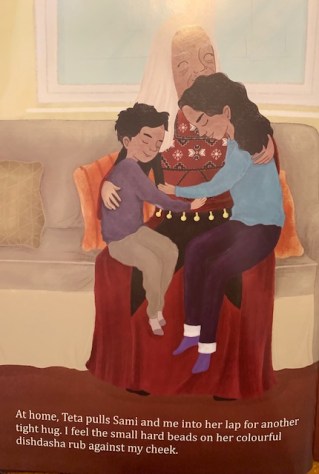
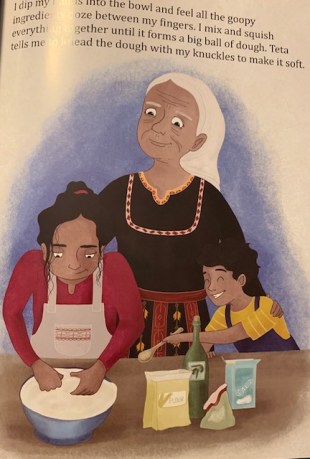
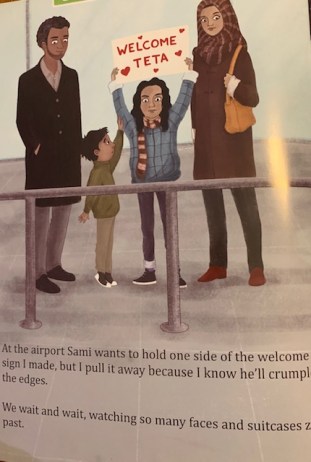
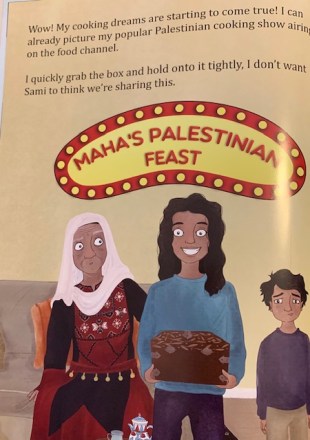
Maha is excited her Teta is moving from Palestine to live with her, her brother Sami, and parents in Canada.  Maha dreams of being a chef on a famous cooking show, and her Tata and her secret recipes will be a great way to practice.

IMG_5873.jpg

Her little brother Sami is always in the way though.  Whether it is wanting to hold a sign Maha has made, or is wanting to cook with her, she is annoyed by him at every turn.

IMG_5764.jpg

As Maha listens to Teta’s stories and learns about her life in Palestine, she starts to change in her approach to Sami and realizes that family has to take care of each other.

IMG_5874.jpg

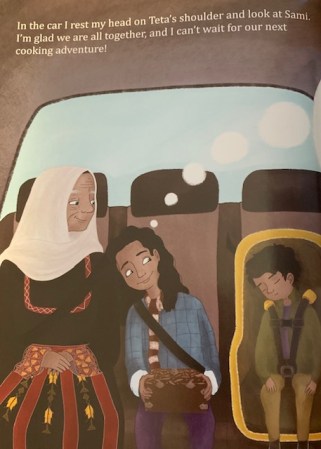
After a day of cooking together, Maha, Sami, and Teta have made too much food and decide to go and share it with those in need at the soup kitchen.

IMG_5763

The book addresses kindness, changing, compassion, immigration, taking care of one another, multi generational lessons and love, stories, life lessons, and some highlights of Palestinian culture, food, clothing, and tradition.

IMG_5761

The book is warm and well done, with the exception of a few of the pictures which seem a bit off to me.  Overall, it is a sweet story that presents with a lot of lessons, but doesn’t force them upon the reader.  The character growth is gentle and subtle and will resonate with readers.

IMG_5762

The characters mention Halal food, and the grandma wears hijab even in the house, where the mother is shown wearing it at the airport, but not in the home.  The book would work for Muslim and non Muslim readers.

More to the Story by Hena Khan

Standard
More to the Story by Hena Khan

more to the story.jpg

For a book written by an accomplished author for 3rd to 7th graders focusing on a Muslim family, I was surprised at how despite wanting to absolutely love this book, I only kind of liked it.  For the first 100 of 271 pages, I really kept hoping there was going to be more to the story.  Luckily the story did pick up, but I couldn’t get passed how much crushing all the sisters were doing on the one boy in the story, and how much stronger I wanted the main character to become.

SYNOPSIS:

Told from Jameela, “Jam’s” perspective, the second of four daughters living with their parents in Georgia, the story focuses on the interpersonal relationships of the members of the family and their parents’ close friends who’s nephew has moved in with them from England, Ali.  All the kids are close in age and of Pakistani ethnicity, and are Muslim.  As the reader gets to know Maryam, Jam, Bisma, and Aleeza, you see the characters develop pretty well and their quirks and personalities emerge.  Jam is more tomboyish than the gorgeous Maryam who likes to bake.  Jam and Bisma share a room and are closer than Jam and Aleeza, the baby of the family who Jam finds is becoming a brat.  Jam also enjoys watching football and eating spicy food with her dad and desperately wants to be an award winning journalist like her grandfather.  She puts out a family newsletter and is ecstatic to be named the feature’s editor as she starts 7th grade.  Ali is a year older and has moved to stay with his aunt and uncle until his mom and sister can join them.  He spends a lot of time with the sisters and in Little Women inspired fashion the little ones want his attention, Jam is a little jealous to learn he finds himself tongue tied when talking to the beautiful Maryam and Maryam in 9th grade is drawn to Ali, but doesn’t vocalize it too much.  And then as the story picks up speed, Jam says, “In a matter of weeks, Baba got a new job and moved across the world, Bisma got sick and has to be in the hospital, and I messed up everything with Ali and the paper. How did my whole life get turned upside down so quickly?”  

The rest of the book is dealing with Baba working in the Middle East, Bisma being diagnosed with lymphoma, Jameela learning some journalistic basics, and Ali and Jameela becoming a bit more than just friends. 

WHY I LIKE IT:

I love that a Muslims desi family is being represented in an own voice novel that mentions religion as a natural part of their life, and doesn’t apologize or overly explain it.  That being said, I feel like the book is trying to present “us” to the outside so to speak, rather than empower our own.  And I point this out, because I feel like it could have done both.  Dialogue between Ali and Jameela about how they might date as they get older, how Ali can’t see any of the sisters having an arranged marriage.  How when Maryam gets asked to a dance her mom doesn’t mention any religious reason her daughter should say no.  None of the girls wear hijab, and they mention that they don’t wear hijab, at one point Jam knows she should get up and pray, but doesn’t.  I don’t expect a fictional story to teach our upper elementary age kids how to behave that is a parent’s job, but to have some basic Islamic tenants brushed aside after being mentioned is worth noting.  Had the book just been more cultural, maybe I wouldn’t be so critical, but Muslim girls are going to be excited to see themselves in this book and some of the messages might tilt a little more liberal than some parents would expect.  It is one thing when our girls read a book with a romantic twist and we say that, that is not for us, but when a book celebrates us not just crushing, but vocalizing those crushes and moving in to a gray area (they hug but it could be an innocent friend hug) and they make a point to be next to each other, Muslim parents should be aware.  In the larger society it wouldn’t even register on the radar, hence I point it out.

Another thing that kind of bothered me and was again related to Jameela and Ali’s relationship was that when Jameela cut her hair in support of Bisma losing hers with chemo treatments, she seems to need Ali’s approval.  I get that she wanted him to see her and all that, but I really wanted her to be strong enough in and of her self that even if she looked awful she would own it and not let it define her and not let a boy’s opinion about her physical appearance weigh that heavily on her.  Again I know 4th grade girls start noticing boys and having crushes and middle school is only worse, but I just was hoping that her strength and confidence would come from her own growth arc, not from someone else, let alone someone she likes. Side-note here too about the hair, it is donated to make a wig, which I know might also be a sensitive subject regarding if that is allowed in Islam or not.

In terms of the cancer and the sister’s rallying together all that I thoroughly enjoyed and found the most interesting passages in the book.  I think the understanding of a real subject and finding a way to help and deal with this was executed expertly and powerfully without sensationalizing the concern or simplifying the experience either.

FLAGS:

The book is clean, but there is a lot of mention of how Ali affects the girls.  And potentially depending your own opinions on the hair being donated.

TOOLS FOR LEADING THE DISCUSSION:

I wouldn’t do this as a book club book, I’m actually hesitant in even recommending it to my 12 year old daughter.  I know she has read worse, but again me handing her a book about Muslim girls might make her understanding of what we expect regarding boy/girl interactions to be a bit muddled.


Badir and the Beaver by Shannon Stewart illustrated by Sabrina Gendron

Standard
Badir and the Beaver by Shannon Stewart illustrated by Sabrina Gendron

badir and

This 92 page early chapter book is a great linear story for 1st through 3rd graders.  The size, font, spacing, illustrations, chapter length, and content make it a fun read that incorporates diversity, environmental action, teamwork, information about beavers and acceptance all through the efforts of young Badir, a recent immigrant from Tunisia during the blessed month of Ramadan.

SYNOPSIS:

Badir is new to Canada and while he misses Tunisia, he is joyful and upbeat as we meet his older brother Anis, young twin siblings and classmates.  Out one night before iftar, he sees what he thinks is a giant rat swimming in a lake, but no one believes him.  When he sees it a second time, a lady at the park explains to him that it is a beaver, not a rat, and pulls out a Canadian coin to show him there is a connection between beavers and Canada.  With new knowledge about the difference between a lake and a pond, a rat and a beaver, Badir is fascinated with how beavers build homes, mate for life, and benefit the environment.  He even likens the beaver eating at sunset to his families own Ramadan schedule.

But all is not well for the beaver, as a petition is being circulated to relocate the rodent and save the trees in the park from his sharp teeth.  With new friends, a supportive teacher and classmates, Badir is determined to prevent the beaver from having to leave his home as Badir and his family had to do.

WHY I LIKE IT:

I love that this book is subtle in highlighting the welcoming of immigrants into a community, about having the main character be Muslim and it being Ramadan, and showing that diverse people can come together for a bigger cause and even become friends.  The main story line is naturally to save the beaver and the trees in the park, so the information and facts about beavers is appreciated and well presented.  I think most everyone of every age will learn something new about the common rodent.  But, by the main character being genuinely like-able and infectious, the reader will also realize that any negative stereotypes about Muslims or immigrants really aren’t a factor.  Badir’s family is really nice, the parents prepare food together, they feed their kids’ friends, and invite them over. The author does a good job at accurately making them seem like any other family.

IMG_4808

There isn’t much stress on Badir being Muslim or what that means outside of it being Ramadan, praying, and going to the mosque as a family at night.  The illustrations show the mom in hijab. The book tells a tiny bit about Tunisia, but not why they left, and definitely makes the foods they eat sound delicious.  Overall, it really does a good job of keeping the book about the beaver and finding a solution.

The book is for both non Muslims and Muslims and seems to be written by a non Muslim, and while set in Ramadan it is definitely not limited to being a “Ramadan story.”  There are small pictures on many pages and a full page picture in each of the 12 chapters.

IMG_4806

FLAGS:

None

TOOLS FOR LEADING THE DISCUSSION:

I think this book should be in classrooms and school libraries.  It really is well written, informative, and fun.  I don’t do a story time for the target audience of this book, but I think it would be a candidate for my “Lunch Bunch” meetings, when I read aloud to 4th and 5th graders once a week while they eat lunch.  Even if it is slightly below a 5th grade level, I think even older kids who pick it up and read it, or listen to it being read, will find it interesting, entertaining, and worth their time.

Publisher’s page: https://www.orcabook.com/Badir-and-the-Beaver-P3992.aspx


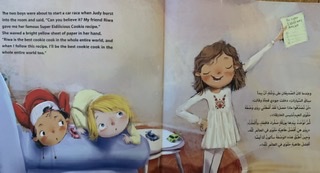
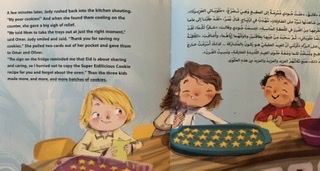
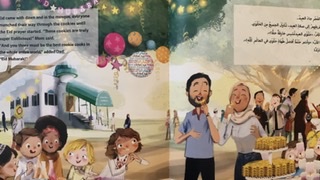
Mustafa and Arwa go on a Ramadan Adventure by Mekram Mohammad

Standard
Mustafa and Arwa go on a Ramadan Adventure by Mekram Mohammad

IMG_3184

Ramadan is two months away and this little book is a great way to introduce and stir up excitement for little Muslim toddlers and preschoolers. It could work for non Muslims, but the general overview given would need some details and explanations, and this book seems more geared to introduce excitement and a few key concepts for the blessed month.

IMG_3190

In 27 rhyming pages the brother sister duo explore some of the feelings of the month, activities that make the month special and what to expect at suhur, iftar, and taraweeh at night.  

IMG_3185

I like that it makes it clear that you don’t eat one bite, that you fast even if you are at work or school, that you use your time to do good and help people, and that you ask Allah for paradise.  

IMG_3188

The end is Eid and while the text presents some great general info, the illustrations are what really give the minimal clear text life.  Seeing the kids giving presents to people and looking for the moon and enjoying iftar together with smiling faces, show kids the warmth of Ramadan.  

IMG_3186

The book doesn’t have a story, it just talks about Ramadan, but the tone in this book and in Mustafa and Arwa go on a Prayer Adventure is very fun and light.  It doesn’t get into rules or articulate what little kids are expected or required to do, or even why Muslims do it, it just gives them some knowledge and some emotion to create the feeling of it being a grand adventure.

IMG_3189

The book is paperback 8.5 x 8.5 and the thickness, sheen and quality of the pages makes it durable and enjoyable to read at story time (in small groups) and bedtime alike.  This book most likely will be on repeat in the weeks leading up to Ramadan and then referenced throughout the month to remind children about what they are seeing and experiencing.