This is an important book to show representation of an underrepresented group, not just those with autism, but also those that love them and live with them. It is also important to spread awareness so that those that do not have first hand experience can show compassion and patience for the individual and those around them as well.
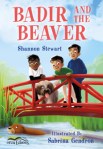
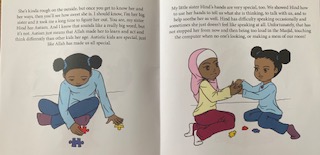
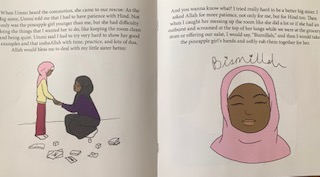
This 16 page book, only 9 pages of text, is written by a mother and daughter about another daughter. It is told from the perspective of 9 year old Juwayriyah and how she sees and helps her younger sister Hind.
I love that it makes it super clear that children with autism are created this way by Allah swt and made special just as all of us are unique and special. I also like that Juwayriyah has had to learn to slow down and say bismillah before often dealing with Hind. It also shows that it is a work in progress and there are good days and bad days. It isn’t smooth sailing, and it isn’t something that needs to be fixed, it is what it is and we must adapt.
The book is wonderful, for what it does and what it represents, however, in terms of story, it is kind of dry. It very much is a nine year old, optimistically talking about her sister and how rubbing her hands has proved a coping skills when she is overwhelmed, but you don’t get to know any of the characters. You don’t feel a bond, or understand what life is like for Hind, or why sometimes she has outbursts or what her triggers are. I don’t know that kids will even understand concretely what autims is other than that it means people with it learn and act and think differently, as no real examples are given.
There is a lot of text on the pages. I think if you know someone with autism or have maybe seen a child having a melt down, children younger kids will enjoy the explanation and fact giving the book provides. Otherwise I think 2nd to 4th graders will get the most out of this book as they start to notice different behaviors and other’s reactions to them.
It is a bit odd that this story is fiction, when it reads so much like a piece of nonfiction. It is a picture book, but has an AR level of 4th grade 4th month. So, while the story is great and highlights a country and culture, Bangladesh, not often seen, I don’t know that this book would appeal to many kids. The kids that it does appeal to though and that can find it in a library or bookstore (not sure where it would be shelved), I think will not just like it, but possibly find it both inspiring and worth reading again and again.
It is monsoon season in Bangladesh and the rains make Iqbal’s mom have to cook indoors. As a result, she and the baby, Rupa are constantly coughing from breathing all the smoke from the woodburning stove. Iqbal’s father mentions a propane stove he saw in the market, but the family cannot afford it, despite wishing that they could.
Iqbal’s school has just announced the School Science Fair and the winners get cash prizes, if Iqbal can win, maybe he can buy his family the new stove. His little sister Sadia offers her services to help him win and be his assistant.
After a lot of thinking, pondering, and dreaming, Iqbal decides on the perfect project: a stove that didn’t produce smoke.
With the help of his teacher at school to find ideas and articles and plans on the internet, Iqbal and his sister build a solar cooker with foil and an old umbrella.
The science fair is a success, Iqbal wins, the family buys the stove and propane with the winnings, and when it isn’t raining, the family is able to use the solar stove Iqbal and Sadia built.
The book draws on ideas of sustainability, pollution, economic viability, problem solving, and education. The culture provides the backdrop making all of these issues relevant and real, and mentioning Ramadan, Eid, and prayer provides some depth to the characters and adds to their culture.
A lot of reviews online criticize that the mom is cooking and that the kids test an egg on the solar cooker and call her to eat it if it is supposed to be Ramadan, but I personally promise you, during Ramadan, we are always cooking. And if she is nursing the baby, the mom wouldn’t be required to fast, there’s a lot of other reason she couldn’t/wouldn’t be fasting, but really, it is such a small portion mentioned in passing, no detail needs to be given, and it didn’t bother me at all.
Another complaint about the book is that if money is so tight the kids wouldn’t be at a school where they can just make copies, and buy eggs on their own. I think there is some truth to this, but maybe a wealthy doner funds the school. I think you could argue it either way. I don’t know that the family is poor, it is the overall society, so kids could have pocket money, a propane stove is probably imported at least from a larger city so the expense would be more, similarily the infustruction of electricity and gas lines could hint more at why they cook the way they do. Needless to say the family is smiling in the pictures, they have food, and they seem to be doing ok. So the fact that the school printed a few articles and the kids bought some eggs without asking permission, didn’t bother me greatly.
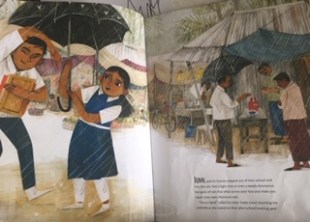
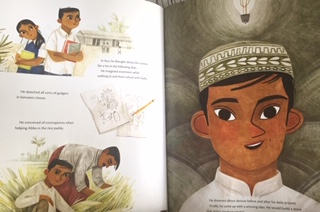
The illustrations are expressive and show the family connections and emotions. I like that they bring to life a country many wouldn’t know, even if I wish it weren’t a work of fiction, but based on some child actually there.
The end of the book has information about clean cookstoves, how to build one yourself, and a glossary. The large 9×12 hardbound book would hold up well to multiple readings, and the amount of text on the pages would work well as a read-a-loud to younger kids who would find the subject matter interesting.
Oh how I love to read sweet books and repeatedly thumb through warm engaging illustrations. This book is beautiful, fun, and (possibly) very relatable.
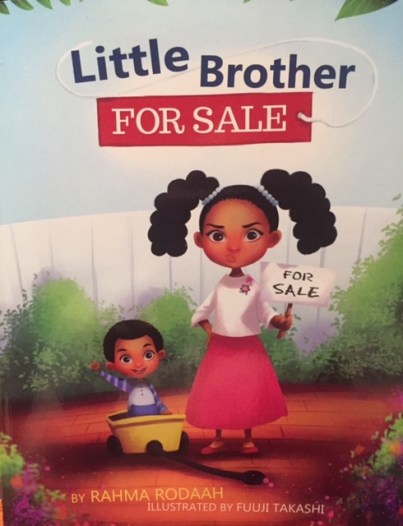
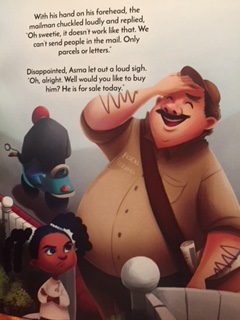
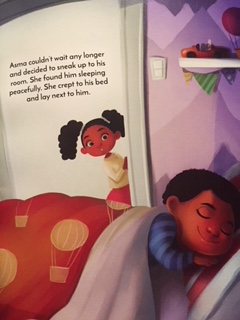
A big sister, Asma, is ready to get rid of her little brother, Hamza, so that she can enjoy all her parent’s attention. But when the mailman won’t let her ship him to grandma, and neither the lady walking down the street nor the neighbor next door want to buy him, she is determined to find someone to take him off her hands. Alas though, it is Hamza’s nap time and while mom makes salat Asma finally gets some time to herself.
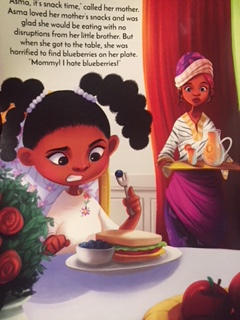
Except she misses having someone sharpen her crayons, or eat the blueberries she doesn’t like, and there is no one to dance with her around the living room. She decides that maybe she does like her little brother, and lays down next to him with promises of loving and protecting him forever. Ahhh…..
Yeah, the book is pretty predictable, but the details make it charming. I love the diverse characters and the love and warmth they all exude. I love that when she drags her brother out in the wagon and holds up the for sale sign, mom is peeking out from the kitchen. I reassured myself that she was there, so it was ok for Asma to be talking to the mail man, a potential stranger, and the lady walking down the street, muslimah or not.
The only slight hiccup to me was what one-year-old, he was seemingly taking his first steps in the first picture, can sharpen crayons? Maybe I just failed to prepare my children, but other than that, the book is smooth, and well done.
The binding quality, the font, the amount of text on the 26 pages, is definitely preschool to first or second grade, and the illustrations will mesmerize even toddlers who won’t understand why the book is so silly.
The book has been floating around my house and I’ve seen my 11 year old pick it up and read it on her own, and then read it to the three year old mutltiple times. She possibly was getting ideas, but maybe it also reminds us that siblings really can be both annoying and lovely as well.
In the first Zak book, Zak had good intentions that just never went his way and we, as the readers, really felt bad for him. In this new book, it takes a few pages to feel sympathy for Zak as his little lies get him in trouble, but sure enough when he finally changes his ways, it is cause for relief, celebration, and a great lesson to teach kids something that they do without much thought.
The book claims to be for 3 to 7 year olds, but I think it works best for 3rd graders who seem to be testing honesty out. Yes, it is great to introduce it to younger kids, and you really should, but like the first Zak book, the pages are a bit text heavy and the concept really should be understood without too much hand holding. For me, the power of the book is the way that Zak’s little lies snowball in to a habit, and the climax really is something that you want the child to feel from within, not as just an adult once again telling them to be honest and not lie and to listen.
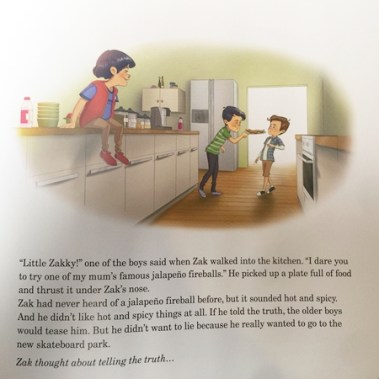
Zak starts the book with one more chore to do until he can go to the skate park with his Baba to play. But, he gets caught in a lie about his bearded dragon, Dwayne, and the stage is set for him to get through the day honestly. The next test doesn’t involve lying to his parents, but rather some kids from school that tease him, he doesn’t tell the truth and consequences ensue. Next up he lies to his sister, again a great addition in showing that honesty is not just important when dealing with parents or adults, but that it needs to be the standard in all our dealings. At the end, it is his sister getting in trouble for something that he has done that forces his to come clean about his whole day and to learn that truly, “Nothing in the earth and in the heavens is hidden from Allah” (Surah Al-Imran 3:5).
The hardback book is 29 pages with the last two pages being Discussion Questions and more information about the Quran Ayats and Hadiths mentioned. The illustrations are not too busy, but the characters facial expressions are spot on, and often where the emotional cues for the text are found.
In terms of plot and and believability, this 274 page 6.3 reading level book has moments of unrealistic twists, but the historical flashbacks and context make up for it as it delves into Pakistan, India partition without getting overly bogged down in politics and bitterness. You can tell that the author writes from a place of love and warmth, as she talks about all sides involved: Pakistan, India, Great Britain. The stories, fictional and historical, that weave through the novel make it informative and entertaining irregardless of one’s prior knowledge.
SYNOPSIS:
Maya is 12, and a little shy, especially compared to her older sister Zara. The book starts with her writing a journal entry about her visit to Pakistan in an airplane somewhere over the ocean. Maya, her older sister Zara, and their mother are heading to Karachi from America because of the death of Maya’s beloved grandfather. Frequent visitors to Pakistan, Maya is familiar with the sights, traditions, and language. As other family members arrive, Maya and Zara overhear their elderly grandmother planning to runaway to India to retrieve family heirlooms that were left during partition. The plan had been in the works for the whole family to go, visas were already obtained, but with the unexpected death, the urgency is amplified. Grandma wants to find a ring to bury with her husband. In Islamic custom burials happen very very quickly, often the same day, so the delay and sending the body to America, is something you just have to go with as the reader. Rather than convince Grandma to stay, the girls threaten to tell their mother if she doesn’t take them along, and the next thing you know the trio are off to India and on a treasure hunt. There is a map at the beginning of the book, which is very helpful. However, the adventure isn’t straightforward, not only in the trio’s adventures, but in that grandma ends up in the hospital, Zara and Maya decide to pursue the lost items on their own, and then Zara and Maya get separated. Twelve-year-old Maya then is forced out of her shell as she is kidnapped, and running for her life, trying to keep her promises, and also in desperately trying to save her family from having to pay a ransom to save her. A lot happens, and the intensity amplifies as it starts out as a elementary aged family story and turns into a middle school adventure. A long the way are beautiful passages about the scenery, amazingly simplified, but factually and emotionally accurate explanations about partition and ultimately, through Maya, about finding your voice.
WHY I LIKE IT:
The framing of the fictional story and the historical context is wonderful. Partition, is such a pivotal moment for those that lived through it, but has less and less relevance to today’s generation that lives abroad. So, to find a book that makes the gist of the events come through, is why I love using fiction to connect people and ideas. I am making my daughter read this tomorrow, no question. She needs to know what her own grandmother endured, what decisions her family had to wrestle with, and this book allows us to have those discussions in an informed way. I’m sure many would disagree and say that the reader should know about partition before reading the book, but I think the tidbits and delicate way the author convey the horrors, the agony, the manipulation, and the struggles in todays time, is far better than I could do to a sixth grader.
Maya’s abilities seem to grow overnight, so while she was an ok protagonist, she might annoy some. I actually had to google in the middle of reading how old Maya is, at times she seems like she is eight or nine and at other times like she is 15. I do like that Maya constantly remarks how alike India and Pakistan are, a reality that today’s generation definitely agrees with, but is often afraid to voice to their parents. I also like that there are good and bad everywhere, a theme that doesn’t get old, especially in books that deal with cultural and religious elements as presented to a wide audience.
There isn’t much religion in the book, the characters don’t stop and pray or wear hijab, but the setting does allow for mention of masjids, and a kind Imam back in California, the characters identify as Muslim and they discuss Muslims as a minority and political entity regularly. One of the treasures the grandma is looking to retrieve is an old Qur’an with the family tree drawn within. The book talks about how intertwined the two countries and many religions of India are, and Maya’s name articulates many of these crossroads. In the end, perhaps the best lesson from the book, is how much alike we all really are.
There is a wonderful Author’s note in the back, along with a glossary.
FLAGS:
The book has some violent images as it discusses trains coming from India to Pakistan with only a few living aboard and vice versa. The intensity as Maya is robbed, and then kidnapped, and then held hostage, could also be jarring for some younger readers.
TOOLS FOR LEADING THE DISCUSSION:
Like all her other books, I would absolutely include this in a Book Club, there is a lot to discuss, lots to understand, and lots to enjoy.
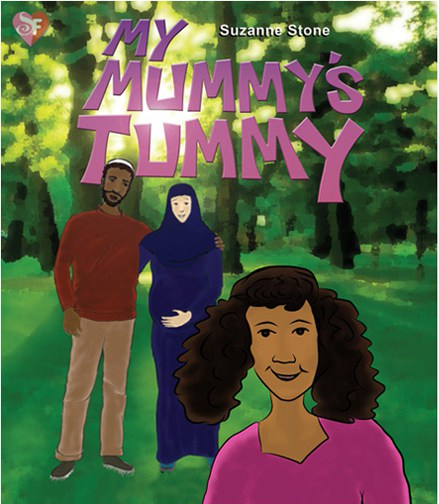
The copy I have is called My Mummy’s Tummy, but the binding says My Mummy’s Fat Tummy, I would assume that they are the same book except for this one word, and I’m hoping they opted to remove it at the last minute. Actually, while on the title, it only works well for the first four pages and yes, it sets up the story of a new sibling, by page five, the baby is born and mom’s tummy is the least of big sister, Maryam’s worries.
The 24 page rhyming book, is a good introduction to what kids ages 3-6 can expect with a new sibling. From Mummy’s large tummy, to having to stay with an Aunt when Mummy’s tummy starts hurting, Maryam is excited to have a new baby sister, except it ends up being a baby brother. And while she is promised someone to play with, initially all he does is cry and sleep. With gentle prodding by her parents and islamic reminders of patience and kindness, by the end of the book the baby is nearly one and his favorite person is his big sister Maryam, alhumdulillah.
I love the diversity of the parents, and the acknowledging that changes are hard without being condescending or dismissive. The book stays positive and hopeful and reminds us to keep Allah close to us when dealing with challenges and dreaming of the future.