Tag Archives: Picture book

Peg + Cat: The Eid al-Adha Adventure by Jennifer Oxley and Billy Aronson

Standard
Peg + Cat: The Eid al-Adha Adventure by Jennifer Oxley and Billy Aronson

peg.jpg

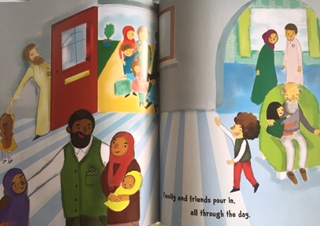
Easily the most anticipated Eid al-Adha book to come out this year, the book does not disappoint.  Following the episode, the book, is 32 pages and while ok for ages 3 and up, like the show, it really is geared to children able to grasp the math concepts presented.

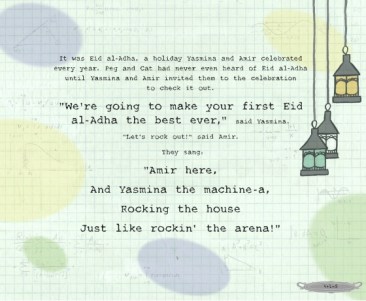
The book’s story is that it is Eid al-Adha, and Peg and Cat are learning about it with their friends Yasmina and Amir. The holiday facts don’t seem forced and words like hijab. oud, and Eid Mubarak, are integrated naturally.  The concept of giving charity, giving to those with LESS, becomes the set-up for learning about more than, and less than. 

peg4

A few pages later the tradition of dividing meat into three parts: one to keep, one for friends, and one for the poor, sets up a lesson on fractions and using a pan balance.  The really big problem, involves moving crates.  They count down from seven to calm down, and then use all their lessons learned to solve the problem and help a neighbor.

peg5.jpg

The illustrations are straight from the show in all their adorable glory, I’m not sure why Yasmina has some strange tree branch looking loose hairs poking out of the top of her scarf.  I love that the page numbers are math problems (2 +1=3 for the 3rd page).  And the hardback with slip cover workpages on the underneath side, are a nice treat.  I was especially greatful the picture on the slip cover is the same as on the book, so the cover can be discarded, as will ultimately occur with multiple readings.

peg2

Books like this are great ways to introduce an Islamic tradition to non Muslims in a non preachy, non threatening way.  By seeing beloved characters with Muslim friends helps shape perceptions and increase understanding, inshaAllah everyone wins, alhumdulillah.

Controlling Your Anger by Saaliha & Ali

Standard
Controlling Your Anger by Saaliha & Ali

anger cover

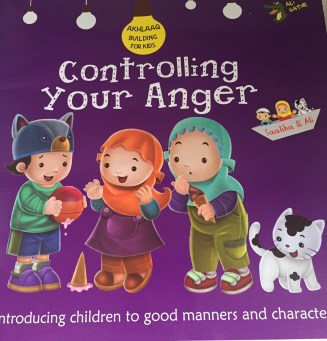
I love little picture books for toddlers and early elementary kids that introduce children to Akhlaaq, good manners and characters.  The book’s tone, however, seemed a bit off to me, so I put it away a month ago and pulled it out again today to read it, knowing I would have forgotten most of my initial thoughts, but somehow, they resurfaced with a vengeance, unfortunately.  And while the pictures and binding and theme are all absolutely wonderful in this 23 page book, I didn’t like the main character at all, and being it is based on a real person, a child, I feel awful saying that.

anger

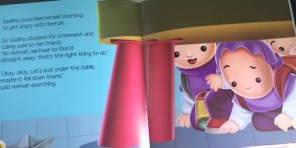
Saaliha starts the book keeping her anger just under the surface as her friend Hannah has borrowed and lost her pencil.  Hannah says she’ll look for it after lunch, and Saaliha controls her anger and basically says that it needs to be found now because it is the right thing to do.  All of that is fine, but for some reason she seems bossy and controlling and I really don’t know why.  Maybe because once they look for the pencil and then find it, Saaliha gives her peer (and thus the reader) a teaching moment by saying that she knew she didn’t lose it on purpose.  Hannah’s response is more believable when she feels embarrassed and admits she should be more careful, but I found Saaliha’s reaction smug because she was so close to getting mad, and then to be self-righteous about it, seemed a little passive aggressive to me.  

anger3

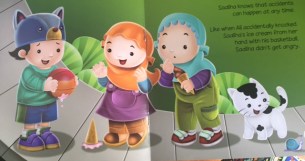
As the book continues, Saaliha recounts that accidents can happen at any time and to not get mad, which is great, it gives the example of when her younger brother Ali, accidentally knocked her ice cream out of her hand with his basketball or when he broke her pencil.   She seems to have a thing with pencils, there should have been a different example.

anger2

It then moves on to an incident with a friend, Jalal, who took a donut without asking, but it was an accident for not asking as he normally asks.  The repetition of the word accident here, I get is to carry the concept, but that doesn’t seem like an accident, it seems like he forgot, and an apology should have been in order, not Saaliha having to justify it solely.  Being it is a book about Akhlaaq I feel like the illustration of Jalal winking and eating the donut, seemed off.  

anger1

I like that Saaliha reminds her friends not to get angry as anger comes from Shaitan, but then when the book says she always says A’uthu Billahi Mina Shaitan Nir Rajeem to keep her anger in check, one wonders why in the opening scenario she didn’t say it.

I can’t pinpoint why I didn’t love this book, or maybe I just didn’t like the main character and I would probably give the series another try, but I’d like to hear your thoughts if you have read the book, and more importantly what your children thought of it.


Mikaeel and Malaika: The Quest for Love

Standard
Mikaeel and Malaika: The Quest for Love

mikaeel.jpg

The beautiful hardback book is pricey, but fun.  I didn’t have any expectations when I read it, but now that I’ve read it three times and had my children read it, and my mom a reading specialist/teacher of 45 years read it, I feel pretty confident in saying, its a well-done book.  I think it can get a bit cumbersome when reading aloud, because some lines rhyme and some don’t, but on the third read through I read it to six kids ages two to nine and all throughly enjoyed it.

maandm

The sibling superhero duo are on a quest to find out how to have a pure heart.  They try praying aloud, praying quietly, then they go and talk to the Big Boss, their dad, who speaks in rhyming clues.  The play on words might make the book utterly confusing to children younger than five, or kids of all ages if full attention isn’t being given when read aloud.  For independent readers, they will delight in the words that sound the same yet have completely independent meanings.

mandm2

Eventually their quest also takes them to Agent M.O.M who loves them more than anyone else they can imagine, but the big reveal is that Allah (swt) loves us even more.  I don’t know that it is crystal clear that getting a pure heart involves loving the one who loves us most. But, I think by the end, the readers are just entertained that they figured out Allah loves them more than anyone else in the world and is the creator of us all.  The last page has an ayat from Surah Rehman, ” So which of the favors of your Lord would you deny?” Which again adds one more thing to the story about being grateful for all that Allah has given us, keeping it from being a completely streamlined story, but adding to the overall love and appreciation for Allah.

mandm1

The illustrations are absolutely beautiful and engaging, the amount of text and the font is perfect for ages 6-8 and the messages is fun and educational.  I hope that there are more in the series, alhumdulillah.


The Swirling Hijaab by Na’ima bint Robert illustrated by Nilesh Mistry

Standard

81fjfxOGmNL

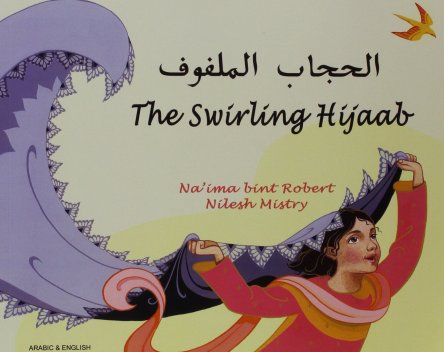
Written in 2002 I’m not sure why this book isn’t in libraries or easy to find, it is wonderful.  We all got so excited when Mommy’s Khimar came out, and for good reason, it is great, but I feel like this book is very similar and somehow not appreciated.  The book is written in verse, with just one line on each page, there are 20 languages that this book appears dual language in, and the author is incredibly well known (Ramadan Moon, From Somalia With Love, Boy Vs. Girl, Going to Mecca, She Wore Red Trainers).

The large pictures show a small girl using her mom’s hijaab to play pretend with as a fort, a boat’s sails, a cloth for her tea party, a comfort when mom isn’t there, and most of all as a covering as a part of one’s faith.  The book shows the little girl as a desi bride, an African warrior queen, a beduin, and a relatable little girl having fun.

The book works well for little ones, with its simple text and large pictures, and is perfect for story time and bedtime alike.  The pictures aren’t bold and vibrant, but are colorful in their muted state and engaging as the swirling hijaab transforms into so much more than a piece of cloth.

It doesn’t mention Islam or Muslims, but just that the hijaab is worn as a sign of faith.  It depicts the girl praying, but doesn’t offer and text regarding it.


Eid by Maria Migo

Standard
Eid by Maria Migo

eid cover

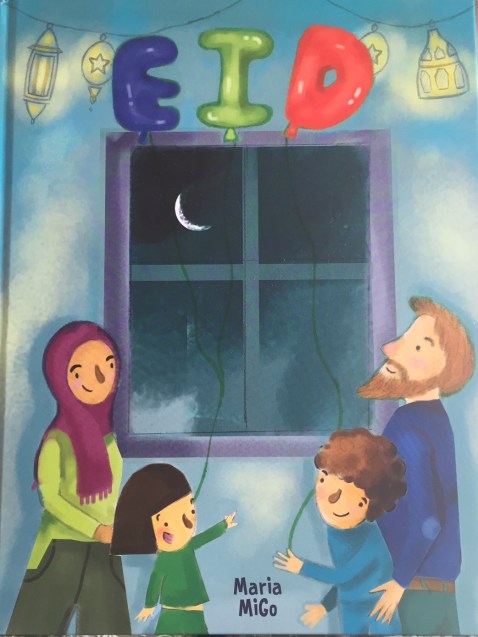
This linear story works great for toddlers that might not remember what a typical eid day is like, or those that do well to know what to expect.  There isn’t a ton of detail, but each page has a sentence or two that move the story from spotting the moon, to putting on new clothes, going for prayers, opening presents, and falling asleep at the end of the day dreaming of next year.

eid4

The gentle pictures convey that Eid is a time of family and love, but don’t necessarily convey that chaos and excitement of the day.  The kids are smiling, as are their parents, and the interaction is playful and safe.  I feel like this book is really ideal for kids with anxiety or that need some reassurance when their daily schedule is altered.  For kindergarten kids and older for the most part, I think they might find the book a glorified timeline list.  After one reading, I’m sure they will not ask for another nor remember much from the 32 page book.

IMG_0478

As seems to be the unwritten rule for books like this, the story is framed through a brother sister duo, however the simplicity of the text doesn’t name them, nor give them any role other then to show what an Eid day is like.  

FullSizeRender (100)

I like that they do go to the mosque and that it remarks that it is a little squished.  I also like that it mentions Eid is in summer, and implies that it isn’t always, something that could be discussed with older readers.  It doesn’t clarify if it is Eid al Fitr or Eid al Adha, so it would work for both.  The hard back binding and size are beautiful and ideal for story time and bedtime.  

FullSizeRender (99)

It isn’t my favorite book, but there is nothing wrong with it.  The Muslim Children’s Books publisher seems to have changed the cover, I’m not sure if anything else has changed.  The book would be a great addition to a book shelf, or in an Eid basket, but I don’t know that it has the wow-power to be a great stand alone gift or book to generate excitement for the blessed holiday.  


Raihanna’s First Time Fasting by Qamaer Hassan illustrated by Yasushi Matsuoka

Standard
Raihanna’s First Time Fasting by Qamaer Hassan illustrated by Yasushi Matsuoka

FullSizeRender (94)

By this time in Ramadan I’ve read a lot of very similar books that all seem to have slightly different takes on presenting the basics with various degrees of turning them into a fictionalized story.  Each have their own flavor and approach and this story in many ways is for mature little kids and works to bring a slightly deeper understanding to Ramadan and helping the less fortunate.  At 36 pages long, most of the pages are heavy on text, but not overly preachy or dense.  Dialogue and emotion fill the paragraphs, and the book works to establish Raihanna as an actual character, not just a foil to move from one Ramadan fact to another. This is also apparent, as a new Riahanna book has just come out, Raihanna’a Jennah, in making her the lead in a series.

FullSizeRender (95)

Raihanna is excited to be fasting this year, after establishing that the crescent must be sighted and that suhoor is the meal to start the fast, Raihanna puts on her hijab to pray.  She asks for forgiveness for being deceitful to get another cookie and asks Allah to make her and her friend able to go ice skating.  At bedtime it also mentions that she says her three kuls before going to sleep.  

FullSizeRender (98)

All her excitement starts to falter at school, however, when the teacher hands out chocolate chip cookies for snack and Raihanna has to explain she is fasting.  By the time she gets home from school she is not sure she even knows why she is fasting as her stomach rumbles and her mood is pretty sour.  Mom jumps in to action and takes her to a soup kitchen where the two of them, along with others, serve food to the homeless. 

FullSizeRender (97)

At iftaar time Raihanna understands how blessed she is to be surrounded by family and food, and makes a more heartfelt dua.  The book ends with letting the reader know that Raihanna spends the next 29 days loving Ramadan and being appreciative.

I love that it really picks one specific aspect of Ramadan and focuses on it in a tangible way, the poor and hungry.  Yes, she prays and recites Quran and all, but establishes that she probably does that every day out side of Ramadan as well.  I like that the author also shows that it is ok that Ramadan is hard.  There is a bit more insight and understanding in this book than just the typical list of facts.  I think ages kindergarten through 2nd grade, kids that are starting to fast will get the most of it, and relate the most to Raihanna.  It could work for non Muslims, with a bit of context of belief or just read a different Ramadan book first, but the target audience is Muslim kids.

FullSizeRender (96)

The beautiful cartoonish pictures are bright and engaging.  I have no idea why it bothered me that the characters wore the same clothes everyday, or at least the two days that the story covers, but it kind of did. I like that the dad sets the table and helps in the food prep and parenting.  The list of family members and all the dishes seems unnecessary, but with the glossary at the back it does offer a bit of culture to be conveyed.  There is also a little reader response at the end.   

Ramadan Around The World by Ndaa Hassan illustrated by Azra Momin

Standard
Ramadan Around The World by Ndaa Hassan illustrated by Azra Momin

IMG_0251

I started this blog because I know the value fiction can have in empowering and exciting people when they see themselves reflected in story lines.  As Muslims, it is a needed tool both for our own children and for teaching other children about us.  So, imagine my surprise when I felt my back straighten up and a smile stain my face for a long while after I finished reading this beautiful book about Ramadan traditions all over the world.  Not because it showed so many beautiful Muslims from rich colorful backgrounds sharing the common bond of loving Allah in Ramadan, that was expected.  Nor was it for the diversity of skin tones, and cultures, and ages, and head coverings, throughout.  No, it was because there are characters with autism, and one that is hearing impaired, one in a wheel chair, and a little girl with diabetes who cannot eat all the candy, just a few.  I didn’t realize how strong that notion hit me.  Me, an adult, a type 1 diabetic since I was 11, there in print, in a book about Muslims.  Yes, I may have had tears, I might still as I write this review.  It is powerful people, to see yourself in a fictional character, at any age.  May Allah swt reward all the authors out there writing books for our children to feel proud of who they are, one beautiful page at a time. You are making a difference.

FullSizeRender (90)

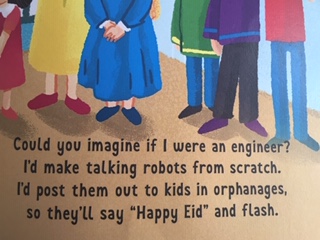
Emotions aside, this book is wonderful in and of itself.  It starts with the moon telling a bit about how Ramadan is fasting from sunrise to sunset, doing good deeds, being kind, and how it is celebrated all over the world.  The moon then takes us on a journey to twelve countries: The US, Turkey, Mexico, Brazil, Australia, Scotland, Malaysia, Egypt, Morocco, Madinah, Palestine, and Senegal.  Each location gets a two-page spread of text and gorgeous illustrations that tell about a Ramadan celebration, or tradition, and stress something about the month in general such as iftar, or sadaqah, going to the mosque, helping orphans, the adhaan, saying salaam.  The book concludes with Ramadan ending and the moon signing off.  There is a glossary followed by more information about Ramadan. 

FullSizeRender (89)

In all the book is 40 pages, hardbound, and large enough to make it perfect for story time and bedtime alike.  In small bursts the book would work for 4 year olds and up and first graders and up will understand how universal Islam is and relish at the diversity in celebrating “the most wonderful time of the year.”
FullSizeRender (92)

My hope is to read this book at a Masjid Ramadan Storytime and to have a few of the countries set up as “stations” for the children to visit.  I can’t wait to try it out and see if we can remind ourselves how blessed we are to be united all around the world as Muslims, alhumdulillah.  For non Muslims this book is not preachy, it shows how a holiday is celebrated in different places, and would do a great job of showing the joy Ramadan contains for Muslims with universal core principals, but how culture and traditions of celebration make it a diverse experience.  
FullSizeRender (91)


The Prophet’s Pond by Zaheer Khatri

Standard
The Prophet’s Pond by Zaheer Khatri

prophets-pond.jpg

Based on the hadith as narrated by Saheeh Al-Bukhari, “Remain patient until you meet me by the pond.”  The book follows a little boy (and his mom) searching for the pond mentioned in hadith as the place Prophet Muhammad (saw) will be waiting for us in the hereafter.
the_prophets_pond_2.jpg

The beautiful, faceless pictures, radiate with beauty and light as they journey from pond to pond in search of one that has all the characteristics of the one described to us.  One that takes a month’s journey to cross one of the sides, one that is whiter than milk, smells better than musk, is colder than ice, is sweeter than honey, that has as many cups to drink from as stars in the sky, and one that if you drink from it you will never be thirsty again.  theprophetspondinside3.jpg

The mother is brought along on this journey to help, and it takes her a few ponds to figure out who her son is hoping to meet in this 23 page hardbound book.  But alas, the rhyming stanzas come to an end and she advises her boy, and the reader, to live the way the Prophet instructed to, inshaAllah, in the akhira meet him by his pond.

The book is perfect for 3  to 7 year olds, with older children enjoying a reading or two as well.  

the_prophets_pond_3.jpg

Twenty-Two Cents: Muhammad Yunus and the Village Bank by Paula Yoo illustrated by Jamel Akib

Standard
Twenty-Two Cents: Muhammad Yunus and the Village Bank by Paula Yoo illustrated by Jamel Akib

22CentsCover

This 40 page biography written on an AR 6.5 level, tells the story of Nobel Prize winner Muhammad Yunus and his microcredit banking initiative.  The book topic is inspiring and for the most part the author does a good job of bringing it down to a middle school level. You can tell the author tries to flesh out Muhammad Yunus by starting the book with him as a boy, and relaying how he was raised and how his parents and boy scouts shaped him.  Despite her efforts however, at times it reads more like a resume, not a children’s picture book.

22_cents_3

Other than his accomplishments, and work history, I didn’t learn anything about him that made him relatable as a person, nor did I learn much about Bangladesh, or Islam.  And yes, I know it is a biography, but it felt like it was a void that needed filling.   I did learn about the program he started, a few of the obstacles that had to be overcome and I particularly liked that those receiving the microloans also had to learn about money, finance, and banking to pass a test before getting approved  And that 94% of those receiving the help have been women.  Grameen Bank is now a global bank, and the help he has given to so many is truly inspiring and something our youth should understand through humanitarian, economic, and compassionate lenses.

The title comes from the incident that brought Muhammad Yunus’ desire to help to fruition. He saw a woman weaving a beautiful basket, and learned that she could not afford the supplies to weave the basket, to sell in the market and as a result needed a loan.  Banks would not loan the equivilant of 22 cents because it was too small, and money lenders would charge so much interest, that after the basket sold, and the money lender repaid, there was scarce enough funds to purchase enough food for the family, let alone enough to buy new supplies, and thus the cycle was unbreakable.  He wanted to make her and those like her independent, not needing charity or the kindness of others to get her ahead, and thus the seven day course, test, and microcredit system evolved.

22 inside

The illustrations I think are both rich and well done.  The effect of the watercolors flesh out the text heavy pages with detail, but don’t create a distraction from the concepts and accomplishments being presented.  Following the story is a two page afterward telling additional awards and continuing the story of Muhammad Yunus with two real life photographs.


My Dad’s Beard by Zanib Mian & Laura Ewing

Standard
My Dad’s Beard by Zanib Mian & Laura Ewing

cover-my-dads-beard

I honestly don’t think this 11×11, 32 page book could be any sweeter.  With just a few words on each page the simple sentences convey such love and warmth from a boy to his dad, by way of his beard.

MyDadsBeard3


The boy articulates that his father’s beard is different from his uncle’s and his grandfather’s and that his kisses tickle because of it.  He knows his sister loves his dad’s beard too because she holds it when she is scared.  Grandma says it makes him look like a real man, and the way it looks in the morning, is just silly.

dad's beard

The author is Muslim, but there is no overt Islamic content or depiction except for the one page that any Muslim would take to reference Prophet Muhammad (saw), see picture below.  Which is a great segue to talking about Rasulullah and his sunnah.

beardThe large bold pictures and simple words make this story perfect for kids a year old and up.  The book definitely deserves a place on every bearded baba’s book shelf.  I challenge you to read this book and not smile, I am confident it will win you over, no matter how many times your little one asks you to read it.

My-Dads-Beard-book1

My only complaint, is that given the size of the book, and how perfect it is for little kids and in story time, the soft pages flop over.  It is impossible to hold the book, read it, and show the pictures in one go, you have to juggle a bit more than one would want. Additionally something to note, is that on the pages where the boy talks about his uncle and granddad, the diction is clearly more British than English. My older kids remarked, but it definitely wasn’t a problem.

Here is a link for the book trailer: https://www.youtube.com/watch?v=Uf7tbvJ5aSw