Tag Archives: diversity

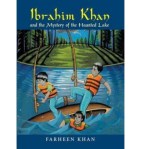
Ibrahim Khan and the Mystery of the Haunted Lake by Farheen Khan

Standard
Ibrahim Khan and the Mystery of the Haunted Lake by Farheen Khan

ibrahim-khan-and-the-mystery-of-the-haunted-lake.jpg

It has been over four years since I reviewed the first Ibrahim Khan book, and while I didn’t love The Mystery of the Roaring Lion, it was just ok, this book was more fun and adventurous and stayed relevant even for a book published in 2010.  At 68 pages the book works ideally for 2nd to 4th graders looking for a quick read, or advanced younger kids that will enjoy the short chapters, detailed illustrations and easy to hold book.

SYNOPSIS:

Third grade cousins, Ibrahim and Zayn, are off on a camping trip with their class. Thinking how nice it will be to take a vacation from solving crime, the boys enjoy hearing the story of the haunted lake around the camp fire and not thinking its more than just a story.  But the next morning when they wake up for fajr and hear some weird groaning from the woods, they realize they have a case after all.

The mysterious noise presents itself at different times and at different locations, as the boys and their friends work to unravel the clues.  The climax gets tense as the whole class is on a moonlight hike when the noise sends them all running and screaming “ghost.”  Ibrahim and Zayn, the smart sleuths that they are, find themselves at the culprits tent with the culprits near by.  Saved by a classmate, the boys now must now figure out how to prove that the “ghosts” are not just having fun scaring the campers, but are up to some serious crimes that will require police action and being patient.

WHY I LIKE IT:  

I love that the boys are Muslim and they wake up and pray and eat vegetarian to ensure they keep halal, and I love that they are also just friends and classmates and kids.  There are Muslim and non Muslim kids in the class, at least one girl  wears hijab, but it is a diverse group.  I like that the characters have their own personalities and they do annoy each other and have to apologize.  There does seem to be a lot of characters, and a few times in the short book I had a hard time keeping them all straight, but knowing the real story is the mystery I just keep reading, and figured all the details aside from the clues wouldn’t hold up the story too much.  

I don’t know why the author has only written two books in the Ibrahim Khan series, but I hope eventually more will pop up.  The books are fun little mysteries that show Muslim characters in action.  They learn good manners, cooperation, compromises, prioritizing, and problem solving without the book being in your face about learning all those things.  The kids embody them, by being good Muslims and having to rely on one another to save the day.

The book is written in British English and is set in Canada.  I bring this up because I didn’t know artifact is spelled artefact and I thought it was an error.  

FLAGS:

The book is clean alhumdulillah.

TOOLS FOR LEADING THE DISCUSSION:

The length is too short for a book club book, but I think it would be nice to have in a school or classroom library as the bright well-done cover will entice children to pick it up off the shelf and the short quick paced story will motivate kids that start the book to finish it.  

IMG_1920.jpg


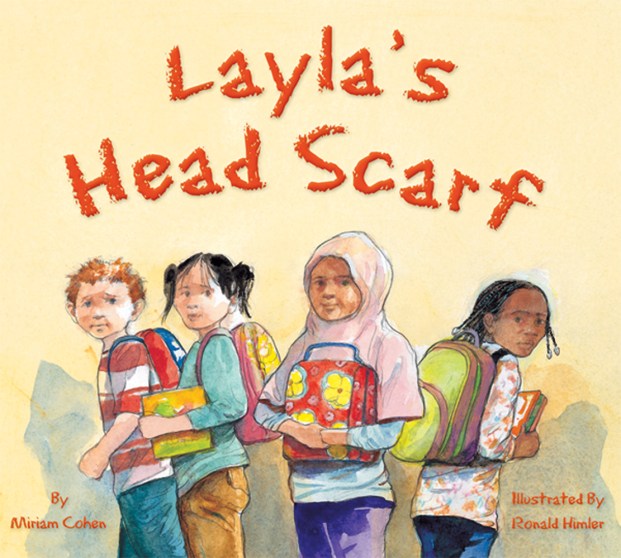
Layla’s Head Scarf by Miriam Cohen illustrated by Ronald Himler

Standard
Layla’s Head Scarf by Miriam Cohen illustrated by Ronald Himler

cover layla

It isn’t often that I feel compelled to list all the things I like about a book and all the things I don’t like about a book and count them up to see what I think about a book.  Especially when the book is only 32 pages and an AR 3.2, but this book has me on the fence.

layla2-e1543798774981.jpg

It is Layla’s first day of school and presumably she is shy.  That’s what the other kids say at least.  The story follows her and the class throughout a typical first grade day, there is no climax or problem, there is just her and her classmates moving from circle time, to the library, to lunch, to recess, to art, and then her joining in at circle time the next day.  

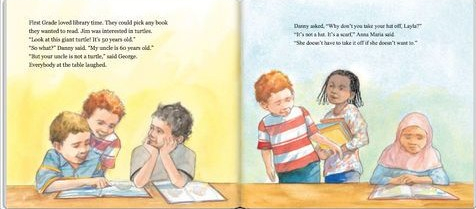
Along the way the kids comment on her scarf, the librarian brings her a book about her country with pictures of sun and sand and veiled women.  The lunch lady looks at her rice and pea pie and says it looks yummy, the kids tell her to take off her hat to play easier, other characters stick up for her and try to correct other classmates that it isn’t a hat, it is a scarf. 

layla

During art time, she paints her family and the women all wear hijabs, a few kids say they look funny, a few others stick up for her, she ends up crying, but the kids come together to make her feel better and to articulate that in America people can wear what they want.  Some kids talk about family members wearing yarmulkas and others about braiding their hair, but there is no reason given for why Layla wears a hijab.

I don’t think any of the kids are intentionally mean or malicious, they are curious and not given any answers by Layla or any of the adults.  As a result when the book is over, the reader similarly has no answers.  Despite that though, I think readers will get the power of kindness and with some (a lot of) discussion, understand how we can help people feel comfortable and celebrate differences.
layal

Here is my pro and con list about the book:

PROS:

Book about hijab is included in a mainstream series meant for 1st graders (We Love First Grade!) 

Kindness comes through.
Kids stick up for each other.

Librarian found a book about Layla’s country and read it to the kids.

Kids include Layla while playing.

Illustrations are soft and realistic.

Diversity in the classroom.

CONS:

The book is about hijab, but nothing is learned about hijab.

Lots of stereotypes: girl doesn’t speak englishF from the desert, different food. 

Focus is on differences not similarities.

1st graders aren’t required to wear hijab.

Islam isn’t mentioned, but the Jewish kid mentions his faith.

Don’t learn what her lunch is called or what country she is from.

If she doesn’t speak English how did she label everyone in her picture?

Clearly she understands English, she is just shy, so why does she mess up the song at the end?

layal1

Luckily the book was in the public library, so I don’t feel like I bought something that I am unhappy with.  I don’t know that I would recommend it to anyone, but it is always nice to see a muhajaba in a story, and there isn’t anything “wrong” with the book, it just lacks a lot of detail unfortunately.

The Boy at the Back of the Class by Onjali Q. Rauf illustrated by Pipa Curnick

Standard
The Boy at the Back of the Class by Onjali Q. Rauf illustrated by Pipa Curnick

boy at the back.jpg

A perfect introduction to the refugee crisis for upper elementary aged kids.  The story is told from the perspective of an unnamed 9 and 3/4 year old narrator about her friends and how the filling of an empty chair in the back of the room changed their lives.  Ages 7 through 12 will enjoy the plotting and planning of the friends, the awesome climax and the gentle opening of their eyes to the atrocities and bigotry around them.  At 297 pages, with a few pictures and some engaging notes and tidbits at the end, the book is both big, yet completely non intimidating at the same time.  

SYNOPSIS:

Right near the end we learn that the narrator’s name is Alexa, and not too much before that, I learned that she is a girl.  I kind of like that vagueness of it, especially as we also learn that she is half Indonesian and half Austrian.  You realize that it doesn’t matter, that it doesn’t change anything, and that we all bring our own assumptions to the story and learn a bit about our selves as the narrator’s identity is revealed.  But really, thats a tiny bit of the book, the book is really about a group of diverse friends battling bullies, bully teachers, and trying to help the new kid in their class Ahmet.

Ahmet is a refugee from Syria, but the information isn’t easy to establish, he doesn’t talk to anyone, he disappears at lunch and recess, so Alexa, Josie, Tom, and Michael, first have to figure out who he is, and how they can be his friends.  Along the way we learn the Tom is from America, the book takes place in England.  Josie is the best football player and her parents are nervous to have her interacting with Ahmet, Michael is incredibly wealthy and his parents are Nigerian and French, and Alexa lives with her mom a librarian who works really long hours, her dad passed away and money is incredibly tight.

Once friendships are established, Alexa learns that Ahmet’s mom and dad are missing and that his sister and cat died while fleeing Syria.  When she learns that the government is planning to close the borders to immigrants and refugees, the group of kids come up with plans to keep the gates open until Ahmet’s parents can be found and they can come to the United Kingdom.  The kids come up with a variety of plans, but “The Greatest Idea in the World,” is the one they decide to go with.  It involves a lot of danger, but the general gist is to get a message to the Queen of England, who will keep the gates open, find Ahmet’s parents and reunite the family.  

Naturally, there are a lot of moving parts to the plan, and a lot of naivety on the part of the 9 year olds, but they do get the Queen’s attention, and they do have a wonderful support system of parents and teachers and while their are bullies around every corner, they do come together to make the world a bit better for Ahmet and for us all.

WHY I LIKE IT:

I love that it is realistic, with the plotting, and understanding of war, alike.  The war and Ahmet’s journey is very very simplified, but the tone, introduces kids to the intensity without overwhelming them.  Just like the plot to get the Queen’s attention is not celebrated, but appreciated.  What the kids did was wrong and dangerous and they lied, and the kids don’t ever know after if they are in trouble or being praised.  I like that the integrity of both situations is upheld and the book doesn’t get too far fetched.  Similarly, the book is fun and adventurous, and in many ways Ahmet is just a catalyst for the kids to come together to solve a problem and save the day. 

There aren’t a lot of details about his life in Syria, because he doesn’t speak English, there isn’t anything about Islam, except he draws his mom with a scarf on her head.  But there is a lot of learning to accept each other, and stick up for whats right and to not give up on people.  I love the diversity of the friends and how they don’t expect each other to change, they accept each other and move along.  

There is a slight typo on page 3, “…could be half as useful as a Tintin’s dog, Snowy,” that had me afraid that this book was going to be unrefined, but alhumdulillah I was wrong.  The book reads easily and wonderfully, and my children loved it as much as I did.  The author is a first time writer, and I hope she has a bunch more stories in her, because I look forward to reading them.  

FLAGS:

The book is clean and reads believably from a 9 year old’s perspective.

TOOLS FOR LEADING THE DISCUSSION:

I would do this in an elementary book club in a heartbeat. I’ve suggested it to many and I hope to read it aloud to my 4th and 5th grade lunch bunch crew. It is well written, timely, and memorable.

Teacher’s Notes: https://www.hachetteschools.co.uk/wp-content/uploads/2018/07/The-Boy-at-the-Back-of-the-Class-Teachers-Notes.pdf

A bit about the author: http://beingthestory.org.uk/speakers/onjali-q-rauf


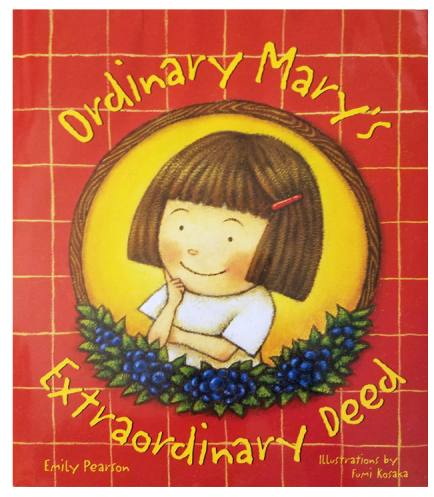
Ordinary Mary’s Extraordinary Deed by Emily Pearson illustrated by Fumi Kosaka

Standard
Ordinary Mary’s Extraordinary Deed by Emily Pearson illustrated by Fumi Kosaka

ordinary-mary.png

Once again I picked up a book for the message that it explored, making a difference, and found myself smiling triumphantly when a flip of a page revealed a Muslim lady depicted in an illustration, and her culturally Islamic name gracing the page. 

The book is an AR 4.2, and while there are a lot of words on each of the 32 pages, and the concept of an act multiplying might be hard for little ones to grasp, I think patient kindergarteners and first graders will grasp enough to make the story enjoyable.

IMG_2114

Ordinary Mary is so very ordinary, but she changes the world.  It all starts when she leaves berries for a neighbor.  And that neighbor, Mrs. Bishop, takes the berries and makes blueberry muffins and secretly gives them to five people.

IMG_2113

Each of those five people in turn give or do something kind to five people and over 30 billion people are impacted.  But there are not that many people on the planet, so there is love left over and extra to give.

IMG_2112

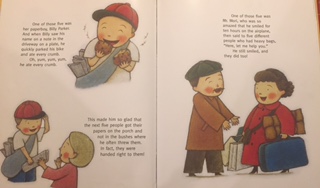
The book doesn’t follow all 30 billion obviously, but it picks and follows one person to show how the chain works before showing the mathematical growth in numbers.  Mrs.  Bishop gave a plate to the paperboy Billy Parker, who handed the next five people their newspaper personally instead of tossing it in their bushes.  One of the people that got their newspaper smiled for 10 hours on his flight, and helped people with their bags, etc etc.  

IMG_2109

The book shows that giving something can be something tangible, or a compliment, or a phone call, or a smile.  Over long distances,  the kind deed comes back to Mary and the message too, comes full circle.

IMG_2110

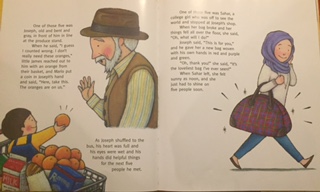
Along the line is Sahar, a college student who’s bag breaks and she benefits from a kind man who was just gifted oranges at the grocery store when he didn’t have enough money.  She in turn compliments a woman on a boat who is distraught and unsure. An important character in the link, and an import illustration of inclusion.

IMG_2111

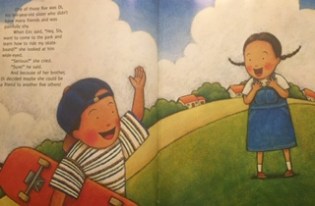
There author mentions a variety of names, male and female, and the illustrator represents a fair amount of diversity of age, color, gender, religions, socio economic, ethnicity and mobility.  Truly, we all have the potentially to change the world.


Meet Yasmin! by Saadia Faruqi illustrated by Hatem Aly

Standard
Meet Yasmin! by Saadia Faruqi illustrated by Hatem Aly

yasmin.jpg

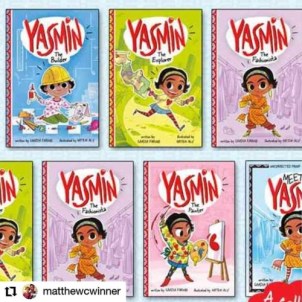
Yes! Yes! Yes! A strong and relatable 2nd grade, Pakistani-American Muslim girl, with stories written on a AR 2.4 -2.5 level, learns lessons and grows in everyday scenarios.  Seriously, this book is overdue and so well done, I can’t wait for the author, illustrator, and publisher, to team up to do more.  The book I have, Meet Yasmin! contains all four stories: Yasmin the Explorer, Yasmin the Painter, Yasmin the Builder, and Yasmin the Fashionista. You can buy each of the books separately in a larger format, and possibly a longer story.  The version I have is 5.5 x 7 and 96 pages long which includes a Think About It, Talk About It section at the back as well as a glossary of Urdu words, some facts about Pakistan and a recipe for Mango and instructions to make a bookmark craft .  The individual stories are 6 x 9 and 32 pages, and whether you buy the collection or the individual stories, they are under $6. Fabulous all the way around.

lots of yasmin

SYNOPSIS:

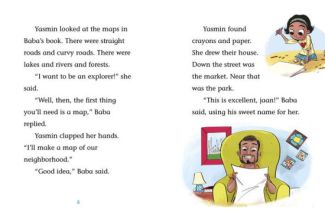
Yasmin the Explorer:  The book starts out with Yasmin’s dad telling her about explorers and maps.  Inspired, Yasmin decides to make her own map of the neighborhood, which gets really exciting when her mom asks her if she wants to join her on a shopping trip to the farmer’s market.  While they stop at different stalls and Yasmin adds to her map, the temptation of a playground draws Yasmin away from her mom, but luckily her map can guide her back.

Yasmin the Painter:  Yasmin’s school is having an art competition and Yasmin is nervous because she doesn’t consider herself a very good artist.  Her parents show her videos and gift her supplies.  Unhappy with how her attempts are turning out, she decides to find her own style and with the support of her parents she enters her painting and waits nervously to see who wins and what the mystery prize is.

Yasmin the Builder:  I think this story is my favorite because she really had to rely on herself when the class is building a city and Yasmin can’t figure out what to build.  She perseveres and works hard, and ends up connecting the dots and making the city come to life by finding a way to make her favorite part of the city, going for walks, a part of the class project.

Yasmin the Fashionista:  Mama and Baba have gone out for the evening, so Yasmin is hanging out with her grandparents.  When Nani and Yasmin play dress-up and Mama’s shirt gets ripped, Yasmin and Nani have to solve the problem!  Not only that, they get inspired to transform Yasmin’s pajamas, and when Mama and Baba come home they are treated to a fashion show!

meet-yasmin_1

WHY I LIKE IT: 

There is a lot to love about these stories.  Yasmin is not great at everything, and things don’t necessarily come easy for her.  But she is bright and surrounded by people that love her, and she is allowed and encouraged to shine in her own way.  I like that her painting wasn’t great, and that she stayed in from recess to figure out what to build.  I love that her dad is involved in her projects and ideas as much as her mom, if not more.  I love all the little nuances that accurately show a Pakistani-American family and a Muslim one; not an exaggerated version, or a dumbed down one either.  Yasmin has to wait for her mom to put on her hijab, it doesn’t explain that she isn’t wearing a hijab in the home, but it is shown.  It shows the characters in ethnic clothes and in western clothes.  It shows Yasmin’s classmate building a church, and one building a castle.  Yasmin is spunky, she makes mistakes, she works hard, and she is a breath of fresh air, that I think kids of any and all backgrounds will relate to her and enjoy the stories.

The pictures are bright and colorful and detailed. They are age appropriate and make the chapters within the stories really come to life and keep new readers engaged.  The font and binding and layout is well done.

meetyasmin1

FLAGS:

None.  

9781684360222_p1_v2_s550x406

TIPS FOR LEADING THE DISCUSSION:

I honestly think little kids could read this and discuss it and might actually enjoy having a discussion about Yasmin: what they like about her, what things they have in common, what she does that makes them laugh.  It might come across as a girl book, but really, it isn’t she is relatable for everyone. 

There is nothing Islamic mentioned, just depicted in her mother’s and grandmothers hijabs.


Love by Matt de la Pena illustrated by Loren Long

Standard
Love by Matt de la Pena illustrated by Loren Long

love.jpg

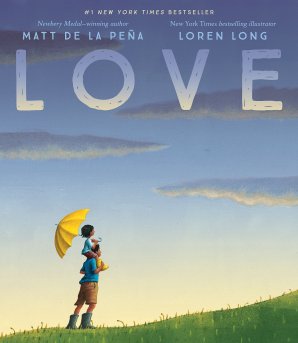
This 40-page-book may have a simple title, but most of us know, there is nothing simple about love, and this book shows love in many forms from a child’s perspective as they grow.  Sometimes picture books are basic and inspired to teach, or simply entertain.  Sometimes when picture books try to do more, the audience is confused when the pictures and amount of text on page don’t seem to align.  And sometimes, large pictures, with thoughtful poetry make the pages come to life and sing.  The book is written on an AR 3.7, so people thinking this book is for preschool aged children seem to be upset by the concepts hinted at and illustrated, but for older kids, this book has amazing power, and beauty that can show just how complex this universal feeling is.  

Love is your parent’s voice, love is burnt toast, love is the stars after your house burns down, love is in your grandpa’s wrinkles, love is staring back at you in the bathroom mirror.  But sometimes love also burns out and love is shielding you from things that might hurt you, and love separates people too. 


As humans, we can all relate to the same emotions, whether we give and receive love the same, the book shows the value and meaning it has to us all.  Hurray for illustrator Loren Long, because page after page, shows diversity of color, mobility, socio economics, age, and religion.  On a page where the love of the child is keeping her from seeing the TV that the family is crowded around a cross is present, and then a few pages later,bam, there is a girl in hijab looking up at the trees and listening to the love shared in their rustling. 

IMG_1901

I had no idea this illustration was present, and gasped aloud.  I said nothing to my daughter, finished the book, and handed it to her to read.  She turned the page and gasped aloud as well saying, “there’s a muhajaba, haha, we are in it too.”  Granted she is my daughter, so environment and genes account for something, but EVERY PAGE I think resonates with someone, and that gasp in my living room from me, from her, could come from anyone who turns a page in this book and bam suddenly feels represented, feels included, feels validated.  That my friends, is LOVE. 

IMG_1900

We are more alike than different.


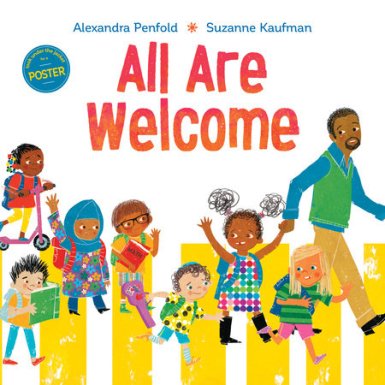
All Are Welcome by Alexandra Penfold and Suzanne Kaufman

Standard
All Are Welcome by Alexandra Penfold and Suzanne Kaufman

all are welcome

This is the perfect book for back to school.  It can set a beautiful tone of letting all children know that they are welcome, that they are accepted, that they are safe, that they are wanted and that they have value in your classroom.  It could also work to allay children’s fears heading in to a new environment, assuming of course that the environment is as fabulous as the one presented in the book.  

IMG_1788

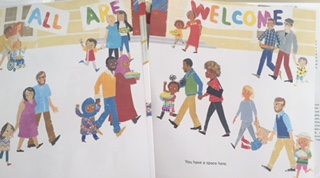
The large, hardback 44 page book with a poster and large pullout concluding page, is fantastic for ages preschool and up, but would have value as part of any grades back to school message.  

IMG_1789

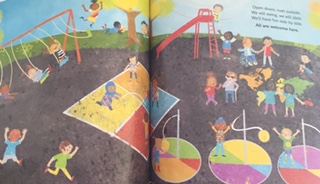
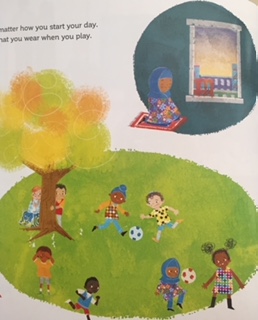
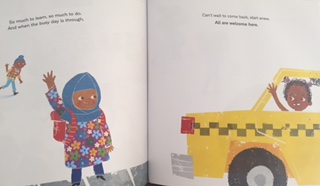
While the rhyming couplets are sweet and sincere, the real beauty of the book are the illustrations.  Bringing all that diversity to life in smiling kids faces, children with hijabs, and yarmulkes, patkas, baseball caps, glasses, curly hair, straight hair, every color of the rainbow, various physical abilities, all show what a day of inclusion can look like.  No one culture or background is articulated or placed higher than another and the coming together of the kids and then their parents and community is inspiring.

IMG_1787

I love that their is a little muhajaba on the the cover and included in the cultural acceptance of the book.  It shows her praying in one picture and then joining in and smiling with the rest of the diverse group of characters in the other pictures.  Feeling included and accepted whether in a classroom, or in a children’s book, feels good, at any age, alhumdulillah. 

IMG_1790

A special shout-out to all the educators and people in positions of power who go the extra mile to create a safe and accepting space, thank you.

IMG_1791

Tilt Your Head, Rosie the Red by Rosemary McCarney illustrated by Yvonne Cathcart

Standard
Tilt Your Head, Rosie the Red by Rosemary McCarney illustrated by Yvonne Cathcart

rosie.jpg

This book is nearly the mirror of Nanni’s Hijab, just told from a different perspective and swapping out the heroine.  Written in 2015 this book definitely came out first, and while the 24 page book is targeted for  4-8 year olds, if your teaching point of view, this book and Nanni’s hijab could be used for older kids to make for a great lesson.  

IMG_1753

I love that this book is written by a non Muslim and the main character is non Muslim.  The binding the pictures, the size, all make this a wonderful addition to any library in showing that differences can and should be celebrated.

IMG_1752

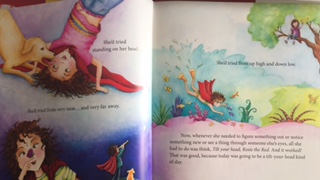
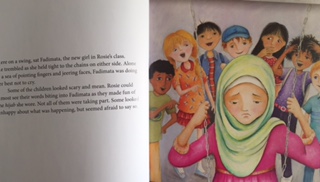
Rosie loves wearing her red cape, and she loves looking at things from all angles and perspectives.  One day at school she arrives at school to see kids making fun of the new girl, Fadimata and her hijab.  

Unable to stop the kids she reaches out to Fadimata, and transforms her cape into a hijab in solidarity.  After the teacher also talks to the class about being kind, the next day is a surprise for Rosie, when many of the girls are wearing scarves and hijabs in a variety of manners to show acceptance and celebrate differences.

IMG_1751

This is the first book in a Rosie the Red Series, and I kinda really love that in the second book, Being Me, about volunteering at a food pantry and helping a friend, Fadimata is minor character.  She is now one of Rosie’s best friends and is both mentioned by name and illustrated.  This is awesome to me, because while books about Muslims are great, having us be in books as supporting characters solving other problems, learning lessons, and going on adventures, makes us more mainstream and inshaAllah part of the accepted landscape.

rosie1

*Side note, if you look at this book on Amazon, and read the comments you can see how truly upset many people are by this book calling it “indoctrination” and criticizing it for not encouraging assimilation.  If you read the book and like it, and like the tone and message it promotes, maybe write a review, and make the world a little warmer.

She Wore Red Trainers by Nai’ma B. Robert

Standard
She Wore Red Trainers by Nai’ma B. Robert

red.gif

After having fairly good luck with the Muslim YA Romance Novel Genre in An Acquaintance and Saints and Misfits, I was willing to give She Wore Red Trainers a try.  Na’ima B. Robert has written a lot of books and this 261 page book was an easy and entertaining read.  There are no plot twists, deep thoughts, or intense drama, its a light read that infuses religion and environment into a story that will be great for 14-16 year olds that have slim pickings of relevant, Islamic, “halal” fiction options.

SYNOPSIS:

The story is told from two 18-year-olds’ perspectives, Ali and Amirah. It goes back and forth and while the perspective is obvious, the bottom of the page identifies the character so there is no chance for confusion.

Ali has begrudgingly moved to London with his brothers and father.  Not very religious before his mother’s death, he and his father and younger brother have made a new start and commitment to Islam since losing her to cancer.  The middle brother, resists this, but isn’t too critical in the story, other than to add a voice to the concept that people have to come to Islam on their own, that the relationship between a person and Allah is not cookie cutter or often simple. 

Amira too has a past and a lot on her plate as she strives to balance her chaotic family life and moving past decisions of her rebellious self.  The two meet and in the brief second before gazes are lowered, they fall in love.  Ok, so it isn’t that cliche’ but it is close.

The two, as the dedication of the book states, “are striving to keep it halal.”  They have a few encounters and the sparks are there, but they both have their own stories and supporting cast of friends as well. It isn’t until the very end, SPOILER, they get married.

Yup. impromptu wedding of 18 year olds.  It isn’t out of left field though, there are passages that contemplate the Islamic merits of a young marriage, and perhaps that is the depth of the book, as far as giving the reader something to think about. That and choosing Islam and actively living it.

WHY I LIKE IT:

The stuff that makes the book interesting, isn’t really even the two love birds, it is the context.  The struggle of Amirah’s complex family situation with a mom that has had multiple husbands, and is suffering from depression.  Amirah also has a creepy stepdad (makes her uncomfortable and seems to make sexual advances toward her) and a sketchy past that isn’t really articulated but is hinted at enough to know that she did rebel briefly by running away and experimented with drugs and alcohol before realizing it wasn’t the life she wanted.  She takes tremendous care of her younger siblings, one who is deaf, and respects her older brother tremendously.  Her friends are not overly developed but provide enough diversity that the reader will see themselves in someone even if just fleetingly.

Similarly Ali is fleshed out by the company he keeps.  He has very religiously devout friends, a few rebellious ones and countless opportunities to define who he is.  His home life is a little chaotic, but they’ve gone through the destruction and are in the rebuilding phase. 

I like that the characters are fallible and represent a wide spectrum of religiosity.  The book isn’t political, nor does it discuss culture really, but it is meant for Muslim readers.  The characters throw in Arabic terms and while there is a glossary at the back, the religious rules, the contemplation of hadith and ayats, understanding Islamic divorce and the stress to be well established before marriage make it a book for those that can relate.  I love that part of keeping it halal is that they don’t talk and text.  I know that makes it a bit unbelievable, but I like that the line is drawn and established.

I wish that the past of many of the characters was clearer.  Not overly sensationalized, but a tiny bit more.  I wanted more information on what Ali’s dad’s new job was, and how far away they would be moving.  I wanted to know how Amira’s family would manage without her and the creepy stepdad, would the mom be able to step up and care for her kids.  I wanted more details about Amira’s family in general and why her older brother had to leave his studies permanently in Saudi Arabia, and wasn’t able to just delay graduation.  

I can’t criticize the writing too much because I did read the book in one sitting and it kept my interest.  I didn’t expect it to be deep or thought provoking, so for a light summer read, it was good enough.  I felt like the ending was a bit rushed, and yes there are some far fetched ideas, but I think it’s a romance novel, halal or not, so yeah, there are going to be some places that forgiveness is needed.

FLAGS:

There is mention of hooking up, drug and alcohol use, virginity, and a creepy sexual predator in the stepdad. It isn’t appropriate for middle school, but not so vulgar that one would need to be 18 to read.  I think high schoolers won’t find it too cheesy, and not be shocked by the content either.  Granted it depends on the reader. but I think it is better to be safe than sorry.

TOOLS FOR LEADING THE DISCUSSION:

I would consider the book for a high school book club. Might have to get parental permission, but I think it works well to consider how to have it all so to speak.  How to live within Islam and be smart about your choices.  The book doesn’t offer a lot to think about and mull over, but if you were a teenager, I would imagine that the book presents a lot of what you are feeling.  There is a lot to relate to in the friends, the deen, the emotions, and the temptations.  It also shows that just because families are Muslim, doesn’t mean that they are not complicated and troubled, a scenario that many would find reassuring at least superficially in the book.

Interview with the Author: http://www.kubepublishing.com/an-interview-with-naima-b-robert-about-her-forthcoming-book-she-wore-red-trainers/

You’re Not Proper by Tariq Mehmood

Standard

your not proper

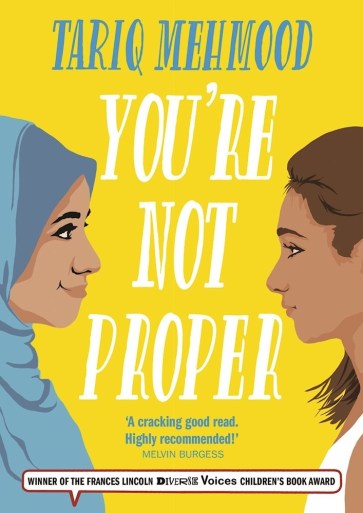
This highly praised British young adult novel is intense.  If I was trying to sell you the book I would say that it is relevant, gritty, raw, and real, but as a reviewer, it is definitely more rough, all over the place, and random.  There is so much going on in the book that it should be well over 400 pages to resolve it all, but almost as if the publisher required that the book be less than 200 to fit the demographic, it all gets tied up way too simplistically and leaves dozens of tangents unresolved, unexplored, and hanging.  The main characters are 14 years old, but I think it is a bit too harsh for that age group and should probably not be read by them.

SYONPSIS:

Karen’s mom doesn’t believe in God but takes her to church.  Karen’s dad is a Pakistani Muslim who loves bacon and beer.  The book opens with Karen’s gang marking her forehead with a cross against her will, and her soon after deciding that she doesn’t fit in with her friends and will now be Muslim.  Part of this transformation involves her wanting her name pronounced properly, as Kiran and her wearing a hijab.  Her parents are pretty ok with the decision, but the author foreshadows that this will be the undoing of her family.  

The book gets crazy, like all over the place crazy, but because of the little hints that all this craziness is leading up to something, I kept reading thinking that the author had it under control.  But no, I don’t think he does or did. 

The most craziness comes from Kiran’s rival Shamshad who leads another gang and pretends to be really religious, but is a bit of a rebel and bully herself.  The author is told from both Kiran and Shamshad’s perspectives, and while at times the reader sympathizes with Shamshad, as her influential father is abusive, many of her actions are so jarring and awkward, that no, she isn’t really like-able at all.  She wants a computer, her parents are that strict, yet she goes out with a guy, gets drunk, hangs all over him, goes to a Halloween party/dance without seeming to have to sneak about doing it.  She is regularly beating people up, threatening to kill and maim people with scissors, not a nice 14-year-old, nor a believable one either.  

As Kiran tries to learn about Islam and figure out what is tearing her family apart, and Shamshad is trying to find her place, the two storylines come closer together before the big climax of learning what tied the two girls’ families together in Pakistan and then here in the same English neighborhood.  The climax/ point of the story is actually a good one, but the resolution of it, is so simplistic that it cheats the reader of any potential investment they may have skimmed from the crazy build up.  It seems like the author had an idea and just worked backward for his big reveal, which is probably how most books are written, but in good books, you connect with the character and join them in their journey, here there is no character connection.

WHY I LIKE IT:

I like the idea of the book.  That there are good and bad Muslims and Christians, that things are diverse and complicated and that we all have our own baggage either at home, or in our heritage, or in our environment. But the book is not cohesive, the characters are really, really harsh.  And it doesn’t seem the author gets their voices right.  Plenty of males write beautiful complex female characters and vice versa, and plenty of adults get teens right, but I don’t think this author got either.  The girls are not believable and the minor characters are just as bizarre.

I think if you you live in a highly diverse area and you are acquainted with lots of minorities you can handle the way Islam is portrayed, but if you aren’t I think both Muslim and non Muslim readers alike will be shocked and offended by the portrayal of such crude characters.  This isn’t a book of accepting differences and finding a way to get along, it is more of a book showing how awful everyone is in varying degrees.  If it was an adult book perhaps you could argue it is realistic, but as a teen book, I think the lifestyle choices of all the characters will be eye-opening and not necessarily in a good way.  I do like that the book isn’t offering a moral statement or opinion on Islam, but the way Islam is presented isn’t inspiring either.

I’ll admit I’m a sucker for books that are meticulous, not boring, but deliberate.  Authors like John Irving who seem to map their stories with crime solving precision.  Where every sentence serves a purpose and every idea has a reason for being shared.  Most books leave something hanging, but this book, left everything hanging.

For two girls in gangs, the gang members by and large fade away before we even get to know them.  There is a rally being planned but resolved half heartedly.  Kiran has to fight with her parents to learn about herself in a really unrealistic way.  Kiran harasses her dad to learn about Islam, but then all of a sudden her paternal grandpa lives nearby and brings over a marriage proposal, why couldn’t she ask him about Islam, and why would a 14 year old be considering marriage?  The whole scene of Kiran getting a hijab is weird and pointless, why stress underwear and having another customer make a random comment for no reason.  What was the obsession with swimming for Shamshad and her mother, like there is a lot of space dedicated to this topic, and I don’t really get it.  Shamshad’s dad is also creepy, he seems to have a decent relationship with her, but is physically abusive to her mom, and he does a weird inappropriate thing with a pointer stick to Kiran at the masjid, that should be discussed more in my opinion.

Once the big reveal happens really there are more questions than answers.  Like I still don’t get why the families hate each other, if they had to make promises of secrecy in Pakistan, couldn’t they just ignore and be ambivalent to one another in England? Why so much hate and hostility? And what is up Jake? He seems like a good friend that makes some mistakes and Kiran is awful toward him, then all of a sudden she claims him as a brother.  And whats up with him going on and on about his brother in the military, I need closure! And last but not least why when Kiran’s mom is in the hospital after a failed suicide attempt, why does the Curry Club, that no one in the book ever liked, suddenly in the hospital room with them, when it should be a tender mother-daughter moment? Seriously, I was beyond annoyed.  There should have been a message, or a cathartic release, not annoying super side characters coming back for no reason.

FLAGS:

Lots of violence, alcohol, language. There are also romantic relationships and the celebration of Halloween.

TOOLS FOR LEADING THE DISCUSSION:

I don’t know that I would recommend this book to anyone.  I am willing to concede that some of it was lost in translation for me, but there is so much going on in the book that there is no way that it can excuse it all.  I would love to discuss some of my concerns with someone who has already read it though. So feel free to reach out, I’m all ears.