Tag Archives: culture

Looking for the Eid Moon by Sahtinay Abaza illustrated by Sandra Eide

Standard
Looking for the Eid Moon by Sahtinay Abaza illustrated by Sandra Eide

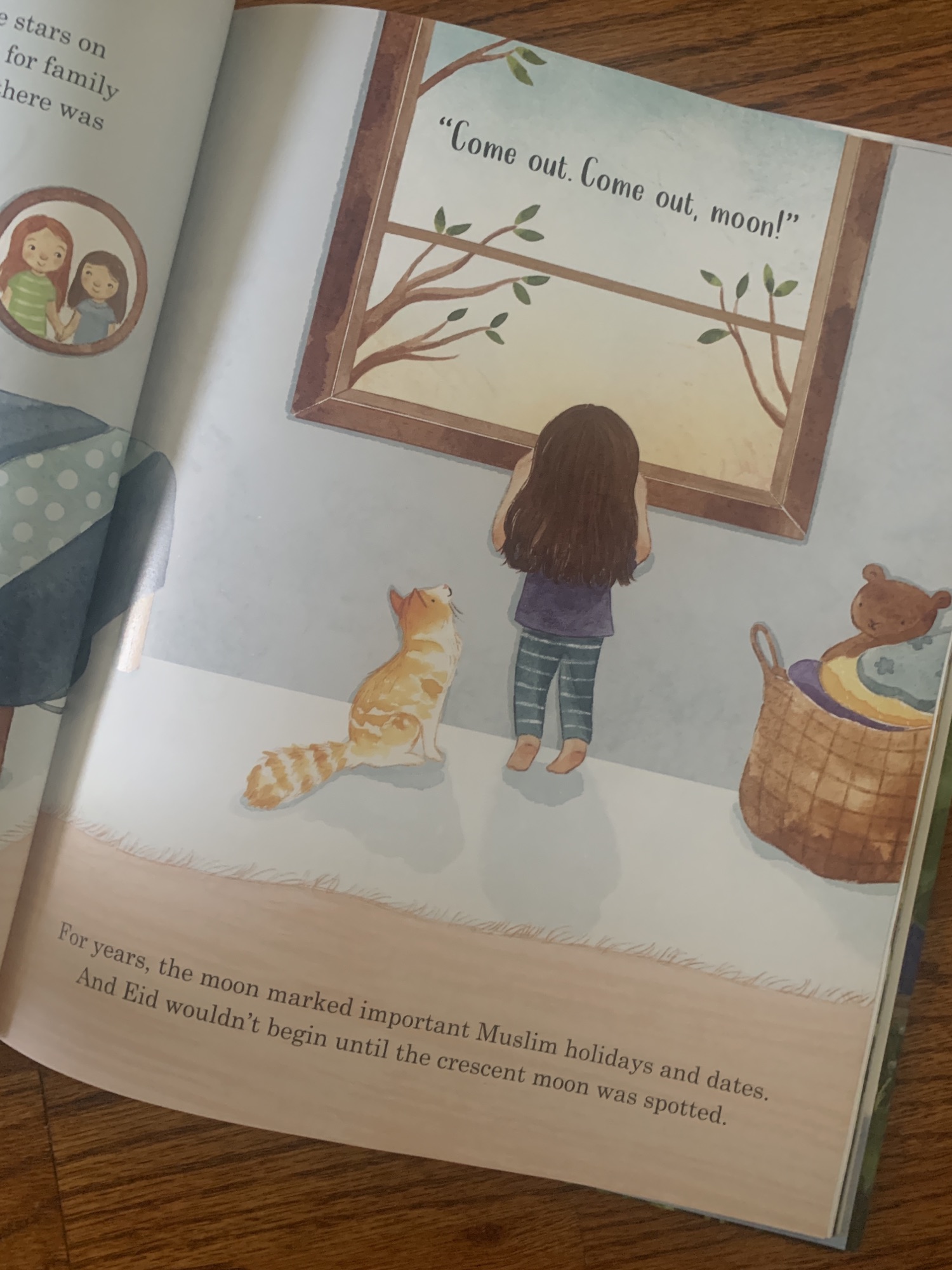
The illustrations and sister bonding in this story are sweet, but it isn’t exciting, and doesn’t feel very Ramadan or Islamic rep or even very purposeful.  I was really surprised that there wasn’t a craft activity or science tie in at the end, it seemed to be heading in that direction seeing as Eid joy, iftar, and anything religious are all completely absent. The plot really is just the title, “looking for the Eid moon.” The text feels abrupt, it doesn’t flow, and feels othering.  “For years, the moon marked important Muslim holidays and dates. And Eid wouldn’t begin until the crescent moon was spotted.” Numerous communities still rely on local sighting and have hilal committees marking all moon phases and months.   This framing of it being an antiquated practice, feels off.  The sisters are young, but Sara is old enough “to know the crescent moon is faint and hard to see,” yet she doesn’t even acknowledge iftar time, they don’t pray maghrib.  The complete removal of Islam makes looking for the Eid moon seem like they could just be looking for Mars or a comet.  It says they are excited for an Eid party, but clearly not enough to be excited it is Eid the next day, they are simply sad that they didn’t see the moon.  I’ve read the book a few times, and I truly can’t make it make sense, and I don’t understand how silver paint glows, shouldn’t it be glow in the dark paint? Sigh.

The book starts with Sara looking at her Eid dress saying she is excited for the Eid party, but first she has something to do.  She packs her flashlight and binoculars and grabs her little sister Lulu and the head out to spot the Eid moon. On their way out they pass mom hanging decorations, and she wishes them well.
In the backyard the girls watch the sky change colors and the sky is cloudy.  As it gets darker, the girls get a little scared, but mom finds them and tells them the moon has been spotted elsewhere.  The girls are sad and Sara comes up with a way to cheer up Lulu.  SPOILER she paints a ball silver, fills it with coins, and writes a note that it is from the Eid Moon, claiming this is a moon rock.  Lulu proclaims it the “best Eid ever.”

The Author’s note tells of the family’s tradition to hide and find moon rooks with coins in them, in what sounds akin to an Easter egg hunt.  It also erroneously says that Eid al Fitr is a three day holiday.  I don’t get the connection to the moon being brave and a source of light to refugees in the book, if that was the author’s intent, to show the moon as hope “when times are bleak and dark,” I’m sorry but the message was not conveyed.

Noura’s Crescent Moon by Zainab Khan illustrated by Nabila Adani

Standard
Noura’s Crescent Moon by Zainab Khan illustrated by Nabila Adani

img_3075-1

I know, I know, another Ramadan book about the moon and a little girl’s first fast, but this one is slightly different.  The moon they are searching for is the Eid moon and the focus is on whether they will see it and Eid will begin, or if there is one more day of fasting.  The story itself would not make sense if it wasn’t Ramadan and the characters Muslim, but the story only subtly sprinkles in bits of Islam, the backmatter though, is where the Islam really shines.  The tone of the book with the lyrical text and full color illustrations is very relatable to Muslims that both want to see the moon and celebrate, while at the same time being sad the the blessed month of Ramadan is over.  It comes from a Desi centric approach to the foods, and traditions, but their aren’t a lot of Urdu words used either, and those that are, are defined at the end.  The book works for Muslims and non Muslims, and would benefit both groups with a bit of discussion. Overall, not a particularly memorable book, but one that stands out for focusing on the tradition of looking for the moon and being together as a family.

I love that the notes at the end do mention that Muslims fast to “show love and obedience for the Creator,” under the Ramadan header.  The other backmatter headings are Eid ul-Fitr, Suhoor, Iftar, Chaand Raath, Pakora, Gulab Jamun, Sheer Khurma, and The Islamic Calendar and the New Moon.  A lot of space is dedicated to food, explaining those mentioned in the story.  It gets it right that Muslims begin fasting at dawn, it shows mom not wearing hijab at home, but wearing it when they go out, yet, it doesn’t just say the maghrib athan it refers to it as the “call for the twilight prayer.”  And it doesn’t mention or show them praying, which would have been a nice inclusion.

img_3080-1

The book starts with Noura playing outside and her tummy rumbling on this 29th day of Ramadan, and her first fast.  Mama, Papa and Noura all help make and pack up iftar, as they get ready to go look for the Eid moon.

img_3079-1

Before they go, Mama shows Noura her new dress, and they add some henna cones to the items they are taking, they then set out to the countryside.  All along, Noura is hoping to see the moon and her parents are reminding her how rare it is to see it.

When they get to the hill there are other families already there, and Noura has done it, completed her first fast.  Unfortunately the moon is not there as hoped, or is it?

img_3078-1

I wish some duaas or Islamic expressions, and salat would have made it into the book, but the large hardback size makes this a good book to read at story times, and a nice way to explain why we don’t know when we will miss school to celebrate Eid, or how many days we will fast.

Eliyas Explians Ramadan by Zanib Mian illustrated by Daniel Hills

Standard
Eliyas Explians Ramadan by Zanib Mian illustrated by Daniel Hills

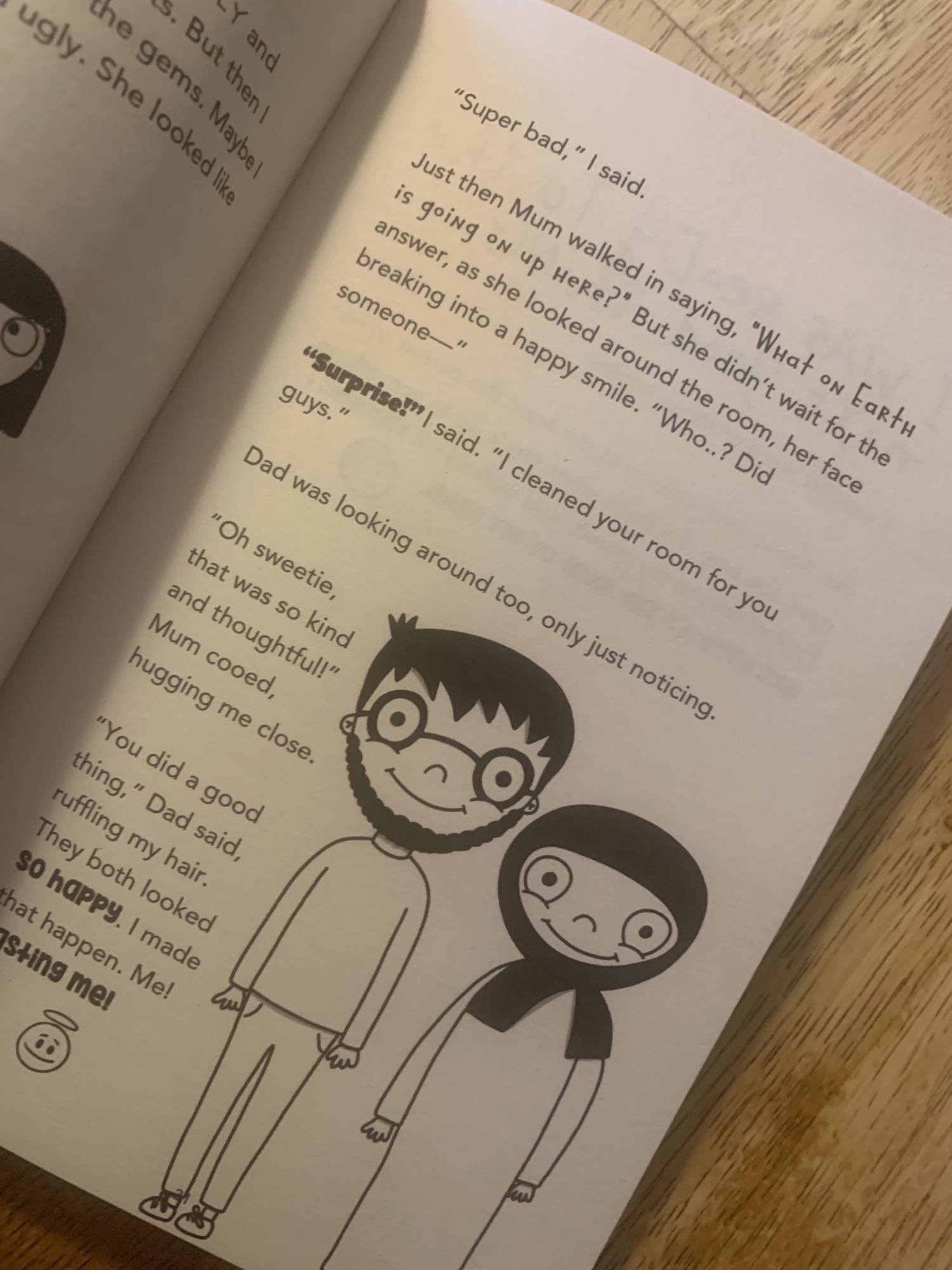
This is the fifth book in the Eliyas Explains series, and it really is what you would expect and hope, a book about Ramadan from Zanib Mian would be.  Eliyas’s voice is funny, relatable, engaging, and yet somehow manages to find a clear way to inform too.  The framing is fictional, but the book is meant to be lesson, moral, and information filled.  The voice did seem to break when Eliya’s didn’t know what “Ramadan Mubarak” meant, but it is clear that the book is meant to teach and remind middle grade kids about Ramadan from moon sighting to Eid, so I don’t think anyone other than an old reviewer would notice.  Parents might notice though that Eliyas loses his cool at one point and starts to presumably call his sister stupid, it stops at “st,” but then says he “started to cuss” which in America would be taken to mean a profanity much stronger than stupid, so just be aware, so you don’t panic if your child asks.  Overall the book is great, it is a solid 80 pages before the guided journaling begins and concludes at 115 pages.  The illustrations, changing font, and humor really make it perfect for the age group.  I gave it to my eight year old to read and I could hear him laughing, saying a few dua’as aloud, and he even came and asked me a few questions making sure he understood new information correctly.  This book would work as an independent read, a read aloud, or even an elementary reading assignment in an Islamic or weekend school.  The book is remarkable for the simple fact that it starts by naming the scholar that proofed the book, truly this is revolutionary, please can we normalize sourcing already.

The book is divided into chapters, with chapter one reintroducing Eliyas and his family to the reader. They are out on a bike ride and Eliya’s wants to know why everyone is so excited for Ramadan and giving up food and water.  Mom and dad explain taqwa and good deeds being multiplied and prayers being answered and big shaytans being locked up and Eliyas is excited (to put it mildly) to get closer to Allah swt and be a better version of himself.

Chapter two explains the moon, making intention, and waking up for suhoor.  With nine chapters before the journaling, the book discusses doing good deeds, fighting, forgiveness, shaytan being locked up, taraweeh, Laylatul Qader, and Eid.

The journaling guides readers through forgiveness, ibadah, goals, duas, kindness, feelings, connecting with Allah swt and more.  The beauty of this book is that it does pack a lot of information, but it shows a lot too, and gives kids a way to see Ramadan in action.

You can order your copy here at Crescent Moon store 

Rabia’s Eid by Rukhsana Khan illustrated by Debby Rahmalia

Standard
Rabia’s Eid by Rukhsana Khan illustrated by Debby Rahmalia

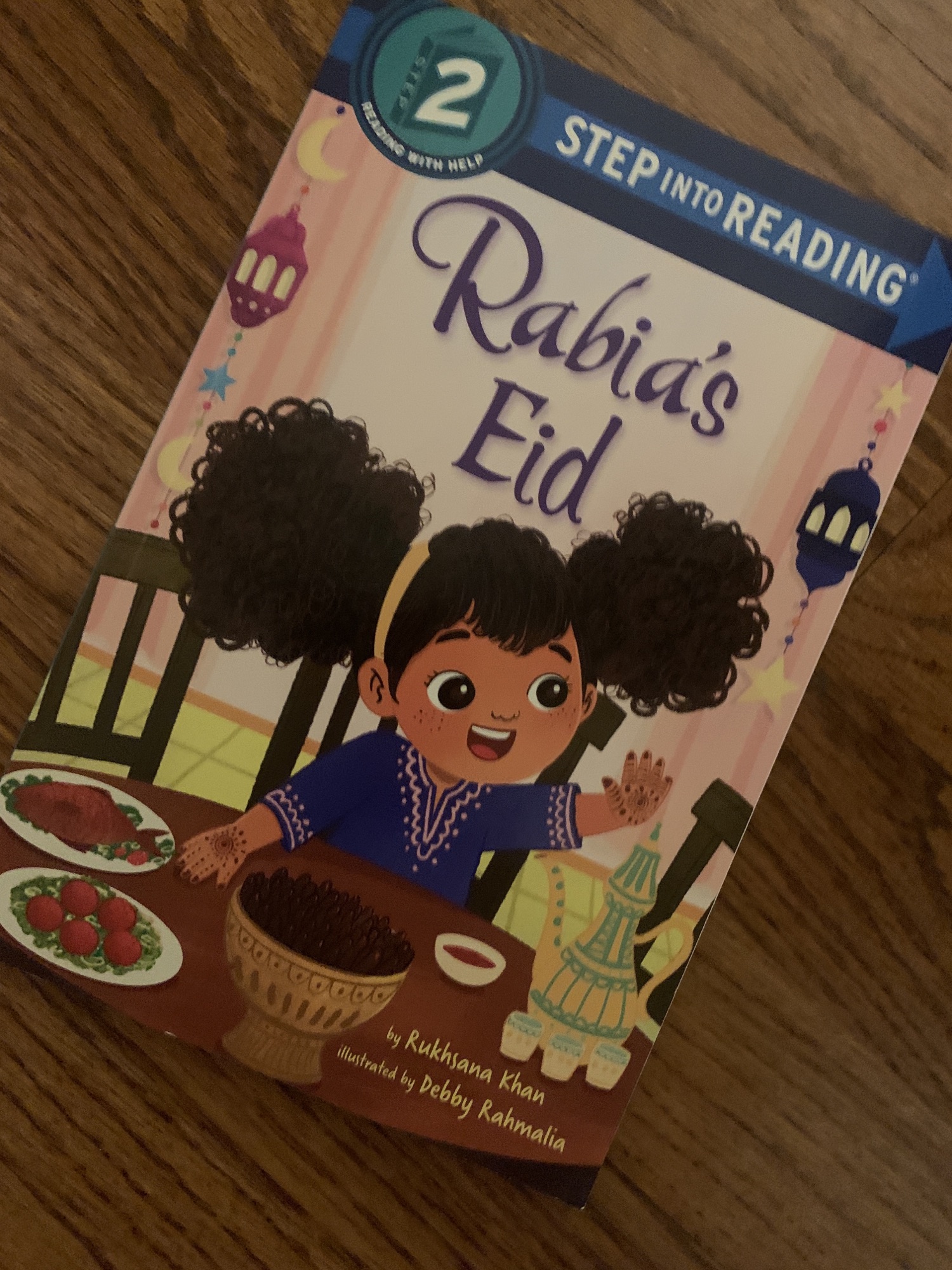
We definitely lack Islam centered leveled readers, so how exciting to see one this year focused on Eid, that contains more about Zakat al Fitr than presents no less.  The book starts on the last day of Ramadan, so there are details about both Ramadan and Eid shown, not dictated, as it stays on a Step 2 reading level.  As with most books meant to be read with help, for preschool to 1st grade, the story is a bit abrupt at times, and by not showing the Eid salat it definitely leaves some confusion as to whether Zakat was actually paid before the prayer started as required (I’m not a scholar, so please look into this), or not.  InshaAllah, if adults are reading this with their children, some basics about Zakat al Fitr would be something wonderful to discuss when you finish.  The book is joyful, the little girl wants to fast and is encouraged to do a half day, the illustrations are adorable as well, alhumdulillah. Oh and for those keeping track, this might be the first Ramadan book I’ve read in a long time that does not mention the moon, not even once.

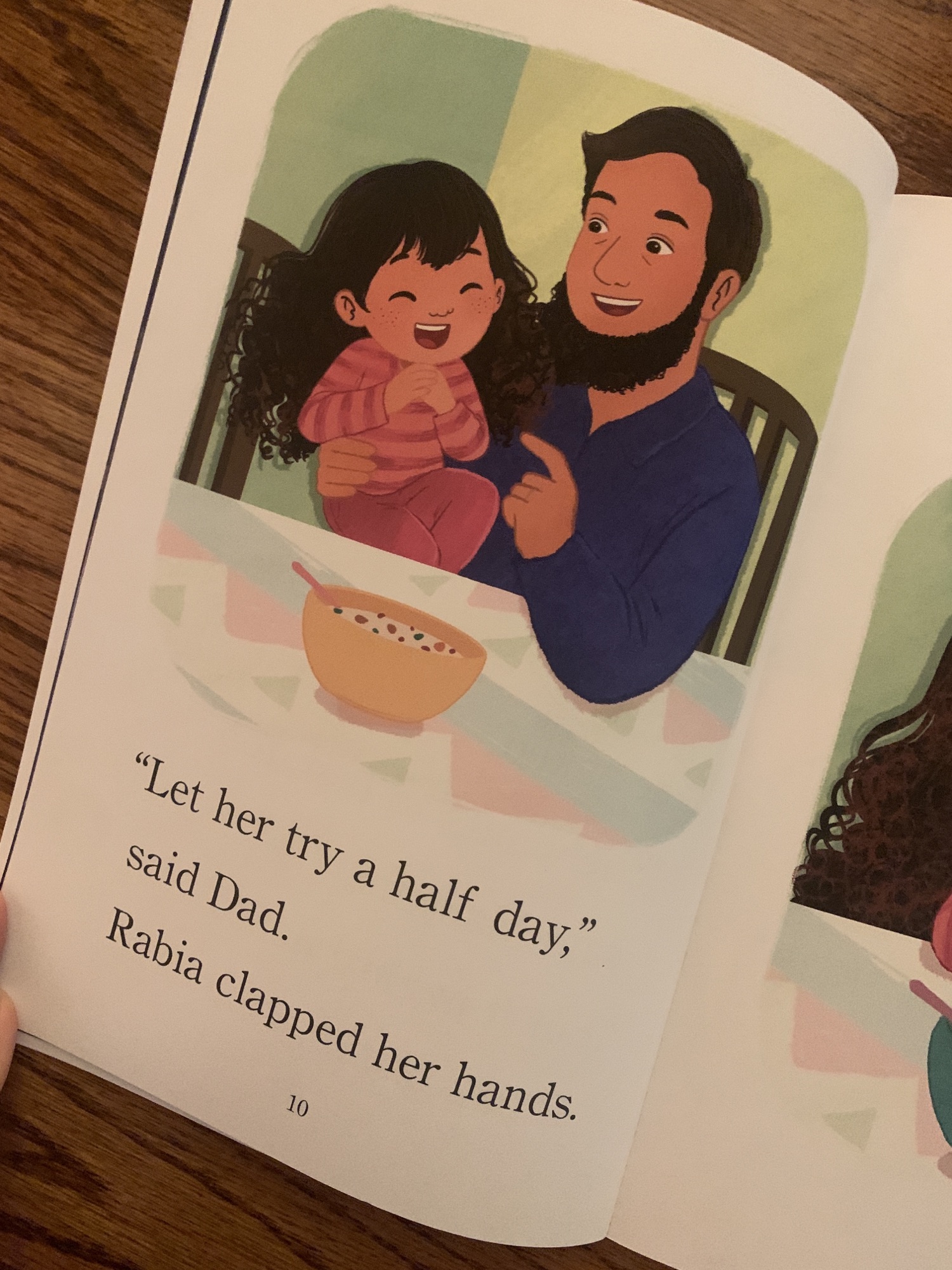
The book starts with Mom waking Maryam up for suhoor on the last day of Ramadan and Rabia wanting to fast as well.  Her sister tells her she is too young, but she joins the family for cereal in the kitchen, and Dad encourages her to try a half day.  The family then prays fajr together and the day is going great.

About lunch time Maryam is getting ready to break her fast. The family praises her on as she settles in with a cheese and tomato sandwich.  Later the rest of the family breaks their fast, and Rabia joins in with starting with a date and making duas.  Then it is time for henna and getting their clothes ready.

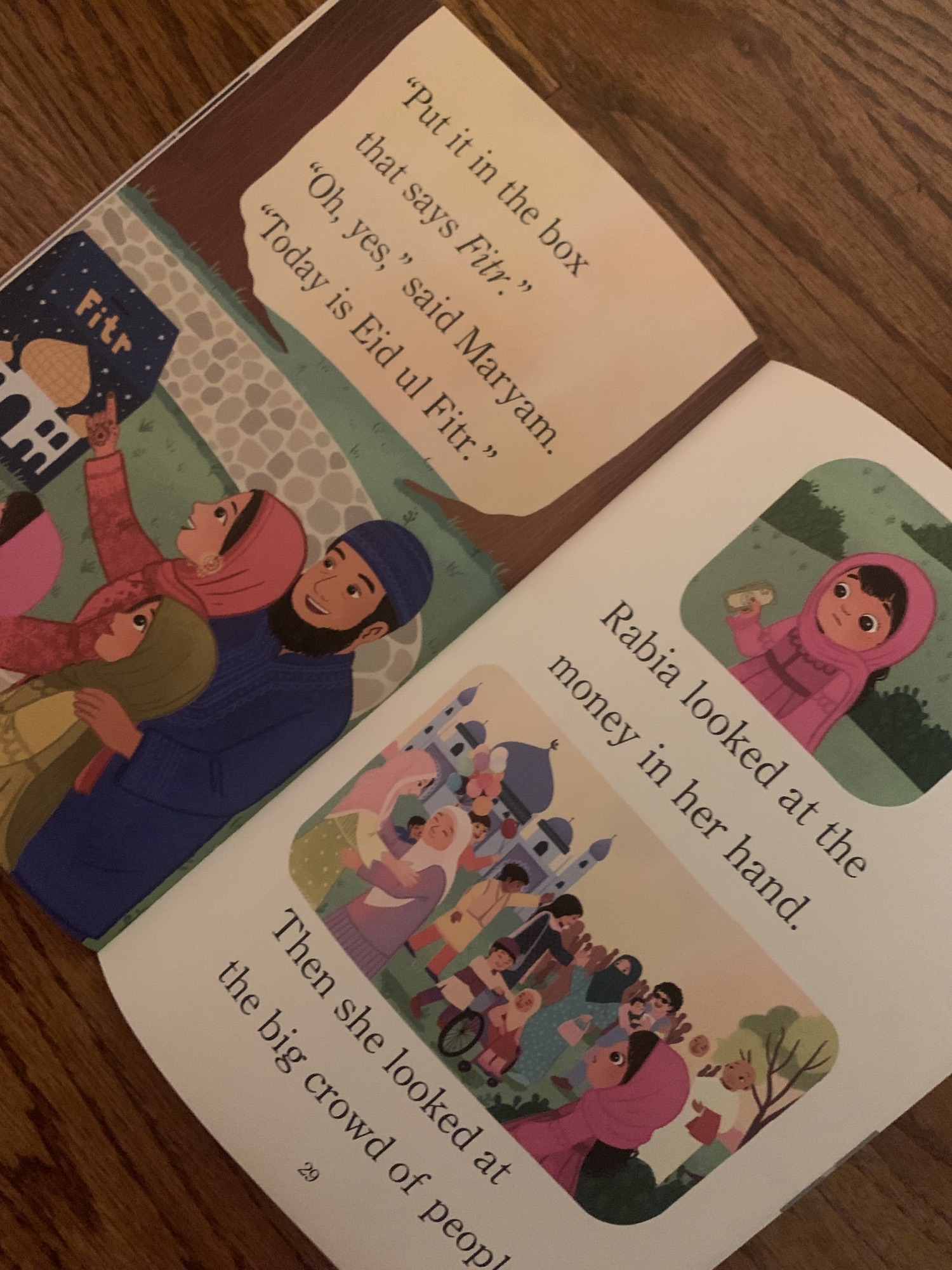
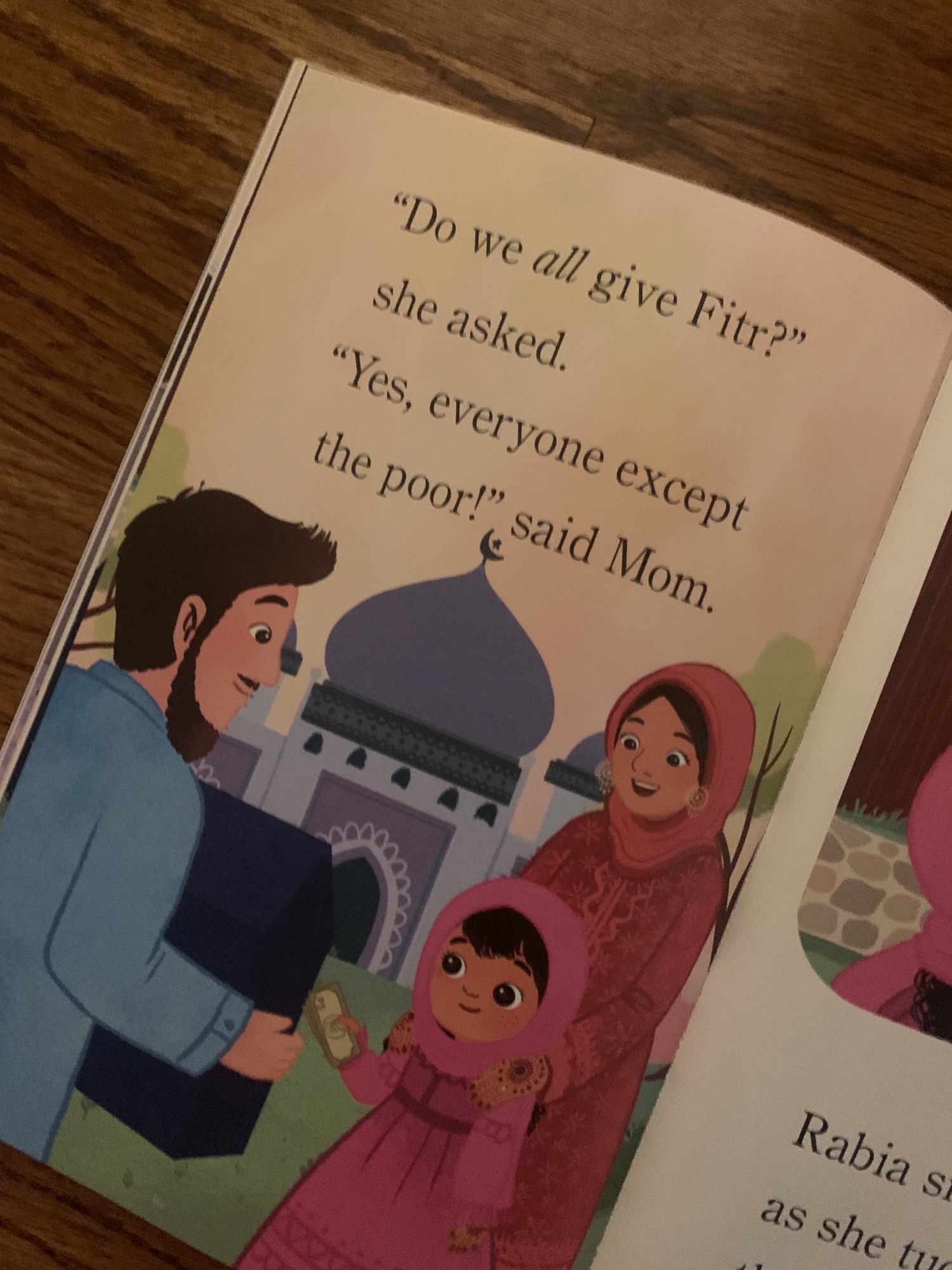
At Eid prayer everyone is dressed up, and Dad gives Rabia some money to put in the box labeled Fitr, for the poor.  Rabia wonders if everyone has to give money, and mom responds that everyone except the poor do.  The book concludes with the family smiling knowing everyone is having a happy Eid.

The book is great for Muslim and non Muslim kids, because of the size though, it isn’t a great choice for story time in big groups, but the price point makes it an awesome addition to gifts, classrooms, and to share with others in general.  I purchased my copy here.

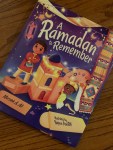
A Ramadan to Remember by Marzieh A. Ali illustrated by Najwa Awatiff

Standard
A Ramadan to Remember by Marzieh A. Ali illustrated by Najwa Awatiff

img_2876-1

A problem solving kid that loves his faith, finds himself in a new neighborhood at the beginning of Ramadan without a mosque or a Muslim community.  I appreciate that this 32 page book actually has a bit of a plot, not just the overly done fictional story crafted around basic Ramadan facts of a child’s first fast.  Sure, it mentions most of the expected concepts in a similar manner, but it also centers acts of ibaada, shows more than tells, is brightly illustrated, and is unapologetic. The kid is a doer, a problem solver, and isn’t unsure about who he is, which is refreshing. That isn’t to say that it gets everything right, it still attributes fasting to feeling compassion for the poor.  Even when a side character challenges the notion, the character doubles down that it makes us more appreciative, which inshaAllah it does, but it isn’t WHY we fast.  Overall though, I think the book still is a benefit in Muslim and non Muslim spaces. The story and illustrations make it appealing at story times and bed times, and the backmatter is equally engaging.

img_2877-1

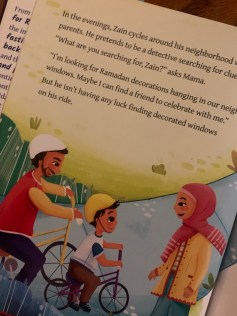
The book starts with Zain getting excited for his favorite time of year, Ramadan.  Only this year the decorations are still in boxes, Mama and Baba are busy with their new jobs, and there is no mosque or Muslims in the neighborhood.  Zain knows, he rides around looking for clues, has even checked the newspaper, and had his dad look on his phone.  It is a big change from the Islamic school he used to go to, and the busy mosque he used to volunteer at.

img_2879-1

Then Zain gets an idea, to build a mosque with all the moving boxes.  Neighbor kids come and ask questions, and Zain is happy to explain as they join in the building.  One night while praying outside under the stars in the cardboard mosque, a friend joins the family, and this Ramadan just might turn out to be pretty wonderful after all.

img_2878-1

I love that Zain doesn’t wait around for his parents to figure everything out, he is motivated. I also really like that he knows who he is, is comfortable sharing his faith and beliefs, and that the neighbor kids find connections to him, not the other way around.  I wish he would find a place to volunteer at, our charity isn’t restricted to helping only Muslims, though I might be the only one to pick up on that unresolved thread.  I also get that the kid that joins the salat for story purposes, is seen after prayer, but he didn’t join the prayer right and my older kids were sure to point that out.

The backmatter has a glossary, but in a more engaging format that I think kids will actually stick around for, and the Ramadan essentials and crafts make for a nice extension for those wanting to add a craft to the story time activity.

img_2882-1

The book is traditionally published and widely available.  You can find it here at Amazon, or here at my favorite store Crescent Moon.  It is also available in public libraries and would be a great addition to classroom and school library shelves.

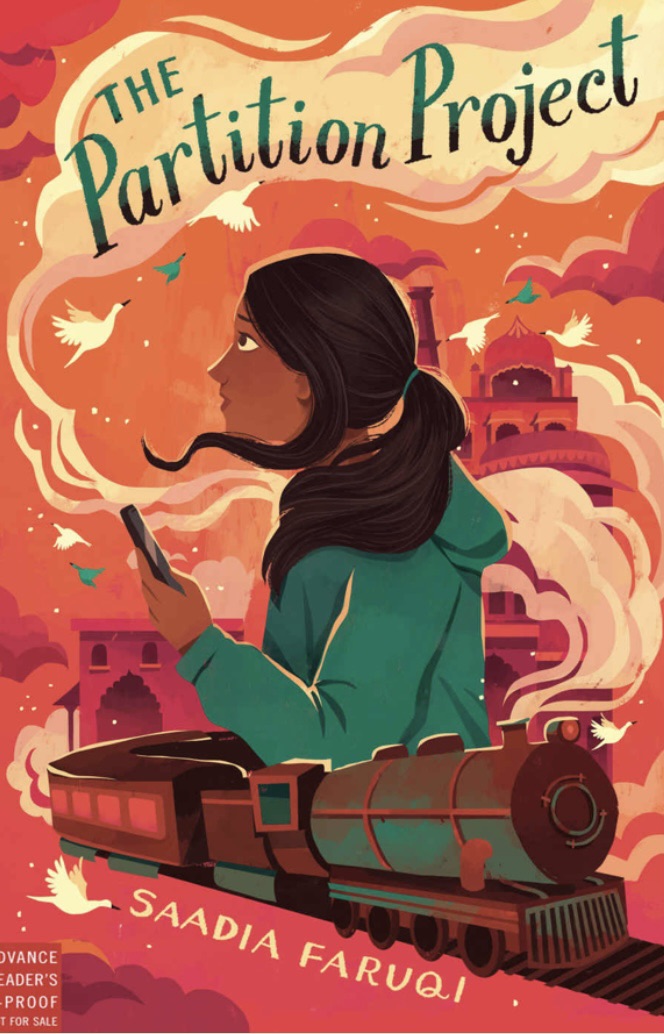
The Partition Project by Saadia Faruqi

Standard
The Partition Project by Saadia Faruqi

Screenshot

I have always maintained that my reviews are not personal, and for over 10 years, I kept to that. I recently made a public exception however, for Palestine. I cannot and have not checked every author, every illustrator, every publisher, or every agent, to see who has spoken up about the genocide, but there are a few prolific authors that are standards in the niche of Islamic fiction literature. Who have elevated our representation with a standard of quality and consistency across multiple age groups over the years, whose stature made their silence, seeming or actual, to the occupation, the apartheid, and the ongoing attempted erasure of a people and culture impossible to miss. No there is no standard or bare minimum, this is all emotion, and if you are thinking who am I to judge, or maybe I missed something, yes you are right. None-the-less it definitely caught my attention that an author who remained silent, wrote a 416 page middle grade book about partition, a historical event impossible to separate from colonization. I know the timeline for books to be published is not quick, but when I read the characters discussing that, “If we only read books by perfect authors, we’d read…nothing, I guess.” It felt a little defensive, and while I never set out to shame anyone, I have written this disclaimer to hold to my word, and to acknowledge that as much as I have set out to write the remainder of this review as I would review any book, my own disappointment in the author, may show through. Literary wise the book is moving, heartfelt even, but the performative othering, the internalized Islamophobia, and the catering to a western gaze, are subtle, but undeniably there. Perhaps the biggest example is the word “British,” the whole reason for partition, is only mentioned a grand total of six times.

SYNOPSIS:
Mahnoor, aka Maha, is in seventh grade, and her whole world has just flipped upside down. Her Dadi, her paternal grandmother, has just moved in from Pakistan, taking her room, and her free time. Plus Dadi is old and grumpy, and Maha is not amused. With parents that are too busy to spend time with her, Dadi slowly but surely starts to fill in a lot of pieces that Maha didn’t know were lacking in her life. Through food and stories and the start of Ramadan, Maha learns about Islam, Pakistan, friendship, and with a school documentary assignment, partition. A historical event she had never heard about before, starts to be all she can think about. It also seems to hang over everything she encounters from a book on a novel study English assignment list, to the train in their neighborhood, everyone at the senior center, and even Texas history. With dreams of being a journalist, Maha’s singular focus because almost obsessive, according to her friend Kim, but the more she learns, the more she changes. And the changes are for the better, even if there are some stumbles along the way, fighting with Kim, making Dadi runaway, calling out her parents preoccupation with work, missed fasts. The book has a happy ending though, as the unlikeable privileged Maha at the beginning, transforms to being someone the reader is cheering for at the end.

WHY I LIKE IT:
I am Pakistani-American, being half Pakistani and half American, the hyphen for me signals both my parents. So I was thrilled a year or so ago when I first heard about this book. I am a bit removed from partition because my father was the first in his family to be born in Pakistan, and my in-laws did not move from India until much later. That being said, I know it is a part of me, as all desis do, and was eager to read this middle grade book. Please note though, I am also white passing American (albeit with a hijab), so I can tell when I am being pandered to as well.

Do I feel the book did the topic justice? Absolutely not, by not discussing colonialism and British occupation, a huge part of the setup is conveniently ignored. It also is very placating of what the Muslims, Seikhs and Hindus seemed to want as Jinnah and Nehru are only name dropped once. Gandhi not at all. I get that the book presumably isn’t about that, but by ignoring it all together, there is some intent there, possible watering down for a white audience, that doesn’t sit right with me.

This book feels like it is written for non Muslims. The dialogues about being a good person even though they don’t follow Islam as they should, and pray and fast and eat halal, seem like internalized Islamophobia, that is trying to normalize not practicing. When the text goes so far as to call those that do fast all 30 days “ultra-religious” it seems to walk back the numerous passages of Maha loving fasting and finding peace in prayer. The takeaway for a Muslim reader will be a little self doubt, for a non Muslim reader it will reinforce the labels of “those Muslims” and “extremists.” It makes what many Muslims find basic faith requirements, come across as optional here in America, like taking off shoes when entering your house. With that being said though, the book does have a lot of heart, and in many places Islam and Pakistani culture are warm, but that warmth often comes through attempts to appeal to a non Muslim western lens. Similarly the stereotypes do as well. Pakistan is considered conservative, which is dismissed as meaning, “code for no swimsuits.” Wow, a whole culture and religion, so easily labeled and stereotyped. Stings a bit, not gonna lie.

Maha’s parents are not religious, so much of Maha’s knowledge of Islam is coming from what she sees her Dadi do, pray, fast, read Quran, etc. Except, Maha knows how to read Quran, and pray, she just needs practice. So explain, how she doesn’t know what inshaAllah means? This is just one example of inconsistency bumps in the text. At one point they eat iftar, and then a few hours later have dinner, I mean sure it is possible, but it seems weird. Her frail grandma runs away on a hiking trail? She wants the archive curators approval for her documentary and not her Dadi’s? Ahmed says he only eats hala, Maha is eating a non halal chicken salad and then they share it. Overall, Maha rarely reads like she is 12. At the start when she is whining, is about it, the rest of the book she reads much much older.

FLAGS:
Boy girl close friendships, angry mobs with guns, death, cholera, internalized islamophobia, talk of gods and demigods in Percy Jackson, mention of J.K. Rowling negative comments on trans community, fear.

TOOLS FOR LEADING THE DISCUSSION:
I cannot in good conscious purchase, recommend, or even check this book out from the library. I received an advanced digital arc, but my heart is too heavy by the author’s silence in the face of the atrocities occurring in front of us regarding Palestine.

Insha’Allah, No, Maybe So by Rhonda Roumani, Nadia Roumani illustrated by Olivia Aserr

Standard
Insha’Allah, No, Maybe So by Rhonda Roumani, Nadia Roumani illustrated by Olivia Aserr

img_2711-1

Not every funny thing a child says can be copied and pasted into a children’s book.  And while I have no doubt that this book was edited and revised numerous times, it sure feels like a conversation or 20 that I’ve had as a mom, a teacher and a librarian over the years.  Well, I take that back, the mom in this book, is very articulate, and not nearly as exasperated as I’m sure I always am.  It is so on point that it makes me truly wonder, are you even a Muslim parent if you haven’t been asked what Insha’Allah means? The backmatter articulates that Muslims and Arabs of all faiths use Insha’Allah. The text and illustrations themselves are not Islam specific, but the authors are Muslim, and the term always on the tip of our tongues. It is very relatable and impossible to read without smiling, I can’t wait to share it, insha’Allah. (See what I did there? ya.)

img_2715-1

The book starts simple enough, a little girl asks her mom if they can go to the park as they walk near one, and mom says, “Insha’Allah,” and keeps on walking.  Ranya gets upset asking why she said no, and the mom explains that insha’Allah doesn’t mean no, it means God willing.

img_2712-1

Ranya doesn’t just accept the answer and move on, she tells her mom it always feels like no, until her mother explains that we can want something to happen, but sometimes Allah has other plans.  Ranya presses her mother a little more trying to understand if insha’Allah means, maybe.  A few more examples are shared, and the definition is expanded to also mean, hopes and dreams.

img_2713-1

Ranya wants to pin down her mom on some of the insha’Allahs, making cookies, a sleepover, a trip to Disneyland.  Mom does her best, but Ranya is spunky and makes sure she gets the last word in.

I love the note at the end that ties it all together and shows the universal appeal of the word.

You can preorder your copy here

img_2714-1

Tipu’s Roar: A Freedom Fighter’s Tale by Subia J. Ali illustrated by Gabriel Sorondo

Standard
Tipu’s Roar: A Freedom Fighter’s Tale by Subia J. Ali illustrated by Gabriel Sorondo

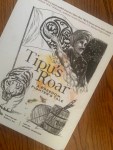
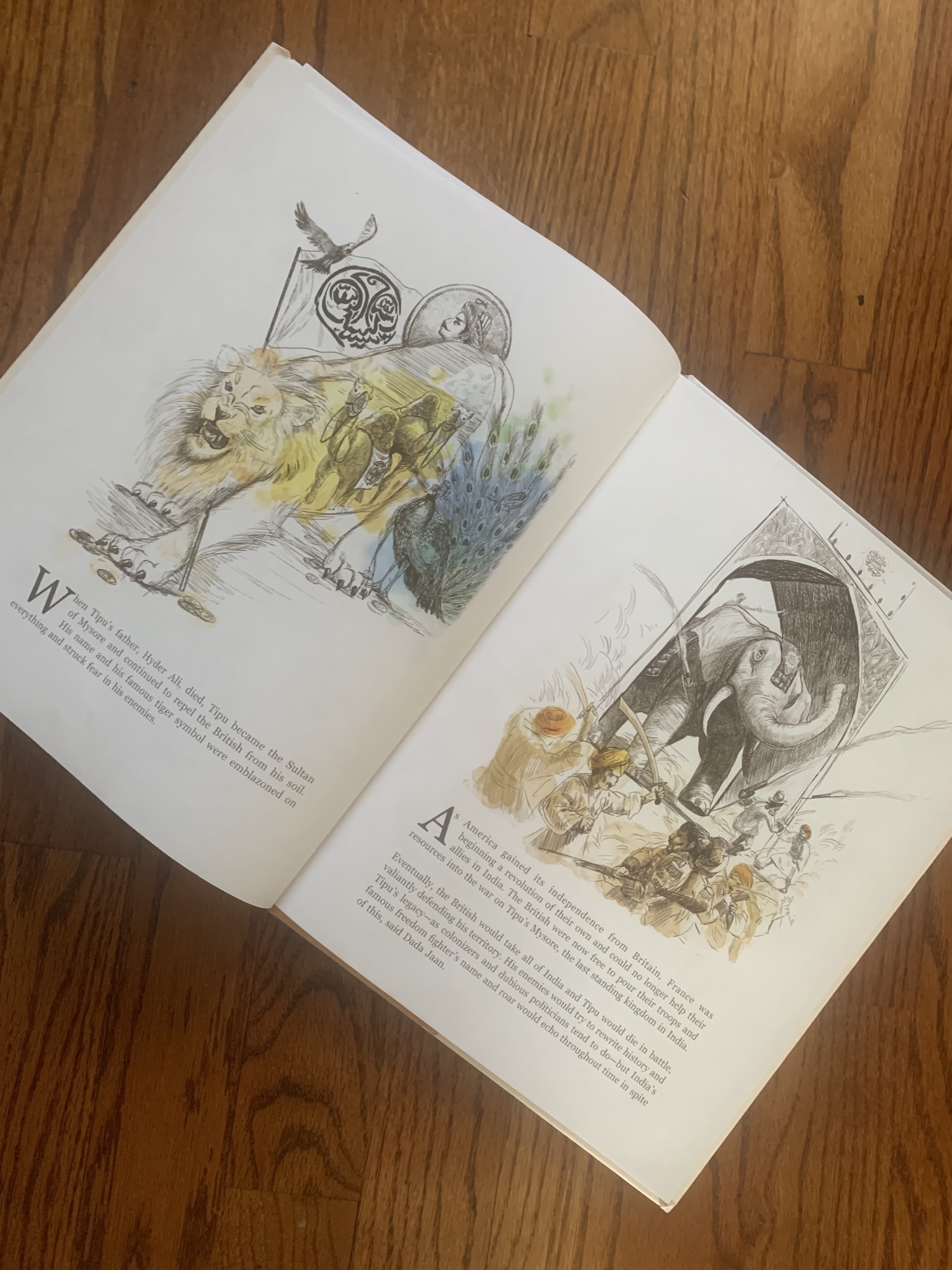
This large (9×11) hardback book is for the most part gorgeously illustrated in sepia tones, but the story is only 11 pages long; a pretty steep price point for 11 pages.  A story nestled with in a story, the premise of bringing to light a not well-known historical figure is admirable, but with no sourcing, it is hard to know what is real, and what is legend.  The concept and angle of being a freedom fighter and resisting colonization is timely, sadly it lacks the inspiration that I feel the author set out to convey.  I read the book a few times, and still had to Google a map of Mysore, Tipu Sultan and the role of the French in the subcontinent in the 1700s.  It would seem a book dedicated to the children of Palestine, defining words of freedom fighter, colonization, and imperialism before the book even begins, would answer the basic questions about the hero at hand.  

The book starts with an old man feeling gentlemanly wearing a bush shirt, chatting with his grand daughter who is being corrected to call him Dada Jaan instead of Grandpa. He then gets lost in thought and begins to tell his grand daughter the power of names to emphasize his point.  Tipu Sultan, known as the Tiger of Mysore, he tells her, “fought the British, who had come to colonize the Indian subcontinent.”

He doesn’t so much as convey the information in an entertaining way, as he lists off details and then pulls out to make sure she is still listening.  He tells her about the British East India Company draining the wealth of the subcontinent by taking tea, cotton, gems and spices.  He tells how Tipu “studied Islam, spoke many languages, and was a pioneer in rocket artillery.”  He credits Tipu’s rockets as revolutionizing warfare all around the world, and connects India, France and America as fighting off their Imperial colonizers, with the French being close allies in India’s struggle against the British.

Once her Dada Jaan’s retelling is through, and Tipu has lost, and Mysore falls, the little girls ponders over the story and years later appreciates her Dada Jaan in his traditional tunic rather than his bush shirt from before.

The book is in many ways needs to be fleshed out, sourced, and the messages articulated for today’s readers. 

Tagging Freedom by Rhonda Roumani

Standard
Tagging Freedom by Rhonda Roumani

20801TaggingFreedom

This 282 page OWN voice middle grade book weaves together two points of view that shed light on the recent events in Syria and life as a Syrian American without self-othering or over-explaining.  The characters are Muslim and while yes, I wish there was more Islam woven in,  when it did present itself in more than just a passing “inshaAllah” or “ya rab” it was heartfelt and sincere.  The book has a few plot holes, a plethora of underdeveloped characters, and the religion and cultural components take a backseat to the tropey MG themes of finding your voice, friendships, crushes, fitting in, and having hope. Despite my critiques though, I still found the book focused around graffiti and spirit squad, engaging and hard to put down.  The pacing makes for an easy read, and while the adult reviewer in me wishes there was more depth, insight, consequences, and Islamic references, I definitely appreciated the emotion and framing of this story.  The book does contain a lot of lying, crushes, sneaking out, “vandalism,” breaking laws, and mentions bombings, disappearing, and fear.  The connection though of what has been left behind and experienced in Syria is moving, and I’m glad that a book so relatable to western kids is widely available to be shared with them.

SYNOPSIS:

The chapters alternate between Kareem and his cousin Samira, aka Sam. At the beginning of the book Kareem is in Syria, spending time with his friends graffitiing in protest of Bashar al-Assad and in support of the boys from Dara’a.  They are covering their tracks, sneaking out to join rallies and finding their strength in their art, common goals, and the change that is taking over the country.  Unfortunately, his parents don’t see it that way and decide he needs to be sent to live with his uncle’s family in Massachusetts for his own safety.

Sam is Kareem’s cousin, she is great at reciting Quran, she has a best friend Eleanor who lives across the street, and is an amazing artist.  She sees people as fonts, and dreams of being a part of the school spirit squad.  Her only real problem is Cat, a girl that has bullied her for years and spread rumors about her in the past.  It is never quite articulated what was done and how bad it was, but the fact that Cat is the head of spirit squad, the daughter of influential parents, and the twin sister of Sam’s crush Dylan, has Sam trying desperately to fit in.

When Kareem arrives, he is not happy to be in America.  He calls Sam out for her inability to speak up and with Sam and her bff Ellie on the outs, Sam heads off to her new friends that have allowed her into spirit squad, and Kareem and Ellie start sharing their art around town.

Kareem’s character arc is more subtle, but Sam/Samira, finds herself with the help of her cousin as she channels the yearning of Syrians to set her free in America.

WHY I LIKE IT:
I love that it is Syrian American OWN voice MG, the news cycle has moved on, but stories are so critical to reminding the privileged outsiders what has occurred and continues to endure, so just that this book exists, is a positive for me.  I like that the code switching of being Samira and speaking Arabic at home is so clearly contrasted with Sam at school.  I struggle with the idea of dating not being a religious, but rather a cultural no-no, and her being so obsessed in the beginning with Dylan and then Amari is a bit of flag. By the end they feel like friends, but it is definitely a big part of the first half of the book that could have used some context, same with when she goes out in a tank top.  I wish there was a Muslim conscience that enters the story, to see Sam grappling with who she is from a faith perspective would have been nice.

I love that Kareem comes to America and starts school, it doesn’t have him being meek, or struggling to transition, it really is empowering that he breaks that stereotype just by allowing him to be seen from the very first day as strong and fully fleshed out.  Yes, in real life and in some books the adjustment is a plot point, but in this book it is not, and the author seems to not indulge in it deliberately.

I struggled with a few plot holes. I get that Kareem was frustrated and wanted to educate and be heard, and when Sam can’t stick up for herself and he calls her out, they are both annoyed, but to go from that to graffitiing is a big step.  A few instances of maybe trying to talk about Syria being shut down by teachers, or friends, would have made it a more logical leap.  I worry a little that there wasn’t enough hand holding regarding graffiti as a whole seeing as it is an MG book.  I understand it is expression and art, but there is some element of vandalism to it as well, and because it didn’t connect the dots that street art was the only way to be heard, I bring it up for awareness.

I needed closure on Cat, I didn’t like that we didn’t know more specifics about her torment or her thoughts at the end.  I know the story is not about her, but she was important for much of the story and to have her fade seemed a little short sighted.  I liked Ellie, but her wanting to sticker everything seemed in contradiction to her environmental activism.  Sam’s parents are barely a blip on the radar, and even some details about the supporting cast, really would have made the story that much better.

FLAGS:

Crushes, immodest clothing, lying, sneaking out, boy/girl friendships, boy/girl hugging, vandalism, breaking the law. Hearing about bombings, being taken away by the police, death.

TOOLS FOR LEADING THE DISCUSSION:

I don’t think I would use this for book club, but I would have it on the library and classroom shelf.

Drawing Deena by Hena Khan

Standard
Drawing Deena by Hena Khan

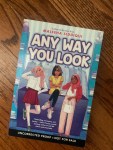
This 232 page middle grade read with a beautiful cover, has a beautiful heart as well.  A Muslim girl in a Muslim family is struggling with anxiety and family financial stresses, remarkably the book avoids tropes of blaming immigrant parents, culture, or religion.  It also doesn’t have any relationship crushes, or catty friends, bullies, or annoying sibling squabbles.  It was refreshing to see a strong character that seemed to not lack a voice, really find her voice,  advocate for herself and those she loves, apologies when in the wrong, and be surrounded by friends and family members that truly love one another.  I also appreciate that a licensed school psychologist was consulted and named in the backmatter.  As with nearly all Hena Khan chapter books, there is Islam and culture, but as an Islamic school librarian, I long for more.  There are a few inshaAllahs, mashaAllahs, salams, and references to praying, there is one solid paragraph that mentions dua, dhikr, and the Quran, but that is about it in a book that focuses a lot on fashion, make-up, social media, drawing portraits and hanging them in the home.  The protagonist is in middle school, but this is a solid middle grade read that teachers and librarians can feel confident having on the shelves and sharing with students.

img_2301-1

SYNOPSIS:

Deena loves art and to draw, she’s also really good at it.  She longs to take extra classes outside of school, but she knows it isn’t a priority with her bite guard already causing a lot of stress on the already financially strapped family.  Overhearing her parents fights about money adds to her anxiety and makes her nauseous every morning before school.  Determined to help her mom grow her basement clothing boutique, and increase the family income, she dabbles in social media, designs a logo, and sets up a website.  One of the new customers is a real life artist, who encourages Deena to look at art differently, and offers to take her under her wing to teach her about the power of art and decolonizing her mind. Things are starting to look up for Deena, but a disagreements with her cousin Parisa, feeling like she let a close friend down, and being overwhelmed at an immersive Van Gogh exhibit culminate with her having a panic attack at school.  The school counselor wants her to attend some therapy sessions at the school, but first Deena will have to convince her parents that this is something she needs and wants.

WHY I LIKE IT:

I mentioned a lot of my likes and loves above, but really it is a solid middle grade read where the character just happens to be Pakistani American and Muslim.  I like that Deena is just a sweet girl.  I think a lot of kids that have the emotional intelligence to know how fortunate and privileged they are, often push down their emotions and troubles, because they know others have it worse, don’t want to worry their parents, and/or seem ungrateful, and that this book can normalize getting help, advocating for yourself, and communicating with your parents, is really quite impressive.  Deena has a diverse group of friends, religion doesn’t come up much or seem to shape her perspective which is unfortunate, but it doesn’t make things harder for her either.  She isn’t bullied, there is no Islamophobia, or self-othering or stereotypes.  Deena is who she is, with a good head on her shoulders, and throughout the book you find yourself cheering for her and her success.

FLAGS:

She does draw faces, and they talk of hanging up the images in the living room.  There isn’t lying, but it kind of skirts the line at times. Anxiety.

TOOLS FOR LEADING THE DISCUSSION:

For even a young middle school book club, I think this book would be a quick read, but open the door for some quality discussion about anxiety that would benefit middle graders and up.  The book on the shelf will tempt readers, and handing it to kids will yield results.

The book goes on sale February 6, 2024 and you can preorder/order it here.