Category Archives: preschool

A Moon for Moe and Mo by Jane Breskin Zalben Illustrated by Mehrdokht Amini

Standard
A Moon for Moe and Mo by Jane Breskin Zalben Illustrated by Mehrdokht Amini

IMG_1514Based on the release date of this book (August), I preordered it in the Spring with the Peg+Cat book thinking they were both about Eid al-Adha.  Oops.  As someone who reads a lot, I really need to learn how to read.  This book is not about Eid al-Adha, it actually mentions Ramadan, but just as a context point, so rather than wait til next Ramadan to post the review, I though, lets do it now and celebrate how much we all have in common and build bridges of friendship across religious lines during this blessed month of Thul Hija.

Set in Brooklyn, New York, Moses and Mohammed live on opposite ends of the same street.  One day they accompany their moms to a store in the middle of the street, and when the boys start touching things they shouldn’t their mothers’ reprimands reveal their shared nickname, Mo/Moe.  

IMG_1520

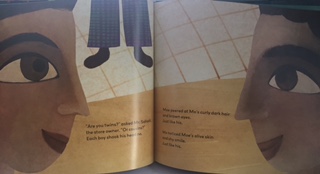
The boys then pause to look at each other and notice the same dark hair, brown eyes, olive skin, and shy smile.  Add in to the mix that one of them has a bouncy ball, and the boys become quick friends, while their mothers shop.

IMG_1519

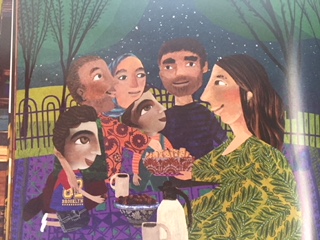
The boys hope to see each other again, but don’t.  Weeks pass, and the Feldman family is busy getting ready for Rosh Hashanah and the Hassan family is preparing for Ramadan.  Another chance meeting happens at the park, and the boys are thrilled.  The mom’s are seen chatting and then, the boys are missing, and the moms are panicked.  They are found playing in the dirt, but the relief from the moms, bonds the families who plan an evening picnic together.

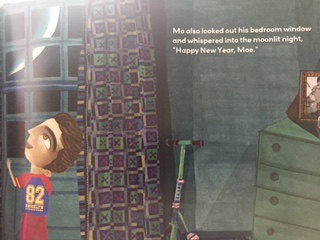
The book concludes with the boys in their own homes looking at the same moon and wishing each other a blessed Ramadan and Happy New Year to themselves.

IMG_1516

The book reminds me a lot of Yaffa and Fatimah, Shalom, Salaam, in the way the two characters, one of Jewish faith, and one of Muslim, occupy the same environment and come to know and appreciate one another as friends.

IMG_1517

The illustrations are by the same artist that illustrated Hena Khan’s color and shape books, and they are vivid and fun.  I’ve read the book a few times, and flipped through it a few more times just to marvel at the pictures and the world of these two sweet families.

A great book, that I hope to use in an interfaith story time when the opportunity arises!

IMG_1518

Sidenote, the shop keeper is the nicest one ever, he gives the boys taffy, and warm falafel, and doesn’t scold them.  The book mentions a few foods and at the end of the book there is a factual paragraph about the holiday and a recipe to try.  There is also an Author Note and Illustrator Note at the end of the 48  page book.  The book would be perfect for 5-8 year olds, but younger kids and older kids will enjoy the book as well.


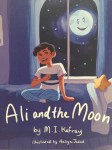
Ali and the Moon by M.I. Kafray illustrated by Aaliya Jaleel

Standard
Ali and the Moon by M.I. Kafray illustrated by Aaliya Jaleel

IMG_1421

I originally bought this book in Ramadan and had hoped to review it so that those looking for Ramadan books could benefit. But it isn’t Ramadan specific, just moon themed, and I really was so disappointed with the binding quality for the amount I paid for it, I didn’t think it was fair to review the story until I could get over the number of blank white pages in the book, and the overall copy-shop self-printed and bound vibe that the book emits as soon as you hold it.

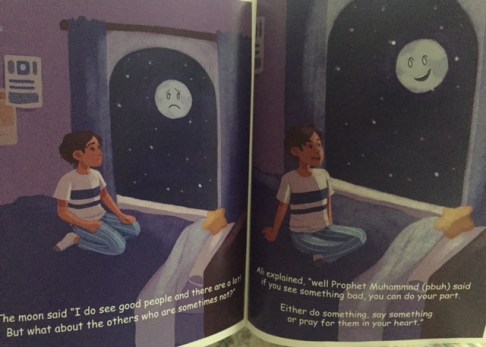
The premise of the book is the hadith that if you see something bad you should change it with our hands, and if you can’t, then change it with your tongue, and if you can’t do that, then pray for them in your heart. 

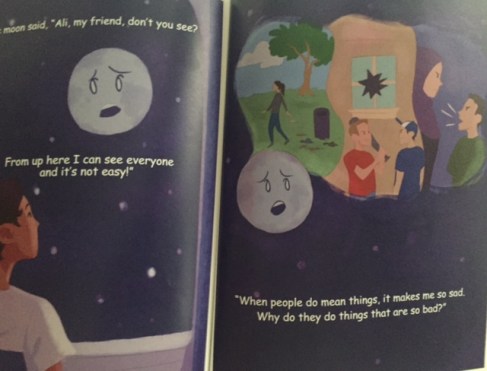
The 16 page book starts off a bit awkward, with the boy just staring at the moon, but by page five, the story hits its stride and is sweet.  The moon dims and is sad about the state of the world.  Ali starts talking to the moon in rhyming lines, and convinces him that there is still good in the world.  The moon and Ali decide that at night they will pray for the world and the people in it.

ali inside2

The end of the book has the hadith and the surahs one should say before going to sleep: Surah al-Ikhlaas, Surah al-Falaq, then Surah an-Nas and lastly, Ayatul Kursi.

The illustrations are cute, they are expressive and the moon and boy sweet.  I just wish the paper had more weight and that the story a bit longer.  A lot could be discussed with the premise of the Muslim boy talking to the moon with a great vantage point.  More specifics and more inspiration would have made this mediocre, albeit expensive book, great.

ali inside


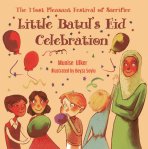
The Most Pleasant Festival of Sacrifice: Little Barul’s Eid Celebration by Munise Ulker Illustrated by Beyza Soylu

Standard
The Most Pleasant Festival of Sacrifice: Little Barul’s Eid Celebration by Munise Ulker Illustrated by Beyza Soylu

batul.jpg

This book is beautiful, it feels great in your hands, the raised glitter embellishments in the illustrations, the price point, everything except the text.  The gist of the story is even fine, the execution is just off.  It reads very much like it has been translated from another language in to English, and yes my privilege might be showing, but the phrasing, the passive voice, the orphanage, all make the book with its massive text passages hard to convince kids younger than 7 to sit through.

batul9

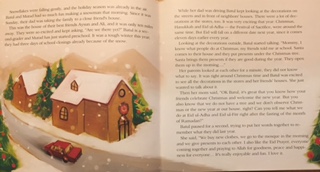
The story starts off with parents and two kids , Murad and Batul, driving to a friend’s house for dinner, commenting on the Christmas decorations that they see.  The parents ask what the kids know about Eid al-Adha that is coming up and the kids remember how much fun they had in Turkey.  Except it is really awkward to get this bit of information out.  They discuss Eid last year, and then remind each other that they were in Turkey, and how it was much more fun.  Noting that international travel is expensive and they won’t be able to go again, the Mom over dinner discusses how they can make Eid fun for the kids with her friend.

batul2

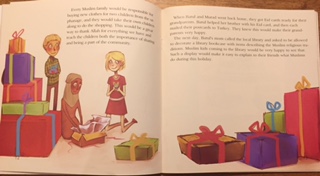
It is decided that the Muslim and non Muslims will celebrate together and include a local orphanage.  “Each Muslim family would be responsible for buying new clothes for two children from the orphanage, and they would take their own children along to do the shopping.” This would teach the kids to thank Allah and learn about community and sharing.  A great lesson overall, again just a concept presented in a really wordy, round about, awkwardly forced manner.

The Mom contacts the library and gets permission to decorate an information table, the kids make Eid cards for their grandfather in Turkey, at Sunday school they make gifts for friends.  They learn about Zakat and sacrificing an animal like Allah commanded Abraham to do, they even send cards to their neighbors.  Oddly though remarking how fun it is to get candy outside of Halloween.  After the first two pages explaining Christmas and telling that Muslims don’t celebrate it, I found it odd that they would, 15 pages later, be referencing Halloween. 

bat

Some of the sentences also don’t made sense.  About half way through I didn’t understand what the author meant by the boys “celebrating each other’s Eid” after they put their new clothes on and went to Eid prayer.

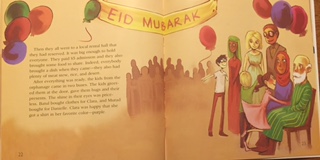
Once at the party, they give specific details of how much they charged everyone, yet no details about the food they all brought.  The kids enjoy a pinata and everyone including the orphans get Eid gifts.  Despite everyone’s fun the party has to end, and the orphans return to the orphanage and Murad and Batul declare they “will always remember this Eid.”

batul3

The illustrations are great, it is really yet another example of a book just needing a good editor.  From the very beginning, even the title isn’t really right, the book isn’t even mainly about Batul, to the random details shared, the book is just too long and too unpolished.  It is really unfortunate, because it has so much going for it on its 32 pages.  The main points however, I feel are lost about Eid and the reason it is so dear to Muslims everywhere.

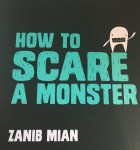
How to Scare a Monster by Zanib Mian

Standard
How to Scare a Monster by Zanib Mian

scare a monster

I like a lot of books, but this one, well it might be my favorite.  The size, the length, the colors, the fonts, the illustrations, the message, truly it is fabulous for 3-5 year olds.

ScareMonster-003

The premise is simple and straightforward.  The book doesn’t try and do too much or put too much on its 32 pages.  It identifies ways to deal with monsters, and then offers what some people try and do to scare them away, concluding the best and only solution, is to ask Allah for help by saying, Audhoobillah.  

Kids will laugh at the silly illustrations and attempts to be monster free, and remember the clear strong message of calling on Allah swt when afraid.  

ScareMonster-002

The only critique for me is the page about the kid with a stink-bomb in their nappy. While funny, the sentence structure doesn’t flow, the narrator’s voice seems abrupt and off to me.  Possibly that it goes from active voice to passive for that line only (its been a while since I’ve articulated grammar structure, so maybe not :)).

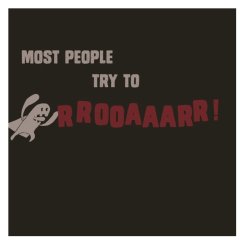
Most people try to rrooaaarr!

or hide under the bed.

Sometimes they call their mum, mmummm!

or even better.  A kid with a stink-bomb in their nappy.

Some turn the lights on,

or hold on to their favourite teddy.

Other than that, the book is fun and works well for muslim kids at story time or bedtime alike, alhumdulillah.


Controlling Your Anger by Saaliha & Ali

Standard
Controlling Your Anger by Saaliha & Ali

anger cover

I love little picture books for toddlers and early elementary kids that introduce children to Akhlaaq, good manners and characters.  The book’s tone, however, seemed a bit off to me, so I put it away a month ago and pulled it out again today to read it, knowing I would have forgotten most of my initial thoughts, but somehow, they resurfaced with a vengeance, unfortunately.  And while the pictures and binding and theme are all absolutely wonderful in this 23 page book, I didn’t like the main character at all, and being it is based on a real person, a child, I feel awful saying that.

anger

Saaliha starts the book keeping her anger just under the surface as her friend Hannah has borrowed and lost her pencil.  Hannah says she’ll look for it after lunch, and Saaliha controls her anger and basically says that it needs to be found now because it is the right thing to do.  All of that is fine, but for some reason she seems bossy and controlling and I really don’t know why.  Maybe because once they look for the pencil and then find it, Saaliha gives her peer (and thus the reader) a teaching moment by saying that she knew she didn’t lose it on purpose.  Hannah’s response is more believable when she feels embarrassed and admits she should be more careful, but I found Saaliha’s reaction smug because she was so close to getting mad, and then to be self-righteous about it, seemed a little passive aggressive to me.  

anger3

As the book continues, Saaliha recounts that accidents can happen at any time and to not get mad, which is great, it gives the example of when her younger brother Ali, accidentally knocked her ice cream out of her hand with his basketball or when he broke her pencil.   She seems to have a thing with pencils, there should have been a different example.

anger2

It then moves on to an incident with a friend, Jalal, who took a donut without asking, but it was an accident for not asking as he normally asks.  The repetition of the word accident here, I get is to carry the concept, but that doesn’t seem like an accident, it seems like he forgot, and an apology should have been in order, not Saaliha having to justify it solely.  Being it is a book about Akhlaaq I feel like the illustration of Jalal winking and eating the donut, seemed off.  

anger1

I like that Saaliha reminds her friends not to get angry as anger comes from Shaitan, but then when the book says she always says A’uthu Billahi Mina Shaitan Nir Rajeem to keep her anger in check, one wonders why in the opening scenario she didn’t say it.

I can’t pinpoint why I didn’t love this book, or maybe I just didn’t like the main character and I would probably give the series another try, but I’d like to hear your thoughts if you have read the book, and more importantly what your children thought of it.


Hats of Faith by Medeia Cohan illustrated by Sarah Walsh

Standard
Hats of Faith by Medeia Cohan illustrated by Sarah Walsh

Hats_of_Faith_Sm_1024x1024

How fun to find similarities between groups that on the surface might seem so very different.  This 7×7, 14 page board book, keeps it simple and perfect for toddlers starting to notice people all the way through to early elementary children making connections around them.

Each page shows a portrait style illustration with a warm smiling face and the repetitive text of identifying what the name of the “hat” is followed by who wears it.

The opening page states that ” Many religious people share the custom of covering their heads to show their love for God.” And concludes by saying that “Learning about each other makes it easy to be more understanding.  Being understanding helps us spread love and peace.”

hats_of_faith_deensquare_04.jpg

Muslims are mentioned and depicted on the hijab page, the topi page, and on the head wrap page.  The book shows Muslims, Sikhs, Rastafarian, Jewish, and African Christians, it shows both men and women and offers phonetical pronunciations when necessary.


Jameelah Gets Dressed by

Standard
Jameelah Gets Dressed by

FullSizeRender (62)

These books in the Mini Mu’min Dua Series are a great way to introduce familiar concepts in an Islamic framework to preschoolers and teach them the accompanying duas for them.  I previously reviewed Sajaad is Sick, which pleasantly surprised me, and this book proved that the series has consistency and value.

FullSizeRender (63)

The pictures are colorful, but basic, there are no faces or people included.  The text rhymes, yet has a nice cadence that doesn’t seem overly forced throughout the 38 pages.  The book is large, 8×10, with a glossary cover, and decent weight and binding.

This book includes a few footnotes: defining hijab, giving the ayats for the commandment to draw your veil over your bodies, the hadith about starting with your right, etc.  There are four duas included, the one for getting dressed, the one for wearing something new, the dua for when someone else wears something new, and the dua for getting undressed.

FullSizeRender (64)


It’s Jummah! The Sunnah and Etiquettes of Friday! by Najia Rastgar & Lyazzat Mukhangaliyeva illustrated by Zainab Arshad

Standard
It’s Jummah! The Sunnah and Etiquettes of Friday! by Najia Rastgar & Lyazzat Mukhangaliyeva illustrated by Zainab Arshad

jummah cover

This is a very straight forward toddler board book about what you should do on Jummah.  The simple text, the blocky pictures and the overall size and feel of the book make it a great teaching tool for establishing routine. 

jum4

The book is 10 pages and measures at about 6×6 inches.  It is very sturdy and solid and perfect for babies up to 2 or 3 years old.

jum1

The day starts with waking up for jummah, taking a bath, reading Quran and praying in the mosque.

jum

I like that it is completely linear, and that the words under the pictures offer the Islamic vocabulary.  There are also no faces in the pictures. There isn’t a story, but the opening line of “Let’s wake up!” make your little one the star.  

jum3

There aren’t a lot of toddler board books out there, and thankfully this one doesn’t have any flaps to lift up or more text than a one year old can handle.  

Zaydo Potato: A Muslim Superhero by Randa Taftaf and Maz Galini illustrated by Lovyaa Garg

Standard
Zaydo Potato: A Muslim Superhero by Randa Taftaf and Maz Galini illustrated by Lovyaa Garg

img_0531.jpg

This is the second review of a Zaydo Potato book on the blog, and much like the first book this one caters to toddler and early elementary aged children who will enjoy the large colorful pages, the silliness of finding a potato on each page, and who can benefit from the repetition of events to understand a concept.  In this 32 page book the concept being conveyed is taking care of each other, as established by the hadith at the beginning of the book.

zayd

Zaydo and Raya dress up as superheroes, but find their power in saving the day involves using their capes, and masks, and belts, and gloves, to help those around them who can benefit more. They use a bandana to sling a hurt arm, a towel cape to cover a spill, and silly gloves to make a baby stop crying.   They call themselves Muslim Superheroes and after showing the reader that it is good to help one another, praise Allah, and do what is right, they ask if you want to join their force.

zayd2

I read the book to my own children and then to a group of about 25 kids under the age of 6 and it went over pretty well.  The amount of text on a page is sufficient to convey the repetitive scenarios.  Honestly, I don’t really understand why the book takes place in Ramadan.  Other than the first page saying that they are the fasters of Ramadan days, and the last page repeating it, there is nothing Ramadan specific about the story.  In fact the Grandma is drinking tea on the first page, so yes maybe she is excused, but it is a bit confusing to have the Ramadan element in there when it is not a facet of the story at all. 

zayd1

The word ‘super’ is used a lot, and if reading it aloud can get your tongue a bit tied.  I also don’t understand why Raya has a last name or second part to her name, Raya Amaraya, maybe to go with the rhyming of Zaydo Potato? Either way by adding super, before their names, and the rhyming second name, I felt like a lot of the book was just saying names. The only other critique of an other wise solid book about teaching kids how to truly be super in a practical way, is that the Grandma is in a lot of the pictures in the background sewing so that when she surprises them with real costumes, the kids can enjoy going back and see she was working on them the whole time.  Except I thought, my kids thought, and the story time kids all thought she was knitting, and the costumes don’t look knitted, so it is a bit jarring.  On closer inspection there is just one needle, not two, but it is really large, almost crochet hook size, so a sewing machine illustration would have been a much better choice.

zayd3

The activities and lessons at the end and the founding premise of the book really make the book an important one to share with your little ones.  The binding and glossy pictures of smiling children having fun will entertain and educate them at the same time.  My critiques are small, but I feel like a few test readings by the authors, and the minor quirks could have been eliminated all together.  

zayd4


Hassan and Aneesa Celebrate Eid by Yasmeen Rahim illustrated by Omar Burgess

Standard
Hassan and Aneesa Celebrate Eid by Yasmeen Rahim illustrated by Omar Burgess

hassan.jpeg

So, cute, mashaAllah, I remember last year when I read about these two siblings celebrating Ramadan how pleasantly surprised I was by their relatable sweet story, and once again, I am thrilled that such a little book packs so much information in a fictionalized story to smile at.  Really its size is my only criticism, the book is tiny in size at 7 inches by 8.  The length of 24 pages is fine, its just hard to read it to a group, and really is only ideal for bedtime (not that I won’t read it to a group of kids, its just hard).  Even the price is fabulous, alhumdulillah, and also available in the public library.  Overall, the book is pretty sweet.

handa

Hassan and Aneesa are getting ready for Eid after a month of fasting.  Their parents are having a party so there is a lot to do to get ready, cleaning, cooking, sampling food, and wrapping gifts. The morning of eid is chaos with everyone running around (so relatable)!  They finally are out the door and heading to the park to pray outside, following Prophet Muhammad’s example.  They listen to the imam give a speech about sharing food and then its off to hug everyone and wish one another an Eid Mubarak.

handa1

When everyone heads to the siblings home, you see kids having fun, dad cooking, and presents being exchanged.  After everyone leaves, they take food to the neighbors, as the imam reminded and the fictional family concludes a wonderful eid that they don’t want to end.

anda2

There is a glossary at the back and the pictures are colorful, bright, and expressive.  While there isn’t a plot or any character development, the situations the kids find themselves are relatable.  The joking that Aneesa will help her mom by sampling the food, and the picture at the end of the kids playing in a messy room with the parents passed out from exhaustion on the couch is pretty fun. 

handa4

There are a few books out there that timeline an eid day, but this one does it well. Kids two and up will enjoy the excitement and feel ready to celebrate eid themselves.  It shows the holiday as fun and desirable and something to look forward to.  Because the kids are in a handful of books, it also does create some identity confidence, as kids see themselves in the various situations that Aneesa and Hassan explore.